Wings of the Sterile Bloom
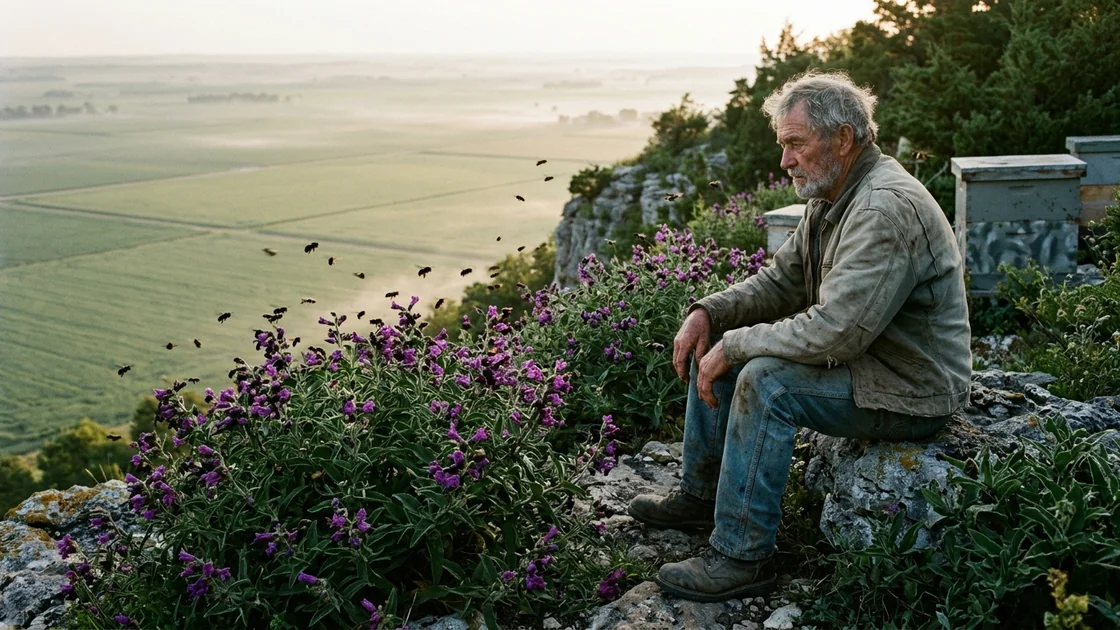
Arthur Pendelton spent forty years tending to his heritage honeybees in the quiet hollow of Oakhaven Valley, living in delicate harmony with the land until the conglomerate Veridian AgriCorp bought the surrounding plains. When Veridian illegally sprayed an experimental, banned neurotoxin during a midnight temperature inversion to protect their genetically modified soy monoculture, the chemical drift wiped out all sixty of Arthur's hives in a single morning. Faced with a corrupt regulatory board and corporate lawyers who buried the evidence of the poisoning, Arthur realized the law would offer him no justice. Discovering a tiny pocket of toxin-resistant survivors in his cellar, he embarked on a grueling winter breeding program to lengthen their tongues and alter their foraging instincts. His goal was to create a specialized swarm capable of pollinating the Iron-Vetch, a deep-throated, herbicide-immune weed clinging to the valley's limestone bluffs that had been reproductively sterile since its native pollinator went extinct. By spring, Arthur unleashed his engineered bees, triggering a massive cross-pollination event that blanketed Veridian's ten thousand acres in an unstoppable, deep-rooted weed, bankrupting the facility and returning the valley to the wild.
The morning the valley died, the air smelled faintly of crushed almonds and wet copper.
Arthur Pendelton stood on the wrap-around porch of his timber-frame house, a mug of black coffee cooling in his scarred hands, listening to a silence so absolute it made his ears ring. For forty-two years, the soundscape of his mornings had been a constant, low-frequency thrumming—a resonant C-sharp that vibrated up through the soles of his boots from the sixty Langstroth hives arranged in neat, white-painted arcs across the south-facing meadow. Today, there was nothing. Even the wind seemed hesitant to move through the orchard grass.
A heavy, unnatural mist clung to the hollow. It was early June, far too warm for frost, yet a greasy, iridescent film coated the broad leaves of the comfrey and the purple heads of the alsike clover. High above the mist, the sun was a pale, watery disc struggling to burn through a thermal inversion.
Arthur set his mug down on the porch rail. His knees clicked as he descended the wooden steps, the leather of his work boots darkening instantly as they brushed through the tall, wet grass. He didn't bother putting on his veil or lighting his smoker. A cold weight had already settled behind his ribs, an instinct honed by four decades of reading the subtle moods of insects and weather.
He reached Hive One—the colony he called the Duchess, descended from a line of gentle, dark-banded Caucasian-Italian hybrids his father had bred back in the seventies.
He stopped three feet from the bottom board.
The landing strip wasn't empty; it was buried. A thick, lifeless carpet of bees spilled out from the entrance reducer, cascading over the lip of the cedar box and piling three inches deep in the flattened clover below. Thousands of workers lay twisted in grotesque postures of agony. Their wings were unhooked and splayed at sharp, unnatural angles. Their abdomens were curled inward, stingers extruded in a final, futile reflex against an invisible enemy. Most damning of all, every single bee had its proboscis—its delicate, reddish-brown tongue—extended to its fullest length, frozen in the ultimate death rattle of acute neurotoxic poisoning.
Arthur dropped to his knees in the toxic dew. He didn't care about the moisture soaking through his denim jeans. With trembling fingers, he scooped up a handful of the dead insects. They were still soft, their chitinous shells damp with the morning fog, meaning they had died within the last three hours.
A few among the pile were still twitching. A forager, her pollen baskets still stained bright orange from yesterday’s dandelion harvest, spun on her back in frantic, erratic circles, her six legs pedaling the air before seizing into a rigid knot.
"No," Arthur whispered, his voice cracking in the stillness. "No, no, no."
He stood up and broke into a heavy, lumbering run down the line of hives. Hive Two, Hive Three, Hive Twelve, Hive Twenty-Four. It was the same everywhere. The strong colonies had died in greater heaps at the entrances, the house bees having tried in vain to drag their poisoned sisters out of the brood chambers before succumbing to the fumes themselves. The weaker nuc boxes were simply silent tombs.
When he pried the telescoping cover and the inner lid off Hive Thirty, a wave of warm, sour air hit his face. The interior was a charnel house. Without the thousands of workers fanning their wings to regulate the temperature and humidity, the hive had overheated in their collective death throes before cooling down. Nurse bees lay dead with their heads buried inside the hexagonal cells, having poisoned the larvae with their final feedings of contaminated jelly. The queen, marked with a tiny dot of blue paint on her thorax from two springs ago, lay motionless at the bottom of the third frame, surrounded by a circle of dead attendants who had stayed by her side until their nervous systems dissolved into static.
Arthur stood in the center of his apiary, the hive tool hanging loosely from his right hand. sixty colonies. Roughly three million bees. Forty years of selective breeding for winter hardiness, propolis production, and resistance to tracheal mites—erased between midnight and dawn.
He looked west, up the gentle slope that marked the boundary of his twelve-acre sanctuary. Beyond his rusted barbed-wire fence, the land flattened out into a vast, laser-leveled tableland that stretched for six miles to the base of the limestone bluffs.
There, ten thousand acres of Veridian AgriCorp’s GoldenYield-9 soybeans sat in uniform, emerald-green rows, spaced precisely fifteen inches apart by GPS-guided planters. Nothing moved out there. Not a crow, not a field mouse, not a single lacewing or ladybug. And rising from the dirt service road a half-mile away, catching the first rays of the morning sun, were the fresh, deep ruts of a heavy-duty high-clearance rig, accompanied by the lingering, chemical haze of an aerial drift that had slid down the hillside like cold water filling a basin.
By nine o'clock that morning, Arthur’s hands were encased in thick nitrile gloves, and his kitchen table looked like a crime scene laboratory.
He had worked with the cold, mechanical detachment of a surgeon operating on a loved one. Knowing that modern agricultural toxins were often designed to photodegrade once the sun hit them, he had raced against the rising light. He had filled a dozen amber glass Mason jars with dead and dying bees from twelve different hives. He had scraped fresh, unripe nectar from the combs using sterile razor blades, sealing the samples in foil-wrapped vials. He had even used clean cotton swabs and distilled water to wipe the greasy residue off the broad leaves of his rhubarb plants and the painted roofs of the beehives, labeling each jar with the exact time, GPS coordinates, and wind direction recorded by his home weather station.
His weather station log had given him the smoking gun before he even left the house. At 2:15 AM, the wind had been dead calm—zero miles per hour—with a ground temperature of fifty-four degrees and an upper-air temperature at fifty feet of sixty-one degrees. A classic radiative temperature inversion. Spraying anything from an airplane or a high-boom rig during an inversion was strictly illegal under both state and federal law; instead of settling onto the target crop, the aerosolized droplets remained suspended in the cool, dense layer of air near the ground, sliding downhill along the topography like an invisible river of poison.
At ten o'clock, Arthur walked into the County Agricultural Extension Office in the town of Oakhaven. The building smelled of stale coffee, damp paper, and floor wax.
He bypassed the front desk and walked straight down the linoleum hallway to the cramped back laboratory where Clara Miller worked. Clara was fifty-five, with iron-gray hair cut ruthlessly short and eyes permanently squinted from decades of peering through microscopes at nematode cysts and root rot. Her father had farmed the section of land just north of Arthur’s before the farm crisis of the eighties broke him, and she held no fondness for the corporate syndicates that had swallowed the county piece by piece.
Arthur didn't say a word. He simply lifted the heavy canvas cooler onto her stainless-steel prep table, opened the lid, and took out a quart jar filled to the brim with dead bees. He set it down next to her keyboard with a dull thud.
Clara stopped typing. She looked at the jar, then slowly raised her eyes to Arthur’s face. She took off her reading glasses.
"How many, Arthur?" she asked quietly.
"All of them," he said. His voice sounded like gravel grinding under a tire. "Sixty hives. Four observation nucs. Even the feral colony in the hollow oak down by the creek. Nothing is flying, Clara. The swallows are diving over the pasture and coming up empty."
Clara picked up the jar, tilting it toward the fluorescent light. She looked closely at the curled abdomens and the extended tongues. "Acute knockdown. They didn't even make it back to the field to die. They died on the porch."
"They didn't go to the field," Arthur said, pulling out the printout from his weather station and laying it beside the jar. "It came to them. Between two and three this morning. Inversion drift off the West Section. Veridian was running either a night-rig or an unmanned rotorcraft. I heard a low buzz around two-thirty, thought it was a semi on the highway."
Clara frowned, picking up the weather log. "Veridian's West Section isn't scheduled for a foliar application until late June, and even then, GoldenYield-9 is only registered for standard glufosinate and a mild pyrethroid for bean leaf beetles. A pyrethroid wouldn't melt sixty hives in their boxes from half a mile away."
"They had an outbreak of rootworm beetles and resistant stinkbugs on the south perimeter last week," Arthur said. "I saw their scouts out there in white Tyvek suits on Tuesday. Whatever they sprayed last night, they did it in the dark because they didn't want anyone seeing the rig, and they didn't want the sun breaking it down before it killed every living thing in that dirt."
Clara looked toward the closed door of her lab, then back at the cooler. "If you take this through the official state channel right now, Arthur, it goes to the capital. Since the budget cuts three years ago, the Department of Agriculture outsources its toxicology screening to a private lab in St. Louis. Guess who holds thirty percent of that lab's service contracts?"
"Veridian," Arthur said flatly.
"They'll hold your samples in an unrefrigerated locker for three weeks until the compound hydrolyzes into harmless metabolites, then send you a polite letter saying your bees died of Varroa destructor and poor winter management." Clara stood up and locked her office door. She walked over to a bulky, beige machine humming in the corner—an older Agilent gas chromatograph-mass spectrometer that the university had donated to the extension office five years ago. "Give me the foliage swabs and the fresh nectar. And give me three hours. Go get some breakfast, Arthur. You look like a ghost."
Arthur didn't get breakfast. He sat in the cab of his twenty-year-old Ford pickup in the parking lot, staring at his hands. The skin of his knuckles was thick and calloused, permanently stained in the creases with dark brown propolis—the resinous glue bees gathered from poplar buds to seal the cracks in their homes. For as long as he could remember, his skin had carried that warm, balsamic scent of honey, beeswax, and pine smoke. Now, when he brought his hands to his face, all he could smell was the bitter, metallic tang of the morning fog.
His phone buzzed at 1:15 PM. He walked back inside.
Clara was standing by the printer, holding a sheaf of spectral graphs studded with sharp, jagged peaks. Her face was pale.
"Tell me," Arthur said, closing the door behind him.
"It’s a cocktail," Clara said, tapping a tall spike on the readout. "The carrier is an ultra-low-volume methylated seed oil mixed with an organosilicone surfactant. That’s why it looked like an oil slick on your clover. It’s designed to penetrate the waxy cuticle of insects and leaves instantly."
"And the active ingredient?"
"Two of them. The first is high-concentration clothianidin—a neonicotinoid, applied at roughly four times the legal maximum label rate for row crops. That alone would kill every bee that touched it." She paused, flipping to the second page. "The second peak shouldn't even exist in North America. It's an unapproved organophosphate derivative called Sulfo-Vex. Technically, the EPA canceled its experimental registration in 2014 because it bioaccumulates in groundwater and causes delayed neuropathy in mammals. Somebody imported technical-grade powder—probably from an unregulated synthesis plant overseas—and tank-mixed it on-site."
Arthur stared at the paper. "It’s a nerve agent."
"In agricultural terms, yes. It’s an irreversible acetylcholinesterase inhibitor. It locks the nervous system in the 'on' position until the organism spasms to death. Because they mixed it with the neonicotinoid and the silicone surfactant, they created a synergistic reaction. It volatilized in the damp air and drifted straight into your hollow. The bees breathed it in through their spiracles while they were sleeping."
"Can you sign an affidavit on this?" Arthur asked, reaching for the papers.
Clara pulled them back slightly, pain flashing across her face. "Arthur, my GC-MS isn't certified for forensic chain-of-custody litigation anymore. The state revoked county-level certification two years ago to centralize testing. If I put my name on this, Veridian’s legal team will have it thrown out of court in five minutes as an uncalibrated rogue test, and the county commissioner will fire me by Friday for misusing state equipment."
She handed him the papers anyway, along with a thumb drive. "The raw data files are on that drive. You need to call the State Apiary Inspector immediately and demand an emergency EPA enforcement sample while the residue is still active on your property. Now you know exactly what chemical markers to tell them to look for so they can't claim they didn't find anything."
Before calling the state, Arthur drove out to the old grain elevator on Highway 9, which Veridian AgriCorp had converted into their regional command center.
They had torn down the old wooden feed mill and erected a sprawling, windowless prefabricated steel structure surrounded by an eight-foot chain-link fence topped with three strands of barbed wire. A dozen white pickup trucks, all spotless, sat in the paved lot. Beyond the main building stood the chemical storage bunker—a reinforced concrete pad housing towering polyurethane tanks painted in hazard yellow, connected by a labyrinth of stainless-steel piping.
Arthur parked by the gate and walked into the reception area. The air conditioning was frigid after the humid June heat. The room smelled of lemon cleaner and new carpet.
"Can I help you?" asked a young woman behind a glass partition, eyeing his mud-stained boots and the canvas cooler in his hand.
"I need to see Marcus Sterling," Arthur said. "Tell him Arthur Pendelton is here from the hollow below Section Four."
"Mr. Sterling is in a teleconference with Chicago—"
"Tell him I have a cooler full of Sulfo-Vex and clothianidin sitting in his lobby," Arthur said, his voice even, quiet, and entirely devoid of warmth. "And if he isn't out here in two minutes, my next stop is the county sheriff and the regional EPA desk."
The woman stared at him, picked up a phone, spoke briefly in hushed tones, and buzzed the heavy security door. "Down the hall, third door on the left."
Marcus Sterling didn't look like a farmer. He was thirty-eight, wearing a crisp, slate-gray dress shirt with the sleeves rolled up over forearms that had never thrown a hay bale, and a pair of pristine leather loafers. His office was dominated by a massive sixty-inch monitor displaying a satellite heat-map of Oakhaven Valley, divided into neon-colored polygons representing soil moisture, nitrogen levels, and yield projections.
"Mr. Pendelton," Sterling said, not offering a hand, gesturing instead to a leather chair across from his glass desk. "Come in. Shut the door, please."
Arthur didn't sit. He stepped up to the desk, unlatched the cooler, and dumped thirty thousand dead bees directly onto the tempered glass surface.
They made a dry, rustling sound—like autumn leaves pouring out of a sack—forming a dark, glistening mound that slid across Sterling's legal pads and bumped against his gold nameplate. A few of the bees, warmed by the room, gave one last, microscopic twitch.
Sterling didn't flinch, though his jaw tightened and a muscle jumped beneath his right eye. He looked at the pile of dead insects, then slowly looked up at Arthur.
"I assume you're here to make an accusation, Mr. Pendelton," Sterling said smoothly.
"I'm not making an accusation, Mr. Sterling. I'm stating a fact," Arthur said. "Between two and three o'clock this morning, your crews sprayed the West Section during a Class-A thermal inversion. You used an illegal tank mix of clothianidin and an unregistered organophosphate—Sulfo-Vex—laced with an organosilicone surfactant. The drift settled into my hollow and killed sixty colonies of heritage bees. That is three hundred thousand dollars in direct livestock, equipment, and crop loss, and forty years of irreplaceable genetic stock."
Sterling leaned back in his chair, steeple-ing his fingers. He looked back at the satellite map on the wall, where Arthur’s twelve acres showed up as a tiny, uncolored gray square wedged into the side of Veridian's vast green empire.
"We didn't spray Section Four last night, Mr. Pendelton," Sterling said, his voice practiced and calm. "According to our digital application logs, which are automatically uploaded to our compliance servers in real time, our rigs were parked in the maintenance bay all night. We applied a standard, EPA-approved foliar nutrient package on Tuesday afternoon when the winds were out of the south at four miles per hour."
"I heard the rig," Arthur said. "I have the weather data. And I have the GC-MS spectral analysis of the residue on my clover and in these bees. Sulfo-Vex doesn't fall out of the sky like rain, Sterling. You had a resistant stinkbug flare-up and you panicked because your yield bonuses are tied to the Section Four harvest."
Sterling sighed, a sound of mild, corporate exasperation. He stood up and walked to the window that overlooked the concrete chemical pad. Outside, two men in rubber aprons were hosing down the belly of a massive John Deere high-clearance sprayer, the soapy runoff disappearing into a closed sump drain.
"Let me explain how the world works now, Arthur," Sterling said, keeping his back turned. "May I call you Arthur? You're a hobbyist. You keep bugs in wooden boxes and sell jars of honey at a roadside stand. What we do here is feed the global supply chain. We have forty million dollars invested in the Oakhaven consolidation. Do you really think a company of our scale leaves loose ends lying around in a chemical shed?"
He turned back to face Arthur, a cold smile touching the corners of his mouth. "If you have a GC-MS readout this early in the day, it means Clara Miller ran it down at the extension office on an uncertified university dinosaur. That paper is worth less than the napkin under my coffee mug. By the time the state inspector gets out here—which, given his current schedule, won't be until Friday afternoon—the sun and the soil microbes will have broken down whatever trace organic compounds you think you found into common phosphoric acid and carbon."
"I have frozen samples," Arthur said.
"Taken by an uncertified property owner with a financial motive and no third-party witness to the collection," Sterling countered instantly. "Our attorneys in Chicago have a very simple playbook for situations like this. Honestly, Arthur, if you had evidence of Sulfo-Vex on your property, I’d be very careful who you show it to. Possession of an unregistered Class-1 organophosphate on an agricultural homestead is a federal felony. Who’s to say a desperate, aging beekeeper, struggling with colony collapse disorder and failing finances, didn't buy some black-market chemicals to poison his own dying hives and extort a deep-pocketed neighbor?"
The silence in the room grew heavy, broken only by the hum of the server rack in the corner.
"You'd frame me for poisoning my own bees," Arthur said softly.
"I wouldn't have to frame you for anything," Sterling said, walking back to his desk and picking up a tissue to brush a dead worker bee off his blotter. "I would simply instruct our legal department to file a counter-suit for defamation, corporate espionage, and unlawful trespass, given that I’m fairly certain you stepped over our property line to check those tire ruts this morning. We would tie you up in federal discovery for six years. You’d have to mortgage your twelve acres by Christmas just to pay your retainer. By next spring, we’d own your hollow, knock down your house, push those trees into a burn pile, and plant thirty more rows of soybeans."
Sterling opened a drawer, pulled out a checkbook, and clicked a silver pen.
"Or," Sterling continued, "we can be good neighbors. Veridian has a community goodwill fund. I can write you a check right now for five thousand dollars as a non-admission grant to help you buy some new package bees from Georgia next spring, provided you sign a standard release of liability and non-disclosure agreement. You take the money, you burn your dead boxes, and you enjoy your retirement."
Arthur looked at the checkbook, then at the mound of dead bees on the glass desk. One of them was a young drone, his large, compound eyes dull and gray, his wings still shiny and untorn from a life that had lasted less than a week.
Arthur reached out, scooped his bees back into the canvas cooler with both hands, leaving a smear of yellow pollen and toxic grease across Sterling’s glass desk. He latched the lid.
"Keep your check, Mr. Sterling," Arthur said. He turned and walked out the door.
Sterling’s prediction wasn't just accurate; it was conservative.
The State Apiary Inspector, a tired man named Miller who was six months away from his pension, didn't show up until the following Monday—six days after the kill. In the intervening days, two inches of heavy summer rain had washed the valley clean, followed by three days of ninety-degree heat.
Miller walked the row of dead hives with a clipboard, shaking his head sympathetically while refusing to look Arthur in the eye. He took three cursory scrapings of dry wax from a single brood frame, ignored Arthur’s freezer full of timestamped Mason jars—citing strict chain-of-custody protocols—and left after twenty minutes.
Four weeks later, the official report arrived in Arthur’s mailbox.
Conclusion: Acute colony mortality consistent with parasitic mite syndrome (Varroa destructor) exacerbated by late-spring nutritional stress. Toxicology screening: Negative for registered agricultural pesticides above actionable thresholds. Case closed.
That afternoon, Arthur spent six hours in the blazing July heat doing the hardest work of his life.
Because Sulfo-Vex and clothianidin were lipophilic—meaning they bound permanently to fats and oils—every ounce of beeswax and woodenware in his yard was now lethal. If he put new bees into those boxes, the poison leaching out of the wax would kill the new brood within days.
He dug a pit ten feet wide and six feet deep in the center of the dirt turnaround behind his honey house. One by one, he carried the sixty hives—the cedar boxes his father had dovetailed by hand in 1968, the thousands of wooden frames he had wired and embedded with wax foundation during long winter evenings, the heavy supers dripping with forty pounds of capped, poisoned spring clover honey—and threw them into the pit.
He poured five gallons of diesel fuel over the mountain of white-painted wood and struck a match.
The fire burned for two days. The wax melted and boiled, sending up towering plumes of thick, black, sweet-smelling smoke that drifted back up the hill toward Veridian’s soybean fields. Arthur sat on an overturned five-gallon bucket twenty yards from the blaze, his face blackened with soot, watching forty years of history turn into gray ash and melted nails.
When the fire finally died down to glowing embers on the second night, he walked back toward his house to sleep. His boots felt like lead. The hollow was so quiet he could hear the blood pumping through his carotid artery. The crickets were gone. The katydids were gone. Even the bats that usually wheeled around his barn gable at dusk had abandoned the valley for lack of prey.
He walked down the exterior stone steps into his root cellar to fetch a bottle of rye whiskey he kept on the back shelf behind the canned peaches.
The cellar was cool and damp, cut directly into the limestone bedrock beneath the house, ventilated only by a small, charcoal-filtered pipe that Arthur had installed years ago when he used the room to age mead and overwinter delicate queen-mating nuclei.
As his hand closed around the dusty neck of the bottle in the dim light of the single bare bulb, he froze.
He heard it.
It was faint—barely louder than the rustle of dry paper—and instead of the deep, resonant C-sharp of a full colony, it was a high, thin, trembling F-sharp.
Arthur forgot the whiskey. He moved to the back corner of the cellar, pushing aside a stack of empty burlap sacks and old extractor baskets.
Sitting on a stone ledge near the foundation wall was a tiny, four-frame wooden mating nuc he had brought down here in late May. It had held a weak, experimental split—a handful of bees bred from a wild, dark-colored swarm he had caught high up in the limestone crags three years ago, crossed with his own long-tongued Caucasian stock. He had put them in the cellar for three days of cool darkness to stop them from drifting back to their parent hive, and in the chaos of the early June honey flow, he had simply forgotten to move them back outside.
Because the cellar vent had a charcoal filter to keep out cellar mold, and because the stone room was sealed tight against the morning inversion, only a fraction of the poison gas had crept down the steps.
Arthur lifted the wooden lid with agonizing slowness.
The bottom of the tiny box was covered in dead bees—maybe two thousand of them. The air inside smelled sharply of the almond-copper taint of Sulfo-Vex. The poison had gotten in.
Yet, clinging to the center of the second frame, clustered over a patch of capped brood no bigger than a silver dollar, were roughly three hundred living workers. They were dark, almost black, with grey-white hair on their thoraxes. Their wings were tattered from fanning the toxic air out of the box, and their movements were sluggish, but they were alive. And right in the center of the cluster, moving with deliberate, heavy grace over the comb, was the virgin queen he had introduced two weeks ago—except her abdomen was now swollen and heavy. She had mated right before he locked her in the dark, and she was laying eggs.
Arthur leaned in so close his glasses fogged.
These bees had breathed the Sulfo-Vex. He could see the greasy residue right there on the top bars where the cellar draft had deposited it. Ninety percent of the box had died, just like the ones outside.
But ten percent hadn't.
By some random roll of the genetic dice—a slight mutation in their cytochrome P450 detoxification enzymes inherited from that wild mountain swarm—these three hundred workers and their queen had metabolized the nerve agent and survived.
Arthur stood in the damp dark of the cellar for a long time, listening to that tiny, defiant hum. The grief that had hollowed him out over the last month didn't vanish, but it hardened, cooling like molten iron plunged into oil, taking on a sharp, heavy edge.
He didn't drink the whiskey. Instead, he went upstairs, mixed a batch of warm sugar syrup laced with chamomile and thyme oil, and carried it back down to the cellar as if he were carrying the last ember of fire on earth.
A week later, Arthur went walking on the Razorback—the steep, unplowed limestone ridge that formed the eastern wall of Oakhaven Valley, rising three hundred feet above Veridian’s monoculture sea.
Up here, the soil was too thin and rocky for Veridian’s thirty-foot tillage disks, so the corporation had left it alone. It was a baking, wind-scoured wasteland of chert rock, stunted cedar trees, and dry sedge.
Arthur climbed the deer trail until his lungs burned, stopping at a wide shelf of fractured limestone that overlooked the entire valley. Below him, Veridian’s ten thousand acres of soybeans formed a monotonous, unnatural green carpet. Not a single weed broke the canopy. GoldenYield-9 was engineered to survive massive applications of three different classes of herbicides—glyphosate, glufosinate, and dicamba. Three times a season, Veridian’s sprayers swept across the plain, sterilizing the soil of every native plant, leaving only the patented soy standing in sterile dirt.
Arthur looked down at his boots, wedged into a crack in the limestone. Growing out of the dry rock at his feet was a sprawling, woody patch of dark-green foliage studded with silvery bristles and deep, tubular purple flowers.
Silphium ferox. Locally, the old-timers called it Iron-Vetch, or Devil’s Flax, though it was neither a vetch nor a flax.
Arthur knelt beside the plant and touched one of the tough, leathery leaves. It was an ancient, relic species from the Pleistocene prairies. It had a taproot as thick as a man’s wrist that could bore fifteen feet straight down through solid clay and fractured rock to find water, and its roots secreted a potent allelopathic chemical—a natural herbicide similar to the juglone in black walnuts—that stunted the growth of any competing plant within three feet. Better still, as Clara had once explained to him during an extension seminar on native flora, Silphium ferox possessed a naturally occurring, rock-solid insensitivity to synthetic auxins and shikimic acid inhibitors. You could pour straight, undiluted glyphosate over an Iron-Vetch plant on a hot day, and it would simply use the phosphorus and nitrogen in the herbicide as fertilizer and grow two inches taller by morning.
For the corporate farmers in the valley, Iron-Vetch would have been an apocalyptic nightmare, except for one saving grace of evolutionary biology: the plant was functionally sterile.
Arthur gently pinched one of the purple blossoms and peeled back the petals. The corolla tube was remarkably deep and narrow—nearly eight and a half millimeters from the lip of the flower down to the nectary at the base. Furthermore, the plant was an obligate outcrosser with strict sporophytic self-incompatibility; pollen from one patch of Iron-Vetch could not fertilize flowers on the same genetic clone. It required an insect to carry pollen from a genetically distinct patch a half-mile away.
For ten thousand years, that job had belonged to a single specialist species: Bombus morrisoni var. oakhavensis, a giant, long-tongued native bumblebee.
When the industrial farms moved into the valley in the late nineties and began tiling the wetlands and spraying systemic insecticides, the native bumblebee went completely extinct. Without its pollinator, the Iron-Vetch could no longer set viable seed. Every autumn, the purple flowers withered and produced nothing but empty, sterile chaff. The plant survived only as isolated, geriatric clones clinging to the high limestone bluffs, spreading less than an inch a year via underground rhizomes, trapped on the rocks while the monoculture conquered the plain below.
Arthur looked at the eight-and-a-half-millimeter tube of the purple flower.
A standard Italian honeybee had a proboscis—a tongue—measuring about 6.1 millimeters. When honeybees visited Iron-Vetch, they couldn't reach the nectar at the bottom of the tube, so they quickly gave up and ignored the plant entirely.
Arthur’s dark mountain-Caucasian crossbreeds down in his cellar, however, belonged to the longest-tongued subspecies of Apis mellifera on the planet. Their average glossa length was 7.2 millimeters. And in any given population, due to natural genetic variance, the largest workers in the top percentile pushed 7.6 millimeters.
If he could breed them in a closed loop, selecting ruthlessly for tongue length and body size... if he could push that average to 8.0 millimeters, just long enough for the tip of the glossa to touch the rising nectar column inside the Iron-Vetch during the humid morning hours... and if he could train them to crave the bitter, alkaloid-heavy nectar of this specific weed above all else...
Arthur stood up on the windy ridge. He looked along the two-mile crest of the Razorback. He counted at least forty distinct, isolated patches of purple Iron-Vetch scattered across the bluffs—forty genetically distinct clones that hadn't exchanged pollen in twenty-five years.
And each flower head on an Iron-Vetch plant contained three hundred ovules. If fertilized, each ovule produced a microscopic, barbed seed equipped with a silky pappus parachute, designed to ride the violent late-spring westerly gales for miles across open ground.
Arthur looked down at Veridian’s ten thousand acres of bare, herbicide-soaked dirt.
"You want a monoculture, Marcus?" Arthur whispered to the wind. "I’ll give you a monoculture."
The transformation of Arthur’s homestead over the late summer and autumn went entirely unnoticed by the rest of the county. People assumed the old man had simply gone into seclusion after losing his livelihood.
In reality, Arthur was working eighteen hours a day.
He cashed out forty thousand dollars from his modest retirement annuity. He didn't spend it on lawyers. Instead, he bought a high-grade stereomicroscope, a Schley instrumental insemination apparatus with micro-syringes and brass queen-hooks, three cylinders of medical-grade carbon dioxide, four industrial dehumidifiers, and enough heavy poly-carbonate sheeting to turn his entire thirty-by-sixty-foot barn hayloft into a climate-controlled, indoor flight facility.
Beekeeping in the wild was bound by the rhythm of the seasons; a queen mated once in the spring and laid until winter. But inside the insulated, sodium-lit warmth of the hayloft, Arthur abolished winter altogether. He created perpetual May.
First came the botanical preparation. Every afternoon in August, Arthur hiked the Razorback with a pickaxe and wet burlap sacks. He didn't take whole plants—he left the wild patches intact on the bluff—but he dug up small, peripheral root crowns from twenty different, widely separated clonal patches of Iron-Vetch. He hauled them down the mountain on his back and planted them inside his greenhouse in deep, four-foot PVC pipes filled with crushed limestone and valley topsoil. Under high-output grow lights and liquid phosphorus feeds, the weeds exploded into lush, thorny bushes, sending up dozens of purple flower stalks.
Next came the crucible of selection.
In September, the tiny cellar colony had built its numbers back up to ten thousand bees inside the hayloft. Their survival of the initial drift had proven they possessed the baseline gene for Sulfo-Vex tolerance, but baseline wasn't enough. If Veridian panicked next year and sprayed again, Arthur needed his swarm to fly straight through a toxic cloud without losing a beat.
He divided the colony into ten mini-nucs, inducing each to raise new virgin queens from the original survivor’s eggs by grafting day-old larvae into wax cups filled with diluted royal jelly.
Once the new queens emerged, Arthur subjected the colonies to micro-doses of the poison. Using the contaminated nectar he had saved in his freezer on the morning of the kill, he diluted the Sulfo-Vex and clothianidin down to five parts per billion in sugar water and fed it to the ten colonies.
Six of the colonies showed tremors and high mortality within forty-eight hours. Arthur euthanized those queens immediately, combining their surviving workers back into the strong units. The four colonies that showed zero symptoms—whose workers actively broke down the organophosphate using hyper-expressed esterase enzymes—became his foundation stock.
Then began the painstaking work of lengthening their reach.
Every evening, Arthur sat hunched over his kitchen table under the harsh glare of a magnifying lamp, his eyes burning, a pair of micro-calipers in his right hand. He took samples of fifty worker bees from each surviving queen, chilled them in the refrigerator until they were dormant, and measured the exact length of their extended proboscises under the microscope, down to the hundredth of a millimeter.
He also altered their larval architecture. Standard commercial beeswax foundation is stamped with hexagon cells measuring 5.2 millimeters across. Arthur melted down clean, organic capping wax he had stored in his attic from five years ago and poured it into custom-machined silicone molds stamped at 5.7 millimeters. Raised in larger cradles and flooded with surplus royal jelly by an artificially high ratio of nurse bees, the emerging workers developed ten percent larger thoraxes, stronger flight muscles, and significantly longer mouthparts.
When a line produced workers averaging 7.6 millimeters, Arthur harvested semen from the drones of that colony and used his instrumental insemination rig to breed them directly back to the highest-scoring virgin queens under carbon dioxide narcosis.
It was grueling, microscopic work. His back ached constantly. His fingers cramped around the brass dials of the micromanipulators. In November, an electrical short in a space heater nearly cooked two of his best breeder lines; in January, a bout of nosema threatened to stall egg-laying until he treated the syrup with thymol and willow-bark extract.
By February, while two feet of snow buried Oakhaven Valley outside, the hayloft was a roaring, tropical jungle.
Four generations of intense, artificial selection had produced something that had never existed in nature. Arthur called them the Lazarus Line. They were large, jet-black bees with smoky-gray wings and a low, aggressive buzz that sounded like distant thunder. Under the microscope, the average worker glossa measured 8.12 millimeters. They could tolerate concentrations of clothianidin and Sulfo-Vex that would drop a hornets' nest in thirty seconds.
Now, he had to teach them to hate clover and love the weed.
Honeybees are creatures of profound habit, governed by floral constancy and olfactory memory. In the hayloft, Arthur cut off all access to standard sugar syrup. Instead, he set up a series of feeding stations constructed from thousands of artificial plastic tubes, each exactly 8.5 millimeters deep and painted the exact ultraviolet-reflective shade of purple as Silphium ferox.
At the bottom of these deep tubes, he placed a rich, warm sucrose solution steeped in crushed Iron-Vetch blossoms and spiked with two things: the bitter sesquiterpene lactones native to the weed, and a trace dose of caffeine.
In nature, certain plants like citrus and coffee put caffeine in their nectar because it acts on a honeybee’s brain the exact same way it acts on a human’s—it stimulates the mushroom bodies of the insect’s central nervous system, locking the floral scent into long-term memory and creating a mild chemical addiction. Bees fed caffeinated nectar don't just remember the flower; they perform waggle dances with twice the intensity, recruiting the entire hive into a single-minded frenzy to find that specific scent.
For the first three days, the bees starved, buzzing angrily around the deep purple tubes, repelled by the bitter alkaloid smell of the Iron-Vetch extract.
On the fourth day, driven by hunger and the brood's demand for food, the longest-tongued foragers thrust their heads deep into the narrow tubes, stretched their eight-millimeter glossas to the absolute limit, and tasted the caffeinated, sweet-bitter liquid at the bottom.
Within an hour, the hayloft erupted.
Arthur stood in the corner of the room without a veil, watching in awe as thousands of black bees swarmed over the purple feeding racks and the live Iron-Vetch plants he had brought up from the greenhouse. On the observation frames, scout bees were executing violent, rapid-fire waggle dances, vibrating their wings so hard the wax comb hummed beneath Arthur’s fingers. He placed a dish of pure, sweet white-clover honey right next to the purple tubes. The bees walked right over the clover without stopping, fighting each other to plunge their heads into the bitter, deep-throated blossoms of the weed.
By late March, Arthur had split the Lazarus Line into forty roaring, double-deep colonies, packing the hayloft to capacity. Nearly two million engineered specialists were waiting in the dark, addicted to a flower that was just beginning to wake up on the mountain.
Spring came early to Oakhaven Valley that year, arriving on the back of a warm, wet April that turned the dirt roads to grease and set the frogs singing in the ditches—everywhere except near Veridian’s land.
In the first week of May, Veridian’s machinery rolled out of the steel sheds like an armored division.
Arthur watched them from his porch through a pair of binoculars. Six massive, articulated tractors, running twenty-four hours a day under stadium-bright LED floodlights, pulled sixty-foot high-speed planters across the ten thousand acres. There were no drivers in the cabs; the machines were guided entirely by satellite kinematics, laying down hundreds of millions of treated GoldenYield-9 soybean seeds in rows straighter than a rifle shot. Behind the planters came the pre-emergent herbicide rigs, laying down a chemical blanket over the bare black dirt to ensure that nothing green dared to sprout alongside the corporate crop.
While Veridian planted the valley floor, Arthur worked the ridges by night.
Every evening between midnight and four in the morning, when the moon was down, Arthur loaded four of his black-painted hive boxes onto the bed of his old Polaris ATV. He had wrapped the exhaust pipe in fiberglass header tape to muffle the engine down to a low mutter, and he drove without headlights, navigating the steep, rocky logging trails of the Razorback entirely by memory and the pale glow of the stars.
He didn't place the hives in the open. He tucked them into limestone crevices, behind thickets of eastern red cedar, and under the overhanging ledges of the bluffs, painting the boxes in mottled shades of gray and moss-green until they were invisible from the valley floor or from the air.
As he placed the hives, he also planted his greenhouse stock. Whenever he found a half-mile gap between the wild clonal patches of Iron-Vetch along the two-mile ridge, he dug into the rocky soil between the limestone boulders and transplanted his vigorous, greenhouse-grown root crowns, watering them in with five-gallon jugs strapped to the ATV racks. He was building a continuous, genetically diverse corridor of pollen donors along the entire windward rim of the valley.
By the third week of May, all forty hives were in position along the Razorback, their entrances plugged with wire mesh while Arthur fed them caffeinated Iron-Vetch syrup through internal frame feeders to build their populations to a fever pitch.
Down in the valley, Veridian’s soybeans had emerged—ten thousand acres of tiny, two-leaved cotyledons standing in pristine, weed-free soil.
Up on the bluff, triggered by the increasing day length and the warm May sun, the wild patches of Silphium ferox sent up their thick, bristly flower stalks. By May twenty-fourth, millions of deep, tubular purple buds were swollen and ready to burst open across the rocks.
On the night of May twenty-fifth, the weather forecast called for five straight days of eighty-five-degree sunshine, low humidity, and a steady, building wind out of the east—blowing directly off the Razorback ridge down across Veridian’s plains.
At four o'clock in the morning, while the stars were still bright, Arthur walked the two-mile length of the ridge one last time.
At each of the forty hidden hives, he knelt in the damp grass, slipped his hive tool into the entrance slot, and pulled out the wire mesh plugs.
Then, he walked out to the limestone shelf overlooking the valley, sat down on a flat boulder, and waited for the sun.
Dawn broke clear and gold behind him, casting the long shadow of the ridge across the sleeping soybean fields below. As the temperature on the rocks climbed past sixty degrees, the purple buds of the Iron-Vetch slowly unfurled, releasing their sharp, bitter-sweet alkaloid perfume into the morning breeze.
Ten minutes later, the ridge began to hum.
It started as a low vibration in the limestone beneath Arthur’s boots, then swelled into a deep, thrumming roar that echoed off the rock faces. From the cedar thickets and the stone crevices, dark ribbons of bees poured into the morning sky.
They didn't spiral upward to orient themselves toward the valley floor where the dutch clover and the wild mustard were blooming along the county road. They stayed low, skimming like black water over the contours of the ridge, following the invisible plumes of bitter scent they had been bred and caffeinated to worship.
Arthur watched a patch of wild Iron-Vetch ten feet away. For forty years, he had never seen a single honeybee touch the plant.
Now, the purple blossoms disappeared beneath a seething mantle of black insects. Three or four workers clung to each flower head, shoving their heads deep into the narrow corollas. With their enlarged thoraxes and 8.1-millimeter tongues, they drained the virgin nectaries at the base of the tubes while the stiff, silvery bristles of the flower’s anthers scraped across their furry backs, dusting them solid gold with sticky, viable pollen.
When a bee finished draining a flower on Clone A, she launched herself into the air, riding the ridge draft three hundred yards north to land on Clone B, plunging into a new flower and rubbing that golden pollen directly onto the receptive stigma of a genetically distinct mate.
For twenty-five years, the Iron-Vetch had stood on this mountain in reproductive isolation, dropping empty shells onto the stone.
Now, two million hyper-specialized bees were working the ridge twelve hours a day, executing hundreds of millions of cross-pollination transfers every afternoon. The hum on the mountain was so loud it sounded like high-voltage power lines singing in a storm.
On the third day of the bloom, Arthur noticed a white Veridian drone—a quadcopter equipped with multispectral cameras—flying along the boundary fence three hundred feet below the bluff, mapping the soybean emergence. The drone never bothered to tilt its gimbal upward toward the barren rocks of the Razorback. Why would it? According to Veridian’s agronomic models, nothing on that dry limestone ridge mattered to the bottom line.
By June fifth, the purple petals on the Iron-Vetch began to wither and drop.
Arthur climbed the ridge with a magnifying glass and sliced open the base of a dried flower head with his pocketknife.
In previous years, the interior of the receptacle would have been hollow, filled with shriveled, papery white scales. Now, packed tightly together like the tiles of a mosaic, sat three hundred plump, dark-brown achenes, each swollen with fertile endosperm and topped with a crown of fine, barbed, feathery bristles that flared open the moment the knife let the dry air touch them.
Every single plant on the two-mile ridge held between fifty and a hundred flower heads. There were tens of thousands of plants along the bluff.
Billions of seeds were ripening in the June sun, waiting for the wind.
The gale hit on June twelfth.
It wasn't a thunderstorm, which would have beaten the seeds straight into the mud with heavy rain; it was a dry, violent prairie wind born of a low-pressure system stalling over the plains, roaring out of the east at thirty-five miles per hour with gusts touching fifty.
Arthur stood on his porch, holding onto the wooden upright as the dry wind whipped his gray hair across his forehead.
Looking up at the Razorback ridge, it looked as though the limestone bluffs were smoking.
Great, shimmering, silvery-white clouds of pappus down were lifting off the crags in continuous sheets. As the fifty-mile-per-hour gusts hit the dried receptacles of the Iron-Vetch, the seed heads shattered, launching billions of microscopic parachutes into the turbulent air column.
Because the ridge acted as a natural airfoil, the wind carried the seeds high into the thermal currents before dropping them in a wide, swirling eddy across the ten thousand flat acres of Veridian’s estate.
It snowed in June.
The silky white fluff drifted across the county road, catching in the barbed-wire fences, coating the windshields of Veridian’s white pickup trucks, and settling into the warm, moist, nitrogen-rich black dirt between the neat fifteen-inch rows of GoldenYield-9 soybeans. Each seed had a tiny, backward-pointing microscopic barb at its base; as the wind rolled the parachute across the soil, the barb caught in the dirt, detached from the silky fluff, and screwed itself a quarter-inch down into the ground with the changing humidity of the night air.
The wind blew for three days. When it finally died down on the night of June fifteenth, a gentle, soaking half-inch of warm rain fell over the valley.
For four days, nothing visible happened.
Inside the soil, however, the seeds of Silphium ferox—carrying the combined hybrid vigor of forty ancient clonal lines crossed for the first time in a quarter-century—absorbed the warm rainwater and ruptured their coats.
Unlike standard annual weeds that put all their initial energy into throwing up broad leaves to catch the sun, the Iron-Vetch spent its first five days driving a spear-like radicle straight down into the earth at the rate of two inches a day, tapping directly into the bands of synthetic anhydrous ammonia and liquid phosphorus that Veridian had injected into the root zone for their soybeans.
On June twenty-second, the earth broke.
Arthur drove slowly down Highway 9, which bisected Veridian’s West and Central sections.
Between the neat, ankle-high rows of pale green soybeans, the black dirt had turned a dark, velvety silver-green. Millions upon millions of tiny, bristly rosettes had emerged overnight—at a density of roughly two hundred plants per square foot. It looked as though someone had rolled a thick wool carpet between every single row of crop across all ten thousand acres.
By the following morning, Veridian’s satellite monitors in Chicago had clearly flagged the chlorophyll anomaly.
At eight o'clock, the gates of the regional command center swung open, and four high-clearance John Deere sprayers rolled into the fields, their ninety-foot carbon-fiber booms unfolded like the wings of giant preying mantises.
Arthur watched from his fence line as the rigs swept across Section Four. The nozzles hissed, laying down a heavy, misty blanket of maximum-rate glyphosate and dicamba—the standard nuclear option designed to melt any broad-leaved plant within forty-eight hours while leaving the genetically modified soy untouched.
Two days later, the soybeans were slightly yellowed and curled at the edges from the sheer stress of metabolizing the heavy herbicide load.
The Iron-Vetch, meanwhile, had grown four inches taller.
Having absorbed the phosphorus and nitrogen breakdown products from the glyphosate through its leaves while its naturally insensitive EPSPS enzymes ignored the poison entirely, the weed exploded upward. Its broad, leathery leaves spread out, shading the soil and locking in moisture for itself while its deep taproots began pumping allelopathic phenolic acids directly into the rhizosphere.
Within a week, the GoldenYield-9 soybeans stopped growing altogether. Their root hairs, burned by the natural toxins exuded by the millions of Iron-Vetch taproots tangling beneath them, turned brown and sloughed off. In the blazing July sun, surrounded by a sea of lush, dark-green weeds that were now knee-high and growing thicker than broomstraw, the patented soybeans began to wilt, turning a sickly, chlorotic yellow.
Panic set in at the steel compound on Highway 9.
Arthur watched a parade of rental SUVs with out-of-state plates arriving at Veridian’s headquarters. Agronomists and corporate executives in khaki pants and white hardhats walked out into Section Four, wading hip-deep into the bristly green jungle that had swallowed their crop. They pulled up plants, breaking the woody stems in half while the wrist-thick taproots stayed anchored like steel cables in the clay.
On July tenth, Veridian brought out the heavy artillery.
They sprayed glufosinate mixed with paraquat—a contact desiccant that burns plant tissue on contact like acid.
The top two inches of the Iron-Vetch leaves turned brown and crispy under the assault. Three days later, drawing on the massive carbohydrate reserves stored in their three-foot-deep taproots, every single burned stem sent out four new lateral shoots from the root crown, turning a single stalk into a multi-branched bush as hard as oak.
Then, on the night of July fifteenth—during another dead-calm temperature inversion—Veridian got desperate. Convinced that some rogue insect vector was still spreading a blight or facilitating the weed, or perhaps simply throwing everything in their chemical bunker at the field in a blind rage, the unmarked night-rigs rolled out at two in the morning.
The smell of crushed almonds and wet copper drifted down into Arthur’s hollow at dawn. Sulfo-Vex and clothianidin, sprayed at lethal concentrations across the valley.
Arthur walked out onto his porch at six o'clock with his mug of black coffee.
He had moved six of his Lazarus hives back down from the ridge into his home meadow the week before, setting them right on the stone slabs where his old colonies had died.
He walked down the steps through the poisoned dew and stood three feet from Hive One.
The landing board was covered in big, jet-black bees. They were fanning their wings in a steady, powerful rhythm, ventilating the hive, while hundreds of foragers launched themselves into the toxic morning mist, flying straight through the chemical drift without a single tremor, heading up toward the late-blooming patches of Iron-Vetch on the shady north side of the bluff. A few workers on the porch were calmly grooming the oily surfactant off their sisters' backs, metabolizing the nerve agent as if it were morning dew.
Arthur took a sip of his coffee and smiled.
By August, the war was over, and the machines had lost.
Realizing the harvest was a total loss—the soybeans had withered into three-inch brown twigs buried beneath a five-foot-tall forest of woody purple stalks—Marcus Sterling ordered the fields tilled under before the first-year weeds could set a second autumn seed crop.
Veridian brought in four five-hundred-horsepower quad-track tractors pulling heavy steel disk-rippers designed to slice through tough corn stalks and hardpan clay.
Arthur leaned against his fence post and watched the lead tractor enter Section Four.
It made it less than two hundred yards.
The Iron-Vetch stems had lignified in the August heat, becoming as tough and fibrous as hemp rope, while the underground network of millions of taproots had woven the top two feet of topsoil into a solid, reinforced mat. The heavy steel disks failed to slice through the stems; instead, the woody stalks wrapped around the axles and bearing housings in thick, smoking bundles until the hydraulic cylinders blew their seals with a sound like a shotgun blast.
Worse, where the ripper shanks did manage to tear the roots apart, they simply chopped the rhizomes into millions of two-inch fragments. As every farmer’s grandfather knew before the age of chemicals, cutting the root of a perennial Silphium doesn't kill it; every two-inch piece of root left in the dirt simply sprouts a new crown the following week.
By mid-August, three broken tractors sat abandoned in the middle of the purple-and-green sea, their tires half-hidden by the rising brush.
The silence that had haunted the valley in June was gone. Because the Iron-Vetch was too dense for the sprayers to enter, and because the weed provided an impenetrable canopy over ten thousand acres, life was pouring back in from the surrounding hills. Goldfinches and meadowlarks nested by the thousands in the thorny stalks, gorging on the seeds. Field mice and voles tunneled beneath the root mats, bringing the red-tailed hawks and barn owls back to the evening sky. Grasshoppers, monarch caterpillars, and wild solitary bees returned to the margins, shielded from the corporate world by a fortress of deep roots and bitter sap.
In October, a crew with cranes and flatbed trucks arrived at the Highway 9 compound to dismantle the yellow chemical tanks and haul away the GPS tractors.
Arthur was stacking firewood behind his barn when a familiar slate-gray sedan pulled down his gravel driveway, its low front bumper scraping against the ruts.
Marcus Sterling got out. He wasn't wearing his loafers; he had on mud-caked boots, and his tailored shirt was wrinkled at the collar. There were dark circles under his eyes. Chicago does not forgive a forty-million-dollar write-off.
Sterling walked over to the woodpile and stopped ten feet away, looking past Arthur toward the south meadow, where six white-painted Langstroth hives hummed quietly in the crisp autumn sun, black bees streaming in and out with heavy loads of goldenrod and late Iron-Vetch pollen.
Sterling looked at the bees, then up at the Razorback ridge, and finally back to Arthur.
"Clara Miller told one of the state soil guys at a conference in Columbia last month that Silphium ferox is an obligate outcrosser with an eight-millimeter floral tube," Sterling said. His voice lacked its smooth, boardroom polish; it was tight and thin. "She said it hasn't set viable seed in this county since 1998 because no bee in the valley has a tongue long enough to trip the nectary."
Arthur picked up a split log of white oak and laid it neatly on the rick. "Clara knows her botany."
"The university entomology department ran a sweep net along our boundary road on Tuesday," Sterling continued, taking a step closer. "They caught twenty honeybees working those weeds. They said they've never seen the morphotype before. Almost nine-millimeter glossa length. And when they tested them in the lab, they had a forty-fold metabolic resistance to organophosphates and neonicotinoids."
Arthur dusted the bark shards off his leather gloves and turned to face the younger man.
"Nature is an amazing thing, Mr. Sterling," Arthur said mildly. "You push a biological system hard enough with poison, and whatever doesn't die adapts. I believe that's the exact same speech your company gives the Senate committee whenever superweeds show up in the South."
"You bred them," Sterling said, his hands clenching at his sides. "You bred them in that barn, you planted that weed along the ridge line, and you deliberately contaminated ten thousand acres of prime commercial farmland."
"Prove it," Arthur said softly.
He stepped forward until he was standing right in front of Sterling, looking down slightly at the executive.
"Let me explain how the world works now, Marcus," Arthur said, his voice carrying the quiet rhythm of the wind in the pines. "If you go to a federal judge and claim that an old hobbyist beekeeper in a wooden barn engineered a honeybee to pollinate a native wildflower that has been growing on that ridge since the Ice Age, they will laugh you out of the courtroom. And if you try to prove that my bees are resistant to Sulfo-Vex, you’ll have to explain under oath in federal discovery how an illegal, banned nerve agent happened to be the selective pressure in Oakhaven Valley in the first place."
Sterling stared at him, his jaw working silently.
"Furthermore," Arthur added, "who’s to say a desperate, failing regional director, terrified of missing his Q3 yield projections after a rootworm outbreak, didn't neglect his basic integrated pest management protocols and allow a native prairie species to reclaim poorly managed soil?"
Sterling didn't answer. He looked out over the fence toward the West Section. Under the October sky, the ten thousand acres of Iron-Vetch had turned a rich, burnished bronze, the woody stalks standing six feet tall, rustling in the breeze like an ancient ocean. To rehabilitate that land for row-crop monoculture would require excavating the top four feet of soil across sixteen square miles and sterilizing it with methyl bromide—a cost ten times higher than the market value of the dirt itself.
"Veridian is liquidating the Oakhaven holding," Sterling said, the words tasting like ash in his mouth. "They're writing it off as a conservation easement for the tax break and transferring the deed to the State Prairie Restoration Trust at the end of the quarter."
"I heard," Arthur said. "Clara told me they're planning to reintroduce native bison and prairie chickens next spring to graze the vetch down and open up the canopy for purple coneflower and big bluestem."
Sterling looked at Arthur with a mixture of hatred and something approaching awe. "You ruined a forty-million-dollar enterprise over sixty boxes of bugs."
"They weren't bugs, Mr. Sterling," Arthur said, turning back to his woodpile. "They were my family. Now get off my land before I have the sheriff cite you for trespassing."
Sterling stood there for another five seconds, then turned on his heel, got into his sedan, and backed out of the driveway, disappearing down the county road in a cloud of limestone dust.
Arthur didn't watch him leave. He finished stacking the last cord of oak, pulled a tarp over the top, and walked down through the meadow toward his hives.
The autumn sun was warm on the back of his neck. Around him, the grass was alive with the chirping of field crickets, and high overhead, a pair of red-tailed hawks wheeled in lazy circles against the blue sky.
He stopped beside Hive One, took off his leather gloves, and laid his bare, propolis-stained palm flat against the warm cedar lid. Through the wood, he felt the steady, powerful vibration of fifty thousand wings beating in unison—a deep, resonant C-sharp that hummed up through his bones and filled the valley from ridge to ridge.