The Zero-Sum Ledger
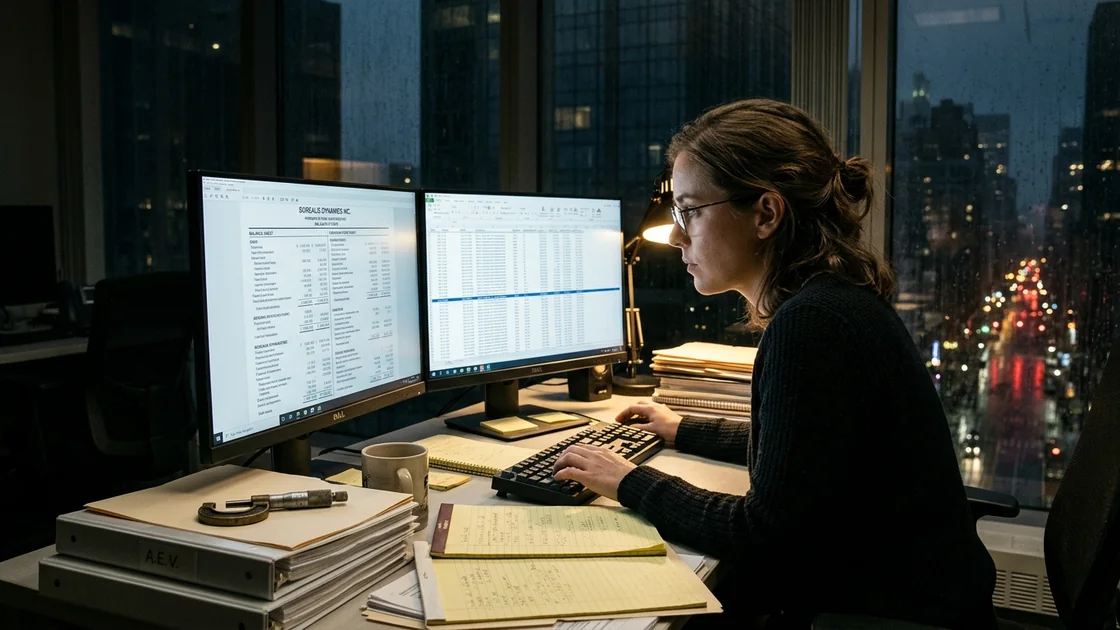
Clara Vance is a quiet forensic accountant in Manhattan who discovers a fatal algorithmic flaw inside Obsidian Peak Capital, the predatory hedge fund that looted her Rust Belt hometown's pension fund and drove her father into an early grave. Using her deep knowledge of generally accepted accounting principles, offshore derivative swaps, and clearinghouse settlement mechanics, she uncovers how Obsidian's billionaire founder, Julian Vane, has illegally trapped an undervalued aerospace supplier in a massive synthetic short position. Teaming up with a disgraced quantitative programmer and the surviving union trustees of her ruined hometown, Clara engineers a relentless, mathematically inevitable short squeeze that hijacks the hedge fund's own automated trading system, liquidating Vane's empire in a single Friday session and returning billions to the workers he robbed.
The fluorescent tubes on the thirty-fourth floor of the Whitehall Building hummed at sixty hertz, a flat, insectoid B-flat that Clara Vance had stopped hearing three years ago. It was 2:14 in the morning on a Tuesday in November. Outside the rain-streaked glass, the financial district of Lower Manhattan looked like a circuit board submerged in dark water, sodium-vapor streetlights bleeding amber across the wet cobblestones of Stone Street.
Clara took a slow sip of cold chamomile tea, her eyes fixed on two twenty-seven-inch monitors arranged side by side on her desk. On the left screen sat the public, audited consolidated balance sheet of Borealis Dynamics Inc., a mid-cap manufacturer of precision titanium bearings and high-tolerance turbine shafts headquartered in Syracuse, New York. On the right screen sat a raw, comma-delimited data dump from the bankruptcy discovery proceedings of Gibraltar Clearing Corp., a boutique prime brokerage that had collapsed four months earlier after an unauthorized currency trade in Zurich.
Most of the senior associates at Kestrel, Finch & Lowe treated bankruptcy discovery like municipal garbage collection. You wore metaphorical thick gloves, sifted through terabytes of disorganized PDFs and broken Excel macros, billed your three hundred and eighty dollars an hour to the court-appointed receiver, and went home at six. Clara did not go home at six. She preferred the graveyard shift, when the air conditioning scaled back and the partners were asleep in their Westchester colonials, leaving her alone with the numbers.
Numbers did not have public relations departments. They did not hire crisis management firms, and they did not give keynote speeches at Davos about synergistic capital allocation. Even when numbers were forced to lie—and they were forced to lie constantly, twisted through Delaware shell corporations, Cayman Island special purpose vehicles, and off-balance-sheet total return swaps—they always left a bruise on the surrounding arithmetic. A forensic accountant did not look for the stolen money. She looked for the bruise.
And right there, on line 14,892 of Gibraltar Clearing’s internal continuous net settlement log, was a bruise the size of a fist.
Clara leaned forward, pushing her wire-rimmed glasses up the bridge of her nose. Her fingers moved across her mechanical ten-key pad with a rapid, rhythmic clatter—clack-clack-clack-tick—that had been drilled into her muscles since she was nineteen years old.
On paper, Borealis Dynamics was a dying company. Its stock price had bled out over the past eighteen months, falling from thirty-four dollars a share to three dollars and eighty-two cents. Financial blogs regularly published gloomy articles with suspiciously similar phrasing about Borealis’s outdated factories, shrinking margins, and imminent delisting from the NASDAQ. According to the official short-interest data reported twice a month to FINRA, fourteen percent of Borealis’s fifty million outstanding shares were sold short—a high number, indicating bearish sentiment, but nothing illegal.
Yet Gibraltar’s dead servers told a wildly different story.
Before Gibraltar went belly-up, it had acted as an executing counterparty for an offshore entity registered in Hamilton, Bermuda, called Pelagic Alpha Ltd. Through a series of "married puts" and over-the-counter equity swaps that reset every twenty-eight days—just shy of the thirty-day regulatory reporting window—Pelagic Alpha was rolling over failures-to-deliver on Borealis Dynamics stock. They weren't holding seven million short shares. Through Gibraltar alone, Pelagic Alpha was synthetically short twenty-two million shares. And Gibraltar had been only one of four secondary prime brokers Pelagic used to fragment its footprint.
If the ratio held across the other three clearinghouses, someone had sold short more than eighty-five million shares of a company that only had fifty million shares in existence. And because corporate insiders, index funds, and long-term state retirement systems held thirty-two million of those real shares in locked custodial accounts, the actual tradable public float of Borealis Dynamics was barely eighteen million shares.
Someone was short nearly five hundred percent of the tradable float. They were cellar-boxing the company—driving the share price below five dollars so institutional funds would be forced by their own charter rules to dump the stock, cutting off Borealis from the credit markets until the company suffocated, declared Chapter 11, and saw its common stock cancelled entirely. If a stock goes to zero, a short seller never has to buy back the phantom shares they created, and they never even have to pay capital gains tax on the profits. It was the Wall Street equivalent of burning down a granary to collect fire insurance on wheat that never existed.
Clara opened a third window, accessing the SEC’s EDGAR database and cross-referencing the Legal Entity Identifier code attached to Pelagic Alpha’s swap agreements. The Bermuda shell was wholly owned by a master fund in George Town, Grand Cayman, which in turn had its voting shares controlled by a Delaware limited partnership headquartered on the fifty-second floor of a glass tower overlooking Bryant Park.
Obsidian Peak Capital Management LP.
Chief Investment Officer: Julian Vane.
Clara’s right hand stopped moving on the ten-key pad. The room seemed to drop ten degrees. She looked down at her desk, past the glowing spreadsheets and the yellow legal pads filled with her neat, slant-less handwriting, to the small, tarnished brass micrometer that served as her paperweight.
Engraved along the sleeve of the micrometer, worn nearly smooth by forty years of a machinist’s thumb, were the initials A.E.V.—Arthur Edward Vance. And beneath those initials, the stamped insignia of the United Steelworkers Local 402, Ironwood, Pennsylvania.
She did not feel a spike of cinematic rage. Rage was messy; it made you transpose digits and misread footnotes. Instead, she felt the cold, heavy settling of an unbalanced scale finally finding its counterweight. For six years, she had waited for Julian Vane to make an arithmetic error.
He had finally left a trail in the dark.
Ironwood sat in a narrow, steep-sided bend of the Monongahela River valley, forty miles south of Pittsburgh, where the morning fog smelled permanently of wet coal dust and river silt. For ninety years, the town’s heart had been the Ironwood Foundry & Forge, a sprawling two-hundred-acre complex of corrugated steel sheds and electric arc furnaces that produced heavy propulsion castings for cargo ships and industrial locomotives.
Clara’s father had walked through the foundry’s main gate six days a week from the spring of 1976 until the autumn of 2017. Arthur Vance was a master tool-and-die maker, a quiet man with broad shoulders, silver stubble, and hands so ingrained with molybdenum grease that even Lava soap left dark crescents beneath his fingernails. He was a man who believed in tolerances measured in ten-thousandths of an inch, and he believed in contracts.
"You give them forty years of your back and your eyesight," he used to tell Clara at the kitchen table while helping her with her ninth-grade algebra, tapping his thick knuckle against her textbook. "And in return, the company and the union put seventy cents of every hour into the trust. It’s deferred wages, Clara-belle. Not charity. It’s math. You put the work in on the left side of the equals sign, and you get your peace on the right side."
After Clara’s mother died of ovarian cancer during Clara’s sophomore year at Penn State, Arthur’s entire horizon shrank to two things: Clara’s CPA exams, and the eighteen-foot aluminum fishing boat he was restoring under a blue tarp in the driveway, waiting for the day he turned sixty-two.
He turned sixty-two in March of 2017. In June, Obsidian Peak Capital acquired a controlling stake in Castleton Heavy Industries, the conglomerate that owned the Ironwood Foundry, through a hostile leveraged buyout.
At the time, Clara was twenty-four, working sixty hours a week as a junior auditor at a Big Four firm in Philadelphia. She watched in slow-motion horror through public filings as Julian Vane executed what business school case studies called "balance sheet optimization." Vane did not buy Castleton to make steel castings. He bought it to strip its marrow.
Within ninety days, Obsidian Peak forced Castleton to issue eight hundred million dollars in high-yield junk bonds. Rather than using that borrowed money to modernize the furnaces in Ironwood, Vane had the board of directors pay out a six-hundred-million-dollar "special dividend" directly to Obsidian Peak and its partners, instantly recouping their entire purchase price plus a forty percent profit, while leaving the factory saddled with crushing interest payments it could never afford.
Then came the second phase. While sitting on Castleton’s board through his lieutenants, Vane quietly opened massive credit default swap positions through European investment banks—betting that the very company he controlled would default on the debt he had forced it to take on. Simultaneously, Obsidian Peak’s lawyers petitioned the federal bankruptcy court in Delaware for an "emergency distress termination" of the Ironwood Municipal and Steelworkers Pension Fund, arguing that the company had inadvertently underfunded the plan during the previous decade and that liquidating the pension obligations was the only way to save the jobs.
It was a lie built on actuarial sleight of hand. Obsidian’s auditors had retroactively changed the assumed discount rate of the pension fund’s liabilities from six percent to two-point-one percent while valuing the fund’s commercial real estate holdings at fire-sale distress prices. Overnight, a healthy four-hundred-million-dollar pension fund was declared catastrophically insolvent on paper. In the ensuing Chapter 11 restructuring, Obsidian Peak—holding senior secured liens they had granted themselves six months earlier—seized the pension’s liquid reserve assets to satisfy their own management fees, dumped the gutted carcass of the fund onto the federal Pension Benefit Guaranty Corporation at pennies on the dollar, and then shut down the Ironwood foundry anyway, selling the electric arc furnaces for scrap to a broker in Mumbai.
Arthur Vance’s pension went from three thousand four hundred dollars a month to six hundred and ten dollars a month, with the total elimination of his supplemental retiree healthcare and prescription coverage.
Clara offered to send him half her salary. Arthur, proud and stubborn to the bone, refused to take a dime from his daughter. He sold the aluminum fishing boat without ever putting it in the water. At sixty-three, with two degenerated discs in his lower back and a mild mitral valve murmur, he took a night-shift job driving a stand-up forklift inside a sub-zero frozen grocery distribution warehouse off Interstate 70.
Fourteen months later, at 4:15 on a January morning, while loading pallets of frozen poultry in minus-ten-degree air, Arthur suffered a massive myocardial infarction. By the time a coworker found him slumped over the steering tiller of the forklift, he had been gone for twenty minutes.
At the funeral at St. Jude’s in Ironwood, half the men in the pews were in their late sixties and seventies, wearing frayed union jackets over their dark suits, coughing into their hands because they were rationing their blood pressure and emphysema medications. Four months after the burial, Clara saw Julian Vane on the cover of Institutional Investor. He was standing on the teak deck of his seventy-meter yacht in St. Barts, wearing a cashmere crewneck sweater, smiling under the headline: The Alchemist of Distressed Debt: How Julian Vane Turned Rust Belt Relics into a 44% Net Return.
That week, Clara resigned from her corporate audit firm, moved to a four-hundred-square-foot studio apartment in Queens, and took a job in the forensic litigation division at Kestrel, Finch & Lowe, specializing in clearinghouse fraud and complex derivatives. She didn't buy clothes, she didn't go to bars, and she didn't take vacations. She spent five years learning how the plumbing of the global financial market worked—not the shiny faucets that retail investors saw on television, but the rusted cast-iron sewer pipes underneath the floorboards where the big funds dumped their toxic liabilities.
Now, staring at the Gibraltar Clearing logs at 2:30 in the morning, she had found the main valve.
On Thursday morning, Clara walked into the corner office of Arthur Finch, the senior managing partner at her firm. Finch was seventy-one, a former SEC enforcement attorney with white hair like dandelion fluff and a profound distaste for modern Wall Street’s complexity.
"Borealis Dynamics," Clara said, laying a thin manila folder on his mahogany desk. "They’re on our conflict-free roster for Q4 vendor compliance audits because they supply turbine bearings to our defense client in Connecticut. I’d like to take the field verification up in Syracuse myself next week."
Finch peered over his half-moon reading glasses. "Syracuse in November, Clara? That’s a junior staff rotation. You’re our lead forensic specialist on the Gibraltar receivership. Why do you want to count crates of ball bearings in upstate New York?"
"Because Borealis shows up four thousand times in the Gibraltar continuous net settlement failures," Clara replied smoothly, keeping her voice entirely neutral. "Gibraltar’s estate has a potential twelve-million-dollar clawback claim against an offshore counterparty that was using Borealis stock as synthetic collateral. Before I draft the subpoena recommendation for the bankruptcy trustee, I need to verify that Borealis’s underlying physical inventory matches their 10-Q filings. If Borealis is cooking their books, the estate’s claim is worthless."
It was ninety percent true, which was the best kind of cover story in an accounting firm. Finch sighed, waving a liver-spotted hand. "Fine. Take the Amtrak up on Monday. Keep the billables under thirty hours, or the bankruptcy judge will bark at me."
Monday morning broke gray and sleeting over Syracuse. The Borealis Dynamics facility sat in an industrial park near the old Erie Canal bed—four massive, windowless brick buildings humming with the deep, rhythmic vibration of five-axis CNC milling machines and vacuum induction furnaces.
Clara spent her first six hours in a cramped conference room smelling of burnt Folgers coffee, reviewing general ledgers alongside Walter Ostrowski, Borealis’s Chief Financial Officer. Ostrowski was fifty-eight, wearing a short-sleeved dress shirt despite the November chill, with dark rings of exhaustion under his eyes and two antacid bottles sitting next to his calculator.
By four in the afternoon, Clara had finished reconciling the raw material invoices against the work-in-process ledgers. She closed her laptop and looked across the table at Ostrowski.
"Mr. Ostrowski," Clara said quietly. "Your company isn't going bankrupt, is it?"
Ostrowski froze, a highlighter poised over a shipping manifest. He glanced toward the closed door of the conference room, then let out a long, ragged breath that seemed to deflate his entire chest.
"Read the financial press, Ms. Vance," he said bitterly. "According to MarketWatch and four different analyst notes published last week by boutiques in Manhattan, our technology is obsolete, our debt covenants are about to trip, and we’re a zombie company walking toward Chapter 7. Our stock closed at three dollars and forty-one cents today. Six weeks ago, our primary commercial bank in Boston refused to renew our revolving credit line because our market cap dropped below two hundred million."
"I don't read financial blogs, Mr. Ostrowski. I read general ledgers," Clara said. She tapped a thick binder labeled Schedule C: Raw Material & Deferred Revenue. "You have forty-two million dollars of aerospace-grade titanium-aluminide bar stock sitting in Warehouse 3, which you’ve recorded at historical cost from four years ago before the global titanium spot price tripled. Under lower-of-cost-or-market GAAP rules, you haven't marked it up, which means your balance sheet is hiding eighty million dollars in liquid raw material value alone."
Ostrowski stared at her, blinking slowly.
"More importantly," Clara continued, flipping to the back of the binder, "you have a seventy-six-million-dollar liability listed under 'Customer Advances and Unearned Contract Deposits.' On your public 10-Q, it looks like debt—like you owe seventy-six million dollars that you can’t pay back. That’s what the short sellers are pointing to when they say your debt-to-equity ratio is fatal. What is Contract ND-4409-Sub?"
Ostrowski swallowed hard. "I can't discuss classified Department of Defense subcontracts."
"I have a Secret-level clearance through my firm’s defense auditing practice, Mr. Ostrowski, and you already included the contract number in the unredacted audit trail," Clara said gently. "You’re making the main propulsion shaft bearings for the Navy’s new Columbia-class ballistic missile submarines through General Dynamics Electric Boat. You received seventy-six million in milestone prepayments, and you’ve spent the last two years manufacturing the first twelve shipsets. Why haven't you recognized a single dollar of that revenue on your income statement?"
"Because of ASC 606," Ostrowski said, rubbing his temples with both hands. "The Navy’s metallurgic testing laboratory in Bethesda had a nineteen-month backlog on ultrasonic fatigue certification because of a testing equipment upgrade. Under strict accounting rules, until the final certification stamp comes back on Lot 1, we have to book the entire prepayment as a liability and all our manufacturing labor as an unrecovered expense. It makes us look like we’re bleeding thirty million dollars a quarter."
"And when does the certification stamp come back from Bethesda?"
Ostrowski looked down at his desk calendar. "It came back via courier on Friday afternoon. Lot 1 through Lot 4 passed with zero defects. Not only does that convert the seventy-six million from a liability into pure recognized revenue at a forty-eight percent gross margin, it triggers an automatic two-hundred-and-forty-million-dollar follow-on production option for the next ten years."
Clara felt the fine hairs on her forearms stand up. "When were you planning to file the Form 8-K and the restated financial guidance?"
"Next month, with our year-end results," Ostrowski said helplessly. "Not that it’s going to save us in time. Last Thursday, a vulture fund called Obsidian Peak Capital bought up our thirty-million-dollar senior note from our regional bank at a discount. Their lawyers sent us a notice of technical default this morning based on a stock-price covenant buried in paragraph nineteen of the loan agreement—a covenant that requires our share price to stay above four dollars on a thirty-day moving average. Since our stock has been hammered down to three-forty, they’re demanding immediate full repayment in cash by next Friday, or they seize our patent portfolio and force us into receivership. I have twenty-one million in cash. I’m nine million short, and no bank will lend to us while our stock is in freefall."
Clara sat very still. The elegance of Julian Vane’s trap was breathtaking in its malice.
Obsidian Peak had bought Borealis’s thirty-million-dollar loan. Then, using Pelagic Alpha and three other offshore shells, Obsidian had illegally naked-shorted eighty-five million shares of Borealis stock to artificially drive the price below the four-dollar covenant threshold they themselves now enforced. Once Borealis defaulted on the nine-million-dollar shortfall next Friday, Obsidian would seize a company sitting on a two-hundred-and-forty-million-dollar Navy monopoly and eighty million in titanium, wipe out the shareholders, and walk away with half a billion dollars in tax-free short profits and stolen industrial assets.
It was Ironwood all over again. Six hundred skilled machinists in Syracuse were twelve days away from losing their livelihoods and their pensions so Julian Vane could add another two percent to his fourth-quarter performance fee.
"Mr. Ostrowski," Clara said, her voice dropping an octave. "What if I told you that the people demanding your loan repayment are the exact same people illegally manipulating your stock below four dollars? And what if I told you that by next Friday afternoon, Borealis Dynamics could have zero debt, a stock price north of two hundred dollars a share, and enough cash in the treasury to fund your employee pension plan until the twenty-second century?"
Ostrowski looked at her as if she had just offered to turn his stapler into solid gold. "Who the hell are you?"
"I’m the daughter of a tool-and-die maker from Local 402," Clara said, opening her briefcase. "And I know how to read a clearinghouse ledger."
To break a man who uses a machine to rob the world, you first have to understand the machine’s gears.
On Tuesday night, back in New York, Clara took the Q train all the way to the end of the line at Brighton Beach, Brooklyn. The elevated tracks rattled overhead as she walked three blocks off Brighton Beach Avenue, turning into a narrow, steam-fogged Georgian bakery that smelled of khachapuri cheese bread and strong Turkish coffee.
Sitting in the back booth, hunched over a chessboard where he was playing both white and black against himself, was Dr. Eli Varga.
Four years ago, Varga had been the Chief Quantitative Architect at Obsidian Peak Capital, the man who had written the core codebase for Kronos—Obsidian’s proprietary high-frequency algorithmic execution and risk-management engine. Three years ago, during a sudden liquidity freeze in the European sovereign bond market, Kronos had accidentally front-run a client account belonging to a sovereign wealth fund. To avoid an SEC criminal indictment, Julian Vane had testified that Varga had altered the code without authorization to pad his own bonus. Varga had lost his Series 7 and Series 63 licenses, paid a four-hundred-thousand-dollar civil fine that bankrupted him, and was permanently blacklisted from the financial industry.
Clara slid into the red vinyl booth across from him. She didn't say hello; she simply slid a printed spreadsheet across the table, stopping it right beside his black queen.
Varga didn't look up for ten seconds. He was forty-two, with unruly salt-and-pepper curls, a three-day beard, and restless, hyper-intelligent dark eyes. Slowly, he picked up the spreadsheet. As his eyes scanned the Gibraltar continuous net settlement failures and the twenty-eight-day swap reset timestamps, a slow, crooked smile spread across his face.
"Pelagic Alpha," Varga murmured, his accent carrying a faint trace of his native Budapest. "And I assume if we look at the London clearing logs, we’ll find Stygian Partners, and in Singapore, Meridia Holdings. Julian never changes his naming conventions. Everything has to sound like a Greek myth or an ocean trench. The man has the soul of a sophomore philosophy major with a Bloomberg terminal."
"It’s Borealis Dynamics, Dr. Varga," Clara said. "Ticker symbol BORD. Float of eighteen million shares. From the settlement velocity I’ve reconstructed across the four prime desks, Kronos has built a synthetic short position of at least eighty-two million shares."
Varga whistled softly, setting the paper down. "Eighty-two million. He’s using the 'Hydra' sub-routine I wrote in 2018. You see, if you short a stock normally, you have to borrow the share first, which costs a borrow fee and shows up on the public tape. Hydra bypasses that. It pairs up with a cooperative market maker—usually Vanguard-Sloane’s derivatives desk—and buys deep-in-the-money put options while the market maker sells synthetic shares to 'hedge' the puts, then immediately wraps the resulting delivery failures into an offshore total return swap. To the SEC’s automated surveillance, it looks like zero short interest. It’s invisible."
"Until one of the prime brokers goes bankrupt and a forensic accountant gets root access to the raw DTCC settlement tape," Clara said.
"Even so," Varga said, leaning back and folding his arms. "What do you think you’re going to do with this, Ms. Vance? Take it to the SEC? I spent fourteen months in rooms with SEC attorneys. Half of them are twenty-eight-year-old kids hoping to get hired by Obsidian’s compliance department next year, and the other half don't understand stochastic calculus. Even if they open an investigation, Julian’s lawyers will tie it up in administrative court until 2029, pay a two-million-dollar fine without admitting or denying guilt, and Borealis Dynamics will be dead and buried next Friday."
"I have no intention of asking the SEC to save Borealis," Clara said calmly. "I want to force Kronos to eat itself."
Varga stared at her. The ambient noise of the bakery seemed to fade. "Explain."
"Kronos is fully automated, isn't it?" Clara asked. "When a target stock like Borealis is being cellar-boxed below four dollars, Kronos monitors the lit exchanges and the dark pools. Whenever retail or institutional buying pressure pushes the price toward four dollars—the debt-covenant trigger—Kronos automatically sells another hundred thousand synthetic shares to slam the price back down."
"Yes," Varga said, nodding slowly. "It’s an elastic suppression ceiling. It calculates the exact volume required to absorb bid-side liquidity and executes in microseconds."
"Because Julian Vane doesn't trust human traders not to hesitate," Clara said. "Now, tell me how Kronos interfaces with the master risk engine at Obsidian’s primary clearing bank, Vanguard-Sloane."
Varga’s eyes narrowed, a spark of genuine professional fascination igniting behind them. "Vanguard-Sloane gives Julian a five-to-one intraday leverage line on his offshore swap book, on one condition. After the Archegos collapse, Vanguard-Sloane’s board insisted on a hardwired API bridge directly into Kronos. It runs a real-time Value-at-Risk calculation—we called it the Cerberus protocol. As long as Obsidian’s unrealized losses on any single synthetic swap basket stay below fifteen percent of the fund’s posted collateral, Julian has total autonomy."
"And if the unrealized loss on a single ticker breaches that fifteen percent collateral threshold simultaneously across both equity and options tiers while underlying dark-pool liquidity drops below ten percent?" Clara asked, leaning forward over the chessboard.
Varga’s breath caught. "How do you know about the dual-tier liquidity parameter?"
"Because I saw the dormant code tags in the Gibraltar bankruptcy files," Clara said. "What happens when both triggers hit at the exact same millisecond?"
"Cerberus seizes the wheel," Varga whispered, his fingers tapping rapidly against the Formica tabletop. "To protect the bank from holding the bag on an infinite loss, Vanguard-Sloane’s risk server automatically revokes Obsidian’s admin privileges. It locks Julian’s terminals out of manual override and flips Kronos from 'Suppression Mode' to 'Forced Liquidation Mode.' The algorithm is legally and mechanically compelled to close the short position by buying shares at the current market ask—at any price—until the swap book is flat."
"At any price," Clara repeated softly. "And if there are eighty-two million shares that need to be bought back by a machine that cannot negotiate, cannot pause, and cannot turn itself off... what happens if there are no shares available for sale?"
Varga stared at the chessboard, his mind visibly running the differential equations. "The ask price goes vertical. Twenty dollars. Fifty dollars. Two hundred dollars. Five hundred dollars. Every dollar the stock rises increases Obsidian’s margin deficit by eighty-two million dollars, which forces the algorithm to liquidate Julian’s long positions in Apple, Microsoft, and Treasury bonds to raise cash to keep buying Borealis shares at ever-higher prices. It’s a thermodynamic runaway reaction. A gamma-driven doom loop. It wouldn't just wipe out the Borealis trade. It would bankrupt the entire eleven-billion-dollar master fund before the closing bell."
He looked up at Clara, his voice hushed. "But to trip that wire, Borealis would have to jump from three dollars and forty cents to at least nineteen dollars and eighty cents in less than forty minutes, on a day when the tradable float is completely locked up, while simultaneously forcing the options market makers to buy millions of shares to delta-hedge. You can't do that with a spreadsheet, Ms. Vance. You would need a fundamental catalyst, a complete lock on the physical shares, and at least twelve to fifteen million dollars in precisely timed derivatives capital to build the gamma ramp."
Clara reached into her coat pocket and placed a train ticket to Pittsburgh on the table.
"You write the options-routing script to disguise the order flow from Kronos’s predictive filters, Dr. Varga," she said. "I’ll get the twelve million dollars."
On Wednesday afternoon, Clara drove a rented sedan south from Pittsburgh along Route 837, following the gray curve of the Monongahela River into Ironwood.
The town looked smaller than it had six years ago, as if the valley walls were slowly pressing inward. The giant corrugated sheds of the Ironwood Foundry stood silent behind rusted chain-link topped with weeds, their windows broken out like missing teeth. Along Main Street, the bakery, the hardware store, and the Ford dealership were boarded up with painted plywood. Only the VFW hall, a Dollar General, and a cash-advance storefront showed neon in the gray drizzle.
Before heading into town, Clara turned up the steep gravel road of Calvary Cemetery on the ridge above the river. She walked through the wet grass to the third row beneath a bare pin oak and stood before a simple granite headstone: ARTHUR EDWARD VANCE, 1955–2019. BELOVED HUSBAND AND FATHER. MEASURED TWICE.
She knelt, brushed a handful of wet oak leaves off the polished stone, and rested her palm on the cold granite for a full minute. She didn't speak out loud; her father had never been a man for long speeches. She simply made a quiet entry in the ledger of her mind, stood up, and drove down the hill to the brick building at the corner of Fourth and Sycamore: the former union hall of Steelworkers Local 402.
Inside the basement meeting room, five people sat around a folding metal table under a buzzing fluorescent fixture. The walls were still lined with framed black-and-white photographs of men pouring molten steel in the 1950s and marching in Labor Day parades.
At the head of the table sat Frank Kovacs, her father’s best friend and the former president of Local 402. Frank was sixty-eight, missing the tip of his left ring finger from a stamping press accident in 1984, wearing a flannel shirt and a faded Pirates cap. Beside him sat Sarah Jenkins, the county treasurer, along with three trustees from sister union locals in neighboring valleys—Monessen, Braddock, and Weirton—all of whom had seen their municipal and union funds gutted by Obsidian Peak’s Castleton buyout.
"Clara-belle," Frank said, standing up to wrap her in a bear hug that smelled of pipe tobacco and wool. He held her at arm's length, looking into her face. "You look just like your mother around the eyes. Sit down, kid. Sarah made coffee, though it’s probably strong enough to strip paint."
For the next forty-five minutes, nobody interrupted her. Clara did not use Wall Street jargon. She used a whiteboard and a black dry-erase marker, drawing out the plumbing of what Julian Vane had done to Ironwood in 2017, and what he was currently doing to Borealis Dynamics in Syracuse.
When she finished explaining the mechanics of the synthetic short position and the automated liquidation trigger inside Vanguard-Sloane’s risk server, the basement was dead silent save for the drip of the coffee percolator.
Sarah Jenkins, a sharp-eyed woman in her fifties who had managed county bond accounts for twenty years, leaned forward. "Clara, you’re talking about the Ironwood & Mon Valley Litigation Recovery Trust. We have fourteen million, two hundred thousand dollars sitting in an escrow account at First Commonwealth Bank—the settlement crumbs we clawed back from Castleton’s insurance carriers three years ago. Divided among four thousand two hundred retirees and widows, after legal liens, it comes out to barely two thousand bucks a head. That’s why the board has kept it parked in Treasury bills while we appeal the federal ruling."
"And the federal appeal was denied by the Third Circuit two weeks ago," Clara said gently. "Which means next month, the trust dissolves, the lawyers take thirty percent, and the retirees get a one-time check that won't cover four months of heating oil and insulin."
Frank Kovacs rubbed his jaw with his scarred hand. "And you want us to take twelve million of that trust money—the last nickel this town has in the world—and put it into stock options on a ball-bearing factory in Syracuse?"
"Not a gamble, Frank. An audit," Clara said, stepping back to the whiteboard. "If I were asking you to bet on a casino spin, my father would climb out of that hill up there and box my ears. Listen to the sequence of events."
She held up one finger. "First, Borealis Dynamics is not a dying company. I personally audited their physical inventory and their government contracts forty-eight hours ago. Even without a short squeeze, the moment their CFO files the restated 10-K/A with the SEC tomorrow afternoon after the market closes, recognizing the seventy-six million in Navy submarine revenue and the two-hundred-and-forty-million-dollar contract extension, the fundamental book value of that company is twenty-six dollars a share. Buying it at three dollars and forty cents isn't speculation; it’s buying a twenty-dollar bill for three bucks."
She held up a second finger. "Second, you remember the nine-million-dollar cash shortfall Borealis needs to pay off Obsidian Peak’s predatory loan before next Friday? Four million of your trust money won't go into the stock market at all. It will purchase a senior secured equipment note directly from Borealis Dynamics, paired with a five-million-dollar bridge advance from their Navy prime contractor that I helped Mr. Ostrowski negotiate this morning. That pays off Julian Vane’s thirty-million-dollar loan in full tomorrow at 4:01 PM, extinguishing his default claim and releasing the lien on their patents."
She held up a third finger. "Third, the remaining eight million dollars of the trust will be used over the next twenty-four hours to buy a staggered ladder of out-of-the-money call options—strike prices at five dollars, seven-fifty, ten, fifteen, and twenty dollars—expiring tomorrow afternoon, Friday. Because Borealis has been beaten down for so long, its implied volatility is near zero. Those call options cost pennies—literally four to आठ cents a contract. With eight million dollars, routed through twelve different regional brokerage desks using Dr. Varga’s splitting algorithm so Kronos doesn't detect institutional accumulation, the trust will control the rights to sixteen million shares."
"Walk me through the Friday morning math," Sarah Jenkins said, her pen poised over her legal pad.
"At 4:05 PM today, Thursday, five minutes after today’s closing bell, Borealis files three documents simultaneously on the SEC’s EDGAR system," Clara said. "Document one: Notice that the thirty-million-dollar senior note held by Obsidian Peak has been paid in full, eliminating all bankruptcy risk. Document two: The restated audited financials showing record profitability and the quarter-billion-dollar Navy submarine contract. Document three: A board-approved resolution declaring a special shareholder vote on a corporate stock buyback, which legally requires all institutional lenders of Borealis stock to issue an immediate share recall by Friday at noon."
Sarah’s eyes widened as the financial mechanics clicked into place. "A share recall shrinks the available lending pool to zero overnight. And when the stock jumps in pre-market trading on the Navy contract news..."
"Every call option the Ironwood Trust holds between five dollars and fifteen dollars suddenly goes 'in the money,'" Clara said, her voice steady and clear. "The Chicago Board Options Exchange market makers who sold us those cheap call contracts are not directional gamblers; they are required by their own computer models to stay delta-neutral. As the stock passes five dollars, they are mathematically forced to go into the open market and buy millions of actual shares of Borealis to hedge the calls we hold. Their buying pushes the price past seven-fifty, which forces them to buy millions more shares to hedge the ten-dollar calls, which pushes it past fifteen. It’s called a gamma ramp."
"And that’s when Vane’s machine hits the wall," Frank whispered.
"At nineteen dollars and eighty cents," Clara said, "Vanguard-Sloane’s automated risk engine seizes control of Obsidian Peak’s accounts and starts buying back eighty-two million phantom shares in a room where the doors are locked and we are holding the only exit keys. We won't be selling our contracts to retail investors, Frank. We will be selling them directly into the forced, automated buy-orders of Julian Vane’s clearinghouse."
Frank Kovacs looked around the table at the other four trustees—men and women who had watched their neighbors lose their homes, their dignity, and their lives while Wall Street toasted record bonuses. Then Frank looked up at the framed 1988 photograph on the wall behind Clara, where a young Arthur Vance stood in the second row with his arm around Frank’s shoulder, both of them grinning under their hardhats.
Frank reached into his shirt pocket, pulled out a cheap ballpoint pen, and slid the trust authorization resolution across the table.
"Tell us where to sign, Clara-belle," Frank said. "Let’s go get Arthur’s boat back."
Thursday was a masterclass in silent execution.
Operating out of a windowless server room in Jersey City that Varga had rented under the name of a defunct telecommunications consultancy, Clara and Varga sat before six monitors wired directly into a fiber-optic trunk line less than two miles from the NASDAQ data center in Carteret.
From 9:30 AM to 3:59 PM on Thursday, while the broader market drifted through a sleepy pre-holiday session, Varga’s custom Python script parceled the Ironwood Trust’s eight million dollars into fourteen thousand separate micro-orders.
Instead of buying blocks of five thousand call contracts—which would have immediately triggered Kronos’s anomaly-detection radar—the script routed orders of seven contracts here, twelve contracts there, nineteen contracts through a retail execution hub in Omaha, fourteen through a pension desk in Toronto, spacing them out at randomized prime-number intervals. To Kronos, and to the human traders sitting on the derivatives desk at Vanguard-Sloane, it looked like a scattered handful of retail day-traders throwing lottery tickets at a dying penny stock ahead of Friday’s weekly options expiration.
Because the market makers believed Borealis Dynamics was days away from Chapter 11, their automated pricing engines happily sold the five-dollar, ten-dollar, and fifteen-dollar Friday call options for almost nothing, pocketing what they assumed was free premium without bothering to buy a single underlying share to hedge.
By 3:58 PM on Thursday, the Ironwood Recovery Trust owned one hundred and sixty-four thousand call option contracts—representing the legal right to demand sixteen million, four hundred thousand shares of Borealis Dynamics at an average strike price of eleven dollars. Almost the entire tradable float of the company was coiled inside those contracts like a compressed titanium spring.
At 4:00 PM, the closing bell rang on the NASDAQ. Borealis Dynamics closed at three dollars and thirty-nine cents.
Clara picked up her encrypted burner phone and dialed Syracuse. "Walter. Are the wire transfers cleared?"
"Cleared at 3:59," Walter Ostrowski’s voice came back, tight with adrenaline. "Thirty million, four hundred and twelve thousand dollars—principal plus accrued interest—has been wired into Obsidian Peak’s escrow account at JPMorgan Chase. Our bond counsel just transmitted the stamped Notice of Satisfaction and Lien Release. And our external audit partner at Kestrel, Finch just signed off on the restated 10-K/A."
"Press the button, Walter," Clara said.
At 4:04 PM, just as the majority of Wall Street traders were putting on their coats to head to steakhouses in Midtown, three separate filings hit the SEC’s EDGAR database under ticker symbol BORD.
In Jersey City, Varga’s fingers flew across his keyboard, ensuring that the automated news-scraping bots at Bloomberg, Reuters, and Dow Jones immediately parsed the XBRL accounting tags embedded in the filings.
For ninety seconds, nothing happened on the after-hours tape.
Then, at 4:06 PM, the algorithmic headline scanners at six major quantitative funds in Greenwich and Chicago read the numbers: BOREALIS DYNAMICS EXTINGUISHES SENIOR DEBT; RESTATES Q3 EARNINGS TO +$1.42 EPS ON $240M U.S. NAVY SUBMARINE CONTRACT; INITIATES EMERGENCY SHAREHOLDER RECALL AND $25M BUYBACK.
On Clara’s center monitor, the green bid-ask line for BORD twitched.
$3.39... $4.10... $5.85... $7.20.
"Kronos just woke up," Varga said, pointing to the Level 2 order book on the far-left screen.
A massive wall of red sell orders suddenly appeared at $7.50—five hundred thousand shares, then a million shares, then two million shares. Even in after-hours trading, Julian Vane’s algorithm was automatically manufacturing synthetic shares and slamming them onto the ECNs to keep the price suppressed, assuming this was a temporary spike that could be crushed before Friday’s open.
"Look at the short volume," Varga breathed, his face illuminated by the cascading red and green digits. "Kronos doesn't have a human reading the text of the Navy contract or the debt payoff. It only sees a price deviation exceeding four standard deviations, so its prime directive is to short into the rally to protect the swap threshold. It just sold another six million phantom shares between seven dollars and nine dollars to keep the lid on!"
By 8:00 PM, when after-hours trading closed, Borealis had settled at $9.40. In four hours of thin evening trading, Kronos had expanded Obsidian Peak’s synthetic short position from eighty-two million shares to ninety-one million shares.
And because the options markets did not trade after 4:00 PM, the Chicago market makers who had sold Clara one hundred and sixty-four thousand call contracts were now completely unhedged on sixty thousand contracts that had just blown past their five-dollar and seven-fifty strike prices. Tomorrow morning at 9:30 AM, their computers would have no choice but to buy six million shares at the opening bell just to catch up.
Clara didn't sleep that night. She sat in the blue glow of the monitors, double-checking the settlement wiring instructions for the Ironwood Trust, drinking black coffee, and watching the pre-market European order books open at 4:00 AM.
Across the Hudson River, on the fifty-second floor of Obsidian Peak’s headquarters above Bryant Park, Julian Vane arrived at 7:45 AM on Friday.
He was forty-six, lean and impeccably tailored in a charcoal Loro Piana suit without a tie, his hair cropped close and silver at the temples. He had played squash at the University Club at 6:30, had his usual espresso and poached egg, and was looking forward to flying his Gulfstream G650 down to Palm Beach at three o'clock for the weekend.
As he walked past the glass-walled trading pit toward his corner office, he noticed four of his senior portfolio managers standing in a tight, silent cluster around the risk-monitoring console.
"Why does everyone look like the caterer brought bad oysters?" Vane asked pleasantly, pausing by the glass door.
Devon Locke, his thirty-four-year-old Head of Equities, turned around. Locke’s face was the color of wet drywall.
"Julian," Locke said, his voice cracking slightly. "We have a situation on the Pelagic Alpha swap book. Borealis Dynamics."
Vane frowned slightly, trying to place the name among the forty-odd distressed mid-caps in their cellar-box portfolio. "The bearing manufacturer up in Syracuse? We bought their senior note last week. They’re supposed to default next Friday."
"They paid the note off yesterday at 4:00 PM in cash," Locke said. "And then they dropped a restated 10-K with a quarter-billion-dollar Navy submarine contract they’d been hiding in deferred revenue, plus a mandatory share recall. Pre-market just opened in New York. The stock is trading at sixteen dollars and forty cents."
Vane’s jaw tightened, the pleasant mask vanishing instantly. "Sixteen-forty? From three-forty? Why the hell didn't Kronos cap the momentum at the four-dollar resistance band?"
"It tried," Locke said, gesturing helplessly at the glowing red matrix on the central screen. "Kronos shorted another nine million synthetic shares through Vanguard-Sloane’s swaps desk in the after-hours session yesterday, and four million more in Frankfurt at five this morning. Total synthetic exposure across the four offshore shells is now ninety-five million shares. At sixteen-forty, we’re down one-point-two billion dollars on the mark-to-market."
Vane stepped into the pit, his mind calculating rapidly. Obsidian Peak had eleven-point-four billion dollars in assets under management. A one-point-two-billion-dollar drawdown on a single short position was ugly—it would ruin his annual return metrics—but it wasn't fatal. Retail spikes on small-cap industrial stocks always faded by ten-thirty once the initial euphoria burned off and profit-taking set in.
"Turn off the automated shorting sub-routine on BORD so it stops adding to the position," Vane ordered coldly. "Then have our prime desk at Vanguard-Sloane route twenty million shares of dark-pool sell orders right at the 9:30 bell to break the chart pattern and trigger stop-losses. Once it cracks back below twelve dollars, the momentum algos will dump it."
"Julian, you’re not looking at the options chain," Locke said, pointing a trembling finger at the lower monitor. "Somebody bought a hundred and sixty-four thousand weekly call options yesterday across every strike from five dollars to twenty dollars. Almost the entire chain is in the money if we open above fifteen. And because of the share recall Borealis announced last night, State Street and BlackRock just froze their stock-lending desks. There are zero shares available to borrow in the dark pools. The float is completely dry."
Vane stared at the screen. Before he could speak, the private red direct-line handset connecting Obsidian’s pit to the Managing Director of Prime Brokerage at Vanguard-Sloane began to buzz.
Vane snatched it up. "Richard. Listen to me, we need a temporary intraday waiver on the Pelagic Alpha swap margin until noon while we work down this Borealis spike—"
"Julian, shut up and listen to me," Richard Vance’s counterpart—Richard Sterling, head of global prime risk at Vanguard-Sloane—said, his voice devoid of its usual country-club deference. "Our credit committee has been in an emergency session since six this morning. Your four offshore SPVs are holding ninety-five million synthetic short shares of a company with an eighteen-million-share float, on a Friday morning when options market makers have to buy sixteen million shares at the open to delta-hedge."
"It’s a temporary dislocation on a rust-belt machine shop, Richard!" Vane snapped. "We have eleven billion in collateral with your bank!"
"And under Paragraph 12 of your ISDA Master Agreement, if Borealis crosses nineteen dollars and eighty cents for more than five hundred milliseconds while market-wide borrow liquidity is below ten percent, our automated Cerberus risk engine takes full administrative control of the Pelagic, Stygian, and Meridia swap books," Sterling said coldly. "I cannot override it even if I wanted to, Julian. The board hardwired it after Archegos so our bank doesn't go to prison for aiding naked short manipulation. Pre-market is at eighteen dollars and ninety cents right now. We open in four minutes. If you don't push that stock below nineteen-eighty before the opening bell, our computer is going to liquidate your fund to buy back those ninety-five million shares."
The line went dead.
Vane slowly lowered the receiver. In the glass trading pit, twenty-four traders were staring at him in terrified silence. On the wall clock, the digital numerals flipped to 9:29:00.
In Jersey City, Clara sat with her hands folded neatly in her lap, watching the pre-market equilibrium price tick upward on the NASDAQ opening cross.
9:29:30 — $19.10. 9:29:45 — $19.45. 9:29:55 — $19.75.
"Here comes the bell," Varga whispered, gripping the edge of his desk.
9:30:00.
The opening cross executed. Four million shares of market-on-open buy orders from the Chicago options market makers slammed into an order book that had fewer than eighty thousand shares for sale.
In the first four hundred milliseconds of Friday trading, Borealis Dynamics didn't walk past nineteen dollars and eighty cents; it gapped straight to twenty-six dollars and fifty cents.
On Varga’s third monitor—the one tracking the API routing signatures from Vanguard-Sloane’s clearing server—a sudden, violent transformation occurred.
"Cerberus just tripped!" Varga shouted, slapping the desk. "Look at the order-flow tag! Vanguard-Sloane’s risk engine just severed Obsidian’s manual control and flipped Kronos into automated forced buy-in!"
In Midtown Manhattan, Julian Vane watched in disbelief as every terminal on his fifty-second floor flashed crimson, displaying a single gray system dialog box across the center of the screens:
ADMINISTRATIVE OVERRIDE ENGAGED — COUNTERPARTY DEFAULT MITIGATION PROTOCOL (ISDA SEC. 12.4). MANUAL ORDER ENTRY SUSPended.
"Unplug the server!" Vane roared, lunging over Devon Locke’s desk and grabbing the keyboard, hammering the escape and cancel keys. "Cut the fiber line to Carteret! Call the NASDAQ market operations desk and tell them we had a fat-finger software glitch!"
"Julian, the algorithm isn't running on our servers anymore!" Locke yelled back, his hands in his hair. "It’s executing directly off Vanguard-Sloane’s risk mainframes in New Jersey! They’re liquidating our long book to raise margin cash!"
On the left side of the giant wall board, Obsidian Peak’s crown-jewel holdings—billions of dollars in Microsoft, Nvidia, Alphabet, and US Treasury futures—began dumping onto the market in massive automated block sales to generate cash. On the right side of the board, the Cerberus-controlled algorithm took that cash and fired relentless, automated market-buy orders into Borealis Dynamics.
It was a mathematical meat grinder.
The algorithm had a simple, unyielding instruction: Buy 95,000,000 shares of BORD at current market ask until position = 0.
At 9:34 AM, the stock hit $42.00 and triggered a five-minute NASDAQ volatility halt. When it reopened at 9:39 AM, there were still no sellers. The price gapped to $68.00 and halted again. At 9:45 AM, it reopened at $104.00.
Every time the stock jumped another ten dollars, Obsidian Peak lost another nine hundred and fifty million dollars. By 10:15 AM, as Borealis crossed $140.00 a share, Obsidian Peak’s entire eleven-point-four-billion-dollar equity base was officially underwater. Under clearinghouse rules, once the hedge fund’s equity hit zero, the remaining liability spilled over onto the prime broker’s own balance sheet insurance pool, making Vanguard-Sloane’s computer even more desperate to close the trade at any price.
In Jersey City, the room was completely quiet except for the hum of the cooling fans.
On the screen before Clara, Borealis Dynamics was trading at $188.00 a share. The Ironwood Trust’s eight-million-dollar call option ladder—controlling sixteen million, four hundred thousand shares—was now sitting on an unrealized value of more than two-point-eight billion dollars.
"Clara," Varga said, his voice shaking slightly as he looked at the vertical green line on the chart. "They still have sixty-two million phantom shares left to cover, and nobody in the world is selling. If you hold these contracts for another hour, the price could hit four hundred, maybe five hundred dollars. You can take Vanguard-Sloane down with him."
Clara looked at the screen. She thought of the sixteen million shares she controlled, and she thought of the thousands of lower-level bank clerks, pension index funds, and ordinary workers whose accounts were tied up in the broader clearinghouse system if a major prime bank collapsed. Then she looked down at her father’s brass micrometer resting beside her keyboard.
Measured twice.
Her father had never been a greedy man. He had only ever asked for what was on the right side of the equals sign—what was owed to the men and women who had built the castings, poured the steel, and kept their side of the bargain, plus enough to make sure the six hundred families in Syracuse never had to know what it felt like to watch their town boarded up with plywood.
"What is the remaining equity balance inside Obsidian Peak’s master fund and Julian Vane’s personal general-partner capital account?" Clara asked calmly.
Varga tapped a rapid sequence of keys, calculating the net asset value of Obsidian’s liquidated long portfolio against the mark-to-market loss on the BORD buy-ins.
"At two hundred and ten dollars a share," Varga said, looking up at her, "Obsidian Peak Capital hits absolute zero—including Vane’s personal nine-hundred-million-dollar GP stake, which is cross-collateralized in the master fund."
At 10:42 AM, coming out of its seventh volatility halt, Borealis Dynamics printed $212.50.
"Exercise the five-dollar and ten-dollar calls using cashless net settlement," Clara said evenly. "And begin feeding the remaining contracts directly into Vanguard-Sloane’s automated buy desk in blocks of five thousand at a limit price of two hundred and ten dollars."
Varga smiled—a deep, genuine smile that reached his eyes for the first time in three years—and pressed the execution macro.
On the screen, the sixteen million shares controlled by the Ironwood & Mon Valley Litigation Recovery Trust flowed smoothly into the ravenous jaws of the automated liquidation algorithm, acting as a pressure relief valve for the clearinghouse while extracting the exact pound of flesh required to drain Obsidian Peak Capital to the last cent.
In Syracuse, Walter Ostrowski executed Borealis’s shelf offering of one million treasury shares at $205.00, instantly raising two hundred and five million dollars in pure, debt-free cash for the company’s balance sheet—enough to modernize every furnace in the plant and fully pre-fund the Syracuse machinists' pension plan for the next thirty years.
By 11:30 AM, the last of the Ironwood Trust’s contracts settled into cash.
On Clara’s settlement screen, the final wire confirmation from the Options Clearing Corporation blinked into existence in crisp, unadorned black type:
ACCOUNT: IRONWOOD & MON VALLEY LITIGATION RECOVERY TRUST NET LIQUIDATION PROCEEDS (SETTLED T+1): $3,148,620,400.00
Three billion, one hundred and forty-eight million, six hundred and twenty thousand, four hundred dollars.
Even after setting aside thirty-seven percent for federal and state taxes and distributing the proportionate shares to the sister union trusts in Monessen, Braddock, and Weirton, the Ironwood fund now held enough capital to restore one hundred percent of every steelworker’s original pension, retroactively pay every dime of missed benefits since 2017 with six percent compounded interest, restore full lifetime healthcare and prescription coverage for every retiree and widow in the valley, and endow a four-hundred-million-dollar industrial redevelopment foundation for the town of Ironwood.
At 11:48 AM, a breaking news alert flashed in red across the bottom of the Bloomberg terminal:
OBSIDIAN PEAK CAPITAL HALTED BY REGULATORS FOLLOWING MASSIVE DERIVATIVES LIQUIDATION; PRIME BROKER VANGUARD-SLOANE CONFIRMS FUND EQUITY WIPED OUT IN MORNING SQUEEZE.
Clara reached out, picked up her father’s brass micrometer, and slipped it into her coat pocket.
"Dr. Varga," she said, standing up and smoothing her skirt. "The Ironwood Trust agreement includes a standard one-point-five percent quantitative consulting and execution fee. Thirty-one million dollars will be wired to your escrow account on Monday morning. I suggest you buy a larger chessboard."
Varga looked up at her, momentarily speechless, before nodding once. "Where are you going, Ms. Vance? You still have a job at Kestrel, Finch."
"I emailed my two weeks' notice to Arthur Finch at nine-twenty this morning," Clara said, picking up her briefcase. " along with the complete eighty-page forensic audit report on the Gibraltar receivership, billed to the minute. I have a train to catch."
In April, the redbud trees along the steep banks of the Monongahela River came into bloom early, splashing purple and pale green against the dark slate of the hillsides.
On a bright Saturday morning, Main Street in Ironwood was loud for the first time in nearly a decade. Two dozen pickups and work vans were parked along the curbs outside the former hardware store and the old bakery, where carpenters were pulling down the weathered plywood sheets and installing double-paned plate glass. Down by the river, the massive corrugated sheds of the old Ironwood Foundry were swarming with structural engineers and rigging crews; three months earlier, a newly capitalized Borealis Dynamics had purchased the dormant facility out of receivership to serve as its secondary heavy-forging plant for the Navy submarine contract, hiring back a hundred and eighty younger machinists from Local 402 at full union scale, with forty older retirees retained as paid master-apprentice instructors.
Inside the newly renovated first floor of the union hall on Fourth and Sycamore, a simple brass plaque had been mounted beside the double doors: The Arthur E. Vance Pension & Community Trust.
Clara sat at her oak desk near the front window, where the morning sun fell warm across a neat stack of municipal infrastructure bond proposals and scholarship applications for the children of Local 402. Her two twenty-seven-inch monitors sat quietly on the credenza behind her, displaying no high-frequency order books, no offshore swap schedules, and no bankruptcy dockets—only a clean, balanced general ledger where the assets on the left side exceeded the liabilities on the right side by a comfortable, unshakeable margin.
There was a light knock at the open door. Frank Kovacs stood there, wearing a clean canvas fishing vest over his flannel shirt and holding a thermos of coffee. Behind him at the curb, hitched to the back of his Ford F-150, gleamed an eighteen-foot aluminum fishing boat that Frank had tracked down in Ohio over the winter and repurchased for the trust.
"The crappie are biting down by the locks, Clara-belle," Frank said, nodding toward the truck. "And you’ve been staring at those scholarship forms since seven this morning. Even your old man took Saturdays off when the water was flat."
Clara looked down at her legal pad, wrote a final check-mark beside the last column of figures, and capped her pen. She placed the tarnished brass micrometer squarely in the center of the closed ledger, stood up, and reached for her jacket.
"Give me two minutes, Frank," Clara said, smiling into the spring light. "The books are balanced."