The Wrath of Wai-Ariki
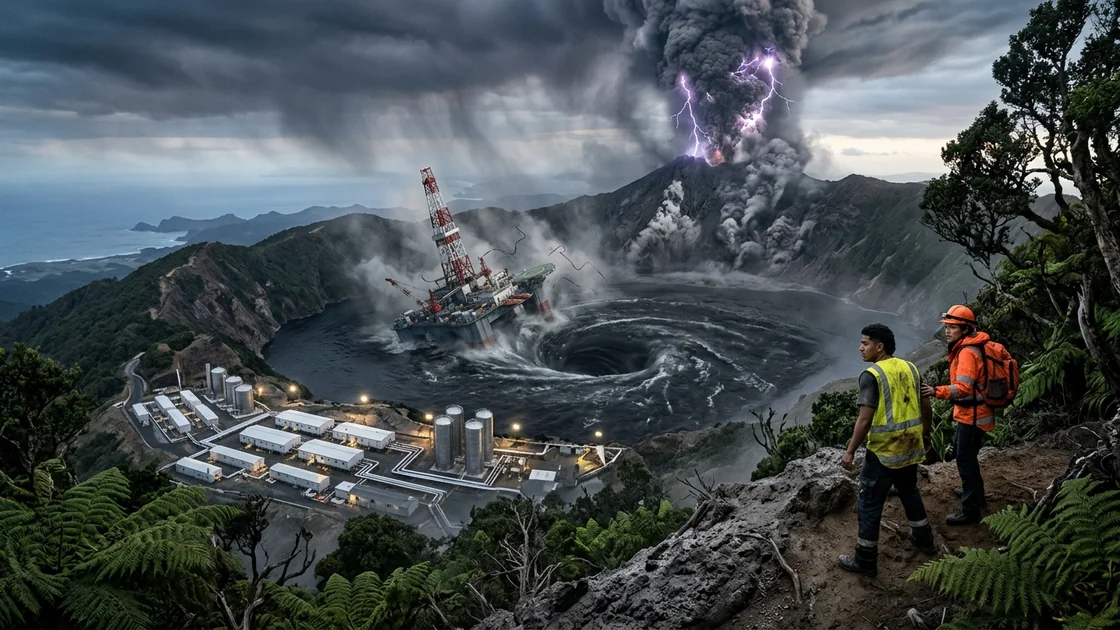
When the conglomerate Pyreos Energy secured the mineral and geothermal rights to the volcanic island of Motu Kora through a corrupt mainland tribunal, they wasted no time evicting the indigenous Kora people who had guarded the island for forty generations. Forced onto rusted transport barges at gunpoint, the islanders warned the corporate executives that the pristine crater lake at the mountain summit, known as Wai-Ariki, was not a resource to be tapped, but a sacred seal keeping an ancient and volatile devastation asleep beneath the crust. Ignoring the warnings as primitive superstition, Site Director Julian Vance oversaw the construction of a massive geothermal drilling complex directly upon the waters of the high caldera. Only Koa, a young islander who stayed behind as a terrain surveyor to watch over his ancestral home, and Dr. Mara Lin, a conflicted corporate volcanologist, recognized the terrifying geological and spiritual signs as the drill bit ground toward the heart of the mountain. When the company shattered the subterranean silica caprock to maximize steam production, they inadvertently broke the ancient hydrostatic seal, draining the sacred lake into a hyper-pressurized magma chamber and awakening a cataclysmic fury that tore the corporate empire apart in fire, ash, and boiling stone.
Chapter 1: The Barges of Oru
The rust on the hull of the transport barge looked like dried blood in the late afternoon sun. Koa stood on the black basalt jetty of Oru Harbor, his boots planted firmly on stone his great-grandfather had helped quarry by hand, watching the last of his people being herded up the steel gangplank.
Security contractors hired by Pyreos Energy stood at five-meter intervals along the pier. They didn't wear military uniforms; they wore slate-gray tactical polos, wrap-around ballistic sunglasses, and carried non-lethal riot carbines slung across their chests. The weapons were meant to project a sanitized, corporate civility, though everyone on the island knew the magazines loaded with rubber baton rounds were backed up by live ammunition in the armored SUVs parked near the seawall.
"Keep moving, folks. Watch your step on the grate," one of the contractors said through a megaphone, his voice flat and nasal, stripped of any real malice, which somehow made the eviction worse. It was the tone of a warehouse manager clearing out expired inventory. "Your stipends will be processed upon arrival at the Port Vila resettlement housing. Do not leave any personal bags on the jetty."
Koa’s hands clenched inside the pockets of his high-visibility vest. The neon yellow fabric felt like a brand of treason against his skin, even though the village council had practically ordered him to wear it. Someone must remain, his grandfather, Teo, had whispered three nights ago when the final court injunction failed and the eviction notices were nailed to the doors of the meeting house. Someone must walk the ridges and listen to the stones. If none of our blood is on the mountain when they cut into her, no one will know when to run.
So Koa had signed the subcontractor employment agreement. Because he held a degree in civil surveying from the university in Suva, Pyreos had been happy to hire him. To the company’s public relations department, employing a native of Motu Kora as a junior terrain technician was a convenient statistic to drop into their quarterly sustainability brochure.
Down the pier, an old woman stumbled. Her woven pandanus basket spilled open, scattering dried kava roots and smooth, water-worn hearth stones across the concrete. Before Koa could take two steps to help her, his grandfather was there.
Teo was eighty-two years old, his back curved like the hull of an outrigger, his skin the color and texture of cured mahogany. He knelt slowly, gathering the hearth stones—stones that had been warmed by family cooking fires for three hundred years—and placed them back into the woman's basket. Then Teo stood and looked past the security guards, past the chain-link fences topped with fresh razor wire, straight up toward the cloud-shrouded peak of Mount Taranu.
From the harbor, the volcano looked deceptively gentle. Its lower flanks were draped in dense, emerald rainforest—giant tree ferns, banyans strangled in lianas, and groves of wild ironwood. Higher up, the green gave way to silver-gray moss forests, and finally, above the two-thousand-meter line, the jagged, dark rim of the caldera bit into the sky. Inside that cradle of stone lay Wai-Ariki. The Waters of the Sleeping Lord.
Teo’s eyes dropped from the mountain and locked onto Koa’s. The old man didn't nod. He didn't wave. He simply pressed the palm of his right hand flat against his own sternum, then turned it outward toward the dirt. The land holds the breath.
"Sir, we need to raise the ramp," a guard said, placing a gloved hand on Teo’s frail shoulder.
Teo didn't flinch, nor did he hurry. He stepped onto the barge as if he were boarding a royal canoe. A moment later, the hydraulic winches whined, chains rattled through hawsepipes, and the steel ramp rose, sealing the Kora people inside the gray belly of the vessel. Twin diesel tugboats churned the turquoise water of the lagoon into a dirty brown froth, their exhaust stacks coughing black soot that drifted across the frangipani trees lining the shore.
"Quite a logistical feat, getting six hundred people off a rock with zero hospitalizations," a voice said beside Koa.
Koa didn't turn his head. He knew the smell of expensive cedarwood cologne and dry-cleaned linen. Director Julian Vance stood a few paces away, his hands resting on his hips as he watched the barge clear the reef channel. Vance was in his late forties, lean and silver-haired, with the restless, hyper-focused posture of a man who viewed the entire physical world as an inefficiently managed spreadsheet. He had overseen deep-water oil platforms in the North Sea and lithium brine mines in the Atacama Desert before Pyreos brought him in to spearhead their flagship green-energy venture.
"They didn't fight you because our elders believe spilling blood on the coastal flats disrespects the ancestors buried beneath the sand," Koa said quietly.
Vance glanced at him, adjusting his polarized glasses. "Whatever the cultural rationale, Mr. Manu, I appreciate it. Violence is terrible for share prices, and worse for construction timelines. Look at that harbor. By Tuesday, the heavy dredge arrives from Singapore. Within six months, we’ll have a deep-water berth capable of docking Panamax cable-layers."
"And the graveyard behind the banyan grove?" Koa asked. "The dredge staging area goes right through it."
"Already mitigated," Vance replied briskly, tapping the tablet tucked under his arm. "Our cultural heritage consultants cataloged the headstones this morning. Everything will be respectfully capped with a two-meter layer of crushed aggregate and geotextile fabric before we pour the concrete pad for the turbine transformers. Technically, we aren't disturbing a single bone. We're preserving them in perpetuity under fortythousand tons of reinforced Portland cement."
Koa looked at the man. There was no cruelty in Vance’s face—only an absolute, impenetrable vacuum where reverence should have been. To Julian Vance, Motu Kora was not an island. It was a thermal anomaly sitting conveniently within three hundred kilometers of an undersea high-voltage direct-current trunk line that fed the eastern industrial seaboard of the mainland.
"The mountain isn't dead, Mr. Vance," Koa said, the words tasting like ash on his tongue. "Your geologists say the last eruption was four thousand years ago. Our songs say it was twelve generations. And they say it didn't stop because the fire went out. It stopped because the water came."
Vance offered a thin, patronizing smile. "If the fire had gone out, Koa, I wouldn't have spent four hundred million dollars of shareholder capital buying this island. I'm counting on the fire. In fact, I'm going to put a titanium straw right into it, and it’s going to power two million homes. Now, grab your theodolite. The helicopter is fueling up on Pad B. Dr. Lin wants the laser-level benchmarks along the northern caldera rim verified before the night mist rolls in."
Vance walked away, his leather boots clicking rhythmically against the ancient stone of the jetty. Koa looked back out to sea one last time. The barge was already beyond the barrier reef, pitching in the deep sapphire swells of the open Pacific, shrinking into the blinding glare of the western horizon. He was alone with the ghosts, the machines, and the mountain.
Chapter 2: The Eye of the Mountain
Eighteen months later, the summit of Mount Taranu looked like an open surgical wound.
Where there had once been a silent amphitheater of whispering tussock grass and sacred lehu'a blossoms that grew nowhere else on earth, there was now the Perimeter. Three million tons of volcanic scoria had been blasted and bulldozed flat along the southern lip of the caldera to create the staging ground for Station Aegis. Modular steel buildings painted clinical white squatted in rows beside towering silver silos filled with bentonite drilling mud, barite, and potassium chloride. Miles of thick, insulated pipes snaked across the raw dirt like metallic intestines, hissing intermittently through pressure-relief valves.
And in the center of the crater lake floated the Titan-IV.
Wai-Ariki was nearly two kilometers across, a circular basin of water so deep and pure that, before the company came, it had reflected the stars like polished obsidian. The water had always been cold on the surface, fed by the relentless tropical rains and high-altitude cloud condensation, yet strangely buoyant with dissolved minerals. No fish swam in it. No birds landed on its surface. For a thousand years, no Kora islander had ever touched the water without undergoing three days of fasting and purification, and even then, only the high priests had dipped the tips of their fingers in to mark the foreheads of newborn children.
Now, the Titan-IV—a semi-submersible drilling barge assembled from forty-two interlocking steel pontoons airlifted in by sky-crane helicopters—sat anchored over the lake’s geometric center. Twelve massive steel cables, each as thick as a man’s thigh, radiated outward from the barge's winches to concrete dead-man anchors blasted directly into the sacred cliffs of the caldera wall. Rising sixty meters above the platform was the derrick, a skeletal tower of red-and-white lattice steel that groaned constantly under the torque of its top-drive motor.
Inside the mobile geochemistry lab on the southern rim, Dr. Mara Lin adjusted the focus knob on her petrographic microscope and frowned.
She was thirty-six, a volcanologist poached from the United States Geological Survey with the promise of an unlimited research budget and the chance to study a supercritical hydrothermal system up close. For the first year, the science had been exhilarating. Mount Taranu was a geological marvel—a stratovolcano sitting over an unusually hot mantle plume fragment. Usually, drilling for geothermal energy meant looking for permeable rock fractures filled with hot brine at two or three kilometers depth. Here, the thermal gradient was so steep that they were hitting four hundred degrees Celsius at barely thirty-two hundred meters below the lake bed.
"You've been staring at that thin section for forty minutes, Mara," Koa said from the corner of the trailer. He was downloading raw GPS deformation data from his field backpack into the lab’s main server rack. "Is it gold?"
"If it were gold, Vance would have us running a strip mine instead of a steam plant," Mara murmured, not looking up from the eyepiece. She clicked a camera shutter attached to the scope, sending the polarized image to the large monitor on the wall. "Come look at this. Core sample 88-B. Pulled up two hours ago from thirty-four hundred meters."
Koa walked over, wiping the red volcanic dust from his hands with a rag. The monitor showed a mosaic of interlocking mineral grains glowing in psychedelic colors under cross-polarized light. Even to his moderately trained eye, it didn't look like the porous, fractured basalt or altered andesite they had been drilling through for the last two months.
"It looks solid," Koa said. "No micro-fractures. No secondary quartz veins."
"It’s more than solid. It’s virtually impermeable," Mara said, tapping the screen with the back of her pen. "This is a hornfelsic silica-sinter caprock, intergrown with dense anhydrite and a glassy basaltic matrix that shouldn't exist at this depth. When lava cools slowly underground, it forms large crystals—gabbro, diorite. It only forms glass when it quenches instantly against cold water."
"Like pillow lava on the ocean floor," Koa noted.
"Exactly. Except this is three and a half kilometers beneath the bottom of the lake, underneath two kilometers of older volcanic strata," Mara said, turning in her swivel chair to face him. Dark circles bruised the skin beneath her eyes; the constant low-frequency hum of the drilling rig out on the water made sleeping in the summit dormitories an exercise in fragmentation. "And look at the density profile from the wireline logs. This layer is thirty meters thick, stretching horizontally across the entire width of the caldera conduit like a concrete vault door. Above it, the rock is relatively cool—about two hundred degrees, saturated with water percolating down from the lake. Below it..."
She pulled up a second chart. The temperature line hit the thirty-four-hundred-meter mark and went nearly vertical, shooting off the calibrated scale of the downhole thermistor before the sensor melted.
"How hot?" Koa asked softly.
"At least seven hundred degrees right beneath the boundary. Maybe nine hundred," Mara said. "That isn't a hydrothermal reservoir down there, Koa. That's the carapace of a shallow, active magma body. And the pressure differential across this thirty-meter silica cap is insane. The magma chamber below is wildly over-pressurized with dissolved volatiles—water vapor, sulfur dioxide, carbon dioxide. The only thing keeping it from flashing into a runaway decompression event is the combined structural strength of that glassy caprock and the forty million tons of cold lake water sitting on top of the system like a hydraulic lid."
Koa stared at the vibrant, jagged patterns on the screen. A chill that had nothing to do with the lab’s air conditioning crept up his spine.
The belt of Hina-Waitiri, he thought. His grandfather’s voice echoed in his memory, reciting the creation chant around the village fire pit when Koa was seven years old. When the fire-eater Rangi-Moho tried to swallow the sky, the goddess of the high rain wept into his open mouth. Her tears froze his throat into black mirror-stone, and she left the heavy mirror of Wai-Ariki upon his chest so he could never draw breath again. Should a man break the mirror-stone, the tears will boil, and the eater of skies will finish his meal.
"You're quiet," Mara said, studying his face. Over the past year, she had become the only person on the payroll Koa actually trusted. She hadn't been here during the eviction, and when she had found out how Pyreos acquired the land lease, she had spent a week locked in shouting matches with Vance before discovering her contract contained a brutal non-disclosure and financial penalty clause that would bankrupt her family if she walked off the job. "Does this match something in the oral histories?"
"Our stories call it the black mirror-stone," Koa said. "They say the lake isn't just sitting in an old crater. They say the lake was put there to hold the mountain down."
Mara let out a long, slow breath, rubbing her temples. "Scientifically speaking, your ancestors were spot-on. A massive body of cold water creates a downward hydrostatic pressure gradient that suppresses boiling in the upper hydrothermal system, which in turn prevents mineral leaching of the caprock. It’s a delicate, self-stabilizing natural seal. If you leave it alone, it could stay locked like that for another ten thousand years."
"And if we punch a fourteen-inch borehole right through the middle of the mirror-stone?"
"I just sent an urgent memo to Vance and the chief drilling engineer out on the Titan," Mara said grimly. "I told them to halt drilling at thirty-four hundred and ten meters. We have more than enough heat in the upper zone above the cap to run a standard binary-cycle power plant. It’ll produce maybe sixty megawatts instead of the two hundred megawatts Vance promised the board, but it’s safe. If we breach that silica cap, we won't just get high-pressure steam. We risk destabilizing the entire seal."
The door to the lab banged open, letting in a gust of damp, sulfur-tinged wind and the rhythmic thump-thump-thump of the mud pumps echoing off the caldera walls.
Julian Vance stepped inside, accompanied by Marcus Cade, the head toolpusher for the Titan-IV. Cade was a massive Texan with a sunburned neck, wearing oil-stained coveralls and carrying a yellow hard hat under his arm. Neither man looked pleased.
"Dr. Lin," Vance said, not bothering with a greeting. He held up his tablet, displaying her red-flagged memo. "I assume this is a preliminary caution and not an actual operational directive, given that you don't have the authority to shut down a rig that costs ninety thousand dollars a day just to keep floating."
"It is a geological red line, Julian," Mara said, standing up to meet him eye-to-eye. "Look at the core data. We are not drilling into a conventional fractured granite basement. We are sitting directly on top of a sealed, volatile-rich magmatic cupola. The caprock we’re chewing into right now is an impermeable silica-anhydrite seal holding back lithostatic pressures that exceed our blowout preventer's ratings by at least thirty percent."
Cade chuckled, a dry, gravelly sound. "Little lady, I’ve drilled sour gas wells in the Permian Basin that kicked harder than a mule, and I’ve punched holes in the Salton Sea geothermal field where the brine comes up hot enough to melt lead. We’ve got a fifteen-thousand-PSI Annular Blowout Preventer sitting on the lake bed casing head, cemented fifty meters into solid basalt. Nothing's getting past that stack unless we open the choke valves."
"Your blowout preventer is designed to stop things from coming up the pipe, Marcus!" Mara snapped, her patience fraying. "It won't do a damn thing if the surrounding rock fractures laterally! Do you understand how brittle hydrothermally altered silica is under thermal shock? Right now, you are pumping cold lake water down the drill string to cool the bit. When you punch through the bottom of that caprock into an eight-hundred-degree vapor pocket, the thermal shock combined with the mechanical vibration of the drill string could propagate radial fractures right across the seal!"
"Could," Vance repeated smoothly. "You're using the word could, Mara. Meanwhile, I have a binding power-purchase agreement with the mainland grid authority that mandates two hundred and fifty megawatts of supercritical steam capacity on-line by Q4. Standard binary steam from the upper zone doesn't pay for the undersea cable. We came here for supercritical water at four hundred and fifty degrees. It’s sitting right beneath that rock layer."
"Along with a shallow magma chamber!"
"Magma doesn't climb up a ten-inch steel pipe, Dr. Lin. It freezes against the casing," Vance said, his voice dropping its veneer of politeness, turning cold and hard like the basalt outside. "We are twelve meters away from the target depth. Cade’s crew is going to drill through the cap, drop the perforated titanium liner, and then we are going to run a controlled hydro-shearing stimulation to open up the permeability."
Mara’s face went pale. "You're going to frack the caprock? Julian, that’s insane. If you shatter that seal, you’re creating a two-way conduit between forty million cubic meters of lake water and a shallow magma body!"
"We are going to stimulate the reservoir according to the approved engineering plan," Vance said with finality. He looked over at Koa, who had remained motionless by the server rack. "Manu, your survey team has been slacking on the eastern slope inclinometers. Two of the nodes went offline an hour ago. Get out there and fix the telemetry before dark."
"The nodes didn't go offline because of a battery fault, Mr. Vance," Koa said evenly. "The ground on the eastern flank swelled by four centimeters between midnight and noon today. It snapped the fiber-optic anchor cable."
Vance paused, a flicker of irritation crossing his features. "Ground heave is normal during high-pressure mud injection. Fix the cable." He turned back to Cade. "Put the fresh tungsten-carbide bit on. I want us through that silica zone by midnight, and I want the stimulation pumps rigged up for 0600 tomorrow."
"You got it, boss," Cade said, tipping his hard hat toward Mara with a smirk before stepping back out into the mist.
Vance lingered in the doorway for a fraction of a second, looking at Mara. "You're a brilliant researcher, Dr. Lin. Don't ruin your career by succumbing to the local superstitions. It’s just heat and rock. And we own both."
The door slammed shut. In the quiet of the lab, the glass slides on the counter rattled softly—a subtle, rhythmic vibration coming up through the steel floor struts of the trailer. It wasn't the diesel generators. It was deeper, lower, like a giant turning over in its sleep three miles beneath their boots.
Chapter 3: The Voice in the Pipe
By late afternoon, the clouds had dropped onto the shoulders of Mount Taranu, wrapping the high jungle in a dripping, ghostly twilight.
Koa hiked alone along the eastern ridge trail, three kilometers away from the floodlights and diesel fumes of Station Aegis. Out here, inside the moss forest, it was almost possible to pretend the last two years hadn't happened. Giant rata trees twisted toward the gray sky, their trunks buried under thick carpets of dripping emerald bryophytes and miniature orchids. The air smelled of wet humus, crushed fern fronds, and the faint, sharp ozone scent that always preceded a mountain squall.
Except the forest was dead silent.
Koa stopped on a narrow switchback above a deep ravine, shifting the heavy fiberglass case of the optical transit on his shoulder. He listened. Usually, this elevation was alive with the metallic chimes of the kora honeyeaters and the rustling of flightless rails darting through the undergrowth. Today, there was only the sound of water dripping from leaf to leaf. Not a single bird called. Even the cicadas, whose saw-buzz chorus normally deafened anyone walking the lower timberline, were gone.
He knelt beside Inclinometer Station East-4. The concrete monument had been poured directly into an outcropping of ancient, cooled lava. Just as the telemetry had indicated, the heavy armored cable connecting the borehole sensor to the solar transmitter box hadn't been chewed by rats or snapped by a falling branch. A fresh, jagged fissure three inches wide split the solid basalt monument directly in half.
Koa took off his leather work gloves and held his bare palm over the crack.
Warm air was breathing out of the stone. It smelled faintly of rotten eggs—hydrogen sulfide—mixed with something sharper, more acrid: sulfur dioxide and hydrochloric acid gas. Deep magmatic gases that had no business venting through cold parasitic fissures three kilometers outside the main caldera rim.
"You are using their eyes to look at her, grandson. Can you still see with your own?"
Koa spun around, his heart leaping into his throat.
Standing ten feet away, half-swallowed by the hanging curtains of pale green beard-moss, was Teo.
The old man wore a ragged rainwater poncho woven from waterproofed pandanus leaves over faded cotton trousers. He leaned on a staff of polished ironwood, his bare feet caked in black volcanic mud. He looked thinner than he had on the pier eighteen months ago, his cheekbones sharp enough to cut the mist, yet his eyes were fiercely bright.
"Papa Teo?" Koa breathed, scrambling up from the muddy ground. He rushed forward, dropping to one knee before the elder and pressing his forehead against the old man's gnarled hand in the traditional greeting of highest respect. Teo’s skin was hot and dry, smelling of woodsmoke and wild taro. "How are you here? You were on the second barge to Port Vila! I saw the ramp go up!"
A dry, wheezing laugh rattled in Teo’s chest. "The white men count heads like they count sheep, Koa, and to them, one old brown face looks very much like another. When the barges stopped at the reef atoll of Motu-Iti to take on fuel for the tugboats on the first night, three of the young fishermen swam ashore in the dark with an inflatable raft they stole from the crew deck. They came back for me before the guards changed shifts."
"You’ve been on Motu-Iti for a year and a half?"
"No," Teo said, looking up through the canopy toward the hidden summit. "I stayed on the atoll only until the new moon. Then the boys paddled me back across the channel in a two-man outrigger and dropped me at the Shark's Tooth sea caves on the north coast. Where their radar does not point, because they think no boat can land against the northern breakers."
Koa stared at him in disbelief and terror. "You’ve been living on the island this whole time? Papa, the security drones fly thermal sweeps of the jungle every week! If Vance’s patrol catches you, they’ll throw you in a mainland prison!"
"Their machines look for heat," Teo said simply. "And the north caves are full of hot springs now. To a glass eye in the sky, an old man is just another warm rock." His expression hardened, the humor vanishing from his lined face. He pointed his ironwood staff at the cracked concrete monument at Koa’s feet. "The warm springs in the lower caves turned to boiling mud three days ago, Koa. Yesterday, the blind white eels that live in the deepest freshwater pools beneath the mountain came washing out into the ocean, cooked dead before they hit the surf. The mountain is clearing her veins."
Koa swallowed hard, looking back at the fissure. "I know. The drill on the lake... it reached the black mirror-stone today."
Teo closed his eyes. His grip on the ironwood staff tightened until his knuckles turned the color of bleached coral. When he opened them again, there was a profound, ancient sorrow in his gaze. "They have touched the breastplate of Rangi-Moho."
"The geologist—Dr. Lin—she tried to stop them," Koa said quickly, feeling a desperate need to explain, to justify why he hadn't thrown himself into the gears of the rig. "She showed the director the rock. She told him the seal is holding back magma. He wouldn't listen. Tomorrow morning at dawn, they’re going to pump water down at extreme pressure to shatter the stone."
"Of course he did not listen," Teo said softly. "A man who buys his fire in wire and metal boxes does not know what real fire is. He thinks the earth is an anvil that exists only to take the blow of his hammer." The old man reached out and grasped Koa’s shoulder with surprising strength. "Listen to me, my blood. You must not be on the rim when the sun rises tomorrow. And you must not go down to their harbor on the south coast."
"If the caldera blows, the harbor is five miles away, shielded by the southern ridge," Koa said, thinking of the company’s emergency evacuation protocols.
"The southern ridge is the lip of a broken cup!" Teo hissed. "In the time of the Seventh Navigator, twelve generations ago, when the mountain merely coughed in her sleep, the river valley that feeds Oru Harbor did not carry rainwater. It carried the boiled bones of the forest and a wall of gray stone-mud thirty fathoms high. That is why our people built our village on the high eastern headland, never on the flat ground by the harbor where the white men put their barracks and fuel tanks! When the lake goes down into the fire, the mountain will vomit the lake back out, mixed with her own melted belly, and it will run straight down the river throat to the sea."
Koa pictured the coastal compound—the rows of prefabricated dormitories, the giant diesel storage bladders, the helicopter pads, the concrete pier built over the ancestors' graves—all sitting squarely at the mouth of the Vahu River gorge.
"How many people are on the island right now, Koa?" Teo asked.
"Ninety-two," Koa said. "Sixty down at the harbor facility building the turbine hall, and thirty-two up on the caldera rim and the drilling barge."
"Bring the woman who listens to the stones," Teo said. "Bring anyone whose ears are not stopped with gold. Meet me at the Mouth of the Ancestors—the upper lava tube entrance behind the Twin Falls—before the morning star fades. The old path through the belly of the eastern ridge is still clear. It leads down to the Shark's Tooth cave. The great double canoe of your great-uncle’s clan is hidden there, oiled and lashed with fresh sennit."
"A canoe?" Koa looked at the frail old man. "Papa, if the volcano erupts, how far can we paddle?"
"Far enough to reach the current that runs south to the barrier islands, where the wind will take the ash the other way," Teo said. He stepped back into the hanging moss, already fading into the green gloom like a spirit of the forest. "Do not wait for their iron birds, Koa. When the breath of Rangi-Moho touches the sky, nothing with wings will fly."
Before Koa could answer, the mist swallowed him.
Koa didn't bother fixing the inclinometer cable. He left the expensive optical transit lying in the mud and ran back up the mountain trail as fast as his lungs could burn the thin, sulfur-tainted air.
When he reached the security gate of Station Aegis at dusk, the floodlights were already blazing against the rolling fog, turning the swirling vapor into a blinding white glare. He didn't go to the survey shed. He went straight to the edge of the caldera cliff, where the mooring winches for the Titan-IV were anchored, and looked out over Wai-Ariki.
The floodlights on the drilling barge illuminated the water around the pontoons. For a thousand years, that water had been the darkest, deepest indigo—so clear you could see forty meters down into the drowned basalt cliffs.
Tonight, the lake was the color of sour milk.
Great, billowing plumes of colloidal sulfur and microscopic mineral precipitate were welling up from the bottom, turning the sacred water into aopaque, ghostly turquoise swirl. And across the surface, radiating outward from the central drill pipe that plunged into the depths, were concentric ripples.
It wasn't the wind. The air inside the crater bowl was dead calm. The drill string itself was vibrating like a plucked guitar string, humming at a frequency so low and powerful that Koa could feel it in the fillings of his teeth from half a mile away on the cliff edge.
His radio crackled on his belt—the encrypted geological channel.
"Koa? Koa, are you back inside the perimeter?" It was Mara’s voice, tight and breathless.
Koa unclipped the handset, glancing around to make sure none of the gray-shirted security guards were within earshot. "I'm at Winch Station Three on the south rim. Mara, look at the lake."
"I'm not in the lab. I'm out on the Titan," she said over the roar of the rig’s mud pumps in the background. "Cade’s night crew hit the lower boundary of the silica cap twenty minutes ago. They didn't even make it all the way through—there's still four meters of rock left at the bottom of the hole—and the whole drill string started harmonic resonance. Come down to the dock jetty and take the work skiff out here. I need another pair of hands to deploy the hydrophone array before Cade kicks me off the platform."
Chapter 4: The Harmonic Tremor
The aluminum work skiff felt weirdly heavy as Koa piloted it across the half-mile stretch of lake to the Titan-IV. The milky water didn't splash right; it was thick with suspended kaolinite clay and precipitated sulfur, leaving a chalky, lukewarm slime on his hands when the spray came over the bow. Worse, millions of tiny gas bubbles were fizzing to the surface all around the boat, like someone had uncorked a massive bottle of champagne on the lake floor. The smell of rotten eggs was strong enough to make his eyes water, and he had to pull his respirator mask up over his nose and mouth.
As he tied the skiff to the steel bumper tires of the barge’s lower pontoon, he realized why the boat had felt sluggish. The bubbles were reducing the density of the water. If the outgassing got much heavier, the lake wouldn't be able to support the displacement of a boat—or the pontoons of a four-thousand-ton drilling rig.
He climbed the steel ladder to the main deck. The noise was physical. Above him, the sixty-meter derrick was shuddering violently. The heavy steel traveling block, suspended from twelve lines of braided wire rope, was swaying in a tight elliptical orbit even though there was no wind. On the elevated drill floor, four roughnecks in mud-caked slickers were wrestling with the iron roughneck tongs, trying to lock down the kelly bushing while Marcus Cade bellowed orders from the doghouse window.
"What the hell is it biting on?!" one of the derrickhands yelled over the shriek of metal. "We got zero weight on the bit and the torque gauge is redlining!"
"It’s not biting on anything, you idiot, it’s harmonic kickback from the mud returns!" Cade roared back through the PA system. "Increase pump weight! Dump another fifty sacks of barite into the active pit! We’re holding that zone down!"
Koa ducked under a vibrating high-pressure mud line and found Mara crouched near the moonpool—the twenty-foot square opening in the center of the barge where the massive steel riser pipe vanished into the milky, bubbling water of the lake. She was wearing an orange survival suit and a hard hat with a headlamp, frantically paying out a thick black cable attached to a sonar transducer.
"Help me snub this off at fifty meters!" she shouted as Koa knelt beside her. Together, they wrapped the cable around a steel cleat. Mara dropped down beside her ruggedized Toughbook laptop, which was resting on an overturned five-gallon grease bucket.
The screen displayed a real-time spectrogram and an acoustic waveform. Instead of the chaotic, jagged spikes of normal rock-grinding noise, the screen showed a series of terrifyingly regular, pulsing bands of bright orange and red energy between one and five Hertz.
"Listen to this," Mara said, handing him one side of her heavy acoustic headphones. "I shifted the pitch up three octaves so the human ear can register the sub-audible frequencies."
Koa pressed the padded cup against his ear.
Wub-wub-wub-wub... HUUUUUUMMMMMM.
It sounded like a colossal bronze bell being struck with a padded mallet inside a cathedral filled with water, followed by a deep, resonant groan of tearing rock that rose in pitch, peaked, and began again. It had a rhythm. Sixty beats a minute. A slow, titanic pulse.
"That’s volcano-tectonic harmonic tremor," Mara said, her eyes wide in the glare of the rig lights. "Magma or supercritical fluid is moving rapidly through a narrow resonant conduit right beneath the silica cap. Every time the pressure builds, it forces a micro-crack open, squirts fluid through, and the rock snaps shut again, vibrating like the reed in a saxophone."
Suddenly, the rotary table above them let out a sound like an artillery shell going off.
CLANG-SCREEEEECH!
Sparks showered down from the drill floor as the emergency brake on the top-drive motor smoked and locked up. The four-inch-thick steel drill pipe passing through the moonpool suddenly jerked upward by three feet, stopped with a bone-jarring thud against the blowout preventer rams beneath the barge, and then began to spin backward on its own as fifty-four hundred meters of twisted steel pipe violently unwound its trapped torque.
"Clear the floor! Clear the rig floor!" Cade’s voice cracked over the loudspeakers.
Koa grabbed Mara by the collar of her survival suit and dragged her back behind a steel mud tank just as a high-pressure flexible hose on the standpipe manifold ruptured with the crack of a gunshot. Boiling gray drilling mud sprayed across the deck like shrapnel, melting the paint off the bulkheads and filling the air with scalding steam.
Within thirty seconds, the emergency shut-off valves slammed closed, cutting the mud flow. The screaming pipe ground to a halt, groaning as it settled back down.
Through the drifting steam, Cade came stomping down the steel stairs from the drill floor, his face the color of raw beef. Julian Vance was right behind him, wearing a spotless white visitor’s hard hat and a yellow rain slicker over his dress shirt.
"What just happened?" Vance demanded, coughing as the sour steam hit his lungs. "Did we drop the string?"
"No, we didn't drop the string," Cade panted, wiping hot mud off his cheek with a trembling forearm. The big Texan didn't look arrogant anymore; he looked like a man who had just seen a ghost in a dark alley. "The bit didn't break through. The bottom four meters of that silica cap is harder than weapon-grade tungsten. We burnt every diamond cutter off the face of the bit in twenty minutes, and then the formation started pushing back."
"Pushing back? You have eighteen-pound-per-gallon barite mud in that hole!" Vance said.
"And the bottom-hole pressure is still climbing!" Mara shouted, stepping out from behind the tank and shoving her laptop screen directly in front of Vance’s chest. "Look at the tremor spectrogram, Julian! The heat from the drilling friction and the weight of the bit has weakened the last four meters of the seal. The magmatic volatile pocket underneath is jackhammering against the bottom of your borehole at sixty cycles a minute! And look at the lake temperature sensor!"
She pointed to the corner of the display. The ambient water temperature at the bottom of Wai-Ariki—normally a steady four degrees Celsius year-round—had risen to thirty-eight degrees in the last four hours.
"The seal is leaking through micro-fissures around the well casing," Mara said, her voice shaking with adrenaline. "If we don't pump heavy cement down that hole right now and plug the bottom five hundred meters of this well, that remaining four meters of rock is going to fail on its own before morning!"
Vance stared at the glowing orange bands on the laptop screen. Above them, the steel derrick gave another low, shuddering groan as a bubble of gas the size of a city bus belched up through the moonpool, rocking the entire four-thousand-ton barge five degrees to port. Tools clattered off workbenches and splashed into the milky water. Several roughnecks on the upper deck were already unbuckling their tool belts, looking nervously toward the lifeboats on the port side.
For five seconds, Koa thought Vance was actually going to give the order to plug the well. The man’s jaw worked silently, his eyes darting from the boiling moonpool to the trembling steel tower above his head.
Then Vance looked at his watch.
"If we cement that wellbore tonight, we lose the bottom two kilometers of the hole," Vance said quietly. "It will take four months and thirty million dollars to sidetrack and redrill. And the board meets in Zurich on Friday to approve the second tranche of bond financing."
"Julian, there won't be a rig here on Friday if that cap fails!" Mara cried.
"It’s failing because the pressure is localized against a four-meter plug at the bottom of our pipe," Vance said, his mind twisting the terrifying physics into a neat engineering problem he could control. "If you have a boiler building up dangerous pressure against a stuck valve, you don't weld the valve shut—you pop the relief port and vent it through the choke manifold in a controlled bleed."
Cade blinked at him. "Mr. Vance... you want to perforate that last four meters right now?"
"We don't need to drill it if it’s only four meters thick," Vance said, his voice regaining its brisk, hypnotic authority. "Pull the drill string back up a hundred meters into the steel casing. Drop the wireline shape-charge gun down to the bottom of the hole and blow a clean tunnel through the remaining silica. Once the steam pocket vents up into our cemented steel casing, we close the main blowout preventer rams on the lake bed and route the flow through the six-inch choke line to the flare silencers on the rim. We bleed off the excess gas pocket over forty-eight hours, equalize the pressure, and we have a completed, two-hundred-megawatt production well by Thursday."
Mara stared at him in utter horror. "You think that’s a localized gas pocket down there?! Julian, that is the top of a volatile-saturated magma conduit! And you want to detonate high-temperature RDX shaped charges directly against a stressed, brittle silica seal?!"
"The casing is cemented into solid rock, Mara. The shaped charges only fire downward and radially within a twelve-inch diameter," Vance said coldly. "Marcus, how long to trip the pipe back a hundred meters and run the wireline gun?"
Cade looked up at his terrified crew on the rig floor, then back at the icy corporate director who signed his massive bonus checks. Habit and fifty years of oilfield pride won out over instinct. "Four hours. We can have the charges on bottom by 0430."
"Do it," Vance ordered. "Clear non-essential personnel off the barge before you arm the detonator. I’ll monitor the pressure bleed from the rim control room." He looked at Mara and Koa. "Take the skiff back to shore. Both of you are relieved of duty until the well is stabilized. If either of you sets foot near the main communications array tonight, I'll have security lock you in the storage container until the supply ship arrives next month."
Vance turned on his heel and walked toward the gangway where the company’s fast fiberglass launch was waiting.
Mara stood frozen on the vibrating deck, watching him go. Her hands were shaking so badly she nearly dropped the laptop.
Koa gently took the computer from her hands and set it back on the grease bucket. "Mara," he said softly, leaning close so his voice wouldn't carry over the hiss of the steam lines. "Take only what you can carry on your back. Meet me behind the core storage shed in twenty minutes."
She looked up at him, her eyes hollow. "What are you talking about? Where can we go? We’re on an island fifty miles from the nearest shipping lane, and Vance controls the helicopters and the harbor boats."
"We aren't going to the harbor," Koa said, looking out across the glowing, milky cauldron of Wai-Ariki. "My grandfather is waiting in the forest. And in four hours, this mountain is going to take her island back."
Chapter 5: The Fracture
At 04:15 in the morning, the mist above Mount Taranu began to glow a dull, bruised violet.
Koa and Mara crouched in the wet fern breaks three hundred meters above the southern caldera rim, on the narrow goat track that led over the high pass toward the eastern slopes. Between them, they carried two emergency survival packs stolen from the survey shed, three liters of water, a geological hammer, and a handheld VHF radio tuned to the rig’s operational channel.
Below them, Station Aegis looked like a miniature toy city dropped into the pit of a monster. The white modular trailers and silver mud silos were bathed in the harsh sodium glare of the perimeter towers. Out on the lake, the Titan-IV was mostly dark except for the red aviation warning beacons blinking atop the derrick and the blazing floodlights over the drill floor. Most of the roughnecks had been ferried back to the shore dock; only Cade and two wireline specialists remained on the barge to run the detonation cable down the well.
The lake itself had changed again. The milky turquoise color was gone, replaced by an eerie, swirling black slick as millions of tons of dark bottom sediment and iron sulfide mud were churned up from the depths by the violent outgassing. Great concentric waves rolled outward from the barge, crashing against the ancient basalt cliffs of the caldera with a rhythmic, booming surf sound that had never been heard at two thousand meters above sea level.
And the smell—even three hundred meters above the rim, the stench of sulfur dioxide was so sharp that Koa and Mara had to breathe through wet rags tied across their faces.
"Control, this is Titan Wireline," Cade’s voice crackled over the stolen handheld radio in Koa’s palm. Even through the static, the big Texan sounded tight, like a wire stretched to its breaking point. "Perforating gun is seated on bottom at thirty-four hundred and twelve meters. Temperature downhole is... Christ, the cable armor is melting. Telemetry says three hundred and ninety Celsius inside the casing shoe. If we don't fire these charges in the next sixty seconds, they’re gonna cook off on their own."
Another voice came over the channel from the heavily reinforced concrete control bunker on the caldera rim—Julian Vance. "Copy that, Titan. Main Annular Blowout Preventer is closed around the wireline pack-off. Choke line to the rim flare pit is open at twenty percent. Fire when ready, Marcus, and get on the launch."
"Firing in five... four... three... two... one. Fire in the hole."
For three seconds, nothing happened on the surface.
Then Koa felt it through the soles of his boots—before the sound even traveled up the three and a half kilometers of rock and water.
It wasn't a sharp crack like a normal downhole perforation charge. It was a sickening, hollow THUMP, followed instantly by a sound that made Mara clap both hands over her ears and drop to her knees in the mud.
Deep beneath the mountain, the thirty-meter layer of ancient glassy silica—already stressed to its structural limit by thermal shock, mechanical drilling, and the relentless upward battering of the magma chamber beneath—did not neatly perforate within a twelve-inch circle.
Just as Mara had predicted, the high-velocity shockwave of the RDX shaped charges acted like a glass-cutter striking a sheet of tempered crystal under immense tension.
CRACK-BOOM-RRRRRRRRIP!
A spiderweb of catastrophic radial fractures propagated outward from the bottom of the borehole at the speed of sound—four kilometers per second—tearing completely across the breadth of the subterranean conduit. The ancient seal, the mirror-stone of Hina-Waitiri that had held the mountain’s throat closed for twelve generations, shattered into a million jagged blocks.
On the radio, the telemetry alarms in Vance’s bunker went berserk, a chorus of shrill electronic klaxons warbling in panic.
"What the hell was that?!" Vance’s voice shouted over the radio. "Marcus! What's our wellhead pressure?! Why isn't the choke line venting steam?!"
There was a long pause on the radio. Out on the lake, the floodlights of the Titan-IV suddenly tilted ten degrees to starboard.
"Mr. Vance..." Cade’s voice came back, barely a whisper, stripped of all comprehension. "The pressure gauge... it’s not going up. It’s in vacuum. The well isn't blowing out. It’s sucking in."
Mara scrambled to the edge of the trail, pulling her binoculars to her eyes and staring down at the lake. "Oh, my God," she whispered. "Oh, no. No, no, no..."
"What is it?" Koa asked, looking down.
Instead of a geyser of steam erupting from the center of the lake, the surface of Wai-Ariki was dropping.
When the silica cap shattered, the heavily fractured rock blocks had dropped downward into the frothy, volatile-rich top of the magma chamber like trapdoors opening in a floor. Instead of magma immediately shooting up a narrow pipe, a yawning chasm fifty meters wide had opened at the bottom of the lake bed. And forty million cubic meters of heavy, cold lake water—driven by gravity and the immense weight of the two-hundred-meter water column—was pouring straight down the throat of the volcano into an eight-hundred-degree furnace of molten rock.
A whirlpool had formed around the Titan-IV.
At first, it was fifty meters across, a gentle depression in the dark, steaming water. Within sixty seconds, it was five hundred meters wide, spinning clockwise with terrifying speed. The twelve massive steel anchor cables holding the drilling barge to the caldera cliffs began to sing like violin strings as the rotating vortex dragged the four-thousand-ton platform down into its funnel.
PING! WHAM!
On the western cliff face, a twenty-ton concrete anchor block tore straight out of the basalt wall, flying into the air and plunging into the boiling lake. Seconds later, two more cables on the north side parted with twin cannon shots, their frayed steel ends whipping back across the deck of the Titan-IV and shearing the fiberglass lifeboats cleanly off their davits.
"Cut the remaining cables! Cut the moorings!" Cade screamed over the radio, his voice drowning in the roar of rushing water and groaning steel. "The pontoon hulls are flooding! It’s pulling us down the hole!"
With its starboard cables snapped and its port cables still anchored to the southern rim right below Koa and Mara, the massive drilling barge was dragged sideways into the steepening wall of the whirlpool. The sixty-meter red-and-white derrick leaned past forty-five degrees. With a shriek of tearing rivets that echoed off the clouds, the tower buckled in the middle, collapsing into the spinning black funnel of water.
Then the remaining port cables snapped in rapid succession—BANG! BANG! BANG! BANG!—shaking the cliffside where Station Aegis stood.
Freed from its tethers, the Titan-IV spun twice around the rim of the maelstrom like a dead leaf in a drain. Its steel pontoons imploded from the violent pressure changes, and the entire multi-million-dollar rig tilted bow-first into the gaping abyss at the center of the lake bed and vanished beneath the churning foam.
The radio went dead with a sharp burst of static.
Mara lowered the binoculars, her face white as bone in the violet pre-dawn light. Down in the crater bowl, more than half the water of Wai-Ariki had already drained into the earth, exposing the jagged, steaming black walls of the inner volcanic throat that no human eye had ever seen.
"How long?" Koa asked, grabbing her arm and pulling her back toward the ridge pass. "Mara, when all that water hits the magma chamber—"
"Water expands seventeen hundred times its volume when it flashes to superheated steam," Mara said, her voice terrifyingly calm as she began to run beside him up the muddy track. "Forty million tons of water is mixing directly with basaltic-andesite magma three kilometers below our feet. There is no caprock anymore. We have maybe ten minutes before the steam pressure overcomes the weight of the overlying rock column. When it blows, it won't be a lava flow. It’s going to be a phreatomagmatic detonation. We have to get behind the eastern ridge now!"
Chapter 6: The Breath of Rangi-Moho
They crested the high saddle of the eastern ridge just as the security sirens down at Station Aegis began to wail through the fog.
Behind them, in the caldera bowl, pandemonium had finally broken out. The doors of the white modular dormitories burst open as thirty technicians, engineers, and security guards spilled out into the muddy compound in their underwear and work boots, staring in horror at the empty, steaming abyss where the sacred lake had been.
There was no water left in Wai-Ariki. Only a bottomless pit of glowing, dull orange cracks at the base of a mud-slicked funnel, from which a deafening, continuous hiss—like ten thousand jet engines strapped together—was rising into the sky.
"Move! Move!" Koa urged, half-carrying Mara as they plunged down the steep leeward trail into the dense moss forest of the eastern slope, putting the solid basalt spine of the ridge between themselves and the main crater.
They had made it barely four hundred meters down the trail toward the Twin Falls when the mountain took its first breath.
There was no sound at first—because the shockwave traveled faster than sound, and it came right through the mountain itself.
The solid rock trail beneath Koa’s boots suddenly dropped two feet, then kicked upward like the deck of a ship hitting a mine, throwing both of them flat on their faces in the wet ferns. Around them, ancient rata trees three feet thick snapped off at their bases like dry celery stalks.
A fraction of a second later, the acoustic wave arrived over the ridge above their heads.
It wasn't a boom. It was a physical tear in the atmosphere that sucked the breath out of Koa’s lungs and ruptured the eardrums of every living thing left inside the caldera rim.
Looking back up through the shattered canopy, Koa saw the sky above the ridge turn instantly from dawn gray to midnight black.
A vertical column of pulverized black rock, boiling mud, and incandescent white steam shot out of the dry crater of Wai-Ariki like a round fired from a planetary cannon. Driven by the explosive flashing of forty million tons of sacred water into superheated vapor, the eruption column punched straight through the cloud deck at seven hundred meters per second, climbing five, ten, fifteen kilometers into the stratosphere in less than a minute.
Forked bolts of brilliant purple and white volcanic lightning—generated by the violent friction of billions of colliding ash and ice particles—danced wildly through the rising black pillar, illuminating roiling cauliflower lobes of ash as big as mountains.
Then the outer edges of the column, too dense and heavy with shattered rock to stay aloft, collapsed back down onto the rim of the caldera.
"Base surge!" Mara screamed, though Koa could barely hear her over the continuous, deafening roar of the sky. She pointed up at the ridge spine three hundred meters above them. "Get under the overhang! Under the rock!"
Koa dragged her into a deep undercut beneath a jutting shelf of old lava just as a rolling, hurricane-force wall of gray ash and steam spilled over the top of the ridge behind them.
They pressed their faces into the wet dirt at the back of the hollow, pulling their packs over their heads. Through the narrow gap, Koa knew that on the other side of the ridge, Station Aegis had just ceased to exist. The primary pyroclastic surge had hit the southern rim at two hundred miles an hour and three hundred degrees Celsius—a turbulent avalanche of superheated steam and sandblasting rock fragments that would have stripped the steel trailers off their foundations, boiled the bentonite silos dry, and tossed sixty-ton mud pumps down the mountain like empty tin cans.
Here on the sheltered eastern slope, only the detached upper ash cloud of the surge rolled overhead, snapping the treetops fifty feet above their shelter and plunging the forest into absolute, pitch-black night.
Hot, wet gray mud began to rain down through the broken canopy—accretionary lapilli, pea-sized balls of volcanic ash cemented together by condensed steam from the boiled lake. It pattered against the broad leaves of the tree ferns with a heavy, suffocating hiss, weighing down the branches until they broke under the grey sludge. Within three minutes, the lush green paradise of the cloud forest was buried under four inches of warm, stinking gray cement that smelled of battery acid and burnt stone.
The roar of the main vent shifted into a rhythmic, pounding chug, like an impossible steam locomotive climbing into the heavens.
"Koa! Mara!"
A dark figure stumbled down the ash-choked trail, holding a flaming torch made of resinous ironwood bark soaked in coconut oil—the only kind of light that wouldn't short-circuit or choke in the electrically charged, ash-thick air.
It was Teo. And behind him were two others: a tall, muscular roughneck in torn Pyreos coveralls whose left arm was wrapped in a blood-soaked shirt, and a young Indian woman from the telecommunications trailer, both of them coughing violently through wet strips of cloth.
"Papa!" Koa scrambled out from under the rock shelf into the warm, falling mud-rain, grabbing the old man’s arm. "Where did you find them?"
"They were running down the service road from the relay tower when the sky fell," Teo coughed, wiping gray paste from his eyebrows. "The road is gone—slid into the southern gorge. Come! The mountain is only clearing her throat. When the water is finished boiling, the true fire will come!"
Koa looked at the roughneck. It was Miller, one of the derrickhands who had been sent off the Titan-IV on the last boat before Cade armed the charges. The man’s eyes were wide, staring blankly through a mask of gray mud.
"The rig..." Miller rasped, his voice raw from inhaling hot ash. "The whole lake went down, man. And then the dock... I looked back from the service road when the blast hit. The whole south rim just blew outward. The silos, the dorms... they’re gone."
"What about Vance?" Mara asked, grabbing the telecom technician’s shoulder to steady her as another violent earthquake rolled through the ridge, nearly knocking them all off their feet. "Was he in the rim bunker?"
"No," the young woman—Priya—sobbed, clutching a cracked satellite phone to her chest. "When the lake started draining at four-thirty, he didn't stay in the rim bunker. He took the armored SUV down the switchbacks to the harbor compound. He said he was going to coordinate the maritime evacuation from the main office!"
Koa exchanged a look with his grandfather.
"The Vahu River gorge," Koa said quietly.
"Come," Teo repeated, turning back down the obliterated trail toward the roar of the Twin Falls. "Or we will join them in the stone."
Chapter 7: Ash and Hubris
Five miles down the southern flank of the mountain, at the mouth of the Vahu River valley, Oru Harbor was trapped in a nightmare of falling night.
At six in the morning, the sun should have been rising over the coral reef. Instead, a towering, impenetrable ceiling of rolling black anvil clouds blotted out the entire sky, lit from within by continuous, silent webs of blood-red lightning. Ash and wet gray mud-balls rained down on the corrugated iron roofs of the sixty-man coastal camp with the sound of a hailstorm of gravel.
Julian Vance stood on the covered balcony of the two-story concrete administration building, wiping gray sludge off the lenses of his glasses with a silk handkerchief that was already ruined.
His white dress shirt was soaked with warm, acidic mud-rain that stung his skin like nettles. Below him, in the floodlit compound courtyard, fifty construction workers, turbine mechanics, and gray-shirted security contractors were milling around the two heavy Sikorsky transport helicopters sitting on Pad A.
The helicopter pilots were standing by the cabin doors, shaking their heads and shouting over the roar of the distant volcano as the security chief tried to force them into the cockpits.
"Why aren't those rotors turning?!" Vance yelled down from the stairs, marching into the courtyard with his tablet still clutched instinctively under his arm like a talisman. He grabbed the chief pilot by the wet shoulder of his flight suit. "Get these birds in the air! Ferry the essential staff out to the cable ship anchored twelve miles offshore! That’s an order!"
"Look at the air, Mr. Vance!" the pilot shouted back, scooping a handful of wet, gritty volcanic ash off the nose cone of the helicopter and shoving it in Vance’s face. "That is pulverized silica glass! If I spin up these turbine engines right now, the intakes will suck in fifty pounds of rock dust in thirty seconds! It melts inside the combustion chambers and freezes the turbine blades solid! We wouldn't make it two hundred yards past the seawall before we dropped into the ocean like a brick!"
Vance stared at the dark, silent helicopters, already sagging on their landing struts under the rapidly accumulating weight of six inches of wet gray mud on their rotor blades. For the first time since the alarms had gone off on the rim, a cold knot of genuine fear tightened in his stomach.
"Fine," Vance said, pivoting sharply toward the new concrete pier jutting out into the lagoon. Tied up alongside the heavy crane barge were two sixty-foot aluminum crew boats and a fast steel tugboat used for moving the dredging equipment. "Everyone to the pier! We take the crew boats and the tug out through the reef channel!"
"Sir, look at the lagoon!" someone shouted from the seawall.
Vance stopped.
The lights on the pier illuminated the harbor basin. Or rather, where the harbor basin had been ten minutes ago.
The water was gone.
For half a mile out to the barrier reef, the turquoise lagoon had drained completely dry, exposing acres of glistening coral heads, flopping reef fish, and the rusted iron anchor chains of the dredge barges lying in the black silt. The two aluminum crew boats and the steel tugboat weren't floating alongside the pier anymore; they were lying heeled over on their sides in fifteen feet of wet mud at the bottom of the harbor trench, utterly stranded.
Far out beyond the reef, where the massive magmatic inflation and sudden flank collapse on the northern side of the island had displaced millions of tons of ocean floor, the sea had pulled back to gather its breath.
And from the other direction—straight down the throat of the Vahu River gorge behind the compound—came a sound that drowned out even the continuous thunder of the eruption column five miles up the mountain.
RUMBLE-CRUNCH-ROOOOOOAAAAR.
It sounded like ten thousand freight trains tumbling down a stone staircase. The ground beneath the concrete courtyard began to vibrate so violently that puddles of muddy water danced three inches into the air.
Every single ton of the forty million cubic meters of lake water that had been blown out of the volcano as condensing steam and torrential mud-rain, combined with the collapsed southern wall of the caldera, had funneled directly into the steep watershed of the Vahu River. Mixed to the consistency of wet concrete with sixty-percent solid volcanic debris, boulders the size of houses, and the stripped trunks of a hundred thousand rainforest trees, a boiling lahar—a volcanic mudflow—was racing down the mountain gorge at sixty miles per hour.
"To the roof!" Vance screamed, his corporate composure shattering completely as he saw the treeline at the mouth of the gorge half a mile behind the camp suddenly explode into matchsticks. "Get into the administration bunker! Get up the stairs!"
A wall of steaming, dark gray sludge forty feet high burst out of the river canyon. It didn't flow like water; it rolled like a glacier made of boiling wet cement, carrying whole bulldozers and shattered steel shipping containers from the upper road tumbling on its crest like corks.
Men scattered across the courtyard, slipping and falling in the ankle-deep ash. Some ran toward the high banyan grove behind the concrete pad that covered the old native graveyard; others fought their way up the narrow exterior staircase of the administration building behind Vance.
At the exact same moment, out beyond the dry coral reef, the horizon turned white.
The volcanogenic tsunami—triggered by the collapse of the western submarine flank—returned to the shore as a thirty-foot wall of black ocean water choked with broken coral, racing straight into the harbor mouth just as the boiling lahar slammed into the camp from the mountains behind.
Vance reached the second-floor steel door of the reinforced hurricane room and threw himself inside, slamming the heavy dog-latches shut before the three mechanics scrambling up the stairs behind him could reach the landing. He locked the steel bolts and backed away from the thick polycarbonate porthole window, breathing in ragged, shallow gasps.
"Thirty-inch reinforced concrete," Vance whispered to himself in the dim emergency lighting of the safe room, his hands trembling as he smoothed back his mud-caked silver hair. "Anchored to the bedrock pad. Rated for Category Five storm surge. It’ll pass right around us. The insurance underwriters will cover the surface plant..."
He looked out the six-inch-thick porthole.
The lahar hit the fuel bladder farm first. Two hundred thousand gallons of diesel fuel ruptured and ignited against the red-hot volcanic boulders rolling in the mudflow, sending a fireball of greasy black smoke into the falling ash. A heartbeat later, the forty-foot wall of boiling gray concrete slammed into the two Sikorsky helicopters, crushing them flat and sweeping them toward the pier, where the incoming tsunami wave collided head-on with the mudflow in an apocalyptic geyser of boiling salt water, diesel fire, and grinding boulders.
The administration building didn't collapse—at first. Its thirty-inch concrete walls held against the initial impact as the boiling mud rose right up to the second-floor window, submerging the porthole in a dark, grinding paste of rock and debris that radiated blistering heat through the glass.
Then Vance felt the floor tilt.
The building had been poured directly on top of the capped native graveyard—two meters of loose crushed aggregate and geotextile fabric laid over sandy coastal soil to avoid the cost of excavating the ancestors' bones down to true bedrock. Under the buoyant, battering ram force of twenty million tons of dense volcanic mud, the shallow concrete foundation pad simply sheared off the wet sand beneath it.
With a sickening, slow-motion groan of snapping rebar, the entire two-story concrete building lifted off its pilings, rolled ninety degrees onto its side in the boiling gray river, and was carried out into the churning cauldron of the destroyed harbor, sinking beneath thirty feet of steaming mud with its steel door locked tight from the inside.
Chapter 8: The Belly of the Ancestors
High on the eastern flank of the mountain, the world had been reduced to touch, heat, and the struggle for every breath.
The ashfall was so dense now that Teo’s resin torch was only a dim orange smear three feet in front of Koa’s face. The air was hot—nearly forty-five degrees Celsius—and thick with fine glass dust that turned to paste inside their nostrils and mouths. Every few minutes, a massive basalt bomb ejected from the main crater three miles away would come whistling down through the darkness like a falling mortar shell, exploding into red-hot shrapnel against the mountain slopes above them and setting the mud-buried remains of the forest hissing with steam.
Koa had Miller’s good arm draped over his neck, while Mara and Teo supported Priya between them. Behind the roaring curtain of the Twin Falls—which was no longer clear mountain water, but a warm, cascading slurry of gray mud—Teo led them up a slick basalt ledge into a yawning black cleft in the cliff face.
As soon as they stumbled twenty meters inside the cave mouth, the suffocating rain of ash stopped, and the deafening roar of the eruption column softened into a deep, resonant rumble that vibrated through the stone walls.
They collapsed onto the dry, cool rock floor, ripping the mud-caked rags from their faces and coughing up gray phlegm. Mara shone her headlamp around the cavern.
It wasn't a sea cave or an eroded limestone cavern. It was a primeval lava tube—a perfectly arched tunnel twenty feet wide and fifteen feet high, with ropey, solidified pahoehoe lava ribs lining the walls like the ribcage of a petrified leviathan. Arranged in neat niches along the entrance walls were dozens of bleached human skulls and bundles of dry femurs wrapped in ancient, rotting bark-cloth, watching the intruders with hollow sockets.
"The Mouth of the Ancestors," Koa breathed, leaning his head back against the cool basalt wall and pouring a trickle of water from his canteen over Mara’s ash-crusted eyes. "When Taranu formed the eastern cape ten thousand years ago, this river of fire drained out into the sea and left its stone skin behind. It goes all the way down to the northern cliffs."
"How... how thick is the ceiling?" Miller panted, clutching his broken left forearm against his chest as Mara knelt to splint it with a folded sample board and duct tape from her pack. The big roughneck looked at the skulls in the wall niches with wide, terrified eyes, though he didn't dare touch them. "If the whole mountain blows—"
"Sixty meters of solid, cooled flood basalt," Mara said, shining her light up at the seamless, arched ceiling. Despite the violent tremors shaking the mountain every thirty seconds, not a single pebble fell from the roof of the tube. "A circular arch of dense basalt is one of the strongest natural structures on Earth. Even a pyroclastic surge passing right over the forest above us won't collapse this tube, as long as we keep moving downslope before the heat conducts through the rock or heavy gases pool in the upper entrance."
Teo was already standing twenty paces deeper in the tunnel, where he had pulled three more oiled bark torches from a dry stone cache hidden by the elders years ago. He lit one from his dying stub and handed it to Koa.
"Do not rest long," the old man said, his voice echoing down the dark, winding throat of the mountain. "Listen to the floor."
Mara pressed her ear against the ribbed basalt floor of the tunnel. Her eyes widened.
Beneath the rhythmic booming of the surface explosions, there was a continuous, grating roar—like two tectonic plates grinding their teeth together directly underneath the mountain's core.
"The magma chamber is emptying too fast," Mara said, scrambling to her feet and pulling Priya up with her. "When the lake water super-charged the volatiles, it created a runaway Plinian foam eruption. It’s evacuating cubic kilometers of magma from a shallow reservoir in a matter of hours. The roof of the chamber—the entire summit of Mount Taranu—is losing its structural support!"
"Caldera collapse," Koa said.
"If the summit collapses into the empty chamber while we’re still high up on the flank, the ring-fault earthquakes will shear this tunnel in half," Mara said urgently. "How far to the sea caves, Papa Teo?"
"Four miles down the stone throat," Teo said, turning and trotting down the smooth, sloping floor of the ancient lava river with the sure-footed grace of a man who had walked the dark path in his youth. "Keep your hands on the wall. Where the river forks, follow the carvings of the turtle!"
They ran into the dark belly of the mountain.
It was a surreal, claustrophobic descent. For two hours, they hurried down the twisting, black basalt artery while the world above them tore itself apart. Every ten minutes, a tremor of magnitude five or six would roll through the island like an ocean swell passing through solid rock, throwing them against the smooth walls of the tube and filling the air with the low, terrifying groan of billions of tons of stone flexing under unimaginable stress.
Twice, they had to scramble over ancient roof falls where roots from the jungle above poked through hairline cracks, dripping warm, acidic sulfur water that burned their skin on contact. In the lower sections of the tube, where geothermal vents intersected the tunnel, the air grew stiflingly hot and smelled faintly of sulfur, forcing them to run at a dead sprint with wet cloths over their mouths until the passage dropped sharply again and a cool draft of salty ocean air hit their faces.
"Do you smell that?" Priya gasped, stumbling over a ropey ridge of stone as Koa caught her by the waist. "Salt! That’s the sea!"
Up ahead, the darkness softened into a dim, smoky twilight, and the deep, booming crash of northern ocean rollers echoed up the tunnel.
They emerged from the lava tube onto a wide, subterranean stone ledge inside a cathedral-sized sea grotto carved into the sheer northern cliffs of Motu Kora.
Here, the overhanging five-hundred-foot basalt cliffs had shielded the cove from the worst of the ballistic rockfall, though the sky outside the cavern arch was a swirling, apocalyptic twilight of falling gray ash and glowing orange clouds. The ocean surging into the mouth of the grotto was covered in a three-foot-thick raft of floating gray pumice stones that hissed and clinked together like broken glass as the swells heaved up and down.
And resting on wooden log rollers high on the dry stone shelf at the back of the cave was Te Manu-o-Rangi—The Bird of the Heavens.
She was fifty feet long, a traditional ocean-going double-hulled vaka carved from two massive trunks of sacred red tamanu wood, lashed together with a heavy cross-deck platform of seasoned ironwood and braided coconut sennit that did not rely on a single iron nail to hold its strength. Her high, curved prows were carved with the spiral patterns of the sea-swallow, and her woven pandanus crab-claw sail lay furled and wrapped in oiled canvas along the center deck.
"My God," Miller breathed, staring at the ancient vessel in the smoky light of the cave. "You people hid a boat in here?"
"Not a boat," Koa said, feeling a sudden, fierce surge of pride in his chest as he ran his hand along the smooth, oil-rubbed hull that his grandfather’s generation had carved with stone and steel adzes before the company ever heard the name of Motu Kora. "A vaka moana. Her hulls climbed the swells from Hawaiki a thousand years ago. Five feet of floating pumice that would foul the propeller and crack the fiberglass of Vance’s crew boats won't even scratch two feet of solid tamanu wood."
"Pull the stern wedges!" Teo commanded, throwing his weight against the heavy wooden lever beneath the starboard hull. "The tide is receding again! We must ride the wash out beyond the Shark's Tooth rocks before the mountain drops her crown!"
Koa, Mara, Priya, and even Miller with his one good arm threw themselves against the greased log rollers. With a deep groan of wood against stone, the twin hulls began to slide down the sloping basalt ramp into the surging, pumice-choked water of the grotto.
They scrambled aboard the central platform just as the vaka hit the water, floating high and stable on the dense carpet of gray pumice. Koa and Teo grabbed the massive twenty-foot steering sweeps mounted at the sterns of the twin hulls, digging the heavy blades deep beneath the floating rock layer into the clean, dark ocean current below, guiding the vessel out through the jagged basalt archway of the sea cave.
As the bow cleared the cliff overhang into the open ocean on the northern side of the island, they looked back up at Mount Taranu.
Chapter 9: The Fall of the Iron Crown
From half a mile offshore on the northern sea, the scale of the cataclysm was almost beyond the capacity of the human mind to process.
The green island of Motu Kora was gone. In its place stood a jagged, smoking cone of ash-buried stone rising out of an ocean turned gray with floating pumice. Above the two-thousand-meter summit, the eruption column had grown into a monstrous, mushrooming colossus thirty kilometers high, its spreading umbrella cloud blotting out the sun across five thousand square miles of the Pacific. Continuous, blinding bolts of magenta lightning arced from the roaring throat of the crater straight down to the mountain ridges, striking the steel transmission towers Pyreos had built along the slopes and vaporizing them in flashes of green copper fire.
"Paddle!" Teo roared from the starboard stern sweep, his white hair whipping in the hot, ash-laden gale that was suddenly blowing inward toward the island as the rising eruption column sucked air from the surrounding ocean. "Do not raise the sail yet! The wind is drawing back into the fire! Put your backs into the paddles!"
Koa, Mara, Priya, and Miller knelt along the gunwales of the twin hulls, plunging the broad wooden paddles through the clinking crust of hot pumice and hauling the vaka northward with every ounce of strength left in their muscles, fighting the inward suction of the super-cell updraft.
One mile offshore. One and a half.
Then the sound stopped.
For four agonizing seconds, the continuous, world-shaking roar of the volcano abruptly cut off, as if a giant hand had plugged the vent. In the sudden, eerie silence, the only sound was the hiss of hot pumice cooling in the sea and the crackle of purple lightning overhead.
Mara dropped her paddle and grabbed the wooden rail of the cross-deck, staring at the mountain peak. "Hold on to the lashings! Everyone hold on to the deck!"
With the magma chamber beneath the mountain finally emptied of its frothy core, the billions of tons of basalt forming the upper six hundred meters of Mount Taranu had nothing left to stand on.
Along the circular ring-fault encircling the summit, the entire mountain peak simply let go and dropped straight down into the earth.
KRAK-THOOOOOOOOOOM!
The implosion of six hundred vertical meters of solid mountain falling into a subterranean reservoir of remaining magma created an acoustic shockwave that flattened the ocean swells around the vaka into white foam and blew the breath from their chests two miles out to sea.
Where the jagged peak of Mount Taranu had stood for a hundred thousand years, a colossal, incandescent dome of red-hot rock and superheated gas—three miles wide—blossomed upward into the black sky.
Then that dome collapsed outward in every direction at once.
A massive, omnidirectional pyroclastic density current—a glowing, ground-hugging hurricane of seven-hundred-degree gas, incandescent boulders, and volcanic ash moving at over three hundred miles per hour—exploded down all four flanks of the island simultaneously.
Koa watched in stunned silence as the glowing black-and-orange curtain of death raced down the mountain slopes, swallowing everything left on Motu Kora in less than ninety seconds. It obliterated the remains of the cloud forest, roared straight over the eastern ridge where they had been standing two hours ago, and buried the ruins of Oru Harbor on the south coast under a hundred vertical feet of welded volcanic tuff and glowing stone. Every steel pipe, every concrete foundation pad, every modular trailer, every crane, drill bit, and corporate server rack that Pyreos Energy had brought to the island was instantly incinerated, melted, and entombed forever beneath a brand-new stratum of cooling basalt.
When the glowing surge reached the shoreline cliffs of the island, the heavy rock fraction plunged into the sea with a titanic hiss of boiling ocean, while the lighter, superheated ash cloud detached and kept right on skimming across the surface of the water on a cushion of steam, racing straight toward the vaka.
"Into the water! Under the deck!" Koa screamed, grabbing Mara and Priya by their vests and dragging them over the side into the warm, pumice-covered sea between the two wooden hulls just as Teo pulled Miller in from the other side.
They clung to the heavy sennit cross-lashings beneath the solid ironwood platform, submerging their bodies to their necks and pulling wet canvas tarpaulins over their heads as the dying edge of the over-water ash surge passed over the canoe two miles from shore.
For two minutes, the air above the water turned blistering hot and pitch black. Steam hissed as glowing embers and hot ash rained down onto the wet wooden deck above their heads and sizzled into the sea around them. They breathed the cool two inches of air trapped directly against the ocean surface between the thick wooden hulls, coughing and praying in the dark while the hot wind shrieked overhead and tried to tear the canoe apart.
Then, slowly, the temperature dropped. The shriek of the surge faded, replaced by the sudden, torrential roar of clean tropical rain as the atmospheric moisture displaced by the eruption condensed and poured down from the upper sky in blinding sheets, washing the hot ash off the wooden hulls and cooling the steaming sea.
Koa pushed the heavy, mud-soaked canvas aside and pulled himself back onto the cross-deck, helping Mara, Priya, and Miller climb out of the water.
At the stern of the canoe, Teo was still standing, dripping wet and covered in gray ash, one gnarled hand wrapped firmly around the carved handle of the steering sweep.
Behind them, three miles away across the rain-swept sea, the island of Motu Kora was unrecognizable. The tall, emerald peak of Mount Taranu was gone, replaced by a broad, low, smoking plateau of black stone half its former height. The violent explosions had ceased; a lazy, towering plume of white steam and pale gray ash rose peacefully from the new, wider caldera, drifting southward on the high trade winds while the torrential rain washed the lower slopes clean.
The mountain had eaten the iron crown, cleansed her skin with fire, and gone back to sleep.
Chapter 10: The Long Current
By noon the next day, the south-equatorial current and a steady northwest wind filling the woven crab-claw sail had carried Te Manu-o-Rangi forty miles south of the smoking horizon, out into clean, deep sapphire water where the flying fish broke the surface in silver arcs and the sky overhead was a washed, brilliant blue.
Around noon, a long-range maritime patrol aircraft from the mainland coast guard roared low overhead, dipping its wings as the spotters in the blister windows stared down in disbelief at the fifty-foot ancient Polynesian double canoe slicing cleanly through the swells with five ash-stained survivors waving from its deck. Ten minutes later, the coast guard plane banked north toward the towering white steam plume on the horizon, where the corporate rescue ships and news helicopters were circling a barren, smoking rock that no longer had a harbor, a power plant, or a single scrap of steel visible above the new lava deltas.
On the foredeck of the vaka, Miller sat with his splinted arm resting across his knees, watching Priya sleep beneath the shade of the canvas awning while Mara wrote furiously in a water-damaged field notebook, documenting every seismic precursor and pressure reading she could remember before the corporate lawyers tried to blame the disaster on an unforeseeable "act of God."
She already knew what the inquiry would do to Pyreos Energy. Between the loss of the uninsured Titan-IV, the four-hundred-million-dollar plant, the wrongful death lawsuits from the families of the eighty-seven workers and contractors lost on the rim and at Oru Harbor, and the testimony she and Miller were about to give to the international tribunal about Julian Vance ordering the illegal perforation of a magmatic seal against his chief volcanologist’s direct warning, Pyreos wouldn't exist by the end of the month. The mineral lease to Motu Kora would revert to worthless paper in a bankruptcy court.
Koa walked back toward the stern, where his grandfather sat cross-legged beside the steering sweep, his eyes half-closed against the glare of the sun on the water, steering the canoe purely by the rhythmic slap of the ocean swells against the tamanu hulls.
Koa sat down beside him on the sun-warmed wood. For a long time, neither of them spoke. Looking back toward the northern horizon, all that remained of their homeland was a faint, pearlescent tower of white clouds rising above the curve of the earth.
"She looks small now," Koa said softly, his voice aching with a grief he hadn't had time to feel while they were running for their lives. "The forests are gone, Papa. The rivers are buried in stone. Even the village headland and the graves of the ancestors are under fifty feet of black rock. There is nothing left for our people to go back to."
Teo opened his dark, ancient eyes and looked at his grandson. Slowly, the old man reached into a small woven pouch tied inside his waistband—the only thing he had carried with him out of the high caves—and placed something heavy and warm into Koa’s palm.
It was a smooth, water-worn black hearth stone from the old meeting house, junto to three green, waxy seed pods of the high-mountain lehu'a tree, gathered before the drilling rig ever touched the lake.
"Where do you think the black soil of our gardens came from, grandson?" Teo asked gently, looking back toward the distant white cloud on the northern sea. "Every tree in the forest, every taro patch in the valley, every freshwater spring that fed our grandfathers was born from the ash of the First Burning. The stone that buried the white men’s iron today will crack under the rain tomorrow. In three rains, the ferns will uncurl from the crevices. In ten years, the ironwood will take root. And high in the new bowl of the mountain, the rain is already falling into the warm stone, filling a new lake to cool her breast."
Teo placed his rough, weathered hand over Koa’s fingers, closing them around the seeds and the stone.
"A company lives only as long as its gold," the elder said, turning his face back toward the southern islands where the Kora people were waiting by the shore. "A people who know the name of their mountain can wait a little while for the trees to grow back."