The White Ruin of Iron Peak
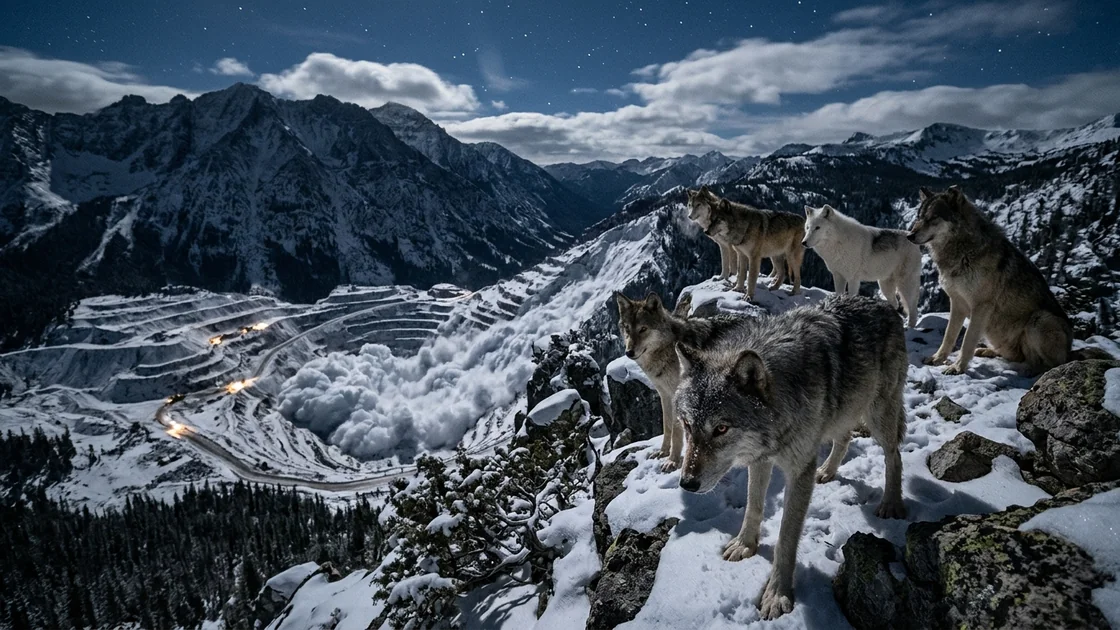
Driven from their ancestral valley by a ruthless and illegal open-pit mining operation, a starving pack of timber wolves retreats to the lethal, windswept ridges of Iron Peak. As the miners carve up the mountain and poison the meltwater, the pack's aging alpha and an observant yearling watch the human crews use jury-rigged explosive charges to clear overhanging snowpacks above the treacherous supply road. Through patience, trial, and desperate hunger, the wolves learn how the pull-cord igniters function and begin systematically triggering massive avalanches to ambush supply convoys, eventually orchestrating a catastrophic slide that buries the entire industrial operation beneath millions of tons of snow and rock.
Part I: The Bitter Melt
The wind off the high divide carried three scents that had no business existing in the world of ice and spruce. The first was the greasy, throat-coating reek of burned diesel that hung in the hollows like a dead thing that refused to rot. The second was the sharp, metallic vinegar of nitric acid leaching from the settling ponds where the winter creeks used to run clear under their shelves of blue ice. The third was the smell of pulverized stone—not the clean, flinty odor of a natural rockfall after an autumn freeze, but the cooked, sulfurous dust of deep granite blown apart from the inside.
Kael stood on a wind-scoured spur of granite two thousand feet above the valley floor, his heavy gray coat frosted at the guard hairs, his breath puffing in short, rhythmic clouds that vanished instantly into the updraft. He was seven winters old, which was ancient for a wolf of the high country. A jagged ribbon of hairless black skin ran from the corner of his left eye down across his muzzle, a souvenir from a bull elk’s brow tine three Novembers ago. In the cold, his left shoulder ached where a stray bullet from a rancher’s rifle had chipped the bone during his second year. Yet his amber eyes remained sharp, fixed on the blazing cluster of halogen suns that had murdered the night down in the bowl of the valley.
Behind him, nestled in the lee of a twisted subalpine fir that grew nearly flat against the shale, the seven remaining members of the Silverthorn pack waited in the snow. They were curled nose-to-tail, conserving the meager heat their bodies could generate from the stringy meat of two snowshoe hares and a winter-killed mountain goat they had dug out of forty inches of crust four days prior.
Vesper, his mate, rose silently from the drift and padded to his side. She was smaller than Kael, nearly pure white except for a saddle of charcoal across her shoulders, and she moved with a liquid economy of effort that even starvation could not strip away. She pressed her cheek briefly against his scarred jaw, a quick greeting of pack-assurance, before turning her ears toward the valley below.
Down in the bowl, where the warm thermal springs once kept the sedge meadows open and drew herds of three hundred elk through the darkest months of the year, the earth had been skinned alive. Great terraced steps of raw, bleeding mud and fractured shale spiraled downward into a flooded pit. Even through the falling snow, the yellow machines were moving. They looked like bloated beetles crawling across a carcass. Huge haul trucks with tires twice the height of a standing man groaned up the switchbacks, their exhaust stacks belching black plumes that stained the falling flakes before they could even touch the ground.
Two months ago, in the moon of the first heavy frost, the machines had come up the old logging trace at the mouth of the gorge. They had not stopped at the timberline. They had brought chainsaws, bulldozers, and men with rifles who shot at anything that moved along the treeline. The Silverthorn pack had denned in the cedar bottoms near the thermal springs for six generations. The roots of the ancient trees knew the shape of their bones. When the first charges went off—twenty tons of ammonium nitrate packed into drill holes along the granite bench—the shockwave had collapsed the old bank den where Vesper’s sister and two yearlings had been sheltering from an early sleet storm. Kael had dug until his claws were torn down to the quick, staining the mud with his own blood, while the yellow blade of a bulldozer roared fifty yards away, pushing a wall of uprooted cedars over the grave before he could even smell the bodies go cold.
They had been pushed up into the White Teeth, the barren alpine zone above eight thousand feet where nothing lived in January except the ravens, the ptarmigan, and the wind.
A smaller shadow detached itself from the huddle under the fir tree and trotted toward the alphas. It was Lark, a female from their previous spring’s litter. She was gangly, all long legs and oversized ears, her ribs showing like the slats of a wicker basket beneath her winter coat. Unlike her littermate Rook, who responded to hunger with a sullen, snapping irritability, Lark possessed a restless, probing curiosity that Kael found both troubling and necessary. She did not look down into the pit as Kael and Vesper did. Instead, her yellow eyes were fixed on the long, serpentine ribbon of the supply road—the Spine—that clung to the eastern wall of the gorge, winding four miles from the pit up toward the southern pass before dropping down to the distant highways of the human world.
Lark lifted her nose, testing a localized eddy of air that curled up the granite chute directly beneath their paws. She gave a low, nasal whine, little more than a vibration in her chest, and pawed at a stunted juniper bush.
Kael stepped over and lowered his broad head to the spot. Beneath the smell of pine pitch and dry snow, there was the faint, oily residue of two-stroke exhaust and the sour tang of chewing tobacco. Men had been up here on the ridge. Not down in the pit, where they belonged with their lights and their iron teeth, but right here on the knife-edge of the peaks.
Kael’s hackles rose, a stiff ridge of silver and black hair standing up between his shoulder blades. The valley was gone, swallowed by noise and poison. If the men took the high ridges too, there was nowhere left to go. To the north lay the territory of the Blackwater pack, twelve strong and fiercely territorial; to the west lay sixty miles of vertical icefields where not even a mouse could find a seed to eat.
Down in the pit, a siren began to wail—three long, rising shrieks that echoed off the cirque walls and set the pack’s ears flattening against their skulls. Bram, the massive, one-eared beta male who served as the pack’s heavy anchor during elk hunts, stood up from his bed in the snow and growled deep in his throat, a sound like grinding river stones. He hated the siren more than any of them. It always came before the ground shook.
Five seconds after the third wail died away, the floor of the pit flashed with a dull, orange-white light that illuminated the undersides of the snow clouds. A heartbeat later, the shockwave hit the ridge through the rock itself, vibrating through the pads of Kael’s paws, followed by the rolling, chest-crushing thunder of the blast. High above them, on the steep forty-degree lee slopes of Iron Peak, a thin slab of wind-packed snow fractured with a sound like a snapping pine bough and whispered down the rocks for thirty yards before fanning out into harmless powder.
Kael watched the small slide trickle to a halt. His golden eyes narrowed. Then he looked back down at the Spine, where three fully loaded haul trucks were creeping bumper-to-bumper along a narrow shelf carved into the cliffside, directly beneath five hundred vertical feet of overhanging, snow-choked gullies.
He did not think in the way the men below thought, in maps and schedules and balance sheets. He thought in weight, in balance, in the way an old bull elk’s hock would give out when driven into deep crust, in the way river ice groaned before it swallowed a careless yearling. He knew that the mountain was heavy with winter, and that the men down on the road were very small beneath it.
Down in the corrugated steel trailer that served as the site office for Apex Basin Extraction, Vance Mercer poured lukewarm coffee from a dented thermos into a plastic mug and stared at the barometer bolted to the plywood wall. The needle was dropping again. It had been falling steadily since noon, slumping toward the low end of the dial like a tired man sliding out of a chair.
"Another fourteen inches by daybreak," Mercer muttered, not turning around as the trailer door banged open, letting in a swirl of fine, dry snow and the deafening roar of the primary rock crusher outside. "Maybe twenty on the crest."
Tully stepped inside, kicking his heavy insulated pac-boots against the threshold to knock off the gray slush. He was a wiry, grease-stained man in his forties who had lost his blasting license in Nevada after a fly-rock incident took out a county water tank. That made him cheap, and more importantly, it made him quiet. Behind him came Garrett, younger and broader, carrying a crate of surplus military friction igniters and two coils of bright red waterproofing cord.
"Crusher two is throwing sparks off the main bearing again, Boss," Tully said, pulling down his neoprene face mask to reveal wind-burned cheeks and a three-day stubble stained yellow around the mouth from unfiltered cigarettes. "And the boys on the haul rigs are bitching about the Grade Four switchback. The cornice up on Widow’s Shelf is leaning out over the road like a wave about to break. One of the drivers—Miller—says he ain't taking twenty tons of high-grade cobalt concentrate under that overhang after midnight unless we drop it first."
Mercer turned slowly. He was a tall man who wore a clean goose-down parka over oil-stained khaki trousers, a man who had spent twenty years scouting mineral veins for major conglomerates before realizing how much faster a man could get rich if he skipped the five-year environmental impact statements, the federal lease auctions, and the reclamation bonds. They were eleven miles inside the boundary of the Sawtooth Wilderness Area. On paper, his company was grading a private timber road twelve miles to the south. In reality, under the dense, unbroken cloud cover of the worst Northern Rockies winter in thirty years—clouds that blinded commercial imaging satellites and kept the Forest Service spotter planes grounded in Boise—he was gutting the richest surface pocket of tantalite and cobalt in North America.
He had forty-five days left. Once the late March sun started breaking up the cloud deck and the backcountry ski tourers started poking around the lower passes, they had to be gone. The heavy machinery would be driven out, the temporary bridges blown, and the ore already sitting in unmarked shipping containers in a rail yard in Spokane.
"Miller gets paid nine hundred dollars a day to keep his foot on the throttle and his mouth shut," Mercer said, his voice flat and dry. "If he stops that rig on the Spine, I’ll dock him three days' pay and make him walk back to town in his socks."
"He ain't wrong, though, Vance," Garrett spoke up from by the stove, holding his thick, gloved hands over the glowing red coil of the electric heater. "Me and Tully rode the sleds up the ridge line at dusk. The wind’s been blowing forty knots out of the northwest for three days straight. It’s loading every leeward chute between here and the pass. You’ve got four feet of dense wind-slab sitting on top of two inches of November sugar-snow. You drop a wrench up there, the whole side of the mountain’s gonna peel off down to the granite. If it catches a convoy on the switchbacks, you won't find those trucks till July, and you sure as hell won't get your ore out before the feds fly over."
Mercer took a slow sip of his coffee, his eyes flicking back to the hand-drawn topographical map taped over the desk. Four red X's were marked in grease pencil along the ridge directly above the five-mile supply road: The Gate, Widow’s Shelf, The Chute, and highest of all, right beneath the jagged summit pyramid, The Crown.
A legitimate mine in avalanche country would have hired a certified snow-safety team. They would have had a leased Bell helicopter dropping twenty-pound cast primers from the air at dawn, or permanent Gazex exploder tubes bolted into the rock, fed by propane lines and triggered by computer from a warm bunker two miles away. Mercer couldn't use helicopters—their transponders and flight plans drew FAA eyes, and the sound of rotor blades carried thirty miles down the river canyons to the ranching towns. And he didn't have the time or the money to weld steel exploder pipes into wilderness granite.
Instead, they used Tully’s specials.
Along the starting zones of the four main avalanche paths, Tully and Garrett had driven six-foot iron fence posts into the shale before the deep December freezes set in. Wired to the base of each post, buried beneath the accumulating snowpack, sat wooden cases of stolen forty-percent gelatin dynamite wrapped around bags of ANFO—ammonium nitrate and fuel oil—linked together with detonating cord. Running up from the buried charges, threaded through greased PVC pipes strapped to the iron posts so the shifting snow wouldn't pinch them, were six-foot lengths of heavy red nylon cord ending in fat wooden toggle handles.
Each red cord was tied directly to the pull-ring of an M60-style weatherproof fuse igniter. A man rode up the safe windward side of the ridge on a snowmobile, walked out to the rock outcrop at the top of the chute, grabbed the wooden toggle, and gave it a hard fifteen-pound yank. The friction pin fired the percussion cap, lighting a three-minute time fuse that burned down through the PVC pipe at two feet per minute and set off the buried charge, flushing the unstable snow out of the chute while the road below was held clear by radio.
It was crude, illegal as hell, and required resetting the charges by hand every time a chute was blown, which meant Tully had wired up three separate posts at each of the four stations so they could fire them sequentially through the winter without having to dig out frozen boxes in a blizzard.
"How many live posts we got left up on Widow’s Shelf?" Mercer asked.
"Two," Tully said. "Post A blew last Tuesday. Post B and Post C are still hot, primed with forty pounds of ANFO each. And we got three live posts at the Chute, two at the Gate, and the big motherlode up at the Crown."
"Leave the Crown alone," Mercer said sharply. "That five-hundred-pound cache is strictly for March when the deep wet-slabs start creeping toward the main portal. You blow the Crown now, you’ll bury the lower switchbacks thirty feet deep and it’ll take the D9 cats four days to dig the road back out." He looked at his watch. It was 9:15 PM. "Hold the outbound convoy at the pit staging area at ten. Take the sleds up the north spine, pull Post B on Widow’s Shelf and Post A on the Chute. Let the dust settle, run the rotary plow through the debris toe on the road, and get those trucks moving by midnight. I’ve got two fuel tankers waiting at the highway junction, and if we don't keep the diesel flowing, the generators freeze."
"It’s twenty below up on that ridge with the windchill, Vance," Garrett muttered, though he was already reaching for his goggles.
"Then wear two pairs of socks," Mercer said, turning back to his ledger. "And take the rifle. The night-shift loader operator said he saw wolf tracks down near the grease dumpster behind the mess tent yesterday. Big ones. I don't want those mangy bastards chewing through the hydraulic lines on the spare excavators like the coyotes did in Montana."
Tully grinned, patting the battered Ruger Mini-14 slung across the handlebars of his snowmobile outside. "I see a wolf up there, Boss, I’ll bring you back a new collar for that fancy jacket."
The sound of the snowmobiles reached the pack long before the machines themselves came into view. It was a high, angry, wasp-like whining that rose and fell as the machines fought their way up the steep windward hogback on the far side of the peak.
Kael led the pack fifty yards back from the crest, melting into a jumble of frost-split boulders where the wind kept the granite mostly bare, leaving no fresh tracks to catch a spotlight. They lay flat on their bellies—Kael, Vesper, Bram, Lark, and the three others: Ash, Cinder, and Rook. Their coats, thick with winter underfur, took on the exact gray-and-white mottling of the lichen-covered gneiss and wind-scoured snowdrifts.
Lark lay directly beside Kael, her chin resting on her front paws, her ears swiveling independently like radar dishes as the whine grew louder. The smell hit them first: a thick plume of unburned gas and hot rubber carried over the ridge crest by the gale. Then came the twin yellow beams of the headlights, slicing through the blowing spindrift, bouncing wildly as the machines crested the saddle above Widow’s Shelf.
The two men stopped their machines twenty yards from the drop-off, leaving the engines idling. Their headlights painted the stark, vertical world in harsh relief, illuminating the row of three iron fence posts sticking out of the snow near the lip of the gully. From each post, a bright red cord with a wooden stick tied to the end dangled against the white plastic pipe, whipping frantically in the gale.
Kael watched without blinking. He had seen the men visit these iron trees twice before since the moon had gone dark, and both times, the mountain had roared afterward.
The smaller man—Tully—climbed off his roaring sled, his boots squeaking loudly on the dry, styrofoam-like snow. He walked with the clumsy, stiff-legged gait of a human bundled in too many skins. He approached the middle iron post, took the wooden stick in both gloved hands, braced his boot against the pipe, and leaned back with a sharp jerk.
Snap.
Even over the idle of the snowmobiles and the howl of the wind, Lark heard the metallic pop of the friction pin inside the weatherproof housing. A tiny puff of blue-white smoke spurted from the joint where the red cord entered the pipe, carrying a sharp, biting odor that made Lark’s nose wrinkle—potassium chlorate and sulfur, the smell of a lightning strike mixed with burned hair.
Inside the PVC pipe, invisible to the wolves, the black powder core of the safety fuse began to spit and hiss, burning downward toward the buried dynamite at a steady, inexorable crawl.
The man dropped the severed red cord and the wooden handle into the snow at his feet, turned, and trotted quickly back to his machine.
That was when the second man, Garrett, swept the beam of a handheld spotlight across the boulder field to check the upper slope. The white beam flashed across granite, ice, and stunted krummholz—and caught the pale green retro-reflective tapetum of Rook’s eyes before the young male could duck his head.
"Hey!" Garrett yelled, his voice muffled by his helmet. "Tully! Look there, in the rocks! Seventy yards out!"
Bram tensed beside Kael, a low rumble starting in his chest as the harsh light pinned them. Kael gave a single, sharp snap of his jaws—the silent command to scatter and drop back over the false crest.
The wolves exploded out of the rocks like windblown smoke, staying low, using the troughs between the snow-dunes to break their silhouettes. Behind them, Tully cursed, wrenched the rifle from his scabbard with clumsy, gloved fingers, and levered the bolt.
Crack-crack-crack-crack!
The .223 rounds shrieked off the frozen granite, sending up showers of stone splinters that whined into the dark. One bullet clipped the top of a boulder six inches above Vesper’s tail; the next punched through the crust right between Bram’s hind legs, kicking up a geyser of ice before a third round caught the big beta male across the fleshy crest of his rump.
Bram let out a short, barking yelp, stumbling into a drift before scrambling back to his feet, a dark ribbon of blood immediately freezing into black beads along his gray flank.
"Get back on the sled, you idiot!" Garrett shouted, grabbing Tully’s shoulder as the older man tried to line up another shot into the swirling dark. "That’s a ninety-second fuse you cut down, not a three-minute! We gotta clear the ridge before the air-blast hits!"
Tully spat into the snow, shoved the hot rifle back into the boot, and gunned his throttle. The two snowmobiles spun around in tight arcs, their tracks throwing rooster tails of powder, and vanished back down the windward slope toward the next station along the ridge.
Four hundred yards away, sheltered in a deep wind-scoop behind a pinnacle of dark basalt, the pack regrouped. Vesper immediately went to Bram, licking the shallow furrow across his hip where the copper-jacketed bullet had parted the fur and grooved the muscle. It was a surface wound, bleeding little in the intense cold, though Bram’s eyes were yellow with rage as he licked his own lips, tasting the copper of his blood.
Kael did not look at the wound. He stood on the pinnacle, looking back toward the lone iron post at Widow’s Shelf.
A moment later, the snow around the base of the middle post bulged upward like the back of a breaching whale. A muffled, subterranean whump punched through the mountain, followed by a geyser of black dirt, shattered shale, and gray smoke that shot fifty feet into the blizzard.
The shockwave did what the miners wanted it to do. Across the entire hundred-yard width of the Widow’s Shelf starting zone, a jagged fracture line three feet deep unzipped across the snowpack with the sound of tearing canvas. The entire slab tilted forward, shattered into ten thousand white blocks, and poured over the cliff face into the dark abyss above the road.
For nearly a minute, the mountain shook as fifty thousand tons of snow roared down the gully, snapping fifty-foot Douglas firs like dry twigs, scouring the supply road twenty feet deep under packed ice, and finally slamming to a halt against the far wall of the canyon down by the poisoned creek.
Then the wind swept the smoke away, and a vast, hollow silence settled over the peak.
Lark crept up the basalt pinnacle until her shoulder brushed Kael’s flank. Her heart was hammering against her ribs—not from fear of the rifle, nor from the terror of the thunder, but from a fierce, electric connection that had just snapped together behind her eyes.
She looked at the place where the man had stood. She remembered the sight of him leaning back with the wooden stick in his paws. She remembered the sharp snap, the smell of the blue smoke, the pause while the two-legged things ran away, and then the mountain waking up to sweep the world clean.
Twenty minutes later, after the whine of the snowmobiles had faded to the south where they were setting off a second blast at the Chute, Kael and Lark padded silently back across the boulder field toward Widow’s Shelf. Vesper and the others stayed back in the rocks, watching the ridge.
The blast crater at Post B was a smoking black pit in the white slope, smelling foully of fuel oil and burned sulfur, its iron post twisted like a corkscrew and blown thirty yards down the stripped rock of the gully.
But ten yards to the left stood Post C. It had been beyond the fracture line of the slab, anchored on a separate rocky rib that fed into the northern fork of the same chute. The snow around it was still four feet deep, untouched, groaning softly under the weight of the fresh drift the wind was piling onto it every minute.
Kael stopped three paces from the post. Lark stepped closer, stretching her long neck out until her black nose was an inch from the bright red cord and its six-inch wooden toggle handle. The toggle was made of unpainted birch, roughly an inch thick, stained with the salty grease of Tully’s leather gloves and the faint, sweet scent of engine oil.
Lark opened her jaws slightly and touched the wooden stick with her front teeth. It was hard, like a dried rib bone from an old carcass. When she nudged it, the red cord pulled taut against the brass ring sticking out of the grey plastic pipe, offering a stiff, springy resistance.
Kael gave a low, warning rumble in his throat. Not now. Down on the road below, there was nothing but empty snow and the distant clank of a rotary plow beginning its slow climb from the pit to clear the debris Tully had just dropped. There was no meat on the road. There was no reason to wake the thunder when the canyon was empty.
Lark released the wood, stepping back into Kael’s tracks as the alpha turned back toward the high rocks. Yet as she trotted behind him into the blinding dark of the storm, she rolled her tongue over her teeth, memorizing the taste of the birch wood and the exact tension of the little wire ring inside the pipe.
Part II: The Red Vine and the Iron Herd
For the next six days, the sky did not open. A great Arctic trough stalled over the Northern Rockies, pumping moisture off the Pacific and slamming it directly into the freezing wall of Iron Peak. It snowed an inch an hour, then two, then three. In the high basins, the old boulders vanished beneath smooth, pillowy whales of white. The stunted firs became ghosts, weighted down until their branches froze into the crust, forming narrow, suffocating ice caves where the Silverthorn pack spent twenty hours a day curled in a tight knot against the thirty-below gale.
Hunger was no longer a sharp pain in their bellies; it had become a dull, cold weight that lived in their marrow. Cinder, the oldest female after Vesper, had stopped rising when the others went out to check the ptarmigan roosts along the scree slopes. Her pads were cracked from the blue ice, and when she breathed, there was a wet, rattling click in her lungs. Rook and Ash spent hours gnawing on a frozen strip of mountain goat hide they had carried up from the lower timber a week ago, chewing the hairless leather until their gums bled just to give their stomachs something to work on.
Kael knew that within three days, Cinder would not get up at all, and two days after that, the pack would either have to eat their own dead or come down off the mountain straight into the barrels of the miners’ guns.
On the seventh night, the wind abruptly died. The clouds did not break, remaining as a low, suffocating ceiling of iron gray just above the summit pyramid, but the screaming gale subsided to a stealthy, freezing drift. In the sudden quiet, the sounds from the valley below rose with crystal clarity.
The pack emerged from their snow cave beneath the krummholz, shaking the powder from their gaunt frames. They walked in single file, each wolf placing its paws precisely in the deep prints of Kael before them to save energy—the ancient single-track gait of the winter hunter.
When they reached the granite spur overlooking the valley, they found the world below changed. The deep snow had choked the Spine. Down at the mouth of the gorge, four miles toward the southern pass, a cluster of red and amber lights flashed against the snowbanks. A supply convoy coming in from the highway had stalled behind a massive rotary snowplow whose main auger gearbox had sheared a pin in the heavy drifts near the Gate.
Closer to the pit, directly beneath the towering, snow-choked gullies of the Chute and Widow’s Shelf, three vehicles sat idling on the narrow shelf of the road, waiting for the plow to clear the lane ahead so they could descend. At the front was a heavy black pickup truck with a steel headache rack and a dual-cab full of armed relief guards. Behind it sat a two-ton flatbed supply truck covered in a heavy canvas tarp, and behind that, a smaller tracked utility carrier towing a portable generator.
Even from fifteen hundred feet above, the thermal updraft rising from the canyon floor carried a scent that made every wolf on the ridge freeze, their ears pricked forward, their nostrils flaring wide until the cold air burned their nasal passages.
Beneath the canvas tarp of the middle truck, stacked in wooden crates alongside drums of hydraulic fluid and boxes of blasting caps, was the bi-weekly rations shipment for the forty-man camp: six hundred pounds of frozen beef quarters, vacuum-packed pork loins, crates of bacon, and bags of dried suet. Even frozen solid, the rich, fatty odor of slaughtered cattle leaked through the canvas and rode the warm diesel exhaust straight up the vertical rock face of Widow’s Shelf.
Bram let out a low, trembling whine, saliva instantly pooling inside his black flews and freezing into tiny icicles on his chin. Rook took two stiff steps toward the cliff edge, his eyes locked on the canvas-covered truck as if he meant to leap down the vertical granite into the dark. Vesper intercepted him, snapping her teeth an inch from his muzzle and forcing him back onto his haunches.
Down on the road, the driver of the lead pickup cracked his window and tossed a glowing cigarette butt into the ten-foot snowbank beside the road. He picked up his CB mic, his voice crackling faintly out of the external speaker bolted to the flatbed’s cab.
"Base, this is Supply Lead. We’re still holding here two hundred yards south of Widow’s Shelf waiting on that rotary to clear the lower cut. How’s the ridge look? Over."
Down in the pit office, Mercer’s voice came back over the static, tinny and impatient. "Hold your position, Supply Lead. Tully and Garrett can't get the sleds up the north hogback tonight—the drifts in the saddle are eight feet deep and vertical. The wind’s died down anyway, so the slab ought to hold until we get the D8 dozer up the back trail at dawn. Just keep your rigs spaced out and stay in the cabs."
Kael did not understand the words, of course, but he understood the stillness on the ridge. The wasp-machines were not coming tonight. The deep, powdery drifts on the windward slope that required a wolf’s wide, webbed paws and light frame to traverse had defeated the heavy iron sleds.
The alpha turned his head slowly and looked two hundred yards north along the rocky spine, toward the northern fork of Widow’s Shelf, where Post C stood solitary and black against the six-foot wall of new snow that had piled up since the last blast.
The overhang above the road was monstrous. The six-day storm had built a rounding pillow of wind-packed snow nearly twelve feet thick across the forty-two-degree shale slab directly above the stalled flatbed truck. It was held in place only by the fragile tensile strength of its top crust and the narrow rock anchor at the top of the gully.
Kael looked at Vesper. The white female held his gaze for a long moment, then dropped her head and trotted down the back of the spur toward a narrow deer trail that switchbacked safely down through the timber at the far southern edge of the slide path. Bram, Ash, Cinder, and Rook followed her without a sound. They knew their jobs. When the herd was driven into the trap, the pack waited at the bottom of the draw.
Only Lark stayed behind with Kael.
Together, the old scarred male and the starving yearling moved along the knife-edge of the ridge. Where the snow was wind-scoured to bare rock, they trotted swiftly; where it had drifted into deep, soft pillows in the hollows, Kael broke trail, plunging up to his chest, lunging forward with powerful thrusts of his hindquarters while Lark swam through the trough he left behind.
When they reached the top of Widow’s Shelf, only the top two feet of Post C was visible above the snowpack. The PVC pipe had been buried almost to its collar, leaving the wooden toggle and six inches of red nylon cord resting directly on the surface of the crust like a dead ptarmigan’s foot.
Kael stopped at the edge of the rock island. His old instincts warred violently with his new understanding. For seven years, every fiber of his blood had told him that the things of men—steel traps buried in dirt holes, poisoned tallow baits dropped along fence lines, wire snares hung in willow runs—meant agonizing death. To put one’s teeth on a human tool was to invite the iron jaws to snap shut on a paw or the fire to burst in the dark.
Yet down in the canyon, the smell of beef fat rose through the freezing air, and back in the timber, Cinder was dying on her feet.
Lark did not have seven years of trap-fear etched into her bones. She had only known one winter, and in that winter, she had watched the world work by simple rules.
She stepped past Kael’s shoulder, placing her wide front paws carefully on the firm rock around the pipe. She lowered her head, sniffing the birch toggle. The smell of the man’s glove had mostly faded in the week of storm, washed clean by six feet of new snow, leaving only the smell of raw wood and the faint brass tang of the igniter ring.
She opened her jaws, fitted the birch stick securely behind her canine teeth across her broad premolars, and backed up a step until the red cord came taut.
Nothing happened. The cold had stiffened the grease inside the weatherproof brass sleeve of the M60 igniter, and the angle of the deep snow pinched the cord against the lip of the PVC pipe.
Lark let out a muffled grunt through her nose, planted her front paws wide, lowered her hindquarters like a wolf trying to tear the hamstring out of a downed moose, and gave a fierce, snapping jerk of her neck.
Wait—
The resistance was heavier than she expected. Her back paws slipped on the glazed ice covering the shale.
Kael moved instantly. He stepped beside his daughter, opened his heavy, scarred jaws, and clamped his teeth down over the left half of the six-inch birch toggle right beside hers, their muzzles pressed tight together, his gray fur mingling with her dark silver coat.
Together, two hundred and десять pounds of starving timber wolf leaned back on their haunches and ripped their heads backward.
POP.
The recoil threw both of them back a step into the soft drift. A sharp tongue of red sparks and acrid blue smoke shot out of the top of the pipe, singeing the whiskers on the right side of Kael’s muzzle and making Lark sneeze violently as the sulfur cloud washed over her face.
Deep inside the plastic pipe, the fuse began to hiss—a venomous, snakes-in-the-dry-grass sound that vibrated up through the iron post.
Kael did not wait to see the smoke clear. He spun on his heels, cuffed Lark’s shoulder with his muzzle to drive her ahead of him, and bounded back along the rocky spine into the deep wind-scoop behind the basalt pinnacle where they had sheltered from the bullets a week before.
They pressed themselves flat against the stone. Kael licked the singed fur on his lip, his ears pinned back, waiting.
One minute passed. Down on the road, the relief guard in the passenger seat of the pickup truck opened his door, stepped out onto the running board to relieve himself against the snowbank, and zipped up his coveralls, stamping his boots against the cold.
Two minutes passed. The hiss inside the pipe burned down past the frost line, down past the December crust, down into the dark hollow at the base of the iron post where forty pounds of ammonium nitrate soaked in diesel fuel sat taped around four sticks of forty-percent gelatin dynamite.
At two minutes and fifty-four seconds, the burning core hit the mercury fulminate inside the blasting cap.
The mountain did not roar at first; it leaped.
A dome of six-foot snow lifted ten feet into the air in eerie silence before the orange fireball tore through its center, turning the night into blinding noon for a tenth of a second. Then the concussion wave slammed into the basalt pinnacle, knocking a shower of icicles down onto Kael and Lark’s backs, as the whole northern bowl of Widow’s Shelf let go at once.
Because the storm had loaded the slope with six days of uncompacted, high-density slab, the resulting slide was four times larger than the controlled releases Tully had triggered the week before. The fracture line propagated instantly across the entire four-hundred-yard width of the upper basin, jumping the rock ribs, tearing out a twelve-foot-deep wall of snow that accelerated from zero to eighty miles an hour in four seconds flat.
Down on the Spine, the guard standing on the running board of the pickup looked up as the air above him began to scream.
"Jesus Christ!" he screamed, though the wind of the approaching powder cloud tore the words straight out of his throat before the men inside the cab could hear him.
He didn't even have time to pull the door shut. The air-blast hit first—a hurricane-force wall of displaced air and ice crystals moving at a hundred and ten miles an hour that blew out every window on the uphill side of the three trucks and ripped the canvas tarp and its wooden bows clean off the flatbed in a single shred.
Half a second later, two hundred thousand tons of wet, concrete-hard snow slammed into the Spine.
The lead pickup truck was lifted off its tires like a plastic toy in a gutter and hurled sideways over the cliff edge, tumbling end-over-end down four hundred vertical feet of timbered gorge before vanishing beneath the boiling white river at the bottom.
The rear utility carrier and its generator trailer were sheared in half against a granite outcrop, buried under thirty feet of debris that instantly froze into the consistency of bricks through friction-melt and pressure.
The middle truck—the heavy flatbed—was caught by the northern wing of the slide just as its rear axle wedged against a steel rock-bolt anchor in the cliff wall. The cab was crushed flat against the steering column, killing the driver instantly, while the flatbed frame twisted like a pretzel and tipped at a forty-five-degree angle over the edge of the abyss, half-buried in a fifteen-foot drift, dumping its cargo of wooden ration crates, cardboard boxes, and steel drums across the churned snow of the lower slope just where the slide path fanned out into the timber.
Kael and Lark waited on the pinnacle until the white powder cloud settled out of the air, leaving the moonlight—filtering faintly through the thinning cloud deck—gleaming off a smooth, freshly scarred chute of bare shale and ice. Down on the road, where the three sets of headlights had been shining three minutes before, there was only blackness, except for a single yellow clearance light on the twisted rear bumper of the flatbed, blinking weakly beneath three feet of snow.
Kael rose and shook the ice crystals from his coat. He trotted to the head of the deer trail and looked down into the canyon.
Halfway down the debris fan, five shadows detached themselves from the dark spruce timber and loped out across the hard, blocky surface of the avalanche toe. Vesper was already at the spilled cargo, her white tail held high in the stiff flag of a successful hunt.
Kael and Lark dropped off the ridge, taking the steep couloir along the flank of the slide path in long, sliding bounds, their legs acting as shock absorbers as they descended a thousand vertical feet in less than four minutes.
When they reached the debris fan, the smell of diesel and battery acid from the crushed truck was strong, mingled with the coppery stench of human blood from inside the crumpled cab. None of the wolves went near the cab. They had no interest in the men.
Fifty yards down the slope from the wreck, six heavy pine crates had smashed open against a granite boulder when the truck tipped. Spilled across the packed snow were dozens of forty-pound blocks of frozen beef chuck, slabs of salt pork wrapped in butcher paper, and a burst fifty-pound sack of dry tallow rendering cubes meant for greasing the crusher skids.
Bram was already standing over a quarter of beef, his massive jaws shearing through the heavy plastic vacuum-wrap and ripping off a three-pound slab of frozen red meat with the crunch of his carnassial teeth. Cinder was beside him, her weak legs braced wide as Vesper stepped back to let the sick female gorge first on the soft, high-calorie blocks of suet and lard that required no chewing to swallow.
Kael did not push into the pile immediately. He circled the downwind perimeter of the wreck, checking for survivors. Far below, at the very bottom of the gorge where the pickup had gone over, something metallic popped and hissed as a hot engine block settled into six feet of snow, followed by total silence. Nobody was climbing out of that hole.
Up toward the pit, a mile away around the blind bend of the canyon, the sirens hadn't even started yet; the curve of the mountain had muffled the blast, making it sound to the night shift like just another natural cornice drop in the back basins. It would be an hour before the rotary plow driver cleared the lower cut, backed up, and discovered that the road—and the three trucks behind him—had ceased to exist.
Kael trotted back to the shattered crates. Lark was tearing open a cardboard box of frozen pork loins, gulping down chunks of meat and fat whole in the frantic, bolting manner of a wolf who knows the scavengers are coming. Within ten minutes, each wolf had packed between twelve and fifteen pounds of pure meat and fat into their distended stomachs.
Still, Kael was not done. With his belly full and the warm, furnace-like energy of the beef fat already beginning to spread through his cold veins, he grabbed an entire twenty-pound slab of frozen bacon in his jaws, lifted his head to balance the weight, and gave a low, muffled woof around the meat.
Vesper immediately clamped her jaws onto a whole beef shoulder. Bram took another. Even Cinder, her eyes brighter than they had been in three weeks, picked up a five-pound block of tallow.
Weighted down, moving slowly back up the timbered draw before the first yellow headlights of the search party rounded the bend from the pit, the Silverthorn pack carried a hundred and twenty pounds of stolen meat back up into the inaccessible crags of the White Teeth, burying it in six separate caches beneath four feet of packed snow on the north face where the sun never touched.
As they climbed, Lark walked directly behind Kael. Every hundred yards, she paused to look back down at the dark scar on the mountain, and then up at the silhouette of the next set of iron posts standing against the skyline half a mile south at the Chute.
Part III: The Hunters on the Wire
"You’re telling me the fuse lit itself?" Mercer’s voice was dangerously quiet.
It was ten o'clock the next morning. A pale, watery disk of sun was visible through the high ice fog for the first time in a week, casting a dead, shadowless light over the ruins of Widow’s Shelf. Two D8 bulldozers and a front-end loader were roaring on the shelf below, pushing the mangled frame of the flatbed truck and the bodies of the four dead men into the canyon so they could grade a temporary bypass lane across the frozen avalanche toe.
Mercer, Tully, and Garrett stood on the ridge at the top of the chute, their snowshoes sinking six inches into the wind-crust beside the twisted remains of Post C.
"I didn't say it lit itself, Vance," Tully said, crouched down in the snow ten yards back from the blast crater, holding something between his greasy thumb and forefinger. "I said we didn't light it. Look here."
He stood up and held out the six-inch birch toggle and a foot of frayed red nylon cord that had been blown backward into the rocks when the igniter fired.
Mercer took the piece of wood, pulling off his insulated ski glove to squint at it in the flat light.
The birch was deeply scored on both ends by clean, conical punctures that had crushed the grain of the wood nearly a quarter-inch deep. Caught between a splinter on the left side and the knot of the red cord were two stiff, three-inch guard hairs—coarse, banded with silver, black, and white.
"Look at the snow around the rock," Garrett said, his voice tight, his eyes darting nervously toward the jagged wall of basalt boulders two hundred yards up the crest while his hands kept a white-knuckled grip on his twelve-gauge pump shotgun. "The wind scoured most of the tracks off the flats after the slide, but right here in the lee of this boulder, they’re plain as print. Two of 'em. One big as a calf, one smaller. They walked right up to the pipe, bit the handle, and pulled the pin."
Mercer stared at the wolf hairs stuck in the splintered birch. A cold, prickling sensation moved up the back of his neck, entirely separate from the twenty-below wind.
"Wolves chew on things," Mercer said, snapping the words out as if trying to convince himself. "Trappers see it all the time. They smell the sweat and the bacon grease from your gloves on the wood handle, they think it’s a bone or a piece of leather, they tug on it to carry it off, and the pin pops. It’s a fluke. A one-in-a-million goddamned fluke."
"Yeah?" Garrett pointed his gloved hand down toward the canyon floor. "And what about down there, Vance? Before the dozers got there at two in the morning, those bastards had hauled off damn near four hundred pounds of beef and pork out of the wreck. Didn't touch a single drum of oil, didn't chew on the tires, didn't go near the cab. They waited till the snow stopped moving, ran right down the chute they just blew, cleaned out the meat locker, and vanished before the rescue crew even got their boots laced."
"They’re scavengers!" Mercer barked, his face flushing dark red against the white collar of his parka. "They heard the blast, smelled the broken crates, and came down to eat! You think a pack of mountain dogs knows how a military friction fuse works? You think they’re sitting up on that peak timing our supply trucks?"
Tully didn't answer right away. He looked down at the tracks in the lee of the boulder, then up at the basalt pinnacle where he had fired four rounds from his Mini-14 into the pack the week before. He remembered the way the biggest wolf had stood on the skyline watching him pull the cord at Post B.
"Dogs ain't wolves, Boss," Tully said softly, spitting a brown stream of tobacco juice onto the crust. "Back when I was working the pipeline up on the North Slope, we had a single old female wolf figure out how to unlatch the steel spring-hasps on four different kitchen dumpsters along a fifty-mile haul road. We put padlocks on 'em, and she figured out that if she waited till the kitchen kid came out with two bags of trash and set one down to unlock the lid, she could rush him from behind the blind corner and take the bag while he climbed the fence. They watch you. All winter long, they got nothing to do up here in the dark except watch everything you do."
Mercer shoved the chewed wooden toggle into his parka pocket. He couldn't afford panic among the crew. He had already lost four men in the night’s slide—men whose families didn't even know what state they were working in, hired for cash out of barrooms in Elko and Butte—and if the rest of the drivers started believing the mountain was haunted by wolves setting off dynamite, the whole operation would mutiny before he got the remaining twelve hundred tons of high-grade tantalite out of the pit.
"Listen to me, both of you," Mercer said, stepping close to them so his breath steamed against their goggles. "You breathe a word of this wolf bullshit down in the mess trailer, and you walk out of here with zero pay. Tell the drivers the cold snapped the tension wire inside the M60 igniter on Post C. Tell 'em it was defective military surplus."
"And what about the rest of the posts?" Garrett asked. "We still got three live charges at the Chute, two down at the Gate, and the big five-hundred-pound cache up at the Crown."
"Go down the line today," Mercer ordered. "Cut the wooden toggles off every single pull-cord so there’s nothing for them to get their teeth around. Wrap the cords high around the top of the iron posts and wire 'em down with mild baling wire—tight enough that a wolf can't pull it loose with its mouth, loose enough that you can still yank it free with two hands when we need to blow a slope. Then take fifty pounds of venison scraps from the kitchen, lace it with sodium cyanide out of the leaching shed, and scatter it along the ridge line around every station."
Tully nodded slowly, a hard, unpleasant smile creasing his wind-chapped face. "Now that’s a language they’ll understand."
Four hundred yards away, lying flat on a high snow-cornice near the summit pyramid where the wind carried the humans' scent directly to them, Kael, Vesper, and Lark watched the three men snowshoe back toward their idling snowmobiles.
The pack was no longer starving. Their bellies were tight and heavy with beef tallow, their coats already regaining their oily, insulating sheen after a single night of heavy feeding. Cinder was back in the timber den, sleeping deeply atop a bed of dry spruce boughs with twenty pounds of frozen pork buried between her paws.
When Tully and Garrett rode their snowmobiles down the ridge line that afternoon, visiting the Chute and the Gate before climbing high to the base of the Crown, Kael and Lark shadowed them from the rocks above, never once showing a silhouette against the sky.
They watched Tully take a pair of steel pliers from his belt, cut the wooden sticks off the red cords at each post, and wrap the remaining nylon loops around the top of the iron stakes, twisting a thin strand of dull gray wire around them to hold them snug against the pipe.
Then they watched Garrett open a plastic bucket with yellow rubber gloves and toss chunks of dark red meat onto the snow in a circle around each set of posts.
An hour after the snowmobiles had whined back down into the valley for the night, the entire pack gathered at the edge of the rocks above the Chute.
Rook, young and bold now that his strength was returning, trotted immediately down the slope toward the scattered chunks of dark meat around Post A, his tail wagging once as he caught the rich scent of deer liver.
Twenty feet from the nearest bait, Kael intercepted him. The old alpha did not merely growl; he bowled Rook completely off his feet, pinning the yearling’s throat into the snow with his heavy chest while snapping his jaws shut an inch from Rook’s ear.
Rook went limp instantly, rolling onto his back and exposing his throat and belly in total submission, whining high in his throat.
Kael stepped off him and walked slowly toward the nearest chunk of liver sitting in a little cup of pink snow. He stopped three feet away, lowering his muzzle and inhaling in short, shallow puffs that kept the air in the front of his nasal cavity.
He knew that smell. Three winters ago, a federal trapper down in the lower river valley had set out tallow baits spiked with cyanide capsules and strychnine near a sheep allotment. Kael’s brother had bitten into one; he had died in less than three minutes, his back arched like a drawn bow in the snow, black foam bubbling from his clenched jaws while Kael watched helplessly from the willows.
Beneath the rich, metallic odor of deer liver, this meat smelled of bitter almonds, burned rubber, and the yellow latex of Garrett’s gloves. It was not food; it was human malice made solid.
Kael turned his back on the chunk of meat, lifted his hind leg, and soaked the poisoned bait in hot yellow urine.
Then he walked deliberately to the second chunk and marked it as well. Vesper stepped down from the rocks and urinated on the third. One by one, Bram, Ash, Lark, and finally a chastened Rook walked the circle around the iron posts at the Chute, burying every single poisoned scrap under kicked snow and fouling it with urine and scat until no predator on the mountain—not even a starving wolverine or a blind raven—would ever touch it.
While the others finished marking the outer baits, Lark walked up to Post A at the head of the Chute.
The wooden stick was gone. The red cord was looped around the rusted top of the iron fence post and secured with two twists of thin bailing wire, sitting four feet above the snow crust.
Lark reared up on her hind legs, resting her front paws lightly against the cold PVC pipe, and sniffed the knot. Without the wooden toggle, there was nothing broad to clamp her premolars across. When she tugged tentatively at the red cord with her front incisors, the thin gray wire bit into the nylon and held it fast against the iron post.
She dropped back to all fours, tilted her head sideways, and looked up at the wire. She smelled Tully’s pliers on it. She saw how the soft gray metal was twisted into two neat ears on the back of the post, holding the red loop prisoner just before it entered the brass collar of the igniter.
Down on the Spine, a mile of empty road wound through the twilight. Mercer had halted all daytime traffic while the bulldozers finished clearing the Widow’s Shelf slide, planning to run a double convoy of eight ore haulers and two fuel tankers through the canyon between midnight and four in the morning.
Kael padded over to Lark and looked up at the wired cord. His scarred face was unreadable, his amber eyes reflecting the first stars appearing in the clearing sky.
Two hours later, down in the site trailer, Mercer was going over the weight manifests when Tully banged through the door, his face pale beneath his windburn, holding a pair of binoculars in one hand.
"Get your coat, Vance," Tully said without preamble.
"What now?" Mercer snapped. "Did the rotary shear another pin?"
"The rotary’s fine," Tully said, his voice dropping to a hoarse whisper since the radio operator was sitting in the corner compartment. "Me and Garrett went down to the hair-pin turn on the lower road with the night-vision spotter scope to check if any of those bastards were belly-up around the Chute stations from the bait."
Mercer stood up slowly, closing the door to the radio room with his boot. "How many did you get?"
"None," Tully said. "They buried every piece of meat in the snow and pissed on it. And while we were watching through the green glass, the big one with the scar across his face and that skinny young bitch walked right up to Post A at the Chute. They stood up on their hind legs, chewed straight through the sixteen-gauge baling wire with their back teeth until the cord came loose, and then they just sat down in the snow beside it. Looking down at the road."
Mercer stared at him for five full seconds. "They pulled it?"
"No," Tully said, and for the first time since Mercer had known the man, his hands were trembling slightly around the leather strap of the binoculars. "They didn't pull it. Because there weren't any trucks under the Chute yet. They just unwrapped the cord so it was hanging loose, tested the slack once with their teeth to make sure it was free, and then lay down behind the rocks above the post. Waiting for the convoy."
The silence in the trailer was absolute save for the hum of the fluorescent tube overhead and the distant thrum of the diesel generators.
"Take the sleds back up there right now," Mercer whispered. "Both of you. Take the AR-15s, take the spotlights, and kill every single one of those things before the midnight convoy pulls out of the pit."
"In the dark?" Tully laughed shortly, an ugly, humorless sound. "Up in those rocks? Vance, it’s twenty-five below up there and the wind’s picking back up. You ride a sled up that hogback tonight, they’ll hear you coming from two miles off and vanish into the boulders until you freeze to death waiting for 'em."
"I have six million dollars of refined concentrate sitting in those haul trucks!" Mercer hissed, grabbing Tully by the front of his greasy Carhartt jacket. "If they drop the Chute on that convoy, I lose the trucks, I lose the drivers, and the road stays plugged till April! You get up there with Garrett, you disconnect the igniters on all three posts at the Chute, and you stay on that ridge with the rifles until every last truck clears the Gate at four in the morning. I’ll pay you ten thousand dollars cash bonus each the second the last rig hits the highway."
Tully looked down at Mercer’s hand on his coat, then slowly up into the boss’s frantic eyes. Ten thousand dollars was a lot of money in a winter when he couldn't work a legal job anywhere west of the Mississippi.
"Make it fifteen," Tully said evenly. "And we go up before you move a single truck."
The wind had shifted back to the southwest, blowing up out of the canyon floor and screaming across the icy spine of the Chute.
Kael knew the two men were coming twenty minutes before their headlights cleared the timberline on the north hogback. Not only did the high, angry whine of the snowmobiles carry miles through the thin mountain air, but the wolves had been watching the lights move around the pit trailers below like hawks watching mice in a stubble field.
Kael did not retreat into the back basins this time.
For two months, the pack had run whenever the rifles barked. They had given up their valley, their cedar den, their elk meadows, and their warm creeks. Now their bellies were full, their muscles were hot with beef blood, and they knew the layout of every cornice, wind-scoop, and vertical ice chute along the five-mile crest better than the men knew the floorboards of their own trailers.
Kael stood on the narrow saddle between Widow’s Shelf and the Chute and communicated with his pack through a series of subtle posture shifts, nose-touches, and low vocalizations that barely carried ten feet in the wind.
The trail the snowmobiles had to use to reach the Chute from the north hogback ran along a narrow, thirty-foot-wide bench beneath a towering, wind-sculpted overhang of snow known to the miners as the False Comb. It wasn't one of the main road chutes—anything that slid off the False Comb simply piled up in a rocky hanging cirque fifty yards above the main cliff, which was why Tully had only planted a single, small twenty-pound test charge there back in November to clear the sled trail, leaving the rusted post half-buried and forgotten.
Bram, Vesper, Ash, and Rook trotted down the windward slope to the lower end of the narrow bench, positioning themselves among a stand of dead, lightning-struck whitebark pines right where the snowmobile trail made a sharp, slow climb out of the trees.
Kael and Lark climbed fifty feet higher, straight up the rocky spine to the top of the False Comb, where the forgotten November post stuck out of the ice by eight inches.
Because Tully hadn't visited this post during the afternoon wire-wrapping run—having forgotten it was even still primed after two months of storms—its faded red cord and splintered wooden toggle still lay frozen into the top inch of wind-crust.
Lark set to work immediately with her front claws, scratching away the rime ice around the toggle until the red cord came free, while Kael watched the twin yellow headlights of the snowmobiles grinding up through the stunted timber below.
Tully was in the lead, riding a wide-track Polaris with his AR-15 slung across his chest for quick access, a high-output halogen headlamp strapped to his helmet scanning the rocks above. Garrett followed thirty yards behind on an older Ski-Doo, towing a small fiberglass utility sled loaded with wire cutters, flares, and a spare box of ammunition.
As Tully’s machine slowed to ten miles an hour to negotiate the steep, icy turn through the dead whitebark pines at the entrance to the bench, Bram stepped straight out into the middle of the trail thirty feet ahead of the skis.
The huge, one-eared beta male looked massive in the glare of the headlight, his frosted gray coat bristling, his breath steaming in the beam, the black furrow of Tully’s bullet scar clearly visible across his hip.
"Got you, you bastard!" Tully roared inside his helmet, letting go of the left handlebar to yank the AR-15 up to his shoulder while keeping his right thumb mashed on the throttle to close the distance.
Before he could flip the safety off with his clumsy glove, Vesper and Ash lunged out of the snowbank on his right, snapping their jaws at his boot and then whirling back into the dark between the dead trees, while Bram pivoted and bolted straight up the narrow bench directly beneath the overhanging lip of the False Comb.
Tully took the bait without a second thought. Cursing, his blood up, he gunned the Polaris onto the flat bench, chasing the big one-eared wolf through the deep drift, while Garrett accelerated behind him to bring his shotgun into range.
"Cut him off against the rocks!" Tully yelled into his helmet radio as the wolf seemed to flounder in the waist-deep powder directly beneath the middle of the overhang.
The moment both snowmobiles were fifty yards out onto the bench—trapped between the vertical wall of the overhang on their left and a three-hundred-foot drop into the dark cirque on their right—Bram reached the hard-packed rocks at the far end and leaped six feet up onto a granite shelf out of the deep snow.
Fifty feet directly above the two roaring machines, Kael saw the headlights converge beneath the belly of the cornice.
He looked at Lark. Both wolves already had their jaws clamped across opposite ends of the November toggle.
They pulled.
This time, Tully had rigged this early-season test charge with a fast, forty-five-second military combat igniter meant for clearing trail obstructions quickly.
Down on the bench, Tully braked hard as Bram vanished into the dark boulders at the far end of the shelf, his ski tips sinking into the drift. Garrett pulled up ten feet behind him, his engine bogging down in the heavy snow.
"Where'd they go?" Garrett shouted, sweeping his headlamp frantically across the blank white wall above them. "There were three more back in the trees!"
Then both men heard it—not over the roar of their engines, which were idling low, but through the sharp, crystal-clear air right above their heads: the unmistakable, spitting hiss of a burning time fuse buried in the overhang directly over their helmets, accompanied by a little curl of sulfurous blue smoke drifting down into the beam of Garrett’s headlamp.
Tully looked up. Through the blowing snow, thirty feet above the lip of the cornice, he saw the massive, scarred head of Kael looking straight down at him between two granite horns, the wolf's amber eyes glowing gold in the stray light of the headlamp.
"Back up!" Tully screamed, his voice cracking into a high, terrified shriek as he frantically jammed at the reverse lever on the Polaris’s gearbox. "He pulled the trail charge! Back the fuck up!"
Garrett didn't try to reverse his heavy sled with the trailer attached; he threw himself sideways off the seat into the waist-deep snow and began clawing his way back toward the whitebark pines on his hands and knees, losing his shotgun in the drift after the second lunge.
Tully’s machine lurched backward five feet, the track spinning wildly on buried ice, and then wedged firmly against the nose of Garrett’s abandoned Ski-Doo. Tully tried to kick his right boot free of the stirrup floorboard, his rifle sling tangling around the handlebar riser just as the forty-five seconds ran out.
BOOM.
Twenty pounds of dynamite wasn't huge compared to the road charges, but it was buried directly behind the keystone of a twenty-foot-tall wind cornice that had been building since Thanksgiving.
The cornice didn't slide; it broke off in five massive, solid blocks of blue wind-ice, each the size of a pickup truck, followed by a roaring curtain of dense slab snow.
One block of ten-ton ice dropped straight down onto the two wedged snowmobiles, crushing the steel frames flat against the rock bench and rupturing both gas tanks in a cloud of freezing mist. The rushing wave of the slab caught Tully half out of the saddle and Garrett ten yards back in the drift, sweeping men, mangled machines, rifles, and fiberglass sled sideways off the narrow bench like crumbs brushed off a table.
They fell three hundred vertical feet down the near-vertical rock face into the enclosed bowl of the hanging cirque, followed by ten thousand tons of ice blocks that thundered down on top of them for forty seconds, filling the bottom of the rocky pocket twenty feet deep and sealing it tight.
Up on the crest, Kael stood still until the last rattle of loose shale died away in the dark cirque below.
There was no movement down in the bowl. No lights shone through the twenty-foot plug of jagged blue ice blocks. Only the faint smell of raw two-stroke gasoline drifted up from a cracked fuel line buried deep under the snow, and within five minutes, the falling flakes had covered even that.
Kael turned away from the edge. The night was only half over, and down in the brightly lit pit, the eight heavy ore haulers were warming up their turbo-diesels, their exhaust stacks beginning to roar in unison as they formed up for the final run up the Spine.
Part IV: The Long Spine
By two o'clock in the morning, Vance Mercer knew Tully and Garrett were dead, or at least gone.
For an hour, he had stood in the radio room of the site trailer, barking into the base-station handset on every frequency they had—Channel 1 for the mine crew, Channel 4 for the road guards, and the private VHF tactical channel Tully used on the ridge. Nothing came back except the endless, frying-bacon hiss of mountain static.
"Maybe their batteries froze up in the wind," the young dispatcher, a twenty-two-year-old dropout from Coeur d'Alene named Kip, offered weakly, his eyes fixed on the red digital clock above the console. "Those handheld Motorola bricks drop dead in ten minutes if you take 'em out of your coat at twenty below."
"Both of them?" Mercer snapped, pacing the six-foot length of the plywood floor. "And the base radio mounted on Tully’s Polaris? That runs straight off the alternator."
"We heard a thump up near the north saddle about midnight," Kip said, swallowing hard. "Sounded smaller than a road charge. Maybe they blew a cornice on the trail to get through to the Chute and buried their sleds. If they’re walking out on snowshoes down the back hogback, it’ll take 'em till dawn to reach the pit."
Mercer stopped by the window and pulled back the aluminum blind.
Outside, in the glare of the halogen floodlights, the pit was dead quiet. He had shut down the rock crushers and the excavators at midnight. Every piece of refined tantalite and cobalt concentrate they had extracted over the last nine weeks—eleven hundred tons of black, heavy sand packed into reinforced two-ton super-sacks—was loaded onto the beds of eight massive Caterpillar 773 articulated haul trucks and six highway-legal Kenworth semi-dumps lined up at the bottom of the Spine.
The storm was clearing fast. Through the rents in the cloud deck, the stars were shining with a hard, diamond-like brilliance, and the temperature had plunged to thirty-two below zero. A clearing sky meant high pressure. High pressure meant that by noon tomorrow, every satellite passing over Idaho would have a crystal-clear photograph of an eight-hundred-foot open-pit mine and five miles of black diesel soot smeared across a federal wilderness area, and by three in the afternoon, Forest Service helicopters would be hovering over the ridge.
This was it. Either this convoy made it over the four-mile climb of the Spine to the southern pass before the sun came up, or ten million dollars of ore stayed in this hole forever and Mercer spent the next fifteen years in a federal penitentiary in Florence.
"Did Tully say they cut the wood handles off the cords at the Chute and the Gate this afternoon?" Mercer asked, not looking at Kip.
"Yeah," Kip said. "Garrett told me at supper they wired every single loop tight to the iron posts from the Gate all the way up to the Crown. Only one they pulled was Post A at the Chute, and you said Tully went back up to disconnect that one."
"Even if he didn't make it to the Chute before his sled broke down," Mercer reasoned aloud, his mind racing through the cold math of desperation, "the cold has locked the snowpack tight since the wind died at midnight. Thirty below freezes wind-slab into concrete. And even if a wolf is sitting up there by Post A right now, without those wooden handles, it can't get enough leverage with its jaws on a slick nylon string in the dark to pop a fifteen-pound military friction pin."
He turned back to the console and grabbed the heavy silver microphone for the convoy channel.
"All rigs, this is Mercer," he said, his voice booming out over the yard speakers and inside the warm cabs of the fourteen trucks idling in line. "The ridge crew has secured the upper stations and is walking out down the back trail after a sled breakdown. The sky’s clearing and the temperature’s thirty-two below—the snowpack is locked up tight. We are rolling the whole train right now. Keep fifty yards between rigs, keep your spotlights sweeping the uphill banks, and do not stop for anything until you cross the pass and hit the county pavement. Lead truck, put it in gear."
Outside in the freezing yard, air brakes hissed in unison. A massive cloud of white diesel steam erupted from fourteen vertical stacks as the lead vehicle—an armored Ford F-550 crew-cab fitted with a steel V-plow on the bumper and two guards with Remington 870 shotguns riding in the bed behind cab-mounted floodlights—lurched forward onto the bottom ramp of the Spine. Behind it, the eight giant off-road haulers and six Kenworths began their slow, grinding, ten-mile-an-hour climb up the mountain, their tires chaining loudly against the packed ice.
Mercer grabbed his shearling coat, a pair of night-vision binoculars, and a heavy .308 hunting rifle from the rack behind his desk. He ran out the door and swung himself up into the passenger seat of the fourth vehicle in line—his own four-wheel-drive Suburban, driven by his head mechanic, tucked safely between two sixty-ton haul trucks.
From the high rock spur above the Chute, the ascending convoy looked like a fiery centipede crawling up the black wall of the gorge. Twenty-eight headlights and a dozen roof-mounted halogen spotter beams cut through the freezing air, painting the snowbanks blinding white while the roar of fourteen heavy diesel engines fighting a twelve-percent grade filled the entire basin with a deep, throbbing vibration that shook loose powder from the spruce boughs.
The Silverthorn pack stood together at the top of the Chute.
They had heard the men down in the hanging cirque stop screaming two hours ago, before the cold and the weight of the ice had finished them. They had watched the lights in the bottom of the pit go dark one by one as the machines stopped chewing the earth and gathered into a single, long herd at the foot of the trail.
Kael smelled the change in the air. The big machines were leaving, carrying the men and their noise out of the valley.
Yet Kael was a wolf. When a crippled bull moose turned to hobble out of the timber, the pack did not stand back and watch it walk away; they tore its tendons out from behind so it could never return to trample the pups in the spring. The valley floor was ruined, poisoned and stripped, and for the last two months, everything that had died on this mountain had died because of the roaring iron herd down on that shelf.
Lark stood at Post A of the Chute, where she and Kael had bitten through Tully’s baling wire earlier in the evening. Ten yards to her left stood Post B, and ten yards beyond that stood Post C. Working methodically over the last hour while the men down in the pit were arguing on the radios, Bram and Kael had used their massive back carnassials—teeth designed by two million years of evolution to shear through the two-inch femur bone of an adult bison—to snap the light sixteen-gauge mild steel wire on Post B and Post C as well.
All three red nylon cords now hung loose against their plastic pipes, their cut ends frayed where Tully had snipped off the wooden toggles.
Mercer had been right about one thing: without the wooden sticks, a wolf could not grip the slick, frozen quarter-inch nylon cord between its teeth hard enough to pull a fifteen-pound friction pin before the cord slipped right through its incisors.
Lark had already tried it on Post B twenty minutes ago, her teeth scraping uselessly off the glazed nylon until her gums bled.
Down on the road, the lead plow truck passed safely beneath the empty, scarred gully of Widow’s Shelf and entered the half-mile straightaway that ran directly under the towering, forty-five-degree snowfields of the Chute.
Up on the ridge, Lark looked down at the frayed red loop of Post A. She couldn't hold it in her teeth.
Instead, she did what she had done four days ago when she was trying to pull a frozen, grease-slicked beef rib out from between two wedged rocks in their meat cache: she raised her right forepaw, slipped her tough, hooked dewclaw and four main toes directly through the six-inch loop where the wooden toggle had been tied, let the braided nylon cinch tight behind the wide pad of her wrist joint, and then clamped her jaws down over the cord above her paw to lock the hitch in place.
She wasn't pulling with her teeth anymore. She was pulling with the entire skeletal frame of her shoulder and back.
Lark threw her weight backward into the snow.
POP.
The friction pin fired in a shower of red sparks. Lark shook her paw once to clear the loose loop from her wrist and bounded ten yards south to Post B, where Kael was already standing.
The old alpha had watched her every move. Without hesitation, Kael shoved his massive scarred forepaw through the loop of Post B, bit down on the standing line above his knuckle to keep it from slipping over his claws, and lunged backward off the rock shelf.
POP.
Two fuses were now hissing inside their pipes at the head of the Chute. At the third station, Post C, Vesper had tried to copy them, but Tully had cut that cord an inch shorter than the others, leaving a loop too small for a paw to pass through. Bram stepped in, took the tiny frayed knot at the very tip of the cord behind his side canine teeth, wrapped his head sideways so the nylon wound once around his muzzle behind his nose leather, and threw all one hundred and thirty pounds of his body down the windward slope.
The nylon burned a raw red groove across the bridge of his snout before the pin finally gave way with a sharp snap, sending him tumbling head-over-heels into a drift while the third pipe began to spit blue sulfur smoke into the starlight.
Down on the Spine, the lead F-550 plow truck and the first two Caterpillar haul trucks were directly beneath the mouth of the Chute.
In the fourth vehicle—the Suburban—Mercer had his window rolled down despite the thirty-below cold, peering through his night-vision binoculars at the dark crest twelve hundred feet above.
Through the green phosphor lenses, he saw the three bright, unmistakable blooms of magnesium-white sparks erupt sequentially along the ridge line at the Chute—one, two, three—followed by seven dark, long-legged silhouettes turning to sprint north along the skyline.
"Stop the rig!" Mercer screamed, slamming his fist against the dashboard so hard the plastic cracked. "Put it in reverse! Back up! Back the fuck up!"
"Boss, I got five forty-ton haul trucks three lengths behind me on a twelve-percent ice grade!" his mechanic yelled, standing on the brake pedal as the Suburban skidded twenty feet forward on its chained tires.
Mercer grabbed the CB mic. "All trucks behind the Suburban, stop! Hold at Widow’s Shelf! The Chute is gonna blow! Lead three rigs, floor it! Get past the gully!"
Ahead of the Suburban, the driver of the third Caterpillar hauler saw the brake lights behind him and heard Mercer’s scream over the radio. Panicking, he stomped his accelerator to the floor; the massive turbo-diesel roared, the right rear dual-tires spun out on the icy shoulder, and the sixty-ton truck jackknifed sideways against the uphill granite wall, blocking the road completely behind the first two haulers and the lead F-550.
Thirty seconds later, all three charges at the top of the Chute detonated within four seconds of each other—WHUMP-WHUMP-WHUMP.
The triple blast did not just fracture the wind-slab; it shattered the underlying November ice crust across a quarter-mile front. A wall of snow twenty feet high and four hundred yards wide peeled off the face of the mountain and dropped twelve hundred vertical feet down the funnel of the Chute like the fist of God.
Mercer watched through the windshield of the stalled Suburban fifty yards outside the southern edge of the slide path as the avalanche hit the road directly ahead of his hood.
The jackknifed Caterpillar haul truck—a machine weighing seventy-five tons loaded, built of two-inch structural steel plate—was picked up by the boiling white wall and rolled sideways over the cliff like an empty beer can, its headlights spinning crazily through the swirling powder cloud before exploding against the rocks five hundred feet below. The second hauler just ahead of it had its entire dump bed sheared off its frame, burying the cab under forty feet of cemented snow, while only the lead F-550 and the #1 hauler managed to outrun the northern edge of the debris cloud, sitting stranded on the far side of an impassable forty-foot mountain of ice that now blocked the Spine completely.
For ten seconds, nothing moved except the white fallout settling over the hood of Mercer’s Suburban.
Behind him, five more Caterpillar haulers and six Kenworth semi-trucks sat bumper-to-bumper along the half-mile shelf stretching back toward the pit, trapped on a narrow ledge with no room to turn a forty-foot truck around, a forty-foot wall of ice blocking the road ahead, and the towering, untouched snowfields of the high summit pyramid looming two thousand feet directly above them.
And at the very top of that summit pyramid, directly above the broad, funnel-shaped basin that fed into every single lower switchback on the mountain, sat the Crown.
Mercer kicked open the door of the Suburban and jumped out into the snow, leaving his rifle behind as he grabbed the heavy radio handset through the window.
Up on the skyline, visible even to the naked eye against the brilliant starry sky, the seven wolves were not coming down to scavenge the wreck this time. There was no meat in these trucks, only black sand and men.
Instead, the pack was running in a tight, disciplined line straight up the forty-degree snow spine toward the summit ridge—climbing directly toward the five-hundred-pound master cache of bulk explosives Tully had chained to the granite pinnacle at the Crown.
If the Crown blew, it wouldn't just block a switchback. The Crown sat above the great hanging glacier bowl that fed the main central couloir. A five-hundred-pound blast up there would trigger a full-depth climax avalanche—tens of millions of tons of snow, glacial ice, and fractured granite—that would sweep the entire four-mile face of the Spine clean down to the bedrock and bury the pit itself under a hundred feet of rubble.
"Everybody out of the trucks!" Mercer screamed into the mic, his voice breaking into a ragged sob of pure terror as he looked at the eleven stranded rigs behind him. "Leave the ore! Leave the rigs! Run back down the road toward the pit Shelter! Wait—anybody with a rifle, shoot the ridge! Shoot the high ridge!"
A dozen doors flew open down the line of trucks. Men in oil-stained coveralls and parkas scrambled out onto the icy road, some bolting blindly back down the grade on foot, while four contract guards from the rear security pickup braced their rifles across the hoods of the Kenworths and began firing wildly up at the distant, starlit crest two thousand feet above.
Part V: The White Ruin
There was one man still on the mountain above the road.
Halfway up the southern shoulder of the peak, perched on a rocky promontory four hundred yards below the Crown, sat the wooden wind-shack that housed the mine’s radio repeater and weather station. Inside was Miller—not the truck driver, but his older brother, Danny Miller, a sixty-year-old former timber faller with a bad knee whom Mercer paid two hundred dollars a night just to keep the coal stove burning in the repeater shack so the radio batteries wouldn't freeze during the big storms.
Danny had heard the triple blast at the Chute, had seen the haul truck go over the cliff, and had heard Mercer screaming over the open radio channel that the wolves were climbing toward the Crown.
Unlike the guards down on the road, who were firing .223 carbines blindly up a two-thousand-foot vertical slope out of effective range, Danny had a pre-64 Winchester Model 70 chambered in .30-06 with a four-power Leupold scope, and he was only three hundred yards below the summit spine with a clear field of fire across the open snowfield leading to the Crown’s blasting stanchions.
He kicked open the plywood door of the repeater shack, stepped out onto the frozen rock shelf in his wool shirt-sleeves without even stopping for his coat, and rested the forearm of the walnut stock across the cross-brace of the radio antenna tower.
Through the crosshairs, illuminated by the cold, brilliant starlight reflecting off the unbroken white slope, he saw them coming.
They were moving at a relentless, ground-eating lope along the narrow wind-scoured crest leading to the three iron posts bolted into the summit granite at the head of the central bowl. The big scarred male and the long-legged young female were fifty yards out in front, heading straight for the master post, while the white female and four others trailed behind them on the lower flank.
Danny settled the crosshairs on the chest of the lead male, let out half a breath in a white cloud, and squeezed the trigger.
BOOM.
The heavy 180-grain soft-point bullet cracked across the basin a fraction of a second before the report of the rifle reached the wolves. Kael happened to drop his front quarters into a shallow wind-trough at the exact instant the rifle fired; the heavy lead slug sheared a tuft of silver guard hair off the top of his shoulder hump without breaking the skin and whined off into the stars.
Instantly, Vesper saw the orange muzzle flash wink from the dark square of the wooden shack three hundred yards down the southern rib.
She did not hesitate. She did not look back at Kael to see if he would call her off. While Kael and Lark kept surging upward toward the iron posts at the Crown, Vesper gave a single, sharp bark that split the remaining five wolves off the main spine, sending them pouring down the steep southern snowfield straight toward the repeater shack like water spilling out of a broken dam.
Danny levered the bolt of the Winchester, his bare fingers sticking painfully to the thirty-below steel of the receiver, and swung the scope back toward the two wolves still climbing toward the explosive cache.
"Come on, come on," he muttered, trying to find Kael’s gray shoulder in the narrow lens as the old wolf weaved between the summit boulders.
Before he could touch the trigger a second time, Bram, Vesper, Ash, Cinder, and Rook came over the snow lip forty yards above the shack, moving at thirty miles an hour down the downhill grade, fanned out in a wide crescent—the classic elk-surrounding formation of the high timber.
Danny saw the movement out of the corner of his left eye. He tore his face away from the scope, swinging the long barrel of the hunting rifle down toward the charging white female, and fired from the hip.
The shot went three feet high, punching a hole through the empty air above Vesper’s ears.
Before Danny could work the bolt a third time, a hundred and thirty pounds of one-eared beta male hit him square in the chest.
Bram’s jaws closed not on the man’s throat, but on his right forearm, the heavy canine teeth punching straight through the wool sleeve and shattering both the radius and ulna with a single, violent wrench of the wolf’s neck. The Winchester flew ten feet into the snowbank as Danny went down hard on his back across the icy threshold of the shack door.
Vesper was on him half a second later, standing directly on his chest with her front paws, her white muzzle wrinkled back to the gums to reveal two-inch ivory fangs three inches from his throat, pinning him flat while Rook and Ash tore the heavy leather boots off his feet to keep him from kicking.
Danny froze, his breath coming in ragged, terrified gasps, staring straight up into the pale, ice-yellow eyes of the alpha female.
Vesper did not tear his throat out. Wolves did not kill out of spite when the threat was already disarmed and the real work lay above. She simply stood on his sternum, seventy-five pounds of bone and muscle trembling like a coiled spring, a low, continuous rumble vibrating out of her chest directly into his ribs, keeping him pinned in the snow beside his dropped rifle while she turned her head slightly to watch the summit above.
Up at the Crown, two hundred feet below the true summit of Iron Peak, the wind was a solid wall of moving ice.
Here, bolted directly into a wide shelf of fractured granite overlooking the vast, mile-wide central snow bowl, stood a heavy steel H-beam that Tully and a four-man crew had hauled up in sections back in October. Chained to the base of the beam, buried beneath eight feet of dense winter snowpack and linked together with triple strands of fifty-grain detonating cord, were ten fifty-pound cases of high-velocity military C4 and aluminized ammonium nitrate—five hundred pounds of high explosives meant to bring down the entire overhanging glacier toe in the spring.
Because this was the master charge, Tully hadn't trusted a simple baling-wire twist to keep the snow-weight or wind from accidentally pulling the igniter during a five-month winter.
Threaded through the top of the steel H-beam was a heavy brass M60 friction igniter housing, and attached to its pull-ring was a two-foot length of quarter-inch braided steel aircraft cable ending in a four-inch welded steel D-ring, held flat against the H-beam by a heavy iron cotter-pin shear wire. It was built so a man had to brace both boots against the steel beam and pull with forty pounds of dead-weight force to snap the safety wire and fire the percussion cap.
Kael and Lark reached the H-beam together, their flanks heaving like bellows in the thin ten-thousand-foot air, pink foam flecking their black lips.
Down on the Spine, three thousand vertical feet below them, the trapped trucks looked like tiny yellow fireflies strung out along a white thread. A mile away toward the pit, tiny black dots—the drivers and guards who had abandoned the rear trucks—were scrambling down the icy grade toward the lower portal, while Mercer stood alone beside his stalled Suburban in the middle of the canyon, staring up at the peak.
Lark reared up against the H-beam and tried to slip her forepaw through the steel D-ring at the end of the aircraft cable.
The bare steel was thirty-five degrees below zero. The instant the moist pad of her wrist touched the welded iron, the skin flash-froze to the metal. She yanked her paw back with a sharp yelp, leaving a thin layer of black pad-skin frozen to the ring, her breath misting over the cable.
Even when she hooked her claws over the top of the D-ring and threw her seventy-pound frame backward, the heavy safety wire holding the ring to the post didn't budge. Forty pounds of dead horizontal pull was too much for a starving yearling whose back paws were slipping on blue summit ice.
Kael stepped up beside her. His left shoulder—the one with the old rancher’s bullet embedded in the joint—was screaming with agony from the two-thousand-foot vertical climb, and his lungs burned as if he had swallowed hot coals.
He did not use his paw.
He stood on all fours on the flat granite slab directly in front of the H-beam, opened his massive, scarred jaws, and pushed the lower jaw of his mouth straight through the four-inch steel D-ring so the cold iron rested directly behind his lower canine teeth against the tough, calloused bone of his jaw symphysis.
The freezing steel immediately bonded to the wet mucous membranes of his gums and tongue, searing his mouth like a red-hot branding iron. Kael did not flinch, nor did he let go.
Still, one wolf on slick rock was not enough to snap the heavy shear wire.
Lark saw his back legs trembling as he braced his claws into the frozen cracks of the granite, leaning backward with the iron ring locked behind his lower fangs, the braided steel cable groaning taut as a bowstring against the brass housing.
Lark did not try to bite the ring beside him—there was no room. Instead, she did what young wolves do when helping an alpha drag a bull elk carcass out of a creek bed: she stepped directly behind Kael, opened her jaws wide, and clamped her teeth firmly onto the thick, loose scruff of hide and winter fur at the base of Kael’s neck and shoulders, bracing all four of her wide, clawed paws against a raised lip of granite behind him.
Down on the Spine, Mercer raised his night-vision binoculars one last time, his hands shaking so badly the green image bounced across the sky.
Through the lenses, magnified ten times against the starlit snow of the Crown, he saw the two wolves locked together in tandem—the old scarred alpha with the steel firing ring hooked over his lower jaw, blood freezing black around his mouth, and the young female anchored into the fur of his shoulders behind him.
Like a two-dog team hitting the traces together on a frozen river, Kael and Lark dropped their bellies to the granite and drove backward with all the combined power of eight legs, two backs, and two winters of fury.
CRACK.
The heavy safety wire sheared clean in two. Half an inch later, the internal firing pin of the M60 igniter tore through its brass friction sleeve and slammed home into the primer cap.
The recoil threw Kael backward over Lark’s shoulder, ripping a strip of bleeding skin from his lower gums as the D-ring tore free of his frozen mouth. A fountain of brilliant white sparks and thick gray smoke blasted out of the top of the steel H-beam, lighting the five-minute deep-hole safety fuse that ran down through the iron pipe into the heart of the five-hundred-pound cache.
Kael scrambled to his feet, shaking his bloody head, and let out a single, long, rising howl that cut through the roar of the summit wind and echoed down the three-thousand-foot granite walls of the cirque.
Down at the repeater shack on the safe southern rib, Vesper heard the call. She stepped off Danny Miller’s chest, turned without a backward glance at the whimpering, one-armed man in the doorway, and led Bram, Ash, Cinder, and Rook bounding up the rocky southern hogback—well clear of the central bowl—while Kael and Lark sprinted down the narrow granite divide to meet them.
Down on the Spine, Mercer dropped the binoculars into the snow.
He didn't run. There was nowhere to run; it was a mile and a half down the switchbacks to the pit, and a man in heavy winter pac-boots couldn't cover three hundred yards in five minutes on glare ice. Behind him, the last of the fleeing drivers were still only halfway down the lower grade, slipping and falling on the chains-scarred road, while the eleven sixty-ton haul trucks and semi-dumps sat idling in a neat, glowing line beneath the shadow of the peak, their exhaust plumes rising straight up toward the stars.
Four minutes passed in a silence so profound that Mercer could hear the ticking of the cooling exhaust manifold on the Suburban beside him and the faint, dry whisper of snow crystals blowing across the road.
At four minutes and fifty-eight seconds, the burning core of the fuse reached the ten cases of military C4 buried beneath the glacier toe at the Crown.
When five hundred pounds of high explosives detonate at ten thousand feet beneath an overhanging ice cliff, there is no puff of smoke.
The entire summit pyramid of Iron Peak seemed to lift off its granite foundations in a blinding, blue-white flash that turned the night sky twenty miles away in the ranching valleys into purple twilight. Four seconds later, the acoustic shockwave hit the canyon walls with a roar that shattered every single pane of glass in the trailers down in the pit and knocked Mercer flat on his back on the icy road.
Up at the Crown, the blast sheared off a forty-foot-thick, quarter-mile-wide overhanging wall of glacial ice and five months of accumulated winter snowpack in a single piece.
Ten million tons of blue ice and wind-slab dropped into the forty-five-degree central bowl.
As that titanic mass plunged downward, accelerating past a hundred and forty miles an hour, the sheer weight of it scoured the mountain down to the Precambrian granite, ripping out every remaining unblown snowfield across the entire two-mile face of the peak, absorbing the Chute, Widow’s Shelf, and the Gate into a single, mile-wide, two-hundred-foot-tall white tsunami that boiled down the gorge with the force of a tactical nuclear weapon.
In front of the wall of snow came the wind-blast—a two-hundred-mile-an-hour hurricane of compressed air and pulverized ice that ripped the wooden roofs off the site trailers down in the pit three seconds before the snow even arrived, snapping hundred-year-old spruce forests along the flanks of the mountain like fields of dry wheat, their trunks exploding into splinters like cannon fire.
Then the white wall hit the Spine.
It did not merely push the trucks off the road; it erased the road itself. Eleven sixty-ton haul trucks, Mercer’s Suburban, the stalled rotary plow, the steel guardrails, the temporary bridge trusses, and the men running down the lower switchbacks were swallowed in less than two heartbeats, ground into twisted scraps of iron and bone beneath thirty million tons of hurtling ice and boulder-sized chunks of granite.
The avalanche did not stop at the road. It plunged straight down the remaining thousand vertical feet into the open pit at the bottom of the valley.
The halogen light towers winked out instantly as the two-hundred-foot wave of snow and shattered timber slammed into the terraced bowl, smashing the rock crushers, the excavators, the fuel tanks, the leaching sheds, and the office trailers into the bottom of the pit and burying the entire illegal operation under a solid, hundred-and-fifty-foot-deep glacier of packed white ice that filled the valley from wall to wall.
For ten minutes after the mountain stopped moving, a dense white fog of suspended ice crystals hung two thousand feet above the valley, glowing silver in the starlight before slowly settling back to earth like a fresh snowfall.
High up on the southern hogback, where the ancient granite spine divided the watershed, the eight wolves of the Silverthorn pack sat together on a wind-scoured ledge of rock.
Kael sat in the front, licking the frozen blood from his lower jaw where the steel ring had torn his gums, while Lark pressed her warm, lean shoulder tight against his scarred side. Behind them sat Vesper, Bram, Ash, Cinder, and Rook. Down at the repeater shack two hundred yards below, Danny Miller had crawled back inside and wedged the door shut with a table leg, nursing his broken arm by the dying stove, the sole survivor of Apex Basin Extraction who would walk out down the southern pass two days later when the snowshoes carried him to the highway.
Kael lifted his broad head and looked down into the bowl of the valley.
The yellow suns were gone. The roaring iron beetles were gone. The black plumes of diesel smoke that had stained the clouds since November had vanished, and the reek of nitric acid and cooked stone was buried beneath a hundred and fifty feet of clean, high-country snow that wouldn't fully melt out of the deep shaded pit for three summers to come.
For the first time in seventy nights, there was only the sound of the wind moving through the surviving spruce timber on the western ridge and the dry rattle of ice crystals blowing across the rocks.
Kael stood up, stretched his stiff front legs, and tested his weight on his aching left shoulder. Down in the lower river canyon to the south, beyond the pass where the forest had not been touched, the elk herds would be yarding up in the willow bottoms to wait for the March thaws.
The old alpha turned his back on the buried valley, stepped out into the virgin powder on the western slope, and led his pack down toward the trees.