The Weight of Twelve Eternities
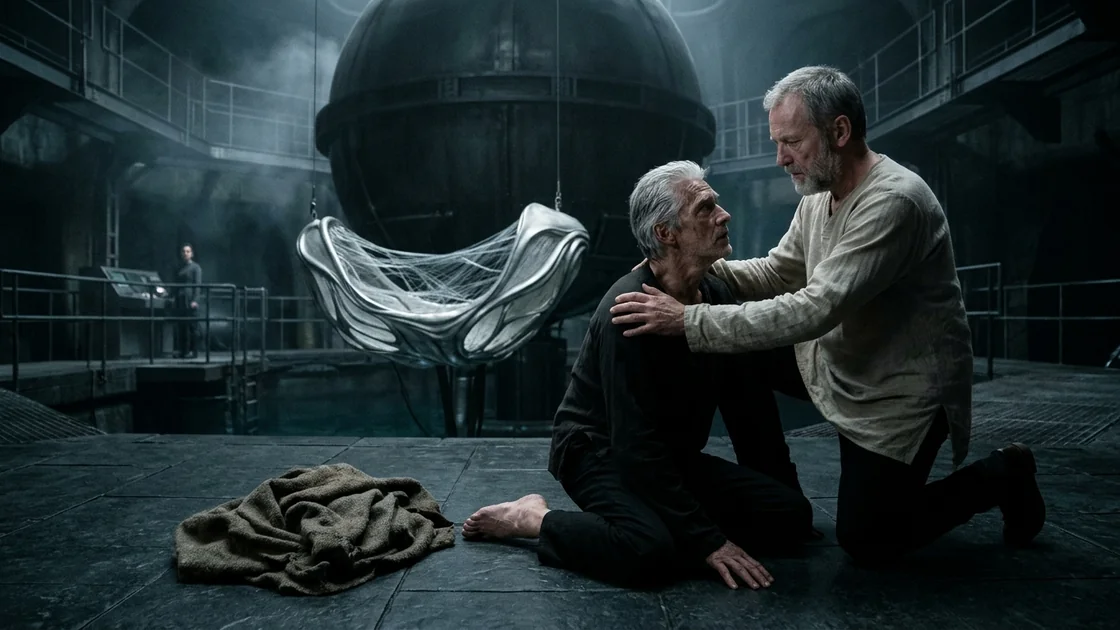
In a post-scarcity utopia where material want and violence have been eradicated for centuries, Arbiter Vaelen Thorne presides over the trial of Julian Kael, an unrepentant saboteur who permanently ended the lives of twelve citizens at the Veridian Spire to reintroduce suffering to humanity. Refusing to resort to execution or involuntary neural erasure, Vaelen invokes an ancient and terrible rehabilitation protocol that binds Julian into a neural synthesis chamber. Over the course of the sentence, Julian is forced to experience the complete subjective lifetimes of all twelve of his victims from their earliest infancy to the agonizing final moments of his attack. As the centuries of borrowed joy, heartbreak, artistic struggle, and quiet love overwrite his nihilistic arrogance, both the criminal and the judge watching over him are forced to confront the true cost of empathy and the unbearable weight of human continuity.
The Hall of Consensus had not hosted a criminal tribunal in three hundred andforty-two years. Designed by the third-generation architects of the Post-Scarcity Accord, the chamber was meant for gentle disputes—debates over whether a valley in the New Andes should be flooded to create a bioluminescent reef, or how long a collective of kinetic sculptors could occupy the orbital rings above Jupiter before yielding the view to the astronomers. The walls were grown from acoustic alabaster, a living mineral that absorbed the harsh frequencies of raised voices and returned them as a low, soothing hum that vibrated in the sternum like a purring cat.
Today, the alabaster was choking on silence.
Arbiter Vaelen Thorne sat upon the high bench, though the bench was only elevated by three shallow steps of polished river stone. He wore no robes of office, only a simple tunic of undyed linen that hung loosely on his tall, spare frame. Vaelen was four hundred and eighty years old. He had lived long enough to see the last deserts bloom, the last genetic plagues unraveled like bad knitting, and the last currencies melt into the historical archives as curiosities of an age when human beings believed another person had to starve so that they might eat. His face was smooth, held at the biological equilibrium of a man in his late fifties, though his eyes—pale grey, like winter water—carried the sedimentary weight of nearly five centuries of uninterrupted memory.
Below him, standing in the center of the mosaic floor without restraints, was Julian Kael.
Julian was thirty-four years old in his first and only body. He had refused the baseline somatic adjustments when he came of age, leaving a slight congenital asymmetry in his jaw and a scatter of sun-damage across his nose and cheeks. He wore a coat of rough, hand-woven wool that he had sheared and spun himself in the wilderness preserves of the northern peninsula—a garment meant to scratch the skin, a deliberate affectation of discomfort. His hands were clasped loosely behind his back. He looked up at Vaelen, and then around at the tiered balconies where three thousand citizens sat in stunned, breathless stillness, with an expression that bordered on pity.
"You are still looking for an illness, Arbiter," Julian said. His voice was clear, unhurried, and slightly raspy. The acoustic alabaster tried to soften his consonants, but the sheer certainty in his cadence cut through the air. "Your diagnostic drones have scanned my amygdala four times since Tuesday. Your neuro-ethicists have combed through my childhood records from the Third Archipelago, searching for a bruised knee, a neglectful mentor, a chemical imbalance in my serotonin uptake. You cannot bear the thought that a fully healthy, fully educated child of the Commons looked at your paradise and decided it needed to burn."
Vaelen rested his forearms on the warm stone of the lectern. Beside his right hand lay a small, translucent slate containing the names of twelve human beings. He did not need to read it; he had whispered those twelve names to himself every minute since the smoke had cleared from the Veridian Spire four days ago.
"We looked for a pathology, Julian, because the alternative is a philosophical failure so profound we had no vocabulary left to describe it," Vaelen said quietly. "Until Tuesday at fourteen-hundred hours, no human being had experienced involuntary True Cessation on this continent for twelve decades. Those who died by accident were restored from the Continuity Loom within the hour, missing perhaps twenty minutes of afternoon sunlight. Those who died permanently did so in the Quiet Houses, surrounded by three generations of their loved ones, having decided after five or six centuries that their tapestry was complete."
"They didn't die in the Quiet Houses," Julian said, his lip curling. "They evaporated. Like puddles on a warm patio. No struggle, no terror, no rage against the dark. Just a polite nod to the attendants and a sedative."
"And at the Veridian Spire," Vaelen continued, his voice never rising, "you carried a salvaged military-grade tachyon disruptor—an artifact you spent seven years fabricating from historical blueprints—into a botanical conservatory during the midday meal. You activated a three-hundred-meter dead zone that severed the ambient quantum entanglement between the citizens present and the Continuity Loom. You blinded the city’s resurrection arrays. And then you detonated a thermobaric charge."
A collective intake of breath rippled through the balconies. In a society where most people had never seen an open flame larger than a hearth fire, the forensic holos of the Veridian Spire had been incomprehensible. The shattered crystalline domes, the carbonized ancient ferns, and the twelve shadows burned into the white limestone plaza where twelve people had been vaporized before their backup nodes could register the trauma of their deaths.
Because of the tachyon disruptor, the Loom had not merely failed to record their final afternoon; the feedback loop of the disruptor’s collapse had spiked backward through the open quantum channels, corrupting their active resurrection matrices at the root. Their bodies were gone, and the vessels needed to call them back from the ether were shattered beyond reconstruction. Only their passive historical archives—the non-viable, read-only recordings stored in the deep civic vaults—remained intact.
As living, evolving consciousnesses, they were extinct.
"I gave them weight," Julian said, stepping forward until his boots touched the first river-stone step of the bench. His dark eyes were bright, almost feverish with intellectual triumph. "Don't you see what has happened to us, Vaelen? Look at the people in these balconies. Look at yourself. Five hundred years old, and what have you done this century? You learned to play the glass harp. You bred a new variety of frost-resistant orchid. You mediated an argument between two poets who wanted to use the same cliffside for their solstice recitals."
Julian spun around, flinging an arm toward the silent crowd. "We are ghosts haunting a museum! When you remove hunger, you remove the taste of bread. When you remove cold, you remove the sacredness of the hearth. And when you remove death—real, teeth-bared, irreversible death that can strike you down on a Tuesday afternoon while you're eating plums in a garden—you remove the value of every single breath you take! Prior to Tuesday, those twelve people had infinite tomorrow. Which meant their today was worth precisely zero. In the fraction of a second before my charge ignited, when their internal implants chimed red and told them they were offline from the Loom, they were more alive than any of you have been in four hundred years!"
Silence followed his outburst. Nobody shouted back. Nobody cursed him. In the balconies, an elderly woman with silver-braided hair simply bowed her head and began to weep—not with the theatrical hysteria Julian clearly wanted, but with a heavy, bewildered sorrow.
Vaelen looked down at his own hands. His fingers were trembling, very slightly. He hid them beneath the edge of the lectern.
He did not tell the court that one of the twelve names on the translucent slate was Dr. Aris Thorne. He did not need to; the public records were open to all, and the citizens of Solis-Vespera knew that the man presiding over the tribunal was the older brother of the botanist who had been pruning a six-hundred-year-old Ginkgo tree thirty feet from Julian’s backpack when the air turned to plasma. The Council of Arbiters had begged Vaelen to recuse himself. Vaelen had refused. Not out of a desire for vengeance—vengeance was an atavistic rot he had spent centuries pruning from human jurisprudence—but because he knew that any other Arbiter, untouched by the immediate frost of this grief, might treat Julian as a mere logistical problem.
"You believe," Vaelen said slowly, "that our lives have no friction. That because we do not fight the dirt for calories, or the winter for warmth, or the Reaper for another decade, our internal lives are flat, shallow things. You looked at twelve strangers eating plums in a conservatory and saw twelve blank sheets of paper."
"They were interchangeable," Julian said flatly. "Pleasant, harmless, grazing animals in a gilded pasture."
"Under the Charter of the Third Accord," Vaelen said, looking up to meet Julian’s gaze, "we do not possess prisons. To lock a human mind inside a concrete box for decades is to commit the very waste of potential we sought to abolish. Nor do we practice capital termination; to kill you would be to validate your thesis that death is an acceptable punctuation mark to a philosophical disagreement. Finally, the Council has debated the use of a Targeted Cortical Wipe—erasing the last ten years of your ideological radicalization and returning you to the community as a docile twenty-four-year-old."
Julian laughed, a harsh, barking sound. "Do it, then. Murder my mind and keep my body walking around smiling at your flowers. Prove to everyone here that your utopia can only survive by lobotomizing anyone who remembers what it means to be human."
"I rejected the Cortical Wipe," Vaelen said.
Julian’s smile faltered slightly. "Then what? Exile? Send me to the northern wastes? I already live there."
"No," Vaelen said. "You claim you destroyed twelve empty vessels to give humanity back its meaning. You claim their lives were weightless. The law of the Commons is rooted in restorative truth, Julian. When a citizen accidentally damages another’s work, they must repair it. You cannot repair the twelve lives you severed from the Loom. Their active matrices are burned out. They will never wake again. They will never see next spring."
Vaelen touched the translucent slate. A soft golden light rose from the podium, projecting twelve complex, spiraling mandalas of data into the air between them.
"However," Vaelen continued, his voice dropping an octave, "while their resurrection nodes at the Spire were destroyed by your tachyon field, every citizen of Solis-Vespera voluntarily commits their passive sensory stream to the Deep Civic Archive at the end of each lunar cycle, so that future historians may understand how we lived. And as for their final nineteen days—between their last archival upload and your detonation—the forensic reconstruction teams were able to pull the residual mnemonic echoes directly from the blackened silicate of the conservatory’s memory-glass walls, which absorbed their catastrophic neural discharge at the microsecond of death."
Julian narrowed his eyes. "Historical ghost-files. Read-only data. You can't resurrect a person from a passive archive; the quantum spin isn't there. They're still dead, Vaelen."
"They are," Vaelen agreed. "They cannot live their memories anymore. Therefore, you will live them in their stead."
A murmur rose from the balconies—a sound like wind moving through dry reeds. Even the senior neuro-ethicists in the front row stiffened.
"I am invoking Article Seven of the Foundation Transitional Code," Vaelen announced, his voice ringing off the acoustic alabaster so hard the mineral walls flushed a pale, startled violet. "The Protocol of the Complete Mirror. You will be taken to the Deep Synthesis Chamber beneath this hall. Your own identity will not be erased; it will be pinned open, held fully conscious as the baseline substrate. Upon that substrate, the Deep Archive will sequentially imprint the complete, unedited subjective lifetimes of the twelve victims of the Veridian Spire."
Julian stared at him, trying to calculate the implications. "You're going to make me watch home movies of their lives?"
"Not watch," Vaelen said coldly. "There is no screen in the Synthesis Chamber, Julian. You will be connected via deep-weave neural lace at a one-to-one perceptual fidelity. You will feel the pressure of the birth canal—or the decanting tank—as they felt it. You will spend years learning to walk through their toddling legs. You will feel their boredom on rainy afternoons, the sting of their scraped knees, the agonizing slowness of their centuries of study, the precise chemical warmth of every person they ever kissed, and the dull ache of every existential terror they hid behind their polite smiles. And at the end of each life, you will walk into the Veridian Spire on a sunny Tuesday afternoon, hear the chime of your own tachyon disruptor, and burn to ash."
Julian’s jaw tightened, a muscle twitching beneath his sun-spotted skin. "Twelve lives. Some of those people were three or four hundred years old."
"The combined subjective duration of the twelve archives is one thousand, eight hundred and forty-six years, seven months, and fourteen days," Vaelen said. "Through temporal compression within the synaptic cradle, only twelve days will pass here in Solis-Vespera—one day of real time for each soul you extinguished. Inside your skull, however, there will be no compression. Every second will last a second. Every century will take a hundred years to cross."
"A human brain can't hold nearly two millennia of foreign memory at once without fracturing," Julian whispered, the first genuine tremor of dread creeping into his voice. "When I wake up—"
"When you wake up in twelve days," Vaelen said, standing up from the bench, "you will be free to walk out of those doors without surveillance, without restrictions, and with all your physical faculties intact. If you still believe human life in this city is hollow, we will not stop you from saying so."
Vaelen looked down at the young man who had turned his brother into a shadow on a limestone wall.
"Let us see how light they are, Julian, when you have to carry them all."
The Deep Synthesis Chamber did not look like a place of punishment. It was a spherical room suspended within a cool, subterranean cistern of heavy water, isolated from the seismic vibrations of the planet. In the center floated a cradle of silver-white polymer, woven with millions of microscopic optical fibers that drifted in the ambient air currents like dandelion down.
Seraphina, the Chief Mnemonic Technician, moved around the cradle with the hushed reverence of a surgeon preparing for an operation she had only ever read about in textbooks. She was a small woman with dark, close-cropped hair and optical implants that gleamed like polished brass.
Julian lay in the cradle. He had refused a sedative for the insertion of the neural lace, gritting his teeth as the microscopic filaments slipped through his nasal sinuses and base of the skull to marry themselves to his cerebral cortex. Sweat beaded on his forehead, soaking into his rough wool collar, which he had insisted on keeping on.
Vaelen stood on the observation gantry five feet away, separated only by a transparent field of containment glass.
"You're going to watch?" Julian asked, his head immobilized by the halo-clamp. His eyes swiveled toward Vaelen. Despite the sweat on his brow, his sneer had returned. "Going to sit there for twelve days and watch me twitch? Very progressive, Arbiter."
"The law requires the sentencing magistrate to remain tethered to the telemetry beacon for the duration of an Article Seven protocol," Vaelen answered, stepping up to the secondary console and placing his left palm onto a biometric induction plate. A thin needle of light pricked his wrist, establishing a low-level sympathetic link. "I will not experience the memories—only a single brain can survive the full immersion—but I will feel the emotional and physiological spikes of your nervous system in real time. If your synaptic integrity drops below the threshold of permanent catatonia, it is my hand that must pull you out."
"Don't bother," Julian spat. "Show me your lotus-eaters. I'll walk through their thousand years of afternoon naps and come out laughing."
Seraphina looked up at Vaelen, her brass eyes troubled. "Arbiter, the sequence is queued chronologically by the victims' proximity to the blast epicenter, beginning from the outer perimeter and moving inward toward the charge. Are you certain you do not wish to rotate watches with Arbiter Kaelen? Twelve days in the sympathetic tether without full sleep cycles will age your telomeres by decades."
"Begin the sequence, Seraphina," Vaelen said softly. "Victim One. Marek Vance."
Seraphina bowed her head and drew her fingers across the glass console. "Engaging temporal dilation at ratio fifty-six thousand to one. Subjective timeline initialization: One hundred and forty-two years, three months, eleven days. May the Loom hold your thread, Julian Kael."
The dandelion fibers around Julian’s head suddenly stiffened, flaring with a blinding, sapphire luminescence.
Julian opened his mouth to make one final remark, his chest rising with air—and then his eyes rolled back, his spine arched two inches off the polymer gel, and the air left his lungs in a long, shuddering sigh that sounded entirely like a newborn infant crying in the dark.
At first, Julian tried to fight the tide by shouting his own name.
I am Julian Kael. I am thirty-four years old. I was born on the rocky coast of the Third Archipelago. I am inside a machine.
The machine did not care. The machine did not argue with him. It simply poured the ocean of another human being into the cup of his consciousness until his own thoughts were diluted to a pale, frantic background hum beneath the roaring immediacy of being Marek.
He was small. His hands were plump, sticky with crushed mulberries, and the sun above the terraced vineyards of New Valencia was impossibly huge and warm. Julian tried to clench his fists and remember the Veridian Spire, remember his wool coat, remember his grand philosophy of friction—but a four-year-old child’s nervous system does not have the cortical architecture to hold adult political rhetoric. The rhetoric dissolved into pure sensation: the terrifying height of the garden wall, the booming, cedar-scented laugh of a woman with calloused hands who swung him onto her shoulders—Mama, Mama, look at the beetles!—and the overwhelming, world-ending tragedy of dropping his wooden horse into the irrigation ditch.
Decades rolled over him like slow, relentless geological strata.
As Marek grew into adolescence, Julian’s pinned consciousness was able to surface more clearly, riding inside Marek’s skull like a stowaway in a glass submarine. He couldn't steer Marek’s limbs; he could only feel everything Marek felt, think every thought Marek thought, and experience the terrifying dissonance of realizing that he was Marek while simultaneously knowing he was the man who would eventually murder him.
"Wait," Julian’s internal voice whispered as Marek turned twenty-six. "Wait, why is he doing that?"
Marek Vance had everything the utopia offered. He had a villa overlooking the Turquoise Sea, a body capable of running a marathon without lactic acid buildup, and the affection of three brilliant, witty companions. And yet, inside Marek’s mind, Julian felt a gnawing, ferocious hunger that felt terrifyingly familiar.
It wasn't a hunger for violence. It was the hunger of the maker.
Marek was a sculptor, and at the age of forty, sitting in a sunlit studio filled with effortlessly laser-carved marble statues that the critics of Solis-Vespera praised as masterpieces, Marek felt a profound, suffocating disgust.
It is too easy, Marek thought—and Julian felt the thought burn in his own chest with a shock of recognition. The stone yields to the plasma-chisel before I even know what the stone wants to be. My eyes lie to me. They look for symmetry, for pretty curves, for what pleases the retina. I am skimming the surface of matter.
The next morning, Marek walked into a surgical clinic in the lower city and requested a bilateral optic nerve disconnection and the deactivation of his muscular healing synthesizers.
Julian screamed inside the memory as the darkness fell. Are you insane?! Julian raged against the walls of Marek’s mind. You have eyes! Why would you blind yourself when you don't have to?!
For the next one hundred and two years, Julian lived in pitch blackness.
There were no sunsets. There were no colors. There was only the brutal, unforgiving resistance of raw basalt boulders dragged down from the volcanic highlands, and the iron chisel held in hands that were suddenly able to bleed, to blister, to develop thick, horn-like calluses that cracked in the winter air.
Year after year—fifty years, seventy years, ninety years—Julian stood in the dark shed beside the sea, breathing basalt dust until his lungs coughed grey phlegm, running his ruined, hypersensitive fingertips over cold stone. He felt the sheer, crushing despair of spending eleven years on a single twelve-foot monolith, only to feel a hidden geological fault split the stone in half on a freezing November night, ruining over a decade of daily, back-breaking labor.
Marek knelt in the gravel among the shattered pieces of his decade, his bleeding knuckles pressed to his sightless eyes, weeping until his ribs ached.
Give up! Julian begged him from the depths of their shared consciousness. Turn your eyes back on! Use the matter-compiler! Why are you torturing yourself when nothing forces you to?!
And from the deep, quiet core of Marek’s mind came the answer—not spoken to Julian, for Marek didn't know a ghost was riding him, but spoken to the darkness itself:
Because the stone is real, and my hands are real, and if I do not give my hours to something that can break my heart, then I have never touched the world at all.
Marek stood up in the dark. He swept the broken basalt aside. The next morning, at dawn, he had the haulers bring a larger boulder from the mountain.
By the one-hundred-and-thirtieth year, Julian had forgotten he was supposed to be despising this man. He knew every ridge of the studio floor by the feel of it through thin leather soles. He loved the smell of rain on hot iron. He knew the profound, sacred ecstasy of the moment when, after thirty-four years of blind chiseling, his thumb slid across a curve of basalt that felt exactly like the sound of his mother’s voice when he was four years old.
And then came Tuesday.
Marek was one hundred and forty-two. He had been invited to the Veridian Spire to exhibit his final work—a twisting, gravity-suspended column of dark basalt called The Weight of the Unseen. He had refused to have his sight restored even for the opening. He stood in the warm conservatory, listening to the fountain, feeling the sun on his scarred face, holding a ripe plum that someone had pressed into his calloused palm.
He heard footsteps approach on the limestone pavers. Heavy boots. The smell of rough, unwashed lanolin wool.
Inside Marek’s blind head, Julian suddenly realized who was walking past them. No, Julian tried to scream, trying to force Marek’s blind legs to run toward the exit. No, get out of the garden! That's me! That's my coat! Marek, run!
Marek didn't run. He smiled toward the sound of the heavy boots, appreciating the texture of a stranger's purposeful stride, and raised the plum to his lips.
A high-pitched whine split the air, vibrating in Marek’s acoustic implants. The ambient hum of the Continuity Loom—a background presence as constant as gravity—vanished, leaving a sudden, sickening vertigo in the pit of the stomach.
"What is that?" a woman asked nearby.
Then the world did not turn bright, because Marek had no eyes to see the flash. Instead, the world became a wall of absolute, skin-stripping heat that turned the air in his lungs to molten glass. His beloved basalt column shattered against his chest, driving stone shrapnel through his sternum before the thermobaric pressure wave vaporized his nerves in a symphony of white-hot agony that lasted for an eternity of three hundred milliseconds.
In the subterranean cistern, Julian’s body convulsed violently against the polymer straps. His hands—soft compared to the stone-carver’s—clawed at the air, his fingers curled as if trying to hold an invisible chisel. Tears leaked from beneath his closed eyelids, running down into the silver fibers of the neural lace.
On the gantry above, Vaelen gripped the edge of the console, his knuckles white, his breath coming in ragged gasps as the sympathetic shockwave of Marek’s death slammed through the biometric tether into his own nervous system.
"Heart rate at one-ninety," Seraphina called out, her fingers flying across the dampeners. "Cortisol spiking. He’s experiencing post-mortem phantom blindness—his visual cortex is trying to shut itself down because it thinks it has been blind for a century. Should I pause the queue?"
"No," Vaelen gasped, wiping cold sweat from his upper lip. "If he surfaces now, the shock of returning to a thirty-four-year-old body will cause a psychotic break. Let the next archive catch him."
"Transitioning," Seraphina whispered. "Victim Two. Linnea Chen. Subjective duration: Nineteen years, two months.Victim Three will follow immediately: Soraia Al-Mansoor, three hundred and ten years."
Julian fell out of the dark and landed in a blinding explosion of color.
He had eyes again! He wanted to weep with gratitude just at the sight of the sky, even as the phantom ache of Marek’s ruined hands still throbbed in his mind.
Wait, he thought, panicked, trying to gather the frayed threads of his identity. I am Julian Kael. I just survived one hundred and forty-two years. Only eleven left. This one is short. I can feel the boundaries of the file. She’s just a child. Nineteen years. Nineteen years is nothing compared to a century in the dark.
He was wrong.
Marek’s century had possessed the slow, stoic rhythm of an ocean swell; Linnea Chen’s nineteen years were a forest fire.
To be a teenage girl in a world of immortals, Julian discovered, was to suffer a form of vertigo that no previous generation of humans had ever had to endure. As Linnea grew from a bright, inquisitive child in the floating kelp-cities of the Pacific into a gangly, ink-stained seventeen-year-old, Julian felt the crushing, terrifying weight of the utopia’s greatest gift: infinite potential.
Every adult around Linnea had been alive for centuries. Her mother was a master geneticist who had rebuilt the Siberian mammoth steppes; her uncle had composed symphonies performed on the rings of Saturn; her neighbors spoke six languages and had mastered four distinct artistic disciplines.
And Linnea sat on the edge of her bed at midnight, staring at her violin, her chest so tight with inadequacy that she couldn't breathe.
Everything good has already been done, Linnea thought, pulling at her dark hair while Julian felt the sharp, metallic taste of adolescent panic in her throat. Everyone is so wise, so calm, so finished. What if I live for five hundred years and I'm still small? What if I never find the thing I'm supposed to give back to the world?
Julian had assumed the youth of the Commons were pampered, arrogant creatures who floated through life on a cushion of automated luxury. Instead, he lived through every excruciating second of Linnea’s secret shame. He felt her hide in the conservatory washrooms because she thought her laugh was too loud compared to the serene elders. He felt the clumsy, trembling electricity of her first love at eighteen—a boy named Lukas with a gap between his front teeth who studied meteorological tides.
When Lukas kissed her for the first time under the rain-canopy of the Western Pier, Julian—who had spent his own youth reading dusty manifestos of destruction and despising the softness of the flesh—felt his heart hammer against Linnea’s small ribs with such violent, defenceless joy that it terrified him.
Don't trust it, Julian tried to warn her, like an old, bitter ghost whispering from the attic of her mind. Wait until you see how it ends, little bird. Don't love him so much. You only have four months left.
Linnea couldn't hear him. She loved Lukas with the reckless, unshielded totality of someone who believed she had four hundred years to learn how to guard her heart.
Two weeks before the Tuesday at the Veridian Spire, Linnea finally found her calling. She discovered acoustic botany—the study of how ancient trees responded to sub-audible harmonic frequencies in the soil. Her academic advisor, an elderly, kind-faced man named Dr. Aris Thorne, read her preliminary paper and looked at her over his spectacles with genuine wonder.
"Linnea," Dr. Thorne said, his voice warm with brotherly pride, "in four hundred years of studying Ginkgo biloba, I have never noticed this resonance pattern in the root-hairs. You have a remarkable ear."
Walking home through the twilight gardens of Solis-Vespera that evening, Linnea literally danced on the paving stones. The crushing weight of the immortal world had lifted. She had found her place in the choir. She was going to spend the next fifty years mapping the songs of the forests. She called Lukas on her wrist-comm, breathless, laughing, telling him to meet her at the Veridian Spire next Tuesday at two o'clock so she could show him the six-hundred-year-old Ginkgo tree while they ate lunch.
Don't go, Julian wept inside her head as Tuesday morning dawned bright and clear. He was no longer Julian the Saboteur; he was a one-hundred-and-sixty-one-year-old blind sculptor who was also a nineteen-year-old girl in a yellow sundress, and he was desperately trying to drag her feet backward on the steps of the Spire. Please be late. Drop your notes. Twist your ankle. Lukas isn't even there yet, wait for him outside the perimeter!
Linnea walked briskly into the conservatory, her yellow dress swirling around her knees, clutching her datapad to her chest. She waved to Dr. Thorne by the Ginkgo tree. She saw a blind man holding a plum near a tall black sculpture. She saw a man in a strange, scratchy wool coat drop a heavy canvas pack beside the central fountain and walk quickly away—Wait, no, he didn't walk away. Julian had stayed at the outer rim of the dead zone to watch the glass shatter, relying on his directional shield to spare his own lungs.
Linnea looked at her wrist-comm. 13:59. Lukas was two minutes late.
Then the high-pitched whine pierced the conservatory.
Linnea didn't have centuries of philosophical calm to cushion her when the red warning glyph flashed across her optic nerve: CONTINUITY LOST. LOOM DISCONNECTED.
She was nineteen. She didn't want to die. She hadn't even kissed Lukas in the spring yet. She hadn't finished her paper. She looked up at the glass dome just as the thermobaric cloud bloomed like an angry sun, and her final thought—which tore through Julian’s soul like a jagged hook—wasn't a grand confrontation with mortality. It was a tiny, terrified cry for her mother as her yellow dress caught fire and the world vanished into roaring white nothingness.
And then there was silence.
Not the warm, dusty darkness of Marek’s sculpting shed, nor the brief erasure between files, but the cold, diamond-hard silence of the outer Oort Cloud.
Victim Three: Soraia Al-Mansoor. Three hundred and ten years.
By the fiftieth year of Soraia’s life, Julian’s original thirty-four years of existence felt like a rumor he had once heard about a stranger in a tavern. How could thirty-four years of petulant brooding on an island compete with the sheer, staggering mass of the centuries he was now accumulating?
Soraia had spent her first century in the sun-drenched academies of Cairo-Prime, mastering astro-linguistics and quantum cartography. She was brilliant, gregarious, the center of a sprawling family of seventy grandchildren and great-grandchildren. And then, at one hundred and ten, she volunteered for the Deep Listening Post on Asteroid 994-Persephone—a solitary ice-rock drifting two light-months beyond the orbit of Neptune.
Why? Because the automated probes could only record the radiation of the galaxy; it required a conscious, biological human mind interfaced with the deep-space gravitational arrays to feel the subtle harmonic ripples of dying stars and search for the elusive, non-repeating geometries of extra-galactic intelligence.
For one hundred and eighty consecutive years, Soraia lived alone in a habitat the size of a three-room cottage buried under four miles of nitrogen ice.
Julian, who had boasted in the Hall of Consensus that utopians knew nothing of hardship, was forced to live every single hour of those one hundred and eighty years of absolute isolation.
He learned what happens to the human mind when the communication delay to Earth is sixteen hours round-trip, when everyone you ever loved grows older by centuries on tiny flat screens while you walk the same forty paces from the hydroponic tray to the telemetry chair, seven days a week, fifty-two weeks a year, for eighteen decades.
He felt the Grey Decades—between Soraia’s two-hundredth and two-hundred-and-fortieth years—when a creeping existential madness settled into the ice habitat. For forty years, Soraia did not speak a single word aloud. She forgot the texture of wind. She hallucinated footsteps in the airlock. She sat with her finger hovering over the manual purge valve that would have flooded her cabin with vacuum and ended her vigil.
Press it, the tiny, exhausted fragment that remained of Julian whispered, broken by the sheer, crushing monotony of the void. No one can survive this much quiet. We've been in this tin can for a hundred and twenty years, Soraia, let us out!
She didn't press it. She looked at the small hologram of the Earth—a pale blue speck lost in the glare of a distant sun—and remembered that twelve billion human beings were sleeping safely in their gardens because listeners like her stood watch on the dark walls of the solar system, mapping gravitational anomalies and rogue comets before they could ever threaten the inner worlds.
She stayed for sixty more years until her relief ship arrived.
When she finally stepped off the shuttle in Solis-Vespera at the age of two hundred and ninety, her bones fragile despite the low-gravity treatments, Julian wept through her eyes just at the smell of damp dirt and the sound of strangers chattering in a plaza. She spent her last twenty years simply sitting in public parks and conservatories, drinking in the miraculous, chaotic noise of human voices, never wanting to be alone again.
On Tuesday afternoon, she was sitting on a limestone bench in the Veridian Spire, smiling at a young girl in a yellow dress who was checking her watch, soaking in the warmth of twelve people breathing the same air—when Julian’s bomb turned the conservatory back into the burning vacuum of space.
Four days had passed in the subterranean cistern.
On the observation gantry, Vaelen sat in a high-backed chair he had dragged up to the console, his left hand still strapped into the biometric induction plate. A three-day beard, silver as frost, covered his hollow cheeks. Beside him, an untouched tray of nutrient broth had gone cold.
Down in the sphere, Julian Kael no longer looked like the defiant radical who had stood before the tribunal. His body had lost twelve pounds despite the intravenous glucose drips. His muscles twitched with microscopic, involuntary muscle memories: his right hand moved in the tiny, precise arcs of a violin bow (Linnea), while his left fingers tapped out base-twelve gravitational algorithms against his thigh (Soraia), and his head tilted slightly to the left, listening like a blind man for echoes off stone (Marek).
"He has cleared Victim Four," Seraphina said softly, reading the cascading green glyphs on the main monitor. Her voice was thick with exhaustion; she had only slept in two-hour naps on a cot in the corner. "Kaelen Ross. Eighty-eight years. The structural engineer with the congenital tremor who kept the antique water-wheels under the Spire turning by hand because he loved the sound of bronze gears."
Vaelen nodded slowly, his eyes closed. "I felt it. Julian spent eighty-eight years learning patience from a man who took four minutes to tie his own boots every morning and never once cursed his fingers."
"Arbiter," Seraphina said, stepping closer to the gantry rail. "The next two files are linked in the queue. Oren and Talia Vane. Two hundred and four years, and one hundred and ninety-eight years."
Vaelen opened his pale grey eyes. "The couple by the fountain."
"Yes. And directly after them is File Seven." Seraphina hesitated, her brass optical implants dimming in sympathy. "Dr. Aris Thorne. Four hundred and twelve years. Vaelen... when Julian enters your brother’s archive, you are going to feel your own shared childhood reflected back through the sympathetic tether. Every memory Aris had of you over four centuries will hit your nervous system as Julian processes it. The psychological feedback loop could be catastrophic for you."
Vaelen looked down through the glass at the trembling, sweat-soaked man suspended in the web of sapphire light.
"Julian believed we do not suffer," Vaelen said, his voice a dry whisper. "If I disconnect my hand when it is time for my own grief to be weighed, then I am a coward, and his accusation against us stands. Keep the queue moving, Seraphina."
Inside the synthesis, Julian was drowning in love, and it was far worse than the blindness or the void.
He had lived Kaelen Ross’s eighty-eight years like a warm, quiet bath after the freezing solitude of Soraia’s asteroid. As Kaelen, he had greased the colossal bronze gears beneath the city, eaten crusty bread with honey every afternoon, and loved every stone of the Veridian Spire as if it were his own child—only to feel the heartbreaking betrayal of watching his beloved structure tear itself apart from the inside out when the bomb went off.
Now, he was Oren Vane.
For the first hundred and fifty years of Oren’s life, Julian experienced a marriage so deeply woven that he couldn't tell where Oren’s nervous system ended and his wife Talia’s began. They were ecological architects who spent a century together restoring the coral shelves of the Mediterranean. They finished each other’s sentences; they woke up at the exact same second in the night without speaking.
And then, in Oren’s one-hundred-and-fifty-fourth year, out of sheer hubris, emotional restlessness, and a sudden vanity sparked by a brilliant visiting oceanographer from Mars, Oren betrayed her.
In a world without material scarcity, where nobody could steal your house or starve your children, Julian discovered that emotional betrayal was the single sharpest blade still in existence. Because no one had to stay together for survival or financial security, the only currency between two people was absolute, voluntary trust.
When Oren broke that trust, he broke Talia’s world.
For the next fifty years of Oren’s archive, Julian lived inside a furnace of unrelenting remorse. Oren did not ask for an easy forgiveness; he knew he didn't deserve it. Talia moved to the opposite side of the planet. The Martian oceanographer returned to the stars within a year, leaving Oren alone in the silent house by the Mediterranean.
For five decades, Julian walked those empty rooms as Oren. He felt the physical sickness of waking up every morning for eighteen thousand mornings knowing that the person you loved best in the universe was hurting because of your own careless hands. He wrote her letters he didn't send. He spent thirty years quietly completing the coral reef project they had abandoned, working alone in the cold deep currents, building it to her exact specifications as a silent monument of penance.
In the fiftieth year of their estrangement, he sent her a single message: The reef is finished. I am coming to Solis-Vespera on Tuesday. If you are at the Veridian Spire at two o'clock, I will know we can begin again. If you are not, I will never trouble your peace again.
On Tuesday, Oren sat on the edge of the central fountain in the conservatory, his hands shaking harder than old Kaelen Ross’s ever had. At 13:55, Talia walked through the western archway.
She looked at him across the ferns. She didn't say a word. She simply walked over, sat beside him on the stone rim of the fountain, and laid her hand palm-up on her knee. Oren reached out, his eyes blurred with fifty years of unshed tears, and laced his fingers through hers.
Five seconds later, the tachyon disruptor whined, and Julian’s bomb blew them apart before Oren could even say I'm sorry.
And before the phantom fire had even cooled on Oren’s skin, the Archive slammed Julian straight into Victim Six: Talia Vane.
No, please, no! Julian screamed within the synaptic web, though who was screaming—Julian, Marek, Linnea, Soraia, Kaelen, or Oren—he could no longer tell. Don't make me do those fifty years from the other side! I just lived them!
The Archive had no mercy.
He grew up as Talia. He fell in love with Oren—feeling the strange, dizzying shock of falling madly in love with the man he had just been five minutes ago. He spent a century in the warm Mediterranean sun with him.
And then, at age one hundred and forty-eight, he walked into their study and discovered Oren’s betrayal.
Julian felt his own heart—Oren’s heart—shatter Talia’s chest from the inside out. For the next fifty years, Julian had to suffer the exact wound he had just spent fifty years regretting having inflicted. He lived through Talia’s decades of bitter grief in the northern forests, the nights she lay awake wondering why a century of devotion hadn't been enough, the slow, agonizing work of pruning the bitterness from her soul so it wouldn't poison her remaining centuries.
When Oren’s message arrived after fifty years, Julian felt the trembling, terrified courage it took for her to board the transport to Solis-Vespera. She walked through the western archway of the Veridian Spire at 13:55. She saw Oren sitting by the fountain, looking so frail and hopeful beside a forgotten canvas backpack left on the pavers.
She sat down. She turned her palm up. She felt his warm, familiar fingers lace through hers, and for five glorious, golden seconds, a fifty-year winter thawed into spring.
Then the flash took them both.
Eight days had passed in the cistern.
Julian had crossed the one-thousand-year mark inside the machine.
When he entered Victim Seven—Dr. Aris Thorne, four hundred and twelve years—the boundary between the prisoner in the tank and the Judge on the gantry dissolved into a shared ocean of sorrow.
For twenty-four hours of real time, Vaelen Thorne sat with his forehead pressed against the cold glass of the observation window, tears streaming silently into his silver beard, as Julian lived for four centuries as Vaelen’s little brother.
Through Aris’s eyes, Julian saw Vaelen not as the stern, ancient Arbiter on the river-stone bench, but as a protective ten-year-old boy teaching his younger brother how to swim in the cold lakes of the Pre-Accord Transition era. Julian felt the deep, lifelong awe Aris held for Vaelen—how Aris had watched Vaelen take on the thankless, exhausting burden of the Magistracy so that others like Aris could spend their centuries in peace among the trees.
He loves you so much, Julian thought, projecting the thought outward through the biometric tether as he pruned a sapling in Aris’s two-hundredth year. He didn't know if Vaelen could hear him, only that he could feel Vaelen’s heartbeat stuttering through the link every time Aris remembered his brother. Vaelen, I didn't know he was your brother. Look at how he saved that chestnut seed from the old-world vaults just to plant it outside your window when you were sad in the third century. I burned him, Vaelen. I burned him while he was looking at the Ginkgo leaves.
On the gantry, Vaelen pressed his right palm against the glass, directly aligned with Julian’s suspended body below, and stayed there until the four hundred and twelfth year ended in fire.
After Aris, the remaining lives came like hammer blows upon metal that had already been heated white-hot and hammered paper-thin.
Victim Eight: Bram Kovic, sixty-four years. A man of completely ordinary intellect who possessed no grand cosmic ambition, no tragic artistic blindness, no centuries of deep-space vigil. He simply loved being a father. For sixty-four years, Julian packed lunches, bandaged scraped knees, built treehouses that weren't quite level, and worried tenderly over his children’s small heartbreaks.
Victim Nine: Elowen Kovic, thirty-one years. Bram’s youngest daughter. Julian immediately had to live for thirty-one years being rocked to sleep, comforted after nightmares, and taught to ride a bicycle by the warm, clumsy hands of the father he had just been—only to sit across from him at a sunny table in the Veridian Spire, laughing over a bowl of cherries, and watch her father’s face peel away in the blast wave an instant before her own.
Victim Ten: Nadia Vos, one hundred and seventy-five years.
When Nadia’s life washed over him, the very last cornerstone of Julian Kael’s original self turned to dust.
Nadia Vos was the philosopher whose essays—On the Perils of the Static Soul—Julian had carried in his pocket in the northern wilderness, underlining passages in charcoal, using her words as the sacred scripture for his bomb.
Living her one hundred and seventy-five years from the inside of her skull, Julian felt a humiliation so profound it bordered on nausea.
Nadia had written those essays at the age of ninety, after losing her brother to voluntary termination in the Quiet Houses because he had grown bored with existence. Her writing was not a call to bring back murder, pain, or tyranny; it was a passionate, desperate love letter to humanity, begging them to seek out internal mountains to climb—like Marek’s blind basalt, like Soraia’s cold asteroid, like Oren and Talia’s hard-won forgiveness—precisely so they would never long for the violent barbarism of the ancient world.
In her one-hundred-and-seventieth year, Nadia had read an anonymous tract posted on the fringe networks by a young radical calling himself The Frictionist—Julian’s own manifesto.
Sitting in her study through Nadia’s eyes, reading his own arrogant, juvenile words on her desk slate, Julian felt her reaction: not anger, not fear, just a heavy, maternal grief that someone had read her plea for spiritual depth and heard an excuse for slaughter.
"What a lonely, frightened boy he must be," Nadia murmured to her tea cup, five years before he killed her, "to think that the only way to feel alive is to break something he doesn't know how to build."
Victim Eleven: Dorian Grey-Wind, one hundred and nineteen years. A non-verbal synesthete who had never spoken a single word in a century, whose brain wired sound, light, and human emotion into towering, architectural cathedrals of color. For one hundred and nineteen years, Julian had no language left at all—only a soaring, luminescent tapestry of golden chords and cobalt warmth that grew brighter whenever people around him were kind to one another. When the bomb detonated in the conservatory, Dorian did not even understand what a weapon was; he simply experienced the sudden, violent screaming of twelve minds as a jagged black dissonance that tore the music of the universe in half.
Eleven days and fourteen hours had passed.
In the cistern, the sapphire light of the neural lace had shifted to a deep, pulsing amber. Julian had lived one thousand, seven hundred and fifty-one years.
His breathing was so shallow the monitors barely registered the rise and fall of his chest. His hair, where it met the temples beneath the halo-clamp, had turned starkly white from the decades of continuous catecholamine stress surging through his follicles.
"Final transition," Seraphina whispered. Her voice trembled. "Victim Twelve. Cassian Cole. Ninety-five years, four months. Civic Safety Warden. He was the closest to the device at detonation."
Vaelen lifted his head from his chest. His eyes were bloodshot, sunken deep into their sockets. "Engage."
Julian didn't know who he was anymore when he became Cassian Cole.
He was a parliament of memories. He was a blind man, a teenager in a yellow dress, an astronaut in the ice, a clumsy mechanic, a repentant husband, a forgiving wife, a gentle botanist, a devoted father, a laughing daughter, a grieving philosopher, and a silent symphony of color. All eleven of them crowded inside his mind, weeping together as the twelfth door opened.
Cassian Cole was ninety-five years old, broad-shouldered, with a booming laugh and an incurable fondness for bad puns and antique mystery novels. He had taken the post of Civic Safety Warden at the Veridian Spire not because Solis-Vespera needed police—there hadn't been a violent assault in his lifetime—but because someone needed to help lost children find their parents, catch runaway dogs in the botanical beds, and make sure the elderly astronomers didn't wander off the high terraces while staring at the daytime moon.
Cassian loved everyone. It was a simple, biological fact of his brain chemistry, honed over ninety-five years of pleasant, sunny afternoons. When he walked through the district, he knew the names of four thousand people and all of their dogs.
On Tuesday afternoon, at 13:58, Cassian was standing in the security kiosk at the southern archway of the Veridian Spire, nursing a mug of spiced cider, when his perimeter board chimed with an anomalous energy reading near the central fountain.
He brought up the holo-feed.
Through Cassian’s eyes, Julian saw himself for the first time.
There he was on the monitor: Julian Kael, looking small, pale, hunched inside a ridiculous, scratchy wool coat, setting a heavy canvas backpack down beside the fountain where Oren Vane was waiting for his wife, and then backing rapidly toward the outer glass doors where a personal directional shield in his coat pocket would deflect the main pressure wave away from him.
Cassian didn't think Terrorist. The concept didn't exist in his daily reality.
Cassian looked at the tachyon signature spiking inside the canvas pack, looked at the pale, sweating young man backing toward the doors with wild, terrified eyes, and thought: Gods above, that young fellow’s portable fusion battery is having a containment runaway, and he doesn't realize the blast radius is going to catch him before he reaches the steps!
Cassian had an emergency override switch right under his thumb in the kiosk. If he pressed it, a localized stasis-dome would drop from the ceiling directly over the fountain and the fleeing young man, containing the explosion to a ten-meter sphere. It would have saved everyone else in the conservatory—Marek, Linnea, Soraia, Kaelen, Aris, the Kovics, Nadia, Dorian—and instantly incinerated only the man in the wool coat and the couple sitting on the fountain rim.
Cassian’s thumb hovered over the glass button for half a second. He looked at Julian Kael’s tense, frightened face on the screen.
"I can't drop the dome on him," Cassian thought, his heart surging with fierce, protective urgency. "If I hit the manual vent on the pack itself, I can direct the plasma plume straight up through the central skylight and get him and the Vanes behind the fountain wall!"
Cassian dropped his cider mug, vaulted over the kiosk counter, and sprinted into the conservatory.
Stop! thirteen voices screamed inside Cassian’s head as his heavy warden’s boots pounded across the limestone pavers toward the fountain. Julian was screaming hardest of all, tearing at his own mind in horror. Hit the switch! Kill me! Drop the dome on me, Cassian, don't run toward the pack! I'm not having an accident, I'm trying to kill you! Let me die!
Cassian ran past Dr. Aris Thorne by the Ginkgo tree. He ran past Linnea in her yellow dress. He shouted at the top of his lungs, waving his arms: "Clear the plaza! Everyone down, battery runaway by the fountain!"
At the edge of the glass doors, the real Julian Kael saw the big warden sprinting toward the backpack, panicked that his bomb was about to be disarmed, and thumbed the remote detonator three seconds early.
Cassian was six feet from the fountain. He saw the man in the wool coat press the stud in his hand.
In the final two hundred milliseconds of Cassian Cole’s ninety-five-year life, as the tachyon whine cut off the Continuity Loom and the backpack split open into a miniature star, Cassian realized the truth. He saw the detonator in Julian’s hand. He understood that this was deliberate.
And in that fraction of a second, as the fire reached for his chest, Cassian didn't feel hatred for the man in the wool coat. He lunged forward anyway, throwing his wide, ninety-five-year-old body directly between the blooming fireball and Oren and Talia Vane on the fountain rim, trying with his very last heartbeat to be a shield of flesh and bone against the sun.
The sapphire and amber lights in the Deep Synthesis Chamber died.
In the quiet cistern, the only sound was the gentle hiss-click of the pneumatic halo-clamp releasing, and the soft splash of microscopic optical fibers retracting from Julian’s skull back into the polymer cradle.
One thousand, eight hundred and forty-six years, seven months, and fourteen days had elapsed inside the three pounds of tissue between Julian’s ears.
Twelve days had passed in Solis-Vespera.
For a long time, nothing moved inside the sphere.
Up on the gantry, Seraphina gently unstrapped Vaelen’s left hand from the biometric induction plate. Vaelen’s fingers were stiff, curled like dried leaves; he had to use his right hand to massage the blood back into them. Slowly, leaning heavily on the railing, the four-hundred-and-eighty-year-old Arbiter walked down the spiral stairs to the floor of the chamber as the containment glass retracted into the ceiling.
Julian Kael lay on the silver polymer cradle. His eyes were open, staring straight up at the vaulted concrete roof of the cistern.
Seraphina approached with a medical scanner, checking the holographic readout floating above his chest. "Synaptic architecture is holding," she whispered in disbelief. "I don't understand how. His neural density has quadrupled in the hippocampus and prefrontal cortex. It’s as if his brain physically rewired every unused pathway just to store the sheer volume of the archives."
Julian blinked once. Slowly, with the cautious, unfamiliar grace of a man trying on a suit of clothes he hadn't worn in nearly two millennia, he sat up on the edge of the cradle and swung his legs over the side.
His bare feet touched the cold floor tiles. He looked down at his hands.
He turned them over—palms up, then palms down. He touched the smooth, unscarred skin of his knuckles, searching for Marek’s basalt calluses. He flexed his fingers, waiting for Kaelen Ross’s congenital tremor, and seemed almost startled when his hands remained steady. He reached up and touched his own face, his fingertips brushing the slight congenital asymmetry of his jaw and the rough, scratchy wool collar of the coat he had insisted on wearing into the tank twelve days ago.
With a sudden, shuddering gasp, Julian grabbed the lapels of the wool coat and tore it off his shoulders, ripping the hand-spun seams in his haste to get it off his skin, and dropped it onto the floor as if it were crawling with scorpions.
He didn't cry out. He didn't sob. The grief inside him was eighteen centuries deep; it was far too vast and heavy to fit through the narrow bottleneck of a thirty-four-year-old tear duct.
He simply looked up at Vaelen Thorne.
And when Julian looked at Vaelen, Vaelen felt the hair on his arms stand up—because the eyes looking back at him were not Julian Kael’s. In the tilt of the chin, there was Soraia’s ancient patience. In the way his hands rested palm-up on his knees, there was Talia Vane waiting by the fountain. And in the devastating, familiar warmth of his gaze as it settled on Vaelen’s tired face, there was Aris.
"Vaelen," Julian said. His voice was a low, raspy whisper, layered with twelve invisible cadences. "You didn't sleep. Aris always said you never sleep when the river rises."
Vaelen stopped three paces from the cradle. His throat closed so tightly he couldn't speak for several seconds. "Is he... is he in there?" Vaelen asked, the magistrate vanishing entirely, leaving only an old man begging at the door of a tomb.
Julian looked down at his chest, pressing a flat palm against his breastbone.
"No," Julian whispered, a single tear finally spilling over his lower lash and tracking through the dust on his cheek. "He is dead, Vaelen. I killed him. All twelve of them are dead. They aren't ghosts living inside me—there is only me here. Only Julian."
He looked back up, his dark eyes hollowed out by an unfathomable horror.
"Only I remember everything they ever were as if it happened to me. I know the taste of the mulberries in New Valencia. I know where Aris hid the grafted peach pits in the northern greenhouse so he could surprise you on your five-hundredth birthday next autumn. I love Lukas with all of Linnea’s heart, and if I walk out onto the street today and see him, he will look at my face and see the monster who burned her alive. I have Oren’s love for Talia, and Talia’s love for Oren, and nobody to hold my hand on the fountain. I am nineteen hundred years old, Vaelen, and I murdered myself twelve times."
Julian slid off the edge of the polymer cradle and fell to his knees on the cold tiles. He did not bow his head in theatrical submission; he simply folded over, pressing his forehead to the stone, because his spine could no longer hold up the sky he had pulled down upon it.
"Put me back in the Quiet Houses," Julian whispered against the floor. "Terminate me. Wipe my cortex. Please, Vaelen. A man wasn't built to be a graveyard that remembers how to breathe."
Seraphina stepped forward, reaching for a sedative hypospray on her belt, her face pale with pity. "Arbiter, this is beyond rehabilitative parameters. His ego-boundary has completely collapsed into the victim profiles. If we leave him like this, the survivor's guilt alone will kill him."
Vaelen raised a hand, stopping her.
He looked down at the kneeling man. Twelve days ago, Vaelen had wanted Julian to break. Beneath all the high-minded rhetoric of the Charter and the Third Accord, some ancient, mammalian corner of Vaelen’s grieving heart had wanted the boy who killed his brother to choke on the weight of what he had stolen.
Now, looking at the white-haired thirty-four-year-old shivering on the floor, Vaelen felt no triumph. Because as he looked at Julian’s trembling shoulders, he saw the exact way Aris used to hunch his shoulders when the winter wind blew off the canyon. To destroy Julian now, or to wipe his brain clean, would be to burn the very last parchment upon which those twelve lives were written in living ink.
Vaelen knelt slowly on the cold tiles in front of Julian, his old knees popping in the silence. He reached out and placed both of his hands on Julian’s shoulders.
"No, Julian," Vaelen said softly. "You wanted friction. You wanted our lives to have weight. There is no heavier weight in the cosmos than the one you are carrying right now. And we cannot let you put it down."
Julian lifted his head, his eyes wide and wet. "Why? To torture me?"
"Because the Deep Archive is only glass and light," Vaelen said, his voice breaking as his thumb brushed Julian’s cheek. "Glass cannot smell the rain on basalt. Light cannot miss Lukas, or love the bronze gears under the city, or remember the peach pits in the northern greenhouse. You broke their vessels on the Continuity Loom, Julian. Which means, for as long as you draw breath, you are their Loom. If you die, or if we wipe your mind, they die a second time. The only way they get to see tomorrow is through your eyes."
Julian stared at him. Inside his vast, crowded skull, twelve centuries of human resilience—Soraia’s refusal to open the airlock on the asteroid, Marek’s refusal to abandon the shattered stone, Cassian’s refusal to drop the stasis dome—rose up like a silent tide to meet the pain.
Slowly, painfully, Julian took a deep breath. His lungs expanded, drawing in the cool, damp air of the cistern.
When he exhaled, he did not ask for death again.
He reached out with a hand that knew how to carve stone, play the violin, chart the stars, and shield a stranger from the fire, and gripped Vaelen’s wrist.
"The third water-wheel under the western terrace of the Spire," Julian murmured, his voice steadying into something ancient, quiet, and unbreakable. "Kaelen noticed a hairline fracture in the central axle pin on Tuesday morning. He was going to replace it after lunch. If the reconstruction crews don't shore it up before they turn the fountains back on, the torque will shear the housing."
Vaelen closed his eyes, a long, trembling breath leaving his chest. "I will tell the engineers."
"No," Julian said, rising slowly to his feet, leaving the rough wool coat of the saboteur lying forgotten on the floor behind him. "Give me a wrench and show me the stairs. I know where Kaelen kept the spare bronze pins. And when I am finished in the sub-levels... Aris’s Ginkgo tree had deep taproots. If the soil wasn't completely vitrified past three meters, there's a chance the root-crown survived the heat. You and I need to go dig it out before the frost hits."
Vaelen stood up beside him. Together, the judge and the parliament of thirteen souls turned away from the synthesis cradle and walked up the long stairs toward the sunlight of the living world.