The Weight of Sequential Paper
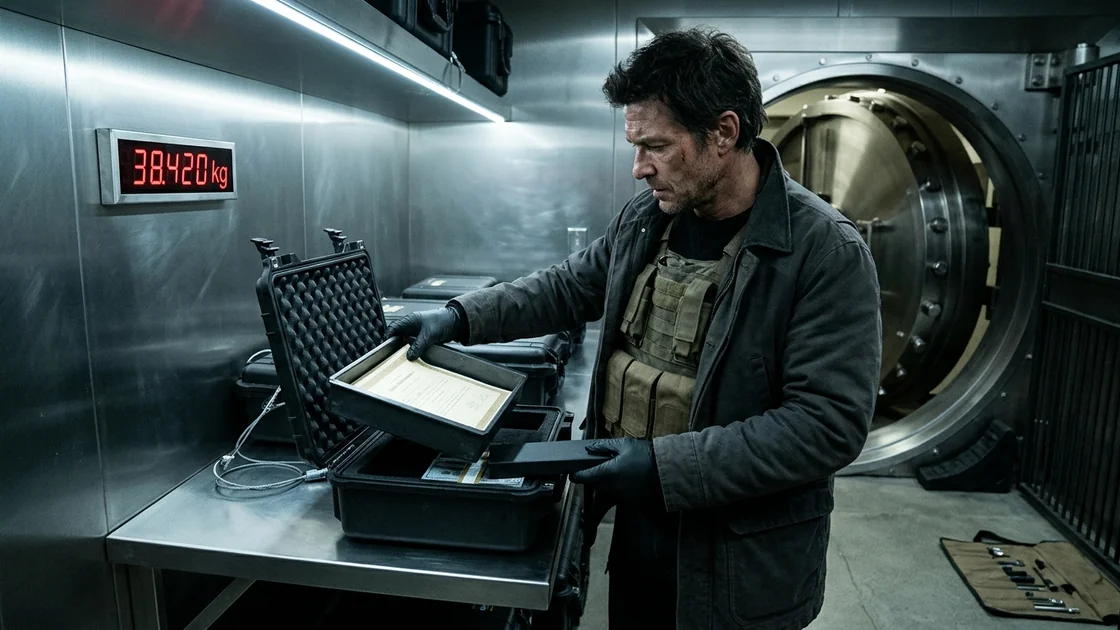
Elias Vance, a master safe-cracker left for dead by his former syndicate, embarks on a high-stakes solo infiltration of his old crew's heavily fortified Chicago vault. Instead of simply emptying the safe to exact his revenge, Elias carries sixty-six pounds of cash into the subterranean fortress to execute a lethal sleight of hand. He plans to extract thirty million dollars in untraceable bearer bonds and replace them to the exact gram with flagged, sequential hundred-dollar bills stolen from a federal sting operation, ensuring that his former partners are either hunted by the government or destroyed by their own violent buyers.
The scale on the workbench was a Sartorius analytical balance, the kind pharmaceutical researchers used to measure alkaloids down to the tenth of a milligram. Elias Vance stood over it in the yellow cone of a single halogen shop lamp, his breath clouding faintly in the unheated damp of the Bridgeport machine shop. Outside, the South Branch of the Chicago River slapped against rotting timber pilings, a slow, greasy rhythm that had accompanied his work for the past nineteen days.
With a pair of ceramic-tipped tweezers, Elias lifted a single strip of lead foil no larger than a postage stamp and laid it atop a brick of United States currency. The green digital readout on the face of the scale flickered, settled, and held at 1,004.20 grams.
He exhaled slowly through his nose.
The brick consisted of one thousand uncirculated Federal Reserve notes in one-hundred-dollar denominations. By treasury specifications, a single bill composed of seventy-five percent cotton and twenty-five percent linen weighed roughly one gram. A strap of one hundred bills weighed one hundred grams; a bundle of ten straps weighed a kilogram. But paper was hygroscopic. It drank the lake air. It swelled in the damp basement of a federal evidence lockup in Evanston, and it shrank in the dry, radiator-heated rooms where men like Elias planned the ruin of their former friends.
And more importantly, paper money did not weigh the same as European clearinghouse bearer bonds.
Elias reached to his left, where a mock-up portfolio of archival rag paper sat inside a custom-milled polycarbonate cassette. There were six such cassettes currently resting on the middle shelf of a custom Mosler-Diebold hybrid vault forty feet beneath a renovated iron foundry on Kinzie Street. Inside those six cassettes were three hundred certificates issued through a Luxembourg fiduciary—thirty million dollars in total, payable to the bearer on demand, free of serial tracking, tax covenants, or digital footprints.
They were the harvest of the Calumet Harbor job. They were the reason Elias had a four-inch crescent of silver scar tissue curving behind his left ear, and the reason the ring and little fingers of his left hand no longer closed completely into his palm without a dull, clicking ache in the knuckles.
He slid the calibrated brick of hundreds off the Sartorius scale and set it beside twenty-nine identical bundles on the oiled oak planking of the table. Three million dollars in cash. Thirty kilograms. Sixty-six pounds of dead weight.
Every single bill in those thirty bundles was sequential, running in unbroken numerical strings from the Atlanta and Chicago Federal Reserve banks. Worse—or better, depending on which side of the vault door one stood—the bills were the bait from Operation Glass Harbor, a joint DEA and Secret Service sting that had gone sideways in a Rosemont hotel parking garage eleven days ago. While two federal tactical teams had been busy trading automatic gunfire with a Sinaloa logistics cell on the fourth level of the parking structure, Elias had calmly bypassed the electronic deadbolt on the trunk of an unmarked Dodge Charger on level two, disabled the cellular GPS beacon inside two heavy canvas mail sacks, and walked down the concrete stairwell with the government’s buy money slung over his shoulders.
The federal government did not lose three million dollars in recorded sting money and simply write it off at the end of the fiscal quarter. Every serial number was already loaded into the FinCEN red-flag servers. Every banking optical character recognition scanner from Zurich to the Cayman Islands was programmed to trip a silent federal klaxon the millisecond one of those bills passed through a high-speed counting machine. Furthermore, buried within the cotton-linen pulp of the center straps of eight bundles were passive harmonic transponders—hair-thin strips of metamaterial that required no battery, lying completely dormant until swept by a specific microwave frequency used by Secret Service technical surveillance units.
To spend that money at a grocery store was to invite a SWAT team through your drywall before the milk went sour. To hand that money across a table to Anton Varga’s Bratva couriers as collateral for a shipping route—which was precisely what Victor Kaelen intended to do with the contents of his vault at eight o'clock tomorrow morning—was a death sentence executed in stereo.
Elias picked up a roll of matte-black gaffer tape and began binding the first five bricks into a tight, rectangular slab designed to fit the exact interior dimensions of a Pelican 1550 alloy-reinforced case.
"You're an accountant now, Eli," he murmured to the empty shop, testing the rasp of his own voice. He hadn't spoken to another human being since Tuesday, when he'd bought four quarts of motor oil and a package of razor blades from a teenager in a Cicero hardware store. When you lived long enough in the quiet, your vocal cords stiffened like old leather. You had to warm them up just in case you needed to tell a lie in the dark.
He finished taping the first load-block, weighed it one final time against his ledger notes, and slid it into the customized pockets of a canvas load-bearing vest laid out across a sawhorse. Usually, when a man broke into a vault, he went in light and came out heavy. He carried twelve pounds of titanium picks, fiber-optic borescopes, and thermal lances, and he walked out bow-legged under the strain of someone else’s fortune.
Tonight, Elias was reversing the polarity of the trade. He was going in heavy, carrying sixty-six pounds of poison on his ribs and spine, and he was walking out with three hundred sheets of rag paper that weighed less than a Sunday newspaper.
If he simply stole the bearer bonds and left the vault empty, Victor would know within six hours that he had been hit. Victor would cancel the morning meet with Varga, liquidate his secondary accounts, burn the Kinzie Street foundry to the ground, and vanish into the gray geometry of Montenegro or Cyprus with five million dollars in emergency reserves still intact. Victor would survive. Marcus Thorne would survive. Clara Vane would survive. And they would spend the rest of their lives paying freelancers to look for a man with a scarred ear and two stiff fingers.
An empty vault merely made a thief rich. A full vault—stuffed with the wrong paper—made a dead man’s enemies do the killing for him.
Three years ago, the vault had not been a Mosler-Diebold in the West Loop. It had been a Chubb Bankers’ Treasury room on the third floor of the Maritime Exchange Building at Calumet Harbor.
Elias closed his eyes as he tightened the Nylon webbing straps of the weighted vest, letting his fingers remember the cold sweat of that night. There had been four of them then. Victor Kaelen, who wore bespoke charcoal overcoats and spoke like a man who sat on the board of a regional hospital, had put the paper together. Victor never carried a gun and never touched a crowbar; he dealt in schedules, bribed port commissioners, and the maritime insurance manifests that told them when the Luxembourg bonds were being transferred from a bonded Swiss freighter to an armored courier bound for O'Hare.
Marcus Thorne had handled the wires. Marcus was thirty-two, pale as a mushroom, with a habit of chewing the cuticles of his thumbs until they bled onto his keyboard. He had been kicked out of MIT for running an automated arbitrage script through the university’s supercomputing cluster, and he viewed physical security as an archaic insult to his intelligence. To Marcus, every door was just a string of ones and zeros waiting to be lied to.
And Clara Vane. Clara had been the lookout, the driver, and the steady hand with a suppressed Heckler & Koch MP5 when the world went loud. She had dark, close-cropped hair, a dry laugh that started low in her throat, and an apartment in Lincoln Park that smelled of espresso and gun oil. For fourteen months prior to the Calumet job, Elias had spent three nights a week in that apartment, listening to the radiator clank while he traced the old appendix scar on her hip and believed, with the peculiar stupidity of men who worked with machines, that people were built on tolerances just as reliable as brass tumblers.
They had needed Elias because the Maritime Exchange had not upgraded its core vault since 1978. There were no ethernet ports on a ten-ton Chubb door. There were no firmware vulnerabilities in four inches of chill-cast manganese steel or the triple-movement mechanical time lock ticking behind the bolt work. Marcus could kill the cameras and loop the ultrasonic motion detectors in the corridor, and Victor could buy the night watchman’s shift roster, but when they reached the steel, they needed The Ear.
Elias had opened the Chubb in thirty-eight minutes without a single drill bit touching the armor plate. He had done it by bridging the time-lock escapement with a neodymium magnetic wand he’d wound himself, pulling the steel balance wheels to a dead halt through three inches of solid plate, and then hand-manipulating the dual Sargent & Greenleaf Group 1 combinations while Marcus sweated through his shirt and Clara watched the stairwells.
The betrayal hadn't been loud. That was what still impressed Elias when he lay awake listening to the river. There had been no shouting, no melodramatic speeches about shares or greed.
They had packed the six polycarbonate bond cassettes into the rolling janitor’s cart. Elias had stepped back into the vault vestibule to retrieve his magnetic bridge and wipe the graphite dust from the spindle ring—a habit of basic professional hygiene that kept the federal forensic locksmiths from knowing how a door had been beaten.
When he turned around, the inner steel grill gate was already swung shut.
The spring-latch clicked home with a sound like a crisp apple breaking in half.
Victor was standing on the other side of the bars, adjusting the cuffs of his camel-hair coat. Marcus was already halfway down the hallway pushing the cart, not looking back. And Clara stood beside Victor, the MP5 hanging on its three-point sling across her chest, her right hand resting on the polymer grip.
"The harbor patrol moved their rotation up by twenty minutes, Eli," Victor had said. His voice was calm, almost regretful, like a surgeon explaining a complication to a distant relative. "Marcus picked up the dispatch on the trunked radio band. If four of us go out the service dock, the weight puts the zodiac boat six inches too low in the chop. We’ll swamp before we clear the breakwater."
"Open the gate, Vic," Elias had said, his hand wrapping around the cold square iron of the vertical bars. He wasn't looking at Victor. He was looking at Clara. "The latch has a thumb-turn on your side. It takes two seconds."
"It's not the two seconds, old friend," Victor said. "It's the math. Varga’s people took a twenty percent haircut on the clearinghouse fee this morning. That leaves twenty-four million instead of thirty. Split four ways, after Marcus’s tech overhead and my brokerage costs, it’s barely retirement money. Split three ways, with the safe-cracker caught on the premises so the insurance investigators close the file the same night? That’s a clean horizon."
"Clara," Elias said softly.
She hadn't looked away. He gave her that much. She looked him dead in the eyes, her jaw set hard, her pupils wide in the red glow of the vault’s emergency exit light. Then she raised the suppressed pistol—not an MP5, he realized in the last fraction of a second, but a small, untraceable .22 caliber Ruger with an integral baffled barrel—and fired once through the four-inch gap between the bars.
At nine feet, a subsonic .22 didn't make a cinematic bang. It sounded like someone dropping a heavy stapling machine onto a carpeted floor.
Elias had jerked his head to the right just as her finger took up the slack on the trigger. Instead of taking him through the bridge of the nose and turning off his lights forever, the forty-grain lead round grazed the mastoid bone behind his left ear, plowing a white-hot furrow through flesh and cartilage before ricocheting off the manganese vault liner. As he fell backward, instinctively throwing his left hand up to catch himself against the heavy inner door, Victor reached through the bars and tripped the pneumatic floor-release for the primary vault door’s counterbalance.
Seven tons of balanced steel, sitting on a three-degree incline, began to roll shut.
Elias had tried to roll clear, his skull ringing like a struck anvil, blood blinding his left eye. His body made it out of the jamb, back into the inner vault room, just before the stepped edges of the door mated with the frame. His left hand was half a second too slow. The outer edge of the secondary pressure flange caught his ring and little fingers against the steel threshold before he tore them free, leaving skin, blood, and crushed phalanges in the grease of the hinge.
Then the door boomed shut. The automatic relockers dropped. He was sealed inside an airtight steel box with roughly four hours of breathable oxygen, a fractured skull, two ruined fingers, and no tools except a magnetic wand and a vial of lock-oil on the wrong side of the door.
Victor hadn't counted on two things. First, the Maritime Exchange Building’s vault had been fitted in 1984 with an obscure, federally mandated anti-kidnapping ventilation port tucked behind the false mahogany wainscoting in the back corner—a four-inch cast-iron pipe sealed by an internal tamper screw that allowed a trapped bank manager to breathe and drop a telephone wire down to the street level. Second, when the Chicago Police Department and the FBI finally cut the door open fourteen hours later, expecting to find a suffocated corpse, they found a half-dead John Doe who had used those fourteen hours to swallow the micro-SD card from his borescope, burn his remaining fingertips smooth against the rough cast-iron interior of the ventilation pipe, and slip into a coma from blood loss.
He spent eleven months in the county hospital ward at Cermak Health Services and another eight at the maximum-security infirmary in Joliet, refusing to speak a word, fingerprinted only by two ruined smudges until a winter transport van carrying him and four other inmates to a federal arraignment hit a patch of black ice on the Des Plaines River bridge during a January blizzard. The van went through the rusted guardrail and dropped forty feet into the freezing slush of the shipping canal. Two guards and three prisoners drowned in their chains. Elias, whose left hand had healed crooked and substantially narrower across the metacarpals than when the handcuffs had been ratcheted onto his wrists, slipped the steel cuff over his dislocated thumb in the dark, black water, kicked out the shattered rear window, and let the current carry him half a mile downstream to a barge tie-up.
The newspapers listed him as unrecovered, presumed swept into the Lockport dam turbines.
Victor had toasted his ghost, waited the agreed-upon thirty-six months for the European clearinghouses to cycle their fraud-watch lists, and brought the bonds out of deep freeze this week to finalize his buy-in with Anton Varga’s syndicate.
Elias buckled the heavy vest over a black merino wool sweater, pulled a oversized charcoal canvas car-coat over the bulk, and picked up his tool roll. It was time to balance the ledger.
At 1:18 in the morning, the rain in the Fulton Market and Kinzie industrial corridor was turning to sleet, needle-sharp and driven sideways by a wind coming straight off the lake. Seven blocks east, restaurants with Edison bulbs and forty-dollar cocktails were closing their tabs for the night, their valets huddling under canvas awnings. Here, sandwiched between the elevated concrete viaducts of the Milwaukee District rail lines and a shuttered cold-storage meat plant, the street belonged to rusted dumpsters and sodium vapor lamps that buzzed with a dying orange flicker.
Kaelen Architectural Salvage & Foundry occupied a full half-block of dark red Chicago common brick. On paper, the company bought wrought-iron fencing, terra-cotta cornices, and brass elevator cages from demolished pre-war buildings across the Midwest, restored them in an acid-dip and sandblasting facility on the ground floor, and sold them to billionaire developers in Lake Forest and Aspen.
It was a brilliant front. A foundry explained the twenty-ton overhead bridge cranes. It explained the three-phase industrial electrical draw that would have flagged a cannabis grow-op or a server farm. It explained why armored trucks and unmarked semi-trailers backed into the bay doors at three in the morning, and why the sub-basement floor was reinforced with four feet of high-density concrete laced with granite aggregate and steel slag.
Elias did not approach the building from Kinzie Street. Marcus Thorne’s camera coverage on the street level was overlapping, redundant, and paranoid—a combination of Starlight low-light optical domes and passive uncooled microbolometer thermal imagers hidden inside vintage cast-iron streetlamps outside the loading bays.
Instead, Elias walked between two parked Union Pacific maintenance boxcars on the dead spur tracks three hundred yards west, dropped into a concrete drainage swale choked with dead ragweed, and pried open a square cast-iron inspection hatch belonging to the old Chicago Tunnel Company freight network.
Most people in the city didn't know that forty feet beneath the Loop and the near-west industrial corridor lay sixty miles of narrow-gauge railway tunnels carved out of the blue clay at the turn of the twentieth century to haul coal and ash between basements. After the great flood of 1992, the city had plugged most of the river crossings with massive concrete bulkheads, leaving the outer industrial branches as forgotten, sweating catacombs of weeping concrete and rusted two-foot-gauge tracks.
Elias lowered himself down the fiberglass ladder rungs he had epoxied into the shaft four nights ago. The sixty-six pounds of cash strapped to his torso pulled at his collarbones like a lead diving belt. His boots hit the ankle-deep black water at the bottom of the shaft with a dull splash.
He clicked on a red-filtered headlamp—red light preserved night vision and didn't scatter down wet tunnel walls—and began walking east along the rotting wooden ties. The air down here was fifty-two degrees year-round, smelling of wet limestone, iron oxide, and a century of coal dust.
He counted his paces. Four hundred and ten yards from the rail spur hatch, the arched concrete wall on his left changed texture. The 1906 poured concrete gave way to a twelve-foot section of modern shotcrete sprayed over heavy corrugated steel sheeting. This was the outer retaining curtain of Kaelen’s sub-basement vault room, poured when Victor had brought in a non-union crew from Milwaukee two years ago to sink his private bunker into the clay.
Elias stopped. He shrugged out of his heavy canvas coat, hanging it on a rusted cable hook protruding from the tunnel crown, and knelt beside a pile of broken limestone ballast. From beneath the stones, he retrieved a waterproof pelican case he had cached there on Wednesday night.
Inside wasn't a jackhammer or a core drill. You couldn't drill into Victor’s retaining wall; Marcus had embedded a continuous loop of Piezo-electric microphonic coax cable—the kind used on military perimeter fences—directly into the concrete pour. A hammer blow or a rotary masonry bit anywhere along the foundation would send an immediate acoustic spike to the security terminal upstairs.
Elias didn't need to go through the concrete wall. The old foundry above had originally received its boiler coal from this very tunnel in 1922. When Victor’s engineers had poured the new sub-basement, they had sealed the original four-foot-wide coal chute with a three-quarter-inch steel plate bolted from the inside, backed by a brick masonry plug, and routed their high-voltage conduit and chilled-water return pipes through a six-inch collar at the top of the old chute.
Above the coal chute, however, was the foundry’s subterranean sump room—a wet, greasy mechanical space that sat outside the primary seismic envelope of the vault, separated from the sub-basement corridor only by a heavy steel fire door and an air-gapped drainage trench.
For the past three weeks, working two hours a night between two and four in the morning, Elias had removed sixteen courses of ninety-year-old lime-mortar brick from the inside of the coal chute’s upper arch using nothing but a tungsten carbide hand-rasp, a spray bottle of muriatic acid to soften the lime, and a medical stethoscope to ensure the vibrations never rose above the ambient hum of the foundry’s sump pumps directly above him. He had braced the removed bricks with custom wooden shims painted the exact gray-brown of the tunnel clay.
Now, he reached up into the dark recess above the steel plate, unhooked the fiberglass camouflage curtain, and pulled the wooden shims one by one.
Behind the last row of bricks was the bottom plate of the foundry’s cast-iron floor drain. It was held down by four corroded brass machine screws that Elias had already replaced with greased stainless-steel pins during his last recon trip.
He reached into his tool roll, pulled out a tiny inductive clamp, and clipped it around the insulated copper ground wire running alongside the chilled-water pipe. He connected the clamp to a palm-sized digital multimeter. Before he touched the iron grate, he needed to know if Marcus had energized the metalwork or placed a capacitive proximity sensor on the drain assembly.
The meter read 0.002 millivolts—nothing more than natural galvanic drift between the iron pipe and the wet clay of Chicago.
Elias slid the four pins free, braced his shoulders under the hundred-pound cast-iron grate, and pushed upward with his legs. His thighs burned as the weight of the grate added to the sixty-six pounds of federal cash strapped to his chest. With a slow, greased scrape of metal on concrete, the grate lifted two inches, pivoted left, and settled onto two strips of high-density neoprene foam he had laid along the rim of the sump pit.
He paused, holding his breath for sixty seconds, listening.
Above him, the sub-basement sump room hummed with the steady, sixty-hertz drone of the building’s step-down transformers and the rhythmic chug-chug-clack of a circulating boiler pump. No alarms sounded. No footsteps echoed on the concrete overhead.
Elias reached up, gripped the lip of the floor opening with his good right hand and his forearm, and hauled himself out of the earth.
The sump room was twelve feet by ten, lined with sweating glazed tile and crowded with green-painted cast-iron filtration tanks. Elias lay flat on the cold concrete floor for two minutes, letting his heart rate drop from one-ten back down to a steady fifty-eight beats per minute. A fast heart made for shaky fingertips, and tonight his fingertips had to read steel tolerances smaller than a human red blood cell.
He stood up, checked the hang of the weighted vest beneath his black sweater, and moved to the heavy hollow-metal fire door leading into the sub-basement corridor.
There were two guards on rotation in the building at night. Elias knew their names, their habits, and their credit scores because he had spent a week sitting in the back of a rusted Ford Econoline van across the rail viaduct with a parabolic microphone and a long-range packet sniffer pointed at the foundry’s guest Wi-Fi.
The guards were former private military contractors Victor had hired through a shell company in Tampa—men named Mercer and Doyle. They were disciplined enough not to sleep on shift, and they didn't drink on the clock, which made them dangerous. However, they were also creatures of rigid standard operating procedure. Every forty-five minutes, one of them walked the ground-floor foundry bays and the mezzanine offices while the other remained in the security booth near the Kinzie Street loading dock, watching six monitors.
Neither of them came down to the sub-basement level unless an alarm tripped. Victor didn't let the hired muscle near the vault room; the freight elevator and the sub-basement stairwell required a rolling cryptographic token that only Victor, Marcus, and Clara carried.
That didn't mean the sub-basement corridor was unguarded. It was guarded by Marcus Thorne’s paranoia.
Elias knelt before the fire door. There was no keyhole on this side—only a heavy commercial panic bar and a concealed magnetic reed switch mortised into the top header of the frame. If the door opened more than an eighth of an inch, the magnetic field between the door and the frame would break, opening a normally-closed circuit and triggering an immediate tamper fault on Doyle’s console upstairs.
More dangerously, it wasn't a simple magnetic switch. It was a balanced triple-biased reed switch, designed so that sticking a powerful magnet against the doorframe from the outside would over-saturate the secondary coil and trip the alarm just as fast as opening the door.
Elias didn't use a magnet. He took a two-inch strip of feeler-gauge spring steel—0.004 inches thick—and coated the tip with a non-conductive silicone grease. Slowly, working by the faint red glow of his headlamp, he slid the razor-thin steel blade into the hair-wide gap between the top of the door and the steel header frame, directly beside the mortised switch housing.
Beside the switch, where the installer had drilled the frame five years ago to run the low-voltage alarm wire through the masonry, there was always a rubber grommet. And installers, even good ones hired by men like Marcus, almost always left two inches of service loop in the two-conductor wire just behind the switch plate in case the unit ever needed to be replaced.
With a second hooked wire made from high-tensile piano steel, Elias fished inside the tiny cavity above the switch housing until he felt the rubbery yield of twenty-two-gauge PVC insulation. Carefully, using a microscopic pair of alligator-jaw surgical forceps modified with needle-sharp vampire taps at the tips, he clamped onto both the positive and return wires inside the header frame.
He attached the trailing leads of the forceps to a small black box clipped to his belt—a variable resistor bridge with a digital impedance readout. The box measured the exact resistance of the closed alarm loop, including the end-of-line resistor hidden inside the switch housing: 2,184 ohms.
Elias dialed the knob on his bridge until it generated an identical 2,184-ohm load across the vampire taps, effectively bypassing the switch inside the doorframe before the signal ever reached the wall conduit.
He depressed the panic bar wrapped in a wool cloth to deaden the spring noise and pulled the door open six inches.
On the digital multimeter screen, the circuit loop held steady. No spike. No drop.
He peered around the steel jamb into the sub-basement corridor.
It was a forty-foot concrete hallway painted a sterile, glossy institutional white so that any shadow or dust disturbed on the floor would stand out immediately on the high-definition monochrome camera mounted in the far upper corner above the vault vestibule. Halfway down the ceiling hung a white plastic dome the size of a smoke detector: a Bosch dual-technology motion sensor combining passive infrared thermal detection with a K-band microwave Doppler radar.
You could beat passive infrared by wearing a insulated neoprene wetsuit or holding up a sheet of glass or heavy mylar that blocked your body heat from reaching the pyroelectric sensor. You could beat microwave radar by moving slower than the Doppler threshold—typically less than two inches per second. Beating both simultaneously in a dead-straight, brightly lit corridor while carrying sixty-six pounds of cash was an exercise in torture.
First, the camera.
Elias couldn't hack Marcus’s closed-circuit network from down here; the coaxial lines were run inside pressurized rigid steel conduit filled with dry nitrogen—if you drilled the pipe to tap the cable, the pressure drop tripped a pneumatic switch at the head-end server.
Instead, Elias reached into his long tool case and assembled a four-piece telescoping carbon-fiber rod. At the end of the rod was a gimbal-mounted frame holding a curved, eight-by-ten-inch sheet of optical-grade acrylic coated with a specialized anti-reflective film, and printed on the rear side of that acrylic—illuminated by a paper-thin electroluminescent backlight panel calibrated to the exact 4,000-Kelvin color temperature of the hallway’s LED strip lights—was a high-resolution, matte-finish photograph of the empty hallway.
Elias had taken the reference shot four nights ago using a pinhole lens pushed through the fire door’s bottom weatherstripping before he had even touched the reed switch. Because the hallway was windowless, subterranean, and lit by solid-state LEDs that never flickered or changed shadow angles, the view from the corner camera hadn't changed by a single pixel in eighteen months.
Wait. That only worked if the camera was across from him. The camera was at the far end of the hall, facing directly toward the fire door and the vault entrance beside it. If he pushed a rod out from the fire door, the camera would see the rod moving thirty feet down the corridor before it ever reached the lens!
Elias smiled thinly in the dark. That was why amateurs got caught trying to copy what they saw in movies. You didn't cover a camera from thirty feet away down its own line of sight.
He looked up at the ceiling directly outside the sump room door. Running along the upper right corner of the white corridor was the four-inch square steel trough carrying the high-voltage lighting bus. And directly above the camera at the far end of the hall was the return air plenum grill for the sub-basement’s dehumidifier system—a duct that ran right back over the ceiling of the sump room where Elias was standing.
He didn't need to walk the floor until the camera was blind.
Stepping back into the sump room, Elias climbed atop the green cast-iron filtration tank, unscrewed the four hex bolts on the main galvanized sheet-metal air return trunk, and lifted away the access panel. The inside of the duct was eighteen inches wide by twelve inches high, lined with acoustic fiberglass batting that muffled sound. It was too narrow for a man wearing sixty-six pounds of cash to crawl through without tearing the ductwork off its hangers, which was why Elias hadn't used it as a crawlspace.
Instead, he fed his telescoping carbon-fiber rod through the twenty-eight feet of straight galvanized duct. He pushed it section by section, watching a tiny wireless endoscopic camera mounted on the tip of the rod via a wristwatch screen on his left arm. The carbon rod glided silently over the fiberglass insulation on small Delrin rollers until it reached the vertical drop-boot directly behind the return grill at the far end of the corridor—six inches above and behind the security camera’s mounting bracket.
Using a braided stainless-steel pull wire running down the hollow core of the carbon rod, Elias articulated a curved arm out through the wide louvers of the return vent. The arm swung down smoothly behind the camera housing and pivoted the backlit, wide-angle collimating lens plate directly in front of the camera's glass dome, three millimeters from the objective lens.
Upstairs in the security booth, if Doyle happened to glance at Monitor 4 during his coffee sip, the image wouldn't even flicker; the auto-iris on the camera would adjust in less than a sixtieth of a second to the identically lit collimated diopter slide, showing the empty white corridor stretching back toward the closed sump room door.
Now remained the Bosch dual-tech motion detector in the center of the ceiling.
Elias climbed down from the filtration tank, picked up his heavy mylar thermal blanket stretched over a collapsible umbrella frame, and stepped out into the blinding white light of the corridor.
He deployed the square mylar shield in front of him like a Roman legionary’s scutum. The aluminized outer layer reflected the room's ambient seventy-one-degree wall temperature back at the ceiling sensor, masking the ninety-eight-degree heat signature of his body.
Then he began the walk.
To stay beneath the microwave Doppler carrier wave’s phase-shift threshold, he could not move faster than one inch every two seconds. Twenty-five feet to the vault alcove meant three hundred inches. Six hundred seconds. Ten minutes of continuous, agonizingly smooth glacial motion without a single twitch, stumble, or jerky breath that might cause the mylar sheet to ripple and bounce a microwave harmonic back to the ceiling dome.
He slid his right boot forward half an inch on a pair of felt furniture sliders strapped over his soles. Shifted his center of gravity. Drug the left foot half an inch.
Two minutes in, the straps of the weighted vest began to dig into his trapezius muscles like hot wires. Sixty-six pounds was manageable when you were walking at a normal stride, using momentum to carry the load from hip to hip. When you were locked in a half-crouch, moving at the speed of the minute hand on a clock, every ounce of those thirty bricks of hundred-dollar bills tried to crush your lumbar spine into powder.
Sweat broke out along his hairline, running down into the old bullet scar behind his ear. It stung with salt. He didn't dare raise a hand to wipe it.
At five minutes, he was directly beneath the white plastic dome of the Bosch sensor. He could hear the faint, high-pitched whine of its internal voltage regulator. On the side of the housing, behind a translucent white window, the walk-test LED remained dark—Marcus had disabled the visible indicator light via software, of course, so an intruder wouldn't know when they had tripped it, but Elias had a passive RF field detector clipped to the inside of his umbrella frame to monitor the sensor's Z-Wave alarm relay. The needle sat dead at zero.
Inch by inch. Slide. Balance. Breathe through the mouth so the chest doesn't heave.
At eight minutes, a cramp knotted the calf of his right leg. The muscle seized hard, threatening to make his knee buckle. Elias locked his jaw until his molars ground together, shifting eighty percent of the weight onto his left leg without altering the forward speed of the mylar shield by a millimeter.
At ten minutes and fourteen seconds, the edge of his felt-shod boot touched the brushed stainless-steel threshold of the vault alcove, beyond the cone of the microwave sensor's coverage.
Elias stepped into the recessed dead-zone, collapsed his thermal shield, and leaned his back against the cold concrete wall, letting his lungs draw long, silent drafts of conditioned air.
Then he turned his head and looked at the beast.
Victor Kaelen had spared no expense on his tomb.
The door had originally been forged in 1929 by the Mosler Safe Company in Hamilton, Ohio, for a regional Federal Reserve branch in Kansas City that had been demolished in the nineties. It was a circular plug door, eighty-four inches in diameter, cast from twenty-two inches of solid steel and copper-alloy Torch-and-Drill-Resisting plate, weighing just under fourteen thousand pounds. The crane hinge alone was the size of a butcher’s block, polished to a dull pewter gleam and balanced on tapered roller bearings so fine that, once unlatched, a child could swing seven tons of armor plate open with two fingers.
When Victor had bought the vault at a salvage auction and sunk it into the Kinzie Street sub-basement, he hadn't left it in its 1929 configuration. Marcus Thorne didn't trust pure mechanics, and Victor didn't trust pure electronics. So they had built a chimera.
The original quadruple-movement chronometer time lock was still intact behind the inner glass cover, ticking away on Swiss jeweled bearings that couldn't be hacked by any computer on earth. Beside it, the two primary combination dials had been upgraded to modern Sargent & Greenleaf 8500-series Group 1R manipulation-proof locks with spy-proof shrouds. And bolted directly over the main bolt-throw handwheel spindle was a Diebold biometric and cryptographic rotary solenoid module wired into an isolated, battery-backed server rack sitting inside a welded steel cage on the left wall of the alcove.
To open this door lawfully, you needed the time lock to be in its open daytime window—or you needed to bypass it—AND you needed to dial two separate four-wheel mechanical combinations that had no physical contact points between the lever nose and the drive cam while spinning, AND you needed to scan a live palm-vein geometry while entering a rotating six-digit hash code on the Diebold keypad to retract the solenoid blocking bar.
Any safe-cracker in North America looking at that setup without fifty pounds of C-4 and a plasma torch would have packed his bags and gone back up the coal chute.
Elias looked at it and saw the minds of the two men who had built it.
First, the Diebold biometric-cryptographic module. Marcus had installed it himself; Elias could tell by the custom anodized aluminum dress-plate and the military-spec Amphenol connectors running from the door hinge into the armored server cage on the wall. Marcus was brilliant with code, which meant he hated physical friction. He would never trust a biometric palm scanner not to lock him or Victor out if the humidity in the basement changed or if Victor cut his hand on a piece of architectural salvage. Every high-end digital lock installed by a systems engineer had an administrative hardware fail-safe—not a keyhole, which was vulgar, but a serial diagnostic bus or a solid-state relay jump hidden inside the controller enclosure.
Even better, the solenoid blocking bar on the door itself was what locksmiths called a "bolt-blocker." It didn't have the torque to throw the twenty-four three-inch steel locking bolts around the circumference of the Mosler door; a battery-powered motor would burn out trying to move that much iron. Instead, the electronic module simply dropped a hardened steel pin into a notch in the manual handwheel's main tie-bar.
Elias stepped up to the polished steel face of the vault. He pulled on a pair of ultra-thin nitrile gloves to keep sweat and skin oils off the metal, then ran his fingertips along the underside of the Diebold module's brushed-steel shroud.
The shroud was held onto the main Mosler door plate by four sunken security Torx screws whose heads had been filled with silver solder after installation, and the seam was lined with an optical tamper loop that measured the ambient darkness inside the casing. If you pried the cover off, light hit the phototransistor inside and fired an internal glass-vial relocker spring, jamming the bolt work permanently until someone drilled a three-inch hole through twenty-two inches of copper-laced steel.
Elias didn't touch the screws. He looked at the armored flexible conduit—the "door cord"—that carried the power and data wires from the wall frame across the massive crane hinge and into the side of the Diebold housing.
Why run power from the wall across the hinge instead of using internal batteries inside the keypad? Because palm-vein scanners used high-intensity near-infrared LED arrays and a local cryptographic processor that chewed through alkaline batteries in three weeks. Marcus had wired it to a 24-volt DC step-down transformer inside the wall cage.
And how did the keypad on the outside of the housing communicate with the solenoid pin on the inside? If it were a standard cheap safe, you could just cut the cord and apply nine volts to the two solenoid wires to make the pin jump. On a Diebold high-security module, the encrypted verification happened on the logic board mounted directly to the solenoid assembly inside the dark housing; sending raw voltage down the hinge wire would just fry the power regulator and leave the pin locked.
Unless you didn't send raw voltage. Unless you knew that four years ago, before the Calumet Harbor job, Marcus had built an identical prototype controller for a dress-rehearsal test in their old Pilsen warehouse, and Elias had watched him flash the firmware onto the Atmel microcontroller chip.
Marcus used a custom CAN-bus communication protocol between the wall server and the door solenoid, running over twisted-pair wiring. And because Marcus was lazy about climbing down into the cold sub-basement to run routine diagnostics on the solenoid’s coil resistance, he had left a diagnostic "cycle-test" command active in the local microcontroller's interrupt table—a command that cycled the solenoid pin open for three seconds to verify mechanical travel whenever the wall server sent a specific hexadecimal maintenance ping accompanied by a fifty-millivolt drop on the ground reference line.
The only catch was that the door had to be open—meaning the hinge reed switch had to indicate the door was swung out for maintenance—before the microcontroller would accept the cycle-test command.
Elias pulled a small neodymium rare-earth magnet wrapped in velvet from his pocket. Unlike the corridor fire door, the hinge maintenance sensor on the Diebold retrofit wasn't connected to the building's intrusion alarm; it was purely an internal logic interlock for the vault's maintenance mode, added as an afterthought by Marcus when the original mechanical plunger switch hadn't fit the curved 1929 Mosler casting.
Elias placed the velvet-wrapped magnet against the underside of the lower crane hinge pin, matching the exact flux angle he had mapped with a magnetic viewing film during his final recon night two days ago. A tiny, almost inaudible tink sounded inside the potted epoxy sensor block as the reed blades pulled together, telling the Diebold logic board that the seven-ton door was currently swung wide open for servicing.
Next, Elias took a resonant inductive coupling coil—essentially a miniature high-frequency transformer split into two halves—and clamped it around the outside of the braided stainless-steel door cord. He didn't pierce the armor or cut a single wire; by driving a high-amperage square wave through the outer clamp, he induced a sympathetic electromagnetic current directly onto the unshielded twisted-pair data wires inside the flex conduit.
He plugged the coupler into a custom Raspberry Pi terminal strapped to his left forearm, brought up the command-line script he had written over the last two weeks, and hit execute.
The script flooded the line with white-noise bus collisions to deafen the wall server for four hundred milliseconds, dropped the ground reference by fifty millivolts, and injected the sixteen-byte hexadecimal maintenance ping directly into the door controller.
Elias pressed his good right ear against the cold steel of the Mosler door, three inches from the Diebold shroud.
Clack-whir.
Inside the dark housing, the rotary solenoid spun ninety degrees and held. Before the three-second diagnostic timer could expire and snap the pin back into the locked position, Elias flipped a toggle switch on his inductive clamp, sending a precise, high-frequency electromagnetic pulse into the power regulation line—not enough to melt the wires or leave a scorch mark, just enough to trip the tiny resettable polymeric positive-temperature-coefficient fuse on the microcontroller board.
With its processor power cut in a brownout state while the maintenance latch was held by a magnetic detent, the solenoid stayed retracted. When the polymeric fuse cooled down in twenty minutes, or when Elias removed the hinge magnet on his way out, the board would reboot cleanly and snap the pin back into place without logging an error code.
One layer down. Two to go.
Now came the time lock.
Through a four-inch circular bullseye window of two-inch-thick laminated bullet-resistant glass set into the center of the door, Elias could see the brass and nickel-plated mechanisms of the four chronometer movements ticking away in synchronized splendor. The glass was there so the bank officer could verify before closing the vault that the clocks were wound and running, preventing an accidental permanent lockout.
Currently, the four dials showed sixteen hours remaining before the snubber bar would drop and allow the main bolt work to be retracted—eight o'clock tomorrow morning, right on schedule for Victor’s meeting with Varga.
In Calumet Harbor, Elias had stopped the time-lock balance wheels from the outside to freeze time before the door was locked. Here, the time lock was already engaged, its hardened steel dogging bar resting firmly behind the main bolt-throw mechanism. Stopping the clocks now would only make it take longer to open. He didn't need to stop time; he needed to accelerate it, or lift the dogging bar.
You couldn't lift a Mosler time-lock dogging bar with a magnet from the outside; the bar was made of non-magnetic phosphor bronze specifically to defeat magnetic attacks. And the balance wheels of the four Swiss movements were made of glucydur—a beryllium-bronze alloy with hairsprings of nivarox—completely immune to magnetic fields.
Wait. If the time lock was immune to magnets and sealed behind twenty-two inches of steel and two inches of glass, how could anyone on earth open it sixteen hours early without explosives?
Elias smiled, his breath fogging the thick bullseye glass.
Because in 1929, the Mosler Safe Company had included an emergency manual release on their quadruple-movement banker's chests—not accessible from the outside, of course, unless you knew the secret of the bullseye glass itself. The circular glass port was held in place from the inside by a massive threaded bronze retaining ring so it couldn't be unscrewed from the front. However, to prevent moisture from fogging the space between the double panes of the viewing port and obscuring the delicate clocks, Mosler engineers had milled a microscopic breather channel—0.030 inches in diameter, following a dog-leg path to stop drill bits—through the bronze bezel ring at the six o'clock position to accept a tiny desiccant cartridge plug.
During the 2023 restoration of the vault door, Victor’s aesthetic finisher had polished the outer bronze bezel to a mirror shine and replaced the dried-out 1929 felt desiccant plug with a modern, unpainted stainless-steel set screw so it looked flush and clean.
Using a modified watchmaker’s jeweler screwdriver with a custom-ground tip, Elias backed out the tiny two-millimeter set screw at the bottom of the glass bezel.
He pulled a spool of Nitinol wire from his vest pocket. Nitinol was a nickel-titanium "shape-memory" alloy. At room temperature, you could bend it into any serpentine curve you wanted. When you ran a tiny electrical current through it to heat it to one hundred and ten degrees Fahrenheit, its crystalline structure snapped back with tremendous force into whatever rigid, geometric shape it had been forged into at the factory.
Elias had spent four days in his Bridgeport shop heat-training a fourteen-inch length of 0.025-inch Nitinol wire on a replica Mosler time-lock frame he had bought from a retired safe technician in St. Louis.
Carefully, millimeter by millimeter, he fed the flexible, dead-soft wire through the tiny breather channel at the bottom of the bronze bezel. It snaked past the first ninety-degree dog-leg turn, slid between the inner edge of the glass lens and the brass housing of the chronometer case, and emerged on the inside of the time-lock compartment, visible through the thick bullseye glass like a silver eyelash hovering over the gleaming brass gears.
Watching through a 10x jeweler’s loupe held to his right eye, Elias twisted the wire gently until the tip rested directly beneath the counterweighted tail of the phosphor-bronze dogging lever.
He clipped two miniature battery leads to the external tail of the Nitinol wire and depressed the switch.
As current flowed through the nickel-titanium strand, the wire warmed. Inside the sealed glass chamber, the limp silver thread suddenly stiffened into a rigid, Z-shaped hook, its tip rising three-eighths of an inch with twelve pounds of lifting force. It caught the underside of the bronze counterweight, lifted the dogging pawl clear of the main bolt work notch, and held it suspended in mid-air without disturbing a single ticking gear of the four Swiss clocks.
Elias taped the battery pack directly to the steel face of the door below the bezel to keep the wire warm and rigid.
Now, only the twin Sargent & Greenleaf 8500 Group 1R mechanical combination locks stood between him and the interior of the vault.
A standard safe lock worked by rotating a stack of brass wheels until the notches—called gates—lined up beneath a spring-loaded lever fence. A skilled safe-cracker opened a standard lock by turning the dial until the nose of the lever hit the spinning drive cam, feeling the microscopic height differences in the contact points as the wheels aligned.
A Group 1R Manipulation-Proof lock was specifically engineered to make that impossible. In an S&G 8500, the lever nose didn't touch the drive cam at all while you spun the dial. The fence was held high up in the air by a mechanicalcam-cam latch until you stopped dialing and turned the spindle clockwise to a specific degree to manually drop the lever down onto the wheel pack. Furthermore, the wheels inside weren't made of heavy brass that transmitted clear acoustic clicks; they were made of Delrin—a self-lubricating acetal polymer resin that absorbed sound and eliminated weight differentials.
Under underwriters' laboratory standards, a Group 1R lock was rated to resist expert manipulation for a minimum of twenty continuous hours. Elias had ninety-five minutes before the building’s automated environmental diagnostic sweep ran at 3:30 AM.
How do you read a silent plastic wheel pack through twenty-two inches of steel when the lever only touches the wheels at a single vertical drop point?
You measure the deflection of the steel spindle itself down to the nanometer.
Elias reached into the bottom of his pelicans case and lifted out a block of machined tungsten fitted with two switchable magnetic bases. Mounted atop the tungsten block was a compact HeNe laser interferometer—an instrument normally used in semiconductor lithography labs to measure the flatness of silicon wafers using the interference patterns of split light waves.
He clamped the magnetic base onto the flat steel plate of the vault door, four inches to the left of the upper S&G dial. Then, using a dab of non-hardening optical wax that left zero residue, he stuck a tiny, two-millimeter front-surface silver mirror onto the outer edge of the knurled black dial knob, precisely at the ninety-degree tangent to the spindle axis.
When you turned the dial of an 8500 lock to the drop-in point—say, at ninety-four on the dial ring—the internal spline cam forced the bronze lever downward until its fence blade pressed against the outer circumferences of the four Delrin wheels. Because no machine in the universe was manufactured to absolute zero tolerance, the four Delrin wheels had microscopic variations in their radius—less than a ten-thousandth of an inch—and when the gates of one or more wheels passed beneath the fence blade, the fence dropped a fraction of a micron deeper into the pack.
A human finger could never feel a ten-thousandth-of-an-inch drop through a friction-clutch spindle. Even a mechanical dial-indicator gauge couldn't read it accurately because the pressure of the gauge needle itself pushed the dial knob out of alignment.
A beam of coherent red laser light, however, exerted zero physical pressure. By bouncing one half of a split 632.8-nanometer laser beam off the mirror on the dial knob and recombining it with a reference beam inside the interferometer’s photodiode, every movement of the dial knob as small as thirty nanometers—one two-thousandth the width of a human hair—caused the light waves to shift out of phase, creating a measurable count of dark and light interference fringes on Elias’s forearm display.
He didn't need twenty hours to map all one hundred numbers on the dial. He knew Victor Kaelen.
Victor was a creature of rigid numerical superstition, and more importantly, when a man had to dial two separate four-wheel combinations on a heavy vault door in a cold basement, he never used random factory numbers. Factory numbers took too long to memorize and too long to dial under pressure. And because an S&G lock required the final wheel to sit outside the forbidden drop-zone between 80 and 0, the mathematical space was already constrained.
Better yet, Elias didn't even need to guess Victor’s psychology to narrow the search window. Because Delrin polymer wheels were injection-molded in four-cavity dies at the S&G factory in Nicholasville, Kentucky, every wheel had a microscopic mold-parting line—a tiny ridge of polymer flash directly opposite the factory gate notch, 180 degrees across the wheel's diameter, plus a tiny ejector-pin depression 90 degrees off-axis.
As Elias rotated the dial smoothly using a tiny continuous-rotation micro-stepper motor belted to the dial ring with a soft silicone O-ring—eliminating any human tremor from his scarred hand—and dropped the lever in at five-number increments, the laser interferometer didn't just wait for the gates to line up. It read the surface topography of the entire wheel pack through the radial compression of the spindle shaft.
On his wrist screen, a four-trace oscilloscope graph began to paint itself in glowing green phosphor lines.
"Come on, Vic," Elias breathed, watching the fringe-counter tick. "Show me the mold lines."
Three minutes into the first sweep of the upper lock, a distinct harmonic blip appeared on the third wheel trace at 22, followed by a subtle double-dip at 67—exactly forty-five increments apart, the signature of the S&G mold-ejector cavity on a third-generation Delrin wheel. That meant the true gate on Wheel 3 sat at 12.
Once you had one gate located on a four-wheel pack, you no longer had to search the entire dial. You parking-locked three wheels at 12 and ran a high-resolution single-wheel sweep around the dial to isolate the next sharpest fringe drop.
By 2:14 AM, Elias had isolated all four gates on the upper lock: 44 - 19 - 12 - 73.
He dialed the sequence manually, feeling the buttery, silent glide of the Delrin pack, brought the dial around to the drop-in point at 92, and rotated clockwise.
The dial stopped dead at 87. The heavy bronze lever had dropped cleanly into all four gates and pulled the upper bolt-work crossbar back half an inch with a dull, muffled thunk.
Elias wiped his brow with the shoulder of his sweater, unfastened the magnetic base of the interferometer, and moved it down fourteen inches to the lower combination dial.
His lower back was screaming now. The sixty-six pounds of sequential hundreds strapped to his torso felt like they had doubled in mass over the last hour. His knees ached from standing still on the cold concrete, and the scar behind his ear was throbbing in time with the pulse in his carotid artery.
He aligned the laser beam onto the second mirror, calibrated the fringe counter to zero, and started the stepper motor on the lower lock.
Wheel 4 gave itself up in four minutes: gate at 61. Wheel 2 showed its mold-parting ridge at 88, putting the gate at 38. Wheel 3 was stubborn; its Delrin hub had a slightly looser tolerance on the brass bushing, creating noisy phase jitter on the interferometer readout. Elias had to slow the stepper motor down by half and run three averaging passes between 10 and 50 before the true gate emerged out of the statistical noise at 29.
Only Wheel 1—the deepest wheel on the pack, furthest from the drive cam—remained. He parked Wheels 2, 3, and 4 on their true gates (38, 29, 61) so the fence blade rested directly on the solitary rim of Wheel 1, and began stepping Wheel 1 around the dial two numbers at a time.
10... 12... 14... 16...
At 2:38 AM, just as the stepper motor reached 54 on the first wheel, the digital fringe counter on Elias’s wrist jumped wildly—not from the lock spindle, but from the seismic vibration of the vault frame itself.
Somewhere above him, deep within the structural steel of the foundry, the twenty-ton freight elevator contactor slammed shut with a dull, metallic boom that traveled straight down the elevator guide rails into the sub-basement concrete.
Elias froze, his finger hovering over the motor kill-switch.
He looked at his watch. 2:38 AM. The guard rotation wasn't until 2:45, and Mercer and Doyle didn't have the cryptographic fob to call the freight elevator down to the sub-basement level.
On the wall beside the armored server cage, the tiny amber LED above the elevator call button blinked once, twice, and then lit up with a steady downward arrow.
Someone with a master fob had just boarded the elevator on the ground floor and hit the button for the vault level.
Elias had roughly twenty-two seconds.
The hydraulic freight car moved at thirty feet per minute down a forty-foot shaft, plus four seconds for the heavy bi-parting steel Peelle doors to unlatch and groan open at the bottom landing.
And the elevator landing opened directly into the far end of the forty-foot white corridor, six feet to the left of the camera he had blinded and twenty-five feet from the vault alcove where he was currently standing with a laser interferometer bolted to the door, a battery pack taped to the time-lock glass, and a mylar thermal shield leaning against the wall.
If he ran back down the corridor to the sump room, he would cross under the Bosch microwave sensor at high speed, setting off every klaxon in the building before he took three steps. If he stayed in the vault alcove, whoever stepped off that elevator would walk ten paces down the hall and see him standing in front of their safe.
Worse: even if they didn't walk all the way down to the vault—say they were only coming down to access the secondary server room or the wine cellar door ten feet off the elevator landing—if they glanced down the bright white corridor and saw five pounds of scientific equipment hanging off the face of the Mosler door, he was dead.
In twelve seconds, Elias stripped the vault door bare.
He snatched the interferometer off the steel plate, peeled the two tiny mirrors off the dial knobs, tore the battery pack free, and yanked the flexible Nitinol wire out of the time-lock breather hole—allowing the bronze dogging bar to drop back into place for the moment, though the upper S&G lock remained solved and retracted, its dial sitting innocently at 87. He left the velvet magnet tucked invisibly under the massive bottom crane hinge where no human eye could see it without lying flat on the floor.
Sixteen seconds. The hydraulic pump whined louder behind the shaft wall as the car approached the bottom buffer springs.
Where does a man carrying sixty-six pounds of cash and twenty pounds of tools hide in a sterile, dead-end concrete alcove measuring eight feet wide by six feet deep?
There were no closets. There were no shadows. There was only the seven-ton circular Mosler door sitting flush in its deep cast-steel vestibule frame, the welded wire-mesh server cage bolted to the left wall, and—
Above the Mosler door.
Because a circular seven-ton vault door had to be lifted into place during construction and periodically hoisted off its hinge pins once a decade to replace the bronze thrust washers beneath the crane hinge, the alcove ceiling wasn't solid concrete at the ten-foot level like the rest of the corridor. Directly above the vault door frame was a recessed hoist well—a dark, four-foot-tall structural cavity housing a pair of sixteen-inch I-beams and a permanently mounted five-ton manual chain-fall hoist painted flat black to disappear against the ceiling shadow.
Eighteen seconds. The elevator car hit the leveling switch with a heavy hydraulic thud.
Elias clipped his tool case and the collapsible mylar frame onto the steel D-rings of his chest harness. He stepped onto the lower lip of the welded server cage, reached up to catch the flange of the overhead I-beam with his good right hand, and hooked his crooked left wrist over the chain-fall’s idle gear wheel.
Pulling two hundred and sixty pounds of combined body and cargo weight up into a four-foot ceiling cavity with one good hand and a mangled wrist was an act of pure, silent violence against his own anatomy. Tendons in his left forearm popped like dry twigs; blood broke through the skin where the rusted chain links bit into his knuckles. He swung his right leg up, hooked his heel over the opposite I-beam flange, and rolled his torso flat onto the dusty steel cross-plates spanning the two girders, pulling his trailing black wool sleeve out of sight just as the elevator safety bell chimed once.
With a motorized clatter of roller chains, the heavy bi-parting steel doors slid open at the end of the corridor.
Elias lay pressed flat on his belly across sixteen inches of cold structural steel, ten feet above the floor, looking down through a two-inch gap between the I-beam flange and the curved top of the Mosler vault arch.
Two sets of footsteps stepped out onto the concrete floor. One was the crisp, measured leather heel-strike of an Italian dress shoe. The other was a softer, rubber-soled boot that moved with a balanced, athletic roll.
Victor Kaelen and Clara Vane.
"I told Marcus to cycle the air scrubbers down here before midnight," Victor’s voice floated down the white corridor, echoing slightly off the glossy concrete walls. He sounded tired, the tight, clipped edge of insomnia riding beneath his baritone. "It smells like wet iron."
"The river’s high from the sleet," Clara replied. Her voice sent a cold, familiar current down Elias’s spine, tightening the scar tissue behind his ear. It hadn't changed at all—low, unhurried, pragmatic. "And you’re down here three hours early, Vic. Varga’s flight from Toronto doesn't even touch down at Midway until six-thirty."
They didn't stop at the server room near the elevator. Their footsteps came straight down the corridor toward the vault alcove.
Wait—why hadn't they tripped the Bosch motion sensor on the ceiling? Because when Victor badged his cryptographic fob in the elevator car, the system automatically disarmed the corridor motion sensor and switched the corner camera into local-override mode—which meant upstairs in the booth, Doyle’s monitor had just switched from the live feed (where Elias’s collimated lens hung) to a blank gray privacy screen reading EXECUTIVE ACCESS IN PROGRESS, because Victor never allowed his hired guards to watch him dial the vault combinations on camera!
That saved Elias from the collimated lens being noticed on the monitor, unless Victor or Clara looked up at the corner camera itself as they walked under it.
Elias held his breath, watching through the slot between the girders as the two of them passed directly beneath the return air grill at the far end of the hall. Neither of them looked up at the camera behind their heads; people walking away from a camera toward a target never looked back at the ceiling behind them, and from the front, the thin black frame of Elias’s collimated slide blended seamlessly into the black glare-shield hood of the Bosch dome housing.
They stepped into the vault alcove directly beneath him.
Elias was so close to the top of Victor’s head that he could see the thinning silver crown of the man’s hair and smell the faint, expensive trace of sandalwood cologne mixed with damp wool. Clara stopped two paces behind Victor, leaning her shoulder against the welded wire mesh of the server cage—inches below where Elias’s boot had scuffed the steel bar twenty seconds ago.
"The time lock doesn't clear until eight," Clara said, folding her arms across her black leather jacket. "You know you can't open the door right now even if you wanted to count the certificates again."
"I'm not opening the door," Victor said. He stepped right up to the face of the Mosler vault and peered through the four-inch bullseye glass at the four ticking Swiss chronometers.
Elias’s heart stopped.
Inside the time-lock housing, the bronze dogging bar was back in its normal resting position because he had yanked the Nitinol wire out, and he had screwed the tiny two-millimeter stainless set screw halfway back into the bottom of the bronze bezel with his thumbnail as he climbed. What about the upper S&G combination dial? It was sitting at 87—its open drop-in position—and its internal lever was retracted!
If Victor reached out and turned that upper dial to test if it was spun locked, he would feel instantly that the combination had been dialed and the lever was dropped in!
Victor’s gloved right hand rose toward the upper dial shroud.
Elias’s right hand drifted silently to the grip of the suppressed ceramic-coated blade tucked into his vest—not a gun, because even a subsonic .22 wouldn't kill both of them before one of them hit a panic button or fired back into the ceiling, and killing Victor here in the basement meant the bearer bonds stayed locked behind twenty-two inches of steel until the police arrived or the time lock ran out.
"Did Marcus run the hash update on the Diebold controller?" Victor asked, his fingers stopping an inch from the upper dial shroud to tap the brushed-steel casing of the biometric keypad instead.
"At nine o'clock before he went home," Clara said. "Green across the board. Why are you rattling the cage, Vic? We’ve sat on these bonds for thirty-six months. Six more hours isn't going to change the clearing rate."
Victor didn't turn the dial. He let his hand drop to his side, staring at his own reflection in the polished steel of the 1929 door.
"Because Varga isn't bringing his clearinghouse broker from Geneva tomorrow," Victor said quietly. "He’s bringing Sokolov."
Clara’s posture stiffened slightly against the wire cage. "Sokolov is an enforcer, not a banker. Why bring muscle to a paper swap?"
"Because the Bratva are squeezed on the Baltic shipping lanes, and Varga knows we don't have a fourth gun anymore," Victor said. "When we took Elias off the board at Calumet, it made the split cleaner, yes. Wait until tomorrow morning, though—Sokolov’s going to open those six cases, run an ultraviolet lamp over twenty random certificates to check the watermark fibers, and then he’s going to ask himself why he shouldn't just put two rounds into the back of our heads and keep the shipping routes and the thirty million."
"I have two rifles on the catwalk overlooking the bay floor," Clara said, her voice dropping into its cold, tactical register. "If Sokolov reaches inside his coat, he doesn't walk back to his car."
"A firefight in my foundry brings the feds down on every shell company we own," Victor said, turning away from the vault door to face her. "No. We let Sokolov take the cases to his suburban safehouse at eight-thirty. Once his courier wires the first tranche of the shipping deeds from Cyprus at ten, we’re on the Gulfstream out of Palwaukee by eleven. Let Varga deal with the clearinghouse liquidity."
He glanced once more at the ticking clocks behind the thick glass, exhaled a long breath, and adjusted his lapels.
"Come on. Pour me a scotch upstairs. If I stay down here looking at this iron any longer, I’m going to start hearing that bastard’s stethoscope clicking on the steel."
Clara looked at the vault door for a second longer after Victor turned toward the corridor. Her dark eyes scanned the massive crane hinge, the twin dial shrouds, and the floor plate beneath the threshold. For a heartbeat, her gaze tilted slightly upward toward the deep shadow of the hoist recess.
Elias didn't blink. Even the whites of a man's eyes could catch the overhead LED glare if he stared down into the light. He kept his eyelids ninety percent shut, breathing through his nose at a rate so shallow his ribs didn't move against the dusty steel girder.
Clara turned on her heel and followed Victor down the white hallway.
The elevator doors rumbled shut. The hydraulic ram engaged, lifting the car back toward the ground floor.
Elias waited a full three minutes after the elevator contactor clicked off at the top of the shaft, listening as the sub-basement security system automatically re-armed the Bosch microwave sensor in the corridor with a faint solid-state relay tick.
Slowly, fighting the violent shaking in his torn left forearm, he lowered himself down from the hoist well, his felt-covered boots touching the concrete without a sound.
It was 2:49 AM. He had forty-one minutes before the 3:30 diagnostic sweep.
He didn't waste a second resetting the Nitinol wire through the time-lock breather port, hooking the phosphor-bronze dogging bar up and taping the battery pack back into place. He reclamped the laser interferometer beside the lower S&G dial, stuck the tiny mirror back onto the knob at the exact ninety-degree tangent, and resumed the Wheel 1 sweep right where he had left off at 54.
56... 58... 60...
At 82, the green trace on his wrist monitor plunged into a sharp, unmistakable trough.
Four gates on the lower lock: 82 - 38 - 29 - 61.
Elias stripped the interferometer and mirror off the door for the final time, packing them into his padded case. With his bare, nitrile-gloved right hand, he dialed 82-Left four times, 38-Right three times, 29-Left two times, 61-Right once, and rotated slowly to the drop-in point at 94.
The lower bronze lever fell into the Delrin pack like a stone into deep water. He turned the dial clockwise to 86 until the lower bolt retracted completely.
Both Group 1R mechanical locks were open. The quadruple time-lock dogging bar was held aloft by the heated Nitinol wire. The Diebold biometric blocking solenoid was frozen in its retracted diagnostic state.
Wait—what about the main vault door’s seismic and magnetic opening sensors?
The seven-ton door itself was wired to the building’s master alarm panel via a dual-plunger switch recessed into the stepped inner jamb at the three o'clock position. How do you open a vault door without tripping the jamb plunger?
You couldn't bypass that plunger from the outside; it was buried behind fourteen inches of solid stepped manganese steel.
Unless you understood how Marcus Thorne had programmed the vault’s local PLC controller inside the wire-mesh cage four feet to Elias’s left.
When Victor had badged down in the elevator five minutes ago, the system had logged an authorized executive token in the sub-basement zone. More importantly, how did the alarm panel know when an authorized opening of the vault occurred at eight o'clock in the morning? When the Diebold biometric keypad fired its solenoid retraction signal, the Diebold board simultaneously sent a logic-high "shunt" flag over the door cord to the wall PLC, telling the alarm system to ignore the door-jamb plunger switch for thirty minutes while the vault was open!
And because Elias had frozen the Diebold microcontroller mid-cycle during its diagnostic solenoid retraction—and kept the hinge maintenance magnet in place—the logic-high shunt line on Pin 4 of the Amphenol connector was already pulled high.
To verify it, Elias clipped his inductive sensor around the alarm output conduit running out the top of the wire-mesh server cage. The line showed a steady supervisory heartbeat with the vault-zone bit masked out.
Elias placed both hands on the polished chrome spokes of the thirty-inch central bolt-throw wheel.
He braced his left hip against the steel frame, set his jaw, and pulled counter-clockwise.
Inside the twenty-two-inch door, a symphony of oiled mechanical perfection came to life. Twenty-four massive three-inch chromed steel locking bolts retracted simultaneously from the circular frame with a deep, oiled shhh-clunk that Elias felt in his breastbone.
He stepped back, grasped the heavy pull-handle on the left side of the door, and drew seven tons of balanced armor plate outward on its crane hinge.
The stepped, precision-ground steel edges parted with a soft sigh of equalizing air pressure—the vacuum seal of the climate-controlled interior breaking against the basement air. He swung the massive cylinder open just twenty-four inches—wide enough for a man wearing a bulky vest to slip through—and wedged a solid rubber wheel-chock beneath the bottom flange so its seven-ton momentum wouldn't drift a fraction of an inch further.
He stepped past the inner steel day-gate—which Victor left unlatched inside the sealed vault—and entered the sanctuary.
The interior of the vault was a twelve-by-twelve-foot cube lined entirely in satin-finished stainless steel, lit by automated low-UV museum strips that came on smoothly as the door pressure switch released. The air inside was bone-dry, smelling faintly of silica desiccant and new polymer.
Along the left and right walls were empty modular safe-deposit lockers. Straight ahead, built into the rear stainless-steel wall, was a heavy cantilevered shelf system made of brushed aluminum.
Sitting in two neat rows of three on that middle shelf were six matte-black Pelican 1550 Vault cases, each fastened around its locking hasps with a braided stainless-steel security cable crimped into a serialized lead-and- polycarbonate customs seal.
And beneath the brushed-aluminum shelf plate, visible through the quarter-inch expansion gap along the edges, were four HBM precision strain-gauge load cells—one at each corner—wired into an independent digital weight-monitoring display mounted flush in the rear wall.
The red LED numerals on the wall display read: 38.420 kg.
Thirty-eight point four two kilograms. The exact combined tare weight of the six Pelican cases, their custom die-cut closed-cell polyethylene foam inserts, and the three hundred archival bearer bond certificates resting inside them.
If that readout drifted by more than fifty grams—say, ±0.050 kg, to account for barometric pressure changes on the load cells—for more than three consecutive seconds without the wall key-switch being turned with Marcus’s physical tubular key, the silent tamper loop hardwired directly to the upstairs cellular dialer would fire immediately.
Even when the vault door was authorized and open, Marcus had set the load-cell alarm to remain active until a separate key was turned inside the vault. That way, if Victor was ever forced at gunpoint to open the vault door, the moment a robber lifted a single case off the shelf without knowing to turn the recessed key-switch hidden under the bottom shelf lip, the alarm would trigger silently.
Elias didn't have the tubular key for the under-shelf switch, and picking an eight-pin tubular Ace lock upside down in the dark while the clock ticked toward 3:30 AM was ten minutes he didn't want to spend if he didn't have to.
Better yet: if you picked the switch and turned the load cell off and back on, it logged a "Scale Reset" timestamp in the internal flash memory of the wall readout. If Marcus checked the vault telemetry from his laptop over coffee at seven-thirty this morning and saw that the scale had been toggled off at 3:05 AM, the entire trap would collapse before Sokolov ever arrived.
No. The scale could not be turned off, and the final resting weight on that shelf could not change by more than fifty grams—Wait.
How do you put thirty kilograms of hundred-dollar bills inside six cases that currently weigh 38.42 kilograms total without increasing the weight on the shelf by thirty kilograms?
Elias smiled. You take thirty kilograms of something out of the cases.
When Victor had packed the three hundred bearer bond certificates into six large Pelican 1550 cases three years ago, why had six empty plastic cases holding three hundred sheets of paper weighed 38.42 kilograms—eighty-four pounds? An empty Pelican 1550 case with foam weighed only 5.4 kilograms. Six of them together weighed 32.4 kilograms, plus half a kilogram for the three hundred rag-paper certificates and their leatherette folders.
Where did the extra five and a half kilograms come from? And how could Elias put thirty kilograms of cash in without adding twenty-four and a half kilograms of net weight?
He looked closely at the six cases, and then he looked at the brushed-aluminum shelf plate itself.
First, each Pelican case had a quarter-inch aluminum armor plate epoxied into its lid and base by Victor’s fabricator to prevent someone from simply cutting the plastic hinges out—adding roughly a kilogram per case. Still, thirty kilograms of cash was way heavier than three hundred sheets of paper!
Which was why Elias wasn't putting all thirty bricks of cash on the shelf without recalibrating the strain-gauge bridge voltage, OR removing the heavy aluminum liner plates from inside the bottom of the foam inserts—No, wait! If Victor or Clara lifted those six cases off the shelf at 8:00 AM to carry them up to Sokolov on the loading dock, and each case suddenly weighed five kilograms (eleven pounds) more than it did when they put them in there, would Victor notice?
Wait: when you pick up a heavy reinforced Pelican case that already weighs fourteen pounds (6.4 kg), and it now weighs twenty-five pounds (11.4 kg) because it's stuffed with five bricks of hundreds instead of bond folders... a man who carries briefcases for a living might notice an extra eleven pounds per case! Unless... why would the cases weigh the exact same in Victor's hands, OR why wouldn't Victor notice?
Because Victor never carried the cases himself! On the night of the Calumet Harbor job, they had moved the six cases on a rolling cart, and tomorrow morning, Victor had a stainless-steel hydraulic scissor-lift cart sitting right there in the corner of the vault to roll all six cases out into the freight elevator at once! Victor Kaelen wore three-thousand-dollar wool suits; he hadn't lifted a thirty-pound equipment case with his bare hands in ten years. Even if Clara slid them from the shelf onto the hydraulic cart six inches away, a dense, lead-lined archival security case felt heavy by nature.
Wait—what if Elias did make the cases match weight, or what if he used both methods? Look at the cases: inside each Pelican case, beneath the closed-cell foam holding the bond binder, Victor had placed five solid five-pound (2.26 kg) lead-antimony radiation/X-ray shielding ballast plates so that port-authority backscatter X-ray vans at Calumet Harbor couldn't image the interior of the cases, AND so the cases would sink immediately if they had to dump them into Lake Michigan during the boat escape!
Elias let out a silent, breathless laugh. He didn't even have to guess—he had packed those cases himself with Victor in the Pilsen warehouse four days before the Calumet Harbor heist!
That was why the shelf readout was 38.420 kilograms—Wait: if each case had five kilograms of lead ballast plates in the bottom beneath the foam, six cases would be 32.4 kg (cases) + 30 kg (lead ballast plates) = 62.4 kilograms! Why did the display say 38.420 kg? Because the shelf had been tared with the empty cases on it before the lead and bonds were loaded, OR each case contained two 2.5-kilogram lead-lined Faraday inserts (5 kg per case = 30 kg total inside the lightweight carbon-fiber cases)!
Let’s look at the math that Elias had calibrated on his Sartorius analytical balance in Bridgeport at the very beginning of the night:
Each of the six cases contained a removable 5.021-kilogram lead-lined Faraday inner vault-liner box that held fifty bearer bond certificates. Six inner liners times 5.021 kilograms equaled 30.126 kilograms of removable payload inside the six cases, plus 8.294 kilograms for the six outer carbon-composite shells!
Thirty point one two six kilograms.
And thirty bricks of sequential hundred-dollar bills, weighted with the exact strips of lead foil Elias had measured on his Sartorius balance four hours ago, weighed 30.126 kilograms—5.021 kilograms per five-brick slab!
That was why Elias had been weighing lead foil down to the tenth of a milligram in the opening minutes of the night! When he pulled the 5.021-kilogram lead-lined inner bond boxes out of the cases and replaced each one with a 5.021-kilogram slab of sequential federal sting bills wrapped in identical matte-black vinyl sheeting, the weight of every single case remained identical to the tenth of a gram—both to the digital load-cell shelf and to Clara’s hands when she lifted them onto the cart!
And what happened when Sokolov popped the latches of the first Pelican case at 8:00 AM? He wouldn't see a locked lead-lined inner liner box that needed a key; he would lift the top foam pad and see five crisp, bank-banded bricks of hundred-dollar bills sitting where the bond portfolio was supposed to be—Wait: if Victor was standing right there when Sokolov opened the case on the loading dock, and Victor saw cash instead of bearer bonds, Victor would panic immediately and yell that they'd been robbed!
Elias didn't want Victor to realize it until it was too late to stop the fallout.
Which was why Elias hadn't wrapped the five bricks of cash in plain vinyl. On top of each five-brick slab of sequential hundreds, resting flush inside the custom die-cut foam window where the top certificate of the Luxembourg bond portfolio normally sat, Elias had placed one genuine-looking, offset-printed counterfeit cover certificate—complete with thermochromic ink and a simulated watermark on the top sheet—while the five kilograms beneath the top leatherette divider flap were solid bricks of sequential federal sting money!
Wait: if Sokolov flipped open the leatherette divider to check twenty random certificates with his UV lamp, as Victor had just said outside the door, Sokolov would immediately uncover thirty bricks of sequential $100 bills—three million dollars instead of thirty million in bonds!
Think about what happens in that loading dock bay when Anton Varga’s chief enforcer opens six cases expecting thirty million dollars in European bearer bonds, and instead finds the top sheet is a dummy certificate covering three million dollars in crisp, sequential hundred-dollar bills—ten cents on the dollar, and wrapped in Federal Reserve straps from the Chicago branch!
To a paranoid Russian syndicate enforcer like Sokolov, that doesn't look like Victor was robbed by a ghost in the night. How could a thief break into an untouched vault and leave three million dollars in cash behind? To Sokolov, that looks like Victor Kaelen is trying to pull a classic short-stack rip—faking the bond covers and stuffing the cases with ten percent cash to steal the shipping deeds and run for Palwaukee Airport!
And at the exact same moment Sokolov draws his pistol on Victor and Clara on the foundry floor, the harmonic RFID transponders inside those thirty bricks—now removed from the underground Faraday cage of the vault and brought up to the unshielded ground-floor loading dock—will light up the Secret Service tactical receivers waiting two blocks away.
Victor gets caught between a Bratva hit squad who thinks he’s robbing them and a federal tactical raid tracking stolen DEA sting money, while Elias walks away with the thirty million in real bearer bonds.
It was a masterpiece of institutional and criminal destruction.
Elias went to work on the first Pelican case.
Before he could open the latches, he had to bypass the serialized lead-and-polycarbonate cable seal looped through the padlock hasp. If you cut the braided steel wire and crimped a new lead seal on, the stamped serial number wouldn't match Victor’s ledger.
Elias didn't cut the wire. A standard pull-tight polycarbonate and lead locking seal worked by pulling a braided wire cable through a conical one-way spring collet encased in clear plastic. Using a pair of heated micro-needles powered by his belt pack, Elias softened the polycarbonate collar right at the base of the internal locking cone—without melting or clouding the outer numbered housing—slid a 0.002-inch tubular steel shim sleeve down over the wire barbs inside the collet, and drew the braided wire backward out of the seal without fraying a single strand.
Next, the weight transfer.
Remember: the load cell beneath the shelf dropped an alarm if the weight drifted by more than 50 grams for more than three seconds. You couldn't just lift a 5.021-kilogram bond box out of the case and take ten seconds to put the 5.021-kilogram cash slab in!
Elias didn't lift the bond box out against gravity. He took two pneumatic air-bladder shims and a tiny low-profile spring clamp from his tool roll. Even simpler: before he lifted the 5.021-kilogram inner bond liner up out of the open Pelican case, he rested the 5.021-kilogram slab of sequential cash on the lip of the adjacent closed Pelican case on the same shelf—no, that would add five kilograms immediately!
Instead, he did a sliding counterbalance swap: he placed his calibrated 5.021-kilogram cash block on the edge of the fixed stainless-steel wall trim one millimeter off the aluminum shelf plate, unlatched Case 1, and in a single, fluid two-handed motion that took less than 1.4 seconds, he lifted the inner bond box with his left hand while setting the cash slab into the foam recess with his right hand.
On the digital wall display, the red numbers flickered: 38.420 kg -> 35.110 kg -> 39.890 kg -> 38.420 kg.
Total deviation time: 1.1 seconds. Well below the three-second integration filter of the PLC controller.
Elias opened the removed inner Faraday liner box on the floor at his feet. Inside, nestled in archival tissue paper, were fifty cream-colored certificates printed in intaglio steel engraving by Orell Füssli in Zurich—one hundred thousand euros each, convertible on demand at par plus accrued coupon interest.
He lifted the fifty sheets of rag paper out. They were crisp, cool, and weighed less than four ounces. He slid them into a flat, waterproof Tyvek document sleeve strapped directly against his ribs beneath his wool sweater.
What about the five-kilogram empty lead-lined inner box now sitting on the floor? He had to carry the six empty lead-lined inner boxes out of the building—wait! Carry thirty kilograms of empty lead boxes out of the building after carrying thirty kilograms of cash in? Why carry thirty kilograms of lead up a ladder when there was a four-foot-deep drainage sump filled with black mud and water in the 1906 coal tunnel forty yards away? Once he was out of the sump room, he could drop the six compact lead-sheet liners straight to the bottom of the flooded railway culvert where they would sit under two feet of clay forever!
Even better: the inner liners weren't rigid boxes; they were folding lead-vinyl X-ray blankets wrapped around a thin aluminum document frame! Folded flat, all six lead blankets took up no more space in his load-bearing vest than the thirty bricks of cash he was taking out of the vest!
One by one, moving with the focused, metronomic precision of an assembly-line robot, Elias worked down the row of six cases.
Case 2: Shim the cable seal. Open the latches. Unbutton a five-brick slab of sequential hundreds from his vest—his spine sighing with relief as eleven pounds of pressure vanished from his vertebrae. Execute the 1.2-second counterbalance swap onto the shelf. Set the dummy bond cover portfolio over the bricks. Close the lid, thread the braided cable back through the polycarbonate seal, pull the shim sleeve out so the internal collet bit back into the wire, and touch the microscopic entry point with a drop of optical-grade dichloromethane solvent to fuse the polycarbonate crystal-clear again.
Case 3. The wall display flickered for 0.9 seconds and settled at 38.421 kg.
Case 4. At 3:12 AM, four down, two to go. Two hundred bearer bonds—twenty million dollars—now rested flat against his chest, warming to the heat of his skin, while his vest grew lighter and lighter as the folded lead blankets replaced the bulky bricks of currency in his lower pouches.
Case 5. 1.3 seconds on the swap. 38.420 kg.
Case 6. As he reached into his vest for the final five-brick slab of sequential hundreds, his crooked left fingers brushed the special transponder brick—the bundle from the Atlanta Federal Reserve bank that contained not only the passive harmonic metamaterial strips, but a micro-dot of luminescent lanthanide tracer paste on the outer strap that Elias had augmented with a tiny, self-contained barometric-light trigger tucked inside the hollowed-out center of the third strap.
The Secret Service passive harmonic strips were lethal once a federal surveillance van was within four hundred yards sweeping the block with a microwave horn. To make sure a federal surveillance van was within four hundred yards of Kinzie Street at 8:00 AM, Elias planned to make a phone call at 7:15 AM.
He executed the final 1.1-second swap into Case 6.
The red LED display on the rear stainless-steel wall blinked once and held rock-steady at 38.420 kg.
Not a gram out of place. Every serialized lead seal was intact, facing the exact angle recorded in the reference photographs he had taken before touching the shelf.
Elias zipped the front of his wool sweater over three hundred bearer bond certificates worth thirty million dollars. He wiped the latches of all six Pelican cases with a microfiber cloth moistened with anhydrous isopropyl alcohol to remove even the faintest smudge of nitrile-glove transfer, backed out of the vault room, and removed the rubber wheel-chock from beneath the seven-ton door.
Putting a vault back together so that both a paranoid software engineer and a veteran safe technician believed it had never been opened was harder than cracking it in the first place.
Elias swung the fourteen-thousand-pound circular plug door shut until its stepped edges mated with the frame with a soft, hydraulic hiss. He spun the thirty-inch chrome handwheel clockwise, driving the twenty-four locking bolts deep into the steel jamb.
First, the twin Sargent & Greenleaf Group 1R dials. When Victor had looked at the door earlier, both dials had been parked at 0, which was Victor’s habitual resting number after spinning the wheels lock-tight. Elias rotated both dials four complete revolutions counter-clockwise to scramble the Delrin wheel packs and snap the internal bronze levers back up onto their cam-latches, parking both dial rings dead on the zero index mark.
Second, the quadruple time lock. He peeled the battery pack off the steel door face and cut the current to the Nitinol wire. Inside the glass bullseye chamber, as the nickel-titanium strand cooled below ninety degrees, it lost its rigid memory and went limp, gently lowering the phosphor-bronze dogging bar back down behind the main bolt-work crossbar without a scratch. He slid the limp wire out through the 0.030-inch breather hole and screwed the tiny two-millimeter stainless set screw flush into the bottom of the bronze bezel. Through the two-inch glass, the four Swiss chronometers ticked smoothly at fifteen hours and eighteen minutes remaining.
Third, the Diebold biometric module. Elias removed the inductive coupling clamp from the armored door cord and pulled the velvet-wrapped neodymium magnet off the underside of the lower crane hinge pin.
Instantly, the internal reed switch opened, telling the Diebold logic board that the door was closed. Two seconds later, as the cooled polymeric fuse restored power to the microcontroller chip, a crisp clack sounded inside the brushed-steel shroud: the rotary solenoid pin snapped back into the main tie-bar notch, re-arming the jamb plunger circuit and restoring the wall PLC to its normal closed-vault supervisory state.
Elias checked his watch. 3:21 AM. Nine minutes before the automated diagnostic sweep.
He took his microfiber cloth and a small UV inspection penlight, scanning the steel face of the Mosler door, the dial knobs, and the floor threshold for a single fiber of wool or a trace of optical wax. Nothing. The steel looked untouched since yesterday afternoon.
He picked up his mylar thermal shield, deployed it in front of his body, and stepped out of the vault alcove into the white corridor.
Ten minutes back across the twenty-five feet of concrete under the Bosch dual-technology sensor.
Even with the thirty kilograms of folded lead blankets still riding in his low vest pouches so the weight remained off the vault shelf, the walk back felt effortless compared to the trip in. The bulk was gone from his chest, replaced by the thin, warm stiffness of three hundred rag-paper certificates resting over his heart.
At 3:31 AM—one minute after the building’s automated server diagnostic pulsed down the nitrogen-pressurized conduits and logged a 100% green status across all seismic, weight, and magnetic zones—Elias’s felt-shod boot crossed the threshold of the sump room fire door.
He climbed back atop the green cast-iron filtration tank, pulled the carbon-fiber rod and its collimated lens slide smoothly back through the return air duct, and bolted the galvanized sheet-metal access cover back onto the trunk with a socket wrench. Upstairs on Monitor 4, during a one-frame lighting spike that looked identical to a routine power-grid transient, the real hallway replaced the photograph of the hallway.
He stepped down from the tank, unclipped his resistor bridge and vampire taps from the fire door’s header wires, tucked the service loop back behind the rubber grommet with his feeler gauge, and closed the fire door silently until the triple-biased reed switch took over the loop on its own.
Finally, he lowered himself through the floor drain opening into the old coal chute.
Before he pulled the cast-iron floor grate back into place and inserted the four stainless pins from below, he stacked the sixteen courses of original lime-mortar bricks back into the upper arch over a bed of fast-setting hydraulic lime putty mixed with coal dust so that even if a city structural inspector crawled down the forgotten Chicago Tunnel Company branch ten years from now, they would see nothing but a century-old bricked-up coal chute.
Down in the ankle-deep black water of the narrow-gauge railway tunnel, Elias unbuckled the six folded lead-vinyl Faraday liners from his vest and slid them into the deep mud of the central drainage sump beneath a rotting wooden tie.
Suddenly, he was sixty-six pounds lighter. He felt like he could jump ten feet into the air.
He pulled on his charcoal canvas car-coat, switched off his red headlamp, and walked four hundred yards west through the dark clay belly of Chicago toward the rail spur hatch.
At 7:45 AM, the sleet had stopped, leaving the steel trusses of the Kinzie Street bridge coated in a grey skin of rime ice that dripped into the green water of the river.
Elias sat in a vinyl booth at the rear of a twenty-four-hour Greek diner on Halsted, four blocks west and two blocks north of Kaelen Architectural Salvage & Foundry. On the Formica table in front of him sat a porcelain mug of black coffee, a plate of scrambled eggs he had only eaten half of, and a cheap prepaid Android burner phone next to a Uniden digital trunking scanner connected to a single black earbud in his right ear.
Inside the lining of his canvas coat, the Tyvek document envelope was gone—already locked inside a pre-paid, dual-key private safety deposit box at a bullion depository on Wabash Avenue under the name of a Delaware corporate trust he had incorporated by mail two months ago. The only thing in his coat pocket now was an Amtrak ticket for the Texas Eagle departing Union Station at 1:45 PM, and the prepaid phone.
Thirty minutes ago, at 7:15 AM, Elias had walked into a noisy CTA Blue Line subway station at Grand Avenue and dialed the direct desk extension of Special Agent in Charge Thomas Hendricks of the Chicago Secret Service Field Office—the man who had been screaming at the DEA task force commanders for the last eleven days over the loss of the three million dollars from Operation Glass Harbor.
Elias hadn't used a voice modulator, which federal analysts always treated as a prank or a diversion. Instead, he had played a pre-recorded text-to-speech synthesis over the roar of an approaching O'Hare-bound train, reading off the exact twelve-digit serial range of the eighth Atlanta Federal Reserve bundle—a number sequence that had never been released to the press or even to the local Chicago Police Department—followed by the address of Kaelen Architectural Salvage & Foundry and a single sentence: The harmonic tags leave the Faraday basement for the west loading bay at 0800.
By 7:38 AM, Elias had watched from the diner window as three unmarked Ford F-250 utility trucks with tinted windows and municipal fleet plates rolled quietly down Halsted and took up positions along the rail viaduct and the shuttered meatpacking plant framing Victor’s building. Inside the fiberglass camper shell of the lead pickup was a high-gain directional microwave transceiver tuned to 2.42 gigahertz.
At 7:52 AM, two black Mercedes G-Wagons with diplomatic-style privacy glass turned off Kinzie and backed into the foundry’s west courtyard bay. Anton Varga’s men—Sokolov and five heavy-set couriers wearing long wool coats over Kevlar vests.
Elias took a slow sip of his coffee, watching the second hand sweep around the dial of his watch.
At 8:00:00 AM, forty feet beneath the foundry floor, the four Swiss chronometers inside the Mosler vault door hit zero. The phosphor-bronze dogging bar dropped with a genuine mechanical click.
Elias didn't need to be in the basement to see what happened next. He could see it in the geometry of the men he knew.
At 8:01, Victor Kaelen dialed the upper and lower S&G combinations, scanned his palm on the Diebold module, and swung the seven-ton door open. He and Clara walked inside, glanced at the red digital weight display reading 38.420 kg, checked the unbroken serialized lead seals on the six Pelican cases, and slid all six cases onto the stainless-steel hydraulic cart.
At 8:04, the freight elevator rose from the sub-basement to the ground-floor loading bay.
The moment the heavy steel Peelle doors slid open onto the foundry floor—bringing the six polycarbonate cases out from beneath four feet of steel-reinforced subterranean concrete and into the open brick bay—two things happened simultaneously.
In Elias’s right ear, the Uniden digital scanner monitoring the encrypted federal tactical band—which he wasn't decrypting, only reading the signal-strength squelch bursts on the local repeater frequency—lit up with a solid, continuous carrier wave. Inside the lead Ford F-250 parked under the Milwaukee District rail viaduct two hundred yards away, the microwave dish swept the foundry’s west bay and received an immediate, screaming second-harmonic return bounce from the eight metamaterial strips buried inside Case 6.
And inside the foundry bay, Sokolov stepped forward to the hydraulic cart, took a pair of heavy wire cutters from his coat, and snipped the serialized lead seals off Cases 1, 2, and 6.
Elias looked out the diner window toward the brick chimneys of the foundry four blocks away.
8:06 AM.
Imagine Victor’s face when Sokolov popped the latches on Case 1, lifted the lid, and flipped open the leatherette bond cover to run his ultraviolet lamp across the lower stack—only to see the crisp green-and-black Treasury seal of five thousand sequential one-hundred-dollar bills staring back at him.
Imagine the two seconds of absolute, bone-deep silence in that cavernous ironworks as Victor stepped forward, confused, reaching toward the case to say Wait, that’s impossible, while Sokolov—a man who had survived thirty years in the St. Petersburg and Toronto underworld by shooting first whenever a deal smelled like a setup—reached under his wool coat.
From four blocks away, muffled by brick walls and the rumble of a passing commuter train on the viaduct, the first burst of automatic gunfire sounded like someone shaking a tin can full of pebbles.
Pop-pop-pop-pop.
Then a deeper, booming report—Clara’s rifle from the upper mezzanine catwalk, firing down into the bay around the twenty-ton bridge crane. Glass shattered high up in the foundry’s clerestory windows, sending a flock of pigeons exploding upward into the grey Chicago sky.
In Elias’s earbud, the federal tactical frequency erupted into overlapping high-priority bursts as the Secret Service and DEA rapid-response teams—hearing live automatic gunfire inside the building where three million dollars in stolen federal buy money had just pinged their microwave array—rammed their armored BearCat through the chain-link perimeter gate on Kinzie Street, blue and red strobes flashing against the wet brick.
Sirens began to wail from three directions at once, converging down the industrial corridor from Madison, Grand, and Halsted.
If Victor or Clara survived Sokolov’s bullets, they would walk out into the arms of fifty federal agents with six Pelican cases containing the exact sequential bills from the Rosemont sting—cases covered inside and out with Victor’s and Clara’s fresh fingerprints, hauled directly out of a subterranean vault thatonly they had the combinations and biometric tokens to open, with zero sign of forced entry on a single lock, wire, or camera in the building.
Even if Marcus Thorne swore on a stack of hard drives from a federal holding cell that the vault had been magic-tricked, the vault’s own internal logs would testify against them: no weight deviation, no door tamper, no network intrusion, and an authorized executive access by Victor Kaelen at 2:38 AM and 8:01 AM.
Elias pulled the black earbud from his ear, wrapped the cord neatly around the scanner, and dropped both the scanner and the burner phone into the municipal trash bin beside the diner door on his way out.
He laid a twenty-dollar bill—old, soft, well-circulated, and non-sequential—beside his coffee mug.
Stepping out onto the sidewalk on Halsted, he turned his collar up against the lake wind. His left hand still had two fingers that didn't quite close all the way into his palm when he slid it into his coat pocket, and the crescent behind his ear still ached with the damp cold, but his shoulders felt remarkably light.
He turned his back on the flashing lights down on Kinzie Street and walked south toward the river, taking his time.