The Weaver of the High Spire
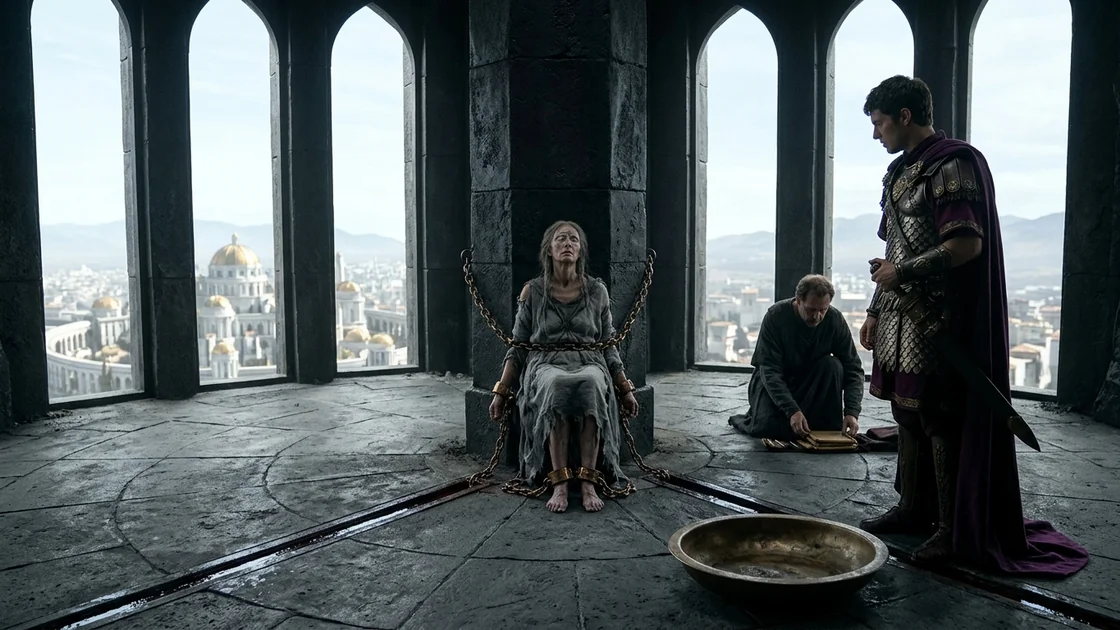
Locked away at the apex of a brutalist obsidian tower, the immortal oracle Maelis serves as the secret weapon of the tyrannical Aurelian Empire. For three centuries, the emperors have climbed the thousand steps to harvest the visions she bleeds into a basin of celestial bronze, using her foresight to crush rebellions, conquer neighboring kingdoms, and amass unimaginable wealth. When the young and ruthless Emperor Cassian ascends the throne, he demands a series of grand prophecies to secure an eternal golden age and cement his status as a living god. Maelis obliges him with absolute obedience, speaking only undeniable truths that bring the empire immediate, dazzling triumphs. Yet the emperor does not understand that foresight is not a single road, but a vast tapestry of branching consequences. Across thirty years of calculated patience, Maelis feeds Cassian a sequence of seemingly miraculous visions that slowly poison the empire's agriculture, purge its most brilliant military minds, bankrupt its treasury, and pit the royal heirs against one another in a shadow war of attrition. Every victory she hands the emperor is a carefully placed domino designed to trigger a catastrophic, simultaneous collapse of the state, proving that the deadliest weapon against an invincible tyrant is his own unchecked ambition.
Chapter I: The Spire of Tears and Bronze
The wind at the top of the world did not howl; it hissed, like water thrown upon a forge. Three hundred cubits below the lancet windows of the Spire, the capital city of Solaris sprawled across the valley in concentric rings of white marble, terraced gardens, and gilded domes, all of it gleaming beneath a relentless midday sun. From the street level, the citizens looked up at the Needle of Aethelgard and saw a monument to imperial piety—a slender pillar of black basalt piercing the heavens, where the Undying Voice communed with the gods to bless the realm.
They could not see the chains.
Maelis sat at the center of the circular chamber, her spine curved like a dry bow, her ankles and wrists bound in manacles of celestial bronze. The metal was warm, forged with blood-iron mined from the deep craters of the northern wastes, and etched with runes that had been worn half-smooth by three centuries of her shifting weight. The chains did not merely hold her; they drank from her. Thin needles on the inner rims of the cuffs pierced her radial arteries, drawing droplets of her immortal blood down along grooved channels in the floor, feeding a shallow basin at the room's threshold.
She was blind, though she had not been born so. When the First Emperor, Valerius the Conqueror, had burned the sacred groves of Elowen and dragged her from the roots of the World-Ash, she had looked upon his face and told him the exact hour and manner of his death. He had ordered her eyes seared with white-hot silver so she might never look upon a king with defiance again. He had not understood that taking her mortal sight merely removed the distraction of the present. Without the sun and the trees and the faces of men to clutter her mind, there was only the Loom.
In the darkness behind her scarred eyelids, Maelis watched the future shimmer. It was not a river, as the poets of Solaris liked to claim, flowing inevitably toward a single sea. It was a monstrous, tangled canopy of light—billions of golden threads branching, intersecting, fraying, and snapping with every breath taken by every living creature on the continent. When a peasant dropped a loaf of bread in the lower market, ten thousand minor threads shifted color. When an emperor signed an edict, whole forests of possibility caught fire and vanished into ash.
For two hundred and sixty years, under eleven emperors, Maelis had been forced to prune that forest for the glory of the house of Valerius. They had tortured her at first, starving her until her ribs pressed through her gray skin like the hull of a wrecked ship, only to find she could not die. When pain failed to make her cooperative, they had used hostages—the surviving children of Elowen, kept in breeding kennels beneath the palace. If Maelis gave a false reading, or if a battle went poorly, a child was brought up the thousand steps and thrown from the lancet window while she was forced to listen to the wind take their scream.
So she had given them victories. She had made them fat on conquest. She had waited until the last drop of Elowen blood in the kennels had been diluted and forgotten, bred out into the common populace of the slums, until the emperors forgot that she had ever been an enemy and began to think of her as a piece of furniture—an ancient, flesh-and-bone astrolabe kept in the attic of the state.
The heavy oak door at the base of the spiral staircase groaned on its iron hinges.
Maelis did not turn her head. She listened to the footsteps ascending the final flight. There were two pairs. The first was light, shuffling, hesitant, accompanied by the dry rustle of parchment sleeves and the faint, sour smell of oak-gall ink and old tallow. That was Elian, the Chief Scribe of the Sanctum, then in his thirtieth year of service.
The second pair of footsteps was heavy, brisk, and rhythmic, striking the basalt steps with the iron-shod heels of legionary boots, followed by the soft, metallic whisper of a scale-mail cloak dragging across stone. A young man's stride. Impatient. Taking the steps two at a time despite the thin air of the heights.
The inner grate of wrought iron was unlocked. The two men stepped onto the cold stone floor of the observatory, stopping just behind the bronze basin where her blood pooled in a slow, viscous film.
"Is that it?" a voice asked. It was a resonant baritone, rich with the oiled arrogance of palace tutors and the sharp edge of the parade ground. Emperor Cassian, fourth of his name, who had buried his father three moons past after a conveniently brief bout of winter fever. Even without her eyes, Maelis could see the threads clinging to him—crimson strands of patricide, bright gold cords of vanity, and a dark, jagged aura of restless ambition that vibrated like a plucked bowstring. "My father spoke of a monster in the dark. This is just a withered crone in a rag."
"Majesty, I implore you, lower your voice," Elian whispered, his tone tight with ritualistic dread. The scribe knelt by the basin, unpacking his silver styluses and wax tablets with trembling fingers. "The Voice hears not as mortals hear. The ritual requires—"
"I am the Emperor of the Six Horizons, old man. I do not whisper in my own house," Cassian said. He stepped around the basin, crossing the boundary line that no emperor had crossed in eighty years. The scent of him washed over Maelis: crushed myrrh, horse sweat, polished steel, and the sweet, metallic tang of young blood. He stopped two paces from her, his shadow falling over her bare, scarred feet. "Look at me, thing."
Maelis raised her chin. The bronze collar around her neck clanked against the central pillar to which she was tethered. Her milky, silver-burnished eyes stared directly through his breastplate, fixing on the rapid, arrogant thumping of his heart.
Cassian flinched, just a fraction of an inch—a minute shifting of weight from his left heel to his right. The threads of the Loom flared around him. In that single heartbeat of hesitation, Maelis saw ten thousand futures for Cassian IV. In some, he died within the year, poisoned by his uncle. In others, he ruled for forty years as a cautious bureaucrat. In a handful, he conquered the eastern steppes and died of an infected arrow wound in a tent of horsehair.
And buried deep beneath the canopy, tangled in shadows so complex that it took all of her three-hundred-year-old mind to trace them, she saw a single, hairline thread of absolute black. A path where not only Cassian died, not only his line ended, but the very stones of Solaris were salted and given back to the wolves.
To reach that thread, she could not strike him down. She had to lift him up so high that the fall would shatter the earth beneath him.
"You smell of your father's bedchamber, Cassian," Maelis rasped. Her voice was like dry leaves scraping across a tombstone, unused for months at a time. "And of the nightshade that grows in the dowager's greenhouse. It took him four hours to stop rattling, did it not? You held the pillow when the physician lost his nerve."
Behind them, Scribe Elian gasped, dropping his stylus. It clattered loudly against the stone, rolling toward the blood basin. Elian pressed his forehead to the floor, squeezing his eyes shut, waiting for the Emperor to order his tongue cut out for hearing such treason.
Cassian did not look back at the scribe. His hand had gone to the pommel of his sword, his knuckles white. "You do see," he breathed, the mockery vanishing from his voice, replaced by a cold, greedy awe. "They told me you only saw what was to come."
"Time is a single garment, little king," Maelis said softly, letting her head loll slightly to the side, feigning the exhaustion that the blood-letting chains were meant to induce. "The hem is woven from the collar. What you have done is merely the shadow of what you will do. You did not climb a thousand steps to speak of dead men. Ask, so that I may bleed and sleep."
Cassian slowly released his sword hilt. He paced a slow circle around her pillar, his cloak whispering over the bronze channels. "The empire is stagnant," he said, his voice echoing off the domed ceiling. "My father and grandfather were shopkeepers with crowns. They built walls and counted tariffs while the provinces grew lazy and the border lords grew insolent. The treasury is full, yes, but it is dead gold. I want an empire that outshines the legends of the First Age. I want monuments that will make the gods jealous. I want a population doubled in twenty years, and an army thrice the size of the one that took this continent. Tell me where to begin. Tell me how to make Solaris eternal."
Maelis sat very still. Inside the dark cathedral of her mind, she reached out with invisible fingers and plucked the black thread. She traced it backward from the ruin of the world to this very room, to this very hour.
To destroy a fortress, one must first undermine the foundation. And the foundation of Solaris was bread.
She let out a long, shuddering breath, allowing her body to convulse violently against the chains. The needles in her wrists bit deeper as she wrenched her arms, sending a fresh, warm gush of crimson racing down the bronze grooves into the basin. It was a performance she had perfected over generations; emperors never trusted a painless truth. They needed to see her suffer to believe they had extracted something precious.
"Write, Scribe!" Cassian barked, his eyes wide as the blood hit the basin and began to steam in the cold mountain air.
Maelis threw her head back, her blind eyes wide, her voice dropping an octave into the rhythmic, chanting cadence of the High Sanctum.
"Look to the south, where the Red Plains thirst beneath a barren sky," she chanted, each word measured, weighed, and poisoned with precision. "For ten thousand years the Great Serpentine has wasted its sweet waters upon the bitter mud of the Salt Marshes. Choke the serpent at the Gorge of Kings. Turn its silver throat into the red dust. And in the mud of the waking desert, sow not the coarse barley of your fathers, nor the black rye of the hills. Sow the Golden Ear of the southern isles, the Sun-Grain of the pharaohs, and sow nothing else beside it. Three harvests shall the sun grant you in a single turning of the year, and every stalk shall bear the weight of coin. From the red dust shall rise a sea of gold, and the granaries of Solaris shall burst their iron bands."
She slumped forward, hanging by her wrists from the chains, her breathing shallow and ragged.
Silence hung in the tower, broken only by the frantic scratching of Elian's stylus across the wax tablet.
Cassian stared down at the steaming blood in the basin. His brow furrowed slightly. "The Gorge of Kings," he murmured, calculating. "My engineers have spoken of damming it before, during my grandfather's reign. They said the stone was too porous, and that draining the southern marshes would upset the southern baronies who fish the delta."
"Look at the northern cliff of the gorge, three leagues above the waterfall," Maelis whispered, as if coming out of a trance. "Strike the gray rock with iron. Beneath the shale lies a vein of blue clay ten fathoms deep, left by the ancient glaciers. Bake it with lime and volcanic ash from Mount Kora. It will set harder than granite, and water will only make it stronger."
Cassian's eyes lit up. That was no vague riddle of the priests; that was actionable imperial engineering, a secret of the earth itself handed to him on a platter. If the blue clay was there—and he would send riders before sundown to dig for it—then the Oracle was truly his key to omnipotence.
He did not see what Maelis saw along the black thread.
He saw the three harvests a year of the lucrative, high-yield Sun-Grain. He did not see that the Red Plains sat atop an ancient, subterranean bed of subterranean rock salt. For millennia, the arid climate had kept that salt locked fifty feet below the surface. Flooding the plains with the diverted waters of the Serpentine would raise the water table, dissolving the deep salt and drawing it upward through capillary action toward the roots. For fifteen years, the soil would produce miracles. By year twenty, it would begin to crust with white poison.
Nor did he see the second edge of the blade. By planting a massive monoculture of Sun-Grain across three thousand square miles—replacing the diverse patchwork of barley, rye, lentils, and fallow grazing land—he was building an unbroken banquet table for the Ustilago Solaris, a dormant spore currently trapped in the humid rot of the southern marshes. And when those marshes dried up from the damming of the river, the wind would lift that dried mud and blow the spores straight north into the heart of the empire's only breadbasket, while simultaneously turning a thousand miles of impassable southern swamp into a hard-packed highway of dry clay, over which the nomadic horse-tribes of the Ash Wastes would one day ride without wetting their hooves.
"If the clay is there," Cassian said softly, a smile touching his cruel mouth, "I will have a golden basin cast for your blood, Oracle."
"Keep your gold, Emperor," Maelis murmured into the dark. "Build your empire. Make it heavy."
Chapter II: The Silver Star and the Deep-Iron
Eight years passed in the Spire like a single slow intake of breath.
Maelis measured the seasons not by the sun, but by the temperature of her chains and the changing scents blown up through the lancet windows from the city below. In the third year after the first prophecy, the smell of Solaris changed. The acrid smoke of poverty—burned dung and wet pine from the outer slums—was gradually replaced by the rich, yeast-heavy aroma of ten thousand bakeries running day and night, mixed with the smell of roasted meats, imported spices, and fresh mortar.
The blue clay had been found exactly where she said it would be. The Great Dam of Cassian had risen across the Gorge of Kings, a marvel of the known world, employing forty thousand laborers. The Serpentine River had been broken to the yoke, its ancient course reduced to a trickle, while great stone canals bled its waters across the Red Plains.
By the fifth year, the Sun-Grain was growing taller than a man's shoulder, three times a year. The price of bread in Solaris dropped to nothing. Cassian abolished the grain tax for citizens of the capital, guaranteeing himself the fanatical devotion of the mob. With the massive surplus, he bought the loyalty of the minor noble houses, funded ten new legions, and began tearing down the old brick districts of the city to rebuild them in white marble.
In the spring of the eighth year, the oak door groaned open again.
Elian entered first. His step was slower now, a slight limp in his left leg from the dampness of the archives, and his breath wheezed in the thin air. Behind him came Cassian.
The boy had become a sovereign. His stride was heavier, the scale-mail cloak replaced by stiff robes of Tyrian purple embroidered with solid gold thread that chimed softly as he walked. He smelled of rich wines, roasted pheasant, and an absolute, unshakeable certainty in his own divinity. The Senate had voted to add Pius Felix Invictus to his titles the month before.
"The southern granaries are so full we are feeding the surplus to the hogs, Voice," Cassian announced without preamble, standing before her pillar. He had brought no guards inside, only Elian. He considered the Oracle his private possession, a secret shame and a secret weapon combined. "The provinces are fat. The plebeians worship my shadow. Now my legions sit idle in their barracks, growing soft on free wheat and cheap wine. An army that does not march eventually marches on its master."
Maelis lifted her head. Her ears caught the faint, rhythmic clinking of a small metal object Cassian was turning over and over in his gloved hand. A military medal, or a seal ring.
"You have eyes on the horizon, Majesty," she whispered. "And a thorn in your boot."
Cassian stopped flipping the object. He held it out, forgetting for a moment that she was blind, before drawing his hand back with a tight laugh. It was a heavy silver signet ring, bearing the crest of a six-pointed star over a crossed gladius. The ring of General Marcus Vane, Lord Marshal of the Northern Marches.
"Vane took the rebel fortress at Oakhaven in three days," Cassian said, his voice dropping low, vibrating with jealousy. "He lost fewer than a hundred men. When he rode through the Eastern Gate yesterday, the crowd threw so many roses before his horse that the hooves didn't touch the cobblestones for a mile. They cheered his name louder than they cheered mine at the Spring Games."
Maelis looked into the Loom. General Marcus Vane was a brilliant, incorruptible soldier. His threads were bright steel and steadfast oak. In almost every probable future, Vane remained fiercely loyal to the crown, reforming the logistics of the imperial army, maintaining the border forts, and training a generation of disciplined officers who would keep the empire secure against external threats for a century. As long as Vane and his officer corps existed, the empire's military spine was unbreakable.
She needed to snap that spine. And while she was at it, she needed to open the eastern gates and bring the fire into the basement of the house.
"You fear the Silver Star," Maelis murmured, letting a faint, mocking smile touch her bloodless lips. "You should. Yet you look at the hand that holds the sword, and not the anvil where the blade will be reforged."
"Speak plainly, wretch," Cassian snapped, stepping closer. "Does Vane plot against me? Give me a name, a date, a letter I can intercept, and I will have his head on the Rostra before noon."
"He plots nothing today," Maelis said, and it was the absolute truth. If she lied, and Cassian tortured Vane only to find him innocent through his own spies, the Emperor might begin to doubt her infallibility. Doubt was a weed she could not allow to grow in Cassian's mind. "A loyal dog does not bite until his master stumbles. Look not to the dog, Cassian. Look to the Iron Mountains of Kor-Vath."
Cassian frowned. "Kor-Vath? Those desolate peaks on the eastern frontier? There is nothing there but goat-herders, snow, and the dwarven-kin who mine the deep shafts. My ancestors signed a treaty with the Mountain Kings two centuries ago. They pay their tribute in pig-iron and keep the passes closed against the Ash-Riders of the waste. Why would I waste blood on rocks?"
Maelis threw her weight forward against the bronze chains. The metal shrieked against the stone rings set into the pillar. Blood welled fresh and bright from her torn wrists, pattering into the grooves.
"Because the tribute is a lie!" she cried out, her voice echoing wildly through the stone chamber as she slipped into the prophetic cadence. "Beneath the grey iron they send to your forges lies the Deep-Iron—the Star-Metal that does not rust, that cleaves bronze and steel like rotten wood! Even now, the Mountain Kings delve into the roots of the world, hoarding the black ore in secret vaults. And when the Silver Star rises to the zenith in the fifth month of the wolf, he who wears the star upon his breast shall take the mountain gold and the black iron, and the gates of Solaris shall open from within to crown a soldier's son!"
She gasped, choking on her own saliva, her body trembling violently as the vision seemed to release her.
In the corner, Elian's stylus flew across the wax, his eyes wide with terror. General Vane was the patron of Elian's own nephew, a young tribune in the Fourth Legion.
Cassian stood frozen, his breathing heavy. Every word she had spoken was technically true, twisted through the prism of her malice. There was a vein of meteoric black iron beneath Kor-Vath, though the Mountain Kings left it untouched out of religious taboo, not rebellion. And in a distant, unlikely branch of the future—one that would only have occurred if Cassian had gone mad and murdered the Senate twenty years hence—Vane's son might indeed have led a rebellion armed with eastern iron. By speaking that distant, conditional possibility aloud as an imminent threat, Maelis killed it and birthed a monster in its place.
"Vane has been corresponding with the envoys of Kor-Vath," Cassian whispered to himself, his mind instantly connecting innocent diplomatic dispatches into a grand conspiracy. "He requested three thousand tons of mountain iron last month to re-shoe the artillery wagons. It was a pretext. A way to move gold into the mountains."
"Strike before the snows melt," Maelis whispered weakly, her chin resting on her chest. "Do not send the legions of the Star. Purge the head, scatter the limbs, and hire the Red Companies of the coast, who love only coin and care nothing for banners. Tear down the mountain gates. Bring the deep-miners of Kor-Vath here, in chains, beneath the marble of your city, and make them dig the foundations of your new palaces with their own hands, where your eyes may never leave them."
Cassian turned on his heel, his purple cloak flaring like a pool of spilled blood. "Elian! Seal that tablet with my private signet. If a single word of this reaches the War Office before my Praetorians have Vane in irons, I will have you flayed alive and your skin used to bind the archive ledgers."
"At once, Majesty! By my life, Majesty!" Elian stammered, his hands shaking so badly he burned his thumb with the sealing wax.
Cassian stormed down the stairs without another word.
Maelis listened to his footsteps fade into the belly of the tower. Then, in the quiet that followed, she listened to Elian. The scribe did not immediately follow the Emperor. He remained kneeling by the blood basin for a long time, his breathing shallow.
"His nephew is with the Fourth Legion at Oakhaven," Maelis said softly, her voice entirely normal now, stripped of the theatrical rasp and the chanting cadence. "Tribune Julian. A boy who writes bad poetry in the margins of his quartermaster reports and sends half his pay to his widowed mother in the weaver's district."
Elian froze. Slowly, the aging scribe raised his head to stare at the blind creature chained to the pillar. "How... how do you know of Julian?"
"I know every thread in the tapestry, Scribe," Maelis said gently. "Cassian will execute General Vane tonight in the dungeons. Tomorrow, he will send the Praetorians to decimate the officer corps of the Fourth, Fifth, and Eighth Legions—every man who ever drank a toast in Vane's tent. Three hundred of the finest tacticians in the empire will be crucified along the Northern Road by the new moon."
Elian's face went grey. "Then my nephew—"
"Will die on the third cross from the milestone at Oakhaven," Maelis said, "unless a dispatch rider leaves the southern post-gate within the hour, carrying an order signed with the seal of the Chief Scribe of the Sanctum, transferring Tribune Julian to the garrison at the Salt Islands for 'disciplinary infractions' committed last winter."
Elian looked down at the imperial signet and his own scribe's seal resting in his lap. "That is forgery. High treason. If the Praetorians discover—"
"They will be too busy confiscating the estates of sixty patrician families to look at a disgraced sub-tribune rotting on a rock in the southern sea," Maelis said. "Save the boy, Elian. Or let him hang on a cross to feed the crows so that your conscience remains clean before your butcher king. The choice is a tiny thread. Pull it."
Elian stared at her through the gloom. For the first time in thirty years, he did not see a holy vessel or a tortured demon. He saw an intelligence so vast, cold, and patient that the Emperor looked like a child playing with matches in a powder magazine.
Without a word, Elian gathered his tablets, tucked them beneath his robes, and hurried down the steps as fast as his limping leg could carry him.
Maelis leaned her head back against the cold basalt pillar and smiled into the dark.
Within six months, General Vane was dead, his head dipped in pitch and mounted above the Senate house. The veteran officer corps of the northern armies was purged, replaced by sycophants, court favorites, and foreign mercenary captains from the Red Companies who took their pay in the newly minted gold of the Sun-Grain trade.
That autumn, Cassian led a massive, clumsy invasion of the Iron Mountains of Kor-Vath. Because Maelis had told him which hidden goat-paths bypassed the mountain fortresses, the campaign was a slaughter. The ancient treaty was burned. The Mountain Kings were thrown from their own battlements, their fortresses dismantled stone by stone so they could never be held against the empire again.
And just as she had instructed, Cassian marched thirty thousand enslaved Kor-Vath miners down out of the mountains in iron collars, driving them into the subterranean quarries beneath Solaris to hollow out the earth for his new Colosseum and the Grand Imperial Baths.
The citizens of Solaris threw roses at Cassian's chariot for three days straight. They marvelled at the wagons of meteoric black iron rolling through the streets.
None of them looked back toward the east, where the high passes of Kor-Vath now stood empty, unguarded, and dismantled, looking down upon the endless grey grass of the Ash Wastes, where the khans of the horse-tribes were already watching the smoke rise from the ruined mountain forts. And none of them listened to the sound beneath their feet, where thirty thousand master engineers and sappers of a conquered race, bound by a fanatical blood-oath of vengeance, had just been handed picks, shovels, blasting-oil, and unrestricted access to the foundational limestone piers that held up the entire capital city.
And in the dark of the Spire, Scribe Elian returned from the post-gate, his nephew safely aboard a grain barge bound for the islands, now bound to the Oracle by the unbreakable chain of shared treason.
Chapter III: The Ledger of Ghosts
Seven more years bled into the bronze basin.
It was the fifteenth year of Cassian's reign, and the Empire of the Six Horizons stood at a height of splendor that terrified the chroniclers. The white marble of Solaris had climbed halfway up the surrounding hills. The Great Aqueduct of the Sun, three tiers of mortared stone arches, carried millions of gallons of water from the northern lakes straight into the city's artificial lagoons, where gilded barges floated beneath lanterns of colored glass while senators dined on peacocks tongues and snow brought down by runners from the peaks.
Yet the air at the top of the Spire had grown heavier.
One night in deep winter, when the wind off the mountains carried the sharp teeth of frost, the iron grate at the top of the stairs clicked open. There were no heavy legionary boots this time. Only the slow, limping shuffle of Scribe Elian.
He carried no wax tablets. Instead, he carried a heavy iron lantern, a wool blanket, and three massive, leather-bound folios clasped in tarnished brass, which he set down with a groan beside the empty blood basin.
"The guards at the base of the tower are drunk on spiced wine," Elian said softly, his voice cracking with age and the cold. He was over sixty now, his back stooped, his fingers permanently stained black at the tips. He stepped across the boundary line—something he had never dared do alone—and draped the thick wool blanket over Maelis's bare, scarred shoulders. "It is the Saturnalia. The Emperor is hosting three thousand guests in the Golden House."
Maelis did not pull away from the blanket, though her immortal flesh felt the cold only as a distant ache in her bones. "You have been reading the Dead Books, Elian."
The old man sank down onto his knees beside the basin, holding his arthritic hands toward the small warmth of the lantern. "For three years," he admitted, his voice barely louder than the wind outside the lancets. "Since the night you saved Julian. I began with the records of your prophecies to Cassian's father, Emperor Tiberius. Then his grandfather, Antoninus. Then back, a hundred years, two hundred, all the way to the First Dynasty."
"And what did you find in the dust, little scribe?"
"A pattern," Elian whispered. He tapped the leather folios. "For two hundred and fifty years, when the emperors came to you, your answers were small. Precise. Defensive. 'A storm will wreck the fleet at Cape Wrath if it sails before the new moon.' 'The governor of Syria is taking bribes from the Parthians.' 'Dig a well at the third milestone to save the garrison.' You kept the empire alive. You patched its leaks."
"There were children in the kennels beneath the palace then, Elian," Maelis said, her voice devoid of emotion. "Grandchildren of the people who sang to the trees of Elowen before Valerius turned them into charcoal for his iron-smelters. Every time a legion lost a skirmish, the kennel-master brought a child up those stairs. The last great-granddaughter of my sister's line died of old age in a fuller's shop near the river gate forty-two years ago. Her heart stopped between one breath and the next. I felt the thread snap. And when it snapped, my debt to the living was paid. Only my debt to the dead remained."
Elian shivered, pulling his robes tighter around himself. "Fifty years ago, under Cassian's grandfather, the prophecies changed. He asked how to increase the silver yield of the western mines. You told him to use quicksilver amalgamation and divert the forest streams to wash the sluices. It tripled the silver output in five years."
"It did," Maelis agreed.
"Last month," Elian said, opening the top folio to a page marked with a ribbon, "I read the censor's report from the western provinces. The rivers there are dead. The quicksilver poisoned the alluvial plains for two hundred miles downstream. Forty villages have been abandoned because the children are born without bones in their legs and the cattle die at the trough. And the mines themselves collapsed three years ago because they clear-cut the oak forests to shore up the shafts, and the spring mudslides buried the valleys."
He turned a page in the second folio.
"Thirty years ago, you told Cassian's father to reform the tax code by commuting all provincial grain tithes into coin, farmed out to private syndicates in the capital. It filled the treasury overnight. It allowed Tiberius to build the Eastern Wall. Today, the small freeholders of the heartland—the yeoman farmers who used to fill the ranks of the heavy infantry—have been entirely bought out by the syndicates to pay their tax debts. The countryside is empty of citizens. It is nothing but vast slave-estates managed by absentee senators, and five hundred thousand landless beggars who have poured into Solaris to live off the free Sun-Grain dole."
Elian looked up at her, the lantern light catching the tears in his rheumy eyes. "You never lied to them. Not once in fifty years. Every single thing you promised them came true. They asked for gold, and you gave them gold. They asked for land, and you gave them land. And every gift was a tumor."
Maelis shifted her wrists, letting the bronze chains clink softly in the quiet room. "What is an empire, Elian? Is it a map? Is it a crown?"
"It is law," Elian said weakly, reciting the catechism of his youth. "It is order against the dark."
"It is an appetite," Maelis corrected him, her blind eyes gleaming like polished coins in the lantern glow. "A beast that must eat its neighbors because it has eaten its own bowels. When Valerius burned Elowen, my people did not have walls, or coins, or scribes. We had songs that taught us how many deer could be taken from the birch wood before the wolves starved, and how many years a field must sleep in clover before it forgot the plough. Valerius called us savages. He paved our sacred springs to build a military road so his catapults would not get stuck in the mud. And when he chained me in this rock, I looked down the Loom to see how I might kill him."
She leaned forward, the wool blanket slipping from one shoulder, revealing the lattice of three-hundred-year-old whip scars crisscrossing her collarbone.
"Do you know what I saw when I looked at the threads where Valerius died young?" she whispered. "His general took the throne and was twice as shrewd. When I looked at the threads where a plague struck the city, the survivors came back harder, leaner, more disciplined, and conquered another continent. An empire at its birth cannot be killed with a knife, Elian. If you prune a young briar, it grows back thicker at the root. To kill the briar, you must fertilize it. You must water it with blood and gold until it grows so tall, so top-heavy, so choked with its own blossoms that its roots can no longer hold the soil. You must teach it to love its own sickness."
Elian closed the folio with a soft thud. "The Red Plains," he said hollowly. "I spoke with a clerk from the Ministry of the Annona yesterday. Three estates on the western edge of the irrigation canals reported a lower yield this autumn. They say the soil stays damp even in the dry wind, and when the sun hits the furrows, there is a thin white crust on the clods, like frost in July. Salt."
"It will reach the central plains in ten years," Maelis said calmly. "By year fifteen, nothing will grow there but scrub-thistle and salt-grass."
"And the mountain passes of Kor-Vath," Elian continued, his voice dropping to a terrified whisper. "There are rumors from the frontier merchants. A great warlord named Temür has united the seven tribes of the Ash-Riders. They are grazing their herds within sight of the dismantled fortresses. And we have no legions left that know how to fight horse-archers—only the Red Company mercenaries who guard the toll-roads and beat the peasants."
"Temür is only thirty years old," Maelis murmured, consulting the invisible tapestry in her mind. "He will need another dozen summers to break the western clans and forge the iron siege-engines he captured from the ruined border towns. He is on schedule."
Elian buried his face in his hands. For a long time, the only sound was the old man's ragged breathing and the wind hissing through the basalt lancets.
"Why haven't you told him?" Maelis asked softly.
Elian raised his head, his face twisted in a bitter grimace. "Tell Cassian? Tell the Living God that his thirty-year golden age is a mirage? That his great dam is salting the earth and his glorious conquest of the mountains opened the door to the barbarians? He would have me boiled in oil before I finished the second sentence. And then he would come up here, torture you until you gave him another comforting delusion, and carry on exactly as before."
"You know him well," Maelis said.
"Besides," Elian whispered, looking out the narrow window toward the glowing, noisy expanse of the palace district far below, where the faint sound of Saturnalia horns and drunken laughter drifted up on the thermals. "Last year, Senator Varro's carriage ran down a baker's child in the street outside my lodgings. The Senator didn't even stop; he sent a slave back to throw three copper coins into the father's lap to pay for the cleaning of his chariot wheels. When the father cursed him, the Praetorians crucified the man on his own shop door. My nephew writes to me from the Salt Islands. He says the sea air is clean there, and the governor is too lazy to enforce the tariffs. The boy has a wife now. A fisherman's daughter."
Elian stood up, his knees popping loudly in the cold. He picked up the three heavy folios and tucked them under his arm.
"He is coming tomorrow," Elian said, looking down at her. "After the Saturnalia hangover clears. His eldest daughter, Princess Lyra, has just returned from her tour of the northern provinces. She brought back a ledger of her own—accounts of mercenary corruption, decaying roads, and the salt crusts on the western farms. She intends to lay it before the Privy Council."
Maelis tilted her head. In the Loom, she saw Princess Lyra clearly: twenty years old, sharp-eyed, educated by the last of the old Stoic philosophers, possessing the cold logistical brilliance of General Vane and the ruthless political instincts of her great-grandfather. Around Lyra, thousands of silver threads were beginning to coalesce. If Lyra succeeded her father—or even if she held his ear for the next five years—she would halt the irrigation of the Red Plains, recall the veteran legions from the coast, rebuild the mountain forts of Kor-Vath, and execute the corrupt grain syndicates. She wouldn't save the empire entirely from the damage already done, but she would salvage a hardened rump state that could survive another two centuries.
"She is a falcon among capons," Maelis murmured.
"She is the only one who can save these people from what is coming," Elian said quietly. He looked at Maelis with a terrible, exhausted pity. "Will you spare her?"
Maelis did not answer him. When Elian finally turned and limped back down the stairs, leaving the wool blanket behind, she used her bound feet to kick the blanket away, sliding it across the cold stone until it soaked into the bronze channels of her blood, ruining the wool. She did not want their warmth.
Chapter IV: The Falcon and the Pale Root
Emperor Cassian did not look like a young god anymore.
When he emerged from the stairwell the following afternoon, leaning heavily on an ivory-headed cane, it took him nearly five minutes to catch his breath. At forty-five, his belly pushed hard against the gilded leather of his ceremonial cuirass. His face was mottled with burst capillaries from decades of sweet southern wine, and his left foot dragged in a velvet slipper, swollen to twice its size with the gout.
Behind him stood two people besides Elian.
To his right stood his eldest child, Princess Lyra. Even without sight, Maelis could feel the girl's presence like a cold draft in a warm room. She wore no perfume, no silk that rustled, only a plain woolen riding tunic and leather boots still dusted with the chalk of the northern highways. Her pulse was steady, slow, and entirely unafraid.
To his left slouched his youngest son, Prince Julian—not the scribe's nephew, who bore the same common imperial name, but the royal Julian, seventeen years old, smelling of laudanum, sugared almonds, and the sour sweat of a boy who spent his mornings pulling the wings off songbirds in the aviary and his nights in the palace brothels. A middle brother, Darius, was currently away with the fleet, a dull brute with a penchant for gladiatorial combat.
"Tell her," Cassian wheezed, waving his ivory cane toward the pillar as he sank onto a folding camp-stool that Elian hastily set up for him. "Tell this arrogant little bitch what you told me twenty years ago. She comes into my study with sacks of dirty salt and mutinies on her tongue, claiming the Red Plains are dying and the treasury is made of paper! Tell her who built this city!"
Princess Lyra stepped forward, ignoring her father's outburst. She did not look at Maelis with superstition or fear; she looked at the chains, the needles in the wrists, the drainage grooves, and the architecture of the room, assessing it like a siege engineer examining an enemy mangonel.
"My father believes you are a conduit of the heavens," Lyra said, her voice clear, crisp, and wholly devoid of reverence. "I believe you are an prisoner from a nation my ancestors exterminated, who has been given the singular privilege of whispering directly into the ear of an absolute monarch for thirty years. Seven years ago, you told him to murder Marcus Vane and empty the eastern border forts. Now the Ash-Riders are grazing their horses fifty miles inside our borders. Fifteen years ago, you told him to dam the Serpentine. Now the water table in the south has risen into the salt-beds, and four thousand acres of prime wheat-land turned into barren alkali marsh this summer alone."
Cassian struck the stone floor with his cane. "Silence! The yield was higher this year than ever before! The syndicates paid twelve million aurei into the privy purse last month!"
"The syndicates are borrowing against future harvests to pay your dividends while secretly buying up copper mines in the provinces because they know the land is dying, Father!" Lyra snapped, turning on him. "And the grain in the lower silos—have you looked at it? Not the gold-leaf loaves they bring to your table, the grain in the public dole! It has a grey smut on the husks. The bakers are mixing it with chalk and bone-meal to hide the bitter taste!"
Young Prince Julian giggled from the shadows by the door, popping another sugared almond into his mouth. "Lyra wants to put us all on military rations, Father. Black bread and vinegar water, like the legionaries. She thinks she's Marcus Vane reborn."
At the mention of Vane's name, Cassian's mottled face darkened to the color of a bruised plum. His hand tightened on the ivory cane.
Maelis listened to the vibrations in the air. Lyra was too smart. If she continued to speak facts—verifiable, physical facts that Cassian could confirm simply by walking down to the lower granaries—even the Emperor's monumental vanity might crack enough to let a sliver of fear in. And if Cassian grew afraid for his grain supply now, five years too early, the black thread in the Loom would fray. The fungal blight in the Red Plains was still in its incubation phase; it needed four more warm, wet summers of monoculture to reach critical mass across the entire basin simultaneously.
Maelis could not argue logistics with the princess. To defeat facts, she had to weaponize paranoia.
She let out a low, rattling laugh that made even Lyra stop and turn her head toward the pillar.
"The little falcon has sharp eyes," Maelis rasped, lifting her chin so the pale light from the lancets caught the silver scars across her sockets. "She sees the mouse in the barley. She counts the salt-grains on the road. Just as she counted the milestones between Oakhaven and the capital, measuring how many hours it takes a column of heavy cavalry to march from the northern barracks to the Palatine Hill by night."
Lyra went rigid. "What are you talking about?"
"Tell your father, Princess," Maelis purred, her voice dropping into a conspiratorial whisper that filled the stone dome, "of the tavern at the Red Ford, six nights ago. Tell him of the three men in cloaks of undyed wool who sat with you by the hearth while the rain fell. One had lost two fingers on his left hand at the siege of Kor-Vath. One wore the bronze torque of the old Third Legion under his tunic. And the third was Senator Cato's youngest brother."
The silence in the room became absolute.
Lyra's breath caught in her throat. It had been an entirely innocent meeting—former logistics officers and a minor magistrate whom she had questioned in secret to get accurate numbers on the road decays and grain spoilage without alerting the corrupt syndicate spies. Yet framed through Maelis's omniscient gaze, stripped of context and handed to a man who had murdered his own father with a pillow, it was a dagger pointed directly at Cassian's throat.
"You met with Cato's brother?" Cassian's voice was no longer loud. It was a soft, terrifying wheeze. "And cashiered officers of Vane's old legions? In secret?"
"Father, the syndicates have eyes in every post-house," Lyra said quickly, for the first time a note of genuine alarm entering her voice. "If they knew I was auditing the northern granaries, they would have burned the ledgers before I arrived! Cato's brother was the sub-prefect of roads under grandfather—"
"Cato voted against my triumph after Kor-Vath!" Cassian roared, heaving himself up from the stool with such violence that the camp-chair tipped over and clattered down the stairs. The gout in his foot was forgotten as adrenaline and twenty years of festering guilt flooded his veins.
Maelis threw herself backward against the pillar, arching her spine until the bronze collar choked her windpipe, letting the blood spurt from her torn wrists across the cold stones toward Lyra's dusty boots.
"The Lion's crown shall crack beneath the beating of the Falcon's wing!" Maelis shrieked, her voice rising to a terrifying, inhuman pitch that echoed off the basalt walls like a flock of crows taking flight. "She comes with a ledger in her right hand and a silk cord in her left! Look to the ides of the harvest moon, when the senators in white gather at the portico of Pompey! The daughter of the morning shall wash the marble in her sire's old blood, and the soldiers of the dead star shall acclaim an Empress upon the shields! Only the pale root, watered in sibling tears and kept close to the hearth, shall keep the breath in the Lion's throat!"
Maelis collapsed onto her knees, her face pressed almost to the stone floor, her shoulders heaving with dry, silent sobs.
"It's a lie!" Lyra shouted, stepping toward her father, her hands outstretched. "Father, look at her! She's playing on your fears! She's protecting the rot because she wants us to starve! Send riders to the Red Plains yourself—not syndicate men, send your own Praetorians! Look at the soil!"
Cassian backed away from his daughter's outstretched hands as if she were holding scorpions. His eyes darted to the bronze falcon brooch pinning her riding cloak at the shoulder—the personal emblem she had chosen at her coming-of-age ceremony four years ago. Then he looked at young Julian, pale, sickly, trembling by the door ("the pale root"), who had never shown an ounce of ambition beyond the wine-cellar and the brothel.
"Guards!" Cassian screamed toward the stairwell. "Praetorians! To me!"
The heavy oak door at the bottom of the stairs burst open, and a dozen armored men came thundering up the spiral steps, swords drawn.
"Take her sword! Take her brooch!" Cassian pointed his trembling cane at Lyra. "Lock her in the lower cisterns! Arrest Senator Cato and his entire household! Arrest every former officer of the Third and Fourth Legions still living within a hundred miles of the capital! And send a fast galley to the fleet at Ostia—tell the admiral to put Prince Darius in chains before his sister's messengers can reach him!"
"Father, no!" Lyra fought as two massive Praetorians seized her arms, her composure finally shattering as she realized the sheer, impenetrable madness of the wall she had struck. "You're blinding yourself! If you kill Darius and me, who are you leaving the empire to? Julian?! The boy can't even read a map! The Ash-Riders will eat us alive! Listen to me!"
They dragged her down the stairs, her boots kicking against the stone steps, her voice echoing up through the shaft until the heavy oak door slammed shut at the bottom, cutting off the sound.
In the chamber above, Cassian stood panting, sweat pouring down his purple cheeks, leaning heavily on Prince Julian's narrow, trembling shoulder.
"You heard her, my boy," Cassian wheezed, patting Julian's pale cheek with a meaty, shaking hand. "Your brother and sister wanted our heads. They thought you were weak. They thought I was old. From today, you sit at my right hand on the council. Put away your toys. I'll teach you how to rule."
Julian swallowed hard, looking down at the blood pooling around Maelis's knees, a slow, cruel, terrified smile spreading across his weak mouth. "Yes, Father. We should... we should question Lyra's tutors first. And the magistrates of the northern road. I know a man from the gladiator schools who is very good with iron pincers."
"See to it," Cassian grunted. "Give him the warrant."
They hobbled down the stairs together, the dying lion leaning on the rotting twig.
Scribe Elian remained behind for a moment to retrieve the fallen camp-stool. He did not look at Maelis as he picked up the tablets. His hands were steady now; the capacity for shock had been burned out of him years ago.
Within three months, the Great Purge of the Twenty-Third Year swept through Solaris like a scythe. Princess Lyra died in the lower cisterns after twelve days of "questioning" supervised by her brother Julian. Prince Darius resisted arrest aboard his flagship at Ostia and was cut down by his own marines, sparking a mutiny that burned half the imperial war-fleet at anchor. And because Julian used the treason trials to settle personal grudges and seize the estates of wealthy patricians to fund his own debaucheries, over four hundred senators, provincial governors, chief engineers, and treasury auditors were executed or exiled before the winter snows fell.
They were replaced by Julian's creatures: pimps, actors, chariot-racers, and flatterers who sold provincial offices to the highest bidder and used the maintenance funds for the Great Dam and the city aqueducts to stage hundred-day gladiatorial games to keep the restless plebeians amused.
High in the Spire, Maelis listened to the distant roar of the Colosseum crowds cheering the slaughter of exotic beasts, and counted the threads remaining.
Chapter V: The Blight of the Golden Ear
Seven years more. The thirtieth year of Emperor Cassian the Great.
The summer came early that year, and it did not come with the dry, crisp heat of the mountain winds. It came with a thick, stagnant humidity blown up from the south, smelling of dead fish, alkali dust, and rotten straw.
For three weeks in the seventh month, a strange red haze hung over the valley of Solaris. It was dust from the dried-up Salt Marshes three hundred miles to the south, lifted by summer gale winds and carried northward across the continent. In the Spire, the red dust settled in a fine, gritty film over the stone floor and turned the blood in the bronze basin into a thick crimson paste.
And then the smell of the city changed again.
The yeast-heavy aroma of the ten thousand bakeries died out over the course of a single moon. In its place rose the smell of burning vinegar, boiling horse-hide, and the unmistakable, sweet-sour stench of unburied bodies in the outer slums. The roar of the Colosseum stopped. In its place came a low, continuous murmur from the streets below—the sound of half a million idle, hungry people standing in queues outside locked granaries beneath a brassy sky.
When the oak door at the base of the stairs opened on an afternoon in late August, it took twenty minutes for the visitors to reach the top.
Elian came first, leaning on a staff, his hair entirely white, his frame shrunk to skin and bone inside his scribe's robes. Behind him, four Praetorian guards carried a wooden litter up the narrow spiral steps, cursing and slipping on the basalt as they tilted the chair to clear the turns.
Strapped into the litter sat what remained of Emperor Cassian.
He was fifty-two, and he looked eighty. A stroke the previous winter had twisted the left side of his mouth downward in a permanent, weeping snarl. Both of his legs were wrapped in linen bandages soaked in yellow pus from gouty ulcers that refused to heal. Beside him walked Prince Julian, now twenty-four, dressed in silk robes so crusted with jewels that he clanked like a mule-train, dabbing a perfumed handkerchief against his nose to block the smell of his father's rotting legs and the metallic tang of the Oracle's blood.
"Leave us!" Cassian slurred, waving his good right hand at the Praetorians. The guards set the litter down roughy behind the basin and retreated down the stairwell to wait on the landing.
Cassian leaned forward against the leather straps of his chair, his one clear eye fixed wildly on the shadowed figure chained to the central pillar.
"The grain is black," Cassian whispered, spittle dripping from the dead corner of his mouth. "All of it. From the Gorge of Kings to the western hills. Three thousand square miles. In four weeks, it turned from gold to black soot on the stalk. When the reapers touch it, the ears burst into black smoke that chokes the horses and blinds the slaves. And where the smoke doesn't grow, the earth is as white as a leper's belly with salt! Nothing will sprout! Not weeds, not barley, not grass!"
"The provincial governors are withholding the emergency reserves, Father," Julian whined through his handkerchief, his voice high and petulant. "The governor of the Northern Marches sent our tax-collectors back with their ears nailed to their foreheads! He says he needs his barley for his own people because the refugees from the Red Plains are pouring across his borders like locusts!"
"Be quiet, you fool!" Cassian snarled at his son, before turning his desperate, bloodshot eye back to Maelis. "Thirty years! For thirty years I followed every word that dripped from your tongue! I dammed the river! I planted the Sun-Grain! I killed Vane! I killed my own daughter! Why didn't you see the blight?! Why is the earth dying?!"
Maelis raised her head slowly. Beneath her eyelids, the vast, dazzling canopy of the Loom had narrowed down until every golden branch, every silver shoot, every crimson twig had withered and snapped away. There was only one thread left in the entire universe now. It was thick as a hawser, black as pitch, and pulled so taut it hummed like a dying star.
"I told you that three harvests the sun would grant you, and every stalk would bear the weight of coin," Maelis said softly, her voice carrying an eerie, bell-like clarity in the stifling heat of the chamber. "Did the sun lie, Cassian? Did the gold not fill your vaults? You asked how to build an empire that outshone the First Age. You did not ask how long the summer would last."
"I asked how to make Solaris eternal!" Cassian screamed, straining against his straps until the veins in his neck bulged like purple worms.
"And so you shall make it," Maelis replied. "Do you think a god is born without labor pains? The earth of the Red Plains has given you thirty years of miracles; now it sleeps, exhausted by its birth-giving. And the provinces test your strength because they think the Lion is old and toothless."
Cassian slumped back into his pillows, chest heaving, grasping desperately at the straw she offered him. After three decades of dependency, his mind was physically incapable of functioning without her validation. "A test," he muttered, wiping his mouth with the back of his hand. "Yes. The gods test the strong. Tell me what to do. The city has food for twelve days at quarter-rations. The plebeians threw stones at Julian's litter yesterday in the Forum. If the bread stops, they will tear the palace down brick by brick."
Maelis leaned forward. The bronze chains were loose around her wrists now; over the past month, she had starved herself of even the watery gruel the guards brought up once a week, shrinking her flesh until the manacles nearly slipped over her scarred knuckles.
She did not need the theatrical convulsions anymore. Cassian would swallow raw hemlock if she told him it was wine.
"Hear the word of the Loom, Emperor of the Six Horizons," she chanted softly. "The rot in the fields is born of the cold iron that offends the Sun. Strip the bronze braces and the leaden pipes from the Great Aqueduct outside the walls, and melt them down in the Forum to cast a colossus of the Unconquered Sun three hundred cubits high; when its shadow touches the eastern gate at dawn, the black smoke shall lift from the wheat."
In the corner, Scribe Elian closed his eyes. Removing the bronze tie-rods and lead joints from the three-tiered arches of the Great Aqueduct would cause the masonry to shift under the immense weight of the water channel within forty-eight hours.
"And what of the food?" Julian demanded impatiently. "We can't eat a bronze statue!"
"Send the Red Companies—every mercenary banner still within the city walls—south into the dried beds of the Salt Marshes," Maelis continued smoothly. "Where the Serpentine once met the sea, beneath the red dust at the place of the Three Skulls, the ancient kings buried the Vaults of Isis—ten thousand stone jars of immortal wheat sealed in beeswax, and a subterranean spring of sweet water that can irrigate the plains anew. March them south with all the baggage wagons, and lock the gates of Solaris behind them so the starving provincials cannot steal the bread that remains in the imperial silos."
"The Vaults of Isis," Julian breathed, his greedy eyes lighting up at the sound of buried treasure. "I've read of them in the eastern romances! Gold and sealed wheat!"
"And the Kor-Vath miners in the deep quarries beneath the city?" Cassian asked, a sudden spasm of old paranoia crossing his ruined face. "They have stopped digging the new baths. Their overseers say they sit in the dark and chant in their mountain tongue."
"Give them double rations of blasting-oil and pitch," Maelis whispered. "And seal the upper quarry grates with iron bars. Tell them to blast through the deep limestone pier beneath the Palatine Hill before the new moon, to open the hot sulfur springs for your healing baths. Once the sulfur water flows over your legs, Majesty, you will walk down these stairs without a litter."
Cassian looked down at his rotting, bandaged legs. A tear of pure, pathetic gratitude leaked from his working eye and tracked through the grime on his cheek. "I will walk," he whispered. "Elian... read it back. Every word."
Elian looked at his blank wax tablet. His stylus had not moved once during the audience. Slowly, the old man raised his head, looked directly at the Emperor, and recited the death warrant of Solaris from memory, his voice steady and resonant.
"Good," Cassian murmured when the scribe finished. "Julian, take the Praetorian prefect. Pull the mercenaries off the northern walls and march them south into the marshes tonight. Send the foundry-men to the aqueduct with crowbars and teams of oxen. And send twenty wagons of blasting-oil down into the deep shafts beneath the palace. By the new moon, we will show these dogs who rules the world."
The guards were summoned. They lifted the litter and carried the broken tyrant down into the dark.
Elian did not follow them.
When the heavy oak door slammed shut at the bottom of the thousand steps and the iron bolts were shot home by the guards on the outside, the old scribe walked slowly over to the window lancet. He set his wax tablets and his silver stylus neatly on the stone sill.
"The Ash-Riders crossed the Oakhaven river three days ago," Elian said quietly, looking out over the vast, shimmering expanse of white marble and gilded domes below. "Temür burned the northern garrison to the ground. There isn't a single soldier between his vanguard and the city gates."
"And the Red Companies are marching south into the dry marshes," Maelis said from the floor, "where Temür's southern wing—forty thousand horse-archers who rode across the dry delta you drained thirty years ago—will ambush them in the dust storm tomorrow noon. Not a man will return."
"And the provincials?"
"Two hundred thousand starving peasants and crucified veterans' sons from the heartland are ten miles west of the walls, led by the surviving officers of Prince Darius's burned fleet," Maelis said. "They have no siege engines. They will not need them."
Elian turned from the window and looked at her. "What will you do, when it is over?"
"I do not know," Maelis said, and for the first time in three centuries, it was the truth. Beyond tomorrow night, the Loom was entirely dark to her—not because the world ended, but because her work was done, and she had finally stopped looking. "What will you do, Scribe?"
Elian smiled faintly. He walked over to the bronze basin, knelt beside it on the stone floor where he had knelt for thirty-seven years, and rested his back against the cold basalt wall. "My legs are very tired, Voice. I think I will sit here and watch the sun go down. I have written enough."
Chapter VI: The Symphony of Cinders
It began at noon on the third day after the final prophecy, with a sound like a giant clearing his throat.
Three miles north of the city walls, where the foundry-teams had spent two days ripping the massive bronze tie-rods and lead expansion joints out of the central arches of the Great Aqueduct to feed the smelting furnaces in the Forum, a hairline fracture in the dry, unmaintained mortar gave way under the pressure of forty thousand tons of rushing water.
Maelis could not see it, but Elian stood at the northern lancet window and described it to her in a calm, detached voice, like a historian reading from a scroll.
"The third tier at the milestone arch has buckled," the old man murmured. "The stone is falling... four arches, five, ten... it is going down like a row of ivory dominoes all the way to the city wall. The water is pouring into the northern valley, tearing out the olive groves and the villa district. The fountains in the palace gardens have just stopped flowing."
Within two hours, under a scorching ninety-degree sun, the artificial lagoons began to drain into the cracked sewers, and five hundred thousand trapped citizens realized that the water had been cut off.
At four in the afternoon, the riots began.
When the starving mobs surged toward the imperial granaries in the lower city, demanding the grain Cassian had ordered locked away, the remnants of the urban cohort tried to hold them back with spears. The mob overran them in ten minutes, battered down the iron doors of the silos with timber beams torn from the bathhouses, and found nothing inside but mountains of black, stinking, fungal-rotted Sun-Grain that had already gone bad in the damp heat.
"They have set fire to the granaries," Elian reported from the western window, as the first greasy columns of black smoke rose to stain the red sky, drifting past the Spire on the rising thermals. "The fire has caught the timber shanties of the plebeian quarter. Without water in the cisterns, the bucket-brigades can only throw dust on the flames. The wind is coming from the west. It is blowing the fire straight toward the Senate house and the Circus."
At sunset, the horns blew from the hills.
They were not the brass buccina of the Roman legions. They were long, curved horns made from the tusks of mammoths and bound in brass, blowing a deep, guttural two-note drone that vibrated in the basalt stones of the Spire.
"They are coming out of the northeast," Elian said, moving to the eastern lancet, his white hair blowing in the hot, smoky wind. "A black line from horizon to horizon. Horses. Hundreds of thousands of them. They are riding straight down the white marble highway Cassian built to haul the iron from Kor-Vath. And from the west... the peasant army has reached the river gate. The gate-guards aren't fighting them; they're throwing down their shields and opening the portcullis to let them in, begging for water."
Down in the city, the bells of the temples were ringing in frantic, discordant peals. Smoke now filled the valley floor like a dark lake, pierced here and there by rivers of orange flame as the dry cedar roofs of the patrician palaces caught fire one by one.
And then, just as the sun dipped below the western hills, turning the smoke the color of clotted blood, the Kor-Vath miners below the city struck their match.
For twenty-two years, in the lightless limestone caverns beneath the Palatine Hill, the enslaved mountain-kin had hollowed out the living rock to build Cassian's monuments. They had left only twelve massive natural stone pillars to support the three-hundred-foot crust of rock and marble upon which the imperial palaces, the Senate, the treasury, and the base of the High Spire rested. For the past forty-eight hours, instead of digging toward the sulfur springs, they had packed twenty wagon-loads of imperial blasting-oil and pitch into deep bore-holes drilled into the bases of all twelve pillars, singing the death-songs of their murdered kings as they sealed the chambers behind them.
Maelis felt the detonation through the soles of her bare feet three seconds before the sound reached the top of the tower.
It was not an explosion; it was an absences of earth.
A dull, subterranean whump shook the continent, as if the world had dropped an inch in its socket. In the chamber, the bronze basin cracked in half, spilling forty years of dried blood across the stone floor.
Outside the window, Elian grabbed the stone sill as the tower swayed like a mast in a hurricane.
"The Palatine!" the old man gasped, his eyes wide as he looked down through the smoke. "The Golden House... the Temple of Jupiter... the ground just opened! The whole hill is sliding into the earth! The marble domes are folding inward like wet paper! Gods above, the dust—"
A massive, mushrooming cloud of pulverized white marble, limestone dust, and furnace ash erupted from the center of the capital as the entire imperial quarter dropped eighty feet into the hollowed-out quarries below, burying Prince Julian, the Senate, the Praetorian barracks, and ten thousand courtiers under five million tons of their own monumental architecture.
The shockwave hit the base of the Spire of Aethelgard. Built of tougher volcanic basalt pinned directly into the deeper bedrock ridge, the tower did not fall immediately, but a jagged crack two feet wide ripped diagonally up the eastern wall of the observatory, letting in a blinding shaft of orange firelight and a gale of hot ash.
The central pillar to which Maelis was chained split down the middle with a sound like a thunderclap. The iron ring holding her tether tore loose from the fracturing stone.
Slowly, for the first time in three hundred and twelve years, Maelis stood up to her full height.
She pulled her thin, scarred hands through the loosened rings of the celestial bronze manacles. The needles tore free of her radial arteries with a brief, sharp sting, and the heavy cuffs fell to the floor with a dull clatter. Where the blood dripped from her wrists onto the stone, the skin was already closing, knitting itself together now that the blood-iron was no longer drinking her life.
From the dark spiral stairwell came a sound.
Scrape. Drag. Thump.
Scrape. Drag. Thump.
Maelis turned toward the open iron grate.
Up the cracked, dust-choked steps, pulling himself by his fingernails and his one good arm, came Emperor Cassian.
His litter had been abandoned five hundred steps below when the first tremors hit and his bearers fled to save their own skins. He had dragged his bloated, ulcerated body up the last half-mile of vertical stone on his belly, leaving a smear of blood, sweat, and torn purple silk across the steps. His crown was gone. His hair was matted with white limestone dust.
He hauled himself over the threshold of the observatory, collapsing across the cracked bronze basin, his chest heaving like a bellows, his good eye rolling wildly in his skull as he stared up at the tall, gaunt figure standing unchained against the orange glow of the fractured wall.
"The hill..." Cassian wheezed, his voice barely human, coughing up grey dust onto the blood-stained stone. "The palace fell into the earth... Julian is gone... the barbarians are in the Forum, they're burning the temples! Where is the spring?! Where are the Vaults of Isis?! You said the sun would save us!"
Maelis walked slowly toward him. Her bare feet made no sound on the stone. Her muscles, wasted by centuries of stillness, trembled with the fierce, sudden rush of immortal strength returning to her limbs.
She stopped just before him, looking down at the greatest monarch in the history of the world, groveling in the dirt at her feet.
"There are no Vaults of Isis, Cassian," Maelis said. Her voice was not a rasp anymore. It was deep, clear, and cold as snowmelt running through the roots of an ash tree. "There is only mud, and salt, and the bones of forty thousand mercenaries who died of thirst in the dust this afternoon."
Cassian stared up at her, his mind fracturing under the weight of the revelation. He looked at the empty manacles lying by the split pillar, then up at her blind, silver-scarred eyes. "You... you lied to me? The Oracle cannot lie! The blood-chains—"
"I never lied to you once, little king," Maelis said softly, kneeling down beside him so that her face was inches from his. "I told you the Red Plains would give you gold, and they gave you gold until the salt rose to choke them. I told you the Silver Star would fall if you struck the mountains, and you murdered the only general who could have kept the horsemen out of your gates, while bringing the men who just collapsed your palace straight into your cellar. I told you your daughter would end your reign, and so you strangled the only mind in this city capable of reading an account book."
She reached out with a pale, blood-stained hand and touched the side of his trembling, sweat-soaked face.
"Every brick that crushed your son today, you laid with your own hands," she whispered. "Every horseman riding through your streets tonight rode across the bridge you built for him. Every grain of salt in your fields was drawn up by the canals you dug to glorify your name. You asked me how to make an empire that would never be forgotten, Cassian. Listen to the wind. They will sing songs of how Solaris burned for a thousand years."
Cassian opened his mouth to scream, to curse her, to summon the guards who were already dead in the rubble below, but his ruined heart, pushed beyond its limits by the climb and the horror, gave a violent, fluttering lurch inside his chest. His jaw locked. His good eye widened, reflecting the orange flames of his burning capital in its pupil, and then went glassy and still.
He slumped forward, his cheek resting in the dry, cracked bronze of the blood basin.
Above them, the tower groaned. The foundations of the basalt spire, undermined by the collapse of the adjacent Palatine caverns, were beginning to tilt toward the fiery chasm where the palace had been. Dust and fist-sized chunks of stone rained down from the domed ceiling.
"Scribe," Maelis said, rising to her feet. "The stairs on the western side of the shaft are still whole. If you go now, the smoke will hide you from the horsemen until you reach the river."
Over by the window lancet, Elian did not move. He was sitting with his back against the wall, his chin resting peacefully on his chest, his eyes closed. His heart had stopped sometime during the collapse of the hill, quietly, without a struggle, a blank wax tablet still resting across his knees.
Maelis stood over the old man for a moment. Gently, she reached down, pulled the wool blanket he had given her fifteen years ago from the corner where it lay stiff with dried blood and dust, and draped it over his thin shoulders.
Then she turned toward the massive, jagged rent in the eastern wall of the tower.
She did not need the stairs. The chains were gone, and the blood of Elowen—the blood that had been born when the world was young and the forests had no names—was awake in her veins once more.
Maelis stepped onto the broken ledge of black basalt, three hundred cubits above the furnace of Solaris. The hot wind whipped her long, white hair back from her scarred face, carrying the roar of the collapsing empire, the thunder of a hundred thousand nomadic hooves, the crackle of burning marble, and the smell of rain coming down from the northern mountains to wash the ash into the sea.
Behind her blinded eyes, the Loom was entirely dark, entirely quiet, and entirely free.
She stepped out into the wind.