The Vintage of Vipers and Ghosts
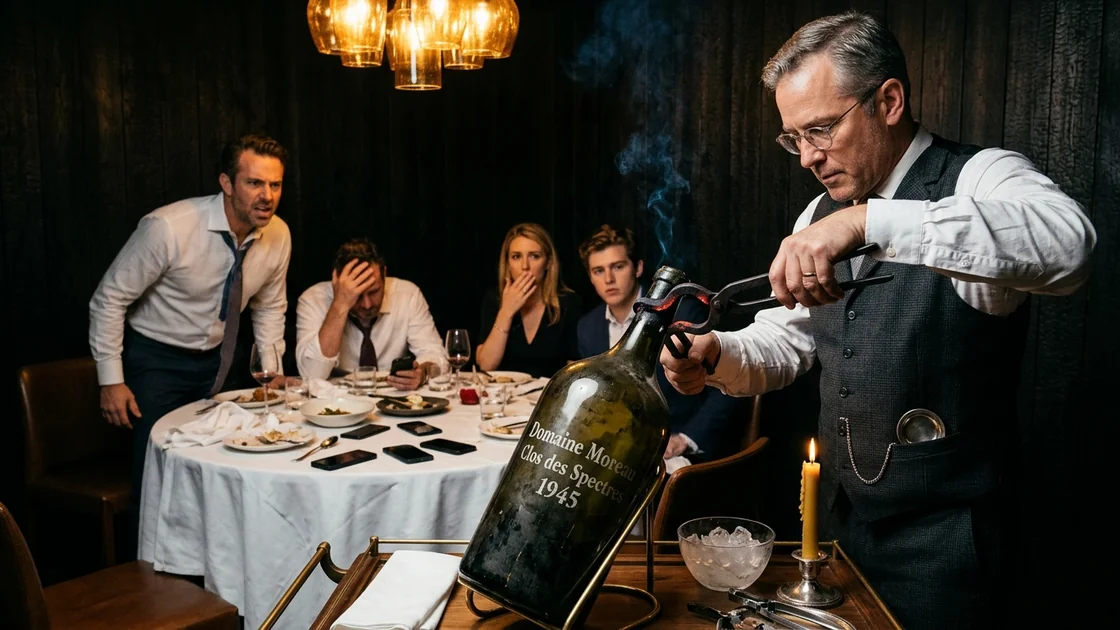
Julian Vance, the head sommelier at an ultra-exclusive restaurant, orchestrates an elaborate financial and culinary trap for four corrupt venture capitalists who destroyed his mentor and stole a historic family vineyard. By placing a mythical six-liter bottle of 1945 Burgundy up for auction through an anonymous trust, Julian manipulates the greedy partners into a frantic bidding war where their secret offshore shell accounts and automated trading bots unknowingly bid against one another. As the price skyrockets into the millions during a lavish seven-course dinner, Julian serves them the very wine they are fighting to acquire, draining their illicit reserves to restore the stolen estate and exposing their embezzlement network to federal regulators before the final glass is emptied.
Forty feet beneath the rain-slicked granite of San Francisco’s Financial District, the air smelled of damp limestone, beeswax, and the quiet passage of a century.
Julian Vance stood in the center of the Vault at L’Abîme, holding a two-pronged Durand corkscrew between his thumb and forefinger as if it were a surgical scalpel. Around him, twelve thousand bottles slept in custom-milled walnut racks that climbed into the vaulted shadows of the old nineteenth-century bullion depository. When the restaurant’s founders leased the basement of the former Pacific Merchant Bank building, they had kept the sixteen-inch steel blast doors and the subterranean spring that kept the ambient temperature at a perpetual, shivering fifty-four degrees Fahrenheit.
On the cedar decanting table before Julian sat a single bottle that did not belong to the restaurant’s inventory.
It was an Imperial—six liters of hand-blown, dark olive glass, heavy and asymmetrical, its punt deep enough to swallow a closed fist. There was no paper label on its belly; the cellar damp of the Côte de Nuits had rotted the paper away before Julian was born. Instead, stenciled directly onto the glass in faded, oxidized white lead paint were the words: Domaine Moreau. Clos des Spectres. 1945.
Julian struck a long cedar match—never sulfur, which would taint the nose—and lit the tall beeswax taper set into its silver holder. He adjusted his spectacles, leaned down, and examined the neck of the bottle against the steady yellow flame. Beneath the chipped black wax capsule, the cork was two and a half inches of compressed Portuguese bark that had been holding back ghosts since the summer the Allied armies marched through Berlin. The wine inside had been harvested by women and old men among unexploded ordnance and rusted German tank traps, pressed in oak vats stained by four generations of Moreau hands, and hidden behind a false brick wall in Vosne-Romanée until the fifties.
And then, three years ago, it had been stolen by men who didn’t know the difference between a Grand Cru and a quarterly earnings call, except that both looked good on a balance sheet.
A soft knock echoed against the iron grille of the cellar door.
Julian didn’t look up from the candle flame. "Come in, Clara."
Clara Lin, his junior sommelier, stepped onto the crushed gravel floor that lined the center aisle. She was twenty-six, possessed a palate sharp enough to detect two parts per million of cork taint at ten paces, and was the only other person in the building who knew that Julian was not merely preparing for a VIP table tonight. She held an iPad against her black wool apron, the screen casting a pale blue glow over her tense features.
"The Geneva lot just went live for final digital pre-bidding," Clara said, her voice dropping to the hushed register the cellar demanded. "Beringer & Voss confirmed the reserve was met forty minutes ago. Current bid is sitting at four hundred and twenty thousand Swiss francs."
"Which shell?" Julian asked softly, picking up a small ivory-handled brush to sweep a microscopic crumb of seventy-nine-year-old wax from the lip of the glass.
"Calypso Capital Partners, registered out of George Town, Grand Cayman," Clara read from the encrypted analytics dashboard on her screen. "That’s Devon Kroll’s algorithmic liquidity fund. And thirty seconds after Calypso placed its marker, an entity called Vespera Holdings LLC out of Wilmington, Delaware, bumped it to four-fifty."
"Sloane Mercer," Julian murmured. A faint, humorless smile touched the corners of his mouth. "She always liked Delaware. No beneficial ownership disclosure required at formation, and the Chancery Court moves only as fast as the retainers are paid. What about Bryce?"
"His proxy bot—the one routing through the Zurich crypto-custody desk—is set to trigger once the lot crosses five hundred thousand," Clara said. She looked from the tablet to the massive six-liter bottle resting in its brass decanting cradle. "Julian, if anyone at Beringer & Voss realizes that Lot 77 isn't sitting in the bonded warehouse at the Embarcadero—"
"It was in the bonded warehouse at the Embarcadero until four o'clock this afternoon," Julian replied smoothly. "When the consignor and the designated local custodian happen to share the same signature, the paperwork becomes remarkably fluid. As far as Zurich and London are concerned, the bottle is stored under climate-controlled guard six blocks east of here, awaiting immediate white-glove courier delivery to the winning bidder upon settlement of the wire."
"And if the wire doesn't settle tonight?"
"It will," Julian said. "Because Marcus Thorne doesn't buy anything unless he can make someone else watch him consume it. Are they upstairs?"
"They just walked through the doors. Twenty minutes early. Marcus is wearing a vicuña overcoat in sixty-degree weather, and Bryce is already asking the maître d' if we have any 'off-menu Screaming Eagle' to start with." Clara winced as if the words physically pained her. "Chef Kaelen looks like he’s about to throw a copper saucepan through the pass."
"Tell Chef to stay the course. The sea urchin tartlet goes out at seven-fifteen sharp." Julian picked up his silver tastevin, polished it once with a linen cloth, and slipped it into the breast pocket of his bespoke charcoal waistcoat. "Keep the iPad mirrored to the terminal at my service station in the private dining room. And Clara?"
She paused at the iron grille. "Yes, Chef?"
"When you bring in the glassware for the fourth course, use the hand-blown Zalto Burgundies from the locked cabinet. If these four are going to pay eight figures to drink their own ruin, the least we can do is give the wine room to breathe."
To understand why a fifty-two-year-old Master Sommelier was willing to risk his career, his freedom, and the reputation of the finest dining room on the West Coast, one had to understand the anatomy of a vine.
A grapevine does not produce greatness through comfort. Plant Pinot Noir in rich, black alluvial valley soil with abundant water and warm, lazy sunshine, and it will grow fat and lazy, throwing out lush canopies of green leaves and swelling its berries with watery, insipid juice that tastes of nothing at all. To make wine that can outlive the man who pruned it, the vine must suffer. It must be planted on steep, rocky slopes of fractured limestone and marl where the topsoil is barely inches deep. Its roots must be forced to drill down twenty, thirty, forty feet through solid rock, cracking the stone in search of microscopic veins of moisture and mineral salts. Every drop of sugar and acid in the fruit is bought with struggle.
Jean-Luc Moreau had understood that better than anyone Julian had ever known.
Thirty years ago, Julian had been a directionless kid from Bakersfield with a busted scholarship at UC Davis and a dishwasher’s job at a wine bistro in St. Helena. Jean-Luc—the seventh-generation scion of Domaine Moreau in Burgundy, who had come to California in the late seventies to establish a sister estate high on the wind-scoured ridges of Mount Veeder—had caught Julian standing by the restaurant’s dumpsters at two in the morning, nose buried in the dregs of five empty Bordeaux bottles, trying to memorize the difference between Pauillac cedar and Saint-Émilion clay.
Instead of firing him for drinking the backwash, the old Frenchman had tossed him a pair of pruning shears and told him to be on the mountain at five-thirty before the sun cleared the Mayacamas range.
For ten years, Jean-Luc was the closest thing to a father Julian possessed. He paid for Julian’s stages in Beaune and Reims. He stood in the back of the hotel ballroom in London when Julian passed his Master Sommelier examination on the first attempt—a feat achieved by fewer than a dozen people in a generation. And when Jean-Luc’s wife died in 2016, leaving the old man alone on the sixty-acre Mount Veeder estate with eighty-year-old dry-farmed vines and no direct heirs, it was understood that the land, along with the small collection of ancestral Burgundies Jean-Luc had brought over from his grandfather’s cellar in Vosne-Romanée, would pass into a conservation trust managed by Julian and the thirty vineyard workers who had spent their lives tending those terraces.
Then came the wildfire of 2017.
The flames didn’t take the old vines—their deep, moisture-laden roots and thick trunks survived the heat—but the smoke tainted the entire vintage, and the embers burned the stone winery and the fermentation barn to ash. Insurance delayed payment for fourteen months on a technicality regarding brush clearance on an adjacent county parcel. Jean-Luc needed four million dollars in bridge financing to rebuild the cellar before the 2018 harvest and keep his workers on payroll through the winter.
Enter Aethelgard Ventures.
They hadn't called it a loan. Marcus Thorne had flown up to Napa in a Sikorsky helicopter, wearing jeans that cost more than a tractor tire, talking passionately about "heritage preservation," "sustainable agritech synergies," and "patient capital." Devon Kroll had brought spreadsheets that promised a low-interest convertible note backed by Aethelgard’s "Luxury Lifestyle & Hospitality Vertical." Sloane Mercer had drafted a three-hundred-page credit facility agreement filled with cross-default clauses buried in footnotes referencing LIBOR adjustments and subjective valuation covenants.
Six months after Jean-Luc signed, Aethelgard quietly acquired the regional wine distributor that handled eighty percent of Domaine Moreau’s domestic allocation. Within a week, Bryce Chu—then a twenty-seven-year-old principal looking to make partner—ordered the distributor to freeze all accounts receivable payouts to the vineyard for ninety days under the guise of an "ERP software migration."
Starved of the cash flow from his previous vintage, Jean-Luc missed a quarterly debt-service covenant by forty-two thousand dollars—a technical default that existed solely on paper, as the winery had twice that amount sitting in pending distributor invoices that Bryce was personally holding back.
Sloane filed the foreclosure and receivership papers in Delaware at 4:59 p.m. on the Friday before Labor Day weekend, right as the grapes were hitting peak physiological ripeness on the vine. By Tuesday morning, private security guards hired by Devon’s shell company had padlocked the iron gates of the Mount Veeder estate.
They didn't want to make wine. Within forty-eight hours of seizing the deed, Aethelgard stripped the vineyard’s water rights and sold them to a luxury resort developer down the canyon for eleven million dollars. They bulldozed forty acres of eighty-year-old heritage vines to clear graded pads for three seventy-million-dollar "wellness compounds" aimed at tech billionaires, and auctioned off the fermentation tanks and cellar inventory for pennies on the dollar to their own offshore subsidiaries.
Jean-Luc Moreau suffered a massive cerebral hemorrhage on the shoulder of Oakville Grade while trying to convince the county sheriff that the men operating the Caterpillar bulldozers on his ridge didn't have a valid demolition permit. He died in the ICU at Queen of the Valley Hospital four days later, his rough, stained vignerons' hands curled around the rails of the hospital bed.
Only one thing had escaped the liquidation inventory. Two nights before the security guards changed the locks, Jean-Luc had called Julian to the blackened ruins of the old stone cellar. Beneath the flagstone floor of the tool shed, wrapped in oilcloth and packed in pine sawdust inside a steel munitions crate, was the last surviving bottle from the family’s original French cradle: the 1945 Clos des Spectres Imperial.
"Do not sell it to pay lawyers, Julian," the old man had rasped, his chest rattling with fluid and woodsmoke. "Lawyers eat paper and spit out more paper. Wait until their greed makes them thirsty. A bad vintage always turns to vinegar in the end—you only have to give it enough air."
It had taken Julian three years of patient, silent cultivation to let enough air into Aethelgard’s cellar.
The Obsidian Room at L’Abîme was designed to make rich men feel like emperors inside a tomb.
There were no windows. The walls were clad in charred Japanese cedar—shou sugi ban—that absorbed both light and sound, save for the soft, rhythmic hiss-click of the climate control system and the low hum of conversation from the round sixty-inch table in the center of the room. Overhead, a single chandelier of blown amber glass cast a warm, theatrical spotlight directly onto the starched Belgian linen tablecloth, leaving the corners of the room in velvet shadow.
When Julian pushed open the heavy, soundproofed leather door, the laughter at the table was loud, brittle, and jagged with adrenaline.
"Look, all I’m saying is that if the FDA wanted clinical trials with actual statistical significance, they shouldn't have fast-tracked the Phase II approval during an election cycle," Bryce Chu was saying, leaning back in his leather armchair and gesturing with a half-eaten brioche roll. At thirty, Bryce looked like an algorithm’s rendering of a Sand Hill Road disruptor: a black cashmere turtleneck under an unstructured Loro Piana blazer, a Patek Philippe Aquanaut on a bright orange rubber strap, and hair styled with matte clay to look deliberately windblown despite his never going outdoors without a driver. "We dumped forty percent of the lockup shares through the secondary Cayman blocker on Tuesday before the short-seller report even hit Bloomberg. Retail bag-holders are going to eat the drawdown, not our LPs."
"Keep your voice down, Bryce," Sloane Mercer said without looking up from her smartphone. She was forty-one, immaculate in an ivory silk blouse with sharp shoulders and platinum hair pulled back so tightly it gave her cheekbones the severity of carved marble. Her fingers moved across her screen with the rapid, silent precision of a concert pianist. "The SEC enforcement division in San Francisco is three blocks away, and half their senior trial attorneys try to get off the waitlist here on their wedding anniversaries. We didn't sell because of the toxicology data; we executed a scheduled portfolio rebalancing."
"Call it whatever keeps the malpractice carriers happy, darling," Marcus Thorne boomed from the head of the table. He was fifty-five, broad-shouldered and florid, with a silver beard trimmed to the millimeter and teeth too white to be entirely native to his jaw. He had already loosened his Hermes tie and draped his arm over the back of his chair, claiming the room’s territory by sheer volumetric expansion. "The point is, Veritas Bio cleared nine hundred million at the bell, and Aethelgard’s carry is north of one-eighty. Which brings us to the actual business of the evening."
Marcus looked up as Julian stepped into the pool of amber light, pushing a two-tiered walnut gueridon cart with silent, rubber-tired wheels.
"Ah! There he is," Marcus announced, spreading his hands as if welcoming a favorite court jester. "The high priest of fermented grape juice. Julian, right?"
"Good evening, Mr. Thorne. Ms. Mercer, Mr. Kroll, Mr. Chu," Julian said, inclining his head at the exact twenty-degree angle that communicated total deference without servility. He had served three of them before over the years, always from behind the armor of his station, always watching, listening, and cataloging their tells. None of them had ever connected the quiet, gray-templed sommelier at L’Abîme with the dusty, devastated nephew-in-all-but-blood who had sat in the back row of the Napa County probate court three years ago. To people like Marcus Thorne, service staff were not human beings with histories; they were well-dressed appliances that dispensed status. "Welcome back to L’Abîme, and congratulations on what sounds like a most auspicious week."
At Marcus’s left, Devon Kroll flinched slightly, his eyes darting up from the two phones lying beside his butter knife. Devon was the quietest of the four—thin, balding, with translucent skin and a habit of rubbing his left cuticle until it bled whenever markets were volatile. As Aethelgard’s Chief Financial Officer and the architect of its labyrinthine offshore fund structures, Devon was the only one at the table who understood just how fragile their nine-hundred-million-dollar exit actually was.
Julian knew why Devon was sweating. Thanks to a former junior auditor at Devon’s accounting firm—a young woman whose father had worked the tractor rows at Domaine Moreau for twenty-two years before losing his pension—Julian knew that Aethelgard’s main fund, Fund IV, was currently running a three-hundred-million-dollar hole caused by a catastrophic, unhedged bet on commercial real estate debt the previous winter. To cover the gap before the quarterly audit on Monday, the partners had been quietly cannibalizing the Veritas Bio proceeds, routing cash through a daisy chain of shell companies to buy up "hard, non-correlated luxury assets"—blue-chip art, classic Ferraris, and investment-grade rare wine—which could be instantly re-appraised at three times their purchase price through corrupt valuation consultants and used as collateral for emergency bridge loans.
Even better, Julian knew that none of the four partners trusted the other three not to bolt before Monday morning.
"Auspicious is an understatement, Julian," Marcus said, tapping his fingers on the closed leather-bound wine list that rested beside his charger plate. It was four hundred pages thick, weighed nine pounds, and was known in the industry simply as The Bible. "Don't bother opening that book tonight. We’re not looking for page numbers. We’re looking for trophies. Chef Kaelen is doing his seven-course white truffle and game menu for us, and I want pairings that make the guys at Benchmark and Sequoia weep when they see the Instagram stories."
"A noble gastronomic philosophy, sir," Julian replied evenly. "I have taken the liberty of pulling a progression from the reserve vault that I believe speaks directly to the nature of your partnership. Wines defined by audacious structure, aggressive extraction, and... unforgettable finishes."
"Now you're talking," Bryce grinned, leaning forward. "What are we starting with? Krug Clos d'Ambonnay? Salon?"
"Close, Mr. Chu," Julian said, lifting a bottle from the silver bucket of ice and rock salt on his cart. He wrapped it in a crisp linen serviette and presented the label first to Marcus, then around the table. "To accompany Chef’s first course—Kumamoto oyster poached in its own liquor with white sturgeon caviar and fermented green apple—we are starting with the 1996 Dom Pérignon Œnothèque, disgorged directly from the abbey cellars at Hautvillers in 2008."
Julian’s hands moved with hypnotic economy. He stripped the foil, untwisted the wire cage while keeping his thumb firmly over the mushroom cork—never taking his eyes off the bottle—and tilted it at forty-five degrees. He twisted the bottle, not the cork, easing the stopper out with what the French called le soupir d'une femme satisfaite—a barely audible, velvet sigh of escaping carbon dioxide, without a single drop of foam lost.
As he poured four ounces of pale gold liquid into each tall, tulip-shaped crystal glass, a microscopic bead of bubbles rose in a relentless, silver column from the laser-etched point at the base of the bowl. Aromas of toasted brioche, lemon curd, crushed oyster shell, and gunflint bloomed instantly in the warm air above the table.
"Ninety-six was a paradoxical year in Champagne," Julian explained softly as he finished pouring for Marcus. "On the surface, the late summer sun produced soaring, almost violent sugar levels—what the growers call a year of excess. Many houses rushed to harvest and produced wines that were showy in their youth, only to collapse from their own internal acid imbalance a decade later. Only those who understood how to balance the rot against the ripeness survived."
Sloane paused mid-text, her sharp gray eyes flicking up to Julian’s face as he set the bottle back in the ice bucket. "The rot?"
"Botrytis and grey rot, Ms. Mercer," Julian smiled pleasantly. "In Champagne, a warm, wet August breeds microscopic fungi inside the tightly packed clusters. If a winemaker is greedy and presses the compromised fruit alongside the clean just to maximize his yield, the flaw remains invisible for years—hidden behind dosage and fizz—until one day the bottle is opened, and all one tastes is mold and wet cardboard. Fortunately, the Œnothèque program leaves the wine on its dead yeast cells for twelve years before disgorgement. The wine literally feeds on the corpses of the organisms that created it, achieving a remarkable, creamy immortality."
Marcus laughed, raising his glass. "Feeding on the corpses of the organisms that created it! Write that down for the next LP shareholder letter, Devon. That’s venture capital in a nutshell."
They clinked glasses and drank.
As they set their glasses down, all four phones on the table vibrated within half a second of one another.
Julian didn't look at their screens. He didn't need to. Behind him, on the small mahogany credenza where he kept his decanting supplies, a recessed monitor built into the wall for communicating with the kitchen was split-screened with Clara’s live feed from the Beringer & Voss Geneva–London–San Francisco evening auction: The Cellar of the Century: Single-Owner Rarities and Lost Provenance.
Lot 71 had just closed. Lot 72 was on the block.
Which meant Lot 77—the six-liter Imperial of 1945 Domaine Moreau Clos des Spectres, the only known surviving large-format bottle from the parcel that Aethelgard had paved over three years ago—was twelve minutes away from live bidding.
And every person sitting at the table in the Obsidian Room had a secret reason to make sure they owned it before the hammer fell.
The trap had not been built with a single bait; it had been tailored to four distinct appetites.
Over the past six weeks, Julian had used three different conduits to whisper into the ears of Aethelgard’s partners.
For Marcus Thorne, the angle was pure, unadulterated ego mixed with marital larceny. Marcus’s third wife had filed for divorce in Marin County ten days ago, seeking a temporary restraining order to freeze his domestic brokerage accounts. Marcus’s private wealth advisor—a man who dined at L’Abîme twice a month and owed Julian for securing him three cases of allocation-only Screaming Eagle at cost—had mentioned to Marcus that an ultra-rare, single-item physical asset held in a Swiss or bonded California freeport under a bearer-share Nevis trust was virtually untouchable by family court forensic accountants. And as a bonus, Julian had made sure a rumor reached Marcus at the Pacific-Union Club that his despised rival, Gavin Hollis of Apex Partners, was planning to buy the legendary 1945 Moreau Imperial at the Beringer & Voss auction just to rub Marcus’s nose in the fact that Marcus had bulldozed the Moreau brand without realizing its historical pedigree was worth millions.
For Devon Kroll, the angle was algorithmic survival. Devon didn't drink wine—he had an ulcer that flared up at anything stronger than chamomile tea—but he ran Calypso Capital, the shadow hedge fund that executed Aethelgard’s wash-trades and artificial asset markups. Four days ago, an anonymous "high-net-worth consortium" in Singapore (actually an escrow shell funded by a coalition of three Napa vintners who had hated Aethelgard ever since Jean-Luc’s death) had submitted a conditional binding letter of intent to Devon’s desk: they were willing to purchase a distressed portfolio of Aethelgard’s illiquid wine and art holdings on Monday morning for twelve million dollars in clean, audit-ready cash, provided the portfolio was anchored by the crown jewel of the Moreau estate—Lot 77—to complete the provenance set. Devon had immediately programmed Calypso’s automated proxy-bidding algorithm to acquire Lot 77 at any price up to 3.5 million dollars, calculating that even at three million, the twelve-million-dollar package deal would plug the exact hole in Fund IV’s balance sheet before the auditors arrived at nine a.m. Monday.
For Sloane Mercer, it was an exit parachute. Sloane knew the SEC was circling Veritas Bio; in fact, she had already drafted her own subpoena response shifting the blame for the falsified toxicology disclosures onto Marcus and Bryce. Before she blew up the firm and took a general counsel role in Dubai, she was quietly skimming seven million dollars from Aethelgard’s legal escrow reserves through her Delaware shell, Vespera Holdings. Why buy Lot 77? Because two days ago, she had intercepted an encrypted email on Devon’s server showing the Singapore consortium’s twelve-million-dollar offer for the bottle. Sloane, thinking she was outsmarting pathetic, nervous Devon, decided to front-run him: she would buy Lot 77 through Vespera Holdings tonight, then flip it to Devon’s desperate fund on Sunday night for double what she paid, pocketing the spread in untraceable offshore cash before catching an Emirates flight out of SFO.
And then there was Bryce. Bryce had nineteen million dollars in illicit crypto tokens sitting in a Zurich custody wallet from an undisclosed side-deal with Veritas Bio’s founders. The Swiss bank had informed him forty-eight hours ago that due to tightening anti-money-laundering regulations, his unverified wallet would be frozen at midnight CET unless converted into a tangible, auction-verified physical asset through an approved European broker. Beringer & Voss’s Geneva desk accepted direct crypto-to-fiat settlement for top-tier lots. Bryce had set his automated Zurich proxy bot to sweep Lot 77, figuring a historic six-liter bottle of 1945 Burgundy was basically a potable NFT that he could either stash in a Geneva vault or brag about on podcasts for the rest of his life.
Four predators. Four shells. None of them aware that the "rival bidders" driving the price into the stratosphere were sitting less than four feet away across the white linen tablecloth, eating the same oysters and drinking the same Champagne.
At 7:35 p.m., two silent backwaiters in black Mao-collar jackets glided into the Obsidian Room to clear the oyster shells and set down the second course: poached white asparagus from the Loire Valley, draped in a warm sabayon of bone marrow and topped with shaved Périgord black truffle.
Julian stepped forward with a tall, slope-shouldered bottle of 2004 Domaine Coche-Dury Corton-Charlemagne.
As he poured the rich, golden Chardonnay—its nose exploding with roasted hazelnuts, struck matchstick, and wet chalk—he noticed Devon’s left thumb digging frantically into the side of his index finger beneath the edge of the table.
On the hidden monitor behind Julian’s service station, Lot 77 had just taken the digital rostrum in Geneva.
Lot 77: One Imperial (6.0 Liters) of 1945 Domaine Moreau, Clos des Spectres, Grand Cru. Direct provenance from the Moreau family private reserve. Verified by microscopic glass-dating and laser spectroscopy. Estimate: CHF 350,000 – 550,000.
"Excuse me for thirty seconds," Devon muttered, his voice tight as he stared down at the phone in his lap. "Just clearing a compliance flag for the Tokyo desk."
"Relax, Dev, Tokyo isn't even open on a Saturday," Marcus chuckled, cutting into his asparagus with heavy silver flatware, though his own right hand slipped casually into his jacket pocket to check the buzzing Apple Watch on his wrist. "Try the wine. Julian, what’s the story on this white? Tastes like buttered rocks, in a good way."
"Corton-Charlemagne, Mr. Thorne," Julian said, stepping back to his credenza where he could watch both the table and the discrete reflection of the monitor in the polished silver ice bucket. "The hill of Corton was once owned by the Emperor Charlemagne himself in the eighth century. Legend holds that in his old age, the Emperor grew tired of red wine staining his long white beard during banquets, so his wife ordered all the red Pinot Noir vines uprooted and replaced with white Chardonnay. It is a wine built for men who wish to erase the stains of their past while retaining the crown."
Marcus grinned around a mouthful of marrow sabayon. "Smart wife. Better to change the crop than change the king."
On the screen, the opening bid of CHF 450,000—Sloane’s Delaware shell, Vespera—flashed green.
Half a second later, Devon’s Cayman algorithm, Calypso Capital, executed its pre-programmed rule: Outbid active high marker by 5% increment within 400 milliseconds to project institutional dominance and discourage human bidders.
CHF 475,000 — Online Bidder 409 (Grand Cayman).
Across the table, Sloane’s jaw tightened almost imperceptibly. Taking a delicate sip of her Corton-Charlemagne with her left hand, she tapped the screen of her phone under the napkin with her right. She thought Devon was bidding manually from his phone, trying to secure the bottle for the firm’s rescue package. Fine, her cold gray eyes seemed to calculate. If the firm needs it to survive Monday’s audit, Devon will pay me whatever I ask on Sunday night. Let’s push him.
She tapped twice.
CHF 520,000 — Online Bidder 118 (Wilmington).
Instantly, four hundred milliseconds later, Devon’s algorithm fired back.
CHF 550,000 — Online Bidder 409 (Grand Cayman).
Now Bryce’s phone buzzed against the bread plate.
Bryce’s five-hundred-thousand-franc trigger in Zurich had just been breached. His crypto-custody desk’s automated sweep script woke up, registering a high-velocity luxury asset crossing its threshold, and entered the fray with a standard ten-percent jump to clear out retail collectors.
CHF 600,000 — Telephone Proxy 04 (Zurich).
Devon blinked rapidly, a bead of sweat forming at his hairline despite the cool air of the dining room. He hadn't touched his asparagus. On his screen, he saw two separate entities—one in Delaware, one in Zurich—attacking his algorithm at once. He didn't know Wilmington was Sloane, and he certainly didn't know Zurich was Bryce’s illicit crypto stash. He assumed the Singapore consortium that had offered him twelve million for the portfolio was trying to bypass him and buy the anchor bottle directly at the auction!
Panic flared in Devon’s chest. If Singapore bought Lot 77 themselves for six hundred grand, they would tear up the twelve-million-dollar letter of intent, Fund IV would default on Monday morning, and Devon Kroll would be wearing an orange jumpsuit in FCI Dublin before Christmas.
Under the tablecloth, Devon logged into Calypso’s master override parameters and changed the algorithm’s ceiling from 3.5 million to Uncapped Priority Execution—Aggressive Step-Up.
CHF 680,000 — Online Bidder 409 (Grand Cayman).
CHF 750,000 — Telephone Proxy 04 (Zurich).
CHF 820,000 — Online Bidder 409 (Grand Cayman).
At the head of the table, Marcus Thorne’s watch tapped his wrist three times in rapid succession. It was his private wealth concierge on the line with the London desk of Beringer & Voss. Marcus glanced down at his watch face, reading the text preview:
Mr. Thorne: Lot 77 passing CHF 850k ($980k USD). Heavy action from Zurich and Cayman. Looks like Hollis’s offshore guys are trying to corner it. Hold at your $1M cap or push?
Marcus’s face flushed a deep, venous crimson beneath his tan. Gavin Hollis. That smug bastard from Apex Partners was really trying to buy the Moreau Imperial just to wave it around at the Sun Valley conference in July and tell everyone how Marcus Thorne had plowed under a billion-dollar heritage vineyard to build three unsold yoga compounds.
"Unbelievable," Marcus muttered under his breath, setting his fork down with a sharp clink against the porcelain.
"Everything satisfactory with the asparagus, Mr. Thorne?" Julian asked gently, stepping to his elbow with the Corton-Charlemagne.
"The food’s fine, Julian, the food’s great," Marcus grunted, pulling his phone openly onto the table now. He didn't care about decorum anymore; his pulse was hammering in his temples. "Just some bottom-feeding vulture on Sand Hill Road trying to buy a piece of history that belongs to me. Give me another splash of that Charlemagne."
"Of course, sir," Julian murmured, tilting the bottle. As he poured, he looked across the table at Devon, Sloane, and Bryce.
All three of them froze for a fraction of a second as Marcus’s words registered.
Trying to buy a piece of history that belongs to me.
Sloane’s eyes narrowed as she looked from Marcus’s thumb hammering at his phone screen down to her own display, where a new bidder—Telephone Paddle 09 (London Desk / Nevis Trust)—had just slammed a flat CHF 1,200,000 onto the board.
Wait. Was Marcus Nevis?
Then who was Cayman? And who the hell was Zurich?
Before Sloane could process the terrifying geometry of what was happening, Bryce’s Zurich script and Devon’s uncapped Cayman algorithm collided with Marcus’s manual bid in a three-way algorithmic feedback loop.
Because Devon’s bot was programmed to outbid any new entrant within 400 milliseconds by five percent, and Bryce’s Zurich crypto-sweep bot was programmed to match and raise any non-Zurich bid within 500 milliseconds to liquidate his nineteen-million-dollar wallet before the midnight freeze, the two machines locked horns like mechanical stags in a dark room.
CHF 1,260,000 (Cayman) CHF 1,350,000 (Zurich) CHF 1,420,000 (Cayman) CHF 1,500,000 (Zurich) CHF 1,580,000 (Cayman)
All within four seconds.
"What the fuck is happening with the latency on this feed?" Bryce blurted out, forgetting himself completely as he stared at his phone screen, his orange-strapped Patek Philippe catching the amber light as his hand shook.
Silence fell over the table like a guillotine blade.
Marcus stopped typing and slowly raised his head. He looked at Bryce’s phone. Then he looked at Devon, whose face had gone the color of the poached white asparagus on his plate. Then he looked at Sloane, who was staring at the three men with her lips parted in dawning, icy horror.
"Bryce," Marcus said, his voice dropping an octave into a dangerous, gravelly purr. "What feed are you looking at?"
"I—nothing, man, just—Ethereum gas fees on a—" Bryce stammered, slapping his phone face-down on the linen tablecloth so hard the water glasses chimed.
"Turn it over," Sloane said. Her corporate veneer had vanished; she sounded like a prosecutor in a grand jury room. "Turn your phone over right now, Bryce."
"What are you talking about, Sloane? Why are you looking at me like that?"
"Are you Zurich?" Devon whispered. His voice cracked like a boy’s. He was staring at Bryce as if the younger man had just pulled the pin on a hand grenade inside an elevator. "Oh, God. Oh, Jesus Christ, Bryce, tell me you aren't Telephone Proxy Four in Zurich."
"What if I am?" Bryce snapped defensively, his ego flaring to cover his panic. "It’s my own side allocation! What do you care what I buy in Geneva? Wait—are you Cayman? You're using Calypso to bid on a fucking bottle of wine?!"
"I had a twelve-million-dollar takeout offer for the portfolio if we anchored it with the Moreau Imperial!" Devon shouted, half-rising from his chair before remembering where he was and sinking back down, clutching his stomach. "My bot is uncapped! It’s locked in a sub-second parity loop with your Zurich proxy! Shut it off! Shut yours off right now!"
"I can't shut it off from my phone!" Bryce yelled back, snatching his device up with trembling fingers. "It’s a smart-contract custody mandate executed by the desk at Banque Pictet! Once the lot crosses one-point-five, it’s locked until the reserve wallet clears or the hammer falls! Turn yours off, you idiot!"
"I'm trying! The two-factor authentication token for Calypso’s master kill-switch is on my hardware key in the office safe on Sand Hill Road!"
At the head of the table, Marcus Thorne sat motionless. The veins in his neck stood out like twisted vine trunks. Slowly, deliberately, he turned his head toward Sloane.
"And Wilmington?" Marcus asked softly. "Who the fuck is Wilmington?"
Sloane didn't answer. She had already hit the Withdraw Paddle button on Vespera Holdings at 1.1 million, thank God, though her initial bids were the spark that had pushed the lot past Bryce’s five-hundred-thousand-franc trigger and ignited the twin automated engines now tearing Aethelgard’s offshore liquidity to shreds.
On the monitor behind Julian, the numbers were climbing with terrifying, hypnotic beauty.
In Geneva, the auctioneer—a veteran of thirty years at the rostrum—was barely able to call the increments fast enough as the two automated institutional channels in Grand Cayman and Zurich battered each other upward by seventy-five thousand francs a second. And because Marcus’s London concierge had been given standing instructions two minutes ago to "Beat the next jump by two hundred grand and don't call me back until we hold the paddle," the Nevis trust was still throwing manual haymakers into the middle of the machine-gun fire.
CHF 3,400,000. CHF 3,650,000. CHF 3,900,000. CHF 4,200,000.
Just like that, Lot 77 shattered the world auction record for a single bottle of wine—eclipsing the 1945 Romanée-Conti standard bottle that had sold at Sotheby’s for $558,000—and kept right on climbing into the stratosphere.
Julian stood by the walnut gueridon cart, his hands folded neatly in front of his waistcoat, watching the four partners scream into their phones while the third course arrived.
It was a ballotine of wild Scottish woodcock, roasted on the bone with its own innards pureed onto sourdough toast, accompanied by a dark, glossy reduction of blood, juniper, and Armagnac.
As the backwaiters set the plates down in front of the frantic, sweating venture capitalists, Julian stepped quietly to the table with a decanter holding the 1989 Château Haut-Brion.
"For the third course," Julian murmured into the chaos, his voice as calm and soothing as a priest delivering last rites in a hurricane, "Chef Kaelen presents the wild woodcock. Traditionally, the bird is strangled rather than shot so that the blood remains trapped within the muscle tissue, lending the flesh an extraordinary, metallic richness. To pair with it, the 1989 Haut-Brion from Pessac-Léognan—a wine of smoke, scorched earth, and iron."
"Not now, Julian!" Marcus roared, his hand clamped over the mouthpiece of his iPhone as he screamed at his London broker on the other line. "Cancel the mandate! I said cancel the fucking mandate, Nigel! I don't care if the hammer is up, pull the paddle!"
Across the table, Devon was hyperventilating, his forehead pressed against the cool edge of the Belgian linen tablecloth as he watched Calypso Capital’s entire cash reserve—the exact liquid pool meant to cover Monday morning’s SEC and LP audit—evaporate in hundred-thousand-franc increments against Bryce’s frozen Zurich script.
CHF 6,100,000. CHF 6,400,000. CHF 6,800,000.
In Geneva, the Zurich crypto-custody desk’s margin limit finally hit its ceiling—not because Bryce’s nineteen million was gone, but because Beringer & Voss’s automated compliance engine capped single-lot unverified crypto-proxy exposure at seven million Swiss francs without a live director’s countersignature.
Zurich dropped out at CHF 6,800,000.
Which left Devon’s Cayman algorithm—programmed to fire one final five-percent dominance bid over the last active marker—to place the winning crown on its own head.
CHF 7,150,000.
With the eighteen-percent buyer’s premium and Swiss value-added tax, the total settlement price flashed in bright gold letters across the Geneva board:
LOT 77 SOLD: CHF 8,437,000 ($9,618,180 USD).
The silence that followed in the Obsidian Room was heavier than the sixteen-inch steel blast doors downstairs.
No one touched the woodcock. The dark, mirror-like pool of blood sauce cooled on the warm porcelain plates, congealing around the edges of the toast points.
Devon Kroll sat upright very slowly. His face was slick with cold sweat, his eyes glassy and unfocused. He looked down at the automated confirmation receipt that had just populated his screen from Beringer & Voss’s institutional settlement desk.
"Nine point six million dollars," Devon whispered. "Because Calypso used an Prime-Brokerage Direct Settlement Line with UBS to qualify for the uncapped paddle... the wire just auto-executed against the Fund IV escrow account."
Sloane grabbed his wrist across the table, her fingernails digging into his skin. "Stop the wire, Devon. Call UBS in Zurich and claim unauthorized algorithmic malfunction. Claim a cyberattack."
"You can't claw back a direct clearinghouse escrow sweep once the auctioneer’s gavel hits the block under Swiss auction law!" Devon’s voice rose to a thin, hysterical shriek. "That’s the whole reason Beringer & Voss requires institutional escrow pre-clearance for lots over a million! And do you know what happens when an eight-million-franc single-asset transaction clears through four linked entities in Cayman, Delaware, Nevis, and Zurich within ninety seconds?"
Sloane let go of his wrist as if it were radioactive. Her hand flew to her mouth.
As a corporate attorney who specialized in structured finance, she knew the answer before Devon even said it.
"FinCEN," she breathed, the blood draining from her cheeks until she matched her silk blouse. "The Bank Secrecy Act automated wash-trade flag."
"When four offshore shells with overlapping IP signatures and shared prime-brokerage guarantees bid an illiquid physical asset up by two thousand percent over high estimate in less than three minutes," Devon said, his voice dead and hollow now, "it triggers an immediate, mandatory Suspicious Activity Report to the Financial Crimes Enforcement Network and the SEC’s Asset Management Unit. UBS just froze the remaining balance of Calypso, Vespera, and Bryce’s Pictet wallet pending beneficial ownership verification."
Marcus Thorne slowly lowered his phone to the table. He stared at the three of them—his partners, his fellow vipers—with eyes that looked like two holes burned in a blanket.
"Wait a minute," Marcus said, his voice trembling with a rage so vast he could barely form the syllables. "Wait just one fucking minute. You’re telling me we just paid nine and a half million dollars of our own money... to outbid ourselves?"
"Well, technically," Bryce mumbled, slumping down in his chair and staring blankly at the ceiling chandelier, "the money goes to the consignor. Whoever put the bottle up for auction."
"And who the hell is the consignor?!" Marcus bellowed, slamming both fists onto the table so violently the Corton-Charlemagne tipped over, spilling golden wine across the white linen like a spreading bruise. "If it’s still in a bonded warehouse here in the city, we seize it! We claim fraud! We tie the consignor up in federal court until the sun burns out! Devon, pull the lot sheet! Who consigned Lot 77?!"
"You need not strain your eyes on the small print, Mr. Thorne," a calm, resonant voice said from the shadow beside the credenza.
All four heads snapped toward Julian.
He was no longer standing in the deferential twenty-degree bow of a servant. He stood tall and completely still beside the massive cedar decanting cradle, where the six-liter Imperial of 1945 Domaine Moreau Clos des Spectres rested like an unexploded artillery shell from the war that birthed it.
In his right hand, Julian held a pair of heavy iron port tongs whose jaws were glowing a dull, cherry red from the small butane burner tucked on the bottom shelf of his cart.
"What did you just say?" Marcus demanded, squinting at him.
"I said you need not look up the consignor on your phone, Mr. Thorne," Julian repeated pleasantly, stepping forward into the amber light. "Lot 77 was consigned by the Moreau Vineyard Workers and Creditors Restitution Trust, formed in the State of California sixty days ago. As the sole trustee and original custodian of the bottle since Jean-Luc Moreau placed it in my hands two days before he died on Oakville Grade, I can assure you that the provenance is entirely unimpeachable."
The four partners stared at him. Then their eyes dropped from Julian’s face to the colossal, dark-green bottle resting in the brass cradle on the walnut cart—the faded white lead stencil gleaming softly in the candlelight: Domaine Moreau. Clos des Spectres. 1945.
"That’s..." Bryce pointed a shaking finger at the cart. "That’s the bottle. That’s Lot 77. How is it in here?! The catalog said it was in the Beringer & Voss bonded vault on the Embarcadero!"
"And so it was, until 4:15 this afternoon," Julian said. "Beringer & Voss provides a bespoke 'Table-Side Immediate Release' protocol for pre-vetted institutional buyers when the consignor waves the transit hold. Since all four of your bidding entities registered your primary GPS compliance terminals within this exact postal code before the auction began—and since the consignor was already in the room—the auction house authorized on-site custody transfer the moment the hammer fell."
Julian reached into his waistcoat pocket, withdrew a folded sheet of heavy cream bond paper bearing the embossed red wax seal of Beringer & Voss Geneva, and laid it neatly beside Marcus’s bread plate.
"Your delivery receipt, Mr. Kroll. Or should I address it to Calypso Capital?" Julian’s eyes swept across the table, warm and scholarly behind his spectacles. "The wire of eight million, four hundred and thirty-seven thousand Swiss francs—minus the auction house’s remarkably reasonable ten-percent charity commission—has already cleared into the Restitution Trust’s irrevocable distribution account at the Federal Reserve Bank of San Francisco. At eight o'clock Monday morning, those funds will automatically disburse to pay off the remaining medical debts of Jean-Luc Moreau’s estate, fund the pensions of the thirty-two vineyard workers you terminated without severance in 2021, and repurchase the Mount Veeder parcel from your distressed real-estate receiver at Tuesday’s foreclosure auction."
Marcus stood up so fast his leather armchair toppled backward onto the carpet with a dull thud. He towered over the table, his face purple, his chest heaving under his bespoke suit jacket.
"You set us up," Marcus hissed, taking a step toward the cart. "You planted the Hollis rumor with my wealth manager. You fed Devon that fake Singapore takeout letter!"
"I merely described a great wine to people who appreciate rare things, Mr. Thorne," Julian said, not retreating an inch. He held the glowing red iron tongs steady between them—not as a weapon, though five hundred degrees of forged steel less than a foot from Marcus’s vicuña lapel certainly gave the older man pause, stopping him dead in his tracks. "You see, Jean-Luc always taught me that you cannot force a bad vine to produce a bad vintage. The rot must already be inside the skin. Did I force Ms. Mercer to skim seven million from your legal escrow to front-run her own CFO? Did I force Mr. Chu to launder nineteen million in undisclosed kickbacks through Zurich behind your back? Did I force Mr. Kroll to run an illegal wash-trading algorithm to hide a three-hundred-million-dollar hole from your limited partners?"
Julian tilted his head, watching the way Marcus’s eyes darted sideways toward Sloane and Bryce as those exact numbers—numbers Marcus clearly hadn't known until this second—landed in the center of the room.
"All I did," Julian said softly, "was put a single bottle of old grape juice in the middle of the table and let your own machines do what you built them to do."
"That bottle is an asset of Calypso Capital!" Sloane said sharply, rising to her feet, her lawyer’s brain scrambling for any salvageable plank in the shipwreck. "As LONG as that bottle remains sealed and in original auction condition, it carries a verified market valuation of nine point six million dollars! We can still book it on the balance sheet as a tier-one tangible asset for Monday’s audit and refinance it through a Geneva Lombard loan by noon!"
Devon looked up, a sudden, desperate spark of hope igniting in his bloodshot eyes. "She’s right. She’s right! The hammer price establishes fair market value under GAAP! As long as the capsule and cork are intact, we can pledge the physical bottle to Credit Suisse for seventy percent loan-to-value on Monday morning! Don't touch that bottle! Put the tongs down!"
Julian looked down at the Imperial of 1945 Clos des Spectres.
"An unopened bottle as collateral," Julian murmured, as if turning the concept over on his palate. "Yes, I suppose a sealed bottle of 1945 Burgundy is an extraordinary financial instrument. To a bank, its value lies entirely in the fact that no one ever drinks it. It sits in the dark, traded from shell company to shell company by men who view Jean-Luc’s life's work as nothing more than a bearer bond made of glass."
Julian looked at Marcus.
"Fortunately for the wine," Julian said, "Mr. Thorne gave me very clear instructions when he sat down tonight. He told me he didn't want page numbers. He wanted trophies. And under Paragraph 14 of the Beringer & Voss Table-Side Release Agreement—which Mr. Kroll’s algorithm digitally signed when it requested priority local custody—the designated sommelier is instructed to open and decant the lot immediately upon hammer settlement to verify the wine is free of cork taint."
"No—" Devon lunged across the table, knocking over two crystal water goblets. "Wait! Don't—"
Clack.
Julian clamped the glowing red jaws of the iron port tongs around the thick glass neck of the Imperial, just below the base of the seventy-nine-year-old cork.
For twenty seconds, nobody in the room breathed. A thin ribbon of blue smoke curled up from the blackened wax residue on the neck, smelling of pine resin and ancient dust.
Julian removed the heated tongs, picked up a small linen brush dipped in ice water from the Champagne bucket, and drew a single, delicate wet line across the superheated glass ring.
Tink.
It was the cleanest, sharpest sound in the world—like a skater’s blade cracking virgin pond ice at dawn.
With a practiced flick of his wrist, Julian lifted the severed glass top of the bottle’s neck cleanly away, cork and wax still fused inside the glass cylinder, exposing the dark, ruby meniscus of the 1945 Clos des Spectres to the air for the first time in nearly eighty years.
Nine point six million dollars of collateral value vanished into the air of the Obsidian Room in a single breath.
Devon Kroll made a small, strangled whimpering sound and slid from his chair onto his knees beside the table, staring up at the open bottle as if he had just watched his own heart lifted out of his chest.
Sloane sank back into her leather seat, her face an immobile mask of chalk, already calculating the federal sentencing guidelines for wire fraud and obstruction. Bryce simply stared at the severed glass neck sitting on the silver tray, his mouth hanging open.
And Marcus Thorne stood frozen by the head of the table, his fists clenched at his sides, watching as Julian calmly picked up the heavy six-liter bottle in its brass cradle and began to pour the wine down the inside wall of two wide, hand-blown crystal decanters over the flame of the beeswax candle.
The aroma that rose from the crystal was not merely a scent; it was a presence.
It filled the charred-cedar room in seconds—an impossible, haunting tapestry of wild black cherries dried in the autumn sun, crushed violets, damp forest floor after an October rain, Truffle, woodsmoke, cured game, and the deep, cold, iron-rich limestone rock of Vosne-Romanée. It smelled of survival. It smelled of women singing in the vineyards while the smoke of a ruined continent cleared from the sky. It smelled of an old man on a California mountain who had loved the earth more than money.
Julian set the decanters down, leaving the last half-inch of dark sediment in the belly of the Imperial. Then he picked up four hand-blown Zalto Burgundy glasses—their bowls as thin and weightless as soap bubbles—and placed one in front of each seat.
Slowly, methodically, he poured four generous measures of the 1945 Domaine Moreau Clos des Spectres.
"The 1945 vintage," Julian said softly into the dead silence of the room, "was born of a spring frost that destroyed seventy percent of the buds on the vine, followed by a scorching summer and a hailstorm in August. The yields were tiny—barely fifteen hectoliters per hectare—concentrating everything the roots could pull from the bedrock into a handful of small, thick-skinned berries. It is a wine that teaches us a very simple lesson, gentlemen, Ms. Mercer: you can burn the barn, you can tear out the vines, and you can salt the earth with concrete, but the rock underneath remembers everything."
Julian picked up a fifth glass—his own small tasting glass from the credenza—and poured a single ounce for himself and another for Jean-Luc, which he left standing beside the flickering beeswax candle.
He raised his glass toward the four ruined titans of Sand Hill Road.
"The fourth course—roasted squab with black winter truffle—will be out momentarily," Julian Vance said, bowing his head with impeccable grace. "Do drink up before it oxidizes. At two hundred and forty thousand dollars an ounce, it would be a terrible sin to let it go to waste."
He turned, walked across the plush carpet, and stepped through the heavy leather door of the Obsidian Room, pulling it shut behind him with a soft, final click.
Outside in the cool stone corridor, Clara was waiting by the service elevator, holding the iPad against her apron. Her eyes were wide as she looked at the small tasting glass of garnet-colored 1945 Burgundy in Julian’s hand.
"Did it hold up?" she whispered. "After seventy-nine years?"
Julian lifted the glass to the light of the corridor sconce. The color at the core was still a vibrant, living ruby, fading to antique tawny gold at the rim. He brought it to his nose, closed his eyes, and took a single, slow sip.
On the palate, there was no decay, no vinegar, no fatigue—only a soaring, cathedral-like architecture of pure fruit, velvet tannin, and bright, clean acidity that lingered on the tongue long after the liquid was gone, refusing to die.
Julian opened his eyes and smiled.
"It’s just now entering its drinking window, Clara," he said, handing her the glass so she could taste it too. "Tell Chef Kaelen he can fire the squab."