The Vintage of Silent Glass
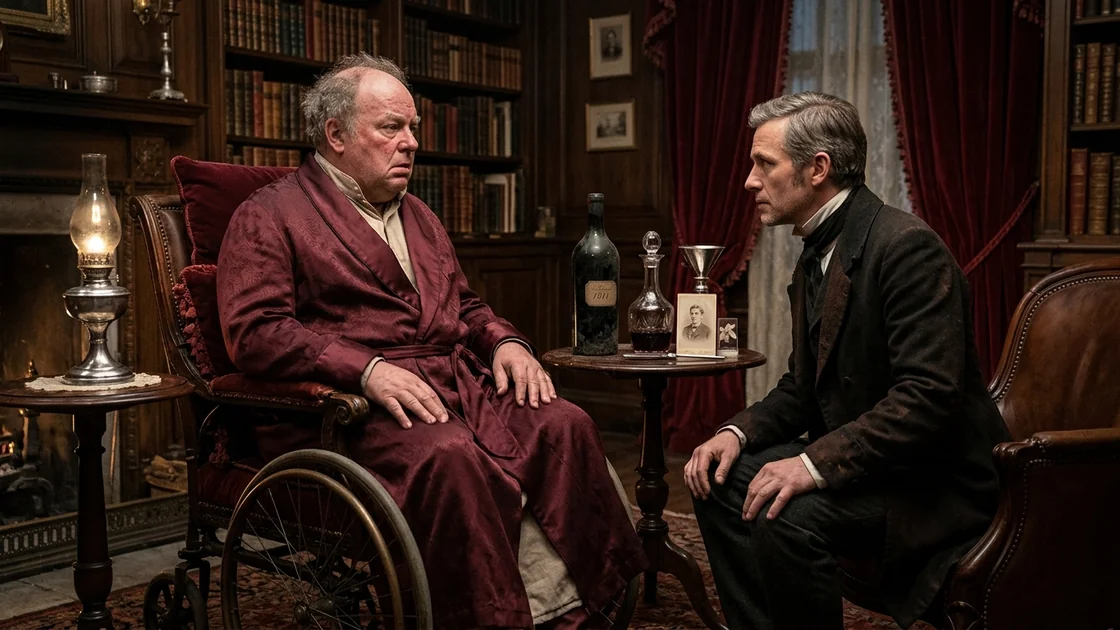
In late nineteenth-century London, Arthur Pendelton, a quiet and meticulous apothecary, harbors a devastating secret regarding the death of his falsely accused younger brother at the hands of the notoriously corrupt Magistrate Horace Sterling. Seeking a patient and poetic justice, Arthur uses his profound botanical expertise to cultivate a rare, toxic orchid from the humid jungles of Borneo, distilling its nectar and root alkaloids into an odorless, cumulative paralytic agent. Over the course of an entire year, under the guise of treating the judge's chronic gout and preserving his subterranean wine vaults from damp and mold, the apothecary systematically extracts bottles from Sterling's prized collection of vintage clarets, ports, and Madeiras, fortifying them with the slow-acting botanical toxin. As the seasons turn and the tainted vintages are consumed, the magistrate's body begins to fail him inch by imperceptible inch, leading to a final, terrifying confrontation where the judge finds himself trapped within the prison of his own opulent flesh, forced to listen to the truth of his crimes with no voice left to pass sentence.
The fog that rolled off the Thames in the November of 1884 did not merely hang in the air; it possessed a weight and a greasy, sulfurous malignancy that seemed to seep through the very mortar of the brickwork along Fleet Lane. Inside the narrow, gas-lit shop of Pendelton, Chymist and Druggist, the fog was kept at bay only by the competing pungency of a hundred dried herbs, mineral spirits, and simmering decoctions. In the window, two immense glass carboys—one filled with a solution of cupric sulfate that glowed a deep, melancholic blue, the other with potassium dichromate of a fiery, arterial amber—cast elongated, distorted pools of color across the wet cobblestones outside, signaling to the denizens of the ward that relief from their corporeal miseries could be purchased within for a few copper pence.
Arthur Pendelton stood behind his counter of dark, acid-stained mahogany, his back as straight as a glass stirring rod. He was a man of forty, though the silver at his temples and the deep, vertical crease between his brows suggested another decade of quiet endurance. He wore a frock coat of rusty black broadcloth, protected at the cuffs by linen oversleeves tied neatly below the elbow, and a spotless white apron that smelled faintly of camphor and crushed lavender. Before him lay a pill tile of glazed porcelain and a brass balance scale so sensitive it could measure the weight of a dried eyelash.
With a bone spatula, Arthur divided a grey, cohesive mass of mercury and chalk—the standard blue pill of the London Pharmacopoeia—into twenty-four equal portions, rolling each beneath a boxwood rounder until they were uniform spheres. His hands moved with an almost mechanical lack of hesitation. There was no tremor in his long, pale fingers, though his knuckles were permanently stained a faint yellowish-brown from years of handling nitric acid and tincture of iodine.
The brass bell above the door gave a dull, asthmatic clank. A woman entered, bringing with her a gust of freezing, coal-choked air. A tattered paisley shawl was drawn tight over her head, framing a face hollowed out by the relentless arithmetic of factory work and cheap gin.
"Evening, Mr. Pendelton," she rasped, placing a brown penny bottle and two damp farthings upon the edge of the counter. "The usual for the babe. The colic's got him fierce tonight, and my husband needs his sleep before the morning shift at the foundry."
Arthur looked at the bottle. The faded label read Mother Bailey's Quieting Syrup—a mixture of treacle, aniseed oil, and laudanum that kept half the infants of the rookeries in a state of stupor while their mothers worked or wept. Other apothecaries along the Strand or down in Whitechapel diluted their opiates with ditch water or spiked them with rough methylated spirits to stretch the profit margin. Arthur never did. If the poor must poison themselves to survive the grinding wheel of the city, he reasoned, they should at least receive a pure, predictable measure of the poison.
"Half a drachm, Mrs. Garrow," Arthur said, his voice quiet, resonant, and entirely devoid of judgment. "Give him no more than three drops upon the tongue. The cold weather slows the digestion; what cleared his blood in August will linger in his liver in November."
He took the bottle to the dispensary shelf behind him, unstoppered a tall flint-glass vessel labeled Tinct. Opii, and measured the dark, reddish-brown liquid into a graduated glass cone. He cut it with fennel water and simple syrup, stoppered the vial with a fresh cork pared down by his own knife, and handed it back across the mahogany. He did not take the second farthing, pushing it gently back toward her chapped, blackened knuckles.
"Keep the half-penny for coal, Mrs. Garrow," he murmured. "A warm hearth does more for the spasms than the poppy ever could."
She blessed him in a hoarse whisper and slipped back out into the yellow murk. When the bell ceased its vibrating, the shop fell back into its customary silence, broken only by the rhythmic drip-drop of a glass condenser in the back room and the ticking of a tall case clock that had belonged to Arthur's father.
Arthur untied his linen oversleeves, folded them into precise squares, and carried a brass oil lamp into the sanctum behind the shop. To the casual observer, or the occasional inspector from the Worshipful Society of Apothecaries, this rear chamber was merely a laboratory for compounding galenicals—a place of copper stills, cast-iron mortars, sand baths, and rows of stoneware jars containing colocynth, jalap, and Peruvian bark.
Yet behind a heavy baize curtain at the far end of the laboratory stood a heavy oak door reinforced with iron straps and secured by a Bramah lock of intricate design. Beyond that door lay what had once been a small paved courtyard, now entirely enclosed by a slanted roof of ribbed glass and heated day and night by a network of copper hot-water pipes fed from a coke furnace in the cellar.
Arthur unlocked the door and stepped into the tropics.
The air inside the conservatory was heavy, hot, and wet, smelling of rotting teakbark, damp sphagnum moss, and a strange, sweetish odor that resembled bruised peaches mixed with bitter almonds. Condensation ran in slow, meandering rivulets down the glass panes. Suspended from the iron rafters in baskets of charred cedar were dozens of epiphytic plants—orchids gathered by madmen and profiteers from the fever-swamps of Guiana, the cloud forests of New Granada, and the limestone crags of Sarawak.
Arthur did not cultivate them for the drawing rooms of duchesses. He had no interest in the flamboyant purples of the Cattleya or the bridal pureness of the Phalaenopsis that fetched a hundred guineas apiece at Stevens's Auction Rooms in Covent Garden. His collection consisted of the botanical anomalies, the shadowed dwellers of the forest floor that the great collectors threw away as weeds.
He walked down the narrow duckboard path to the center table, where a large Wardian case of leaded glass stood under the warm glow of a dedicated paraffin burner. Inside this miniature greenhouse within a greenhouse grew seven specimens of a plant that possessed no name in the catalogues of the Royal Horticultural Society.
Its leaves were mottled like the skin of an adder, dark green blotched with livid purple, hugging a bed of crushed limestone and decaying beech leaves. From the center of three of the plants rose tall, wiry stems, nearly black and covered in fine, glandular hairs that glistened with microscopic droplets of mucilage. At the summit of each stem hung a single blossom. It was a slipper orchid, though the pouch was elongated and twisted in upon itself like a hangman's leather hood, colored the dull, waxy white of dead tallow and veined with threads of dried-blood carmine.
The Dyak headhunters along the Rajang River in Borneo called it Bunga Tidur Batu—the Flower of the Stone Sleep. In Arthur's private leather-bound ledger, he had classified it with a binominal of his own invention: Cypripedium lethe.
Arthur set his lamp down and lifted a small pane of glass at the side of the Wardian case. Using a pair of long silver forceps, he plucked a single, faded blossom that had begun to detach from its ovary, dropping it into a wide-mouthed jar of rectified spirit of wine. The pale petals immediately began to leach a faint, opalescent cloud into the clear alcohol.
"Eighteen months," Arthur whispered to the humid air, his breath not misting in the eighty-degree heat. "Eighteen months since the dockside, and the concentration in the rhizome is finally approaching saturation."
He looked down at the pale, hooded flowers, and as always, when he looked at them, he did not see the jungles of the East Indies. He saw the stone façade of Newgate Prison on a Monday morning in March, two years prior.
He saw his younger half-brother, Thomas Vance—twenty-two years old, with their mother's bright grey eyes and a laugh that used to shake the medicine jars on the shop shelves—standing upon the drop with a white linen cap pulled down over his face.
Thomas had been a junior copying clerk in the offices of the Great Northern and Midland Railway Extension Trust. He had possessed a mind for numbers as neat and incorruptible as Arthur's was for chemical weights. It was that very precision that had killed him. While cross-referencing land acquisition deeds in the parish of St. Pancras, Thomas had discovered that four streets of crowded tenements had been purchased through a phantom company three weeks before the parliamentary route of the railway was publicly announced, and subsequently sold to the railway board at six hundred percent profit, bankrupting the trust's pension fund.
The phantom company had been chartered by a straw man, a clerk who died in a workhouse, but the dividends had been paid in bearer bonds directly into a private vault at Child & Co.'s Bank. The signatory on that vault was the Honorable Horace Sterling, Justice of the Assizes and Magistrate of the Crown.
Thomas, in the fatal innocence of his youth, had gone not to the newspapers, nor to his brother, but to the senior partner of the firm, believing an honest mistake or a rogue solicitor was to blame. Within forty-eight hours, the police from Bow Street had descended upon Thomas's lodgings in Islington. Found neatly tucked inside the lining of his mattress were three forged bank drafts totaling four hundred pounds, junto with a set of engraved copper plates bearing the signature of the firm's treasurer.
The trial at the Old Bailey had lasted less than an hour. By a manipulation of the court calendar that only those familiar with the corrupt subterranean machinery of the Temple understood, the presiding judge on the bench that afternoon was none other than Justice Horace Sterling.
Arthur had sat in the public gallery, his fingernails digging crescent moons of blood into his palms, watching the magistrate look down from beneath his horsehair wig. Sterling was a vast, crimson-faced bull of a man, his jowls resting heavily upon his judicial bands. He had listened to Thomas's desperate, stammering explanations about the St. Pancras land deeds with a look of pious, paternal sorrow. When Thomas had shouted the judge's own name in connection with the bank vault, Sterling had merely sighed, tapped his ivory gavel, and instructed the jury to disregard the "delirious slanders of an ungrateful youth who seeks to blacken the pillars of the realm to mask his own common greed."
Forgery alone no longer carried the rope, not since the reforms of the thirties, so Sterling had ensured the indictment included a second count: the violent assault with intent to murder of the arresting constable—a man who had in reality bruised his own knuckles against Thomas's jaw in the cells, though three bought witnesses swore Thomas had struck him with an iron poker.
In the cells at Newgate, the night before the end, the damp and the filth had already broken Thomas's lungs, and the turnkeys, paid with someone's gold, had broken his spirit. They had left him in leg-irons in a flooded pit until his mind wandered. Because Arthur bore the surname of his father, Pendelton, and Thomas bore that of their mother's second husband, Vance, the prison authorities had recorded Arthur merely as a charitable tradesman visiting the condemned. Sterling had never once looked at the quiet chemist in the gallery; to a man who dined with earls and cabinet ministers, the people below the bar were as indistinguishable as ants beneath a boot-heel.
"A sudden death is a mercy," Arthur said softly, closing the glass panel of the Wardian case and locking it with a tiny brass key that hung from his watch chain. "A drop through a trapdoor takes less than a second to sever the cervical cord. Even when the hangman botches the knot, as he did with Tom, four minutes sees the end of it. Four minutes is a blink of an eye. It is an insult to the crime."
He picked up the jar of alcohol containing the drowned orchid blossom and held it up to the yellow flame of the paraffin lamp.
"A man like Horace Sterling should have time to contemplate his architecture," Arthur murmured. "He should have months to feel the mortar crumble. And at the end, he should be bricked up inside the house he built, with all his windows open and all his doors nailed shut."
The opportunity to cross the threshold of Number 14, Eaton Square, did not require Arthur to force a lock or bribe a footman. He had engineered the summons six months earlier through the simple, patient application of superior chemistry.
Magistrate Horace Sterling was famous throughout the clubs of St. James's and the corridors of the Law Courts for two things: the merciless severity of his sentences and the peerless quality of his table. A lifelong bachelor who regarded marriage as an unnecessary dilution of a man's estate, Sterling poured his considerable fortune—both inherited and embezzled—into his belly and his wine cellar. The natural consequence of forty years of venison pasties, turtle soup, and three bottles of crusted port a day was a case of gout so monumental that it had become a subject of morbid fascination among the medical men of Savile Row.
Arthur had made the acquaintance of a junior assistant at Bell & Croyden, the fashionable West End chemists who supplied Dr. Abernathy, Sterling's personal physician. Over several quiet pints of porter at a tavern off Fleet Street, Arthur had learned that the judge was in a perpetual rage against his doctors. The standard treatment for gout—massive doses of wine of colchicum paired with calomel—stripped the lining from Sterling's stomach, leaving him writhing with abdominal cramps that rivaled the agony in his great toe, while doing nothing to prevent the chalk-stones from swelling his joints.
Arthur had provided the young assistant with an unmarked sample bottle of an elixir he had compounded himself, suggesting the boy offer it to Dr. Abernathy as an experimental continental preparation. The formula was a masterwork of precise extraction: he had isolated pure salicin from the bark of the white willow, buffered it with an alkaline infusion of meadowsweet and potassium bicarbonate to neutralize the uric acid in the blood, and suspended a fractional, micro-filtered dose of purified colchicine in soothing almond emulsion. It relieved acute inflammation in four hours without causing a single spasm of nausea.
Dr. Abernathy, delighted to take the credit and the five-guinea consultation fee, had administered it to the judge during a violent October flare-up. When the sample ran dry and Bell & Croyden's own laboratory failed utterly to replicate the delicate chemical suspension, Abernathy had been forced to confess the true source of the draught to his irate, slipper-bound patient.
Thus it was that on the morning following Mrs. Garrow's visit to his shop, a tall groom in dark green livery and top-boots stood inside Arthur's humble dispensary, holding his nose against the smell of valerian and handing over a cream-colored envelope sealed with a crest in scarlet wax: a blindfolded figure of Justice holding a pair of scales, beneath the motto Fiat Justitia.
At three o'clock that afternoon, having left his shop in the care of a deaf retired dispenser whom he employed twice a week, Arthur descended the area steps of the grand white-stuccoed residence in Belgravia. Men of business and tradesmen did not use the front door at Eaton Square, yet Arthur was not kept waiting in the scullery. Graves, the butler—a desiccated man with the posture of an undertaker and eyes like boiled gooseberries—met him at the tradesmen's entrance and led him immediately up the baize-covered service stairs into the hushed, carpeted grandeur of the main house.
The library on the first floor smelled of Russia leather, beeswax, Turkish tobacco, and old, expensive wool. Heavy velvet draperies of dark crimson were drawn half across the tall windows to keep out the pale winter glare. Before a roaring coal fire sat Horace Sterling.
He was propped up in a vast leather bergère chair, his left leg resting upon a gout-stool padded with swan's-down and swathed in yards of flannel bandage. Even seated and invalided, he was an imposing mass of flesh. His face was broad and heavy-jowled, mapped with a dense network of broken purple capillaries across the cheeks and nose—the unmistakable heraldry of the great vintages of Bordeaux and Oporto. His eyes, small and dark beneath shelf-like grey brows, possessed a sharp, porcine intelligence. Beside him, on a rosewood tripod table, stood a crystal decanter half-full of a ruby liquid that caught the firelight like freshly spilled blood.
"So," Sterling growled, his voice a deep, phlegmy bass that had echoed down from benches across three counties. "You are the Fleet Lane alchemy fellow. Pendelton."
"At your service, My Lord," Arthur said, bowing from the neck with the precise degree of deference expected of a respectable tradesman—neither servile nor familiar. He held his black Gladstone bag in both hands before him.
"Don't 'My Lord' me in my own library, man, it makes me feel I ought to put on my wig and sentence you to seven years' penal servitude," Sterling barked, letting out a short, wheezing laugh that ended in a grimace as his bandaged foot twitched upon the stool. "Damn that fool Abernathy. A Fellow of the Royal College, charges me three guineas every time he walks across my threshold to look at my tongue, and he doesn't know a retort from a bedpan. That second bottle he brought me last Tuesday tasted of chalk and dishwater and gave me the gripes until dawn. I told him if he didn't produce the man who made the first bottle by Friday, I'd have him struck off the register for quackery."
"The preparation requires a vacuum distillation at a very low temperature, sir," Arthur explained smoothly, stepping forward to the edge of the hearthrug. "If the meadowsweet infusion is boiled rather than macerated in warm ether, the volatile salicylic compounds degrade into crude carbolic irritants. The West End houses employ apprentices who are always in a hurry. Chemistry does not forgive haste."
Sterling stared at him for a long moment, his small dark eyes narrowing as he took in the apothecary's neat black coat, his calm demeanor, and his quiet, educated diction.
"You speak like a gentleman, Pendelton, though you keep a penny shop by the Fleet ditch. Where did you learn your trade?"
"My father was demonstrator of materia medica at Guy's Hospital before his health failed, sir," Arthur replied truthfully. "I was raised among the herbals and the balances."
"Have you brought the proper stuff with you?"
"Three sixteen-ounce bottles, sir. Sufficient for six weeks of maintenance, with a separate concentrated phial should an acute paroxysm threaten after dinner." Arthur opened his bag and set the square, blue-glass bottles upon the rosewood table, right beside the crystal decanter.
As he did so, his eyes lingered for a fraction of a second upon the wine.
"Ah," Sterling said, following the apothecary's gaze with a sudden, greedy pride. "You have an eye for color, I see. You won't find that in your blue carboys on Fleet Lane, Pendelton. That is a Cockburn's of the '47 vintage. Bottled in '50 by Justerini. Abernathy, the white-livered butcher, tells me I must give it up. Tells me I must drink Vichy water and weak Scotch whisky with soda! Might as well tell a man to shoot his dogs and go live in a workhouse."
"Dr. Abernathy subscribes to the prevailing theory that all fermented grape sugars precipitate uric crystals in the extremities," Arthur said, clasping his hands behind his back. "However, my own observations suggest that in long-matured vintages, where the harsh tannins and unfermented saccharines have fully precipitated into the crust, the moderate consumption of fine wine acts as a gentle stimulant to the renal circulation, rather than an impediment."
Sterling's heavy purple face broke into a triumphant grin. He slapped his meaty hand down upon the leather arm of his chair.
"By God, I knew it! I told the quack so myself! 'Look here, Abernathy,' I said, 'my grandfather drank two bottles of port a day and lived to be eighty-three, and the only man I ever knew who drank water at dinner died of the dropsy at forty!' It isn't the wine, Pendelton, it's the damned London damp getting into my bones!"
"Damp is indeed a great enemy, both to the human constitution and to the preservation of fine spirits," Arthur murmured, casting a glance toward the floorboards. "Yet even the finest old port can turn treacherous if the cellar beneath the house suffers from fungal corruption. The spores of Merulius lacrymans or the common cellar mold can penetrate an aged, drying cork over decades, introducing microscopic mycotoxins into the wine. The palate cannot detect them beneath the fruit, yet they inflame the joints worse than fresh must."
The smile vanished from Sterling's face, replaced by a look of genuine alarm—far more acute than any concern he had ever shown for his own liver or the lives of the men he judged.
"Penetrate the cork?" Sterling repeated sharply. "Are you telling me my cellar might be souring my bins? I have forty dozen of the '47 Cockburn down there, man! I have thirty dozen of the '48 Lafite, and six magnums of the 1811 Comet Bordeaux that I bought at the Marquis of Hertford's estate sale! If the damp is getting through the wax, it would ruin ten thousand pounds' worth of claret!"
"It is merely a theoretical possibility, sir," Arthur said mildly. "Though in these Belgravia squares, built over the old Five Fields marshland, the water table rises considerably during the winter tides of the Thames. If the brickwork is not periodically treated with an antiseptic wash of bisulfite of lime and carbolic vapor, the black mold thrives upon the evaporating angel's share. And once the cork weevil takes hold in the outer third of the bark—"
Sterling reached out and seized the embroidered bell-pull beside the chimney piece, yanking it with such violence that the brass wire shrieked inside the wall. Within thirty seconds, Graves materialized at the library door.
"Graves! Bring the cellar keys and two candlesticks," Sterling barked. "Not the kitchen tallow—the wax tapers! Mr. Pendelton is going down into the vaults. You will show him every bin from the coal-hole to the back mews, and you will answer whatever he asks you."
The butler blinked his pale eyes, looking from his master to the quiet man in the rusty black frock coat. "The private wine vaults, sir?"
"Did I stutter, you old fool? The wine vaults! Now!"
Sterling turned back to Arthur, leaning forward as far as his massive girth and his swaddled leg would allow. "Go down there, Pendelton. Inspect the brickwork. Inspect the wax and the corks. You are a chemist, you know what rot looks like under a glass. I don't trust the wine merchants from St. James's—if I let them down there alone, they'll tell me half the stock is corked just to buy it back at ten shillings a dozen! Tell me the truth of how it stands, and there is a five-pound note in it for you over and above your bill for the physic."
"You are most generous, sir," Arthur said, inclining his head so the judge would not see the terrible, cold stillness in his grey eyes. "I shall examine the collection with the utmost care."
The cellars beneath Number 14, Eaton Square, were a subterranean cathedral dedicated to the worship of gluttony.
Descending the worn stone steps behind Graves, the air grew rapidly colder, dropping to a steady fifty-four degrees. They passed through the outer domestic vaults—where mountains of Newcastle coal slumbered in the dark and barrels of small beer sat upon wooden stillages for the servants' hall—until they reached a heavy iron grille secured by a padlock the size of a tortoise.
Graves unlocked the gate, swung it back with a low groan of oiled hinges, and stepped aside, holding his brass candlestick high.
"Mind your head on the keystone, Mr. Pendelton," the butler said in a dry, sepulchral voice. "The master had the arches lowered and reinforced with brick ten years ago to stop the vibration from the carriages in the square from disturbing the sediment."
Arthur stepped through the gate. Before him stretched three parallel vaulted brick tunnels, each forty feet long, lined from floor to curving ceiling with honeycomb bins of slate and wrought iron. In these dark cubbyholes lay thousands of bottles of dark green and black hand-blown glass, sleeping horizontally in beds of silver sand or sawdust, shrouded in thick, grey blankets of undisturbed cobwebs and the black, velvety cushions of Zasmidium cellare, the noble cellar fungus that feeds upon the fumes of ancient alcohol.
White porcelain bin-labels hung from copper wires on each section, bearing inscriptions in faded black ink that read like a roll-call of lost summers: Château Margaux 1844, Fonseca 1834, Sercial Madeira 1795, Château d'Yquem 1847, Taylor Fladgate 1820.
Here was where the bribe money of the Great Northern Railway had gone. Here, transmuted into fermented grape juice and sealed with coloured wax, was the blood of Thomas Vance and a hundred other nameless wretches who had been ground to powder beneath Horace Sterling's gavel.
"The master takes a monstrous pride in these vaults, sir," Graves remarked, standing by the iron gate as if reluctant to venture too deep into the gloom. "No one sets foot inside this gate save myself when I fetch up the evening's decanting, and the master himself when his foot permits him to walk the stairs."
"And what is the Judge's routine regarding his selections?" Arthur asked, pulling a small brass magnifying glass from his waistcoat pocket and leaning in to examine the yellow wax seal on a bottle of the 1847 Cockburn's in Bin 4.
"Very regular, sir. A man of iron habits is the Judge," Graves said, setting his candle on a small oak decanting cradle near the entrance. "Every day at noon, I come down and draw a bottle of the '47 Cockburn—Bin 4 here—and stand it upright in the pantry to let the chill off, then decant it through muslin at four o'clock. He drinks three glasses before dinner, and finishes the decanter before he goes to bed. On Sundays and Wednesdays, when he dines alone on saddle of mutton or woodcock, he takes a bottle of the '48 Lafite from Bin 12 alongside his meat."
"And the older bins?" Arthur asked, moving slowly down the central aisle, his shadow stretching like a giant crow across the vaulted ceiling. "The 1834 Fonseca? The 1811 Bordeaux?"
"Oh, those are the state occasions, sir, though he rarely entertains company here now that his leg troubles him so," Graves replied. "He prefers to drink the great bottles by himself. Says other men talk too much and ruin the bouquet with their cigars. Once a month, on the first Saturday, he has a bottle of the '34 Fonseca. And the 1811 Comet wine there in the locked cage at the end—he only touches that once a year, on the twentieth of November. That's the anniversary of his elevation to the Bench. He'll have one of those up next week, I expect."
"Next week is too soon," Arthur murmured under his breath, so softly the butler did not hear him over the crackle of the candle wick. "Next year will do nicely."
He turned back toward Graves, holding his magnifying lens up to a patch of white, crystalline efflorescence on the damp mortar between the bricks behind Bin 4.
"Come here a moment, Mr. Graves, if you please."
The butler shuffled forward, peering where Arthur pointed.
"Do you see these delicate white needles growing from the lime mortar, and the greenish slime beneath the slate shelf of the '47 Port?" Arthur asked, his voice dropping into the grave, authoritative cadence of a consulting scientist. "That is nitrobacter calcification accompanied by a secondary growth of Penicillium glaucum. Observe the wax upon this front bottle."
With the tip of his fingernail, Arthur flicked a tiny, brittle flake of yellow sealing wax from the neck of the bottle, exposing the dark, spongy crown of the cork beneath. The cork was slightly damp and pitted with tiny holes.
"In six months, Mr. Graves, the mycelium will work its way down the side of the cork by capillary action. By next summer, every bottle in Bin 4 and Bin 12 will taste of wet horse-blanket and vinegar."
Graves turned nearly as pale as the tallow in the kitchen. "Good Lord, Mr. Pendelton. If the Judge draws a corked bottle of the '47, he'll turn me out into the street without a character! I've been with him nineteen years!"
"There is no cause for alarm, provided we act methodically," Arthur said, slipping his lens back into his pocket and patting the older man gently on the shoulder. "I can arrest the decay completely. Every second Tuesday, when I call to deliver the Judge's gout medicine, I shall bring a portable fumigating lamp and a solution of salicylic spirit and sublimed sulfur. It will require me to spend an hour down here alone, brushing the bottle necks with a preservative varnish and treating the mortar behind the slates. The fumes are quite pungent and irritating to the bronchial tubes of those unaccustomed to chemical vapors, so I must insist that you lock me in or remain upstairs while I work, lest it bring on a coughing fit."
Graves looked at him with watery eyes brimming with profound relief. "You are a Christian gentleman, Mr. Pendelton. My lungs have never been strong since the great fog of '79. I shall tell the Judge at once."
Ten minutes later, standing once more in the warm crimson glow of the library, Arthur received his commission.
"Do it!" Sterling roared, tossing off a glass of the ruby port and wiping his wet lips with a silk handkerchief. "Come every second Tuesday! Wash the bricks, paint the corks, burn your sulfur—whatever it takes to keep my '47 sound! And here—" He fumbled in his waistcoat pocket with stubby, swollen fingers and flung a crisp five-pound Bank of England note onto the table alongside a sovereign. "That's for today and your first month's cellar-work. Keep my foot quiet and my claret sweet, Pendelton, and you'll find me the best patron a back-street druggist ever had!"
Arthur picked up the banknote, folded it neatly into quarters, and placed it in his purse.
While Graves had been locking the outer cellar door below, and before his eyes had adjusted to the dim light of the passage, Arthur had slipped two bottles—one of the 1847 Cockburn's Port from the back row of Bin 4, and one of the 1848 Château Lafite from Bin 12—into the deep, flannel-lined compartments of his leather Gladstone bag, replacing them in the dark recesses of the bins with two dummy bottles of green glass filled with sand and water that he had brought with him on the off-chance fortune favored him on his very first visit.
The bag was heavy as he walked back down the steps of Number 14, Eaton Square, into the gathering London dusk, but to Arthur Pendelton, it felt lighter than air.
The alchemy of vengeance required a patience that belonged more to geology than to human passion.
That night, with the shop shuttered and bolted and the deaf assistant long gone to his bed in Clerkenwell, Arthur worked in his private laboratory until the bells of St. Sepulchre-without-Newgate chimed four in the morning.
First, he attended to the orchid.
He harvested four mature pseudobulbs and twelve inches of the fleshy, grey-white aerial roots from the Cypripedium lethe plants in the Wardian case. Using a razor-sharp surgical scalpel, he sliced the botanical matter into paper-thin discs upon a slab of plate glass, then transferred them into a drying oven heated to ninety degrees Fahrenheit until they were crisp and brittle. He ground the dried slices in an agate mortar—iron or brass would have reacted with the delicate organic acids—until he had three drachms of a fine, greyish-violet powder.
This powder he packed into a cylindrical thimbles of filter paper and placed inside a Soxhlet extractor—an intricate tower of hand-blown borosilicate glass consisting of a boiling flask, an extraction chamber with a delicate siphon tube, and a water-cooled Allihn condenser at the top. Into the lower flask he poured six ounces of anhydrous diethyl ether and chloroform.
As the spirit lamp beneath the sand bath warmed the solvent, the ether vapor rose through the bypass arm, condensed into cold liquid droplets in the upper bulb, and dripped steadily onto the powdered orchid root. Slowly, the liquid in the chamber turned a faint, eerie chartreuse. When the chamber filled to the top of the siphon arm, gravity pulled the entire charge of saturated solvent back down into the boiling flask below, leaving the purified alkaloid behind while the pure ether evaporated once more to repeat the cycle.
Arthur sat on a high wooden stool beside the apparatus, his chin resting in his hand, watching the glass siphon fill and empty, fill and empty, twenty times an hour.
The active principle of Cypripedium lethe—which Arthur had named letheine—was a marvel of natural cruelty. During the previous winter, he had tested fractional dilutions of the compound upon a series of white fancy mice and two large brown wharf rats caught behind the granaries at Blackfriars.
Unlike strychnine, which killed in twenty minutes through violent, arching tetanic convulsions, or curare, which acted only when introduced directly into a wound and paralyzed the diaphragm almost instantly, letheine was wholly absorbed through the mucous membranes of the stomach and was completely insoluble in water, binding instead with fierce affinity to the lipid sheaths of the peripheral motor nerves and the fat cells of the body.
A single small dose produced no visible effect whatsoever. A second dose, administered three days later, also showed nothing. The toxin accumulated silently in the myelin of the spinal cord and the neuromuscular junctions, occupying a tiny percentage of the motor receptors each time, like soldiers slipping one by one into a fortress disguised as merchants. The body compensated naturally for the loss of ten, twenty, even forty percent of its nerve pathways; the rats ran upon their wheels, ate their grain, and cleaned their whiskers with only the slightest, almost imperceptible stiffness in their hind legs.
Only when the cumulative concentration in the nervous system reached roughly seventy percent did the scaffolding begin to visibly buckle. First came a loss of fine motor control in the extremities. Then, a heavy, leaden weakness in the muscles of articulation and swallowing. Yet because the molecule was too large to cross the blood-brain barrier into the cerebral cortex, the mind remained entirely untouched. The sensory nerves—those that carried the signals of touch, cold, heat, and pain toward the brain—remained completely intact and, in fact, became hyper-sensitized as the motor pathways died. And because the autonomic nervous system governing the heart and the smooth, involuntary rhythm of the diaphragm operated on a different chemical receptor, the animal did not suffocate.
The wharf rat in Cage Three had lived for six weeks on a diet of bread soaked in sugar-water dropped into its open mouth with a pipette. It had lain upon its side on a bed of clean straw, its dark eyes bright, alert, and darting frantically around the laboratory whenever Arthur approached, utterly incapable of twitching a whisker, blinking an eyelid, or uttering a squeak, until Arthur had mercifully ended its vigil with a bell jar and a sponge soaked in chloroform.
For Horace Sterling, there would be no sponge of chloroform.
At two in the morning, Arthur extinguished the lamp beneath the Soxhlet extractor. He poured the concentrated chartreuse liquid into a porcelain evaporating dish and placed it under a glass vacuum bell connected to a water-aspirator pump. Within an hour, the solvent had boiled away at room temperature, leaving behind a thin crust of microscopic, needle-shaped crystals that glittered like frost under the gas-jet.
Arthur scraped the crystals together with a platinum wire and dissolved them in forty minims of pure, odorless absolute alcohol. He tasted a microscopic pinprick of the diluted solution upon the tip of his own tongue. There was a fleeting, metallic dryness, remarkably similar to the astringency of grape-seed tannin, which vanished in three seconds. In a heavy vintage port or an aged Bordeaux, it would be utterly undetectable, even to the most celebrated palate in London.
Now came the surgery upon the wine.
He brought the bottle of 1847 Cockburn's Port and the 1848 Lafite to the workbench, handling them slowly and keeping them at a forty-five-degree angle in padded wooden troughs so as not to disturb the heavy crust of tartrates and pigment that had adhered to the lower side of the glass over the past thirty-seven years.
To draw the cork with a screw would have been fatal; an old cork, pierced through the center, would crumble into black dust or leave a telltale hole that Graves would spot the moment he pared away the wax to decant it.
Instead, Arthur took a small brass spirit lamp and heated a flat-bladed micro-spatula until it was warm. With infinite care, he melted and lifted away the central disc of yellow wax on top of the port bottle without cracking the surrounding collar that clung to the glass lip. He placed the salvaged wax fragments in a clean watch-glass.
Next, he selected a tool he had forged himself from two thin strips of high-temper spring steel taken from a brokenstays corset, ground down until they were thinner than playing cards and curved slightly inward. He dipped the twin prongs into glycerine and worked them gently down between the outside of the cork and the inside of the glass neck, rocking them side to side by fractions of a millimeter until the steel fingers embraced the wet, wine-stained cork cleanly from top to bottom.
With a slow, twisting upward pull, the ancient cork slid from the neck with a soft, sighing pop, entirely intact, unpierced, and retaining the exact compression rings of the bottle's throat.
Arthur took a long-needled glass Luer syringe, drew up twelve minims of the clear letheine solution—calculated precisely for a man of Sterling's seventeen-stone weight—and injected it gently down the inside wall of the bottle's neck so it slid into the dark wine without raising a single bubble of froth. Then, using a heated glass rod, he purged the half-inch of headspace in the neck with carbonic acid gas generated from marble chips and hydrochloric acid, ensuring no oxygen remained to sour the vintage before it was opened.
He slid the cork back into the neck with the spring-steel prongs, pressing it down to the exact millimeter where the stained ring met the glass. Finally, he melted the original yellow wax in his watch-glass, added a drop of oil of turpentine to restore its plasticity, painted it back over the crown of the cork, and stamped it with a plaster-of-Paris negative impression he had taken of the Justerini seal before he began. When it cooled, he dusted the fresh wax with a camel-hair brush dipped in the grey cellar-dust and dried Zasmidium mold he had scraped from the bottle's own shoulder.
He held the bottle up to the gaslight and examined it through his jeweler's loupe. Even knowing what he had done, he could not find a seam, a bubble, or a blemish.
He repeated the operation upon the 1848 Château Lafite, using dark red sealing wax tinted with vermilion and venetian red to match the Bordeaux château's stamp.
By four-thirty, the two bottles lay resting in his cold cellar beneath the shop, waiting for Tuesday next.
Winter settled over London like an iron lid. The Thames froze at the edges along the Embankment, and the poor died in their hundreds of bronchitis and starvation in the courts off Drury Lane and Bethnal Green.
Every second Tuesday, as regular as the Greenwich time-ball, Arthur Pendelton descended the area steps of Number 14, Eaton Square.
His routine became an accepted, almost invisible part of the household machinery. First, he would spend fifteen minutes in the library with Magistrate Sterling. The gout elixir worked with miraculous efficacy; the chalky swellings in the judge's great toe had subsided enough for him to discard his flannel bandages and wear a soft velvet slipper, allowing him to return to his seat upon the bench at the Old Bailey with renewed vigor.
"You're a wizard, Pendelton!" Sterling declared on a bleak afternoon in late January, standing before his library fire with his coattails hoisted to warm his vast posterior. "I sat through six hours of sessions yesterday without a single twinge in my ankle. Gave a pair of Fenian dynamiters twenty years apiece, and sent three poaching blackguards from the Hertford assizes down for ten! My head has never been clearer, and my appetite would shame a ploughboy!"
"I am gratified to hear the uric acid is remaining in solution, sir," Arthur said, setting a fresh blue bottle of the willow-bark emulsion on the side table. "And you have found the '47 Cockburn to your satisfaction?"
"Never better! Never better! That sulfur wash of yours down in the vaults has worked wonders. It seems to me the wine has even gained a certain body, a deeper grip on the back of the throat, since you took the bins in hand."
"The absence of mold spores allows the true character of the vintage to assert itself," Arthur replied gravely.
He would then take the heavy iron ring of keys from Graves and descend alone into the silent vaults.
Over the course of twelve weeks, working with the methodical precision of a watchmaker, Arthur rotated his stock. Each fortnight he removed two clean bottles from Bins 4 and 12, replaced them with the two poisoned bottles he had prepared during the intervening week at Fleet Lane, and arranged them at the very front of the slate shelves where Graves's hand would naturally fall when drawing the daily allowance.
Because Sterling did not drink every single bottle—occasionally dining out at his club on Pall Mall or entertaining a brother judge who shared half the decanter—Arthur kept a meticulous tally in a coded notebook. By carefully examining the empty bottles stacked in the scullery bottle-rack before they were collected by the rag-and-bone man, where he could recognize the microscopic scratch of a diamond point he placed on the base of every treated bottle, Arthur knew to the exact fluid ounce how much letheine had entered Horace Sterling's blood.
By the end of February, the judge had consumed nineteen tainted bottles of port and eight of claret.
In the first week of March, Arthur closed his shop for an afternoon, put on a grey tweed ulster and a bowler hat instead of his apothecary's black, and walked up the Old Bailey to the Central Criminal Court. He climbed the steep, greasy stone stairs to the public gallery, paying sixpence to the bailiff at the door for a seat on the front bench looking directly down upon the well of the court.
The courtroom was stifling, smelling of wet wool, unwashed bodies, and the dry, dusty odor of law-calf bindings. Bundles of dried rue and sweet herbs still lay scattered upon the ledge of the prisoner's dock—a relic of the days when the judges feared catching the black typhus from the wretches brought up from the cells of Newgate next door.
Below him, elevated beneath the carved wooden Royal Arms, sat Justice Horace Sterling in his scarlet and ermine robes.
In the dock stood a girl of no more than seventeen, a housemaid from Kensington with a face the color of skimmed milk, accused of stealing a silver-gilt vinaigrette worth forty shillings from her mistress's dressing table to pay for her mother's burial club. She was weeping so hard she could scarcely stand, her hands gripping the iron spikes of the dock rail.
Arthur did not watch the girl. Through a pair of small mother-of-pearl opera glasses kept partially concealed within his gloved hands, he watched the judge's fingers.
Sterling was taking notes of the testimony in his giant calf-bound ledger with a goose-quill pen. Every three or four words, the quill would stop. The thick, hairy fingers of his right hand had stiffened around the shaft; to move the pen across the paper, Sterling was no longer using the small intrinsic muscles of his fingers and thumb, which had already surrendered thirty percent of their motor units to the orchid's lipid bond, but was dragging his entire forearm across the desk from the shoulder.
Suddenly, as the prosecuting counsel finished his examination, the quill slipped between Sterling's numb index and middle fingers, rolling down the slanted mahogany desk and dropping onto the clerk's table below, spattering a dark blot of gall ink across an indictment sheet.
Sterling stared down at his own right hand with a fleeting expression of baffled annoyance. He flexed the fingers slowly; the ring and little fingers lagged half a second behind the others, curling inward like the legs of a dying spider. With an impatient grunt, he ignored the fallen quill, leaned back into his throne-like chair, and fixed his dark, porcine eyes upon the weeping girl in the dock.
When the jury, without leaving their box, returned a verdict of guilty with a recommendation to mercy on account of her youth, Sterling cleared his throat.
"The jury have recommended you to mercy," Sterling said. His deep voice still carried through the court, yet Arthur, listening with the keen ear of a diagnostician, heard the faint, wet thickening of the lingual consonants—the l's and the t's—as the hypoglossal nerve began to feel the first delicate caress of the letheine. "I see no ground for mercy when domestic servants, admitted into the sacred trust of an Englishman's home, prey like jackals upon the property of their betters. If such thefts are met with leniency, no silver spoon in London is safe. You will be kept in penal servitude for five years. Take her down."
The girl gave a single, high-pitched shriek that echoed off the plastered ceiling as the turnkeys dragged her backward down the steps into the dark pit leading to the cells—the very same steps Thomas Vance had descended two years before.
Up in the gallery, Arthur lowered his opera glasses and slipped them into his pocket. His heart did not beat any faster; his breathing remained deep and regular. Five years in Millbank or Woking would likely kill the girl of consumption before half her term was out, yet if his calculations held true, Horace Sterling would be in a far darker cell long before she served her first twelve months.
Spring arrived late that year, bringing gusts of warm rain that washed the winter soot from the plane trees in Eaton Square and turned the flowerbeds in Hyde Park into riots of yellow crocus.
Inside Number 14, however, an unseasonable winter was creeping steadily upward through the master's limbs.
On a Tuesday in late May, Arthur arrived at the house to find a sleek brougham with yellow wheels and a matched pair of bays waiting before the front portico. When Graves admitted him by the area door, the butler's face was drawn with anxiety.
"Dr. Abernathy is upstairs with the master, Mr. Pendelton," Graves whispered as he took Arthur's hat. "The Judge has had a bad week of it. Not the gout—the toe is as clean as a whistle—but a strange heaviness in the shanks. Twice this week he nearly pitched headlong down the front stairs when his knees gave way beneath him without warning, and yesterday at breakfast he dropped his teacup straight into his lap because he said he couldn't feel the handle."
"Indeed," Arthur murmured, his face a mask of sympathetic concern. "That is most distressing. Did he ask for me to come up, or shall I proceed directly to the vaults?"
"No, he shouted for you the moment you rang the area bell. He wants you in the library to hear what the Doctor says."
When Arthur entered the library, he found Sterling seated by the open window, through which drifted the scent of lilac from the square's central gardens. Standing before him, holding a gold-headed cane and wearing a frock coat of superfine broadcloth with a silk hat resting on the table, was Dr. Abernathy. The physician was a tall, florid man with magnificent mutton-chop whiskers and an air of pompous infallibility that had comforted the dying aristocracy of Mayfair for thirty years.
"Ah, here is Pendelton!" Sterling barked. Though his voice was still loud, there was an unmistakable edge of fear beneath his bluster, and the left corner of his heavy mouth drooped slightly, refusing to rise when he spoke. "Come here, Pendelton, and listen to this Latin nonsense Abernathy is peddling!"
Dr. Abernathy turned and looked down his nose at the apothecary through a pair of gold pince-nez, visibly annoyed at having a mere dispensing chemist brought into a clinical consultation.
"You are the man who compounds the salicylate emulsion?" Abernathy asked coldly.
"I have that honor, Doctor," Arthur said with a deferential bow.
"Then let me ask you directly, sir: have you altered the proportions of colchicum or introduced any preparation of hemlock, aconite, or lead acetate into the Judge's draughts over the past three months?"
"Certainly not, Doctor," Arthur replied, opening his Gladstone bag and taking out a fresh bottle, which he held out toward the physician. "Here is the exact formula written upon the inner wrapper in full accordance with the Pharmacopoeia, together with a sealed control sample. You are quite welcome to send it to the analytical chemists at Somerset House or Apothecary's Hall for testing. In fact, should you desire to satisfy yourself immediately that it contains nothing noxious—"
Arthur pulled the cork from the new bottle he had just brought for the judge, poured a full two-ounce dose into Sterling's medicine glass, and drank it down himself without hesitation.
"A simple buffering of willow-bark salicin and bicarbonate of potash," Arthur said, wiping his lips with a clean handkerchief and setting the glass down. "Entirely harmless to the nervous system."
Sterling glared up at his physician. "There! You see, Abernathy? The man drinks his own physic like small beer! I told you it wasn't the gout draught! Ever since I started taking Pendelton's stuff, I haven't had a stone in my joint or a sour belch in my gullet!"
Dr. Abernathy cleared his throat, somewhat deflated by the dramatic demonstration, and tapped his gold-headed cane against the carpet. "Well, well, one must eliminate all exogenous factors in cases of obscure neuropathy. As I was explaining to you, Judge, when the gouty diathesis is driven out of the great toe too rapidly—what we call retrocedent or suppressed gout—the uric humor occasionally migrates from the synovial membranes to the sheath of the spinal marrow. It produces a condition known to the French school as paraplégie goutteuse, or creeping peripheral palsy."
"And what the devil do you propose to do about it?" Sterling demanded, his right hand lying flat and strangely lifeless upon the velvet arm of his chair, while his left hand gripped the wood tightly. "I have the Summer Assizes at Maidstone in June! I cannot be carried up to the Bench in a sedan chair like an old woman!"
"You must resign yourself to a period of absolute repose, my dear Judge," Abernathy said in his best bedside purr. "You must apply a mustard plaster to the lumbar spine every night, take five grains of iodide of potassium thrice daily, and avoid all mental agitation. Above all, we must keep the vital spark stimulated. Do not lower your diet; keep up your strength with beef tea, calves'-foot jelly, and a pint of your good old port or Madeira with your meals to keep the peripheral blood vessels dilated."
Arthur kept his eyes fixed humbly upon the Turkish carpet so that neither man would see the terrible, silent laughter that rose in his chest. The Fellow of the Royal College of Physicians had just prescribed the very poison that was killing his patient as the sovereign remedy for the disease.
"You hear that, Pendelton?" Sterling rasped, a slow trickle of saliva escaping the drooping left corner of his mouth before he caught it angrily with his handkerchief. "The vital spark! Go down and see to the bins. And tell Graves to bring up a bottle of the '34 Fonseca for my dinner tonight. If I am to be chained to this damned chair while my spine clears itself, I won't do it on small claret!"
"At once, sir," Arthur said.
Down in the vaults that afternoon, Arthur altered his strategy.
With Sterling now housebound and ordered by his physician to drink the heavier, older fortification wines to "dilate his blood vessels," the consumption of the 1834 Fonseca Port and the 1795 Sercial Madeira would accelerate. Moreover, because the judge's taste buds and olfactory nerves were completely unaffected while his motor nerves died, Arthur still had to maintain the delicate balance of concentration so the wine never tasted bitter, yet he could now increase the dosage in the heavier, sweeter vintages by fifty percent.
In the quiet of his conservatory on Fleet Lane, the Cypripedium lethe had entered its second blooming cycle. Arthur had learned that by starving the orchids of water for ten days and then scorching their lower leaves ligeramente with a heated iron wire—mimicking the trauma of a forest fire or a predatory insect—the plants responded in panic by flooding their rhizomes with three times the normal concentration of letheine.
He was no longer merely putting soldiers into the fortress; he was mining the foundations.
Summer blazed and faded into the golden, smoky mellowness of September.
Horace Sterling did not go to the Summer Assizes at Maidstone. In July, a formal announcement appeared in The Times stating that owing to a severe indisposition of a rheumatic nature, the Honorable Justice Sterling had been granted an extended leave of absence from the Queen's Bench Division, though it was hoped he would resume his judicial duties during the Michaelmas term.
He never left the first floor of Number 14, Eaton Square.
By August, his legs had ceased to obey him altogether. They were not wasted or withered—for Arthur, during his fortnightly visits, had gently suggested to Graves that the footmen should massage and flex the master's calves with camphorated oil twice a day to prevent bedsores and muscular atrophy—yet when Sterling commanded his feet to bear his weight, they remained as limp and unresponsive as sacks of wet meal. A pair of burly Irish footmen had to lift him from his four-poster bed in the morning, carry him into the adjoining library, and strap him upright into a specially commissioned mechanical invalid chair on brass-rimmed wheels.
By September, the creeping frost had reached his arms and his throat.
When Arthur called on the first Tuesday of October, the change in the great magistrate was shocking even to the man who had engineered it.
The library curtains were drawn against the autumn sun, for Sterling could no longer blink his left eyelid completely, and the bright light dried and irritated the exposed cornea. He sat banked in pillows inside his wheeled chair before a roaring fire, a silver oil-lamp burning beside him. His massive body looked like a waxwork effigy of itself that had begun to sag slightly in the heat. Both of his heavy arms lay propped upon velvet cushions across his lap, the swollen fingers curled into permanent, motionless hooks.
Graves stood behind the chair holding a linen napkin and a long-stemmed wineglass filled with the golden-brown 1795 Madeira. To allow the judge to drink without choking—for the muscles of his soft palate and pharynx had grown terribly sluggish—Arthur had provided Graves with a curved glass feeding-tube, through which the butler allowed small sips of the ancient wine to trickle down the back of his master's throat.
"Here is Mr. Pendelton, sir," Graves said gently, wiping his master's chin with the napkin.
Sterling's dark eyes, sunken deep within the purple flesh of his face, snapped toward Arthur. Those eyes were terrifying. While the rest of the man had turned to clay, the eyes burned with a frantic, volcanic fury—the eyes of a bull nailed by the hooves to the slaughterhouse floor, watching the world go on around him without his consent.
"P-P-Pen..." Sterling tried to speak. His chest heaved as his diaphragm pumped air through his windpipe, yet his vocal cords, half-paralyzed by the recurrent laryngeal nerve's decay, produced only a wet, strangled wheeze, like air escaping a punctured bellows, while his heavy tongue flopped uselessly against the roof of his mouth. "...del...t'n."
"Good afternoon, sir," Arthur said softly, stepping up to the chair and taking the judge's limp, warm wrist between his fingers as if checking his pulse. The radial artery beat strong, steady, and regular beneath his thumb—seventy-two beats to the minute. The heart muscle, governed by its own intrinsic pacemaker and autonomous ganglia, was entirely immune to the orchid's lock. With proper nursing and liquid feeding, that heart could beat for another ten years.
"Dr. Abernathy was here yesterday with Sir William Gull from Guy's Hospital," Graves said in a low voice, speaking over the judge's head as one speaks over a cradle, though Sterling's furious eyes darted upward in impotent rage at the indignity. "They call it Landry's ascending paralysis, though Sir William says he has never seen a case take ten months to climb from the toes to the collarbones without stopping the breath. They say there is nothing to be done save keep him warm and give him whatever liquid nourishment he fancies."
"Medical science is often humbled by the mysteries of the nervous fluid," Arthur said gravely. He looked directly into Sterling's burning, unblinking eyes. "Yet I observe that the Judge's mental faculties remain entirely unimpaired. He hears every word we say, and understands everything that passes in this room, does he not, Mr. Graves?"
Sterling let out a violent, nasal grunt, his eyeballs rolling upward in desperate confirmation.
"Oh, yes, sir," Graves sighed. "Sharp as a needle in his head, poor gentleman. When the junior clerk from the Law Courts came last week to read him the new circuit lists, he grew so red in the face trying to shout at the boy that we thought he'd have a fit of apoplexy. It's a terrible cross to bear, having a live mind inside a dead carcass."
"A terrible cross indeed," Arthur murmured. He leaned closer to the judge, adjusting the flannel shawl around the thick, motionless shoulders. "And next month is November, is it not? The twentieth of November marks the twenty-fifth anniversary of Your Lordship's elevation to the Bench."
A spasm of anguish crossed the half-frozen muscles of Sterling's brow.
"I was speaking with Mr. Graves regarding the cellar," Arthur continued in a soothing, conversational tone. "Your digestive strength can no longer support solid meats, yet Sir William Gull himself recommends the continued administration of the finest old alcohol to sustain the blood. It occurred to me that on the night of the twentieth, rather than leaving you to the care of the footmen while the servants have their supper, I might come here myself at eight o'clock, decant one of the magnums of the 1811 Comet Bordeaux from the iron cage, and sit with you by the fire to help you drink a glass in honor of your career."
Sterling's eyes widened slightly. Over the long, terrifying months of his decay, as his fashionable friends from the clubs ceased to call—for no Victorian gentleman of leisure cared to sit in a dark room with a drooling mute—the quiet, respectful apothecary from Fleet Lane had become the only visitor who treated him not as a slab of dying beef, but as a man of intellect and consequence. In the judge's isolated, frantic mind, Pendelton was his last link to the world of power and respect.
A slow, laboured nod—barely half an inch of movement from the deep muscles at the base of the skull that still retained a flicker of function—moved the massive head.
"He would like that very much, Mr. Pendelton," Graves said gratefully. "The twentieth is a Thursday, and the maids have their half-day, and I am due at my sister's in Camberwell for her christening supper if the master is settled. The night-nurse doesn't come on duty until eleven."
"Then it is settled," Arthur said, offering the judge a gentle, almost tender smile. "Do not fret, My Lord. On the twentieth of November, we shall open the 1811. It will be a night you will remember for the rest of your life."
In the back room on Fleet Lane, the final alchemy was not an extraction of the flower, nor of the pseudobulb, nor even of the root.
When the Cypripedium lethe was pollinated—a process Arthur had performed himself in June using a single bristle from a sable paintbrush to transfer the waxy pollinia from the anther cap to the stigmatic surface—the flower rapidly withered, and the ovary beneath it swelled into a long, three-ribbed seed capsule the size of a man's thumb.
Within that capsule, alongside a million microscopic, dust-like seeds, the plant secreted a dark, resinous oil intended to coat the testa of the seeds and protect them from fungal attack on the jungle floor. This oil contained no letheine; instead, it held a volatile diterpene ester that acted as an enzymatic key.
Arthur had discovered its property entirely by accident in August, when he had fed a drop of the seed-pod wash to a laboratory mouse that had been dosed with letheine two months earlier and had plateaued at a mild, twenty-percent paralysis of its hindquarters. Within fifteen minutes of swallowing the seed-oil, every dormant molecule of letheine stored lazily in the mouse's subcutaneous fat cells had been stripped from the lipids and dumped simultaneously into the bloodstream, seeking out the remaining thirty percent of the motor receptors in a single, catastrophic flood.
Within half an hour, the mouse was as rigid and motionless as a carved ivory netsuke, its tiny ribs rising and falling in a shallow, automatic rhythm, its black bead eyes wide and staring.
On the nineteenth of November, Arthur harvested the single black seed-pod from the Wardian case. He split it longitudinally with his silver scalpel, scraped the golden-brown resin from the inner valves, and dissolved it in a phial of brandy.
After he had finished, he took the seven potted specimens of Cypripedium lethe from their heated glass case, carried them one by one down into the cellar beneath his shop, and cast them into the roaring white-hot belly of the coke furnace that heated his water pipes. He watched through the iron grate as the mottled, adder-skinned leaves curled, blackened, and burst into brief, hissing tongues of green and violet flame, until nothing remained but grey ash indistinguishable from the coal-clinkers.
He smashed his Soxhlet extractor and his graduated syringes in an iron mortar, washed the glass fragments in boiling nitric acid, and threw them into the mud of the Thames at Blackfriars stairs at low tide.
When the sun rose on the twentieth of November, there was not a grain of evidence in all the British Empire that such a plant had ever grown outside the jungles of Borneo.
The night of the twentieth was bitterly cold, with a sharp white frost riming the iron railings of Eaton Square and turning the breath of the cab-horses into plumes of steam beneath the gas-lamps.
Arthur arrived at Number 14 at a quarter to eight. He wore his best black broadcloth suit, a fresh linen cravat as white as snow, and carried no Gladstone bag—only a small mahogany case containing a decanting funnel of perforated silver and a candle-cradle.
The great house was unusually quiet. The footmen had already lifted Magistrate Sterling from his bed into his wheeled chair before the library fire, dressed him in a quilted silk dressing-gown of deep burgundy over his shirt and trousers, and gone down to the servants' hall at the back of the basement to eat their beef pudding and drink their porter behind closed doors. Graves met Arthur on the first-floor landing, already dressed in his greatcoat and muffler.
"Everything is ready, Mr. Pendelton," Graves said, handing over a tall, heavy bottle that rested in a wicker basket upon the sideboard. "I brought the 1811 magnum up from the cage at noon and stood it here by thewainscot just as you instructed. The master has had a bowl of clear turtle consommé at six, and he's been watching the clock ever since."
"Go along to Camberwell, Mr. Graves," Arthur said kindly. "Do not hurry back on my account. I shall remain with the Judge until the night-nurse arrives at eleven, and let myself out by the front door."
"Thank you, sir. You're a true friend to this house."
Graves hurried down the stairs. A moment later, the heavy thud of the area door closing echoed faintly up the stairwell, followed by the click of the iron gate outside.
Arthur walked into the library and closed the heavy mahogany doors behind him. Just to be thoroughly methodical, he turned the brass key in the lock.
The library was warm and dim, lit only by the red glow of the sea-coal in the grate and two branched candelabra upon the mantelpiece. In his great wheeled chair sat Horace Sterling.
Over the past three weeks, the paralysis had completed its slow, relentless ascent of the somatic nervous system. The judge could no longer move his head even a fraction of an inch; it rested back against a padded leather neck-rest, facing the fireplace and the table beside him. His hands lay like pale, mottled weights upon the burgundy silk of his lap. His jaw was held closed by a silk scarf tied neatly beneath his chin and over the crown of his iron-grey hair—a device Graves had adopted to keep his mouth from hanging open—yet his eyes were completely free.
When Arthur locked the door, Sterling's eyes shifted sharply to the left, tracking the apothecary across the carpet. There was a question in those dark, bloodshot orbs—a sudden flicker of unease at the sound of the turning lock.
"A draught in the corridor, My Lord," Arthur said smoothly, walking over to the rosewood table and setting down his mahogany case. "At your age, and in your delicate condition, we must not risk a chill upon the chest. Pneumonia is so often the friend of the paralytic, and I should be most distressed if anything were to carry you off prematurely."
He lifted the magnum of 1811 Château Lafite from its wicker cradle. The glass was thick, dark, and irregular, hand-blown during the year Napoleon was preparing his legions for the snows of Russia, when the Great Comet had blazed across the skies of Europe for two hundred nights and ripened the grapes of Bordeaux to a legendary perfection.
"A magnificent relic," Arthur murmured, paring away the black, crumbling wax from the lip with a small silver penknife. "Seventy-three years in the dark. Do you know, when this wine was pressed, my father was a boy of ten, and your own father was busy enclosing the common lands of Hertfordshire to build the fortune that bought your seat in Parliament."
He inserted a long, geared brass corkscrew into the ancient cork and turned the handle slowly. With a dry, whispering sigh, the cork emerged. Immediately, an extraordinary perfume filled the space between the two men—an aroma of dried violets, cedarwood, truffles, and old, sun-baked earth, miraculously alive after three-quarters of a century in a glass tomb.
Arthur held a lit wax taper beneath the shoulder of the magnum and poured six ounces of the pale, tawny-garnet wine through his silver funnel into a crystal decanter. He did not decant the rest; he would not need it.
While his back was half-turned to the judge's chair, Arthur took the tiny glass phial from his waistcoat pocket, pulled the stopper with his teeth, and emptied the golden-brown resin of the Cypripedium lethe seed-pod into the decanter. He swirled the crystal vessel gently until the brandy and the ester vanished into the claret, then poured a full glass into a wide-bowled crystal goblet.
He carried the goblet and the curved glass feeding-pipette over to the chair.
"Allow me, My Lord," Arthur said softly.
He untied the silk scarf from the judge's head so the heavy lower jaw dropped half an inch. He dipped the curved glass tube into the 1811 Bordeaux, placed his finger over the upper vent to hold the column of liquid, and slipped the smooth glass tip between Sterling's lips, resting it upon the back of the thick, motionless tongue. He lifted his finger.
The wine trickled down into the judge's throat. Automatically, by the deep brainstem reflex that had not yet surrendered, Sterling's throat contracted and swallowed.
Even through the prison of his dying nerves, the judge's eyes closed halfway in an unmistakable spasm of pure epicurean ecstasy. The olfactory bulb, sitting directly beneath the frontal lobes of the brain, received the glorious, complex vapours of the Comet vintage in all their undiminished majesty.
"Exquisite, is it not?" Arthur whispered, refilling the glass pipette and administering another ounce, and then another, until the entire goblet—containing the full catalytic dose of the seed-resin—had passed down Horace Sterling's gullet. "Not a trace of the cellar mold. Not a hint of vinegar. I promised you I would keep your claret sweet, and I am a man who honours his accounts."
Arthur wiped the judge's lips carefully with a linen napkin, retied the silk scarf loosely beneath his chin so his mouth was closed once more, and set the empty goblet back upon the table.
Then, instead of standing respectfully by the hearthrug as a tradesman ought, Arthur drew up the second leather bergère chair—the one in which Dr. Abernathy usually sat—placed it directly in front of Horace Sterling, less than two feet away, and sat down. He crossed one knee over the other, leaned back, and folded his pale, acid-stained hands in his lap.
He looked at his pocket watch. It was twenty minutes past eight.
Sterling's eyes stared back at him, bewildered by the breach of etiquette.
"We have approximately fifteen minutes before the resin dissolves the lipid bonds in your adipose tissue, Horace," Arthur said.
His voice had changed. The quiet, deferential murmur of the Fleet Lane tradesman was gone. In its place was a tone of crystal, surgical clarity—cold, level, and utterly devoid of fear.
At the use of his Christian name, Sterling's eyeballs bulged in their sockets. A furious, strangulated hiss wheezed through his nostrils as he tried to summon the voice that had terrified a hundred courtrooms.
"Do not waste your strength trying to shout," Arthur said mildly. "The servants are three floors below behind padded baize doors, the square is empty, and even if Graves were standing outside the keyhole, your recurrent laryngeal nerve is currently losing its remaining twenty percent of conductivity. Within ten minutes, you will not even be able to produce that charming little wheeze."
Arthur leaned forward, resting his elbows on his knees so that his grey eyes were dead level with the magistrate's.
"You are a man of the law, Horace, and a man of business. You appreciate a clear ledger. It would be profoundly unsatisfying—both to myself and to the shade of the boy you murdered—if you were to spend the next five years locked inside your own skull believing that you were struck down by the hand of God or a wandering flare of the gout."
Sterling's eyes fixed upon Arthur's face. For the first time, as the apothecary leaned into the direct, upward glare of the silver oil-lamp, the judge looked closely at the bone structure of the man's brow, the set of his jaw, and the clear, slate-grey color of his irises.
"I see you are beginning to wonder," Arthur whispered. "My name is indeed Arthur Pendelton. My father was William Pendelton of Guy's Hospital. When he died in sixty-one, my mother married a second time, to a clerk in the East India Company named Robert Vance. They had a son. A bright, honest boy with an unfortunate gift for arithmetic, whom I raised from his cradle after our mother passed away."
A sudden, terrible comprehension flashed across the dark pupils of Horace Sterling's eyes. The remaining muscles around his right temple twitched violently.
"Thomas Vance," Arthur said softly, each syllable falling like a drop of nitric acid onto bare skin. "March the twelfth, eighteen hundred and eighty-two. The Old Bailey. You wore your scarlet robes that afternoon, Horace, because it was a capital session, though you were in such a hurry to get back to your club for a dish of native oysters and a bottle of the '48 Lafite that you summed up to the jury in less than seven minutes."
Arthur reached into his breast pocket and withdrew two objects. The first was a faded carte-de-visite photograph of a smiling young man of twenty with bright eyes and a high collar. The second was a dried, pressed blossom of Cypripedium lethe, sealed between two small plates of glass bound with black paper tape, looking like a tiny, flattened white hood veined with dried blood.
He propped the photograph of Thomas Vance against the crystal decanter of the 1811 Bordeaux, directly in the line of Sterling's fixed, unblinking gaze.
"Thomas came to me the night before the Bow Street men took him," Arthur continued conversationally. "He did not tell me the details—he was too honourable to break his employer's confidence even to his own brother—but he told me he had found a thief on the bench of the High Court who was stealing the bread from the mouths of three hundred railway widows in St. Pancras, and he wrote your name upon a slip of paper and hid it in my dispensary ledger in case any misfortune befell him."
Inside the burgundy dressing-gown, a visible tremor ran down Sterling's massive chest and thighs—fasciculations of the dying motor units as the seed-resin flooded his bloodstream with the accumulated letheine of forty-two bottles of vintage wine. The slight droop on the left side of his face suddenly smoothed out as the right side paralyzed to match it, turning his entire visage into a symmetrical, slack mask of heavy wax.
"When they hanged him outside Newgate," Arthur said, his voice never rising above a gentle murmur, "the hangman, Marwood, miscalculated his drop by four inches because Tom had lost two stone of weight in the flooded pit where your turnkeys kept him. His neck did not break, Horace. I stood in the crowd at the corner of the Old Bailey for four minutes and twenty seconds, watching my little brother's boots kick against the black timbers of the scaffold while he strangled to death on the end of a hemp rope."
Arthur held up the glass slide containing the pressed white orchid.
"I am not a violent man. If I had shot you through the heart on the steps of the Law Courts, or put fifty grains of strychnine into your first bottle of gout medicine last November, you would have suffered for half an hour and gone into the dark. And then, of course, they would have hanged me beside my brother, and the Crown would have auctioned your cellar to pay your estate duties. There was no symmetry in that."
He set the glass slide down beside the photograph.
"This is Cypripedium lethe. Every drop of the '47 Cockburn, the '48 Lafite, the '34 Fonseca, and the '95 Madeira that has passed your lips since the fourteenth of November last year has carried twelve minims of its alkaloid into your fat and your marrow. The gout elixir I gave you was entirely pure—I wanted your joints free of pain and your kidneys spotless so that Dr. Abernathy and Sir William Gull would keep you well-fed and well-watered with your finest bins. And what you have just drunk in your beloved Comet Bordeaux was the key that unlocked the storehouse."
Sterling tried to close his eyes to shut out the sight of the dead boy's photograph and the calm face of the apothecary, but his eyelids refused to descend. Even the orbicularis oculi had severed its connection to his will. His eyes remained wide, wet, and staring, trapped open to the lamplight. His chest rose and fell in a shallow, mechanical rhythm, wholly governed now by the phrenic autonomous pace, while his heart beat strongly against his ribs.
Arthur stood up and stepped close to the chair. He picked up a silver paper-knife from the writing table and pressed the sharp point lightly against the back of Sterling's motionless right hand, just hard enough to indent the skin without drawing blood.
Sterling's pupils dilated instantly to immense black pools of terror and pain. He felt the cold silver; he felt the sharp prick of the point with exquisite, hyper-sensitized clarity; yet not a finger twitched, not a muscle in his forearm tensed, and not a sound escaped his sealed lips.
"You feel everything," Arthur whispered into the judge's ear. "Every draught of cold air when the footmen leave the door ajar. Every cramp in your unmoved limbs. Every itch upon your face that no hand will ever scratch. Every burning drop of dust that settles upon eyes you can no longer blink. Tomorrow morning, Graves will find that the creeping palsy has reached its natural conclusion. Dr. Abernathy will sign a certificate declaring you incapable of managing your affairs, and your nephew in Shropshire—whom I believe you despise—will be appointed guardian of your person and your estate."
Arthur walked to the table, picked up the glass slide and the photograph of Thomas, and returned them to his breast pocket. He rinsed the wine goblet and the glass feeding-tube with a splash of water from the carafe on the sideboard, wiped them dry, and poured three ounces of the remaining decanted 1811 Bordeaux down the coal-scuttle beneath the ashes so it appeared the judge had drunk two full glasses before falling into his final stupor.
"Your nephew is a thrifty young man, Horace, and a teetotaler," Arthur said, putting on his black overcoat and taking up his hat and his small mahogany case. "Yet I expect he will hire a nurse to pour beef-tea and gruel down a rubber tube into your stomach twice a day for as long as you remain above ground. With a heart as strong as yours, and your gout entirely cured by my willow-bark, you should live inside that chair for five, perhaps six years. Six years in the dark, listening to the clock tick, unable to scream, unable to die, and watching your nephew auction off your cellars to pay for your napkins."
Arthur paused at the library door, his hand upon the brass key. He looked back at the vast, silent figure enthroned before the dying fire. In the red glow of the coals, two slow tears overflowed the judge's paralyzed lower lids, tracing shining tracks down through the purple veins of his cheeks before soaking into the white silk scarf tied beneath his chin.
"The court is adjourned, My Lord," Arthur Pendelton said softly.
He unlocked the door, stepped out onto the quiet landing, and walked down the carpeted stairs into the crisp November night, leaving Justice Horace Sterling alone with the ghost of a magnificent vintage and the endless ticking of the clock.