The Underwriters of the Abyss
Every hundred years on the fourteenth of November, an unnatural fog rolls into the coastal town of Braddock's Reach, bringing with it the rotting hull of a sunken eighteenth-century slave ship. The vessel does not return for the descendants of the sailors who steered her, as those men paid their debt with their lives when the ship went down in a winter gale. Instead, the spectral ship rises from the ocean floor to claim a new crew from the living bloodlines of the seven wealthy merchants who insured the voyage and profited from the slaughter of its human cargo. In the autumn of 2024, seven modern heirs gather in the old port to sign a centennial trust document and claim their generational dividends, completely unaware that the true price of their inheritance is a century of agonizing servitude beneath the crushing black waters of the Atlantic.
I. The Iron-Gall Ledger
The salt air of Braddock’s Reach did not merely chill the bone; it pickled it. By the second week of November, the wind coming off the North Atlantic carried the sharp, metallic tang of dredged mud and dying kelp, whistling through the rotted clapboards of the waterfront district like breath through a dead man’s teeth.
Arthur Pendelton stood at the tall, wavy-glass window of the Braddock Athenaeum, watching the gray rollers smash against the granite blocks of the Long Wharf. He was forty-two, though the permanent stoop of his shoulders and the silver threading his untidy hair made him look a decade older. Around him, the archive smelled of decaying calfskin, cedar oil, and the sour dust of three centuries of meticulous New England bookkeeping.
On the heavy oak table behind him lay the First Book of Assurances, bound in green vellum that had darkened with age to the color of pond scum.
Arthur walked back to the table, adjusting his wire-rimmed glasses, and looked down at the page dated April 12, 1724. The ink was iron-gall, eaten nearly through the rag paper by its own acidity, yet the handwriting of the clerk remained spider-thin and aggressively legible.
Touching the Adventures and Perils which we the Assurers are contented to bear and do take upon us in this Voyage, the entry read, they are of the Seas, Men-of-War, Fire, Enemies, Pirates, Rovers, Thieves, Jettisons, Letters of Mart and Counter-Mart, Surprisals, Takings at Sea, Arrests, Restraints, and Detainments of all Kings, Princes, and People, of what Nation, Condition, or Quality soever, Barratry of the Master and Mariners, and of all other Perils, Losses, and Misfortunes that have or shall come to the Hurt, Detriment, or Damage of the said Goods and Merchandises, or any part thereof.
Beneath the florid boilerplate was the name of the vessel: the snow-brig Sovereign Grace, two hundred andforty tons burthen, out of Braddock’s Reach, bound for the Windward Coast of Africa, thence to Kingston, Jamaica, and home. Master: Josiah Vane.
And beneath the vessel’s name was the schedule of cargo. Four hundred hogsheads of New England rum. Twohundred barrels of salted cod. Twelve chests of trade muskets. And, for the middle leg of the triangle, an underwriting valuation for three hundred and twenty Prime Pieces of Ebony, valued at Thirty Pounds Sterling per head.
Arthur’s finger traced the seven signatures at the bottom of the page. The Syndicate of Seven. Each man had pledged a seventh share of the risk in exchange for a seventh share of the twenty-percent premium, plus a cut of the final cargo auction.
Ezekiel Pendelton. Obadiah Vance. Samuel Sterling. Balthazar Thorne. Nathaniel Ward. Caleb Holt. Gideon Frost.
"Still staring at the ghosts, Arthur?"
Arthur startled, looking up to see Thomas Gable standing in the doorway of the reading room. Gable was the senior partner of Gable, Finch & Gable, the law firm that had administered the Braddock Maritime Trust since the administration of John Quincy Adams. Nobody in town knew how old Gable actually was; he looked like a tallow candle that had been partially melted and allowed to harden again in a draft. He wore a heavy black wool overcoat that reached his ankles and carried a sleek leather attaché case.
"Mr. Gable," Arthur said, clearing his throat. "You're early. The signing isn't until eight o'clock at the Custom House."
"The weather is turning," Gable said. His voice sounded like dry leaves scraping across a gravestone. He walked over to the table, his rubber-soled shoes making no sound on the wide pine floorboards. He looked down at the open ledger. "The Sovereign Grace. A lamentable loss. Foundered off the Georges Bank on the night of November the fourteenth, 1724, on her return leg. All hands lost."
"Not on her return leg from Jamaica," Arthur said quietly. "She never made Kingston. That's what I've been cross-referencing in the harbor master’s private correspondence."
Gable’s milky-blue eyes shifted from the page to Arthur’s face. The lawyer did not blink. "The official manifest states she was lost with a cargo of molasses and sugar on the homeward run."
"The official manifest is a lie," Arthur said, tapping a stack of brittle, unbound letters beside the ledger. "She was blown off course by an early hurricane in the horse latitudes. Becalmed for three weeks. Water ran foul. The dysentery started in the hold. Captain Vane knew that if the captives died of disease or thirst, the loss fell entirely upon the ship's owners under the standard exclusion for natural mortality. There would be no insurance payout."
Gable remained silent, his hands clasped over the handle of his attaché case.
"So," Arthur continued, his voice dropping to a whisper in the cold room, "Vane sailed north instead of west, riding the Gulf Stream straight back toward Massachusetts, intending to claim he was driven off course by pirates and forced to lighten the ship during a gale. On November fourteenth, three leagues off Braddock’s Reach, before the harbor pilot could board and inspect the hold, Vane ordered the hatches opened. Two hundred and eighty-four men, women, and children, still chained two-by-two at the ankle and wrist, were driven onto the main deck and thrown into the freezing surf. Jettison of cargo for the preservation of the vessel. Under the law of General Average, the underwriters had to pay thirty pounds for every soul drowned."
"And the ship struck the Devil’s Tooth reef an hour later in the dark," Gable murmured. "Taking Captain Vane and his twenty-two sailors straight to the bottom."
"Yes," Arthur said, leaning over the table. "Which should have bankrupted the seven underwriters! Paying out over eight thousand pounds in 1724 money should have ruined Pendelton, Vance, Sterling, and the rest. Instead, within two years of the wreck, all seven men tripled their holdings. Why? Because they were the actual silent owners of the Sovereign Grace. They insured their own vessel through a shell syndicate in London at triple value, Pocketed the locally pooled premiums, used Vane to murder the cargo when the market price of sugar dropped in Kingston, and collected twenty-four thousand pounds in gold coin from Lloyd’s of London for a total loss. The entire fortune of this town—the Trust we are all gathering to sign tonight—was built on an insurance fraud baptized in the blood of nearly three hundred chained human beings."
Gable looked at the window. Outside, the horizon had vanished. A thick, dirty-white bank of mist was creeping over the breakwater, swallowing the red-and-white tower of the lighthouse.
"History is rarely clean, Mr. Pendelton," the old lawyer said softly. "Capital is a heavy stone. It crushes whatever is beneath it when it is first laid down. After a few centuries, moss grows over it, and we call it a foundation."
"That's not all I found," Arthur said, pulling a modern yellow legal pad toward him. "Look at the dates of the Trust renewals. Ezekiel Pendelton and his six partners set up the Perpetuity Charter in 1725. Every hundred years, on the anniversary of the wreck, a direct descendant of each of the seven houses must appear in person at the Custom House to sign the continuation of the charter, or the entire principal reverts to the state, and the defaulting families lose their quarterly dividends."
"A standard tontine-style mechanism to ensure family cohesion," Gable said dismissively.
"In 1824, on November fourteenth, seven descendants signed the book," Arthur said, his finger trembling as he pointed to his notes. "Isaiah Pendelton, Arthur Vance, William Sterling, Jeremiah Thorne, Abigail Ward, Thomas Holt, and Phineas Frost. According to the town parish register, all seven of them walked out of the Custom House after the dinner. None of them were ever seen again. The official inquiry concluded their carriage had driven off the pier in the fog."
Gable did not answer. He turned his head slightly toward the sea.
"And in 1924," Arthur pressed, his voice rising. "My great-grand-uncle, Thomas Pendelton. Along with Charles Vance, Victoria Sterling, Henry Thorne, Beatrice Ward, Richard Holt, and Lawrence Frost. They signed the charter at eight o'clock. At midnight, the Coast Guard found their Pierce-Arrow idling by the Long Wharf. All seven had vanished into a record-breaking coastal fog. Not a single body ever washed ashore."
"The Long Wharf is treacherous in foul weather," Gable said, pulling a gold pocket watch from his vest. It ticked with a heavy, metallic clank that seemed far too loud for so small an mechanism. "It is six-thirty, Mr. Pendelton. Your share of the dividend for the next decade is four hundred and twenty thousand dollars. The Athenaeum’s roof is leaking, and your mortgage on the Pendelton House is three months in arrears. If you do not sign that parchment at eight o'clock, you lose everything, and the six others lose their disbursements as well. Bring the First Book of Assurances with you. The charter requires it to be present on the table."
With that, Gable turned and walked out of the reading room, leaving the door ajar. A draft followed him—not the dry chill of the library's hallway, but a damp, suffocating gust that smelled distinctly of bilge water and vinegar.
II. The Tontine of Seven
The Old Custom House stood at the head of Water Street, a grim, square fortress of dark Quincy granite built in 1805 on the site of the original wooden tavern where the Syndicate had once drunk their flip and Madeira. Its windows were tall and narrow, barred on the ground floor with wrought iron that had rusted and bled dark orange streaks down the stone facade.
By seven-thirty, the mist had reached the steps of the Custom House. It did not drift like ordinary sea fog; it crawled with a heavy, greasy cohesion, clinging to the cobblestones and muffling the sound of the surf until the ocean sounded as though it were beating against the inside of a padded coffin.
Inside the second-floor boardroom, a fire of seasoned birch logs burned in the wide brick hearth, though its heat seemed unable to penetrate more than three feet into the room. A massive oval table made from the varnished jawbones and oak-planked ribs of a right whale dominated the center of the floor. Seven high-backed leather chairs were arranged around it.
Arthur arrived at seven-forty-five, clutching the heavy First Book of Assurances against his chest wrapped in oilcloth. He found the others already assembled, standing in awkward, isolated pockets around the room, holding crystal tumblers of scotch provided from a sideboard by Mr. Gable.
They were cousins in the most diluted, mathematical sense of the word, bound not by affection or shared memory, but by a wire transfer that arrived on the first of every quarter from a private bank in Boston.
"Well, look who finally crawled out of the stacks," said Julian Vance. He was thirty-four, dressed in an impeccably tailored charcoal cashmere turtleneck and a sport coat that cost more than Arthur’s car. Julian lived in San Francisco, where he ran an algorithmic credit-scoring startup that specialized in subprime auto loans. He raised his glass in a mock toast. "Arthur, my man. Tell me you didn't walk here. The Uber driver from Logan practically had a panic attack coming over the causeway. I had to tip him two hundred bucks just to keep him from turning around in Salem."
"I live four blocks away, Julian," Arthur said, setting the heavy ledger at the head of the table.
"Right, right. The ancestral museum," Julian said, already losing interest and tapping the face of his titanium smartwatch. "Weird. My cell service just dropped to zero bars. Do you guys not have 5G out on this rock yet?"
"My phone went to SOS mode twenty minutes ago," said Clara Sterling. She was standing near the hearth, warming her manicured hands. Clara was fifty, a senior partner at a white-shoe lobbying firm in Washington, D.C., with hair cut like a steel helmet and eyes the color of wet slate. She looked at Gable, who was busy arranging seven fountain pens around the whalebone table. "Mr. Gable, can we expedite this? I have a red-eye out of Boston at eleven, and if this fog gets any thicker, the Mass Pike is going to be a parking lot."
"The charter stipulates the clock must strike eight before the signatures are affixed, Ms. Sterling," Gable said without looking up. "A signature set down at seven-fifty-nine renders the trust null and void."
"Archaic nonsense," muttered Harrison Holt from the leather sofa in the corner. Holt was a bull-necked man in his late fifties who developed luxury condominiums along the Connecticut coast. He was sweating despite the chill in the room, Dabbing at his forehead with a linen handkerchief. "Four hundred grand a year per share, and we have to play colonial dress-up in a haunted house. Why couldn't we do this via DocuSign? I’ve had my lawyers look at the 1725 trust instrument three times. The language is tighter than a submarine hatch."
"Because the dead like to see our faces," murmured Marcus Thorne.
Everyone in the room turned to look at the far window. Marcus was twenty-eight, the youngest of them, and the only one besides Arthur who still lived within twenty miles of Braddock’s Reach. He sat on the deep stone windowsill, his knees drawn up to his chest, staring out into the pressing white wall of fog. He was gaunt, his skin translucent and bruised beneath the eyes from a decade of opioid relapses and expensive, failed stints in Malibu rehabilitation clinics.
"Jesus, Marcus," Julian said, rolling his eyes. "Did you pre-game this meeting? You look like warmed-over death."
"Have you smelled it?" Marcus asked, his voice trembling. He didn't look at Julian; his forehead was pressed against the cold glass. "Open the window an inch and smell it. That’s not fog. I’ve been hearing it since Tuesday. In the pipes at the manor. When I turn on the faucet, it sounds like chains dragging across gravel."
"You need to adjust your dosage, darling," said Evelyn Frost, offering him a tight, practiced smile that never reached her eyes. Evelyn was sixty-five, draped in an Hermes shawl, her silver hair pinned in a patrician chignon. She sat on the boards of three major hospital foundations and the Boston Symphony, spending her life laundering the Frost name through gala dinners. "Though I must admit, the atmosphere in this town has become terribly depressing. Once we sign the renewal tonight, Arthur, you really ought to let Harrison’s group buy the downtown waterfront parcels. Turn these rotting old warehouses into a boutique marina. Put the past to bed."
"You can't put a ledger to bed until the balance is zero, Evelyn," said Eleanor Ward.
She was the quietest of the seven, a forty-year-old curator of decorative arts from New York who specialized in early American silver. She was standing by the glass display case at the back of the room, where the Custom House kept its small collection of maritime relics.
"Look at this," Eleanor said, pointing at a tarnished brass ship's bell sitting on a velvet cushion inside the case. The metal was pitted with green verdigris, and one side of its lip was cracked, as if struck by a sledgehammer. "The plaque says this was dredged up by a scallop trawler in 1923 from the Devil’s Tooth reef. The bell of the Sovereign Grace."
Arthur walked over to stand beside her. "Have you noticed the moisture?"
Eleanor nodded slowly, her dark eyes wide with unease. "The velvet cushion underneath it is soaking wet. And the glass case is hermetically sealed."
Arthur looked closer. She was right. Dark, oily droplets of water were beading on the corroded brass of the bell, trickling down its sides to form a dark puddle on the red velvet. As he watched, a tiny, translucent barnacle near the crown of the bell seemed to twitch, its calcified plates parting for a fraction of a second before snapping shut.
Clang.
The tall grandfather clock in the corner began to strike the hour. Eight slow, resonant blows that vibrated through the floorboards and into the soles of their shoes.
"Ladies and gentlemen," Mr. Gable said, standing at the head of the whalebone table. He had opened his leather attaché case and removed a roll of heavy sheepskin parchment, weighted down at the corners with four small blocks of black pig-iron. "If you would take your seats. By order of seniority of the original subscription."
Reluctantly, the seven heirs moved to the table. Arthur sat at the top right; Julian took the chair beside him, followed by Clara, Marcus, Eleanor, Harrison, and Evelyn.
Gable unrolled the parchment. It was ten feet long, scrolled tightly at the top to hide the earlier centuries, showing only the blank space for the Year of Our Lord Two Thousand and Twenty-Four. Yet just above the fold, Arthur could see the faded brown signatures from November 14, 1924. He recognized the looping, hesitant hand of his great-grand-uncle, Thomas Pendelton.
"WAIT," Arthur said, placing both hands flat on the table as Julian reached for his fountain pen. "Don't sign it."
Six pairs of eyes turned to him. Seven, counting Gable’s milky, unblinking stare.
"Arthur, please," Clara sighed, unscrewing the cap of her pen. "I am not in the mood for a lecture on historical guilt. My foundation donates fifty thousand a year to inner-city scholarships. We know where the money came from three hundred years ago. Nobody in this room ever owned a slave."
"I’m not talking about guilt, Clara!" Arthur snapped, his voice echoing off the granite walls. "I’m talking about survival! Look at the signatures above ours. 1924. Every single person who signed that line vanished into thin air less than four hours after putting pen to paper. And the seven who signed in 1824 vanished on the exact same night a hundred years before that!"
Harrison Holt let out a bark of harsh laughter. "Vanished? They probably took the cash and went to Paris, you idiot. It was Prohibition in 1924! If I just locked in a generational bag of money in a dry town, I’d take a boat to Cuba that same night."
"Their cars were left running on the pier, Harrison," Arthur said, leaning across the whalebone table. "Their luggage was still in their hotel rooms. Beatrix Ward left her six-month-old baby with a wet nurse in Boston and never came back for her! People don't abandon their infants and their fortunes to go on a bender!"
"Then what are you suggesting?" Julian asked, a smirk playing on his lips, though his eyes darted nervously toward the blacked-out windows. "That the ghost of Captain Hook comes up the stairs and kidnaps us? Come on, man. Look at the contract. If all seven don't sign by midnight, the Trust dissolves. Over three hundred million dollars in core principal gets handed over to the Commonwealth of Massachusetts. I don't know about you people, but I leveraged my next three years of trust distributions to cover a margin call on my Series B funding round last month. I need that wire to clear on Monday."
"And I have a forty-million-dollar construction loan in Bridgeport tied to my share as collateral," Harrison growled, glaring at Arthur. "You try to tank this signing, Arthur, and I’ll have you committed before breakfast."
Without waiting another second, Harrison leaned down and scrawled Harrison Caleb Holt across the sheepskin.
The moment the gold nib of his pen scratched the parchment, the birch fire in the hearth hissed violently, dying down to a bed of dull, smoking embers. The temperature in the room plummeted ten degrees.
"Must be a downdraft in the chimney," Harrison muttered, rubbing his arms and sitting back.
Julian immediately signed beneath him—Julian Obadiah Vance—followed by Clara Sterling and Evelyn Frost, neither of whom wanted to look foolish by hesitating.
Marcus stared at the pen in front of him. His hand was shaking so badly the metal cap rattled against the wood. "It’s out there," he whispered. "I can hear the timbers groaning. Like a big wooden house twisting in the wind."
"Sign the damn paper, Marcus," Clara said sharply. "Then you can go back to your manor and take whatever pills you left in your bathroom."
Marcus closed his eyes, a tear slipping down his hollow cheek, and signed his name.
Eleanor looked at Arthur. Her face was pale. "Arthur? What happens if we don't sign?"
Arthur looked at Gable. The old lawyer stood motionless in the shadows beyond the table, his face half-swallowed by the gloom.
"Mr. Gable?" Arthur asked, his voice tight. "What happens if Eleanor and I refuse to sign?"
Gable tilted his head. "The debt is attached to the blood, Mr. Pendelton, not the ink. The ink merely ensures your estates remain solvent for those who come after you in 2124. Whether you sign or not, the harbor master has already logged your presence in the port."
A low, mournful sound rolled through the fog outside. It was not the modern compressed-air foghorn on the breakwater. It was the deep, resonant blast of a blown conch shell, followed three seconds later by the unmistakable, metallic clank-clank-clank of a heavy iron capstan pawl dropping into gear.
Eleanor gasped, her hand flying to her throat. "Did you hear that? That came from the end of Water Street."
"It's a fishing boat," Julian said, though the color had drained from his face. "They're just hauling traps."
"Nobody hauls lobster traps at eight o'clock at night in zero visibility, Julian," Arthur said slowly. He looked down at the First Book of Assurances lying open beside him. The iron-gall ink on the page from 1724 was no longer dry. It was glistening, wet and black, smelling sharply of copper and salt water.
"Sign the document, Arthur," Eleanor whispered, picking up her pen and signing her own name with a rapid, terrified stroke. "Please. Just sign it so we can get in our cars and get out of this town right now."
Arthur picked up the seventh pen. His fingers felt numb, as if he had been holding them in ice water. Beneath Eleanor’s name, he wrote Arthur Ezekiel Pendelton.
As he lifted the pen from the final letter, the glass display case at the back of the room shattered inward with a sound like a pistol shot.
From the darkness of the shattered case, the cracked brass bell of the Sovereign Grace rang out—Clang! Clang!—two sharp, deafening strokes, though no human hand was within ten feet of it.
Simultaneously, the electric chandelier above the whalebone table flickered twice, turned a sickly, sulfurous yellow, and went dead.
III. The Sea-Mist and the Vinegar Smell
For five seconds, the silence in the dark boardroom was absolute, broken only by the ragged, panicked breathing of the seven people around the table.
"What the hell was that?" Harrison roared, shoving his chair back so hard it toppled over onto the pine floor. "Gable! Turn on the backup generator!"
There was no answer.
Julian fumbled his phone out of his pocket and switched on the flashlight beam. He swept the white LED arc across the head of the table.
The sheepskin parchment was gone. The four blocks of pig-iron were gone. And Mr. Thomas Gable was nowhere in the room.
"He went out the door," Clara said, her voice tight with controlled panic as she turned on her own phone light. "He must have slipped out when the lights blew."
"The door hasn't opened," Arthur said, shining his light toward the heavy oak entrance at the far end of the room. The massive brass drop-bar was lowered into its iron brackets—locked from the inside.
"Then where did the old bastard go?" Harrison demanded, stomping over to the door and yanking up the brass bar. He pulled the door open and stepped out onto the second-floor landing. "Gable! Hey! You think this is some kind of cute hazing ritual? My company built half of Stamford, you geriatric—"
Harrison stopped speaking.
The others crowded behind him on the landing, their phone beams cutting through the gloom. Looking down the central stairwell toward the ground-floor lobby of the Custom House, they saw why Harrison had gone quiet.
The heavy front doors of the building were still bolted shut, yet the fog was pouring through the keyholes and beneath the threshold like pressurized steam. It had already filled the lower lobby waist-deep, swirling in slow, oily eddies. And rising from that gray layer of vapor was a smell so overpowering that Evelyn Frost gagged and covered her mouth with her Hermes shawl.
It was the smell of an eighteenth-century slaughterhouse combined with a stagnant tidal flat. Rancid tallow, human excrement, rotted salt-pork, spoiled vinegar used to scrub typhus-ridden timbers, and beneath it all, the thick, coppery stench of old blood soaked into wet oak.
"Get to the cars," Julian said, his voice cracking an octave higher than usual. "Now. Down the stairs, out the back fire exit, straight to the parking lot."
They bolted down the wide granite steps, plunging waist-deep into the freezing mist at the bottom. The moment the fog touched Arthur’s skin, it felt less like air and more like a wet shroud of greased wool. It left a sticky, gray film on his hands and face.
Harrison reached the rear service door first, throwing his two-hundred-and-forty-pound frame against the crash bar. The steel door groaned, its hinges crusted with a sudden, impossible layer of orange rust, before banging open into the back alley.
The parking lot behind the Custom House was a small asphalt square bordered by brick warehouses. In the suffocating whiteness, they could barely see five feet ahead of their phone beams. The town of Braddock’s Reach had gone completely silent. There was no hum of distant highway traffic on Route 1A, no hum of transformers on the telephone poles, no bark of a dog. The streetlights were dark.
"Here! My truck’s right here!" Harrison shouted, stumbling toward the hulking silhouette of his black Cadillac Escalade. He pressed the key fob.
Nothing happened. No chirp, no flashing hazards.
"The battery in the fob is dead," Harrison cursed, ripping the physical emergency key blade out of the plastic housing and jamming it into the driver’s side lock. He wrenched the door open and threw himself into the leather seat.
Julian, Clara, and Evelyn scrambled toward Julian’s rented Mercedes sedan parked right beside it, while Arthur, Eleanor, and Marcus stood huddled near the rear bumper of the Escalade.
Inside the truck, Harrison slammed his foot on the brake and pressed the ignition button. The dashboard stayed completely black. Not even a warning light flickered.
"Come on, you hundred-thousand-dollar piece of garbage!" Harrison bellowed, hammering the steering wheel with his fists.
Suddenly, a sound came from underneath the hood of the Escalade. A wet, rhythmic sloshing, followed by a hacking cough. Dark, brackish water began to pour out from beneath the front grille, cascading over the tires and onto the asphalt. Something small and pale flopped out with the water—a blind, bloated sculpin fish that twitched twice on the pavement and went still.
"The engine block," Arthur whispered, shining his light on the stream of seawater pouring from the truck's undercarriage. "It's full of salt water."
Down the alley, toward the main thoroughfare of Water Street, a new sound began.
Slap. Slap. Drag. Clink.
It was the sound of dozens of bare or sodden feet walking in unison over wet cobblestones, accompanied by the rhythmic clinking of heavy iron links and the scrape of wooden poles.
"Who's there?" Clara shouted, stepping away from the dead Mercedes and shining her phone light down the mouth of the alley. Her lawyer’s instinct for command took over, even as her voice shook. "This is private property! Identify yourselves!"
Out of the swirling wall of yellow-gray mist, a lantern appeared.
It was not a flashlight. It was a horn-lantern, its panes made of scraped, translucent cow horn, housing a sputtering tallow candle that burned with a sickly green flame.
Behind the lantern stepped four men.
Arthur’s breath froze in his lungs.
They were not eighteen-century sailors. They were dressed in the rotting, waterlogged remnants of 1920s evening wear. The man holding the lantern wore a tuxedo jacket covered in green sea-slime and black bladderwrack kelp; his stiff white shirtfront had rotted away to reveal ribs caged in gray, water-bloated flesh that looked like drowned dough. Around his neck hung a tarnished platinum bow tie, and chained to his left wrist by a three-foot length of rusted iron was a heavy wooden deck-holystone.
Behind him walked a woman in a shredded, barnacle-crusted beaded flapper dress, her bobbed hair plastered to her skull like wet eelgrass, carrying a rusted iron boat-hook. Beside her were two more men in sodden tweed Norfolk jackets, their eyes milky white and bulging with the pressure of three hundred fathoms of ocean water.
As the man with the horn-lantern raised the light, Arthur saw the gold signet ring embedded in the swollen, gray flesh of his pinky finger. The crest of a heron holding an anchor. The Pendelton crest.
"Uncle Thomas," Arthur breathed, stepping back until his spine hit the brick wall of the Custom House.
The thing that had been Thomas Pendelton in 1924 opened its mouth. A pint of black harbor mud and tiny, frantic sand-fleas spilled over its lower lip before it spoke in a voice like grinding stones.
"Relief of the watch," the drowned man gurgled, raising a bloated finger to point directly at them. "Seven for the seven. The pump-brakes are manned. The Captain calls the roll."
"Get back!" Harrison screamed. He reached into the glove compartment of his Escalade, pulled out a compact 9mm Glock, and stepped out from behind the open car door, leveling the pistol at the figures in the alley. "Stay where you are or I'll put you down!"
The four figures from 1924 did not slow their pace. Behind them in the fog, three more shapes appeared—completing the seven who had signed the ledger a century ago.
Harrison pulled the trigger.
Click.
He racked the slide back. A live cartridge ejected onto the pavement, dripping with thick, oily sea-slime. He pulled the trigger again. Click. The firing pin was rusted solid; the gunpowder had turned to wet paste in the chamber.
The woman in the shredded flapper dress—Victoria Sterling, Clara’s great-aunt—lunged forward with terrifying, unnatural speed. She swung the long wooden shaft of the boat-hook, hooking the curved iron spike directly behind Harrison’s collarbone.
Harrison let out a shriek of pure agony as the rusted iron punched through his cashmere overcoat and into his trapezius muscle. Two of the drowned men in tweed jackets seized his arms. Their grip had the crushing, hydraulic force of the deep ocean floor; the bones in Harrison’s forearm snapped like dry kindling as they dragged him off his feet.
"Help me!" Harrison howled, his fingernails tearing off on the asphalt as they hauled him backward into the fog toward Water Street. "Julian! Arthur! For God's sake, pay them! Give them whatever they want!"
"Thirty pounds sterling per head," the drowned men chanted in unison, their voices harmonizing into a dreadful, hollow shanty as Harrison’s boots disappeared into the white wall of mist. "Paid in full at the Crown and Anchor. All risks borne by the Assurers. Heave away, boys, heave away."
Harrison’s screams abruptly turned into a wet, choking gargle, as if someone had shoved a bucket of bilge water down his throat, and then faded down the slope toward the harbor.
IV. The Sanctuary of Blood Money
"Run!" Julian screamed, shoving Clara out of his way as he bolted in the opposite direction—away from the harbor, up the steep incline of Federal Hill toward the town square.
Fear shattered the remaining group into frantic motion. Arthur grabbed Eleanor’s cold hand, pulling her after Julian, while Clara, Evelyn, and Marcus stumbled alongside them, keeping the heavy leather First Book of Assurances clutched beneath his left arm.
They ran up the center of Federal Street. The fog was just as thick here on the hill, pressing against the colonial clapboard houses that lined the brick sidewalks.
"Wake up!" Clara hammered her fists against the front door of a narrow Federal-style house with a brass pineapple knocker. She leaned on the doorbell, then pounded on the ground-floor parlor window. "Call the police! Help us!"
Arthur shone his phone light through the parlor window. Inside, a family of four—a man, a woman, and two teenagers—were sitting on a sectional sofa in front of a dark television set. Their heads were lolled back against the cushions, their mouths slightly open, their chests rising and falling in a slow, comatose rhythm. Clara’s frantic pounding on the glass less than two feet from the father's head didn't even make his eyelids flutter.
"They can't hear us," Marcus panted, looking wildly back down the hill where green horn-lanterns were beginning to bob in the mist. "The whole town is under it. Just like in 1924. Nobody saw them go because the town was asleep."
"The church!" Evelyn Frost gasped, pointing up the hill where a tall, white wooden steeple pierced the lower layer of the fog. "St. Jude’s by the Sea! Just at the top of the green! My family built that church in 1728! My grandfather paid for the bronze doors! It's consecrated ground—those things can't come onto consecrated ground!"
Desperation made theologians of them all. Even Julian, who hadn't stepped inside a house of worship since his prep school graduation, sprinted toward the wide granite steps of the church as if his life depended on it.
They scrambled up the steps. Evelyn grabbed the heavy bronze ring of the central doors and pulled. They swung open with a hollow groan, and the six survivors threw themselves inside, slamming the five-inch-thick oak and bronze doors shut behind them. Julian and Arthur threw the heavy iron deadbolts into the stone jambs.
Inside the sanctuary, the air was cold and smelled of old beeswax and dry hymnals, temporarily free of the nauseating stench of the harbor. Their phone lights cut across rows of white-painted box pews with dark mahogany rails, leading up to a raised pulpit shaped like the prow of a ship.
Evelyn collapsed onto the front pew beneath the pulpit, sobbing and clutching her pearls. "Thank God," she wept. "Thank God. Gideon Frost laid the cornerstone of this sanctuary himself. Look at the plaque on the wall! We are safe here. Whatever demonic curse is out there, it cannot cross the threshold of the house of the Lord."
Arthur walked slowly down the center aisle, shining his light onto the large brass memorial tablet bolted to the plaster wall beside the altar.
TO THE GLORY OF ALMIGHTY GOD, the brass read, AND IN THANKSGIVING FOR HIS MERCIFUL PROVIDENCE UPON THE DEEP. THIS SANCTUARY WAS ERECTED IN THE YEAR 1728 BY THE MUNIFICENCE OF GIDEON FROST, ESQ., MERCHANT AND UNDERWRITER OF THIS PARISH.
"Evelyn," Arthur said, his voice echoing hollowly in the vaulted ceiling. "Look at the date. 1728. Three years after the Sovereign Grace went down."
"What does that matter?" Evelyn snapped, wiping her tears with the back of her trembling hand. "He gave a tenth of his fortune to build a house of prayer! That is penance! That is grace!"
"He built it with the payout from Lloyd’s of London," Arthur said, looking up at the huge stained-glass window behind the altar, which depicted Christ calming the storm on the Sea of Galilee. "Every stick of timber in these pews, every brick in the foundation, every ounce of bronze in those doors was bought at thirty pounds a head for drowned women and children. What kind of sanctuary do you think you can buy with blood money?"
Before Evelyn could answer, a sound came from outside the stained-glass window behind the altar.
They were on the crest of Federal Hill, sixty feet above high-water mark and three hundred yards from the ocean. Yet outside the window, there came the unmistakable, deafening roar of a breaking wave.
The stained-glass window began to bow inward. Cracks spiderwebbed across the painted face of Christ as tons of black, foaming water pressed against the leaded panes from the outside.
"Get away from the altar!" Arthur yelled, tackling Eleanor and dragging her behind a heavy structural pillar just as the entire twenty-foot window exploded inward in a cascade of colored glass and freezing Atlantic surf.
Out of the fog and through the shattered stone lancet of the window crashed the prow of a wooden longboat.
It was thirty feet long, built of black, worm-eaten oak ribs crusted with gooseneck barnacles and trailing thick ribbons of rotting canvas. It did not fall to the floor; it glided through the air of the sanctuary as though floating on an invisible tide six feet above the carpet, shearing the mahogany pulpit in half with a sound of splintering wood.
Sitting on the thwarts of the spectral longboat were four figures in rotting 1920s attire, pulling rhythmic strokes on twelve-foot ash oars that left swirling eddies of salt foam hanging in the dry air of the church. Standing in the bow was an enormous man in a waterlogged 1920s raccoon-skin coat—Lawrence Frost, Evelyn’s grandfather—holding a coiled hemp harpoon line.
"No!" Evelyn screamed, backing down the center aisle on her hands and knees as the shadow of the floating longboat fell over her. "I am on the board of the diocesan charity! I built the pediatric wing at Mass General! I am a good person!"
The drowned man in the raccoon coat looked down at his granddaughter with eyes like burst grapes.
"The foundation requires repointing, Evelyn," the corpse rasped, and cast the heavy hemp noose downward.
The wet rope whipped around Evelyn’s waist, pinning her arms to her sides. The four rowers in the longboat backed water with their oars, and the boat glided backward through the shattered altar window, dragging Evelyn Frost off the floor and out into the roaring whiteness of the fog. Her screams were cut short by the heavy thud of her body striking the outer stone wall as she was hauled into the mist.
Inside the ruined church, the freezing surf that had poured across the altar began to hiss and bubble, turning into gray fog that rapidly filled the sanctuary.
"The vestry door!" Clara shouted, pointing to a small oak door near the choir loft. "Come on!"
The remaining five—Arthur, Eleanor, Julian, Clara, and Marcus—scrambled through the vestry, kicking open a side door that led into the old colonial burying ground adjacent to the church.
V. The Bargain in the Burying Ground
The graveyard was a labyrinth of leaning slate headstones carved with winged skulls and hourglasses, half-swallowed by the greasy mist. They ducked behind the massive granite mausoleum of the Sterling family, chests heaving, their breath pluming white in the frigid air.
Julian was hyperventilating, his cashmere coat torn at the shoulder and smeared with green slime from the church floor. He grabbed Arthur by the lapels, shoving him back against the cold granite of the tomb.
"You know what’s happening!" Julian hissed, spittle flying from his lips. "You're the historian! You read the book! How do we stop it? What's the loophole? Every contract has an exit clause, Arthur! A force majeure! A buyout provision!"
"Look around you, Julian!" Arthur whispered fiercely, shoving the younger man back. "Does this look like arbitration? We aren't dealing with a court of equity! We're dealing with the vessel itself!"
"A boat is an inanimate object!" Clara snapped, though she was pressing her back tightly against the iron gates of her ancestors' tomb, her eyes darting into the fog between the gravestones. "Think like a lawyer for five seconds, Arthur! Why us? Why the underwriters? Captain Vane threw those people overboard! His sailors worked the chains! Why isn't this ship hunting their descendants?"
Arthur looked down at the oilcloth-wrapped ledger in his arms. "Because Captain Vane and his crew went down with the ship on the Devil’s Tooth reef that night," he said grimly. "They paid with their lives on November fourteenth, 1724. Their accounts were settled in the dark while the iron was still on the captives' wrists. And the enslaved people in that hold... their souls went free the moment the cold water took them. They aren't on that ship."
"Then who is driving it?" Eleanor asked, her teeth chattering so hard she could barely form the words.
"The contract," Arthur said. "Think about what marine insurance actually is, Clara. Read the words in this book: Touching the Adventures and Perils which we the Assurers are contented to bear and do take upon us in this Voyage. Our ancestors didn't just bet on the Sovereign Grace. In the eyes of maritime law—and whatever dark justice lives at the bottom of the sea—when a vessel is declared a Total Constructive Loss and the underwriters pay the claim, the underwriters take legal possession of the wreck. It’s called the Doctrine of Abandonment and Subrogation. Once the claim is settled, the hull, the rigging, and the eternal labor of sailing her belong entirely to the insurers."
Clara stared at him, her sharp, pragmatic mind instantly grasping the horrific legal architecture of the curse. "Subrogation," she whispered. "When you pay out on a total loss, you step into the shoes of the insured and assume title to the salvaged asset—and all liabilities attached to it."
"And our ancestors cheated the ledger," Arthur said. "They took twenty-four thousand pounds in gold for a loss they orchestrated, and they left the ship sitting on the bottom of the sea with an unbalanced manifest. So every hundred years, the Sovereign Grace exercises its lien. It comes back to port to collect a crew from the bloodlines that hold title to her. A century of labor at the pumps and the oars for every century of compounded interest we’ve enjoyed on the shore."
"Screw that!" Julian said, pulling his thick leather wallet from his pocket and throwing credit cards, platinum Amexes, and hundred-dollar bills onto the wet grass of the cemetery. "I repudiate the inheritance! Do you hear me?! I disclaim the trust! Keep the four hundred grand! I’ll wire every cent I ever got back to the state tomorrow morning!"
From the fog beyond the cemetery wall came the slow, rhythmic clink-clink-drag of holystones and chains.
"You cannot disclaim a leveraged asset after the default has occurred, Mr. Vance," a voice drifted through the slate headstones. It sounded remarkably like Mr. Gable, though layered with the roar of distant surf. "Your company in California was seeded with two million dollars from the 2018 distribution. Ms. Sterling’s law school tuition and Georgetown brownstone were purchased with the 1998 dividend. Every breath in your lungs, every straight tooth in your jaw, every degree on your walls was bought in the hold of the Sovereign Grace. You are the cargo now."
"Not me," Clara said suddenly.
Her eyes had gone entirely cold—the look she got in Senate committee rooms when she realized a client was going down for fraud and it was time to cut a deal with the prosecutor.
Before anyone could react, Clara reached out and shoved Marcus Thorne hard in the center of his chest.
Weak and unsteady on his feet, Marcus tripped backward over a low footstone, crashing down into a patch of dead nettles with a cry of pain as his ankle twisted beneath him.
"Take him!" Clara shouted into the fog, backing away toward the cemetery gate while pointing at Marcus on the ground. "He’s a waste of blood anyway! Take him and leave the rest of us!"
She turned and sprinted out the iron gate of the burying ground, heading back down the alleyways toward the Custom House, where she remembered seeing a storm drain grate that led into the municipal sewer lines.
"Clara, wait!" Julian yelled, torn between following her and staying with the group. Panic won out; he bolted after her into the mist.
Arthur knelt beside Marcus, trying to haul the younger man to his feet. "Get up, Marcus! Put your arm around my neck!"
Marcus didn't reach up. He lay back against a leaning slate headstone carved with the name Balthazar Thorne, Died 1761, and let out a long, shuddering sigh that almost sounded like relief.
"Leave me, Arthur," Marcus whispered, looking up at the swirling gray sky where the faint outline of vast, rotting yardarms was beginning to blot out the church steeple. "My ankle is broken. And honestly... I’m tired of running from it."
"Marcus, don't talk like that! Eleanor, grab his other arm!"
"Look at my life, Arthur," Marcus said, pulling his arm away with surprising strength. A strange, lucid calm had settled over his hollow face. "I've been drowning on dry land since I was sixteen years old. Every time I closed my eyes in that big empty house on the cliff, I heard the water in the dark. I heard people crying in a language I didn't know, locked under the floorboards. My father heard it too—that's why he drank himself to death at forty. We knew what the money was. It tastes like rust."
Four shapes stepped out from behind the rows of slate headstones. At their head was a tall, gaunt phantom in a sodden 1920s pinstripe suit—Henry Thorne, who had jumped into the fog a hundred years ago. In his bloated hands, he held a heavy iron bilge-pump handle and a collar of rusted iron.
"Go," Marcus told Arthur and Eleanor, rolling onto his side and offering his wrists to his ancestor. "Get to the stone house. Maybe the book can buy you an hour."
Arthur felt Eleanor yanking desperately at his coat sleeve. As the 1924 crew closed their barnacle-crusted hands over Marcus’s shoulders, Marcus didn't scream. He simply closed his eyes as the iron collar clicked shut around his throat, and allowed himself to be drawn backward into the swirling mist like a swimmer letting go of the side of a pool.
VI. The Anatomy of a Claim
Arthur and Eleanor ran blindly down the steep cobbles of Church Lane, guided only by the dark, hulking mass of the Old Custom House rising at the bottom of the hill.
As they reached the front steps of the granite building, they collided with Julian, who was staggering backward away from the harbor end of Water Street, his hands pressed to his ears.
"Where's Clara?" Eleanor gasped, pulling Julian toward the heavy oak front doors of the Custom House.
Julian couldn't speak for a moment; he just pointed a trembling finger toward a cast-iron municipal manhole cover in the middle of the street twenty yards away.
"She tried to pry open the storm drain," Julian whimpered, his face streaked with tears and gray fog-slime. "She thought she could crawl out through the town culverts. The grate... it opened from the underneath. The water was right at the top of the street level. Hands came out of the drain, Arthur. Men in rotten evening coats... they pulled her down through an eighteen-inch iron ring. I heard her pelvis break before her head even went under."
"Inside! Now!" Arthur roared.
They threw themselves through the front doors of the Custom House, splashing ankle-deep through the brackish water that now covered the ground-floor lobby, and ran back up the granite stairs to the second-floor boardroom.
They slammed the heavy oak door shut and dropped the brass bar into its iron brackets.
The boardroom was freezing. The fog hadn't penetrated the upper room as thickly yet, though the tall windows were completely opaque with condensation and outside mist. Through the walls came a low, rhythmic thumping—like the hull of an enormous wooden ship rubbing against granite pilings right outside the building, even though the harbor pier was still two hundred yards down the street.
"The tide is coming up the street," Eleanor whispered, looking out the window where dark, oily waves were now lapping five feet up the exterior granite walls of the first floor. "The ocean is rising into the town."
"Not into the town," Arthur said, setting the First Book of Assurances down on the whalebone table and unwrapping the oilcloth. "Just for us. If a townsperson looked out their window right now, they’d just see fog. We're already inside the maritime boundary of 1724."
Julian collapsed into one of the leather chairs, pulling at his hair. "Think, Arthur! For the love of God, think! You said the ship belongs to the underwriters through subrogation! If we own the ship, we're the bosses! Why are we letting the dead crew dictate terms to the owners?!"
Arthur stared at Julian, then looked down at the massive leather spine of the 1724 ledger.
When he had carried the book while running down Federal Hill, something heavy and rigid had shifted inside the hollow binding of the spine.
Arthur reached into his coat pocket and pulled out a small brass penknife he used for trimming archival binding tape. Holding his breath, he jammed the blade into the thick, rotted calfskin along the spine of the First Book of Assurances and slit it open from top to bottom.
Tucked inside the false back of the ledger, wrapped in oiled sailcloth that smelled of tar and gunpowder, was a smaller, thinner book bound in black sharkskin.
"What is that?" Eleanor asked, shining her dim phone light over Arthur’s shoulder.
Arthur unwrapped the sailcloth and opened the black book. The pages were water-stained, dried, and pressed flat centuries ago.
"It’s the private sea-journal of Captain Josiah Vane," Arthur whispered. "Washed ashore in his waterproof oilskin pouch after the wreck. Ezekiel Pendelton must have recovered it on the beach the next morning and hid it inside the insurance ledger so the London investigators would never find it."
Arthur turned to the final entries at the back of the sharkskin book. His eyes scanned the jagged, frantic handwriting of a dying man writing by lantern light in a pitching cabin.
November 12th, 1724. Lat. 41° 12' N, Arthur read aloud, his voice trembling. The Flux and the Bloody Scourge hath taken forty-two of the Cargo since the Calms. The remaining Two Hundred and Eighty-Four are so reduced in Flesh that they will not fetch Five Pounds a head at Vendue in Charleston or Kingston, which is a Ruin to the Adventure. Opened the Sealed Instructions given to me at Braddock’s Reach by Master Ezekiel Pendelton and Master Obadiah Vance.
Julian looked up sharply from his chair. "Sealed instructions? From Obadiah Vance?"
Arthur kept reading, his finger moving down the salt-crusted page.
The Instructions are plain. If the Market or the Distemper should threaten a Loss exceeding Ten Percent of the Capital subscribed, I am to steer for the Shoals of Braddock’s Reach under cover of the November Gales, commit the living Cargo to the Deep in chains so as to claim a Jettison of Necessity for the Safety of the Ship, and thereafter run the Hull upon the Outer Bar at half-tide so she may break her Back cleanly while the Boats bring the Crew ashore.
"My God," Eleanor whispered, covering her mouth. "It wasn't Captain Vane's idea. He didn't do it on his own initiative. The seven merchants wrote it into his sailing orders before the ship ever left Massachusetts."
"Wait, read the last entry," Arthur said, turning to the final page, which was scrawled diagonally across the paper in huge, desperate letters.
November 14th. Eight Glasses in the First Watch. The Deed is done. Two Hundred and Eighty-Four souls driven over the lee rail in their irons. The sound of their crying hath driven the Mate mad; he hath leapt after them. We stood in for the Harbor Light to run her gently upon the Sand-spit as agreed, where Master Pendelton and Master Vance promised two whaleboats would be waiting with lanterns to take my Men off before the Hull broke.
Arthur stopped. His blood turned to ice water.
"Read it," Julian demanded, standing up. "What happened?"
There are no whaleboats, Arthur read softly. The Beacon on the Sand-spit hath been extinguished. They have lit a false fire half a league north, directly behind the Devil’s Tooth Reef! God rot their Merchant Souls! Dead men tell no tales to the Assurers in London! They mean to drown my Crew with the Cargo to seal the Fraud! We are striking the Rocks! The Mainmast is gone by the board! If there be a Devil in the Deep, I give him this Ship, and I bind the Seven who sold us to haul her ropes and man her pumps from century unto century until the Timber rots to nothing!
The silence that followed the reading of the log was broken by a colossal, splintering crash outside the building.
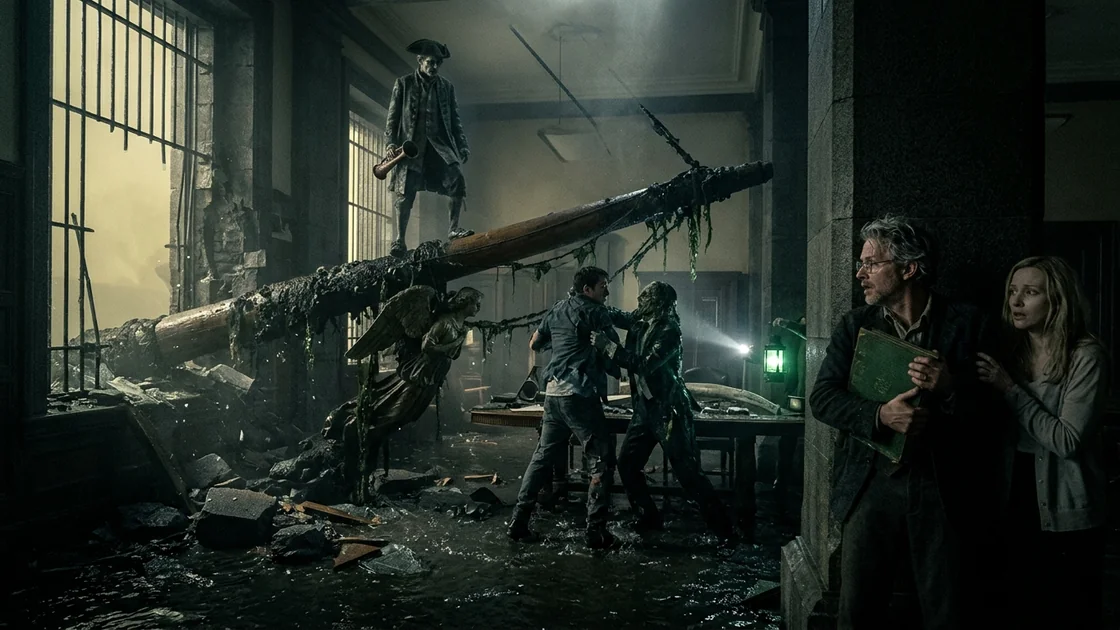
The tall, barred window at the north end of the boardroom exploded inward as a massive wooden spar—the sixty-foot bowsprit and jib-boom of an eighteenth-century brig—punched straight through the granite wall of the Custom House like a battering ram.
Rotted hemp rigging, thick with black sea-mud and pulsing jellyfish, cascaded onto the whalebone table.
"They didn't just murder the slaves," Eleanor cried over the roar of wind and water pouring through the breached wall. "They murdered their own captain and crew with a wreckers' light so there wouldn't be any witnesses to the insurance fraud!"
"Subrogation!" Julian screamed, his mind finally snapping under the weight of the revelation. He grabbed the sharkskin logbook out of Arthur’s hands and ran toward the splintered hole in the wall, where the enormous, barnacle-encrusted figurehead of the Sovereign Grace—a wooden angel whose face had been eaten away by shipworms into a screaming skull—loomed just outside in the fog.
"Look at the logbook!" Julian shrieked at the towering hull rising out of the flooded street below. "My ancestor broke the contract! Fraud invalidates the policy! The underwriting is void ab initio! You hear me, Vane?! The policy is void! You have no legal claim on us!"
Out on the bowsprit, crawling along the slick, rotting wood like a giant spider, came a figure that did not wear 1920s clothing.
He wore a frock coat of stiff, salt-hardened blue broadcloth with tarnished brass buttons, knee-breeches through which white shinbones gleamed, and a three-cornered hat pinned to his skull by an iron nail. Around his neck hung a rusted speaking-trumpet.
Captain Josiah Vane looked down at Julian from the bowsprit. His face was a mask of gray leather and scuttling crabs.
"The money was paid, Master Vance," Captain Vane’s voice boomed through the rusted speaking-trumpet, vibrating with the force of a hurricane. "Twenty-four thousand pounds in gold guineas, weighed and counted in London town. You spent the gold. Now you sail the ship."
From the rigging above the bowsprit, two drowned men from the 1924 watch—Charles Vance and Richard Holt—dropped down onto the whalebone table inside the boardroom.
Julian tried to scramble backward, throwing the sharkskin logbook at them, but his ancestor Charles Vance caught him by the throat with one bloated hand and by the belt of his trousers with the other. With effortless, mechanical brutality, the corpse lifted Julian off his feet, carried him to the jagged hole in the granite wall, and hurled him down onto the main deck of the ship waiting in the fog below.
They heard the sickening crack of Julian’s knees shattering against oak planking twenty feet down, followed by his high, ragged wailing as iron shackles were hammered shut around his ankles.
VII. The New Watch
Only Arthur and Eleanor remained in the ruined boardroom.
The floor beneath their feet was tilting now, listing five degrees toward the street as the foundations of the Custom House gave way to the impossible depth of ocean water swirling outside. Through the torn wall, Arthur could see the full scale of the Sovereign Grace.
She was a nightmare of rotting carpentry. Her hull was black and swollen, bearded with ten-foot fronds of kelp and encrusted with millions of razor-sharp oysters and barnacles. Great gaps showed between her timber strakes where the ribs of the vessel were visible like the ribcage of a beached whale, glowing with a faint, sickly bioluminescence from deep-sea bacteria. Her sails were tattered shrouds of gray canvas that hung stiffly despite the absence of wind, and from her scuppers poured a continuous, steaming waterfall of dark bilge water that smelled of three hundred years of misery.
On the main deck below, five figures—Harrison, Evelyn, Clara, Marcus, and Julian—were already chained to the massive wooden brakes of the main bilge pumps and the heavy ash sweeps protruding through the gunwales.
And standing along the bulwarks were the seven ghosts of 1924.
As Arthur and Eleanor watched, a strange transformation began to overtake the 1924 crew. One by one, as the five modern heirs were shackled into their places at the pumps and oars, five of the 1920s corpses stepped back from their stations.
The woman in the beaded flapper dress dropped her boat-hook onto the deck. She looked up at the gray sky, let out a long, whistling sigh of pure, indescribable relief, and simply dissolved—her bloated flesh and sodden silk collapsing into a pile of white sea-foam and dry shells that washed away through the scuppers. Four others followed her, their century of torment completed, sinking back into the true, dreamless sleep of the ocean floor.
Only two of the 1924 crew remained standing on the deck, waiting for their replacements: Beatrice Ward and Thomas Pendelton.
"Arthur," Eleanor said softly.
He turned to look at her. She was standing by the broken display case at the back of the room, where the cracked brass bell of the Sovereign Grace lay among the shards of glass. She wasn't crying anymore. The terror had burned itself out, leaving behind a bleak, quiet dignity.
"There is nowhere to go, is there?" she asked.
Arthur looked at the locked door, then at the towering masts filling the sky outside. "No. Even if we made it fifty miles inland, the fog would follow us. It's in the ledger."
Eleanor looked down at her hands—the hands of an art curator who had spent her life handling eighteenth-century silver teapots and sugar tongs, never once allowing herself to picture the fingers that had mined the silver or harvested the cane.
"A hundred years," she whispered. "And then it ends?"
"In 2124," Arthur said, his voice breaking. "Wait—none of us had children, Eleanor. Except Harrison and Evelyn. What happens in 2124 when there aren't seven direct lines left?"
From the bowsprit protruding into the room, Captain Josiah Vane lowered his rusted speaking-trumpet.
"The Charter provides for collateral heirs, Master Pendelton," the dead captain rasped, his milky eyes fixed on them. "Second cousins. Nephews. Those who buy the assets of the Trust at bankruptcy. So long as one penny of the principal turns a profit upon the earth, the Sovereign Grace shall never want for hands."
Beatrice Ward climbed slowly up the wooden gangway that had been lowered from the ship's quarterdeck straight onto the windowsill of the Custom House. She held out a rusted iron scraper and a bucket of freezing vinegar water toward Eleanor.
Eleanor looked at Arthur one last time. "Don't let them make you forget your name, Arthur."
"I won't," he promised.
Instead of waiting to be dragged, Eleanor walked forward with her head held high, took the iron scraper from her ancestor’s bloated hand, and stepped across the threshold onto the wet, pitching planks of the quarterdeck. Immediately, the corpse of Beatrice Ward sighed, collapsed into white foam, and washed into the sea.
Arthur stood alone in the boardroom with his great-grand-uncle, Thomas Pendelton, waiting at the gangway, and the First Book of Assurances lying open on the whalebone table.
Suddenly, a desperate, reckless thought seized Arthur.
The ship was bound to the ledger. Captain Vane had said it himself: So long as one penny of the principal turns a profit upon the earth. The 2024 renewal parchment had vanished with Mr. Gable, signed by all seven of them, ensuring the Trust would continue to pay out to Harrison’s and Evelyn’s children, and eventually to distant cousins, keeping the machinery of the curse alive for another century.
Where was the parchment?
Arthur looked down at the First Book of Assurances. Placed neatly between the pages of 1724, right where Gable had stood earlier, was the rolled sheepskin charter of 2024, bearing their seven fresh signatures. Gable hadn't taken it with him; the charter had to remain with the ship's purser during the hundred-year voyage so it could be brought back to shore in 2124.
And the Pendeltons had always been the clerks and archivists of the Syndicate.
"Thomas Pendelton was the ship's clerk," Arthur realized aloud, looking at the ink-stained fingers of his great-grand-uncle's corpse waiting at the window. "That's my station. The purser’s cabin."
Arthur grabbed the sheepskin scroll of 2024. Near the hearth, a few dull red embers still glowed beneath the wet ashes of the birch logs.
Before the corpse of Thomas Pendelton could lunge across the room, Arthur dove toward the fireplace, shoving the sheepskin scroll with their seven signatures directly into the bed of glowing coals, and piled the dry, splintered wood of a broken chair leg on top of it.
A roar of fury echoed from the ship outside—not from the crew, but from the very timbers of the Sovereign Grace itself. The hull groaned like a wounded beast as the dry sheepskin caught fire, curling black at the edges as the flames licked toward the 2024 signatures.
Thomas Pendelton crashed across the room, grabbing Arthur by the hair and hauling him backward away from the hearth. With his other hand, the corpse reached into the fire to pull the burning charter out.
Arthur fought like a cornered animal, wrapping both legs around his ancestor's rotting waist and dragging him down onto the pine floor, pinning the corpse's arms with all his weight while keeping his eyes fixed on the fireplace.
Burn, Arthur prayed as the freezing slime from the corpse's jacket soaked through his shirt, numbing his chest to the bone. Burn the signatures. Dissolve the Trust. Give the money back to the world so no one else ever has to board this ship again.
In the hearth, the fire flared bright orange. The signatures of Evelyn Frost, Harrison Holt, Eleanor Ward, Marcus Thorne, Clara Sterling, and Julian Vance blackened, shriveled into gray ash, and crumbled.
Just as the flame reached the final signature at the bottom—Arthur Ezekiel Pendelton—a massive wave of black bilge water erupted down the chimney, dousing the hearth in an instant.
Captain Vane stood over the fireplace, having swung himself in from the bowsprit. He reached into the wet ashes and lifted the last surviving scrap of sheepskin—a charred strip three inches wide containing only Arthur’s signature.
"Six lines extinguished," Captain Vane rumbled, holding the wet scrap of parchment up in the gloom. "Six estates forfeit to the Commonwealth at dawn. Their children are free of the rope."
The dead captain turned his hollow, crab-infested gaze down upon Arthur, who lay pinned beneath the crushing weight of Thomas Pendelton.
"Brave clerk," Vane rasped, a horrific approximation of a smile stretching his leather lips. "You have bought their bloodlines out of the syndicate for the next turn of the glass. Which leaves the entirety of the subrogated liability upon the surviving subscriber."
Thomas Pendelton stood up, hauling Arthur to his feet, and dragged him through the shattered wall onto the quarterdeck of the Sovereign Grace. On the moment Arthur’s shoes touched the wet oak planks of the ship, his great-grand-uncle dissolved into a puddle of salt foam and vanished.
VIII. The Three-Hundred-Fathom Watch
They did not chain Arthur to the bilge pumps or the oars.
Instead, two phantom sailors—the only original crewmen of Vane’s who remained bound as boatswain's mates—dragged Arthur across the pitching quarterdeck to a high wooden standing-desk bolted directly to the mainmast behind the ship’s wheel.
On the slanted surface of the desk lay the waterlogged First Book of Assurances, open to a blank page.
Captain Vane stepped behind Arthur, holding two six-inch spikes of square wrought iron and a heavy wooden carpenter's mallet.
"Hold out your skirts, Clerk," Vane commanded.
Before Arthur could flinch, the boatswain's mates stretched the heavy wool tails of Arthur’s tweed coat out across the oak sides of the standing-desk. With four deafening blows of the mallet, Vane drove the iron spikes through the fabric of Arthur’s coat and deep into the timber of the desk, pinning him upright in place, while an iron bilge-shackle was locked around his left ankle and bolted to the deck planks.
Into Arthur’s trembling right hand, Vane forced a heavy goose-quill pen with a nib cut from sharp brass. There was no inkwell on the desk. Instead, the brass nib was wired to a thin copper tube that ran straight into the back of Arthur’s own left forearm, drawing a slow, steady bead of dark red blood down into the channel of the pen.
"The manifest is incomplete, Master Pendelton," Captain Vane said, stepping back to take his place beside the helm. "Two hundred and eighty-four souls jettisoned without names. You are an historian. You like the truth. You shall write their true accounting—every ounce of flesh, every drop of water denied, every penny of interest compounded across three hundred years—until the ink runs clear."
Down in the waist of the ship, the whip cracked.
Harrison Holt and Julian Vance screamed as their blistered, bleeding hands were forced down onto the wooden brakes of the bilge pumps. Clank-hiss. Clank-hiss. Black, freezing water gushed from the pump spouts across the deck, washing over Clara Sterling and Eleanor Ward, who were already on their knees in the freezing slush, dragging fifty-pound sandstone holystones back and forth across the blood-stained oak planks until their fingernails tore loose. Below the main hatch grating, in the pitch dark of the lower sweeps, Marcus Thorne pulled on a twenty-foot ash oar alongside the shadows of the hull.
"Let go the spring-lines!" Captain Vane roared through his speaking-trumpet, his voice echoing off the silent, sleeping houses of Braddock’s Reach. "Brace the yards round! Sound the bell!"
At the belfry forward of the mainmast, the cracked brass bell of the Sovereign Grace—returned from the museum case to its iron bracket—struck eight bells. Midnight.
The ship began to move.
She did not sail out through the harbor mouth between the breakwaters. Instead, as she glided down the flooded canyon of Water Street and reached the end of the Long Wharf, her bow tilted downward at a forty-five-degree angle.
Arthur gripped the edges of the standing-desk, screaming as the freezing green wall of the Atlantic Ocean rose up over the bowsprit to swallow them whole.
The water closed over the quarterdeck with the weight of a collapsing mountain.
Arthur gasped, his lungs filling instantly with thirty-four-degree salt water. His chest burned with the white-hot agony of drowning; his vision blackened at the edges as his heart hammered against his ribs, trying to die.
And then, the horror of the Sovereign Grace revealed its true depth.
His heart did not stop.
The freezing water pumped in and out of his ruined lungs like bellows, carrying no air, only the bitter taste of iron and salt, yet his brain remained terrifyingly, sharply awake. The crushing pressure of the abyss squeezed his skull and joints until every nerve ending screamed in continuous, unrelenting agony, as the ship sank deeper and deeper into the pitch-black trench beyond the Devil’s Tooth reef.
Two hundred fathoms. Three hundred fathoms.
The ship leveled out just above the abyssal mud of the ocean floor, gliding forward through the eternal, freezing dark, lit only by the pale green glow of rotting wood and the horn-lantern swinging above Arthur’s desk.
Around him in the crushing black water, the rhythmic clank-hiss of the bilge pumps and the scrape-drag of the holystones continued without pause.
Arthur looked down at the glowing white page of the ledger beneath the water. His right hand, moved by a compulsion heavier than the ocean above him, lowered the brass nib to the parchment. In his own dark blood, which did not disperse in the seawater but clung to the rag paper like black tar, he wrote the first line of his hundred-year watch:
November 15, 2024. Touching the Adventures and Perils which we the Assurers are contented to bear...
IX. The Morning Tide
When the sun rose over Braddock’s Reach at six-forty-two the next morning, the sky was a crisp, cloudless November blue. A brisk northwest wind had blown the coastal fog thirty miles out to sea, leaving the white clapboard houses and brick chimneys of the old port sparkling with clean frost.
Down at the Old Custom House, Police Chief Robert Miller stood in the rear parking lot with his hands on his hips, staring at a black Cadillac Escalade and a rented Mercedes sedan.
Both vehicles were covered in a thick layer of dried white salt-crust, and tangles of dead brown kelp were wrapped around their axles. Inside the Escalade, the keys were still in the ignition, and a 9mm pistol lay on the asphalt beside the open driver’s door, rusted into a solid block of orange iron as though it had been sitting on the bottom of the harbor since World War II.
"Chief!" a young patrol officer called out from the back fire exit of the Custom House. "You need to come look at the second floor!"
Miller walked up the granite stairs—which were damp and smelled faintly of dead low tide—and stepped into the second-floor boardroom.
The room was entirely intact. The tall windows were unbroken; the granite walls stood solid and dry. Only the glass display case at the back of the room was shattered, and the tarnished brass bell of the Sovereign Grace that had sat on the velvet cushion since 1923 was gone.
On the whalebone table in the center of the room lay seven gold fountain pens, arranged in a neat circle around a pile of wet gray ash in the fireplace. There was no sign of the seven trust beneficiaries, nor of the ancient lawyer from Boston, whose firm, when contacted by telephone an hour later, informed the police that Mr. Thomas Gable had passed away in 1988 and that the Braddock Maritime Trust account was currently under review by the state attorney general for automatic dissolution due to a failure of renewal.
Only one object remained on the whalebone table: the hollow, slit-open leather binding of the 1724 First Book of Assurances, empty of its pages.
Chief Miller walked over to the window and looked out toward the Long Wharf, where the early morning lobster boats were chugging out past the breakwater into the bright Atlantic sun. He shook his head, pulling out his notepad to begin a missing persons report that he knew, deep in his New England bones, would sit in the same unsolved filing cabinet as the identical reports from 1924 and 1824.
Three leagues out to sea, directly above the jagged granite spires of the Devil’s Tooth reef, a single patch of greasy yellow-gray mist no wider than a ship's hull clung stubbornly to the surface of the waves, refusing to disperse in the morning wind, trailing slowly southward toward the horse latitudes against the current of the Gulf Stream.