The Unbent Spine of Silas Vance
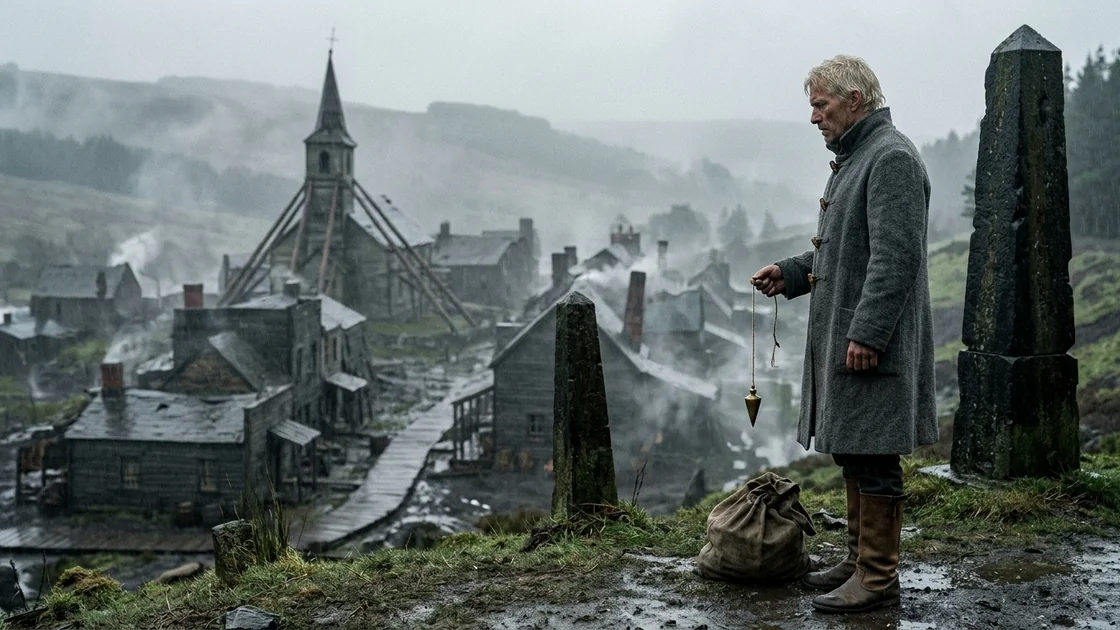
In the sunken valley town of Cairnbarrow, every spoken falsehood manifests as an invisible, compounding physical weight upon the liar's back, forcing the deceitful to walk in iron braces until their own dishonesty drives them into the soft, merciless mud of the earth. After serving fifteen brutal years in the distant sulphur mines for a murder and arson he did not commit, master mason Silas Vance returns home as a rare anomaly, a man whose spine is entirely unbent because he has never uttered a single lie. He walks back into the crumbling, low-slung settlement not to seek vengeance with blade or fire, but simply to stand beside the four conspirators who framed him, knowing that the compounding gravity of their fifteen-year betrayal has already broken their bodies and that his mere presence will finish driving them down into the dark soil forever.
The road into Cairnbarrow did not descend by switches or gentle grades; it dropped like a bucket down a well. Those who had built the highway three hundred years ago had cut it straight into the weeping shale of the mountain's southern face, scoring the stone with deep horizontal ruts so that the iron-shod heels of the townsfolk could catch and hold against the pitch. An outsider walking down that grade would have felt the strange, syrupy thickening of the air at the boundary markers—two obelisks of unmortared black basalt that stood where the pine line ended and the peat bogs began. Between those stones, the atmosphere of the valley possessed a peculiar density, as though the sky above Cairnbarrow were not made of cloud and vapor, but of tallow and wet wool.
Silas Vance stopped between the obelisks and set down his canvas sack.
He was forty-two years old, though the sulphur trenches of the northern reaches had bleached his hair the color of sheep’s bone and scored the corners of his eyes with gullies of permanent yellow dust. He wore a coat of coarse gray frieze that hung loosely from his shoulders, buttoned to the throat with horn toggles, and boots of untanned mule hide Whose soles were worn nearly through to the welt. Yet as he stood in the gray drizzle of an October afternoon, looking down into the smoking chimneys of his birthplace, there was something almost obscene about his posture.
He stood entirely straight.
His head did not jut forward like a snapping turtle’s; his clavicles did not curve inward toward his breastbone; his knees were not locked in that wide, trembling splay that characterized every man, woman, and child born within the parish of the sink. A plumb-line dropped from the lobe of Silas Vance’s left ear would have kissed the point of his shoulder, grazed the outer seam of his hip, and struck the heel of his boot without a hair’s breadth of deviation. In Cairnbarrow, such verticality was only ever seen in children under the age of four, before they learned to say they had not touched the honey-crock, or in the corpses of the shriven dead after the cemetery diggers had pried the stones from their ribs.
Silas reached into his coat pocket and drew out a small brass plumb-bob suspended from six feet of braided hemp cord. The brass was tarnished to the dark brown of an old penny, its conical point blunted by a thousand mornings of testing the true of cornerstones and chimney breasts. He pinched the knot of the cord between his thumb and forefinger and let the weight drop.
It spun three times in the wet wind, slowed, and hung dead still.
"True," Silas whispered. His voice was like two bricks being rubbed together to clear the mortar. He had not used it much since the gates of the penal colony at High Scar had swung open twelve days ago. Even when he spoke that single word, he felt the ancient, watchful reflex of his native valley—a brief, prickling chill across his trapezius muscles, as though an unseen bailiff had laid a cold palm across the nape of his neck to measure the honesty of the syllable.
Because the word was true, the palm lifted. Nothing settled. His shoulders remained light as dry elder-pith.
He coiled the cord around the brass cone, tucked it back against his ribs, and stepped over the threshold of the parish.
Below him, Cairnbarrow huddled in the bowl of the hills like a collection of wet gray toadstools. To an eye trained in masonry, the town was a nightmare of subsidence. During the fifteen years of Silas’s absence, the whole settlement seemed to have settled another four feet into the waterlogged marl of the valley floor. The steeple of Saint Jude-in-the-Mire leaned seven degrees to the west, shored up by massive flying buttresses of raw pine logs that looked like the legs of a dying spider. The roofs of the houses along Tallow Street were no longer peaked; they had been rebuilt flat and low, because high rafters meant high stairs, and few citizens past their thirtieth year could lift a knee high enough to clear a standard seven-inch riser.
The very streets had been altered. When Silas was a young journeyman laying the kerb-stones for the Corn Exchange, the roads had been paved with river cobbles. Now, the cobbles were gone, pried up and replaced with broad, flat tracks of three-inch oak planking laid directly over the mud, like the corduroy roads loggers used to haul timber across quagmires. Without the planks, a man carrying the ordinary, accumulated falsehoods of middle age—the polite flatteries to a rich uncle, the understated weights at the butcher’s scale, the whispered assurances to a wife that the tavern had kept him late on business—would sink to his ankles at every intersection whenever the autumn rains turned the valley’s silt into porridge.
Silas walked down the shale grade with a long, swinging stride that ate up the furlongs. He had no staff. He wore no leather corset laced with whalebone or flat bar-iron under his shirt. As he reached the level of the valley floor and his mule-hide boots struck the first of the oak boardwalks at the West Toll, the sound of his footsteps was ridiculously faint—a mere tap-tap-tap of leather on wet wood, lacking the heavy, grinding crunch of iron-plated heels that formed the constant acoustic bass-note of the town.
The toll-hut was a squat box of fieldstone that had sunk until its eaves were nearly level with the boardwalk. To look out the window, the toll-keeper had to peer upward through a grate level with a tall man’s shins.
As Silas approached, the grate rattled. A pair of rheumy eyes, set in a face as broad and creased as an old blacksmith’s apron, peered out from the gloom of the sunken hut. It was Barnaby Crump. Fifteen years ago, Barnaby had been a tall, spindly youth who collected market dues with a swagger and a brass badge on his lapel. Now, from what Silas could see through the iron bars, Barnaby’s chin rested permanently upon his sternum. A yoke of riveted boiler-plate curved over his shoulders, bolted directly into two oak stanchions that flanked his stool, taking the strain off his collarbones so his lungs had room to draw air.
"Halt at the chain," Barnaby wheezed. Every breath sounded as if it were being pumped through a bellows with a split leather valve. "State your parish, your trade, and the tally of your goods. And speak clean, stranger, for I’ve no stomach to watch a peddler drop to his knees in my doorway when his tongue slips."
Silas stopped three paces from the rusted iron chain that sagged across the boardwalk. He looked down at the grate.
"I have no goods, Barnaby," Silas said. "My parish is this one. My trade was stone, before they gave me a pickaxe at High Scar."
Silence fell inside the stone box. The only sound was the drip of rainwater from the tarred roof onto the oak planks and the distant, rhythmic thud-thud-thud of a pile-driver working somewhere near the center of town, driving fresh timber into the mud to keep some wealthy liar’s parlor from vanishing into the bog.
Inside the hut, iron scraped against stone as Barnaby shifted his bulk within his supporting cradle. His eyes widened until the yellowed whites showed all around the irises. They traveled up from Silas’s worn boots, past his straight knees, up the long, vertical line of his frieze coat, to the level, unstrained set of his chin.
"Silas?" the toll-keeper whispered. "Silas Vance?"
"The same."
"They said you died in the third year," Barnaby breathed, his fingers gripping the iron bars of his window grate. "Alderman Thorne read the notice from the Warden’s clerk at the Michaelmas vestry. Said the yellow damp took your lungs in the deep drift."
Silas looked toward the center of the town, where the chimneys of the great houses rose above the mist. "Did the Alderman lean a little harder on his stick the morning he read that notice, Barnaby?"
Barnaby’s mouth worked soundlessly for a moment. Then he let out a wet, rattling bark that might have been a laugh. "He had the smith add another quarter-inch of wrought leaf to his hip-springs that very week. Told the vestry it was the sciatica come early with the frost." Barnaby’s eyes dropped back to Silas’s boots. "God in the cellar, Silas. Look at the plank under your feet. It doesn't even bow. Not a drop of water squeezed out from the joint. How? Fifteen years among cutthroats and turnkeys, and you didn't tell a single crooked thing? Not even to get an extra crust of bread? Not even to keep the lash off your shirt?"
"A man who is there because of a lie," Silas said quietly, "loses his taste for the sound of them. Drop the chain, Barnaby. My sentence is served. I have the Warden’s parchment in my coat, stamped in red wax, though I think you need no parchment to see I am telling you the truth."
"No," Barnaby muttered, reaching for a rusted winch beside his knee. "No, a blind man could weigh your words by the way your coat hangs." He cranked the handle three turns. The chain clanked down into the black mud beneath the planks. "Where are you bound, Master Vance? Your cottage by the quarry fell in six winters back. Nobody’s lived there since."
"The cottage had a good foundation," Silas said, stepping over the chain. "I laid it myself on the blue bedrock."
"Aye, the foundation’s still there, clean and dry as a bone," Barnaby called after him, twisting his neck Painfully in its iron collar to watch the mason pass. "It’s the rest of the street that sank around it! Your doorstep is twelve feet up in the air now, Silas! You’ll need a ladder to get in your own front door!"
Silas did not look back. "I am used to climbing, Barnaby. And I have four calls to make before I look for a bed."
To understand Cairnbarrow, one had to understand the Law of the Loam, though no scholar from the capital had ever succeeded in mapping its borders or distilling its principle into an alembic. Three centuries earlier, when the first settlers—a sect of strict covenanting miners fleeing the religious wars of the lowlands—had driven their wagons into the valley, they had prayed to the Almighty that their new home might be a place where hypocrisy could find no purchase. Whether it was God who answered them, or something older that slept beneath the deep limestone aquifers and the bottomless beds of blue clay, the prayer was granted with a literalism that broke the grandchildren of those who had prayed it.
In Cairnbarrow, the air listened.
A word was not merely a puff of breath shaped by the teeth and tongue; it was a contract signed with the gravity of the earth. When a child looked his mother in the eye and said, I did not break the pitcher, the air two inches above the child’s seventh cervical vertebra grew cold and dense. Nothing could be seen by the naked eye, save perhaps a faint distortion of the light, like the shimmer above a hot stove lid on a winter afternoon. Yet the child’s shoulders would drop half an inch. An invisible stone, roughly the weight of a brook trout, would settle into the hollow between his shoulder blades, bound to his flesh by straps that no knife could sever.
If the child wept within the hour and confessed, the trout-weight melted away like hoarfrost in the sun, leaving only a dull ache that vanished by morning.
That was the mercy of the valley, and also its trap. Because small lies could be shed so easily when they were fresh, the townsfolk grew careless. A merchant would shave an ounce off a tub of butter and swear it was full weight, intending to make it right on the next reckoning. A girl would tell a suitor she loved him best of all when her heart was elsewhere, thinking the two-pound burden across her collarbones was a small price to pay for a silver ribbon or a quiet evening.
What they forgot—what every generation in Cairnbarrow had to learn anew through the cracking of its own cartilage—was the Law of Compound Interest.
A lie that was not confessed before the sun went down began to put down roots into the teller’s marrow. Worse, if the lie caused harm to another living soul, the weight of the falsehood did not remain static. It grew in direct proportion to the suffering it caused. Every tear shed by the swindled widow, every cold night endured by the cheated laborer, every drop of sweat wrung from the brow of a man falsely condemned added its exact, scrupulous equivalence in leaden gravity to the back of the liar. And once a lie had compounded for a year and a day, simple confession could no longer dissolve it. If a man confessed a great, festering lie without first obtaining the free, uncoerced forgiveness of the person he had wronged, the invisible tether holding the weight nicely balanced upon his shoulders would snap—dropping the entire accumulated tonnage onto his spine in a single, bone-pulverizing instant.
And so, in Cairnbarrow, those who told great lies never confessed. Instead, they hired blacksmiths.
As Silas walked down Tallow Street toward the center of the town, he passed the smithies. Fifteen years ago, there had been two blacksmiths in the parish, mostly occupied with shoeing dray horses, mending wagon tires, and forging quarry-wedges. Now there were nine. Their forges blazed with a frantic, smoky industry that filled the narrow lane with the stink of coal-slag and scorched leather.
Outside the open double doors of Jabez Coyle’s shop, three customers waited on a low stone bench reinforced with iron pilings. They were respectable tradesmen—a chandler, a tanner, and a vestry clerk—and every one of them was bent at a forty-five-degree angle, their noses pointing at the oak planks between their feet, their hands resting on short, dual-handled iron crutches shaped like cobblers' lasts. Inside the shop, Jabez was fitting a middle-aged woman with a "Cairnbarrow Corset"—a cage of tempered spring-steel strips that ran from a heavy iron hip-girdle up the spine, curving over the crown of the head like a hangman’s gibbet to take the downward thrust of an unseen boulder that sat squarely upon the back of her neck.
As Silas passed the doorway, the rhythmic clang-clang of Jabez’s hammer faltered.
The chandler on the bench, whose neck was so bowed he could only see the world from the knees down unless he rolled onto his back, stared at Silas’s boots as they went by.
"Look at the leather," the chandler whispered hoarsely to the tanner beside him. "No iron plates on the heels. No flange to spread the load. Who walks on bare hide in this parish?"
Jabez the smith stepped to the threshold of his shop, wiping his soot-blackened forehead with a forearm as thick as a ham. The smith himself was relatively upright—a man only leaned perhaps ten degrees forward, carrying the modest twenty or thirty pounds of a craftsman who occasionally called cast-iron wrought—and so he was able to look Silas directly in the face.
The tongs fell from Jabez’s hand and clattered onto the hearthstones.
"Master Vance," the smith breathed.
Silas stopped and inclined his head. Even the bow of his neck was effortless, fluid as a willow wand, returning immediately to the perpendicular. "Good morrow, Jabez. Your trade has prospered."
"Men have grown heavier since they sent you over the mountain, Silas," Jabez said, his voice dropping low so the three bent figures on the bench could not hear him over the roar of the bellows. "A great deal heavier. Some more than others."
"So Barnaby told me at the gate," Silas said. He looked past the smith into the glowing interior of the shop, where a massive contraption of two-inch wrought iron bars, brass turnbuckles, and thick oak rollers lay half-finished across two anvils. It looked less like a brace for a human body and more like the cradle used to haul fifty-ton blocks of granite out of the bottom of a pit. "Who is that for, Jabez?"
The smith glanced nervously toward the high end of the town, where the old Manor house sat upon what used to be Alderman’s Hill. "I’m sworn not to name my patrons, Silas. You know the guild rule."
"I do," Silas said mildly. "And I would not ask you to tell me a lie about it. Your back looks light enough for a man of fifty. Keep it so."
Silas turned to continue up the street, then paused. "My old shop in Quarry Lane. Barnaby says the street sank away from the bedrock, but the walls stand. Did anyone take my tools?"
Jabez shook his head quickly. "Nobody dared touch them, Silas. Alderman Thorne put them up for auction the week after the assizes, to pay the costs of the fire at the Assay House. Garrow the Bailiff cried the lot three times in the square—your chisels, your mallets, your levels, and your great iron square. Not a mason in the valley made a bid."
"Why not?" Silas asked. "They were good Sheffield steel."
"Because," Jabez said, spitting into the coal dust at his feet, "when Garrow held up your mason’s square and swore before the parish that it had belonged to a thief and a murderer, the bailiff’s knees buckled so hard under him that he split the wood of the auction block with his shins. We have eyes, Silas. We might be cowards who kept our mouths shut while four men swore your life away, and every grown soul in this town carries a five-pound pebble on his neck for that silence alone—I feel mine right here under my collar every time I lift a hammer—but we aren't blind. Nobody wanted to buy a dead man’s tools when the auctioneer couldn't stand up straight while selling them."
"I am glad of it," Silas said. "A man likes to use his own steel."
Quarry Lane was on the eastern rim of the town, where the blue granite of the mountain’s root poked through the overlying blanket of peat and marl like the knuckles of a buried giant. When Silas had built his house there at the age of twenty-four—the year he was made Master of the Masons’ Guild, the year he bought the silver betrothal ring for Hester Vane—he had cleared away six feet of muck to anchor his foundation walls directly into the living rock.
Now, as he turned the corner from Weavers’ Row, he saw what Barnaby had meant.
The lane itself had subsided twelve feet as the overloaded houses of the weavers and dyers dragged the soft earth down into the subterranean caverns. The road was a narrow canyon of oozing gray clay shored up with rotting ship-timbers. High above the muck, perched upon a sheer pinnacle of exposed blue granite like a sea-bird’s nest on a crag, sat Silas’s stone cottage. Its slate roof was intact; its chimney was still true to the sky; its heavy oak door stood twelve feet above the level of the street, completely inaccessible without a crane or a builder’s ladder.
Around the base of the granite pinnacle, the houses of his former neighbors had sunk until their upper-story windows were level with the mud. The house directly opposite—which had belonged to old Widow Crewe—was nothing more than a mossy roof sticking out of a pool of black bog-water, with a wooden stovepipe extended ten feet into the air so the widow’s daughter, living down in the buried attic like a badger in a set, could still draw a draft for her peat fire.
Silas did not need a ladder. He had spent fifteen years climbing the sheer sulfur-faces of High Scar with forty pounds of ore in a basket on his head.
He slung his canvas sack across his chest, walked to the base of the wet granite outcrop, and found the chisel-marks he had cut into the stone twenty years ago. His fingers, calloused until they were as hard and insensitive as horn, hooked into a quarter-inch seam in the rock. With the quiet, terrible economy of a man who had no extra weight pulling him toward the center of the earth, he drew himself up.
Toe in a cleft, hand on the lintel-stone, knee onto the sill. Within thirty seconds he stood upon his own porch.
The iron latch was rusted fast, fused by fifteen winters of valley mist, but Silas knew where the mortar was thin beside the jamb. He reached under the eaves, pulled out the spare iron cold-chisel he had hidden there the night before the Watch came for him, and drove it between the bolt and the strike-plate with the heel of his palm. A sharp crack echoed down the sunken lane, and the door swung inward on groaning hinges.
Inside, the air smelled of dry dust, dead spiders, and old lime.
Silas stepped into the single ground-floor room that had served as both his parlor and his drafting chamber. Because the cottage rested on the immovable spine of the mountain, nothing here had tilted. On the long pine table under the north window, a sheet of vellum was still pinned to a drawing board with four brass tacks. Upon it, drawn in faded walnut ink, was the elevation for the new bell-tower of the Assay Office—the very building he had been accused of burning to the ground on the night of the autumn equinox fifteen years ago.
Beside the drawing board lay a small wooden box lined with green baize. Silas walked over and lifted the lid.
Inside lay a little circle of twisted silver wire, set with a chip of pale river-garnet no bigger than a lentil. Hester had thrown it onto the floorboards of the Guildhall on the third day of his trial, right after she kissed the iron-bound Bible and swore before the King’s Circuit Judge that Silas had come to her father’s garden at midnight with his hands black with lamp-soot and a bag of stolen Assay silver under his coat.
Silas remembered the sound the ring had made when it hit the oak dais—a tiny, bright tink. And he remembered the sound that had followed it three seconds later: the dry, sickening pop of Hester Vane’s left collarbone cracking like a dry hemlock twig under her lace fichu as the air above the witness box turned the color of bruised plum and dropped fifty pounds of raw, invisible falsehood onto her twenty-year-old shoulders.
She had screamed then, clutching her shoulder, and Alderman Thorne had risen swiftly from the magistrates' bench to catch her, announcing to the visiting Judge—an outsider from the lowlands who knew nothing of the valley’s deeper nature and thought the folk of Cairnbarrow were simply deformed by goiter and bad water—that the poor maiden had been overcome by the vapors of grief.
Silas closed the lid of the baize box. He did not put the ring in his pocket.
Instead, he went to the hearth, knelt by the ash-pit, and lifted the false flagstone at the back. From the dry hollow beneath, he lifted a leather tool-roll wrapped in oiled sheepskin. He unrolled it on the table. There was his three-pound bush hammer, its sixteen pyramidal teeth still sharp; his spirit-level of seasoned boxwood with its vial of yellow spirit unbroken; his steel calipers; and a six-foot folding rule of riveted brass.
He slid the bush hammer into the loop of his belt, not as a weapon, for he had no intention of striking any man, but because a mason did not walk through a collapsing town without his kit. He took the folding rule in his left hand like a walking stick, stepped out onto the high porch, and dropped twelve feet into the gray mud of Quarry Lane.
He landed lightly on the balls of his feet, his heels sinking less than a quarter of an inch into the mire.
Then he turned toward the Watchhouse to pay his first call upon Captain Garrow.
The Watchhouse stood at the bottom of Market Dip, which had always been the lowest point in the parish, collecting the runoff from the slaughterhouses and the tanneries. In Silas’s youth, the building had been a grim, square fortress of red brick, three stories high, topped with a leaded cupola where the watchman’s bell hung to warn of floods or bog-slides.
When Silas came around the corner of the Corn Exchange, he stopped dead on the boardwalk.
The red brick fortress was gone. In its place was a crater in the mud, forty feet across, surrounded by a high cofferdam of interlocking timber piles driven deep into the silt to hold back the surrounding street. Down inside the crater, protruding from the gray ooze like the rotten stump of a molar, was the leaded cupola and the top three feet of the third-story parapet. The rest of the Watchhouse—the first floor, the second floor, the cells, the guardroom, and the foundation—had been pushed thirty feet down into the liquefied clay beneath the town.
A wooden gangplank sloped steeply down from the street level into a hole smashed through the third-story roof. Beside the top of the gangplank, a small boy in a ragged oilskin coat sat on an upturned bucket, turning the crank of a leather-valved bilge pump that sucked yellow water out of the sunken roof-hole and spat it into the street gutter through a canvas hose.
Silas walked to the edge of the cofferdam and looked down.
"Is the Captain at home, lad?" Silas asked.
The boy stopped cranking, wiped his nose on his sleeve, and squinted up at the tall figure against the gray sky. Like everyone else in town, his eyes went instantly to Silas’s straight back, then widened in superstitious dread. People who stood straight in Cairnbarrow were either angels, madmen, or ghosts come back from the lime-pits.
"He’s down in the attic, mister," the boy piped, his voice trembling. "He can’t come up no more. Last time they tried to haul him up with the block-and-tackle for the vestry meeting, the main beam of the hoist split in two. You got business with him? You got to pay a penny toward the pumping if you go down. If I stop cranking for twenty minutes, the water gets above his chin."
Silas reached into his pocket, found one of the three copper pennies the prison gatekeeper had given him as journey-money, and dropped it into the boy’s greasy cap.
"Keep pumping, then," Silas said. "I would not want him to drown before we have finished talking."
Silas stepped onto the cleated gangplank and walked down into the broken roof of the Watchhouse.
The smell hit him first—a stifling stench of wet cellar-rot, old urine, liniment, and the sour, metallic odor of iron rusting in damp air. Light came only from a pair of tallow dips stuck in iron sconces driven into the rafters of what had once been the building’s garret. The floorboards of the attic were gone, long since shattered and punched downward into the flooded second story below. Instead, whoever was tending to Captain Garrow had laid a grid of twelve-by-twelve oak baulks—the kind of massive timbers used for mine-shaft shoring—directly across the submerged brick load-bearing walls of the house beneath.
Even those twelve-inch oak beams were bowed downward in the center like drawn longbows, groaning continuously with a low, rhythmic creak-tick, creak-tick as the wet brick walls underneath them slowly surrendered another millimeter to the subterranean mire each hour.
In the middle of that sagging timber grid sat what remained of Giles Garrow.
Fifteen years ago, Garrow had been a bull of a man, six feet two inches in his stockings, with a black beard trimmed square like an Assyrian king’s and calves that filled out his riding boots until the leather shone. It was Garrow who had kicked in the door of Silas’s cottage that October night; Garrow who had pulled a smoke-blackened crowbar from beneath his own boat-cloak and dropped it on Silas’s hearth; Garrow who had laid his right hand upon the iron-bound Evangelists in the circuit court and said, I took this man running from the postern gate of the Assay House with the fire at his back and the blood of old Master Hallet wet upon his sleeves.
Now, Giles Garrow was no taller than a squatting toad, though he was not squatting.
He was encased from the armpits to the hips in a cylindrical drum of quarter-inch boiler plate riveted together around his torso like a barrel around a hogshead of salt pork. The iron drum prevented his ribs from collapsing outward as his spine telescoped in upon itself. His legs were stretched out straight before him across the oak baulks, useless and white as lard-bladders, both femurs having snapped lengthwise four years ago when the tenth anniversary of Silas’s imprisonment had added another hundredweight of accumulated misery to the bailiff’s neck.
Above him, an A-frame of heavy ironwood timbers straddled his body. A thick iron chain ran from a leather padded horse-collar beneath his jaw up to a massive iron pulley at the apex of the frame, counterweighted by four hundred-pound pigs of lead hanging down into the flooded stairwell behind him, simply to keep the man’s head from being driven down through his own collarbones into his chest cavity.
Every time Garrow drew a breath, the lead pigs clinked against the submerged brickwork below.
"Boy?" a voice croaked from the iron barrel. It was a flat, wet sound, the voice of a man speaking with three hundred pounds of invisible granite sitting on his lungs. "Boy, is that the soup? Tell that bitch of a cook if the broth is cold again, I’ll... I’ll have the constables..."
The threat died away into a wheezing cough. Garrow knew there were no constables left who took his orders. He was kept alive in this hole by a monthly stipend from Alderman Thorne, because if Garrow died with the lie unconfessed on his tongue, there was an old belief in the valley that a dead co-conspirator’s share of a shared falsehood didn't vanish—it divided itself equally among the surviving partners.
Silas walked out onto the groaning oak baulks and stopped four feet from the iron A-frame.
Garrow’s eyes, sunk deep in sockets of purple, bruised-looking flesh, rolled upward as far as the leather neck-collar would allow. Because his head was fixed staring at his own lap, he could only see Silas from the waist down unless he strained against the four-hundred-pound counterweight.
He saw the mule-hide boots. He saw the brass-bound folding rule resting lightly on the oak beam—and he saw that the oak beam did not sink a fraction of an inch under the newcomer’s weight.
"Who’s there?" Garrow gasped, his fingers—swollen like grey sausages from poor circulation—clawing at the riveted rim of his iron corset. "Who walks like that? Nobody in Cairnbarrow walks on two legs without a staff! Lift the lantern, damn you!"
Silas reached up, plucked one of the tallow dips from the rafter sconce, and knelt on one knee so that his face came level with the bailiff’s downward-staring eyes.
He held the candle between them. The yellow flame burned straight up, reflected in the brass plumb-bob that Silas drew from his pocket with his free hand.
Garrow stared at the lean, weather-scored face, the bone-white hair, the calm, level gray eyes that held no madness, no rage, only the terrible, dispassionate focus of a master builder inspecting a wall that had failed its load test.
A sound came out of Garrow’s throat like a pig’s bladder being stepped on.
"No," the bailiff whispered. The lead counterweights in the stairwell suddenly banged violently against the bricks as Garrow’s whole body spasmed with terror. "No, you’re dead! Thorne had the letter! The Warden wrote that the sulfur ate your throat in the winter of the great snow!"
"The Warden of High Scar never wrote a letter in his life, Giles," Silas said softly. "He could neither read nor write. That was another small stone the Alderman added to his own pile to keep the parish quiet."
"Get back!" Garrow shrieked, though the shriek came out as a thin, whistling hiss through his compressed windpipe. "Get back from me! Don't stand so close!"
It was not merely guilt that made the bailiff scream; it was the secondary law of the valley’s gravity. A lie told against a man three hundred miles away was heavy enough, fed by the slow trickle of the victim's distant suffering. But when the victim stood within arm's reach—when the living, breathing truth of the wronged man occupied the same six feet of air as the falsehood—the contrast between what was and what had been sworn became intolerable to the atmosphere of Cairnbarrow.
Above Garrow’s shoulders, the air began to hum.
It was a low, sub-audible vibration, like the sound a great cathedral bell makes an hour after it has been struck, felt in the teeth rather than heard in the ears. The tallow candle in Silas’s hand flickered as the air above the bailiff’s A-frame grew visibly dark, warping the light of the rafters behind him as though a lens of smoky quartz were condensing around his neck.
Crack.
One of the twelve-by-twelve oak baulks beneath Garrow’s iron barrel split down the grain with a report like a musket shot. Yellow bilge-water spurted up through the newly opened seam, soaking the bailiff’s useless legs.
"Silas!" Garrow wept, tears and snot running straight down from his nose onto his chest because he could not lift his hand past the rim of his iron drum to wipe them. "Silas, for the love of Christ, step back onto the gangplank! You’re doubling it! You’re doubling the weight! The iron’s cutting into my hips! I can feel my pelvis splitting!"
Silas did not move. He knelt there, four feet away, his spine as straight as the candle flame.
"How much did he pay you, Giles?" Silas asked conversationally. "For the crowbar and the oath. I had fifteen years to wonder about the price of a master mason's life. In the first five years, while I was breaking yellow rock in the wet drift up to my knees in acid water, I thought it must have been a hundred sovereigns. In the second five years, when my teeth came loose from the scurvy and we ate boiled hides when the winter wagons didn't come through the pass, I thought perhaps fifty. By the twelfth year, I knew you better. It was twenty, wasn't it?"
"Thirty!" Garrow sobbed, the iron rivets of his barrel creaking as his torso was driven another inch down into the cylinder, blood beginning to ooze through his wool shirt where the top edge of the boiler plate sheared into his armpits. "Thirty silver crowns and the freehold to the grazing meadow behind the tannery! Silas, forgive me! Say you forgive me! I confess it! I confess it before God and you! I put the bar on your hearth! I wiped the sheep’s blood on your coat in the lock-up while you were bound! Hallet was already dead when I got to the Assay House—Thorne and Orin did for him with the ingot-tongs because he caught them shaving the King’s silver! I confess it!"
"I know you do, Giles," Silas said.
Garrow’s eyes bulged as the air above him did not lighten. Instead, because he had spoken the confession aloud without first receiving the absolution of the man he had destroyed, the unseen tether that had distributed the weight across his back and the iron A-frame began to fray.
"Why doesn't it lift?" Garrow screamed, his jaw Lock-straining against the leather horse-collar as the four-hundred-pound lead pigs were jerked upward out of the stairwell water by the sudden, monstrous increase of downward force on his neck. "I told the truth! I just told the truth! Forgive me, Silas! Say the words! If you don't say the words, the tether breaks!"
Silas looked at his brass folding rule. Carefully, he unfolded two segments of it and laid it vertically against the side of Garrow’s iron barrel, measuring the gap between the bailiff's chin and the iron rim.
"Fifteen years is five thousand, four hundred and seventy-five days, Giles," Silas said, his voice even and quiet over the groaning of the splintering oak beams. "In the mines, the shifts are fourteen hours long. A man swings a nine-pound pick twenty times a minute if the overseer is watching with the rattan cane. That is sixteen thousand, eight hundred swings a day. Ninety-one million swings of the iron in fifteen years. I counted them. Every time the pick struck the sulfur-stone, I said to myself: There is nine pounds for Giles. There is nine pounds for Orin. There is nine pounds for Hester. There is nine pounds for Thorne."
Silas folded the brass rule with a neat click and stood up.
"I have no forgiveness in my sack, Giles," Silas said. "I left it all at the bottom of the third shaft at High Scar. You may keep the meadow behind the tannery."
Above Garrow, the invisible tether snapped.
There was no flash of light, no thunderclap—only a dull, wet thump, as if a block of quarry granite the size of a hay-wain had been dropped from the rafters directly onto the apex of the ironwood A-frame.
The iron pulley at the top of the frame shattered into three pieces like cheap crockery. The four hundred pounds of lead counterweight dropped back into the stairwell with a tremendous splash, their chain whipping through the broken sheave like a striking snake. Released from the counterweight, Garrow’s head was driven straight down into his chest with a sound like a boot stamping on a basket of crabs.
Beneath him, the twelve-by-twelve oak baulks did not merely crack; they sheared clean through at the walls.
The iron barrel containing the bailiff plunged downward through the broken floor into the flooded darkness of the second story, smashing through the rotted joists of the first story a second later, and striking the buried cellar floor thirty feet below with a muffled, subterranean boom that sent a geyser of foul yellow water shooting up through the hole in the rafters.
Then the gray mud closed over the hole, bubbling twice, and was still.
Silas wiped a single drop of yellow bilge-water from his cheek with the back of his sleeve. He climbed back up the gangplank to the street.
At the top, the boy in the oilskin coat was staring down into the crater, his hands frozen on the handle of the bilge pump, which was now sucking nothing but air.
"You don't need to pump anymore, lad," Silas said, stepping back onto the boardwalk. "Keep the penny."
The second name on Silas’s tally was Master Humphrey Orin, the parish assayer and clerk of the peace.
It was Orin who had brought the ledgers into the circuit court—great folios bound in calfskin, with column after column of neat, copperplate figures showing that Silas Vance, as Master of the Masons, had drawn three hundred pounds of silver bullion from the Assay vault to pay the quarrymen for the new guildhall, and had never paid the wages, burning the office and murdering old Hallet the watchman to cover the deficit.
When Orin had read those figures aloud to the court, he had been a neat, dapper little bird of a man in a powdered wig and a plum-colored coat, standing behind the clerk’s desk with his hands tucked into his waistcoat. Silas remembered watching the clerk’s heels sink right through the cedar floorboards of the courtroom dais as he read the third page of the forged audit. By the time the jury retired, two carpenters had been called in with crowbars to pry Master Orin’s silver-buckled shoes out of the sub-flooring so he could go home to his supper.
Finding Orin took Silas away from the sunken center of the town toward the north bank of the Silt River, where the old wool-warehouses stood on high stone pilings above the mud-flats.
As Silas walked along the river path, he noticed a crowd of perhaps twenty townsfolk gathered around the largest of the warehouses—a cavernous, windowless barn of black tarred clapboard that had once held the parish’s winter fleeces. Someone had painted a fresh sign over the wide loading doors: H. ORIN, NOTARY & CONVEYANCER.
The townsfolk stood in the drizzle in their bent postures, leaning on their iron-shod staffs and crutches, listening to a strange, rhythmic groaning that issued from the roof of the warehouse. Looking up, Silas saw that the ridge-pole of the great barn had been reinforced with a massive truss of bridge-iron. Even so, the entire roofline sagged inward toward the middle like the back of a foundered mare.
Silas stopped beside an old weaver named Thomas Finch, whose back was bent only to the modest curvature of a man who occasionally lied to his wife about the price of ale.
"What goes on inside, Thomas?" Silas asked quietly.
Thomas started violently at the sound of the voice, peering sideways from beneath his sou'wester hat. When he recognized Silas, he crossed himself with a trembling hand and took two shuffling steps backward on his iron pattens.
"Silas Vance," the old weaver muttered. "Jabez’s boy ran up from the smithy ten minutes back saying you’d walked through the West Toll with a back like a church candle, and now Garrow’s roof just swallowed itself whole down in the Dip. Is it true? You’re back from the Scar?"
"I am," Silas said. "What is that noise in the barn, Thomas?"
Thomas swallowed hard and pointed a crooked thumb at the tarred doors. "That’s Master Orin’s engine. Five years back, the earth under his brick house on High Street gave out. He went down through his parlor floor into the root-cellar while he was eating his Michaelmas goose, and the diggers barely got him out before the clay took him by the waist. He’s a rich man, Silas—rich from the silver he and Thorne stole the night they burned the Assay House and laid it on you. So he bought the wool-barn because the rafters were thirty-foot ship-masts."
"He hangs from the roof?" Silas asked, his mason’s mind immediately picturing the distribution of stresses.
"Like a side of bacon in a smokehouse," Thomas whispered. "He hasn't touched the floor with his feet since three summers ago. If he touches the ground, the mud sucks him down an inch an hour. So he hired three millwrights from over the mountain to build him a spider-web of fifty-to-one blocks and tackle. He’s got forty tons of river-boulders hanging in wicker baskets along the outside walls inside the barn, all pulling up on a leather belly-band to keep him floating three feet off the clay. Every week, his clerks have to shovel another barrow of gravel into the baskets to keep him from touching down."
"And why are you all standing in the rain listening?"
"Because," Thomas said grimly, "about ten minutes ago—right around the time you must have walked down into Garrow’s cellar—Master Orin dropped two feet without anyone taking a single stone out of the baskets. His clerks just ran out screaming that the main beam is weeping rosin."
Silas nodded once. Because Garrow was dead in the mud with his lie unshriven, the bailiff’s share of the conspiracy had not died with him. Like water seeking its own level through an underground pipe, the weight of the dead man's perjury had redistributed itself among the three surviving plotters.
Silas walked to the small wicket door cut into the great loading gate of the warehouse and lifted the latch.
The interior of the wool-barn was a dim, cathedral-like space filled with a forest of hemp ropes, creaking wooden sheaves, and iron chains smeared with black tallow. Around the perimeter of the building, just inside the timber walls, hung twenty enormous cradles of woven iron-wire and oak slats, each one filled to the brim with gray river cobbles. These twenty counterweights were connected by a labyrinth of three-inch hawser ropes that ran up to the massive iron-reinforced roof trusses and converged at the exact center of the barn.
There, suspended three feet above a floor of wet, glistening blue clay, hung Master Humphrey Orin.
He looked like a pale, bloated larva caught in the center of an immense geometric web. Because a single harness would have sliced through his flesh under the terrific downward pull of his fifteen-year falsehood—now augmented by a third of Giles Garrow’s dead burden—the millwrights had constructed a full-body cradle of quilted horsehair and boiled sole-leather. One wide strap passed beneath his pelvis; another cradled his ribs; a third supported his elbows; a fourth, lined with dirty sheep’s wool, held his chin and cheekbones. From every square inch of this leather cocoon, iron hooks sprouted, attached to seventy separate vertical ropes that rose toward the groaning roof like the strings of a monstrous harp.
Directly beneath Orin, resting on the clay floor on broad timber skids so it wouldn't sink, was a tilted writing desk that could be raised or lowered by hand-screws so the suspended notary could still reach his inkhorn and parchment with his dangling, purple-swollen hands.
At the moment Silas stepped through the wicket door, the barn was empty of clerks. They had fled when the roof-trusses began to scream.
Orin was swinging slightly in his harness, a foot above the clay, his face purple from the constriction of the chin-strap, his wig askew over a bald skull beaded with cold sweat.
"Simpkins!" Orin screeched, his voice high and piping like a penny-whistle. "Simpkins, you dog! Put another hundredweight in the north-west cradle! My heels are brushing the skids! Did you hear me? Something happened! The air just went black as pitch! Put more stone in the baskets or I’ll dock your quarter’s wage!"
Silas closed the wicket door behind him and walked across the clay floor. The mud was soft enough that a normal townsman would have left ruts six inches deep. Silas’s mule-hide boots left only the faint impression of their stitching on the wet surface.
He walked right under the canopy of seventy taut ropes and stopped beside the tilted writing desk.
Above him, the ropes were vibrating with such tension that you could have played a tune upon them with a fiddler’s bow. Small flakes of dry hemp fiber were snowing down through the gloom as the strands stretched toward their breaking point.
Orin peered down over the padded rim of his chin-splint through a pair of gold-rimmed spectacles that were tied around his ears with twine.
For five seconds, the notary did not recognize the gaunt, straight-backed mason standing beside his desk. Then he saw the bush-hammer hanging at Silas’s belt, and the brass plumb-bob that Silas took from his pocket and set gently upon the sloped mahogany of the ledger stand.
When Silas set the four-ounce brass cone on the wood, the desk did not budge.
Orin’s eyes went round behind his spectacles. A thin trickle of bloody saliva ran from the corner of his mouth where the chin-strap pressed his molars into his cheek.
"Vance," Orin whispered.
"Good afternoon, Master Orin," Silas said, looking up at the dangling bundle of leather and broadcloth. "Your books are out of balance."
Just as had happened in the flooded garret of the Watchhouse, the proximity of the wronged man acted upon the valley’s air like acid upon zinc. Ten feet above Orin’s head, among the network of pulleys, the air turned greasy and dark, smelling faintly of ozone and crushed slate.
Twang.
One of the seventy vertical ropes—the one hooked to the left hip of Orin’s leather cradle—parted with the sound of a snapping harp-string. The severed end whipped upward into the rafters, and Orin’s body tilted sideways at a sickening thirty-degree angle, shifting the load onto the remaining sixty-nine lines.
Outside along the north wall, one of the great rock-baskets groaned as its supporting beam cracked, showering dry rot and dust onto the floor.
"Don't!" Orin shrieked, his dangling legs kicking uselessly at the air six inches above the mud. "Silas! Master Vance! Listen to me! I am a man of law! A man of figures! We can compound this! Everything has a composition in law! The silver—my share of the Assay bullion—it’s buried in lead pipes under the flagstones of the vestry! Nine hundred ounces of crown plate! Take it! I’ll sign the deed of gift right now! Put the pen in my hand! Forgive the debt, Silas! Under the custom of the valley, if the creditor signs a release of all claims and forgives the trespass from his heart, the air clears!"
Silas looked down at the ledger lying open on the tilted desk. The pages were covered in Orin’s tiny, neat script—mortgages, foreclosures, the buying up of sunken cottages from families whose fathers had broken their backs under lesser debts.
"Can nine hundred ounces of silver buy back fifteen autumns, Humphrey?" Silas asked calmly. "When I went into the dark at High Scar, my mother was living in the almshouse by the church. In my second year, the turnkey told me she died in the winter cold because the parish clerk cut off her coal-dole, saying the mother of an incendiary deserved no warm hearth from the rates. Was that your hand in the parish book, Humphrey?"
Orin’s spectacles slipped from his nose, fell three feet, and shattered on the mahogany desk.
Twang. Twang. Twang.
Three more ropes parted in rapid succession. The leather harness around Orin’s ribs split down the laced seam, the rawhide thongs popping like pistol shots as the invisible mountain atop the notary swelled with the memory of the old woman freezing in the almshouse bed.
Now the twenty rock-baskets along the walls were rising instead of falling. Forty tons of river boulders were being lifted smoothly toward the rafters as the downward gravity upon the little clerk in the center of the barn exceeded the weight of the stone.
"She was old!" Orin howled, his voice breaking into a bubbling froth as the remaining straps cut through his plum-colored coat and buried themselves in his flesh. "Thorne told me to strike her name off the roll! It was Thorne’s order! I only dipped the pen! Silas, say you forgive me! Say the words! Look at the roof! The main truss is coming down!"
Silas looked up. Thirty feet overhead, the great twelve-inch ship-mast that formed the ridge-pole of the warehouse was bending downward like green willow. The iron truss-bolts were shearing through the timber, spitting sparks and splinters into the dark air.
"A clerk who dips the pen," Silas said, picking up his brass plumb-bob from the desk and slipping it back into his pocket, "carries the weight of the ink. Goodbye, Humphrey."
Silas turned and walked back toward the wicket door with the same unhurried, measured pace he used when walking across a churchyard.
He was three paces from the door when the main roof-truss failed, though the roof itself did not fall inward—for the force was not pulling the building down, it was pulling Humphrey Orin into the earth, and Orin had foolishly tied himself to the rafters.
With a roar like a breaking dam, all sixty-six remaining ropes snapped at once or ripped their iron eye-bolts straight out of the overhead beams. The twenty counter-baskets of river stone crashed forty feet down around the perimeter of the barn, bursting their wire cages and burying the walls in avalanches of gray rock.
In the center of the floor, Humphrey Orin struck the blue clay like a meteor dropped from the moon.
The timber skids of his desk were pulverized into matchwood. The clay did not splash; it parted with a deep, gluttonous gulp, a conical funnel ten feet wide opening instantly in the floor of the warehouse as the concentrated weight of fifteen years of stolen silver, forged books, and a dead mother’s cold hearth drove the little notary straight down through the silt bed toward the subterranean river fifty feet below.
By the time the dust of the fallen rock-baskets cleared, there was nothing in the center of the barn floor but a smooth, circular dimple of wet gray mud, slowly filling with black water from underneath, and a single powdered wig floating on the scum.
The rain had stopped by the time Silas climbed the long, terraced slope toward the western bench of the valley, though the clouds still hung low enough to brush the tops of the dead elms along Lovers' Walk.
Now the whole town knew he was there.
They did not ring the church bell—the bell had been taken down ten years ago because its vibration threatened to shake the leaning steeple into the graveyard—but as Silas walked up the oak planks of High Street, every sunken window and half-buried doorway was filled with faces. Men in iron neck-braces, women leaning on double-handled crutches, children whose backs were still straight enough to run alongside him at a safe distance—all of them watched in dead, hushed awe as the tall mason passed.
Not a voice was raised against him. No constable stepped out to ask how Captain Garrow’s floor had given way or why Master Orin’s barn was now an empty shell of broken ropes. In Cairnbarrow, when the earth claimed a debtor, the coroner simply wrote Subsidence in the parish register and closed the book. To question the fairness of the mud was to tell a lie against the valley itself, and no man wanted to feel his own collarbones creak for the sake of Giles Garrow or Humphrey Orin.
Silas turned off High Street into Bramble Lane, where the houses of the lesser gentry stood.
He stopped before a high stone wall topped with iron spikes. Like his own cottage on Quarry Lane, the house behind this wall—Old Man Vane’s house, which had passed to his daughter Hester when the old apothecary died—stood upon a shelf of relatively firm gravel near the hillside. Yet even gravel could be compressed if the hammer striking it was heavy enough.
Silas pushed open the iron garden gate.
The house itself—a handsome, two-story cottage of whitewashed cob and timber—looked curiously deserted. Its windows were shuttered from the outside; no smoke rose from its kitchen stack; the front door was boarded across with oak planks nailed fast with four-inch spikes.
Yet someone lived here. Silas could hear the faint, rhythmic clink-scrape, clink-scrape of a small iron trowel coming from the walled rose-garden at the side of the house.
He followed the gravel path around the corner of the building and stopped under a trellis of dead clematis.
The rose-garden had once been fifty feet square, laid out with neat boxwood hedges and a small stone sundial in the center. Now, there were no roses and no boxwood. The entire garden had been excavated into a broad, stepped amphitheater of raw yellow gravel, sloping down toward a deep, stone-lined pit in the center, like an inverted pyramid or a dry well ten feet wide at the bottom.
Around the rim of the pit sat stacks of flat granite paving stones, barrels of quicklime, and heaps of sharp river sand.
Down at the very bottom of the pit, fifteen feet below the level of the garden path, a woman sat upon a massive block of dressed blue granite four feet square.
She was not wearing iron like Garrow, nor was she hung from ropes like Orin. Instead, she had dealt with the Law of the Loam the way a mason’s betrothed would know how to deal with it: by spreading the load over the widest possible foundation.
Her legs were tucked beneath her skirt on top of the four-foot granite block, which had been greased on its sides with tallow so it wouldn't bind against the stone walls of the shaft as it slowly sank into the gravel bed beneath the garden. Her upper body rested forward across a breast-high stone altar built directly onto the front of the block, supporting her chest, her chin, and her outstretched arms so that her spine didn't have to carry the downward thrust alone.
With her right hand, which could still move from the wrist down, she was using a small pointing-trowel to pack fresh lime mortar into the joints of the stone shaft around her, keeping the walls of her own well from caving in upon her head as she descended inch by inch into the dark.
Her hair, which Silas remembered as the color of new copper kettle-sheeting when they walked together by the weir, was streaked with gray and tied back with a strip of dirty linen. A heavy wool shawl was draped over her shoulders, though even beneath the thick folds of the wool, Silas could see the grotesque, crooked hump where her left collarbone had healed overlapping itself after the day she dropped his silver ring on the courtroom floor.
As Silas’s shadow fell across the mouth of the pit, the trowel stopped scraping.
She could not lift her chin from the stone rest before her—the weight upon her neck had fused her upper vertebrae into a single rigid hook years ago—but she held a small piece of broken looking-glass in her left hand, angled upward so she could see the sky and the rim of her garden well.
In the shard of mirror, her pale green eyes met Silas’s.
She did not scream. She did not drop the trowel. Instead, a long, shuddering breath went out of her, as if she had been holding it for five thousand, four hundred and seventy-five days and was almost glad to let it go.
"You’re very straight, Silas," Hester said. Her voice was quiet, husky from the damp of the pit, echoing slightly off the mortared walls she had built around herself. "I used to dream about how you’d look if you ever came back over the pass. In the dreams, you were bent double like the rest of us, dragging a leg behind you. I think I wanted you to be bent. It would have meant you’d learned how to lie down there in the dark."
Silas walked down the shallow, two-inch stone steps that had been cut into the gravel slope of the garden until he stood at the coping of the central well, looking down at her from six feet above.
"There was nothing to lie about at High Scar, Hester," Silas said. "Every morning the overseer asked my name and my crime. I gave him my name, and I told him I had done no crime. He gave me three stripes across the shirt with the rattan for insolence, and then I went down the ladder with my pick. It was a simple life."
In the pit below, the air above Hester’s wool shawl began to shimmer with that familiar, oily darkness.
Two hours ago, when Giles Garrow had plunged through the floor of the Watchhouse, a third of his perjury had settled onto Hester’s shoulders. Half an hour ago, when Humphrey Orin had been swallowed by the blue clay of the wool-barn, half of that combined burden had shifted here to Bramble Lane. And now Silas himself stood on the coping of the well.
Beneath Hester’s knees, the four-foot block of blue granite groaned against the gravel bed. A puff of white lime-dust squeezed out from the mortar joints at the bottom of the shaft as the block drove itself a full inch deeper into the earth with a dull, grinding crunch.
Hester closed her eyes for a moment, a spasm of agony crossing her pale face as the stone chest-rest drove hard into her breastbone. Blood, bright and sudden, welled at her lower lip where she bit down to keep from crying out.
When she opened her eyes again and looked into the piece of broken mirror, her voice was steady, though reduced to a whisper.
"Garrow and Orin are gone, aren't they?" she asked. "I felt the first drop an hour past noon. It cracked the mortar on the east course. And the second one came twenty minutes ago—that one broke two of my ribs against the rest. I’m carrying three shares of it now, Silas. Mine, and theirs."
"Why did you board up the house, Hester?" Silas asked, looking around at the shuttered windows. "Thorne got the Assay silver. Why didn't you live up at the Manor with him? It was for him you went into the witness box."
A bitter smile touched the corner of her bloodied mouth in the mirror.
"Do you know what happens when two people who told the same lie live under the same roof in this valley, Silas?" she whispered. "For six months after they took you away in the iron cart, I lived at the Manor. We were going to be married at Easter, once the talk died down. By Christmas, we couldn't sit in the same parlor without the joists cracking under the carpet. Every time he looked at me, my lie looked at his, and the air between us turned into millstones. By February, he couldn't climb the stairs to my chamber, and I couldn't lift a teacup if he was in the room. Hate isn't half so heavy as a shared secret in Cairnbarrow, Silas. He put me back here in my father’s garden with a bag of silver crowns to pay the quarrymen for my granite blocks, and we haven't seen each other’s faces in fourteen years."
Silas looked down at the neat, tight mortar joints lining the pit around her.
"Who laid this stone for you?" he asked.
"I did," she said softly. "What I could reach as I went down. Remember the summer before the fire, when you were building the weir at Miller’s Brook? I used to bring your dinner in a basket and watch you work the trowel. You told me the secret of a dry retaining wall was never to let one joint sit plumb over the joint below it. Break the bond, you said, or the frost will find the seam." She tapped the stone wall beside her shoulder with the iron blade of the trowel. "I remembered what you taught me, Silas. It’s kept the gravel out of my hair for ten years."
Silas reached into his coat pocket and took out the little wooden box lined with green baize. He opened it, took the twisted circle of silver wire and the pale river-garnet between his thumb and forefinger, and held it out over the pit.
In the shard of mirror, Hester’s eyes fixed upon the tiny point of red stone. For the first time, the tears spilled over her lower lids, tracking through the lime-dust on her cheeks.
"Why did you do it, Hester?" Silas asked. His voice was not loud, yet in the stone well it sounded like water dropping in a cave. "I had no great riches, it is true, but my trade was good. My house was built on the rock. You would never have had to carry a single pebble on your back if you had married me."
"My father," she whispered, her chest heaving painfully against the stone altar as the air above her darkened further, condensing into a visible, swirling mist of soot-colored vapor. "You never knew about my father’s apothecary books, Silas. Five years before he died, he sold watered laudanum to the miners during the spotted fever. Thirty men died screaming in the bunkhouses because the draught had no poppy in it. He died before the weight could push him through the floorboards, and by the old law of the parish, when a liar dies in his bed with his trade-books falsified, the debt passes with the freehold of the house unless it’s paid off in silver to the families."
She coughed, a wet crimson bubble forming at her lips.
"Thorne bought up the miners' claims," she said, her eyes pleading with him in the tiny square of glass. "He held them over my head the night he and Orin robbed the Assay vault. He told me if I didn't swear you came to my garden with the soot on your hands, he’d read my father’s laudanum books at the market cross, and both my father’s bones and my own back would be driven twenty fathoms into the bog before the month was out. I traded my father’s dead lie for a living one, Silas! I was nineteen years old, and I was afraid of the mud!"
"And I was twenty-seven," Silas said quietly, "and I was afraid of the dark. Yet they put me in a hole four hundred feet under High Scar where the sun never shone for fifteen years, because you were afraid of the mud."
Beneath her, the four-foot granite block gave a sudden, violent lurch downward—not an inch this time, but half a foot. The dry stone walls of the shaft she had so carefully mortared buckled inward on the north side as the earth beneath the foundation stone liquefied under the intolerable resonance of Silas’s presence. Gravel and wet yellow marl poured through the ruptured masonry, burying her skirt and legs to the thighs.
Hester did not try to dig herself out. She let the pointing-trowel fall from her right hand into the gravel.
With a terrible, agonizing effort that made the bones in her neck grate like millstones, she slid her left hand forward across the stone rest and held the shard of looking-glass out toward him, face up, like a beggar holding out an alms-dish.
"I will not ask you to forgive me, Silas," she gasped, her chin now pinned so tightly to the stone block that she could barely move her jaw to shape the words. "I heard Garrow screaming from three streets away when his tether broke, and I won't beg like a dog from the man I sold. Just drop the ring, Silas. Drop it on the stone where I can see it before the gravel takes my eyes. Tell me... tell me you loved me once, before the equinox. That wouldn't be a lie, would it? Your back wouldn't bend if you said that?"
Silas looked down at the broken woman in the pit, and at the little circle of silver in his calloused fingers.
He thought of the spring morning by Miller’s Brook when she had sat on the parapet of the half-built weir with her shoes off, swinging her bare feet above the cold mountain water while he laid the coping stones.
"I loved you once, Hester," Silas said.
He waited. The air above his own shoulders stirred, cool and inquisitive, testing the shape of the words against the ledger of his heart—and then passed on, leaving him weightless. It was the truth.
He opened his fingers.
The little silver ring fell six feet through the damp air and struck the granite rest two inches from Hester’s cheek with that same bright, tiny tink it had made in the Guildhall fifteen years before.
Only this time, the ring was not alone. It carried with it fifteen years of Silas’s memory, the only thing he had kept whole in the sulfur pits, and as it touched the stone beside her face, the last thread of the invisible harness that had held Hester’s burden suspended for a decade and a half gave way under the unbearable contrast between the ring and the oath.
Hester did not scream. She looked at the little red garnet resting on the granite an inch from her eye, and she let out her breath.
The four-foot block of blue granite beneath her did not merely sink; it dropped like a trapdoor whose bolt had been drawn.
With a deep, grinding roar, the stone altar, the woman upon it, and the silver ring plunged straight down into the ruptured gravel bed. The four walls of the mortared well collapsed inward behind her in a thunderous cascade of dressed stone, lime-barrels, and yellow earth, filling the shaft to the brim in three seconds flat and leaving only a conical depression of loose, sliding gravel in the center of the dead rose-garden.
Silas stood at the edge of the pit until the last pebble stopped rolling.
He did not reach down to dig for the ring. It was where it belonged, down on the bedrock with the woman it had been forged for.
He turned, walked out through the iron garden gate, and set his face toward Alderman’s Hill.
By the time Silas reached the foot of the hill road, a strange procession had formed behind him.
He had not called them out, nor had he looked back once to acknowledge them, yet there were nearly two hundred people shuffling along the oak boardwalks thirty paces behind his heels. They came out of the smithies, out of the sunken taverns, out of the leaning weavers' cottages—men and women hobbling on iron pattens, leaning on crutches, pushing themselves along on low wheeled carts if their legs could no longer bear their own modest tallies of parish deceit.
They were silent. No one spoke a word, for in the wake of Silas Vance’s upright figure, the air of Cairnbarrow felt dangerously thin and sharp, as though a single careless exaggeration about the weather might drop a man through the planks. They followed him because for fifteen years Alderman Malachi Thorne had ruled the valley from his hill, taxing their braces, foreclosing on their sunken roofs, and telling them every Sunday from the magistrate’s pew that the heavy air of the parish was God’s judgment upon common sinners, while he himself sat upon a cushion of red velvet with four sturdy footmen holding up the canopy over his head.
Now they wanted to see how much velvet could hold when the fourth share of the Assay House fire came home to roost.
Alderman’s Hill was no longer a hill.
When Silas had been an apprentice, the Manor had stood upon a proud knoll of red clay and limestone drift eighty feet above the valley floor, visible from every street in Cairnbarrow. As Silas came past the old carriage gates, he saw that the knoll had been hollowed out from within like a rotten turnip.
Where the great lawn had once sloped up to a three-story Georgian mansion of yellow sandstone, there was now a vast, terraced quarry of mud, two hundred yards across, surrounded by concentric rings of massive timber sheet-piling.
The mansion itself was gone—dismantled stone by stone eight years ago when its upper walls began to shear off and threaten to crush the master inside. In the very center of the mud-amphitheater, forty feet below the level of the old carriage gates, sat a low, flat-roofed bunker built of solid railway iron and two-foot-thick baulks of ship-oak, resting upon a vast timber raft a hundred feet square, like an ark floating on a sea of gray porridge.
Around this iron bunker swarmed forty laborers in high leather wading-boots, working in two shifts under the direction of an overseer with a speaking-trumpet.
Ten of the men worked a battery of steam-driven suction pumps that chugged and wheezed, throwing thick streams of gray slurry up through iron pipes over the rim of the hill into the river below. Twenty more stood in the muck around the edges of the timber raft with long-handled iron shovels, frantically digging away the mud that welled up over the edges of the logs, while the remaining ten constantly slid fresh, greased thirty-foot pine trunks underneath the sinking raft with giant iron lever-jacks, trying to build a new floor under the Alderman faster than his weight could push the old one down into the mountain’s throat.
Even from the carriage gates, Silas could see that the laborers were losing the race.
Half an hour ago, when Hester Vane had vanished beneath the gravel of Bramble Lane, the entire four-part burden of the equinox conspiracy—Garrow’s false arrest, Orin’s forged books, Hester’s perjured alibi, and Thorne’s own murder of old Hallet—had coalesced into a single, indivisible mass upon the shoulders of the last surviving conspirator.
"Heave on the west jacks!" the overseer bawled through his brass trumpet from the edge of the timber raft, his voice cracking with panic as black mud bubbled up between the two-foot oak baulks like boiling pitch. "He’s gone down three feet since two o'clock! Put the spare timber under the parlor corner! If the raft tilts five degrees, the mud will come over the coaming!"
One of the shovelers at the edge of the pit stopped, wiped the gray slime from his forehead, and looked up toward the carriage gates.
He saw Silas Vance standing alone at the top of the clay ramp, with two hundred bent townsfolk ranged silently along the rim of the crater behind him.
The shoveler threw his iron spade into the muck and scrambled up the timber piling toward dry ground.
"Look at the gate!" the man shouted to the crew. "Look who’s standing at the gate! It’s Vance! He’s come up from Bramble Lane, and he’s got no bend in him at all! Get off the raft, boys, before the mason comes down the ramp!"
The overseer spun around, lowered his brass trumpet, and stared up at the solitary figure in the gray frieze coat.
In Cairnbarrow, working men might take the Alderman’s silver to shovel mud against an old lie when the victim was three hundred miles away in the northern mines. No man in his senses would stand on a sinking timber raft when the victim walked through the gate with a plumb-bob in his hand.
Within sixty seconds, every shovel was dropped. The engine-men shut off the drafts of the steam-pumps, though they didn't wait to bank the fires; the forty laborers scrambled up the timber terracing like rats fleeing a flooding bilge, climbing past Silas on the ramp without daring to brush against his coat, and joining the silent crowd of townsfolk around the rim of the sinkhole.
The chugging of the steam-pumps died away.
In the sudden, vast quiet of the afternoon, the only sound in the crater was the deep, tortured groaning of the hundred-foot timber raft as it settled evenly into the unpumped slurry, and a furious, muffled hammering coming from inside the iron bunker at its center.
Silas walked down the mud ramp alone.
He stepped onto the edge of the great timber raft. The two-foot oak logs were slick with gray clay and axle-grease, and the whole platform was trembling under his boots with a continuous, sickening vibration, like the deck of a ship grinding over a granite reef.
In the center of the raft, the bunker had no doors or windows on its sides—for the mud frequently rose halfway up its walls during heavy rains—only a broad, sliding skylight of thick ship’s glass set into its flat roof, four feet above the deck of the raft, with a brass speaking-tube sticking up beside it.
From the brass tube came the voice of Alderman Malachi Thorne.
It did not sound like a human voice at all. It sounded like two flat stones grinding corn in a quern, squeezed out from lungs that were compressed between a spine of crushed chalk and a breastbone of iron.
"Higgins!" the tube rattled. "Higgins, why have the pumps stopped? Why isn't the west jack rising? I can feel the floorboards lifting under my chair! The clay is coming through the seams! Answer me, you dog! I’ll double the shift-wage! A guinea a man if you keep the raft level till midnight!"
Silas walked across the trembling, grease-smeared logs and stood beside the raised skylight. He looked down through the two-inch green glass into the interior of the bunker.
The room inside was lit by four whale-oil lamps hung in gimbals, like a ship’s cabin, so they wouldn't spill fire when the raft tilted. There was no furniture, no carpet, no velvet cushions. The entire floor of the bunker was a solid slab of three-foot cast iron, poured at the foundry to prevent the mud from punching upward through the middle.
Bolted to the center of that iron slab was a monstrous contraption of hydraulic cylinders, brass pressure-gauges, and four-inch steel screws.
Malachi Thorne did not sit or stand within it; he was laminated into it.
Because no human skeleton could transfer the weight of Hallet’s murder and fifteen years of Silas’s torment down to the floor without the thigh-bones driving straight up through the skull, Thorne had spent his stolen fortune building an external skeleton of forged cannon-steel. He lay nearly flat on his stomach upon a bed of shaped lead and horsehair, tilted up only twenty degrees at the head. A massive steel bridge curved over his back, taking the invisible, mountain-heavy pressure of the valley’s air via a broad copper plate molded directly to his naked, ulcerated shoulder blades, and transferring the load straight down through four steel pillars as thick as cannon barrels into the cast-iron floor slab and the hundred-foot timber raft beneath.
Even those four-inch steel pillars were bowed outward like barrel-staves. The brass pressure-gauges on the hydraulic cylinders were pinned past the red mark, weeping yellow oil from their seams, and Thorne himself was reduced to a flat, wide pancake of purple flesh and white hair squeezed between the upper copper plate and the lower lead bed, like a beetle pressed between the leaves of a family Bible.
Only his right arm was free enough to reach a small iron mallet, with which he was weakly striking the bottom of the brass speaking-tube.
Silas laid his bush-hammer down on the glass of the skylight with a sharp clink.
Down inside the bunker, the iron mallet stopped tapping.
Thorne could not turn his head—the copper load-plate curved down around his ears like a diving helmet—and he had no broken mirror like Hester. He could only see a small patch of the iron floor three feet in front of his nose.
"Who is on the roof?" the brass tube wheezed. "Higgins? Who dropped that iron on the glass?"
Silas leaned down slightly—bending only from the hips, his back still as straight as a pine tree—and spoke into the flared mouth of the brass tube.
"The pumps have stopped, Malachi," Silas said. "The men have gone up the hill."
Down inside the iron box, the four hydraulic cylinders suddenly let out a high, singing ping as their brass relief-valves blew off under a sudden, catastrophic surge of pressure. Hot oil sprayed across the gimbaled lamps, filling the bunker with white, stinking smoke.
The hundred-foot timber raft beneath Silas’s boots dropped four inches into the mud all at once, sending a brown wave of slurry washing over the outer logs toward the center bunker.
"Vance," came the whisper from the speaking-tube. It was barely audible over the hiss of the escaping hydraulic oil. "You’re dead. Orin paid the turnkey at High Scar twenty sovereigns to put ground glass in your porridge in the third winter."
"The turnkey took your twenty sovereigns, Malachi," Silas said into the tube, "and bought himself a tavern in the lowlands. He told me about it the day he left. Even outside the valley, men lie for silver."
Silas took his brass plumb-bob from his pocket. He uncoiled the six feet of braided hemp cord, held the knot at his breastbone, and let the brass cone hang two inches above the glass of the skylight, directly over the crown of Malachi Thorne’s white head four feet below.
"I have been to the Watchhouse, Malachi," Silas said, his voice carrying clearly in the dead stillness of the amphitheater so that the two hundred bent souls standing around the high rim of the mud-pit heard every word. "Giles Garrow confessed before the floor took him. He said you struck old Hallet from behind with the ingot-tongs while he was locking the Assay vault."
Down in the bunker, the four-inch steel pillars supporting the copper back-plate groaned like a dying whale. A hairline crack appeared in the three-foot cast-iron floor slab between Thorne’s hands.
"I have been to the wool-barn," Silas continued calmly. "Humphrey Orin confessed before his ropes parted. He said the silver was never drawn by me, that you and he split nine hundred ounces of the King’s bullion while the Assay roof was burning."
The glass of the skylight beneath Silas’s plumb-bob suddenly crazed into a thousand spider-web fractures as the walls of the iron bunker warped inward under the strain. Around the edges of the hundred-foot raft, the gray mud was no longer being held back; it was pouring over the two-foot oak baulks in four-foot-high black rollers, racing toward the center skylight as the entire platform bowed downward into a dish.
"And I have been to Bramble Lane," Silas said. "Hester is under the gravel now. You are carrying all four quarters of the ledger, Malachi, and I am standing on your roof."
From the brass speaking-tube came a wet, bubbling scream as the copper plate inside the bunker sheared through the steel pins of its supporting pillars and dropped two inches onto Thorne’s spine. Blood gushed from the Alderman’s mouth and nose, pooling on the cracked iron slab beneath his chin.
"Mercy!" the speaking-tube bubbled, spitting red froth from its brass lip onto the cracked skylight glass. "Silas! Take the Manor! Take the bullion! Say you forgive me! One word! Give me one word or the limestone crust under the bog will break! If the crust breaks, there’s no bottom for half a mile!"
Silas looked down through the crazed glass at the man who had stolen his youth, his trade, his mother’s life, and his bride’s soul, and who had spent fifteen years hiring forty men a day to shovel mud away from his own chin rather than speak a single word of truth while there was still time.
Silas did not answer him. He had nothing left to say to Malachi Thorne.
Instead, Silas stepped backward off the roof of the bunker, walked calmly across the tipping, mud-washed logs of the sinking raft, and stepped back onto the lowest tier of the timber ramp just as the black slurry closed completely over the hundred-foot platform.
For three seconds, the brass speaking-tube and the cracked frame of the skylight remained visible above the surface of the mud-pool, like the periscope of a founderingsubmarine.
From the mouth of the brass tube came one last, muffled sound—not a voice, for there was no room left in Thorne’s chest for air, but the deep, ringing BONG of the three-foot cast-iron floor slab snapping clean in two under the final, unshared tonnage of fifteen years of absolute falsehood.
Beneath the forty-foot mud-crater, deep down where the valley’s silt rested upon the thin limestone roof of the subterranean caverns, something ancient and overloaded gave way.
The center of the mud-pool did not merely sink; it began to spin.
A vortex twenty yards across opened in the center of Alderman’s Hill with a sound like a giant pulling the plug from a stone cistern. The shattered skylight, the iron bunker, the hundred-foot raft of two-foot ship-timbers, the abandoned steam-pumps, and ten thousand tons of gray liquid clay were sucked downward into the throat of the mountain in a roaring, spiraling maelstrom.
The two-foot oak baulks stood on end like toothpicks as they were drawn into the funnel, snapping in half with reports like cannon fire before vanishing into the black hole.
Within two minutes, the vortex had swallowed the entire central terrace of the estate. Water from the underground aquifers rushed in to fill the void, rising rapidly until where the Manor of Cairnbarrow had stood for two centuries, there was only a circular, stinking tarn of dead black water, sixty feet across and bottomless in the middle, with a few splintered pine logs bobbing slowly on the greasy ripples.
Around the high rim of the crater, two hundred men and women stood leaning on their iron crutches and staffs, staring down at the black pond in utter silence.
Slowly, one by one, they turned their bent necks to look at Silas Vance.
He stood at the water’s edge, his mule-hide boots resting on a dry shelf of exposed limestone that the slide had washed clean of mud. He held his brass plumb-bob by its cord. The cone hung straight down, pointing directly at the center of the earth, motionless in the damp evening air.
Silas coiled the hemp cord around the brass weight, tucked it into his frieze coat, and walked back up the ramp toward the carriage gates.
As he reached the top of the rim, the crowd parted before him like water before the prow of a ship, shuffling backward on their iron pattens to leave a wide, clear lane down the center of the oak boardwalk. Nobody spoke to him; nobody touched his hem; yet as he passed Jabez the smith at the gate, Silas saw that the smith had dropped his iron-shod walking stick into the mud and was trying, with a grimace of effort that brought the sweat to his soot-stained brow, to pull his shoulders back an inch closer to the perpendicular.
Silas did not stay in the town below. The houses there were built on the silt, and he had no wish to listen to the creaking of their rafters through the night.
He walked back through the quiet streets to Quarry Lane, climbed the twelve-foot pinnacle of clean blue granite in the gathering dusk, and stepped through the door of his own cottage. He lit a tallow candle from his tinder-box, set it on the pine drafting table beside the faded drawing of the bell-tower that had never been built, and sat down in his straight-backed wooden chair—the only chair in the parish of Cairnbarrow whose legs were not reinforced with iron bands, and which did not groan when its master rested his back against the slats.