The Ultraviolet Vanishing
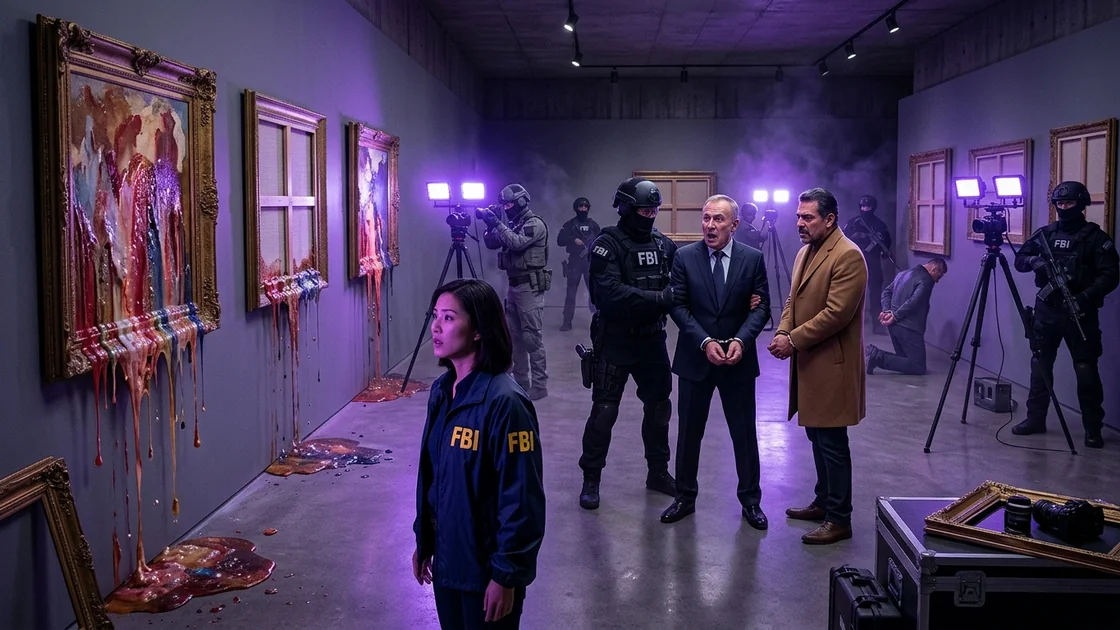
Julian Vance is a disgraced museum conservator and master art forger who is coerced by ruthless syndicate boss Viktor Morozov into restoring a secret collection of twelve stolen masterpieces used as fifty million dollars of laundered cartel collateral. Realizing that Morozov intends to execute him the moment the restoration is complete to preserve the vault's secrecy, Julian devises an intricate scheme of chemical vengeance. Working inside Morozov's subterranean compound, Julian secretly unmounts the priceless originals and smuggles them out inside his conservation equipment while replacing them with meticulous replicas painted with an experimental, photo-degradable polymer binder. He then tips off the Federal Bureau of Investigation, tricking both the federal agents and Morozov's cartel partners into converging on the vault at the same time. When the forensic authenticators switch on their high-intensity ultraviolet floodlights to verify the paintings during the raid, the ultraviolet radiation triggers a catastrophic chemical chain reaction that dissolves the forged masterpieces into worthless liquid sludge right before the crime boss's eyes, destroying his empire and leaving him with no leverage for either the law or the underworld.
I. The Anatomy of Lapis and Lead
The mortar and pestle had belonged to an apothecary in seventeenth-century Antwerp, though for the last twelve years it had lived on a scarred maple workbench in Red Hook, Brooklyn. Julian Vance pressed his thumb against the cold porcelain rim and rotated his wrist in slow, rhythmic circles. Beneath the heavy head of the pestle, chunks of raw Afghan lazurite cracked and surrendered, collapsing into a coarse, crystalline powder the color of a winter twilight.
Grinding genuine ultramarine was an exercise in patience and humility. Crush the stone too hard, and the crystal fractures into pale, lifeless gray shards that lose their refractive magic. Leave it too coarse, and it sits on the canvas like wet sand, refusing to bind with the cold-pressed linseed oil. You had to coax the blue out of the rock. You had to listen to the grit singing against the unglazed ceramic until the pitch climbed from a harsh crunch to a soft, whispering hiss.
Julian stopped, lifted a palette knife, and scraped a sample of the powder onto a glass slab. He added three drops of aged walnut oil and worked the paste in a figure-eight motion. The pigment drank the oil and deepened into a blue so profound it seemed to have its own gravitational pull.
"You always smell like a funeral parlor in here, Vance," a voice said from the shadows by the freight elevator.
Julian did not flinch, nor did he set down the palette knife. He had heard the hydraulic sigh of the street-level door three minutes ago, followed by the heavy, asymmetrical tread of two men who carried too much iron under their coats to walk quietly on hundred-year-old pine floorboards.
"It’s dammar varnish and spike lavender oil, Anton," Julian said, keeping his eyes on the glass slab. "Formaldehyde is much sharper on the sinuses. Though I suppose in your line of work, the two odors frequently overlap."
Anton stepped into the cone of warm light cast by the halogen work lamps. He was a broad, thick-necked man in a cashmere overcoat that cost more than Julian’s yearly lease. Behind him stood a younger man named Kirill, whose hands remained permanently buried in his pockets and whose eyes swept the tall racks of stretched linen, glass jars of toxic earth pigments, and hanging drying cabinets as if calculating how long the room would take to burn.
"Mr. Morozov does not like waiting," Anton said. He pulled a pair of black leather gloves from his pocket and began pulling them on, finger by finger. "And he does not like calling twice."
"Mr. Morozov didn't call at all," Julian replied calmly. He wiped the palette knife clean on a rag soaked in turpentine. "He sent you. Which means this isn't a social inquiry regarding my health, and it isn't a standard commission for one of his Cypriot shell companies."
Julian finally turned on his stool. He was forty-four, lean and slightly stooped from two decades of leaning over conservation tables through binocular loupes. His dark hair was threaded with silver at the temples, and the skin around his knuckles was permanently stained with burnt umber and walnut ink—the telltale tattoos of a man who lived three centuries in the past.
"The debt is paid, Anton," Julian said, his voice dropping half an octave. "Three years, four paintings. The Sisley for the oligarch in Zurich. The two Modiglianis for the customs seizure swap in Rotterdam. And the Chagall that paid off Elena’s oncology bills before she died. That was the ledger. Viktor shook my hand in this very room eight months ago and told me we were square."
Anton looked at the glass slab of ultramarine, reached out with one gloved finger, and smeared a streak of the priceless blue paste across the raw wood of the workbench.
"A handshake is a gesture, Julian. Not a contract," Anton said softly. "You have a very rare skill set. When the Stradivarius is sitting in the closet, the maestro doesn't go down to the pawnshop to buy a fiddle. Put on a coat. A warm one. It’s snowing upstate."
"And if I decline?"
Anton looked past Julian toward the far wall, where a small, unframed charcoal sketch of a woman reading by a window hung in a protective UV-filtered acrylic box. It was the only genuine piece of art in the studio—a drawing Julian had made of Elena during their last summer in Vermont.
"Then Kirill stays here for twenty minutes with a five-gallon can of your turpentine," Anton said, his tone entirely devoid of malice, as if reading a train schedule. "And you still get in the car. Only you ride in the trunk, and you arrive in a much worse mood."
Julian stared at the streak of ruined ultramarine on his table. Eight hundred dollars of raw mineral, reduced to a smudge by a man who didn't know the difference between cobalt and Prussian blue. His pulse beat once, hard and cold against his collarbones, before settling back into the slow, methodical rhythm he used when slicing nineteenth-century varnish off a Rembrandt with a surgical scalpel.
"Let me pack my travel kit," Julian said. "If Viktor wants me looking at canvases, I’m not using whatever hardware-store brushes he has lying around."
"Ten minutes," Anton said. "And leave your phone on the table."
II. The Sanctuary in the Pines
The drive took two hours north along the Taconic State Parkway, through a blinding curtain of wet February snow that turned the headlights of oncoming cars into smeared haloes of yellow lead. Julian sat in the back of the armored Mercedes sedan, his worn leather tool roll resting across his knees. Through the tinted glass, the skeletal silhouettes of the Hudson Highlands rose like charcoal wash drawings against the dark sky.
They turned off the highway onto an unmarked county road, then passed through a set of wrought-iron gates guarded by two men in white winter camouflage holding submachine guns. The tires crunched up a heated cobblestone drive that wound through forty acres of dense hemlock forest before emerging before a sprawling structure of board-formed concrete and floor-to-ceiling glass. It looked less like a home and more like a high-altitude bunker designed by an architect with a fetish for minimalism.
Viktor Morozov was waiting for them not in the main house, but thirty feet beneath it.
To reach the subterranean gallery, Julian was escorted through two biometric airlocks, an electromagnetic pulse scanner that required him to surrender his steel palette knives to Anton until they were inside, and a freight elevator lined with brushed titanium. When the doors slid open, the air changed instantly.
Julian inhaled and knew the metrics before he even looked at the digital hygrometers mounted on the wall: sixty-eight degrees Fahrenheit, forty-eight percent relative humidity, positive air pressure with triple-stage carbon filtration to strip out sulfur dioxide and ozone. It was better climate control than the basement vaults of the Metropolitan Museum of Art.
The room itself was a cathedral of quiet wealth. Perfectly diffused, museum-grade LED tracks traced a matte-gray perimeter wall sixty feet long and thirty feet wide. Hanging on those walls, spaced with generous, arrogant breathing room, were twelve paintings.
Julian stopped dead on the polished concrete floor. The leather tool roll slipped an inch in his grip.
In the center of the room, seated in a low Mies van der Rohe Barcelona chair beside a glass table bearing a decanter of amber liquid, was Viktor Morozov. He was sixty, compact and immaculate in a charcoal turtleneck and tailored trousers. His hair was cropped close to his scalp, and his face had the pale, tight smoothness of someone who had spent his youth in the freezing winds of Magadan and his fifties under the care of Swiss dermatologists.
"Look at his face, Anton," Morozov said, chuckling warmly. He rose and spread his hands like a benevolent cardinal welcoming a pilgrim to the Vatican. "You can always tell a true believer when he enters a church. He doesn't look at the priest. He looks at the altar."
Julian barely heard him. His eyes were moving from frame to frame, his mind automatically cataloging provenance, brush handling, and historical trauma.
Three paces to his left hung The Lute Player of Delft, a small oil-on-panel by Johannes Vermeer that had been stolen from a private collection in Brussels in 1974 and declared destroyed in a warehouse fire by Interpol a decade later. Next to it was a brooding, violent Saint Jerome in Meditation by Caravaggio, lifted from an altar in Palermo during the chaos of the 1982 mafia wars. Beyond that: a 1658 self-portrait study by Rembrandt van Rijn; a luminous 1954 crimson-and-ochre canvas by Mark Rothko; a jagged, screaming triptych study by Francis Bacon; a Cezanne still life of green apples that had vanished from Paris in 1999; a radiant J.M.W. Turner seascape; a Raphael Madonna; a Velázquez court dwarf; a Monet water lily panel; a Jean-Michel Basquiat skull on nailed wood slats; and a Géricault equestrian study.
"My God," Julian whispered, stepping toward the Caravaggio. He stopped eighteen inches from the canvas, his hands clasped tightly behind his back by old museum reflex. "The Palermo Jerome. The Italian government spent twelve million lire dragging the harbor for this."
"They should have looked in a diplomatic pouch bound for Geneva," Morozov said, walking up beside him. He smelled of cedarwood and cold gin. "What do you think, Julian? In total. If Sotheby's were allowed to put them under the gavel tomorrow morning."
"They couldn't," Julian said automatically. "Every single one of these is on the Art Loss Register, the FBI National Stolen Art File, and Interpol's red list. They have no legal market value because they can never be shown to the sun."
"In the daylight world, yes," Morozov agreed smoothly. "In my world, however, they are cleaner than gold bullion and far lighter than five hundred million dollars in non-sequential hundred-dollar bills. A Rembrandt weighs twelve pounds, Julian. You can carry an empire under your arm in a mailing tube."
Julian tore his gaze away from the dramatic chiaroscuro of Saint Jerome's wrinkled brow and looked at Morozov. "Why am I here, Viktor? These paintings are real. You don't need an authenticator to tell you that, and you certainly don't need a forger."
Morozov’s smile faded into a flat, businesslike line. He gestured toward the Cezanne and the Rembrandt. "Four months ago, these twelve pieces were stored in a vault aboard my yacht in the Adriatic. There was an... engineering failure in the starboard ballast tanks during a storm off Montenegro. The vault seal held against the seawater, mostly, but the climate control failed for seventy-two hours before we could transfer the crates to a private plane. The humidity spiked to ninety percent, then dropped rapidly during the high-altitude flight."
Julian stepped closer to the Rembrandt. Now that he wasn't blinded by the sheer shock of the painting's existence, the conservator in him took over. Under the raking angle of the ceiling lights, he saw it instantly: a faint, milky bloom across the dark umber shadows of the background—blanching in the old mastic varnish—and worse, along the bottom quadrant, tiny, tented ridges of paint pulling away from the linen ground like flaking pastry crust.
"Cleavage," Julian murmured, wincing as if he were looking at an open bone fracture. "The animal-glue size layer absorbed the moisture in the Adriatic, swelled, and then contracted faster than the oil paint when you flew it in an unpressurized cargo hold. The paint is delaminating from the canvas."
"It looks like dandruff," Morozov said with distaste. "And in exactly five weeks, on the fourteenth of March, I am hosting three gentlemen in this room. One from Monterrey, one from Limassol, and one from Zurich. I am merging my European logistics network with their distribution channels. These twelve paintings are my buy-in. My collateral. They are bringing their own specialist—a former curator from the Prado who went private—to verify the condition and authenticity of the collection before the escrow accounts are released."
"Five weeks," Julian said, walking down the line. The Vermeer had minor craquelure expansion on the oak panel; the Rothko had a slight slackening in the canvas tension and a tide line of moisture stain on the raw, unprimed duck cotton edge; the Caravaggio had severe varnish clouding. "Viktor, stabilizing twelve paintings of this caliber, reforming the varnish, laying down flaking impasto with heated sturgeon glue, and doing in-painting where the losses occurred... in a museum, that is a two-year conservation project with a team of six."
"You have thirty-five days," Morozov said. "And you have yourself. You will live in the guest suite one level up. You will eat what my chef prepares. You will write down a list of every chemical, brush, and lamp you require from your studio or from Kremer Pigments in Manhattan, and Anton will have it here within six hours."
Julian looked back at the titanium elevator doors, then at Anton, who stood by the keypad like a gargoyle. A cold, crystalline clarity settled over Julian’s mind.
He had never seen this house before. Eight months ago, when he had delivered the forged Chagall, they had met in a rented warehouse in Queens. Morozov had always been fanatical about compartmentalization. Yet today, Julian had been driven up the front driveway with his eyes uncovered. He had seen the biometric locks, the vault layout, the faces of the guards, and the exact location of half a billion dollars in black-market cartel equity.
You didn't show a contractor the heart of your kingdom unless that contractor was never going to leave the grounds.
"And on the fifteenth of March?" Julian asked quietly. "After the man from the Prado signs off and your friends from Monterrey wire the money?"
Morozov clapped Julian on the shoulder. His grip was like an iron C-clamp. "Then, my friend, I pay you one million dollars in clean bearer bonds, and you retire to Florence or wherever it is men like you dream of dying."
Not Florence, Julian thought, looking into Morozov's dead, slate-gray eyes. Forty acres of hemlock forest right outside the front door. Frozen ground, a backhoe, and lime.
"I'll need my vacuum hot table from Red Hook," Julian said, keeping his voice entirely steady, laced with just the right note of fussy, academic arrogance. "And my binocular microscope. Plus twelve sheets of half-inch aluminum honeycomb archival backing board. If these paintings are going to survive another century of your yachting trips, Viktor, I have to strip the acidic wooden stretchers, stabilize the verso of the linen, and mount them on conservation supports. Otherwise, the next time the barometer drops, your Rembrandt is going to end up as a pile of brown dust on the floor."
Morozov studied him for a long moment, searching for deceit, and found only the familiar, obsessive neurosis of an artist who cared more about dead Dutchmen than his own skin.
"Give Anton the list," Morozov said. "Start tonight."
III. The Chemistry of Ephemerality
The guest suite had no windows, a king-sized bed with Egyptian cotton sheets, a bathroom lined in Calacatta marble, and a heavy steel door that locked from the outside every night at midnight.
On the second day, Anton’s men arrived with two box trucks containing the entirety of Julian’s Red Hook workshop. Every jar of pigment, every bottle of solvent, the six-by-eight-foot aluminum vacuum hot table, the rolls of Belgian linen, the infrared reflectography camera, and the stacks of stiff aluminum honeycomb panels were carried down the freight elevator after being swabbed for GPS trackers and passed through an X-ray scanner.
They found nothing, because there was nothing electronic to find. Julian’s weapon was not a transmitter or a gun. It was sitting in three brown amber-glass apothecary bottles labeled Paraloid B-72 Conservation Resin, Cyclododecane Volatile Wax, and Diphenyliodonium Hexafluorophosphate.
For the last four years—ever since he had realized that a man who forges masterpieces for the Russian mob has the life expectancy of a coal-mine canary—Julian had spent his quiet nights in Brooklyn working on an insurance policy. Before his fall from grace, before Elena’s illness had driven him to sell his skills to the underworld, Julian hadn't just been a painter; he had held a master’s degree in conservation chemistry from the Courtauld Institute in London.
He knew how paintings lived, and he knew how they died.
That night, alone in the vault under the silent, unblinking gaze of four security cameras positioned in the upper corners of the ceiling, Julian put on his nitrile gloves, pulled his rolling stool up to the stainless-steel preparation table, and began to mix what he privately called Medium Zero.
The cameras could see his hands, of course. Anton watched the feeds from the security office upstairs. So Julian made it look exactly like standard varnish reformulation. He set up a magnetic hot-plate stirrer, a glass beaker, and a distillation condenser.
Into the beaker went fifty milliliters of dichloromethane solvent, followed by seventy grams of a white, crystalline powder from the jar marked Paraloid B-72. Except it wasn't Paraloid B-72, the standard acrylic resin used by every museum in the world. It was cyclic poly(phthalaldehyde)—cPPA—a metastable, low-ceiling-temperature polymer originally developed in the semiconductor industry for transient electronics and photoresist lithography.
At room temperature, and under the strictly filtered, UV-free 3000K LED lighting of Morozov’s vault, cPPA was a marvel of mimicry. When plasticized with a precise ratio of synthetic cold-pressed walnut oil and pine resin, it dried into a hard, glossy, slightly elastic film that matched the refractive index, brushstroke retention, and age-crackle characteristics of seventeenth-century linseed oil and dammar varnish. You could touch it. You could smell the turpentine and oil he spiked it with. You could even take a microscopic pinpoint sample from the edge, as the curator from the Prado surely would, and the outer protective micro-layer of genuine beeswax and mastic would pass a standard solubility test.
Then Julian opened the smaller brown bottle and weighed out four grams of triphenylsulfonium triflate—a high-quantum-yield photoacid generator, or PAG. He stirred the clear liquid into the polymer matrix under a dim yellow safelight.
The chemistry was as elegant as a guillotine.
So long as the ambient light remained above four hundred nanometers—visible light—the photoacid generator slept like a dormant virus inside the dried paint. The paintings would look, feel, and age like three-hundred-year-old masterpieces.
But if the paintings were ever struck by high-intensity ultraviolet radiation in the 365-nanometer band—the exact wavelength used by heavy forensic authentication lamps to examine paintings for overpainting, forged signatures, and varnish fluorescence—the photoacid generator would shatter at the molecular level. It would flood the paint layers with super-strong triflic acid. That acid would instantly cleave the acetal backbone of the poly(phthalaldehyde) in a self-sustaining, exothermic unzipping reaction.
Because the ceiling temperature of the polymer was minus forty degrees Celsius, once a single bond broke in the polymer chain, the entire molecule would spontaneously depolymerize back into liquid phthalaldehyde monomer. In less than three minutes, solid oil impasto, delicate glazes, and centuries-old craquelure would liquefy, boil off its volatile solvent, and slide right off the canvas like warm butter on a hot skillet.
Julian held a glass stirring rod up to the light, watching a clear drop of Medium Zero hang from the tip.
"You want collateral, Viktor?" Julian murmured under his breath, keeping his back to the north camera so his lips couldn't be read. "Wait until the bill comes due."
IV. The Hollow Honeycomb
The problem was not just making twelve fakes in thirty-five days. Even for Julian, who had spent twenty years studying the muscle memory of the Old Masters until he could paint a Rembrandt lace collar with his eyes closed, painting twelve museum-grade replicas from scratch in five weeks was physically impossible. Oil paint alone took weeks to skin over and months to cure.
Fortunately, Julian was not using oil paint. Medium Zero cured by solvent evaporation and thermal cross-linking on the vacuum hot table in less than forty minutes. And more importantly, he didn't have to guess the compositions or spend days working out the proportions. He had the originals right in front of him, and he had his infrared reflectography camera and a high-resolution large-format flatbed scanner.
First, however, he had to solve the problem of the originals.
He couldn't burn them. Every instincts of his soul revolted at the thought of destroying a Vermeer or a Caravaggio; it would have been like murdering a child to spite its kidnapper. Yet he couldn't walk out the front door with them, either. And he couldn't leave them hidden in the vault where Morozov could salvage his fortune after the fakes melted.
The solution lay in the twelve sheets of half-inch aluminum honeycomb archival backing board stacked against the west wall.
On the fourth morning, Anton came down the elevator with a tray bearing black coffee and rye toast. He stopped beside the worktable, where Julian had unframed the Saint Jerome by Caravaggio and laid it face-up on the padded felt surface of the vacuum hot table.
"What are you doing to it?" Anton demanded, his hand dropping instinctively toward the bulge under his suit jacket. Around the perimeter of the painting, Julian was using a pair of antique iron pincers to pull out the rusted, hand-forged seventeenth-century tacks holding the brittle linen canvas to its wooden stretcher bars.
"Doing what Viktor is paying me not to get killed for," Julian snapped without looking up. He had discovered early on that criminals respected irritable experts much more than polite ones. "Look at this wooden stretcher, Anton. It’s worm-eaten Italian poplar from 1608. When it got wet on the yacht, it warped by four millimeters across the diagonal. It’s pulling the canvas out of plane. If I don't take the canvas off the wood, flatten it on the vacuum table, and apply a strip-lining support before putting it back on the original stretcher, the paint is going to pop off like corn in a pan."
Anton stepped closer, scowling down at the dark, brooding image of the saint beside a grinning human skull. "You take the picture off the wood?"
"It’s called a relining, Anton. Every painting in the Louvre over two hundred years old has had it done three times. Drink your coffee and don't breathe on the canvas; your cologne has alcohol in it."
Anton’s jaw tightened, a muscle twitching beneath his ear, but after ten seconds he turned on his heel and walked back to the elevator.
The moment the titanium doors hissed shut, Julian checked the angles of the four ceiling cameras. When he had set up the six-by-eight-foot vacuum hot table on day two, he had positioned it directly beneath the central chandelier housing, using the bulky aluminum hood of the overhead fume extractor to create a three-foot blind spot along the rear edge of the table.
Working with the calm, surgical speed of a heist crew, Julian lifted the unmounted Caravaggio canvas. Without its heavy wooden stretcher and gilded baroque frame, the fifty-million-dollar masterpiece was nothing more than a supple, four-by-five-foot sheet of painted cloth no thicker than a heavy winter tablecloth.
He laid a sheet of silicone release paper over the painted surface, flipped the canvas onto a thin sheet of flexible archival Mylar, and reached for one of the four-by-eight-foot aluminum honeycomb panels leaning against the table.
Before leaving Red Hook during his ten-minute packing window, Julian hadn't touched his clothes; he had gone straight to his rack of structural conservation panels and used a long-blade utility knife to slice the interior aluminum grid out of the center of the panels, turning them into hollow, quarter-inch-deep briefcases disguised as solid industrial building materials. Even under the X-ray scanner Anton’s men had used at the service entrance, an aluminum honeycomb panel simply looked like a solid opaque rectangle of metal mesh.
Julian slid the flat, unstretched Caravaggio canvas—protected in its Mylar envelope—directly into the hollow core of the first aluminum panel. He sealed the raw edge with brushed-aluminum foil tape, then deliberately splashed dirty turpentine and gray gesso primer across the outside of the board, tossing it onto a pile labeled SCRAP / WARPED SUBSTRATES beside the freight elevator.
Next, he pulled a piece of pre-aged seventeenth-century flax linen from his supply rack.
Every good forger hoards old canvas the way a sommelier hoards pre-phylloxera Bordeaux. Julian had spent years buying worthless, ruined nineteenth- and seventeenth-century parish portraits from estate sales across Europe, stripping their terrible paint off with caustic lye, and saving the authentic, hand-loomed linen and oak panels.
He stretched the blank, historic linen onto Caravaggio’s original worm-eaten poplar stretcher bars, driving the original rusted iron tacks back into their exact centuries-old holes. Even if the curator from the Prado flipped the painting over and examined the back with a magnifying glass, he would see genuine 1608 wood, genuine 1608 iron tacks, original Christie’s stencil numbers from 1894 on the crossbar, and genuine seventeenth-century linen weave on the verso.
Only the front of the canvas was a blank, brown-primed desert.
Julian rolled his chair over to the easel, picked up a broad bristle brush, dipped it into a jar of burnt umber suspended in Medium Zero, and began to resurrect Michelangelo Merisi da Caravaggio from the dead.
V. The Twelve Labors
Time inside the vault lost all connection to the sun and moon. There was only the hum of the air handlers, the sharp, piney tang of spike lavender oil concealing the faint sweet-almond odor of the cyclic monomer solvent, and the relentless countdown toward March fourteenth.
Julian slept four hours a night, usually collapsed on a leather sofa in the corner of the vault with a wool blanket thrown over his shoulders. He painted in a fugue state, becoming twelve different dead men across three centuries of human history.
The Caravaggio took four days. Caravaggio never drew his compositions in charcoal first; he incised guide lines directly into the wet dark priming coat with the butt end of his brush or a stiletto knife, working straight from life into dramatic light and shadow. Julian used a bone stylus to replicate the exact incised lines he had mapped with his infrared camera before hiding the original. He built up the flesh tones of Saint Jerome’s gaunt chest using genuine lead white, vermilion, and earth pigments bound in the photo-reactive cPPA matrix. To create the network of three-hundred-year-old cracks—the craquelure—he brushed a thin base layer of brittle animal glue spiked with ceramic micro-balloons under the Medium Zero, then baked the canvas on the vacuum hot table at sixty degrees Celsius. As the glue shrank against the elastic polymer, a web of microscopic fractures bloomed across the saint’s forehead, identical to the age cracks of a Roman church. He rubbed dirty bone-black dust and rottenstone into the cracks, wiped the surface clean, and sealed it with a photo-reactive varnish tinted with yellow lake to mimic three centuries of candle smoke.
When he mounted it back into the gilded baroque frame on day six, even Julian had to step back and blink. Under the 3000K gallery lights, the saint looked out from the abyss with terrifying, tactile mortality.
Next was the Rothko.
Ironically, modern abstract expressionism was far harder to forge than the Old Masters. In a Rembrandt, if a brushstroke is a millimeter to the left, it is lost in the complex tapestry of shadow and drapery. In a 1954 Mark Rothko, there is nowhere to hide. It is nothing but atmosphere—twenty whisper-thin, translucent glazes of turpentine-thinned pigment floating one atop the other so that the light passes through the red, bounces off the yellow beneath, and returns to the viewer's eye as a glowing ember.
Julian worked flat on the floor for thirty-six hours straight, using four-inch housepainter’s brushes just as Rothko had, feathering layer after layer of synthetic alizarin crimson, cadmium red, and rabbit-skin glue modified with the PAG-doped polymer. Each layer flashed dry under a warm air blower in ten minutes. By the ninth day, the fake Rothko hung in its thin strip frame, vibrating with a quiet, tragic resonance that held five grams of dormant super-acid inside every square inch of red.
Then came the Rembrandt Self-Portrait, a battlefield of heavy, sculptural impasto where the nose and the golden chain around the burgher’s neck stood an eighth of an inch proud of the canvas. Then the Cezanne apples, built from disciplined, parallel strokes of viridian, chrome yellow, and cobalt blue like interlocking roof tiles. Then the Turner seascape, a violent blizzard of palette-knife scrapes and watercolor washes.
By day twenty-two, nine of the twelve masterpieces were sealed inside the hollow aluminum panels stacked neatly behind the waste solvent drums, and nine ticking chemical bombs hung in their places on Morozov’s walls.
Julian was losing weight. His eyes were bloodshot from peering through the 10x magnification loupe, and a fine tremor had taken up residence in his left ring finger from the constant exposure to dichloromethane vapors.
More than that, he knew that simply melting the paintings wasn't enough.
If the paintings dissolved during the cartel audit on March fourteenth, Morozov’s deal would collapse in bloodshed, yes—the men from Monterrey and Cyprus would think Morozov was trying to rob them with a stage-prop trick. But before the gunfight was over, Morozov’s first order would be to send Anton down to the guest suite to put a bullet through Julian’s eye.
For Julian to walk out of the Hudson Valley alive, two things had to happen simultaneously: the cartel had to see the paintings melt so Morozov’s underworld credibility was permanently obliterated, and the United States federal government had to breach the vault at that exact moment so Morozov and Anton were in handcuffs before they could draw their weapons.
And there was a third requirement, the most crucial of all: Julian couldn't be the one to turn on the ultraviolet light. If Julian walked into the room with a blacklight, everyone would know he had rigged the canvases. The forensic technicians of the Federal Bureau of Investigation had to do it for him.
On the twenty-fourth night, Julian sat at his stainless-steel table and prepared to bait a hook for Special Agent Clara Lin.
VI. The Dead Drop in Soho
Every week, Julian was allowed one requisition order for depleted chemicals and specialized conservation supplies from Kremer Pigments on West 29th Street in Manhattan. The protocol was strict: Julian wrote the list by hand on a sheet of yellow legal paper; Anton photographed the list and emailed it to a courier service; the courier picked up the sealed cans and jars in the city and delivered them to a drop-off point ten miles from the estate, where Kirill X-rayed them and brought them down to the vault.
Julian never saw the courier, and the store never knew where the supplies were going. What Anton didn't know, however, was who owned the quiet little restoration shop next door to the pigment supplier.
Arthur Pym was seventy-eight years old, half-blind from cataracts, and had been Julian’s mentor at the Metropolitan Museum thirty years ago before retiring to repair torn nineteenth-century Hudson River School landscapes in a dusty fourth-floor walk-up on Chelsea’s edge. More importantly, Arthur was the first person the FBI’s New York Art Crime Team consulted whenever a suspicious Old Master surfaced in a private Manhattan estate.
And the head of that Art Crime Team was Special Agent Clara Lin—a relentless thirty-six-year-old former prosecutor who had tried to indict Julian three years ago over the Rotterdam Modigliani swap, failing only because the Dutch witnesses had conveniently forgotten how to speak English before the grand jury convened. Lin had given Julian her card outside the federal courthouse on Pearl Street, tapping it against his chest with two fingers. "One day, Julian," she had told him in the rain, "the people you paint for are going to decide it's cheaper to bury you than pay you. When you smell the dirt, call me."
Julian couldn't write a note to Arthur or Lin on the requisition list; Anton read every word and cross-referenced the product numbers online.
Instead, Julian used the empty hazardous-waste containers.
Once a week, Kirill hauled the five-gallon steel drums of spent turpentine and dirty acetone out of the vault to be dumped at a commercial chemical disposal facility in Newburgh, along with the empty glass jars that had held specialty pigments—because Kremer charged a three-hundred-dollar deposit on the handmade airtight German apothecary jars used for unstable historical minerals.
Julian took an empty hundred-milliliter glass jar labeled KREMER #10300 - GENUINE AZURITE. The bottom of the jar was coated in a quarter-inch crust of dried blue pigment sludge.
Working in the blind spot behind the vacuum table fume hood, Julian took a two-millimeter sliver of paint and canvas edge that he had trimmed from the genuine Palermo Caravaggio during the unmounting process. It was no larger than a grain of basmati rice, containing the original 1608 Sicilian red-earth ground layer, Caravaggio’s lead-white priming, and traces of volcanic ash from Mount Etna that existed only in paintings executed during his brief exile in Sicily.
Next, Julian took a shard of glass microscope slide and, using a diamond-tipped engraving needle under his 40x microscope, etched four lines of microscopic text—each letter half a millimeter high—onto the underside of the slide:
LIN - FBI ART CRIME. PALERMO CARAVAGGIO + 11 STOLEN RED-LIST WORKS IN SUB-VAULT AT 41.4082 N, 73.9214 W (MOROZOV ESTATE). SYNDICATE TRANSFER MARCH 14 @ 2100 HRS. MOROZOV HID CYPHER LEDGER KEYS & OFFSHORE ACCOUNT PASSWORDS IN FLUORESCENT ZINC-SULFIDE INK UNDER VARNISH OF ALL 12 CANVASES. BRING HIGH-OUTPUT 365nm UV FLOOD ARRAYS TO DOCUMENT BEFORE VARNISH OXIDIZES ONCE VAULT SEAL IS BROKEN.
Julian knew how the federal bureaucracy worked. If he simply told the FBI that Morozov had stolen art in his basement, the U.S. Attorney for the Southern District of New York would spend three weeks arguing over probable cause for a no-knock warrant, and when they finally seized the paintings, they would pack them straight into dark crates and ship them to an evidence locker in Queens to be examined months later.
That wouldn't work. If the paintings went into crates intact, Morozov’s lawyers would spend five years fighting the seizure on technicalities while Morozov told his cartel partners that the art was still real and safe in federal custody, keeping his credit line alive.
The paintings had to die in the room, in front of the cartel's eyes and the federal cameras.
By telling Clara Lin that the offshore banking passwords for Morozov’s entire financial network were painted into the canvases in fugitive UV-fluorescent ink that would oxidize as soon as the vault’s inert air seal was breached, Julian guaranteed that the FBI Financial Crimes unit and the Art Crime Team would bring high-wattage, wide-spectrum 365-nanometer forensic floodlights directly into the vault during the tactical takedown to photograph the "ledgers" on the spot.
How had Julian known the exact GPS coordinates of the estate, when he had arrived without a phone?
He smiled grimly as he pressed the engraved microscope slide and the genuine Caravaggio paint chip into the bottom of the Kremer jar, sealing them beneath a layer of genuine beeswax and blue azurite sludge. On the wall of the vault, right beside the climate-control panel, hung a framed architectural topography certificate issued by the Putnam County Department of Environmental Conservation for the geothermal well that powered the vault's HVAC system. Rich men were always so proud of their engineering; the exact survey coordinates of the parcel were printed right above the county engineer's stamp.
On the bottom of the glass jar's exterior label, where the shop clerk at Kremer would scan the barcode for the bottle deposit refund, Julian used a fine nib and iron-gall ink to write a single notation in his distinctive, calligraphic hand: Return to A. Pym for credit — Urgent.
When the clerk at Kremer saw that, he would walk the jar next door to old Arthur. And when Arthur saw Julian’s handwriting on a jar containing a suspicious layer of fresh beeswax at the bottom, forty years of conservation instinct would make him scrape it open under a microscope.
VII. The Scratch Test
By the tenth of March—four days before the syndicate audit—only one painting remained on the worktable: Johannes Vermeer’s The Lute Player of Delft.
It was the smallest piece in the collection, barely sixteen by fourteen inches, painted on a quarter-inch plank of Baltic oak cut in the winter of 1664. It was also the most terrifying to forge. Vermeer did not paint lines; he painted light itself. Using a camera obscura as an optical guide, the master of Delft had constructed the world out of tiny, luminous pearls of lead-tin yellow and natural ultramarine—pointillés—that blurred into miraculous focus when viewed from three feet away.
Julian was bending over the oak panel, holding his breath as he touched a single hair of a sable brush loaded with Medium Zero and genuine lapis lazuli to the brass tuning peg of the lute, when the elevator doors chimed.
It wasn't the dinner tray. And it wasn't Anton alone.
The titanium doors parted to reveal Viktor Morozov, flanked by Anton and a third man Julian had never seen before. The newcomer was fiftyish, impeccably dressed in a camel-hair coat over a tailored charcoal suit, with silver hair swept back from a deeply tanned, hawkish face. He carried a pair of tortoiseshell reading glasses in one hand and moved with the quiet, unhurried confidence of a man who owned three banks and half a dozen politicians.
"Julian," Morozov said, his voice echoing slightly in the cool air of the vault. "I hope we are not interrupting the muse. Allow me to introduce Señor Hector Delgado. He arrived from Monterrey three days early. He is a man who prefers to see the horses in the stable before the race begins, rather than waiting for the parade."
Julian stood up slowly from his stool, stripping off his nitrile gloves to hide the slight tremor in his fingers. "Mr. Delgado. You're catching the lady before she has her evening dress on. The Vermeer still needs its final protective varnish."
Delgado didn't smile, nor did he shake Julian's hand. His dark, intelligent eyes swept the walls, lingering on the eleven finished paintings—the Caravaggio, the Rembrandt, the Rothko, the Cezanne—all gleaming in their frames with fresh, museum-grade vitality.
"My associates and I are putting two hundred and forty million dollars in liquid credit against this room, Mr. Morozov," Delgado said in smooth, Oxford-educated English. "When our specialist from Madrid arrives on Friday night, he will bring his portable X-ray fluorescence spectrometer and his ultraviolet lamps. Until then, I rely on my own eyes. My grandfather collected Spanish colonial art; I grew up smelling linseed oil."
Ultraviolet lamps on Friday night, Julian noted inwardly. Even if the FBI somehow missed the raid window, the Prado curator would trigger the meltdown anyway—though without the FBI there, Julian wouldn't live five minutes to enjoy it. Come on, Clara. Read the slide.
Delgado walked slowly past the Caravaggio and stopped in front of the Rembrandt Self-Portrait. He put on his tortoiseshell glasses and leaned in until his nose was six inches from the canvas.
"Remarkable," Delgado murmured. "Look at the impasto on the gold chain. When I saw the photographs taken in Montenegro after the yacht incident, there was a three-inch strip of flaking paint right below the collar. Now I cannot even see the seam."
"Sturgeon glue and a heated spatula," Julian said smoothly, stepping between the worktable and Delgado, casually angling his body to keep the man away from the uncured Vermeer. "And a minimal touch of reversible conservation watercolor in the microscopic losses. The Dutch masters built their paintings like battleships, Mr. Delgado. They just needed the slack taken out of the sails."
Delgado turned his head slightly, studying Julian over the rims of his glasses. "You are Julian Vance, yes? The man from the Courtauld who got into trouble with the Chagall in Zurich?"
Julian’s stomach dropped half an inch, though his face remained an impassive mask. "The charges in Zurich were dropped for lack of evidence, Mr. Delgado. I am a conservator."
"You are a magician," Delgado corrected softly. "Which makes a cautious businessman wonder. When a magician is locked in a room for a month with twelve miracles... does he repair the miracles, or does he perform a trick?"
The silence in the vault became absolute. Even the hum of the positive-pressure HVAC vents seemed to vanish. Five feet away, Anton shifted his weight onto the balls of his feet, his right hand slipping inside his lapel. Morozov’s eyes narrowed to icy slits as he looked from Delgado to Julian.
Delgado reached into his vest pocket and pulled out a small, folding pearl-handled penknife—the kind wealthy men used to trim the caps off Cohiba cigars. He clicked the one-inch silver blade open.
"Fresh oil paint," Delgado said conversationally, turning back to the Rembrandt, "takes six months to oxidize to the touch, and eighty years to polymerize completely through the lead-white layers. Even with cobalt driers, if a painting was forged this month, a needle point will sink into the impasto like warm cheese. Three-hundred-year-old Rembrandt lead white, however, is as hard as porcelain."
Before Morozov could speak, Delgado raised the tip of the cigar knife toward the thick, golden ridge of paint on the burgher's cloak in the center of the Rembrandt.
Julian’s heart hammered against his ribs.
Medium Zero was hard—much harder than wet oil paint—because it was a high-density thermoplastic polymer. If Delgado tapped it lightly, it would hold. If he scraped the surface, the micro-layer of genuine beeswax and mastic varnish Julian had buffed over the top would flake just like old resin.
Wait, Julian thought, his mind racing through the spatial geometry of the canvas. Not the cloak. The cloak is pure cPPA and lead-tin yellow. If he digs the blade deep into the thick ridge and twists, the friction heat of the steel might cleave a localized pocket of the polymer and release the bitter almond smell of phthalaldehyde monomer right under his nose.
"I wouldn't touch the cloak if I were you, Señor Delgado," Julian said, his voice ringing out sharp and cold across the concrete floor.
Delgado froze with the blade two millimeters from the paint. He looked back at Julian with a faint, cruel arch of his eyebrow. "Oh? And why is that, Mr. Vance? Afraid the paint is still wet?"
"No," Julian said, walking right up to the cartel boss and pointing a pigment-stained finger at a spot three inches higher, right on the bridge of the Rembrandt’s nose, where the highlight was thickest. "Because the cloak was heavily restored by a clumsy French cleaner in 1880 using soft bitumen wax. If you scratch the cloak, all you’re testing is nineteenth-century French candle grease. If you want to test Rembrandt van Rijn, test the nose. That’s pure 1658 lead white and crushed glass paste. Scratch it right there. Go ahead. Take a fifty-thousand-dollar chip off Viktor’s painting to see if I’m lying."
It was a bluff born of pure technical preparation. Knowing that authenticators always tested the highest impasto highlight on a Rembrandt portrait—invariably the nose or the forehead—Julian had mixed crushed, high-borosilicate glass microbeads and genuine seventeenth-century lead white bound in fast-curing epoxy cyanoacrylate strictly into that single quarter-inch spot on the nose, leaving the photo-degradable Medium Zero underneath and around it.
Delgado stared into Julian’s eyes for five seconds. Then he moved the tip of the blade up to the bridge of the burgher's painted nose and pressed the steel point against the ridge with deliberate force.
Tink.
The sound was tiny, brittle, and unmistakable—like steel tapping against an old dinner plate. The blade skidded slightly off the cured glass-and-lead bead without leaving so much as a dent.
Delgado lowered the knife, folded it shut with a soft click, and slipped it back into his vest pocket. For the first time, a thin smile touched his lips.
"Forgive an old man's paranoia, Viktor," Delgado said, turning back to Morozov. "In Monterrey, trust is an expensive luxury. Your man knows his craft. We will see you on Friday night at nine o'clock with our curator and the transfer keys."
Morozov smiled warmly, though as Delgado walked back toward the elevator, the look the Russian boss threw over his shoulder at Julian was cold enough to freeze mercury.
"Finish the Vermeer by tomorrow evening, Julian," Morozov said softly. "Thursday morning, Anton’s men will clear out your equipment and return the vault to showroom condition. You wouldn't want to leave a mess for our guests."
"Of course, Viktor," Julian said, bowing his head slightly. "Everything will be spotless."
Thursday morning, Julian thought as the elevator doors closed. Thirty-six hours before the Friday night meeting.
Morozov wasn't even going to wait for the Prado curator to sign off before cleaning house. Once the Vermeer was in its frame tomorrow night, Julian’s usefulness was officially over. Thursday morning, they would load his equipment into the trucks to be dumped in some industrial shredder in New Jersey, and they would load Julian into a body bag.
VIII. The Hazardous Waste Protocol
Across the river in lower Manhattan, at four o'clock that Wednesday afternoon, Special Agent Clara Lin stood in the cramped, turpentine-scented laboratory on the fourth floor of Arthur Pym’s Chelsea brownstone, staring into the dual eyepieces of a polarized light microscope.
"Read it again, Arthur," Lin said, her notebook open beside the brass base of the scope.
Old Arthur Pym adjusted his thick spectacles and squinted at the photograph they had printed from the digital scope camera. "It’s Julian’s hand. No question about it. Nobody else in New York writes a capital R with a seventeenth-century secretary-hand flourish when they're etching glass with a diamond scribe. And the paint chip... Clara, I ran the micro-Raman spectroscopy twice. The red earth ground contains trace augite and titanomagnetite from the eastern slopes of Mount Etna, bound with walnut oil dated by fatty-acid gas chromatography to the first decade of the 1600s. There is only one missing painting in the world with that stratospheric signature."
"The Palermo Caravaggio," Lin whispered. She stood up from the microscope, her mind already racing through operational logistics. "Viktor Morozov. Organized crime task force has been trying to pierce his Putnam County compound for four years, and the judge always kicked the warrants because we couldn't place contraband inside the residential perimeter."
"Wait," Arthur said, holding up a liver-spotted finger. "Look at the last sentence on the slide. Morozov hid cypher ledger keys and offshore account passwords in fluorescent zinc-sulfide ink under the varnish of all twelve canvases. Bring high-output 365nm UV flood arrays to document before varnish oxidizes once vault seal is broken."
Arthur frowned, scratching his white beard. "Clara, that doesn't make chemical sense. Zinc-sulfide phosphor ink doesn't oxidize when exposed to oxygen. Why would Julian write that?"
Lin picked up the photograph of the microscopic glass slide and stared at the tiny, frantic lettering. She remembered Julian Vance standing outside the federal courthouse three years ago—a brilliant, broken man who knew every secret of how light interacted with matter, and who never made a mistake in chemistry in his life.
"Because," Lin said slowly, a realization dawning in her eyes, "if he just told us there were stolen paintings in the vault, the U.S. Attorney’s office would take four days to draft an art-recovery warrant, and the tactical team would leave the lights off and lock the doors until next week. By putting fugitive financial cyber-ledgers on the canvases, he just triggered an immediate exigent-circumstances raid under the Patriot Act financial-terrorism statutes. And he guaranteed I' have to bring four thousand watts of long-wave ultraviolet light into that basement at nine o'clock on Friday night."
"Why would he care what kind of lights you bring?" Arthur asked.
"I don't know," Lin said, reaching for her encrypted mobile phone. "Wait. If the meeting is Friday at nine, and Julian got this jar out in today's waste pickup... when is he finishing the job?"
Fifty miles north, at six o'clock on Wednesday evening, Julian was laying the final microscopic pearl of lead-tin yellow onto the Vermeer replica while the genuine 1664 oak panel of The Lute Player of Delft sat sealed inside the twelfth hollow aluminum honeycomb board behind the waste drums.
He didn't have until Friday night. He had until Thursday morning at eight o'clock, when Anton came down to clear out the studio and execute him.
Julian couldn't fight Anton and Kirill with a palette knife. He couldn't hack a biometric titanium elevator door. And he couldn't wait for the FBI, who thought the deadline was Friday at 2100 hours.
He had to leave the vault tonight—Wednesday night—the exact same way the twelve masterpieces were going to leave.
At seven-thirty that evening, Julian pressed the intercom button beside the elevator door.
"Anton," Julian said when the speaker crackled to life. "I'm done with the Vermeer. The varnish is drying under the heat lamp now. If Viktor wants this room smelling like a gallery instead of a chemical refinery by Friday night, Kirill and the cleanup crew need to haul the vacuum hot table, the scrap aluminum boards, and the waste solvent barrels up to the loading dock tonight so the carbon filters have forty-eight hours to scrub the air."
There was a ten-second pause on the intercom. Julian could practically hear Anton consulting with Morozov upstairs. From Morozov’s perspective, the request was convenient: let the fussy artist pack up his own toxic garbage tonight, lock him in his bedroom at ten o'clock as usual, and then deal with him quietly in the morning after the heavy equipment was already loaded onto the disposal truck in the garage.
"Pack it up," Anton’s voice came back over the speaker. "Kirill and two men will be down at nine o'clock to haul the pallets to the garage truck. You go straight to your room while they load the elevator."
"Thank God," Julian said wearily into the mic. "I haven't slept in a bed in four days."
Julian hung up the intercom and checked his watch. Seventy-eight minutes.
He walked over to the six-by-eight-foot aluminum vacuum hot table.
A conservation vacuum hot table is an imposing piece of industrial machinery. The top is a solid, flat platen of heavy-gauge aluminum perforated with thousands of tiny pinholes. Beneath that top plate is a fourteen-inch-deep enclosed steel chassis housing the heating elements, fiberglass insulation pads, vacuum manifold pipes, and twin rotary-vane vacuum pumps. The whole unit sits on locking caster wheels so it can be rolled into freight elevators.
When Anton’s men had X-rayed the table on day two, they had used a handheld backscatter wand along the outer frame, seen the dense tangle of copper heating coils and steel vacuum pipes inside the chassis, and passed it through. They would have no reason to X-ray it on the way out of the vault—especially when they believed Julian was locked in his bedroom one floor up.
First, Julian had to fool the cameras and the bedroom lock.
He knew the routine of the nine o'clock guard change and equipment haul. At 8:55 PM, Anton would unlock the vault door from the upstairs security console and tell Julian over the intercom to take the elevator up to Level B1—the residential guest floor—where a second guard, Pavel, stood at the end of the corridor and watched Julian walk into his bedroom before turning the heavy deadbolt on the outside of the door.
The blind spot wasn't in the bedroom corridor; it was inside the titanium freight elevator itself, during the twelve-second vertical transit between Level B2 (the Vault) and Level B1 (the Guest Suite).
Julian worked with furious, silent precision behind the fume hood shadow. He unbolted the lower maintenance panel beneath the vacuum hot table, disconnected the two heavy fifty-pound rotary vacuum pumps and the steel manifold tank, and slid them into the bottom of two five-gallon waste-solvent drums, topping them off with dirty turpentine so the weight of the drums felt right and the table didn't become suspiciously light.
Removing the pumps and manifold hollowed out a five-foot-long, fourteen-inch-high insulated cavity right inside the belly of the table chassis, directly beneath the aluminum heating platen and shielded from below by the sheet-metal drip pan.
Next, Julian rigged the elevator delay.
At 8:50 PM, he stacked the twelve four-by-eight-foot hollow aluminum honeycomb panels—containing the genuine Caravaggio, Vermeer, Rembrandt, Rothko, Bacon, Cezanne, Turner, Raphael, Velázquez, Monet, Basquiat, and Géricault—onto the rolling A-frame cart beside the vacuum hot table. He hung the twelve completed photo-degradable replicas in their original frames along the walls of the vault, adjusting each one with a spirit level until they hung with millimeter perfection under the 3000K museum lights.
At 8:55 PM, the intercom buzzed.
"Time’s up, Vance," Anton said. "Leave the carts by the door and bring yourself up to B1. Kirill and the boys are coming down from the garage as soon as you're locked in."
"Coming," Julian said. He picked up his empty leather tool roll, walked across the gallery in full view of all four cameras, stepped into the freight elevator, and pressed the button for B1.
Wait—if he rode up to B1, Pavel would see him get off. How could he get back into the vacuum table on B2?
He didn't get off on B1.
As the heavy titanium doors slid shut, isolating Julian inside the elevator shaft, he looked up at the single dome camera in the corner of the cab. Before stepping in, he had palmed a small handheld laser pointer—the high-wattage green alignment diode from his infrared reflectography rig. The instant the door closed, he flashed the beam directly into the lens of the cab camera from a low angle, blinding the CMOS sensor with a flare of green static—a common electrical glitch that happened whenever the heavy elevator motor kicked on.
While the camera sensor was blinded for four seconds, Julian reached up with a flat steel palette knife, popped the emergency drop-ceiling access hatch in the roof of the elevator cab, and pulled himself onto the top of the elevator car just as it braked at Level B1.
Below him, the doors slid open onto the B1 hallway.
Julian crouched flat in the greasy shadows atop the elevator roof cables, holding his breath. Down in the hallway, twenty feet from the elevator doors, Pavel the guard was looking at his phone. Hearing the elevator chime, Pavel glanced up, saw an empty cab, frowned, and muttered in Russian into his walkie-talkie: "Anton, the car came up empty. He didn't get on."
Up in the security room, Anton cursed and checked the vault cameras. The vault was empty. The elevator camera was showing a blown-out green horizontal sync glitch.
"Stay by the B1 door, Pavel!" Anton barked over the radio. "Kirill, take the stairs down to B2 with me right now! If he's hiding behind the air handlers, break his legs!"
Anton recalled the elevator to B2 using the master override.
As the car descended back down the shaft toward the vault, Julian lay flat on its roof. The instant the car hit the bottom of the shaft at B2 and the inner doors began to slide open into the unmanned vault—thirty seconds before Anton and Kirill could sprint down the four flights of concrete emergency stairs through two biometric airlocks—Julian dropped silently through the ceiling hatch, darted out of the cab into the blind spot behind the vacuum hot table, slid feet-first into the fourteen-inch cavity inside the table’s steel chassis, and pulled the magnetized lower sheet-metal maintenance panel shut from the inside with two neo-magnets glued to the steel plate.
Ten seconds later, the stairwell airlock burst open.
Through the tiny pinhole perforations in the aluminum table top above his face, Julian heard the heavy thud of four sets of boots hitting the concrete floor, accompanied by the metallic rack of Heckler & Koch submachine gun bolts.
"Check the bathroom! Check the air-handler plenum!" Anton roared.
Footsteps raced across the vault. Doors slammed. The metal doors of the drying cabinets were yanked open and smashed against the walls.
"Nothing here, boss!" Kirill shouted from the utility alcove. "And the biometric log on the inner airlock hasn't been triggered since nine this morning! He couldn't have gone through the stairs!"
Anton stopped two feet from the vacuum hot table. Julian lay entirely motionless in the dark, fiberglass-lined coffin, breathing through his nose in shallow, silent sips. Above him, the gallery lights cast tiny pinpoint stars of light onto his chest through the vacuum holes.
"Check the elevator shaft," Anton snarled. "He knocked out the cab camera. He’s on top of the car or in the pit beneath it!"
Anton, Kirill, and the other two guards ran back to the elevator, pried open the service hatch, and shone tactical flashlights up into the grease-stained cables of the shaft.
"Look!" Kirill yelled, pointing at the open ceiling hatch Julian had deliberately left ajar inside the cab, and a streak of burnt-umber pigment Julian had smeared onto the steel ladder rung leading up the shaft wall toward the main house's ground-floor ventilation grating. "He climbed the shaft ladder toward the first-floor air ducts!"
"Seal the house!" Anton shouted into his radio, his boots pounding back toward the stairwell. "Wake Mr. Morozov! Turn loose the dogs on the perimeter and get everyone into the main house mechanical rooms! Wait—Kirill, you and Oleg get this table and these junk boards out of the vault and onto the disposal truck in the garage first so we can lock the vault down completely! Nobody gets in or out of this room until Friday night!"
"Got it!" Kirill grunted.
A moment later, Julian felt the locking casters beneath him click free. Two heavy sets of hands shoved the vacuum hot table across the smooth concrete floor into the freight elevator, right alongside the rolling cart bearing the twelve aluminum honeycomb panels.
Twenty minutes later, the table was winched up the hydraulic lift gate of the commercial hazardous-waste box truck parked inside the estate’s heated garage. And at midnight, when the scheduled waste-disposal driver—an independent contractor from Newburgh who knew nothing about the frantic manhunt going on inside the main house's ventilation shafts—arrived at the outer gate to swap the full chemical truck for an empty one, Anton waved the truck straight through the gates after a cursory flashlight check of the cab so the driver wouldn't see thirty armed men tearing the mansion's drywall apart.
As the truck’s diesel engine roared to life and its tires crunched out onto the snowy county road toward theTaconic Parkway, Julian Vance closed his eyes inside his aluminum coffin and smiled in the dark.
IX. The Siege of Hudson Valley
Viktor Morozov did not sleep on Thursday, nor did he sleep on Friday.
For forty-eight hours, his forty-acre estate was turned upside down from the wine cellar to the roof trusses. They never found Julian Vance inside the ventilation ducts, of course. By Thursday afternoon, when Anton checked the highway traffic cameras through a corrupt state trooper contact and discovered that the hazardous-waste truck had made an unscheduled twenty-minute stop behind an abandoned warehouse in Yonkers before arriving at the Newburgh chemical plant with its rear padlock clipped, Morozov finally understood how the mouse had left the trap.
Anton expected to be shot where he stood.
Instead, Morozov stood in the middle of the subterranean vault on Friday afternoon, surrounded by four armed guards, staring intently at the twelve masterpieces on the walls.
"He ran because he figured out what was going to happen to him on Thursday morning," Morozov said quietly, his hands clasped behind his back. "He wasn't stupid. He knew I couldn't let him live once the job was finished. So he finished the Vermeer, hid in his own machinery, and bolted."
"Viktor," Anton said, his voice tight with dread. "What if he went to the feds? What if he stole one of the paintings?"
"Look around you, Anton," Morozov said coldly. "Count them. Twelve paintings. And you watched Delgado test the Rembrandt with his own knife on Wednesday afternoon! They are right here. As for the feds—Vance is a wanted felon who skipped bail in Zurich and forged two Modiglianis in Rotterdam. If he walks into an FBI office, he goes to federal prison for twenty years. And even if he sent an anonymous tip, no federal judge in New York is going to sign a warrant for my home on the word of a phantom."
Even so, Morozov had not survived thirty years at the pinnacle of the Eurasian underworld by being careless. He doubled the perimeter guard to twenty-four men. And he called Hector Delgado and the bankers from Cyprus and Zurich, offering to move the Friday night inspection to a neutral location next week.
Delgado’s answer was ice-cold: "Viktor, my curator from the Prado just landed at Teterboro Airport. Our escrow authorizations expire at midnight tonight. If we do not walk into your vault at nine o'clock and verify the collateral, the merger is dead, and my people in Monterrey will assume you never had the paintings at all."
Backing out meant instant war with the Monterrey cartel and financial ruin in Cyprus.
So at eight-thirty on Friday evening, the fourteenth of March, three black Escalades glided up the heated cobblestone drive of the Hudson Valley estate.
Inside the subterranean vault, a waiter in a white tuxedo jacket arranged crystal flutes of vintage Krug champagne on the glass table before being escorted out and locked above ground. Viktor Morozov stood beside the Cezanne, immaculate in a midnight-blue bespoke suit. Across the room stood Hector Delgado, two austere Swiss-Cypriot bankers in rimless spectacles, and a thin, aristocratic Spaniard in his sixties named Dr. Alejandro Serrano—formerly chief of seventeenth-century conservation at the Museo del Prado in Madrid, now the highest-paid black-market authenticator in the world.
Dr. Serrano had brought three heavy aluminum Pelikan cases into the vault. He opened the first one, took out a high-powered jeweler's loupe and a handheld raking-light LED torch, and spent twenty minutes walking from the Vermeer to the Caravaggio, then to the Velázquez and the Rothko.
The room was silent save for the soft clicks of Serrano’s tongue.
He examined the back of the Caravaggio frame, nodding approvingly at the worm-eaten 1608 poplar stretcher, the rusted hand-forged tacks, and the Christie’s stencil marks. He examined the front under raking light, marveling at the laid-down cleavage on the Rembrandt and the subtle, centuries-old craquelure on the Vermeer.
"Well, Alejandro?" Delgado asked from the center of the room, his untouched glass of champagne in his hand.
Dr. Serrano lowered his loupe and looked at Morozov with genuine professional admiration. "Whoever you hired to stabilize these after the Adriatic incident is a genius, Señor Morozov. The relining tension on the Caravaggio is flawless, and the varnish reformation on the Rembrandt has restored thirty percent of the shadow depth without disturbing the original 1658 glaze layer. From a visual and structural standpoint, all twelve works are in extraordinary condition."
Morozov allowed himself a small, triumphant smile and raised his glass toward Delgado. "To new partnerships, Hector."
"Almost," Dr. Serrano interrupted mildly, walking back to his largest aluminum Pelikan case. "As Señor Delgado knows, I never certify a nine-figure portfolio on visual inspection alone. A master restorer can hide extensive modern overpainting under a tinted varnish that looks identical to the naked eye under 3000-kelvin gallery LEDs. Before I sign the escrow release, I must examine the fluorescence of the varnish and pigment layers under long-wave ultraviolet radiation."
Serrano popped the latches on the third case and lifted out two collapsible carbon-fiber light stands, each mounted with a twin-bank 500-watt 365-nanometer mercury-vapor ultraviolet floodlight array.
Before Serrano could plug the heavy black power cord into the wall outlet beneath the Rothko, the floor beneath their Italian leather shoes trembled.
It wasn't an earthquake. It was the simultaneous detonation of four shaped breaching charges blowing the wrought-iron front gates and the steel service doors of the main house off their hinges thirty feet above their heads.
The vault’s internal security klaxon let out a single, strangled chirp before the estate's main power grid was severed by an FBI electronic-warfare truck parked on the county road, dropping the vault onto its backup battery inverters.
"What is this?!" Delgado snarled, his hand diving inside his suit coat as his two bodyguards by the elevator whipped out compact nine-millimeter pistols. "Morozov! You brought the police down on us?!"
"Put the guns down, Hector!" Morozov roared, his face draining of blood as he looked up at the security monitors by the door, which showed forty men in black tactical armor, Kevlar helmets, and yellow FBI placards swarming across the snow-covered lawn behind ballistic shields and an armored BearCat Bear vehicle. "Look at the screens! My men are being taken down on the lawn! Nobody can breach this vault—it's four inches of titanium and three feet of reinforced concrete! My lawyers will have a federal injunction shutting this raid down within forty-five minutes!"
He was wrong about the titanium door.
He had forgotten that the vault's biometric lock control system ran on a closed-loop serial bus connected to the geothermal HVAC maintenance panel—and that Julian Vance had spent thirty-five days living beside that panel with a screwdriver and forty years of mechanical curiosity. In the dossier Julian had left for Clara Lin via a secondary dead-drop message waiting in a storage locker in Yonkers on Thursday morning, he had included the eight-digit master maintenance override code he had watched Anton punch into the keypad every morning at nine o'clock.
The digital keypad beside the elevator beeped eight times from the outside. The heavy electromagnetic bolts retracted with a resounding clack, and the titanium doors slid wide open.
Two flash-bang grenades didn't roll in—Special Agent Clara Lin had strictly forbidden the Hostage Rescue Team from using incendiaries or percussion grenades anywhere near five hundred million dollars of historic art. Instead, twelve SWAT operators in night-vision goggles lunged through the doorway behind blinding tactical strobe shields, their M4 carbines leveled at the chests of Anton, Kirill, and Delgado’s bodyguards.
"Federal agents! Drop the weapons now! Drop them or you are dead where you stand!"
Anton hesitated for half a heartbeat, looking at Morozov.
"Drop it, Anton," Morozov said smoothly, raising his own manicured hands into the air with the practiced calm of a billionaire who viewed arrests as merely an expensive afternoon with his legal team. "Gentlemen, please. Do not shoot near the walls. There is a Vermeer behind your left shoulder."
Steel clattered onto the concrete floor as Anton and the cartel guards surrendered their pistols and were forced face-down onto the concrete, their wrists zip-tied behind their backs. Morozov and Delgado were cuffed standing up, side by side in the center of the room.
Then Special Agent Clara Lin stepped out of the elevator, wearing a blue FBI raid windbreaker over her suit, followed immediately by four forensic evidence technicians pushing a heavy rolling cart loaded with high-speed digital cameras and four industrial 1000-watt 365-nanometer ultraviolet floodlight banks.
"Viktor Morozov," Lin said, holding up a thick federal search and seizure warrant signed by a Foreign Intelligence Surveillance Court judge two hours earlier. "You and your guests are under arrest for conspiracy to commit international money laundering, wire fraud, and possession of stolen interstate cultural property."
Morozov looked at the warrant and laughed softly, shaking his head. He looked sideways at Delgado, whose face was purple with rage.
"Do not panic, Hector," Morozov said in rapid Spanish, loud enough for the Cypriot bankers to hear. "They have no financial trail linking my Cypriot shells to your Monterrey accounts. And look—your own man from the Prado just authenticated the entire collection. Even with the paintings in federal custody, the equity is proven and my lawyers will have the warrant thrown out by Tuesday for lack of probable cause."
Delgado looked at the twelve magnificent paintings gleaming on the walls, then at Dr. Serrano, who nodded nervously in his handcuffs. Delgado’s shoulders relaxed a fraction of an inch. So long as the art was real and verified, the syndicate's balance sheet held together, and Morozov hadn't betrayed them.
Clara Lin didn't speak Spanish, and she didn't care what Morozov was saying. She turned to her lead forensic technician and pointed at the twelve paintings, and then at the two UV floodlights Dr. Serrano had already set up in the center of the floor.
"The vault air seal is broken," Lin ordered briskly. "Before that fluorescent zinc-sulfide ink oxidizes under the varnish, I want every square inch of those twelve canvases bathed in 365-nanometer UV and photographed at fifty megapixels. Use their lamps too. Light them up. All of them. Now."
X. The Ultraviolet Vanishing
The forensic technicians plugged their four heavy-duty ultraviolet arrays into the emergency inverter circuits and threw the switches, while a second agent flipped the toggle on Dr. Serrano’s twin lamps.
"Kill the gallery overheads," Lin commanded.
The warm, 3000-kelvin museum lights snapped off.
Instantly, the subterranean vault plunged into an eerie, humming cathedral of deep violet darkness. Six thousand watts of pure, unfiltered 365-nanometer long-wave ultraviolet radiation flooded all four walls simultaneously.
For the first five seconds, nothing happened.
Under the purple glare, the twelve masterpieces glowed with the pale, ghostly greenish-blue luminescence typical of old natural resin varnishes. Lin’s photographers raised their cameras, peering through their viewfinders for the glowing offshore account numbers and cipher keys Julian Vance had promised would be shining beneath the paint.
"Agent Lin," the lead photographer said, frowning as he adjusted his focus ring on the Caravaggio. "I’m not seeing any fluorescent characters on the Saint Jerome. Wait... what is that sound?"
In the dead silence of the vault, everyone heard it at once.
It was a soft, wet, effervescent hiss—like twelve bottles of warm champagne being uncorked in an empty church.
Inside the paint layers of all twelve canvases, the ultraviolet photons were striking the triphenylsulfonium triflate molecules like trillions of microscopic hammers. Across fifty square yards of linen and oak, the photoacid generators shattered in unison, flooding the cyclic poly(phthalaldehyde) binder with super-concentrated triflic acid.
The ceiling temperature of the polymer was minus forty degrees Celsius. At sixty-eight degrees Fahrenheit, once the acid unzipped the first link in the molecular chain, the solid resin didn't just soften—it underwent catastrophic, self-amplifying depolymerization.
Dr. Alejandro Serrano was the first to scream.
"Madre de Dios!" the old curator shrieked, straining against his plastic handcuffs as he stared at the Caravaggio three feet in front of him. "Turn off the lights! Turn them off!"
Nobody touched the switches. Nobody could move.
On the wall, Saint Jerome’s gaunt, agonized face suddenly broke out in a slick, glistening sweat of clear liquid monomer. A sharp, sweet, suffocating smell of bitter almonds and hot pine resin rolled across the room in a thick wave.
Then the saint’s right eye detached from his skull and slid six inches down his cheek in a long, weeping ribbon of bone-black and lead-white slime.
"What is happening?!" Viktor Morozov gasped, his voice cracking as he lunged a step forward before an FBI SWAT operator slammed a hand against his chest to hold him back. "What are you doing to my paintings?!"
"We didn't touch them!" Clara Lin breathed, her eyes wide with shock as she spun in a slow circle in the center of the purple-lit vault. "It’s just light! It’s just ultraviolet light!"
All around the perimeter of the room, three centuries of human genius were dying in a synchronized chemical hemorrhage.
To Morozov’s left, the priceless 1658 Rembrandt Self-Portrait blistered and sagged; the heavy impasto of the burgher’s golden chain liquefied into a bubbling yellow froth that poured over the lower lip of the gilded frame and splattered onto the polished concrete floor like melted candle wax—leaving only a single, hard, quarter-inch bead of lead-white and crushed glass stuck stubbornly to the middle of the bare canvas where the man’s nose had been.
Across the room, Mark Rothko’s luminous crimson-and-ochre rectangles bled into one another, weeping down the raw duck cotton in a torrential red waterfall that pooled on the floor like fresh blood from a slaughterhouse floor. Cezanne’s green apples collapsed into a slick puddle of viridian mud. Velázquez’s court dwarf melted from the crown of his head to his boots in forty-five seconds flat, his aristocratic lace collar sliding off the linen with a wet, heavy plop.
Even the tiny Vermeer on its Baltic oak panel—the painting Julian had finished barely forty-eight hours ago—shivered under the violet lamp as the girl’s yellow silk bodice and her delicate pearl earrings dissolved into a swirling turquoise soup of lapis lazuli and liquid monomer that ran out the bottom of the Dutch ebony frame and dripped onto Anton’s cheek where he lay pinned to the floor.
Within two minutes and forty seconds, the hissing stopped.
Clara Lin slowly raised her hand and signaled the technician by the door. "Turn the white lights back on."
The museum track lights clicked on.
Along the sixty-foot gray walls of the vault hung eleven empty, antique wooden canvases stained with brown animal glue and streaked with dripping ribbons of foul-smelling chemical sludge, plus one bare plank of seventeenth-century oak. Around the baseboards of the room ran a continuous, gleaming moat of red, blue, yellow, and black liquid paint.
The five-hundred-million-dollar collection was gone. Not stolen. Not seized. Erased from the physical universe.
Hector Delgado turned his head slowly and looked at Viktor Morozov. The cartel boss’s face was no longer angry; it had settled into the terrifying, hollow calm of a man who has just realized he is looking at a dead man.
"Stage props," Delgado whispered in Spanish, his voice trembling with quiet, murderous certainty. "You brought us from Monterrey to buy two hundred and forty million dollars of theater paint that melts under a lightbulb. And then you called the federales so they would take the blame when the vault was empty."
"No!" Morozov shouted, his legendary composure shattering completely as he dropped to his knees in the puddle of melted Rembrandt, his bespoke trousers soaking up the yellow sludge as he scooped a handful of liquid pigment and genuine seventeenth-century linen lint off the floor. "They were real! You scratched it yourself, Hector! Serrano looked at them ten minutes ago! Vance! It was Vance! He was in the room for a month!"
"Who is Vance?" Delgado spat, looking down at Morozov with pure disgust as the SWAT team hauled the Russian boss back to his feet. "By tomorrow morning, Viktor, every syndicate from Sinaloa to Moscow is going to know that Viktor Morozov's legendary vault was full of wet watercolor paper. There isn't a prison cell deep enough in America to keep you alive until Christmas."
In the center of the room, Special Agent Clara Lin stood staring at the bare, dripping canvas of the Saint Jerome, where the genuine 1608 Christie’s stencil marks were now clearly visible through the translucent, stripped linen from the back.
She reached into her coat pocket, pulled out the plastic evidence bag containing the microscopic glass slide Arthur Pym had extracted from the Kremer pigment jar, and held it up to the light.
She didn't have the paintings—or so it seemed—which meant Viktor Morozov had zero assets to forfeit in exchange for a plea bargain with the Justice Department, and zero collateral to keep his cartel creditors from tearing his organization apart by sunrise. Plus, the FBI had caught Morozov, Delgado, and two offshore cartel bankers in the same room with active wire-transfer laptops and half a dozen illegal automatic weapons.
"Agent Lin?" her tactical commander asked, stepping around a puddle of ultramarine blue that had once been a Vermeer. "What the hell just happened here? Where is the art?"
Lin slipped the evidence bag back into her pocket, a tiny, almost imperceptible smile touching the corner of her mouth as the aroma of spike lavender oil and bitter almonds drifted up toward the ceiling vents.
"He told you," Lin said quietly. "It oxidized."
XI. The Amsterdam Inventory
Six months later, the September rain fell in a gentle, silver veil over the Herengracht canal in Amsterdam, dimpling the dark water beneath the elm trees.
Inside a climate-controlled art storage facility near Schiphol Airport, Clara Lin stood beside two inspectors from Interpol and the director of recoveries for the Carabinieri Art Squad from Rome.
Two days earlier, an anonymous cashier's check drawn on a Lichtenstein bank had expired on the lease of Vault 404, accompanied by a couriered package sent directly to Clara Lin’s desk at 26 Federal Plaza in New York. Inside the package had been a brass storage key and twelve sheets of heavy cotton rag paper, each bearing a meticulous, museum-grade conservation treatment report written in a flowing, seventeenth-century calligraphic hand.
When they had rolled up the steel door of Vault 404 that morning, they hadn't found crates. They had found twelve sheets of four-by-eight-foot industrial aluminum honeycomb panel standing neatly in a wooden rack.
Sliced open along their foil-taped seams, the hollow cores of those twelve panels had yielded the unmounted, impeccably stabilized, and freshly cleaned canvases of Caravaggio’s Saint Jerome, Rembrandt’s Self-Portrait, Rothko’s 1954 Crimson, Vermeer’s The Lute Player of Delft, and eight other ghosts that the world had mourned as lost for half a century.
"Look at the conservation notes on the Caravaggio," the Italian colonel murmured, holding Julian’s handwritten report with white-gloved hands as technicians carefully lifted the Sicilian masterpiece out of its Mylar sleeve. "Original 1608 poplar stretcher and baroque frame regrettably contaminated by chemical spill in Putnam County, New York; currently held in FBI evidence locker, Queens. Recommend remounting on Belgian linen strip-lining with a tensioned beechwood strainer before returning to the Cathedral of Palermo."
"Is there any trace of the man who conserved them?" the Interpol inspector asked Lin. "Fingerprints on the Mylar? DNA on the tape?"
"Not a smudge," Lin said, leaning against the doorframe as she watched the Vermeer catch the clean, UV-filtered light of the inspection lamps. "Just a bill at the bottom of the last page for twelve hundred dollars' worth of Afghan lapis lazuli and twelve sheets of aluminum honeycomb board, marked Paid in Full by V. Morozov."
Viktor Morozov was currently serving forty-five years without parole in the Supermax facility in Florence, Colorado—having voluntarily waived every appeal and begged the federal government to place him in permanent twenty-three-hour solitary confinement after three separate attempts were made on his life during his first week in the Metropolitan Detention Center in Brooklyn. Hector Delgado had pleaded guilty to conspiracy and was in the cell block down the hall.
Eight hundred miles south of Amsterdam, in a small stone cottage overlooking an olive grove outside Siena, Italy, the late afternoon sun poured through an open casement window—warm, golden, and rich with every wavelength of the natural sky.
On the wall beside the fireplace hung a small charcoal sketch of a woman reading by a window in Vermont.
At a scarred wooden table by the open shutters sat Julian Vance. Before him lay an antique porcelain mortar and pestle from seventeenth-century Antwerp, a small pile of raw, sky-blue lazurite stones, and a blank panel of primed poplar wood.
There were no cameras in the corners of the ceiling. There were no biometric locks on the oak door. And on the easel beside him sat a half-finished landscape of the Tuscan hills—clumsy in places, hesitant in its composition, and signed in the bottom right corner with a name he hadn't painted on a canvas in twenty years: his own.
Julian picked up the porcelain pestle, pressed it against the blue stone, and began to grind, listening to the grit sing in the sunlight.