The Timber of a Borrowed Tongue
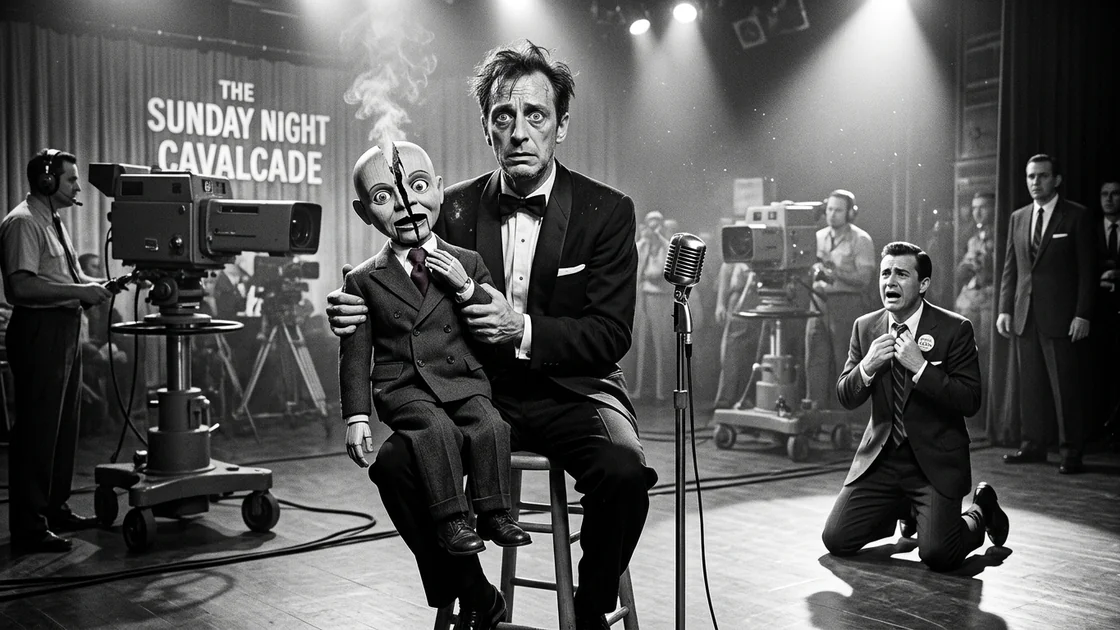
Silas Vane was a quiet master carpenter in upstate New York who was wrongfully convicted and executed for the murder of a wealthy lumber baron after his trusted associate, Lawrence Sterling, delivered a perjured testimony in court to conceal his own guilt. Before walking to the electric chair, Silas used his final months on death row to carve a ventriloquist dummy from a block of seasoned basswood taken from the scene of the crime, pouring his grief and obsession with the truth into the hollow resonance of its wooden skull. Eight years later, a desperate and failing Manhattan ventriloquist named Leo Kestrel purchases the uncanny figure from a dusty theatrical curio shop, unaware of its dark origins. The dummy revitalizes Leo's career and lands him a coveted spot on a prestigious coast to coast live television variety broadcast, where Lawrence Sterling happens to be the evening's guest of honor as a rising political candidate. Under the blinding studio lights and before an audience of millions, the wooden figure overrides its operator and speaks with the exact voice of Lawrence Sterling, reciting the perjured testimony and forcing the real killer to confess his crimes to the entire nation.
The sawdust in Silas Vane’s workshop never truly settled; it hung in the slanted afternoon light like pulverized amber, smelling of turpentine, wintergreen, and the slow, patient death of ancient trees. Silas was a man who understood the world almost entirely through its grain. Where other men heard only wind in the high canopies of the Adirondacks, Silas heard the distinct, dry rattle of white ash, the heavy sigh of eastern hemlock, and the muted, whispering gossip of basswood. He was forty-two years old in the autumn of 1953, a bachelor with knuckles permanently swollen from the mallet and fingernails crescents of dark walnut stain. He spoke so seldom that the townspeople of Blackbriar often forgot the sound of his voice between the seasons, remembering him only when a church pew split in the winter freeze or when a wealthy family required a mantelpiece carved with acorns and tangled vines that looked as though they might burst into leaf come April.
Silas did not mind the silence. Silence was the natural state of timber after the saw had done its screaming. He believed that wood possessed a long and unforgiving memory. Every drought the sapling had endured was recorded in the tight, choked closeness of its summer rings; every lightning strike was preserved in a ribbon of char buried deep beneath the living bark; every twist of the prevailing wind remained locked in the tension of the fibers, waiting decades to warp a poorly planed board. You could not lie to a piece of wood, Silas often thought as he drew his spokeshave along a length of maple. If your hand trembled, the blade chattered and left a ridge. If your heart was impatient, the chisel split the cheek of the mortise. Truth was simply a matter of following the grain wherever it insisted on going.
It was this reverence for the material that had brought him into the employ of Harlan Mercer, the aging patriarch of the Mercer Timber and Milling Company. Mercer owned forty thousand acres of virgin hardwood along the Black River and three sawmills that roared from dawn until the stars came out. Though Mercer was a hard man who measured human beings in board-feet and profit margins, he had a grudging respect for Silas. Whenever the logging crews felled a tree of rare perfection—a bird’s-eye maple without a blemish, or a linden tree whose heartwood was as pale and soft as sweet cream—Mercer would have the prime butt-log hauled not to the ripping saws, but to the low stone cottage behind Silas’s yard.
On the night of October fourteenth, a cold rain was blowing down from Canada, stripping the last rusted leaves from the oaks. Silas was at his bench, working by the yellow glow of a single kerosene lamp, fitting a set of brass hinges to a cellarette commissioned by Judge Caldwell. The tall case clock in the corner—carved by Silas’s grandfather out of black cherry—had just struck ten when the frantic hammering began at his shop door.
When Silas drew back the iron bolt, the wind nearly tore the heavy plank door from his grip. Standing on the slick cobbles was Lawrence Sterling, Harlan Mercer’s chief accountant and junior partner. Sterling was thirty, a graduate of a downstate college, who wore tailored worsted suits that looked absurdly out of place among the mud and pitch of a logging town. Tonight, however, his silk tie was twisted beneath his ear, his pale hair was plastered to his forehead, and his camel-hair coat was soaked dark at the shoulders.
"Silas," Sterling gasped, his chest heaving as he pressed a gloved hand against the doorframe. Even in panic, Sterling possessed a remarkable voice. It was the first thing anyone noticed about him—a rich, cultivated baritone, resonant as a cello, with a slight, patrician cadence that made every trivial observation sound like an edict from a high court. "Silas, you have to come to the main yard. Immediately. The lock on the counting-house safe has jammed, and the old man is inside having one of his spells. We can't get the heavy timber door open from the corridor—the damp has swollen the oak jamb. Bring your irons and a heavy chisel."
Silas did not question him. He was a tradesman summoned to a task. He reached for his oiled leather tool roll, slipped his favorite two-inch firmer chisel—the one with the boxwood handle he had turned himself and marked with his initials—into his apron pocket, pulled an oilskin slicker over his shoulders, and followed Sterling out into the blinding rain.
They did not walk together. Sterling hurried ahead, claiming he needed to flag down the night watchman at the river gate. By the time Silas trudged through the ankle-deep mud of the lower lumber yard, past the towering, tarpaulin-draped stacks of drying pine that loomed like dark cathedrals against the storm, Sterling was nowhere to be seen. The counting-house stood at the edge of the mill pond, a squat brick building with a single yellow light burning behind the frosted glass of Harlan Mercer’s private office.
The outer door was not jammed at all; it stood three inches ajar, groaning softly on its hinges as the wind worried it.
"Mr. Mercer?" Silas called out, his voice rusty from disuse. He stepped inside, water dripping from the brim of his hat onto the braided rag rug. "Mr. Sterling?"
He pushed open the inner oak door. The smell hit him before the sight did—not the familiar scent of ledger paper and cigar smoke, but the thick, coppery stench of a slaughterhouse. Harlan Mercer lay slumped beside the cast-iron safe, which stood wide open and entirely empty of the weekly payroll. The old man’s skull had been crushed by a heavy, square-edged instrument. Beside his outstretched hand lay a jagged billet of seasoned basswood, dark with clotted blood, and next to it—Wait. Silas had not yet reached into his pocket, yet as he looked down, his breath froze in his throat.
He reached into his apron. The two-inch firmer chisel was gone. He remembered then, with a sickening lurch of his stomach, how Sterling had stumbled against him on the narrow footbridge over the sluiceway, gripping Silas’s waist to steady himself on the wet planks.
There on the Persian carpet, three inches from Mercer’s spectacles, lay Silas’s boxwood-handled chisel. The blade had been used to pry open the inner cash drawer of the safe, snapping the steel tip cleanly in half, and the handle was smeared with red.
Before Silas could even kneel, the frost-glass window behind the desk shattered inward—or rather, the street door banged wide—and three men burst into the room. Leading them was Sheriff Garrett, shotgun leveled, and right behind the sheriff’s shoulder was Lawrence Sterling. Sterling had shed his wet camel-hair coat; he wore a dry tweed jacket now, and his hair had been hastily combed.
Sterling pointed a trembling finger at Silas, who stood alone over the corpse in the lamplight, dripping rain and holding his leather tool roll.
"There!" Sterling cried out, that magnificent, bell-like baritone ringing off the plaster walls with theatrical horror. "Good God in heaven, Sheriff, I told you! I saw him running toward the counting-house when I drove past the gate!"
Silas opened his mouth to speak, to explain about the knock at his door, the swollen jamb, the stumble on the footbridge. Being a man who measured his words the way he measured dovetails—taking ten minutes to be sure of the line before making a single cut—he was too slow. By the time his tongue found the shape of the truth, the narrative had already been planed, jointed, and nailed shut by a man who worked exclusively in words.
The trial in the county seat of Watertown lasted only four days in early December. Outside the tall arched windows of the courthouse, snow fell in thick, soundless sheets, muffling the world in white while twelve farmers and shopkeepers sat in the mahogany jury box, listening to the music of Lawrence Sterling’s voice.
Silas sat at the defense table in his Sunday woolens, his large, scarred hands resting flat and motionless on the blotter. His court-appointed attorney was a young man named Henderson, whose mind was mostly occupied by an upcoming divorce proceeding and who viewed Silas’s habitual silence as the sullen obstinacy of a guilty peasant.
When Lawrence Sterling took the witness stand on the afternoon of the second day, the courtroom grew so still that Silas could hear the steam hissing in the cast-iron radiators along the wainscot. Sterling looked the very picture of bereaved rectitude. He wore a mourning band of black grosgrain around the sleeve of his charcoal suit. When he placed his hand upon the Bible, his fingers were long, pale, and entirely steady.
"Mr. Sterling," the District Attorney began, pacing slowly before the rail, "would you tell the jury what transpired between the deceased, Mr. Mercer, and the defendant, Silas Vane, on the afternoon preceding the murder?"
Sterling looked toward Silas with an expression of profound, almost brotherly sorrow. Before he spoke, he performed a small habit Silas had never noticed before: he cleared his throat twice—a soft, dry ahem-hem—and touched the knot of his silk necktie with his thumb and forefinger.
"It pains me to speak of it," Sterling began, his baritone dropping half an octave into a register of intimate tragedy. It was a voice that made the jurors lean forward in their oak chairs, wanting to be worthy of its confidence. "Silas Vane had done work for Mr. Mercer for ten years. We all knew him to be a solitary man, perhaps a bit peculiar in his attachment to his craft, yet none of us suspected the depth of his resentment. That afternoon, Mr. Mercer discovered that several loads of prime black walnut had vanished from the upper drying sheds. He confronted Vane in my presence. Vane had been losing money—bad debts down in Utica, so Mr. Mercer believed. When Mr. Mercer threatened to call the magistrate if the timber wasn't accounted for by Friday, Vane grew terrifyingly quiet. He held a heavy gouge in his hand, and he said to Mr. Mercer, 'A man who takes the wood from beneath my hands won't live to see it seasoned.'"
Silas stared at the witness box. Every single word was an invention, constructed out of whole cloth without a knot or seam showing. There had been no missing walnut. There were no debts in Utica; Silas kept four hundred dollars in a tin coffee can beneath his floorboards and had never owed a penny to any living soul.
"And later that night?" the prosecutor prompted gently.
Ahem-hem. Sterling’s thumb brushed his silk knot.
"I had returned to the mill yard at ten-fifteen to retrieve my briefcase, which I had forgotten in the outer office," Sterling testified, his eyes glistening in the grey winter light filtering through the high windows. "As I approached the counting-house through the rain, the light was on. I looked through the lower pane of the window, where the frosting had worn away near the sill. I saw Silas Vane standing behind Harlan Mercer. I saw him raise a heavy billet of four-by-four basswood—one of the carving blocks Mr. Mercer kept in the corner for him—and bring it down twice upon Mr. Mercer’s head. I heard the sound of the bone through the glass. Then I saw him take his own two-inch chisel from his leather apron and force the inner drawer of the safe, taking the canvas payroll bag containing eleven thousand dollars."
"Why did you not intervene, Mr. Sterling?"
Sterling lowered his gaze to his folded hands, a gesture of humble confession that won every heart in the room. "I am ashamed to say I was paralyzed by terror, sir. Vane is a man of immense physical strength in the arms and shoulders. He had a blade in his hand and blood on his cuffs. I ran straight to the telephone box at the corner of Mill Street and summoned Sheriff Garrett."
From the defense table, Silas did not shout. He did not curse. Instead, he listened with the detached, terrible concentration of a master craftsman examining a counterfeit chest of drawers. He listened to the pitch and timber of Sterling’s voice. He noticed how, when the lie grew particularly elaborate, Sterling’s breath caught ever so slightly on the intake—a tiny, whistled sibilance through the left nostril—before the rich baritone smoothed it over like French polish over cheap pine. He noticed the exact cadence, the musical rise at the end of a clause, the theatrical pause before a damning noun.
When Silas took the stand the following morning, his own voice sounded to the jury like a rusty saw hitting a hidden nail. He spoke in short, flat sentences. He had no polish. When the prosecutor asked him why his bloodied chisel was beside the body, Silas explained about the footbridge. When asked why no one had seen Sterling at his cottage door, Silas could only say it had been raining hard. The police had searched Silas’s workshop and found eleven hundred dollars of the missing payroll stuffed inside a hollow newel post in the back corner—a corner just beneath a loose casement window that anyone could have pried open from the alley while Silas was being booked at the county jail. The rest of the ten thousand dollars was never found, though anyone who looked closely at Lawrence Sterling’s accounts in Boston might have noticed that his catastrophic margin debts with a brokerage firm there had been settled in cash three weeks after the funeral.
No one looked at Boston. The jury deliberated for forty-eight minutes, thirty of which were spent eating a lunch of roast beef sandwiches provided by the bailiff.
When the foreman read the verdict, Lawrence Sterling sat in the front row of the gallery beside Harlan Mercer’s weeping sister, whom Sterling had already convinced to sign over power of attorney for the entire Mercer Timber empire. Sterling looked across the bar at Silas, and for a fraction of a second, the mask of sorrow slipped. His eyes were as flat and cold as river ice.
Silas looked back at him, his gaze dropping from Sterling’s eyes to his throat—to the pale column of flesh above the white collar where that magnificent, murderous voice lived.
At Clinton Correctional Facility in Dannemora, and later in the stone bowels of Sing Sing while the automatic appeals ground toward their inevitable failure, Silas Vane was the quietest resident the death house had seen in thirty years. He did not pace his cage. He did not weep in the night when the dynamos hummed during test runs, dimming the corridor bulbs to a bruised orange glow.
Warden Arthur Miller was an old prison man who had seen four hundred men walk through the little green door. He knew the difference between a killer who had made peace with his sins and an innocent man whose shock had calcified into something beyond human reach. The warden also happened to be an amateur woodturner who kept a lathe in his basement, and he had seen photographs of the pulpit Silas had carved for the Methodist church in Watertown.
Four months before the date set by the Governor, Warden Miller stood outside Silas’s mesh door.
"The chaplain says you won't take the Bible, Vane," the warden said, puffing on a briar pipe. "And the doctor says if you don't find something to do with those hands of yours, you're going to tear the mortar out of the bricks in your sleep."
Silas looked down at his thumbs. In the absence of wood, he had been unconsciously miming the motion of a gouge against the rough wool of his prison trousers for twelve hours a day, wearing two white holes right through the knees.
"I have a piece of basswood in my property box," Silas said quietly. It was the longest sentence he had spoken in three weeks. "Not the one from the evidence locker. The other half of the flitch. The sheriff took it from my bench when they searched the shop for the money. It came from the old linden tree that grew by the mill pond—ten yards from where Mr. Mercer died. They cleared my shop to pay the court costs, but the clerk couldn't sell a raw block of wood. It's sitting in the basement here with my personal effects."
Warden Miller frowned through a cloud of blue tobacco smoke. "I can't give a condemned man steel chisels, Vane. You know the rules. You'd open your wrists before morning, or take a guard's eye out."
"Grind the tangs down to an inch," Silas said, his dark eyes steady on the warden’s face. "Set them in round cork handles so I can't get leverage for a thrust. Give me a blunt wooden mallet and two sheets of garnet paper. Let a guard sit outside the bars while I work, and take the steel back every evening at five o'clock. I have no desire to bleed on the floor, Warden. If I die before my date, nobody will finish the work."
Perhaps it was professional curiosity, or perhaps it was the uneasy knowledge that the Watertown case had been rushed through before an election year, but Warden Miller relented. Two days later, two trusties lugged a forty-pound block of air-dried American basswood into Cell 4. It was three feet long and fourteen inches square, pale as tallow, with a faint, sweet smell of dried honey and pond mud still clinging to its rough-sawn ends.
Silas did not sketch a pattern. For three days he merely sat on his iron bunk with the block between his knees, pressing his ear against the end-grain as if listening for a heartbeat inside the timber.
When he finally began to cut, the guards on the death tier found themselves hypnotized. Silas worked with a terrifying, rhythmic precision. Tap-tap-shave. Tap-tap-shave. White curls of wood, thin as onion skin, drifted down around his gray prison slippers until the concrete floor looked as though it were covered in fallen magnolia petals.
"What is it, Vane?" asked Officer Boyle, a heavy-set Irishman who spent the afternoon shifts sitting on a stool outside the bars with a newspaper across his knees. "A saint? You making a statue of Saint Joseph for the chapel?"
"No," Silas said, not looking up as his short-handled gouge curled a delicate hollow beneath a wooden cheekbone. "Saints don't talk."
By the end of the first month, the figure had emerged from the block. It was not a saint, nor was it a portrait of Silas himself. It was the torso, head, and jointed limbs of a ventriloquist’s dummy, roughly the size of a ten-year-old boy, yet possessing the sharp, aristocratic bone structure of a grown man in his prime. The nose was long and straight, the brow high and smooth, the chin slightly cleft.
Yet it was the head that occupied Silas for the remaining ninety days of his life.
He split the cranium cleanly behind the ears along an invisible hair-line joint and began to hollow the interior. A normal puppet maker would have cleared the space crudely with an auger bit just enough to fit the wooden post, the leather hinges for the jaw, and the wire pulls for the winking eyelids. Silas did nothing of the sort. Using tiny, bent-shank rifflers and folded corners of sandpaper, he carved the interior of the wooden skull into a labyrinth of wafer-thin acoustic chambers.
He knew how sound traveled through cellulose. His grandfather had made fiddles during the long northern winters, and Silas knew how the spruce belly of an instrument could amplify the scrape of horsehair into a cry that filled a barn. Inside the dummy’s head, running from the base of the hollowed throat up behind the palate and into the sinus cavities behind the nose, Silas carved spiral fluting and tiny, vibrating reeds of split white pine no thicker than a dragonfly’s wing. He shaped the interior of the mouth like the bell of an oboe.
As he worked in the dead of night—using only his fingernails and a scrap of sandstone after the guards had locked away the steel tools—Silas whispered into the open skull.
He did not whisper his own prayers. He closed his eyes, remembered the four days in the Watertown courtroom, and reproduced the sound that had killed him.
"Ahem-hem," Silas breathed into the resonant wooden dark, forcing his own rough vocal cords to mimic the exact frequency, the precise sinusoidal wave of Lawrence Sterling’s patrician baritone. He tuned the tiny wooden reeds inside the dummy’s throat the way a piano tuner adjusts a pin, scraping away a thousandth of an inch of basswood until, when he blew across the throat cavity, the wood itself hummed back with Sterling’s exact pitch. He carved the lower jaw hinge not with leather, which rots and stretches, but with interlocking knuckles of greased boxwood that clicked with the precise rhythm of Sterling’s diction. When he cut his thumb on a sharp edge of the hard palate, he did not wipe the blood away; he rubbed it deep into the pores of the wood with the ball of his thumb, sealing it with linseed oil and his own salt sweat.
On the night of August twelfth, 1954, they came for him at eleven o’clock.
The dummy sat completed upon the iron table in the corner of the cell. Warden Miller had supplied a jar of shellac, a tiny pot of flesh-toned oil paint, and a pair of blown-glass taxidermy eyes originally meant for a fawn, which Silas had ground down on the concrete floor and backed with lead foil until they looked human—a pale, watery gray-blue. The dummy had no clothes, only its pale, jointed wooden limbs laid neatly over its knees, its hands carved with long, steady fingers, the right thumb slightly cocked as if reaching to adjust a silk necktie.
"What do you want done with it, Silas?" Warden Miller asked softly as the guards slit the right leg of Silas’s trousers for the electrode.
Silas looked at the figure. In the yellow light of the cell, the glass eyes seemed to catch the reflection of the bars and bend them.
"Let it go to the state auction with the rest of the unclaimed property," Silas said. His voice was little more than a dry rustle of shavings now. "A man who needs a voice will buy it."
Twenty minutes later, when the electrician threw the switch behind the one-way glass and two thousand volts of alternating current surged through Silas Vane’s body, the lights in the death house dropped to a dull red thread. Back in Cell 4, sitting alone on the iron table, the basswood figure gave a single, sharp tick—the sound of timber settling cleanly into its final season.
Seven years later, in the damp and glittering autumn of 1961, Leo Kestrel was dying on his feet at the Coconut Grove Lounge in Queens.
He was not dying of anything medical, unless one counted chronic poverty and a diet consisting primarily of automat coffee and cold pastrami ends. He was dying the way vaudevillians and nightclub comics died when the world changed its mind about what was funny. The room smelled of stale beer, damp wool overcoats, and the floral disinfectant they used to mop the restrooms at four in the afternoon. Thirty people sat at the small round tables, most of them talking loudly over Leo’s routine while a busboy in a stained white jacket cleared shrimp cocktail glasses with a deafening clatter.
"So I said to the landlord," Leo projected, smiling so hard his molars ached while keeping his lips locked in the rigid, quarter-inch aperture required for the craft, "I said, 'Mr. Fineman, the plaster in my bedroom fell down last night!'"
Perched on Leo’s left knee was Barnaby, a papier-mâché figure Leo had bought second-hand in Toledo in 1949. Barnaby had a bulbous red nose, painted freckles the size of dimes, and a shock of orange mohair that looked as though a cat had nested in it. When Leo pulled the thumb-trigger on the control stick inside Barnaby’s frayed plaid jacket, the dummy’s lower jaw dropped with a loud, hollow clack that could be heard in the third row.
"The plaster fell down?" Leo squeaked in his strained, nasal falsetto, bouncing Barnaby’s head frantically to cover the fact that his own Adam's apple was bobbing like a cork in a bucket. "What did you do, Leo? Call the union?"
"No," Leo said, wiping a bead of flop-sweat from his temple with his free hand. "I just put a blanket over it and charged it half the rent!"
Silence. Not even the polite, pitying chuckle of a drunk in the back booth. Only the shhk-shhk of the bartender shaking a Manhattan and a woman at a corner table asking her husband if he had remembered to turn off the porch light in Hempstead.
Leo cut his twelve-minute set to eight, stuffed Barnaby head-first into a battered fiberboard suitcase behind the velveteen curtain, and collected his fifteen dollars from the manager, who didn't bother to look up from the racing form.
When Leo stepped out into the alley behind Northern Boulevard, the rain was coming down in a cold, greasy drizzle. Waiting under the awning of a closed dry cleaner across the street, chewing on an unlit cigar, was Marty Gable. Marty was sixty-five, wore a homburg hat that had seen the Hoover administration, and represented fourteen variety acts, eleven of which were currently working as elevator operators or night clerks.
"You're bleeding from the throat, kid," Marty said as Leo sloshed across the puddles with the fiberboard suitcase banging against his shin. "I stood in the back by the cigarette machine. Every time you went into the 'G' and the 'B' consonants, your mouth looked like a goldfish eating bread. And that doll—for crying out loud, Leo, the left eye is stuck halfway down. He looks like he had a stroke on the BMT."
"The spring broke in Yonkers," Leo said miserably, turning up his trench coat collar. Leo was thirty-four, thin, with dark circles under his eyes and the perpetually bruised expression of a man who was actually quite funny at two in the morning when he was alone, but turned to wood the moment a spotlight hit him. "I tried to fix it with a rubber band, Marty, the tension isn't right. What are you doing out in Queens? You never come past the bridge unless somebody died."
Marty took the soggy cigar out of his mouth and stared at it with distaste. "Somebody did, practically. Danny Foster broke his collarbone slipping on the steps at Penn Station two hours ago. He was booked for the novelty slot on The Sunday Night Cavalcade next week."
Leo stopped dead beneath a flickering neon sign that read TAILORING & FURS. His heart gave a painful, erratic thud against his ribs.
The Sunday Night Cavalcade, hosted by Dickon Vance out of the old Majestic Theater on Fifty-Fourth Street, was not just a television show. It was the secular church of American Sunday evenings. Thirty-five million people watched it live from coast to coast. If you did six good minutes on Vance’s stage, you went from fifteen dollars a night in Queens to fifteen hundred a week at the Sands in Las Vegas and the Chez Paree in Chicago.
"You got me an audition?" Leo whispered.
"I got you four minutes in front of Artie Kaufman, the talent coordinator, this Thursday at two o'clock," Marty said, poking a thick, nicotine-stained finger into Leo’s chest. "Because Kaufman owes me a favor from the Catskills in 'fifty-two, and because all the real vent acts are out on the coast doing the Shriner conventions. Listen to me, Leo. You walk into Studio B with that chewed-up piece of cardboard in that suitcase, Kaufman will have the page boys throw us both down the freight elevator shaft. Your material is ten years old, your dummy looks like firewood, and your breathing is shot because you're nervous. Go down to Fourth Avenue tomorrow morning. Borrow fifty bucks from your sister if you have to. Get a new head from one of the theatrical hockshops, write five minutes of snappy topical stuff—talk about the space monkeys, talk about the traffic, I don't care—and for God's sake, learn to keep your trap shut when the doll is talking."
On Wednesday morning, Leo had thirty-eight dollars to his name—the fifteen from Queens, twenty he had pawned his father’s gold pocket watch for on Eighth Avenue, and three singles he had found in the lining of his winter coat.
Fourth Avenue below Fourteenth Street was a canyon of used bookstores and dingy antique shops whose windows were piled high with rusted swords, cracked porcelain washbasins, and yellowing bundles of National Geographic. Leo had already tried the two theatrical supply houses near Times Square; a decent custom-made Marshall figure with full eye-and-lip mechanics cost three hundred dollars minimum, and even their rental stock started at seventy-five with a deposit he couldn't cover.
He found M. Asher’s Curiosities & Estates purely by accident, ducking into its recessed doorway to escape a sudden gust of wind that threatened to turn his cheap umbrella inside out.
The shop was narrow, dark, and smelled intensely of camphor, old horsehair stuffing, and damp cellar brick. Narrow aisles wound between precarious towers of Victorian birdcages, tarnished brass telescopes, and dressmakers’ mannequins that stood like headless ghosts in the gloom. At the very back, beneath a green-shaded banker’s lamp, an old man in a black cardigan was repairing the movement of a mantel clock with a jeweler’s loupe wedged in his eye socket.
"Do you have any theatrical props?" Leo asked, his voice echoing oddly in the cramped space. "Specifically figures. Puppets. Ventriloquist dummies."
The old man didn't look up from his escapement wheel. "Third aisle left, on the floor behind the ship’s binnacle. Don't knock over the milk glass."
Leo squeezed sideways between a stuffed badger and a stack of walnut picture frames. Behind a tarnished brass compass housing sat an oblong wooden box, roughly three feet long, constructed of rough pine boards stenciled with faded black government lettering: NYS DEPT. OF CORRECTION – LOT 409 – UNCLAIMED.
The iron hasp was unlatched. Leo knelt on the dusty floorboards and lifted the lid.
Lying on a bed of gray excelsior packing shavings was the figure.
Leo had been around carvers and prop-makers since he was sixteen, and the breath went right out of him. It was dressed in an ill-fitting, moth-eaten black boy’s confirmation suit that someone—likely an auction dealer—had thrown on it to make it presentable, and its head was entirely bald, smoothly sanded and finished with a clear, amber varnish that let the fine, tight grain of the wood show through like the pores of living skin.
Leo reached in with both hands and lifted it out.
It was heavier than Barnaby—dense, solid, balanced with an uncanny center of gravity that made it settle against Leo’s crooked left arm not like a dead weight of lumber, but like a sleeping child adjusting its posture to be carried. The face was extraordinary. There was nothing comic about it. No bulbous nose, no idiotic grin painted at the corners of the mouth. The features were handsome, almost patrician, with high, shadowed cheekbones and a long, straight nose. The glass eyes—a pale, wintry gray-blue—did not stare blankly ahead; they were set at such a subtle convergence that wherever Leo moved his head, the figure seemed to be studying his chin with quiet, mild amusement.
Trembling slightly, Leo unbuttoned the cheap wool jacket at the back and slipped his right hand into the cavity between the shoulder blades to grasp the control stick.
Usually, a control post was a simple broomstick dowel fitted with brass bicycle-brake levers. When Leo’s fingers closed around this post, he felt no metal. The post itself was carved to fit the exact anatomical hollow of a human palm, with four shallow flutes for the fingers and a thumb-depression worn smooth as river stone.
Leo pressed his thumb down gently.
The jaw did not clack. It opened with the silent, velvet fluidity of an oiled hinge. Simultaneously, through some linkage Leo couldn't fathom without a separate lever, the upper lip curled slightly—just a sixteenth of an inch—revealing a row of carved ivory-colored teeth, while the eyebrows rose in an expression of polite inquiry. When he tilted the post a fraction to the left, the glass eyes slid smoothly toward him, the eyelids dipping into a slow, knowing wink.
"How much?" Leo called out, standing up so quickly he nearly clipped a hanging kerosene chandelier with his shoulder.
Asher finally removed the loupe from his eye and squinted over the tops of his spectacles as Leo carried the figure toward the counter. A flicker of distaste crossed the old dealer’s face.
"That thing," Asher murmured. "I bought a blind estate lot from a surplus broker in Albany three years ago. Watches, eyeglasses, rings, and that box. Never liked having it on the floor. The eyes catch the streetlamp at night when I'm locking up."
"What do you want for it?" Leo repeated, clutching the dummy tightly against his ribs. His right hand was still inside the back; the basswood felt strangely warm, as though it had been sitting near a radiator, though the back of the shop was freezing.
"Forty," Asher said.
Leo pulled out his wallet and emptied it onto the glass counter—a twenty, a ten, a five, and three crumpled ones, followed by a handful of silver change amounting to sixty-five cents. "It's every dime I have in the world, Mr. Asher. Leave me the fifteen cents for the subway token uptown and you'll never see it again."
The old man looked from the pile of bills to the pale wooden face resting against Leo’s trench coat. In the green glow of the banker’s lamp, the dummy’s slight, carved smile looked almost triumphant. Asher reached out, swept the paper money into his drawer, and pushed the coins back across the glass.
"Take the box too," Asher said, putting the loupe back in his eye. "I don't want the shavings in here."
Leo lived in a fourth-floor walk-up on West Forty-Seventh Street, a single room with a Murphy bed, a hot plate, and a window that looked out onto the brick airshaft of an adjacent tenement.
That afternoon, he set Barnaby’s battered suitcase in the hallway closet and placed the new dummy on a wooden chair opposite the cracked wardrobe mirror. He went down to the corner haberdashery and traded his good winter overcoat—he still had his trench coat, after all—for a boy’s size-fourteen charcoal gray double-breasted suit, a crisp white shirt, and a narrow burgundy silk tie.
When he dressed the figure and tied the silk knot beneath the wooden chin, the transformation was startling. The dummy looked less like a toy and more like a miniaturized senator, or a bank president reduced by some dark parlor trick to thirty-six inches of timber.
"You need a name," Leo said aloud to the empty room. "Something classy. Something for the marquee. Julian? No. Victor? How about Mr. Sterling? No, wait—Sterling is that rich guy running for the Senate on the posters in the subway. Let's call you Arthur."
Leo sat down on the edge of the bed, lifted Arthur onto his knee, and slipped his hand inside the jacket.
First, he wanted to see how the mechanics worked so he could oil them if necessary. He felt around the base of the neck for the brass thumb-screw or latch that usually released the back panel of a dummy’s skull. There was none. The hair-line seam behind the ears was held together by an internal wooden spring-catch tucked just beneath the occipital ridge. When Leo pressed it, the back half of the skull slid downward an inch and came free in his hand.
Leo stared into the head, his brow furrowing.
He had expected lead weights, piano wire, and leather loops. Instead, by the gray light of the airshaft window, he was looking into what appeared to be the cross-section of a wooden sea-shell, or the interior of an ancient church organ. Dozens of paper-thin baffles and spiral channels had been gouged and sanded into the pale basswood, leading down into a throat tube that was ribbed like a human trachea. Tiny slivers of wood, thin as eyelashes, were cantilevered across the air passages. Dark stains—brown and rusted, like dried varnish or old blood—marbled the raw wood around the mouth cavity.
"Who the hell made you?" Leo whispered. "Stradivarius?"
When his breath brushed across the open back of the skull, the tiny cantilevered reeds inside vibrated with a faint, ghostly hum—a chord in a minor key that made the fine hairs on Leo’s forearms stand straight up. Quickly, he slid the rear plate back into its dovetail tracks until it clicked shut with a solid snick.
He turned toward the wardrobe mirror, took a deep diaphragmatic breath, locked his jaw into the ventriloquist’s mask, and began to run through his routine.
"Well, Arthur, how do you like New York?" Leo said in his natural voice—a thin, slightly reedy tenor.
Then he depressed his thumb on the internal post and threw his voice into his chest cavity to produce the dummy’s reply. He intended to use a lower, gruff voice to contrast with Barnaby’s old squeak.
What came out of the air between them made Leo’s eyes fly wide in the mirror.
"New York is a magnificent market, Leo, provided one knows which ledgers to burn before the auditors arrive."
Leo froze. His heart hammered against his sternum.
He hadn't written that line. It wasn't in his notebook on the bed. More terrifying still was the sound of it. It had not come from Leo’s throat—or rather, it had used the air from Leo’s lungs, for he felt the sudden, exhausting emptiness beneath his ribs, yet as the sound had vibrated up through his chest, down his right arm, and into the wooden post, it had been entirely reshaped.
The voice that had filled the small room was a rich, resonant, patrician baritone. It had the velvet authority of an actor trained in London, carrying a slight, cultivated drawl that dropped half an octave at the end of the sentence. And sitting in front of the mirror, Leo swore that his own lips had not parted by a hair's breadth, yet the sound had originated unmistakably from a point eighteen inches to his left—right between the carved basswood lips of the figure on his knee.
"How did I do that?" Leo breathed, staring at his reflection.
He tried again. He cleared his throat—curiously, he felt an urge to do it twice, ahem-hem—and asked the mirror, "What do you think of the Kennedy administration, Arthur?"
He pressed the thumb lever. He didn't even consciously form words in his mind this time; he merely pushed a column of air up from his diaphragm and let his fingers dance over the wooden flutes of the control stick, which seemed to twitch and guide his tendons of their own accord.
"Politics is merely lumber on a grander scale, my boy," the velvet baritone purred, while the wooden head turned smoothly toward Leo, one carved eyebrow arching as the glass eyes glinted. "You fell the tall trees in the dark, you float them down the river while the town is asleep, and by morning, nobody remembers who owned the forest."
Leo burst out laughing—a sharp, slightly hysterical sound. It was brilliant. It was cynical, sophisticated, Noël Coward meets the Algonquin Round Table. In his exhaustion and desperation over the upcoming audition, his subconscious mind must have unlocked some deep reservoir of wit and vocal technique he had been suppressing for fifteen years with cheap slapstick jokes. And the acoustics of the hollow wooden head! That nameless carver had built a mechanical resonator that took Leo’s thin tenor and bounced it through those basswood chambers until it emerged like a cello!
For the next six hours, Leo did not eat, did not turn on the lamp as twilight gathered in the airshaft, and did not take his hand out of the dummy’s back. He sat in the darkening room in front of the gray mirror, conversing with the wood. The more they talked, the less effort Leo had to expend. By midnight, his right arm felt numb from the elbow down, cold as river mud, as if the circulation had merged with the dry grain of the control post, while the baritone voice grew richer, smoother, and more effortlessly devastating with every passing hour.
At two o’clock on Thursday afternoon, Artie Kaufman sat in the third row of Studio B at the network building on Sixth Avenue, nursing a paper cup of black coffee and a bad case of indigestion. Beside him sat Marty Gable, who was sweating through his shirt collar before Leo had even walked out from the wings.
When Leo stepped into the white circle of the work-light carrying the figure, Marty actually took the unlit cigar out of his mouth and blinked.
Leo had slicked his hair back and borrowed a decent dark suit from the guy down the hall who played clarinet in a society band, yet nobody looked at Leo. Your eyes went immediately to the dummy. In the double-breasted charcoal suit and burgundy silk tie, with its pale, unpainted wood gleaming like old ivory under the klieg light, it looked eerily alive. Before Leo even sat down on the high wooden stool, the dummy’s head pivoted slowly on its brass-and-boxwood neck ring, scanning the empty rows of velvet seats before settling its pale gray-blue eyes directly on Artie Kaufman.
The dummy’s right hand—which wasn't even supposed to be articulated, though Leo’s left hand was resting near its elbow—seemed to brush the knot of its burgundy tie.
Ahem-hem.
The sound was so dry, so human, and so remarkably resonant in the cavernous studio that Kaufman looked up from his clipboard, thinking an executive had walked up the aisle behind him.
"Good afternoon, Mr. Kaufman," Leo said nervously, his natural voice trembling slightly. "This is Arthur."
The dummy turned its head toward Leo, its carved upper lip lifting in a look of profound, weary condescension.
"Do try not to grovel, Leo," the baritone voice rolled out across the footlights—deep, effortless, and crystal clear. "A man sitting in the dark drinking cold coffee out of a wax cup is hardly Lorenzo de' Medici."
Kaufman’s jaw dropped slightly. Then, despite himself, a sharp bark of laughter escaped him. He leaned forward, squinting fiercely at Leo’s face. Leo was smiling a tight, polite, apologetic smile; his lips were pressed together like a sealed envelope, his throat entirely motionless.
"Excuse him, Mr. Kaufman," Leo apologized, playing the straight man with a natural timidity he didn't even have to fake. "He's been reading the Wall Street Journal in the subway again."
"Only the obituaries, Leo," the dummy replied smoothly, pivoting back to Kaufman and dropping its voice half an octave into an intimate, conspiratorial purr. "I find it comforting to see how many self-made men eventually runs out of other people's money. Tell me, Mr. Kaufman—is the network still paying you in stock options, or have they switched entirely to broken promises?"
For four minutes, Leo barely said twenty words. He didn't need to. The dummy roasted the network, the sponsors, the cold war, and Leo’s own threadbare wardrobe with the ruthless, patrician grace of a corrupt aristocrat holding court at a dinner party. Every pause was perfection. Every slight tilt of the basswood chin carried more theatrical weight than a dozen Broadway actors waving their arms.
When Leo stood up at the four-minute mark and gave a slight bow, the studio was dead silent for three seconds. Then Artie Kaufman stood up and clapped his hands together slowly.
"Marty," Kaufman said, never taking his eyes off the wooden figure resting on Leo’s crooked arm, "where the hell have you been hiding this guy? That voice—it doesn't even sound like it's coming out of the same zip code as the kid. And the mechanics on that head... is that remote-controlled? Have you got batteries in the trunk?"
"Pure craft, Artie," Marty Gable said, recovering his composure fast enough to relight his cigar with a flourish. "Five years in the woodshed perfecting the act. The kid's an artist."
"He's in," Kaufman said, scribbling rapidly on his clipboard. "Sunday night. Eight-forty slot, right after the commercial break for Continental Motors and right before Dickon does the sit-down interview with Lawrence Sterling. Seven minutes, live. Two-fifty scale, and if he kills like he just did, we'll hold him over for the November sweep."
As they walked out toward the elevators, Marty slapped Leo on the back hard enough to make him stumble. "Lawrence Sterling! You hear that, kid? The biggest timber millionaire in the state, front-runner for the governor's mansion next year! Every newspaper guy from Albany to Washington is gonna be watching this broadcast on Sunday! You're made!"
Leo nodded numbly, trying to smile. His right hand was still tucked inside the back of the dummy’s charcoal jacket. He hadn't taken it out during the entire conversation in the aisle because, for three terrifying minutes after the routine ended, the carved flutes of the wooden control stick had contracted ever so slightly around his knuckles, refusing to let his fingers slide free until they reached the lobby.
Between Thursday night and Sunday afternoon, Leo Kestrel did not sleep for more than twenty minutes at a stretch.
His tiny room on West Forty-Seventh Street had grown unbearably stuffy, smelling no longer of boiled cabbage from the third floor, but of river mud, wet pine bark, and something metallic and sharp, like ozone before a summer thunderstorm or copper pennies held too long in a sweaty palm.
He tried to write a script for Sunday night’s seven-minute spot, sitting at his rickety table with a yellow legal pad, while Arthur sat upright on the bed opposite him, propped against the pillows in his charcoal suit. Yet every time Leo tried to rehearse a standard joke about television commercials or the Dodgers moving to Los Angeles, his throat would constrict until he gagged. He could only breathe easily when he stopped trying to lead and simply let his mind go blank.
On Friday night, at three in the morning, Leo woke with a start in the pitch dark.
The Murphy bed was creaking, though Leo wasn't moving. And from the wooden chair by the window came the sound of a voice—so soft it was barely louder than the hissing of the radiator valve, yet unmistakable in its rich, cultivated cadence.
"...fourteenth of October, Your Honor. A terrible night. The rain had swollen the sluice gates along the Black River..."
Leo bolted upright, his heart slamming against his ribs, and yanked the pull-chain on the bedside lamp.
The yellow bulb flared. The dummy sat completely motionless on the chair by the window. Its hands were folded neatly in its lap, its pale wooden face serene, its glass eyes reflecting the naked filament of the bulb.
"The radio," Leo whispered to himself, pressing a shaking hand to his wet forehead. "The guy upstairs left his radio on. Late-night drama."
Yet the building was dead quiet. No muffled music, no hum through the plaster ceiling. Just the distant wail of a police siren over on Tenth Avenue and the faint, sweet smell of freshly shaved basswood hanging in the cold air of the room.
On Saturday, Leo didn't leave the apartment at all. His voice in normal conversation had dropped to a hoarse whisper; whenever the landlady knocked to ask about the rent, he could barely croak through the keyhole that he would pay her on Monday. All his vocal strength seemed to be hoarding itself somewhere deep below his lungs, coiling like a heavy steel spring. When he looked in the bathroom mirror to shave on Sunday morning, his own face looked gaunt, gray, and hollow—like a papier-mâché shell—while his right hand, the hand that worked the stick, looked strangely flushed, the veins standing out dark and thick across the back of the wrist.
The Majestic Theater on Fifty-Fourth Street was a palace of crimson velvet, gilded plaster cherubs, and controlled hysteria.
By seven-thirty on Sunday evening, half an hour before air, the backstage corridors were a tangle of black rubber camera cables, scurrying stagehands with headsets, and chorus girls in sequined feathers stepping carefully over sandbags. Above the stage door, the massive rectangular ON AIR sign hung unlit, waiting for eight o’clock like an executioner’s axe poised in the rafters.
Leo was assigned Dressing Room 11, three flights up near the carpenter’s loft. He didn't stay there. The small, windowless cubicle felt too much like a cell, and the way the dummy sat on the makeup table between the rows of blinding round bulbs made Leo’s skin crawl. At seven-forty-five, dressed in his newly pressed dark tuxedo, Leo carried the figure down the iron spiral staircase to the wings of the main stage.
The studio audience—eight hundred people in their Sunday best, selected from a waiting list six months long—was already seated out beyond the heavy velour curtain, their collective murmur sounding like surf breaking against a seawall. Three massive RCA television cameras with their triple-lens turrets prowled the apron on pneumatic dollies.
Near the stage manager’s desk, surrounded by three network vice presidents in horn-rimmed glasses and two campaign aides carrying leather portfolios, stood a tall man in a tailored charcoal suit.
Leo stopped behind a stack of painted flats, staring.
The man was in his late thirties, handsome in a smooth, patrician way, with silver-blond hair brushed back from a high forehead and a campaign button gleaming on his lapel: STERLING FOR PROGRESS. As Leo watched from twenty feet away, one of the network executives made a deferential joke. Lawrence Sterling smiled, raised his right hand, brushed the knot of his burgundy silk tie with his thumb and forefinger, and cleared his throat twice.
Ahem-hem.
"Well, gentlemen," Lawrence Sterling said, his rich, cello-like baritone carrying effortlessly over the backstage din, "as my late mentor Harlan Mercer used to tell me up in the North Country, you never measure the timber until it's safely through the mill."
Behind the painted flat, Leo’s knees nearly buckled.
He looked down at the figure resting on his left arm. The charcoal double-breasted suit. The burgundy silk tie. The high, smooth brow, the straight nose, the slight, arrogant tilt of the chin. It wasn't a caricature; it was an anatomy lesson. And that voice—the voice Leo had thought he was inventing out of his own buried genius for the past four days—was standing twenty feet away, shaking hands with the president of Continental Motors.
I stole his act, Leo thought wildly, his mind scrambling for a rational foothold in a room that had suddenly tilted on its axis. No, he's not an actor. I must have heard him on the radio! That's it! I heard one of his campaign speeches on the radio in a diner, and I subliminally copied his voice! And the suit—I saw the posters in the subway!
At that moment, Lawrence Sterling turned toward the wings to set his coffee cup on a prop table.
His eyes swept past the stage manager, past the lighting board, and landed on Leo. Specifically, they landed on the pale basswood figure sitting on Leo’s arm.
Sterling froze. The genial politician’s smile did not fade; it seemed to crack like glaze on a dropped plate. The color drained so rapidly from his cheeks that the pancake makeup applied by the network girls stood out in two grotesque orange circles over his cheekbones.
Slowly, as if dragged by an invisible wire, Sterling took three steps away from the network executives and approached Leo in the dim shadow of the wings.
"Excuse me," Sterling said. The magnificent baritone had lost its bottom register; it was tight, breathless. His eyes were fixed not on the dummy’s face, which might have been dismissed as a flattering tribute by a novelty performer, but on the dummy’s exposed left wrist, where the cuff had ridden up an inch to reveal a miniature, interlocking blind-dovetail joint carved with a distinct, scrolled chamfer along the wrist bone.
Only one man in the state of New York had ever cut a chamfer like that. Sterling had seen it on the walnut clock case in Harlan Mercer’s office every day for five years.
"Where," Sterling whispered, the scent of his expensive cologne mixing with a sudden, sharp odor of sour sweat, "did you get that piece of wood?"
Leo swallowed hard. His own tongue felt thick and dry as leather. "Fourth Avenue, Mr. Sterling. An estate shop. I—I didn't mean any offense by the suit, sir, it's just a coincidence—"
Inside the dummy’s back, against Leo’s damp palm, the basswood post gave a faint, rhythmic throb, like an artery.
The dummy’s head did not turn, for Leo kept his fingers rigid, terrified to move a muscle. Yet in the stray blue glare of the backstage monitor, the blown-glass eyes seemed to dilate.
"Take it off the program," Sterling said, spinning toward Artie Kaufman, who had just walked up with a stopwatch around his neck. "Kaufman, I want this man cut from the lineup. Immediately."
Kaufman blinked, glancing at his watch as the five-minute warning buzzer sounded across the stage. "Mr. Sterling, we're four minutes to air! Danny Foster broke his collarbone, I don't have a fill-in for the eight-forty slot! What's the problem? The kid does a high-society bit, it's completely clean, standards and practices cleared it—"
"Get rid of him!" Sterling snapped, his voice rising until two cameraman turned to stare. Sterling caught himself, visibly fighting for control as his thumb jerked up to touch his tie knot. He forced a stiff, trembling laugh. "Forgive me. Pre-broadcast nerves. It’s just—I have a childhood phobia of marionettes. Ridiculous, isn't it? At least keep him on the far side of the stage during his segment."
"You won't even see him, Mr. Sterling," Kaufman assured him, patting the candidate’s sleeve as the orchestra began tuning up in the pit. "He goes on before your intro. Wait in the green room until eight-forty-five, then we'll bring you out to the sofa during the station break while he clears."
Sterling looked one last time at the dummy. The pale basswood face stared straight ahead into the dark curtains. Turning on his heel, Sterling practically fled down the corridor toward the green room, where District Attorney Thomas DeSapio and three reporters from the Herald Tribune were waiting to watch his triumph on the closed-circuit monitor.
At eight o’clock sharp, the red ON AIR signs blazed to life around the studio perimeter like open wounds.
The brass orchestra roared into the theme music, the crimson curtains swept apart, and Dickon Vance strode out to thunderous applause. For forty minutes, the great machine of live network television hummed along its polished tracks. A soprano from the Metropolitan Opera sang an aria from Carmen; a family of Belgian acrobats balanced on chrome poles; two minutes of live commercial copy were delivered beside a revolving turquoise convertible.
Leo stood in the darkness of Stage Left, waiting.
Something was happening to the wood in his arms. It was no longer merely warm; it was hot—feverishly, impossibly hot, as if an electric heating element were buried inside the chest cavity. Through the holes of the carved acoustic chambers behind the neck, a faint smell was rising: scorched white pine, boiled linseed oil, and the sharp, unmistakable tang of burnt hair and copper.
"Stand by, Kestrel," the stage manager whispered, holding up five fingers as the turquoise convertible revolved back behind the scrim. "Stool is set on the center mark. You got seven minutes. When Dickon throws it to you, walk to the mic. Three... two... one..."
Out on the brightly lit apron, Dickon Vance turned toward Camera One, beaming. "And now, ladies and gentlemen, before we sit down with our very special guest, the distinguished businessman and civic leader Mr. Lawrence Sterling—in fact, I see Mr. Sterling has just stepped out into the wings with the District Attorney to watch the rest of the show! Give him a wave, Larry!"
The studio applause sign flashed. Standing just inside the Stage Right archway, surrounded by his aides and the Manhattan District Attorney because the green room air conditioner had failed, Lawrence Sterling raised a hand in a practiced wave, though his eyes darted instantly across the stage toward the opposite wing.
"Before we chat with Larry," Vance continued smoothly, "let's welcome a brilliant young newcomer making his coast-to-coast television debut tonight—Leo Kestrel and his aristocratic little friend, Arthur!"
The stage manager shoved Leo lightly between the shoulder blades.
Leo walked out into the furnace glare of the klieg lights.
Beyond the blinding white rim of the footlights, the audience was a vast, breathing wall of shadows, punctured only by the glowing red tally lights of the three RCA cameras. Leo sat down on the wooden stool at center stage, adjusted the standing boom microphone, and rested the dummy across his left knee.
The moment he sat, a terrible, silent clamp closed around his own throat.
Leo opened his mouth to deliver his opening line—"Good evening, folks, we just flew in from Park Avenue"—and nothing came out. Not a squeak. His vocal cords were completely paralyzed, locked open like a floodgate to let the air rush through his windpipe without touching them. At the same time, his right hand inside the dummy’s back was seized by a cramp so violent that his fingers were locked into the carved wooden grooves of the control post like iron bolts dropped into their sockets.
He couldn't let go. He couldn't stand up. He was no longer the operator; he was merely the bellows attached to an organ built by a dead man.
On Leo’s knee, the basswood dummy moved.
It did not turn toward Camera One. It did not look at Leo. With a sharp, dry crack—the sound of the internal brass stop-pin snapping clean through inside the neck—the wooden head rotated a full eighty degrees to the left, pointing its pale chin directly across the stage toward the Stage Right archway where Lawrence Sterling stood beside the District Attorney.
The dummy’s carved right hand twitched upward, brushing the knot of its burgundy silk tie.
Into the live network microphone, amplified across thirty-five million living rooms from Maine to California, came two soft, dry coughs.
Ahem-hem.
Out in the wings, Lawrence Sterling’s hand flew to his own throat as if he had been shot with an arrow.
"Mr. Sterling," the dummy said.
Wait—for the first two words, it had used the prosecutor's voice from Watertown, a nasal, courtroom baritone, just to set the stage. Then, without a pause, the tiny pine reeds inside the wooden skull shifted their tension, and the voice that poured out of the basswood mouth was Lawrence Sterling’s voice.
It was not an impression. An impressionist captures the quirks and exaggerations of a voice. This was an acoustic duplicate so absolute, so terrifyingly exact in its harmonics, its sibilant left-nostril intake of breath, and its velvet patrician resonance, that the audio engineer in the glass control booth upstairs frantically checked his patch bay, convinced he had accidentally opened the boom mic over Sterling’s head in the wings.
"It pains me to speak of it," the dummy recited into the silent theater, its glass eyes locked upon the frozen candidate in the archway while its carved wooden jaw moved with fluid, hypnotic grace. "As I approached the counting-house through the rain at ten-fifteen on the night of October fourteenth, the light was on. I looked through the lower pane of the window, where the frosting had worn away near the sill. I saw Silas Vane standing behind Harlan Mercer. I saw him raise a heavy billet of four-by-four basswood and bring it down twice upon Mr. Mercer’s head."
On the stool, Leo Kestrel sat drenched in sweat, his eyes wide with terror, his lips sealed tight as a tomb while his chest heaved like a marathon runner’s, feeding gallons of air into the scorching wooden furnace on his knee.
In the Stage Right wing, District Attorney DeSapio frowned, turning his head slowly to look at Lawrence Sterling. "Larry?" DeSapio murmured. "Isn't that your transcript from the Mercer murder trial in 'fifty-three? What kind of gag is this?"
Sterling didn't answer. He couldn't. His mouth was working silently, his face the color of lard under the studio lights.
Out on center stage, Camera Two zoomed in for a tight close-up of the dummy. Millions of viewers watching their black-and-white consoles saw the extraordinary perfection of the carved basswood face—the tiny pores of the grain, the dark, rusted stains seeping slightly through the amber varnish around the corners of the mouth as the wood grew hotter, the pale glass eyes that seemed wet with light.
The dummy tilted its head, and the voice dropped half an octave—into that private, late-night register that Lawrence Sterling used only when he was entirely alone behind locked doors.
"That was what I told the twelve farmers in Watertown," Lawrence Sterling’s voice purred out of the wooden throat, carrying a sudden, chilling note of triumph. "And how easily they swallowed it! A man only has to clear his throat twice and wear a black band on his sleeve, and the whole world believes he has a soul. Why would I tell them that I was forty-eight thousand dollars short on my margin accounts with Pell & Company in Boston? Why would I tell them that old Harlan Mercer had found the forged timber receipts in my desk at six o'clock that evening, and had given me until dawn to confess to the sheriff?"
"Cut the mic!" Lawrence Sterling screamed from the wings.
In doing so, he made the fatal mistake. Because his scream was picked up by the ambient stage microphones, forty million people—and the District Attorney standing six inches from his elbow—heard Lawrence Sterling’s real voice overlap with the voice coming from the dummy.
They were identical. Two tuning forks struck from the same ingot of steel.
Up in the control booth, the director panicked. "Kill Camera Two! Cut to commercial! Roll the Continental Motors film!"
The technical director slammed his palm down on the main switcher lever to fade to black. A blue spark leaped half an inch from the console’s Bakelite housing, smelling of ozone and Sing Sing’s dynamo room; the relay welded itself shut with a loud pop, leaving Camera Two’s red tally light burning steady and bright.
"Shut it off!" Sterling roared, shoving past Dickon Vance and stumbling out onto the edge of the polished stage floor, his arms windmilling as the spotlight operator instinctively swung a beam onto him. "That's a recording! Someone spliced a tape! I never said anything about Pell & Company to anyone!"
Behind him in the archway, District Attorney DeSapio went dead still. Nobody on stage had asked Sterling if he had ever spoken of Pell & Company; the dummy had just named the firm for the first time in public.
On Leo’s knee, the basswood figure leaned forward until its nose was an inch from the chrome mesh of the ribbon microphone. Smoke—thin, white, and smelling of scorched linden wood—was curling lazily up from the collar of the dummy’s miniature white shirt.
"I went to Silas Vane’s cottage at ten o'clock," the dummy continued in Sterling’s smooth, relentless baritone, completely ignoring the raving man advancing across the boards. "I told him the counting-house door had swollen in the rain. When we crossed the sluiceway footbridge in the dark, I bumped against his apron and slipped his two-inch boxwood chisel out of his pocket. Old Harlan was already dead on the Persian rug—I had stove his head in at nine-thirty with the carving block from the corner before he could telephone Judge Caldwell. I used Vane's chisel to snap the lock on the inner safe drawer so the sheriff would find the broken steel tip beside the body. Then I climbed through the loose casement window at the back of Vane's shop while he was in the county jail and dropped eleven hundred dollars down the hollow oak newel post."
"You're dead!" Sterling shrieked, ten feet from Leo now, spittle flying from his lips as he stared into the carved dovetails and the pale wood that had grown beside the mill pond where Harlan Mercer bled out. His sanity, preserved for eight years behind a fortress of money and political ambition, shattered under the unbearable weight of hearing his own throat testify against him out of Silas Vane’s work. "They burned you in Ossining! I read the certificate! And the rest of the payroll isn't in Boston, you deaf bastard, it's still in the—"
Sterlingclapped both hands over his own mouth, his eyes bulging in horror at what he had just shouted into the live boom microphone hanging three feet above his head.
He didn't need to finish the sentence. The dummy finished it for him, their voices blending on the final word before the wood carried on alone.
"—still in the zinc lining of the old ice-chest in the cellar of the Mercer summer camp on Cranberry Lake," the dummy said calmly. "Sixty-two hundred dollars in tens and twenties, wrapped in oilcloth, right where I put it the morning after the jury came back."
The theater was as quiet as a snowy afternoon in Watertown. Not a cough in the eight hundred seats. Not a whisper from the orchestra pit. Only the sixty-cycle hum of the television cameras drinking in the sight of Lawrence Sterling dropping to his knees on the stage floor, his hands clawing at his silk necktie as if it were a hemp rope tightening around his windpipe.
On the stool, Leo Kestrel felt a sudden, violent release.
Inside the dummy’s chest, the tension of the wood gave way all at once.
A sound rang out across the stage—not a voice, but a loud, pistol-shot CRACK of seasoned timber splitting along the heart-grain after decades of holding its breath against the wind.
A jagged fissure opened right down the center of the dummy’s face, running from the crown of the skull, between the pale glass eyes, through the bridge of the straight nose, and splitting the lower jaw cleanly in two. From the crack rose a single puff of fine white sawdust that hung in the klieg light like amber mist, smelling faintly of turpentine, wintergreen, and dry autumn leaves.
The miniature head dropped forward onto the burgundy silk tie. The glass eyes rolled upward into the broken socket and fell with two tiny clicks into the hollow chest.
Leo pulled his right hand out of the jacket and stumbled backward off the stool, collapsing onto the stage floor as Dickon Vance, the stagehands, and two uniformed studio guards finally rushed out from the wings, while District Attorney DeSapio walked slowly toward the weeping man on the boards.
Leo didn't look at Sterling. Sitting in the dust of the stage, rubbing his numb and blistered fingers, Leo looked only at the broken figure lying across the base of the microphone stand.
In the blinding glare of the television lights, it didn't look like a senator anymore, nor did it look like a killer. It was just a piece of clean, quiet basswood, finally planed true to the line.