The Testimony of the Unburied
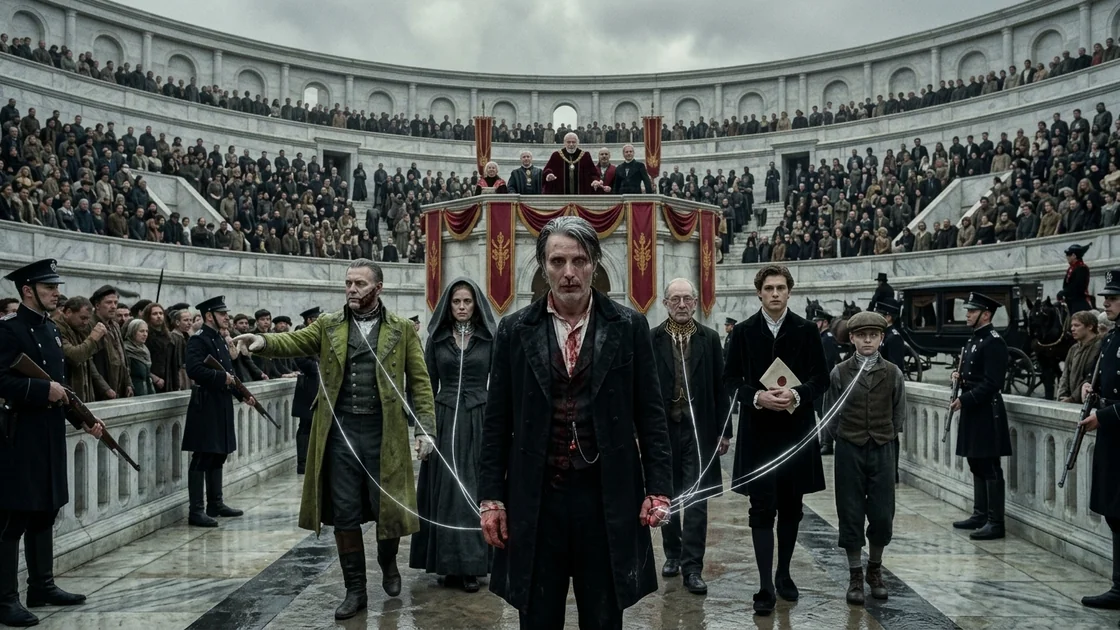
Julian Vane is a reclusive mortician and secret necromancer living in the corrupt republic of Vaelis on the eve of a historic election. When a desperate rebel leader demands that he raise an ancient army of fallen soldiers to overthrow the murderous High Council by force, Julian refuses to plunge his city into a bloody civil war. Instead, he devises a far more devastating strategy to dismantle the regime without taking a single human life. Aided by a cynical grave robber and a skeptical rebel commander, Julian embarks on a perilous midnight mission to exhume the murdered whistleblowers, auditors, and witnesses the High Council silenced to secure their power. Using forbidden and exhausting magic to restore their minds and voices rather than their capacity for violence, Julian marches the rotting victims directly into the Grand Forum during the final election debate to let the dead testify against their killers.
The rain in the Ossuary Ward never truly fell; it merely condensed out of the yellow coal-fog that drifted down from the iron foundries of the High Terrene, coating the cobblestones in a slick, greasy film that smelled of sulfur and wet wool. Beneath the street level, in the subterranean mortuary of St. Jude-in-the-Mire, the dampness manifested as a slow, rhythmic weeping along the limestone walls.
Julian Vane stood over a porcelain drainage table, a curved bone-needle threaded with waxed linen pinched between his thumb and forefinger. On the slab before him lay the mortal remains of a cooper named Hobb, who had met his end beneath the iron-shod hooves of a dray horse three evenings prior. Julian’s fingers moved with the quiet, unhurried economy of a watchmaker. Stitch, draw, knot, trim. He had already wired the shattered jawbone back into alignment so that Hobb’s widow would not have to look upon the violence of the street when she kissed his forehead at the graveside tomorrow morning.
At the edge of Julian’s hearing, beneath the sound of the dripping cistern and the hiss of the single camphor lamp, the dead man’s spirit lingered like static electricity in a winter room. It was not a ghost—ghosts were rare, calcified things born of centuries of obsession—but the breath-echo, the residual heat of a soul not yet fully untangled from its cooling meat.
Cold, the echo whispered against the back of Julian’s teeth. My boots are in the hall. Tell Martha the cobbler owes me fourpence.
"She knows about the fourpence, Master Hobb," Julian murmured aloud, his voice a dry baritone rasped thin by twenty years of inhaling embalming salts and dried rosemary. He did not look up from his suture. "And you will have no need of boots where you are going. Sleep now. The horse did not mean it."
The static in the room softened, untangled, and dissolved into the damp stone, leaving behind only the quiet dignity of clay.
Julian set down his needle, wiped his hands on an apron stained with decades of ferric chloride, and looked toward the shadowed archway leading up to the street stairs.
"If you stand on that third step much longer, Commander," Julian said into the gloom, "the rot in the timber will give way, and I will have four bodies to prepare by morning instead of one."
The shadows shifted. Metal clinked against metal—the unmistakable chime of a cavalry saber’s scabbard striking a brass coat button. Three figures descended into the yellow ring of lamplight.
The woman in front wore a Greatcoat of boiled oilskin that dripped murky canal water onto Julian’s freshly swept flagstones. Beneath the hood, Mara Kestrel’s face was all sharp angles and sleepless iron. A faded livid scar ran from the corner of her left eye down into her collar, a souvenir from the Border Wars ten years back. Behind her stood two broad-shouldered men carrying short-barreled carbines under their cloaks, their eyes darting nervously toward the shrouded shapes lining the mortuary’s cooling alcoves.
"You leave your cellar door unbolted, Vane," Mara said, throwing back her hood. Her dark hair was plastered to her temples. "In a neighborhood like this, that’s an invitation to have your throat cut for the silver pennies on your clients' eyes."
"I use copper tokens, Commander Kestrel," Julian replied, stepping over to a tin basin to wash the cooper’s blood from his knuckles. "And the cutthroats of the Mire are superstitious men. They know that everyone ends up on my porcelain eventually. No one wants to give their undertaker a personal grievance." He dried his hands on a linen towel and turned to face her fully. "Besides, your sentries have been blocking both ends of the alley since sundown. I assumed you were keeping the common thieves away."
Mara’s jaw tightened. She gestured sharply to her two guards. "Wait at the top of the stairs. Watch the grate. If a Watch patrol comes within two blocks, drop a pebble down the chute."
The men nodded, clearly relieved to be out of the cold room that smelled of cloves, vinegar, and quiet finality. Their heavy boots retreated up the stone steps.
When they were alone, Mara walked to the edge of Julian’s workbench, looking down at the neat rows of scalpels, bone-saws, trocars, and small glass vials filled with grey ash and mercury. From inside her coat, she pulled a heavy leather satchel and dropped it onto the wood. It landed with a dense, metallic thud that made the surgical instruments chime.
"Five hundred sovereigns in Imperial gold," she said. "And a signed writ of full pardon, pre-dated and stamped with the seal of the Provisional Assembly, absolving Julian Vane—formerly Magister Julian Corvus of the University of Kor—of all charges relating to the practice of the Black Art."
Julian did not touch the satchel. He merely looked at it as though it were a dead rat someone had left on his doorstep. "A Provisional Assembly that does not yet exist, Mara. If I remember the constitution of Vaelis correctly, the Grand Election is in three days. High Archon Sterling Thorne and his Council of Seven still hold the Chancellor's Spire, the courts, the printing presses, and the Obsidian Watch."
"There won't be an election in three days," Mara said, her voice dropping an octave, thick with bitter fury. "Not a real one. Tonight, the Watch raided the headquarters of the Reform Coalition in the Weaver’s Ward. They arrested Alderman Vance on fabricated charges of Ostrian espionage. The ballot boxes in the four outer districts have already been seized by Thorne’s magistrates under the pretext of 'securing them against rioters.' By Friday morning, Thorne will declare a fifth consecutive term by unanimous consent, and the Republic will be dead in everything but name."
"It has been dying for twelve years," Julian said softly. "A slow gangrene of the extremities. Why come to an undertaker when the patient is still breathing?"
Mara leaned across the workbench, planting both gloved palms on the scarred oak. "Because I don't want an undertaker, Magister. I want a Grave-Binder."
The silence that followed was heavy enough to drown the dripping of the cistern. In the corner of the room, where a massive oak wardrobe stood with its doors slightly ajar, something shifted. A pair of pale eyes gleamed from the shadows behind a rack of mourning coats, belonging to Finch, Julian’s assistant, who had been hiding there with a loaded blunderbuss aimed squarely at Mara’s ribs since she walked in.
Julian raised two fingers slightly at his side—a signal for Finch to hold his fire.
"That title was outlawed by the Pact of Ash three centuries ago," Julian said evenly. "Along with the men and women who bore it."
"Don't play the humble parish mortician with me, Julian," Mara snapped. "I was a captain in the Third Vanguard at the Siege of Oakhaven. I know who you are. I know why the University cast you out, and I know what your bloodline can do. Three miles north of the city walls lies the Barrow-Field of Karth. Twelve thousand iron-armored pikemen and knights from the Old Kingdom lie under six feet of peat bog, preserved like Bog-oak with their swords still in their fists."
She pulled a rolled parchment map from her belt and slammed it down beside the gold.
"My people have three hundred rifles and four barrels of black powder," she continued, her eyes feverish in the yellow light. "Thorne has two thousand Obsidian Watchmen and the garrison artillery on the High Terrene. If my rebels march on the Parliament alone, we will be slaughtered in the avenues before we reach the inner gates. Join us. Come to the Barrow-Field tonight. Tear open the peat, bind those twelve thousand dead men to your will, and march them through the North Gate at dawn. Bone does not bleed. Bone does not fear canister shot. With the Legion of Karth at our vanguard, we can storm the Spire, drag Sterling Thorne and his corrupt councilors onto the steps, and hang them from their own marble pillars before noon."
Julian looked down at the map. It was drawn with military precision: red ink marking firing arcs, blue arrows charting the path of an undead horde smashing through the densely populated working-class tenements of the North Gate to reach the Citadel.
"You have given this a great deal of thought," Julian observed quietly.
"It is the only mathematics left to us," Mara said. "Tyranny only understands superior force."
"Let me explain a different kind of mathematics to you, Commander," Julian said. He walked around the table, past the body of the cooper, and stopped before a shelf holding several human skulls—not trophies, but medical specimens from his university days, their cranial sutures mapped in faded India ink.
"What you are asking for is Somatic Necromancy," Julian said, picking up a skull whose temple had been caved in by a mace centuries ago. "The art of the puppet-master. To raise twelve thousand skeletons from the peat of Karth, I would not be calling back the men they once were. Their souls are long gone into the Grey Beyond, dissolved like salt in the sea. Instead, I would be pouring raw, unrefined kinetic malice into calcified calcium, binding their joints together with shadow-sinew and driving them forward with a single, rudimentary command: Kill everything in front of you."
"I can live with that," Mara said coldly.
"Can you?" Julian turned the skull in his hands. "My grandfather was a Somatic Binder during the Salt Wars. My father was a conscript who died at the Battle of the Red Ford—And then marched home six weeks later at the head of an enemy column, his jaw wired shut and a pike wired to his rotting hands, to burn the village where my mother was hiding me in a root cellar. A raised legion does not distinguish between an Obsidian Watchman and a baker’s apprentice who gets in its way in a narrow street. It does not take prisoners. It does not stop when the white flag goes up, unless the Binder’s concentration is absolute—and no mortal mind can hold twelve thousand leashes at once without at least a thousand of them snapping."
He set the skull back on the shelf with a dull click.
"If I raise the Barrow-Field of Karth," Julian said, his voice hardening into granite, "the High Council will turn their alchemical sun-cannons down from the battlements directly into the North Ward. They will burn four districts to cinders just to melt the tallow off my soldiers' bones. Ten thousand living citizens will die in the crossfire. And when the smoke clears, and you hang Sterling Thorne from his marble pillar over a mountain of burned children and shattered skeletons, what do you think the survivors will call you, Mara? Liberator? Or the butcher who broke the Pact of Ash and brought the Nightmare back to Vaelis?"
Mara stared at him, her chest heaving beneath the wet oilskin. For a moment, her hand hovered near the hilt of her saber, the desperate rage of a cornered soldier warring with the cold truth of his words.
"Then what would you have me do?" she demanded, her voice cracking with frustration. "Stand by while Thorne crowns himself King in all but title? Watch my people get rounded up in the night and dropped into the lime pits? Give me an answer, Magister! If we don't use a sword, what is left?"
"You are a soldier, Commander," Julian said softly. "When you see a locked door, you think of a battering ram. You think necrosis is only good for swinging an iron piece of metal because that is all the warlords of the Old Kingdom had the imagination to ask of the dead."
He walked back to his workbench and pushed her bag of gold and her map aside. From beneath a stack of burial registers, he pulled out a thin, oilcloth-wrapped dossier and laid it flat on the wood. Inside were clippings from the Vaelis Daily Gazette, handwritten notes in Finch’s cramped scrawl, and charcoal sketches of five faces.
"The dead are terrible soldiers, Mara," Julian said, tapping the dossier. "They are clumsy, brittle, and blind. Do you know what the dead actually are?"
Mara frowned, looking down at the sketches. "What?"
"Witnesses," Julian said. "The only truly incorruptible witnesses in the world. Because you cannot bribe a man who has no pockets, and you cannot threaten a woman who has already been murdered."
From the wardrobe in the corner, the door creaked open. Finch stepped out, lowering his blunderbuss and resting its brass barrel over the crook of his left arm—an arm that ended not in flesh, but in an articulated gauntlet of blackened iron and leather straps. He was a thin, ferret-faced man of thirty with hair the color of graveyard moss and a perpetual squint.
"Told you she'd ask for the bog-men, boss," Finch rasped, spitting a bit of chewed clove onto the floor. "Always the bog-men with the military types. Zero appreciation for craftsmanship. Do you have any idea how bad twelve thousand peat-corpses smell when they warm up, lady? You’d clear the city before a single sword got swung."
Mara didn't even blink at Finch’s sudden appearance, though her hand twitched. She kept her eyes locked on Julian. "Explain yourself, Vane."
"Sterling Thorne is not a warlord," Julian said. "If he could hold Vaelis by raw military force alone, he wouldn't bother rigging an election. He needs the illusion of legitimacy. The Merchant Guilds, the Ironworkers’ Union, the Dockers, even the rank-and-file of the Obsidian Watch—they obey the Council because they believe the Republic’s laws are still functioning, and that the Reformers are foreign-funded anarchists."
Julian spread the five charcoal sketches across the table like a hand of cards.
"Over the past six weeks," Julian continued, "Thorne and his inner circle have systematically murdered the five people who possessed the hard, undeniable proof of their high treason, embezzlement, and mass murder. They killed them, staged their deaths as suicides or tragic accidents, or made them vanish entirely, precisely so they could not testify before the Electoral Tribunal on Friday."
He touched the first sketch: an elderly man with spectacles and deep, worried jowls.
"Arthur Pendelton. Chief Auditor of the Public Granaries and Master of the Mint. Found floating in the Weeping Canal eleven days ago, his pockets full of river-stones. The Watch ruled it melancholia. In truth, he had memorized the ciphered account numbers proving that Thorne sold forty thousand tons of the city’s winter grain reserve to the Ostrian Empire to fund his private secret police."
He moved his finger to the second sketch: a fierce-eyed woman in her forties with a braided crown of hair.
"Clara Valen. Matron of the Smog-Ward Ironworkers. Burned to death in a tenement fire three weeks ago. Before she died, she uncovered the alchemical blasting caps proving that Councilman Garrow intentionally collapsed the Foundry Three roof on eighty sleeping miners to break their strike and claim the insurance indemnity."
He tapped the third: a broad-necked man in the uniform of a Watch officer.
"Captain Gregor Hull. Twenty-year veteran of the Obsidian Watch. Officially listed as having deserted to the southern provinces last month. Actually executed in the basement of the Black Keep by Inquisitor Malrik Kross because Hull refused the order to fire on the unarmed women of the Bread March—and because he kept the signed execution warrants bearing Thorne’s personal seal."
He touched the fourth: a handsome young patrician with high cheekbones.
"Elian Thorne. The High Archon’s own nephew and private secretary. Died Tuesday night at a dinner party of 'acute bilious fever.' Poisoned with nightshade-distillate after he found the blood-treaty his uncle signed promising to surrender our northern border forts to the Ostrian Emperor in exchange for a hereditary dukedom once the Republic is dissolved."
Finally, he touched the last sketch: a boy of no more than sixteen, thin and sharp-featured, wearing a telegraph courier’s cap.
"And Lark. A night-runner for the Central Telegraph Exchange. Threw himself off the Clocktower Spire four nights ago, according to the papers. He was thrown by two of Kross’s hounds after he intercepted the encrypted wire ordering the deaths of the other four."
Mara looked from the sketches back up to Julian’s pale, lined face. Understanding was beginning to dawn behind her scarred brow, mingled with a profound, unsettling awe.
"You don't want to raise an army," she whispered.
"I want to convene a grand jury," Julian said. "To raise twelve thousand hollow bones takes brute power. Any butcher with the blood-gift and a sacrificial altar can do it. What I am proposing has not been attempted since the High Courts of Old Kor fell five hundred years ago. Pneumatic Resurrection. True Elegaic Binding. I will not merely animate their corpses, Mara. I will repair their broken vessels with silver and wax, walk down into the Grey Threshold myself, find their five departed souls before they cross the final river, and ask them if they wish to come back."
"Ask them?" Mara repeated.
"A mindless thrall can be enslaved," Julian said quietly. "A speaking soul cannot be forced. If you drag a spirit back into its rotting meat against its will, it will only scream until the vocal cords tear apart. They must return by their own consent, anchored by their own unfinished testimony. They will retain their memories, their intellect, their voices, and their wounds. And on Friday noon, when High Archon Thorne steps onto the rostrum of the Grand Forum in front of thirty thousand citizens, the Guild Masters, and the foreign press to accept his stolen crown—we are going to put his murder victims on the witness stand."
Finch grinned, his iron fingers clicking rhythmically against the stock of his blunderbuss. "Try spinning that in the morning edition, eh, Commander?"
Mara stared at the five faces on the table. For a long time, the only sound was the rain beating against the iron street-grate overhead.
"And the Watch?" she asked finally. "When Thorne orders his men to shoot them down?"
"Half the Watch served under Captain Gregor Hull," Julian said. "When they see their most respected commander step forward with his throat cut by their own Inquisitor, and hear him name the men who gave the order, whose side do you think those boys in black coats are going to take? And even if Kross’s fanatics open fire—how do you assassinate a witness who is already dead?"
A slow, fierce smile—the first genuine expression of hope Julian had seen on a citizen of Vaelis in years—cut across Mara Kestrel’s scarred face.
"What do you need from me, Magister?" she asked.
"Keep your gold," Julian said, rolling up his cuffs. "I need four fast horses, a covered dray wagon with oiled springs, forged Watch passes for the quarantine zones, and forty-eight hours. Because before I can call their souls back to testify, Commander, we have to steal their bodies back from the state."
The anatomy of a cover-up in Vaelis was dictated by social class. Even in murder, the High Council observed the strict hierarchies of the city.
"The boy, Lark, and the union woman, Clara Valen, are the easiest," Finch said an hour later. They had moved into the back room of the mortuary, where Julian kept his alchemical furnace and his maps of the city’s subterranean drainage networks. Finch was busy packing a leather doctor’s bag with crowbars, jars of corpse-tallow, muffled lanterns, and coils of consecrated silver wire. "Pauper deaths go to the Municipal Charnel House in the Potter's Field. They hold 'em in the ice-cellars for two weeks before the mass trench-burnings on Saturday. I know the night watchman there—Old Barnaby. Give him a bottle of gin and ten silver groats, and he’ll look at the ceiling while we wheel out half the basement."
"Go with two of Mara’s men and get them first," Julian instructed, measuring out three drams of powdered belladonna root and mixing it with melted beeswax in a copper crucible. "Clara’s body was badly burned in the tenement fire. Handle her ribcage and throat with extreme care. If the larynx is completely carbonized, I will have to fashion a reed-box out of silver tubing before tomorrow night, and I need to see the extent of the damage."
"Right you are, boss. Easy work." Finch snapped the bag shut and paused, nodding toward the map. "It’s the other three that are going to give me indigestion."
Mara leaned over the map of Vaelis. "Arthur Pendelton was pulled from the Weeping Canal, yes? His family has money. Wouldn't he be in a private cemetery?"
"He would be, if Inquisitor Kross hadn't intervened," Julian said, pouring the hot, dark wax into flat tin molds to cool. "When a high-ranking official dies under suspicious circumstances, Kross’s office claims the body under the Public Contagion Act—claiming they died of canal-typhus—to prevent independent surgeons from examining the lungs. Pendelton’s corpse is currently locked inside Barge Seven at the Quarantine Docks on the river. Tomorrow morning at high tide, that barge will be towed out to the Acid Flats and scuttled."
"And Captain Hull?" Mara asked, her voice tight. "You said the Black Keep."
"The Old Penitentiary lime pits," Julian confirmed. "Behind the North Bastion. When the Watch executes one of their own in secret, they drop them down the Dry Well into the quicklime vats under the guardhouse. Quicklime eats flesh in a week and turns bone to chalk in a month. Hull has been down there for nineteen days. If there is still enough of his jaw and cranium left to hold an echo, we have to pull him out tonight."
"What about the Archon's nephew?" Mara pointed to the high, walled hill at the center of the city map. "Elian Thorne."
"Buried this afternoon with full patrician honors in the House Thorne Mausoleum in the Necropolis of the Saints," Julian said. "Archon Sterling wept at the graveside for the sketch-artists of the Gazette. The mausoleum is warded with blood-sigils tuned to the Thorne family line, and patrolled by the Cemetery Guard."
Mara straightened up, adjusting her sword belt. "Then we split the work. Finch takes two of my men to the Potter's Field for the boy and the woman. You and I take the Quarantine Docks and the Black Keep tonight. Tomorrow night, when the storm hits, we crack the Necropolis."
"No weapons that make noise," Julian warned her, turning from the furnace. His eyes were dark and sunken in the firelight. "If Inquisitor Kross discovers what we are collecting before Friday noon, he won't just double the guards at the Forum. He will bring in the Church Exorcists to salt the Parliament grounds and erect bell-towers that will shatter any spirit-tether within half a mile. We must be ghosts ourselves."
"I know how to be quiet, Magister," Mara said. "I didn't survive the Oakhaven trenches by singing marching songs."
The Quarantine Docks smelled of dead eels, coal tar, and carbolic soap.
At two in the morning, the fog off the River Vael was so thick that the gas lamps along the wharf looked like bruised dandelions floating in greasy milk. Three hundred yards down the pier, Barge Seven bobbed sluggishly against its hemp moorings, its hull painted the livid yellow of the Plague Authority.
At the head of the gangplank stood a wooden sentry box where two low-ranking Watchmen hunched over a brazier of glowing coke, passing a clay pipe back and forth.
In the shadow of a stacked pile of timber fifty paces away, Mara slipped a pair of brass knuckles over her left glove, preparing to creep forward. Julian caught her by the elbow.
"Leave them," he whispered.
"They're looking right at the gangplank," she breathed back. "I won't kill them, just put them to sleep for an hour."
"An unconscious guard raises an alarm the moment he wakes up," Julian said. "A distracted guard remembers nothing but a slow shift."
He reached into his coat pocket and drew out a small object wrapped in black silk. Unfolding the cloth, he revealed the desiccated skull of a wharf-rat, its eye sockets filled with hardened grey tallow and a tiny thread of copper wire twisted around its incisors.
Julian pricked his left thumb with a silver pin he wore in his lapel, smeared a single bead of dark blood across the rat’s nasal bone, and set the tiny skull down on the wet cobblestones.
Run, Julian thought, projecting his will into the ancient, minuscule echo of instinct that still clung to the rodent’s calcium. Find the lard-barrels at the other end of the pier. Knock them over. Make a racket.
The rat skull twitched once, rose onto four invisible legs woven from condensed shadow and damp fog, and skittered away along the wharf at lightning speed, completely silent until it reached the towering pyramid of salted-pork barrels two hundred yards behind the sentry box.
A moment later, a tremendous clatter echoed through the fog as three heavy wooden casks toppled onto the planks and rolled booming toward the water, accompanied by the frantic, phantom scratching of what sounded like a hundred giant rats tearing into the stores.
"Bloody hell!" one of the Watchmen cursed, jumping up from the brazier and grabbing his lantern. "The wharf-vermin are into the quartermaster's pork again! Come on, Tam, if the Sergeant sees the staves chewed through, he'll dock our pay!"
Both guards went trotting down the pier into the yellow mist, clubs drawn and lanterns swinging.
Mara looked down at Julian with grudging respect. "Convenient."
"Everything that dies leaves a tool behind, if you are polite enough to ask," Julian said, already moving toward the barge. "Come. We have four minutes."
They glided up the gangplank and dropped onto the wet deck of Barge Seven. The heavy iron padlock on the hold hatch was rusted stiff. Mara produced a steel tension wrench and a curved pick, working the tumblers with practiced military efficiency until the shackle popped open with a greased click.
Julian lifted the hatch and descended the vertical ladder into the belly of the barge, Mara right behind him.
Down in the hold, the stench of river-rot and cheap lime was suffocating. Julian uncovered a tiny hooded shutter-lantern, casting a narrow beam of blue-tinted light across the deck. Twelve pine boxes lay stacked in two rows, stenciled with the black cross of typhus.
Julian didn't need to pry open the lids to read the names. He closed his eyes, held out his bare, scarred palms, and listened.
Most of the boxes were quiet—the occupants had died of genuine fever in the slums, their spirits having drifted away cleanly days ago in the exhaustion of sickness. From a box in the far corner, however, came a sharp, rhythmic tapping against the inside of Julian’s skull, like an iron nib striking an inkwell.
Fourteen thousand sovereigns on the twelfth of June, a voice muttered in the dark behind Julian’s eyes, frantic and obsessive, repeating the ledger entries like a prayer. Transferred through the Bank of Ostria. Account Seven-Seven-Four. The grain is gone. God help us, the silos are empty, the children will starve in January... Fourteen thousand sovereigns on the twelfth of June...
"There," Julian said, pointing to the bottom crate on the port side. "Help me lift the top one off."
Together, they heaved the upper coffin aside. Using a small iron pry-bar, Julian eased the nails out of the lower box’s lid without making a sound and slid the pine planks back.
Arthur Pendelton lay inside, bloated from three days in the Weeping Canal before the dredge-nets found him, his fine woolen waistcoat still heavy with mud. Around his bruised throat, hidden high beneath the stiff linen collar that the Watch coroner had conveniently neglected to unbutton, was a deep, purple furrow made by a garrote wire.
Julian leaned down, placing two fingers gently against the cold, waterlogged forehead of the former Chief Auditor.
"Peace, Master Pendelton," Julian whispered, letting a tiny trickle of his own warmth flow into the corpse to stabilize the frantic, looping echo within the brainpan. "I have a ledger for you to balance. Hold onto the numbers. Just a little longer."
The frantic tapping in the dark subsided into a tense, waiting stillness.
Working swiftly, Julian and Mara lifted the heavy body out of the coffin, wrapped it in an oilskin shroud they had brought with them, and replaced the weight inside the pine box with four heavy iron ballast pigs from the barge’s bilge so the stevedores wouldn't notice the difference when they sank it in the morning. They re-nailed the lid into the existing holes, slipped back up through the hatch, clicked the padlock shut, and vanished into the timber stacks just as the two Watchmen came grumbling back up the pier, complaining about phantom rats.
The Black Keep was another matter entirely.
Rising out of the rocky crags at the northern edge of the city, the ancient fortress served as the headquarters and prison of the Obsidian Watch. To get inside the main gates was impossible; to get into the disposal yards behind the North Bastion required climbing through the Mouth of St. Giles—an abandoned medieval storm-sewer that emptied into the gorge sixty feet below the prison walls.
By four in the morning, Julian’s coat was soaked to the waist with freezing sewage, and his lungs burned like hot iron. He was forty-four years old, a scholar and a craftsman, not a mountaineer. Ahead of him, Mara moved up the slick iron rungs of the vertical maintenance shaft like a spider, pausing every ten feet to haul the coiled hemp rope attached to Julian’s belt.
At the top of the shaft, they squeezed through a broken iron portcullis into the Rear Yard of the Keep—a narrow, high-walled stone courtyard open to the drizzling sky, wedged between the prison slaughterhouse and the old executioners' tower.
In the center of the yard sat a circular stone well-head, ten feet across, capped with a heavy wooden grate through which rose a faint, acrid steam that smelled of wet plaster and burned hair.
The Dry Well.
High above on the battlements, forty feet up, the silhouetted figure of a Watch rifleman paced slowly along the stone walkway, his boots clicking rhythmically.
Julian crawled on his stomach across the wet flagstones to the lip of the well and peered through the wooden slats. Thirty feet below, at the bottom of the circular shaft, lay a Pale lake of slaked quicklime mixed with rainwater, crusted over like old porridge. Bones and rags jutted out of the white crust at unnatural angles.
"Is he down there?" Mara breathed beside him, her eyes fixed on the guard pacing high overhead.
Julian closed his eyes and reached down with his senses into the pit.
It was a horrible place for a Necromancer to touch. Dozens of men and women had died down there or been thrown in while their echoes were still screaming. The residual agony clung to the limestone walls like grease, a discordant chorus of terror, betrayal, and chemical fire. Julian had to grit his teeth against a sudden wave of nausea, filtering out the noise of petty thieves and political prisoners until he felt something else at the northern edge of the pit.
It was not a scream. It was a low, steady drumbeat of pure, cold fury, disciplined even in death.
Tell the boys to hold the line, the echo growled from beneath a crust of white lime. Kross has Ostrian gold in his saddlebags. Don't shoot the weavers. Hold your fire, damn you, hold your fire!
"He’s there," Julian whispered, opening his eyes. "Under the overhang on the left. A ledge kept the worst of the rain from slaking the lime right on top of him, or there’d be nothing left at all. Lower me down."
"I'll go," Mara said immediately. "I'm stronger."
"If you touch him wrong, his ribs and cervical vertebrae will crumble like shortbread in your hands," Julian countered, already tying the hemp rope around his chest beneath his arms. "I have to bind the calcium with my own breath before he is moved an inch, or we’ll be hauling up a bag of wet flour. Anchor yourself to the grate. Three tugs when I’m ready."
Before she could argue, they silently slid one broken slat of the wooden grate aside. Mara braced her boots against the stone rim, wrapped the rope twice around her waist and an iron mooring ring, and fed the line out through her gloved hands as Julian lowered himself into the dark, burning throat of the well.
The heat and chemical fumes inside the shaft were blinding. Julian wrapped a vinegar-soaked kerchief over his nose and mouth, his eyes watering fiercely as his boots touched the crusted edge of the lime pit.
To his left, wedged beneath a projecting shelf of rock that had spared the corpse from the direct rain-drip, lay what remained of Captain Gregor Hull.
The quicklime had eaten away the lower legs of his Watch uniform and most of the flesh from his hands and jaw, leaving the bone bleached a stark, porous chalk-white. The heavy wool of his officer’s tunic had protected his chest and throat somewhat, though the fabric was stiff with chemical salt. Across his windpipe was a jagged, terrible rent that had notched the fourth vertebra—the work of a heavy trench-knife applied from behind while he was kneeling.
Julian knelt in the caustic muck, ignoring the burn of the lime eating through the knees of his trousers. He pulled off his gloves and laid his bare hands directly onto the exposed, brittle bone of Hull’s skull and collarbone.
"Captain Hull," Julian whispered through his mask.
The fury in the corpse flared like a stoked furnace, so sudden and violent that Julian was nearly knocked backward into the pit. In life, Gregor Hull had been a man of immense willpower; in death, his spirit-echo was like an iron bar heated white-hot.
Get back! the dead captain roared inside Julian’s head, a phantom hand seeming to close around the necromancer’s throat. No more traitors! No more of Kross’s butchers!
"Look at me, Captain," Julian gasped, refusing to pull his hands away despite the crushing psychic pressure bruising his mind. Instead of shielding himself, Julian opened his own memories to the dead man—showing him Mara Kestrel waiting above, showing him the faces of the young Watchmen on the streets, showing him the Grand Forum and the podium where Sterling Thorne stood smiling. "I am not Kross’s man. Your boys on the street are being turned into executioners. They don't know what happened to you. Come with me, Gregor. Come up out of the pit and give them their orders one last time."
The phantom grip on Julian’s throat went slack. The blinding heat of the rage cooled into a focused, razor-sharp lance of intent.
Friday, the echo rumbled.
"Friday noon," Julian promised.
Drawing deep on the reserves of his own vitality, Julian whispered a word in the dead tongue of Old Kor. A faint, silvery frost seemed to spread from his fingertips over the porous, lime-eaten bones of the dead captain, hardening the brittle chalk back into dense ivory and knitting the dissolved ligaments with threads of shadow so the body would hold together during the ascent.
Julian wrapped Hull’s remains carefully in a second heavy canvas shroud, lashed it tightly to his own chest with leather straps so they formed a single grotesque bundle, and tugged the rope three times.
Above, Mara’s muscles corded like iron cables as she began the agonizingly slow process of hauling three hundred pounds of living man and waterlogged corpse up thirty feet of rough stone. Halfway up, a chunk of loose mortar dislodged from the shaft wall and splashed into the lime below.
High on the battlements, the pacing footsteps stopped.
"Who's down there?" a voice called out from the walkway forty feet above the yard. The beam of a bullseye lantern swept across the wet cobblestones, stopping ten inches from the edge of the well behind which Mara lay flattened in the mud, the rope biting so deeply into her hip and palms that blood was running down her wrists inside her gloves.
Julian hung suspended ten feet below the grate, his boots braced against the slimy wall, holding his breath while the dead captain’s skull pressed cold against his chin.
For ten agonizing seconds, the lantern beam lingered on the steaming well-head.
Then, from the slaughterhouse roof across the alley, a stray alley-cat—nudged by a tiny, desperate flick of Julian’s remaining concentration toward the carcass of a dead crow on the tiles—let out a yowl and knocked a loose slate crashing into the street outside.
The guard on the battlements cursed, swung his lantern toward the outer wall, and resumed his patrol.
Five minutes later, Julian tumbled over the stone lip of the well into the rain, gasping for clean air, his chest heaving and his hair streaked with grey ash. Mara didn't waste a breath; she hoisted the shrouded bundle of Captain Hull over her own shoulder like a sack of grain, hauled Julian to his feet by his collar, and dragged him back toward the sewer grate before the guard could complete his circuit.
When they returned to the cellar of St. Jude-in-the-Mire just before dawn, Finch was already there, warming his iron hand over the brazier and drinking cold tea from a tin mug.
On two of the porcelain slabs lay the bodies from the Potter's Field: young Lark, looking as though he were merely asleep save for the unnatural twist of his broken neck and the shattered bones of his legs from his fall off the Clocktower; and Clara Valen, a tragic, blackened form smelling faintly of charred pine and kerosene.
"Barnaby didn't even wake up all the way," Finch reported cheerfully, though his eyes narrowed with genuine concern as he saw Julian stumble down the stairs, leaning heavily on Mara’s shoulder. "Bloody hell, boss. You look like the ones on the tables. Did you swim in the lime pit?"
"Near enough," Julian wheezed, collapsing onto a three-legged stool while Mara gently laid the shrouded remains of Arthur Pendelton and Gregor Hull onto the remaining two slabs. Julian’s hands were trembling violently, the skin around his fingernails blue and raw from the magic he had expended in the well. "Let me see Clara."
He forced himself up five minutes later, after drinking a glass of bitter tonic laced with laudanum and iron filings, and examined the union matron with a magnifying lens.
"Her lungs and trachea were seared by the superheated smoke before the rafters fell," Julian murmured, his clinical mind taking over to push back the exhaustion. "And Hull’s vocal cords were severed by the knife and eaten away by the lime. Pendelton’s hyoid bone was crushed by the garrote. Even if I call their souls back, three of our five witnesses have no physical instruments left with which to shape human speech."
Mara wiped the sweat and sewage from her face with a rag, her eyes dark with sudden dread. "Can they write their testimony?"
"A dead hand writing on a slate looks like a parlor trick—a medium’s fraud," Julian said firmly. "Thorne would laugh it off as my own ventriloquism or puppetry. No. The thirty thousand people in that Forum must hear Arthur Pendelton’s own prim, nasal accent. They must hear Clara Valen’s gravelly contralto that rallied the Smog-Ward for twenty years. They must hear Gregor Hull’s parade-ground bark. If the flesh is ruined, we must build them new throats."
He turned to Finch. "Take the gold sovereigns Commander Kestrel brought us. Melt down thirty of them in the crucible with four ounces of pure virgin silver and a pinch of grave-salt. Draw them through the die-plate into wire as fine as human hair, and hammer the rest into reed-plates thin enough to vibrate when a moth breathes on them. We are going to play the goldsmith today, Finch. Neither of us sleeps until they have tongues."
Throughout the long, dreary daylight hours of Thursday, while the printing presses of Vaelis churned out special editions praising Archon Sterling Thorne’s decisive crackdown on "Ostrian saboteurs," the subterranean mortuary of St. Jude became an operating theater of the impossible.
Mara slept for four hours on a pile of clean burlap sacks in the corner, waking at noon to find Julian and Finch working in absolute, synchronized silence over the four slabs.
It was not the gruesome, bloody butchery she had half-expected of necromancy. It was heartbreakingly gentle.
Julian had washed the river-mud from Arthur Pendelton’s thinning white hair and dressed him in a clean linen shirt from the mortuary stores. With microscopic precision, using long silver forceps and a jeweler’s loupe strapped to his eye, Julian was weaving a tiny cage of gold-silver alloy wire around the shattered fragments of Pendelton’s hyoid bone, reconstructing the collapsed cartilage of the throat like a master luthier repairing the soundbox of a crushed violin.
Beside him, Finch—using delicate pliers screwed directly into the socket of his prosthetic iron wrist in place of his hook—was sliding a finely fluted tube of beaten silver, containing three microscopic vibrating reeds made of cured raven-quill and gold foil, down into the ruined windpipe of Clara Valen.
"Silver conducts the anima," Julian explained softly without looking up, sensing Mara watching over his shoulder. "Gold does not tarnish in contact with necrotic humors. When a soul returns to a dead body, it does not breathe air with its diaphragm the way we do. It expels pneuma—spiritual pressure. By tuning these reeds to the exact anatomical proportions of their original throats, the pressure of their thoughts will vibrate the silver and produce the exact timbre of their living voices."
Mara looked down at Captain Hull. Julian had already reconstructed the missing lower half of the captain’s jaw using hardened grave-wax mixed with bone-meal and calcified ash, sculpted so skillfully that in the dim light it looked merely like pale, scarred skin beneath a high military collar.
"You care for them," Mara said quietly. It wasn't a question.
Julian tied off a silver suture at the base of Clara Valen’s neck and set down his forceps, rubbing the bridge of his nose. "When I was twenty, at the University of Kor, my professors taught me that corpses were merely raw lumber. Clay and calcium to be ground into alchemical powders or wired together for siege labor. Then a typhus epidemic hit the lower wards. I was assigned to the disposal carts. One night, a girl of nine died in my arms while her mother begged me to make her stay. I couldn't save her life, Mara. When she died, I heard her voice in the silence, terrified of the dark, asking someone to tell her mother where she had hidden her doll."
He looked across the four tables—at the old clerk, the burned matron, the betrayed soldier, and the broken boy whose neck he had set with a splint of ash-wood and silver ribbon.
"That was when I realized the warlords had it backward," Julian said. "Necromancy was never meant to be a weapon of conquest. It is a bridge. A final mercy for those whose sentences were cut off in the middle of a word. The High Council thinks that by stopping a heart, they have won the argument. Tomorrow, we teach them that death is only a change of jurisdiction."
A sharp pebble rattled down the ventilation chute from the street above, bouncing twice on the flagstones.
Finch’s head snapped up. In a heartbeat, he had unscrewed the pliers from his wrist, clicked a heavy iron hook into place, and snatched up his blunderbuss.
A second pebble followed, then three in rapid succession. Watch patrol. Stopping at the door.
"In the alcoves!" Mara hissed, drawing her saber.
"No!" Julian caught her wrist. "If they find armed rebels down here, we are dead. Finch, get Mara into the lime-closet behind the furnace. Put the shrouds over the tables and unstop the formaldehyde carboy. Quickly!"
Within twenty seconds, Mara was shoved behind the false brickwork beside the chimney flue, Finch was hunched over a bucket pretending to scrub the flagstones with a stiff brush, and Julian had pulled the linen sheets up to the chins of the four corpses, uncorking a massive five-gallon jug of pungent embalming vinegar that immediately filled the cellar with an eye-watering chemical stench.
Heavy, hobnailed boots clattered down the stone stairs. Four men in the long black leather coats and silver-badged shakos of the Obsidian Watch stepped into the mortuary, led by a tall, cadaverous man wearing the crimson sash and high gorget of a Watch Inquisitor.
Julian felt a cold needle slide into his spine. He knew that face from the University trials fifteen years ago. Inquisitor Malrik Kross.
Kross had eyes like two chips of anthracite coal and a mouth that looked as though it had never known the shape of a smile. Behind him, held on a heavy iron chain by a handler, prowled a Ward-Hound—a massive, hairless mastiff bred in the alchemical kennels of the Keep, its nostrils slit wide and its eyeballs milky white, trained to scent the ozone-and-copper tang of illicit magic.
The hound immediately whined, lowering its scarred snout to the flagstones and straining at the leash, its milky eyes fixed toward the worktables.
"Master Vane," Inquisitor Kross said. His voice was like dry parchment sliding over glass. He held a pomander of spiced orange to his nose against the overpowering reek of vinegar. "You are busy for a Thursday afternoon."
"The damp weather brings the croup to the tenements, Your Excellency," Julian said, bowing his head with the servile, slightly round-shouldered stoop of a poor parish tradesman. "And the riots in the Weaver’s Ward left a few poor souls under the wagon wheels. How may a humble mortician serve the Watch?"
"We are conducting a census of all licensed and unlicensed charnel houses before tomorrow’s election," Kross said, stepping further into the room. His boot crushed the tiny rat-skull Finch had carelessly left near the workbench leg into gray powder, though in the gloom Kross did not look down. "Certain agitators have been spreading rumors regarding the... improper disposal of state detainees. And my hound seems to think your cellar smells of more than vinegar, Master Vane."
The Ward-Hound barked—a wet, choking sound—and lunged toward the slab where Captain Gregor Hull lay under a linen sheet.
Behind the brickwork of the furnace, Mara’s hand tightened on her pistol grip. If Kross pulled back that sheet and saw the silver-wired throat and wax-sculpted jaw of the man he had personally murdered nineteen days ago, the room would become a slaughterhouse in three seconds.
Julian did not move a muscle outward, yet beneath his stained apron, his thumb pressed hard against the silver pin in his lapel, drawing blood.
He did not cast a spell at the hound—the beast would detect active magic instantly and tear his throat out. Instead, Julian reached out to the cooper, Master Hobb, who lay on the fifth table nearest the stairs, freshly embalmed and entirely mundane. With the tiniest nudge of Somatic pressure—no more than the weight of a falling leaf—Julian caused a pocket of trapped embalming gas and vinegar in the cooper’s stomach to shift and release through the stitched lips with a loud, wet, unmistakable corpse-groan, while the dead man’s left arm slid off the porcelain edge and knocked a tin basin of bloody sponges clattering onto the flagstones right beside the hound’s flank.
The Ward-Hound yelped, startled by the sudden noise and splashed from nose to tail with cold blood and raw vinegar. Its delicate olfactory nerves were instantly blinded by the burning acid. The beast sneezed violently, pawing at its stinging snout and retreating between its handler’s legs.
"Clumsy!" Julian scolded himself aloud, hurrying forward to pick up the basin and push the cooper’s arm back under the sheet with an apologetic bow toward Kross. "Forgive me, Excellency. Gases in the bowel. Master Hobb was a large man, and cheap cabbage does terrible things to the interior after forty-eight hours."
Kross stepped back in disgust, checking his polished boots for spots of bloody vinegar. Slowly, his anthracite eyes traveled over the five shrouded tables, pausing for a long, terrible moment on the lump of linen covering Clara Valen.
He reached out with his black-gloved hand and pinched the edge of Clara’s sheet.
"And these four?" Kross asked softly.
"Canal-typhus from the Bilge-Alley boarding house, sir," Finch piped up from his knees, holding up a rag dripping with yellow pus he had saved from an abscess the week before. "Just lanced the buboes on this old girl’s neck ten minutes ago. Still weeping fresh humor, if Your Excellency wants a closer look. The Quarantine barge was full, so the parish beadle paid us sixpence a head to lime 'em in the cellar till Saturday."
Kross froze with the sheet half an inch from Clara’s charred chin. Like most men who dealt out death from behind a desk, the Inquisitor had a profound, visceral terror of infectious disease.
Slowly, Kross released the linen and wiped his gloved fingertips on his cloak.
"See that they are burned before the Sabbath," Kross said coldly, already turning back toward the stairs. "If a single unauthorized assembly takes place in this ward tomorrow, Vane, you will have more customers than your cellar can hold. Come, hound."
The Watchmen retreated up the stairs, dragging the sneezing, whimpering mastiff behind them. A moment later, the iron grate overhead clanged shut.
Julian stood motionless in the center of the room until the sound of their boots faded entirely into the rain. Then his knees buckled, and he had to catch himself on the edge of the cooper’s slab, his face the color of tallow.
Mara slid out from behind the brickwork, letting out a breath she seemed to have been holding for five minutes. "He’s hunting," she said grimly. "Someone tipped him off, or he’s just paranoid enough to check his own blind spots."
"It doesn't matter," Julian said, straightening up with an effort of sheer stubbornness. "We have four. Tonight at ten, we go over the wall of the Necropolis of the Saints for Elian Thorne. And at midnight, we lock the doors and call the dead home."
The Necropolis of the Saints sat upon the Western Bluff, a city of white marble angels, weeping willow trees, and wrought-iron gates that overlooked the smog-choked valleys of lower Vaelis like a gathering of wealthy spectators at a theater.
At ten o’clock that Thursday night, the wind turned from the north, bringing a driving torrent of icy rain that lashed the marble tombs and drove the Cemetery Guard into their stone gatehouses.
Julian, Mara, and Finch did not use the gates. Using a grappling hook muffled in sheepskin, they scaled the twelve-foot boundary wall at the rear of the bluff, where the cliff dropped away toward the river, and dropped down among the overgrown yew trees of the old patrician quarter.
The Mausoleum of House Thorne stood at the end of an avenue of granite obelisks—a miniature Doric temple of black veined marble, its bronze double doors flanked by carved stone griffins.
Even from twenty paces away through the pouring rain, Julian could see the wards. To normal eyes, the bronze doors were merely wet metal; to Julian’s sight, they crawled with a lattice of dull red fire—blood-sigils laid down by the High Council’s court alchemists, anchored to the genetic bloodline of House Thorne. If anyone not carrying Thorne blood touched that bronze lock, an alchemical flare would ignite fifty feet into the air and turn the intruder’s nervous system to ash.
"Stand back," Julian murmured, kneeling in the wet gravel before the steps of the tomb.
"Can you break a blood-ward?" Mara asked, crouching beside a marble angel with her carbine sheltered under her cloak.
"I don't need to break it," Julian said. "I just need to knock politely."
The secret of a blood-sigil was that it was a deeply stupid thing; it only checked whether the flesh touching the lock shared the blood of the family buried inside. And while the living members of House Thorne were all safely asleep in their palaces on the High Terrene, the mausoleum was literally full of dead ones.
Julian placed his palms flat on the wet marble steps and sent his awareness tunneling downward through six feet of consecrated granite into the lower crypts beneath the floor. Down there, in lead-lined coffins stacked three deep since the founding of the Republic, lay four generations of Thorne senators, aunts, cousins, and infants.
A tiny favor, Julian whispered to the cold, dusty bones of Sterling Thorne’s grandfather, who had died of gout forty years ago. Your grandson has murdered your great-nephew and put him in the upper vault. Lend me a splinter of your finger to open the door.
Beneath the floor, in a rotted cedar coffin whose lead lining had cracked with age, a single dry phalanx bone detached itself from a skeletal hand. Drawn upward by Julian’s magnetic pull, the tiny bone slid through a mason’s drainage crack between the foundation stones, wriggled up through the mortar of the steps like a white beetle, and dropped into Julian’s waiting palm.
Wrapping the dry bone in his handkerchief so his own skin wouldn't touch the metal, Julian stepped up to the bronze doors and pressed the dead grandfather’s knuckle bone directly into the keyhole of the warded lock.
The red lattice of fire flared once, tasted the ancient calcium of the family patriarch, recognized its own kin, and extinguished itself with a soft hiss of steam. With a heavy metallic clunk, the counterweights inside the bronze door released, and the portal swung six inches inward.
"Clever bastard," Finch muttered in awe, hoisting his crowbar and slipping inside.
The interior of the mausoleum smelled of crushed lilies, beeswax candles, and fresh damp mortar. In the center of the mosaic floor, upon a raised bier of black velvet, rested a mahogany casket with silver handles—not yet bricked into the wall niches, waiting for the seven-day mourning period to conclude.
Finch and Mara unscrewed the silver bolts of the casket lid and lifted it off.
Inside lay Elian Thorne, twenty-three years old, dressed in the velvet robes of a Chancery Scribe. Unlike the others, he was untouched by fire, water, or lime. Only the faint, bluish-black tint of his fingernails and lips—and the tiny trickle of dried dark blood at the corner of his mouth—betrayed the nightshade-distillate his uncle had poured into his claret glass Tuesday night.
Julian reached into the casket and touched the boy’s cold temple.
The echo inside was heartbreakingly bright and clear, humming with the shock of a sudden, betrayed departure.
Uncle Sterling smiled at me, the boy’s spirit whispered in bewildered grief against Julian’s fingers. He toasted my birthday. He saw me reading the Ostrian dispatch in the library, and he smiled, and put his hand on my shoulder, and poured the wine himself...
"I know, Elian," Julian said softly, sliding his arms beneath the young man’s velvet-clad shoulders while Finch took his boots. "And on his silver signet ring, inside the lining of your left waistcoat pocket, is the wax impression of the Ostrian Eagle he used to seal that dispatch, isn't it?"
Julian reached into the corpse’s waistcoat pocket and felt the hard, cool lump of the stolen wax seal and the rolled parchment cipher that the Archon hadn't even thought to search his nephew’s body for before the undertakers dressed him.
"Come with us, boy," Julian whispered as they lifted him into an oilskin shroud and replaced the casket lid over an empty velvet box. "You have one more document to deliver to the Chancery."
It was half-past midnight on Friday morning when they bolted the heavy oak doors of St. Jude-in-the-Mire from the inside, wedged iron bars under the cellar grates, and lit the seven braziers of charcoal, dried mugwort, and frankincense around the central drainage floor.
The five porcelain slabs had been pushed together into a five-pointed star around the main cistern drain.
Upon them lay the five witnesses of Vaelis: Arthur Pendelton, the Chief Auditor, with a throat of woven gold wire. Clara Valen, the Union Matron, with a windpipe of fluted silver and raven-quill reeds. Captain Gregor Hull, the Watchman, with a jaw of sculpted bone-wax and ash. Elian Thorne, the Scribe, with nightshade in his veins and his uncle’s treason in his pocket. And Lark, the sixteen-year-old courier, with an ash-wood splint holding his broken neck straight.
Around the perimeter of the tables, Julian had drawn a continuous circle of powdered chalk, iron filings, and his own blood—drained cleanly from a vein in his forearm into a porcelain bowl, a full pint and a half that left him pale and shivering before the true work had even begun. Linking the five bodies to the center of the star were five continuous threads of pure silver wire, each wrapped around the left ring finger of a corpse and converging at the central stone where Julian stood barefoot in his shirt-sleeves.
Mara and Finch stood back against the wall by the stairs, outside the chalk circle.
"No matter what you see or hear in the next hour," Julian told them, his voice echoing strangely in the incense-thickened air, "do not cross the chalk line. Do not speak to me, and do not touch me. To anchor five conscious souls simultaneously without destroying their minds, I have to leave my own body standing as the lightning rod and walk into the Grey Threshold to lead them back by hand. If you break that circle while I am across, my tether will snap, and you will have six corpses in this cellar instead of five."
Mara looked at the deep, bluish shadows beneath Julian’s eyes and the way his left hand trembled against his thigh. "Can your heart take five at once, Julian? Even the old chronicles say the High Judges of Kor only raised one witness at a time."
"We don't have time for five separate trials, Mara," Julian said, offering her a faint, exhausted smile. "Besides, they aren't heavy if they want to walk."
He stepped onto the central iron grate, gathered the five silver wires into his bleeding left palm, closed his fist tightly over the metal until the blood ran between his knuckles along the five threads, and bowed his head.
He began to chant.
It was not the harsh, barking command-cant of battlefield necromancy. It was an ancient, melodic lullaby in the Low Tongue of the river-valleys, paced to the slow, stalling rhythm of a dying human heart.
With every syllable, the camphor lamps in the cellar dimmed, their yellow flames stretching upward into thin, blue needles of light. The temperature in the room plummeted until Mara could see her breath billowing white in the gloom, and frost began to crystallize in delicate fern-patterns across the porcelain edges of the five tables.
Julian’s breathing slowed. Once every ten seconds. Once every twenty.
Then, with a soft gasp, his chin dropped to his chest, his eyes rolled back until only the whites showed in the blue firelight, and his physical body locked rigid as a marble statue, held upright only by the taut pull of the five silver wires radiating from his fist.
To Julian, the cellar of St. Jude dissolved like smoke in water.
He was standing ankle-deep in grey, motionless dust under a sky the color of tarnished pewter. There was no sun here, no moon, no wind, and no sound save the distant, rhythmic roar of an unseen ocean breaking against a shore infinitely far away.
The Grey Threshold. The waiting room between the fever of living and the peace of the final sea.
Most souls passed through this plain in a matter of hours or days, walking steadily toward the sound of the surf until they forgot their names, their grievances, and the faces of those they loved, dissolving at last into the great quiet.
Five figures stood waiting in the grey dust fifty paces from the water’s edge, held back from the surf by five glowing threads of silver light that trailed back across the plain to Julian’s bleeding hand.
Here in the Threshold, they did not wear the wounds of their murders, though the shadows of how they died clung to them like torn cloaks.
Arthur Pendelton stood polishing his spectacles on his waistcoat hem, looking anxiously back toward the city he could no longer see. Clara Valen stood with her arms crossed over her soot-stained apron, her jaw set like an anvil. Captain Gregor Hull stood at parade rest, a ghostly hand pressed to his severed collar. Young Elian Thorne sat on a boulder of grey ash, staring at his own translucent hands, while the boy courier, Lark, stood beside him, tossing a phantom telegraph slip from hand to hand.
Julian walked across the silent dust and stopped before them. In this place, he looked like a man made of flickering candle-flame, already burning perilously low.
"You know who I am," Julian said. His voice here had no echo.
"You're the mortician from the Mire," Clara Valen said, looking him up and down with sharp, appraising eyes. "You put silver in my throat. I felt you stitching."
"I did," Julian said. "I ask your pardon for the intrusion upon your rest."
"Rest?" Captain Hull barked, stepping forward. "How is a man supposed to rest whenMalrik Kross is still wearing the badge of the Watch and my boys are being turned into street-butchers? You made me a promise in the lime pit, Grave-Binder."
"And I have come to keep it," Julian said, looking at each of the five in turn. "Listen to me carefully. What lies behind you is the Sea. If I let go of these silver threads right now, you can turn around, walk into that water, and put down every sorrow, every betrayal, and every pain Vaelis ever inflicted upon you. You have earned your peace."
He held up his bleeding hand where the five silver wires burned like white-hot filaments.
"If you take my hand and walk back up the stair with me," Julian warned them, "it will hurt. You will feel the cold of your dead flesh. You will taste the river-mud, the smoke, the quicklime, and the poison. And you will only have until sunset tomorrow before the tether burns out and you must return here forever. I cannot force you. I will not command you. The choice is yours alone. Will you come back to Vaelis and speak?"
Arthur Pendelton put his spectacles back on his nose, his mild eyes hardening behind the lenses. "Forty thousand tons of winter wheat, Magister Vane. If nobody reads those account numbers into the public record tomorrow, three thousand children in the Potter's Ward won't see April. A clerk does not close his books until the columns balance." He stepped forward and laid his hand over Julian’s wrist.
Clara Valen spat into the grey dust. "Eighty men and boys died under the roof of Foundry Three while Councilman Garrow drank champagne at the Opera House. My girls are still breathing that coal-dust up there. If you’ve given me a silver pipe to shout through, mister, I intend to rattle the glass in the Parliament dome." She gripped Julian’s forearm.
Captain Hull didn't say a word; he simply clamped his heavy hand onto Julian’s shoulder like an iron vise.
Julian looked down at the boulder where Elian Thorne sat with the courier boy.
"Elian?" Julian asked gently. "It is your own family’s house you will be tearing down."
The young scribe stood up, brushing the grey ash from his velvet knees. The bewildered grief in his eyes had crystallized into something cold and patrician. "My uncle used our family name to sell our country to an emperor," Elian said softly. "And then he poisoned my wine while looking me in the eye. He has no house left to tear down." He took hold of the silver wire.
Finally, the sixteen-year-old runner, Lark, grinned—a flash of street-urchin bravado in the bleak landscape—and adjusted his cap. "A Night-Runner always finishes his route, guv'nor. Even if the stairs are a bit steep."
He grabbed the last wire.
"Hold fast, then," Julian whispered, feeling the crushing, five-fold weight of their memories, their grief, and their iron resolve slam into his chest like a falling cathedral wall. "The stairs are steep indeed."
Back in the cellar of St. Jude-in-the-Mire, the five braziers exploded into pillars of blinding white-blue flame that licked the limestone ceiling.
Mara threw up an arm to shield her eyes as a gale-force wind—smelling of river-water, woodsmoke, quicklime, bitter almonds, and high altitude air—howled outward from the chalk circle.
In the center of the star, Julian arched backward with a strangled cry, blood bursting from his nostrils as five distinct bolts of pale lightning raced down the silver wires from the ceiling, struck his clenched fist, and split outward into the five porcelain tables.
Simultaneously, five dead chests expanded with a sharp, metallic hiss of indrawn air.
On the first table, Arthur Pendelton’s watery eyelids fluttered open, revealing eyes that glowed like pale silver coins in the gloom. He raised a bloated, grey hand and adjusted his spectacles on the bridge of his nose.
On the second table, Clara Valen sat bolt upright, her charred fingers gripping the porcelain rim as a long, harmonic chord—like wind blowing through a silver organ pipe—hummed from her reconstructed throat before settling into a low, clear rasp: "The roof-beams were wired."
On the third table, Captain Gregor Hull rolled smoothly off the slab onto his boots, catching himself against the workbench, his wax-and-ash jaw clenching as he looked down at his lime-stained uniform and touched the silver sutures at his neck.
On the fourth and fifth tables, Elian Thorne and the boy Lark sat up together, looking at each other through the clearing blue smoke and then down at Julian.
In the center of the circle, Julian dropped to his knees on the iron grate, coughing bright blood onto the flagstones, yet holding the five silver wires intact in his hand—thin, nearly invisible filaments of light now, stretching from his heart to theirs like spider-silk.
Finch crossed himself with his flesh hand, his eyes wide with terrified wonder. "Mother of mercy," he whispered. "He actually did it."
Mara stepped up to the edge of the chalk circle, looking straight into the glowing, silver-white eyes of Captain Gregor Hull. Even with half his face sculpted from dark wax and his uniform eaten by quicklime, the sheer, unmistakable presence of the veteran commander radiated off him like heat from a stove.
Hull looked at the scar on her face and the military cut of her coat, then gave a crisp, measured nod.
"Commander Kestrel," Hull’s voice emerged—a little metallic, carrying the faint double-echo of a church crypt, yet unmistakably the booming baritone that had commanded the Third Precinct for twenty years. "We are ready for inspection."
Friday broke over Vaelis not with sunlight, but with a high, glaring canopy of white clouds that turned the marble spires of the High Terrene into blinding spears of chalk.
It was Grand Election Day.
From dawn onward, the great bells of the Cathedral and the Chancery tolled every quarter-hour. Along the Grand Processional Way leading up to the Forum of the Seven Spires, crimson and gold banners bearing the crest of the Republic—and the personal hawk-emblem of High Archon Sterling Thorne—snapped in the brisk morning wind.
By eleven o’clock, thirty thousand citizens packed the sweeping semicircular stone tiers of the Grand Forum, an open-air amphitheater vast enough to hold a fleet of ships. In the lower marble boxes sat the Electors of the Twelve Wards, the Masters of the Merchant and Artisan Guilds, the foreign ambassadors—including the Ostrian delegation in their white fur pelts—and fifty journalists from every broadsheet in the northern provinces, their pencils poised over thick pads of paper.
Lining the wide central aisle and ringing the base of the towering marble Speakers’ Rostrum stood four hundred men of the Obsidian Watch in full dress uniform, their rifles grounded at their boots, under the direct gaze of Inquisitor Malrik Kross.
High upon the Rostrum, flanked by the six surviving members of the High Council in their robes of state, stood High Archon Sterling Thorne.
He was a magnificent specimen of patrician authority—sixty years old, with a mane of silver hair, broad shoulders draped in crimson velvet, and a voice trained by the finest rhetoricians of the age to carry to the highest stone benches through the acoustic brass horns built into the rostrum’s canopy.
"My fellow citizens of Vaelis!" Thorne’s voice rolled across the packed amphitheater like warm thunder. "We gather today at the culmination of our most sacred democratic tradition, yet we gather under the shadow of a great and shared grief!"
He paused, placing a heavy, beringed hand over his heart, bowing his silver head toward an empty chair draped in black crepe beside him.
"In the past month, our beloved Republic has been struck by cruel misfortune and foreign malice," Thorne continued, his voice dropping into a register of noble sorrow. "We have lost our brilliant Chief Auditor, Arthur Pendelton, to the dark waters of melancholia. We have lost brave workers like Matron Clara Valen to tragic industrial accidents. We have suffered the desertion of once-trusted officers like Gregor Hull, seduced by foreign gold. And I myself... I have stood beside the tomb of my own flesh and blood, my beloved nephew Elian, taken by sudden fever in the flower of his youth!"
Across the upper tiers, women dabbed at their eyes with handkerchiefs. In the guild boxes, the Master Ironworkers and Grain-Merchants nodded solemnly.
"And now," Thorne’s voice rose, hardening into righteous iron as he pointed toward the outer wards, "while we mourn our dead, radical traitors calling themselves the Reform Coalition seek to paralyze our grieving city with strikes and riots! They claim the Council hides the truth! They demand witnesses who are no longer among the living! Therefore, with a heavy heart, to preserve the peace and sanctity of those who have passed on, I ask the Electoral College today to ratify the Emergency Continuity Decree—suspending the contested ward ballots and granting this Council sovereign authority for the next ten years!"
Polite, orchestrated applause broke out from the patrician boxes, rippling upward into the confused, intimidated ranks of the common citizens. In the Clerk’s podium, the Chief Magistrate lifted the ceremonial ivory gavel to call the ratification vote.
"Are there any registered Electors or accredited witnesses who wish to speak against the motion before the gavel falls?" the Magistrate recited by rote, not even looking up from his parchment.
Down at the very back of the amphitheater, where the wide stone archway of the Southern Gate opened onto the Processional Way, the heavy oak doors groaned open.
A black, four-wheeled mortuary wagon—drawn by two lathered black horses with Finch sitting on the driver’s box, his iron hook gleaming on the reins—rolled straight through the outer cordon of guards, where Mara Kestrel and thirty Reform Coalition veterans wearing the official white armbands of Electoral Marshals had quietly presented forged Chancery writs thirty seconds prior.
Before the Watchmen at the gate could realize the writs were false, the wagon stopped at the head of the central aisle.
The back doors of the hearse swung open.
Julian Vane stepped down onto the white marble paving stones of the Grand Forum.
He wore no necromancer’s robes, no skulls, no talismans of terror. He wore his neat, threadbare black suit of a parish undertaker, though his face was as white as the marble beneath his boots and a thin line of dried blood still stained his upper lip. Every step he took down the long, sloping aisle cost him a year of his life; his heart hammered like a trapped bird against his ribs, holding open five doors that nature demanded be shut.
Behind him, five figures stepped down from the wagon in single file, cloaked in grey hooded burial shrouds, and began walking down the center aisle toward the Rostrum.
A murmur rippled through the thirty thousand spectators, rising like wind in dry leaves. Up on the platform, High Archon Thorne frowned, shading his eyes against the white glare of the sky. Down at the base of the steps, Inquisitor Malrik Kross stepped forward, his hand dropping to the hilt of his sword.
"Halt!" Kross shouted, his voice echoing across the sudden hush of the lower boxes. "The floor is closed! State your name and warrant, or be removed by the Watch!"
Julian stopped twenty paces from the Rostrum, directly in the center of the acoustic circle where every whisper was amplified by the brass horns above to reach the furthest rim of the stadium.
"My name is Julian Vane, Master Mortician of the Parish of St. Jude," Julian said. His voice was quiet, almost conversational, yet the acoustic canopy caught it and carried it to thirty thousand pairs of ears. "The Magistrate asked if any accredited witnesses wished to speak before the gavel falls. High Archon Thorne just told this assembly that the witnesses to his crimes are no longer among the living, and therefore cannot be heard."
Julian turned and looked up at Sterling Thorne.
"The Archon has forgotten the Constitution of the First Republic, Article Four," Julian said clearly. "Which states that any citizen of Vaelis whose name remains upon the Parish Tax Rolls has the right to give testimony before the Electoral Tribunal. It makes no stipulation that the citizen’s heart must still be beating."
A nervous laugh broke from one of the councilors on the stage—Councilman Garrow, a fat man inermine robes—before dying in his throat as Julian raised his right hand and drew back the five grey hoods at once.
The silence that fell over the Forum of the Seven Spires was so absolute that the flapping of a single banner in the wind sounded like a pistol shot.
In the front row of the press box, a journalist dropped his pencil. Along the central aisle, twenty young Watchmen went pale as snow, their rifles wavering in their hands as they stared at the broad-shouldered man with the scarred wax jaw and the silver-sutured throat standing third in line.
"Gregor?" a veteran Watch Sergeant whispered from the front rank, taking a stumbling step backward. "Captain Hull?"
High on the Rostrum, Sterling Thorne’s face went the color of wet putty. He gripped the marble balustrade with both hands, staring down into the upturned, bluish-white face of his nephew, Elian.
"Abomination!" Inquisitor Kross screamed, his composure shattering as he drew his saber. "Necromancy! This man is a Grave-Binder! Watchmen, present arms! Fire into them! Destroythose puppets!"
Forty rifle barrels along the aisle began to rise.
Then Captain Gregor Hull took two heavy, booming steps forward, stopping three feet from the rifle muzzles of his former men. His silver-white eyes blazed with twenty years of parade-ground authority, and when he opened his mouth, the reconstructed throat amplified his voice into a bronze trumpet blast that shook the dust from the marble pillars.
"THIRD PRECINCT! STAND DOWN AND GROUND ARMS!"
Instinct, drilled into bone and muscle through ten thousand hours in the courtyard of the Keep, proved stronger than fear. Half the Watchmen along the aisle automatically slammed the butts of their rifles back down onto the marble before their brains even registered that the order had come from a dead man.
"Look at me, Sergeant Miller!" Hull roared, pointing a chalk-white finger at the trembling veteran in the front rank before tearing open the high collar of his lime-stained tunic to expose the jagged, horrific notch in his neck bones and the silver wire holding his head straight. "Am I a puppet? Do you know a puppet that knows you named your youngest daughter after my wife? I did not desert to the south, boys! Nineteen nights ago, in the cellar under the North Bastion, I refused Inquisitor Kross’s order to fire live shot into the wives and mothers of the Weaver’s Ward! And for keeping my oath to the Republic, Kross had three of his hounds hold me on my knees while he sawed my throat open from behind and dumped me alive into the quicklime well!"
A roar of sheer horror and fury erupted from the ranks of the Watchmen. Sergeant Miller spun around, his rifle leveling not at the dead captain, but squarely at Inquisitor Kross’s chest. Around the amphitheater, thirty thousand people rose to their feet as one.
"Lies!" Archon Thorne shrieked into the brass acoustic horns, his refined patrician mask disintegrating into foaming panic. "Ventriloquism! Sorcery! He is putting words into rotting meat! Clear the Forum!"
"Shall we speak of numbers that only you and I know, Archon Thorne?"
Arthur Pendelton stepped forward beside Hull, adjusting his spectacles with his bloated fingers. His prim, unmistakable nasal voice—heard at every budget session of the Parliament for thirty years—floated up through the brass horns, cold and precise as a guillotine blade.
"I did not jump into the Weeping Canal, Your Excellency," Pendelton said to the thirty thousand stunned citizens. "Two of Kross’s men held me under the water at Lock Four after crushing my throat with a piano wire. Because on the eleventh of June, I audited the secret ledger in the sub-vault of the Chancery. Account Seven-Seven-Four at the Imperial Bank of Ostria. Pass-code: Hawk-Crown-Seven. Shall I recite the dates and weights of the forty thousand tons of public winter grain you sold to the Ostrian Quartermaster Corps for fourteen thousand gold sovereigns while telling the people the harvest had failed? Check the third flagstone beneath the stove in my office at the Mint, Guild Masters! The duplicate bank drafts are buried there in an iron box!"
Up in the Merchant Guild boxes, the Master of the Granaries bolted from his seat, shouting for four Electoral Marshals to run to the Mint immediately.
Before Thorne could draw breath to scream another denial, Clara Valen stepped to the edge of the marble stairs, pointing a charred, blackened finger straight up at Councilman Garrow, who was already backing away toward the rear curtain of the Rostrum.
"Hold that fat murderer!" Clara’s voice rang out like a silver church bell through the raven-quill reeds in her throat, sending a cheer of wild, weeping recognition surging through the five thousand ironworkers and miners packed into the upper tiers. "He wired Foundry Three with alchemical blasting caps on the night of the third! Two of his engineers are buried under the slag-heap at River-Bend with the detonator receipts in their boots! Ask him why he took out forty thousand pounds in Lloyd’s indemnity insurance forty-eight hours before the roof came down on our boys!"
Councilman Garrow turned to bolt, only to be tackled flat onto the marble floor of the stage by four burly Representatives from the Smog-Ward.
At the base of the steps, Julian swayed violently. A fresh torrent of blood spilled from his mouth down his white shirtfront, and he dropped to one knee on the stone, his vision swimming with black stars. Five speaking souls shouting across a stadium was tearing his nervous system to shreds. He felt the silver wires in his palm growing slick and hot, beginning to fray.
Not yet, Julian begged his own failing heart, bracing his free hand against the marble floor. Two more minutes. Just two more.
Young Elian Thorne walked past him, ascending the first three marble steps of the Rostrum until he stood directly below his uncle’s podium.
Sterling Thorne backed away from the edge as if his nephew were a venomous snake, knocking over the black-draped memorial chair in his terror.
"Elian," the Archon whispered, forgetting the acoustic horns entirely—which caught the terrified whisper and broadcast it to every corner of the hushed stadium. "Elian, I had no choice... you were going to go to the Tribune... you would have ruined the family..."
Elian reached into his velvet waistcoat pocket with stiff, blue-nailed fingers and drew out the rolled parchment cipher and the heavy silver signet ring clogged with red Ostrian wax. He laid them neatly on the marble step at the Chief Magistrate’s feet.
"The nightshade burned my stomach for four hours while you sat at my bedside holding my hand for the doctors, Uncle," Elian said softly, his clear young voice carrying across the weeping crowd. "Here is the treaty you signed promising to open the North Gate to the Ostrian Vanguard next month in exchange for a hereditary dukedom. And here is the boy who died trying to stop you."
Beside him, sixteen-year-old Lark stepped forward, took off his courier’s cap with a sweeping bow to the press box, and tossed a bloodstained telegraph tape onto the journalists' table. "Intercepted at eleven-forty on Monday night from the Archon's private wire to Ostria," the boy piped up brightly. "Sorry for the late delivery, gents. The steps from the Clocktower were a bit of a drop."
That broke the dam.
Down on the floor, Inquisitor Malrik Kross lunged forward with a snarl, raising his saber to cleave Julian Vane’s skull in two while the necromancer knelt helplessly on the stones.
He never completed the swing. Sergeant Miller and six of the Obsidian Watchmen tackled their own Inquisitor to the flagstones, wrenching the sword from his hand and snapping heavy iron manacles around his wrists while Captain Gregor Hull stood over them, nodding once in grim satisfaction.
Up on the Rostrum, the Chief Magistrate—pale, trembling, yet holding the Ostrian treaty with Sterling Thorne’s blood-seal in his hand—struck the marble podium three times with his ivory gavel.
"By the authority of the Electoral Tribunal!" the Magistrate shouted into the horns over the deafening roar of thirty thousand citizens chanting for justice. "The Emergency Decree is rejected! Guards of the Watch—arrest High Archon Sterling Thorne and the members of the High Council on charges of High Treason, Embezzlement, and Murder!"
Sterling Thorne did not resist as twenty Watchmen—their eyes fixed in awe and terror upon the figure of Captain Hull below—marched up the steps and dragged the silver-haired tyrant from his podium in chains.
Down in the center aisle, as the crowd surged forward not in a riot of blood, but in a weeping, cheering wave of citizens embracing the Watchmen and cheering the names of the dead, Julian Vane looked up at the five figures standing around him.
The white sun had broken through the clouds above the Forum, casting long beams of golden light down into the marble bowl.
Arthur Pendelton took off his spectacles, folded them neatly, and tucked them into his pocket, giving Julian a polite, clerkly bow.
Clara Valen looked up toward the upper tiers where her union sisters were waving their red kerchiefs and crying her name, and a peaceful smile softened her scarred face.
Elian Thorne and the boy Lark stood shoulder to shoulder, the shadows around them already growing translucent in the afternoon sun.
And Captain Gregor Hull turned back to Julian, stood at full attention, and raised a chalk-white hand to his brow in a final, crisp military salute.
"Dismissed, Magister," Hull whispered, for Julian’s ears alone. "We’ll take the walk from here."
Julian smiled through the blood on his lips and opened his left hand.
The five silver wires dissolved into motes of golden dust that drifted upward on the warm air of the living city. Simultaneously, without a sound or a shudder, the five corpses collapsed gracefully downward onto the white marble stones as Mara Kestrel and Finch rushed through the parting crowd to catch Julian before his head struck the floor.
Julian woke three days later in a room that had windows.
That was the first thing that confused him. For twenty years, he had woken only to damp limestone and the smell of camphor. Here, a breeze smelling of river-willows and fresh baking bread blew through open casements, stirring clean white linen curtains.
He tried to sit up and discovered that his chest felt as though an iron wagon had parked on it, and his hair—falling across his eyes—had turned entirely the color of winter snow.
"Stay down, you stubborn old goat," a familiar raspy voice said.
Finch was sitting in a plush velvet armchair by the window, his feet propped up on a mahogany desk, polishing his iron hook with a silk handkerchief that bore the embroidered crest of the Chancellor’s Palace.
Across the room, standing by a tall bookshelf filled with historical volumes, stood Mara Kestrel. She had traded her mud-stained oilskin coat for the crisp blue uniform of Provisional Commander of the City Guard, though she looked decidedly uncomfortable in the gold braid.
"Where am I?" Julian croaked. His voice sounded like gravel in a tin can.
"The Infirmary of the University of Kor," Mara said, walking over to the bedside and handing him a glass of cool water. "The new Dean of Medicine insisted on treating you himself after your heart stopped twice in the wagon on the way back from the Forum."
Julian drank greedily, his hand shaking only a little. "And the election?"
"Delayed by two weeks while the new Reform Coalition audits the books and prints clean ballots," Mara said, a genuine smile warming her scarred face. "The grain barges from the southern provinces arrived this morning—bought and paid for with the gold we seized from Thorne’s private vaults. Thorne, Garrow, and Kross are in the iron cells of the Black Keep awaiting formal trial before a jury of the Guilds. Not a single citizen died on Friday, Julian. Not a single building burned."
She reached into her uniform pocket and laid a folded sheet of thick, cream-colored vellum on his blanket, stamped with the Great Seal of the Republic and signed by all twelve Ward Electors.
"The Pact of Ash wasn't repealed," Mara said quietly. "Battlefield necromancy remains a capital crime. By unanimous vote of the Provisional Assembly yesterday afternoon, however, the ancient Office of the High Coroner and Speaker for the Dead has been restored to the Constitution. With a permanent seat on the Judicial Bench, a salary of four hundred sovereigns a year, and full immunity."
Julian looked down at the parchment, then over at Finch.
"Four hundred sovereigns, boss," Finch said, grinning from ear to ear. "And they gave us an office above ground with actual carpets. Though I told 'em we’re keeping the cellar at St. Jude for the delicate work."
"And the five?" Julian asked softly, looking up at Mara.
"Buried this morning in the Founders' Grove at the center of the Necropolis," Mara said gently. "Side by side. All five of them—the patrician, the clerk, the captain, the matron, and the telegraph boy. Thirty thousand people followed the cortège up the hill in the rain. There won't be a politician in Vaelis for the next hundred years who passes a law without looking over his shoulder at that graveyard first."
Julian leaned back against the clean white pillows and closed his eyes, listening to the distant, peaceful hum of the living city drifting in through the open window—and beneath it, for the first time in forty-four years, the deep, untroubled silence of the dead at rest.