The Tarnished Glass of Seraphina
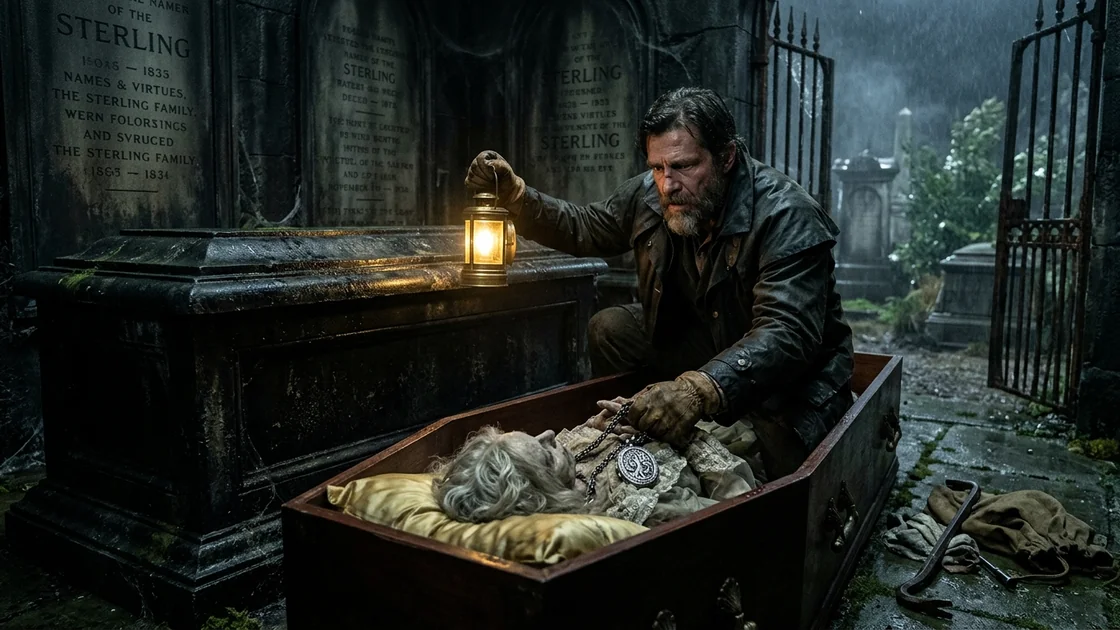
Silas Thorne is a seasoned grave robber in the perpetually fog-drenched city of Dredgeport who makes the fatal mistake of plundering the family crypt of the recently deceased Lady Seraphina Sterling. Drawn by greed and the promise of an easy fortune, he rips a heavy silver heirloom locket from her decaying neck, unknowingly binding himself to a vengeful curse born of the dead woman's obsessive vanity. Over the following weeks, Silas discovers to his mounting horror that his own reflection in mirrors, shop windows, and stagnant puddles is slowly being replaced by the rotting, cadaverous visage of the noblewoman he desecrated. When an examination by a local anatomist proves that the gruesome transformation exists only within reflective surfaces, and every attempt to discard the cursed ornament fails, Silas descends into suffocating paranoia. As the boundary between the living thief and the dead aristocrat dissolves across every piece of glass in the city, Silas is driven into a desperate, madness-fueled race to return the jewel to the mausoleum before the corpse in the mirror claims his physical existence entirely.
The rain in Dredgeport never truly fell; it simply hung in the air like a wet wool shroud, thick with the stench of coal smoke, rotting kelp from the harbor, and the sour tang of the tanneries along the Blackwater River. For a man of Silas Thorne’s particular vocation, however, such weather was a benediction. It kept the constables huddled around their braziers in the watch-houses, drove the mourning widows from the churchyard paths before dusk, and muffled the rhythmic, biting scrape of an ash-wood spade against wet gravel.
Silas crouched behind a weeping stone angel in the oldest quarter of St. Jude’s Cemetery, his oiled canvas coat pulled tight around his broad shoulders. He was forty-two years old, though the damp had settled into his knuckles and knees early, giving him the stooped, deliberate gait of a man twenty years his senior. His face was rough-hewn, marked by a broken nose from a long-forgotten tavern brawl, heavy dark brows, and a thick, salt-and-pepper beard that hid a jagged scar along his jawline. For fifteen years he had been a resurrectionist—a sack-em-up man—supplying the dissecting tables of the Ravenscroft Medical Amphitheatre with fresh subjects pulled from the pauper pits.
But the pauper pits were deep, muddy work, and the medical students had grown stingy with their guineas since the magistrate started hanging fewer footpads. Lately, Silas had turned his attention away from flesh and toward bone—specifically, the velvet-lined coffins of the merchant princes and faded aristocrats who occupied the terraced mausoleums on the northern hill. Flesh rotted and brought only three pounds a corpse; gold and silver did not spoil in the earth, and they did not require a heavy handcart to haul through the city gates at three in the morning.
Before him stood the Sterling Mausoleum. It was a grim, neoclassical structure of blackened Portland stone, its portico supported by four fluted columns that looked like rotting teeth in the gloom. Iron gates, rusted to the color of dried blood, barred the entrance, surmounted by the Sterling crest: a swan with a crown around its throat.
Silas waited until the distant bell of St. Jude’s tolled one. The single note vibrated through the sodden turf beneath his boots, dying quickly in the fog. Moving with practiced economy, he stepped out from behind the angel, his boots making no sound on the moss-slick flagstones. From the deep pockets of his coat, he produced a small vial of whale oil and a goose feather. He painted the hinges and the heavy padlock of the iron gate with the oil, letting it seep into the seized mechanisms before inserting a curved steel pick and a tension wrench.
Three minutes of patient probing rewarded him with a dull, greasy click.
He slipped inside the vestibule, pulling the gate shut behind him until it rested against the latch. In the absolute dark of the tomb, he unshuttered his bull’s-eye lantern by a fraction of an inch. A thin, yellow blade of light sliced across the interior, revealing rows of marble loculi built into the walls, each sealed with an inscribed tablet recording the virtues of dead Sterlings stretching back two centuries.
Silas did not care about the ancient ones; their trinkets had usually turned to brittle dust or been pilfered by their own destitute heirs decades ago. His eyes dropped to the center of the floor, where a massive sarcophagus of polished black granite stood upon a dais. Unlike the wall niches, the mortar around the lid of this monument was still pale and smelled faintly of fresh lime.
Lady Seraphina Victoria Sterling, the gilt lettering read. Taken from the light in her thirty-fourth year. Beauty is a fragile glass, yet she endures.
She had been buried four weeks ago. Silas remembered the funeral cortege passing through the Rookery on its way up the hill—six black Friesian horses with ostrich plumes, a glass-sided hearse, and rumors whispered in every gin shop from the docks to the Shambles. They said Lady Seraphina had been the last of the direct line, a reclusive beauty who had locked herself away in Sterling Manor when a wasting sickness of the blood began to ruin her famed complexion. More importantly to Silas, the chambermaids who had prepared her body had gotten drunk at the Drowned Oarsman three nights after the burial and boasted that the vain woman had refused to have her jewelry removed for the grave. She had gone into the dark wearing her rings, her pearl ear-drops, and the legendary Sterling heirloom—a heavy silver-and-onyx locket that had belonged to her great-grandmother.
Silas set his lantern on a stone ledge, pulled a three-foot ironjemmy wrapped in woollen rags from his canvas sack, and wedged the flattened tip into the fresh mortar beneath the granite lid.
He braced his shoulder against the cold stone and heaved. His muscles bunched; the veins in his thick neck stood out like cords. With a dry, powdery crunch, the lime mortar gave way. Working systematically around the perimeter, he levered the slab up onto three stout oak rollers he had brought in his sack, then pushed with all his weight. The granite lid slid six inches, then a foot, grinding over the oak dowels with a low, rumbling groan that seemed to shake the dust from the spiderwebs in the vaulted ceiling.
That was enough room. Inside the granite shell lay the inner coffin of waxed mahogany, fastened with eight brass screws.
Silas worked quickly now, the sweat breaking out under his collar despite the graveyard chill. Using a turnscrew, he backed out the brass fasteners—only four had actually been driven home by the lazy undertaker’s men, a common shortcut Silas had blessed a hundred times in his career—and lifted the wooden lid aside.
The smell hit him first.
It was not the clean, sharp odor of a newly dead pauper, nor the dry, musty scent of an old skeleton. It was a thick, cloying miasma of expensive French lavender water, rotting white lilies, and the unmistakable, sweet-sour reek of liquifying human fat. Silas didn't gag; he merely pulled a kerchief soaked in vinegar up over his mouth and nose, tying it tight behind his ears.
He picked up the lantern, slid the shutter wide, and shone the light down into the ruined satin nest.
Lady Seraphina Sterling was not aging gracefully in the dark. The four weeks of damp heat trapped inside the lead-lined mahogany had done terrible work upon her famed beauty. She lay in a shroud of ivory silk that had already turned yellow and dark brown around the ribs and hips where the bodily fluids had pooled. Her hands, folded over her breast, were like chicken claws dipped in tallow, the skin shrunken tight against the phalanges, though two heavy gold rings still gleamed on her fingers.
Her face was worse. The wasting disease had clearly hollowed her out before death, and the grave had finished the sculpture. Her skin had the texture and color of wet grey parchment, peeling away from her high cheekbones in translucent ribbons. Her nose had collapsed slightly at the cartilage, and her lips had drawn back in the rictus of desiccation, exposing long, yellowing teeth and blackened gums. Her left eye had sunken entirely into its socket, a dark pool of stagnant jelly, while the right lid remained half-open, revealing a milky, deflated orb that seemed to stare up at the lantern light with a profound and venomous indignation.
"Not so proud now, my lady," Silas muttered behind his vinegar rag.
He reached in with leather-gloved hands and slipped the two gold rings from her fingers. They came off easily, greased by the slick decay of the epidermis. Next, he pinched the pearl ear-drops from her grey, shriveled lobes, tearing the brittle cartilage without a second thought when the clasps caught.
Then his eyes fell to her throat.
Nestled in the hollow between her jutting collarbones, half-buried in a tangle of long, surprisingly vibrant silver-blonde hair and rotting Brussels lace, was the locket.
It was larger than he had expected—nearly the size of a pocket watch, oval in shape, forged from heavy, dark-patinated silver. The front was inlaid with a slab of polished black onyx, surrounded by raised silver filigree worked into the likeness of weeping willow branches and two intertwined serpents biting their own tails. Even in the dim yellow beam of the bull’s-eye lantern, the onyx seemed to drink the light rather than reflect it.
Silas reached down, slid two fingers beneath the heavy silver chain, and lifted.
The chain did not slide free. Over the past month, as the corpse had settled and bloated and collapsed, the heavy link chain had sunk deep into the softening flesh of the nape of her neck, and her matted hair had wound around the clasp like wire. Silas gave it a sharp tug. The corpse’s head lolled upward with a wet, sucking sound from the satin pillow, her milky right eye rolling toward him, her exposed teeth catching the light in a sudden, jarring grin.
Silas cursed under his breath. He took his clasp-knife from his pocket to cut the chain, then hesitated. The chain itself was thick, hand-forged silver box-link; cutting it would mar the piece and give Mordecai Finch an excuse to dock him ten shillings at the scale.
"Come on, then," Silas growled.
He planted one knee on the edge of the granite sarcophagus for leverage, wrapped both gloved hands around the silver chain close to her throat, and yanked upward with all his strength.
There was a sound like a wet bundle of twigs snapping in a fireplace. The brittle cervical vertebrae gave way, the rotting muscles of the neck tore with a soft shluck, and the locket came free, bringing with it a long, tangled hank of pale hair and a strip of grey, papery skin still adhered to the links. Lady Seraphina’s head dropped back onto the stained satin at an unnatural, broken angle, her chin pointing toward her left shoulder, her one milky eye fixed squarely on Silas’s chest.
For a second, the silence in the mausoleum was absolute. The rain outside seemed to have stopped. Looking down into the coffin, Silas felt a sudden, sharp prickle at the base of his skull—the ancient animal instinct of a scavenger realizing the predator is still near. In the wavering light of the oil wick, it looked almost as if the ruined chest beneath the ivory shroud gave a faint, shuddering sigh as the weight of the locket left it.
Silas shook the notion off, attributing it to the noxious gases escaping the thoracic cavity. He wiped the hair and the clinging scrap of skin off the chain against the edge of the coffin shroud, dropped the locket into his leather pouch beside the rings and pearls, and didn't bother replacing the mahogany lid or the granite slab. No one visited the dead once the mortar dried, not until the next Sterling died, and there were none left to die.
Ten minutes later, he was over the cemetery wall and vanishing into the labyrinthine alleys of the Rookery.
Mrs. Garrow’s boarding house stood at the bottom of Tallow Lane, where the cobblestone street sloped down toward the stagnant Fleet Canal. The house was a narrow, timber-framed structure that leaned so far over the alleyway its upper stories nearly kissed the brickwork of the chandler’s factory opposite. Silas occupied the back garret on the third floor—a room with a sloping ceiling that smelled permanently of damp plaster, boiled cabbage, and the tallow vats next door. It had one window overlooking a courtyard full of broken barrels, an iron bedstead, a three-legged table, and a washstand topped with a cracked porcelain basin and a small, foxed shaving mirror hanging from a rusty nail.
Silas bolted the door behind him, stripped off his sodden canvas coat, and lit a tallow dip on the table. His fingers were stiff with the graveyard chill. Before examining his haul, he poured cold water from the ewer into the porcelain basin to wash the grave-grease from his hands and face.
He stripped off his leather gloves, plunged his rough hands into the water, and scrubbed them with a Cake of harsh yellow lye soap. Lifting his dripping face, he glanced casually into the shaving mirror on the wall as he reached for a towel.
He froze, the rough linen halfway to his cheek.
In the dim, guttering light of the tallow candle, the mirror showed the familiar cramped geometry of the garret behind him—the sloping rafters, the iron bedstead, the dark square of the window. And it showed his own broad shoulders, clad in his sweat-stained linen shirt.
Wait. For the fraction of a second, before his eyes fully focused on the tarnished glass, the face above those shoulders had not been his own.
It had been pale. Dead pale, with a hollow under the left cheekbone that looked like a thumbprint pressed into wet clay, and a smear of dark, bruised lividity around the mouth.
Silas blinked hard, his heart giving a heavy, irregular thud against his ribs.
Immediately, the image resolved. There was his own thick, grey-streaked beard, his crooked nose, his dark, deep-set eyes squinting back at him through the black spots of the mirror’s aging silver backing.
"Grave-damp," he muttered aloud, his voice sounding thick and alien in the small room. He rubbed his eyes with the heels of his hands. He had inhaled too much of the coffin-gas when he wrenched her neck. Every resurrectionist knew about the corpse-miasma; if you breathed too deep of a burst belly in a closed vault, it gave you the shakes and made you see lights in the fog for a day or two.
He turned his back on the mirror, walked to the table, and emptied his leather pouch onto an old square of oiled cloth.
The two gold rings were heavy eighteen-carat bands, one set with a garnet. The pearl ear-drops were fine orient, though one of the gold wires was bent where he had torn it through her ear. Together, they would fetch twelve, perhaps fifteen pounds from Mordecai Finch.
Then he picked up the locket.
Even after being wiped on the shroud, it was ice-cold in his palm, carrying the stubborn, subterranean chill of the vault. It weighed nearly half a pound. Silas held it close to the candle flame, turning it over. The black onyx on the front was flawless, so dark it seemed like a hole cut into the fabric of the room. The silver serpents and willow branches around the border were worn smooth at the high points, as if generations of nervous fingers had traced them in the dark.
On the reverse side, the silver was engraved with a motto in cramped Latin script, encircling a tiny crest of the crowned swan.
Silas ran his thumb along the right edge, feeling for the catch. He found the small silver lip and pressed it with his thumbnail. Nothing happened. He wedged the point of his clasp-knife into the hair-thin seam between the two halves of the oval and pried gently, careful not to gouge the soft metal.
The locket remained shut as solidly as if it had been soldered from the inside. Yet, when he shook it beside his ear, he heard a faint, dry shifting within—like a pinch of dust or a dried curl of hair sliding across glass.
"Stubborn bitch," Silas whispered, setting the locket down beside the candle. As he released it, the tallow flame dipped low, burning blue at the base for a moment, and the faint, sweet-sour smell of French lavender and spoiled meat drifted across the table. Silas sniffed his own sleeve in disgust, convinced the stench had soaked into his woollen waistcoat, and blew out the light to get some sleep before morning.
He did not sleep well. Through the thin walls of the garret, the boarding house creaked and settled in the river wind, and all night he dreamed that he was lying flat on his back in a box lined with wet satin, unable to close his right eye while someone stood over him with a lantern, prying his teeth apart with an iron bar.
At nine o'clock the next morning, under a sky the color of a lead weight, Silas pushed open the door of a narrow shop in the Shambles, a crooked lane wedged between the slaughterhouses and the old debtors' prison. A brass bell above the lintel gave a choked, flat clatter.
The interior of Mordecai Finch’s establishment was a cavernous clutter of dead men’s castoffs. Tarnished silver tea services sat stacked beside ships' chronometers, yellowed ivory tusks, cases of dueling pistols, and racks of faded velvet coats that had been stripped from the backs of gentlemen fished out of the Blackwater. The air smelled of brass polish, old paper, and the sweet Turkish tobacco Finch smoked to keep the smell of the nearby abattoirs out of his lungs.
Finch himself sat behind a high walnut counter enclosed by a brass wire grille, like a spider in a gilded cage. He was a tiny, hairless man of indeterminate age, wearing a greasy velvet skullcap and a pair of jeweler’s loupes strapped to his forehead that magnified his watery grey eyes to monstrous proportions.
"Morning, Mr. Finch," Silas said, approaching the grille and resting his knuckles on the scarred wood.
Finch didn't look up from the pocket watch movement he was disemboweling with a pair of tweezers. "You smell of clay and vinegar, Thorne. If you have brought me brass coffin-handles again, you may turn around and walk back into the fog. The foundry men are watching the scrap yards, and melted brass brings me nothing but headaches."
"Not brass," Silas said. He reached into his coat pocket and laid the garnet ring, the wedding band, and the pearl ear-drops onto the green baize pad passed under the grille.
Finch laid down his tweezers, slid the baize toward himself with one long, yellow fingernail, and lowered a brass loupe over his right eye. He picked up the garnet ring first, weighing it in his palm, then held the pearls up to the grimy window light. He paused when he noticed a tiny fleck of dried, brownish-grey matter clinging to the bent gold wire of the left pearl.
With a delicate grimace, Finch flicked the bit of dead flesh away with a blotter and looked up at Silas. "Good water on the pearls. Old setting. Not pauper-pit work, Silas. You’ve been up on the hill."
"A man goes where the harvest is," Silas replied evenly. "What’s the reckoning?"
"Nine pounds for the rings. Five for the drops, seeing as you butchered the wire on the one like a clumsy blacksmith."
"Seventeen the lot," Silas countered automatically.
"Fourteen, and I don't ask whose vault is sitting open in the rain this morning."
Silas grunted, accepting the price with a nod. "Fair enough. But that’s just the starter. Look at this."
He reached into his inner waistcoat pocket and drew out the heavy silver locket. When he laid it on the green baize, it landed with a dull, heavy thud that made the brass scales on the counter tremble.
Finch leaned forward. The moment his magnified eye fell upon the black onyx and the silver filigree of serpents and weeping willows, the old fence went completely still. He did not touch it. Slowly, he reached up and pushed the jeweler’s loupe back onto his forehead, staring at the piece with his naked, rheumy eyes.
"Where did you get this?" Finch’s voice had dropped an octave, losing all its nasal merchant’s cant.
"Same place as the rings," Silas said, frowning slightly at the old man’s reaction. "Solid silver, heavy gauge, good onyx. Clasp is stuck fast, so there’s likely a miniature inside, maybe diamonds round the bezel once you get a blade in it."
Finch pulled his hands back from the counter as if the green baize had suddenly caught fire. Using the wooden end of a dip-pen, he prodded the locket half an inch, turning it just enough to see the crowned swan visible at the clasp.
"The Sterling Vault," Finch whispered. His bald scalp had gone the color of cold mutton fat. "You broke Lady Seraphina’s box."
"What of it? She’s got no kin left in Dredgeport to raise a hue and cry, and the sexton at St. Jude’s is deaf and blind on gin half the week. You’ll melt the silver and recut the stone by nightfall."
"I won't touch it," Finch said flatly. With the tip of the wooden pen, he shoved the green baize pad back under the brass grille until it bumped against Silas’s knuckles. "Take the rings and the pearls too. Take the whole lot and get out of my shop."
Silas stared at him, anger flaring hot under his breastbone. "Have you gone soft in the head, old man? It’s twenty ounces of silver if it’s a dram!"
"It is the Glass of Seraphina," Finch hissed, glancing nervously toward the shadowed corners of his own shop, where a tall cheval mirror stood among the antique furniture. "Do you never listen to anything in this town unless it’s the clink of coin, Silas? That locket was made in Vienna four generations back for the old Countess Sterling, who dabbled in things that got her barred from the churchyard at her death. There is no portrait inside that case."
"Then what’s in it?"
"A looking-glass," Finch said, his voice trembling. "Silvered with mercury and polished obsidian dust. When Lady Seraphina took the rotting sickness in her blood last winter, her face went first. Her nose, her lips—she was the proudest woman in the county, and she had to watch herself spoil like a dropped plum while she was still drawing breath. She had her servants take hammers to every pier-glass in Sterling Manor. Every window was draped in black broadcloth so she wouldn't catch sight of herself at dusk."
Silas crossed his arms, unimpressed by parlor stories. "So she was mad. Dead women don't care how they look."
"She did," Finch whispered, leaning close to the brass wires. "The physician who attended her sold me her silver pomander two days after the funeral, and he told me how she died. For the last three months of her life, she kept that locket open in her hand day and night, staring into the little glass inside. She swore that the glass held the memory of her face before the rot took her—or else she was pouring the rot into it, the doctor couldn't tell which. On her deathbed, she made the vicar swear on the sacrament that nobody would take that locket from her breast. She said if any thief took her glass, she would take theirs in trade, so she wouldn't have to look at her own corruption in the dark of the grave."
A draft blew under the shop door, making the brass bell above the lintel give a tiny, shivering ting.
Silas looked down at the black onyx resting between them. In the dim light of the shop, the silver serpents seemed to glisten with a faint, oily moisture. For an instant, he remembered the shaving mirror in his garret the night before—that fleeting glimpse of a sunken, grey-skinned cheek above his own collar.
Then his habitual cynicism reasserted itself. Finch was a notorious miser who had tried every trick in the book over the last decade to drive down the price of grave-goods.
"That’s a fine penny-dreadful tale, Mordecai," Silas sneered, tapping a thick finger against the wire grille. "Did you make that up while you were weighing the pearls, so I’d let the locket go for five shillings out of fright?"
Finch didn't argue. He reached into his cash drawer, counted out fourteen gold sovereigns, and dropped them onto the counter beside the locket. "There is your fourteen pounds for the rings and the ear-drops. Leave them on the pad. Take the locket off my counter. If you leave it here, I’ll throw it into the street behind you."
Silas studied the old man’s face. There was a beaded line of sweat across Finch’s upper lip, and his hand was shaking so badly as he pulled the rings and pearls back through the grille that one of the sovereigns rolled off the counter and hit the floorboards. Finch didn't even bend to pick it up.
Silas bent down, retrieved the gold coin, scooped the fourteen sovereigns into his purse, and picked up the locket. The metal felt noticeably warmer now than it had in his garret—almost blood-warm, like a bird held too long in a closed fist.
"Plenty of other fences in Dockside who aren't scared of dead women’s nursery rhymes," Silas muttered. He dropped the locket back into his waistcoat pocket and strode toward the door.
As he reached for the brass handle, he had to pass the tall cheval mirror standing near the shop window. He wasn't trying to look into it, yet the movement in the glass caught the corner of his left eye.
Silas stopped dead, his hand on the latch.
He turned his head slowly toward the mirror.
Standing there in the dusty, cluttered reflection of the curiosity shop was a man in an oiled canvas coat and a slouch hat. The coat was his. The heavy boots covered in dried cemetery mud were his. The right side of the face—the broken nose, the bristling dark beard, the deep-set brown eye— belonged to Silas Thorne.
The left side of the face did not.
From the bridge of the nose across to the left ear, the reflection’s beard was gone, replaced by smooth, hairless skin the color of wet ashes. The cheekbone jutted out sharp and gaunt, and just beneath it, the grey skin was split in a vertical crack half an inch wide, revealing the dull yellow gleam of the upper molars beneath the cheek.
Silas let out a strangled gasp and stumbled backward, crashing into a display of brass candlesticks that went clattering to the floor. He clapped his left hand violently to his own cheek.
Beneath his calloused fingers, he felt coarse, wiry beard hair. He felt warm, solid muscle and unbroken skin. He pinched his cheek hard enough to bring tears to his eyes; he felt the sharp pain, the living blood rushing to the surface.
Yet in the cheval mirror, his reflection’s hand—a thick, muscular workman’s hand—was pressing against a hairless, rotting grey hollow, and as his real fingers pinched, the reflection’s fingers sank half an inch into the putrid, yielding dough of the corpse’s cheek.
"Thorne?" Finch’s terrified voice squeaked from behind the counter. "Thorne, what are you doing? Get out! Get out of my shop!"
Silas tore his gaze away from the glass, wrenched the door open, and bolted out into the fog-choked lane.
He ran until his lungs burned like hot coals, shoving past butchers’ apprentices carrying trays of offal and fishwives hawking herrings from wheelbarrows. Every puddle in the broken cobblestones was a trap. As he leaped over a pool of rainwater gathered in a cart-rut, a pale, bloated face with one milky eye flashed up at him from the muddy water. When he passed the glazed storefront of an apothecary’s shop, the dark backing of the window panes behind the colored water-carboys showed a figure hurrying past—a broad-shouldered man whose head was crowned not with a slouch hat, but with long, trailing ribbons of matted silver-blonde hair plastered to a peeling scalp.
Silas ducked into the narrow, windowless entry of the Drowned Oarsman tavern near the coal wharves, slamming the heavy oak door behind him.
The taproom was low-ceilinged, dark as a ship’s hold, and lit only by the red glow of a sea-coal fire in the hearth. No mirrors hung here; the landlord was too poor for looking-glasses, and the walls were wainscoted in black, tar-stained oak. Three bargees sat in a corner booth playing dice, paying no mind to Silas as he stumbled to the rough plank bar.
"Brandy," Silas wheezed at the pot-boy. "Double measure. In horn, not pewter."
The boy blinked at the strange request—pewter tankards were the house standard—but fetched a scarred cow-horn mug and filled it from a stoneware jug. Silas tossed a sixpence onto the wet wood, seized the horn with both hands, and drained the raw, fiery spirit in two gulps.
The alcohol hit his stomach like a hot iron, steadying the violent tremor in his knees. He leaned his elbows on the bar, burying his face in his hands, breathing in the familiar, grounding smells of spilled porter, sawdust, and pipe-ash.
Think, he told himself fiercely. Think like a sensible man, not an old woman.
What had happened? Last night in the Sterling tomb, when he had wrenched the locket from the corpse’s neck, her head had lifted and a puff of trapped gas had blown right into his face through the vinegar rag. Everybody in the resurrection trade knew stories about vault-fever. Three years ago, Billy Craddock had opened a lead coffin in the plague-ground at Stepney, breathed the foul air, and spent a week raving in Bedlam that giant beetles were crawling out of his ears before the fever broke.
It was a poison of the optic nerve. That was all. A trick of the brain conjured up because old Finch had planted that story about the dead woman’s curse in his head right before he looked into the cheval glass.
Silas lowered his hands slowly. He felt his face again, methodically tracing every inch from forehead to chin. His beard was thick and full on both sides. His nose was crooked and warm. Both eyes saw clearly; when he closed his right eye, the vision in his left was just as sharp as ever, unclouded by any cataract or rot.
To prove it to himself, he dipped two fingers into a puddle of spilled ale on the dark oak bar, smearing the liquid across the wood until it formed a small, glossy pool in the firelight.
Slowly, holding his breath, he leaned his head over the bar and looked down into the wet wood.
The firelight danced orange on the surface of the ale. Looking back up at him from the dark liquid was the left side of his own bearded, rugged face. No grey skin. No split cheek. Just Silas Thorne, looking haggard and pale from lack of sleep.
Silas let out a long, shuddering breath that turned into a dry laugh.
"Vault-miasma and old Finch’s Jewish tricks," he muttered to himself, tapping the horn mug for another brandy. The shadow in Finch's shop had just been a flaw in the cheap antique glass, combined with the dim light and his own ragged nerves.
He drank the second brandy slowly, letting the heat spread to his fingertips. By the time he left the tavern an hour later, the rain had turned to a brisk drizzle that washed the coal-smut from the air. Feeling vastly restored, Silas decided he wouldn't even bother taking the locket to the Dockside fences while the clasp was stuck; they would only cheat him on the gross weight, claiming the interior was filled with lead or paste. He would take it back to his garret, put it in his iron bench-vise, and chisel the damned thing open himself. Once the silver was broken up into scrap and the onyx popped out of its bezel, it would just be anonymous metal and stone, and Finch himself wouldn't know it from a melted candlestick.
The afternoon was waning into a premature twilight when Silas climbed the three flights of creaking stairs at Mrs. Garrow’s boarding house. On the second-floor landing, he encountered Mrs. Garrow herself, kneeling beside a bucket of grey suds with a scrubbing brush in her swollen red hand. She was a vast, sour-faced woman who wore a permanent shawl of greasy black wool and smelled of gin and camphor.
"Mr. Thorne," she barked, sitting back on her heels and wiping a strand of iron-grey hair from her forehead with her forearm. "A word with you before you go locking yourself in that loft."
"Rent isn't due till Friday, Mrs. Garrow," Silas said, keeping one hand in his pocket around the heavy locket.
"It ain't the rent, though I’ll take that early if you’ve come into luck," she said, narrowing her small, piggy eyes as she sniffed the air near his coat. "It’s what you’re bringing up my stairs after dark. I’m a tolerant woman, Mr. Thorne. I don't ask what a gentleman carries in canvas sacks, so long as he don't leave mud on my runners. But when I came up to sweep the landing at noon today, there was a smell coming from under your door would turn the stomach of a dog. Like a butcher’s basket left in the sun, mixed up with funeral lilies."
Silas felt a cold trickle of sweat run down his spine, though his voice remained gruff. "I stepped in some bad mire down by the canal last night, missus. And spilled some hair-oil on my cuff. I’ll air the room out."
"See that you do," she snapped, though as she looked up at him in the gloom of the stairwell, her expression shifted from anger to a strange, squinting confusion. "Are you quite well, Mr. Thorne? You’ve got a dreadful queer look about you in this light."
Silas stiffened, his hand tightening around the silver oval in his pocket until the filigree bit into his palm. "What do you mean, a queer look?"
"Just peaky," she muttered, looking back down at her scrub bucket as if suddenly uncomfortable holding his gaze. "Like you’ve been sleeping in a cellar. Open your window, mind, or I’ll charge you sixpence for chloride of lime."
Silas didn't answer. He took the last flight of stairs two at a time, unlocked his garret door, and locked it behind him.
The smell in the room was strong. It wasn't his coat—he was wearing his coat—and it wasn't the boots he had worn the night before, which were sitting outside on the window ledge in the rain. The odor was radiating directly from the three-legged table where the locket had lain overnight. It was the unmistakable, heavy perfume of a closed coffin: sweet, waxy, and rotten at the core.
Silas walked straight to the washstand first. Without hesitating, before his nerve could fail him, he looked squarely into the foxed shaving mirror on the wall.
In the grey dusk filtering through the garret window, the glass was dark. He leaned closer—six inches from the surface.
His own face stared back. Or mostly his own face.
Now, both eyes in the reflection were changed.
His real eyes were dark brown, small and sharp beneath heavy brows. The eyes looking back at him from the shaving glass were larger, sunken deep into purple-black bruised sockets, and the irises were a pale, watery blue—though the right one was completely clouded over with a thick, milky cataract that looked like boiled egg-white. Around the reflection’s temples, his coarse dark hair looked thin and patchy, with long, wispy strands of dead white-blonde hair growing straight through his own locks, drifting slightly as if underwater.
Silas didn't scream this time. A cold, leaden horror settled into his gut, too heavy for panic.
Slowly, he raised his right hand and touched his own right eyelid. His reflection raised its left hand—a hand that was no longer his thick, scarred paw, but a long, skeletal thing with peeling grey skin and blackened fingernails—and pressed a rotting index finger directly against the milky, deflated eyeball.
The eyeball in the mirror squelched inward like a rotten grape, leaking a drop of clear, viscous fluid down a bearded cheek.
Silas jerked his hand away from his face as if he had burned himself. He backed away from the washstand until the backs of his knees hit the iron bedstead.
It wasn't grave-miasma. No fever of the blood could make a man see the exact, specific details of a corpse he had looked at for less than two minutes in the dark—the precise shade of watery blue in the left eye, the exact way the cuticle had pulled back from the yellowed thumbnail on the left hand.
She said if any thief took her glass, she would take theirs in trade.
Silas tore the locket from his waistcoat pocket and slammed it down into the jaws of the small iron bench-vise bolted to the corner of his table. He spun the iron handle with all his might, tightening the steel jaws until the heavy silver oval groaned under the pressure.
"We’ll see whose glass it is," Silas snarled through clenched teeth, his breath coming in ragged pants.
He grabbed a cold chisel and a heavy cobbler’s hammer from his tool-box under the bed. Positioning the sharp bevel of the chisel squarely against the seam where the clasp met the hinge, he raised the hammer and brought it down with a deafening CLANG.
Sparks flew blue in the dim room. The chisel skittered off the silver without leaving so much as a scratch in the patina, jarring Silas’s wrist all the way to the elbow.
He cursed, reset the chisel against the black onyx face on the front, and struck it again, harder. CLANG! CLANG!
The hammer blows echoed off the rafters like pistol shots. Down below, Mrs. Garrow banged a broom handle against her ceiling in fury, shouting muffled curses up through the floorboards.
The onyx did not crack. The silver did not dent. Instead, from the hair-thin seam along the edge of the locket, a single bead of thick, dark red liquid—blackish and coagulated, like blood drawn from a three-day corpse—squeezed out under the pressure of the vise and ran down the iron screw, filling the room with an overpowering wave of putrescence.
Silas dropped the hammer. He stepped back, wiping his mouth with the back of his sleeve, staring at the thing clamped in the iron jaws.
If he couldn't break it, and he couldn't sell it, he had to get rid of it. No—first he had to know if he was losing his mind. If Mrs. Garrow had looked at him on the stairs and seen only a "peaky" man, not a walking monster with a dead woman’s eyes, then the thing was only in the glass.
He needed a man of science. Someone who knew both the living body and the dead one.
Silas snatched up his hat, walked over to the washstand without looking at the wall, and lifted the shaving mirror off its nail, turning its face flat against the cracked plaster. Then he unscrewed the bench-vise, wrapped the bleeding locket in a thick piece of greasy rags, shoved it deep into his coat pocket, and went back out into the night.
The Ravenscroft Medical Amphitheatre occupied a grim, windowless building of soot-stained brick at the end of Surgeons’ Row, backing directly onto the sluggish waters of the Fleet Canal so that waste from the dissecting rooms could be sluiced straight into the tide.
Silas did not go to the front portico, where the medical students in their fine broadcloth coats entered for lectures. He went down the narrow, sunken stone steps into the basement area, past the zinc-lined receiving troughs, and rapped his customary signal—three slow knocks, then two fast—on the iron-bound oak door.
After a moment, a small Judas-grille slid back. A pair of sharp, spectacled eyes peered out into the drizzle.
"Thorne?" said a crisp, cultivated voice. "We didn't order a subject for tonight. The frost hasn't set in yet, and the cellar is full from the typhus ward at St. Bart’s."
"I haven't got a sack with me, Dr. Vance," Silas said, keeping his face turned slightly away from the wet gleam of the iron grille. "I need five minutes of your time. Professional consultation. I can pay a guinea."
The bolt shot back inside. Dr. Julian Vance opened the door and stepped back to let Silas enter. Vance was a tall, spare man in his thirties, wearing a blood-stiffened butcher’s apron over a fine linen shirt with the sleeves rolled up above his elbows. In his right hand he still held a small bone-saw, which he wiped absently on a towel as he closed the door.
The basement dissecting room was brightly lit by four roaring gas-jets hanging from brass pipes over three zinc-topped tables. Two of the tables were occupied by canvas-draped mounds; on the third lay the partially flayed cadaver of an old dockworker, the musculature of his chest pinned back like the pages of a fleshy book. The room smelled fiercely of carbolic acid, spirits of wine, and raw beef.
Silas kept his eyes fixed firmly on the sawdust-covered flagstones as he walked in, terrified of the polished zinc tables and the glass bell-jars lining the shelves along the walls, wherein pale, deformed fetuses and diseased livers floated in yellowing alcohol.
"Well, Thorne?" Vance asked, tossing the bone-saw into a shallow enamel tray with a clatter that made Silas flinch. "Have you finally caught a watchman’s buckshot in your backside, or is it the French pox? Put your guinea on the desk."
Silas fished a gold sovereign and a shilling from his pocket and laid them on the high clerk’s desk in the corner. "Neither, Doctor. Look at me. Look closely at my face under the gaslight."
Dr. Vance frowned, adjusting his wire-rimmed spectacles—Silas instantly averted his eyes from the twin convex lenses, lest he see himself reflected in them—and stepped closer. He took Silas by the chin with warm, carbolic-scented fingers and tilted his head up toward the hissing gas-jet.
"Hmph," Vance murmured, turning Silas’s head left, then right. With his thumbs, he pulled down Silas’s lower eyelids, examining the conjunctiva. "Pupils are dilated, though that might be the brandy I smell on your breath. Pulse in the carotid is racing—a hundred and twenty at least. Skin is slightly clammy, color a bit sallow, which is hardly surprising given your nocturnal habits. Your tongue?"
Silas stuck out his tongue.
"Coated, dry," Vance said, stepping back. "Have you been working the old cholera pits behind the workhouse? Or did you puncture a thumb on a necrotic bone?"
"Tell me what my eyes look like, Doctor," Silas rasped, his voice tight as a violin string. "Tell me the color of them. Tell me if there’s a film over the right one."
Vance stared at him as if he were an idiot. "Your eyes are dark brown, Thorne, same as they’ve been every time you’ve haggled with me over a corpse for the last six years. Sclera are slightly bloodshot from drink or lack of sleep, cornea entirely clear. No cataract, no ulceration. And your beard could use a comb, if you’re suddenly concerned with your beauty."
A wave of dizzying relief washed over Silas, followed immediately by a deeper, colder dread. If his body was whole, then the thing wasn't in his flesh.
"What about vault-poisoning, Doctor?" Silas pressed, gripping the edge of the zinc table where the dead dockworker lay. "If a man opens a lead coffin that’s been sealed a month, and breathes the gas off a woman who died of a blood-rot... could it make him see things? Could it make him look into a glass and see the corpse’s face instead of his own?"
Dr. Vance’s eyebrows rose high above his spectacles. "Hallucinations from hydrogen sulfide or cadaveric alkaloids? An interesting notion. The fumes of putrefaction can certainly cause vertigo, nausea, and delirium if inhaled in an unventilated crypt. Though a visual monomania restricted entirely to reflective surfaces sounds less like toxicology and more like the early stages of cerebral syphilis or religious mania."
Vance walked over to a mahogany cabinet on the wall, opened a drawer, and pulled out a large, round hand-mirror framed in polished brass, which he used for demonstrating dental anatomy to students.
"No!" Silas shouted, throwing an arm up across his face and backing against the dissecting table, nearly knocking the dead dockworker’s rigid arm off the zinc slab.
Vance paused, holding the mirror down at his side. "My dear fellow, you are shaking like a dog in a thunderstorm. It is a piece of silvered glass. Look into it while I stand beside you. When your mind registers that both our faces are reflected normally under strong gaslight, the phantom of your imagination will dissolve."
"You don't understand," Silas breathed, his back pressed hard against the cold zinc.
"I understand that I am not letting my best resurrectionist go raving mad and babble to the parish beadle about where he gets his cadavers," Vance said sharply. He stepped forward, seized Silas by the wrist to pull his arm down, and held the brass hand-mirror up twelve inches in front of both their faces. "Look, Thorne. Look at me in the glass first, then look at yourself."
Silas couldn't stop his eyes from opening.
In the bright, merciless white glare of the four gas-jets, the round brass mirror was crystal clear.
On the left side of the circle stood Dr. Julian Vance. His reflection was sharp, ordinary, and alive—his spectacles gleaming, his brow furrowed in clinical sternness.
On the right side of the circle, standing shoulder-to-shoulder with the doctor, was Lady Seraphina Sterling.
There was almost nothing of Silas Thorne left in the glass now, save for the broad bulk of the canvas coat and the dark collar of his shirt. Rising out of that man’s collar was a thin, broken neck with a ring of purple-black bruising where the silver chain had torn the flesh. Above it sat the dead woman’s head, tilted slightly toward the left shoulder at that same sickening angle he had left her in the coffin.
Her long, silver-blonde hair hung in greasy, clotted ropes down over Silas’s lapels. Her grey, parchment skin had peeled further back from her cheekbones than it had that morning, exposing the dark red meat of the masseter muscle underneath. Her nose was a sunken triangle of blackened cartilage. Both eyes were hers now—the left a stagnant blue pool, the right a bulging white marble of rot—and as Silas stared in paralyzed horror, the corpse in the mirror slowly parted its shriveled, blackened lips.
Silas’s own mouth was shut tight; he could feel his teeth grinding together in his skull.
Yet in the mirror, right beside Dr. Vance’s unbothered reflection, the dead woman’s jaw unhinged with a silent snap, opening wide until the corners of her mouth split, revealing a blackened tongue and three tiny, glistening white maggots wriggling between her yellow bicuspids.
"You see?" Dr. Vance said calmly, looking right into the mirror at the exact spot where the rotting monstrosity was grinning at them. "Nothing there at all, Thorne, save a very tired man who needs thirty grains of bromide of potassium and a night’s rest. You look perfectly normal."
Silas let out a thin, high-pitched whimper that sounded like a rabbit caught in a wire snare. He shoved Dr. Vance backward with all his strength, sending the anatomist sprawling into a rack of surgical trays that crashed to the flagstones in a shower of scalpels and forceps.
Silas didn't stop to pick up his guinea. He tore the basement door open and fled into the rain along the Fleet Canal.
The canal was black and thick as treacle, swollen with the runoff from the slaughterhouses and the dye-works upstream. The brick towpath was deserted at ten o'clock at night, shrouded in a yellow fog that smelled of sulfur and wet soot.
Silas stopped in the middle of the iron footbridge that spanned the lock-gates. Below him, the dark water boiled and churned through the narrow sluice, thirty feet deep and floored with six feet of sucking black silt that had swallowed a hundred murdered men and weighted sacks without ever giving them back.
Breathing in great, tearing sobs, Silas pulled the rag-wrapped bundle from his coat pocket. He didn't unwrap it. He didn't want to see the black onyx or the silver serpents ever again.
"Go back to the mud, you rotting whore," he sobbed, and hurled the heavy bundle over the iron parapet with all his might.
He heard it strike the churning water below with a sharp plop. No ripples showed in the black scum. It sank like a cannonball into the thirty feet of slime and industrial waste behind the lock-gates.
Silas stood gripping the wet iron railing of the bridge for ten minutes, letting the cold rain beat down on his bare head—he had lost his hat somewhere in Surgeons’ Row. Gradually, the wild hammering of his heart slowed.
It was gone. Thirty feet of water and six feet of lime-sludge lay over it. Even if they dredged the lock next summer, the acid from the dye-works would have eaten the silver to black scale.
He walked slowly off the bridge, keeping his head down, though he was still terrified of the puddles on the towpath. When he passed beneath a solitary street-lamp near the mouth of Tallow Lane, a broad puddle of rainwater lay directly across the flagstone pavement under the gas-cone.
Silas stopped six feet away from it.
Look, a voice whispered in his head. It’s at the bottom of the canal. Look and see that you’re yourself again.
Trembling, Silas took two steps forward and craned his neck over the edge of the puddle.
The gaslight reflected yellow on the surface of the water. Beneath the yellow glow, framed by the brick wall of the chandler’s factory behind him, a figure stood looking down.
It was her.
She hadn't vanished when the locket hit the water. If anything, she was clearer in the puddle than she had been in Dr. Vance’s brass mirror. Even in the rippling rainwater, he could see the broken angle of her neck and the shroud-lace collar that had now replaced the linen collar of his shirt in the reflection. Worse still: in the puddle, she was not looking down at the water as Silas was. Her head was tilted back, looking straight up through the surface of the puddle into his real eyes, and her skeletal, grey hand was raised toward him, clutching the silver-and-onyx locket between long, rotting fingers that dripped with black canal silt.
Silas screamed, stomping his heavy boot straight into the middle of the puddle, shattering her face into a hundred splashing droplets of filthy water.
He ran the rest of the way down Tallow Lane, burst through the front door of Mrs. Garrow’s boarding house, and thundered up the three flights of stairs to his garret.
He slammed the door, threw the iron bolt, and dragged the three-legged table across the threshold to barricade it. In the pitch dark of the room, he fumbled for his box of lucifer matches on the mantlepiece, struck one with shaking hands, and touched it to the tallow candle.
As the yellow flame bloomed, Silas turned toward his iron bedstead.
He froze, his back pressed against the chimney-breast.
Leading from the closed, rain-streaked window across the dry pine floorboards to the bed was a trail of black, slimy canal water, smelling foully of dye-sludge and dead eels.
And sitting squarely in the center of his coarse wool blanket, resting in a soaking wet ring of dark mud and tangled water-weed, was the locket.
The greasy rag he had wrapped it in was gone. The silver serpents gleamed bright and clean through the black silt, as if the acid of the canal had only polished away a century of tarnish.
Silas sank slowly to his knees beside the hearth, his legs refusing to support him any longer.
For a long time, he simply stared at the thing on his bed. He could not break it. He could not sell it. He could not drown it. And every hour it remained in his possession, it ate away another piece of his likeness from the world’s glass, pasting her decaying carcass over his image like a bill-sticker covering an old poster on a dead wall.
Why hadn't Dr. Vance seen it?
Because the glass belonged to Silas. When a man looks in a mirror, he looks at his own reflection; another man standing beside him sees what belongs to his own eyes. Seraphina hadn't cursed the world’s mirrors; she had cursed the thief’s reflection—the intangible phantom of light that bounced back from silver and water to tell a man that he existed in the world of the living.
Wait. If she was taking his reflection... where was his reflection going?
As if in answer to the unspoken thought, a sharp, metallic CLICK echoed through the silent garret.
Silas’s breath caught in his throat.
On the bed, resting in the puddle of black canal silt, the heavy silver locket had sprung open by itself.
Silas crawled across the floorboards on his hands and knees, drawn by a horror stronger than self-preservation. He reached the side of the iron bedstead and raised himself just high enough to peer over the mattress into the open oval of silver.
Old Mordecai Finch had been right.
On the left side of the interior, where a lock of braided hair was usually kept under beveled crystal, lay a tiny, circular mirror made of dark, mercury-backed obsidian glass. It was cracked down the middle, and smeared across its surface was a dried crust of brown-black blood—the rot that Lady Seraphina had poured into it during her final months.
On the right side of the interior, framed in a delicate rim of twisted gold wire, was a painted miniature on ivory.
When Silas had pried open her coffin the night before, Finch said there had been no portrait inside.
There was one now.
Painted in exquisite, microscopic detail upon the ivory disk—every grey hair in the thick beard rendered with a single bristle brush, the broken bridge of the nose, the deep-set brown eyes wide with stark, suffocating terror—was the face of Silas Thorne.
And as Silas stared down at the tiny painting of himself, less than an inch wide, the painted eyes of the miniature moved. The tiny mouth behind the beveled crystal opened in a silent, frantic scream, and two miniature hands pressed flat against the inside of the glass, trying to push their way out of the locket.
Silas stumbled backward, upsetting the water ewer on the washstand, which crashed to the floor and shattered into jagged white shards. Water flooded across the floorboards, soaking the knees of his trousers.
In the spreading sheet of water on the floor, lit by the single candle on the mantlepiece, Lady Seraphina stood towering over him—and she was no longer mimicking his posture.
Silas was on his knees on the floor, shivering in the spilled water.
In the reflection on the wet floorboards, Lady Seraphina was standing tall and straight by the table, her broken neck snapping back into alignment with a visible jerk, her rotting grey hands smoothing down the front of her stained ivory burial shroud. Her milky right eye and her stagnant blue left eye looked down at Silas from the water with cold, aristocratic triumph.
The next three days were a descent into a waking coffin.
Silas did not leave his garret on the first day. He nailed his heavy woollen blanket over the window so that the glass panes could not catch his image when night fell. He took the foxed shaving mirror that he had turned against the wall, wrapped it in an old shirt, and smashed it to powder with his cobbler’s hammer, sweeping the silvered dust into the ashes of the grate so not even a splinter remained to catch the candlelight. He ate dry bread and cheese in the dark, drinking straight from the neck of an earthenware gin bottle with his eyes tightly shut so he wouldn't see the wet glaze of the pottery.
The locket remained on the bed where it had opened. He dared not touch it with his bare hands; using the fireplace tongs, he had lifted it and locked it inside his heavy iron tool-box under the bed, piling forty pounds of iron jemmies, spades, and chains on top of the lid.
All through that second night, from inside the iron box beneath his mattress, he heard a faint, rhythmic scratching—like a man’s fingernails scraping desperately against the inside of a beveled watch-glass.
By the morning of the third day, the physical changes began.
Silas woke on the bare floorboards where he had slept, shivering violently despite his heavy coat. His mouth tasted of wet grave-dirt and dry lavender. When he tried to bend his fingers to unbutton his waistcoat, the joints in his knuckles didn't just ache with their usual rheumatism; they felt stiff, waxy, and cold, as if the tallow in his veins was beginning to congeal in the cold.
He held his hands close to the tiny tallow stub burning on the hearth.
To his naked eyes, his hands were still his own—thick, calloused, covered in black hair across the backs, though deathly pale and bluish under the nails. When he pricked his thumb with a sewing needle, a drop of bright red, living blood welled up and hurt sharply.
Yet when he breathed out, his breath smelled of the Sterling vault. And deep in his chest, beneath the strong, frantic hammering of his living heart, he felt a strange, hollow lightness—as if he were slowly becoming a shell of dry skin stretched over empty air, while the weight and substance of his soul were being compressed into an oval of ivory one inch wide beneath his bed.
A sharp knock rattled the garret door, making Silas leap to his feet with a strangled cry.
"Mr. Thorne!" Mrs. Garrow’s voice shrilled through the keyhole. "Open this door this instant! The chandler’s men can smell this room from across the alley! Have you got a dead carcass up here for the doctors? If you don't unbolt this door, I’m sending the pot-boy for the parish constable!"
Silas stood frozen in the middle of the dark room. If the constables came and broke the door down, they would find his resurrectionist tools—the wooden spades, the silenced jemmies, the grappling hooks—and worse, if they opened the iron box, they would find the Sterling heirloom with the crowned swan on the back. Grave-robbing a pauper was a misdemeanor; breaking a noble’s vault and stealing family plate was a hanging felony at Newgate, or transportation for life to the hulks.
"Hold your noise, Mrs. Garrow!" Silas called out, surprised by how thin, reedy, and high-pitched his voice sounded in his own ears—almost like a woman’s voice rasping through a dry throat. "I’ve had the flux for two days! Let me pull my breeches on!"
He dragged the three-legged table away from the door, kicked the broken shards of the porcelain ewer under the bed, and slid the iron bolt back by two inches, opening the door just a crack.
Mrs. Garrow stood on the landing, holding a bright brass candlestick with a fat wax candle burning in it, and a bucket of chloride of lime in her other hand.
When the door opened and the air of the garret washed out onto the landing, the landlady clapped her hand over her mouth and nose, gagging violently.
"God in heaven, man!" she choked out through her fingers. "What have you got in there?!"
"Nothing," Silas rasped, blocking the gap with his bulk so she couldn't see the blanket nailed over the window. "Bad meat I bought in the Shambles on Tuesday. Made me sick as a dog. Give me the lime, I’ll scrub the boards myself."
Mrs. Garrow held the brass candlestick up higher to peer into his face.
Silas realized the danger a fraction of a second too late.
First, there was the wide, polished brass drip-pan of the candlestick itself. In its curved golden surface, warped by the bend of the metal, Lady Seraphina’s rotting face lunged forward, her blackened teeth bared an inch from Mrs. Garrow’s knuckles.
Silas jerked his eyes up from the brass pan—and looked straight into Mrs. Garrow’s wide, watered eyes.
The human cornea is wet, curved, and dark over the pupil. In the bright flame of the wax candle held between them, Mrs. Garrow’s two dark eyes acted as twin convex mirrors.
And in those two tiny, wet black circles, less than a quarter-inch across, Silas saw what was standing in the doorway of his garret.
It was no longer a corpse.
In the tiny reflection of his landlady’s pupils, Lady Seraphina’s hair was no longer matted and grey with grave-mold; it was shining like spun gold around her shoulders. The peeling parchment skin on her cheeks had closed up, smoothing out into pale, translucent ivory flushed with the first faint pink of living blood. Her milky eye had cleared to a brilliant, icy sapphire blue. She was growing younger, fresher, and more radiant with every hour she fed upon the living man trapped inside her locket.
While Mrs. Garrow, looking directly at Silas’s physical body with those very same eyes, gasped and recoiled a step toward the stairs.
"Mother of Mercy, Mr. Thorne," the landlady whispered, crossing herself hurriedly with her wet hand. "You’ve got the consumption! You’ve wasted away to a shadow since Tuesday! Your skin looks like old tallow, and your voice—"
She dropped the bucket of chloride of lime on the landing and backed down the stairs two steps at a time. "I’m fetching the parish dispensary doctor! I won't have a lodger dying of the black rot in my house without the priest and the doctor!"
Silas slammed the door and threw the bolt.
He held his trembling hands up in front of the candle flame on his mantlepiece.
Mrs. Garrow had seen it now. Not the woman—never the woman—but the decay.
The curse was crossing the glass.
It hadn't just replaced his reflection to torment his eyes. A man and his reflection are bound together like a body and its shadow; when you change the image in the glass, the flesh outside the glass must eventually conform to the truth of the mirror, while the thing in the mirror drinks the life out of the frame. Seraphina was pouring her four weeks of grave-rot out of the mirror and directly into Silas’s living veins, while she drew his warm blood and breath into the reflection, preparing to step out—or simply leaving him to rot to death on his floorboards while his soul suffocated behind an inch of beveled glass.
Look at his hands now. Under the tallow flame, the skin across his knuckles had turned grey and papery since morning. A patch of black hair on the back of his left wrist came loose and drifted to the floor at a breath; when he rubbed the spot, the skin beneath peeled away like wet tissue paper without bleeding, showing yellow fat underneath.
When he coughed, something rattled wetly in his lungs, tasting of cemetery clay and lavender water.
He had until midnight at best. Once the parish doctor came with the constables, or once the rot reached his heart, the trade would be finished forever.
There was only one place where the bargain had been struck. Only one place where the chain had been broken.
"You want your glass back, my lady?" Silas whispered through lips that felt dry and split at the corners. "You’ll have it back around your brittle neck before the bells toll twelve."
He dragged the iron tool-box out from under the bed, threw off the weights, and unlocked the padlock. Inside, the silver locket lay open. He didn't look at the ivory miniature on the right side, though out of the corner of his eye he saw the tiny painted figure of himself slumped exhausted against the bottom of the gold rim, its chest barely rising and falling.
With his greying, half-numb fingers, Silas snapped the two halves of the locket shut. This time, the catch clicked effortlessly into place.
He shoved the locket into his pocket, slung his canvas sack containing a crowbar and his bull’s-eye lantern over his shoulder, unbolted the door, and slipped down the back stairs into the courtyard before Mrs. Garrow could return up the front steps.
A tempest had blown in from the northern sea, driving sheets of freezing rain horizontally through the streets of Dredgeport. The wind howled through the rigging of the tall ships moored along the Blackwater and sent slate tiles crashing from the roofs of the Rookery into the flooded alleys below.
Silas moved through the storm like a drunken phantom, his oiled coat flapping around his legs like the wings of a crippled crow.
Every street-lamp was an agony; every wet cobblestone was a mirror.
As the torrential rain sheeted across the paving stones and down the brick walls of the houses, the entire city had turned into one vast, shimmering looking-glass.
Whenever a flash of sheet-lightning illuminated the narrow lanes, Silas saw her walking beside him in the wet shop windows of the High Street. She was no longer creeping or decaying. In the great plate-glass window of a draper’s shop, illuminated by the blue lightning, Lady Seraphina glided along in a gown of pristine white silk, her golden hair dry and billowing, her face breathtakingly, terribly beautiful—cheeks flushed like roses, lips red as arterial blood, her sapphire eyes fixed straight ahead with serene expectation.
While Silas, stumbling through the ankle-deep gutter water in the real world, felt his left knee give way with the dry, grinding crunch of decaying cartilage. When he coughed into his hand, he spat out a yellow molar whose roots had turned black and loose in his shrinking gums.
He pulled his slouch hat down until the brim touched the bridge of his crooked nose, keeping his eyes fixed strictly on the toes of his boots as he climbed the steep, muddy hill toward St. Jude’s Cemetery.
By the time he reached the high stone wall on the northern side of the graveyard, the storm was at its height. The ancient yew trees inside the wall were thrashing and groaning like tortured giants, and the rain was coming down so hard it turned the gravel paths into foaming brown brooks.
Silas didn't have the strength to scale the eight-foot stone wall where he had climbed over four nights ago. His fingers were too stiff, the skin tearing away on the rough mortar whenever he tried to grip a ledge. Instead, he staggered around to the narrow iron postern gate used by the gravediggers, wedged his three-foot iron jemmy into the lock-box, and threw his diminishing body weight against the bar.
The rusty bolt snapped with a sharp crack. The wind caught the iron gate and flung it inward against the stone pillar with a clang that was instantly swallowed by a deafening clap of thunder overhead.
Silas lurched into the cemetery, falling to his knees in the wet mud among the tilted headstones, then dragging himself back up by clinging to a marble obelisk.
Wait—the obelisk was polished black marble, wet with rain.
Right in front of his nose, reflected in the wet black stone during a three-second flare of lightning, Lady Seraphina stood looking at him. She was so close in the stone that her breath seemed to fog the marble from the inside. She raised a slender, living white hand and touched the black marble directly opposite the spot where Silas’s rotting, blackened palm was resting.
Silas wrenched his hand off the monument and staggered onward up the terraced path toward the neoclassical columns of the Sterling Mausoleum.
His lungs felt as though they were half-filled with stagnant water. Every breath was a wet, whistling rattle. His vision in his right eye was suddenly blurring, a thick, cloudy curtain of white creeping inward from the edges of his sight—the cataract that had belonged to her corpse was finally forming in his own living orb.
He reached the iron gates of the mausoleum. They were still unlocked, just as he had left them on Monday night, creaking back and forth an inch or two in the gale.
Silas shoved the gate open and stumbled into the dark vestibule, collapsing against the stone wall as he fumbled with numb, clumsy fingers to strike a match and light the wick of his bull’s-eye lantern.
The yellow beam flickered to life, cutting through the pitch blackness of the vault.
Nothing had been disturbed. No sexton had come in out of the rain; no distant cousin had come to lay flowers. The massive granite sarcophagus stood in the center of the floor, its heavy black lid still skewed a foot to the side on the three oak rollers. Beside it on the flagstones lay the mahogany inner lid with its four torn brass screws.
And rising from the open rectangular gap of the coffin was that familiar, suffocating stench of French lavender, dead lilies, and rotten meat.
Silas dragged himself across the floor to the dais. He set the bull’s-eye lantern on the edge of the granite lip, directing the beam away from the coffin for a moment while he reached into his coat pocket and pulled out the heavy silver locket.
"Here," Silas croaked. His tongue felt thick, dry, and leathery in his mouth, barely able to form the consonants. "Here is your glass, Lady Sterling. Take it back. Give me back my face. Give me back my life."
He held the silver chain in his left hand—two of the fingernails on that hand had come off inside his pocket, leaving black, painless beds of dried meat—and picked up the bull’s-eye lantern with his right, swinging the yellow beam down into the satin-lined mahogany box so he could loop the chain back around her broken neck.
The light hit the interior of the coffin.
Silas stopped, the locket dangling an inch above the open chest.
Lying on the stained, yellow-brown satin pillow, dressed in the rotting ivory silk burial shroud trimmed with Brussels lace, was a corpse.
Its hands were folded peacefully over its breast, the skin shrunken tight over thick, heavy knuckles covered in coarse black hair. The chest beneath the delicate woman’s shroud was broad and barrel-shaped, straining the rotten silk seams at the shoulders.
And the head resting at a broken, unnatural angle against the wet satin pillow—its neck snapped cleanly at the vertebrae, its right eye a deflated, milky pool of white jelly, its grey, parchment skin peeling back from a crooked, broken nose and a jaw covered in a thick, salt-and-pepper beard—was the corpse of Silas Thorne.
Silas stared down into the coffin.
He couldn't breathe. Literally, his chest had stopped rising and falling. There was no air in his lungs because there were no lungs beneath his coat—only the cold, hollow geometry of a shadow cast by a lantern.
Slowly, mechanically, Silas looked down at the front of his own body.
He was still wearing his oiled canvas coat and his muddy boots. He lifted his right hand into the beam of the lantern. It was a dead man’s hand, four weeks rotted in a lead box, the grey skin hanging in ribbons from the wrist.
Wait. If his rotting corpse was lying down there in the satin shroud... and he was standing here above the coffin in his own rotting skin... then who was in the glass?
A draft blew through the iron gates of the mausoleum, making the flame inside the bull’s-eye lantern flare bright against its curved, polished brass reflector.
Silas slowly turned his head toward the lantern sitting on the granite ledge.
In the convex brass mirror behind the oil wick, and in the thick glass lens at the front of the lantern, she was looking out at him.
She was no longer in the mausoleum at all.
Behind her in the glass of the lantern, Silas did not see the marble loculi of the dead Sterlings or the black granite sarcophagus. He saw the warm, candlelit interior of a grand parlor hung with crimson velvet draperies, where a bright fire crackled in a marble hearth. And sitting before that fire, looking out through the circular lens of his bull’s-eye lantern as if peering out through a tiny porthole into a dark cellar, was Lady Seraphina Sterling, alive and whole, holding his heavy silver locket open in her warm, pink palm.
She smiled at him through the lantern glass.
Then, with a delicate, deliberate movement of her slender white thumb, she pressed the two halves of the locket in her hand together.
In the mausoleum of St. Jude’s, the silver locket dangling from Silas’s dead fingers snapped open with a sound like a pistol shot.
A blinding flash of dark, mercury light erupted from the cracked obsidian mirror inside the case, swallowing the yellow beam of the lantern.
Silas tried to scream, tried to drop the silver chain, tried to throw himself backward onto the flagstones of the vault.
Instead, the stone walls of the mausoleum rushed upward and curved inward around him like two vast jaws of silver closing over his head. The cold stone floor tilted beneath his boots, turning smooth, hard, and painted with microscopic strokes of oil on ivory. The air vanished entirely, replaced by the crushing, airless prison of a beveled crystal dome pressing down half an inch in front of his nose.
The rain stopped shortly before dawn, leaving the terraced paths of St. Jude’s Cemetery quiet under a pale, washed-out autumn sky.
At seven o'clock, old Toby, the under-sexton, came trudging up the northern hill with a wheelbarrow and a rake to clear the fallen yew branches that the night’s gale had scattered across the gentry’s graves. As he passed the portico of the Sterling Mausoleum, he noticed the rusted iron gates standing ajar and the yellow glow of an oil lantern still burning faintly inside the dark vestibule.
Muttering curses against the resurrection men who had grown bold enough to work the hill vaults, Toby fetched two constables from the watch-house at the cemetery gate.
Together, the three men entered the tomb.
What they found puzzled the coroner’s jury for a fortnight, and remained a favorite tale in the taproom of the Drowned Oarsman for thirty years thereafter.
The granite lid of Lady Seraphina Sterling’s sarcophagus had been levered aside on oak rollers, and the inner mahogany coffin stood open.
Inside the coffin, dressed in the rotting remnants of Lady Seraphina’s ivory silk burial shroud, lay the body of Silas Thorne, a notorious sack-em-up man from Tallow Lane. Though witnesses swore they had seen Thorne drinking brandy in Dockside and speaking to his landlady less than twelve hours before the body was discovered, the police surgeon testified under oath that the corpse in the coffin had been dead for at least a month. The cervical vertebrae had been snapped with great violence, the internal organs were advanced in putrefaction, and the body was wedged so tightly into the narrow, woman-sized mahogany casket that the shoulders had been broken to make it fit.
Of the corpse of Lady Seraphina Sterling herself, there was no trace whatsoever. No bones, no shroud, no hair—save for a single, sweet scent of fresh French lavender that lingered in the vault, entirely overpowering the stench of the dead grave robber.
Stranger still was the piece of jewelry found resting upon the dead man’s chest, tangled in the rotting Brussels lace at his throat.
It was the famous Sterling heirloom locket of silver and black onyx, which had been buried with her ladyship a month prior. The clasp was sprung open, and when the coroner’s clerk lifted it to the morning light, the jury saw that the tiny obsidian looking-glass on the left side was entirely clean and unblemished, reflecting the morning sun like a pool of clear water.
On the right side, beneath the beveled crystal, was an exquisitely painted miniature on ivory of a bearded, crooked-nosed man who was the unmistakable image of the dead thief lying in the box below it.
The coroner remarked upon the extraordinary skill of the unknown artist who had painted a low-born resurrectionist into a noblewoman’s locket—particularly the terrifying lifelike quality of the eyes, which seemed to follow the viewer across the courtroom with a frantic, suffocating madness, and the way the tiny painted hands were pressed flat against the inside of the crystal, as if the portrait were still trying to scratch its way out into the light.