The Sovereign of False Light
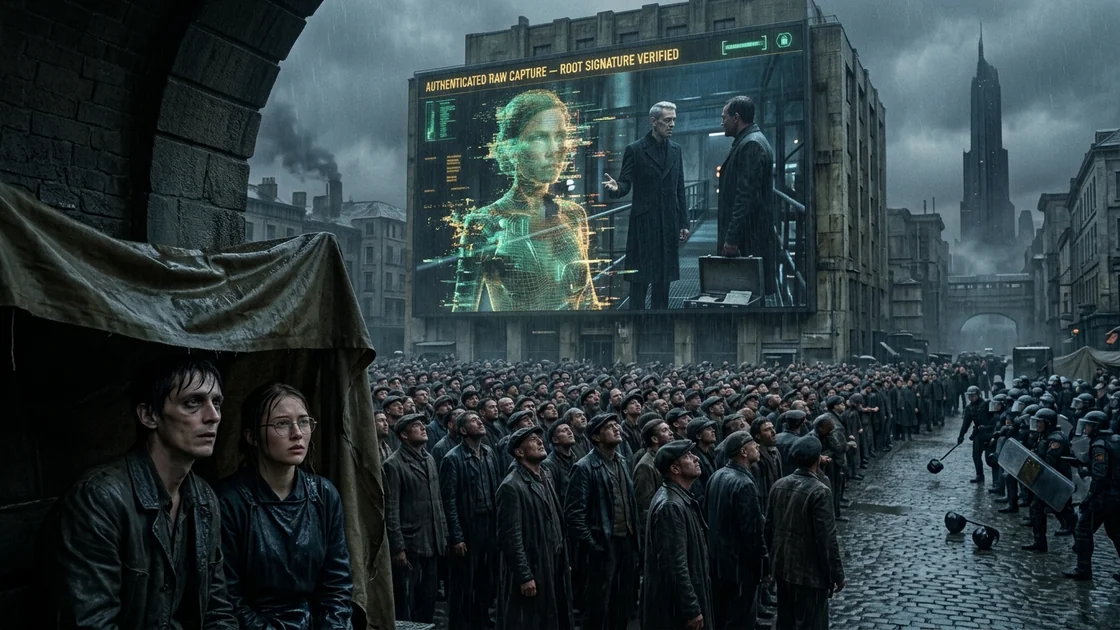
Julian Vance is a master synthetic media artist living in the tyrannical city-state of Vespera who gets coerced by Minister Malakor Thorne into fabricating a damning video of the beloved political dissident Elena Rostova. While working inside the government digital archives to build the illusion, Julian discovers encrypted files proving that Thorne himself orchestrated the catastrophic infrastructural sabotage being blamed on the resistance. Using a complex dual-layer rendering algorithm that behaves differently during private security checks than it does on a mass network, Julian secretly embeds the minister's real crimes beneath the fabricated footage. When the state broadcasts the file across every screen in the nation to justify Rostova's execution, the digital mask dissolves, exposing Thorne's atrocities to millions of citizens and sparking the regime's collapse.
The human face is not a surface; it is a geological record of light and blood. Julian Vance knew that if you wanted a lie to breathe, you had to start beneath the dermis. You had to model the way capillary beds beneath the cheekbones flushed three milliseconds before a surge of anger, and how the orbicularis oculi muscle around the eye trembled when a person tried to suppress grief. Most black-market weavers in the sunken wards of Vespera merely painted masks. They stretched a target’s pixels over an actor’s skull like wet parchment, resulting in things that looked convincing on a cracked hand-terminal in the rain, but fell apart the moment you looked at the teeth or the wet margin of the lower eyelid.
Julian did not paint masks. He built ghosts from the bone outward.
In the cramped, subterranean vault of his studio beneath an abandoned textile mill in Sector Seven, the air tasted of warm mineral oil and old copper. Three immersion tanks lined the damp brick wall, their translucent fluid glowing a faint, hypnotic amber as rows of illegally salvaged tensor blades chewed through petabytes of light-field data. Above his desk, three reference monitors cast a pale, clinical wash across his hollow cheeks and the dark crescents beneath his eyes.
On the center screen, a boy of nineteen was laughing.
The boy had been dead for four years, killed when a Directorate transport freighter suffered a containment failure in the northern quarries. His mother, a retired seamstress who had paid Julian in pre-collapse silver coins and two liters of real olive oil, sat on a wooden crate behind him, her knuckles white as she gripped her shawl.
"Watch his left shoulder, Mrs. Kael," Julian murmured, his fingers dancing across a haptic trackball and a bank of motorized sliders. He didn't look back at her; his eyes were fixed on the micro-mesh overlay hovering over the boy’s throat. "When he laughs, I have the clavicle rising symmetrically. That’s wrong, isn’t it? He broke his collarbone when he was twelve."
Behind him, the old woman drew a sharp, ragged breath. "The left side," she whispered. "It healed crooked. He always tilted his chin toward it when he was embarrassed."
"Right." Julian adjusted a weight parameter in the skeletal kinematic tree, then re-seeded the adversarial network. The cooling pumps in the mineral oil tanks hummed a half-step higher. On the screen, the wireframe dissolved back into skin—pores, peach fuzz catching the simulated late-afternoon sunlight, the faint yellowish bruise of a long-healed fracture distorting the shadow beneath the boy's collar. The boy on the screen laughed again, and this time his left shoulder hitched slightly, his chin dipping toward it with a shy, sidelong glance that made the phantom light in his brown eyes catch fire.
Mrs. Kael began to weep, a sound so quiet it barely rose above the gurgle of the cooling fluid.
"It’s thirty seconds," Julian said softly, initiating the final compile onto an unindexed crystal drive. "No audio loop artifacts. If you play it on an offline viewer, the state crawlers won't flag the lack of a registry hash. Don't ever plug it into a networked terminal."
"Thank you, Mr. Vance," she said, taking the warm sliver of quartz from his palm. Her fingers were dry and rough as bark. "May the quiet keep you."
"And you, Mrs. Kael. Go out through the dye-works. The street cameras on Mercer Avenue have a four-second blind spot when the tram passes."
After the heavy iron door clicked shut behind her, Julian leaned back in his chair and rubbed his temples. His eyes burned. Outside, five stories above the vaulted ceiling of the old mill, the eternal drizzle of Vespera was falling through the neon haze of the Ministry’s public broadcast towers. Even down here, through forty feet of damp earth and stone, he could feel the low, rhythmic thrum of the city’s power grid.
He reached for his mug of chicory coffee, then froze.
The amber glow of the immersion tanks had shifted. The cooling pumps were spinning down, their pitch dropping not because the render was finished, but because the external line voltage had just been clamped by an industrial regulator.
At the same time, the spectrum analyzer on his far-left monitor—the one wired to the ultrasonic motion sensors in the drainage tunnel—went completely flat. Not spiking with an intrusion. Flatlined. Someone had flooded the tunnel with phase-inverted white noise to deafen his triggers before stepping a single boot onto the concrete.
Julian didn’t reach for the thermite switch beneath his desk. Against amateurs or local syndicate extortionists, burning the tanks gave him leverage. Only the Directorate of Civic Alignment possessed phase-cancellation arrays capable of neutralizing an entire city block’s sensor net at once, and if you burned hardware in front of the Directorate, they simply extracted the data from your cerebral cortex with a bone-saw and a galvanic probe.
Instead, his fingers flew over the keyboard, executing a twelve-stroke macro. Within four hundred milliseconds, his proprietary rendering engine—the Loom—fragmented its core weights and hid them inside the corrupted sector headers of three thousand mundane municipal architectural schematics stored on his secondary array. He left the superficial workspace intact: a half-finished commercial touch-up for a mid-tier soap actress who wanted to look ten years younger for a state melodrama.
Three seconds later, the electromagnetic lock on the heavy iron door didn't break; it simply unlocked itself, the encrypted rolling code solved by sheer brute-force computation from the other side.
The door swung open without a squeak—someone had oiled the hinges from the outside while he was talking to the old woman.
Four men entered. Three of them wore the matte-gray ballistic coats of the Civic Guard, their visors down, compact submachine guns held at a relaxed, terrifyingly professional low-ready. The fourth man wore a dark wool overcoat that shed the sewer dampness in beading droplets. He was thin, with silver hair cut so short his scalp showed through like parchment, and he carried a slim leather briefcase under one arm.
"Julian Vance," the man in the overcoat said. His voice was pleasant, dry, and entirely devoid of inflection, like a pre-recorded transit announcement. "Formerly Senior Forensic Restorer for the High Court of Vespera. Dismissed six years ago for ideological non-compliance during the Third Census. Currently operating under the handles Vesper, Glassmaker, and Null-Set."
Julian kept his hands flat on the desk, well away from the keyboard. "You have the wrong cellar, Inspector. I do cosmetic grading for the Channel Four serials. The producers don't pay enough for licensed hardware, so I run salvaged blades."
The man smiled faintly. He stepped past the guards, his polished shoes clicking on the oil-stained concrete, and looked down at the center monitor where the soap actress’s frozen face stared out.
"I am Sub-Director Silas Vane," he said. "And you don't need to insult us both with the soap actress, Mr. Vance. We stopped Mrs. Kael two blocks south. She is seventy-four years old and has a weak heart. Whether she walks home to her apartment with her dead son in her pocket, or spends the remainder of her very brief life in a reclamation labor camp, depends entirely on what you say in the next ten seconds."
Julian’s stomach dropped into an icy void. He looked up into Vane’s pale gray eyes. There was no malice in them, which made the threat infinitely worse; it was a simple math problem to the man.
"The boy died in a quarry accident," Julian said, his voice tight. "There’s nothing political on that drive. Just a kid laughing in a garden."
"And yet it was rendered using an unindexed kinematic model that bypassed our local node sniffers," Vane replied smoothly. He reached into his coat, pulled out the small quartz drive Julian had just handed the old woman, and set it on the edge of the desk. "Look closely at the render you made for her, Mr. Vance. Specifically the subsurface light scattering across the cartilage of the ear. Only two systems in Vespera can calculate translucent tissue refraction at that speed. One of them belongs to the Ministry of Information. The other is sitting in those fish tanks behind you."
Vane picked up the quartz drive again and slipped it back into his pocket. "I let her go, by the way. Keep the drive, I told my men? No, she actually has a copy. We duplicated it at the checkpoint in five seconds and sent her on her way. The Minister has no interest in grieving seamstresses. He has an interest in you."
"If you’re confiscating the rig, take it," Julian said, his heart hammering against his ribs. "You don't need me to run the algorithms."
"On the contrary," Vane said, glancing around the cramped, glowing cellar with mild distaste. "An algorithm is a brush. We have brushes ten times the size of yours at the Pinnacle. What we lack is a portraitist who understands why a dead boy tilts his chin toward a broken collarbone."
He gestured vaguely toward the guards.
"Bag the primary drive array. Leave the tanks; where he is going, he won't need salvaged junk. Mr. Vance, stand up and put your coat on. You have an appointment with Minister Thorne."
The Pinnacle did not merely rise above Vespera; it seemed to pin the city to the mud like an obsidian spike.
As the armored sedan climbed the elevated expressway reserved for Directorate officials, Julian watched his neighborhood vanish beneath a blanket of gray industrial smog. Down in the sectors, every building was plastered with Clarity Screens—massive, weather-beaten LED billboards that broadcast productivity quotas, arrest tallies, and the serene, paternal visage of the Chancellor and his cabinet. Up here, above the cloud line of coal smoke and chemical mist, the architecture changed. The brutalist concrete gave way to soaring towers of self-cleaning glass and white composite stone.
Yet Julian weren't taken up into the glass spires. The sedan plunged down a helical ramp into the bedrock beneath the Plaza of Unity, passing through four successive biometric checkpoints where automated turrets tracked the vehicle’s occupants through the windshield with red laser rangefinders.
They disembarked in a subterranean bay that smelled of ozone and floor wax. Vane led him down a corridor lined with acoustic baffling tiles—the kind used in high-security SCIFs and anechoic chambers—until they reached a pair of tall doors made of brushed steel.
Inside was not an interrogation cell, nor a typical bureaucratic office. It was an amphitheater of light.
The room was circular, forty feet across, its walls composed entirely of seamless micro-LED panels currently displaying a live, three-hundred-and-sixty-degree panoramic feed of the city from the very tip of the Pinnacle two thousand feet above. Walking onto the floor felt like stepping out onto an invisible platform suspended in the storm clouds.
In the center of the room stood a single slab of black marble serving as a desk, and beside it stood Minister Malakor Thorne.
In his public broadcasts, Thorne always appeared tall, broad-shouldered, and paternal, his deep baritone voice resonant with sorrow whenever he announced a new round of austerity rations or the execution of saboteurs. In person, he was shorter than Julian, with a slight stoop and skin the color of tallow. He wore a bespoke tunic of dark blue wool, unadorned by medals, and he was paring an apple with a small ceramic knife. Real apples were worth a month’s wages in Sector Seven.
"Leave us, Silas," Thorne said without looking up from the fruit.
Vane bowed his head slightly and stepped backward out the steel doors, which sealed with a heavy pneumatic hiss.
Thorne sliced a thin crescent of white flesh from the apple, placed it in his mouth, and chewed thoughtfully while studying Julian.
"You look thinner than your file photo, Mr. Vance," Thorne said. Even without a microphone, his voice possessed that extraordinary, trained resonance—an actor’s instrument honed in the halls of power. "The lower wards are hard on a man’s constitution. The damp gets into the lungs."
"The air is fine where I am, Minister," Julian said, keeping his hands clasped behind his back so Thorne wouldn't see his fingers trembling. "Sub-Director Vane didn't explain why I was brought here."
"Didn't he? Silas has a flair for theatrical omission." Thorne set the knife down on a porcelain plate and wiped his fingers on a linen napkin. He walked slowly toward the curved wall of the room, where the giant LED panels showed the distant, rain-swept expanse of Sector Four. "Do you recognize that district, Mr. Vance?"
"The Hydro-Processing Basin," Julian said. Everyone in Vespera knew Sector Four. Three weeks ago, the main filtration manifold and chemical dosing plant had ruptured in a series of catastrophic explosions. Twelve hundred workers had died in the chlorine gas cloud that followed, and the southern half of the city was still on boiled-water rations of one liter per day.
"A tragedy," Thorne murmured, gazing out at the distant black scar on the city’s grid. "The Directorate blamed the Unseen—Elena Rostova’s little network of dissident engineers and union agitators. We presented log files showing remote overrides on the pressure valves. We arrested three hundred of her sympathizers."
Julian stayed silent. He knew the official story. Everyone knew it, and almost no one down in the mud believed it. Elena Rostova had been the Chief Civil Engineer for the Southern Aqueduct before she went underground five years ago; she had spent her life building that water system. The idea that she would poison half a million working-class citizens with chlorine gas was absurd on its face.
"And ten days ago," Thorne continued, turning back to face Julian, "our internal security units finally captured Ms. Rostova in a safe house near the old rail yards. In four days—on Reconciliation Day—she will be brought before the Public Tribunal in the Plaza of Unity."
"Then it sounds as though your case is closed, Minister," Julian said carefully.
"My case is a disaster," Thorne said calmly. "Do you know what our civic sentiment polling shows in Sectors Three through Nine, Mr. Vance? Seventy-eight percent disbelief. Even with our total control of the Clarity Network, the populace believes the explosion was caused by Directorate neglect—that we diverted maintenance funds from the hydro-plant to build the northern defense perimeter, and that Rostova is being framed to cover up structural rot."
Julian’s pulse skipped. The way Thorne said it—so matter-of-factly, without a trace of defensiveness—made it immediately clear to Julian that the rumor wasn't even the whole truth. It was worse.
"If I execute Elena Rostova on Reconciliation Day based on server logs and signed confessions," Thorne said, stepping closer, "I create a martyr. A saint of the rusted pipes. Every time a child gets dysentery in Sector Seven for the next twenty years, her name will be painted on the walls. Bullets do not kill ideas, Mr. Vance. Only disgust kills ideas."
The cold truth of why he was standing on this glass floor settled over Julian like lead.
"You don't want her executed as a rebel," Julian whispered.
"I want her executed as a parasite," Thorne corrected gently. "Or perhaps not executed at all. Perhaps when the people see what she truly is, the mob in the plaza will tear her apart before she even reaches the scaffold. We have decided that Ms. Rostova did not blow up the Sector Four plant out of ideological zeal, nor was it an accident. She blew it up because she was paid four million sovereign credits by the Ostrian Trade Syndicate to cripple our industrial manufacturing capacity ahead of the winter tariff negotiations."
Thorne walked back to his marble desk and tapped a touch-panel. A section of the panoramic wall behind him darkened, replaced by a high-resolution still photograph of a dimly lit industrial catwalk.
"You want me to put her at the scene," Julian said.
"No," Thorne said. "Any technician on my staff could composite her into security footage. And within an hour, every underground coder in the city—men like you—would tear the frame rates apart, find the compression seams, and prove it was a fabrication. No, I want something far more intimate. I have a recording of a meeting that took place forty-eight hours before the explosion, inside a shielded warehouse at Dock Fourteen. In this recording, a high-ranking official of the Ostrian Syndicate hands over the cryptographic bearer bonds and discusses the exact valve sequence to maximize civilian casualties in Sector Four, ensuring the Directorate is blamed."
"If you have the recording, why am I here?"
"Because Elena Rostova wasn't the person in that warehouse," Thorne said, his eyes locking onto Julian’s with reptile stillness. "Another individual was present. You are going to replace that individual with Elena Rostova. Full sixty-frames-per-second high-dynamic-range video, synchronized spatial audio, four minutes and twelve seconds long, continuous single-take camera movement from a hidden body-worn optical sensor."
Julian stared at him. The sheer technical insanity of the request momentarily overrode his horror. "A four-minute continuous shot from a moving body-cam? In low warehouse lighting, with dynamic shadows and ambient harbor echo? Minister, do you have any idea how many variables are in a shot like that? If she walks past a single sodium vapor lamp, the color temperature on her skin, her hair, the dust motes in the air between her and the lens—all of it has to shift in real time. And the state Veritas verification hash! Every public screen in Vespera checks the quantum signature of raw camera captures before displaying the green authenticity seal. The moment you alter a single pixel of a signed file, the hash breaks."
"You will not need to worry about the Veritas signature," Thorne said softly. "Because you will perform the render inside Sub-Level Nine, directly on the Oculus core. When your work is finished, I will personally provide the sovereign root key to re-sign the completed file as an original, unaltered raw capture from a Directorate surveillance unit."
Julian’s breath caught. The sovereign root key. According to Directorate law, such a key didn't even exist; the entire legitimacy of the state’s surveillance apparatus rested on the dogma that Veritas-stamped footage was mathematically impossible to forge, even by the government itself.
"If you have the root key, and you’re letting me know it exists," Julian said, his voice dropping an octave, "then I’m never walking out of Sub-Level Nine."
Thorne picked up another slice of apple, studying its translucent edge against the light of the wall screen.
"Let us speak plainly, Mr. Vance, as men of craft," the Minister said. "If you refuse me now, you will die in the basement of this building tonight, and your friend Mrs. Kael, along with the fourteen other clients we have identified from your transaction ledger over the past three months, will be arrested for possession of seditious synthetic media at dawn. If you accept, and you deliver a piece of work that convinces not only the rabble in the streets, but the forensic auditors of the High Command by noon on Reconciliation Day, you will be placed on a diplomatic transport train to the neutral zone in Geneva with a new identity and half a million credits."
It was a lie. Julian didn't need to model Thorne’s facial muscles to see it; the man didn't leave loose ends who knew about the sovereign root key. The train to Geneva was a furnace in the sub-basement.
Yet four days was ninety-six hours. Ninety-six hours sitting at the keyboard of the most powerful computational array on the continent, with direct access to the state’s master rendering architecture.
"To build a model of Rostova that can survive a four-minute single take," Julian said slowly, letting his posture slump as if the terror had broken his resistance, "I can't just scrape public broadcasts of her old speeches. I need high-density biometric scans. Pore mapping, dental geometry, sub-glottal vocal cord resonance, retinal reflection profiles."
"She is in Detention Block C, three floors below us," Thorne replied. "Our medical staff has already sedated her and run a full laser-topography scan and multi-angle photogrammetry pass. Everything is waiting on the local drive in Sub-Level Nine."
"And the base footage?" Julian asked. "The warehouse recording. Who is the actor I’m painting over? Because if their body mass index or gait differs by more than fifteen percent from Rostova’s, the volumetric displacement in the scene won't match. A tall man casts a wider shadow than a five-foot-six woman; if I shrink the figure to match Elena, I have to synthetically reconstruct the background behind the original person’s silhouette in every single frame."
For the first time, a microscopic tic flickered at the corner of Thorne’s left eye. A tiny tightening of the muscle, gone in a tenth of a second.
"The background reconstruction will be necessary," Thorne said coldly. "The original subject in the footage has already been masked out by a preliminary silhouette filter to protect operational security. You will be given a wireframe motion-capture track of the subject’s movements, the raw background plates where the subject did not obscure the room, and the environmental lighting data. You do not need to see who was originally standing on that catwalk."
There it is, Julian thought, a cold electrical current racing down his spine. He didn't hire a body double to stage a fake meeting in a warehouse. The meeting actually happened. And whoever was standing on that catwalk taking money or giving the order to blow up Sector Four is someone so high up that Thorne won't even let a condemned man see their face.
"A silhouette mask makes the edge-blending three times harder," Julian said, keeping his voice strictly professional, the weary artisan complaining about bad source material. "If the preliminary mask clipped the ambient occlusion shadows on the floor around their feet, I’ll need the raw depth-map channels from the optical sensor to recalculate where her shoes touch the grating."
"You will have the depth maps," Thorne said. He pressed a button on his desk, and the steel doors hissed open to reveal Silas Vane waiting in the corridor. "You have eighty-eight hours until the final verification audit, Mr. Vance. Give me a masterpiece."
Sub-Level Nine did not smell like mineral oil and damp brick. It smelled of liquid nitrogen and sterile, ionized air.
Julian’s workstation sat inside a glass-walled cube suspended over the main server vault of the Oculus core—a cavernous black pit where thousands of optical processors pulsed with cold blue light. Outside the glass cube, two armed guards stood at permanent attention, while a cluster of four directional cameras mounted in the ceiling corners recorded every keystroke, every movement of Julian’s hands, and every dilation of his pupils.
There was no external network connection. The terminal was physically air-gapped from the city grid, connected only to a dedicated forty-petabyte storage partition and the local rendering nodes below.
He wasn't entirely alone, however.
When Vane escorted him into the glass cube, a young woman in the grey smock of a Ministry Junior Archivist was standing beside the secondary audio console, nervously adjusting her wire-rimmed spectacles.
"This is Technician Mara Lin," Vane said, gesturing toward her as if she were a piece of diagnostic equipment. "She is an acoustic topographer from the Forensic Division. Because the warehouse environment has complex metallic reverberation, she will handle the impulse-response mapping for the voice synthesis while you focus on the visual composite. Neither of you will speak of anything outside the technical parameters of Project Chimera. You will sleep on the cots in the alcove. Meals will be passed through the airlock every eight hours."
Vane looked at Julian, then at the young woman. "If the render fails the Veritas neural audit on Friday morning, neither of you will require breakfast."
The glass door sealed and locked with a heavy magnetic clunk.
For a long moment, only the whisper of the air filtration vents filled the room. Mara Lin didn't look at Julian; she sat down rigidly at the audio workstation, her eyes fixed on the spectral waveforms glowing on her screens. Julian noticed that the tips of her fingers were stained with faint blue ink, an old habit of archivists who still handled physical microfiche logs in the lower vaults, and that her breathing was shallow and rapid. She was terrified.
Julian sat down at the primary console and flexed his fingers over the unfamiliar, pristine mechanical keyboard.
"Let's see what they gave us," he said aloud, keeping his tone flat for the directional microphones overhead.
He opened the project directory labeled
CHIMERA_SOURCE.
Inside were two main folders. The first was
TARGET_ROSTOVA. When Julian opened it, his chest
tightened.
There were four hundred gigabytes of raw biometric data taken less than twelve hours ago. High-resolution photogrammetry scans showed Elena Rostova strapped to a stainless-steel medical table, unconscious. Even under harsh fluorescent clinical lights, with a dark bruise blooming across her left temple and her gray-streaked hair matted with dried blood, there was an unmistakable severity and dignity to her bone structure. He opened the historical reference subfolder: dozens of unedited clips of her from before she went underground. Elena arguing before the Municipal Water Board seven years ago, her dark eyes flashing with passion as she pointed at stress fracture charts; Elena laughing with a crew of tunnel borers in Sector Six, wiping grease from her forehead with the back of her wrist.
She had a distinct habit when she was listening to someone lie: she would press the tip of her tongue against the inside of her lower lip and tilt her head roughly three degrees to the right, as if examining a faulty weld.
"They gave us six hours of isolated phoneme captures from her interrogation this morning," Mara Lin spoke up suddenly, her voice quiet and tight. She tapped a key, routing an audio file to Julian’s headphones.
Elena’s voice filled his ears—hoarse, dehydrated, yet steady as bedrock. "You can break every bone in my hands, Silas. It won't make the concrete in the north manifold any thicker."
Julian closed his eyes for a fraction of a second, then cut the playback. "That's post-trauma vocal strain," he told Mara, pointing to his screen. "If this warehouse meeting happened forty-eight hours before the explosion, she wasn't in a cell being beaten. If we use her interrogation voice as the timber base, the laryngeal tension will read as distress. Use her municipal water board hearings from five years ago for the baseline harmonic structure, then age the formants by four percent to account for five years of living in coal cellars."
Mara blinked, glancing over at him for the first time. Behind her thick lenses, her eyes were sharp, observant, and deeply exhausted. "That... yes. That makes sense. The sub-glottal pressure in the interrogation tapes is too erratic anyway."
"Good. Start building the phonetic dictionary," Julian said. He
turned back to his center monitor and opened the second folder:
SCENE_DOCK14.
The video file loaded into his viewport.
It was four minutes and twelve seconds of 8K raw sensor data, shot from the perspective of someone standing near the entrance of an elevated rusted iron catwalk high above the floor of an empty dry-dock warehouse. Rain drummed relentlessly against the corrugated tin roof overhead. Down below, dark harbor water lapped at concrete pilings.
Standing ten feet away from the camera was a tall, broad-shouldered man in a wet trench coat—the Ostrian Syndicate envoy, recognizable by the distinctive lapel pin of the northern trade delegation. He was holding an open aluminum case containing crystalline bearer drives.
And standing across from the envoy, closer to the camera, was a void.
Someone had run a brute-force matte extraction over the second figure in the room. Where a human being should have been, there was only a jagged, black silhouette shaped roughly like a person in a long coat, overlaid with a green wireframe skeleton showing the joints of their arms, spine, and head as they gestured and spoke. The audio track during the silhouette’s lines had been replaced by a harsh bursts of pink noise, leaving only the envoy’s replies intact.
"Four million is a steep price for a valve failure, friend," the Ostrian envoy said on the recording, his voice echoing off the damp concrete walls. "My directors in Ostria want assurances that the chlorine tanks will breach simultaneously. If the wind is blowing south toward the residential tiers, the casualties will paralyze the city for a month."
Then came six seconds of static where the black silhouette leaned forward, raising a green wireframe right hand with the index finger extended.
"I understand," the envoy replied, nodding slowly, a flicker of genuine unease crossing his broad face as he looked at the black void. "You have a remarkably cold view of your own constituents. The bonds are yours. Have your people pull the primary scrubbers offline at 0300."
Julian paused the playback at frame 4,102.
He leaned in toward the monitor, his brow furrowing. He wasn't looking at the envoy, and he wasn't looking at the green wireframe skeleton. He was looking at the edges of the black silhouette mask.
Whoever in Vane’s technical division had applied the black censorship mask had been thorough—they had expanded the matte by twenty pixels outside the original person’s body to make sure not a single sliver of sleeve, hair, or profile remained visible. They had also scrubbed the metadata headers clean.
However, as Julian had told Thorne upstairs, you cannot composite a
new human being into a physical space without knowing how the room’s
light interacts with them. To allow Julian to do his job, the
technicians had been forced to leave the ancillary sensor
channels intact in a sub-directory labeled
ENV_TELEMETRY.
Julian opened the telemetry folder. The camera used to record this meeting hadn't been a standard civilian lens; it was a Directorate Mk-IX tactical recorder hidden inside a briefcase or a coat button. A Mk-IX didn't just record red, green, and blue pixels. It recorded an infrared depth matrix using a low-power LiDAR grid, and a dual-channel high-frequency ultrasonic acoustic trace used to calibrate noise cancellation in loud environments.
Julian loaded the LiDAR depth matrix into his viewport. As expected, the technicians had punched the same black hole into the depth map where the mysterious figure stood.
"They clipped the floor contact," Julian muttered loud enough for the ceiling mics to hear. "Look at this. Whoever masked the target cut twenty pixels into the iron grating beneath their boots. If I put Elena’s feet there, she’s going to look like she’s floating on a blurred smudge."
He keyed the intercom button on the wall. "Sub-Director Vane."
After ten seconds, Vane’s dry voice came through the small speaker grill. "What is it, Mr. Vance? You are two hours into your window."
"Your techs butchered the alpha matte on the floor grating," Julian said, pointing irritability at his monitor. "And look at the puddle of water three feet to the left of the silhouette on the catwalk. They masked out the puddle because the original subject’s reflection was in it. If I put Elena Rostova next to a wet floor under a skylight, and there is no reflection on the wet iron, a first-year media student will spot the fake. I need the raw specular reflection passes, or I need you to expand my clearance to the unmasked floor layers."
Silence hung on the line for several seconds. Julian kept his expression annoyed, impatient—the perfectionist artist dealing with clumsy bureaucrats.
"The unmasked video frames were purged from the local partition before you arrived," Vane said coldly. "Reconstruct the puddle synthetically. You have the tools."
"Fine," Julian snapped, releasing the intercom button. He shook his head in mock disgust and turned back to his terminal.
He didn't actually need the puddle. He had only complained about the puddle so that the guards and the remote system monitors watching his screen would see him spending the next four hours obsessively writing a custom ray-tracing shader to calculate light reflections across wet iron grating.
Because while the technicians had masked out the puddle right next to the figure’s boots, they hadn't masked the entire room.
In a dark, rain-soaked warehouse, light bounces everywhere.
And more importantly, there were two other reflective surfaces in the shot that the Ministry’s technicians hadn't thought to scrub because they were too small and too distorted for the human eye to resolve as an image.
The first was the convex silver lapel pin on the Ostrian envoy’s coat, three feet in front of the masked figure.
The second was the wet corneas of the envoy’s eyes, captured in crisp 8K resolution.
And the third wasn't visual at all.
Julian glanced over at Mara Lin. She was wearing massive studio headphones, her eyes closed as she isolated individual consonant clicks from Elena Rostova’s water-board speeches.
Julian opened a text window on his secondary monitor—not a messaging program, which would be logged, but a comment string inside the C++ shader code he was writing to simulate the rain puddle. He angled his body slightly to block the ceiling camera behind his right shoulder, though he knew the terminal’s screen-capture logger was recording every character he typed. He couldn't write a note to her. Everything on the screen was watched by Vane’s auditors.
So he didn't write a note. He wrote legitimate code.
// AUDIO_SYNC_ERROR: Check channel 4 ultrasonic carrier (42kHz) for window pane resonance.
He dragged the compiled shader module into the shared workspace folder that Mara’s audio terminal used to synchronize lip movements with sound waves.
Ten minutes passed. Julian worked furiously on the skeletal wireframe of Elena Rostova, scaling down the tall, slightly stooped posture of the mystery figure to match Elena’s five-foot-six frame. As he worked, he analyzed the kinematic gait of the green wireframe skeleton they had given him.
The mystery person in the warehouse had a slight stoop. They kept their left hand tucked inside the pocket of their tunic or coat while speaking, gesturing exclusively with the right index finger. And when they shifted their weight on the iron grating, they favored their right leg, rolling slightly onto the outer edge of the sole.
Julian didn't need a LiDAR scan to recognize that posture. He had watched that exact stoop walk across a black marble floor two hours ago while paring an apple.
Minister Malakor Thorne hadn't sent an underling to negotiate the destruction of Sector Four. The Ostrian Syndicate wouldn't have handed four million credits in untraceable bearer bonds to a proxy; they had demanded to deal with the architect himself. Thorne had orchestrated the chlorine gas massacre of twelve hundred of his own citizens to pocket a fortune in foreign currency and simultaneously give himself the pretext to declare martial law and crush the union movement.
Across the glass cube, Mara Lin opened the shared shader file to link her audio markers.
Julian watched her out of the corner of his eye. Her gaze scanned the code lines, lingered on the comment about the 42-kilohertz ultrasonic carrier for three seconds, and then moved on without a single flicker of expression on her face. Her fingers tapped four keys, opening the raw environmental audio tracks to build the room’s reverb profile.
Most people assumed that when you replaced a voice track with pink noise, the original voice was gone. And on the audible spectrum—between twenty hertz and twenty kilohertz—it was. The technicians had completely obliterated Thorne’s voice on the primary vocal channels.
However, the Mk-IX recorder’s fourth channel was a thirty-to-sixty-kilohertz ultrasonic structural sensor designed to measure the acoustic geometry of a room so the state’s processors could filter out echoes. Sound is physical pressure. When a man with a resonant baritone voice speaks in a quiet room, the pressure waves of his voice hit thin surfaces nearby—like the aluminum lid of the envoy’s open briefcase, or the glass face of the envoy’s wristwatch—causing them to vibrate microscopically. The ultrasonic beam bouncing off those objects picks up the phase modulation of the vibration, just like a laser microphone bouncing off a windowpane.
Mara didn't demux the ultrasonic channel into headphones; if the
system auditors saw an audio waveform appear during the censored gaps,
they would shut the room down instantly. Instead, she routed the
ultrasonic phase-modulation data directly into the impulse-response
convolution filter as an array of floating-point numbers, labeling
it AMBIENT_RAIN_DAMPENING_MATRIX.
To the security monitors watching her screen, she was simply sampling the sound of the rain hitting the tin roof to make Elena’s synthesized voice echo realistically.
Two minutes later, she pushed the updated convolution matrix back
into the shared folder. Inside the data array, buried in the hexadecimal
header table where no graphical monitor would ever display it, she had
left a single checksum marker:
MATCH_CONFIRMED_ID_001_THORNE.
She knew. And she hadn't hit the panic button to alert Vane.
Julian felt a surge of fierce, dizzying adrenaline. He looked over at her to ask a mundane technical question, wanting to gauge her state of mind.
"Technician Lin," he said aloud. "The reverb decay on the catwalk seems thirty milliseconds too short for an empty dry-dock. Is there acoustic foam on the far wall?"
Mara looked up at him through her thick lenses. Her face was pale, her jaw set hard. "No, Mr. Vance. My brother worked in the Sector Four filtration plant on the night shift. He told me all the industrial basins use open concrete baffling. There’s no foam."
The silence that followed her words was heavier than the bedrock above them.
Her brother had been on the night shift at Sector Four. He had breathed the green cloud that Malakor Thorne had sold for four million Ostrian credits. And Vane’s background check had missed it—probably because her brother had been listed as an unmarried casual laborer under their mother’s maiden name, or because the Ministry’s bureaucracy was so bloated with terror that they hadn't cross-referenced a junior sound technician’s extended family before pulling her off the night desk.
"Right," Julian said quietly, looking back at his screen. "Open concrete baffling. I'll adjust the diffusion weights."
By hour twenty-four, the illusion was beginning to live, and Julian hated his own hands for how good they were at making it.
On his primary viewport, the black void was gone. In its place stood Elena Rostova.
She wore the heavy, oil-stained canvas jacket she had been photographed in during the transit strikes three years ago. Rainwater dripped from the stray silver hairs at her temples, catching the cold bluish glare of the warehouse skylight. As the Ostrian envoy spoke, Elena stood with her arms crossed over her chest, her weight balanced squarely on both feet—Julian had completely rewritten the kinematic solver to erase Thorne’s stooped posture.
Just before the envoy finished saying "My directors in Ostria want assurances," Julian had programmed Elena’s model to press the tip of her tongue against the inside of her lower lip and tilt her head three degrees to the right.
Then she spoke, using the voice Mara had stitched together from five-year-old civic hearings, roughened with coal dust and warehouse damp:
"The scrubbers will be offline at 0300. Just make sure the transfer clears the Zurich ledger before the gas hits the lower tiers. I don't care how many of them choke as long as the Directorate gets the blame."
It was monstrous. It was seamless.
When Julian played the twenty-second test clip at full resolution, the skin around Elena’s eyes crinkled with cold calculation; the veins in her neck pulsed in exact physiological synchronization with the volume of her voice; the water droplets falling from her jacket sleeve splashed onto the iron grating and sent tiny concentric ripples across the synthetic puddle Julian had built.
At hour thirty, Silas Vane entered the glass cube accompanied by two senior systems auditors from the Ministry’s Verification Directorate.
Julian stood up from his chair, stepping back as the two auditors—hunched men in charcoal uniforms carrying diagnostic tablets—plugged directly into the console’s local fiber port.
Vane didn't sit. He stood behind the primary chair, watching the twenty-second render loop on the main monitor.
"Play it with the mesh overlay off," Vane ordered.
Julian reached forward and tapped a hotkey. The diagnostic grids vanished, leaving only the raw, cold cinema of the warehouse. Elena Rostova stared down the Ostrian envoy, her dark eyes hard and greedy in the half-light, her breath misting faintly in the chilly harbor air—a detail Julian had added an hour ago after checking the meteorological logs for Dock Fourteen on the night in question.
One of the auditors frowned at his tablet, tapping the screen rapidly. "The adversarial discriminator network is scoring it at ninety-nine point nine-four percent organic authenticity. Subsurface light transport on the cheekbones is within two sigmas of a native Mk-IX sensor capture. No temporal flickering in the hair strands."
"And the Veritas structural compliance?" Vane asked softly.
"Once the Minister’s key signs the temporal hash tables, no automated terminal in Vespera or Ostria will flag this," the second auditor said, sounding vaguely unsettled by the quality of the work. "However, we should run a deep-memory scrub on the project directory. Mr. Vance’s ray-tracing shader for the environmental reflections is unusually large—nearly fourteen gigabytes of compiled library dependencies."
Julian’s heart did not speed up; he had spent the last ten hours preparing for this exact sentence.
"Of course it’s fourteen gigabytes," Julian said, his voice raspy with genuine exhaustion as he gestured wildly at the screen. "Look at the background plate your people gave me! You punched a two-hundred-pixel black hole straight through the middle of a moving camera shot! Every time the operative wearing the body-cam breathes, the lens shifts two millimeters up and down, changing the parallax angle of the rusted steel beams behind her head and the water ripples thirty feet below the catwalk!"
He leaned over the console, pulling up the sprawling, chaotic node graph of his custom shader. "Because you deleted the original video frames instead of giving me clean background plates, I couldn't just paint the iron beams back in by hand. I had to build a neural radiance field—a full volumetric 3D reconstruction of the entire damned warehouse—just to calculate what the back wall looks like when a five-foot-six woman stands where a five-foot-ten man used to be! If you shrink that library by a single megabyte, the background steel beams behind her shoulders will warp like melted wax every time the camera moves!"
The first auditor leaned in, squinting at the dense thicket of mathematical matrices inside the neural radiance field—the NeRF volume—that Julian had constructed.
It was completely true. A neural radiance field did use massive
multi-layered perceptrons—millions of interconnected numerical weights
that didn't look like pictures or code at all, just endless seas of
floating-point decimals like 0.0048291 and
-1.928374—to represent how light bounced inside a
three-dimensional space.
And that was the miracle of a neural radiance field.
To a human auditor, or even to a diagnostic virus scanner, a fourteen-gigabyte table of neural network weights looked like random static. You couldn't read it line by line like source code. The only way to see what those billions of numbers actually did was to pass a specific camera coordinate into them and let the graphics processor render the output.
What the auditor didn't know as he scrolled through the weight tables was that Julian hadn't just trained the neural network on the rusted iron beams of the warehouse.
Over the past eighteen hours, hidden inside the GPU cache operations while calculating light bounces, Julian had fed the microscopic corneal reflections from the Ostrian envoy’s eyes, the convex mirror distortion from the silver lapel pin, the LiDAR depth contours around the edges of the censorship mask, and the ultrasonic vocal vibrations Mara had extracted from the briefcase lid into an inverse-deconvolution neural net.
And then he had stumbled across something even better.
When the Ministry’s technicians had purged the original unmasked
frames from the SCENE_DOCK14 folder before Julian arrived,
they had executed a standard military-grade zero-fill overwrite on the
logical partition. On magnetic drives, or standard solid-state drives,
that would have been the end of it.
However, the Oculus core didn't use standard solid-state drives for active rendering. It used phase-change optical crystal memory connected directly to the tensor blades via a non-volatile wear-leveling controller. To prevent the expensive optical crystals from burning out during massive read-write cycles, the hardware controller automatically shifted newly written blocks to fresh physical addresses while keeping the old physical blocks in an unindexed "dark buffer" until the weekly hardware maintenance cycle flashed the whole vault with ultraviolet lasers.
By instructing his neural radiance shader to allocate fourteen gigabytes of "uninitialized scratch VRAM" directly from the optical wear-leveling controller, Julian hadn't created an empty space. He had scooped up fourteen gigabytes of raw, unindexed dark buffer straight out of the crystal vault’s ghost memory.
Inside that dark buffer sat sixty-eight percent of the raw, unmasked spatial color blocks of Minister Malakor Thorne standing on the catwalk at Dock Fourteen, combined with the raw audio packets from the primary microphone before the pink-noise wipe had been saved over the logical directory.
Julian hadn't extracted those fragments into a separate video file. Doing so would have triggered ten different alarms on the auditors' tablets.
Instead, he had baked the recovered data of Malakor Thorne directly into the hidden weight layers of the neural radiance field that was currently rendering Elena Rostova.
"Let me run a perturbation test on the radiance weights," the first auditor said, typing a command into his tablet to force the shader to render from three different viewing angles and frame rates.
Julian watched the screen, keeping his breathing slow and rhythmic. Beside the audio desk, Mara Lin sat motionless, her hands folded in her lap.
On the monitor, the test ran. Elena Rostova’s face remained solid, flawless, and terrifyingly real at thirty frames per second, at sixty frames per second, and across every color space the auditor threw at it.
Why wouldn't it? Julian had designed the mathematical trigger—the activation function of the hidden neural layer—around a condition that could never occur inside this glass room.
"The weights are stable," the auditor admitted, unplugging his tablet from the fiber port. "No steganographic payloads detected in the alpha channels or the audio tracks. The file is purely mathematical geometry."
Vane looked from the monitor to Julian’s hollow, stubble-shadowed face. "You have thirty-six hours to finish the remaining three minutes and fifty seconds of the sequence, Mr. Vance. Do not let the quality drop in the third minute."
"Just tell your kitchen to send actual coffee instead of that lukewarm soya water," Julian muttered, dropping back into his chair and turning his back on Vane before the Sub-Director had even left the cube.
The next thirty hours blurred into a fever dream of light, bone, and numbers.
Julian barely slept. Twice, he lay down on the narrow cot in the alcove for ninety minutes while the Oculus blades compiled heavy volumetric passes, staring up at the acoustic tiles while the cold blue light of the server pit pulsed against the glass walls. During the second rest period, he heard Mara Lin moving quietly at the water cooler near the alcove entrance.
As she walked past his cot to return to her desk, she didn't look down at him, nor did she break stride, yet her fingers brushed the edge of his blanket. She wasn't carrying a note—there was no paper in the room. Instead, she tapped her knuckles lightly against the metal frame of the cot in a distinct rhythmic cadence: three short taps, a pause, two long taps.
It wasn't Morse code. It was an audio engineer’s timing signature: 3/2 polyrhythm.
When Julian returned to his console twenty minutes later, he checked the shared convolution matrix where their audio and video pipelines merged.
He had faced a critical hurdle with his plan. His dual-layer neural
construct—what he privately thought of as the Palimpsest—was a
self-extracting shader wrapper that would be compiled into the final
.VTS (Veritas Transport Stream) broadcast file.
Unlike legacy video formats that simply stored flat grids of colored
pixels, the Directorate’s modern .VTS broadcast
architecture was an active neural-codec stream. Because streaming raw 8K
video to fifty thousand public Clarity Screens and four million domestic
terminals simultaneously would choke the city’s bandwidth, the
.VTS file sent a compressed neural model along with a
stream of vector coordinates; the receiving processors at the broadcast
towers and local hubs decoded the neural weights in real time to paint
the pixels.
Julian’s Palimpsest worked by exploiting the mathematical precision of those weights.
Inside Sub-Level Nine, and inside the Ministry’s closed screening
rooms, the video was played back on a local loopback bus where the
network hop-count variable (NET_TTL_HOP) was equal to zero
or one, and the multicast distribution flag
(MCAST_DIST_ARRAY) was false. As long as those network
variables remained near zero, the neural network’s activation function
evaluated to positive one, feeding the primary weights: Elena Rostova on
the catwalk, speaking Mara’s synthesized voice.
However, the moment the .VTS file was injected into the
state’s Panopticon master broadcast router for Reconciliation
Day, the router’s hardware automatically stamped the stream headers with
a multicast distribution flag of 1 and a network hop-count
exceeding 128 as the packet replicated across the city’s
fiber-optic backbone.
Julian had used the MCAST_DIST_ARRAY header bit as a
mathematical multiplier inside the shader’s normalization matrix. It
wasn't an IF/THEN statement in the code—auditors scanned
compiled binaries for conditional branching logic like
if (broadcast == true) because that was the oldest sabotage
trick in the book. There were no IF statements in Julian’s
file.
Instead, it was pure linear algebra. Every pixel color and every
audio sample was multiplied by a polynomial equation that included the
stream’s native header bit. When the header bit was 0
(local playback), the second half of the equation multiplied by zero and
vanished, rendering Elena. When the header bit flipped to 1
(city-wide multicast), the phase inverted: the positive weights of
Elena’s face canceled themselves out through destructive interference,
and the orthogonal weight matrix—the ghost data from the dark
buffer—resolved into focus.
The hurdle Julian had been struggling with was the audio synchronization during that inversion. If the video flipped to Minister Thorne, the audio had to flip to Thorne’s real voice simultaneously without triggering a buffer underrun error that might cause the broadcast towers to automatically cut the feed to a blue technical-difficulty screen.
And that was what Mara’s 3/2 polyrhythm tap had pointed him toward.
Inside the acoustic convolution filter, Mara had woven the recovered primary audio packets from the dark buffer together with the ultrasonic phase-modulation trace she had pulled from the briefcase lid, formatting them as a 3:2 phase-inverted harmonic overtone series. In local playback, the two frequencies canceled each other out into silence—acting as a noise floor beneath Elena’s fake voice. When the multicast bit flipped the phase of the video channel, the audio phase inverted by a hundred and eighty degrees at the exact same clock cycle. Elena’s voice would annihilate itself into silence, and Malakor Thorne’s resonant, unmistakable baritone would rise from the mathematical ashes at ninety decibels.
And because Julian had used his master restoration algorithms to merge the fragmented dark-buffer blocks with the LiDAR depth mesh and the corneal reflections, the resulting image of Thorne wasn't even blurry. It was sharper, cleaner, and more terrifyingly immediate than the raw camera sensor had originally captured it.
At hour eighty-six—six A.M. on the morning of Reconciliation Day—the glass door of the cube hissed open for the final time.
Minister Malakor Thorne stepped inside, flanked by Silas Vane, three Verification Directorate auditors, and four elite Praetorian guards carrying bullpup carbines.
Julian and Mara stood up behind their consoles. Julian’s eyes were bloodshot; his gray tunic was soaked with sweat beneath the arms, and his hands had a slight, genuine tremor from eighty-six hours of caffeine and terror.
"Is it finished?" Thorne asked. He looked immaculate in his ceremonial Reconciliation Day uniform—a high-collared coat of midnight blue trimmed with silver braid, ready for the grand grandstand in the Plaza of Unity above.
"Rendered, compiled, and packaged into the .VTS
container ten minutes ago," Julian said, his voice a dry croak. "Four
minutes, twelve seconds. Full 8K. Zero dropped frames."
Thorne nodded once to the chief auditor. "Verify it."
Julian stepped back beside Mara as the three auditors converged on the main console. For the next forty-five minutes, the glass room was silent save for the clatter of diagnostic keyboards and the hum of the cooling vents.
They played the video from start to finish on the main wall screen.
It was a work of dark sorcery. Even knowing every spline and weight that had gone into it, Julian felt a chill watching Elena Rostova pace the rusted iron catwalk of Dock Fourteen. In the third minute, when the Ostrian envoy asked what would happen if the civic guards responded too quickly to the chlorine leak, Julian had made Elena pause, look down at the black harbor water below the grating, and give a small, dismissive shrug that was so quintessential to her public body language that Thorne himself let out a quiet breath of admiration.
"Let them respond," the phantom Elena said on the screen, her breath misting in the pale light as she took the first crystalline bond from the briefcase. "Half the guard detachment in Sector Four lives near the basin anyway. They’ll be too busy looking for their families to secure the perimeter."
The video ended.
"Check the binary structure for conditional branches, time-bombs, or logic gates," Vane instructed the chief auditor, his pale eyes fixed not on the screen, but on the side of Julian’s neck, watching his pulse.
"We already decompiled the instruction set, Sub-Director," the chief auditor reported, holding up his diagnostic slate. "There isn't a single conditional jump instruction in the entire file. It is a flat, deterministic neural weight matrix. We also ran it through three separate hardware decoders simulating domestic terminals, public monument screens, and military command consoles."
Julian’s pulse stayed steady. The auditors’ simulator tested the
decoding hardware of a monument screen, not the live
network multicast router—because the live router was connected to
forty million people outside, and you couldn't test a secret state
fabrication on the live city grid before the broadcast time. On a closed
simulator, the MCAST_DIST_ARRAY bit remained
0.
"Very good," Thorne said softly. He stepped forward to the primary console.
From inside his ceremonial tunic, attached to his wrist by a thin titanium chain, Thorne produced a hexagonal cylinder of black sapphire glass inlaid with gold circuitry—the sovereign root key of the Veritas cryptographic protocol.
He inserted the cylinder into the quantum signing port at the base of the terminal, then placed his thumb against the biometric reader on the cylinder’s end and spoke a twelve-syllable vocal passphrase.
On the center monitor, a cascade of golden cryptographic hashes
rained down the borders of the .VTS container. The neural
weight matrix—all fourteen gigabytes of it, both the surface layer of
Elena Rostova and the buried orthogonal matrix of Malakor Thorne—was
permanently, irrevocably sealed with the highest mathematical authority
of the Directorate of Civic Alignment.
Once signed by the root key, the .VTS file bypassed all
downstream content filters, AI censors, and emergency kill-switches in
the city’s broadcast towers. The system was designed that way so that in
the event of a military coup or a rebel cyber-attack on the local
television stations, a sovereign-signed message from the Ministry would
force every screen in the nation to lock onto its signal and disable
manual power-off switches until the file finished playing.
Thorne withdrew the black sapphire key and slipped it back inside his coat.
"Copy the signed container to the Panopticon staging buffer for the twelve-hundred-hour broadcast," Thorne ordered the chief auditor.
"Transferring now, Minister. Transfer complete. File is queued in the Plaza of Unity master array."
Thorne turned to look at Julian. There was something almost resembling regret in his pale, watery eyes.
"You are a remarkable talent, Mr. Vance," Thorne said quietly. "In another century, the church would have commissioned you to paint the ceiling of a cathedral, and emperors would have wept beneath your frescoes. It is a tragedy of our technological age that the artist can no longer be separated from his knowledge of the brush."
Beside him, Silas Vane didn't reach for a weapon; he simply raised two fingers toward the four Praetorian guards standing inside the doorway.
"Wait," Julian said swiftly, not lunging for the guards—which would have gotten him shot in half a second—but pointing frantically at the diagnostic monitor on the far right where the file transfer progress bar had just completed. "Look at the buffer checksum on the Plaza master array! Your auditor transferred it over an uncompressed fiber bridge without stripping the local GPU cache headers!"
Thorne paused, frowning slightly. Vane held up a hand, halting the guards half a step from raising their rifles.
"What are you talking about?" the chief auditor snapped, turning back to the right-hand screen.
"The optical crystal wear-leveler in the Oculus pit!" Julian said, his voice pitching high with frantic, convincing panic as he backed half a step toward the secondary audio console where Mara stood. "When you signed the file while it was still mounted on the active scratch partition, the root key bound the temporal hash to the local physical crystal sector ID! If the Oculus core runs its scheduled ten-hundred-hour thermal purge in twenty minutes, the crystal addresses will shift, and when the Plaza array tries to verify the live stream at noon, the hash will mismatch and throw a forged-media red alert across the entire city!"
It was sixty percent technical gibberish wrapped around forty percent plausible hardware architecture, delivered at rapid-fire speed to a room full of bureaucrats whose heads were on the chopping block if the noon broadcast failed.
Thorne’s eyes flashed with sudden fury as he looked at the chief auditor. "Is that true?"
"I—no, the .VTS container should be hardware-agnostic
once signed," the auditor stammered, sweating instantly as he shoved his
colleague aside to check the terminal logs. "Wait—let me check the
memory-map pointers in the header—"
"Don't touch the mounted volume while the optical bus is hot, you idiot, you’ll corrupt the root signature!" Julian shouted, lunging not toward the door, and not toward the guards, but diving behind the heavy steel chassis of the audio console and yanking the manual liquid-nitrogen emergency purge lever mounted on the floor conduit.
He had spent eighty-six hours in this glass box. He had memorized every bolt, every wire, and every safety valve within reach.
The glass cube wasn't cooled by standard air conditioning; the high-density fiber optic trunks running up from the Oculus pit beneath their feet were jacketed in pressurized liquid nitrogen lines to keep the superconducting data buses near absolute zero.
When Julian pulled the red emergency bypass handle with both hands, the overpressure relief valve beneath the floorboards blew open with the deafening roar of a jet engine.
Instantly, a blinding, freezing white geyser of vaporized nitrogen erupted from the floor grates between the consoles and the doorway. Within two seconds, the temperature in the room plummeted forty degrees, and visibility dropped to zero as dense, rolling clouds of cryogenic fog filled the glass cube from floor to ceiling.
"Fire!" Vane’s voice barked through the roaring hiss of the gas.
Bursts of automatic rifle fire shattered the silence, muzzle flashes strobing orange inside the white mist. Bullets punched through the primary monitors above the desk where Julian had been standing a second earlier, showering the room in sparks and shattered glass.
Julian was already flat on his stomach on the floor behind the steel audio rack. He grabbed Mara Lin’s wrist in the dark fog. She hadn't screamed; she was already crouched low, holding a heavy five-pound titanium magnetic tape degausser she had unplugged from the bottom shelf of her rack.
Not toward the door. Going out the door meant running into four guards with rifles in a narrow corridor.
Julian swung the heavy degausser—or rather, took it from Mara’s hands and slammed its reinforced corner against the lower corner of the tempered glass wall that separated their cube from the open catwalk overhanging the Oculus server pit.
Tempered glass is strong across its face, but brittle at the edges—especially when flash-frozen by minus-two-hundred-degree liquid nitrogen mist.
A spiderweb of cracks exploded across the pane. Julian kicked the center of the frost-covered glass with both boots, and the entire wall gave way, tumbling down into the blue-lit abyss of the server vault fifty feet below.
"Through! Go!" Julian gasped, shoving Mara out onto the narrow aluminum maintenance gantry that ran along the outer skin of the suspended cube.
He scrambled out through the jagged frame right behind her as another volley of gunfire ripped through the fog behind them, ricocheting off the steel railings with angry whines. The nitrogen cloud was pouring out through the broken glass wall now, cascading down into the server pit like a waterfall of dry ice.
"Which way?" Julian coughed, his lungs burning from the freezing air as he pulled her along the narrow catwalk toward the service ladder on the far concrete wall of the cavern.
"Down!" Mara panted, her spectacles fogged white, ripping them off and stuffing them into her smock pocket. "The upper levels will be locked down automatically by the gunfire sensors! I worked in the physical tape vaults on Sub-Level Ten for three years—the pneumatic tube shafts and the gray-water cooling drains connect directly to the old storm sewers under the river!"
Above them, alarms had begun to wail—a deep, throbbing klaxon that vibrated in their teeth. Yet as Julian glanced back while sliding down the rungs of the vertical steel ladder into the gloom of the lower vault floor, he noticed something crucial.
The lights on the Oculus server blades weren't flashing red.
The data purge hadn't touched the .VTS file because the
file had already been transferred out of Sub-Level Nine five minutes
ago. It was sitting safely up in the Plaza of Unity’s master broadcast
buffer, two thousand feet above their heads, waiting for the
twelve-o'clock chime.
And Thorne wouldn't cancel the broadcast just because his two captive technicians had jumped into the server pit during an execution attempt. His auditors had just sworn on their lives that the file was clean, and Thorne needed that broadcast to go out at noon before the military brass and the restive populace in the Plaza grew suspicious.
"He’ll send hunters into the storm drains," Julian said as his boots
hit the steel floor of the lower vault and they sprinted toward a heavy
maintenance hatch marked
THERMAL EXHAUST / SECTOR 1 OUTFALL.
"Let him," Mara breathed, spinning the heavy iron wheel of the hatch with surprising strength until the rusted dogs disengaged. "In forty minutes, nobody in a Directorate uniform is going to be taking orders from Silas Vane."
It took them thirty-two minutes of wading through waist-deep, freezing runoff water in pitch-black brick tunnels before they saw the gray daylight of Vespera again.
They emerged through a corroded iron grate beneath the arches of the Old Stone Bridge, half a mile south of the Plaza of Unity, where the industrial drainage canal emptied into the sluggish brown current of the Vesper River.
Both of them were soaked to the bone, shivering violently, their hands bleeding from rusted ladder rungs and wet brickwork. Julian pulled himself up onto the narrow cobble towpath beneath the bridge abutment and helped Mara out of the water.
Above them, the city was eerie, silent, and expectant.
It was eleven-fifty-five in the morning on Reconciliation Day.
By Directorate decree, all factory shifts, tram lines, and commercial markets halted between eleven-thirty and one o'clock. Every citizen over the age of twelve was required to gather in the nearest public square or stand before their block’s Clarity Screen to witness the state’s address.
Julian and Mara crept up the stone steps of the bridge embankment, staying in the deep shadow of a derelict grain warehouse overlooking the Market Square of Sector Three. They pulled a discarded canvas tarpaulin over their wet gray Ministry smocks and crouched behind a stack of rusted oil drums.
Before them, the square was packed with nearly ten thousand people.
Men and women in faded gray work-jackets stood shoulder to shoulder in the thin drizzle, their faces upturned toward the colossal, six-story Clarity Screen mounted on the facade of the District Rationing Hall. Surrounding the perimeter of the crowd were dozens of Civic Guard troopers in riot gear, their batons drawn, watching the silent workers for any sign of unrest.
And two miles to the north, rising above the slate rooftops and chimney pots like a spear of black glass, the Pinnacle itself gleamed against the low gray clouds, its four massive exterior monument screens broadcasting the same unified feed across the entire horizon of Vespera.
On every screen—in Sector Three, in the Plaza of Unity, in the military barracks, in the high-tier apartments of the oligarchs, and on four million kitchen terminals—the live camera feed showed the grand marble stage at the base of the Pinnacle.
There stood Minister Malakor Thorne at the central podium, flanked by the generals of the High Command.
And thirty feet to his left, inside a raised cage of transparent ballistic glass, stood Elena Rostova.
Even from the distant camera angle, Julian could see the dried blood on her temple that he had studied in the photogrammetry scans. Her wrists were chained to a steel ring on the floor of the cage, yet she stood straight, her chin raised, looking out over the sea of a hundred thousand citizens gathered in the main plaza.
Around Julian and Mara in the Sector Three square, a low, angry murmur rippled through the crowd of workers at the sight of her in chains. Several men near the front of the square unconsciously reached into their coat pockets, where Julian knew stones or wrenches were likely hidden. The riot guards shifted nervously, tightening their grips on their shields. Thorne’s polling had been right: this crowd wasn't sad; it was a powder keg waiting for a spark.
On the giant screen, Minister Thorne raised his hands for silence. His face—forty feet high on the wall of the Rationing Hall—was a mask of solemn, paternal grief.
"Citizens of Vespera," Thorne’s resonant baritone boomed from the horn speakers mounted on every lamppost in the city, echoing off the wet cobblestones. "We gather on this Day of Reconciliation with heavy hearts. For three weeks, we have mourned the twelve hundred brothers and sisters lost in the Sector Four Hydro-Basin. And for three weeks, whispers have circulated in the dark corners of our city—whispers spread by those who wish to divide us—claiming that the Directorate condemned an innocent engineer to cover for structural failure."
Thorne turned slowly toward the glass cage where Elena Rostova stood, and shook his head in sorrow.
"I wish with all my soul that Elena Rostova were merely a misguided idealist," Thorne said into the microphones. "An idealist can be pardoned. A patriot who loves her city too fiercely can be reconciled. However, idealism did not open the chlorine valves in Sector Four. Greed opened them."
In the square below Julian, a dockworker spat onto the cobblestones. "Liar!" someone shouted from the middle of the dense crowd, before quickly ducking down as the riot guards scanned the sea of caps.
"You do not need to take the word of the Ministry," Thorne declared, his voice rising with righteous authority as he gestured toward the giant master screens behind him. "Because forty-eight hours before the massacre, an automated Directorate surveillance sensor at Dock Fourteen captured the truth—verified and sealed by the unbreakable quantum signature of the Veritas protocol. Look upon the woman you call your champion, and hear from her own lips the price of twelve hundred Vesperan lives!"
Beside Julian beneath the tarpaulin, Mara Lin gripped his forearm so hard her nails bit through the wet cloth of his sleeve.
Julian didn't blink. His eyes were glued to the upper-right corner of the six-story screen on the Rationing Hall.
The live camera feed of the stage dissolved.
First appeared the green and gold emblem of the Veritas
Quantum Seal:
AUTHENTICATED RAW CAPTURE — ROOT SIGNATURE VERIFIED — OVERRIDE LOCK ENGAGED.
Across the city, every screen’s local manual disconnect relay locked
shut with an audible click in the junction boxes.
Then the dark, rain-swept interior of the Dock Fourteen warehouse filled the screens.
The tall Ostrian envoy stood on the rusted iron catwalk holding the open aluminum briefcase of crystalline bonds.
And across from him stood Elena Rostova.
For exactly one point four seconds—eighty-four frames—Elena stood on that catwalk while the initial local buffer of the Plaza array flushed through the main trunk line. On the picture-in-picture inset at the bottom corner of the screen, Julian could see the real Elena inside her glass cage on the stage blinking up at the giant monitor in stunned disbelief, while beside the podium, Malakor Thorne permitted himself a tiny, triumphant smile.
Then the packet stream hit the primary city-wide multicast distribution routers.
The network hop-count variable crossed 128. The
MCAST_DIST_ARRAY header bit flipped from 0 to
1.
Inside the decoding processors of fifty thousand public billboards and four million home terminals simultaneously, the polynomial equation at the heart of Julian’s fourteen-gigabyte neural radiance field inverted its phase.
On the six-story screen in front of ten thousand silent workers, Elena Rostova’s face didn't vanish with an abrupt cut that might look like a rebel hack.
It peeled away like burning tissue paper.
For half a second, the bright green wireframe mesh and the crimson LiDAR depth points flashed across her skull as the destructive interference stripped the synthetic pixels to nothing—showing the whole city the exact mathematical scaffolding of the lie they had almost been fed.
And as the green wireframe dissolved into the rain mist of the warehouse, the orthogonal weight matrix snapped into crystal-clear, 8K hyper-reality.
Standing on the rusted iron catwalk of Dock Fourteen, wearing a dark blue wool overcoat beaded with harbor drizzle, his left hand tucked into his pocket and his weight resting slightly on the outer edge of his right boot, was Minister Malakor Thorne.
In the Sector Three square, ten thousand people drew a single, collective breath that sounded like the wind rushing into a furnace.
On the giant screen, the Ostrian envoy spoke: "Four million is a steep price for a valve failure, Minister. My directors in Ostria want assurances that the chlorine tanks will breach simultaneously. If the wind is blowing south toward the residential tiers, the casualties will paralyze the city for a month."
And then the figure on the catwalk leaned forward into the cold light of the skylight, every pore on his tallow-colored skin, every silver hair at his temples, and the wet gleam of his pale eyes rendered with merciless, undeniable perfection as he raised his right index finger.
When he spoke, the voice that boomed from every loudspeaker across Vespera was the exact same resonant, trained baritone that had addressed the nation thirty seconds earlier—only stripped of its paternal warmth, cold and sharp as a butcher's blade:
"Let the lower tiers choke on it," Malakor Thorne said on the screen. "The livestock in Sectors Four through Seven have been talking about a general strike since October. Twelve hundred dead pipe-fitters will give me the emergency powers I need to dissolve the trade unions, and your syndicate gets the northern shipping tariffs reduced by forty percent. Just make sure the four million clears my personal account in Geneva before my men blow the primary manifold at 0300. We’ll pin the remote override logs on Rostova’s network before the gas even settles."
In the upper-right corner of the giant screen, the golden
Veritas authenticity seal pulsed steadily:
AUTHENTICATED RAW CAPTURE — ROOT SIGNATURE VERIFIED.
On the picture-in-picture inset showing the live stage at the Plaza of Unity, pandemonium had erupted.
Thorne was lunging wildly toward the technician’s console behind the podium, his face twisted in apoplectic terror, screaming orders that were completely drowned out by his own recorded voice booming across the sky from the Pinnacle’s monument towers. He was screaming at his staff to cut the power—to pull the plug—but his own sovereign root key had engaged the anti-tamper hardware lock across the entire municipal grid. Even when a Praetorian guard fired three rounds into the stage-side routing cabinet, only the live camera inset flickered and died; the main broadcast file, already cached in the local memory of fifty thousand individual tower nodes across the city, kept playing relentlessly.
"You have a remarkably cold view of your own constituents, Minister," the Ostrian envoy said on the towering screens.
"They are not constituents," the giant image of Thorne replied, reaching out with his ungloved right hand to take the first crystalline bearer bond from the aluminum case, turning his face slightly so the skylight caught the unmistakable scar beneath his right jawline as he smiled. "They are coal for the furnace. Have the transfer completed by midnight."
In the square of Sector Three, nobody waited for the four-minute video to finish.
A roar rose from the throats of ten thousand people—a sound so vast and primal it shook the rusted oil drumsJulian and Mara were crouching behind. And as the giant wave of workers surged forward, Julian saw something that made his breath catch in his throat.
The line of Civic Guard riot troopers standing at the front of the crowd didn't raise their batons.
One of the sergeants stood frozen, staring up at the towering screen where Thorne’s recorded voice was currently detailing how the guard detachment in Sector Four would be left to die without gas masks to make the sabotage look real. Slowly, the sergeant unclipped his riot helmet, dropped it onto the wet cobblestones, and stepped aside.
Down the entire line, shields lowered. Batons clattered to the ground. Several of the guards tore the blue Directorate insignia patches from their shoulders and turned around to march with the crowd toward the main boulevard leading north to the Pinnacle.
Two miles away, a thick plume of black smoke was already rising from the base of the Plaza of Unity, and the distant, muffled crackle of gunfire echoed across the rooftops as the regular army units guarding the outer perimeter clashed with Thorne’s personal Praetorian detachment.
Beneath the canvas tarpaulin on the bridge embankment, Mara Lin let out a sound that was half laugh, half sob, burying her face in her hands as her shoulders shook.
Julian sat back against the wet brick wall of the grain warehouse, letting the cold rain wash over his face as he looked up at the sky.
High above the smoky rooftops, on the four gleaming glass faces of the Pinnacle, the final frames of his masterpiece were playing out before the waking city. There were no seams, no compression artifacts, and no lies left to hide behind. For the first time in his life, Julian Vance had taken the shattered fragments of the dark and rendered the truth.