The Somna-Weaver of Sector Nine
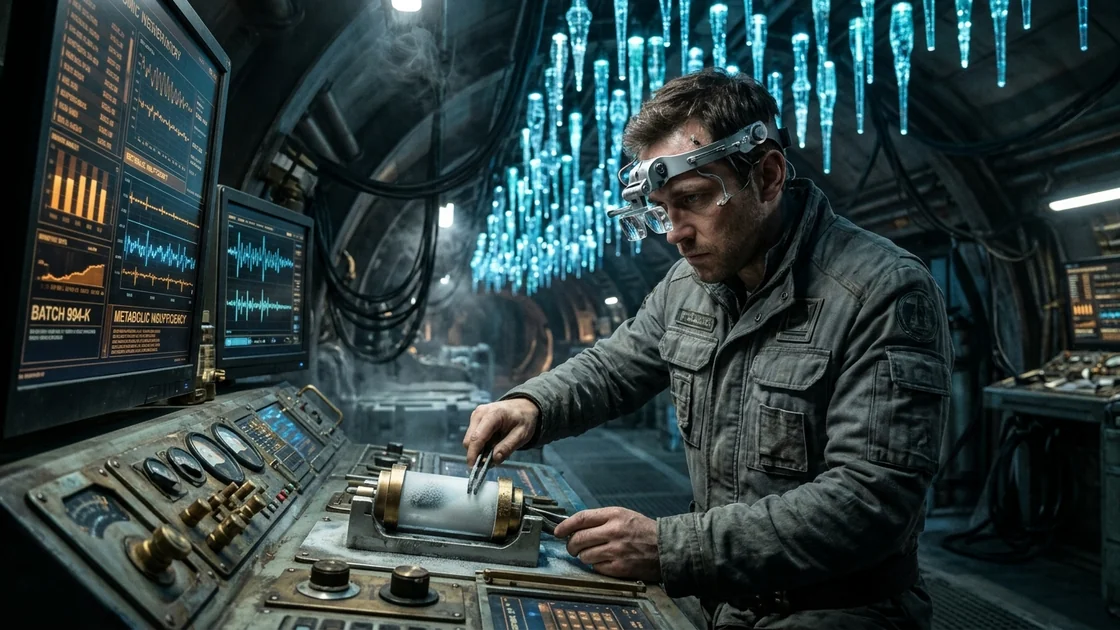
Aboard the generation ship Cynosure, three centuries into a five-hundred-year voyage, a ruthless oligarchy enforces a starvation decree upon the lower decks to preserve luxury resources for the elite. Silas Vane, a quiet memory technician tasked with harvesting the final neural recordings of the dead before their bodies are recycled, discovers the horrific sensory reality of those dying from the famine. Using his privileged access to the recreational dream networks of the ruling class, Silas begins covertly splicing the visceral agony of the starved victims directly into the nightly lucid dreams of the oligarchs who signed their death warrants, sparking a psychological collapse at the very top of the ship's hierarchy.
The dead came up from the Sump in chilled ceramic cylinders, forty to a crate, smelling faintly of copper and industrial coolant.
Silas Vane stood at his workstation in the Mnemonic Conservatory, adjusting the magnification lenses of his ocular rig until the tiny, glistening filament of a harvested hippocampus came into sharp focus. Around him, the hall stretched out in a curve that followed the inner hull of the Mid-Spindle. Hundreds of glass stalactites hung from the ceiling, each housing a fiber-optic loom that pulsed with a pale, rhythmic bioluminescence. It was the quietest room on the Cynosure, insulated from the constant, bone-deep thrum of the heavy ion drives three kilometers aft.
A pneumatic chime sounded at his elbow. A fresh dispatch manifest scrolled across his slate in amber phosphor.
Batch 994-K. Origin: Sector 9, Sub-level 12 (Hydro-Reclamation). Cause of Cessation: Metabolic Insufficiency. Directive: Scrub and Reclaim Substrate.
"Metabolic insufficiency," Silas murmured to the empty stall. His voice was dry, raspy from hours of breathing the dehumidified air of the server vaults. Four weeks ago, the High Directorate had passed Caloric Optimization Protocol 44. On the public broadcasts, Magistrate Julian Sterling had stood before a holographic projection of their distant destination—a verdant, cloud-swirled super-Earth three generations away—and spoken with solemn gravity about a blight in the primary yeast vats. Sacrifices, he had said, were required of the lower decks so that the ship's genetic stock and leadership could remain robust.
Silas knew there was no blight. Two days after Protocol 44 was ratified, he had been summoned to the Canopy to calibrate the private somna-cradle of Councilor Aurelia Vance. While waiting in her conservatory, he had watched a servant throw an entire platter of poached river trout and sugared figs into the organic disposal chute because the fish had cooled by three degrees.
He reached into the crate with insulated tongs and lifted the first cylinder. The frost covering the ceramic hissed against the rubber pads of his tool. He slotted the cylinder into the reader cradle, locked the brass collar, and brought the microneedles down until they pierced the conductive gel at the top of the casing.
On his primary monitor, a waveform bloomed. It was jagged, brittle, and flatlined at the tail—the classic signature of a brain that had consumed its own myelin sheaths before shutting down.
By law, the Charter of the Cynosure stated that no citizen would truly die before the ship reached the new world. Every mind was to be recorded at the moment of bodily expiration and stored in the Great Archive, awaiting the day when the colonists would have the resources to print new bodies or build a planetary virtual heaven. That was the Gospel of the Voyage, the promise that kept fifty thousand people turning the wrenches and scrubbing the carbon scrubbers in the dark, airless bowels of the vessel.
In practice, the Great Archive had run out of quantum-crystal storage seventy years ago.
Now, when a cylinder arrived from Sectors 7 through 12, the technicians were instructed to run a "compression pass." They stripped out the semantic memory, the personality matrix, and the episodic history, reducing a human life to a three-kilobyte statistical summary, and wiped the wetware core so its neural lattice could be dissolved into raw biochemical slurry for the Canopy's recreational dream-weavers.
Only the oligarchs of the Spire and their favored retainers were archived in high-fidelity. Worse, the oligarchs had grown bored of merely living for two hundred years in their hydroponic estates; they wanted to sleep wrapped in the curated sensations of dead worlds and impossible luxuries. They paid technicians like Silas extra ration-chits to build "Lucidries"—synthetic dreamscapes braided together from archival fragments, sensory simulators, and pure neuro-chemical euphoria.
Silas placed his fingers on the haptic deck. Before a core could be wiped, an archivist had to verify its termination timestamp by sampling the final sixty seconds of cortical activity. Most technicians did this with the sensory dampers set to ninety-eight percent, viewing the death as a blurred, mute ghost on a screen.
Silas never used the dampers when the cylinders came from Sector 9. He had grown up on Sub-level 12. He owed them the courtesy of a witness.
He slipped the silver induction crown over his temples and depressed the pedal.
Instantly, the sterile smell of the Conservatory vanished.
His lungs filled with the hot, greasy stench of unwashed bodies and scorched insulation. His vision narrowed to a tunnel of flickering orange sodium light. He was lying on a sheet of corrugated iron that vibrated with the roar of the secondary coolant pumps.
He was not Silas anymore; he was a girl of perhaps fourteen. Her name—floating up from the fraying edges of her semantic cortex—was Jessa.
The pain in his abdomen was not a sharp ache; it was a hollow, twisting vacuum, as if a fist had reached up through his pelvis, grabbed his stomach, and wrung it like a dry rag. His mouth tasted of acetone and old blood. When he tried to swallow, his esophagus clicked dryly. His tongue felt swollen, leathery, and foreign.
Beside him, a woman with skin the color of tallow was scraping the gray, calcified biofilm from the seam of a sewage pipe with a broken piece of plastic, trying to gather enough residue to boil into a broth. Her fingers were split at the knuckles, the wounds refusing to clot or heal.
Mama, Jessa tried to say, or thought she said. No sound came out. Her vocal cords were too weak to vibrate.
The hunger was a living thing inside the memory. It had eaten past the fat, past the muscle, and was now gnawing on the rhythm of her heart. Every four seconds, her chest gave a violent, fluttering lurch—arrhythmia from potassium depletion. The edges of her vision were dissolving into swarms of black, jagged sparks. She was cold, so impossibly cold, despite the forty-degree heat of the reactor shielding five meters below the floor. Her body no longer had the calories required to generate its own warmth.
She looked at her own hand. The skin was translucent, stretched taut over the metacarpals like yellowed parchment over a bird's cage. She remembered—in a sudden, delirious flash of associative memory—a spoonful of sweetened soy-paste she had been given on her eighth birthday. The memory of that tiny, artificial sweetness was so intense in her dying brain that it triggered a phantom flood of saliva that wasn't there, making her dry-heave until a rib cracked with a dull, wet pop.
Then the black sparks rushed inward. The sodium light shrank to a pinhole. A terrifying, bottomless panic surged through her limbic system—not the peaceful drifting away that the ship's medics promised, but the ancient, animal terror of a body realizing it was being murdered by inches.
The waveform flatlined.
Silas tore the induction crown from his head. He doubled over his console, gasping for air, his hands clutching his own stomach. The phantom taste of acetone lingered on the back of his tongue. His heart was hammering against his ribs in a sympathetic echo of Jessa’s final fibrillation.
He sat still for three minutes, watching the condensation drip down the exterior of cylinder 994-K-01.
On his secondary screen, an incoming message blinked with a gold-rimmed priority border. It was from the Spire.
To: Senior Archivist S. Vane, Conservatory Bay 4. From: Office of Magistrate Julian Sterling. Subject: Nocturnal Commission – "The Autumnal Hunt at Fontainebleau." Note: The Magistrate was displeased with the gustatory resolution in Tuesday's banquet sequence. The venison lacked the proper gamey finish, and the burgundy felt thin on the palate. Increase somatic gain on the digestive and olfactory channels by thirty percent for tonight's cycle. Ensure the sensation of satiety is prolonged through the third REM phase. Double chits upon satisfactory delivery.
Silas looked from the gold-bordered message back to the jagged, starving death-rhythm of Jessa on his primary monitor.
In the standard workflow, he would press the green key under his right palm. A high-frequency magnetic pulse would scour Jessa's agony from the wetware, leaving a blank, pristine neural lattice ready to be programmed with the taste of roasted venison and vintage burgundy for the man who had turned off the food chutes to Sector 9.
Silas did not press the green key.
Instead, he reached into the back of his console, unlocked a maintenance drawer with a physical brass key, and pulled out a modified bridging cable. It was an antique piece of diagnostic hardware from the first century of the voyage, stripped of its telemetry loggers.
"You want thirty percent more gain on the digestive channel, Magistrate?" Silas whispered. His hands had stopped shaking. They were steadier than they had been in ten years. "I'll give you a hundred."
To understand how to break a mind through a dream, one first had to understand how the Cynosure kept its masters asleep.
The oligarchs of the Spire did not sleep the way the workers in the Sump slept. Down in the hull, sleep was a coma induced by exhaustion and hypoxia, broken every six hours by the klaxons of the shift change. Up in the Canopy, where no one had performed physical labor in four generations, natural sleep had become elusive. Their bodies, preserved by telomere-lengthening serums and artificial organ replacements, grew restless in the endless, unchanging artificial spring of the upper decks. Left to their own devices, they suffered from "Hull-Stare"—a creeping claustrophobia born of the subconscious knowledge that outside the three-meter titanium-ceramic skin of their garden paradise lay an infinite, freezing vacuum.
So they used the Somna-Net.
Every night at twenty-two hundred hours, the fifty members of the High Directorate and their three hundred extended family members climbed into contoured gel cradles. A cervical jack at the base of their skulls linked them to the Conservatory's main broadcast array. For eight hours, their conscious awareness was shunted into a partitioned sandbox within their own sensory cortex, while a curated data-stream fed them synthetic experiences.
A standard Lucidry consisted of five braided tracks: Visual, Auditory, Tactile-Proprioceptive, Olfactory-Gustatory, and the deepest, most delicate layer—the Limbic Bassline. The Limbic Bassline regulated the dreamer's emotional state, flooding the amygdala and hypothalamus with comforting whispers of safety, superiority, and bliss. Even if an oligarch dreamed of a thunderstorm or a wild boar charge, the Limbic Bassline ensured they felt only thrilling exhilaration, never genuine fear.
And every cradle was equipped with a "Cortical Fuse." If the dreamer's heart rate exceeded one hundred and thirty beats per minute, or if cortisol spikes indicated a nightmare, the fuse tripped, cutting the feed and waking the sleeper gently with a wash of synthetic endorphins.
Silas knew the architecture of the Cortical Fuse because he had helped write the firmware update for it six years ago.
He spent the next four hours in his isolated stall, working behind a privacy screen he had flagged as a routine calibration diagnostic. He pulled up Magistrate Sterling’s commissioned file: The Autumnal Hunt at Fontainebleau.
He scrubbed through the timeline. The first two hours were a brisk ride on a simulated stallion through a forest of golden oaks—trees that no living human had ever seen, reconstructed from twenty-first-century cinema files. The third hour was the kill, bloodless and triumphant. The fourth through eighth hours—the part Sterling cared about most—consisted of a gargantuan feast in a timbered hall.
Silas isolated the fourth hour. He zoomed in on the data-stream where the simulated roast venison was brought to the table.
In the standard code, as the dreamer chewed and swallowed, the Olfactory-Gustatory track fired a rich chord of juniper, charred fat, Maillard reaction compounds, and iron, while the Limbic Bassline sent a warm wave of satiety-contentment-pleasure to the vagus nerve and the hypothalamus.
Silas opened Jessa’s cortical recording in a parallel window.
He did not take her visual memories; if Sterling saw the rusted pipes of Sector 9, his conscious mind would recognize the anomaly immediately and try to force an awakening. Silas wanted something far more insidious. He wanted a dissonance that the conscious mind could not rationalize.
Using a micro-scalpel subroutine, he separated Jessa's somatic, visceral, and limbic tracks from her visual and auditory ones. He isolated the exact forty-minute sequence of her terminal agony: the stomach acid burning through her own mucosa, the parched clicking of her throat, the cellular screaming of muscles catabolizing themselves, the terrifying, hollow pit of starvation, and the ragged, potassium-starved misfiring of her heart.
Then, he wrote a wrapper script.
The wrapper was disguised as a standard high-resolution texture pack. When the Somna-Net parsed the file before broadcast, its automated security scanners would see only the visual data of golden oak leaves and glistening silverware. The wrapper would remain dormant until Sterling’s brainwaves dropped into deep delta-phase REM—the point at which the human thalamus naturally paralyses the body to prevent sleepers from acting out their dreams.
Once Sterling was in deep REM, the wrapper would execute two commands. First, it would spoof the telemetry returning to the Cortical Fuse, feeding the cradle's monitors a looped recording of a steady sixty-beat-per-minute pulse and calm alpha waves. The cradle would think the Magistrate was sleeping like a swaddled infant. It would not wake him.
Second, the wrapper would invert the sensory routing. Every time Magistrate Sterling took a bite of food in his dream, the somatic and limbic channels wouldn't play the Fontainebleau file. They would play Jessa.
Moreover, they would play her at a four-to-one temporal compression ratio, driven straight into the long-term potentiation centers of his hippocampus—the biological mechanism that turns short-term experiences into permanent, trauma-grade memories.
Silas watched the progress bar as the two files braided together. On the screen, the golden helices of the oligarch’s fantasy intertwined with the jagged, crimson spikes of the dead girl’s reality.
"A symphony requires counterpoint, Magistrate," Silas said softly as the compilation reached one hundred percent.
He tagged the file with his encrypted clearance key, uploaded it to the Spire's nocturnal queue, and then, instead of wiping Jessa's cylinder, he slipped it into the lining of his heavy technician’s coat.
The pneumatic transit car from the Mid-Spindle to the Lower Hull did not have seats; it had iron grab-bars slick with the sweat of ten thousand hands.
As the car dropped away from the central axis of the Cynosure, the Coriolis effect tugged at Silas’s inner ear, and the artificial gravity grew heavier, pressing his boots into the grated floor. The air changed with every hundred meters of descent. In the Conservatory, the air was fifteen degrees Celsius, filtered through electrostatic precipitators and scented faintly with pine to keep the technicians alert. By Sector 6, it was twenty-five degrees and smelled of ozone and recycled wash-water.
When the rusted shutter doors clanked open at Sector 9, the heat hit him like a physical blow. It was thirty-six degrees, ninety percent humidity, and thick with the stench of sour yeast, human waste, and the acrid metallic tang of overheating transformer coils.
The corridor outside the transit shaft—known to the locals as the Spine-Road—was dimly lit by strips of failing electroluminescent tape. Four months ago, this passageway had been a chaotic, noisy bazaar where off-shift mechanics traded hydro-parts, patched clothing, and home-brewed fungus liquor.
Now, it was a morgue where the corpses still breathed.
People sat propped against the bulkheads in long, silent rows. Moving burned calories; talking burned calories; crying burned sodium and water. So they simply sat, their knees drawn up to their chests, their eyes wide and glassy in the gloom. Children with distended bellies and stick-thin limbs lay across their mothers' laps, too weak to swat away the grease-gnats that bred in the condensation traps.
Every thirty meters, a pair of Internal Security Peacekeepers stood in white, environmentally sealed carapace armor, their visors opaque, heavy shock-batons resting across their chest plates. They stood directly in front of the bolted distribution hatches where the protein paste chutes had once dispensed three thousand calories a day per worker.
Silas kept his head down, his hands thrust deep into his coat pockets to guard the ceramic cylinder and the small parcel of stolen glucose tablets he had scraped together from the Conservatory's first-aid kits. His clean grey uniform marked him as Mid-Spindle—a traitor by elevation, if not by birth. Eyes followed him from the shadows, hollow and luminous with a hatred so pure it felt radioactive.
He turned off the Spine-Road into a narrow service crawlway behind the Number 4 Evaporator, stepping over a man who was no longer breathing, waiting for the night-shift collection detail to load him into a reclamation cart.
At the end of the crawlway, Silas tapped a sequence on a rusted inspection hatch: three quick, two slow, one quick.
A bolt slid back. The hatch opened four inches, chained from the inside. A single bloodshot eye peered out through the gap, framed by a tangle of grease-matted gray hair.
"You're late, Archivist," a voice rasped.
"The transit was held for a security sweep at Deck 5," Silas said, slipping inside as the chain was released.
The chamber was an abandoned pump-control room, three meters square, illuminated by a single jury-rigged LED wired into a secondary emergency bus. The walls were insulated with scavenged foam blankets to deaden sound.
Kael stood by a workbench covered in cannibalized circuit boards and hydro-valves. He had been a Chief Pipefitter before his lungs were scarred by an ammonia leak ten years ago; now he was the closest thing Sector 9 had to an unofficial mayor and undertaker. Since Silas had seen him two weeks ago, Kael had lost another ten kilograms. His coveralls hung off his broad frame like sails on a dead mast, and a purplish bruise of scurvy blotched his left cheekbone.
In the corner, on a pallet of braided cabling, lay a woman in her late twenties. Her breathing was shallow, rattling like dry pebbles in a tin cup.
Silas didn't say hello to Kael. He walked straight to the pallet, dropped to his knees, and took the woman’s hand. Her skin was dry and hot.
"Mara," Silas whispered.
His sister’s eyelids fluttered. It took her several seconds to focus on his face. When she did, a ghost of a smile pulled at her cracked lips.
"Silas," she breathed. Her voice was barely audible over the hum of the evaporator outside. "You still smell like... pine trees."
Silas pulled the packet of glucose tablets and a small bladder of electrolyte gel from his coat. He broke a tablet in half and placed it under her tongue so it would dissolve directly into her mucous membranes without taxing her shrunken stomach.
"Don't try to talk," Silas said, holding the water bladder to her lips so she could take tiny, measured sips. "Just let the sugar work. I brought vitamin B ampoules, too. Kael can give you the injection tonight."
"Should've given it... to the kids on Twelve," Mara murmured, her eyes already drifting shut as her exhausted body redirected every fraction of energy toward absorbing the glucose. "Jessa... Jessa didn't wake up this morning, Silas."
Silas’s throat constricted. He thought of the ceramic cylinder in his coat pocket.
"I know, Mara," he said softly, smoothing the damp hair back from her forehead. "I have her. They didn't scrub her. I swear to you, they didn't scrub her. She's safe with me."
A single tear leaked from the corner of Mara's eye, cutting a clean track through the grime on her temple before she slipped back into a stupor.
Silas stayed by the pallet for a long moment, then rose and turned to Kael. He pulled the rest of the glucose and three pouches of high-density maintenance rations from his lining and set them on the workbench.
Kael stared at the rations as if they were bars of solid iridium, his jaw clenching against the involuntary saliva flooding his mouth, before he forced himself to look away and cover them with a rag.
"That'll keep her and the four kids in the next junction alive for another five days," Kael said quietly. "Maybe six if we cut it with cellulose pulp."
"And the rest of the sector?" Silas asked.
Kael let out a bark of laughter that ended in a wet cough. He wiped his mouth with the back of his sleeve. "Three hundred dead this week. Five hundred the week before. And that's just Nine. Sector 10 is worse—they cut their water ration by forty percent yesterday to pressurize the new ornamental koi ponds in the Spire's East Atrium. One of my lads on the plumbing crew saw the work order."
Kael leaned across the workbench, bracing his trembling knuckles against the metal. "They aren't waiting for the yeast vats to recover, Silas. Because there's nothing wrong with the vats. I pulled the telemetry from the main biomass conduit last night." He tapped a battered data-slate on the bench. "The vats are running at ninety-six percent capacity. The food isn't missing. It's being diverted into deep-freeze storage bunkers in Sector 2, and the rest is being fed into the high-grade protein converters for the Canopy's livestock clones."
Silas stared at him. "Why? Why starve their own labor force?"
"Automation," Kael said grimly. "The fabricators down in Deck 8 have been printing servitor-drones nonstop for six months. Simple maintenance rigs. They don't need fifty thousand people in the Sump anymore, Silas. We're three hundred years out. The heavy hull repairs are done. The ship is on its final cruise phase. They did the math: if they cull the lower decks down to ten thousand essential technicians, they can triple their personal resource allocation for the last two centuries of the flight and arrive at Canaan like gods without a rabble demanding land."
The air in the small room seemed to grow thinner. Silas looked down at his sister on the pallet. Metabolic Insufficiency. It wasn't an emergency measure. It was a controlled venting of human ballast.
"And the harvest cores?" Silas asked, his voice dropping an octave. "The dead?"
"They doubled the collection quotas," Kael said. "Why do you think they're so diligent about pulling the cortical spindles before they dump the bodies into the fertilizer vats? The Spire's neural network—their precious Somna-Net and their estate automation—runs on biological wetware processors. Every brain they pull out of Sector 9 gets formatted and racked into the Spire's server banks to give them higher resolution in their dream-tanks."
Silas reached into his coat and pulled out Jessa's cylinder, setting it gently on the bench beside the rations.
"Not this one," Silas said.
Kael looked at the cylinder, reading the stamped serial number on the brass collar. His weathered face hardened. "You pulled a raw core out of the Conservatory? If the gate scanners catch you with that, they'll throw you in the recycler while you're still breathing."
"The gate scanners check for data theft coming out of the Spire, not garbage going down to the Sump," Silas said. He looked Kael dead in the eyes. "Kael, when your crews load the collection carts for the Conservatory lift... who does the initial extraction?"
"My med-techs. Or what's left of them," Kael said. "The Peacekeepers won't come into the sub-levels to touch the bodies—they're afraid of typhus. They make us wheel the crates out to the lift bulkhead."
"When a core is extracted," Silas said, "there is a physical write-protect pin on the bottom of the casing, beneath the wax seal. Usually, the automated harvester clips it off so the Conservatory looms can wipe the drive remotely."
"I know the pin," Kael said, squinting at him. "What about it?"
"Tell your med-techs to leave the pins intact on the worst ones," Silas said. "The ones who took the longest to die. The mothers who watched their children go first. The men who ate hull-sealant to stop the cramps. Leave the pins intact, and mark the bottom of the cylinders with a smudge of graphite grease."
Kael studied Silas’s pale, narrow face in the dim LED light. For twenty years, Silas Vane had been the boy who got out—the quiet prodigy who passed the Conservatory exams, moved to the Mid-Spindle, and sent down occasional food parcels while keeping his head bowed to the Directorate. Now, there was something terrifyingly cold behind the technician's spectacles.
"If the pins aren't clipped, the automated scrubber will skip them and kick them to manual review," Kael said slowly. "To your desk."
"To my desk," Silas confirmed.
"What are you doing up there, Silas?"
"Magistrate Sterling went to sleep twenty minutes ago," Silas said, checking his wrist-chronometer. "In about three hours, he's going to sit down to a feast in nineteenth-century France. And when he puts the first forkful of meat into his mouth, a fourteen-year-old girl from Sub-level 12 is going to eat him alive from the inside out."
At zero-two-hundred hours, Silas was back at his console in the Conservatory, watching the nocturnal telemetry board.
The night shift in the server bays was a skeleton crew. Only Silas and a junior technician named Devon were on duty in Sector 4, and Devon was asleep in the break alcove three corridors away, his feet propped on a cooler box.
On Silas’s central monitor, fifty green status bars glowed softly, representing the fifty members of the High Directorate currently immersed in the Somna-Net. Each bar displayed the sleeper's real-time neurological phase, heart rate, and dream-script timecode.
Silas highlighted Bar 04: Sterling, J. – Villa 1, East Canopy.
The timecode read 03:58:12.
In the simulation, the hunting horns had just finished blowing. The Magistrate was sitting at the head of a long oak table before a roaring hearth. Servants with powdered wigs were setting down platters of roasted game birds, buttered root vegetables, and goblets of dark red wine.
04:00:00.
On the diagnostic sub-screen, Silas watched his Trojan wrapper unfold. It was a thing of silent, mathematical beauty. First, the telemetry loop snapped into place. The outward-facing readout on the main Conservatory board froze Sterling’s vitals at a placid sixty-two beats per minute, blood pressure one-fifteen over seventy, respiration twelve breaths per minute.
Behind that green curtain, Silas opened the raw, unfiltered biometric feed from Sterling’s cervical jack.
04:01:15.
Sterling’s dream-avatar lifted a silver fork spearing a piece of venison soaked in juniper reduction and placed it on his tongue.
The splice triggered.
On the biometric graph, Sterling’s real-world heart rate shot from sixty-two to one hundred and forty-eight in three seconds.
In the dream, the visual didn't change—Sterling was still looking at a golden banquet hall—but the taste of the meat vanished. In its place came the overwhelming, chemical reek of ketosis and rotting teeth. As he chewed, his teeth felt loose in his bleeding gums. When he swallowed, there was no warm weight hitting his stomach; instead, a bolt of white-hot agony tore through his epigastrium as Jessa’s recorded stomach acid ate into raw, ulcerated tissue.
Sterling tried to spit the food out in the dream. He couldn't. His jaw was locked by the somatic override. He reached for his goblet of burgundy to wash away the taste of blood and acetone; when the wine touched his lips, his throat constricted with terrible, parched dehydration, clicking dryly like cracked leather.
On the telemetry graph, Sterling’s amygdala lit up like a supernova. He was trying to scream, trying to trigger his vocal cords to wake himself up, or wave his hands to alert his bedside attendants.
He couldn't move a muscle. His own brain’s natural REM-atonia, reinforced by the cradle's neural lock, kept his stout, well-fed body lying completely limp and serene in the gel bath while his consciousness was strapped to the rack of Jessa’s dying nervous system.
Because the splice was running at four-to-one compression, every minute on the Conservatory clock was four minutes of unrelenting starvation inside the Magistrate’s head.
He reached for the bread on the banquet table; the more he ate in the dream, the hollower and more excruciating the vacuum in his belly became. His dream-body began to freeze. He could see the roaring fireplace three meters away, yet his fingers were turning black with phantom frostbite as his starved metabolism failed. His heart—both in the dream and in the gel cradle—began to skip and flutter in a terrifying mimicry of potassium-depletion arrhythmia.
And beneath it all, surging through his hippocampus with the force of a hydraulic press, was Jessa’s final, bottomless despair—and her memory of who had done this to her. Before compiling the file, Silas had woven a single auditory thread from the public address loudspeakers of Sector 9 into the deepest layer of the Limbic Bassline: Sterling’s own voice, resonant and paternal, repeating over and over: Sacrifices are required... sacrifices are required... sacrifices are required...
Silas sat in the blue glow of the monitor, his face utterly motionless, watching the spikes of pure terror carve permanent grooves into the oligarch's synaptic pathways.
At 04:11:00—forty-four minutes of subjective time inside the splice—Sterling’s real-world blood pressure hit two-twenty over one-thirty. Another three minutes and a cerebral vessel would rupture, killing him in the cradle.
Silas didn't want him dead. Dead men were simply replaced by their deputies. Silas wanted him awake.
With a single keystroke, Silas dissolved the Trojan wrapper and purged the temporary cache from the cradle's local memory, leaving only the standard Fontainebleau file in the buffer.
Instantly, the Cortical Fuse saw the true biometric readings.
Alarms screamed across the Conservatory board. Bar 04 flashed crimson.
In Villa 1, five hundred meters above Silas's head, the gel cradle dumped its emergency adrenaline-blocker and fired the waking sequence.
"Jesus," Devon muttered, stumbling out of the break alcove with a mug of synthetic coffee in his hand as the klaxon echoed through Bay 4. "What was that? Did a stabilizer blow?"
"Spike on Cradle 4," Silas said, already typing up an automated incident report with practiced franticness. "Magistrate Sterling. Looks like an idiopathic vagal nerve spasm during the third REM transition. The fuse caught it and kicked him out."
Devon leaned over Silas’s shoulder, squinting at the rapidly cooling telemetry graphs. "One-sixty BPM? The old man nearly stroked out. Was it the script?"
"I'm running a checksum on the Fontainebleau file right now," Silas said. He tapped a key, bringing up the clean, spotless code of the original dream. "See? Integrity is one hundred percent. Somatic gain was bumped thirty percent per his office's direct written order. His sixty-year-old cardiovascular system probably couldn't handle the heightened digestive stimulation he asked for."
Devon let out a low whistle of relief. "Thank the Founders you kept the work order. If he complains to the Synod tomorrow, his own memo covers our asses."
"Indeed," Silas said calmly, picking up his tea mug. "It covers us completely."
Magistrate Julian Sterling did not complain to the Synod the next morning. He didn't attend the Synod at all.
The rumors filtered down from the Spire through the house-servants, then to the hydroponics gardeners, then to the transit operators, reaching the Mid-Spindle by noon.
When the cradle had popped open at four in the morning, Sterling had surged out of the nutrient gel screaming so violently he tore his vocal cords. He had ripped the cervical jack from his neck without waiting for the decoupler, spraying blood across his silk canopy sheets, and had crawled across the marble floor of his bedroom on his hands and knees.
When his terrified valet found him, the Magistrate—a man who weighed a hundred and ten kilograms and dined on cloned pheasant—was huddled in the corner of his conservatory, frantically shoveling handfuls of raw, fertilized potting soil from a decorative fern pot into his mouth, weeping that his stomach was eating his spine and that he couldn't get warm.
The Spire’s chief neuro-physician had sedated him and run a full positron scan. The results were baffling: chemically and physically, Sterling had the nutritional profile of an emperor. Yet his hypothalamus and hippocampus showed the exact, unmistakable synaptic scarring of someone who had survived weeks of terminal famine. Every time the doctors woke him and tried to feed him broth or glucose IVs, his brain interpreted the sensation of digestion as acid eating through his viscera, sending him into violent convulsions.
By eighteen hundred hours, when Silas reported for his next shift, the atmosphere in the Mnemonic Conservatory had changed.
The double doors at the entrance of Bay 4 were flanked by two Internal Purity officers in black coats, their sidearms unholstered. Inside, standing by the central supervisor's podium, was a woman Silas had seen only twice in his career.
Her name was Inspector Vespera. She was tall, skeletally thin by choice rather than deprivation, with silver-white hair pulled back so tightly it stretched the skin around her pale, cybernetically augmented eyes. As Chief Auditor of the Directorate’s Internal Purity Division, she answered only to Director Cassian Thorne.
All twelve technicians of Bay 4 were lined up in the central aisle between the glowing fiber-optic looms.
Vespera paced slowly before them, the heels of her boots clicking sharply on the polymer tiles. She held a transparent data-slate in her gloved hands.
"At zero-four-eleven this morning," Vespera said, her voice smooth, quiet, and entirely devoid of inflection, "Magistrate Sterling suffered a catastrophic neurological event while connected to a cradle routed through this bay. As of an hour ago, he has been placed in an induced barbiturate coma after attempting to chew through the skin of his own forearm."
A murmur of shock ran through the line of technicians. Devon, standing two places to Silas's left, went sheet-white.
Vespera stopped in front of Silas. Her ocular implants whirred softly, tiny iris blades expanding and contracting as they scanned his facial micro-expressions, his carotid pulse, and the dilation of his pupils.
Silas had prepared for this before leaving his quarters. Half an hour ago, he had taken thirty milligrams of propranolol—a beta-blocker scavenged from an old medical kit. His heart rate was locked at a sluggish fifty-eight beats per minute; his hands couldn't tremble even if he wanted them to. He met her gaze with the mild, slightly myopic deference of a career bureaucrat.
"You are Senior Archivist Vane," Vespera said. "You compiled the Fontainebleau build."
"I did, Inspector," Silas said. "Per the Magistrate's explicit parameters received at sixteen-forty yesterday. The build log and the checksum verification were submitted to the central audit server at zero-four-fifteen."
"My analysts have dissected the Fontainebleau file packet byte by byte," Vespera said, leaning in until she was twenty centimeters from his face. "They found no malicious code. They found no sensory spikes. They found only a thirty percent amplification of the somatic channel, which you yourself flagged with a standard medical advisory waiver before upload."
"The Magistrate was insistent, ma'am," Silas said quietly. "He had rejected the previous two builds for insufficient realism."
"And yet," Vespera murmured, her mechanical eyes narrowing, "Dr. Aris tells me the trauma patterns burned into the Magistrate's limbic cortex do not correspond to an over-amplified banquet. They correspond to severe, prolonged metabolic deprivation. Starvation, Archivist Vane. How does a man dreaming of venison wake up starving?"
Silas tilted his head slightly, adopting the thoughtful, pedantic tone of an academic asked to explain a complex theorem to a layperson.
"Synaptic phase-inversion, perhaps?" Silas suggested mildly. "The human brain was not evolved to process somatic inputs boosted thirty percent above biological maximums while in delta-sleep. If you overload a pleasure receptor past its saturation threshold, the signal doesn't stay pleasurable—it clips, inverts, and registers as acute pain. Like water that is so hot the nerves read it as freezing. If the gustatory and vagal channels clipped simultaneously during a prolonged REM cycle, the hypothalamus might easily interpret a massive satiety signal as its exact opposite: catastrophic emptiness."
Vespera stared at him for ten seconds. Her ocular implants clicked twice, analyzing his vocal stress patterns and finding nothing but genuine technical fascination.
Slowly, she stepped back.
"A compelling theory, Archivist," she said. "Director Thorne has ordered an immediate cap of one hundred percent normal gain on all somatic channels across the Spire. Furthermore, until the integrity of the Somna-Net is confirmed beyond doubt, all builds for High Directorate members will undergo dual-key verification before broadcast."
She turned and walked toward the exit, pausing at the double doors.
"However," she called back without turning around, "I do not believe in coincidences. While the lower decks are undergoing Protocol 44, a member of the Resource Council suffers a delusion of starvation. My team will be mirroring every terminal in this bay for the next thirty days. If I find so much as an unlogged kilobyte of anomalous traffic, I will have this entire shift stripped to wetware substrate."
The doors hissed shut behind her.
Devon let out a long, shuddering breath and leaned against a server rack. "Gods in the void, Silas. You just saved our necks with that phase-inversion talk. Do you really think that's what happened?"
Silas turned back to his workstation, where a newly arrived crate of cylinders from Sector 9 sat waiting in the frost-chiller. Through the condensation on the bottom of the rack, he could see six brass collars marked with smudges of black graphite grease.
"Oh, I'm certain of it, Devon," Silas said, reaching for his insulated tongs. "When you take too much, the body eventually remembers what it feels like to have nothing."
Vespera's terminal mirroring was a formidable obstacle, at least on paper. Every keystroke, every file transfer, and every compilation run on Silas's workstation was now duplicated in real-time on an Internal Purity server two decks up. If he opened a Sector 9 core alongside an oligarch's dream-file again, the automated watchdogs would trip in milliseconds.
Fortunately for Silas, the oligarchs of the Cynosure were creatures of bottomless vanity, and they hated upgrading infrastructure they couldn't see.
The software of the Conservatory was state-of-the-art, monitored by Vespera's digital hounds. The hardware, however—the miles of optical trunks, analog signal amplifiers, and wetware substrate racks beneath the floorboards—had not been rewired since the ship passed the Oort Cloud two centuries ago.
You could monitor the compiler all day long, Silas thought as he knelt beneath the floor grates of Sub-bay 4B during his lunch break, a diagnostic multimeter in his hand. It wouldn't tell you a thing if the contamination wasn't in the software at all, but in the blank canvas the software was painted on.
The Lucidries were not run on silicon chips; silicon was too rigid to simulate the fluid, associative chaos of human dreaming. They were run on the "Substrate Pool"—banks of supposedly scrubbed, formatted human hippocampi harvested from the dead of the lower decks, kept alive in oxygenated nutrient baths beneath the Conservatory floor.
When the compiler ran a dream for the Spire, it didn't just send code up the cable; it allocated a cluster of thirty or forty biological cores from the Substrate Pool to act as co-processors for the sleeper's own brain.
Normally, those cores were blank slates, scoured clean by magnetic pulses before being slotted into the nutrient racks.
Silas pulled the six graphite-marked cylinders from his tool bag. Because Kael’s med-techs had left the physical write-protect pins intact on the bottom of the casings, the automated magnetic scrubber in the receiving bay had bounced off them without erasing a single synapse, while still logging the batch as "Processed and Formatted" on Vespera’s digital manifest.
Silas didn't need to touch his keyboard. He didn't need to write a line of code on his monitored terminal.
Working entirely by hand in the dark, cramped service crawlway beneath the floor, he used a pair of micro-pliers to snap the write-protect pins off the six cylinders after they had bypassed the scrubber, and then slotted them directly into Rack 12 of the Substrate Pool—the physical wetware cluster hardwired to the West Canopy estates.
In these cores, there were no Trojan wrappers. Instead, working on an isolated, air-gapped analog calibration bench in the dead-storage room earlier that morning, Silas had injected the raw wetware with a synthetic acetylcholinesterase inhibitor.
The chemical did something simple: it made the pre-existing memories inside the dead tissue hyper-dominant. When the Spire's mainframes poured a calm, pristine dream-script into Rack 12 tonight, the clean software would pass Vespera’s monitors without a blemish. Then it would hit the biological co-processors in Rack 12.
And like clean water poured into a sponge soaked with arsenic, the dream would absorb everything the dead brains had been holding when they died, carrying it straight up the optical trunk into the sleeping minds of the West Canopy.
Silas closed the access grate, bolted it down, and dusted off his knees.
Tonight's West Canopy queue included Councilor Aurelia Vance, Chairwoman of Biomass Allocation, and Commodore Hektor Vance, her husband and commander of the Peacekeeper regiments currently guarding the bolted food chutes in Sector 9.
Silas returned to his desk above, logged into his terminal under the watchful digital eye of Inspector Vespera’s mirror program, and spent the next six hours doing exemplary, unimpeachable work. He even reduced the somatic gain on Councilor Vance’s favorite dream—Sailing the Aegean on a Summer Afternoon—down to a conservative eighty percent, just as Director Thorne had ordered.
Councilor Aurelia Vance loved the sea. She had never seen a body of water larger than the fifty-meter ornamental reservoir in the Spire's central park, which was why she spent six nights a week aboard a simulated forty-meter wooden yacht cutting through the impossibly blue swells of the Mediterranean.
At twenty-three hundred hours, she lay down beside her husband in their twin cradles, kissed his cheek, and let the cervical jack slide home.
For the first hour, the Aegean was glorious. The sun warmed the teak deck beneath her bare feet. The linen sails snapped crisply in the salt breeze. A steward brought her a bowl of chilled green grapes and a glass of dry white wine.
At midnight, the system dynamically allocated additional wetware co-processors from Substrate Rack 12 to render the complex fluid dynamics of the waves.
Node 12-Alpha—formerly Cylinder 994-M-09, containing the un-scrubbed hippocampus of a thirty-two-year-old seamstress named Talia who had died in Sector 9 holding her stillborn infant—came online.
Aurelia Vance took a sip of her wine and looked out over the rail of the yacht.
The water changed color first. The brilliant cerulean blue curdled into a dull, bilious brown, thick with grease and rust flakes. The refreshing salt breeze died instantly, replaced by a suffocating, stagnant heat that smelled of boiled cabbage, gangrene, and burnt hair.
"Hektor?" Aurelia called out, frowning. She turned toward the helm where her husband's avatar stood at the wheel.
Hektor wasn't looking at the compass. He was staring down at his hands. On the wheel, his tanned, manicured fingers were shrinking, the flesh melting away beneath the skin until his brass signet ring slipped off his knuckle and clattered onto the deck.
"Aurelia," Hektor whispered, his voice cracking with sudden, uncomprehending terror. "I can't... my legs..."
Aurelia looked down at herself. The white linen sun-dress clung to a body she didn't recognize. Her breasts were shriveled, empty sacks against a ribcage that poked through gray skin like the hull-ribs of a wrecked ship. Her belly was sunken, yet cramping with the violent, tearing contractions of a dry birth after forty days without protein.
Because Silas had lowered the somatic gain to eighty percent as ordered, the Cortical Fuse did not register an overload. To the safety monitors, the signal amplitude was well within legal tolerances. The cradle had no way of knowing that an eighty percent signal of a mother dying of starvation and sepsis after delivering a dead child in a dark pipe-junction was infinitely worse than a hundred percent signal of anything the Spire had ever imagined.
For six uninterrupted hours—because their heart rates stayed trapped in the slow, bradycardic rhythm of Talia's final shock—Councilor Vance and her husband drifted on a dead yacht under a sky that had turned into rusted iron plating.
There was no monster chasing them. There was only the truth.
Aurelia felt every hour of the forty days compressed into her memory banks. She remembered—not as a story, not as a movie, but as her own autobiographical past—standing in line at the Sector 9 chute while the Peacekeepers laughed behind their white visors and bolted the hatch shut. She remembered boiling the leather soles of her boots to give the broth to her older boy. She remembered the exact moment the baby inside her stopped kicking because her blood no longer carried enough glucose to sustain two heartbeats. She felt the gnawing, relentless, animal hunger that stripped away dignity, language, and hope until the entire universe shrank to the size of an empty metal bowl.
And across the West Canopy, in eleven other villas connected to Rack 12, eleven other members of the Resource Committee and their spouses were living through the other five cylinders.
They lived through the death of Old Man Corvo, who had gone blind from vitamin A deficiency before dying in the dark behind the turbines. They lived through the death of the twin brothers on Sub-level 10 who had drawn straws to see who would get the last cup of condensation water.
When the morning chime sounded at zero-six-hundred in the Spire, the cradles opened smoothly. No fuses had blown. No alarms had sounded in the Conservatory.
Yet within twenty minutes, the gilded avenues of the Canopy descended into madness.
Silas heard the sirens before he even reached the Conservatory for the morning shift.
He stepped out of the transit car on the Mid-Spindle to find the concourse clogged with medical response teams rushing toward the Spire lifts. The public news-screens, which usually played serene loops of orchestral music and colonial progress charts, had been cut to a static blue Directorate seal.
When he entered Bay 4, Inspector Vespera was already there.
She didn't look composed today. Her black coat was unbuttoned, and one of her gloved hands gripped the edge of the supervisor's podium so tightly the polymer casing was creaking. Around her, three Internal Purity cyber-forensics specialists were tearing open the main server consoles, trailing ribbons of diagnostic fiber across the floor.
"Vane," Vespera snapped the moment the doors closed behind him. "Get over here."
Silas walked quickly to the podium, allowing a calculated measure of alarm to widen his eyes. "Inspector? What happened? Did another fuse fail?"
"No fuses failed," Vespera hissed, grabbing him by the lapel of his technician's coat and hauling him toward the master telemetry screen. "Look at the logs from last night's West Canopy cycle. Tell me what you see."
Silas scanned the green columns of numbers. "I see... nominal execution across all twelve cradles. Somatic gain capped at eighty percent. Heart rates between fifty-two and seventy. Zero error flags."
"Thirty minutes ago," Vespera said, her voice dropping to a fierce, trembling whisper so the junior technicians wouldn't hear, "Commodore Hektor Vance walked out onto his balcony in his nightshirt, took his service pistol, and shot two of his own Peacekeeper guards when they tried to clear away his breakfast tray. He is currently barricaded in the East Atrium hydroponic orchard with his wife and four other Councilors, weeping on the grass and eating raw turnips out of the dirt while screaming at the gardeners not to bolt the hatches."
Silas stared at her, letting his mouth fall slightly open.
"And he isn't the only one," Vespera continued, her cybernetic eyes whirling frantically as she searched his face. "Nine members of the Resource Committee woke up this morning convinced—not dreaming, Vane, neurologically convinced—that they have spent the last month starving to death in Sector 9. Councilor Vance kept calling for a dead baby named 'Milo' that she has never had! Dr. Aris says the memories aren't sitting in their dream-buffers; they've been written directly over their autobiographical cortexes. They remember starving in the Sump as clearly as they remember their own weddings."
She shoved Silas back against a glass stalactite loom. The fiber-optic cables chimed softly against the casing.
"My mirror servers recorded every single bit of data that left these terminals last night," Vespera snarled. "The code was clean. Which means the poison isn't in the compiler. Where is it, Vane? Where in this bay can a ghost hide without crossing a digital bus?"
Silas swallowed hard, looking down at her boots, then toward the floor grates.
"The Substrate Pool," Silas said, his voice trembling just enough to sound like a terrified technician scrambling for an answer. "The biological co-processors under the floor. They're analog wetware, Inspector. The digital mirror only checks the script going into the rack; it doesn't audit the synaptic states of the biological tissue itself because the cores are supposed to be magnetically wiped in Receiving before they ever get here."
Vespera froze. Her head snapped toward her lead forensics specialist. "Check the Receiving logs for the last seventy-two hours. Cross-reference the Substrate Pool serial numbers in Rack 12 against the origin manifests."
The specialist tapped frantically at his slate for thirty seconds, then looked up, his face pale.
"Inspector... Rack 12 was populated yesterday afternoon with Batch 994-K and 994-M. Origin: Sector 9. Cause of death: Metabolic Insufficiency."
"Pull a core from Rack 12!" Vespera barked.
Two Purity officers pried up the floor grate in the center of the aisle. One reached down into the nutrient bath, unclipped Cylinder 994-M-09, and handed the dripping ceramic tube up to the specialist, who slotted it into an analog oscilloscope.
Instantly, Talia’s jagged, agonizing death-waveform bloomed across the screen—completely intact, completely un-scrubbed, saturated with the chemical signature of the cholinesterase inhibitor.
Everyone in the bay stared at the screen in horrified silence.
"Residual imprint," Devon whispered from his stall, crossing himself in the old way. "The magnetic scrubber in Receiving must have misfired. We've been routing the Spire's dreams through un-wiped famine victims..."
Vespera looked at the cylinder, though her eyes were no longer on the oscilloscope. She was looking at the bottom of the brass collar, where the physical write-protect pin had been neatly snapped off with pliers, leaving two tiny, fresh bright-metal crescent marks inside a smudge of black graphite grease.
An automated scrubber didn't leave plier marks.
Slowly, Vespera’s head turned back toward Silas.
Silas didn't wait for her ocular implants to focus. He knew the game was up the second the cylinder came out of the bath.
His hand was already inside his coat pocket, his thumb resting on the trigger of a wireless maintenance remote he had wired into the bay's fire-suppression system before his shift began.
"Devon," Silas said calmly. "Hold your breath."
He clicked the button.
Up in the ceiling, the halon and cryo-coolant valves for Server Bay 4 blew open simultaneously. A deafening roar filled the hall as pressurized white fog erupted from forty overhead nozzles, dropping the visibility in the room to zero and the temperature by twenty degrees in three seconds.
"Lock the doors! Shoot him!" Vespera’s voice shrieked through the blinding roar of the gas.
Energy bolts sizzled through the white mist, shattering two of the hanging glass looms behind Silas's head in a shower of sparks and optic fibers.
Silas didn't run for the main doors; he knew the Purity guards outside would have them Mag-locked. Instead, he dropped to his hands and knees, sliding straight into the open floor grate the officers had just pried up to reach Rack 12.
He dropped into the knee-deep nutrient troughs of the under-floor crawlspace, pulling the heavy iron grate shut over his head and jamming his insulated tongs through the latch loop just as a Purity officer's boot stomped down on it from above.
In the pitch dark beneath the floor, guided only by twenty years of muscle memory, Silas scrambled backward along the main optical trunk toward the central Core Vault.
The Core Vault was the brain stem of the Cynosure.
It sat at the exact dead-center of the Mid-Spindle, a spherical chamber surrounded by four meters of radiation shielding, where the Conservatory's master broadcast array linked directly into the ship's command-and-control mainframe.
Silas burst through the lower service hatch into the Vault, slamming the wheel-lock shut behind him and spinning the dog-bolts home. He wedged a heavy titanium torque wrench between the wheel and the bulkhead frame. It wouldn't stop a plasma torch, which meant he had perhaps twelve minutes before Vespera burned her way through.
Twelve minutes was all he needed, because the panic in the Spire had played directly into his hands.
He ran to the central master console and pulled up the Spire's current status board.
Up in the Canopy, the Directorate was in full crisis mode. Following the psychotic breaks of Magistrate Sterling and the Vance family, nine more oligarchs had begun exhibiting waking hallucinations—clawing at their throats, hoarding table scraps, and weeping over phantom memories of dead children in the dark.
In response, Director Cassian Thorne had just called an emergency "Synod of Stabilization."
Rather than meeting in the physical council chambers where panicked oligarchs were screaming at one another, Thorne had ordered all forty-one remaining members of the High Directorate and the senior Peacekeeper command staff into the Conclave Matrix—a shared, real-time virtual conference environment hosted on the Somna-Net where emotional dampeners could keep everyone calm while they voted on how to liquidate the rest of Sector 9.
At this very moment, forty-one cervical jacks were locked into the master array. Forty-one minds were gathered in a single virtual marble rotunda, their Cortical Fuses bridged into a collective administrative network.
And sitting in the deep storage buffer of the Core Vault were the three hundred and eighty un-scrubbed cylinders from Sector 9 that Kael’s crews had sent up over the last forty-eight hours—every single one of them pre-loaded into the backup diagnostic racks by Silas during the night shifts.
Silas’s fingers flew across the master routing board.
To force three hundred and eighty raw, un-compiled cortical recordings through the Conclave Matrix's firewall simultaneously required a living bridge—a human brain with Senior Archivist neural pathways to act as the multiplexer, translating the raw wetware signals into the Conclave’s shared protocol in real time.
And to make sure they couldn't pull the plug from the outside, he had to re-route the Conclave's cradle-locks through the Vault's internal life-support bus.
Outside the lower hatch, a bright orange dot appeared in the center of the steel plate. The hiss of a high-output plasma torch filled the chamber, sending molten slag dripping down onto the grating.
"Vane!" Vespera’s voice crackled over the Vault’s intercom speaker. "Open the hatch! If you corrupt the Conclave bus while the Directorate is linked, the feedback will liquefy your own cortex before the upload reaches ten percent!"
Silas didn't answer the intercom. Instead, he opened a secondary communication channel—the hardwired maintenance intercom to Pump Room 4 in Sector 9—and keyed the microphone.
"Kael," Silas said as he pulled the heavy master induction rig down from the ceiling armature and fitted the silver needles against his temples. "Are you at the Spine-Road hatches?"
"We're here, Silas," Kael’s voice came back over the static, accompanied by the low, ominous murmur of thousands of desperate people gathered in the dark corridors of the lower hull. "Two thousand of us. The Peacekeepers have their shock-batons drawn and the heavy auto-turrets spun up. If we rush the bulkhead now, they'll mow us down."
"Wait four minutes," Silas said, his hands flying over the console as he slaved the Sector 9 bulkhead locks and the Peacekeeper armor telemetry to the Conclave’s output bus. "In four minutes, the people giving them orders—and the commanders sitting in the garrison chairs—are going to have forty days of homework to catch up on. When the green lights go on over the freight lifts, don't stop at the storage bunkers on Deck 2. Take the lifts all the way to the Canopy gardens."
"Silas, what about you?" Mara’s voice broke in over the line, weak but clear. "Silas, come down the shaft!"
Silas looked at the hatch. The plasma torch had cut through three of the four dog-bolts. Blue smoke filled the Vault.
"I'm going to make sure they remember Jessa, Mara," Silas said softly. "Eat an orange under the real lights for me."
He cut the comm channel.
On the master screen, the virtual marble rotunda of the Conclave Matrix appeared. Forty-one glowing avatars stood in a circle around Director Cassian Thorne, debating resource metrics and security cordons.
Silas grabbed the two heavy copper grounding levers on either side of the master induction chair, set the temporal compression dial to maximum, and slammed the circuit closed.
The voltage hit Silas’s optic nerves like a white sun exploding behind his eyes.
His body arched against the straps of the chair as three hundred and eighty dead minds from Sector 9 poured out of the backup racks, rushed through his own neural cortex like a flash flood through a narrow canyon, and slammed straight through the shattered firewall of the Conclave Matrix.
In the virtual rotunda, Director Cassian Thorne was in the middle of a sentence when the marble floor beneath his feet vanished.
The forty-one rulers of the Cynosure did not fall into a pit. They fell into the Sump.
Silas stood at the center of the storm, holding the circuit closed with his own burning synapses as he became the conductor of a choir of the dead. Every pain they had suffered, he felt again as it passed through him; yet he held on, forcing the doors of the oligarchs' minds wide open, locking their thalamic gates so they could not look away, could not wake up, and could not hide behind their titles.
In four minutes of real-time—stretched by the overdrive processors into six weeks of raw, inescapable subjective reality—the High Directorate lived the death of Sector 9.
Director Thorne did not merely watch a worker starve; he became the pipefitter on Sub-level 14 whose teeth fell out one by one while he worked an eighteen-hour shift in fifty-degree heat to keep the Canopy's air conditioners running, before collapsing with a ruptured ulcer on the iron grating.
The Chief Peacekeeper Magistrates did not merely read a casualty report; they became the children on Sub-level 12 lying in the dark, listening to the scratching of their mothers' fingernails against bolted steel food chutes until their own hearts fluttered and stopped from lack of salt.
They tasted the boiled leather. They felt the dry, agonizing click of a throat without water. They felt the terror of the slow cold creeping up their extremities as their bodies devoured their own muscles, their own organs, their own minds, all while the loudspeakers above their heads played their own smug, well-fed voices promising that sacrifices were necessary for the future of the ship.
And because Silas was pouring the entire batch through the collective network at once, the memories didn't just overwrite one sensory track—they braided together into a permanent, indelible neural bedrock. For the rest of their lives, none of these forty-one people would ever be able to look at a piece of bread without feeling the ghost of a cracked rib from dry-heaving; none of them would ever be able to give an order to ration a deck without feeling the acid eating through their own stomach lining. Empathy was no longer a moral choice they could ignore; it had been surgically hammered into their brains as a survival reflex.
In the Vault, the heavy steel hatch blew inward with a resounding crash.
Through the smoke and the blinding pain behind his eyes, Silas saw Inspector Vespera stagger into the room, her sidearm raised.
She took two steps toward the chair, aimed her pistol at Silas's chest, and then froze as her eyes caught the master monitor—and the raw, un-dampened audio-visual bleed-through radiating from the Vault's ambient induction coils.
Silas looked at her, blood trickling from his nostrils down over his quiet, terrifying smile, and with his last ounce of conscious motor control, he typed Vespera’s own cybernetic implant serial number into the wireless local broadcast loop.
Vespera gasped. Her pistol clattered to the grating. She dropped to her knees beside the smoldering hatch, her hands flying to her stomach as Jessa’s final sixty seconds hit her ocular and limbic implants at full gain.
On the master board, the upload bar reached 100%.
A cascade of green lights rippled down the schematic of the Cynosure's central spine as the automated dead-man's switch in Silas's script executed its final line of code.
Down in Sector 9, the magnetic locks on every freight elevator, every storage bunker in Deck 2, and every bulkhead leading to the Spire's hydroponic rings disengaged with a thunderous, echoing clank. In the Peacekeeper barracks, the command channels went dead as the senior officers convulsed in their chairs, tearing at their collars and screaming for water to be sent down the chutes.
As the thousands of gaunt, shadowed figures from the lower hull stepped past the bewildered guards into the rising lifts, ascending toward the light and the fruit trees of the Canopy, Silas Vane felt his own heart finally let go of the rhythm it had borrowed from the dead.
The smells of ozone and burnt steel faded from the Vault. In their place, rising up from the quietest corners of his own memory before the dark took him, came the warm, unmistakable scent of pine trees and sweet soy-paste shared with his sister in the narrow hallways of home.