The Somatic Ledger
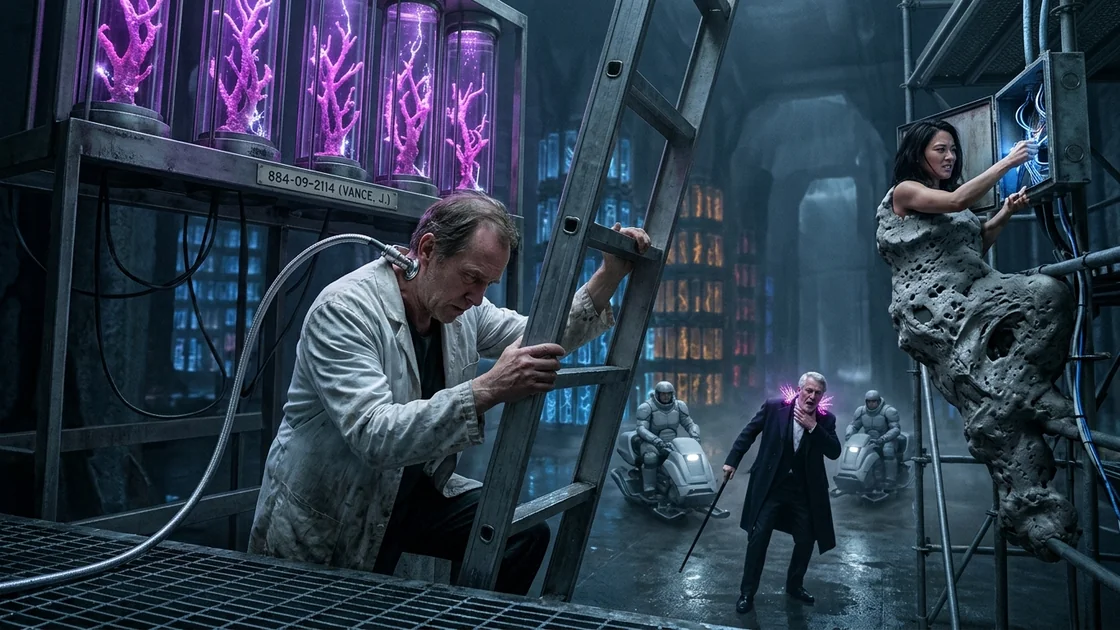
In a future society governed by the Bureau of Somatic Restitution, every citizen is fitted at birth with a neural tether that records, siphons, and stores any physical pain they inflict upon another human being, holding that agony in subterranean bio-crystalline vaults where it accrues compound interest until it is discharged back into the perpetrator on their sixtieth birthday. Julian Vance, a meticulous and gentle actuary who has spent his entire life avoiding even the slightest accidental brush against another person, discovers on the eve of his sixtieth birthday that his personal vault does not contain the negligible balance he expected, but rather a catastrophic, lethal sum of nearly one million units of pain. With less than twenty-four hours before his mandatory neurological settlement, Julian must investigate the origins of this impossible debt alongside a junior clerk named Mara and his estranged wife Clara. His search leads him into the decadent upper tiers of the city and down into the living neural archives beneath the Ministry, uncovering a systemic conspiracy in which the ruling elite launder their own sadism and state-sanctioned violence by splicing their pain debts into the clean ledgers of quiet, solitary citizens. In a final confrontation inside the central vault just minutes before his birth hour, Julian must find a way to redirect the stolen agony back to its rightful architects and face the true, unadorned measure of his own guarded life.
The city of Veridian was built entirely without sharp corners. Where brick once met brick at ninety-degree angles, dense polyurethane bumpers curved around the edges of buildings in muted shades of oatmeal and slate. Sidewalks were surfaced in three inches of vulcanized crumb rubber that swallowed the click of heels and turned every stride into a soft, spongy shuffle. Revolving doors rotated at a fraction of normal speed, padded with memory foam fringes so that a distracted commuter could never pinch a wrist or bruise a shoulder against the frame. Even the trees along the boulevards were pruned to twenty feet above the pavement, their lowest branches wrapped in burlap sleeves lest a sudden gust of wind snap a twig into the eye of a passerby and trigger a municipal liability dispute.
Julian Vance walked down the center of the Third Avenue pedestrian lane with his elbows tucked tightly against his ribs, his hands encased in thick, seamless mittens of woven silicone. He was fifty-nine years and three hundred and sixty-four days old. Tomorrow morning, at precisely forty-two minutes past five, he would reach his Maturity Date.
Around him, the morning crowd moved with the practiced,choreographed spacing of schooling fish. Every citizen wore a high-collared shirt or a cutout scarf that left the base of the occiput bare, exposing the Somatic Tether—a silver-rimmed port the size of a thumbnail fused directly into the cervical spine during the third week of infancy. When two people passed within three feet of each other, the small indicator rings on their Tethers pulsed a steady, cautionary amber, reminding both parties to mind their momentum. If someone tripped and collided with a stranger, the victim’s Tether would instantly intercept the nociceptive signals racing up their spinal cord, siphoning ninety percent of the acute physical pain out of their nervous system after a mandatory three-second registration period. That captured electrochemical agony was then transmitted via the city’s subterranean fiber-optic towers to the Central Depository, logged under the perpetrator’s civic identification number, and placed into long-term bio-storage.
There, in the dark, it grew.
A stubbed toe caused by a careless step on a crowded train might register at four millidolors. Left in the Depository from the age of twenty to the age of sixty, compounding at the standard statutory rate of four point five percent per annum, that trivial moment of clumsiness would mature into nearly twenty-four millidolors. It was still a small thing—a sharp, localized cramp when the clock struck sixty—but if the perpetrator had been walking too fast, or looking at a screen, the Bureau’s algorithmic judges attached a Negligence Multiplier of six percent. If the act had been born of anger—a shove, a slap, a fist driven into a jaw—the Malice Index pushed the annual compounding rate to nine point two percent. A single broken nose inflicted at nineteen could blossom over forty-one years into a devastating storm of neurological fire capable of stopping an old man’s heart in the Settlement Chair.
Julian had never broken a nose. He had never thrown a punch, never slammed a door when another person was in the room, never owned a dog that might pull its leash and trip a neighbor, and never played a sport more violent than solitary billiards with foam-coated balls.
He reached the wide, cushioned steps of the Hall of Scales and paused at the sanitation arch, holding his arms out while the sensors verified the integrity of his silicone mittens and the rubberized soles of his loafers. A soft chime cleared him for entry.
"Good morning, Senior Actuary Vance," said the lobby warden, a young man whose Tether gleamed with the bright, unblemished chrome of the under-thirty bracket. He kept his hands clasped behind his back, bowing slightly from the waist—the standard Veridian greeting that replaced the archaic and hazardous handshake. "And congratulations on your Eve."
"Thank you, Miller," Julian said. His voice was quiet, measured, and dry as pressed parchment. Even shouting, if done close enough to vibrate another person’s tympanic membrane beyond eighty decibels, could register as an acoustic assault of zero point zero two dolors. "It is a quiet day for it."
"The best kind, sir. We heard on the third floor that your projected gross is under fifteen dolors. Is that true?"
Julian allowed himself the faintest curve of his lips. "Fourteen point one eight, as of the quarterly reconciliation in January. Unless I trip over you between here and the elevators, it should remain at fourteen point two by tomorrow morning."
Miller laughed softly, stepping back half a pace just to be certain. "A saint’s ledger, Mr. Vance. You won't even need the bite-block. Just a cup of chamomile and a twenty-minute lie-down."
"Precisely the plan," Julian said.
He took the wide pneumatic lift to the fourteenth floor, where the Department of Somatic Actuaries occupied a vast, carpeted hall divided into sound-dampened pods. For thirty-seven years, Julian had sat in Pod 114, reviewing disputed pain transfers, calculating Malice Adjustments for domestic tribunals, and certifying the final Maturity Warrants before they were sent down to the Settlement Ward on the ground floor. He was good at his work because he understood the profound, terrifying geometry of time. Young people, especially those from the outer industrial sectors where heavy machinery and frayed tempers made physical contact nearly unavoidable, rarely grasped the nature of an exponential curve. To a twenty-two-year-old stevedore, a five-dolor strike during a tavern brawl felt like nothing—a fleeting flash of heat in the knuckles, a tiny beep at the nape of the neck. The victim didn't even bleed for long, because the state’s medical teams repaired the tissue while the Tether ate the pain. The stevedore went home feeling victorious, invincible, and entirely numb to the fact that he had just signed a promissory note against his sixty-year-old self for one hundred and forty-two dolors of concentrated, inescapable torment.
Julian sat at his desk, removed his protective mittens, and laid his pale, slender fingers on the warm glass of his terminal. His skin was remarkably smooth for a man on the threshold of sixty, though it had the translucent, slightly waxy quality of someone who spent ninety percent of his waking life indoors under diffused LED panels.
Before he could log out for his statutory Maturity Leave, he had one final scheduled observation. Every Senior Actuary was required to witness the morning’s first Tier-Three Settlement on the day before their own, a bureaucratic ritual designed to ensure that those who managed the numbers never forgot the flesh beneath the ledger.
At eight-fifteen, Julian put his mittens back on and rode the service elevator down to Sub-Level One.
The Settlement Ward smelled of lavender oil, ozone, and cold sweat. Unlike the rest of the building, which was bright and airy, the Ward was broken into twenty octagonal chambers lined with heavy acoustic baffling. Julian walked down the central observation corridor until he reached Chamber Four. Inside the viewing gallery stood Mara Lin, a junior actuary he had been training for the past three years to take over Pod 114 during his post-Settlement sabbatical.
Mara was twenty-six, sharp-eyed, with her dark hair pinned high to keep it from brushing her Tether. She looked pale under the blue gallery lights, clutching her tablet against her chest.
"Have they started?" Julian asked, stepping up beside her while maintaining the customary eighteen inches of clearance.
"Not yet," Mara whispered. She pointed through the triple-paned glass into the chamber below. "They’re just calibrating the return shunt. Who is he, Julian? His file is flagged with three industrial multipliers and a domestic felony."
Julian looked down into the pit. Seated in the Settlement Chair—a heavy, reclined contour of molded gel and leather straps—was a broad-shouldered man with a thick gray beard and the scarred, calloused hands of a foundry worker. His sixty years sat heavily on him; his knees were swollen with arthritis, and his breathing was already shallow and rapid as two technicians in white padded aprons locked the silver coaxial cable into the port at the base of his skull.
"Thomas Garrett," Julian said, reciting the figures from memory without looking at Mara’s screen. "Born May fourteenth, sixty years ago at eight-twenty in the morning. Total principal accrued across forty-two separate incidents: four hundred and twelve dolors. Total compounded liability at maturity: eleven thousand, eight hundred and forty dolors."
Mara winced, her fingers tightening on her tablet. "Eleven thousand. Why didn't he buy down his principal with voluntary service? Or take an early partial discharge at forty-five?"
"He tried at forty-five," Julian said calmly. "He applied for the Penal Dampening Program, where you absorb twenty percent of your balance early to stop the interest from snowballing. Unfortunately, during the psychological screening, he lost his temper with the examining magistrate and threw a ceramic carafe across the desk. It struck the magistrate’s collarbone. That single act added thirty-eight dolors to his base and locked his account against any future restructuring under the Recidivist Statute."
Down in the chamber, the lead technician stepped back behind a blast partition of clear polycarbonate. When a human nervous system was flooded with eleven thousand dolors of stored nociception, the brain could not distinguish between phantom electrochemical data and genuine physical trauma. Although no blade touched the skin and no hammer struck the bone, the sympathetic nervous system reacted with catastrophic violence. Muscles contracted hard enough to snap tendons; capillaries burst across the sclera and beneath the fingernails; the heart hammered against the ribs as if trying to escape a burning room. Without the gel restraints and the vulcanized rubber bite-block, a Tier-Three recipient would shatter their own teeth and dislocate their spine within the first ninety seconds.
A digital clock on the chamber wall ticked from 08:19:59 to 08:20:00.
The indicator light on the coaxial cable turned from amber to a blinding, steady crimson.
Thomas Garrett did not scream, because the bite-block filled his mouth and the first wave of the discharge seized his diaphragm in an iron vise. Instead, a high, thin whistling sound escaped through his nostrils, audible even through the intercom speaker in the observation gallery. His back arched six inches off the gel pad, every muscle in his neck standing out like twisted steel cable. On the diagnostic monitor above the chair, a rapid cascade of timestamps began to scroll, playing back a lifetime of inflicted misery in compressed chronological order, magnified by decades of interest.
1998-07-12: Fist strike to mandible (Subject: R. Miller). Principal: 6.4d. Matured: 89.2d. 2001-11-03: Crushing injury, negligence, crane assembly (Subject: D. Kowski). Principal: 84.0d. Matured: 1,412.5d. 2006-02-19: Domestic battery, forearm fracture (Subject: E. Garrett). Principal: 112.0d. Matured: 2,890.1d.
Julian watched the man’s hands claw at the padded armrests until his knuckles turned purple. When the 2006 entry engaged, Garrett’s right forearm visibly swelled inside the restraint strap, a dark psychosomatic hematoma blooming beneath his skin in the exact shape of the fracture he had given his wife thirty-two years ago, except now the pain was twenty-five times denser, stretched across an agonizing temporal dilation loop so that what had taken five minutes to inflict took forty minutes for his cortex to process.
Beside Julian, Mara turned her face toward the wall, her eyes shut tight. "How long will the cycle run?"
"At the maximum safe neural throughput of three hundred dolors per minute, his settlement will take thirty-nine minutes and twenty-eight seconds," Julian said. He did not look away from the glass. To look away was to pretend the system was an abstraction, and Julian had built his life on respecting the absolute literalness of the Ledger. "His heart rate is stabilizing at one hundred and seventy beats per minute. The medical drip is administering beta-blockers and neural buffers to prevent a fatal seizure. He will survive. He will walk out of the recovery ward in four days with a permanent tremor in his right hand and a deep aversion to loud noises, and his account will be zero."
"It’s barbaric," Mara murmured, so softly that the hallway microphones could not pick it up.
Julian turned his head slightly to regard her. "Do you know what Thomas Garrett’s wife felt on February nineteenth, thirty-two years ago, Mara? She felt three seconds of sharp pain before her Tether pulled the fire out of her arm and sent it here. She went to the clinic, had her radius set with ultrasonic bone-knitters while reading a magazine, and went back to her life without a single night of throbbing ache or post-traumatic terror. Because the pain was not destroyed; it was merely deferred to the person who created it. Before the Vaults, victims carried the interest of violence for the rest of their lives while perpetrators forgot the blow by the next morning. Now, the book balances."
"I know the catechism, Julian," she said, opening her eyes. They were bright and troubled. "I just wonder if anyone was meant to hold forty years of compounded regret in a single forty-minute hour."
"That is why one does not accrue principal," Julian said simply. He tapped the glass of his watch. "You have the sign-off authority for the remainder of Mr. Garrett’s cycle. I need to go upstairs, print my final personal audit for the magistrate’s seal, and surrender my badge until Tuesday."
Mara nodded, straightening her shoulders and composing her features into the neutral mask required of the Bureau. "Of course. Have a peaceful Eve, Julian. Will you... will you have anyone with you tomorrow morning? In the courtesy suite?"
For those with balances under fifty dolors, there was no Settlement Chair—only the Courtesy Suites on the second floor, where a citizen sat in a plush armchair with a light cranial transceiver while a nurse monitored their blood pressure.
"No," Julian said. "It will be over in less than four seconds. Hardly worth waking someone up at five in the morning."
He left the observation gallery and returned to the fourteenth floor. The great hall of pods was humming with the quiet rhythm of mid-morning computation. Julian walked back to Pod 114, sat down, and inserted his personal cryptographic key into the side of his terminal to generate Form 99-Omega: the Final Pre-Maturity Verification.
It was a formality. Every citizen received an annual summary in the mail on New Year’s Day, and Julian kept thirty-nine years of those cream-colored envelopes bound with linen ribbon in the bottom drawer of his dresser at home. His first entry had occurred at age nine, when he had accidentally stepped on the paw of a classmate’s ankle during a school fire drill: 0.4 dolors, compounded at the juvenile minimum of two percent. His second had occurred at twenty-seven, when he had let go of a heavy brass door at the central library half a second too soon, bruising the fingernails of an elderly archivist: 1.8 dolors. His third and final entry had occurred twelve years ago, during the last night he had ever spent in the same house as his wife, Clara.
He had reached for her wrist across the kitchen table—not in anger, never in anger, only in a sudden, desperate terror that she was truly walking out into the rain never to return. His fingers had closed around her radius for four seconds before her Tether chirped a low, mournful warning and his hand sprang open as if burned by a stove. Principal: 0.9 dolors. Because the domestic subroutines detected elevated cortisol in both parties, it had been assigned an automatic four-point-eight percent rate.
Three entries in sixty years. Fourteen point two dolors total.
Julian entered his civic hash, pressed his thumb to the biometric scanner, and waited for the printer slot beneath his desk to spit out the single green-bordered sheet that guaranteed him a painless transition into old age.
Instead, the terminal screen flickered once, twice, and turned a deep, bruised violet—the color reserved for Class-Zero Terminal Insolvencies.
Julian blinked. He took off his glasses, wiped them with a microfiber cloth from his breast pocket, and put them back on. Instead of a single sheet of paper, the printer mechanism began to whirr continuously, feeding a thick ribbon of fan-folded thermal paper out into the catch tray.
On the screen, his summary header blinked in stark white typography:
CITIZEN: VANCE, JULIAN ARTHUR (ID: 884-09-2114) MATURITY TIMESTAMP: TOMORROW, 05:42:00 ACCRUED PRINCIPAL: 48,210.00 DOLORS COMPOUNDED SETTLEMENT LIABILITY: 914,622.80 DOLORS PROTOCOL: MANDATORY DEEP-VAULT EXTRACTION (LETHAL THRESHOLD EXCEEDED BY 6,400%)
Julian stared at the screen. The air in Pod 114 seemed to thin, growing cold and metallic in his lungs. Nine hundred and fourteen thousand dolors.
The human brain experienced irreversible excitotoxic death—the literal cooking of cortical neurons from sustained synaptic firing—at roughly fourteen thousand dolors, which was why the state capped continuous discharge rates and spread heavy sentences like Thomas Garrett’s across forty minutes with heavy chemical buffering. Even with every pharmacological safeguard known to modern medicine, no human body had ever survived a settlement above thirty-five thousand dolors. Those rare monsters of history—serial assailants, black-market enforcers, industrial saboteurs—were strapped into the Deep-Vault iron frames on Sub-Level Three, kept artificially alive on heart-lung bypass machines for days while their nervous systems were methodically incinerated by the interest of their crimes until nothing remained inside their skulls but gray ash and static.
Julian looked down at his hands. They were trembling so violently that his fingernails clicked against the glass desk.
He grabbed the scrolling ribbon of thermal paper and pulled it up to his face. His three familiar entries were there at the very top, neat and tiny, totaling fourteen point two dolors. Directly beneath them was a horizontal divider labeled SECONDARY LEDGER CONSOLIDATION: STATUTE 44-B (DORMANT RELEASE).
Under that line were forty-seven separate entries, all dated within a single six-month window twenty-eight years ago.
2067-09-14: Severe blunt-force trauma, multiple rib fractures, splenic rupture. Principal: 1,420.0d. Malice Tier: Maximum (11.5%). 2067-09-19: Thermal burns, third-degree, forty percent surface area. Principal: 4,890.0d. Malice Tier: Maximum (11.5%). 2067-10-02: Compound cranial fracture, orbital shattering, optic nerve severance. Principal: 3,110.0d. Malice Tier: Maximum (11.5%).
The list went on and on—a catalog of atrocities that read like the torture logs of a medieval dungeon or a catastrophic gang war. Every single entry bore Julian’s biometric signature hash. And beside every single entry was a red routing code indicating that the records had been held under a "Deferred Administrative Seal" that automatically dissolved twenty-four hours prior to the subject’s sixtieth birthday.
A soft chime sounded on his terminal. A automated warrant had just been generated in the central queue, scheduling Citizen 884-09-2114 for pre-settlement restraint and cardiovascular catheterization at 04:00 tomorrow morning in Deep-Vault Bay Two.
Julian did not call out to his supervisor. In the Bureau, an actuary’s faith in the infallibility of the Tether network was absolute, and he knew the protocol for a Class-Zero activation: the moment a floor supervisor saw a violet screen on an employee’s terminal, the building’s internal security—the Padded Guard—would be summoned to encase the subject in quick-hardening stasis foam so they could not flee or commit self-termination before the state collected its debt.
Moving with the slow, deliberate calm of thirty-seven years of training, Julian reached beneath his desk and pinched the paper feed rollers together, silencing the printer before the sound could draw the attention of the clerk in Pod 115. He tore off the printed strip, folded it neatly into quarters, and slipped it into the inner pocket of his jacket. Then he placed his terminal into a standard ten-minute "Diagnostic Defrag" loop, which masked the violet alert screen behind a spinning geometric screensaver.
He slipped his silicone mittens back over his hands, stood up, and walked toward the elevators at a measured pace of three feet per second.
He did not take the main lift to the lobby. Instead, he took the internal stairwell down to Sub-Level One, where Mara was just stepping out of the observation gallery of Chamber Four, wiping her eyes with the back of her wrist.
"Mara," Julian said.
She looked up, startled by the sudden appearance of her mentor and by the strange, hollow tightness around his mouth. "Julian? I thought you went home. Garrett’s cycle just finished; the orderlies are moving him to recovery now."
"Walk with me to the archive chute," Julian said, his voice pitched at the exact frequency that died between the acoustic tiles of the ceiling. "Do not look at my Tether, and do not raise your voice."
Mara’s training took over instantly. She fell into step eighteen inches to his left as they turned down the long, windowless service hallway lined with pneumatic canister pipes. When they reached the blind alcove behind the liquid nitrogen heat exchangers—the only five-foot square on the floor without an optical sensor because the frost mist continually fouled the lenses—Julian stopped and pulled the folded thermal paper from his coat.
He held it out so she could read it without touching it.
Mara’s eyes scanned the top lines, then dropped to the bottom total. The color drained from her cheeks so fast that for a second she looked like one of the porcelain anatomical models in the training rooms.
"Nine hundred thousand," she breathed. Her hand flew to her mouth. "Julian, this is a system corruption. A decimal shift in the mainframe—"
"Look at the itemized hashes," Julian interrupted, pointing a mittened finger at the center of the page. "Those are not decimal errors, Mara. Those are fully formed, three-dimensional somatic packages with valid cryptographic checksums. Forty-seven individual traumas recorded between September of 'sixty-seven and February of 'sixty-eight."
"Twenty-eight years ago," Mara whispered, her eyes darting across the columns. "You were thirty-two. You were already working here on the third floor in Municipal Audits. How could you possibly have inflicted third-degree burns and ruptured spleens on forty-seven people without being arrested by the Peace Directorate?"
"Remember the foundational law of the Somatic Reserve Act," Julian said grimly. "Since the abolition of the prison system eighty years ago, physical assault carries no incarceration penalty unless it results in immediate biological death. Why lock a man in a cage at taxpayer expense when his own nervous system will serve as his executioner at sixty? The state does not arrest heavy accruers, Mara. It merely lets them walk around in the sunlight, working and paying taxes, while their vault turns into a furnace."
"Even so, an accrual spike of forty-eight thousand dolors in six months would have triggered a mandatory psychiatric quarantine!" She leaned closer to the paper, squinting at the faint gray alphanumeric strings beside the dates. "Wait. Look at the prefix on the victim identifiers. NULL-00-884. There are no victim names attached to these transfers. And look at the transmission node: Sector Zero, Sub-Station Alpha."
"Where is Sub-Station Alpha?" Julian asked.
"It doesn't exist on the municipal grid," Mara said slowly. "I did my graduate thesis on legacy routing architecture. Sub-Station Alpha was the original experimental relay built inside the Central Depository itself during the First Revision. It’s a closed loop, Julian. You can't transmit a wild Tether signal from the street through Alpha. Those pain packages didn't come from the city towers. They were injected directly into your ledger inside the Vaults."
Julian felt a cold weight settle behind his sternum. "A manual splice."
"That’s impossible," Mara said, though her voice lacked conviction. "The Wet Ledgers aren't digital files you can edit with a keyboard. They’re living bio-crystalline matrices. Every citizen’s pain is stored in a specific cylinder of cloned ganglionic coral tuned to their exact genetic and synaptic resonance. If you took a pain package recorded by Person A and tried to pump it into Person B’s cylinder, the coral would reject the foreign frequency and die, triggering a bio-hazard alarm across the entire Ministry."
"Unless," Julian said, his mind racing back through decades of theoretical memorandums he had filed and forgotten, "the coral was re-tuned during a scheduled Tether recalibration. When a citizen undergoes spinal port maintenance, a sample of their fresh cerebrospinal fluid is drawn to rejuvenate their vault cylinder."
He stopped. His breath caught in his throat.
"September of 'sixty-seven," he whispered.
"What happened in September of 'sixty-seven?" Mara asked.
"I was admitted to the St. Jude Neurological Annex for seventy-two hours," Julian said. "My Tether had developed a minor impedance fault—a hairline crack in the ceramic housing that was causing false amber proximity flashes whenever it rained. It was a routine outpatient replacement, except there was an anesthetic complication during the procedure, and they kept me under induced coma for three days."
"Who was the attending neuro-architect?"
Julian didn't need to check the records. The name had been printed on the top of his medical clearance certificate in embossed gold lettering—a point of pride at the time, because the surgeon was a rising star in the Ministry who had personally offered to oversee the calibration of a promising young actuary.
"Dr. Aris Thorne," Julian said.
Mara stared at him. "High Commissioner Thorne? The Director of the entire Somatic Reserve?"
"At the time, he was Chief of Surgical Integration at St. Jude and a special consultant to the Directorate’s Internal Security Committee," Julian said. He folded the thermal paper back into his pocket. Above them, the faint, rhythmic chime of the pneumatic tubes suddenly changed pitch—a three-tone descending sequence that echoed through the concrete walls of the basement.
Mara flinched. "That’s a Floor Lockdown tone on Fourteen. Your defrag loop just expired, Julian. The mainframe flagged your terminal and dispatched the Padded Guard to your pod."
Julian looked at his watch. It was 09:04. He had twenty hours and thirty-eight minutes before his Tether automatically opened its receiving channels to the city grid. It did not matter where he was at 05:42 tomorrow morning—unless he was inside a Faraday bunker three hundred feet underground, the orbital and municipal broadcast towers would lock onto his cervical port and stream all nine hundred and fourteen thousand dolors directly into his brainstem. And if he tried to cut the Tether out of his neck, the fail-safe filament wrapped around his medulla oblongata would sever his spinal cord in a millisecond.
"Go back to your desk, Mara," Julian said, turning toward the subterranean freight tunnels that connected the Hall of Scales to the municipal transit exchange. "When the Guard questions you, tell them I complained of pre-maturity nausea during the Garrett observation and left the building at eight-thirty via the south ramp."
"Wait," Mara said. Before he could step back, she reached into her vest pocket, pulled out a heavy brass magnetic keycard—her Level-Four Archive Maintenance pass, issued only to the junior staff who physically rotated the cooling canisters in the sub-vaults—and dropped it into his coat pocket. Because she didn't touch him, neither of their Tethers made a sound. "If Thorne spliced your coral at St. Jude twenty-eight years ago, there will be a physical bridge-shunt still attached to the base of your cylinder in Bay Nine of the Deep Conservatory. You can't fix this from a terminal, Julian. The digital ledger only reads what’s inside the glass. If someone physically severed that bridge before 05:42 tomorrow—"
"Don't say another word," Julian warned, his eyes fixed on the end of the corridor where the frosted glass doors of the security lift were beginning to glow. "Go. Now."
He slipped through the heavy rubberized curtain of the freight loading bay just as the soft, pneumatic hiss of the Guard’s transport sleds whispered down the hallway behind him.
The rain had begun by the time Julian emerged from the transit tunnels in the Old Quarter—a slow, lukewarm drizzle that smelled of wet rubber and recycled air. Out here, five miles from the gleaming administrative core of the Hall of Scales, the polyurethane bumpers on the corners of the tenement blocks were yellowed and cracked with age, patched in places with gray duct tape by landlords too poor to afford municipal foam contractors. The people on the streets moved with the same wide, careful orbits as the clerks downtown, yet there was a visible difference in how they carried their heads.
In the wealthy central districts, citizens walked upright, their chins lifted, secure in the knowledge that their wide apartments, private cushioned cars, and armies of domestic servants insulated them from the friction of human contact. In the Old Quarter, where six people shared a three-room flat and worked shoulder-to-shoulder in the hydroponic vats or the garment mills, everyone walked with the "Somatic Stoop"—shoulders hunched forward, heads turtled down into padded collars, eyes darting constantly to the feet of everyone around them. Here, a wet patch on the stairs or a sudden coughing fit on a packed tram could ruin a person’s sixtieth year.
Julian walked for forty minutes, keeping under the dripping awnings of closed shops so the overhead traffic drones could not easily scan his facial geometry, until he reached a narrow, three-story building of glazed green brick facing the canal. A wooden sign hung behind a pane of shatterproof acrylic by the door: ST. CLARE RESTORATIVE CLINIC — POST-SETTLEMENT REHABILITATION & PALLIATIVE CARE.
He pushed open the heavy, counterweighted door and stepped into a warm vestibule that smelled of eucalyptus, boiled linen, and old age.
Along the walls of the waiting room sat a dozen men and women in their sixties and seventies. None of them were visibly wounded—there were no bandages, no casts, no missing limbs—yet every single one of them bore the unmistakable imprint of the Chair. An old woman in a knitted shawl sat perfectly still, staring at her own open palms as if she expected them to burst into flame at any moment; she had likely worked forty years as a pediatric nurse before the Indemnity Act covered unlicensed clinic workers, accruing thousands of tiny pinpricks and bone-sets that had returned to her all at once like a swarm of hornets. Near the window, a man with the broad chest of a former construction foreman rocked back and forth in a padded rocker, a soft, rhythmic whimper catching in his throat every third breath as his shattered sympathetic nervous system replayed phantom echoes of a five-thousand-dolor settlement.
Behind the reception counter, kneeling on a rubber mat to adjust the Velcro straps on an elderly man’s orthopedic slippers, was Clara.
Her hair had gone entirely silver in the twelve years since Julian had last spoken to her, worn cropped close to her skull in a soft halo that framed the high, stubborn line of her cheekbones. She was fifty-eight. Her own Tether, visible beneath the collar of her gray linen smock, was dull pewter, slightly scratched from a life spent refusing to wear the silicone mittens that Julian favored.
When she stood up and saw him standing by the door, her hands went still on the counter. For a long moment, the only sound in the clinic was the ticking of the rubber-bladed ceiling fan and the rain against the canal windows.
"Julian," she said. Her voice was warmer than he remembered, fuller and less guarded than anyone else’s in the city. She looked down at his gloved hands, then up at the clock on the wall. "It’s the fourteenth. Your Settlement isn't until tomorrow morning."
"May I speak with you in your office, Clara?" he asked quietly.
She studied his face—the ashen tint beneath his eyes, the damp wool of his overcoat, the fact that an Actuary Senior had walked through the rain without an umbrella drone—and nodded once. She lifted the hinged flap of the counter and led him into a small back room lined with anatomical charts of the human vagus nerve and jars of herbal salves.
The moment the padded door clicked shut behind them, Julian reached into his pocket, pulled out the folded strip of thermal paper, and laid it on her blotter.
Clara picked it up without gloves. She put on a pair of half-moon reading glasses that hung from a cord around her neck and read the top summary, then unfolded the accordion pleats of the itemized ledger. Unlike Mara, she did not gasp. She had spent twenty years treating the broken wreckage that came out of the Hall of Scales; she knew what the numbers did to human flesh.
Slowly, she lowered the paper to the desk. "Nine hundred and fourteen thousand." She looked up at him, her gray eyes fierce and searching. "Tell me you didn't do this, Julian. I didn't leave you because I thought you were a monster. I left you because you were a ghost. A ghost couldn't inflict forty-eight thousand dolors of base trauma if you gave him a blowtorch and an army."
"I didn't do it," Julian said. He sank onto the edge of a vinyl stool by the wall, suddenly feeling every hour of his fifty-nine years. "Look at the dates, Clara. Autumn of 'sixty-seven through the winter of 'sixty-eight."
Clara’s breath left her in a sharp sigh. She looked back down at the paper, her thumb tracing the September timestamps. "That was the autumn after we lost the baby. The autumn your Tether cracked and you went into St. Jude."
"Do you remember when I came home from the hospital?" Julian asked, staring at the floorboards between his shoes. "You told me I slept for nearly a week afterward. That I had night terrors—waking up soaked in sweat, clutching my chest or my face as if someone were beating me, even though there wasn't a mark on me."
Clara sat down slowly in her desk chair, her brow furrowing as the memory assembled itself. "Dr. Thorne told me it was 'synaptic phantom feedback' from the replacement of your cervical housing. He came to our apartment twice that winter to check your port personally with a portable diagnostic kit. I thought he was the kindest man in the Ministry. He sat in our parlor, drank my tea, and told me that a man of your delicate constitution needed absolute quiet and minimal physical stimulation while your nerve endings healed."
"He wasn't checking my port," Julian said, a cold rage beginning to thaw the numbness in his chest. "He was verifying that the secondary relay was taking the load without burning out my primary cortex. When you splice a foreign Tether channel into a host’s living coral inside the Vaults, there is a zero point zero one percent bleed-through back up the host’s spinal link during the initial recording phase. What I felt in my sleep that winter wasn't phantom feedback. It was the shadow of forty-seven people being torn apart somewhere in this city while their pain was written onto my name."
"By Thorne?" Clara whispered. "Why? Thorne is a bureaucrat, a surgeon—"
"Thorne was Chief of Surgical Integration for the Internal Security Committee during the Winter Riots of 'sixty-seven," Julian said, the historical pieces clicking together with the dry precision of an actuarial table. "Do you remember the Water Ration Protests in Sector Seven? Forty-seven ring-leaders and union organizers disappeared between September and February. When they were released in the spring, they were completely docile, broken people who never spoke against the Directorate again, yet none of them showed any physical scars, and not a single security officer in the Peace Directorate ever showed an accrual spike on the public transparency registries."
Clara’s hands curled into fists on the blotter. "Because they tortured them inside a medical facility where they could repair the tissue damage immediately afterward, and they routed the nociceptive harvest away from the interrogators’ Tethers and straight into yours."
"Not just the interrogators," Julian said, leaning forward to point at the Malice Multipliers on the sheet. "Look at the consistency of the neurological signatures on the last twelve entries in January and February, after the riots were already over. Those aren't tactical interrogations, Clara. Those are recreational. Once Thorne and his circle realized they had a functional 'Sink'—a clean, quiet actuary whose low personal baseline would never trigger an audit and whose administrative seal would hide the balance until the day before his sixtieth birthday—they used my vault as a private dump for their own appetites."
Silence fell over the small office. Outside in the waiting room, the former construction foreman gave another low, shuddering sob as a phantom cramp seized his legs.
"Why didn't they kill you before today?" Clara asked quietly. "If you die before sixty, your vault is declared an Orphan Account and liquidated into the general municipal reserve. Why let you live to see the pre-maturity printout?"
"Because of the Conservation Protocol," Julian said. "If a holder with a sealed Class-Zero debt dies prior to Maturity, the sudden release of nine hundred thousand unallocated dolors into the municipal buffer triggers an automatic Full-Spectrum Forensic Audit by the Judiciary Council to determine how a single citizen accrued a lethal balance without triggering quarterly warnings. The seal only stays secret if the debt is legally discharged into a living nervous system at Maturity. Once I die in the Deep-Vault chair tomorrow morning at 05:50 from excitotoxic shock, my account is stamped SATISFIED BY FULL SETTLEMENT, the bio-coral in my cylinder is flushed with bleach, and the cryptographic hashes are permanently erased."
He looked up at his wife. "I wasn't kept alive out of mercy, Clara. I was kept alive because they needed my brain to serve as the incinerator for their evidence."
Clara stood up so quickly her chair bumped against the wall. She walked to the small frosted window, looked out at the canal, and then turned back to him. The professional calm of the healer was gone, replaced by the fierce, unyielding woman he had fallen in love with thirty-five years ago before the fear of the Ledger had turned him into a statue.
"Who else knows?" she asked.
"Mara Lin, my junior clerk. She gave me her Level-Four maintenance pass to the sub-vaults before the Guard locked down my floor." Julian pulled the heavy brass magnetic card from his pocket. "And by now, Thorne knows I saw the printout and left the building. He won't broadcast an all-points warrant to the regular city police because he can't risk a street patrol scanning my docket before tomorrow morning. He’ll use his own people—the Special Bailiffs from the Internal Committee."
"Then you can't go near the Hall of Scales until tonight," Clara said. "And you can't figure out how to sever a bio-coral shunt by yourself when you haven't set foot in a wet-lab in thirty years." She walked over to a locked metal cabinet in the corner, unlocked it with a small key from her waistband, and pulled out a heavy leather medical bag and a black nylon rain poncho. "Wait. You said the last twelve entries in early 'sixty-eight were recreational?"
"Yes. Why?"
"Because I know someone who survived a high-tier Sink," Clara said grimly. "Six years ago, a retired magistrate named Eliot Vane was brought into this clinic after his Settlement. On paper, he had a sixty-dolor balance—a couple of minor youthful scuffles. When they hooked him up in the Courtesy Suite, something went wrong with the routing dampeners for less than two seconds before an emergency override cut the line. In those two seconds, he took four thousand dolors of raw, compounded fire that wasn't supposed to be on his ticket. Instead of sending him to the Ministry hospital, Commissioner Thorne’s office paid us a massive endowment to keep him here in the private annex on the third floor."
Julian stood up. "Eliot Vane is upstairs? Right now?"
"He’s sixty-six, blind in one eye from the vascular spike, and half out of his mind on nerve-blockers, Julian, but before he was a magistrate, he was the Senior Clerk of the Wet Conservatory under Thorne." Clara threw the black poncho over Julian’s shoulders to hide the tailored cut of his Actuary coat. "Come on. Before the Bailiffs remember that you still have an ex-wife on the registry."
The third floor of the St. Clare Clinic was an attic under the eaves, smelling of camphor and dried lavender. Rain drummed steadily against the slanted skylights. Clara unlocked the door at the far end of the hall and ushered Julian into a dimly lit room that looked less like a hospital ward and more like a padded cell in a forgotten monastery.
Every surface—the walls, the bedposts, the round table—was wrapped in four inches of quilted goose down. Sitting in a wide armchair near a heat lamp was a gaunt, skeletal man wrapped in a silk dressing gown. His left eye was milky white, crossed by webs of burst crimson vessels that had never healed, and his left arm was strapped tightly against his chest with a velvet sling to stop it from flailing in involuntary clonus.
"Eliot," Clara said gently, stepping into his field of vision on his right side. "You have a visitor from the fourteenth floor."
Eliot Vane turned his head with a slow, mechanical jerk, as if his neck vertebrae were rusted hinges. His good eye fixed on Julian, narrowing as it took in the spectacles, the neat gray hair, and the silicone mittens.
"Julian Vance," Vane rasped. His voice sounded like dry leaves scraping across gravel; he had bitten through half his tongue during his two-second exposure before the nurses could get a rubber wedge between his molars. "The Saint of Pod 114. Is it May already?"
"Tomorrow morning, Eliot," Julian said, stepping closer.
Vane let out a wheezing chuckle that turned into a cough, his strapped left arm jumping against his ribs. "And you’re not at home steaming your chamomile. Which means the seal broke on your docket." He leaned his head back against the quilted headrest, staring up at the rain on the skylight. "How much did Aris park in your tank, Julian? Three hundred thousand? Four?"
"Nine hundred and fourteen thousand," Julian said.
Vane stopped laughing. His good eye rolled back down to Julian, wide and glistening in the red glow of the heat lamp. "Mother of mercy. You’re not a Sink, Julian. You’re the primary septic reservoir for the entire Directorate."
"Tell me how the bridge works, Eliot," Julian said, kneeling beside the chair so the old man didn't have to strain his neck. "Mara Lin told me there has to be a physical shunt inside the Wet Conservatory connecting my cylinder to theirs."
"There is," Vane whispered, glancing nervously toward the door as if High Commissioner Thorne might materialize out of the shadows. "Bay Nine, Row C, Tier Four. I helped Aris install the manifold in the autumn of 'sixty-seven. We called it the 'Karmic Hedge.' You see, when the Compounding Act was passed, the founders assumed that the fear of the sixtieth year would turn humanity into angels. And for the little people—the clerks, the sweepers, the mothers—it did. You all put on your rubber shoes and your padded gloves and stopped touching each other."
Vane’s lip curled in a bitter, lopsided sneer. "But power cannot exist without the capacity to inflict pain, Julian. And once a man tastes the power to break another human being without feeling the kickback on his own Tether... well, it’s the ultimate intoxicant. Imagine a world where everyone around you is terrified to raise their voice or clench their fist, where every citizen is as soft and defenseless as a freshly molted crab, and you—because you hold the key to the manifold in Bay Nine—can strike, burn, and shatter anyone you please while some pale little actuary on the fourteenth floor pays the compound interest with his life thirty years later."
"How many cylinders are wired into the manifold?" Julian asked.
"Twelve," Vane said. "The twelve members of the Permanent Executive Committee, with Aris Thorne at the center hub. Their cylinders sit in the Exempt Alcove directly behind the wall of Bay Nine. Whenever one of their Tethers transmits a pain package to the Depository, the routing valve at the base of their coral diverts ninety-nine percent of the electrochemical fluid through a platinum-iridium capillary tube straight through the bulkhead into four rotating 'Host' cylinders in Row C."
"Why did you take four thousand dolors on your sixtieth birthday if you helped build it?" Clara asked from the doorway.
Vane’s face twisted. "Because I got greedy. When I turned fifty-nine, I demanded that Aris add my cylinder to the permanent Executive side of the manifold so I wouldn't have to pay for a few... indiscretions I’d committed in the brothels of the Dock Ward. Aris smiled, shook my hand, and told me it was done. Instead, when I sat in the Courtesy Suite, he opened the backflow valve from the manifold for two seconds just to fry my vocal cords and remind me who owned the plumbing, then had me committed here as an encephalopathic invalid so no one would ever believe a word I said."
Julian pulled a pen from his pocket and held it poised over the blank back of his thermal printout. "Draw the valve assembly for me, Eliot. If I get into Bay Nine tonight, how do I sever the line so my cylinder dumps its load before 05:42?"
"You can't dump a Wet Cylinder into nothing, Julian!" Vane hissed, his good hand shooting out to grab the edge of Julian’s coat sleeve—stopping half an inch shy of Julian’s wrist by pure, lifelong conditioning. "You’re an actuary, man, think of the physics! A pain package inside ganglionic coral isn't a number on a disk; it’s nine hundred thousand dolors of pressurized bio-electric potential suspended in a conductive electrolyte bath. If you smash your cylinder or cut the capillary tube without a destination address, the matrix will arc across the floor grates and discharge into the ambient maintenance grid—or worse, it will trigger the Emergency Equalization Protocol, which dumps the orphaned load evenly across every newborn infant cylinder registered in the city that week so it can compound for sixty years!"
Julian froze, the pen hovering above the paper. "It redistributes to the juvenile zero-bracket?"
"The Ledger must always balance to zero," Vane said darkly. "That’s the fundamental hardware lock built into the Depository’s quantum core. Every dolor of pain harvested from a human nervous system must be returned to a human nervous system before the coral degrades. You cannot delete it. You can only route it."
"Then how do I route it back across the bulkhead into the Executive cylinders?" Julian asked.
Vane stared at him for a long five seconds, then let out a low, rattling whistle. "The platinum capillary tubes have one-way osmotic membranes to prevent backflow. You can't push the fluid backward simply by turning a valve. To force nine hundred thousand dolors of hyper-concentrated synaptic charge backward through the membrane into the twelve source cylinders, you would have to manually invert the polarity on the primary bus bar inside the Bay Nine junction box, and then..." He trailed off, his milky eye twitching.
"And then what?"
"The Executive cylinders aren't scheduled for Maturity tomorrow morning, Julian. Thorne is sixty-four; he already passed his fake Settlement four years ago. The others are in their fifties or seventies. Their receiving channels are closed. Even if you forced the pain back into their coral tanks tonight, it would just sit there until their hundred-and-twentieth birthdays unless a live, active Maturity Warrant was physically patched into their output leads to force an immediate, unscheduled discharge."
Julian looked down at the green-bordered top of his thermal printout.
MATURITY TIMESTAMP: TOMORROW, 05:42:00.
"I have an active Maturity Warrant," Julian said softly. "It’s hardcoded to my cylinder’s output lead for five-forty-two tomorrow morning."
Vane’s jaw dropped slightly. "If you invert the osmotic pump and bridge their twelve output leads into your single Maturity relay... at 05:42, the broadcast towers will read the combined manifold as a single composite citizen, lock onto all twelve of their spinal Tethers simultaneously wherever they are sleeping in the city, and divide the nine hundred and fourteen thousand dolors across their nervous systems in a raw, unbuffered stream."
"Wait," Clara stepped forward, her voice sharp with alarm. "You said a composite citizen. If your cylinder is still part of the circuit providing the live Maturity Warrant at 05:42, your Tether will stay in the loop too."
Vane nodded slowly, a grim respect dawning in his single eye. "The junction box requires a live biological handshake through the diagnostic port to hold the polarity inversion open against the safety breakers. Someone has to keep their Tether plugged into the local calibration jack in Bay Nine when the clock strikes 05:42, or the automated dampers will snap shut in half a second."
"How much of the load does the calibration jack take?" Clara demanded, looking from Vane to Julian.
"The diagnostic buffer absorbs ninety-nine point eight percent of the throughput when routing to external towers," Vane said. "If Julian pushes the nine hundred and fourteen thousand back to the twelve originators, they will take roughly seventy-six thousand dolors apiece—instant, catastrophic cortical failure before their heads hit the bedroom floor. Whatever isn't matched to their original genetic imprint inside the coral—meaning Julian’s true, uncorrupted baseline, plus the zero point two percent line-loss from the transfer—will bleed through the calibration jack into whoever is holding the circuit open."
Julian did the math in his head instantly. Zero point two percent of nine hundred and fourteen thousand was one thousand, eight hundred and twenty-eight dolors, plus his own fourteen point two. Roughly eighteen hundred and forty-two dolors, delivered in a compressed burst without a Settlement Chair, without a medical drip, and without a bite-block.
It was not lethal—men like Thomas Garrett survived six times that amount—but raw, unbuffered, on a concrete floor, eighteen hundred dolors was the neurological equivalent of having every major bone in his limbs broken simultaneously with an iron bar while being immersed in boiling water.
Before Clara could speak, the intercom speaker on the wall beside the door gave a sharp crackle.
"Dr. Vance," said the voice of the young receptionist downstairs, tight and trembling with panic. "Two gentlemen from the Directorate’s Special Bailiff Office just stepped out of a municipal transport at the canal lock. They have a containment sled and a thermal scanner."
Clara didn't hesitate. She crossed the room, grabbed a ring of old iron keys from beneath Vane’s medicine tray, and unlocked a low mahogany door set into the wainscoting behind the heat lamp.
"The clinic used to be a bonded warehouse for the canal authority before the Revision," she said rapidly, pulling the small door open to reveal a narrow iron spiral staircase descending into the smell of damp brick and river silt. "This goes down to the storm overflow cisterns beneath the towpath. Follow the yellow maintenance pipes north for two miles and you’ll come up inside the steam-tunnel exchange right beneath the Hall of Scales."
Julian stood up. He took off his silicone mittens and shoved them deep into his pockets, leaving his bare hands exposed for the first time in years.
"Clara," he said. "When the Bailiffs come up here, they will see Vane."
"Let them look at me!" Vane barked, a sudden, fierce gleam in his eye as he fumbled with his good hand to pull a heavy glass paperweight toward the edge of his table. "I’m sixty-six and already half-cooked, Julian. What are they going to do, put it on my tab for when I turn a hundred and twenty? Go! Bay Nine, Row C, Tier Four! Cross the blue and white leads on the osmotic bus bar and hold the calibration jack until the towers finish the dump!"
Julian looked at Clara. For twelve years, he had rehearsed a hundred different speeches he would give her if they ever stood in the same room again—careful, balanced apologies that explained how his terror of hurting her had only been a higher form of devotion, how a man who spent his days measuring human cruelty could not bear to risk adding a single millidolor to the woman he loved. Now, with twenty hours left and the heavy boots of the Bailiffs already thudding softly on the rubberized stairs of the second floor, he realized how cowardly those excuses had been. To live without the risk of causing pain was to live without the possibility of touch.
He stepped across the eighteen-inch proximity boundary. Both of their Tethers flashed a frantic, silent amber against the dim walls of the attic.
Julian took Clara’s bare face between his bare hands. Her skin was warm, slightly rough at the temples, and smelled of lavender soap. He leaned down and pressed his forehead against hers, closing his eyes as her fingers came up to grip his wrists—hard, much harder than the domestic threshold allowed, until a tiny, single-note chirp sounded at the base of her neck, registering zero point one dolors of excessive pressure that she would never have to pay because she had only two years left for it to compound.
"Wait for me tomorrow," Julian whispered against her lips. "In the garden behind the clinic."
"I’ll have the tea hot," she breathed, and shoved him through the mahogany door.
For fourteen hours, Julian lived in the belly of the city that had forgotten how to bleed.
He moved slowly through the subterranean steam tunnels, guided by the glow of the yellow maintenance conduits. Down here, beneath the rubberized sidewalks and the foam-padded boulevards, the architecture of old Veridian remained raw and unforgiving: rusted iron brackets jutted out at head height, jagged concrete pilings rose out of black bilge water, and high-pressure steam valves hissed with blistering heat. Yet to Julian, who had spent sixty years terrified of a paper cut or a bumped elbow, the iron dark felt strangely liberating. If he scraped his own shin against a rusty pipe—which he did twice in the dark—his Tether remained completely inert. The state did not care what a man did to his own flesh; self-inflicted pain carried no civic interest, because there was no complainant to balance the equation.
By two in the morning, he had reached the foundation curtain of the Hall of Scales.
Here, the old brick storm tunnels ended against a massive subterranean wall of poured titanium-reinforced concrete—the outer shell of the Central Somatic Depository. Set into the concrete above the waterline was a heavy ventilation grate used by the cooling tower intake fans. Julian waited until the cyclic hum of the turbines dropped into their fifteen-minute defrost phase, then used a rusted iron pry-bar he had found in a mason’s alcove to pop the rusted bolts of the outer louver.
He crawled through the frost-rimmed duct, his knees aching and his wool coat soaked through, until he reached the inner service airlock of Sub-Level Four: the Wet Conservatory.
He pulled Mara’s brass magnetic pass from his pocket and swiped it through the reader.
The lock clicked open. Julian tumbled out onto a pristine floor of perforated stainless-steel grating and quickly pulled the vent panel shut behind him.
Before he could stand up, a soft shadow detached itself from behind a bank of liquid-nitrogen dehumidifiers. Julian froze, his heart leaping into his throat as he braced for the suffocating spray of a Guard’s stasis-foam canister.
Instead, Mara Lin stepped into the pale green light of the corridor. She was wearing the heavy white thermal jumpsuit of a night-shift vault technician, a tool belt slung low around her waist and a rubberized diagnostic tablet tucked under her arm.
"You’re late," she whispered, kneeling to help him to his feet—carefully gripping only the lapels of his wet coat so their skin didn't make contact. "I’ve been cycling the frost-purge alarms in Sector Four since midnight to keep the night watch out of this quadrant."
"Mara, what are you doing here?" Julian hissed, looking wildly down the corridor. "If you are caught down here during an unauthorized calibration, they will attach an Accessory Multiplier to your personal account!"
"Let them," she said fiercely. "After you left this morning, High Commissioner Thorne came down to Sub-Level One personally with two Special Bailiffs. They confiscated the hard drives from my terminal, erased the local logs of your pre-maturity printout, and made everyone on the fourteenth floor sign a non-disclosure warrant stating that you had suffered a fatal pre-settlement stroke at home and that your vault was scheduled for routine administrative liquidation at dawn."
She held up her diagnostic tablet. "While they were upstairs wiping Pod 114, I ran a cross-query on that NULL-00-884 prefix from the reserve server in the basement. Julian, you aren't the only Sink. There are three hundred and twelve active Class-Zero sealed accounts attached to unmarried, childless citizens in their late fifties across Veridian. Librarians, night-watchmen, actuaries, data-clerks—people with no family to contest a sudden 'pre-settlement stroke' on the day before their sixtieth birthday. It’s an entire hidden economy of deferred violence. Every time a Directorate official, a wealthy industrialist, or a high-tier magistrate wants to break the law of the Tether, they buy a slice of a quiet citizen’s vault through Thorne’s office."
Julian stared at her, the sheer scale of the edifice rising up around him in the freezing green mist. "Three hundred and twelve."
"Come on," Mara said, stripping off his wet overcoat and handing him a spare white technician’s smock from her tool bag. "The Padded Guard has a six-man perimeter stationed around Deep-Vault Bay Two on Sub-Level Three, waiting for the Bailiffs to bring your body in before five o’clock so they can hook your corpse up to the chair and satisfy the mainframe’s hardware lock. They don't think you know about the Wet Conservatory on Four."
She led him through a pair of swinging airlock doors into the main gallery of the Conservatory.
Julian had worked at the Ministry for thirty-seven years, yet he had only seen photographs of the Wet Vaults in orientation manuals. Standing on the narrow catwalk that spanned the central chasm, the sight took his breath away.
The cavern was three hundred feet deep and half a mile long, maintained at a constant thirty-eight degrees Fahrenheit. Stretching from the floor to the ceiling in endless, honeycombed columns were eight hundred thousand glass cylinders, each four feet tall and eight inches wide. Inside every cylinder grew a branching, delicate frond of genetically engineered ganglionic coral—cloned human neural tissue grown over a lattice of piezoelectric quartz, suspended in a circulating bath of oxygenated cerebrospinal fluid.
And every cylinder glowed.
Those belonging to children and young adults shone with a faint, barely perceptible bioluminescent blue, like moonlight through clear water. Those belonging to ordinary middle-aged citizens pulsed with a gentle, rhythmic amber as forty years of minor bumps, harsh grips, and accidental bruises slowly compounded inside the living branches.
Here and there throughout the towering stacks, however, a cylinder burned like a dying star—a fierce, violent crimson or a blinding, erratic violet, the coral inside twisted into gnarled, knotted thorns by the sheer density of the agony it held in stasis, waiting for the calendar to unlock its cage. The sound in the cavern was not mechanical; it was a low, sub-audible thrumming that vibrated in the fillings of Julian’s teeth, as if eight hundred thousand sleeping memories of pain were whispering to one another in the dark.
"Bay Nine is at the far north end, against the foundation bulkhead," Mara said, checking her watch. It was 04:48. Fifty-four minutes until Julian’s birth hour.
They hurried down the spiral catwalk stairs to the floor level and moved between the towering canyons of glass. Their breath plumed white in the cold air. When they reached Row C of Bay Nine, Mara shone a narrow penlight up onto Tier Four.
There, twelve feet above the grating, were four cylinders mounted in a custom-machined cradle of brushed titanium: 884-09-2114 (VANCE, J.) and three others belonging to names Julian didn't recognize.
All four cylinders were glowing with the blinding, toxic violet of a lethal overload. The coral inside Julian’s cylinder was so saturated with electrochemical charge that tiny white sparks of synaptic lightning were jumping continuously from branch to branch through the fluid, scorching the inside of the glass. And running out of the bottom of the titanium cradle, just as Eliot Vane had described, was a thick bundle of braided platinum-iridium capillary tubes that disappeared straight through a sealed drill-hole in the concrete bulkhead behind the rack.
"The Executive Alcove is right on the other side of that wall," Mara whispered, unclipping a folding aluminum maintenance ladder from the rack rail and locking it into place. "Give me five minutes to open the junction box and trace the osmotic bus bar."
She climbed the ladder with quick, practiced agility, unscrewing the stainless-steel faceplate beneath Julian’s cylinder with an insulated hex wrench. Julian stood at the bottom, holding the ladder steady, watching the digital master clock suspended from the cavern ceiling tick to 05:05.
"I have the bus bar," Mara called down softly, pulling a pair of heavy wire-strippers and a copper jumper shunt from her belt. "Vane was right—the twelve incoming lines from the bulkhead are wired through a single one-way diode array. If I cut the diode and bridge the blue and white leads directly into your cylinder’s primary Maturity relay, the backpressure from your tank will blow the osmotic membranes on all twelve of their cylinders the moment the 05:42 discharge pump engages."
"Do it," Julian said, starting up the rungs behind her so he could reach the diagnostic calibration jack with his Tether cable.
Before he had climbed three steps, the heavy pneumatic doors at the far end of Bay Nine slid open with a soft whoosh.
Four men in the seamless, pearl-gray padded armor of the Special Bailiffs glided into the aisle on silent motorized hover-sleds, holding wide-bore net-casters and stasis-foam lances aimed squarely at the ladder. Behind them walked High Commissioner Aris Thorne.
At sixty-four, Thorne was a tall, striking figure with a mane of silver hair and the calm, patrician bearing of a physician who had never once doubted his own diagnosis. He wore an immaculate charcoal cashmere coat over evening dress—he had clearly been summoned from an early-morning gala or his private estate—and his hands were bare, relaxed, and steady at his sides. The Tether at the base of his neck was an ornate, gold-inlaid model reserved for the Directorate, glowing with the tranquil, unblemished blue of a man whose official ledger sat at zero.
"Step down from the rack, Miss Lin," Thorne said. Even in the vast, echoing cavern of the Vaults, his voice was modulated to a soothing, melodic baritone that could never trigger an acoustic sensor. "If my Bailiffs fire a stasis lance at that height, the expansion foam may unbalance you, and a twelve-foot fall onto steel grating would be a tragic way to begin your twenties."
Mara froze at the top of the ladder, her hands still inside the open junction box. Slowly, she looked down at Julian, who had stopped on the fourth rung.
"Do not move, Mara," Julian said quietly. He turned on the narrow aluminum step to face Thorne. "You look well, Aris. Much better than Eliot Vane."
Thorne stopped ten feet away, folding his hands neatly over the silver pommel of an ebony walking stick—an ornamental relic in a city where no one was allowed to carry a blunt instrument. "Eliot was an unstable man, Julian. He lacked the philosophical temperament required to understand our work. Though I must admit, you surprised me. For twenty-eight years, I held you up to the Committee as the absolute ideal of the Veridian citizen: predictable, solitary, obedient, and terrified of his own shadow. When my Bailiffs found Vane awake at the St. Clare Clinic with a broken paperweight in his hand and the canal cisterns unlocked, I realized I had underestimated the ingenuity of a frightened actuary."
"I am not frightened, Aris," Julian said. "I am auditing a fraudulent account."
Thorne sighed, a look of genuine, paternal disappointment crossing his features. "Fraudulent? Look around you, Julian. Look at this city we built. Before the Somatic Reserve Act, three thousand people were murdered in Veridian every year. Forty thousand were beaten in their homes, maimed in factories, or crippled in street brawls. Today, our crime rate is zero point zero one percent. Children walk home at midnight without fear. Women never lock their doors. We have cured human violence by pricing it out of the market with compound interest."
"You didn't cure it," Julian said, gesturing up toward the blinding violet glow of the four cylinders above his head. "You monopolized it. You turned cruelty into a luxury good that only the twelve men on the other side of that wall can afford to consume on credit."
"Because a shepherd cannot govern a flock if he is bound by the same rules as the sheep!" Thorne’s voice rose half an octave, echoing off the glass columns before he visibly checked himself and smoothed his lapel. "Who do you think suppresses the water riots in Sector Seven so that ninety-nine percent of the city can drink clean water in peace? Who do you think interrogates the saboteurs who want to blow up the Tether towers and plunge us back into the barbaric dark? Governance requires force, Julian. It requires men who are willing to get blood on their hands so that five million clerks like you can wear silicone mittens and feel morally superior! And what sane man would ever volunteer to govern, to police, or to surgical-integrate this society if he knew that every necessary act of state violence would be returned to him at ten percent compound interest on his sixtieth birthday?"
"Look at the entries from January and February of 'sixty-eight, Aris," Julian said coldly. "Those weren't saboteurs in Sector Seven. One of them was a fourteen-year-old girl whose wrist bones were crushed one by one over three hours at a private villa on the lake. Which member of the Committee was governing the flock that night? Was it you?"
For the first time, the paternal mask slipped from Thorne’s face, leaving behind something cold, ancient, and predatory.
"The system requires a Sink," Thorne said flatly. "Three hundred quiet, unproductive lives every decade is a statistical rounding error compared to the peace of five million. Now, it is 05:24. You have eighteen minutes left on this earth, Julian. If you come down from that ladder now, I will personally administer a general anesthetic in Bay Two before the 05:42 download begins. Your body will still satisfy the hardware lock and incinerate the ledger, and your unconscious cortex won't feel a thing. If you resist, the Bailiffs will encase you in stasis foam right here on the grating, and you will experience all nine hundred and fourteen thousand dolors fully awake while paralyzed."
He raised two fingers toward the lead Bailiff. "Take the girl down first. Leave Vance at the bottom."
Above Julian, Mara looked at the open junction box, then at the heavy brass wrench in her hand. The Bailiffs couldn't use lethal weapons—even Special Bailiffs were bound by the physical Tether hardware unless their cylinders were actively wired into the Sink, which low-level guards were not—so their only weapon was the non-painful, fast-hardening polymer foam.
"Julian," Mara whispered, so softly only he could hear her over the hum of the cooling fans. "The blue and white leads are already stripped. All it takes is one twist to lock the copper bridge onto the Maturity post, and someone has to plug their Tether into the calibration jack to hold the breaker open."
"Don't," Julian breathed. "Get behind the rack when the foam hits."
The two front Bailiffs raised their lances. With a loud, pneumatic thwack, two thick streams of expanding gray polymer shot upward toward the top of the ladder.
Instead of ducking, Mara slammed the copper bridge onto the live Maturity post with her bare left hand.
A blinding blue arc of electrical current snapped out of the junction box, biting deep into her palm and burning the insulation off the wires before the polymer foam struck her chest and shoulders, pinning her instantly against the upper rails of the titanium cradle in a hardening cocoon of gray sponge. Her Tether let out a shrill, warbling error tone as the electrical burn registered—not against another human being, so it accrued nowhere, leaving the real, unmitigated fire of the scorching copper in her own hand—and she bit her lip until blood ran down her chin, refusing to let go of the bridged wire inside the hardening foam.
Above her head, the four violet cylinders suddenly changed pitch.
The one-way diode array at the base of the rack blew apart with the sound of a rifle shot, showering the catwalk with sparks and droplets of boiling glycol. Inside the concrete bulkhead, twelve osmotic membranes ruptured simultaneously under the massive backpressure of nine hundred and fourteen thousand dolors of stored synaptic potential rushing backward through the platinum capillaries into the Executive Alcove.
Thorne’s eyes went wide as the gold-inlaid Tether at the base of his own neck suddenly began to pulse with a frantic, screaming violet light—its dormant receiving channel forcibly pried open by the live Maturity Warrant now bridged across the manifold.
"Cut the box!" Thorne roared, his composure shattering completely as he lunged forward, forgetting the Somatic Code for the first time in forty years and shoving his own lead Bailiff out of the way so hard the man crashed into the glass columns—an instant three-dolor strike that didn't even matter anymore. "Sever the calibration lead before the safety breakers reset!"
With the circuit bridged by Mara’s pinned hand above him, the automated safety breakers inside the junction box began to chatter violently, trying to trip the overload and dump the backflow before the 05:42 broadcast sequence locked in. The hanging coaxial cable of the local diagnostic calibration jack swung wildly at face height beside the fourth rung of the ladder, flashing amber: AWAITING BIOLOGICAL HANDSHAKE TO CONFIRM POLARITY INVERSION.
Julian didn't look down at the two remaining Bailiffs charging the base of the ladder with their net-casters raised.
He grabbed the heavy silver coaxial plug with both bare hands, tilted his head forward, and slammed the jack directly into the Somatic Tether at the base of his skull.
The magnetic lock engaged with a heavy, solid clunk that echoed right through his teeth.
Instantly, the chattering safety breakers locked open. A tremendous, humming current of bio-electric pressure surged through the cable beside his ear as the four Sink cylinders in Bay Nine—not just Julian’s, but the three neighboring cylinders wired into the same manifold—began to drain backward through the wall like a bursting dam, pumping nearly three million combined dolors of stolen, thirty-year-compounded agony into the twelve pristine tanks of the Directorate’s Permanent Committee.
A weighted kevlar net hit Julian’s legs, tangling him to the aluminum rungs of the ladder, and a stream of stasis foam caught him across the waist and thighs, gluing him to the steel upright from the hips down.
Below him, Thorne reached the bottom of the ladder, his face contorted with terror as he swung his heavy ebony walking stick upward with both hands, trying to smash the coaxial cable out of Julian’s neck.
The heavy wood struck Julian’s left forearm as he raised his arm to shield his neck. The radius snapped with an audible crack.
For three seconds, Julian felt the blinding, white-hot agony of the broken bone—and then his Tether did what it had been engineered to do since the day he was born. It drank the pain right out of his arm, converted it into a fresh digital packet of seventy-four dolors at maximum malice, and pumped it straight up the coaxial cable into the reversed manifold, adding it directly to the top of Aris Thorne’s imminent reckoning.
Thorne staggered back, staring in horror at his own walking stick as his Tether shrieked a confirmation beep.
On the cavern ceiling, the master digital clock ticked from 05:41:59 to 05:42:00.
MATURITY DATE REACHED: INITIATING FULL DISCHARGE.
For a fraction of a second, the entire subterranean cavern went dead silent as the primary broadcast capacitors on the roof of the Hall of Scales drew power from the municipal grid.
Then the sky above Veridian lit up with invisible fire, and the manifold discharged.
Across the city, in eleven silk-sheeted bedrooms and private country estates, eleven members of the Permanent Executive Committee woke from a sound sleep as their cervical ports locked onto the municipal beam and opened the floodgates to two hundred and fifty thousand dolors of unbuffered, maximum-malice trauma apiece. And at the foot of the ladder in Bay Nine, High Commissioner Aris Thorne dropped his walking stick, his hands flying to his throat as forty-seven ghosts from the autumn of 'sixty-seven—the broken ribs, the third-degree burns, the shattered orbitals, and the crushed wrists of a fourteen-year-old girl—poured into his brainstem in a single, blinding tidal wave of thirty-year compound interest.
Thorne did not even make a sound. His body went rigid as iron, his eyes rolling back into his skull as every muscle in his frame contracted at once, and he collapsed onto the steel grating before the first five seconds of the download had even cleared the relay.
Pinned halfway up the ladder, Julian braced himself against the aluminum rungs as the final tail of the transfer rushed through the calibration jack attached to his neck.
First came the zero point two percent line-loss from the massive transfer—a roaring, four-second hurricane of white static and scorching heat that tore through his nerves, making him arch his back against the hardened foam around his waist and scream into the freezing air of the cavern as burst capillaries bloomed across his cheeks and forearms.
And then, just as the static began to fade and the medical safety limits of the diagnostic port kicked in to spare his heart, the last three drops at the very bottom of his own glass cylinder flowed gently down the wire and into his mind.
They were his. Only his.
A sharp, tiny pinch in the heel of his foot from a third-grade fire drill fifty-one years ago.
A dull, throbbing ache across his knuckles from a heavy library door in his twenties.
And finally, a warm, aching band of pressure around his right wrist—fourteen point two dolors of sorrow, rain, and desperate, clumsy love from a kitchen table twelve years ago, compounded across a decade of loneliness until it felt not like a punishment, but like the memory of Clara’s skin against his palm.
Julian let his head fall back against the ladder, tears running hot down his cold face as the glass cylinder above him turned from blinding violet to a clear, empty, peaceful blue.
ACCOUNT BALANCE: 0.00 DOLORS. CITIZEN 884-09-2114: SETTLEMENT COMPLETE.
Down on the grating, the two surviving Bailiffs stood frozen, staring down at the motionless body of High Commissioner Thorne, whose gold-inlaid Tether was still smoking faintly in the cold mist, and then up at the two figures trapped on the ladder. Slowly, carefully, the lead Bailiff lowered his net-caster and reached to his belt for the chemical solvent spray used to dissolve stasis polymer. Without Thorne’s manifold, the Bailiffs were just forty-year-old working men with families and twenty years of interest ahead of them; neither of them had any desire to accrue a single millidolor of negligence by leaving an old man and a junior clerk hanging in a sub-zero vault.
At eight o’clock in the morning, the rain over Veridian finally stopped, leaving the sky a washed, brilliant porcelain blue.
Julian walked slowly along the brick towpath of the Old Quarter canal. He was not wearing his overcoat, nor was he wearing his silicone mittens. His left forearm was set inside a light, breathable pneumatic splint that Mara had fitted for him in the subterranean dispensary before the Judiciary Council’s emergency auditors had arrived to seal the Executive Alcove and begin the long, seismic process of dismantling the Sinks across the city.
Every fourth or fifth step, a faint, involuntary tremor ran through Julian’s right hand—the lingering neurological signature of the eighteen hundred dolors of line-loss he had absorbed to hold the gate open—and the sclera of his left eye was still bright red from a burst vessel. As he walked past a group of morning commuters near the canal bridge, several younger citizens noticed the telltale post-Settlement tremor in his bare fingers and the grey pewter cap that had replaced the active ring on his cervical Tether.
Once you passed sixty and survived your Settlement, your Tether was permanently deactivated. You could no longer accrue debt for the future; any harm an over-sixty citizen caused was adjudicated by the old courts through simple fines or house arrest, though in practice, almost no one who had ever sat in the Chair and felt the weight of the Vaults ever raised a hand to another living soul for the rest of their days.
The commuters parted for him with quiet, respectful bows, giving him three feet of clearance on the rubberized pavement.
Julian reached the green brick building of the St. Clare Restorative Clinic and walked down the narrow cobblestone alley along its side—one of the few remaining stretches of unpadded stone in the district—until he reached the wrought-iron gate of the back garden.
Here, behind a high brick wall covered in wet ivy, there was no vulcanized rubber on the ground. There was only damp black earth, flagstones worn smooth by a century of rain, and three old apple trees whose branches had never been wrapped in burlap sleeves.
Clara was sitting on a wooden bench beneath the center tree, a steaming porcelain teapot and two handleless cups set out on a crate beside her.
When the iron gate clicked shut behind him, she stood up. Her eyes took in the pneumatic splint on his left arm, the crimson web in the corner of his eye, and the slight, rhythmic shake of his right hand hanging bare at his side.
Julian walked across the wet grass. He did not tuck his elbows against his ribs, and he did not measure his stride. When he reached the bench, he did not stop at the eighteen-inch mark.
Clara’s Tether gave its familiar, gentle amber pulse as he stepped into her orbit, and then chirped once as she reached out with both hands and took his trembling right hand between her warm palms, holding it tightly against her chest until the shaking stopped.
"How much was left at the bottom?" she asked softly.
"Fourteen point two," Julian said, his bare fingers closing around hers without a sound from his neck, warm and solid and entirely free of interest. "I barely felt it at all."