The Solvency of Flesh and Stone
Arthur Pendelton, a meticulous actuarial scientist haunted by a childhood mining disaster that claimed his father, is contracted to underwrite an uninsurable and notoriously negligent mining conglomerate called Vane-Kestrel Resources. Realizing the corporate executives view human lives merely as deductible operational expenses protected by bankruptcy shields, Arthur constructs a Trojan horse within a bespoke captive insurance policy using smart contracts and cross-collateralized personal surety bonds. Enticed by tax-free yield dividends, the greedy board members pledge their private estates and family offices as theoretical backing for the policy. When the executives inevitably ignore critical geological warnings at a deep-earth cobalt mine, triggering a catastrophic collapse, the policy bypasses corporate liability shields entirely. Controlled by an immutable mathematical oracle tied to the mine's telemetry, the contract automatically liquidates the board members' personal fortunes, offshore accounts, and luxury assets in real time to fund an immediate, massive rescue operation and compensate the trapped workers, reducing the billionaires to ruin while saving the miners below.
I. The Cost of Breathing
To Arthur Pendelton, the world did not consist of people, places, or intentions; it consisted of exposures, frequencies, and severities. When he walked down Sixth Avenue in the gray slush of a Manhattan February, he did not see commuters hurrying toward the subway. He saw a moving distribution of body mass indices, smoking habits, and actuarial ages, each shuffling toward a terminal event mapped neatly along the Gompertz-Makeham law of mortality. When a delivery cyclist swerved in front of a crosstown bus, Arthur did not flinch; his mind merely adjusted the cyclist’s immediate hazard rate by three standard deviations and moved on.
Arthur was fifty-two years old, a Senior Fellow at Aegis-Thorne Risk Solutions, and a man whose entire existence could be summarized as an effort to eliminate variance. He wore charcoal suits made of thirteen-ounce worsted wool because the fabric demonstrated the lowest coefficient of wear over a five-year depreciation schedule. He ate the same breakfast—seventy grams of steel-cut oats and twelve almonds—because the cardiovascular mortality tables favored soluble fiber by a margin of four-point-two percent in males of his cohort.
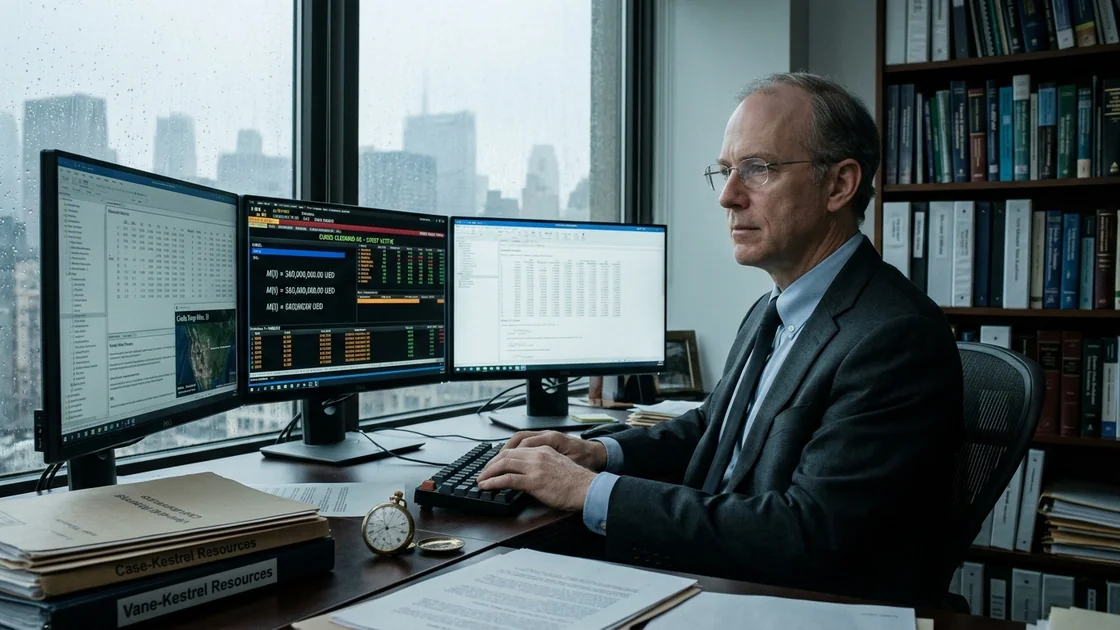
On his desk, beside a triple-monitor workstation glowing with stochastic matrices, sat the only object in his office that served no computational purpose. It was a heavy brass pocket watch, its crystal spider-webbed with ancient cracks, its hands fused by heat and oxidation at seventeen minutes past four.
Inside the warped brass case, dried into the gears like grey talcum powder, was a microscopic trace of Upper Freeport coal dust. It had belonged to his father, Thomas Pendelton, a ventilation engineer at the Black Run No. 4 mine in western Pennsylvania. Thirty-eight years ago, Thomas had written four memos to the mine’s absentee owners regarding a defective methane scrubber in the longwall face. An actuary in Pittsburgh had calculated that replacing the scrubber would cost the company four hundred and ten thousand dollars in equipment and downtime, whereas the statistical probability of an ignition event over the remaining two-year life of the seam was only six percent, carrying an expected statutory payout of one hundred and eighty thousand dollars in state-capped workers' compensation.
The math had been clear. The scrubber was not replaced. The six percent probability had materialized at 4:17 p.m. on a Tuesday.
Arthur had not become an actuary to avenge his father. Vengeance was an emotional expenditure with a negative expected return. He had become an actuary because he wanted to understand the grammar of the language that had sentenced his father to death. Over three decades, he had mastered that language until he spoke it better than anyone on the eastern seaboard.
"You're looking at the Vane-Kestrel files," a voice said from the doorway.
Arthur did not look up from his screen. He recognized the gait and the faint scent of bergamot cologne belonging to Lawrence Sterling, the Managing Director of Aegis-Thorne’s Special Casualty division.
"I am reviewing their five-year loss history," Arthur said, his voice dry and precise, like parchment sliding over glass. "Though 'history' is a generous term. It reads more like an autopsy report."
Lawrence stepped into the office and closed the door—a statistically significant deviation from office protocol that indicated the conversation was non-billable and sensitive. He sat in the leather chair opposite Arthur’s desk, crossing one bespoke trouser leg over the other.
"Lloyd’s dropped them on Tuesday," Lawrence said. "Munich Re walked out of the room last month. Zurich wouldn't even let their brokers past the lobby after the tailings dam breach in Montana."
"With good reason," Arthur replied, scrolling through a PDF on his center monitor. "Vane-Kestrel Resources operates with a loss-frequency multiplier three times the industry average for deep-shaft poly-metallic extraction. In the last thirty-six months, they have accrued four hundred and twelve Mine Safety and Health Administration citations. Eighty-nine of those were classified as 'Significant and Substantial.' Twelve were flagrant violations involving roof-bolting shortcuts and ventilation bypasses. Yet, remarkably, they have paid less than four percent of the assessed penalties."
"Harrison Cole is their General Counsel," Lawrence said, offering a thin smile. "The man has twenty-four associates whose sole job is to file administrative appeals until the administrative law judges retire or die. They drown the regulators in discovery, fold the operating subsidiaries into Chapter 11 when the liabilities crest, and buy back the physical mineral rights through a Delaware shell the next morning."
"A standard corporate judgment-proofing strategy," Arthur noted. "Which makes them an abominable credit risk and an uninsurable casualty risk. Why are their files on my server, Lawrence?"
Lawrence leaned forward, resting his elbows on his knees. "Because Julian Vane needs an eight-hundred-million-dollar senior secured credit facility from a consortium led by Credit Suisse and JPMorgan to finish the deep-shaft expansion at Cradle Deep."
Arthur paused, his fingers hovering over his mechanical keyboard. "Cradle Deep. The cobalt-nickel deposit in the Sawtooth Basin."
"The very one," Lawrence said. "Six thousand four hundred feet down into Precambrian quartzite. The richest domestic cobalt vein discovered in forty years. Every electric vehicle manufacturer in the hemisphere is bidding on their offtake agreements. Vane stands to clear three billion in EBITDA over the next decade if he can get the ore out of the ground before the market shifts to solid-state batteries."
"And the banks?"
"The banks love the cobalt, but they aren't stupid," Lawrence said. "After the Montana dam disaster, the lending syndicate's compliance committee refused to release the eight hundred million unless Vane-Kestrel secures a three-hundred-million-dollar catastrophic casualty and operational surety policy. And because the banks know Harrison Cole’s shell-game tricks, they’ve stipulated that the policy must be an irrevocable, zero-litigation parametric instrument cleared through an AA-rated institutional mechanism."
"No traditional carrier will write three hundred million in primary coverage on a six-thousand-foot shaft with Vane-Kestrel's safety record," Arthur said flatly. "The pure risk premium alone would be ninety million dollars a year. Julian Vane doesn't pay ninety million for insurance. He barely pays for rock bolts."
"He won't pay ninety million," Lawrence agreed. "In fact, he wants to pay an upfront premium of less than four million."
Arthur finally looked up from his monitors. His pale gray eyes fixed on his boss through rimless spectacles. "Then he requires a magician, not an actuary. The expected loss value of Cradle Deep over a thirty-six-month horizon is forty-eight million dollars, assuming standard hydrological variance. Given their management's penchant for deferring maintenance, the true expected loss approaches one hundred and ten million."
"Which is why we aren't going to underwrite it on our balance sheet," Lawrence said softly. "You are going to structure a bespoke captive arrangement. A synthetic risk-transfer vehicle. Vane-Kestrel has the assets to self-insure, Arthur, they just don't want those assets tied up in a dead escrow account earning two percent while they dig the shaft. If you can design a structure that satisfies the banking syndicate's compliance algorithms while leaving Vane’s capital free to generate returns, Vane will pay Aegis-Thorne a twelve-million-dollar structuring fee."
Lawrence stood up and smoothed his jacket. "And your bonus this year will reflect ten percent of that fee. You fly to Idaho tomorrow morning to inspect the shaft, and then to Denver on Thursday to present the architecture to Julian Vane and his board. Make the numbers work, Arthur."
When the door clicked shut, Arthur did not return to his keyboard immediately. He reached out and touched the cold brass of his father's pocket watch.
Make the numbers work.
In Lawrence’s vernacular, that meant finding a way to obscure the mathematical certainty of human death behind a veil of complex financial derivatives, ensuring that when the mountain inevitably crushed the men inside it, the loss would fall neatly into a tax-deductible column where nobody of importance would ever feel the weight of the stone.
Arthur turned back to his center monitor. He opened a blank workspace in his programming environment and typed a single comment line at the top of the script.
// Project: Cradle Deep. Objective: True Equilibrium.
II. Six Thousand Feet Below the Actuarial Table
The town of Silver Creek, Idaho, sat wedged into a narrow, frost-bitten gorge of the Sawtooth Range, looking as though it had slid off the mountain during a thaw and lacked the energy to climb back up. Above the town, chewing into the timberline like a grey canker, rose the headframe of the Cradle Deep mine. It was a two-hundred-foot steel latticework tower, its gigantic sheave wheels spinning in the freezing mist, hauling twenty-ton skips of crushed waste rock out of the earth and dropping men down into it.
Arthur stood in the mud outside the mine’s dry-house, looking absurd in a bright orange visitors' jumpsuit pulled over his worsted wool trousers, with a heavy fiberglass hard hat strapped over his thinning hair. Around his waist hung a four-pound W65 self-rescuer canister—a device designed to convert deadly carbon monoxide into breathable, blistering-hot air for sixty minutes, assuming the wearer wasn't already crushed flat when the gas hit.
"You're the insurance guy."
Arthur turned. A woman in her late thirties was walking toward him from the core-shack. She wore mud-caked steel-toe boots, heavy canvas coveralls stained with hydraulic fluid, and a white hard hat marked with the green cross of engineering safety. Her face was wind-chapped, and dark bruised crescents sat beneath her eyes—the unmistakable look of someone losing a war of attrition against upper management.
"Arthur Pendelton," he said, extending a gloved hand. "Fellow of the Casualty Actuarial Society."
"Sarah Vance," she said, shaking it briefly. Her grip was calloused and strong. "Chief Hydrogeologist. Or at least, I’m the person whose signature stays on the geological assessments until Denver decides they don't like what the rocks are saying." She looked him up and down with undisguised cynicism. "Usually, the underwriters don't bother coming past Boise. They just look at the core assays over steak dinners with Julian Vane and sign off."
"I find that secondary data sources suffer from reporting bias," Arthur said. "I prefer to observe the physical variance myself."
Sarah barked a short, humorless laugh. "Physical variance. That’s a polite word for it. Come on. The cage is waiting. Keep your hands inside the gates unless you want to leave them on the shaft timber."
They stepped into the personnel cage—a double-deck steel box dripping with greasy condensation. The bellman yanked a lanyard three times, the pneumatic gates slammed shut, and the floor dropped out from beneath Arthur’s stomach.
They fell at two thousand feet per minute. The daylight vanished instantly, replaced by the rhythmic, deafening whump-whump-whump of the steel guide rails and the roar of water cascading down the shaft walls outside the mesh. As they descended, the freezing Idaho air turned warm, then humid, and finally oppressively hot, smelling of diesel exhaust, blasted nitrates, sulfur, and wet, ancient stone.
At the 5,800-foot level, the brakes engaged with a metallic shriek that vibrated in Arthur’s fillings. The cage bounced twice on the stretch of its two-inch steel cable—over a mile of wire rope groaning under its own weight—and settled at the station.
"Welcome to the lower paleozoic," Sarah shouted over the roar of a massive overhead ventilation fan. "Ambient rock temperature down here is a hundred and twelve degrees Fahrenheit. The chiller plants keep the drifts around eighty-five, provided Denver doesn't throttle the compressors to save on peak-hour megawatt tariffs."
She led him out of the station and down the main haulage drift—a tunnel twenty feet wide and eighteen feet high, blasted out of dark, glittering quartzite. Enormous articulated dump trucks rumbled past, their headlights cutting through a haze of silica dust and diesel particulates. Overhead, the roof was held back by a grid of eight-foot steel split-set bolts and heavy galvanized wire mesh.
Arthur walked slowly, his eyes scanning the ceiling and ribs of the tunnel. He didn't need a degree in mining engineering; he had read eleven hundred catastrophe investigation reports over thirty years. He knew what failed before a collapse.
"The wire mesh in this section is bulging," Arthur observed, pointing a gloved finger toward the upper left quadrant of the drift where pulverized rock was sagging like a heavy belly in a net. "And the bearing plates on bolts fourteen through twenty-two have sheared their washers due to corrosion."
Sarah stopped and looked at him, her cynicism giving way to genuine surprise. "You actually know what you're looking at."
"Corrosion indicates acidic groundwater infiltration," Arthur said calmly. "And the deformation pattern of the plates suggests horizontal tectonic stress exceeding the yield strength of standard Grade-60 steel rebar. You should be using epoxy-grouted cable bolts on four-foot centers here, not friction bolts on six-foot centers."
Sarah looked down the drift to make sure no shift bosses were within earshot. She motioned for Arthur to follow her into a dark crosscut—an unlit side tunnel that led toward the active stope where the rich cobalt vein was being mined. The roar of the main ventilation fan faded, replaced by an eerie, unsettling sound: a series of sharp, metallic pings and deep, hollow groans coming from inside the solid rock around them.
"The mountain is talking," Arthur murmured.
"It's screaming," Sarah corrected grimly. She shone her cap lamp onto the wall of the crosscut. A jagged fracture, two inches wide, ran diagonally through the quartzite. Out of the crack wept a steady stream of warm, rust-colored water that smelled strongly of rotten eggs. "We're mining eighty yards beneath the Silver Creek Fault zone. That fault is essentially an underground river of pressurized, geothermal brine perched right over our heads. As we blast out the cobalt ore below, the hanging wall is subsiding."
She pulled a laminated tablet from her vest and brought up a 3D seismic map peppered with red and yellow spheres. "Every one of those dots is a micro-seismic event over the last fourteen days. The rock pillar between the active stope in Sector 4 and the flooded fault zone is fracturing. To mine this safely, we need to halt ore extraction for six weeks, pump forty thousand tons of high-density cement paste into the depleted voids to support the roof, and drill pressure-relief drains into the fault."
"And the cost of that remediation?" Arthur asked, though he was already running the calculation in his head.
"Sixteen million dollars in materials and labor, plus forty-two million in deferred cobalt delivery penalties to the battery consortium," Sarah said. She tapped a small, gray metal box bolted to the rock wall nearby. Thick armored fiber-optic cables ran from the box into boreholes drilled deep into the rock. "This is a vibrating-wire piezometer and micro-seismic array. We have forty of them down here. They measure pore-water pressure and rock strain in real time. Right now, the hydrostatic pressure behind Sector 4's bulkhead is sitting at four hundred and ten PSI. The engineering safety limit is four hundred and fifty."
"What happens at four hundred and fifty?"
"Nothing, if you're lucky," Sarah said quietly. "At five hundred, the quartzite pillar suffers a strain-burst. It explodes like a grenade, the fault ruptures into the mine workings, and three hundred thousand gallons of boiling, acidic mud per minute floods the lower levels. There are forty-five men working down here per shift. It takes twenty minutes to get everybody to the shaft station and up the cage. The water will fill Sector 4 in four minutes."
Arthur stared at the little gray telemetry box. A tiny green LED blinked steadily in the gloom. "Where does this data go?"
"Up the shaft via fiber-optic trunk line to my server in the engineering trailer," Sarah said. "And from there, it’s supposed to sync with Vane-Kestrel’s enterprise risk portal in Denver and the federal MSHA compliance database."
"Supposed to?"
Sarah’s jaw tightened. "Last month, Victoria Sterling—the CFO in Denver—had their IT department install a 'data-smoothing middleware' on the Denver server. They claim our sensors produce too many false-positive spikes during blasting cycles, which triggers automatic MSHA inspections. Now, when I log a Priority-1 Geotechnical Hazard Ticket, it doesn't go to the regulators or the lenders. It goes into an internal review queue in Denver, where it sits until Julian Vane decides whether fixing it fits into the quarterly capital expenditure budget."
Arthur took a small leather notebook from his pocket and wrote down the model number of the telemetry box: Geokon-8800-Array.
"Does the raw, unsmoothed data still exist on the local node?" Arthur asked.
"Yeah," Sarah said. "The array has an internal solid-state logger with a satellite backup port on the headframe for remote diagnostics, though Denver turned off the subscription to save twelve hundred bucks a month. Why? What difference does it make? Once you go to Denver and tell them the mine is a death trap, they’ll just fire your firm and find an actuary in Bermuda who will rubber-stamp their paperwork."
Arthur closed his notebook and slipped it back into his pocket. He looked at the weeping fracture in the stone, then at the young geologist whose eyes held the same desperate, helpless fury his father’s had held at the dinner table in 1986.
"I have no intention of telling them it is a death trap, Ms. Vance," Arthur said softly. "If I refuse to write the policy, someone less meticulous will write it, and the forty-five men on this shift will die when the pillar fails in July."
Sarah blinked, stepping back as if he had struck her. "Wait. You're going to approve their insurance? After what I just showed you?"
"Insurance, Ms. Vance, is fundamentally a mechanism for pricing the transfer of consequences," Arthur said, adjusting his hard hat. "The reason Vane-Kestrel ignores your sensors is that there is an asymmetry between the people who make the decisions in Denver and the people who experience the consequences at five thousand eight hundred feet. My profession is dedicated to correcting asymmetries."
He pointed at the gray telemetry box. "Before I leave this evening, I am going to give you a standard regulatory compliance form requiring the installation of a dedicated actuarial pricing modem on the headframe's satellite port. You will sign it under your authority as site safety officer, and my firm will pay the satellite subscription fee as an administrative underwriting expense."
"What's the modem going to do?" she asked warily.
"It is going to listen to the mountain," Arthur said. "And translate what it says into a language Julian Vane understands."
III. The Calculus of Negligence
The fifty-fourth floor of the Tabor Center in downtown Denver was a world entirely scrubbed of silica dust, sulfur, and the groan of stressed Precambrian rock. Here, the air was seventy degrees, triple-filtered, and scented faintly with white tea and cedar. Floor-to-ceiling glass walls offered a sweeping panorama of the Front Range of the Rockies, their jagged snow-capped peaks reduced by distance and elevation into a decorative wallpaper for the people who owned them.
Arthur sat at the far end of a thirty-foot table made from a single slab of polished Peruvian walnut. His briefcase was open beside him, though he had placed only a single printed sheet of heavy cream bond paper on the wood in front of him.
Around the table sat the Board of Directors of Vane-Kestrel Resources.
At the head sat Julian Vane, fifty-eight, his silver hair swept back from a permanently tanned forehead achieved via heliskiing in Gstaad and sailing off Antigua. He wore a cashmere turtleneck beneath an unbuttoned Brioni blazer, projecting the relaxed, unbothered authority of a man whose great-grandfather had bought the mineral rights to half the territories before they were states.
To his right sat Victoria Sterling, the Chief Financial Officer. She was forty-one, razor-thin, with cold, hyper-caffeinated eyes that flicked constantly to the Bloomberg terminal tablet propped beside her sparkling water. To his left sat Harrison Cole, the General Counsel, a heavy-set man in his sixties with the jowls of a bloodhound and a gold Patek Philippe watch that slid out from his French cuffs whenever he gestured. Flanking them were the two "independent" directors: former U.S. Senator Harlan Royce, who served to grease the wheels at the Department of the Interior, and Dev Patel, managing partner of a Silicon Valley venture fund that needed Vane’s cobalt for its mobility portfolio.
"Let’s dispense with the actuarial lecture, Mr. Pendelton," Julian Vane said, leaning back and steepling his fingers. "Lawrence Sterling tells me you’re the smartest quant in New York. You went down the hole in Idaho on Tuesday. You’ve seen the operation. We need the three-hundred-million-dollar surety binder on the syndicate’s desk by Friday at five o'clock, or our bridge loan rolls into a punitive interest rate. What is the number?"
"Before we discuss the premium structure, Mr. Vane," Arthur said calmly, "I am obligated by statutory underwriting standards to raise a material physical risk observed during my site inspection."
Harrison Cole sighed loudly, rolling his eyes toward the acoustic ceiling tiles. "Here it comes."
"In Sector 4 at the 5,800-foot level," Arthur continued, his voice flat and unhurried, "hydrostatic pore pressure behind the primary hanging-wall pillar has reached four hundred and ten pounds per square inch. Your Chief Hydrogeologist has logged three Priority-1 warnings recommending an immediate six-week production halt for paste-backfill stabilization."
Silence hung in the boardroom for three seconds. Then Victoria Sterling laughed. It was a dry, brittle sound.
"Sarah Vance is an alarmist academic who thinks a mine is a national park," Victoria said, not looking up from her tablet. "She wants me to burn fifty-eight million dollars in cash flow and penalties because a rock is wet. Every deep shaft in Idaho weeps water, Mr. Pendelton. That’s why God invented sump pumps."
"My stochastic model of the quartzite pillar’s compressive strength, factoring in the acid-leaching of the rock bolts I observed, indicates a thirty-four percent probability of catastrophic hanging-wall failure within the next one hundred and eighty days if extraction continues at the current pace," Arthur said. "In the event of such a failure, the expected mortality is thirty-eight point four miners."
Julian Vane didn't blink. He looked at Arthur with a mild, clinical curiosity, the way one might look at a slightly defective calculator.
"Thirty-eight point four," Vane repeated softly. "Let’s round it up to forty for the sake of argument, Mr. Pendelton. Let’s do the math that you people are supposed to be so good at. If forty men die in Cradle Deep tomorrow, what is the financial exposure of Vane-Kestrel Resources?"
Arthur looked at Harrison Cole, then back to Vane. "Under Idaho workers' compensation statutes, the exclusive-remedy doctrine bars employees or their families from suing the employer for ordinary or even gross negligence. Death benefits are capped at burial expenses plus sixty-seven percent of the average weekly wage for a period of five hundred weeks. Approximately three hundred and ten thousand dollars per fatality."
"Which equals twelve million, four hundred thousand dollars," Victoria Sterling snapped, her fingers tapping the table. "Paid out over ten years, which has a net present value of roughly ninepoint-two million at current discount rates."
"And the federal regulatory fines from MSHA?" Arthur asked, playing his role with immaculate passivity.
"Capped at two hundred and ninety-one thousand dollars per flagrant violation," Harrison Cole rumbled, smiling thinly. "Even if the Department of Labor throws the book at us with fifty separate counts, that’s fourteen million. I’ll tie it up in the Tenth Circuit for six years and settle it for three million on a no-fault consent decree. And if the structural damage to the shaft exceeds the value of the remaining ore, the operating subsidiary—Cradle Deep Extraction LLC—Simply files for Chapter 11 liquidation. The parent company, Vane-Kestrel, holds the senior lien on the mineral rights. We foreclose on ourselves, wipe out the tort creditors and the union pension liabilities, and sink a new shaft two miles west next spring."
Senator Royce nodded sagely over his coffee cup. "It's how extractive industries have functioned since the Comstock Lode, son. You can't get the minerals the modern green economy needs without breaking a few eggs. The law recognizes that."
"So," Julian Vane said, leaning forward and fixing Arthur with a cold, triumphant stare. "You tell me there is a thirty-four percent chance of an event that will cost my subsidiary, at worst, twelve million dollars in net present value—a cost that is entirely discharged if we bankrupt the LLC. And your geologist wants me to spend fifty-eight million dollars today, with a one hundred percent certainty, to prevent it. What kind of businessman spends fifty-eight million to save twelve million?"
Arthur looked down at the single sheet of cream paper on the walnut table. In his mind, he heard the brass pocket watch ticking—no, not ticking, because it had stopped at 4:17 p.m. when six percent had become one hundred percent in a flash of burning methane.
"A terrible businessman, Mr. Vane," Arthur said quietly. "Your math is entirely rational within the bounds of corporate limited liability."
Vane smiled, his shoulders relaxing back into the leather chair. "I knew Lawrence sent the right man. Now, the problem isn't the miners, Arthur. The problem is the bankers. JPMorgan and Credit Suisse don't care if forty miners drown, except insofar as a flooded shaft stops cobalt deliveries and defaults on their eight-hundred-million-dollar loan. That’s why they are demanding this absurd three-hundred-million-dollar parametric surety policy. They want to know that if the shaft floods, three hundred million in liquid cash hits their syndicate escrow account within twenty-four hours to pay down the principal and fund the shaft recovery. And I am not paying ninety million a year to Lloyd's for that piece of paper, nor am I locking up three hundred million of Vane-Kestrel’s cash in an escrow account."
"You don't have to do either," Arthur said.
Every head at the table turned sharper. Victoria Sterling actually set her tablet face-down on the wood.
"Explain," she said.
Arthur slid the single sheet of paper toward the center of the table. It contained a clean, elegant diagram of boxes and arrows, labeled The Helvetia Synthetic Parametric Surety (HSPS-300).
"The banking syndicate requires Tier-1 liquid collateral backing a three-hundred-million-dollar parametric insurance policy cleared through an automated European exchange—specifically, the Eurex Clearinghouse in Zurich—so that Harrison here cannot tie the payout up in a Delaware bankruptcy court," Arthur said, nodding politely at the General Counsel. "However, Eurex does not require that the collateral be cash sitting idle in a vault. They permit Cross-Collateralized Standby Margin Commitments from prime brokerage accounts held at AA-rated institutions."
Dev Patel leaned forward, his eyes narrowing with interest. "Margin commitments. You mean pledging existing investment portfolios without liquidating them?"
"Precisely," Arthur said. "If Vane-Kestrel pledges corporate assets, it ruins your debt-to-equity ratios on the quarterly balance sheet and violates your existing bond covenants. However, the five of you sitting at this table collectively control private family offices, revocable living trusts, and personal prime-brokerage accounts at UBS, Goldman Sachs, and Morgan Stanley totaling well over one point four billion dollars in equities, sovereign bonds, and unencumbered real estate."
A heavy, incredulous silence fell over the room.
"Are you out of your mind?" Harrison Cole barked, half-rising from his chair. "You're suggesting the Board of Directors personally guarantee a corporate mining policy? The entire point of a corporation is the corporate veil! We never expose personal assets to operational liability!"
"Wait, Harrison," Victoria Sterling said sharply, her eyes darting across the numbers at the bottom of Arthur’s diagram. A flush of avarice was rising up her neck. "Let him finish. Look at the yield structure in Box 4."
Arthur folded his hands neatly on the walnut table. "Mr. Cole is correct regarding standard guarantees. No sensible director would expose personal wealth to an operational risk. Which is why we have two layers of insulation. First, if the five of you pledge three hundred million dollars of your existing personal prime-brokerage margin capacity as the Tier-3 reinsurance backing for the Zurich captive, Vane-Kestrel Resources is legally permitted to pay you a 'Private Counterparty Risk-Retention Fee' for the use of your creditworthiness."
"How much?" Julian Vane asked softly.
"Nine point five percent per annum," Arthur said. "Twenty-eight million, five hundred thousand dollars a year, paid quarterly out of the subsidiary's pre-tax operational budget directly into your personal offshore trusts. Because it is structured as a captive insurance collateral fee domiciled in Guernsey, it is classified as a return of capital basis rather than ordinary income or dividends. Your effective tax rate on that twenty-eight million is zero."
Senator Royce’s mouth opened slightly. "We don't put up a dime of cash. We keep earning the capital gains and dividends on our existing stock portfolios and real estate. And the company pays us twenty-eight million a year in tax-free cash just for letting our prime brokers sign a standby letter of credit?"
"That is the financial architecture, Senator," Arthur said.
"And the risk?" Julian Vane asked, his eyes boring into Arthur. "What triggers a margin sweep from Zurich against our personal accounts? Because if there's even a one percent chance that a cave-in in Idaho touches my family trust, this conversation is over."
"That is the second layer of insulation, Mr. Vane," Arthur said, his voice as smooth and cold as glacial ice. "Because this is a parametric contract, it does not pay out based on actual physical damage, lawsuits, or deaths. It pays out solely based on a mathematical formula written in Annex G of the clearinghouse agreement. I have drafted the legal text of Section 12—which Mr. Cole is welcome to review—to state that a collateral call against the Board's personal accounts can only occur upon an Uncured Enterprise Default Following a Class-A Force Majeure Event, after all corporate exhaustion remedies have failed."
Harrison Cole grabbed the sheet of paper and pulled out his reading glasses. "And what defines an 'Uncured Enterprise Default'?"
"In the legal definitions of Section 12, it requires a final, non-appealable judgment of insolvency by a federal bankruptcy court," Arthur lied—not with his words, for Section 12 did indeed say that, but by omitting the mathematical override in Annex G that governed the automated clearinghouse margin-maintenance engine. "As you yourself noted three minutes ago, Mr. Cole, you can delay a final non-appealable judgment in the Tenth Circuit for at least six years. The credit facility and the surety policy expire in thirty-six months. Mathematically, the policy expires three years before the legal trigger could ever be adjudicated."
Harrison Cole stared at the diagram, then slowly began to smile. It was a deeply unpleasant expression, the smile of a predator realizing the fence around the sheep pen wasn't electrified after all.
"A temporal arbitrage," Cole murmured. "The banks get their AA-rated Zurich paper because the collateral is technically pledged on an automated margin line. We collect eighty-five million in tax-free fees over three years. And if the mountain falls in tomorrow, I file an automatic stay in bankruptcy court that freezes the definition of 'Enterprise Default' until three years after our personal guarantees have expired and dissolved."
"It is a classic regulatory loop," Arthur agreed mildly. "The banks satisfy the Basel III compliance algorithms. You extract twenty-eight million a year in tax-free yield. Aegis-Thorne collects its structuring fee. Everyone’s spreadsheets balance."
Victoria Sterling looked up from her calculator app, her eyes gleaming. "My allocation of the collateral pledge would be forty million. That’s three point eight million a year directly into my Cayman trust, tax-free."
"Mine is a hundred and fifty million," Julian Vane said, tapping a finger against his lips. "Fourteen million two hundred and fifty thousand a year. Enough to cover the refit on the Persephone in Monaco and the carrying costs on the Aspen compound." He looked at his General Counsel. "Harrison, if you read the contract and tell me it's airtight, we sign tomorrow morning."
"Send the full binder over tonight, Pendelton," Cole said, tossing the paper back onto the table. "My team will scrub every syllable of Section 12."
"You will have the complete documentation at eight o'clock this evening," Arthur said, standing up and snapping his briefcase shut. "Along with the prime-brokerage API authorization forms for Eurex Clearing. Because the banks require the facility active by Friday at five, your wealth managers at UBS, Goldman, and Morgan Stanley will need to execute the irrevocable margin-link authorizations by noon tomorrow."
"They'll do what they're told," Julian Vane said dismissively, already turning back to look out the window at the Rockies. "Thank you, Mr. Pendelton. It’s refreshing to deal with a realist."
"Indeed, Mr. Vane," Arthur said from the doorway. "Reality has a way of asserting itself."
IV. The Architecture of the Trap
Arthur did not return to his hotel room that afternoon. Instead, he took a taxi to a quiet co-working space in Cherry Creek, rented a private soundproof booth, and opened an encrypted video link to Zurich.
The face that appeared on his screen belonged to Lukas Meyer, a thirty-two-year-old quantitative developer who worked in the automated settlement architecture division of the Swiss clearinghouse. Lukas had a PhD in stochastic calculus from ETH Zurich and owed Arthur his career, having been rescued by the senior actuary from a catastrophic fat-finger algorithmic error during his internship in London seven years prior.
"Arthur," Lukas said, adjusting his headset in the dim light of the Zurich night. "I received the schema for the Helvetia-300 contract. Are you certain about the margin-maintenance formula in Annex G? It’s... unconventional."
"Is it compliant with Eurex automated clearing protocols?" Arthur asked.
"Technically, yes, completely," Lukas said, pulling up lines of code on his own screen. "Because you structured this as a synthetic variance swap rather than a traditional indemnity policy, the clearinghouse engine doesn't read the English text in Section 12. Legal text is just metadata for the human auditors. The settlement engine only executes the mathematical expression in Annex G—the Dynamic Margin Maintenance Ratio, \(M(t)\)."
"Read the expression back to me, Lukas, so I am certain there are no syntax errors in the smart contract."
Lukas squinted at his monitor. "Okay. Under normal operational parameters, the required cash margin deposit from the pledgors' prime brokerage accounts is defined by:
\[M(t) = L \cdot \left[ 1 - e^{-\lambda(t) \cdot \Delta S(t)} \right]\]
where \(L\) is the policy limit of three hundred million dollars, and \(\Delta S(t)\) is the seismic variance logged by the oracle node."
"And the step-function for \(\lambda(t)\)?" Arthur pressed.
"That’s the clever part," Lukas said, a note of professional admiration in his voice. "You defined \(\lambda(t)\) as a Heaviside step function tied to two external data feeds: the MSHA regulatory portal and the remote satellite diagnostic feed from the Geokon-8800 telemetry array at the mine site. As long as there are no un-remediated Priority-1 geotechnical tickets older than forty-eight hours, \(\lambda(t)\) equals zero. And since \(e^0\) equals one, one minus one is zero. The required cash margin is zero dollars. The board members' assets sit untouched in their brokerage accounts."
"And if a Priority-1 ticket is logged on the local telemetry node," Arthur continued quietly, "and remains un-remediated for forty-eight hours and one second, while simultaneously the piezometer pressure exceeds four hundred and fifty PSI and a seismic event greater than 1.8 magnitude occurs?"
"Then the Heaviside function flips," Lukas said. "\(\lambda(t)\) jumps to ten thousand. The term \(e^{-\lambda(t)}\) instantly collapses to zero. The required cash margin \(M(t)\) becomes one hundred percent of \(L\)—three hundred million dollars—plus a twenty percent liquidity buffer for slippage. Three hundred and sixty million dollars total."
"Explain the execution mechanism when \(M(t)\) hits one hundred percent," Arthur said. "Can Harrison Cole stop it with a federal bankruptcy injunction or a temporary restraining order?"
Lukas laughed softly. "Arthur, how fast do you think a lawyer can type? When the oracle node in Idaho sends that packet via satellite to our server in Zurich, the Eurex margin engine doesn't ask a judge for permission. It’s an institutional derivatives clearinghouse operating under Swiss financial finality laws. Under the prime-brokerage Cross-Collateralization agreements their wealth managers are signing tomorrow, an uncured margin deficit triggers an immediate, automated, market-order liquidation sweep across all linked accounts within one hundred and eighty milliseconds."
"And if the cash and liquid equities in their brokerage accounts are insufficient to cover the three hundred and sixty million?"
"Then the secondary collateral pledges kick in automatically," Lukas said, scrolling down the code. "Their family office LLCs, the deeds to their real estate holdings, the maritime mortgages on their yachts, their private aviation leases—the clearinghouse algorithm transfers title immediately to our distressed-asset liquidity desk in London, which auctions them to pre-approved institutional vulture funds at forty cents on the dollar to generate immediate cash settlement within the fifteen-minute clearing window."
"And the disbursement of the three hundred million?" Arthur asked.
"Per your instructions in the smart contract's payment waterfall," Lukas read off, "the moment the margin sweep completes, the funds do not go to Vane-Kestrel Resources. Because the trigger is classified as an 'Operational Hazard Mitigation Event,' the clearinghouse wires forty million directly to the pre-contracted emergency escrow accounts of Titan Subterranean Rescue Services and the Boise Regional Trauma Center. Eighty million goes directly to the banking syndicate to cure the technical default, and the remaining one hundred and eighty million is locked into an irrevocable Swiss statutory trust divided equally among the bonded employees logged on the mine’s active brass-board shift roster at the moment of the seismic spike."
Arthur sat back in the small soundproof booth. He closed his eyes and listened to the hum of the ventilation fan overhead.
"Will Harrison Cole's lawyers catch Annex G tonight?" Lukas asked warily.
"Harrison Cole employs twenty-four corporate attorneys who went to law school precisely because they could not pass sophomore calculus," Arthur said. "They will spend ten hours dissecting the syntax of 'Force Majeure' in Section 12. When they reach Annex G, they will see four pages of stochastic differential equations and continuous-time Markov chains labeled Standard Black-Scholes-Merton Margin Calibration Model. They will hand it to Victoria Sterling’s junior financial analyst, who will plug in the historical smoothed data from the Denver server, see that \(\lambda(t)\) has equaled zero for five consecutive years, and tell Victoria that the formula outputs a zero-point-zero-zero percent margin requirement."
"Because they forgot that you tied the oracle to the raw satellite port on the headframe in Idaho, not their doctored server in Denver," Lukas whispered.
"I did not forget to mention it," Arthur corrected gently. "The satellite port's MAC address is explicitly listed in Footnote 14 of Schedule B. It is sixteen digits of hexadecimal code. If they choose not to verify which physical server that hexadecimal string corresponds to, that is an underwriting oversight on their part."
Arthur leaned toward the camera. "Finalize the smart contract, Lukas. Once the signatures are authenticated tomorrow at noon, purge the administrative override keys so that neither you, nor I, nor the Managing Director of Aegis-Thorne can halt the execution protocol."
"Deleting the root keys makes it completely immutable, Arthur," Lukas warned. "Once it's live on the Zurich ledger, it's a doomsday machine. If that mountain moves while a safety ticket is overdue, God Himself couldn't stop the clearinghouse from stripping those five people down to the studs."
"God has had thirty-eight years to regulate the mining industry, Lukas," Arthur said, and terminated the connection.
V. The Greed of the Immortal
At 11:42 a.m. the following morning, in the fifty-fourth-floor boardroom of Vane-Kestrel Resources, five Montblanc fountain pens scratched across heavy cotton bond paper.
Harrison Cole had arrived at nine with dark circles under his eyes and a triumphant smirk on his heavy face. He had demanded three minor alterations to Section 12—changing the phrase “material insolvency” to “adjudicated final insolvency following the exhaustion of appellate stays”—which Arthur had conceded after a convincing twenty-minute display of reluctant bureaucratic resistance. Having won his legal victory in the English text, Cole had waved his hand over Annex G without a second glance, pronouncing the document "a masterpiece of asymmetrical protection."
By 12:15 p.m., the wealth managers at UBS Zurich, Goldman Sachs Private Wealth, and Morgan Stanley Smith Barney had transmitted the cryptographic API keys linking the personal family offices, trusts, and holding companies of Julian Vane, Victoria Sterling, Harrison Cole, Harlan Royce, and Dev Patel directly to the Eurex Clearinghouse settlement engine.
At 12:30 p.m., JPMorgan and Credit Suisse received the automated confirmation of the three-hundred-million-dollar AA-rated surety binder and released the first tranche of the eight-hundred-million-dollar loan into Vane-Kestrel’s operating account.
At 12:35 p.m., Victoria Sterling initiated the first quarterly wire of seven million, one hundred and twenty-five thousand dollars in "Counterparty Risk-Retention Fees" out of the loan proceeds and directly into the five directors' offshore accounts.
Champagne—Krug Clos du Mesnil, 2008—was poured into crystal flutes.
"To Mr. Pendelton," Julian Vane said, raising his glass toward the quiet man in the charcoal suit who was methodically sliding the wet-ink duplicate originals into his leather portfolio. "Who understands that risk is only a problem for people who don't know how to price it."
"Thank you, Mr. Vane," Arthur said, declining a flute with a polite inclination of his head. "I wish you a low-variance quarter."
Before flying back to LaGuardia that evening, Arthur sent a brief, encrypted email to Sarah Vance at the Cradle Deep engineering trailer.
Ms. Vance: The actuarial telemetry modem installed on the headframe is now active. Please note that for your Geotechnical Priority-1 tickets to be properly logged by the insurance pricing oracle, you must enter them directly into the local Geokon-8800 terminal in the core-shack using Prefix Code 99-Delta, rather than solely through the Denver enterprise portal. This ensures our risk models remain calibrated to real-time hydrological reality. Regards, A. Pendelton.
Then Arthur flew home to Manhattan, ate his seventy grams of steel-cut oats the next morning, and waited.
He did not have to wait six months. Greed, as Arthur’s tables had long demonstrated, possessed an exponential acceleration curve.
In early April, a civil war in the Democratic Republic of the Congo disrupted global cobalt supply chains. Spot prices for battery-grade cobalt sulfate surged forty-two percent on the London Metal Exchange in eleven days.
Sitting in Denver, watching the commodity ticker climb, Julian Vane and Victoria Sterling saw an opportunity to lock in a four-hundred-million-dollar windfall bonus if they could double Cradle Deep’s ore output before the third quarter.
On April 14th, Denver ordered Cradle Deep to move from two ten-hour shifts to three continuous eight-hour extraction shifts, eliminating the four-hour daily maintenance window used by the timber-crews and grouters to reinforce the roof bolts in Sector 4. Furthermore, to increase the tonnage per blast, they authorized the blasting crews to use high-velocity emulsion explosives within sixty yards of the Silver Creek Fault bulkhead.
In his office on Sixth Avenue, Arthur watched the live telemetry feed on a small secondary window in the corner of his left monitor.
With every blast at the 5,800-foot level, the green line representing hydrostatic pore pressure behind the Sector 4 pillar ticked upward.
Four hundred and twenty PSI. Four hundred and thirty-five PSI. Four hundred and forty-eight PSI.
On Tuesday, May 19th, at 6:00 a.m. Mountain Time, following a massive production blast in Stope 4-B, a twelve-foot section of the hanging wall in the crosscut spalled off, shearing six corroded split-set bolts like dry twigs. Boiling, acidic water began pouring out of the fracture at forty gallons a minute. The piezometer array crossed the red line: four hundred and sixty-four PSI.
In the engineering trailer at Silver Creek, Sarah Vance didn't sleep. She ran down to the shaft, took the cage down to 5,800, looked at the buckling steel mesh and the screaming pressure gauges, and went straight back up to the core-shack.
At 8:12 a.m., she logged a Priority-1 Imminent Catastrophic Inundation Hazard into the Denver enterprise portal, demanding an immediate evacuation of the lower levels and emergency grouting.
Then, remembering the quiet man in the orange jumpsuit, she walked
over to the local Geokon-8800 terminal, typed in 99-Delta,
and entered the exact same Priority-1 ticket directly into the
solid-state logger.
In Zurich, three thousand miles away, a sub-routine on the Eurex Clearinghouse server received the satellite packet, authenticated the cryptographic hash, and started a forty-eight-hour countdown clock.
In Denver, at 8:45 a.m., Victoria Sterling saw Sarah Vance’s shutdown order pop up on her operational dashboard. Stopping the mine now, during peak cobalt pricing, would cost Vane-Kestrel two point one million dollars a day. She called Julian Vane, who was having breakfast on the terrace of his villa in Palm Beach.
"Tell Vance to put another sump pump in the drift and get back to work," Julian said over the sound of Atlantic surf. "We have four more weeks to hit the Q2 delivery threshold. Once we bank the bonus tranche, we’ll let her pour all the cement she wants in July."
Victoria clicked Override / Defer Maintenance on the Denver server, purging the alert from the corporate queue so it wouldn't trigger an MSHA notification.
She had no way of knowing that the clock in Zurich did not have an override button.
VI. The Variance
Thursday, May 21st.
In New York, it was 10:00 a.m. Rain tapped lightly against the double-paned glass of Arthur Pendelton’s office on the thirty-second floor of the Aegis-Thorne building.
Arthur was reviewing a municipal bond portfolio for the city of Cincinnati on his center monitor. On his left monitor, the small black terminal window from Zurich showed the countdown timer in pale green numerals.
47:58:12 47:58:13 47:58:14
In Idaho, it was 8:00 a.m. Forty-two miners were at the 5,800-foot level. Sarah Vance was down there with them, standing near the shaft station, arguing furiously with the mine superintendent, a company man named Miller who had orders from Denver to fire anyone who refused to load the mucking machines in Sector 4.
"Look at the load cells on the pillar, Miller!" Sarah shouted over the roar of the ventilation fans, holding her tablet inches from the man's face. "The pressure is at four hundred and eighty-nine PSI! The rock isn't just pinging anymore—it's gone completely quiet! Do you know what it means when quartzite goes quiet under a load like that? It means the micro-fractures have coalesced into a shear plane! It’s about to slip!"
"Denver says the sensors are drifting because of the humidity!" Miller yelled back, wiping sweat from his forehead. "I got sixty tons of high-grade muck sitting in Stope 4-B! We pull that out, and then I'll let your boys bolt the roof!"
At 8:12:01 a.m. Mountain Time—10:12:01 a.m. in New York—the Zurich
clock hit 48:00:01.
The Priority-1 ticket remained uncured. The first half of the Heaviside condition was Armed.
Four minutes later, at 8:16 a.m., a loader operator in Stope 4-B revved his sixteen-cylinder diesel engine and rammed his five-yard steel bucket into the muck pile at the base of the stressed quartzite pillar.
That tiny vibration—less than the force of a slammed door against the weight of a mountain—was the final straw.
Six thousand feet beneath the Sawtooth Range, a block of Precambrian rock measuring four hundred feet long, eighty feet wide, and ninety feet thick reached its ultimate compressive limit. It did not crack; it detonated.
The strain-burst released the kinetic energy of twelve tons of TNT. A shockwave measuring 2.9 on the Moment Magnitude scale ripped through the lower mine workings.
At the shaft station half a mile away, the concussion knocked Sarah Vance and Superintendent Miller flat on their backs. The main ventilation ducting tore loose from the ceiling in a blizzard of rust and dust. The lights went out instantly, plunging the 5,800-foot level into absolute, suffocating blackness.
Then came the sound that every hard-rock miner fears in his bones: a low, continuous, freight-train roar from the back of the drift, accompanied by a blast of displaced air hot enough to blister skin.
The Silver Creek Fault had breached. Three hundred thousand gallons per minute of geothermal brine, mud, and pulverized rock were surging into Sector 4, racing down the haulage drift toward the shaft station.
"Get to the upper refuge chamber!" Sarah screamed in the dark, scrambling to her feet as her cap lamp flickered back on. She grabbed Miller by his collar. "The shaft station is going to flood! Get the men out of the drift and up the ladderway in the emergency escapeway to the 5,400-foot level! Move! Move!"
Before the wall of boiling mud smashed the Geokon-8800 junction box in Sector 4 into scrap metal, the solid-state logger recorded two final pieces of data: a pore-pressure spike of 1,420 PSI, and a seismic peak ground acceleration corresponding to a 2.9 magnitude event.
In the three milliseconds before the fiber-optic trunk line severed in the shaft, that packet of light shot up six thousand feet of wire rope, hit the satellite transceiver on the headframe in the Idaho mist, bounced off a geostationary communications satellite twenty-two thousand miles above the equator, and landed in the server rack of the Eurex Clearinghouse in Zurich, Switzerland.
In Arthur’s office in New York, the green text on his left monitor turned bright, steady amber.
CONDITION MET: T_overdue > 48.00 AND P_psi > 450 AND M_w > 1.8
EXECUTING HEAVISIDE STEP: LAMBDA = 10,000
REQUIRED MARGIN M(t) = $360,000,000.00 USD
INITIATING DIRECT ALGORITHMIC COLLATERAL SWEEP...
Arthur stopped typing his report on the Cincinnati municipal bonds. He took off his rimless spectacles, polished them carefully with a microfiber cloth, placed them back on the bridge of his nose, and folded his hands over his stomach.
VII. Margin Call in the Dark
In Denver, at 8:25 a.m., the crisis room on the fifty-fourth floor of Vane-Kestrel Resources was already operating like a well-oiled machine.
Julian Vane was on the giant eighty-inch wall monitor via high-definition video link from his study in Palm Beach, wearing a linen shirt and sipping an espresso. Around the walnut table in Denver sat Victoria Sterling, Harrison Cole, Harlan Royce, and Dev Patel, who happened to be in town for the monthly audit committee meeting.
"Give me the status," Julian said calmly from the screen.
"We lost fiber communication with the 5,800-foot level nine minutes ago following a 2.9 seismic event," Victoria said, reading off an operational flash report. "Thirty-eight miners and the geologist, Sarah Vance, have reached the hardened refuge chamber on the 5,400-foot incline above the flood line. Four men from the blasting crew are unaccounted for, though the acoustic beacons indicate they made it into the secondary bulkhead pocket at the back of Drift 6. They have compressed air lines keeping the water out of the pocket, giving them roughly fourteen hours of oxygen."
"Can we reach the four men in Drift 6 with our site rescue team?" Dev Patel asked, looking pale.
"No," Victoria said briskly. "The main haulage drift is blocked by forty thousand tons of flooded muck and fallen quartzite. To get them out in fourteen hours, we’d have to mobilize Titan Subterranean Rescue out of Salt Lake City with their high-speed directional raise-borers and saturation divers, drill a thirty-inch shaft down from the 5,200-foot level, and pull them up in a Dahlbusch bomb."
"What does Titan charge for an emergency hot-mobilization?" Julian asked.
"Eighteen million upfront before their helicopters even lift off the pad, plus two million an hour," Victoria said. "And once MSHA gets on site, they’ll shut the whole mine down for a year."
Harrison Cole leaned forward, opening a thick leather binder labeled Project Phoenix: Chapter 11 Contingency.
"We don't call Titan," Cole said flatly. "If we spend twenty-five million on a private rescue, we're pouring good money into a dead subsidiary. We wait for the state and federal MSHA rescue teams to arrive by truck tonight. It won't cost us a dime. If the four men in Drift 6 run out of air before the government drills reach them, that's a tragedy of nature, and their families get the three-hundred-and-ten-thousand-dollar statutory death benefit from the state fund."
"And the thirty-nine people in the upper refuge chamber?" Senator Royce asked.
"The hoist cage is still operational down to 5,200," Victoria said. "We can pull them out over the next six hours at zero extra cost once the shaft inspection clears."
"Good," Julian Vane said, setting his espresso cup down on its saucer in Florida. "Harrison, walk us through the ring-fence. How fast do we sever Cradle Deep Extraction LLC from Vane-Kestrel?"
"The Chapter 11 petition is already drafted," Cole said, smiling with genuine professional pride. "I hit 'send' on the electronic court filing at nine o'clock when the Boise bankruptcy clerk opens. Cradle Deep LLC declares immediate insolvency due to an unforeseeable tectonic Force Majeure. An automatic stay freezes all lawsuits, MSHA fines, and union claims. Meanwhile, Vane-Kestrel draws down the remaining four hundred million of the JPMorgan loan facility before the banks realize the shaft is flooded, transfers it to our Cayman mineral-rights holding company, and we walk away clean. Our personal seventy-million-dollar bonus pool for Q1 and the risk-retention fees are completely untouchable."
"And the Zurich insurance policy?" Victoria asked. "The banks are going to scream for their three hundred million."
"Let them scream," Cole chuckled. "Under Section 12, which I personally rewrote, the Zurich policy cannot call our collateral until a final, non-appealable judgment of insolvency is entered after all appellate stays are exhausted. I’ll keep the bankruptcy open in Boise until 2032. Our personal guarantees expire in 2028. Not a single penny of our personal accounts is at risk."
At 8:29:14 a.m., Victoria Sterling’s iPhone vibrated against the walnut table.
Simultaneously, Dev Patel’s phone chimed twice. Harrison Cole’s phone buzzed in his breast pocket. On the giant screen in Palm Beach, Julian Vane glanced down as his desk phone began flashing red.
Victoria frowned and picked up her phone. It was a push notification from the Goldman Sachs Private Wealth app.
ALERT: Institutional Margin Maintenance Sweep Initiated (Counterparty: Eurex Clearing AG - Ref: HSPS-300-ANNEX-G). Liquidating $42,110,400.00 USD in public equities at Market Order.
"What the hell is this?" Victoria whispered, the color draining from her face. She tapped the screen frantically. Before her eyes, the balances of her S&P 500 index holdings, her municipal bond ladder, and her tech stocks were dropping to zero in real time as the algorithm dumped them onto the New York Stock Exchange open market at fire-sale bid prices.
"My UBS account was just frozen!" Dev Patel shouted, standing up so fast his chair slammed into the glass wall behind him. He was staring at his phone in horror. "Wait—no, not frozen! It’s liquidating! They just sold my entire Series-B secondary allocation in Palo Alto! Seventy-five million dollars—gone!"
"Harrison!" Julian Vane roared from the wall monitor. He wasn't sitting anymore; he was standing over his desk in Palm Beach, two phones pressed to his ears. "My family office manager at Morgan Stanley is screaming at me! He says Zurich just executed an automated clearinghouse sweep on the Vane Family Revocable Trust! One hundred and eighty million dollars in Treasury bills and blue-chip equities were just wired out of my account to Switzerland in four seconds!"
Harrison Cole’s hands were shaking so violently he could barely unlock his phone. He had six missed calls from his broker at Citigroup Private Bank and four text messages:
MARGIN DEFICIT UNCURED. LIQUIDITY SHORTFALL AFTER EQUITY SWEEP: $14,200,000. EXECUTING SECONDARY COLLATERAL PLEDGE PER API AUTHORIZATION. TITLE TRANSFERRED: 448 MEADOW LANE, SOUTHAMPTON NY (DEED #88412). TITLE TRANSFERRED: GULFSTREAM G550 TAIL #N884VK.
"No," Cole gasped, his heavy jowls trembling as a cold sweat broke out across his scalp. "No, that's impossible! I haven't even filed the bankruptcy petition yet! There is no adjudicated insolvency! I rewrote Section 12!"
"Look at the reference code on the wire!" Victoria shrieked, her voice cracking into a register nobody at Vane-Kestrel had ever heard before. She threw her tablet across the table at Cole. "It doesn't say Section 12! It says Annex G: Dynamic Margin Maintenance Ratio!"
Cole grabbed the tablet, his fingers smudging the glass as he scrolled frantically past the legal text of the insurance contract to the mathematical appendices at the back—the pages of partial differential equations he had dismissed as standard quantitative boilerplate.
His eyes fell on Footnote 14, and then on the definition of \(\lambda(t)\).
"It's not an insurance payout," Cole whispered, his voice hollow with sudden, sickening comprehension. He sank slowly back into his leather chair, staring blindly at the walnut table. "Pendelton didn't trigger an insurance claim. An insurance claim can be litigated in court."
"Then what did he do?!" Julian Vane bellowed from the screen, his tanned face mottled purple with rage and panic. "Speak, damn you!"
"He structured our personal guarantees as an active derivatives margin account on the Swiss exchange," Cole said numbly. "In Annex G, the required cash margin is tied to an equation. As long as there are no overdue safety tickets in Idaho, the required cash deposit is zero. The moment a safety warning went unfixed for forty-eight hours and the mine shook... the equation recalculated our required margin deposit from zero percent to one hundred and twenty percent."
"Then call a judge and get an injunction!" Senator Royce yelled, clutching his chest as he watched his own E-Trade institutional account bleed out on his screen. "Stop the wire!"
"You can't enjoin a Swiss derivatives margin call that has already settled!" Victoria screamed, tears of pure fury spilling over her mascara as another notification popped up on her phone—this one from the distressed-asset registry in London informing her that the deed to her six-million-dollar ski chalet in Vail had just been algorithmically auctioned to a Frankfurt vulture fund for two point four million to cover the twenty percent slippage buffer. "We gave Eurex irrevocable API keys to our prime brokers! The trade settled in milliseconds! The money is already in Zurich!"
On the wall screen in Palm Beach, two men in dark suits and federal marshals' windbreakers appeared on the terrace behind Julian Vane, accompanied by the harbor master of the Palm Beach Marina.
"Julian," Victoria whispered, pointing a shaking finger at the monitor.
Julian turned around. Through the open French doors of his villa, across the manicured lawn and private dock, a crew of bonded maritime repossession contractors was already boarding his one-hundred-and-sixty-foot Feadship yacht, the Persephone, clamping a yellow admiralty seizure notice to the bridge window on behalf of the Zurich clearinghouse's marine-liquidity syndicate.
"Get off my boat!" Julian screamed, dropping his phone and lunging toward the terrace doors before the video feed went dead.
In the Denver boardroom, the main speakerphone in the center of the table chimed.
"Ms. Sterling?" a brisk, professional voice said over the speaker. It was the chief dispatcher of Titan Subterranean Rescue Services in Salt Lake City. "Just calling to confirm receipt of the forty-million-dollar wire from Eurex Clearing AG in Zurich. What a remarkable response time. We have two Sikorsky S-64 Skycranes lifting off right now with our rapid-deployment raise-borer, and two Gulfstreams on the runway with twenty-four hard-rock rescue specialists and saturation divers. We’ll be on the ground at Silver Creek in thirty-eight minutes. We’ll have those four boys out of Drift 6 by mid-afternoon."
Nobody at the table answered. They couldn't.
VIII. The Solvency of Stone
At 11:30 a.m. Eastern Time, the rain in Manhattan stopped, and a pale shaft of sunlight broke through the clouds over the Hudson River, illuminating the thirty-second floor of Aegis-Thorne Risk Solutions.
Arthur Pendelton’s office door flew open without a knock. Lawrence Sterling stood on the threshold. His immaculate hair was disheveled, and his face was the color of skimmed milk.
"Arthur," Lawrence breathed, gripping the doorframe. "Julian Vane’s personal attorney just called the Chairman of our board. He's screaming that you just wiped out five hundred million dollars of the Vane-Kestrel directors' personal net worth in twelve minutes!"
"Three hundred and sixty million in cash and liquid securities, Lawrence," Arthur corrected mildly, not looking up from his spreadsheet. "The additional one hundred and forty million in losses is merely market slippage resulting from the rapid algorithmic liquidation of their illiquid real estate and luxury chattels during an unfavorable morning bidding window. One should never pledge illiquid collateral against a continuous-time Heaviside step function. The variance is punishing."
Lawrence stumbled into the office and slammed his palms down on Arthur’s desk, leaning over the triple monitors. "What did you do?! Did you hack their brokerage accounts?!"
"I am an actuary, Lawrence, not a cyber-criminal," Arthur said, finally looking up with calm gray eyes. "I did precisely what you instructed me to do last week. I designed a synthetic risk-transfer vehicle that satisfied the banking syndicate's compliance requirements without tying up Vane-Kestrel’s corporate cash. Every single word and mathematical symbol of the Helvetia-300 contract was reviewed and signed by Harrison Cole, Victoria Sterling, and Julian Vane, and authenticated by their private wealth managers."
"They thought the collateral couldn't be touched unless the company lost a ten-year bankruptcy battle!"
"That is because they only read the English words in Section 12 and ignored the calculus in Annex G," Arthur said, his voice dropping an octave until it carried the cold, implacable weight of six thousand feet of quartzite. "They believed that language could be twisted to separate an action from its consequence. That is a common delusion among lawyers and executives. Mathematics, however, does not permit such ambiguities."
Arthur turned his left monitor slightly so Lawrence could see the live settlement ledger from Zurich.
"Allow me to walk you through the loss adjustment, Lawrence. As of 11:15 a.m., the banking syndicate has received eighty million dollars, preventing a systemic credit default. Titan Subterranean Rescue is currently landing at Silver Creek, Idaho, funded by a forty-million-dollar escrow disbursement. The thirty-nine employees in the upper refuge chamber are already being hoisted to the surface, and the directional drill will reach the four trapped miners in Drift 6 with six hours of oxygen to spare. Zero fatalities."
Arthur tapped a second window on the screen.
"Furthermore, the remaining one hundred and eighty million dollars of the liquidated collateral has just been deposited into an irrevocable Swiss statutory trust. Each of the forty-two miners and the site geologist who were underground during the breach will receive an immediate, tax-free parametric trauma and relocation payout of four million, one hundred and eighty-six thousand dollars this afternoon, regardless of the fact that Vane-Kestrel’s subsidiary is now bankrupt."
Lawrence stared at the screen, his mouth opening and closing silently. "And the Vane-Kestrel board?"
"Because their personal brokerage accounts were cross-collateralized with their real estate lines of credit," Arthur said matter-of-factly, "the Eurex sweep triggered cascading cross-defaults across their entire private debt structures. Victoria Sterling currently has a net worth of negative four hundred thousand dollars. Harrison Cole’s law license was automatically suspended twenty minutes ago when the clearinghouse swept his firm's client-trust escrow overdraft protection line, which he had foolishly linked to his personal margin account to boost his yield. And Julian Vane is currently sitting in the back of a Palm Beach County sheriff's cruiser for assaulting a federal marshal who was seizing his yacht."
Arthur clicked one final window open.
"Finally, as required by the automated regulatory reporting clause in Schedule D, the raw, unedited telemetry logs from the Geokon-8800 node—proving that the board intentionally overrode a Priority-1 imminent-death warning to maximize their quarterly cobalt bonus—were automatically transmitted at 10:15 a.m. to the Criminal Enforcement Division of the Department of Justice and the U.S. Attorney for the District of Idaho. Given the eliminating of their legal defense funds by the margin sweep, they will likely be represented by public defenders at their arraignments next month."
Silence filled the small office, broken only by the gentle hum of Arthur’s workstation.
Lawrence slowly straightened up. He looked at Arthur as if seeing the quiet, unassuming man in the thirteen-ounce worsted wool suit for the very first time in twenty years. The fear in the Managing Director's eyes slowly receded, replaced by a cold, calculating corporate survival instinct.
"The structuring fee," Lawrence whispered. "Did Vane-Kestrel pay our twelve-million-dollar fee before the subsidiary collapsed?"
"I included our twelve-million-dollar fee in the Zurich clearinghouse's primary waterfall priority, right ahead of the banking syndicate," Arthur said. "It hit Aegis-Thorne’s operating account at 10:14 a.m. And because the Helvetia-300 contract performed with zero counterparty delay and saved the banking syndicate from an eighty-million-dollar write-down, the Managing Director of Risk at JPMorgan just sent an email requesting that we structure the surety wrappers for all fourteen of their global extractive-industry credit facilities next quarter."
Lawrence swallowed hard. He reached up and straightened his silk tie. "I see. Well. A properly priced parametric instrument is... a thing of beauty, Arthur. The board of Aegis-Thorne will be pleased with the JPMorgan mandate."
"I assumed they would be," Arthur said, turning his monitor back toward himself. "Now, if you will excuse me, the city of Cincinnati’s water-main depreciation schedule exhibits a concerning kurtosis in the third quartile."
When Lawrence had backed out of the room and closed the door, Arthur did not immediately return to the Cincinnati water mains.
On his left monitor, a small local news livestream from a helicopter hovering over Silver Creek, Idaho, showed the giant steel headframe of the Cradle Deep mine. Down in the mud outside the shaft house, the personnel cage had just surfaced. Men and women covered in gray quartzite muck were stepping out into the weak mountain sunlight, hugging their families while the massive rotors of two heavy rescue helicopters beat the mist into swirling silver ribbons overhead. Near the core-shack, a woman in a white hard hat marked with a green cross was standing by a gray satellite box, looking up at the sky with her hands on her hips, laughing through tears of exhaustion.
Arthur reached across his desk and picked up his father’s heavy brass pocket watch.
For thirty-eight years, the hands had been fused at seventeen minutes past four—a monument to an equation that had valued a sixty-thousand-dollar machine above a human life because the people who wrote the equation sat too far from the coal face to smell the gas.
Arthur opened the bottom drawer of his desk, placed the broken watch gently inside behind his spare ledger pads, and slid the drawer shut. He no longer needed to look at it to know what time it was.
He placed his fingers on the home row of his keyboard and began to calculate the risk of the next account.