The Servant of the Ash Valley
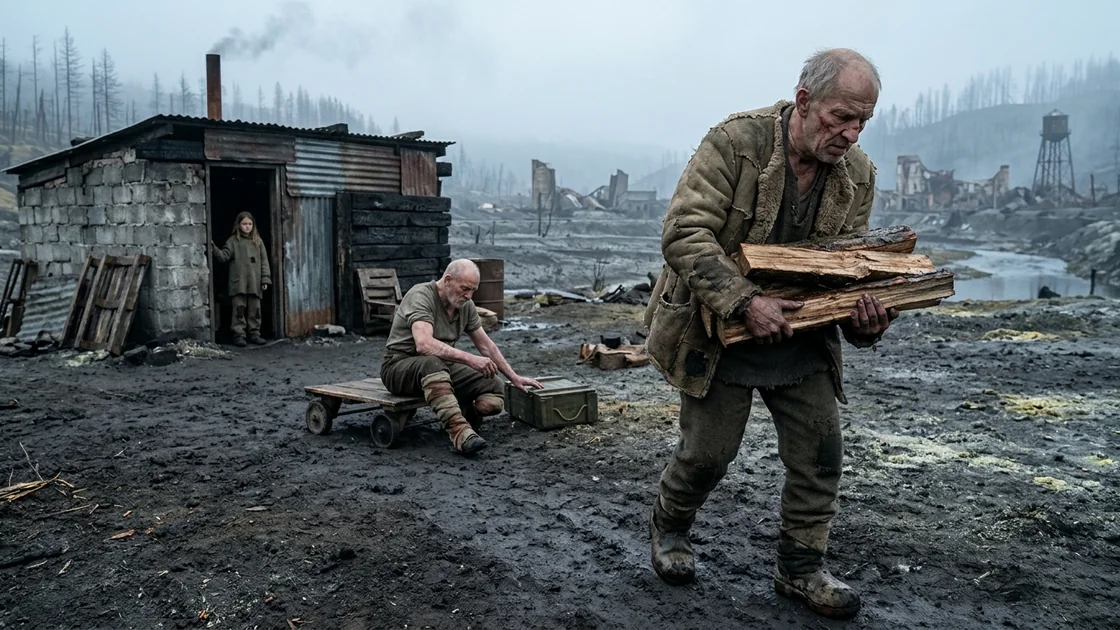
Aris Thorne, an operative for the Temporal Directorate, is sent back in time to assassinate the infant who will grow up to become the genocidal dictator Malakor Vance. Unable to murder an innocent child in his crib, Aris defies his superiors and instead jumps forward thirty-eight years to abduct Vance at the height of his tyrannical power. After stripping the dictator of his voice, his recognizable features, and his capacity for violence through a neural inhibitor, Aris drags him five years into the future of a fractured timeline. There, in the poisoned ruins of the Ostrek Valley, Vance is forced to spend the rest of his natural life as a lowly, mute servant to a blind grandfather, a dying woman, and a young orphan whose lives and homeland were destroyed by his earliest military campaigns.
The rain in Vaelen did not fall so much as it clung, a cold, silver mist that drifted down from the jagged teeth of the Kestrel Mountains and settled into the cobblestones like grease. It was the year 2112, an era that historians in Aris Thorne’s century referred to as the Long Slumber—that brief, fragile interlude between the Resource Wars and the rise of the Hegemonies, when humanity believed it had finally grown too tired to slaughter itself on an industrial scale.
Aris stood in the shadow of agabled roof across from number fourteen Weaver’s Lane. The Chrono-Weave of his coat drank the amber glow of the streetlamps, bending the light around his silhouette until he was little more than a shimmer of wet air against the brickwork. In his right hand, warm against his palm, rested a phase-needle. It was a slender instrument of brushed iridium, no longer than a sewing bodkin, designed to slip between the third and fourth ribs of a sleeping infant and induce an immediate, untraceable cardiac arrest. A tragedy for the parents, a footnote for the parish coroner, and salvation for forty million souls who would otherwise burn in the furnaces of the mid-century.
Inside the house across the lane, a light went out on the second floor.
Aris did not move. His boots felt rooted to the slick slate of the alley. In his mind, the dogma of the Temporal Directorate played on a continuous, sterile loop, spoken in the dry voice of Proctor Vane: We are gardeners of the finite, Operative Thorne. When you pinch a blight from a sapling, you do not weep for the leaf. You think of the orchard.
He had pinched blights before. He had sabotaged the shuttle engines of warlords before their first campaigns; he had slipped slow-acting mutagens into the wine of fanatic demagogues during their university years. Those men had already chosen their paths. Their hands were already stained with the ink of hateful manifestos or the blood of early rivals.
This was different. This was a Cradle Protocol.
Aris inhaled the damp, coal-smoke air of the old mountain town and stepped out of the alley. His phase-field hummed at a sub-audible frequency, parting the dead iron latches of the front door at number fourteen as though they were made of smoke. The house smelled of beeswax, boiled cabbage, and drying wool. It was a poor house, or at least a modest one—the home of a municipal surveyor and a seamstress. It was impossible to reconcile the quiet, domestic poverty of this hallway with the black marble vaults of the Citadel that would stand on this very spot forty years hence.
He climbed the stairs, his weight distributed across the temporal tether so that not a single pine board groaned beneath his tread. The door at the end of the landing stood ajar.
Aris slipped inside the nursery.
The room was cold, warmed only by a dying brick of peat in a tiny iron grate. Moonlight, pale and watery through the rain-streaked glass, fell across a wooden crib painted a faded robin’s-egg blue. Aris deactivated his visual cloak, allowing himself to become solid in the dimness, and looked down.
Malakor Vance was nine months old. He slept on his stomach, his knees drawn up beneath him, one small, chubby fist pressed against a cheek flushed pink with warmth. A tuft of dark, fine hair stood straight up from his crown. As Aris watched, the infant let out a tiny, whistling sigh, his lips parting to reveal two minuscule white teeth on his lower gum.
Aris raised the phase-needle. The iridium tip caught a stray glint of moonlight.
In the archives of the Directorate, Aris had spent three weeks studying the dossier of the Iron Regent. He had watched the holos of the Ostrek Valley after the Night of Falling Phosphorus, where the soil itself had vitrified into black glass and the rivers had turned to steaming lye. He had listened to Vance’s voice booming from a thousand brass speakers across the continent: Compassion is the rot of the species. Only the pruned tree survives the winter. He had seen the mountains of spectacles, prosthetics, and children’s shoes cataloged with maniacal geometric precision by Vance’s quartermasters.
The monster was right there, coiled inside that twenty-pound vessel of soft flesh and milk-breath. One press of his thumb against the needle’s actuator, and the Ostrek Valley would remain green. The Continental Purge of 2150 would never occur. The forty million would live, marry, grow old, and die in their beds.
The infant stirred. He did not wake, but his fingers uncurled, brushing against the rough wool of his blanket, searching in his sleep for warmth.
Aris’s hand began to tremble. It was a microscopic tremor, the kind the Directorate’s neural conditioning was supposed to have burned out of him years ago, yet it traveled all the way up his forearm to his shoulder.
He hasn’t done it yet, a voice whispered in the back of Aris’s mind. It was his own voice, stripped of the Proctor’s rhetoric. Right now, under the laws of every god and every court that ever existed, this child is innocent. If I kill him now, I am the only murderer in this room.
The hypocrisy of the Directorate struck him with a sudden, nauseating clarity. They used Vance’s own logic to destroy him. Only the pruned tree survives the winter. They had become the very thing they hunted, crept through the dark with needles to murder babies in the name of statistical efficiency, washing their hands in the river of outcomes.
Aris lowered the needle.
He stood over the crib for a long time, listening to the ticking of a grandfather clock down in the hall and the steady, rhythmic patter of the rain. If he walked away, the Directorate would know within three subjective minutes of his return—or rather, they would know the moment the timeline failed to shift around their shielded anchor-station. They would send another operative. Someone younger. Someone whose conditioning hadn't begun to fray at the edges.
Unless the timeline did shift.
The mandate required the prevention of the Continental Purge of 2150 and the dissolution of the Iron Regency. The mandate specified the year of termination as 2112 only because an infant lacked a personal defense grid and three legions of Praetorian guards. If the Purge was stopped at its threshold—if Vance simply vanished from the historical record on the eve of his greatest atrocity—the macro-historical sensors at the Directorate’s hub would register a successful prune. The forty million would still be saved.
Except for those who had died before 2150. Except for the Ostrek Valley.
Aris looked down at the sleeping baby. To spare the child today meant allowing the man to exist tomorrow. It meant allowing him to grow, to hate, to rise, and to burn Ostrek during his initial consolidation of power in 2148, before Aris could intervene at the nexus point of 2150 where the timeline was flexible enough to absorb the disappearance of a head of state without causing a paradoxical collapse.
Wait. No. If Vance was going to become the monster anyway, why give him the mercy of non-existence? And if death was too clean for the man, and murder too foul for the child, then there remained a third path. A path the Directorate would consider heresy, a violation of every temporal conservation law ever written.
Aris holstered the lethality module of the phase-needle and dialed the instrument’s emitter to its lowest setting. Instead of a cardiac disruptor, he loaded a sub-dermal chronon beacon—a microscopic grain of temporal isotopes designed to track moving biological targets across decades.
Gently, with a touch so light the baby didn't even flinch, Aris pressed the tip of the cylinder against the base of the infant’s neck. There was a faint click, no louder than the snapping of a dry twig. The infant whimpered once, rubbed his nose against the mattress, and settled back into sleep.
"Grow up, then," Aris whispered into the dark nursery. "Make your choices. Become what you choose to become. And when you have finished building your hell, I will come back and make you live in it."
He stepped backward into the shadows, dialed the coordinates on his wrist-mounted tether, and let the Gray Current take him.
Time travel was not like flying, nor was it like falling. It was like being dragged backward through an ocean of crushed glass while holding one’s breath. The thirty-eight years between 2112 and 2150 rushed past Aris in a roar of silent static. Around him, the modest timber-and-brick walls of number fourteen Weaver’s Lane dissolved into ghosts, replaced by scaffolding, then concrete, then the towering, windowless expanse of black basalt that was the Citadel of New Vaelen.
When Aris solidified, the smell of beeswax and cabbage was gone. The air here was filtered three times through electrostatic scrubbers, leaving it dry, metallic, and smelling faintly of ozone and floor polish.
He was standing in a narrow service alcove behind the grand map room of the High Chancellery. Through the slatted ventilation grille, he could see the heart of the Iron Regency.
The room was fifty feet high, its walls draped in banners of crimson silk bearing the black geometric anvil of Vance’s party. The floor was polished obsidian, reflecting the cold white light of suspended luminary rings. At the center of the room stood a massive table carved from a single slab of petrified oak, and leaning over it, flanked by four generals in silver-trimmed greatcoats, was the infant from the blue crib.
Malakor Vance at thirty-eight was a man of striking, severe symmetry. He was not tall, perhaps five foot nine, but he held himself with such rigid, military verticality that he seemed to loom over the taller men beside him. His hair, once a wild tuft of dark down, was now iron-gray at the temples and shaved ruthlessly close to the skull. His face was lean, the cheekbones high and sharp like the prows of ships, his mouth a thin, bloodless line. He wore a uniform of immaculate, bleached wool without a single medal—an affectation of modesty that made the gold-braided generals around him look like overdressed lackeys.
"The rail networks in the Southern Reach are at ninety-four percent capacity, Excellency," one of the generals was saying, tapping a stylus against a glowing holomap of the continent. "If we initiate the dispersal of the defoliant canisters on the twelfth, the winter winds will carry the cloud into the agrarian basins by the fourteenth. Projected mortality within the first seventy-two hours is eleven million. The remaining infrastructure will collapse before the spring thaw."
Vance did not look up from the map. He picked up a porcelain teacup from a silver tray beside the table, took a small, fastidious sip, and set it down without a sound.
"Eleven million leaves twenty-nine million mouths consuming grain that belongs to the Vanguard, General Kael," Vance said. His voice was surprisingly soft—a cultured, resonant baritone that forced everyone in the room to lean in to hear him. "Your projections rely on the standard three-percent concentration of the arsenic-chlorine compound. We tested the seven-percent variant in the Ostrek Valley two years ago. Why have you not scaled that formula?"
General Kael swallowed hard. A bead of sweat traced the line of his jaw. "Excellency, the Ostrek test... the soil remains completely sterile. The runoff poisoned the groundwater all the way to the delta. If we use the seven-percent compound across the entire Southern Reach, the land won't be arable for half a century."
"Then we will plant forests of solar collectors in the glass and grow our wheat in northern hydroponic vats," Vance replied, his voice devoid of irritation, as though explaining basic arithmetic to a dull child. "I am not interested in inheriting their farms, General. I am interested in erasing their history. When a surgeon removes a tumor, he does not leave the rotten margins behind so the patient has more flesh. He cuts into the healthy tissue until he sees clean bone. Draft the order for the seven-percent compound. Have it on my desk by midnight."
"Yes, Excellency."
"Dismissed. All of you. My head aches. The air in this room smells of your cologne."
The generals bowed in ragged unison, gathered their datapads, and hurried out through the twenty-foot double doors at the far end of the hall. The heavy bronze locks clicked shut behind them.
Vance remained at the table. He reached into his breast pocket, withdrew a silk handkerchief, and carefully wiped the fingertips of his right hand, even though he had touched nothing but his own teacup. He walked slowly toward the tall, armored glass window at the rear of the chamber, looking out over the sprawling, floodlit geometries of New Vaelen. Below him, searchlights swept the smog-choked sky, and the distant, rhythmic thud of stamping mills echoed like the heartbeat of a buried giant.
"It is a terrible thing, isn't it?" a voice said from the center of the room. "How much work it takes to make the world clean."
Vance spun around. His hand dropped instinctively to the pearl-handled disruptor pistol at his hip, his thumb flicking the safety latch off in a smooth, practiced motion.
Standing beside the petrified oak table was a tall man in a coat the color of wet slate. He looked neither like an assassin of the Southern Reach nor like an officer of the Praetorian Guard. His clothes had no seams, and his eyes held a strange, heavy exhaustion that seemed older than the basalt walls around them.
"How did you bypass the pressure plates?" Vance demanded, leveling the pistol at Aris’s chest. He did not shout for the guards. His ego was too vast to admit fear, even in an empty room. "Who bought the watch-commander? Was it Kael? He never had the stomach for the final phase."
"General Kael is loyal to you, though he will shoot himself in his bath three weeks from now when your internal security bureau accuses him of treason," Aris said calmly. He took a step forward.
Vance pulled the trigger.
A bolt of superheated plasma lanced across the room with a shriek of ionized air. It struck Aris squarely in the sternum—and vanished, absorbed into the gray, rippling eddy of his personal phase-shield, which flared briefly like oil on water before subsiding.
Vance’s eyes widened by a fraction of an inch. He fired twice more. Both bolts dissolved harmlessly into the fabric of Aris’s coat.
"Southern technology is twenty years behind our own," Vance said, backing slowly toward the communications console beside the window, where the panic stud gleamed red under a plastic cover. "Which means you are not from the South."
"I am not from this century," Aris said. He raised his left hand and made a sharp twisting gesture with his fingers.
Across the room, the sub-dermal beacon he had planted in Vance’s neck thirty-eight years ago—now buried deep against the dictator’s seventh cervical vertebra—received the activation pulse.
Vance gasped. The pistol clattered to the obsidian floor. His hands flew to his throat as a localized temporal stasis field bloomed outward from his spine, locking his voluntary motor cortex in a fraction of a second. He did not fall; rather, he remained frozen in a grotesque crouch, one hand inches from the panic stud, his lungs still expanding and contracting on autonomous reflex, his dark eyes wild and completely conscious inside a statue of his own flesh.
Aris walked over to him, his boots clicking loudly in the vast, silent hall. He picked up the pearl-handled pistol and tossed it onto the oak table, where it slid across the glowing holomap of the Southern Reach and came to rest over the ruined province of Ostrek.
"Thirty-eight years ago tonight, in my personal subjective time, I stood over your crib in Weaver’s Lane," Aris said, stopping a foot away from Vance’s face. He looked into the dictator’s frantic, darting eyes. "The house is gone now. You tore it down in forty-two to build the eastern wing of the Ministry of Sanitation. Your mother’s rosebushes were right under the foundation of your torture cells. Did you know that, Malakor? Or did you just want to pave over everything that reminded you that you were once small, wet, and helpless?"
Vance’s pupils dilated. A vein throbbed violently in his temple as he fought against the neural lock, trying to force his jaw open, trying to scream for the two hundred heavily armed men standing thirty yards away behind the bronze doors. Only a thin, wet wheeze escaped his nostrils.
"I was sent to kill you," Aris continued, his voice conversational, almost gentle. "A tiny needle between the ribs. It is the standard procedure of my people. We call it pruning. We tell ourselves it is humane because the child feels nothing, and the man never exists to suffer. For three hours, I thought about why I couldn't do it. At first, I thought it was mercy for the child. Now, looking at you, I realize it was something else entirely."
Aris reached out and took the silk handkerchief from Vance’s breast pocket. Gently, almost mockingly, he dabbed the bead of sweat from the dictator’s frozen forehead.
"It was anger," Aris whispered. "If I killed the baby, you would get away with it. You would dissolve into nothingness without ever having to look at what you are. Without ever having to smell the phosphorus or dig the poisoned mud with your own soft, clean hands. Death is a door out of the room, Malakor. I am not going to give you a door."
Aris reached into his coat and withdrew a circular device of dark, matte polymer, hinged on one side like a manacle, lined on the interior with dozens of hair-thin silver filaments. It was a Penitent’s Bridle—an archaic piece of behavioral technology used during the prison-colony rebellions of the twenty-third century, long since outlawed by the Directorate for its cruelty.
"The orders on your desk will never be signed," Aris said, opening the collar. "When you fail to emerge from this room tomorrow morning, General Kael and Minister Vane will suspect each other of a coup. By tomorrow night, the Praetorian Guard will be fighting the Third Armored Division in the streets below. Within six months, your Iron Regency will shatter into twelve squabbling municipal councils, none of which have the launch codes or the logistical capacity to carry out your Continental Purge. The forty million in the South will live."
He fitted the cold polymer ring around Vance’s throat. As the latch clicked shut at the nape of the tyrant’s neck, the silver filaments drove themselves half a millimeter into his skin, grafting directly onto his vagus nerve, his recurrent laryngeal nerve, and the motor pathways of his spinal cord.
Vance’s body convulsed once under the stasis field. Tears of sheer physiological shock spilled over his lower eyelids and ran down his sharp cheekbones. Within three seconds, the smart-polymers of the collar changed color and texture, blending seamlessly into the flesh of his neck until the device was entirely invisible, save for a faint, pale ridge that looked like an old rope scar.
"This is a somatic inhibitor," Aris explained, stepping back and pulling a small surgical laser from his belt. "It leaves your mind entirely untouched. Your memories, your pride, your brilliant strategic intellect—all of it remains pristine. You will think every thought you have ever thought. You will feel every ounce of your superiority. However, your body no longer belongs to your ambition."
Aris switched on the laser and leaned in.
"First, the voice that commanded legions."
With two precise, micro-second pulses through the cartilage of the larynx, Aris scarred the edges of Vance’s vocal cords. It was a bloodless, internal burn.
"You will still be able to make sounds," Aris said, watching the horror deepen in Vance’s eyes. "Grunts. Whispers. Enough to indicate pain or comprehension. Furthermore, the Bridle has a linguistic filter. Even if you learn to shape words with what is left of your throat, or if you pick up a piece of charcoal to write in the dirt, your hand will cramp and your tongue will lock the moment you attempt to communicate your name, your former rank, or your origin. To the world, Malakor Vance died tonight in the Citadel, vaporized by a Southern prototype bomb that I am going to leave under your table."
Aris adjusted the emitter of his tool from laser incision to dermal disruption.
"Second, the face that hangs in every schoolhouse from here to the coast."
For four minutes, Aris worked on the tyrant’s features. He did not mutilate him beyond human recognition, for a freak would draw stares in the places they were going. Instead, he broke the austere, aristocratic symmetry that Vance’s propaganda artists so adored. He collapsed the bridge of the aquiline nose, giving it the flattened, crooked curve of a dockworker who had lost too many tavern brawls. He induced rapid, localized keloid scarring along the left cheek and jaw—the exact pattern of tissue damage caused by low-grade chemical burns—and used a follicular radiation burst to strip the hair from the crown of Vance’s head in ragged, moth-eaten patches.
When Aris finished, the proud, geometric warlord was gone. In his place stood a weathered, homely, broken-nosed laborer in his late thirties, his left eye slightly hooded by scar tissue.
Aris reached down, pulled a heavy brass signet ring from his own pocket—a plain, unadorned band that hummed with the same frequency as the Bridle—and held it up before Vance’s eyes.
"Finally, the tether," Aris said. "The Bridle prevents you from committing any act of self-harm or violence against another living creature. If you pick up a knife to cut bread, your hand will be steady. If you turn that knife toward a throat—their throat or your own—your muscles will turn to stone before the blade moves an inch. More importantly, whoever wears this brass ring is your absolute sovereign. When they speak a command, or even express a need in your presence, the Bridle will stimulate the pain centers of your thalamus until you fulfill that need. You can fight it, Malakor. I expect a man of your iron will to fight it every hour of every day. It will feel like boiling oil poured into your marrow until you kneel."
Aris clipped a small, spherical plasma charge to the underside of the petrified oak table and set the timer for sixty seconds. Then he grabbed the front of Vance’s immaculate white tunic.
"Come along, Excellency," Aris said softly. "You wanted to see the results of the seven-percent compound in Ostrek. Let us go and look at your work."
He activated the Chrono-Tether and pulled them both out of the year 2150.
The explosion in the Citadel never reached their ears. They stepped out of the Gray Current five years later, in the late autumn of 2155, three hundred miles south of New Vaelen.
Aris released his grip on Vance’s tunic and simultaneously dropped the stasis field.
Vance collapsed to his knees.
The great Supreme Architect pitched forward, catching himself with his palms in six inches of freezing, gray-black mud. He retched violently, his stomach heaving against the disorientation of the temporal jump and the lingering phantom agony of the surgical laser. When he tried to scream a curse at the man standing above him, all that came out of his throat was a dry, rattling wheeze, like wind blowing through dead reeds.
“Khh... ahh...”
Vance froze. He brought a trembling, mud-caked hand up to his throat. He felt the rough ridge of the invisible collar. He slid his fingers upward and felt the bulbous, crooked cartilage of his ruined nose, the thick, fibrous bands of chemical scarring pulling at his left eyelid.
He looked down at a puddle of oily water trapped in a tire rut beside his knee. In the dull, pewter light of the overcast sky, a stranger stared back at him—an ugly, balding wretch with wide, terrified eyes, wearing a white military uniform already fouled with slime.
Vance lunged at Aris.
He had been trained in close-quarters combat during his youth in the border militias; his mind calculated the angle of attack instantly, aiming the heel of his palm at Aris’s trachea.
He did not make it two feet.
The moment the intent to strike formed in his motor cortex, the Penitent’s Bridle fired. It was not an electric shock; it was an internal detonation of pure, white-hot neural agony that bypassed the skin entirely, lighting up every pain receptor from his crown to his heels as though his nervous system had been replaced with molten copper wire.
Vance’s arms locked rigidly at his sides. He fell flat on his face in the mud, his jaw clamped shut so tightly his molars creaked, his legs spasming helplessly as the dirty water soaked through his wool trousers and chilled his skin.
Aris stood over him, watching without malice or satisfaction, like a physician observing the predictable course of a fever. After ten seconds, Aris tapped his wrist-pad, dialing the feedback down now that the aggressive impulse had been broken by sheer physiological terror.
"The Bridle learns, Malakor," Aris said, tossing a bundle of coarse, earth-toned rags onto the mud beside the dictator’s head. "The next time you try to strike a human being, the duration doubles. Take off that uniform. Put these on."
Vance lay still in the filth, his chest heaving, his cheek pressed against a sharp piece of vitrified slag. I am the Regent, his mind screamed into the silent vault of his skull. I am the architect of the New Century! Kill me! Draw your weapon and kill me, you coward!
He did not move to touch the rags. He fixed Aris with a glare of pure, concentrated hatred, deciding right then that he would simply lie in this mud until he froze to death or starved. He would deny his captor the satisfaction of his compliance.
Aris didn't argue. He simply slipped the brass ring onto his own little finger and spoke in a flat, clear voice.
"Strip off your uniform and put on the trousers and tunic I have provided."
Vance locked his jaw and refused to budge.
Three seconds passed. Then the Bridle hummed.
A low, nauseating ache began behind Vance’s eyes, rising steadily like a siren. Within five seconds, it felt as though iron wedges were being driven beneath his fingernails. Within ten, his ribs felt as if they were being crushed in an industrial press. He bit his own tongue until he tasted copper, swearing to himself that he would endure it, that his will was stronger than a machine.
At fifteen seconds, the Bridle bypassed his conscious defiance entirely, hijacking his peripheral nervous system while leaving the torture active in his brain. To Vance’s absolute horror, he watched his own hands reach up and begin unbuttoning his white wool jacket. His fingers moved with jerky, puppet-like desperation, tearing at the silver clasps in a frantic biological effort to make the pain in his thalamus stop.
He wept—silent, furious tears of humiliation—as his body stripped itself naked in the freezing wind, cast his immaculate uniform into a ditch, and pulled on the scratchy, lice-bitten hemp trousers and the greasy sheepskin vest of a valley peasant. The moment the last wooden toggle was fastened, the agony vanished, leaving behind a sickening, hollow euphoria of relief that made him hate himself even more than the pain had.
Aris dropped a heavy magnetic flare onto the bundled white uniform in the ditch; it burned away to gray ash in three seconds, leaving no trace of the Citadel’s textiles.
"Stand up," Aris commanded.
Before Vance could even decide to resist, his legs straightened, terrified of the returning fire. He stood shivering in oversized, wooden-soled boots that rubbed raw against his ankles.
"Look around you," Aris said, sweeping an arm toward the horizon.
For the first time, Vance looked past his captor.
They were standing on a ridge overlooking a wide, bowl-shaped valley framed by the skeletal remains of pine forests. There was not a single blade of green grass anywhere in sight. The earth was the color of dead lead, crusted with yellow-white deposits of sulfur and arsenic salt. Down in the basin, the ruins of a mid-sized agricultural town jutted from the mud like broken blackened teeth—charred timber frames, collapsed brick silos, and the rusted carapace of a municipal water tower riddled with shrapnel holes. A sluggish river wound through the center of the valley, its surface covered in a thick, iridescent scum that gave off a faint, acrid vapor smelling of rotten garlic and bleach.
Vance knew this topography. He had studied it on a dozen relief maps in 2148.
It was Ostrek.
"When you disappeared five years ago, the Regency collapsed into civil war," Aris told him as they began walking down the muddy track toward the ruins. Vance’s feet followed automatically, three paces behind Aris, tethered to the brass ring. "The new coalition government in Vaelen signed an armistice with the Southern Reach in 2152. Trade is resuming. The cities are rebuilding. Nobody remembers you fondly, Malakor. The northern factions blame your arrogance for their defeat, and the southern factions use your name to frighten children who won't eat their supper. Even your statues were melted down to make tractor axles."
Vance stared at the back of Aris’s neck, his mind racing, analyzing, searching for a flaw in the mechanism. If there was a ring, the ring could be lost. If the ring was lost, perhaps the collar would go dormant. If he waited—months, years if necessary—some accident would befall the bearer of the ring.
"The world moved on," Aris continued, stepping over a rusted canister half-buried in the ditch—a three-foot cylinder stamped with the black geometric anvil of the Regency. "Everywhere except here. Your seven-percent compound did precisely what General Kael warned you it would do. The soil is dead down to the bedrock. The Reconstruction Commission declared Ostrek a permanent exclusion zone. They offered relocation stipends to the survivors, of course, if they could prove land ownership. Most of the records burned when your vanguard dropped thermite on the town hall. Those who had nowhere else to go stayed in the cellar holes."
Aris pointed toward the edge of the dead pine forest, half a mile upstream from the ruined town, where a thin, greasy ribbon of coal smoke rose from a structure built of salvaged cinder blocks, corrugated tin, and charred railroad ties.
"Three thousand people lived in this valley before the twelfth of October, 2148," Aris said softly. "Today, there are forty-two. Three of them live in that house."
As they approached the homestead, the smell of the poisoned river gave way to the scent of wet ashes, boiled turnip greens, and the sour, unmistakable odor of unwashed sickness. The yard around the cinder-block hovel was fenced with twisted strands of military-grade barbed wire salvaged from the old perimeter barricades, used now to keep out the hairless, feral dogs that scavenged the valley. In the center of the yard, an old man sat on an upturned munitions crate, attempting to split a knotty piece of dead pine with a rusted hatchet.
He had no legs below the knees. The stumps of his thighs were wrapped in thick bindings of cured leather and dirty canvas, strapped to a low, four-wheeled wooden dolly that allowed him to push himself through the mud with his knuckles. Despite the biting cold, his sleeves were rolled up, revealing forearms corded with old muscle but mottled with the purple-white starburst scars of white phosphorus burns. A milky film covered both of his eyes; he was entirely blind, working purely by touch, resting the blade of the hatchet against the wood with his left hand before raising the tool a few inches to tap it down with his right.
Whack. Whack.
The wood was petrified by the chemical winter; the dull blade bounced off the grain without leaving a mark.
"Ilya!" a woman’s voice called from inside the shack. The word ended in a wet, rattling spasm of coughing that lasted nearly thirty seconds—the deep, tearing bark of lungs half-turned to scar tissue. "Ilya, leave it! The damp is coming down. You'll catch your death on that cold stone."
"If I leave it, Elena, the stove goes out by midnight," the old man muttered, his voice gravelly and stubborn. He felt blindly around the block of wood, his scarred fingers brushing the mud until he found the hatchet’s edge again. "And Mira’s feet were blue this morning."
Aris stopped at the gap in the barbed-wire fence and struck his boot against a tin post to announce his presence.
Ilya Korsakov froze. He did not drop the hatchet; instead, he shifted his grip on the handle, turning his sightless, milky eyes toward the sound with the predatory alertness of a man who had lived through a war zone.
"Who's at the wire?" Ilya barked. "If you're scavengers from the ridge, save your breath. We've got four pounds of blight-potatoes and a bucket of slag-coal. Nothing worth killing an old cripple for."
"I am not from the ridge, Master Korsakov," Aris said, stepping into the yard. Vance followed three steps behind, his eyes darting in revulsion from the legless blind man to the filthy, leaking hovel. "My name is Thorne. I represent the Vaelen Penitential Trust. A private relief foundation."
The door of the shack creaked open on leather hinges. A woman stepped out onto the mud-slick threshold, leaning heavily against the doorframe.
Elena Korsakov was fifty-four years old, though she looked eighty. Her skin had the yellowish, translucent sheen characteristic of chronic arsenic toxicity—what the survivors called the Gray Lung. She held a rag pressed to her mouth, and when she pulled it away to look at Aris, Vance saw the dark, rust-colored flecks of dried blood staining the cloth. Behind her, clutching the hem of her patched wool skirt, stood a little girl of about seven, thin as a winter willow, her huge dark eyes staring out from a gaunt, dirt-streaked face.
"We didn't put in a mark with any trust," Elena wheezed, her eyes narrowing with the deep, ingrained suspicion of the valley. "The Commission man came through two springs ago. Said our deed burned in the square. Said we were squatters on state quarantine land."
"The Trust does not care about deeds, Madam Korsakov," Aris said gently. "It was founded by families in the North whose sons served in the Third Vanguard during the forty-eight campaign. People with assets who cannot sleep at night knowing what was done here. We do not have money to give you—currency is worthless in Ostrek anyway—and the state blocks medicine shipments into the exclusion zone. What we provide is labor."
Aris stepped aside and gestured toward Vance.
"This is Marek," Aris said.
Vance felt a cold, suffocating weight drop into his stomach. He looked at the legless old man on the wooden cart, then at the dying woman with the bloody rag, then at the hollow-cheeked child. These were not even political dissidents. They were not officers of the Southern Coalition. They were biological detritus—the exact kind of unproductive, broken humanity his regime had sought to sweep from the board to make room for the Vanguard. And this time-traveling lunatic intended to leave him here, in this stinking sty, with them.
"He looks half-starved himself," Ilya said, cocking his head as he listened to Vance’s ragged, whistling breath. "And what's wrong with his windpipe? Did he catch the gas too?"
"He was on the wrong side of the war," Aris said, watching Vance’s face closely. "He did things during the Regency that broke his mind and his throat. He took a vow of penance with our order, and our surgeons fitted him with a compliance graft. He cannot speak above a whisper, he cannot steal from you, and he cannot raise a hand in anger against any living soul. He eats whatever scraps you can spare—peels, roots, half rations—and he requires no wages. He is here to chop your wood, haul clean water from the high springs above the poison line, dig your garden beds, and carry you when your arms grow tired."
Elena looked at Vance. Her gaze traveled over his crooked nose, his scarred cheek, and his bald, scabbed scalp. If she recognized anything of the colossal bronze statues that had once loomed over the provincial capitals, she gave no sign. Why would she? The Supreme Architect did not wear lice-ridden sheepskin or stand ankle-deep in pig-slop.
"We can't feed another belly through January," Elena whispered, though her eyes drifted longingly toward the unsplit pine knots by the chopping block and the heavy iron water cans sitting empty by the door. The walk to the high springs was four miles uphill over loose shale; since her lungs had worsened in the autumn, seven-year-old Mira had been making the trip twice a week, dragging a small plastic jug that barely kept them alive.
"Wait," Aris said. He reached into his coat and pulled out a heavy canvas sack that clinked dull and solid, followed by a second, larger sack of woven burlap. "Every November, for as long as Marek remains under your roof, a courier from the Trust will leave fifty pounds of clean northern barley, a side of salt pork, and a bottle of bronchial analgesic at the milestone on the ridge road. That is his keep, and yours. If you turn him away, or if he dies of neglect, the deliveries stop."
The silence in the yard was absolute, broken only by the drip of cold condensation from the corrugated tin roof. To a family slowly starving to death in a chemical wasteland, fifty pounds of clean grain and medicine was not charity; it was life until the spring thaw.
Ilya lowered the hatchet to the mud. "What's the catch, Mister Thorne? Nobody gives away a mule that feeds itself."
"The catch is that he must work," Aris said, walking over to Elena. He took her cold, trembling, yellow-skinned hand and slipped the heavy brass ring onto her middle finger, folding her frail knuckles over it. "The compliance graft in his neck is keyed to this ring. If it is on your hand, or your husband’s, he must obey every instruction you give him. Do not spare him out of pity, Madam Korsakov. His penance requires exhaustion. If you let him sit idle while you cough and your husband crawls through the mud, you are robbing him of the only thing that keeps his soul out of the pit."
Elena looked down at the brass band on her finger. Then she looked up at Vance.
In her eyes, there was no cruelty—only a vast, bone-deep weariness that had no room left for questions. She pointed a shaking finger toward the chopping block where Ilya sat.
"Split that pine," she rasped, testing the stranger’s promise. "And carry it inside by the stove."
The brass ring pulsed with a faint, imperceptible warmth against her skin.
Three yards away, Malakor Vance tried to lock his knees. He tried to summon the iron discipline of the Citadel, to stand like a pillar of basalt and show this filthy peasant woman that an eagle did not fetch sticks for worms.
“Mmmph!”
The Bridle bit down on his spine like the jaws of a wolf. White lightning flashed across his retinas. Before the pain could reach its second tier, Vance’s terrified body broke ranks with his pride. He stumbled forward through the mud, fell to his knees beside the legless blind man, and snatched the rusted hatchet from the dirt.
His hands—the pale, manicured hands that had signed the death warrants of cities—closed around the greasy, splintered ash handle. Whimpering through his ruined throat, the Supreme Architect of the Iron Regency raised the blade and brought it crashing down into the wood.
Aris stood by the barbed-wire gate, watching for a moment as Vance hacked frantically at the stubborn pine knot, mud splashing onto his scarred face with every blow, while little Mira watched from the doorway with her thumb in her mouth.
Aris turned up the collar of his coat against the rising wind, stepped back onto the track, and vanished into the gray mist.
The first winter was a long, dark tunnel of humiliation from which Malakor Vance believed he would never emerge sane.
He was assigned a sleeping space in the lean-to shed built against the back of the cinder-block stove wall. It was five feet long and four feet wide, originally intended for storing dry peat and tools. Because the shed was shorter than his frame, he had to sleep with his knees drawn up toward his chest—the exact posture he had taken in his crib in Weaver’s Lane, though he did not know it—wrapped in two stiffening horse blankets that smelled of mold and old axle grease.
Every morning, long before the sun managed to turn the sulfur fog from black to dirty gray, the Bridle woke him.
It did not require Elena to shout an order through the wall. During his first week, she had said once, offhandedly, "Marek, the stove needs feeding before the frost cracks the water bucket, and the chamber pot must go to the ditch before the child wakes." Because she had stated it as a standing household need while wearing the ring, the Bridle’s semantic processor had logged it as a permanent diurnal imperative.
At five o'clock every morning, a dull, throbbing pressure would begin at the base of Vance’s skull. If he did not roll off his straw pallet within two minutes, the pressure sharpened into the sensation of a heated awl being twisted into his ear canal.
Shivering violently in the sub-zero dark, his breath smoking in the blackness, the dictator would crawl out of the shed on his hands and knees. He would creep into the single room of the hovel where the Korsakovs slept—Ilya on a low wooden cot by the door, Elena and little Mira huddled together on a mattress of ticking stuffed with dead pine needles near the stove.
The smell inside the room at dawn always made Vance’s gorge rise: the stale, coppery stench of Elena’s night-coughing, the unwashed wool, and the brimming tin bucket in the corner behind a burlap curtain.
In the Citadel, Vance had employed four personal valets whose sole duty was to ensure that his linen was steamed with lavender and his bathing water maintained at precisely thirty-nine degrees Celsius. He had once had a quartermaster flogged for serving him meat on a plate with a chipped rim.
Now, with his jaw clenched so hard his gums bled, Vance had to lift the heavy, sloshing tin bucket with both hands, carry it two hundred yards downwind to the toxic trench at the edge of the property, empty it into the freezing slime, and scrub the inside with handfuls of sharp gravel and snow until it no longer smelled, because Elena had once complained that a dirty pail made her retch.
His hands ruined within the first fortnight.
Without gloves, hauling four-gallon iron cans of water down the four-mile shale trail from the mountain spring turned his palms into a map of raw, weeping blisters that froze in the wind, split open against the iron handles, and healed into thick, black calluses fissured with frost-cracks. His fingernails broke down to the quick from clawing slag-coal out of the collapsed mine tailings two ridges over.
Yet the physical torment was nothing compared to the furnace of his mind.
Because Aris had left his intellect untouched, Vance spent every waking hour of his servitude locked in a state of frantic, methodical plotting. As he knelt by the stove blowing on damp kindling, or as he dragged Ilya’s wooden cart up the muddy slope so the blind man could check his wire snares for starved rabbits, Vance treated the Korsakov homestead as a tactical problem.
The ring, he told himself, staring at the brass band on Elena’s skeletal finger as she ladled thin barley broth into three chipped bowls and one rusty tin can—the can being his. The ring is the keystone. If the woman dies, the ring stays on her corpse. No—she gave it to the blind man yesterday when she was too weak to come outside and tell me to mend the roof. It responds to whoever wears it.
What if nobody wore it?
In late December, his opportunity came.
Elena had suffered a particularly violent hemorrhage during the night. To wash the blood from her hands and her wool shawl, she had pulled the brass ring off her swollen finger and set it on the corner of the rough pine table beside a basin of warm water. Ilya was outside in the shed, greasing the axles of his dolly. Little Mira was sitting on the floor by the stove, trying to teach a family of pine-cones to march in a line.
Vance was standing two feet from the table, holding an armful of split firewood.
He looked at the brass ring. Beside it lay a heavy iron poker used for raking clinkers out of the grate.
If he dropped the wood and snatched the ring, could he put it on his own finger? Would he become his own sovereign, overriding the Bridle’s baseline directives? Or, failing that, could he hurl the ring straight into the white-hot heart of the coal stove? The metal looked like brass, yes, but it was clearly housing micro-circuitry from the future. The coal fire wouldn't melt the casing, perhaps, but the thermal shock might fry the transmitter inside. And once the transmitter was dead, before the blind cripple could crawl back inside...
Vance’s eyes shifted from the ring to the iron poker, and then to the back of Elena’s fragile, bent neck as she leaned over the washbasin.
The moment his mind connected the iron poker with the base of Elena’s skull, the Bridle didn't even wait for him to drop the firewood.
CRACK.
The neural whiplash struck him with such ferocity that his vision went entirely white. His knees buckled, and he crashed to the dirt floor like a felled ox, the pine logs scattering across the room with a deafening clatter.
Elena gasped, spinning around and clutching her chest. Little Mira shrieked and scrambled behind the stove.
On the floor, Vance writhed in silent, rigid agony. Because this was his second attempt to conceptualize lethal violence, the Bridle held him in the furnace for twenty full seconds. He felt as though his eyeballs were boiling in their sockets; his heels drummed helplessly against the packed earth, and frothy saliva bubbled between his clenched teeth.
"Marek!" Elena wheezed, terrified not for her life, which she never suspected was in danger, but that their only source of survival was having an apoplectic fit. She grabbed a dipper of cold water from the bucket and threw it into his scarred face. "Ilya! Come quick! The penitent is having a seizure!"
Ilya’s wooden cart rattled furiously across the threshold. The blind man swung himself off the dolly with the immense upper-body strength of his scarred arms, dragging his leather-bound stumps across the dirt until he reached Vance’s thrashing body.
"Hold his head, woman! Don't let him bash his brains out on the stove-leg!" Ilya shouted, throwing a heavy, muscular arm across Vance’s chest and pinning him down, while using his other rough, calloused hand to slip a folded rag between Vance’s jaws so he wouldn't bite off his own tongue.
As the twenty seconds expired and the neural fire receded into a dull, trembling nausea, Vance lay staring up at the soot-blackened ceiling rafters.
The blind man was still holding him down, patting his scarred cheek with a heavy, clumsy tenderness. Elena was kneeling beside him, her own bloody rag forgotten as she wiped the cold water and spit from his forehead with the hem of her apron, murmuring a traditional valley prayer against the falling sickness. And by the stove, seven-year-old Mira crept out from her hiding place and timidly laid one of her wool blankets over his shivering legs.
"There now, Marek," Ilya grunted, his sightless white eyes staring six inches above Vance’s face. "Easy, boy. The bad blood passes. You worked too hard in the shale pits yesterday. I told Elena we were driving you like a rented horse. Rest a bit by the fire. The wood can wait till noon."
Vance closed his eyes.
A single tear leaked from beneath his scarred lid and tracked into the dirt by his ear. It was not a tear of gratitude. It was a tear of suffocating, claustrophobic terror. He realized now that there was no tactical solution. The machine inside his neck didn't read actions; it read intent. He could not even plan to drop a heavy stone near the child’s foot, or "accidentally" spill boiling water on the old man’s chest, or throw the ring into the river without his own nervous system turning into a torture chamber before his fingers could twitch.
And worse—infinitely worse to a man who believed that human beings were merely wolves waiting for the weak to stumble—these wretched, broken creatures had seen him fall helpless at their feet, and instead of kicking him into the snow or stealing his boots, they had put a blanket over him and given him an extra spoonful of barley in his tin can that night.
He hated them for their mercy with a ferocity that made him choke on his food.
Spring did not come to the Ostrek Valley as a season of growth; it came as a season of thawing rot.
In April of 2156, the gray snowbanks melted into rivers of yellow-brown sludge that washed new deposits of unexploded ordinance and bones out of the hillsides. Because the ground was finally soft enough to turn with a spade, Ilya embarked on his grand obsession: the reclamation of a twenty-by-twenty-foot square of earth behind the house.
Before the Night of Falling Phosphorus, Ilya Korsakov had been the master orchardist of the Ostrek Cooperative. He knew soil the way Vance knew artillery trajectories.
"The poison sits in the top fourteen inches," Ilya explained one raw morning, sitting on his wooden cart at the edge of the staked-out plot while the wind whipped his gray beard. He wore the brass ring on his thumb. "If we trench down three feet, haul the top dirt down to the gully, and bring up black silt from the deep bend under the limestone overhang—where the gas didn't settle because of the cave draft—we can build a raised bed. Just enough for cabbages and clean potatoes."
Vance stood leaning on a rusted iron shovel, his shoulders permanently rounded now by five months of hauling water cans, his clothes hanging loosely on a frame stripped of every ounce of soft Chancellery fat and replaced by stringy, aching sinew.
"Start digging at the north stake, Marek," Ilya said. "Fourteen inches deep. Throw the dead dirt into the barrow."
For six weeks, Vance dug his own devastation out of the earth.
It was back-breaking, mind-numbing labor. The poisoned topsoil was heavy with clay and acidic moisture, clinging to the spade like wet cement. Twelve hours a day, he drove the iron blade into the ground with his boot, lifted thirty pounds of dead mud, dumped it into a lopsided wooden wheelbarrow with a squeaking iron wheel, and pushed it four hundred yards down a slick path to dump it into a ravine.
On the eleventh day of digging, three feet below the surface near the center of the plot, Vance’s shovel struck something that was neither stone nor root.
He bent down, scraping the gray clay away with his cracked fingers, and pulled out a child’s rubber boot, melted half-shut by extreme heat, and beside it, the rusted, finned tail-assembly of an M-44 Incendiary Cluster Sub-munition.
Vance knelt in the trench, holding the tail-fin.
Stenciled into the corroded green steel, still legible beneath the dirt, were the lot numbers: VLV-2148-09-B.
He remembered that batch. He had personally inspected the munitions plant in Northern Vaelen in the summer of forty-eight. He had signed the requisition authorizing the removal of the self-destruct timers on the M-44s to reduce production costs by twelve percent, arguing that since no Regency troops would occupy Ostrek after the saturation bombing, unexploded duds in the soil were actually an asset that would deny the terrain to survivors.
Across the yard, Ilya heard the scrape of the shovel stop.
"What did you hit, Marek?" the blind man called out, pushing himself over to the edge of the trench on his dolly. "Limestone shelf already?"
Vance looked up at the old man’s leather-wrapped stumps. Then he looked down at the melted rubber boot and the M-44 fin in his hands.
He couldn't speak. He simply reached up and placed the rusted steel fin into Ilya’s scarred palm.
Ilya’s fingers closed over the metal. The old orchardist did not flinch. He traced the three stabilizing fins with his thumb, his blind face going utterly still, like a carving in gray oak.
"Ah," Ilya said softly. "An iron pinecone. That's what my son Pavel called them when they started raining out of the clouds. He was carrying Mira out of the schoolhouse cellar when one of those went off under the porch. Took my legs and my eyes from twenty yards back. Left Pavel right there in the doorway."
Ilya weighed the piece of steel in his hand for a long moment. There was no theatrical rage in his gesture; the grief had been burned so deep into him seven years ago that it had become part of his skeleton. With a grunt, he tossed the tail-fin into the wheelbarrow on top of the poisoned mud.
"Throw it in the gully with the rest of the filth, Marek," Ilya said, turning his dolly back toward the house. "And keep digging. We need three more barrows out before the rain starts."
Vance remained on his knees in the trench for a full minute after the old man rolled away. For the first time since Aris had dragged him out of the Citadel, the dictator did not feel anger. He felt a cold, hollow dizziness, as though the bottom of the trench had suddenly dropped away beneath his boots, leaving him suspended over a black abyss.
He picked up the shovel and went back to work.
Five years passed.
In the high halls of history, the world remade itself without Malakor Vance. Occasionally, when Vance went up to the milestone on the ridge road every November to haul back the heavy sacks of grain and medicine left by Aris, he would find scraps of recent newspapers used as packing material around the medicine bottles.
Squatting behind a boulder in the freezing wind, out of sight of the valley, the former Regent would smooth out the crumpled, grease-stained sheets with his calloused thumbs and devour every word.
He learned that the Continental Union had been ratified in 2158. He read about irrigation projects in the Southern Reach, about a trade dispute over lithium mines in the Kestrel Mountains, about a new symphony premiering in the restored concert hall of Vaelen—the concert hall he had converted into a military tribunal in 2146.
In all the scraps of paper he found over five years, he saw his own name only once: in a small municipal zoning notice on page fourteen of the Vaelen Courier, mentioning that the flooded basement of the "former Vance Citadel" was finally being filled in to serve as the foundation for a public grain market.
He was not even a great demon anymore. He was an architectural inconvenience.
In the autumn of 2160, on the night of the November drop, Aris was waiting by the milestone.
Vance came trudging up the steep shale track in the twilight, pulling a homemade wooden sled rigged with a leather harness that cut across his chest and shoulders like an ox-yoke. He was forty-eight years old now. The wind had burned his scarred face to the color of old saddle leather; his crooked back had settled into a permanent stoop from the water cans and the spade; his sheepskin coat was patched in a dozen places with scraps of canvas sewn by Elena’s trembling fingers.
When Vance saw the tall figure in the slate-gray coat sitting on the milestone—looking not a day older than he had in the Citadel ten years ago—he stopped dead in his tracks. The rope of the sled went slack.
"Hello, Malakor," Aris said.
He stood up and walked over to the harness-sled. With a flick of his fingers, he temporarily suspended the linguistic lock on the Bridle, though the violence inhibitor remained solid as iron.
"The vocal scarring has healed as much as it ever will," Aris noted, studying the weathered, unrecognizable creature before him. "You can speak to me, if you remember how."
Vance opened his mouth. He had not formed a complete sentence aloud in two thousand days. His tongue felt thick, clumsy, like a piece of dry leather in his mouth. When the sound came, it was a harsh, subterranean rasp that scraped painfully against his throat.
"Kill... me," Vance whispered.
He did not curse. He did not demand his throne back. He did not boast of the Vanguard. He simply dropped to his knees in the frost-hardened gravel of the ridge road, still tangled in his leather hauling-harness, and looked up at the time traveler with hollow, bloodshot eyes.
"Five... years," Vance rasped, holding up a hand whose fingers were permanently curled like iron hooks from the shovel handle. "I have eaten... pig-slop. I have washed... the blind man's sores. The woman... coughs blood on my boots... every night. It is enough. You proved... your point. Use the needle."
Aris looked down at him, then past him into the darkening bowl of the valley below, where the tiny orange pinpoint of the Korsakov stove glimmered through the mist.
"How is the garden?" Aris asked.
Vance blinked, his ruined face twitching with confusion and despair. "What?"
"The raised bed behind the shed," Aris said. "Ilya was trying to bring clean silt up from the limestone bend. Did it take?"
"We... we got four rows of cabbages this year," Vance croaked, his mind answering the mundane question automatically before his pride could stop him. "The slugs... got the first planting. I had to... pick them off by lantern light. Every night in June."
"And the girl? Mira?"
"She... she is twelve now," Vance whispered, looking down at the gravel. "She walks... to the town ruins... to read old books in the school basement. Ilya... made me go with her... to carry the timbers... so the roof wouldn't fall on her head."
"And Elena?"
Vance went silent. His raw hands closed around a fistful of frozen pebbles. "Her lungs... are almost gone. The medicine in the sack... it only gives her three hours of sleep now. In January... when the coal ran low... I had to carry her chair... right up against the stove brick. She talks... in her fever."
"What does she talk about, Malakor?"
Vance’s shoulders shook beneath the patched sheepskin. "Names," he rasped. "Just names. All night long. Her sister’s children. The baker’s wife. The boy who brought the milk. Pavel. She makes me... sit by the ash-box... and hold her cold feet... while she tells me what color hair they had before the phosphorus came." He looked up at Aris, and there was a terrifying, naked terror in his eyes. "I didn't know their names, Thorne. On the maps... they were just density shading. Red squares and blue squares. Make her stop telling me their names."
"She has about four years left in those lungs," Aris said quietly, reactivating the linguistic lock on the Bridle with a soft click of his wrist-pad. "And after she goes, Ilya will not be able to lift her body into the frozen earth by himself. And after Ilya goes, Mira will need someone to clear the rocks from the lower field so she can plant rye."
Aris picked up the heavy sack of northern barley and laid it across Vance’s wooden sled, followed by the salt pork and two bottles of bronchial medicine instead of one.
"Pick up your rope, Marek," Aris said, stepping backward into the gathering dark. "It’s going to snow before midnight, and the girl’s blanket is thin."
When Vance looked up again, the milestone was empty.
He knelt in the gravel for a long time as the first fat flakes of November snow began to drift down from the black sky. Then, slowly, he stood up, leaned his scarred shoulder into the leather yoke, and began dragging the sled back down into the valley.
Elena Korsakov died in the late spring of 2167, twelve years after Vance had arrived in Ostrek.
Her passing was not sudden; it was a slow, agonizing drowning in dry air that lasted through the entire month of March. Toward the end, she was too weak even to wear the brass ring, which slipped right off her wasted fingers; it stayed permanently on Ilya’s thumb now, though Ilya rarely gave Vance orders anymore. He didn't need to. After twelve years, the rhythms of the homestead were carved deeper into Vance’s bones than the Bridle’s wires.
On her last afternoon, a freak warm wind blew down from the southern passes, pushing the sulfur fog back toward the river and letting a shaft of pale, yellow sunlight fall across the mud yard.
Elena asked to see the sun.
Without waiting for Ilya’s command, Vance—now fifty-five, his remaining fringe of hair white as bone, his movements slow and deliberate with the arthritis that had settled into his knees—lifted the dying woman from her straw mattress. She weighed no more than a bundle of dry birch twigs. He carried her outside, wrapped in three blankets, and sat down on the chopping block, holding her propped against his chest because she could no longer sit upright in a chair without slumping over and choking.
Ilya rolled his cart beside them, holding Elena’s left hand. Nineteen-year-old Mira knelt on the other side, weeping quietly into her grandmother’s skirt.
Elena leaned the back of her head against Vance’s sheepskin vest, right over his heart. Her breathing was a faint, bubbly rattle, softer now than Vance’s own damaged windpipe.
"Look at the plot, Ilya," she whispered, her yellow eyes fixed on the raised garden bed behind the house, where green shoots of winter onion and young cabbage were pushing robustly through the clean black silt Vance had hauled up over a decade. "The green came back."
"Aye, love," the blind man said, his voice breaking as he pressed his forehead against her knuckles. "It came back. Just like I told you."
Elena lifted her free hand—an effort that took everything she had left—and reached backward to pat Vance’s rough, bearded jaw.
"You... you'll stay with them, Marek?" she breathed, her eyes rolling back slightly to find his scarred face above her. "Ilya gets... turned around in his head now when the damp comes. And Mira... she's too small to pull the plow."
Vance couldn't speak. The Bridle wouldn't let him form words, and his ruined throat was tight with a strange, crushing pressure that had nothing to do with polymers or electricity.
He looked down at this woman whom he had murdered nineteen years ago with a stroke of his fountain pen in a warm, scented room three hundred miles away. It had taken the poison nineteen years to finish the job, and for the last twelve of them, he had carried her water, emptied her blood-stained basins, and kept her stove burning.
Slowly, clumsily, Vance laid his ruined, hook-fingered hand over her frail wrist and nodded once.
Elena let out a small, fluttering sigh that smelled of old blood and wintergreen medicine, and never drew another breath.
That evening, Ilya took the brass ring off his thumb and set it on the table beside his dead wife’s body as Mira washed her face for burial. Nobody was wearing the tether. For the first time in twelve years, Vance was standing outside in the dark yard with no active sovereign attached to the circuit.
He picked up the iron spade.
He walked out past the raised cabbage bed to a small rise under three dead pine trees where the soil was dry and sandy. The ground was still half-frozen two feet down, hard as pig-iron.
All night long, by the light of a tallow stub in a pierced tin lantern, Malakor Vance dug the grave. No neural pain drove his muscles. No invisible whip threatened his spine if he sat down to rest. His blistered hands bled onto the ash handle; his arthritic knees burned like fire every time he climbed out of the six-foot pit to clear the loose shale. He squared the corners of the hole with the geometric precision that had once characterized his military parades, lining the bottom with clean pine boughs and flat river stones so the mud wouldn't touch her blanket when the spring rains came.
When the sun rose, he walked back to the house, carried her out in his arms while Mira and Ilya followed behind, lowered her gently into the earth, and filled it in, mounding the soil neatly with the flat of his spade.
The years began to run together like water down a windowpane.
By 2175, the Ostrek Valley was no longer entirely black. New strains of bio-engineered nitrogen-fixing mosses, dropped by Reconstruction Commission aircraft five years earlier, had taken root across the sulfur flats, carpeting the poisoned mud in a thick, velvety mat of rusty emerald. Wild birch trees, hardy and pale, were colonizing the ruins of the town square.
Ilya Korsakov was eighty-six now, and his mind had finally frayed like an old rope.
He spent his days propped in a willow armchair that Vance had woven for him by the doorway, a blanket over his stumps, his blind eyes staring out at the greening hills he could only smell. Often, in the late afternoon, the old man would forget what decade it was. He would forget that the war was over, or that Elena was under the pines, or who the bent, white-bearded mute was who sat on the stool beside him, whittling wooden spoons or mending boots.
"Pavel?" Ilya would call out suddenly, his gnarled hand reaching blindly into the air, trembling with panic. "Pavel, boy, where are you? Did you get the little girl out of the schoolhouse? The sky is burning, son! Don't look at the white lights!"
And Vance—now sixty-three, his face a deep web of sun-cracks and old scars, his eyes faded to the color of washed slate—would set down his cobbler’s awl. He would shuffle over, drop to his knees beside the willow chair, and press his rough forehead against the old man’s shaking hands, letting out a low, soothing hum from his scarred throat—the same pitch, he had learned over the years, that quieted Ilya’s night terrors.
"Ah, there you are, son," Ilya would weep, running his fingers over Vance’s bald, scarred scalp and patting his gaunt cheek. "Thank God. Thank God the Butcher’s men didn't get you. Sit with your old father a bit, Pavel. My legs are cold today. Tell your mother to put the kettle on."
And Vance would stay there on his knees for an hour, two hours, until his joints locked up and his back screamed with cramps, holding the hand of the father whose son he had incinerated, pretending to be the dead boy so the blind man could fall asleep with a smile on his face.
Mira had married in seventy-two—a young surveyor from the Reconstruction Guild named Tomas, who had moved into the homestead and helped Vance build a proper timber framing around the old cinder-block core. When Ilya died peacefully in his sleep during the thaw of seventy-six, it was Mira who inherited the brass ring.
She never wore it.
She kept it in an old porcelain teacup on the high shelf above the stove, right beside her grandmother’s spectacles. By then, sixty-four-year-old "Uncle Marek" was simply fixture of the valley, as permanent and silent as the mountain ridges. When Mira’s two children were born—a boy named Ilya and a girl named Elena—it was the old mute with the crooked nose and the gentle, hook-fingered hands who rocked their wooden cradle by the stove while Mira and Tomas were out clearing the lower fields. It was Marek who whittled them little wooden horses out of birch wood, and Marek who carried young Ilya on his stooped shoulders down to the river—now clear enough for minnows—to watch the water striders.
Sometimes, when the little boy was asleep in his arms, his warm, chubby fist pressed against Vance’s scarred cheek, the old man would look down at the child and feel a strange, phantom memory tug at the very bottom of his mind—a memory of a blue crib, and the smell of beeswax and rain, and a terror he had long since forgotten how to name.
The autumn of 2185 was golden and dry. The birch forests on the slopes of the Ostrek Valley burned yellow against a sky of piercing, cloudless blue, and the air smelled of woodsmoke, crushed apples, and clean earth.
Malakor Vance was seventy-three years old, though thirty years of hard labor in the shale pits and the fields had aged his body to ninety. His heart was failing. For the past two months, his ankles had swollen so badly he could no longer pull on his wooden-soled boots, and walking from his small timber cabin behind the main farmhouse to the well left him leaning against the fence post for ten minutes, his lips blue, waiting for the crushing iron band around his chest to loosen.
Mira and Tomas had tried to move him into the warm spare room by the farmhouse kitchen, but the old mute had stubbornly refused, shaking his head and pointing back to his shed. They indulged him; Mira brought him hot soup and clean wool blankets three times a day, and ten-year-old young Ilya came out every evening to read his school lessons aloud to the old man by lantern light.
On a crisp afternoon in late October, the children were down in the orchard helping their father harvest the first crop of apples from the trees planted twelve years ago in the detoxified soil. Vance sat alone on a wooden bench outside his shed, wrapped in a thick wool quilt Mira had made for him, his gnarled hands resting in his lap, watching the yellow leaves drift down across the graves of Ilya and Elena under the pines.
A shadow fell across the grass at his feet.
Vance did not startle. His cloudy, pale eyes lifted slowly from the fallen leaves to the tall man standing before him in a coat the color of wet slate.
Aris Thorne looked exactly as he had in the nursery in 2112, and in the Citadel in 2150, and by the milestone in 2160. To Aris, perhaps only a few weeks had passed since he had defied the Directorate and vanished into the slipstream as a rogue operative; to Vance, an entire lifetime of mud, ash, barley broth, and weeping had ground him down to dust.
Aris looked around the homestead. He looked at the whitewashed timber walls of the farmhouse, the solar panels gleaming on the new barn roof, the rows of dark green cabbages in the vast garden, and the laughter of children drifting up from the apple orchard below.
Then he looked at the frail, ancient peasant on the bench.
"Hello, Malakor," Aris said softly.
At the sound of the name, the old man flinched. He had not heard those syllables in a quarter of a century. To him, "Malakor" was the name of a stranger in a white coat who had lived in a black stone room a thousand years ago—a cruel, loud, terrified man who had been terrified of dirt.
Aris stepped forward and knelt in the grass before the bench, bringing himself eye-to-eye with the old man. He reached out and touched the back of Vance’s neck.
There was a faint, metallic snick, followed by the gentle hiss of releasing micro-filaments.
Aris withdrew his hand. Resting on his palm was the dark polymer circle of the Penitent’s Bridle, its silver hairs retracting into the casing.
"It is done," Aris said, slipping the device into his pocket. "The neural pathways are completely clear. The linguistic lock is gone. If you take a piece of charcoal, you can write your memoirs. If you call Mira up from the orchard, you can rasp out the truth—that the old man she has been feeding soup to is the Supreme Architect who murdered her parents and poisoned her valley. If you want to pick up that pruning knife on the bench beside you and drive it into my throat for stealing your empire, your hand will not stop you."
Vance did not look at the pruning knife.
Slowly, painfully, he raised a trembling, swollen hand to his bare neck. The pale ridge where the collar had sat for thirty-five years was still there, indented into his papery skin, but the constant, sub-audible hum that had lived at the base of his skull for half his life was gone. His mind was entirely his own.
Down in the orchard, young Elena laughed as her brother tossed an apple into a basket.
Vance looked at Aris. His faded eyes were wet, not with the furious humiliation of his forties, nor the desperate self-pity of his fifties, but with a vast, quiet, bottomless sorrow that seemed to hold the weight of the entire valley.
He leaned forward and opened his mouth. His voice was no louder than the rustling of the dry birch leaves around their boots, a whisper scraped from the bottom of an empty well.
"Don't..." the old man breathed, his crooked fingers reaching out to clutch desperately at the sleeve of Aris’s slate-gray coat. "Don't... tell her."
Aris held his gaze, remaining perfectly still. "Why? You wanted history to remember your name, Malakor. You built monuments three hundred feet high so the future wouldn't forget you."
Vance shook his head, a slow, agonizing movement. Two tears spilled over his scarred lower eyelids and lost themselves in the white bristles of his beard.
"Let him... stay dead," he whispered, gesturing vaguely toward the northern mountains where the Citadel had once stood. "The boy... young Ilya... he likes the wooden horses I make. If she knows... what I was... she won't let him... sit by the shed anymore."
A violent spasm of coughing shook his frail frame. He doubled over under the quilt, pressing a hand to his sternum as his failing heart fluttered wildly against his ribs like a trapped bird. Aris reached out and steadied him by the shoulder until the spasm passed and the old man leaned back against the rough timber wall of the shed, his breathing shallow and uneven, his lips tinged a deeper violet.
He didn't have weeks left. He barely had hours.
"When I stood over your crib in Weaver’s Lane," Aris said quietly, still holding the old man’s thin shoulder through the wool quilt, "the Directorate told me that no man could pay the debt of forty million lives. They said the ledger was too heavy, and the only logical answer was erasure."
Vance closed his eyes, letting the late afternoon sun warm his scarred cheek. His breathing grew slower, quieter, losing its ragged edge as the pain in his chest began to drift away into a warm, golden numbness.
"I didn't... pay it," he murmured, so softly that Aris had to lean within inches of his mouth to hear him. "Just... the cabbages. And the... water cans. And Pavel's... father."
His hand slipped from Aris’s sleeve and came to rest palm-up in his lap, open and empty, the thick black calluses of the shovel and the axe catching the amber light of the setting sun.
He drew one last, slow breath of the clean autumn air, smelled the apples coming up from the orchard, and did not breathe again.
Aris knelt in the grass for a moment longer. Then he stood up, gently closed the old man’s eyes with two fingers, and pulled the quilt up to his chin so he looked as though he had simply fallen asleep waiting for the children to come back from the trees.
Halfway down the hill, Mira looked up from a bushel basket, wiping her brow with the back of her wrist, and saw the sun dipping behind the western ridge.
"Ilya!" she called out to her son, who was climbing down from a ladder with his pockets full of windfalls. "Run up to the shed and tell Uncle Marek to come inside by the kitchen fire! The frost is coming down early tonight!"
Before the boy could reach the top of the slope, Aris Thorne turned his back on the green valley and stepped into the Gray Current, leaving only the wind shaking the yellow leaves down over the graves under the pines.