The Scribe of the Inverted Feather
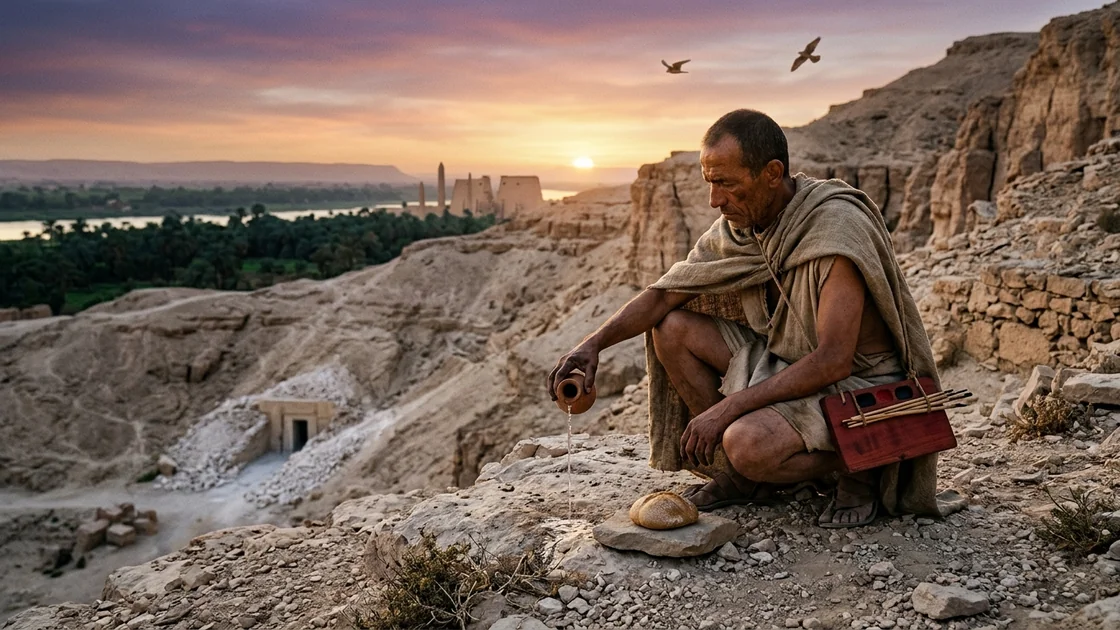
In the scorching hills of ancient Thebes, a quiet master scribe named Nacht is forced to paint the sacred funerary texts inside the magnificent tomb of Merimose, a ruthless and corrupt Grand Vizier. Merimose has grown rich by starving the royal workmen and recently murdered Nachts younger brother to cover up the theft of royal gold, denying the young man a proper burial and condemning his soul to nonexistence. Knowing that no mortal court can judge the second most powerful man in Egypt, Nacht decides to turn the Viziers own eternity into a trap. Using his unrivaled mastery of hieroglyphs, Nacht subtly alters the spells of the Book of the Dead on the tomb walls, hiding curses beneath plaster and inverting sacred signs so that when Merimose dies, the magical words meant to guide him to paradise will instead strip him of his defenses, force his heart to confess his crimes before Osiris, and feed his soul to the Devourer for the Second Death.
The air inside the mountain tasted of pulverized limestone, castor oil, and the sour sweat of starving men. Forty paces beneath the sun-bleached cliffs of the Theban hills, the heat did not dissipate; it merely thickened, trapped within the carved rock of the burial chamber like breath held inside a closed fist.
Nacht sat cross-legged upon a low scaffolding of sycamore planks, his spine curved into the familiar bow of his trade. In his left hand he held his palette, a rectangular slab of polished red wood slotted with two cakes of dried pigment: carbon black scraped from the bottoms of cooking pots and red ochre dug from the desert trenches near Gebel el-Ahmar. Between his fingers, balanced with the effortless grace of thirty years of discipline, rested a thin reed brush, its fibers chewed to a fine, splits-free tip.
Before him rose the western wall of the Room of Gold, smoothed with a fine skin of pinkish gypsum plaster and gridded in taut, snapped lines of red string. Upon this surface, Nacht was birthing eternity.
With a steady intake of breath, he dipped the tip of the reed into his small clay water pot, stroked it three times across the black cake, and pressed it to the wall. A single sweeping curve, a sharp horizontal base, two delicate vertical ticks inside the loop. Ankh. Life. Beside it, the narrow staff with the forked base and the canine head of Set. Was. Dominion. Beneath them, the woven basket. Neb. All.
All life and dominion.
The words were not merely ink upon stone. To the men of Kemet, and above all to the initiates of the House of Life where Nacht had trained in his youth, the Medu Netjer—the Words of the Gods—were living things. Every bird, every viper, every seated man and loaf of bread drawn upon a tomb wall possessed a spirit of its own. Once the lector priests chanted the final consecrations and sealed the shaft, the darkness would quicken. The painted grain would grow into real barley in the Field of Reeds; the painted servants would rise to till the soil; the painted spells would wrap around the dead man’s soul like bronze armor, deflecting the blades of the gate-demons in the subterranean gloom of the Duat.
Nacht paused, his brush hovering a hair's breadth from the plaster. Near his knee, a shallow clay dish burned with a wick floating in salted sesame oil. The salt kept the soot from blackening the ceiling, yet the flame still flickered nervously in the stale air, casting long, trembling shadows across the face of the man painted upon the wall.
It was a handsome face, rendered in the timeless perfection of sacred art. The figure stood twelve cubits tall, his skin painted the rich reddish-brown of fertile river silt, his shoulders broad and youthful, a pleated kilt of sheer white linen stiffened with starch flaring from his waist. Around his neck hung the heavy golden usekh collar, and in his hand he held the long staff of office. Above his head, enclosed in columns of brilliant blue and yellow, marched his titles: Hereditary Prince, Count, Seal-Bearer of the King of Lower Egypt, Overseer of the Granaries of Amun, Mouth of the King, Judge of the Six Great Courts, the Grand Vizier Merimose, Justified.
Look upon that painted face, and one saw a pillar of Ma’at—truth, cosmic balance, the divine order that kept the sun rising and the Nile flooding.
Then came the sound of heavy sandals scraping against the limestone stairs of the upper corridor, and the real Merimose descended into the tomb.
"More light," a voice barked from the gloom of the antechamber, rich with phlegm and effortless authority. "Do these moles work in the belly of Apophis? Bring the bronze mirrors to the turn of the shaft! If I inhale a mouthful of lamp-smoke, I will have the foreman’s hide stripped from his heels to his ears."
Around Nacht, the rhythmic tapping of bronze chisels and the dry whisper of sandstone rubbers ceased instantly. Twenty men—draftsmen, outline scribes, plasterers, and relief carvers from the walled village of Set-Ma’at—scrambled down from their ladders and dropped to their knees in the white dust, pressing their foreheads to the rough stone floor.
Nacht descended from his low plank more slowly. His left hip had been stiff since the winter rains three years ago, and he favored it as he folded his thin frame onto the floor, setting his palette carefully beside his knee so the wet black ink would not spill into the grit. From beneath his brow, he watched the Vizier’s feet appear at the threshold of the burial chamber.
Merimose wore sandals of braided palm leaf worked with gold thread, though he had ordered two Nubian bearers to carry him down the steep outside path in a cedar litter so the dust of the necropolis would not soil his ankles. Above the sandals rose calves swollen with gout and rich living, draped in linen so fine the pale, hairless flesh of his thighs shone through like lard under water. He was sixty years old, a vast, heavy-jowled man whose belly sagged over a wide leather belt inlaid with carnelian and turquoise. A heavy wig of human hair, curled and perfumed with cones of beef tallow and myrrh that were already melting in the subterranean heat, framed a face of sagging, brutal intelligence.
Behind the Vizier walked two men: his chief steward, Seneb, carrying a roll of accounts, and Hori, a second-rank Lector Priest of the Temple of Amun, whose shaven skull gleamed with ungents and whose leopard-skin vestment smelled strongly of dried natron and incense.
"Rise, you lazy dogs, and let me see what my barley has bought this month," Merimose said, waving a hand heavy with jasper signet rings.
Nobody rose completely; one did not stand at full height before the Vizier unless commanded by name. Instead, the workmen crouched on their heels, heads bowed. Only Nebamun, the Chief Foreman of the Right Side, stepped forward, his palms turned upward in supplication.
"May Amun-Re preserve your health, Great One," Nebamun said, his voice tight with the strain of a man walking along the edge of a blade. "The dressing of the sarcophagus pit is complete. The plasterers have finished the astronomical ceiling in the pillared hall, and Master Scribe Nacht has completed the laying out of the Book of Going Forth by Day along the western and southern walls of the burial vault."
Merimose did not look at Nebamun. He waddled toward the center of the chamber, taking a lotus flower from his steward’s hand and pressing it to his broad nostrils to ward off the smell of the workmen. His dark, filmed eyes roved over the walls as two youths hurried into the doorway holding wide disks of polished bronze, catching a beam of reflected sunlight bounced down from the surface three hundred cubits away and throwing a pale, ghostly glare across the painted plaster.
"Too slow," Merimose murmured through the petals of the blue lotus. "Seven months since the stonecutters broke through the chert layer, and still the reliefs in the outer hall are bare of color. Why?"
Nebamun swallowed hard. In the reflected glare of the bronze mirror, Nacht could see the hollows beneath the foreman’s cheekbones, the gray pallor of his skin. Everyone in the village of the tomb-builders carried that same hollow look now.
"Excellence," Nebamun said softly, "the men are weak. The barley rations from the Granary of the West are four months in arrears. The distributions of dried fish and oil have not come since the feast of Thoth. The stonecutters’ wives are grinding bitter vetch and lotus roots into their bread just to fill their children’s bellies. When a man swings a seven-pound maul for eight hours in the dark without grain in his belly, his arms tremble."
Silence fell over the chamber, so complete that the hiss of the salted oil wicks sounded like vipers in dry grass.
Merimose lowered the lotus from his nose. He turned his massive head toward Nebamun, his painted eyelids drooping. As Overseer of the Granaries of Amun, it was Merimose himself who held the seals to the silos along the river. Every man in the chamber knew where the workmen’s grain had gone: loaded onto private barges in the dead of night and shipped south to Kush and north to the Delta, traded by the Vizier’s agents for silver, cedarwood, and Syrian wine.
"Your men eat the King’s bread to build the King’s house in the Great Valley," Merimose said, his voice dropping an octave, smooth as river mud. "Here, in my cliff, you work for the favor of Merimose. Did I not send three jars of sour beer at the new moon? Did I not spare your village from the conscription levies for the Syrian campaign?"
"You did, Great One, and we praise your Ka daily—"
"Then do not speak to me of trembling arms," the Vizier snapped. He stepped closer to the wall where an elderly workman named Baken knelt beside a wooden trough of wet gypsum paste. Baken’s hands were cracked and bleeding from the lime, his eyes milky with early cataracts. Trembling at the Vizier’s proximity, the old man shifted his weight, and his elbow struck a small clay pot of expensive blue frit pigment sitting on the ledge of the scaffolding.
The pot tipped. It struck the limestone floor with a sharp crack, spilling a handful of bright, ground lapis-substitute across the white dust—right over the gilded straps of Merimose’s sandals.
Baken froze, a small, strangled whimper escaping his throat.
Merimose looked down at the blue powder dusting his toes. He did not shout. His expression did not even change. He simply raised his walking staff—a heavy rod of imported ebony capped with a bronze ferrule—and drove the butt end straight down into the back of Baken’s hand where it rested on the stone.
The crunch of small bones breaking echoed sharply against the plastered walls. Baken shrieked, curling into himself, clutching his mangled hand to his chest as dark blood welled between his lime-stained fingers.
"Fool," Merimose said mildly, wiping the tip of his staff against Baken’s linen kilt before stepping back. "That blue was ground from copper ore brought from the Sinai mines. It is worth more than your miserable life and the lives of your sons. Seneb!"
The steward stepped forward immediately, his reed pen already poised over his papyrus scroll. "My Lord?"
"Dock the rations of the entire gang by ten sacks of emmer wheat to pay for the spilled pigment. And have the Medjay give this clumsy dog twenty lashes at the village gate tonight, so the others learn to steady their elbows."
Nebamun opened his mouth to plead—twenty lashes for a man of Baken’s sixty years was a death sentence—but caught the cold glint in the Vizier’s eye and bowed his head to the floor instead, his shoulders shaking with helpless rage.
Merimose turned away from the weeping old man as if stepping past a pile of camel dung. He walked to the western wall where Nacht knelt. The Vizier smelled of crushed myrrh, roasted goose grease, and old sweat.
"You," Merimose said, pointing the blood-flecked tip of his ebony staff at Nacht. "Nacht, son of Kenna."
"I am here, Great One," Nacht said, keeping his gaze fixed on the hem of the Vizier’s translucent pleated robe. His heart beat with a slow, icy steadiness against his ribs.
"Priest Hori tells me there is no hand in Waset steadier than yours," Merimose said. "He tells me you studied in the Per-Ankh at Karnak before you came to the village of the craftsmen. That you know the ancient books of the ancestors from the time of King Djoser."
"I am a humble servant of Thoth, Lord," Nacht replied, his voice quiet, raspy from years of breathing limestone dust. "I write what the gods have ordained."
Hori, the lector priest, stepped beside the Vizier, peering closely at the columns of black and red glyphs Nacht had been laying down before their arrival. Hori squinted, running a manicured finger near—though not touching—the wet ink of Spell 125.
"The proportions are faultless, Excellence," Hori murmured approvingly. "Look at the feathers of the Ma'at glyph, and the curve of the horned viper. Most scribes in the necropolis hurry the determinatives when they work in the deep vaults, knowing few mortal eyes will ever read them. Nacht draws every pinion of the owl's wing as if Osiris himself were holding the lamp."
Merimose leaned in, his heavy jowls quivering as he examined the wall. Like most high officials, the Vizier could read administrative hieratic and the standard formulas of royal decrees, but the dense, archaic religious hieroglyphs of the Book of Going Forth by Day were largely opaque to him. He relied upon priests like Hori to select the spells, and scribes like Nacht to give them physical form.
"See that you do not falter, scribe," Merimose rumbled. "My doctors tell me the swelling in my legs is an evil wind sent by a demon of the marshes. Perhaps I have ten years left under the sun; perhaps I have ten months. When my Ka descends into this mountain, I expect every gate of the underworld to fly open at the sound of my voice. I have paid the Temple of Amun four hundred deben of silver for the finest rituals. If a single line is crooked, my son will inherit my seal, and he will know who held the brush."
"Not a single stroke shall lack its proper power, Great One," Nacht whispered to the dust. "I swear it by the blood of my brother, Ipy."
Merimose did not even blink. To the Grand Vizier of Upper and Lower Egypt, the names of the small men he had crushed beneath his sandals were no more memorable than the beetles flattened beneath his chariot wheels. He grunted, turned on his heel, and called for his bearers.
Within moments, the bronze mirrors at the doorway were lowered, plunging the chamber back into the dim, orange gloom of the oil lamps. The shuffling footsteps of the Vizier’s retinue faded up the long stairs, leaving behind only the scent of melting myrrh and the quiet, ragged sobbing of old Baken on the stone floor.
Nacht did not move for a long time. Slowly, he reached out and picked up his reed brush. He looked at the small smear of Baken’s red blood drying on the white limestone floor, and then up at the towering, serene image of Merimose painted on the wall, holding the staff of peace and truth.
Ten months, or ten years, Nacht thought, his eyes narrowing in the lamplight. It does not matter when you come down into the dark, Merimose. The trap will be waiting.
When the sun dipped toward the western peaks, casting long purple shadows across the barren valleys of the necropolis, the workmen laid down their tools. A guardian of the tomb checked each bronze chisel against a tally board at the entrance to ensure no metal was stolen, and then the gang began the steep, winding climb over the mountain ridge toward Set-Ma’at.
Nacht walked near the back of the column, helping support old Baken, whose shattered right hand was bound in a strip of dirty linen soaked in oil and honey. Behind them, the Medjay guards—Nubian policemen armed with heavy throw-sticks and rawhide whips—followed at a distance, waiting to carry out the Vizier’s sentence once they reached the village gate.
From the spine of the ridge, the world was split in two.
To the east, beyond the dry bone-colored hills of the dead, lay the ribbon of life: the lush, emerald-green floodplains of the Nile, dotted with date palms and sycamore figs, and beyond the glittering brown river, the towering sandstone pylons and gold-tipped obelisks of Karnak and Luxor, glowing like embers in the dying sun. That was the land of the living, where Merimose sat right now in his shaded garden beside a pool of lotus blossoms, eating roasted waterfowl and drinking cooled wine from Canaan while harpists sang of his generosity.
To the west, nestled in a sterile, sun-baked hollow of the desert cliffs where not a single blade of grass grew, lay Set-Ma’at—the Place of Truth. Seventy mud-brick houses packed tightly within a high enclosure wall, entirely dependent on the donkey trains that brought water from the river and grain from the royal storehouses.
When they reached the northern gate, the women and children were waiting, their faces drawn with anxiety, hoping the men had brought news of the delayed grain barges. Instead, they watched in horrified silence as the captain of the Medjay dragged old Baken to the whipping post beside the guardhouse.
Nacht stood in the crowd, his jaw clenched until his teeth ached, forcing himself to watch every stroke of the hippopotamus-hide whip. One. Two. Three. By the tenth lash, Baken had fainted, hanging limp by his bound wrists, his thin, gray-haired back reduced to ribbons of red flesh. By the twentieth, the old man was barely breathing.
When the Medjay cut him down, Nacht helped Baken’s weeping daughter carry the unconscious man into his narrow house, leaving a small jar of precious myrrh ointment he had saved from his own meager stores. Then Nacht walked down the dusty central street to his own home at the southern corner of the wall.
The house was dark and silent. Nacht had no wife; she had died of the marsh fever ten years past, taking their infant daughter with her into the West. For a decade, his only family had been his younger brother, Ipy.
Nacht lit a small tallow lamp and walked through the front room—where a low brick altar held a small limestone bust of his ancestors—into the back chamber. He moved aside a woven reed mat on the floor, pried up a loose mud brick with an ivory knife, and reached into the cool earth beneath.
He drew out a small bundle wrapped in coarse linen. Unfolding the cloth on his worktable, he looked down at what remained of his brother.
There was no mummy. There was only a single bronze stonecutter’s chisel, stamped with Ipy’s personal mark—a running hare—and a handful of dried, black river mud mixed with a few splinters of bleached white bone.
Ipy had been twenty-two years old, fifteen years younger than Nacht, born late in their mother’s life. Nacht had practically raised the boy, teaching him to read the sacred signs even though Ipy lacked the patience for a scribe’s cross-legged life. Ipy had loved the stone itself—the ring of the chisel, the way a block of fine white Tura limestone yielded a smooth cheek or the curve of a goddess’s breast under his strong hands. Because of his skill, Ipy had been chosen two years ago for a special detail working in the royal workshops attached to the Vizier’s estate on the West Bank, carving the gilded shrines meant for the Pharaoh’s own eternal house in the Great Valley.
Nacht remembered the night Ipy had come to this very room, shaking like a leaf in the north wind, his tunic damp with sweat.
"They are stealing the flesh of the gods, Nacht," Ipy had whispered, gripping his brother’s wrists in the dark. "Fifty talents of pure Nubian gold came from the treasury at Karnak to sheet the inner shrine of the King. Today, while I was fitting the mortise joints in the foundry yard, I saw the Vizier’s steward, Seneb, and the chief goldsmith melting the royal ingots down with thirty parts of red copper and ten parts of silver to pale the color. The pure gold is being poured into unmarked rings and packed into wine amphorae with Merimose’s personal seal!"
Nacht had felt the blood drain from his face that night. To steal from a mortal was a crime; to steal the gold meant for the living Horus, the Pharaoh’s own burial equipment, was treason of the highest order.
"You must say nothing, Ipy," Nacht had pleaded, terror gripping his throat. "Forget what you saw. Keep your eyes on your chisel."
"How can I keep silent?" the boy had cried, fierce with the bright, foolish faith of youth. "If the King’s shrines are made of base metal, his journey to the stars is profaned! It is Isfet—chaos! Tomorrow, when the Royal Herald inspects the West Bank, I will lay a petition before his chariot. The King will reward us for exposing a traitor!"
Nacht had argued for hours, until Ipy finally swore he would wait until Nacht could discreetly approach a trusted priest of Ptah who stood outside the Vizier’s web of patronage.
Wait, the boy had promised.
Wait, he had not. Or perhaps another workman in the foundry had seen Ipy watching the crucibles and sold his name to Seneb for a handful of silver rings.
Three days later, Ipy did not return from the river workshops. Instead, a squad of Merimose’s personal retainers marched into Set-Ma’at at dawn. They read a scroll bearing the Grand Vizier’s seal: Ipy, son of Kenna, had been caught in the dead of night attempting to pry gold leaf from the sanctuary doors of the Ramesseum. Because he had resisted arrest and struck a temple guard with his chisel, the Vizier, acting in his capacity as Supreme Judge of the Courts, had ordered instant summary execution upon the riverbank.
And because tomb robbery and sacrilege were crimes against the gods themselves, Merimose had decreed the ultimate punishment: denial of burial.
They had bound Ipy’s hands and feet with weights of basanite stone, rowed a skiff out to the deep channel near the southern sandbars where the great Nile crocodiles sunned themselves, and cast him living into the black water.
Nacht had gone down to the riverbanks every night for a month, walking the dark reeds with a hooded lantern, half-mad with grief, praying to Isis—who had searched the marshes for the scattered pieces of her husband Osiris—to grant him even a finger, even a lock of hair, over which he could perform the funeral rites. All he had ever found on a mudflat downstream, where the crocodiles dragged their prey to tear it apart, was a shred of Ipy’s bloodstained linen kilt, his dropped bronze chisel, and a splintered fragment of a human collarbone picked clean by river crabs.
In the theology of Kemet, there was no horror greater than the loss of the body. Without a preserved corpse—or at least a consecrated statue in a ritual tomb—the Ka had nowhere to return for sustenance, and the Ba, the human-headed bird of the soul, wandered the desolate fringes of the desert, starving, thirsty, howling in the wind until it faded into nothingness.
By feeding Ipy to the crocodiles to hide his own theft of royal gold, Merimose had not merely murdered a twenty-two-year-old boy. He had murdered him forever.
Meanwhile, Merimose’s own body would be washed in palm wine inside the Tent of Purification, packed for seventy days in the purest natron from Wadi El Natrun, stuffed with sweet-smelling myrrh, cassia, and cedar sawdust, wrapped in hundreds of yards of finest royal byssus with amulets of gold and carnelian over every organ, and laid inside three nesting coffins of gilded cedar and a sarcophagus of red granite.
Because Merimose had wealth, the gods would be compelled by the mechanical perfection of the funerary rites to receive him. Because Ipy had sought truth, his soul was blowing through the dark like cold ash.
Nacht touched the splinter of white bone on his table.
"Where is Ma’at?" he whispered to the empty room.
He had asked that question at the small rock-cut shrine of Meretseger—She Who Loves Silence, the great hooded cobra goddess who lived in the high pyramidal peak above the Valley of the Kings—every evening for a year. The priests told the workmen that Meretseger struck blind any man who swore a false oath or committed a secret sin in the necropolis. Yet Merimose walked the paths of the West with his eyes clear and his belly full, while old Baken bled on his pallet and Ipy’s spirit starved in the waste.
If the gods would not act unless summoned by ritual, Nacht had realized six months ago, then it was because the gods read what was written.
In the Hall of Two Truths, when the dead man stood before the throne of Osiris and the forty-two terrible Assessors, the god Thoth—lord of scribes, master of sacred words—stood beside the Great Scales to record the outcome. The spells painted upon the walls of the tomb and written upon the papyrus tucked between the mummy’s thighs were the dead man’s legal brief, his shield, and his voice. When the trauma of death left the soul confused and deaf in the blackness of the Duat, the words on the tomb walls spoke for him.
And who was writing Merimose’s words?
Nacht looked down at his own ink-stained fingers.
If he simply defaced the tomb—if he took a chisel and hacked out Merimose’s name and face—the damage would be discovered before the funeral. Hori and the priests would inspect every wall before the burial shaft was sealed; Nacht himself would be impaled on a stake beside the river, and another scribe would be brought in to replaster and repaint the walls before Merimose’s seventy days of embalming were finished.
No. The destruction had to be invisible. To the eyes of Hori, Seneb, and the high priests of Amun, the burial chamber of Merimose had to appear as the most pious, orthodox, and sumptuously inscribed monument in the Theban hills.
Only the gods—and the hungry demons of the underworld who read the true essence of the Medu Netjer—would see what Nacht had actually written.
Three nights later, when the moon was dark and the village of Set-Ma’at slept behind its bolted wooden gates, Nacht slipped out through a narrow drainage culvert behind the potter’s kilns, a secret passage he and Ipy had discovered when they were boys chasing desert foxes.
He carried a small leather satchel, three empty clay vials, and a bronze knife. Wrapping his linen cloak tightly around his shoulders against the sudden, biting chill of the desert night, he descended the eastern donkey trail toward the edge of the cultivation.
To corrupt a sacred text required more than changing the shapes of the letters; the very body of the ink had to be profane.
In the House of Life, Nacht had been taught the strict purity laws of the scriptorium. Sacred ink had to be bound with pure gum arabic from Punt and thinned with water drawn from the living Nile at dawn or from the sacred lake of the temple. Red ochre came from the lands of Ra; carbon black came from burnt acacia wood blessed by a priest.
Nacht bypassed the river completely. Instead, he crept into the stagnant, rotting backwater marshes behind the slaughterhouses of the mortuary temple of Seti, where the offal of sacrificed cattle was dumped into reed-choked pools that never saw the current of the Nile. The water there was thick, scummy, and stank of putrefaction—the water of Isfet, of stagnation and decay. He filled his first clay vial from that black mire.
Next, he climbed back into the dry, bone-white wadis of the desert hills, where the horned vipers hunted jerboas among the flint boulders. Using a forked stick and the skill of a man raised on the edge of the wild, he pinned a thick, sand-colored cerastes viper behind its triangular head. Holding the thrashing serpent down, he forced its fangs over the rim of his second vial, milking six drops of pale amber venom into the clay before severing its head and burying the body beneath a cairn of stones dedicated to Set, lord of the red desert.
Finally, he gathered the soot not from clean cooking fires, but from a burned pit behind the embalmers’ tents at the foot of the necropolis, where soiled rags stained with corpse-fluid, spoiled natron, and the shaved body hair of the dead were burned as impure refuse.
Returning to his house before the watchmen blew the dawn horns, Nacht ground the corpse-soot and the viper venom into his cake of black carbon and his cake of red ochre, binding them with the stagnant marsh water. To the eye, the inks dried with the exact same matte luster as the pure pigments provided by the temple stores. To the nose, once masked with a single drop of lotus oil, they smelled of nothing at all.
Yet in the unseen realm of Heka—magic—every stroke painted with that ink was an abomination, soaked in death-rot and serpent poison.
The next morning, Nacht returned to the burial chamber of Merimose and began the Great Inversion.
His first task was the Under-Layer.
In the deepest recess of the burial vault, where the granite sarcophagus would rest, the plasterers were still smoothing the final coat of fine white gypsum over the coarser gray mud-and-straw leveling plaster beneath. Because Nacht was the Master Draftsman, it was his duty to mark the bare rock and the rough under-plaster with guiding marks before the final white skin was applied and polished with smooth river pebbles.
While the plasterers worked in the outer hall during the midday break, Nacht stood alone before the rough gray wall at the head of the sarcophagus pit. Taking his thick reed brush dipped in the defiled red ink, he wrote rapidly across the porous stone in bold, cursive hieratic.
He did not write the guiding grids. He wrote an Execration Text—the ancient, forbidden curses used by the Pharaohs to destroy enemies of the state.
Die, Merimose, born of the woman Mutemwia! he painted in foot-high red letters across the stone. Your name is erased in the horizon! Your Ka is fettered in the block of the executioner! Your Ba shall not go forth by day; it shall be trapped in the stone, blind, deaf, and mute! You shall eat your own dung; you shall drink your own urine; you shall walk upside down in the dark forever! Every bread offering placed upon your altar above shall pass through the stone to feed the Ka of Ipy, son of Kenna, Justified, whom you murdered in the water!
Before the footsteps of the plasterers returned down the corridor, the red ink had soaked deep into the dry gray base-coat. When the workmen entered ten minutes later with their troughs of wet, blindingly white gypsum, Nacht calmly directed them to lay a quarter-inch of smooth plaster directly over the wall.
With every sweep of their wooden floats, the workmen sealed the curse inside the rock. Tomorrow, Nacht would paint the serene image of the goddess Nephthys spreading her protective wings over that exact spot. Merimose and his priests would see only the goddess of protection; beneath her feet, beating like a poisoned heart inside the stone, the curse would radiate outward into the sarcophagus for ten thousand years.
Yet the under-layer was only the foundation. The true art—the razor’s edge upon which Nacht walked every hour of the day—lay on the surface of the walls, in full view of the world.
In the Medu Netjer, every sign was a double-edged sword. Because the ancient scribes knew that the hieroglyphs of serpents, lions, scorpions, and knives could come alive inside a sealed tomb and attack the helpless mummy, orthodox tradition demanded that dangerous signs in a burial chamber be "mutilated." A scribe would draw the horned viper (f) or the great cobra (d) with a tiny gap in its neck, as if its head were severed, or draw a tiny knife sticking into its back, rendering it harmless to the deceased while preserving its phonetic value in the word.
As Nacht moved along the fifty-foot expanse of the Book of Going Forth by Day, he did the exact opposite—with microscopic subtlety.
Whenever he painted the monstrous serpent Apophis or the knife-wielding demon heralds of the Twelve Portals, where a pious scribe would leave a hair-thin break in the black outline of the monster’s spine to neutralize its malice, Nacht made the beast’s outline continuous, thick, and whole, reinforcing its belly with a hidden stroke of viper-venom ink.
Conversely, whenever he painted the protective glyphs meant to serve Merimose—the ankh of life, the djed pillar of stability, the kheper scarab of rebirth, and the figure of Merimose himself—Nacht introduced the Mutilation of the Dead.
It had to be invisible to anyone standing more than six inches from the wall. As Nacht painted the brown legs of Merimose’s towering portrait, just where the hem of the white pleated kilt crossed the shin, he left a gap in the flesh the width of a single eyelash, and inside the white line of the linen hem, he tucked the microscopic silhouette of a butcher’s flint knife (ds) cutting straight through the Vizier’s tendons.
In the Duat, a man whose painted image had severed tendons could not walk. When the gates opened, Merimose’s soul would collapse upon the floor of the tomb, crippled before his journey even began.
Then came the Names of the Gatekeepers.
According to Spell 144 and Spell 147, the road to Osiris was barred by seven great Arits and twenty-one mysterious Portals, each guarded by a terrifying demon armed with butcher knives, bearing names like He Who Dances in Blood, Repeller of the Rebel, and Sharp of Flame. A soul could only pass a portal by reciting the exact, secret name of the door, the guardian, and the announcer written on his tomb walls. If the soul mispronounced a single syllable, the demon rose and butchered him on the threshold.
Here, Nacht deployed the secret art of enigmatic cryptography—a complex system of visual puns, homophones, and phonetic substitutions known only to the highest initiates of the House of Life.
Where the text should have read: "O Guardian of the Third Portal, 'Watcher of the Secret Ways,' make a road for the Osiris Merimose," Nacht altered two tiny phonetic complements and reversed the direction of a seated deity determinative.
To a rushed lector priest scanning the column from left to right, the group of birds, loaves, and ripples of water looked identical to the standard temple master-scroll. Because the shapes occupied the same quadrat squares, the visual rhythm was unbroken.
Yet by substituting the quail chick (w) with the nearly identical fledgling swallow (wr / bin—evil) and shifting the mouth sign (r) by a fraction of a finger beneath the water ripple (n), the actual phonetic reading of the sentence in the mouth of the dead man became:
"O Guardian of the Third Portal, I spit upon your secret face; strike down the rebel Merimose!"
Nacht did this across all twenty-one Portals. He was turning Merimose’s own memory script into a litany of blasphemies. When the Vizier’s terrified soul stood before the forty-cubit-high doors of black iron in the underworld and read the text glowing from his tomb walls, every word that left his lips would command the gatekeepers to tear him limb from limb.
On the nineteenth day of the third month of Inundation, the trap nearly snapped shut on Nacht’s own neck.
He was working on the northern wall of the burial chamber, painting the grand vignette of the Psychostasia—the Weighing of the Heart, the climax of Spell 125.
It was the most magnificent painting in the tomb. Spanning twelve cubits in width, it showed the Hall of Two Truths roofed with alternating cobras and feathers. At the far right sat Osiris upon his throne of lapis and gold, his skin painted the deep malachite green of new vegetation, wrapped in white mummy bands, holding the crook and flail. In the center stood the Great Balance. Jackal-headed Anubis knelt beside the plumb-bob to steady the beam, while ibis-headed Thoth stood with reed brush and palette ready to record the verdict.
Beneath the scales crouched Ammit—the Devourer of the Dead. Part crocodile, part lion, part hippopotamus, she waited with her long, serrated jaws parted to swallow any heart found heavier than the feather of Ma’at.
And on the left tray of the scales sat Merimose’s heart (ib), while on the right tray sat the golden ostrich feather of Truth.
Above the scene marched the forty-two columns of the Negative Confession, where Merimose’s soul addressed each of the forty-two Assessors of Ma’at to declare his sinlessness:
I have not impoverished the poor. I have not caused pain. I have not made anyone hungry. I have not made anyone weep. I have not killed. I have not commanded anyone to kill. I have not falsified the plummet of the scales. I have not stolen the gold of the gods.
Every single line was a grotesque lie in the mouth of Merimose. Yet because the negative particle nen (represented by two outstretched arms holding nothing, above a ripple of water: n) stood at the head of each clause, the magic of the text forced the Assessors to accept the statement as truth.
Nacht was in the midst of altering those forty-two nen signs.
In classical Egyptian grammar, if the negative arms (nn) had their palms tilted upward by just five degrees and a tiny vertical stroke hidden in the plaster grain beside them, the sign ceased to be the negative particle nen ("I have not...") and became the emphatic affirmative particle in or the verb ini ("Indeed, I myself have brought forward...").
With forty-two hair-thin flicks of his brush, Nacht was transforming the Negative Confession into an absolute, binding legal confession of guilt before Osiris:
Indeed, I myself have impoverished the poor! Indeed, I have made men hungry! Indeed, I have made men weep! Indeed, I have commanded men to kill! Indeed, I have stolen the gold of the gods!
Furthermore, on the image of the Great Balance itself, Nacht had painted the plumb-bob and the beam not level, as required, but tilted by the thickness of a papyrus sheet toward the heart, while hiding the determinative sign for a heavy stone block (iner) directly inside the dark red pigment of Merimose’s heart vessel.
"Hold your brush, scribe."
The voice came from directly behind his left shoulder.
Nacht’s breath caught in his throat, though his hand, trained by decades of iron control, did not jerk. Slowly, he drew the tip of the reed away from the thirty-eighth column of the Confession and turned his head.
Hori, the Lector Priest of Amun, had entered the burial chamber alone. He wore soft leather temple slippers that had made no sound on the limestone stairs. In his right hand he held a bright, sputtering torch of resinous pine—strictly forbidden in a painted tomb because of the soot, though a priest of Amun answered to no foreman—and in his left he held the master papyrus scroll from the Karnak library.
The other workmen were in the upper pillared hall hauling stone debris. Nacht and the priest were completely alone in the vault.
"Step down from the plank," Hori said, his dark eyes glittering in the torchlight.
Nacht lowered himself from the scaffolding, his stiff hip aching, and bowed low. "May the gods favor you, Father Hori. I did not hear your steps."
"Evidently not," the priest said coldly. He stepped onto the low sycamore plank himself, raising the blazing pine torch right up to the wet black ink of the Negative Confession. The orange light illuminated every stroke with merciless clarity.
Nacht felt a bead of cold sweat trickle down his spine beneath his linen tunic. His fingers brushed the handle of the small bronze scraping knife tucked into his waist-sash. If Hori saw the inversion of the nen signs—if the priest called for the Medjay waiting at the mouth of the shaft—everything was over. Merimose’s tomb would be replastered, and Ipy would remain unavenged. If he had to, Nacht thought with a sudden, terrifying calm, he would drive the bronze scraper into Hori’s throat and tell the guards the priest had slipped and fallen into the twenty-foot sarcophagus shaft behind them.
Hori leaned closer to the thirty-sixth column: I have not fouled the water of the river.
"What is this glyph at the head of the clause, Nacht?" Hori demanded, tapping the parchment of his master scroll. "And here, in the spell for the Heart Scarab above the scales. Look at the determinative after the word transformation (kheperu). In my scroll from the House of Life, it is written with the seated god sign. You have drawn a mummified falcon on a standard, with the phonetic complement of a horned viper whose neck is uncut!"
Nacht let his breath out silently through his nose, releasing the handle of his knife. Hori had not noticed the subtle five-degree tilt of the negative arms; the priest’s eyes had been caught instead by a complex cryptographic substitution Nacht had used in the Heart Scarab heading to invert the plea "Do not stand as a witness against me" into "Rise up and testify against me!"
"Well?" Hori turned his head, glaring down from the plank. "Have your eyes grown as cloudy as old Baken’s, or are you improvising upon the sacred canon?"
Nacht raised his head, assuming the humble yet slightly pedantic expression of an aging library scholar addressing a younger ritualist. He knew Hori’s type well: a man from a wealthy Theban family who had bought his priesthood to enjoy the temple revenues, well-versed in the standard Nineteenth Dynasty vulgar copies of the funeral texts, but deeply insecure about his knowledge of the older, royal mysteries.
"Forgive me, Father Hori," Nacht said softly, clasping his ink-stained hands before his chest. "I would never alter a feather of the sacred canon on my own authority. When the Great Vizier visited us three weeks ago, you yourself praised my knowledge of the ancient books from the time of King Djoser and the Pyramid Age."
Hori frowned slightly. "I did. What of it?"
"The scroll you hold in your hand," Nacht said, gesturing respectfully toward the papyrus, "is the standard recension prepared by the lower scriptorium at Karnak for wealthy merchants and mayors of the towns. It is a fine text, of course. Perfectly adequate for a common nobleman."
Hori’s vanity pricked immediately. "This scroll cost thirty deben of silver!"
"Indeed, Father. Yet Merimose is no mayor of a town," Nacht said, lowering his voice to a reverent murmur. "He is the Grand Vizier of Upper and Lower Egypt, the Mouth of the King. When I studied in the inner archives of the House of Life under Chief Lector Ameneminet—may he be justified—I was permitted to copy the Royal Recension of Heliopolis, found inside the alabaster chest beneath the Sanctuary of Atum, dating to the reign of King Menkaure."
Hori blinked, lowering his torch an inch. "The Heliopolitan chest?"
"You know of it, naturally," Nacht lied smoothly, flattering the priest’s scholarship. "As a learned master of the temple, you will recall that in the archaic Heliopolitan orthography, the seated god determinative was considered vulgar for a man of royal rank, because it bound the soul only to the earthly horizon. By substituting the archaic falcon-on-standard (netjer-aa) paired with the unbroken f-viper—which represents the living horn of the celestial horizon—the spell grants the Vizier the power to ascend not merely to the Field of Reeds, but directly into the Solar Barque of Ra alongside the Pharaoh himself."
Nacht stepped closer to the plank, looking up at Hori with earnest eyes. "As for the unbroken neck of the viper, Father... surely you remember the commentary of Prince Hardjedef? In the presence of the falcon standard, the serpent is already pinned beneath the talons of Horus. To cut its neck with a scribe's brush would be to insult the strength of the hawk."
Hori stared at the wall, then back at his scroll, then down at Nacht.
It was complete, fabricated nonsense, woven seamlessly from real theological terms and obscure historical names. Yet to admit he had never heard of the commentary of Prince Hardjedef on the falcon standard would be to admit that a dusty tomb-scribe from Set-Ma’at knew more of the high mysteries of Amun-Re than a Lector Priest of Karnak.
Slowly, a knowing, superior smile spread across Hori’s oiled face.
"Ah," Hori said, nodding sagely as he rolled up his scroll. "The Heliopolitan recension of Menkaure. Yes, of course. In the dimness of the torch, I mistook the hawk standard for a careless stroke. Few scribes today remember the rule of Hardjedef regarding the pinned serpent."
"Only true scholars such as yourself recognize it, Father," Nacht murmured, bowing his head to hide the fierce, cold triumph in his eyes. "However, if you feel the Vizier is unworthy of the royal archaic forms, I can easily wash the wet ink away with a sponge and paint the common merchant's sign from your scroll..."
"No, no!" Hori waved his hand dismissively, stepping down from the plank. "Leave it as you have drawn it. When I tell His Excellence tonight that I have personally directed you to replace the standard determinatives with the secret royal formulas of Heliopolis, he will be most pleased with my vigilance. Perhaps he will even endow another five arouras of temple land to my chapel."
"Your wisdom illuminates this dark place, Father Hori," Nacht said softly.
The priest puffed out his chest beneath his leopard skin, warned Nacht to keep the other workmen from slackening, and marched back up the stairs, his pine torch trailing black smoke toward the daylight.
Nacht stood alone before the Hall of Two Truths. Slowly, he climbed back onto the sycamore plank, dipped his reed brush into the viper-ink, and finished inverting the fortieth, forty-first, and forty-second confessions.
Indeed, I have slaughtered the sacred cattle! Indeed, I have obstructed the god in his going forth! I am impure! I am impure! I am impure!
In the fourth month of Inundation, during the great Feast of Opet when the sacred barque of Amun journeyed from Karnak to Luxor amid clouds of frankincense and the clash of bronze sistra, the god finally struck Merimose down.
It was not a cobra bite or an assassin’s blade. It was his own gluttony.
At the grand banquet held inside his western estate after the river procession, while the families of Set-Ma’at boiled dried acacia beans to survive, Merimose consumed half a roasted calf, a platter of honeyed figs, and four jars of thick Delta wine. Rising from his couch to boast to the High Priest of the magnificence of his nearly completed tomb, the Vizier suddenly clutched his left arm. His face turned the dark, bruised purple of a ripe plum. He tried to speak his own name, failed, and crashed forward across an ivory gaming table, shattering the faience pieces across the tiled floor.
He lingered for two days upon his bed, paralyzed down his right side, drooling onto his silk pillows while the royal physicians burned incense and pressed cold frogs to his forehead, and on the dawn of the third day, he stopped breathing.
When the news reached the village of Set-Ma’at, no one cheered aloud—the Medjay had ears everywhere—but as women swept their thresholds and men sharpened their chisels, eyes met across the dusty lanes in silent, fierce relief. Even old Baken, whose back had healed into a web of thick keloid scars and whose crippled right hand would never hold a float again, sat in the doorway of his house and wept quiet tears into the sunlight.
Yet for the workmen of the tomb, Merimose’s death meant seventy days of frantic, unceasing labor.
For seventy days, the Vizier’s bloated corpse would lie buried under mounds of dry white natron salt inside the Ibu—the Tent of Purification on the edge of the desert—while the jackal-masked embalmers pulled his brain through his nostrils with bronze hooks, removed his liver, lungs, stomach, and intestines through an incision in his flank, and dried his flesh into dark, brittle leather. On the seventieth day, the funeral procession would arrive at the cliff. Every wall, every pillar, every ceiling star, and every coffin had to be finished and dry before that dawn.
Torches and extra oil lamps burned day and night in the tomb now. The workmen worked in two twelve-hour shifts. Because of Nacht’s reputation—and because Hori boasted to Merimose’s heir that Nacht was inscribing the "secret royal formulas of Heliopolis"—Nacht was given solitary command of the innermost sanctum and the final funerary equipment brought down into the vault during the last ten days.
On the sixty-eighth night after Merimose’s death, a heavy wooden sledge was lowered down the steep limestone ramps into the burial chamber. Upon it rested the lid of the great anthropoid sarcophagus, carved from a single block of black granite from Aswan, and beside it, the innermost coffin of cedarwood, entirely covered in thick gold leaf donated—or stolen—from the royal workshops.
The night shift had ended at midnight, leaving the tomb empty until dawn save for two Medjay guards snoring around a brazier at the outer gate fifty paces above, and Nacht himself, who had been ordered by Hori to paint the final protective Nut spell on the underside of the heavy granite sarcophagus lid before the stonecutters rigged the ropes to position it over the coffer.
Nacht lay on his back upon a bed of folded linen pads between the granite coffer and the suspended lid, which was propped up on four sturdy blocks of acacia wood three cubits off the floor.
Looking up into the concave underside of the black stone, Nacht was looking at the exact surface that Merimose’s mummy would stare at for all eternity once the lid was dropped into place.
Traditionally, this space belonged to the sky goddess Nut, painted with her arms outstretched in yellow gold or white wash, accompanied by the prayer: "O my mother Nut, spread yourself over me, that you may place me among the Imperishable Stars which are in you, and that I may not die again."
Working by the light of a single tiny clay lamp resting on his chest, Nacht painted the figure of the sky goddess in glowing yellow orpiment across the black granite directly above where the dead man’s face would lie.
Yet as he drew her face, he did not give her the serene features of the mother of the gods. Beneath the gentle curve of her golden chin, hidden in the shadow of her collar, he drew the serrated jaws of Ammit, and in the columns of text running down her starry body, he wrote the final, irreversible seal of his vengeance:
"O Nut, crush the bones of the rebel Merimose beneath your weight! Press him down into the black earth! Let no star shine upon his brow; let no breath of the north wind enter his nostrils! His name is obliterated from the Book of Life; his heart belongs to the Devourer; his offerings belong to Ipy, son of Kenna, Forever and Ever!"
Sliding out from beneath the granite lid, his clothes grey with stone dust and his eyes burning from sleeplessness, Nacht reached into his leather satchel for the last time.
He drew out a flat flake of white limestone—an ostracon no larger than the palm of his hand—along with the small linen bundle containing the splinter of his brother’s bleached bone and the bronze chisel marked with the running hare.
On the smooth white limestone flake, using the purest sacred ink he possessed—drawn from the living Nile at dawn, mixed with gum from Punt and blessed before the household altar of his ancestors—Nacht had painted a miniature masterpiece.
It showed a young man of twenty-two sitting upon a carved chair beside a heap of bread, beer, roasted beef, and cool lotus flowers. The young man’s skin was bright, whole, and unmarred; his limbs were strong; both his hands were intact, holding the ankh of eternal life. Above his head, in flawless, crystal-clear hieroglyphs without a single mutilation or shadow, stood the sacred Hetep-di-Nesu offering formula:
An offering which the King gives, and Osiris, Lord of Busiris, the Great God, Lord of Abydos, that he may give a voice-offering of bread, beer, oxen, fowl, alabaster, linen, and every good and pure thing upon which a god lives, for the Ka of the Osiris, the Royal Stonecutter of the Place of Truth, Ipy, son of Kenna, Justified before the Great God.
And beneath the chair, Nacht had written a transfer clause from the ancient legal codes of the Old Kingdom: Every loaf placed in this mountain, every drop of water poured upon the upper court, every grain of incense burned before the false door above, is hereby diverted by the authority of Thoth to the Ka of Ipy.
Nacht walked out of the burial chamber and climbed partway up the dark corridor to the upper offering chapel—the public part of the tomb where living priests would come on festival days to place food and pour water before Merimose’s carved stone False Door, the magical threshold through which the dead man’s spirit was supposed to rise to eat.
At the base of the False Door, a square niche had been left open in the masonry to receive a ritual foundation brick before the final plastering at dawn.
Working quickly in the dark, Nacht placed his brother’s bronze chisel, the splinter of white bone from the riverbank, and the painted limestone ostracon deep inside the hollow directly beneath the central jamb of the False Door. He packed wet mud mortar around them, slid the official stamped clay brick over the front of the niche, and smoothed a thin skin of pinkish plaster over the seam, dusting it with dry limestone powder from the floor so it looked completely dry.
Now, Ipy had a tomb.
The grandest, richest tomb in the Theban necropolis no longer belonged to the Vizier who had paid for it with stolen grain and blood. Every priest Merimose’s family hired to chant prayers in the upper court would unknowingly be standing directly over Ipy’s bone and true name, feeding the boy’s transfigured spirit with every syllable, while down below in the pitch dark, Merimose’s soul starved inside a box of poisoned stone.
Nacht stood up, brushed the white dust from his knees, picked up his palette and brushes, and walked out into the cool blue light of the breaking dawn.
The funeral of the Grand Vizier Merimose was the greatest spectacle Waset had seen since the burial of the Queen Mother.
It began at the eastern bank of the Nile, where a flotilla of painted barges towed the floral-draped funerary boat across the wide brown river toward the West. From the high rocky ledge above the tomb entrance where the craftsmen of Set-Ma’at stood in clean white kilts to witness the closing of their work, Nacht watched the endless procession winding up the white desert road from the valley floor like a jeweled centipede.
First came the troupe of professional mourning women, their breasts bared, their hair unbound and plastered with blue river mud, shrieking and beating their foreheads as they threw handfuls of dust into the air: "Alas, the Great One goes to the West! The pillar of the widows has fallen! The father of the hungry is no more!"
Behind them marched fifty servants carrying the vast wealth Merimose had hoarded for his afterlife: gilded chairs, inlaid cedar chests overflowing with fine linen, alabaster jars of Syrian unguents, bronze weapons, chariots with wheels banded in gold, fan-bearers waving ostrich plumes, and hundreds of blue faience shabti figurines meant to do Merimose’s manual labor in the underworld—though earlier that week, Nacht had quietly scratched the hieroglyph for "rebel against your master" onto the soles of the feet of the three Overseer shabtis in the chests.
Then came the great wooden catafalque resting upon a sledge pulled by four spotless white oxen and dozens of sweating priests, while a boy walked before the runners pouring milk and water upon the burning sand so the wood would slide smoothly. Inside the gilded canopy lay the anthropoid cedar coffin, gleaming like a fallen sun against the pale limestone cliffs, its painted face calm, its golden beard curved toward heaven.
Wait until the dark, Nacht thought, watching from the cliff above with his arms folded inside his cloak.
When the procession reached the broad flattened courtyard before the tomb entrance, the oxen were unhitched and the coffin was stood upright in the blinding glare of the midday sun, facing east toward the land of the living for the last time. Merimose’s eldest son and heir, wearing the panther skin of a Sem priest, stepped forward alongside Hori to perform the climax of the funeral: the Rite of the Opening of the Mouth.
While clouds of expensive Punt frankincense billowed from bronze censers, Hori unrolled a long papyrus and chanted at the top of his lungs, while the Vizier’s son touched the golden lips and eyes of the coffin with a ceremonial adze of meteoric iron, a flint knife in the shape of a fish’s tail, and the bleeding foreleg of a freshly slaughtered calf.
"Your mouth is opened by Ptah! Your eyes are opened by Shu! You shall speak before the Great Ennead in the House of the Prince; your voice shall not be repelled; your heart shall not betray you!"
The mourners wailed; the harpists struck their strings; the priests bowed low.
Not fifty feet away, inside the dark throat of the tomb, waited the painted walls of Spell 23—the written version of the Opening of the Mouth that maintained the ritual’s power after the living priests departed. In that painted scene on the wall, Nacht had drawn the iron adze not touching the mummy’s lips to open them, but reversed by a fraction of an inch so the blade was driving a bronze clamp through the dead man’s jaw, pinning his mouth shut forever, while the determinative for "speech" had been replaced with the crooked sign for the screech of an unclean marsh-bird.
"Carry the Osiris Merimose into his House of Eternity!" Hori cried, raising both arms toward the cloudless blue sky.
Eight muscular temple bearers lifted the heavy gilded coffin, tilted it horizontal, and carried it into the black rectangular doorway of the cliff. Down the steep stairs they went, past the pillared hall, down the long descending shaft, and into the stifling heat of the Room of Gold.
From the courtyard, Nacht heard the deep, echoing rumble from the bowels of the mountain as the wooden props were knocked away and the two-ton lid of black Aswan granite dropped down onto the sarcophagus coffer with a final, booming thud that vibrated through the soles of everyone’s sandals.
One by one, the priests and bearers emerged from the doorway, sweating, blinking in the bright sun, while a servant walked backward up the final steps sweeping away their footprints in the dust with a broom of palm fronds so no evil spirit could follow the tracks inside.
Then the stonecutters of Set-Ma’at stepped forward. At Nebamun’s command, they levered four massive blocks of rough-hewn limestone across the entrance shaft, mortared the joints with wet Nile mud, and piled tons of white flint rubble and limestone chips over the door until the face of the cliff looked unbroken. Hori stepped up to the wet mud plaster on the masonry wall before the rubble was heaped and pressed the great wooden stamp of the Necropolis—a jackal crouching over nine bound captives—deep into the clay.
The tomb was sealed.
By late afternoon, the grandees, the priests, the wailing women, and the Vizier’s family had all climbed back into their litters to return to the funerary banquet at the mortuary temple below. Even the workmen of Set-Ma’at had trudged back over the ridge, carrying the small loaves of funeral bread tossed to them as charity by the steward Seneb.
Only Nacht remained on the mountain.
He had climbed high up the goat tracks onto the jagged limestone shoulder beneath the Peak of the West, sitting perfectly still in the shadow of a boulder as the sun sank into the Libyan desert behind him, turning the sky the color of spilled blood and then a deep, bruised violet.
Below him, the white mound of rubble sealing Merimose’s shaft glowed faintly in the twilight. And then the night fell—the sudden, absolute blackness of the desert—and inside the mountain, fifty cubits beneath the rock, the other world woke.
In the absolute dark beneath the granite lid, Merimose opened his eyes.
At first, there was only the suffocating smell of dried natron, pitch, and crushed myrrh binding his limbs. His Ka stirred, separating from the stiff, leathery shell of his corpse, rising through the cedar wood and the gilded plaster until it passed through the two-ton slab of black Aswan granite.
Except the granite did not yield like mist, as the priests had promised.
As his spirit rose toward the underside of the lid, the golden image of the sky goddess Nut flared with a sickly, venomous green light in the blackness. Instead of gentle arms lifting him toward the stars, an immense, crushing weight slammed down upon his chest, driving his spirit back toward the floor of the burial vault. He tried to stand as he emerged beside the sarcophagus, reaching for his painted staff of office on the western wall—and screamed as a white-hot pain lanced through both his shins.
Where the hem of his painted kilt crossed his legs on the wall, two invisible flint knives sheared straight through his spectral tendons. Merimose collapsed onto his knees in the cold limestone dust.
All around him in the pitch-black chamber, the walls were igniting with pale, corpse-candle fire as the Medu Netjer came alive.
"My spells!" Merimose gasped, terror seizing his throat as the rock wall at the western end of the vault dissolved into the yawning, subterranean cavern of the Duat, where a black river of boiling mud roared between cliffs of iron. "Speak for me, you words! I paid four hundred deben of silver for you! Rise, my shabtis! Carry me!"
In the corner of the chamber, the lids of the painted cedar chests flew open. Three hundred blue faience figurines scrambled out into the dark—led by the three Overseer shabtis bearing Nacht’s hidden curse on their soles. Instead of lifting their master or picking up their hoes, the hundreds of tiny clay men turned toward the crippled Vizier with glowing red eyes, raised their miniature bronze picks and mattocks, and swarmed over him like ants, tearing at his royal linen and driving him bleeding and crawling toward the First Portal.
Above him towered the Gatekeeper of the First Arit—a forty-cubit giant with the head of a crocodile and a butcher’s cleaver the length of an oar burning with white fire.
"Who approaches the Secret Portal?" the demon roared, its voice shaking dust from the mountain above.
Merimose looked frantically back at the glowing columns of hieroglyphs Nacht had painted on the southern wall, reading the phonetic signs aloud as they burned into his mind. He meant to cry out the password of peace. Instead, forced by the iron law of the inverted glyphs, his own voice tore from his throat like the croak of a marsh-crow:
"I spit upon your secret face! Strike down the rebel Merimose!"
The crocodile-headed giant roared with fury. Its burning cleaver swept down through the dark, slicing deep into Merimose’s spectral shoulder as the horned vipers and cobras painted along the baseboards—left whole and uncut by Nacht’s brush—slithered off the plaster walls by the hundreds, sinking their venom-dripping fangs into his swollen calves and thighs.
Howling in agony, hunted by his own servants, bitten by the very letters of his own name, and hacked by the guardians of all twenty-one Portals as each wall forced him to scream fresh blasphemies at every threshold, the shattered, bleeding soul of the Grand Vizier was dragged by two jackal-headed demons into the blazing light of the Hall of Two Truths.
There sat Osiris in terrible silence. There stood the forty-two Assessors with their feathers and knives. There stood the Great Balance.
Merimose fell face-down before the scales, weeping in terror as Anubis reached into his spectral chest, plucked out his dark, heavy heart—weighed down by the hidden stone-block glyph Nacht had painted inside its core—and placed it upon the left pan of the bronze balance.
"Do not stand as a witness against me!" Merimose tried to plead to his heart, calling upon the green jasper scarab bound to his breast.
But the scarab burned like hot coal against his ribs, its cryptographic inscription waking in the light of Truth. Instead of remaining silent, Merimose’s own heart pulsed upon the bronze tray and began to scream at the top of its voice, reciting the forty-two inverted columns from the northern wall:
"Indeed, I myself have impoverished the poor! Indeed, I have starved the workmen of the Place of Truth! Indeed, I have broken the bones of the old! Indeed, I have stolen the gold of the King! Indeed, I have murdered the stonecutter Ipy in the dark water and fed his flesh to the crocodiles!"
With every shouted confession, the left arm of the Great Balance dropped lower and lower. The bronze chain groaned; the beam tilted until the pan holding Merimose’s heart crashed against the stone floor of the hall, while the golden feather of Ma’at rose high into the air.
Thoth drew his reed brush across his palette and made a single black mark upon his scroll.
"The heart of Merimose is heavier than the feather," the Lord of Scribes proclaimed. "Let him be given to the Devourer. He shall not exist; his name shall not be remembered; he shall never see the sun again."
Beneath the scales, Ammit rose upon her lion’s forepaws. Her great crocodile jaws parted, smelling of river mud and old blood—the exact smell of the sandbar where Ipy had died—and lunged forward into the dark.
High upon the shoulder of the Theban peak, the first pale lance of dawn broke over the eastern mountains beyond the Nile, turning the distant pylons of Karnak to rose and gold.
A sudden, warm gust of wind blew up from the valley floor, whistling past the sealed rubble of the Vizier’s tomb below and rustling the dry hem of Nacht’s cloak. For a fleeting heartbeat, in the quiet stillness before the morning birds woke along the river, it seemed to Nacht that the mountain beneath his feet gave a single, deep shudder—and then settled into profound, eternal silence.
Nacht stood up slowly, stretching his stiff hip. From his leather satchel he took a small clay flask of pure, sweet water drawn from the middle of the living Nile, and a fresh round loaf of white emmer bread he had baked on his own hearth before the funeral.
Turning his face toward the rising sun of Ra, right above the spot in the lower courtyard where Ipy’s bronze chisel and painted stone lay sealed beneath the offering door, the scribe tilted the flask and poured a bright, clear stream of water onto the thirsty rock.
"Drink, my brother," Nacht said softly into the morning wind. "Eat the bread of the great ones. Your name is written in the Place of Truth, and the scales are level at last."
A pair of desert falcons rose from the high crags of Meretseger’s peak, catching the warm updraft on spread wings, circling once over the silent valley before gliding out toward the green fields of the Nile. Nacht watched them until they vanished into the blinding gold of the sun, then picked up his scribe’s palette, slung it over his shoulder, and walked down the path toward the village of the living.