The Saturnine Reckoning
Master Corvus Vaelen spent forty years in the subterranean laboratories of King Malakor, perfecting a grand alchemical treatise on the molecular stabilization and transmutation of noble metals, only to have his life work stolen by his ambitious apprentice, Julian. After Julian drugs Vaelen, presents the stolen manuscripts to the crown as his own discovery, and orchestrates Vaelen's banishment to the city slums, the disgraced master discovers that his former student has used an incomplete version of the formula to artificially multiply the kingdom's gold reserves to fund an imminent war. Knowing that the improperly stabilized gold is susceptible to a catastrophic chain reaction, Vaelen brews a virulent alchemical phage in the squalor of his exile and infiltrates the royal vaults on the eve of the grand military campaign. As the king prepares to pay the massive mercenary armies gathered at the capital gates, Vaelen's catalyst takes effect, transmuting the entire royal treasury into crumbling, brittle lead and plunging the kingdom into immediate ruin and mutiny.
The furnace had not gone out in thirty-seven years.
To Master Corvus Vaelen, the low, rhythmic roar of the athanor was not merely the sound of burning beechwood and anthracite; it was the respiration of the world. It was the steady, feverish breath that kept the cold damp of the Castle of Oakhaven at bay, pushing back the creeping rot of the river fog that seeped through the three-foot-thick granite walls of the undercroft. The heat lived in his bones, just as the acrid tang of oil of vitriol and sublimated sulfur lived in the lining of his throat. His fingernails were permanently crescented with the black stain of silver nitrate and the yellow dust of massicot. His left eye watered perpetually from an ancient splash of aqua fortis during the third year of the late king's reign, yet that weeping eye could still discern the exact temperature of a crucible by the shade of cherry-red or dazzling white that bloomed within the clay.
At the long oak table beside the central flue sat Julian.
The boy was twenty-four, though Vaelen still thought of him as the half-starved, shivering wretch of twelve he had pulled from the tin-washer’s lines in the Lower Ward. Julian’s dark hair fell in neat, oiled curls over the collar of a doublet that was far too fine for laboratory work. While Vaelen wore leather aprons scarred by a thousand small explosions and wool sleeves frayed at the cuffs, Julian wore dyed merino wool and kept a linen handkerchief tucked into his cuff to wipe the soot from his palms.
"The distillate is clouding again, Master," Julian said, his voice smooth, pitched with that careful deference that had lately begun to grate on Vaelen’s ears like a pestle grinding dry quartz. "A milky precipitate at the neck of the pelican Vessel. Shall I increase the draft?"
Vaelen did not look up from his desk, where he was inscribing a complex lattice of geometric symbols onto a sheet of cured calfskin with a crow-quill pen. Before him lay the Codex Aurelia, the culmination of four decades of sleepless nights, blistered hands, and slow, incremental revelations.
"If you open the damper now, Julian, you will boil the mercury before the sulfur has fixed," Vaelen said, his voice a dry rasp like dead leaves skittering across stone. "The cloudiness is the White Swan. The Albedo phase. It must weep downward into the belly of the glass seven times before the red seed shows itself. Touch the damper, and you undo three months of digestion."
"The King's Lord Chamberlain was at the door again this morning," Julian murmured, stepping away from the furnace. The firelight caught the sharp, handsome angles of his face, turning his dark eyes into twin pools of polished obsidian. "Lord Vane was not pleased to be turned away at the grate. He says the iron-barons of the Northern Marches have mobilized their pikemen. The Free Companies from across the Narrow Sea have already landed at Salt-Port. Forty thousand mercenaries, Master. They are marching toward the capital to take the King’s coin, and the Mint is three hundredweight short of sovereign bullion."
"Lord Vane understands ledgers, not matter," Vaelen replied, dipping his quill into an inkwell compounded of oak galls and copperas. "And King Malakor understands steel, not patience. Gold is not baked like barley bread, Julian. It is the slowest child of the earth. The sun takes ten thousand years of subterranean pressure to ripen dull lead into the solar metal within the veins of the mountains. That I have found a way to coax the lattice of silver and copper to accept the weight and permanence of gold in six months is a miracle that would make Hermes Trismegistus weep. I will not rush the fixation by a single hour so that Malakor can buy foreign cutthroats a week early."
"He does not need the gold to last ten thousand years," Julian said softly. He walked behind Vaelen’s chair, his footsteps nearly silent on the flagstones. "He needs it to shine in the sun when the chests are opened on the Field of banners. He needs it to weigh twenty-four carats on the scales of the mercenary captains. What happens to the coin five years hence, when it is scattered across the taverns of the continent, is of small concern to the Crown."
Vaelen stopped writing. Slowly, he set the quill down in its brass rest and turned his stiff, aching neck to look up at his apprentice.
"Is that what I have taught you over twelve winters?" the old man asked quietly. "To be a counterfeiter? A guilder of brass? A mountebank selling painted tin at a country fair?"
Julian lowered his gaze immediately, spreading his clean, uncalloused hands in a gesture of submission. "No, Master. Forgive me. I only repeat the anxieties of the court. They do not understand the Great Work. They see only the empty vaults and the spears on the horizon."
"Let them fret," Vaelen grunted, turning back to his parchment. "The Rubedo—the reddening—requires the final stabilization of the salt. Without the Citrinitas fixation, the expanded gold is a lie. It is a house built of dry reeds without mortar. You take one ounce of pure royal gold, dissolve it in the Philosophical Menstruum, and feed it nine ounces of purified lead and antimony. The seed of the gold multiplies across the base metal, forcing the heavy atoms to align in the solar pattern. To the eye, to the tooth, even to the touchstone and the nitric acid test, it is ten ounces of pure gold."
Vaelen tapped the parchment with a crooked, ink-stained forefinger.
"But without the seven-week bath in the Citrinitas salt," the old man continued, his voice dropping to a reverent whisper, "the memory of the lead remains trapped inside the crystal. The metal is stretched under an immense, invisible tension, like a glass drop cooled in cold water. Strike it with the wrong vibration, expose it to its sister-vapor—the breath of rotting antimony—and the tension snaps. The gold forgets the sun. It remembers the earth. It collapses back into the dark, gray mire from which it was raised, rotten and brittle as dried dung."
"A fascinating symmetry," Julian murmured, leaning slightly closer to look over Vaelen’s shoulder at the dense columns of cipher and symbol. "The Spagyric Inversion. You wrote the final proportions for the Citrinitas salt in the margins of the sixth folio, did you not? In the green ink?"
"I did," Vaelen said, closing the heavy leather cover of the Codex Aurelia with a dull thud that sent a puff of dust into the warm air. "And there it stays until the moon enters Aries and the pelican vessel clears. Fetch me my tisane, boy. My joints are screaming with the river-damp, and I have three more tables of logarithmic weights to calculate before dawn."
"At once, Master," Julian said.
Vaelen watched the young man walk toward the small alcove where the culinary herbs and kettle were kept over a spirit lamp. For a fleeting second, a cold draft seemed to snake across the stone floor, entirely independent of the doors or the chimney flue. Vaelen’s hand lingered on the brass clasps of the Codex. He had no sons; the fumes of the mercury stills had robbed him of his seed before his thirtieth year, and he had never taken a wife, wedded as he was to the furnace and the glass. He had always intended for Julian to inherit the high chair, the velvet robes of the Royal Artificer, and the keys to the labyrinthine vaults below.
Yet, as he listened to the clink of the porcelain cup against the iron kettle, Vaelen remembered how Julian had looked at the Codex a moment ago. It was not the look of a scholar admiring a theorem. It was the look of a starving hound watching a butcher turn his back on a slab of dripping beef.
"Here you are, Master," Julian said, returning with the steaming earthenware mug. The scent of chamomile, honey, and valerian root rose from the dark liquid, thick and comforting. "I added a pinch of dried meadowsweet for the ache in your knuckles."
"You are a dutiful boy when you forget the court, Julian," Vaelen sighed, taking the warm mug between his scarred palms. He drank deeply, letting the bitter, floral heat slide down his parched throat. "Go to your pallet. I will bank the coals at the third watch."
"Thank you, Master. Sleep well."
Julian did not go to his pallet in the antechamber. Vaelen realized this some twenty minutes later, though the realization came through a thick, suffocating fog that had descended upon his mind with terrifying speed.
The quill slipped from Vaelen’s fingers, rolling across the parchment and leaving a jagged black scar across a diagram of the planetary metals. Vaelen tried to lift his hand to blot the ink, but his arm felt as though it had been cast in solid iron. A profound numbness was creeping up from his boots, turning his shins to wood, his thighs to stone. His vision blurred, the single candle on his desk fracturing into a dozen swimming haloes of yellow light.
Valerian, Vaelen thought, his tongue thick and swollen against the roof of his mouth. Not valerian. Black henbane. And oil of mandragora.
The odor had been masked by the heavy honey and the sharp tang of the meadowsweet. A classic soporific draught, calculated by weight to paralyze the motor nerves without stopping the heart—the exact formula Vaelen himself had taught the boy two summers ago when they were preparing sedatives for the King’s warhorses.
Vaelen tried to cry out, to summon the guard at the top of the cellar stairs, but only a wet, rattling wheeze escaped his lips. His torso slumped forward, his cheek striking the rough calfskin of the desk. From the corner of his weeping left eye, he saw Julian step out from the shadows behind the great distillation column.
The apprentice was no longer wearing his wool work-coat. He was dressed in a velvet riding cloak, a leather satchel slung across his chest.
Julian walked calmly to the desk. He looked down at Vaelen’s paralyzed form with an expression of mild, clinical detachment—the look of a boy watching a beetle pinned to a corkboard. Gently, almost tenderly, Julian lifted Vaelen’s head by the sparse gray hair, pulled the Codex Aurelia out from beneath his cheek, and let the old man’s head drop back onto the bare oak wood.
"You would have kept me down here until my hair was as white as yours, Corvus," Julian said conversationally, slipping the massive leather-bound tome into his satchel. He moved to the iron strongbox beneath the workbench, using the silver key he had deftly lifted from Vaelen’s belt to unlock it. From within, he took the three glass vials of the Rubedo seed—the crimson powder that had taken twelve years of uninterrupted calcination to produce.
"Six months for the Citrinitas bath," Julian scoffed softly, holding the red powder up to the candlelight. It glowed like trapped dragon’s blood. "The King’s war begins in six weeks. By the time your precious salt had finished digesting, the war would be over, the glory won, and the royal favors distributed to the generals and the financiers. Why wait for the mortar to dry when the house only needs to stand until the treaties are signed?"
Vaelen’s eyes rolled wildly in their sockets. He forced every ounce of will into his throat, managing a single, strangled syllable: "Brittle..."
"Let it be brittle in the purses of foreign dead men," Julian replied, buckling his satchel. He walked over to the great athanor—the furnace that had burned for thirty-seven years. He picked up a five-gallon carboy of cold well-water used for the condensers.
"No," Vaelen whispered, a tear of pure agony leaking from his good eye.
Julian heaved the carboy up and smashed it directly into the open firebox of the furnace.
A violent explosion of steam and grey ash erupted through the grate, accompanied by the sickening, pistol-shot crack of superheated firebrick splitting in two. The red glow died instantly, replaced by a choking cloud of wet soot and the hiss of dying embers. The thirty-seven-year breath of the laboratory ended in a wet, wheezing gasp.
Next, Julian took a heavy iron crowbar and walked down the line of glass alembics, retorts, and pelican vessels. Crash. Tinkle. Smash. The hand-blown Venetian glass, crystal spirals that had taken master blowers months to fashion, shattered into a thousand worthless shards upon the flagstones. Spilled mercury raced across the floor in frantic silver beads; nitric acid hissed and smoked as it ate into the mortar between the stones.
"A terrible accident," Julian said to the dark, smoke-filled room. "The old man grew senile. He fell asleep at his desk, neglected the damper, and the main boiler exploded. In his confusion, he burned his own notes in the panic. A tragedy, truly. Fortunately, his diligent apprentice had been conducting his own independent research in the upper chambers—a far more rapid, modern method of chrysopoeia that will fill the King's war chests within the month."
Julian paused by the door, looking back at the broken old man lying amidst the ruin of his life.
"Do not trouble yourself to explain the truth to the King, Master," Julian added softly. "The dose of henbane I gave you was slightly stronger than the equine measure. When you wake in two days, your tongue will be palsied for at least a fortnight, and your wits will seem thoroughly addled. By the time you can speak a clear sentence, I will be Grand Artificer of the Realm, and you will be a mad beggar screaming at the castle gates."
The heavy oak door swung shut. The iron bolt slid home from the outside. In the sudden, freezing darkness of the dead furnace, Vaelen lay alone on the stone, listening to the slow, mocking drip of his life's work soaking into the dirt.
The fever lasted five days, and the silence lasted twenty.
It happened precisely as Julian had predicted, for Julian had been taught by a master of precise predictions. When the palace guards finally broke down the laboratory door, drawn by the smell of acid fumes seeping up into the kitchen corridors, they found Vaelen lying in a pool of his own filth, shivering violently in the cold ash, surrounded by shattered glass. When they hauled him before Lord Vane and King Malakor in the Small Council chamber, Vaelen could only drool from the left corner of his mouth, his hands trembling with the violent tremors of henbane poisoning, his vocal cords producing nothing but guttural, terrifying barks as he lunged at Julian.
Julian had stood beside the King’s chair, dressed in the crimson velvet robes of the High Tower, the heavy gold chain of the Artificer already resting upon his broad shoulders. He had looked upon Vaelen with such convincing sorrow, such tragic pity, that even the ladies of the court had dabbed at their eyes with lace handkerchiefs.
"The fumes of the mercury finally took his mind, Your Majesty," Julian had said, his voice ringing like a silver bell through the hall. "I begged him for months to rest, to let me share the burden of the Royal Work, but his paranoia grew worse with the winter. Look at him. It breaks my heart to see so great a mind reduced to beastliness. Put him in the madhouse at St. Jude’s, I pray you, at my own expense."
King Malakor, a massive, bull-necked man whose beard was plaited with iron rings and whose mind was entirely consumed by siege engines and supply lines, had waved a mailed gauntlet in disgust.
"I will not waste a single silver groat housing a lunatic who blew up my basement," the King had growled. "And you will keep your coin for the crucibles, Master Julian. You promised me forty tons of sovereign gold before the new moon. See that you deliver it. As for this dribbling wreck—throw him through the Dung-Gate. If he comes within bowshot of the citadel ditch, hang him from the barbican."
They had taken Vaelen’s boots. They had taken his wool coat. They had thrown him into the mud of the Tanner’s Ditch in nothing but his acid-stained linen shift and leather breeches, while a cold autumn rain hammered down from a sky the color of a bruised plum.
That was six weeks ago.
Now, the palsied veil had lifted from Vaelen’s tongue, though a slight twitch remained at the corner of his left eye, and his fingers required an hour of warming over a coal-pot each morning before they would bend properly.
He sat in the cellar of a collapsed tallow-chandler’s shop in the Shambles, the lowest, most pestilential quarter of the city, where the street gutters ran red with the offal of the slaughterhouses and green with the lye of the leather-curers. Above him, the rotted floorboards sagged beneath the weight of Mira’s apothecary stall—a blind old woman who sold penny-cures for the French pox, rat-bane, and dried herbs to the wharf-whores and dockworkers. Mira did not care that Vaelen had been disgraced; she cared only that he knew how to distill pure spirits of wine from rotten grain and could compound an eye-salve of zinc sulfate that stopped her empty sockets from aching in the frost.
In return, she gave him the cellar, a sack of charcoal, and her silence.
Vaelen’s new laboratory was a mockery of the royal undercroft, yet to his purist’s mind, it possessed a stripped-down, vicious elegance. There was no Venetian glass here. His retorts were made from thick green wine bottles with their necks heated and bent over an iron rod. His crucibles were hollowed-out bricks of river clay, tempered with horse dung and ground potsherds. His furnace was an old iron brazier salvaged from a burned-out barge, fed by dry bone-scraps from the knackers' yard and stolen sea-coal that burned with a greasy, foul-smelling yellow flame.
"They brought the wagons down the High Street at noon," Mira said, her milky, sightless eyes staring toward the low cellar ceiling as she descended the rickety wooden ladder. In her apron, she carried three heavy earthenware jars. "Sixteen dray-horses to a team. The iron rims of the wheels cracked the cobblestones by the fountain. Even blind, I could hear the groan of the axles. That was no load of iron ore or grain, Master Corvus."
Vaelen did not look up from the iron mortar he was holding between his knees. With rhythmic, patient strokes, he was grinding a mixture of grey stibnite—antimony sulfide—and scraping of coffin-lead stolen from the crypts of the paupers' graveyard.
"It is the first delivery from the Mint," Vaelen said, his voice quieter now than it had been in the palace, stripped of all wasted breath. "Julian has been busy. Tell me what the crowd said."
Mira set the jars down on an upturned barrel. "They said the King rode behind the wagons in full plate, and the young Artificer rode at his right hand on a white stallion with gold-plated hooves. The heralds threw handfuls of newly minted double-sovereigns into the crowd. My nephew caught one. He brought it to me to bite, thinking my old teeth could still tell real mint from clipped brass."
"And?" Vaelen stopped the pestle.
"It was heavy," Mira said, reaching into her pocket. She tossed a small, bright disk onto the dirt floor beside Vaelen’s stool. "Heavier than the old coinage. Warm to the touch, almost greasy. My nephew traded it to me for threejars of poppy-syrup and a silver mark, because he was afraid the bailiffs would take it back."
Vaelen picked up the coin.
Even in the dim, tallow-lit gloom of the cellar, the gold gleamed with an unnatural, almost feverish brilliance. It was stamped with the profile of King Malakor on the obverse, wearing the laurels of a conqueror he had not yet become, and the rising sun of Oakhaven on the reverse.
Vaelen held the coin between his thumb and forefinger. He closed his eyes and struck the edge of the coin sharply against the iron rim of his mortar.
Tink.
It did not ring with the long, clear, mellow chime of native alluvial gold. It produced a high, tight, singing note—the sound of a lute string tuned one turn away from snapping.
Vaelen brought the coin to his nose and inhaled deeply. Beneath the smell of tallow and city filth, he caught it: the faint, unmistakable, sweetish-garlicky odor of unfixed arsenic and raw antimony.
A cold, terrifying smile stretched across Vaelen’s scarred face. It was the first time he had smiled since the night the furnace died.
"He didn't even wait three weeks," Vaelen whispered, turning the bright coin over in his knotted fingers. "He didn't even let the White Swan settle three times, let alone seven. He boiled the red seed directly in the lead-bath with nitre and tartar to force the color."
"Is it false gold, then?" Mira asked, wrapping her ragged shawl tighter around her thin shoulders. "Will the mercenaries see through it when their assayers test the chests tomorrow?"
"No," Vaelen said, rising from his stool and walking over to his makeshift workbench. "That is the terrible genius of my Codex, Mira. To any assayer in the world, this is twenty-four-carat gold. Drop it in boiling nitric acid, and it will not dissolve. Weigh it in water against pure gold from the southern mines, and the displacement will be identical to the thousandth of a grain. Cut it with a chisel, and it is yellow to the core."
He placed the coin on a flat anvil stone and picked up a small, round-peened jeweler's hammer.
"Julian did not make counterfeit gold," Vaelen murmured, his weeping eye gleaming in the firelight. "He made hasty gold. He forced a marriage between the Sun and Saturn—between gold and lead—at the point of a bayonet. The two metals are locked together in this coin, hating one another, straining to tear apart, held in check only by a microscopic film of unripened red sulfur."
Vaelen turned toward the three earthenware jars Mira had brought down. "Did you get the weeping water from the old silver mines at Black-Crag?"
"In the blue jar," the blind woman nodded. "Cost me four silver pieces to the smuggler. He said the water drips from the cavern roof where the miners all died of the shaking-sickness thirty years back. In the red jar is the sal-ammoniac from the camel-stables of the southern merchants, just as you asked. And the black jar holds the gall of nine slaughterhouse bulls, rotted in horse-manure for a fortnight."
"Good," Vaelen said. He unstoppered the blue jar. Inside was a heavy, viscous liquid that shimmered with a dull, metallic scum—water saturated with native mercury salts, decaying galena, and subterranean sulfur bacteria that ate through iron pickaxes in a month.
"Watch with your ears, old woman," Vaelen said softly.
He dipped a goose feather into the blue jar, then touched it to a small porcelain dish containing a grey powder he had spent the last thirty days distilling from his own blood, grave-lead, and sublimated stibnite. A single drop of greenish-black oil formed at the tip of the feather.
Vaelen touched the feather to the face of King Malakor on the golden coin.
For three seconds, nothing happened.
Then, a sound came from the coin. It was a tiny, frantic hiss, like a drop of grease hitting a hot skillet, followed by a series of microscopic clicks—tick, tick, tick-tick-tick—like beetles boring through dry pinewood.
A grey spot, no larger than a pinprick, appeared on the King’s golden nose. Within ten heartbeats, the grey spot spread outward in jagged, crystalline frost-patterns, racing across the surface of the coin like ice forming on a winter puddle. The brilliant solar yellow vanished, swallowed by a dull, leprous, slate-gray blight. The coin visibly swelled, its sharp milled edges turning furry and porous, puffing outward like risen dough.
Vaelen picked up the small jeweler's hammer and tapped the center of the coin with no more force than one would use to crack a boiled egg.
Crunch.
The sovereign did not bend. It did not dent. It shattered into a dozen jagged, powdery fragments of brittle, dark-gray slag that crumbled into black dust when Vaelen rubbed them between his thumb and forefinger.
Mira inhaled sharply through her teeth, smelling the sudden, choking stench of rotten eggs and damp graveyard earth that rose from the crushed metal. "Merciful God above. You turned gold into dirt."
"Not dirt," Vaelen corrected, wiping the black dust onto his leather apron. "Plumbum nigrum. Saturn’s corpse. Brittle lead, rotted through with antimony crystallization. And notice what rises from the dust, Mira."
A thin, almost invisible wisp of heavy, greenish-gray vapor was curling up from the crushed coin, hugging the surface of the table before spilling over the edge like water.
"The reaction is exothermic and self-propagating," Vaelen said, the cold detachment of the scholar returning to his voice, though his heart was hammering against his ribs like a trapped bird. "When one unstable coin collapses, it releases the trapped sulfur and antimony as a heavy gas. If that gas touches another piece of Julian’s unstabilized gold..."
"It infects it," Mira whispered, horrified. "Like the plague in a crowded tenement."
"Like sparks in a powder magazine," Vaelen said. "One grain of this catalyst—the Saturnine Phage—vaporized into an enclosed space, will sink to the floor. It is four times heavier than air. It will creep under the lids of iron-bound chests. It will seep through keyholes and between the staves of oak barrels. Once it kisses a single ingot of Julian’s gold, that ingot will sweat the same gas, multiplying the phage tenfold, a hundredfold, until every ounce of transmuted metal in the room has forgotten the sun and returned to the grave."
"How much of the treasury did the boy make with this hasty method?" Mira asked.
"The King needed forty tons of bullion to pay the Iron Hounds of Karth and the Free Companies tomorrow morning," Vaelen said, turning back to his brazier and piling fresh sea-coal onto the fire. "When Julian stole my robes six weeks ago, the Royal Vault held perhaps four tons of true, ancient gold. Rather than keep the true gold separate, Julian would have melted the entire reserve down together to serve as the 'seed' for the thirty-six tons of lead he transmuted. It is the only way he could have achieved the volume in time."
Vaelen picked up his bellows and began to pump. The yellow flames roared upward, licking around the belly of a three-gallon green glass carboy filled with the black, bubbling broth of the phage.
"There is not a single pure coin left in the Castle of Oakhaven," Vaelen murmured into the roar of the fire. "The boy infected the entire royal bloodline of the treasury. All forty tons of it are sitting in the Great Vault beneath the Keep right now, stacked in neat pyramids, humming like a stretched bowstring, waiting for a single drop of rain to remind them what they truly are."
"The Great Vault has doors of triple-forged steel, two feet thick, guarded by thirty knights of the Household Guard day and night," Mira said, turning her blind face toward him. "And tomorrow at dawn, the chests are brought up to the War-Plains. How does a lame old beggar get three gallons of poison through thirty knights and two feet of steel before sunrise?"
Vaelen stopped pumping the bellows. He looked down at his scarred, trembling hands—the hands that had built the furnaces of the citadel, the hands that had laid the lead piping for the condensers thirty years ago, when the reigning King was still a boy playing with wooden swords.
"A man who builds a house knows where the roof leaks, Mira," Vaelen said softly. "And a man who lived in the cellar for forty years knows where the drains go."
The night before the Grand Muster was not quiet.
The city of Oakhaven was swollen to bursting, its population doubled by camp followers, sutlers, armorers, horse-traders, and the advance guard of the mercenary legions. Bonfires blazed at every street corner, roasting whole oxen at the King's expense to keep the populace cheering for a war that would double their salt-tax by winter. Drunken pikemen reeled through the cobbled lanes, singing bawdy songs in five different dialects, while heavy baggage wagons rumbled endlessly toward the Northern Gate, carrying barrels of salted herrings, sheaves of ash-wood arrows, and kegs of black powder.
No one looked twice at an old scavenger pushing a handcart loaded with night-soil barrels and wrapped in a ragged oiled-canvas cloak against the midnight drizzle.
Vaelen kept his head down, his chin tucked into a filthy woolen scarf, limping heavily as he guided his squeaking barrow away from the noisy thoroughfares and down toward the River Ouse. Above him, the vast, black silhouette of the Royal Citadel rose against the low clouds like a jagged tooth. Every window in the Great Hall was ablaze with beeswax candles; the King was holding his final War Feast for the mercenary warlords and the barons of the realm. Somewhere up there, behind those stained-glass lancets, Julian was doubtless sitting at the high table, drinking spiced hippocras from a silver goblet, accepting the toasts of generals who believed his magic had bought them an empire.
Vaelen turned his cart down a narrow, flooded towpath that ran beneath the overhanging latrine-towers of the outer curtain wall. Here, the noise of the feast was drowned out by the sullen rush of the swollen river and the patter of cold rain on the mud.
He stopped beside a semicircular arch of fitted stone that was half-submerged in the black river water. An iron portcullis grate barred the opening, thick with river-weed, rusted scale, and the caught bloated carcasses of drowned dogs.
This was the Alchemist’s Sluice.
For four centuries, the Royal Artificers had needed a way to dispose of spent acids, toxic mercury sludges, and poisoned wash-water without contaminating the castle's drinking wells in the upper bailey. The sluice ran at a steep upward angle for six hundred yards through the living bedrock of the castle crag, branching off beneath the old laboratory and running directly alongside the geothermal air-shafts that kept the Great Vault dry.
Vaelen knew the grate well. Thirty-one years ago, during a dry summer, he had personally supervised the smiths who replaced the lower iron bars after forty years of vitriol runoff had eaten the old ones down to the thickness of knitting needles.
And he knew which three bars he had instructed the smiths to cast from high-phosphorus pig iron rather than wrought steel, so that if the laboratory ever flooded with lethal chlorine gas, he would have an emergency escape route he could break open with a single sharp blow.
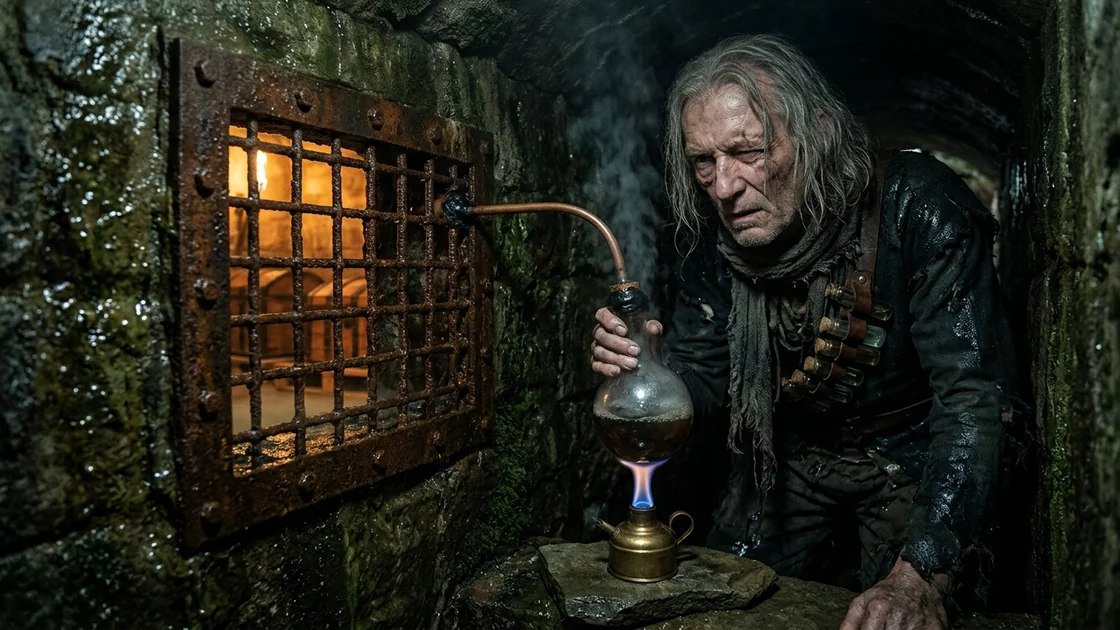
Vaelen reached into his night-soil barrel and pulled out not filth, but a leather harness containing three heavy glass flasks, each stoppered with beeswax and bladder-skin, along with a compact brass spirit-lamp, a copper condensing coil, and a short-handled mason’s hammer.
Strapping the harness carefully across his narrow chest, Vaelen waded into the freezing, waist-deep water of the river. The cold bit through his frayed trousers instantly, making his old joints lock with a sharp, blinding agony that forced a gasp from his throat. He bit down hard on the end of his woolen scarf until the taste of blood filled his mouth, forcing his stiff legs to move forward until he was pressed against the slimy iron bars of the grate.
He felt beneath the dark water with his left hand. One bar from the left wall. Two. Three.
His fingers found the telltale notch he had filed into the iron three decades ago. Now, after thirty more years of acid waste washing over it from his own sinks above, the bar was barely as thick as his thumb and pitted like a sponge.
Vaelen drew the mason’s hammer from his belt, braced his shoulder against the stone arch, and struck the notched bar beneath the water with every ounce of strength left in his withered frame.
Clack.
The sound was muffled by the river. He struck it again. And a third time.
With a dull snap, the rotten pig-iron sheared at the bottom mortise. Vaelen wedged the flat claw of the hammer into the gap and pulled backward, throwing his entire weight against the lever. The top of the bar bent with a screech of flaking rust, opening a gap barely fourteen inches wide.
For a well-fed courtier—for Julian, with his broad shoulders and velvet doublets—the gap would have been impassable. For Vaelen, whom six weeks of starvation in the Shambles had pared down to bone, gristle, and spite, it was just wide enough.
He turned sideways, exhaled all the air from his lungs, and squeezed himself through the jagged iron teeth, careful above all else to protect the glass flasks strapped to his chest. The rusted iron tore a long, deep furrow across the skin of his lower back, the dirty river water instantly setting the wound on fire, but Vaelen did not flinch. He was inside.
He hauled himself out of the river current onto the sloping stone floor of the drain tunnel and lay there for a moment in the pitch blackness, panting, listening to the roar of his own blood in his ears.
Then, he began to climb.
The tunnel was four feet high, forcing him to crawl on his hands and knees over a slick, centuries-old crust of chemical sediment—green copper salts, yellow arsenic cake, and slimy black moss that thrived in the dark. The air smelled of his own past: forty years of discarded experiments, failed elixirs, and washed-out crucibles. In the absolute darkness, he did not need eyes. He knew the anatomy of this stone beast better than his own body.
Fifty yards to the first cistern bend, he counted in his head as his scraped knees bled through his breeches. One hundred yards to the junction beneath the buttery.
Every twenty paces, he had to pause to let the spasms in his back subside, pressing his cheek against the cold, slimy stone while above him, through twenty feet of solid granite, he could feel the faint, rhythmic thudding of the mercenary war-drums beating in the outer courtyard.
After an hour of agonizing ascent, the tunnel narrowed further, branching into two smaller conduits. The left conduit angled sharply upward toward his old, ruined laboratory—now silent and dead, for Julian had moved his operations to the grander, airy halls of the Mint Tower where he did not have to smell the earth.
The right conduit leveled out, running dry and warm.
Vaelen crawled into the right branch. Almost immediately, the temperature rose. The damp river chill vanished, replaced by a dry, dusty warmth.
Here, the castle architects of the first dynasty had channeled the natural hot springs that bubbled deep beneath the crag, running terracotta flues through the foundation walls to keep the lower dungeons and the Royal Treasury free from the moisture that rotted parchment and rusted armor.
Vaelen crawled another forty yards until his outstretched hand struck a solid wall of dressed limestone blocks. Set into the center of the wall was a bronze grate, twelve inches square, secured with four heavy lead rivets.
Light spilled through the bronze lattice—a dim, steady amber glow. And with the light came the sound of voices.
Vaelen froze, extinguishing his breath, and slowly, silently inched his face up to the bottom corner of the grate.
He was looking out from a ventilation shaft set at floor level into the side of the Great Vault of Oakhaven.
The room beyond was cavernous, its vaulted ceiling supported by squat, massive pillars of black basalt. Iron cressets filled with whale-oil burned on the walls, tended by two bored halberdiers in the scarlet-and-black livery of the Household Guard, who stood beside the massive, wheel-locked steel vault door at the far end of the chamber, twenty paces away.
Between Vaelen’s grate and the guards lay the ransom of a kingdom.
There were no coins here—the coins had been for the rabble in the streets. Here lay the heavy bullion demanded by the warlords. Eight hundred iron-bound oak chests stood in neat, military rows upon wooden pallets, their lids thrown open after the evening tally so the Royal Clerks could affix the wax seals at dawn. Inside each chest, stacked like cordwood, gleamed bars of gold, each the size of a mason's brick, stamped with the seal of the Rising Sun and the personal cipher of Julian, Grand Artificer.
Forty tons of it. It filled the subterranean room with a false, captive sunlight that made the air itself look yellow.
And standing right in the center of the room, running a gloved hand admiringly over the nearest pyramid of ingots, was Julian.
Vaelen’s teeth ground together so hard a molar cracked.
Julian was magnificent. He wore a surcoat of silver brocade trimmed with white ermine—royal furs that Vaelen had never been permitted to wear in forty years of service. A rapier with a swept hilt of chased gold hung at his hip, and his dark curls were perfumed with civet and cloves, an odor so strong it reached Vaelen through the grate, warring with the whale-oil smoke. Beside Julian stood Lord Vane, the Chamberlain, holding a leather-bound ledger, and a colossal man in wolf-skin pelts and blackened plate armor—Kaelen, High Marshal of the Iron Hounds of Karth.
"Forty-two thousand pounds Troy," Julian was saying, his voice echoing richly off the basalt pillars. He rapped his knuckles against the top ingot of a stack. "Every bar assayed at nine-hundred-and-ninety-five parts fine. Three months ago, my predecessor told the Council that the Royal Mint could not produce ten hundredweight by spring. He was wedded to the old, superstitious ways—waiting for the stars to align, praying over cold retorts while the kingdom’s enemies sharpened their swords."
General Kaelen grunted, stepping forward. The mercenary warlord reached out with a scarred, mail-clad hand and lifted one of the thirty-pound ingots effortlessly. He turned it in the torchlight, squinting at the bright metal with the practiced suspicion of a man who had been paid by twenty different kings in twenty different currencies.
"It is very bright, Artificer," Kaelen rumbled, his accent thick with the guttural vowels of the eastern steppes. "Brighter than the river-gold we took from the Duke of Cleves last summer. My smiths say gold this yellow is sometimes puffed up with brass and zinc."
"Your smiths are welcome to melt any bar in this vault, Marshal," Julian smiled smoothly, spreading his hands. "In fact, they already did this afternoon, did they not? Five bars chosen at random, boiled in aqua fortis, beaten flat on the anvil, and weighed in the hydrostat. Did they find a single grain of zinc?"
"No," Kaelen admitted grudgingly, dropping the heavy bar back into the chest with a dull, satisfying thud. "It passed the acid. It passed the scales. My men are satisfied. At the first stroke of the cathedral bell at dawn, my wagon-masters will back the teams into the courtyard. When the last chest clears the barbican gate, my forty thousand lances will cross the river and burn the Northern Marches to ash for your King."
"And if the chests are a single hour late?" Lord Vane asked dryly, closing his ledger.
Kaelen looked at the Chamberlain with cold, yellow eyes. "My men have been camped in your mud for ten days on half-rations, Lord Vane, smelling the roast beef from your city walls while your King feasts. If that gold is not on my wagons when the sun clears the hills, we will not march north. We will march through your inner gate and take our pay directly from your palaces, your churches, and your wives' necks. Goodnight, gentlemen. Have the lifters ready at five."
The massive warlord turned on his heel, his heavy iron spurs ringing against the stone floor as he strode out through the great vault door.
Lord Vane let out a long, shaky breath once the mercenary’s footsteps had faded up the stairs. He turned to Julian, his narrow face pale. "A charming savage. You are certain the metal will hold its luster during the march, Julian? I noticed some of the scrap-ings left in the Mint crucibles yesterday had turned a rather peculiar shade of grey."
Vaelen, pressed against the dark side of the bronze grate, stopped breathing.
Julian’s smile tightened for a fraction of a second—a tiny flicker of irritation that Vaelen knew all too well.
"Crucible slag is always grey, my Lord," Julian lied effortlessly, dusting an imaginary speck from his ermine cuff. "It is the dross of the base metals that I have purged from the gold. The bullion itself is eternal. Have the guards seal the vault for the night. I must return to my chambers; the King wishes me to ride beside him at the head of the column tomorrow."
"Of course, Grand Artificer," Vane bowed slightly. "You have saved the realm. The King speaks of granting you the Barony of West-Reach once the northern iron-mines are captured."
"West-Reach has excellent hunting," Julian murmured pleasantly.
They walked out together. The two halberdiers stepped through the threshold after them. With a deep, hydraulic groan, the two-foot-thick steel door swung shut. The massive locking bolts—fourteen cylinders of hardened steel as thick as a man’s thigh—slid into the stone jambs with a booming clank that shook the dust from the ceiling. The wheels were spun from the outside.
The Great Vault was sealed. Inside, the whale-oil cressets burned unattended, casting long, motionless shadows across the eight hundred open chests of unstable gold.
In the pitch dark of the ventilation flue, Vaelen slowly unstrapped the leather harness from his chest.
He did not need to break the bronze grate. The gaps in the lattice were an inch wide—more than enough to pass the half-inch copper tube of his condenser coil through.
Working with the silent, methodical precision that forty years at the workbench had drilled into his soul, Vaelen set up his final apparatus in the cramped, two-foot-wide stone shaft. He did not rush. He did not let the trembling of his exhausted muscles or the burning pain in his torn back hurry his fingers by a single second. Alchemy did not forgive haste; Julian was about to learn that lesson on a scale the world had never seen.
Vaelen placed the flat-bottomed boiling flask on its brass tripod. With a wooden funnel, he poured the contents of the three sealed jars into the belly of the glass. The dark, oily liquid—the Saturnine Phage—gurgled softly, already smoking slightly as it hit the warm air of the geothermal flue.
Next, he fitted the cork stopper and the curved copper neck of the distillation coil into the top of the flask, sealing the joint with a paste of linseed meal and beeswax he had chewed soft in his mouth during the climb. He pushed the far end of the copper pipe four inches through the bronze grate, angling it slightly downward toward the stone floor of the vault.
Finally, he struck a flint against steel—once, twice—catching a spark on a bit of char-cloth, and lit the wick of the spirit-lamp beneath the flask.
A clean, blue flame of pure alcohol bloomed in the dark tunnel, illuminating Vaelen’s hollowed-out, spectral face. He looked like one of the carved stone saints on the cathedral facade after three centuries of acid rain had washed away the mercy from its features.
Within three minutes, the black liquid in the flask began to simmer. Tiny bubbles of greenish-gray gas rose through the viscous broth, climbing into the neck of the glass and entering the copper pipe.
Vaelen watched through the bronze lattice.
From the tip of the copper pipe protruding into the vault, a single drop of heavy, dark condensation fell, hitting the flagstones with a tiny hiss. Immediately after it came the vapor.
It did not rise toward the vaulted ceiling. Heavy with atomized antimony, mercury, and sulfur-rot, the gas poured out of the pipe like invisible molasses, pooling on the stone floor of the treasury in a flat, shimmering layer no thicker than a carpet. Slowly, pushed by the steady pressure of the boiling flask behind the grate, the heavy vapor crept outward across the flagstones.
It reached the base of the nearest wooden pallet.
Like a rising tide in a subterranean cavern, the invisible mist deepened—two inches, six inches, a foot—until it lapped against the iron-bound bottom of the lowest oak chest. It found a gap between the floorboards of the chest where the seasoned oak had shrunk. It seeped inside.
For five minutes, the vault remained utterly silent, bathed in its warm, golden glow.
Then, from the bottom of the nearest chest, came a sound.
Tick.
Vaelen closed his good eye and leaned his forehead against the warm bronze grate, listening as a symphony conductor listens to the first violin take the pitch.
Tick-tick. Crk.
A faint wisp of grey smoke curled up from the open top of the first chest, carrying that sweetish, rotten-garlic stench. One of the lower ingots had just been kissed by the phage.
As the molecular lattice of that first thirty-pound bar collapsed, the immense internal tension of Julian’s rushed transmutation snapped all at once. The bar swelled by a quarter of an inch, cracking the wooden side of the chest with a sharp report like a snapping branch, and exhaled a massive lungful of secondary gas straight up through the stack of ingots above it.
Crack-crack-crack-crack!
Now the sound was like dry pine branches being thrown onto a roaring bonfire. The top ingots of the first chest turned from blinding solar yellow to dull, greasy slate-gray before Vaelen’s eyes. Frost-like dendrites of lead-rot raced across the stamped seals of the Rising Sun, eating Julian’s personal cipher in seconds.
And from the mouth of that first ruined chest, a thick, rolling cloud of greenish-gray fog boiled over the rim and cascaded down onto the floor, rushing outward in all directions toward the other seven hundred and ninety-nine chests.
The chain reaction had begun.
Snap! Crunch! Crack-ack-ack!
Chest after chest caught the plague. Ten chests. Fifty chests. Two hundred. The sound inside the sealed vault grew from the crackle of a fire to the roar of a rockslide. Oak staves splintered as the expanding, rotting lead-bars swelled inside their iron bands. The whale-oil lamps on the walls began to gutter and turn green as the sulfur-heavy gas displaced the oxygen in the lower half of the chamber.
The golden light of the room died, swallowed row by row as the tide of gray blight swept from the front of the vault to the back. Within fifteen minutes, the brilliant treasure of Oakhaven looked like eight hundred boxes of burnt charcoal and grey river-silt.
Vaelen blew out his spirit-lamp. He did not bother to pack the glass flask or the copper coil; let them find the tools tomorrow, when they broke down the walls to see how a god had been murdered.
Slowly, painfully, the old alchemist turned around in the narrow dark tunnel and began to crawl back toward the river.
Dawn broke over the War-Plains in a smear of thin, watery red that promised wind before noon.
The great field half a mile north of the city walls was a sea of iron and canvas. Forty thousand mercenaries stood drawn up in massive, dark squares—pike-blocks from the Low Countries, crossbowmen from the southern republics, and at the vanguard, ten thousand mounted lancers of the Iron Hounds, their horses blowing plumes of white steam into the crisp morning air.
Between the mercenary army and the open gates of Oakhaven stood the Royal Pavilion, a structure of crimson silk and cloth-of-gold, flanked by a thousand knights of the realm with banners snapping in the breeze.
And in the center of the trampled dirt space between the two armies stood eighty heavy four-wheeled baggage wagons, drawn up in two long lines. The sweat was still drying on the flanks of the dray-horses that had hauled the chests up from the citadel dungeons in the dark hour before sunrise. Because the chests had been nailed shut and sealed with the Royal Wax by lantern-light in the misty, sulfur-smelling vault—a smell the coughing guards had blamed on the geothermal vents acting up—not a single human eye had looked inside the boxes since Julian and Kaelen had left them the night before.
Vaelen stood on a low rise near the edge of the city ditch, mingled with ten thousand townsfolk, beggars, and guild-masters who had come out to watch the grand spectacle of the King buying his victory. Vaelen had washed the river-mud from his face at a horse-trough and wrapped himself in a clean grey wool blanket Mira had given him. He leaned heavily on an ash stick, his weeping eye fixed steadily on the crimson pavilion.
A fanfare of silver trumpets shattered the morning chill.
Out from the pavilion rode King Malakor on his great black destrier, his crown forged directly into the brow of his steel great-helm. To his left rode Lord Vane. To his right, dazzling in his white ermine and silver brocade, rode Julian. The young Artificer sat tall in the saddle, his chin high, looking out over the sea of forty thousand spears that his genius had summoned.
From the mercenary lines, General Kaelen rode forward with a dozen of his scarred captains and four men wearing the leather aprons of camp-assayers, carrying iron crowbars and balance scales.
They met beside the lead wagon. Even from two hundred yards away, across the hush that had fallen over the vast plain, the voices of the principals carried clearly on the morning wind.
"Forty-two thousand pounds of the Sun’s metal, Marshal Kaelen!" King Malakor roared, gesturing with his mailed fist toward the line of eighty wagons. "Sealed by my Chamberlain, certified by my Grand Artificer! Take your tally, sound your horns, and cross the river!"
Kaelen dismounted, his heavy boots squelching in the mud. He looked up at Julian, who offered the warlord a gracious, slightly patronizing nod from the back of his white stallion.
"Open the first three wagons," Kaelen barked to his assayers. "And the last three in the line."
An assayer stepped up to the lead wagon, jammed the claw of his iron crowbar beneath the nailed lid of the nearest oak chest, and wrenched downward.
The wood did not creak; it seemed strangely warped, the iron bands straining outward as if the contents had swollen during the night. With a sharp screech of drawn nails, the lid popped off.
A puff of heavy, greenish-gray dust billowed out into the morning air. The assayer coughed violently, waving a hand in front of his face as the foul odor of rotten garlic and graveyard damp hit his nostrils.
The assayer looked down into the chest. He froze.
"Well?" General Kaelen demanded, stepping up to the tailboard of the wagon. "Weigh the top bar, man!"
"My Lord Marshal..." the assayer stammered, his voice cracking in terror. "There... there are no bars."
Kaelen shoved the man aside and vaulted onto the bed of the wagon.
Down the line, at the second, third, and eightieth wagons, the other crowbars were prying off lids. And from every wagon rose the same baffled, horrified murmurs, followed by coughing as the trapped sulfur-gas escaped into the wind.
On the horse beside the King, Julian’s serene smile vanished. He stood up in his stirrups, craning his neck to see into the open box. "What do you mean, no bars? I watched them stacked myself at midnight!"
General Kaelen reached into the open chest. When his mail-clad hand emerged, he was not holding a gleaming brick of royal gold.
He was holding a jagged, misshapen lump of porous, dark-gray slag that looked like a piece of rotten pumice or a wasp's nest made of lead. Even as the warlord held it up to the pale morning sun, the bottom half of the lump broke off under its own weight, falling onto the wagon floorboards and smashing into a pile of greasy black powder.
A dead, suffocating silence fell over the War-Plains. Not a horse neighed; not a banner seemed to flutter.
"What is this?" Kaelen whispered, though the whisper sounded like two millstones grinding together. He crushed the remaining grey lump in his iron gauntlet. Soft, brittle flakes of crystalline lead rained down between his fingers like dead ashes. "What is this filth?"
"That's impossible!" Julian shrieked, his voice losing all its courtly smoothness, cracking like the voice of the twelve-year-old boy from the tin-lines. He flung himself off his white horse, stumbling in the mud as his silver cloak dragged through the mire, and scrambled up onto the wagon beside the warlord.
Julian stared down into the chest. The eighty bars of gold were gone. In their place was a solid, swollen mass of corroded, grey-black lead-antimony crust, cracked down the middle like overbaked clay.
"No," Julian gasped, plunging his bare hands into the grey dust, clawing through it as if the gold were merely buried beneath. His manicured fingernails tore and blackened on the sharp, brittle crystals. "No, the fixation held! The acid test passed! It's the air—the morning damp—it's just a surface tarnish!"
He grabbed a half-intact brick from the bottom of the chest and tried to scrape it against the iron rim of the wagon wheel to reveal the yellow metal beneath. The brick simply shattered in his hands, leaving him holding two pathetic shards of dull grey stone, his white ermine sleeves coated to the elbows in black lead-soot.
Down the line of wagons, the mercenary captains were shouting now. Dozens of chests were being tipped off the tailboards, crashing into the mud and bursting open like rotten melons, spilling tons of worthless, crumbling grey slag across the trampled grass.
"Treachery!" a captain roared from the rear wagons, drawing his broadsword. "It's painted dross! It's slag from the lead-smelters!"
"You sought to cheat the Iron Hounds with alchemist’s dung!" General Kaelen bellowed, his face purple with a rage that was magnificent and terrible to behold. Before Julian could even look up from his blackened hands, Kaelen’s mailed fist shot out and seized the young Artificer by the gold chain of office around his neck.
"Wait!" Julian choked, his feet kicking in the air as the giant mercenary lifted him off the wagon bed by the collar. "Your Majesty! Tell him! It was gold at midnight! The formula—Vaelen’s Codex—the Citrinitas salt—"
In his blind panic, screaming for his life, the truth spilled from Julian’s lips before he could stop it.
"I didn't have time for the salt!" Julian wept, clawing at Kaelen’s iron wrist. "It takes seven weeks! The old man wrote that it takes seven weeks to fix the lead! It was Vaelen's formula! I only skipped the bath!"
King Malakor sat frozen on his black warhorse, staring down at the boy in silver brocade, then at the eighty wagons of gray dirt, and finally out at the forty thousand heavily armed, unpaid mercenaries whose pikes were dropping simultaneously to the charge position with a sound like a forest of pine trees snapping in a gale.
The King did not even draw his sword to defend his Grand Artificer.
"He lied to us both, Marshal," King Malakor said, his voice hollow beneath his iron helm as he reined his horse backward toward the safety of his household knights. "He is yours. We will pay you in land and silver plate from the churches. Give me three days—"
"I will take the plate myself!" Kaelen roared.
With a savage twist of his arm, the warlord hurled Julian down from the wagon into the mud under the hooves of the mercenary vanguard, then drew his massive two-handed greatsword and pointed it straight at the open gates of Oakhaven.
"Sound the charge!" Kaelen screamed. "The city is open! Three days of sack for every man! Take your gold from their vaults and their throats!"
Ten thousand war-horns blew at once. The earth shook as forty thousand men roared in unison and surged forward like a breaking dam.
Julian tried to crawl back toward the royal lines, his silver cloak tangled around his knees, screaming the King's name, before the iron-shod hooves of the first rank of Karthian lancers went over him, trampling the Grand Artificer and his spilled chests of brittle lead down into the same indistinguishable red mud.
Up on the low rise by the ditch, the crowd of townsfolk was already screaming, scattering in blind terror back toward the slums as the King's outnumbered knights broke upon the mercenary pikes like glass against iron. Within minutes, the first black plumes of smoke began to rise from the rich merchant villas outside the curtain wall.
Corvus Vaelen did not run.
He stood leaning on his ash stick for a long moment, watching the distant, glittering line of lancers sweep past the overturned wagons and pour through the Northern Gate toward the high towers of the palace. The morning wind blew a cloud of fine, grey dust from the shattered chests across the field. A few microscopic flakes of it drifted up the hill and settled upon the sleeve of Vaelen’s rough wool blanket.
He lifted his scarred hand and brushed the lead dust away.
"Seven times the White Swan must weep, boy," the old man murmured to the wind. "You cannot rush the earth."
He turned his back on the burning city, adjusted the small bundle of glass vials and dried herbs strapped to his shoulder, and began to walk slowly down the southern road, toward the quiet hills where the tin-miners worked, and where a man who knew how to mend iron pots and cure the shaking-sickness could always find a warm fire for the winter.