The Roots of the Salt-Water Fleet
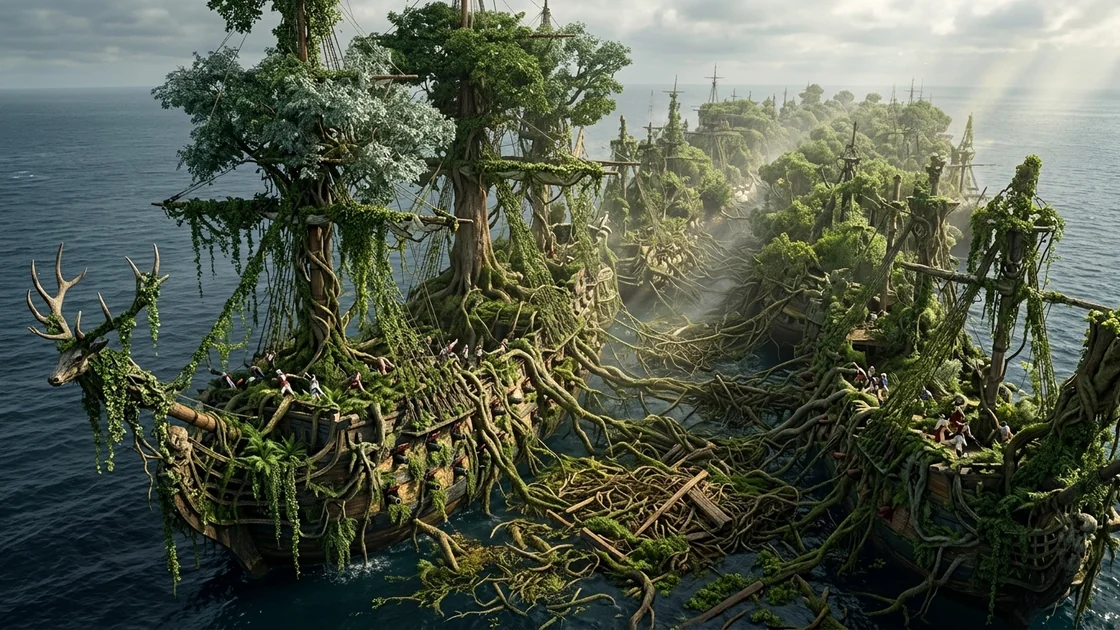
In this tale, an ancient forest deity named Vaelor awakens from a century-long winter slumber only to discover that his sacred, primordial grove has been completely clear-cut by an expanding human empire. The priceless, semi-immortal timber has been hauled to the coast to construct a massive armada designed for global conquest. Driven by a quiet and terrible vengeance, the deity follows the remnants of his murdered trees to the shipyards, embedding his own life force into the flagship before the fleet sets sail. Once the armada reaches the deepest, most isolated expanse of the ocean, Vaelor awakens the dormant wood, causing the hulls, masts, and decks of a hundred warships to violently sprout roots and foliage, transforming the instruments of war into a drifting, pelagic forest that consumes its creators.
The sleep of a god who measures time in the rings of ironwood is neither brief nor shallow. Vaelor had gone down into the dark loam beneath the Mother-Tree when the first frost of the Long Cycle silvered the ferns. He had folded his long, bark-sheathed limbs into the cradle of her taproots, slows his heart to the pace of dripping pitch, and let the mycelium weave a shroud of pale velvet over his closed eyes. In that subterranean dark, he dreamed the slow dreams of minerals dissolving in rainwater, of worms turning the rich black soil, of a thousand autumns shedding their copper and gold to feed the dark. He was the Marrow-King, the quiet breath between the leaves, and for a hundred human years, the world above him was nothing more than a faint rhythmic pressure of snow and thaw.
He did not wake to the song of the thrush, as he had in ages past. He woke to a terrible, blinding heat on his face.
Wait—not heat. Light. Raw, unfiltered, violent sunlight, striking the soil directly where no sun had touched for ten thousand years.
Vaelor gasped, and the sound was like dry branches snapping in a gale. He pushed upward, his antlered head breaking through the crust of the earth, expecting the cool, emerald twilight of the Aethelgard. He expected the cathedral vault of the Silver-Boughs, whose lowest branches hung a hundred feet above the moss, and the vast, corrugated pillars of the Elder Oaks that had drunk the rain since the world was young. He expected the thick, damp perfume of decaying needles, crushed mint, and bracket fungi.
Instead, he breathed in dust, woodsmoke, and the sharp, sour tang of spilled oil.
Vaelor rose to his knees, shedding clods of dry, baked dirt from his shoulders. His skin, which resembled the gray, braided bark of a hornbeam, cracked as he straightened his spine. He blinked eyes of liquid amber against the glare of an empty sky. Around him, as far as the horizon allowed, the valley was naked.
The Aethelgard was gone.
Where the sacred grove had stood—three leagues of unbroken, primeval canopy—there was only a wasteland of pale, weeping stumps. Thousands upon thousands of them stretched across the rolling hills like the broken teeth of a slaughtered leviathan. The ground between them, once a sponge of emerald sphagnum and delicate wood-sorrel, had been churned into a hardened labyrinth of ruts by iron-shod wheels and the hooves of heavy draft beasts. The air was dead. Without the millions of transpiring leaves to breathe moisture into the sky, a dry, sterile wind scoured the valley, lifting clouds of yellow sawdust that stung Vaelor’s eyes.
He looked down at the earth between his knees. The great cradle of roots in which he had slept—the base of Ygg-Vael, the Mother-Tree, whose trunk had required forty men linking hands to encircle—was a flat, circular platform of raw yellow heartwood thirty paces wide. Across its surface ran the coarse, rhythmic scars of a massive two-man crosscut saw, greased with tallow and bacon fat to keep the blade from binding in the sacred sap.
Vaelor placed his long, four-fingered hand upon the stump. The wood was warm from the sun, but beneath that superficial heat, it was cold with shock. The roots below were still alive, still blindly pumping water and dissolved stone up from the deep aquifers, only for that vital fluid to pool upon the severed surface, thickening into amber clots that attracted swarms of black flies. The tree did not know it was dead. Its underground half was still trying to feed a crown that was no longer there.
A sound escaped Vaelor’s throat—not a roar, for trees do not roar, but a low, resonant groan like an ancient elm twisting in a winter storm before it splits down the middle.
He stood up. He was nine feet tall in his true form, gaunt as a winter birch, with a rack of silver-barked antlers rising from his brow like frost-covered boughs. He walked among the stumps, his bare, root-toed feet sinking into the dried mud of the skid-roads. With every step, he read the massacre in the detritus left behind. Here was the black ash of fires where the loggers had burned the smaller branches and foliage—the crown-wood that had no value to them. Here were discarded wedges of cold-forged iron, their heads mushroomed by the blows of heavy sledges. Here were the corpses of the forest’s small children: badgers crushed in their setts by falling giants, owls starved in the dust, dryads who had withered into heaps of brittle brown leaves when their home-trees were felled, their life-threads cut by the bite of steel.
At the western lip of the valley, where the river Elowen had once murmured through a tunnel of weeping willows, Vaelor found the stone boundary marker. For twelve centuries, that mossy obelisk had stood as the pact between the Marrow-King and the first kings of men. Take the deadfall, the runes upon it had read. Take the wind-thrown and the lightning-struck at the forest’s edge. Bring no iron past the stone, and the river shall never flood your fields, nor the blight touch your grain.
The obelisk had been pulled down with chains. Its face was shattered by sledgehammers, its fragments used to fill a mud-hole so the timber-wagons would not bog down on their way to the river.
Vaelor knelt beside the water. The Elowen, once so clear that one could count the trout-spots on the pebbles twenty feet down, was choked with bark-slabs, sawdust, and greasy grey foam. Yet in that turbid water, Vaelor tasted a trail. He dipped his fingers into the current and brought them to his lips. Beneath the taste of iron, horse dung, and coal-smoke, he tasted the unmistakable, resinous blood of Ygg-Vael and her ten thousand sisters. They had been floated down the river during the spring floods, bound together in great rafts, driven toward the sea.
The men who had done this thought the trees were dead. They thought that once a trunk was felled, stripped of its bark, and sawn into baulks, it became mere matter—inert, obedient, and silent.
They did not understand the Aethelgard. The trees of the sacred grove were not common pine or field-oak. They had grown for millennia with their roots braided around a sleeping god. Every cell of their cambium, every vessel of their xylem, was saturated with Vaelor’s own immortal ichor. They did not die when they were cut; they merely entered a terrible, parched stasis, waiting for the spring.
Vaelor looked down at his own body. To walk in the world of men, he could not wear the aspect of the antlered giant; they would set upon him with fire and pikes before he ever reached his children. Slowly, painfully, he drew his bulk inward. The antlers retracted into his skull with the sound of sliding wood; his height compressed, the grey bark of his skin softening into the weathered, leathery hide of an old, sun-beaten woodsman. He wove a cloak from the dead, browned ferns at the river’s edge and took up a staff of split heartwood that the loggers had cast aside as scrap.
Then, with the slow, tireless stride of a root seeking water through solid rock, the god set off down the river toward the salt sea.
One hundred miles south, where the Elowen widened into a muddy estuary, the city of Castamar rose beneath a permanent shroud of coal-smoke and sea-fog. At its heart lay the Royal Naval Yards of Iron-Bight—three miles of stone drydocks, towering timber-cranes, pitch-boilers, and rope-walks that thundered day and night with the industry of an empire preparing for total war.
Master Shipwright Orin Malakor stood upon a high wooden scaffolding, a brass calliper in one hand and a roll of calfskin vellum in the other, looking down into the belly of Dock Number One. Below him, three hundred carpenters, sawyers, and caulkers swarmed over the skeletal ribcage of the greatest vessel ever conceived by the mind of man: the Imperator, a first-rate ship of the line designed to mount one hundred and forty bronze cannon across four decks.
"Look at the grain on that keelson, my lord," Malakor said, his voice swelling with professional pride as he gestured with his callipers toward the massive, single-piece beam that formed the spine of the ship. "One hundred and eighty feet of continuous, knot-free heartwood. Not a scarf-joint in the entire length. Before we broke the treaty of the North Valley, we would have had to splice four separate oaks together with iron fish-plates to achieve a keel of that dimension, and it would have hogged in the first heavy gale."
Beside him on the platform stood Grand Admiral Helion Vance. The Admiral was a tall, blade-thin man encased in a coat of pristine navy-blue wool stiff with gold bullion at the cuffs and collar. He held a scented linen handkerchief near his nose to ward off the stench of boiling Stockholm tar and the sweat of the laborers below. His eyes, pale and grey as winter ice, surveyed the shipyard not with the wonder of a craftsman, but with the cold arithmetic of a conqueror.
"And the weight, Malakor?" Vance asked, his voice crisp and clipped. "The Ministry of Ordnance was concerned that timber of such density would sit too low in the water, bringing the lower gun-ports perilously close to the waterline."
"A marvel of nature, Admiral, though I am not a man given to superstition," Malakor replied, tapping the wooden railing of the scaffold. "When we felled these trees in the Aethelgard, they were heavy as lead—so dense our best Sheffield saws lost their teeth in an hour. We had to bring in steam-driven circular blades from the ironworks to mill them. Yet once the wood was seasoned over the winter kilns, it retained the hardness of cast iron while shedding nearly half its weight. A musket ball fired at twenty paces merely flattens against a two-inch plank of this Silver-Bough. With six inches of the Elder Oak forming the hull strakes, the Imperator will shrug off twenty-four-pound roundshot as if they were hailstones."
Vance lowered his handkerchief slightly, a thin, bloodless smile touching his lips. "And the rest of the fleet?"
"Ninety-nine vessels across the slips," Malakor said, sweeping his arm across the sprawling vista of the yards. Through the smoke of the tar-pots, the ribs of dozens of frigates, corvettes, bomb-ketches, and troop transports rose like the bleached skeletons of beached whales. "Every single one framed and planked from the valley timber. There was enough wood in that single forest to build an armada that will last three hundred years without dry-rot or shipworm. The teredo worms won't touch it, my lord. We submerged a test block in the southern marshes six months ago; every snail and borer that bit into the bark died of some natural toxin in the sap."
"Good," Vance said, turning away from the rail. "The Southern Archipelagos have relied upon their reefs and their fire-ships to keep our merchantmen paying tribute for a century. By midsummer, we shall sail straight through their defensive cordons. Let them throw their Greek fire at timber that refuses to burn."
Down on the floor of the drydock, beneath the shadow of the Imperator’s towering stern-post, a nineteen-year-old apprentice carpenter named Jonas Pike was having a very different experience with the wood from the northern valley.
Jonas was on his knees in the bilge, the darkest, narrowest part of the ship’s interior, where the massive curved futtocks—the ribs of the vessel—met the keelson. His job was to bore one-inch holes through the overlapping planks with a heavy hand-auger so that the trunnion-gangs could drive home the long wooden treenails and copper bolts that held the hull together.
His shoulders ached with a dull, fiery pain, and his palms were a ruin of broken blisters. The wood was wrong. He had worked on common English oak, Baltic fir, and southern cedar since he was twelve years old, and he knew the feel of dead timber. Dead timber had a grain that yielded in dry, predictable curls when the auger bit was sharp. It smelled of sawdust, tannin, and the drying sheds.
This wood smelled like a butcher’s shop made of flowers.
Every time Jonas leaned his chest against the brace of the auger and turned the handle, the steel bit groaned with a high, tortured squeal, and out of the hole came not dry shavings, but damp, fibrous coils the color of fresh venison. And with the shavings came a thick, viscous fluid that was neither water nor pitch. It oozed over his knuckles, warm—distinctly, impossibly warm, like the belly of a living dog—and smelled overpoweringly of crushed green leaves and rainwater.
"Curse this devil’s timber," muttered Barnaby, an older journeyman working six feet away, his hammer ringing dull and flat against the head of a copper bolt. "Look at this, Jonas. I drove this pin flush at dawn before the breakfast bell. Look at it now."
Jonas wiped the sweat from his forehead with the back of a sap-sticky wrist and crawled over the ribs, his lantern casting long, swaying shadows across the curved cavern of the hull. Where Barnaby pointed, a massive bronze spike, two inches thick and three feet long, was protruding nearly half an inch from the plank. Around its head, the pale yellow wood was swollen into a tight, puckered ring, like human flesh trying to push out an iron splinter.
"The wood’s green," Jonas whispered, touching the swollen ring. Beneath his calloused fingertip, he swore he felt a faint, rhythmic throb—slower than a heartbeat, more like the heave of the tide against the dock gates outside. "Malakor baked it in the coal-kilns for three months, Barnaby, I saw them load the cars. How can it still be green?"
"It ain't green, boy, it’s bewitched," Barnaby spat into the sawdust, though he glanced nervously up toward the open deck to make sure no gang-bosses were listening. To speak of the Old Gods in the Royal Yards was an offense punishable by twenty lashes at the capstan. "My grandda came from the hill country near the Elowen headwaters. He told me about the Aethelgard. Said no axe had ever tasted those trees since the world was made, and if a man broke a single green bough, his arm would wither to the socket before the moon changed. Now we’ve shaved the whole valley bald like a convict’s head and turned it into gun-decks."
"It’s just trees, Barnaby," Jonas said, though his own right hand throbbed as he spoke. Three days ago, a long, hair-thin sliver of the Silver-Bough used for the upper deck planking had driven itself under the nail of his index finger. He had tried to dig it out with his needle-knife that night in the barracks, but the wood had been too tough to break and too slick to grip with tweezers. Instead of festering with yellow pus as any normal oak splinter would, the skin around it had turned a strange, cool, translucent green, and thin, pale threads seemed to be spreading just beneath his cuticle, painless but immovable.
Barnaby raised his heavy iron maul and struck the protruding bronze bolt with all his strength. The sound echoed through the hollow hull like a gunshot—CLANG!—and a shower of sparks flew as the iron glanced off the bronze without driving it a fraction of an inch deeper. Instead, the wooden rib vibrated with a low, humming resonance that made both men’s teeth ache in their gums.
"See?" Barnaby hissed, nursing his jarred wrists. "It’s drinking the bilge water, Jonas. Rain fell three nights ago before they tarped the main deck. Common oak swells a bit, sure, then dries out. This stuff drank the rain-puddles dry in an hour. There wasn't a drop left for the bailers. And now it’s squeezing the iron out of its bones."
Before Jonas could answer, the midday bell clanged from the yard-house tower, signaling the twenty-minute break for small beer and hard bread. The hundreds of workmen began to clamber up the ladders and gangplanks, eager to escape the stifling, resin-choked air of the ship’s bowels.
Jonas climbed out onto the main wharf, blinking in the grey coastal light. As the men queued by the beer-casks, a commotion near the main iron gates drew his eye. A team of twelve Shire horses was hauling a tremendous flat-bed dray into the yard, its iron tires groaning and cracking the cobblestones. Upon the dray lay the figurehead of the Imperator, newly arrived from the master carvers' guildhall in the upper city.
It was carved from the single largest fork of the Mother-Tree—a piece of wood so dense and twisted with ancient burl that even Malakor’s steam-saws had been unable to plank it. The guild carvers had spent four months with chisels and mallets shaping it into the likeness of a crowned warrior-king, thirty feet long, holding a gilded sword aimed toward the horizon, his wooden cloak flowing backward to merge with the cutwater of the bow. They had painted it in brilliant vermilion, ultramarine, and gold leaf.
Yet as the dray rumbled past the line of workmen, an old man standing at the very edge of the crowd stepped forward, past the marine guards, before anyone could cross a musket to stop him.
Jonas watched him. The old man was extraordinarily tall and stooped, wrapped in a tattered cloak that looked as though it were woven from dead bracken and dried mud. His hair hung in grey, lichen-like mats around a face so deeply lined it looked like the bark of an ancient ash tree, and his eyes were a startling, clear amber that caught the weak sunlight like drops of pine resin.
"Halt there, grandsire!" barked a marine corporal, bringing the butt of his musket down on the cobbles. "King’s Yard! No beggars past the chain!"
The old man did not seem to hear him. He walked with a silent, gliding gait straight to the side of the wagon and laid a long, scarred hand against the gilded cheek of the carved figurehead.
For a second, the noise of the shipyard—the hiss of the steam-engines, the ring of a thousand hammers, the cries of the gulls—seemed to drop away into an immense, suffocating silence. Jonas felt the splinter beneath his fingernail give a sharp, sudden tug, as if pulled by an invisible magnet.
Where the old man’s palm touched the figurehead, the bright gold leaf and red lead paint crackled, blistered, and flaked away in a patch the size of a dinner plate, exposing the raw, pale heartwood beneath. And from that bare patch, a single drop of clear, golden sap welled up and rolled down the carved king’s cheek like a tear.
"Here you are, my heart," the old man whispered. His voice was quiet, barely louder than the rustle of dry leaves in an October gutter, yet Jonas heard every syllable from forty paces away. "They have dressed you in iron and grease, and they mean to drown you in the salt desert. Wait but a little longer. Wait until the deep water is beneath your feet."
The marine corporal grabbed the old man by the shoulder to haul him back. "I said get back, you old lunatic!"
The soldier’s fingers closed on the tattered cloak, and then he yelped, jerking his hand back as if he had grabbed a bush of nettles or blackened hawthorn spikes. When Jonas looked back toward the wagon, the old man was already gone, lost somewhere behind the towering stacks of seasoned planking that lined the slipways. The guards cursed, poked between the timber piles with their bayonets for a few minutes, and then gave up, blaming the trick of the light and the coal-fog.
That night, after the curfew bell had rung and the great iron gates of the Royal Yards were barred, Vaelor walked out from between the drying stacks.
The night watchmen sat around their braziers by the gatehouse, drinking hot gin to keep out the river damp, their dogs whimpering softly at the back of their kennels with their tails tucked tight against their bellies. None of the beasts dared bark as the Marrow-King passed.
He moved from slipway to slipway, a shadow among the wooden titans. At each of the ninety-nine lesser vessels—the frigates Vengeance, Thunderer, and Scourge; the brigs Arrow and Viper; the massive troop-transports made from his perimeter oaks—he paused. He laid his brow against their stern-posts or their rudders. Into each keel, he breathed a single word in the language of the soil, a language older than human tongues, spoken in chemical whispers between root-tips and fungal threads.
Remember, he breathed into the wood. Remember the rain. Remember the dark earth. Sleep until I call.
Deep within the tarred and painted hulls, the dormant cambium shuddered in answer. The kiln-dried cells, which Malakor believed were dead and cured forever, opened microscopic pores, waiting.
Finally, Vaelor climbed the high catwalks of Dock Number One, ascending to the bowsprit of the Imperator. Here, the colossal figurehead of the warrior-king had been hoisted into place and bolted to the stem with iron bands as thick as a man’s thigh. This was the heart of Ygg-Vael, the very wood that had sheltered Vaelor for ten thousand years.
The god looked out over the dark estuary toward the open ocean—a vast, alien wilderness of shifting water where no tree had ever stood since the dawn of the world. To destroy the ships here in the drydock would be a small thing; the humans would simply chop the sprouted hulls to kindling, burn them with coal-oil, and march north to find another forest to butcher. No. Their pride must be allowed to carry them beyond all reach of rescue. Their wooden walls must fail them where there was no stone to stand upon, only the bottomless dark and the cold green water.
Vaelor stepped out onto the narrow curve of the figurehead’s shoulder. He did not carve the wood; he simply pressed his chest against the carved warrior’s chest, laid his cheek against the wooden cheek, and let the boundaries of his physical form dissolve.
With a low, creaking sigh that the watchmen below mistook for the settling of the launch-blocks, the bark of Vaelor’s skin fused with the heartwood of the Mother-Tree. His long limbs sank into the timber; his ribs became the grain of the figurehead’s torso; his spine locked into the stem-post that ran straight down into the giant keelson. Slowly, the crude, arrogant face of the human warrior carved by the guild-masters softened and shifted in the moonlight. The wooden crown twisted into a rack of jagged, sweeping antlers; the painted eyes became deep, hollow knots that stared out toward the horizon with ancient, unblinking patience.
When the sun rose over Iron-Bight the next morning, the shipwrights marveled at how the damp night air had warped the figurehead’s gilding, making the king’s crown look strangely like a stag’s horns. Malakor wanted to take chisels to it to correct the lines, but Admiral Vance forbade the delay. The spring tides were at their height, the wind was blowing fair from the northeast, and the Emperor’s war could not wait upon the vanity of sculptors.
The launching of the Grand Armada of Castamar was celebrated as the triumph of the age. For three days, the church bells of the capital rang without ceasing, and the shores of the estuary were black with half a million citizens waving handkerchiefs and cheering as the hundred ships slid down the greased ways into the grey water.
From the quarterdeck of the Imperator, Grand Admiral Vance looked out over his dominion. It was a floating city of wood, hemp, and bronze. Ten thousand sailors manned the yards and braces; fifteen thousand royal marines in scarlet coats crowded the waist and forecastles; six thousand brass cannons peered from the checkered gun-ports. In the holds below lay enough salted beef, hardtack, gunpowder, and fresh water in iron-bound casks to sustain the fleet for six months without touching land.
"Set topsails and courses!" Vance commanded his Flag Captain, a stocky, red-faced veteran named Harker. "Signal the squadron commanders to form three columns abreast. Course south-southwest, by the compass."
"South-southwest it is, sir!" Harker bellowed through his brass speaking-trumpet.
The drums rolled across the water. A thousand bosun’s pipes shrilled like sea-hawks. Slowly, majestically, acres of white canvas dropped from the yards and bellied out with the offshore wind. The Imperator leaned her massive shoulder into the swell, the water foaming white around her antlered figurehead, and led the ninety-nine ships out past the harbour forts and into the endless expanse of the Great Western Ocean.
For the first three weeks, the voyage was a textbook demonstration of naval supremacy. They left the green coastal waters behind and entered the Blue Reach, where the ocean bottom dropped away to three miles beneath their keels. The winds remained steady, pushing the armada southward toward the equator at six knots.
Yet down in the carpenter’s walk—the narrow, dimly lit gallery that ran around the inside of the Imperator’s hull just below the waterline so that shot-holes could be plugged during battle—Jonas Pike knew that something extraordinary and terrifying was happening to the ship.
It had started in the second week at sea with the sounds.
Every wooden ship talks. A normal ship at sea is a symphony of groans, creaks, and sharp reports as thousands of individual timbers flex and slide against one another under the competing pressures of wind and wave. A good carpenter learns to read those sounds in his sleep; he knows the high-pitched complaint of an over-strained topmast from the rhythmic thump-creak of the rudder-head.
By the twentieth day out of Castamar, the Imperator had stopped creaking altogether.
Jonas walked the dark gallery at midnight, his horn lantern held high, listening. As the great waves rolled under the ship, lifting her four-thousand-ton bulk and dropping her into the troughs, there was no friction between the planks. Instead, there was a single, deep, thrumming hum, as if the ship were no longer built of ten thousand separate pieces of wood bolted together, but had somehow fused into a single, hollow log.
He stopped beside the mainmast step, where the heel of the colossal central mast—four feet thick at the base—rested upon the keelson. He held his lantern close to the seam between the two timbers.
"Merciful heaven," Jonas breathed.
There was no seam.
The tarred oakum that the caulkers had driven between the mast-heel and the keelson with their mallets had been pushed completely out; it lay in black, tarry ribbons on the floor, like shed snakeskin. In its place, pale, cream-colored woody tissue had grown across the gap, seamlessly welding the vertical grain of the mast to the horizontal grain of the keel. Thick, ropy ridges of new bark—silver-grey and glistening with moisture—were curling over the iron mast-bands, swallowing the three-inch bolts the way an old tree in a churchyard swallows an iron fence over a century, except this was happening in days.
Jonas reached out with his right hand. The splinter under his fingernail was no longer a splinter. During the three weeks at sea, a pale, woody pattern like frost on a windowpane had spread across the back of his right hand and halfway up his forearm. It didn't hurt; in fact, that arm felt stronger and more tireless than it ever had in his life, though he kept his sleeve buttoned tight around his wrist so the ship’s surgeon wouldn't see it and amputate the limb for gangrene.
When he laid his palm against the fused base of the mainmast, a sudden rush of sensation flooded up his arm and into his skull.
He did not hear words, but he felt a vast, crushing thirst—and beneath that thirst, a sudden, triumphant discovery. Deep below the three inches of copper sheathing that covered the ship’s bottom, the keel had found a way through the metal. The wood was drinking the sea.
Just then, heavy footsteps echoed down the companionway ladder, and Mr. Craddock, the Imperator’s Warrant Carpenter, ducked his head into the low gallery, followed by the Purser and two marines carrying muskets. Craddock was a grizzled man of fifty who had spent forty years at sea, and his face was grey with a mixture of rage and bewilderment.
"Pike!" Craddock barked, shining his own bullseye lantern into Jonas’s eyes. "What are you skulking about by the main-step for? Come aft to the spirit-room and the main hold. Bring your pry-bar and a heavy adze."
"What’s amiss, Mr. Craddock?" Jonas asked, quickly tucking his right hand into his apron pocket as he fell in behind the older man.
"The water-casks, boy," said the Purser, his voice trembling. "Someone—some mutinous dog—has bored through the bottom of the fresh-water tier. Forty thousand gallons of river water, gone since Tuesday! And the casks are cemented to the deck!"
They descended another ladder into the main hold, the deepest, foulest part of the ship’s belly, just above the stone shingle used for ballast. The smell hit Jonas before he reached the bottom rung. Gone was the normal naval stench of bilge-rot, sulphurous water, and rancid pork fat. The hold smelled like a deep, sunless ravine in the middle of April. The air was thick, humid, and rich with the scent of damp earth, moss, and budding willow.
A dozen seamen stood around the forward water-tier with lanterns, cursing and crossing themselves.
The water supply for the Imperator’s eight hundred men was stored in massive wooden butts and hogsheads, coopered from staves of northern white oak and laid on their sides in long rows upon beds of gravel ballast. Or rather, they had been laid on gravel.
Jonas stepped off the ladder and stared. The underside of every single oak barrel had split open along the stave-joints, not from rot or breakage, but because the wood of the ship’s lower deck framing had reached up and entered them. Thick, pale white rootlets, ranging in size from sewing thread to ships' hawsers, had erupted from the ceiling planks of the bilge, woven themselves through the stone ballast, and pierced the oak casks like thirsty mouths. They had sucked the barrels completely bone-dry. And the barrels themselves, made of lesser oak from the outer fringes of the Aethelgard, had answered the call: their curved staves were sprouting pale, ghostly shoots in the dark, knitting the entire tier of two hundred casks into a solid, tangled wall of living timber.
"Chop it out!" Craddock roared, snatching a broad-axe from a rack on the bulkhead and thrusting it at a burly quartermaster. "It’s some cursed tropical fungus from the ballast stones! Clear those casks before the Captain comes down for rounds, or we’ll all be kissing the gunner’s daughter!"
The quartermaster spat on his hands, stepped up to the tangled mass of roots binding the nearest hogshead, and swung the six-pound steel axe with all his might.
THWACK.
The blade bit half an inch into a root the thickness of a man’s calf and stopped dead, vibrating violently. Before the quartermaster could wrench the axe free, the cut root oozed a gush of thick, milky sap that instantly hardened on contact with the air, cementing the steel blade into the wound. At the same time, a whip-thin tendril hanging from the overhead deck-beam—where no tendril had been a moment before—uncoiled with a sharp, dry snap and wrapped twice around the handle of the axe.
With a sharp crack like a pistol shot, the ash-wood handle of the tool split down the grain, and from the split handle itself, three tiny green leaves popped out against the quartermaster’s knuckles.
The man screamed, letting go of the weapon as if it were red-hot iron, and stumbled backward into the marines.
"It’s in the tools!" the Purser shrieked, backing toward the ladder. "The wood is alive! The devil is in the timber!"
"Silence that man!" a cold voice cut through the panic from the top of the hatchway.
The seamen flattened themselves against the curved ribs as Grand Admiral Vance descended into the hold, accompanied by Captain Harker and four marine officers with drawn pistols. Vance did not flinch at the sight of the ruined water-tier, nor did he cover his nose against the heavy, earthen perfume of the hold. He walked straight to the tangled wall of casks, where the quartermaster’s axe still hung embedded in the white root, its own handle sprouting fresh foliage in the lantern light.
Vance drew his dress sword—a blade of finest Toledo steel—and tapped the taut, woody cable that held the axe. It rang like an iron bar.
"Mr. Craddock," Vance said calmly, though a muscle twitched beneath his left eye. "How much fresh water remains in the upper scuttle-butts and the iron tanks in the lazarette?"
"Eight days on half-rations, my lord Admiral," the Purser stammered from the ladder. "Perhaps twelve if we catch rain."
"And the other ships?" Harker asked in a low voice, leaning close to the Admiral. "The Dauntless signaled at dawn that her rudder had grown stiff in the pintles, and the Gorgon reported her main-deck seams were oozing resin so thick the men’s shoes were being pulled off their feet."
Vance stared at the pale roots in the dark for a long moment. His mind, trained in the rigid certainties of ballistics and geometry, refused to accept the presence of a god. To admit that the forest had followed them to sea was to admit that the world was not a machine to be conquered by iron and fire, but a wild, vengeful thing that held humanity on sufferance.
"It is a botanical parasite native to the unseasoned timber," Vance declared, his voice loud and metallic so that every sailor in the hold could hear him. "Malakor failed to properly kiln-dry the heartwood, and the heat of the southern latitudes has triggered a secondary germination in the sap-wood. Nothing more."
He turned to Craddock. "Mr. Carpenter, you will have the armourer bring down his portable forge and twenty gallons of boiling pitch. What steel cannot cut, fire and hot iron will cauterize. Burn these growths back to the hull planking, and pack the wounds with salt and quicklime. Captain Harker, signal the fleet to reduce water rations to one pint per man per day. We are nine hundred miles from the Southern Archipelagos. If the wind holds, we shall take our water from the wells of the enemy’s capital next week."
"Aye, aye, sir," Harker said, though his eyes lingered in horror on the axe handle, which had now put forth a tiny, pale white blossom in the dark of the bilge.
As the officers filed back up the ladder, Jonas lingered behind in the shadows. He looked down at the white roots drinking from the bilge. They were not stopping at the hull planking. Even as he watched, the massive twelve-inch oak ribs of the Imperator were rippling like muscles beneath bark, pushing downward against the copper plates that sheathed the bottom of the ship.
Fire would not stop this, Jonas knew. You could not burn a forest that had the entire ocean to drink from.
On the twenty-eighth day of the voyage, the wind died completely.
They had reached the center of the Abyssal Reach—a thousand leagues from the nearest continental shelf, where the water beneath them was four miles deep and darker than purple wine. The sky above became a dome of brassy, cloudless glare, and the sea flattened into a sheet of oiled glass that reflected the sun like a mirror of polished steel.
The hundred ships of the Grand Armada lost steerageway. Slowly, inexorably, as if drawn together by some submarine current that defied the laws of fluid mechanics, the three columns drifted inward until the vessels lay within half a cable’s length of one another, their limp sails hanging in dead folds from the yards.
Out on the bowsprit of the Imperator, Vaelor opened his eyes.
For four weeks, merged with the wood of the figurehead, he had endured the scorching sun upon his back and the salt spray upon his face while he worked his slow, quiet alchemy below the waterline. It had required immense patience. Trees of the high valleys were creatures of sweet rain and mountain streams; salt water was poison to their cells, drawing the moisture out of their tissues by osmosis until they withered.
So Vaelor had spent the four weeks re-weaving the cellular architecture of his children. Drawing upon the memory of the ancient mangroves that had rimmed the warm seas in the first age of the world, he had altered the deep vessel-walls of the keels. Now, the wood acted as a vast, living membrane of microscopic filters: the roots drank the brine of the ocean, crystallized the excess salt into dense, rock-hard nodules that lined the bilges like quartz, and pumped pure, sweet, mineral-rich water upward through the frames of a hundred warships.
The armourer’s fires in the hold had been nothing more than a summer brush-fire to an old-growth oak; the wood had simply bled thick, non-flammable sap over the coals, smothering the forges and choking the work-parties with dense green smoke until they fled back to the upper decks.
Now, the water had reached the tops of the masts. The turgor pressure within the hulls was building like steam in a boiler. Every beam, every plank, every gun-carriage, and every oar in the fleet was engorged with life, straining against the iron bolts and hemp rigging that bound them in the shape of human machines.
The sun reached its zenith over the glassy sea. Eight bells sounded across the silent fleet as the watch was changed.
At the prow of the Imperator, Vaelor took a deep breath, drawing the hot tropical sun into himself, and sang the first note of the Song of the Unfurling.
It was not a sound made with vocal cords; it was a vibration that passed down the stem-post, along the hundred-and-eighty-foot keelson, out through the water, and into the hulls of the ninety-nine surrounding ships.
On the main deck of the Imperator, Jonas Pike was standing by the fife-rail when the deck beneath his bare feet suddenly grew hot, then soft as a forest floor, and then violently heaved.
CRACK-BOOM!
The sound was louder than a broadside from all seventy cannons on the larboard side firing at once. Down in the deep dark beneath the ship, the great keelson of the Mother-Tree split its copper sheathing from stem to stern like a cicada bursting out of its dried shell.
Out from the ruptured bottom of the Imperator plunged a taproot forty feet thick, pale as bone and tipped with a cap of hardened ironwood. It drove downward into the purple abyss of the sea with the force of a falling mountain, displacing thousands of tons of water and causing the massive ship to lurch upward five feet out of the swell before settling back with a tremendous, surging wallow.
Not just the taproot. From every rib-joint along the three-thousand-foot perimeter of the fleet’s hulls, lateral roots erupted simultaneously. They shot outward through the clear water like pale, writhing kraken-arms, thirty, fifty, a hundred yards long, seeking each other across the narrow lanes between the becalmed ships.
"To quarters! Man the pumps! We’ve struck a shoal!" Captain Harker’s voice cracked with terror from the quarterdeck as the Imperator shuddered from truck to keel.
"A shoal in two thousand fathoms?!" screamed the Master at the binnacle, staring wildly over the side. "Look at the water! God have mercy, look at the water!"
Jonas ran to the bulwark and looked down. The sea between the Imperator and the seventy-four-gun ship Vengeance was boiling white, not with foam, but with a colossal, sub-surface basketwork of interlocking roots. Even as he watched, a primary root-runner as thick as a mainmast breached the surface between the two ships, arched over the water like the back of a sea-serpent, and drove its tip straight through the open lower-deck gun-ports of the Vengeance.
Inside the Vengeance, men screamed as the root-tip swept across the gun-deck, crushing three brass twenty-four-pounders into splinters and pinning the ship fast to her flagship. Within seconds, a thousand smaller rootlets burst from the main runner, braiding themselves into the Vengeance’s oak frames, welding the two warships together in a wooden embrace that no storm could ever part.
All across the becalmed circle of the armada, the ocean was turning into a solid mat. The frigates, the brigs, the bomb-ketches—all ninety-nine vessels were being dragged together as their subterranean roots found one another, grafted on contact, and contracted like titanic muscles. Hulls ground against hulls with the roar of colliding icebergs, their outer planking fusing where they touched, squeezing the sea out from between them until the hundred ships were no longer a fleet, but a single, sprawling, cellular island two miles wide.
Then, having secured its footing in the deep water, the forest looked toward the sun.
"Aloft there! Clear the rigging!" Admiral Vance roared from the poop deck, his sword drawn, his hat knocked from his powdered head as the Imperator ceased rolling altogether, locked in the rigid grip of the root-mat.
Above them, the three towering masts—the fore, the main, and the mizzen, each rising two hundred feet above the waterline—began to writhe.
The heavy iron bands that held the mast-sections together snapped like dry twine, raining jagged pieces of metal down onto the deck. Freed from their constraints, the masts expanded outward with a groaning roar of multiplying wood. The pale spruce and silver-bough poles thickened to ten, fifteen, twenty feet in diameter, their smooth, greased surfaces fracturing into deep, rugged furrows of living grey bark.
High on the main-topgallant yard, the lookouts clung in terror as the wooden spar beneath their feet suddenly bent upward toward the sky, swelling and forking into a dozen smaller branches. From every square inch of the masts, the yards, and the bowsprit, millions of dormant buds burst through the bark at once.
It was a green explosion.
In the span of three heartbeats, shoots ten feet long unfurled with the wet, snapping sound of shaken sails. Leaves the size of shields—silver on the underside, deep emerald on top—flushed out into the tropical glare, drinking the fierce sunlight. As the branches thickened and multiplied, spreading a hundred feet out over the water on either side of the ship, they tore through the hemp rigging and the canvas sails like cobwebs.
Tons of tarred rope, wooden blocks, and shredded canvas rained down upon the decks, tangling the terrified marines and sailors in a web of falling gear. And wherever a wooden pulley-block or a belaying pin fell upon the deck planks, it did not bounce—it took root on contact, fusing to the deck and sending up its own frantic thicket of knee-high saplings.
"Cut it down!" Vance screamed, his voice rising to a lunatic shriek as a curtain of hanging vines dropped from the cross-trees, obscuring his view of the bow. "Gunners! Load with canister and grape! Fire into the masts! Marines, form ranks and clear the waist with axes!"
On the main gun-deck below, the gun-captains tried to obey. A crew of eight men threw themselves upon the tackles of a thirty-two-pounder cannon, trying to run the barrel back so they could elevate it toward the mainmast.
The gun would not move.
The heavy elm gun-carriage upon which the bronze barrel rested had fused to the deck planks. Even as the gun-captain reached for his priming-iron, the wooden cheeks of the carriage swelled upward like rising bread dough, wrapping completely over the bronze trunnions and swallowing the breech of the cannon. Vines thicker than a man’s wrist erupted from the deck-seams, coiling around the gunners' ankles, tripping them to the floor.
One gunner, frantic with terror, touched his lit linstock to the touch-hole of a cannon that was already half-buried in burgeoning bark.
The gun roared inside its wooden tomb. Because the muzzle was choked with a knot of ironwood root that had grown down the barrel from the bulwark, the cannon burst at the breech. Fragments of hot bronze tore through the gloom of the gun-deck, yet before the smoke had even cleared, the surrounding wood surged over the shattered metal and the fallen men, covering both in a thick, suffocating blanket of bright green moss and fast-growing fern.
Up on the open deck, the world was vanishing into twilight.
The canopy of the Imperator had joined with the canopies of the Vengeance to larboard and the Thunderer to starboard. Two hundred feet overhead, a continuous roof of rustling silver and green leaves blotted out the scorching tropical sun, replacing it with the cool, dappled, emerald gloom of the ancient Aethelgard.
From the sky fell not rain, but a gentle, continuous snow of pale blossoms and golden pollen that settled upon the scarlet coats of the marines and the gold braid of the officers.
Jonas Pike stood pressed against the main fife-rail, watching the death of the Empire’s pride. He was not afraid. The woody lattice that had grown up his right arm had now reached his shoulder, and where his bare feet stood upon the quarterdeck, small, painless root-hairs had slipped from the soles of his heels into the soft, mossy bark that used to be the holy-stoned planking. He could feel the pulse of the great tree all around him, cool and vast and infinitely welcoming, provided one did not strike it with iron.
Around him, men were losing their minds. Those who threw down their weapons and climbed into the lower branches, or huddled weeping upon the mossy hummocks that had once been the hatch-coamings, the wood left completely alone; the creeping vines parted around their bodies like water around stones, offering them shade and thick, sweet drops of nectar that dripped from the giant blossoms overhead.
Those who fought were shown the mercy of the stone boundary.
Captain Harker charged toward the mainmast at the head of twenty boarding-party seamen, all swinging steel boarding-axes and cutlasses. They hacked wildly at the low-hanging boughs, sending showers of green leaves and bleeding twigs to the ground.
Instantly, the tree responded. From the base of the mainmast, a dozen whip-roots—flexible as willow wands and hard as steel cable—lashed out across the deck. They did not strike to bruise; they coiled around the ankles and wrists of the axe-men and dragged them downward into the yawning fissures where the main cargo hatches had split open. Down into the dark, humid caverns of the hold they went, where the deep root-matrices were hungry for nitrogen and bone-meal to replace the soil they had left behind in the northern valley. Their screams were muffled within seconds by the soft, relentless closing of the moss.
Only Grand Admiral Helion Vance remained standing on the high poop deck at the stern.
The poop deck had been lifted forty feet higher into the air than its original build, carried upward as the stern-post and the great cabin below had transformed into a towering crag of gnarled burl-wood and cascading ivy. The ship’s wheel—once a masterpiece of polished mahogany and brass—had grown into a circular bush of blackthorn, its spokes bristling with four-inch spikes that dripped clear poison.
Vance stood at the taffrail, his blue coat torn, his face streaked with yellow pollen and black gunpowder soot. In his left hand he held a heavy flintlock horse-pistol; in his right, his Toledo sword. He was staring forward, down the length of what had once been his flagship.
The ship was gone. In its place was a canyon of living wood. The bulwarks had grown into high, mossy banks; the waist of the ship was a valley of giant ferns and rushing streams of fresh, desalinated water that bubbled up from the hollow pump-wells and cascaded out through the scuppers into the sea. And walking slowly up the center of that green valley, coming from the direction of the bow, was a figure that was not a man.
Vaelor had stepped out of the figurehead.
Now that the forest stood once more around him, he had resumed the full majesty of his ancient stature. Nine feet tall he walked beneath the canopy he had raised from his own butchered bones. His skin was the silver-plated bark of the Mother-Tree; a cloak of living emerald moss hung from his broad shoulders, trailing white wood-anemones in his wake; and from his brow rose the great crown of ten-pointed antlers, their tips brushing the lower boughs of the mainmast canopy, each tine budding with tiny green leaves.
The few surviving sailors on the deck fell to their faces in the fern-fronds, covering their heads in primal terror as the Marrow-King passed. When he walked beside Jonas, the god paused for a fraction of a second. One of the amber eyes turned toward the young carpenter; a long, bark-sheathed finger brushed Jonas’s right shoulder, and instantly the woody growth on the boy’s arm stopped spreading, flowering instead into a single, painless bracelet of white hawthorn blossoms around his wrist—a mark of sanctuary.
Then Vaelor climbed the steep, root-stepped hill of the quarterdeck toward the Admiral.
"You are an illusion!" Vance screamed, his voice echoing hollowly under the vault of leaves. He raised the heavy flintlock pistol, aimed it squarely at the center of the god’s chest at ten paces, and pulled the trigger.
The flint struck steel; the pan flashed; the gun roared in a cloud of white smoke.
The one-ounce lead ball struck Vaelor just below the collarbone. There was a dull thud, like a stone thrown against a thousand-year-old oak. The bark split half an inch, and the flattened disk of lead was immediately pushed back out by a welling bead of golden resin, dropping harmlessly into the moss at the god’s feet.
Noticeably slower than a man, yet unstoppable as a glacier, Vaelor took another step upward.
"I am Grand Admiral Helion Vance, Peer of the Iron Sovereignty!" the man shrieked, throwing the useless pistol aside and lunging forward with his Toledo blade, driving the point with both hands toward Vaelor’s throat. "This is the King’s ship! You are King’s timber! I command you—"
Vaelor did not parry the sword. He simply raised his left hand and caught the steel blade in his bare palm.
The point pierced an inch into the palm of his hand and stopped dead. Vaelor closed his four long fingers around the steel. There was a sound of screaming metal as the god twisted his wrist, snapping the prized Toledo blade in half as if it were an icicle.
Before Vance could stumble back, Vaelor reached out with his other hand and laid his palm flat against the Admiral’s gold-laced chest.
"You brought iron past the stone," Vaelor said. His voice was not loud, yet it was the sound of ten thousand trees groaning together in an autumn gale, the sound of frozen rivers cracking in the thaw, the sound of roots splitting the foundations of cities. "You took the Mother and her daughters to build a cage for the world. Now you shall stay in the grove you have carried to the sea."
Vance opened his mouth to curse, to give an order, to scream, but no sound came out.
From the broken hilt of the wooden-gripped sword still clutched in the Admiral’s right hand, a sudden explosion of pale white roots burst forth. They did not pierce his skin; they wrapped around his wrist, raced up the sleeve of his blue wool coat, and wound tightly around his torso, his neck, and his legs. At the same time, the blackthorn bush that had been the ship’s wheel leaned forward and embraced him from behind.
Within ten seconds, Grand Admiral Vance was lifted slightly off his feet, bound immobile against the ancient bark of the wheel-post, his arms spread wide, his face turned permanently toward the stern horizon. Fast-growing strangler-fig vines, glossy and dark green, wove a tight lattice over his brass buttons, his medals, and his kicking boots, leaving only his pale, staring eyes visible through a mask of leaves as the wood drew him slowly, inexorably inward to become part of the stern-post forever.
For three days and three nights, the Great Unfurling continued in the center of the Abyssal Reach until not a single square inch of painted hull, tarred canvas, or polished brass remained visible to the sky.
Down in the lightless depths beneath the waves, the taproots of the hundred warships had woven a floating foundation six hundred feet thick—a vast, buoyant raft of air-filled, woody bladders and interlocking ironwood cables that rode the deep ocean swells without ever rolling or pitching. Around the submerged roots, clouds of silvery pelagic fish gathered in the millions, feeding upon the rich organic sugars and minerals that the roots exuded into the barren blue desert of the deep sea, drawing sharks, dolphins, and great whales to the shadow of the floating island.
Above the waterline, the Aethelgard lived again.
Where the armada had floated, there now stood a circular island of primeval forest two miles across, rising three hundred feet above the waves. Its outer edges—formed from the fused hulls of the perimeter frigates—were ringed by towering cliffs of grey, salt-crusted bark that broke the ocean rollers into harmless white spray, while giant mangrove-like stilt roots arched down into the surf to anchor the edges against the storms.
Inside that protective ring, the valley of the hundred ships had filled with deep, rich humus formed from the rotted provisions, the shredded canvas sails, the hundreds of tons of gunpowder—whose potassium nitrate and sulphur had acted as a magnificent fertilizer—and the bodies of those who had died fighting the wood.
Streams of cool, sweet water, pumped relentlessly upward from the sea by the desalinating taproots, murmured along the old gun-decks, spilling down waterfalls where the companionway ladders had been, pooling in clear, fern-rimmed basins inside the old cargo holds where blind, pale cave-fish had already begun to swim.
Six months after the vanishing of the Grand Armada, a lone scouting sloop from the Southern Archipelagos, sent north to discover why the dreaded invasion fleet of Castamar had never arrived, sighted something impossible on the horizon.
The lookouts reported land where no chart showed so much as a rock for a thousand leagues.
As the sloop cautiously shortened sail and approached to within half a mile on the leeward side, the captain stood on his quarterdeck with his brass telescope pressed to his eye, his mouth open in silent wonder.
Before him rose a wall of titanic silver-leaved trees, their crowns glowing in the afternoon sun, their roots washed by the deep ocean swell. Flocks of white sea-birds nested by the tens of thousands in the high branches that looked strangely, impossibly, like the cross-trees of colossal masts. Through gaps in the outer wall of bark, the captain could see dark, square openings lined up in neat horizontal rows near the water’s edge—like the gun-ports of a first-rate ship of the line, except that instead of bronze cannons, great cascades of crimson sea-orchids and trailing ivy spilled out of them to trail in the foam.
And standing upon a high, jutting promontory at the northern end of the drifting island—a promontory that curved outward over the waves like the bow of a ship built for titans—the captain saw two figures through his lens.
One was a young man, brown-skinned from the sun and dressed only in breeches of tattered sailcloth, sitting calmly upon a mossy bough with a crown of white hawthorn around his wrist, eating large golden fruit that grew from the branches overhead. Behind him in the green shadows, dozens of other men moved quietly among the trees, gathering freshwater from the root-springs and tending the bowers like wild monks of a forgotten order.
The other figure stood at the very tip of the prow, looking out over the endless blue road of the ocean as the currents carried his island slowly southward. He was taller than any man had a right to be, his body the colour of ancient hornbeam, his head crowned with a sweeping rack of silver antlers that caught the sun like a king’s diadem.
As the captain watched, trembling, the antlered giant raised one long hand. Instantly, the high, leafy tops of the three central trees turned slightly on their trunks, angling their broad, flat planes of foliage across the wind like living sails, catching the trade breeze and steering the forest away from the sloop, deeper into the untracked wastes of the infinite sea.
The captain lowered his glass, snapped it shut with a shaking hand, and turned to his helmsman.
"Put the helm hard a-lee," he whispered. "Set every stitch of canvas we have, and steer for home. The empire of the north is gone, and the sea belongs to the trees."