The Room Where Morning Never Comes
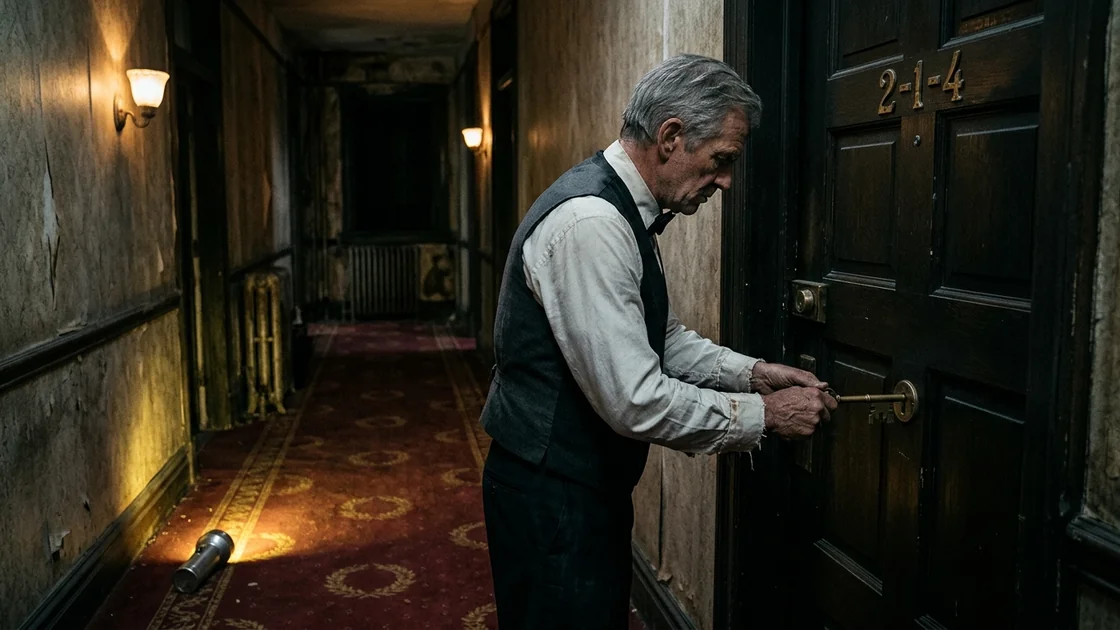
Arthur Pendelton spends his nights behind the front desk of the Oakhaven Hotel, a decaying roadside establishment where he hides from the memory of his daughter Clara, who was killed by a hit-and-run driver two years prior. During his solitary shifts, Arthur discovers that Room 214 exists in a temporal anomaly where time stands completely still and morning never arrives. When a violent autumn storm forces traffic off the main interstate, the wealthy man who struck Clara and escaped justice walks into the lobby seeking shelter for the night. Recognizing the driver who ruined his life, Arthur checks the unsuspecting man into Room 214 and locks the door from the outside, condemning his daughter's killer to an endless, sleepless night while Arthur finally walks out into the dawn.
The grandfather clock in the corner of the lobby did not tick so much as it cleared its throat, a dry, rhythmic rasping of brass gears that had measured the dark since 1928. Arthur Pendelton stood behind the mahogany reception desk, a soft flannel cloth in his hand, polishing the bell for the third time since midnight. He did not like the bell to have fingerprints on it. Fingerprints implied the passage of strangers, the brief, greasy friction of lives intersecting and moving on, and Arthur preferred the lobby of the Oakhaven Hotel to remain as static as a photograph in an closed album.
Outside, the October wind was stripping the last of the dead leaves from the sycamores along Route 9. They scraped across the asphalt of the parking lot like dry little crabs, piling up against the curb beneath the flickering neon vacancy sign. The sign was missing its second letter, so it bled a pale, arterial pink across the wet pavement that spelled out V-CANCY in three-second intervals, buzzing like a trapped hornet.
Arthur was fifty-four years old, though the mirror behind the key rack insisted he was closer to seventy. Grief had a peculiar way of accelerating the body while stopping the mind entirely. His hair had gone the color of sleet over the course of a single winter, and his shoulders had developed the permanent, protective stoop of a man walking into a gale. He wore a charcoal vest over a white shirt with frayed cuffs, a black bow tie clipped neatly at his throat, and shoes with crepe soles that made no sound at all when he walked across the worn Persian rugs of the lobby.
He was a good night clerk because he did not sleep. He had forgotten how to do it properly on the fourteenth of October, two years ago, at approximately eighteen minutes past three in the morning. Now, he merely rested his eyes during the daylight hours in his small, linoleum-floored apartment above the town laundromat, listening to the industrial dryers tumble and thud below him until dusk gave him permission to return to the Oakhaven.
The hotel suited him. In its youth, before the four-lane interstate bypassed the valley twelve miles to the west, the Oakhaven had been a grand dame of the mountain pass. Senators had slept in its bridal suite; bootleggers had drunk rye whiskey in its cellar lounge; salesmen with trunks full of porcelain and silk had lined up three deep at the very desk where Arthur now stood. It had three stories of dark brick, wide wrap-around porches with peeling white balustrades, and seventy-two rooms, most of which smelled faintly of camphor, radiator steam, and the ghosts of cheap cigars. Now, it caught only the stragglers—the long-haul truckers who had missed the turnpike exit, the traveling auditors for regional hardware chains, the occasional pair of illicit lovers looking for a place where the clerk wouldn't ask for two driver's licenses.
Arthur never asked questions. He took their crumpled twenties or ran their plastic cards through the ancient electronic terminal that wheezed before spitting out paper receipts. He handed them heavy, diamond-shaped brass fobs attached to long skeleton keys, told them ice was at the end of the first-floor hall, and watched them vanish up the wide staircase.
There were seventy-two keys hooks on the board behind him, arranged in six neat rows of twelve. Seventy-one of the hooks were tarnished brass, worn bright at the curve where generations of fingers had lifted the keys. The hook for Room 214 was empty. Its key did not hang on the board. It sat in the bottom drawer of the desk, wrapped in a piece of gray chamois leather, wedged behind a tin of typewriter ribbons and an old telephone directory from 1994.
Arthur set the polishing cloth down. He looked at the grandfather clock. It was one-fifteen in the morning. The rain that the radio had been promising since sundown finally arrived, not as a drizzle, but as a sudden, violent slap of water against the tall plate-glass windows of the lobby. The wind had shifted to the north, coming down off the ridge with real malice now, driving the rain sideways so that the neon glow of the sign outside fractured into a thousand red smears on the glass.
He walked out from behind the desk, his crepe soles silent on the parquet, and went to the window. Looking out into the dark, he saw what he always saw when it rained at night: the shiny black skin of wet asphalt, the halo of a streetlamp diffused by mist, and a single shoe lying near a storm drain.
It had been a white canvas sneaker, size seven, with a little astronomical chart drawn in blue ballpoint pen on the rubber toe cap. Clara had drawn it during a boring lecture on thermodynamics the week before. It was the constellation Cassiopeia—five little dots connected by four crooked lines. When the state trooper had handed him the plastic evidence bag three days after the funeral, the blue ink had run slightly from the rainwater, turning the stars into tiny, bruised clouds.
"She didn't suffer, Mr. Pendelton," the coroner had said, a well-meaning lie delivered in a room that smelled of bleach and damp wool coats. "The impact was instantaneous. Severe cranial trauma. She never knew the car was there."
She knew, Arthur thought, pressing his forehead against the cold glass of the hotel window. She knew because I saw her turn her head.
Clara had been twenty-two. She was in her final year at the state university forty miles south, studying astrophysics, a field Arthur only dimly understood despite having bought every paperback book on galaxies and black holes the local bookstore carried so he could hold up his end of the conversation when she came home for Thanksgiving. She had her mother’s dark, serious eyes and Arthur’s terrible habit of chewing the inside of her cheek when she was doing math in her head.
That night—two years ago to the week—she had been driving home in her rusted Honda Civic to surprise him for his fifty-second birthday. She had baked a lopsided lemon pound cake in her dorm kitchen and wrapped it in tin foil; the troopers found it crushed on the floorboards of the passenger side, smelling brightly of citrus and sugar amidst the reek of leaked radiator fluid.
Her alternator had died three miles outside of town, right where Route 9 curved sharply around the old limestone quarry. There was no cell service in the dip between the hills, so she had walked half a mile up the grade until her phone caught a single bar of signal.
Arthur remembered the ring of the landline beside his bed. It was 2:50 AM. His wife, Martha, had mumbled into her pillow, "Who is that?" before Arthur even had his feet on the rug.
"Dad?" Clara’s voice had been small, tinny, competing with the hiss of wind and the patter of October rain on the roof of her car. "I'm sorry to wake you up. The battery light came on near the quarry and then the headlights just sort of faded out like candles. I pulled onto the shoulder, out of the lane, I promise. I have the hazards on, though they're really dim."
"Stay inside the car, bean," Arthur had said, already pulling his trousers on over his pajama bottoms with one hand while cradling the receiver with his shoulder. "Lock the doors. Don't get out for anybody. I'm putting my boots on right now. I'll be there in fifteen minutes."
"Okay," she said. "I brought cake. It's getting cold."
"I'll turn the heater on high when I get there," he told her. "Just sit tight."
Those were the last words they exchanged. He had replayed them ten thousand times while staring at the ceiling of his apartment, trying to find a different arrangement of syllables that might have kept her in the front seat. Don't touch the door handle. Put your seatbelt back on. Close your eyes until you hear me knock on the glass.
Why had she gotten out of the car? The state police theorized that she had seen his headlights cresting the hill from the north and stepped out onto the gravel shoulder to wave him down, afraid he wouldn't see her dark car with its dying hazard lights in the downpour.
Arthur had indeed been cresting the hill in his old Ford pickup. Through the rhythmic sweep of his wipers, he had seen the faint amber pulse of her hazards at the bottom of the grade, maybe two hundred yards away. And then, coming from the opposite direction—roaring out of the curve by the quarry at seventy miles an hour on a forty-mile-an-hour road—came the other headlights.
They weren't the yellow tungsten beams of a local truck. They were brilliant, bluish-white xenon arcs that cut through the rain like surgical lasers, blinding even at a distance. The car was low, wide, and silver-blue, hydroplaning slightly as it took the bend too fast, its rear endfishtailing across the double yellow line before the driver overcorrected and whipped the nose hard onto the gravel shoulder where the Honda sat.
Arthur had stood on his brakes, his pickup skidding sideways on the slick macadam, his horn blaring a useless, strangled warning into the dark.
In the brief, strobing eternity of his own high beams meeting those blinding xenon lights, Arthur saw everything. He saw Clara standing by her rear bumper in her yellow rain slicker, her hand raised to shield her eyes. He saw the low, shark-like grille of the foreign car strike her hip and chest, lifting her off her boots as if she weighed no more than a bundle of dry twigs. He saw her body roll over the sculpted hood, shattering the passenger-side windshield into a silvery spiderweb before she was flung into the drainage ditch among the wet cattails and sumac.
And then the car stopped.
It didn't keep going right away. That was the part that lived behind Arthur’s eyelids like a splinter of hot iron. The silver-blue car skidded to a halt thirty yards past the Honda, its brake lights painting the rain a brilliant, pulsing crimson.
Arthur’s truck was still rolling to a stop fifty feet away. Before Arthur could even throw his door open, the driver’s window of the sports car glided down into the door frame.
The driver leaned his head out into the rain to look back at what he had hit.
He was directly beneath the single sodium-vapor lamp that marked the entrance to the quarry access road. The orange light fell squarely across his face. He was a man in his early thirties, with thick, dark hair combed back from a high forehead, a sharp, narrow nose, and a neatly trimmed beard along his jawline. He was wearing a pale gray overcoat, and as he gripped the doorframe with his left hand to crane his neck backward, the light caught the heavy gold band of a watch on his wrist.
For three seconds—long enough for a heart to beat four times, long enough for a world to end—the man looked past the crumpled yellow slicker in the ditch and looked straight through the windshield of Arthur’s pickup truck. Their eyes met across fifty feet of falling water. The man’s mouth was slightly open, not in horror, not in grief, but in the sharp, calculating panic of a man assessing a liability.
Then the window slid back up. The exhaust pipes barked twice, a deep, throaty, expensive roar, and the silver-blue car tore back onto the asphalt, accelerating up the hill and vanishing into the curtain of rain before Arthur’s boots even touched the road.
By the time Arthur reached the ditch, kneeling in six inches of icy mud and screaming his daughter's name into the wet weeds, there were no taillights left to see.
The police found the car four days later at the bottom of an abandoned strip mine in the next county, burned to a blackened steel carcass with road flares.
Even melted, the chassis numbers told them what it was: a 2019 Aston Martin DB11, slate blue, registered to a holding company owned by Julian Vance, the thirty-three-year-old managing partner of Vance-Sterling Development in the state capital.
When the detectives went to Julian Vance’s townhouse, they didn't find a nervous fugitive packing a suitcase. They found two corporate defense attorneys who cost nine hundred dollars an hour sitting in his drawing room, drinking espresso.
The story was already typed, notarized, and hermetically sealed. Julian Vance had attended a charity gala at the Oakmont Country Club on the night of October thirteenth. He had consumed three glasses of champagne—too much, he responsibly decided, to drive himself home through the mountains. According to a valet who happened to have paid off his mother’s mortgage in cash two months later, Mr. Vance had left his keys on the valet podium at 1:00 AM and taken an unmarked town car back to the city. When he sent his assistant to retrieve the Aston Martin the following afternoon, the car was gone. Stolen, tragically, by some joyriding ghost who had taken it down Route 9, struck poor Clara Pendelton, and torched the vehicle in the strip mine to cover their tracks.
There was no DNA left in the melted slag of the interior. There were no traffic cameras on Route 9. There was only Arthur.
The district attorney hadn't even wanted to bring it to a preliminary hearing, warning Arthur that an eyewitness identification made at night, in heavy rain, at a distance of fifty feet, lasted about four minutes under cross-examination. Together with Martha, whose grief had turned hard and jagged like broken glass, Arthur had begged. They got their hearing in a stifling wood-paneled courtroom in November.
Arthur had sat in the witness box, his hands gripping the oak rail until his fingernails turned purple, pointing across the room at Julian Vance.
Vance had looked impeccable in a navy suit, his dark hair neatly parted, the beard shaved off now to reveal a smooth, patrician chin. He hadn't looked at Arthur once during the testimony; he had spent the forty minutes examining a manicure on his right hand or whispering notes to his lead counsel, a silver-haired man named Higgins who spoke in a gentle, pitying baritone.
"Mr. Pendelton," Higgins had said, standing comfortably near the jury box—empty for the preliminary hearing, though he played to the ghosts in the chairs anyway. "No one in this room can begin to fathom the depth of your loss. My heart breaks for you. Truly, it does. And because of that immense, crushing sorrow, nobody blames you for wanting a face to attach to this nightmare."
"I don't want a face," Arthur had said, his voice cracking in the microphone. "I saw his face."
"Through a wet windshield," Higgins noted mildly. "While your own vehicle was skidding. At three in the morning. From half the length of a football field away."
"The streetlamp was right above him."
"The sodium-vapor lamp at the quarry entrance, yes. Which the county maintenance records show was operating at sixty percent lumen capacity due to a faulty ballast. Mr. Pendelton, do you wear corrective lenses for driving?"
"Reading glasses," Arthur said. "Only for small print."
"Ah. And when you looked at the photographs the detective showed you—after you had already seen Mr. Vance's picture in the newspaper article regarding the recovery of his stolen vehicle—you identified him."
"I knew him before the newspaper. I saw him look at me."
Higgins had sighed, a sound of profound, theatrical sympathy, and walked back to the defense table. "Your Honor, grief is a powerful architect. It builds certainties out of shadows because the alternative—that this terrible tragedy was committed by an unknown thief who may never be caught—is simply too heavy for a father's heart to bear. There is no forensic evidence placing my client within forty miles of Route 9. We move for an immediate dismissal of all charges for lack of probable cause."
The judge had taken twenty minutes in chambers before returning to grant the motion.
As Julian Vance walked out through the brass-studded doors of the courtroom, surrounded by his lawyers, he had paused to button his cashmere overcoat. For a fraction of a second, as the heavy door swung shut between them, Vance had turned his head and looked back at Arthur sitting alone on the hard wooden bench.
It was the exact same look from the quarry road. Cold, assessing, and entirely devoid of remorse. A look that said: I am real, and you are nothing, and the world belongs to men who don't stop in the rain.
Six months later, Martha left. She didn't leave because she stopped loving Arthur; she left because whenever she looked at him, she saw the side of Route 9, and whenever he looked at her, he saw the empty chair at the kitchen table. She moved to her sister’s house in Ohio. Arthur sold their two-story colonial, put the furniture in storage, rented the room above the laundromat, and answered the help-wanted ad taped to the window of the Oakhaven Hotel.
He had discovered the truth about Room 214 during his third month on the job.
The hotel’s owner was an eighty-year-old widower named Mr. Henderson who lived in Sarasota and communicated entirely through monthly payroll checks and occasional, rambling voicemails about boiler pressure. The daytime manager was a sour woman named Mrs. Krantz who arrived at seven in the morning, smelled of peppermint schnapps, and spent her shifts watching soap operas in the back office.
When Mrs. Krantz trained Arthur on his first evening, she had shown him the key board, the register, and the ancient switchboard, and then she had pointed a nicotine-stained finger at the empty hook for 214.
"Don't nobody go in there," she had said.
"Plumbing leak?" Arthur had asked, not caring one way or the other.
"Just out of order. Been out of order since old man Henderson’s daddy ran the place in the fifties. Roof leaked in there once, or somebody died in the bed, I don't know. Keep it locked. Housekeeping don't even have a passkey for it; the deadbolt takes its own heavy brass key, and that stays in the bottom drawer. Don't go poking around, neither. Floors are probably rotten."
For ninety nights, Arthur obeyed her simply because he lacked the curiosity required for disobedience. He sat at the desk, read Clara’s old astronomy textbooks under the green banker's lamp, swept the lobby at four, brewed coffee at six, and went home when the sun came up.
Then came the night in January when the pipes froze in the west wing.
It was twenty below zero outside, the kind of dry, brittle mountain cold that made the old brick walls of the hotel pop and groan like pistol shots. Around two in the morning, Arthur heard a strange, high-pitched whistling coming from the second floor. Afraid a radiator valve had split and was about to flood the ceiling above the lobby, he took a flashlight and the master ring of keys and climbed the stairs.
The second-floor corridor was a long, dim tunnel carpeted in faded crimson wool with a pattern of golden wreaths that had been trodden into mud-colored smears down the center. Brass wall sconces with frosted glass shades cast weak pools of amber light every twenty feet.
As Arthur walked down the hall toward the west wing, checking radiator valves outside each door, he noticed that the whistling sound wasn't steam at all. It was the wind, finding some invisible chink in the masonry.
He stopped in front of Room 214.
The door was heavy dark oak, thicker than the cheaper paneled doors that had been installed on the other rooms during a renovation in the seventies. Near the top of the frame, screwed into the wood, were the tarnished brass numbers: 2-1-4.
Arthur put his hand on the doorknob. It was ice cold, colder even than the drafty hallway, and when he rattled it, the heavy deadbolt held it completely rigid. Yet, as he stood there in the quiet corridor, he felt a strange sensation in his inner ear, like the sudden change in pressure when an elevator drops too fast or a train enters a narrow tunnel. The constant, low-frequency hum of the hotel—the rumble of the basement furnace, the buzz of the hallway sconces, the rattle of the wind against the fire escape door at the end of the hall—seemed to stop right at the threshold of the oak door, as if the wood were ten feet of solid lead.
For the first time since October, Arthur felt a faint, sharp prickle of awareness that wasn't grief.
He went back downstairs, opened the bottom drawer of the reception desk, and unwrapped the gray chamois cloth. The key inside was six inches long, cast from solid yellow brass, with a bit that was intricately notched like the skyline of a miniature city.
He climbed back up the stairs, fitted the key into the massive keyhole below the knob of 214, and turned it. The lock didn't squeak; the bolt slid back with a heavy, greased clack that sounded as if it had been oiled twenty minutes ago.
Arthur pushed the door open and stepped inside.
He didn't need his flashlight. The room was already lit.
A brass floor lamp with a fringed silk shade stood beside a velvet armchair in the corner, casting a warm, buttery glow over the room, and a smaller lamp with a milk-glass globe burned on the bedside table. The air smelled of dry lavender, beeswax polish, and a faint, sharp trace of ozone, like the smell of a transformer after a lightning strike. There was no dust. The burgundy damask wallpaper was pristine, its flocked patterns velvety and rich. The bedspread was a heavy white chenille, pulled taut over two plump feather pillows.
On the bedside table sat a mechanical alarm clock in a bakelite case. Its hands stood at eighteen minutes past three.
Arthur walked slowly to the center of the room, the thick floral carpet swallowing his footsteps. He looked at the clock. The little brass second hand wasn't moving. Wound down, he thought automatically.
He went to the window and parted the heavy velvet drapes.
Outside, it was raining.
Arthur froze, his fingers tangled in the velvet fabric.
When he had come upstairs three minutes ago, it had been twenty below zero and clear as a bell; the stars had been hard white diamonds above the frozen snowbanks of the parking lot. Yet here, through the double-hung panes of Room 214, the snowbanks were gone. The parking lot was black, wet asphalt, though there were no cars in it, and the neon vacancy sign wasn't visible from this angle—only the central courtyard where a single cast-iron lamppost stood beside a dead fountain. Rain was falling through the cone of light from the lamppost, thick, silver needles slanting down through absolute, impenetrable darkness.
Wait.
He leaned closer to the glass, his breath failing to fog the pane.
The rain wasn't falling properly. He watched a large drop hit the iron rim of the dry fountain, splashing into a crown of four smaller droplets that leaped upward, hung for a fraction of a second in the yellow light, and then vanished as another identical drop struck the exact same spot, producing the exact same four-pointed crown. Three leaves from a sycamore tree blew across the wet flagstones from left to right, tumbled over the curb, disappeared into the shadow beyond the lamppost's reach, and then, four seconds later, the exact same three leaves blew across the flagstones from left to right, tumbling at the precise same angle.
It was a loop. A fragment of some long-dead midnight caught like an insect in amber, repeating five seconds of wind and rain forever.
Arthur backed away from the window, his heart hammering against his ribs. He turned toward the door—thank God, he had left it propped slightly ajar with his flashlight wedged against the jamb—and looked out into the hallway.
The crimson carpet of the corridor was still there.
He pulled his grandfather’s Hamilton pocket watch from his vest pocket. Outside at the front desk, he wound it every night at midnight; it kept time to within four seconds a month. The watch read 2:14 AM. And the little subsidiary second hand at the bottom of the dial was ticking steadily along: tick-tick-tick-tick.
He looked from his watch to the bakelite clock on the nightstand: 3:18.
Moved by an impulse he couldn't name—perhaps the scientist’s training Clara had tried so hard to rub off on him, or perhaps just the reckless apathy of a man who had nothing left to lose—Arthur walked over to the velvet armchair, sat down, and placed his pocket watch on the small mahogany side table beside the floor lamp.
"Just for five minutes," he whispered to the empty room. His voice sounded strangely flat, without echo, as if the walls were drinking the sound.
He leaned his head back against the velvet antimacassar. The chair was extraordinarily comfortable. The silence of the room was absolute—no furnace rumble, no wind, no distant semi-trucks gearing down on the highway. For a man whose brain had been a roaring furnace of memory and insomnia for fifteen months, the quiet was like cool water poured over a burn.
He didn't sleep—he couldn't sleep, even though his eyelids felt heavy—he simply sat. He watched the second hand of his pocket watch sweep around the dial. Five minutes passed. Then twenty. He got up and checked the bathroom: white hexagonal tiles, a claw-foot tub, a porcelain sink with brass cross-handle faucets. He turned the cold tap. Clear, icy water rushed out into the basin and swirled down the drain. When he turned the tap off, the porcelain dried instantly, leaving not a single bead of moisture behind.
He came back into the bedroom, took a Gideon Bible out of the nightstand drawer—printed in 1946, the pages crisp and white as the day they left the bindery—and read the entire Book of Job, followed by Ecclesiastes, and then the Gospel of Matthew. He read slowly, mouthing the words. His watch told him four hours had passed. Then six. By the time he closed the book, the hour hand on his Hamilton pocket watch had made a full revolution and a half. He had been in the room for eighteen hours.
Strangely, he wasn't hungry. His mouth wasn't dry. The grey stubble on his chin hadn't grown the sixteenth of an inch it normally grew between sunset and dawn.
And outside the window, the three sycamore leaves blew across the flagstones from left to right, and the raindrop shattered into its four-pointed crown on the lip of the iron fountain.
Arthur stood up, put his pocket watch back into his vest, picked up the flashlight that was still wedged against the doorframe, and stepped out into the hallway.
He pulled the oak door shut and locked the deadbolt.
His knees felt slightly weak as he walked down the stairs to the lobby, bracing himself for the sight of Mrs. Krantz sitting at his desk, furious that he had abandoned his post for an entire day and a half. He expected to see the pale winter sun—or the next night's darkness—through the front windows.
He reached the bottom landing and looked at the grandfather clock in the corner.
The brass pendulum was swinging lazily. The hands stood at 2:14 AM.
Arthur pulled his pocket watch from his vest. Its hands read 8:14—eighteen hours ahead.
He walked to the front window. Outside, the snowbanks were piled high and white under a clear, freezing sky, and the neon vacancy sign blinked pink across the ice. Not a single second had elapsed in the world outside while he had lived through nearly a full day in that velvet armchair.
The following night, he conducted one last test. He bought a cheap wind-up kitchen timer at the hardware store, set it for sixty minutes, placed it on the bed inside Room 214, and closed and locked the door completely from the outside, removing the flashlight wedge. He waited ten seconds in the hallway, then unlocked the door and opened it.
The kitchen timer wasn't ringing. Its dial was spun all the way past zero, the spring inside snapped from the tension of having run out what must have been days, or weeks, or years ago inside the sealed room, while in the corridor, Arthur had barely drawn two breaths. And on the inside of the heavy oak door, he noticed for the first time that there was no thumb-turn for the deadbolt, and no keyhole. Once the brass bolt was thrown from the corridor, the door was simply a slab of solid wood set into an iron frame.
Arthur had taken the ruined timer, dropped it into the storm drain down the road, and put the brass key back into the bottom drawer of the front desk, wrapped in its chamois cloth.
He never told a soul. What was there to tell? That the universe had a tear in its lining on the second floor of a bankrupt motor hotel in the mountains? Clara would have had theories—she would have filled three spiral notebooks with equations about localized gravitational wells, Einstein-Rosen bridges, and closed timelike curves, her eyes shining as she chewed the inside of her cheek. Without her here to explain it to him, it was just another cold, meaningless fact in a cold, meaningless world.
Until tonight.
At 2:10 AM, the lights in the lobby flickered twice and dimmed to a sickly orange before the hotel’s backup diesel generator kicked on in the cellar with a muffled thump, bringing them back up to half-power.
Five minutes later, the front door rattled and flew open, driven by a gust of wind that blew a swirl of wet sycamore leaves all the way across the Persian rug to the base of the reception desk.
A man in a soaked nylon jacket and a Mudflap cap staggered in, dragging a battered canvas overnight bag. It was Miller, a short-haul trucker who drove a flatbed for the lumber mill up in Jackson County and stayed at the Oakhaven twice a month when the weather turned foul.
"Jesus H. Christ on a raft, Arthur," Miller wheezed, pulling off his cap and slapping it against his thigh, sending a spray of water across the floorboards. "You listening to the scanner?"
"Radio's off, Mr. Miller," Arthur said, reaching under the counter for the registration card he kept pre-filled with Miller’s license plate number. "The static was bad."
"Well, you're gonna have company tonight if anybody else made it past the junction before the state boys put the sawhorses up," Miller said, taking the ballpoint pen Arthur offered and scrawling his name across the bottom of the card. "Mudslide took out two lanes of the interstate just south of the tunnel, and the creek’s three feet over the bridge at Lower Crossing. Whole damn valley's corked at both ends until the county gets the loaders out there tomorrow morning. Took me forty minutes just to creep four miles down Route 9. It's coming down like cow piss on a flat rock out there."
"Room 104, same as usual?" Arthur asked, lifting the key from the first row on the board.
"Yeah, keep me on the ground floor. With that wind howling, I don't want the roof coming down on my head while I'm trying to sleep." Miller took the key, tossed two damp twenty-dollar bills onto the blotter, and paused, squinting at Arthur under the dim chandelier. "You look peaked, Artie. Even for you. You eating anything besides that burnt coffee?"
"I had soup at six," Arthur lied smoothly. "Get out of those wet clothes, Mr. Miller. I flipped the radiator valve on in 104 an hour ago; it should be warm by now."
"You're a saint, Artie. Wake me at seven if the world ain't floated away."
Miller trudged down the first-floor hallway, his heavy work boots thumping against the runner until the door of 104 clicked shut.
Twenty minutes later, an elderly couple in matching beige raincoats came in, rattling like dry leaves. Their Buick had stalled in a deep puddle half a mile up the road, and they had walked the rest of the way under a golf umbrella that the wind had turned inside out. Arthur gave them Room 108, brought them two extra wool blankets and a thermos of hot water for their tea, and tried to call Dick’s Towing for them on the desk telephone.
When he lifted the black receiver to his ear, there was no dial tone. Not even the crackle of wet copper lines—just a flat, dead silence that meant a tree had taken down the main trunk line somewhere along the ridge.
He set the receiver back in its cradle and returned to polishing the brass bell, listening to the rain hammer against the brick facade like pebbles thrown by giant hands.
The grandfather clock wheezed and struck the half-hour: two-thirty. Then two-forty-five.
At 2:52 AM, Arthur saw the headlights.
They didn't come creeping slowly out of the dark like Miller’s flatbed or the old couple’s Buick. They swung into the parking lot fast, slicing across the wet plate glass of the lobby windows—brilliant, bluish-white LED beams that cut through the sheets of rain with surgical precision, turning every falling drop into a glittering diamond.
Arthur’s hand stopped on the bell.
A low, dark sedan—a new Mercedes-AMG, black as polished obsidian—pulled up directly under the portico outside the front doors, ignoring the yellow striped lines of the fire lane. Even so, something was wrong with the car. A thin plume of white steam was hissing out from beneath the sculpted hood, whipped away instantly by the gale, and the front right tire was sitting low on its alloy rim, chewed to ribbons from having hit a rock washed out onto the highway by the storm.
The headlights clicked off. For a moment, the driver stayed inside, his face illuminated only by the pale blue glow of the dashboard navigation screen and the smartphone he was holding in his hand, tapping furiously at the glass as he searched for a signal that wasn't there.
Arthur did not breathe. The air in his lungs turned to cold iron. He took one step back into the shadow just behind the mahogany pillar that framed the reception desk, where the green shade of the banker's lamp left his face in partial eclipse.
The driver’s door of the Mercedes opened. A man stepped out under the shelter of the portico, shaking open a black silk umbrella that he didn't even need beneath the overhang, before realizing it and snapping it shut again with an irritated flick of his wrist. He wore a camel-hair overcoat over a charcoal turtleneck sweater, tailored trousers, and Italian leather loafers that were ruined with red mountain mud around the welts. He reached into the back seat, pulled out a supple brown leather weekender bag, and walked toward the glass doors of the lobby.
The bell above the door chimed as he pushed it open.
He stepped onto the Persian rug, bringing the smell of cold rain, wet wool, and expensive cedarwood cologne into the stale warmth of the room. He was thirty-five now. The beard was still gone, as it had been at the courthouse, and there were a few faint silver threads at his temples that hadn't been there under the sodium-vapor lamp by the quarry. Otherwise, he had not changed at all. The same high forehead, the same sharp, patrician nose, the same narrow mouth set in a line of habitual impatience.
Julian Vance stopped in the middle of the lobby and looked around with the undisguised distaste of a man who had accidentally stepped into an open sewer. His eyes swept over the threadbare armchairs, the antlers mounted above the cold fireplace, the water-stained ceiling plaster, and finally settled on the reception desk.
"Hello?" Julian called out, dropping his leather bag onto the floor with a soft thud and walking toward the counter. He didn't wait for Arthur to speak before slapping his palm down on the brass bell. Ding. "Somebody working here?"
Arthur stepped forward half an inch, letting his hands rest flat on the green leather blotter. He kept his head slightly bowed, the posture of a lifelong servant, letting his white hair and the deep trenches that two years of hell had carved into his cheeks do their work. To Julian Vance, Arthur Pendelton had been a nameless annoyance in a county courtroom twenty-four months ago—a grey-faced working-class nobody in a cheap blue suit whom his lawyers had swatted away before lunch. Why would a man like Julian remember the face of a bug on his windshield?
"Good evening, sir," Arthur said. His voice didn't tremble. That surprised him more than anything else. It came out quiet, dry, and raspy, like the gears of the clock in the corner. "Welcome to the Oakhaven."
Julian barely glanced above Arthur’s collarbone. He was already pulling a platinum titanium wallet from the breast pocket of his coat while looking down at his damp loafers.
"Your road out there is a disaster," Julian said, his tone implying that Arthur had personally arranged the landslide with a shovel. "I hit a piece of shale the size of a cinderblock two miles back. Cracked my oil pan or the radiator housing, I don't know, the coolant warnings went off right before I saw your sign. And there's no cell reception in this entire godforsaken hollow."
"The valley blocks the towers when the cloud cover is this low," Arthur said evenly. "And the storm brought the landline down about an hour ago. The interstate is closed in both directions."
Julian stopped with his credit card halfway out of his wallet. Now he looked up, his dark eyes narrowing.
For a heartbeat, Arthur braced himself. They were less than three feet apart. Closer than they had been on Route 9; closer than they had been in the courtroom. Arthur could see the tiny burst capillary in the corner of Julian’s left eye; he could see the heavy gold band of the Patek Philippe watch sliding out from beneath the cuff of the charcoal turtleneck—the exact same watch that had caught the orange light of the quarry lamp when Julian gripped the door frame of the Aston Martin to look back at Clara’s broken body in the ditch.
Julian stared straight into Arthur’s eyes.
Nothing happened. Not a flicker of recognition, not a twitch of memory. Julian saw only an old man in a frayed vest who represented an inconvenience.
"What do you mean, the landline is down?" Julian demanded. "How am I supposed to get a flatbed out here? I have a nine o'clock zoning board presentation in the capital tomorrow morning. If I'm not in the room when the commissioners vote on the riverfront variance, it costs my firm four million dollars."
"Nothing is getting in or out of the valley tonight, sir," Arthur said softly. "The creek is over the bridge at Lower Crossing, and there's a mudslide blocking the north pass. Even if the phones were working, the county sheriff has the roads barricaded until daylight."
"Unbelievable," Julian muttered, rubbing two fingers against his temple. He turned away from the desk and paced toward the front window, staring out at the black rain lashing his crippled Mercedes. "I never should have taken this back road. The GPS rerouted me off the turnpike when the traffic backed up near the tunnel, and now I'm stranded in the nineteenth century."
Route 9, Arthur thought, watching the back of the man's neck. You didn't even remember the name of the road until you were already on it, did you? Or maybe you just don't think about it at all. Maybe to you, a road is just asphalt, and what happened two miles south of here by the quarry was just an inconvenient pothole you paid your lawyers to pave over.
"Do you have a room?" Julian asked without turning around. "Something clean. A suite, if a place like this even has one."
"We have a very quiet room on the second floor," Arthur said. "Away from the wind. The best room in the house."
Julian turned and walked back to the desk, tossing the platinum card onto the blotter where it slid across the leather and clicked against the base of the freshly polished bell. "Fine. Whatever the rate is. And tell me you have a bar open, or a bottle of something decent behind that counter. My nerves are shot driving through that river out there."
Arthur looked down at the card. JULIAN R. VANCE was laser-etched in crisp black capitals across the brushed metal.
"The card machine runs on the phone line, Mr. Vance," Arthur said, speaking the name aloud for the first time. It tasted like copper pennies on his tongue. "We can settle the bill in the morning when the power and the lines are restored. I just need you to sign the register."
Arthur opened the large, leather-bound ledger that Mr. Henderson still insisted they keep for tax audits, turning to a fresh page, and slid a heavy fountain pen across the counter.
"As for the drink," Arthur continued, "the lounge closed at midnight, as required by county ordinance. However, the owner keeps a bottle of eighteen-year-old Glenlivet in the pantry for special guests. I would be happy to pour you a glass while I fetch the key to your room. It takes a moment to prepare."
Julian’s irritation softened by a fraction of a degree at the mention of single malt. He picked up the pen and scrawled a jagged, illegible loop across the line, not bothering to fill in the boxes for his home address or vehicle make.
"Make it a double, neat," Julian said, unbuttoning his damp camel-hair coat and shrugging it off his shoulders. "I'll sit by the radiator over there until my hands stop shaking from fighting that steering wheel."
The small parlor off the main lobby was separated from the front desk by an archway hung with faded velvet portieres. It contained four leather club chairs arranged around a low mahogany coffee table, a bookshelf stuffed with tattered Reader’s Digest condensed books from the nineteen-seventies, and a long cast-iron radiator that clanked and hissed with comforting regularity.
When Arthur carried the brass tray into the parlor five minutes later, Julian was sitting in the best chair nearest the heat, his muddy loafers propped unapologetically on the edge of the mahogany table, staring into the dead fireplace.
Arthur set the tray down. On it sat a heavy crystal lowball glass containing three fingers of amber scotch, a small pitcher of spring water, and a clean linen napkin. He had not poisoned the whisky. Poison was quick, and poison left a body that the coroner would eventually have to explain when the road crews cleared the bridge tomorrow. Arthur had something much larger than poison in his vest pocket, resting heavy and cold against his ribs right beside his Hamilton watch.
"Thank you," Julian said, picking up the glass and taking a long, appreciative swallow. He exhaled sharply as the liquor hit his stomach, his shoulders dropping an inch. "God, I needed that. Surprising to find a decent bottle in a place like this."
"The Oakhaven used to see a great many important travelers, Mr. Vance," Arthur said, remaining standing a few paces back, his hands clasped neatly behind his back. "Before the interstate was built."
"Yeah, well, progress doesn't wait for nostalgia," Julian said, swirling the remaining scotch in the crystal. Possibly because the silence of the hotel was oppressive, or possibly because men like Julian Vance liked the sound of their own voices best when there was an inferior present to absorb it, he gestured vaguely toward the opposite chair. "How long do these mountain storms usually last? Give me an honest estimate. If the rain stops by five, can a tow truck get through by six?"
"It's hard to say, sir," Arthur replied, not sitting down. "In October, the weather up here gets caught between the ridges. Sometimes a squall blows through in an hour. Sometimes the night seems to go on forever."
Julian grunted and took another sip. "It better not. I've been working on this riverfront parcel for eighteen months. Fighting the historic preservation board, fighting the environmental lunatics, bribing half the city council with campaign contributions just to get the height restrictions lifted. You know how it is—everybody wants the tax revenue from a forty-story luxury condominium tower, nobody wants to look at the crane while you build it."
"You build things, then," Arthur said quietly.
"I build the future," Julian said with a faint, humorless smile that didn't reach his eyes. "Old warehouses, rotting docks, tenements that should have been condemned during the Nixon administration—I tear them down and put up glass and steel. People get sentimental about old brick, old trees, whatever happens to be standing in the way. They don't understand the basic law of momentum. You stop moving forward to weep over every cracked sidewalk, you get run over."
Arthur’s fingers tightened behind his back until his knuckles popped softly.
"You know this road, then?" Arthur asked, his voice dropping half an octave, smooth and conversational. "Route 9? You mentioned your GPS sent you this way, yet you handled that curve by the old quarry well enough in the dark. Most strangers miss the turn and end up in the ditch."
Julian raised his glass to his lips, then paused. His brow furrowed slightly as he looked over the rim of the crystal at the old clerk standing in the shadow of the archway.
"The quarry?" Julian repeated.
"Two miles south," Arthur said mildly. "Where the shale washes down onto the asphalt during heavy rains. Right where the old sodium-vapor lamp hangs by the access gate. It's a bad bend. Very narrow shoulder. Every few years, somebody takes it too fast in the wet."
For the first time since he had walked through the door, Julian went completely still. The warmth of the scotch seemed to drain out of his posture, replaced by a sudden, wire-tight alertness. His eyes moved slowly up from Arthur’s black bow tie to his mouth, his nose, and finally locked onto the deep, hollow sockets beneath Arthur’s white eyebrows.
"I didn't say where I hit the rock," Julian said slowly.
"Didn't you?" Arthur tilted his head slightly. "Forgive me. An old man's ears play tricks on him. It's simply the only place along the southern grade where the shale comes down like that. My daughter broke down there once. In the rain. Two years ago this past Wednesday."
The silence in the parlor became absolute. Even the radiator seemed to hold its breath, its rhythmic clanking subsiding into a faint, dying hiss.
Julian slowly lowered his feet from the coffee table, planting his muddy soles flat on the rug. He set the crystal glass down on the brass tray with a sharp clink.
"Who are you?" Julian whispered.
"You looked right at me, Mr. Vance," Arthur said, stepping out from beneath the archway so that the light from the parlor lamp fell directly across his face. He reached up with one hand and smoothed his white hair back from his forehead, straightening his stooped spine until he stood at his full height, just as he had stood in the witness box of Department Four in the county courthouse. "Your window went down. The orange light was right above your head. You looked past her lying in the weeds in her yellow raincoat, and you looked through my windshield for three seconds before you drove away."
Julian’s face went the color of lard. He surged out of the leather chair, knocking the brass tray off the edge of the table; the crystal glass hit the floor and rolled unbroken across the rug, spilling the last of the scotch into the faded wool.
"You're crazy," Julian breathed, backing away a step until the backs of his calves hit the cast-iron radiator, making him flinch at the heat. His hand went instinctively into his pocket for his phone before he remembered there was no signal. His eyes darted toward the front doors of the lobby, calculating the distance. "You're that lunatic from the hearing. Pendelton. Did you follow me? Did you put that rock in the road?"
"I work here, Mr. Vance," Arthur said softly. He didn't move toward the younger man; he didn't raise his voice; he didn't even unclasp his hands from behind his back. "I have worked here every night for twenty-one months. I didn't put the shale on the highway, and I didn't wash out the bridge at Lower Crossing. You came here all by yourself. You saw the vacancy sign in the rain, and you pulled in."
Julian swallowed hard, trying to recover the bluster that had served him his entire life, the armor of wealth and lawyers and granite certainty. He straightened his charcoal turtleneck and sneered, though a muscle was jumping wildly under his left eye.
"That case was dismissed with prejudice," Julian said, his voice tight and loud in the small room. "My car was stolen from the Oakmont Country Club. If you come near me, old man—if you try to touch me—I'll have you in a state penitentiary before tomorrow night. In fact, I'm leaving right now. I'll sit in my car until the sheriff clears the road."
He lunged past Arthur toward the lobby, snatching his damp camel-hair coat off the arm of the sofa as he went.
"Your radiator is cracked, Mr. Vance," Arthur called after him, following at a slow, unhurried pace back into the main lobby. "The temperature is dropping twenty degrees behind this front. By four o'clock, it will be sleeting. If you run the engine without coolant to keep the heater going, the block will seize in ten minutes, and you'll freeze before the county loaders ever get near that bridge at noon."
Julian had his hand on the brass push-bar of the front door. Through the glass, the wind was howling like a pack of wolves, driving sheets of black water horizontally across the portico. Even the concrete under the overhang was awash in swirling, freezing puddles.
Julian stopped, his chest heaving. He turned back to look at Arthur.
He did the math. Arthur could see him doing it behind his dark eyes—the same rapid, cold calculation he had performed on the shoulder of Route 9. Julian Vance was thirty-five years old, five inches taller than Arthur, and forty pounds heavier, kept fit by squash courts and personal trainers. Arthur was a frail, fifty-four-year-old night clerk who weighed a hundred and四十 pounds soaking wet and didn't have a weapon in his hands.
Why go out into the freezing gale when the only thing inside the warm hotel was a broken old man who couldn't even convince a county judge of what he'd seen?
A slow, ugly smile crept back onto Julian’s mouth. He let go of the door handle.
"You think you're going to scare me out into the cold?" Julian said, walking back to the center of the Persian rug and picking up his leather weekender bag. "Because you're still obsessed with a fantasy my attorneys shredded in twenty minutes? Look at you, Pendelton. You're pathetic. A janitor in a roadside dump, talking to yourself in the dark."
"She was twenty-two," Arthur said, walking around the mahogany pillar to stand behind the reception desk once more. "She studied the stars. She had a lemon cake on the floor of her car that she baked for my birthday. If you had stopped—even after you hit her, if you had just stayed there and called an ambulance on that fancy phone of yours instead of driving thirty miles to burn your car in a coal pit—at least I wouldn't have had to hold her in the mud by myself for forty minutes waiting for the state police to drive by."
Julian’s jaw tightened, a flush of angry red creeping up his neck. For a second, the mask of the stolen-car story slipped completely; there were no cameras here, no stenographers, no judges, just an old man he despised.
"She shouldn't have been standing in the road in the dark," Julian snapped, his voice venomous and low. "What was I supposed to do? Throw away my entire life, my firm, everything I built, to sit in a cage for ten years because some girl in a ten-hundred-dollar piece of junk stepped out onto the asphalt in a rainstorm? She was dead the second the bumper touched her, old man. Stopping wouldn't have brought her back. It just would have ruined two lives instead of one."
There it was.
Arthur closed his eyes for a single second. A strange, profound warmth spread through his chest, dissolving the last ragged knot of doubt that Higgins, the silver-haired lawyer, had tried so hard to plant in his skull two years ago. He hadn't wanted a confession for the police; the police were twelve miles away behind a wall of mud, and the law had already shown Arthur what it was worth. He had only wanted to hear it with his own ears before he turned the key.
When Arthur opened his eyes, his face was entirely calm. Almost gentle.
"You're right, Mr. Vance," Arthur said softly, reaching into his vest pocket and drawing out the heavy, six-inch brass key with its city-skyline bit. He laid it on the green blotter beside Julian’s platinum credit card. "Stopping wouldn't have brought her back. And it certainly is cold out there. Take Room 214. Second floor, down the west corridor. You can lock the door from the inside if you think an old man like me is going to bother you in the night."
Julian stared at the big antique key on the blotter, then up at Arthur’s passive, defeated expression. Seeing the old man crumble back into a subservient clerk seemed to restore Julian’s equilibrium entirely. Of course the old coward wouldn't try anything physical; men like Pendelton were born to take what the world gave them and say thank you.
"Does the door have a chain?" Julian asked suspiciously.
"A heavy brass bolt," Arthur lied without blinking. "Solid oak door, two inches thick. Nobody can get in once it's shut. Come along, sir. The hallway lights on the second floor are dim with the generator running; I'll show you the way up with my flashlight, and then I'll stay down here at my desk until morning."
Julian hesitated for a moment longer, weighing the misery of the freezing Mercedes against a warm bed behind a locked oak door. Then he picked up his platinum card off the blotter, shoved it back into his wallet, and snatched up the brass key.
"Walk ahead of me," Julian ordered, hefting his leather bag. "Stay five feet in front where I can see your hands. You try anything funny on the stairs, I'll break your neck and tell the sheriff you fell."
"Yes, sir," Arthur said, picking up his heavy aluminum flashlight from beneath the counter and stepping out from behind the desk. "Right this way."
They climbed the wide staircase in silence, save for the creak of the oak risers and the steady, thundering drumbeat of the storm against the stained-glass landing window halfway up.
Arthur walked slowly, five paces ahead as instructed, shining the yellow beam of his flashlight on the worn crimson carpet before them. Behind him, he could hear Julian’s breathing—still slightly rapid from the adrenaline and the scotch—and the soft squeak of his wet leather loafers.
When they reached the second-floor corridor, the air changed.
The drafty chill of the stairwell gave way to the thick, stagnant hush of the upper hall. The amber wall sconces were burning at half-voltage on the backup generator, their filaments glowing like dull red hairpins inside the frosted glass shades, leaving long pools of shadow between every door.
They passed 202, 204, 206. Turning the corner into the west wing, the crimson carpet seemed to grow thicker under their feet, less worn, its golden wreath pattern brighter as if fewer shoes had ever walked this far down the hall. The sound of the wind outside began to fade, muffled by the heavy brick firewall that separated the wings.
Arthur stopped five feet past the door of Room 214 and turned around, shining the flashlight down at the floor between them so as not to blind his guest.
"Here we are, Mr. Vance," Arthur said quietly, gesturing toward the dark, heavy oak door with its tarnished brass numbers. "The key turns to the left."
Julian stopped before the door, keeping one wary eye on Arthur as he fitted the long brass key into the lock with his right hand. The bolt slid back with that remarkably smooth, freshly oiled clack.
Julian pushed the door open.
Inside, the fringed silk floor lamp and the milk-glass bedside lamp were already glowing with their warm, steady, buttery light—not dimmed at all by the generator in the cellar, burning with the full, bright voltage of some eternal, private dynamo. The air that drifted out into the chilly corridor smelled sweetly of dry lavender, beeswax, and ozone. The white chenille bedspread was pulled taut over the plump pillows, inviting and immaculate.
Julian blinked in surprise, looking from the dim, decaying hallway into the pristine, brightly lit bedroom. "Huh," he muttered. "You weren't lying. It's actually clean."
Still watching Arthur, Julian pulled the heavy brass key out of the exterior keyhole—just as he thought he ought to do so the clerk couldn't lock him in or unlock it later—and stepped backward over the threshold into the room, setting his leather bag down beside the velvet armchair.
"Wait a minute," Julian said, frowning as he glanced at the inside of the heavy oak door swinging near his hand. "Where's the—"
There was no keyhole on the inside of the wood. There was no thumb-turn for the deadbolt. There was only a smooth, cold porcelain doorknob that didn't actually turn the latch mechanism at all—a dummy knob screwed into two inches of solid, seasoned white oak.
And before Julian’s hand could even reach out to stop the door from swinging, Arthur took two silent steps forward on his crepe soles, gripped the exterior brass handle, and pulled the door shut with all his weight.
Boom.
The heavy oak slab seated itself into the iron frame with the finality of a bank vault.
From his left vest pocket, Arthur pulled the second key—the true master passkey he had had a locksmith in the next county grind from brass stock six months ago, just in case the day ever came when he needed to leave one key inside as bait. He slid it into the keyhole and turned it hard to the right.
The deadbolt—a solid one-inch bar of hardened steel—shot two inches deep into the iron mortise in the doorjamb.
For three seconds, there was absolute silence on the other side of the wood.
Arthur stood in the dim corridor, his hand still resting on the brass key, his ear two inches from the dark oak panels.
Then came the muffled thud of Julian’s shoulder hitting the inside of the door, followed by the rattle of the dummy porcelain knob being twisted furiously back and forth.
Even through the two inches of oak, Julian’s voice didn't sound right. It sounded high, thin, and weirdly compressed, like a vinyl record being played at seventy-eight revolutions per minute instead of thirty-three—as if the words were rushing out of him faster than the air in the hallway could carry them.
Arthur couldn't even make out the individual curses; it was just a brief, frantic chattering, like a squirrel trapped in a chimney flue, followed by a rapid-fire series of bangs against the wood—tap-tap-tap-tap-tap—that must have been Julian pounding with his fists at normal intervals inside the room, compressed by the boundary of the doorframe into the rat-a-tat of a woodpecker.
"Goodnight, Mr. Vance," Arthur said softly to the wood. He knew his voice probably sounded to Julian like the low, glacial rumble of a mountain shifting over the course of a week, if it penetrated the threshold at all. "The road crews will have the bridge open by morning. You only have to wait until sunrise."
Arthur pulled the brass key out of the lock, turned around, and walked slowly back down the crimson carpet toward the stairs.
Inside Room 214, Julian Vance slammed his bleeding knuckles against the oak door for the fiftieth time.
"Pendelton!" he roared, his voice raw in the flat, echo-less air of the bedroom. "Open this goddamn door right now! You hear me? I'll kill you! When I get out of here, I will tear your throat out with my bare hands!"
He stopped, panting, and pressed his ear against the wood.
He heard nothing. Not footsteps retreating down the hall, not the rumble of the hotel’s generator, not the wind howling around the eaves. Only a strange, heavy, titanic groan that lasted for nearly ten minutes—like two tectonic plates grinding together at the bottom of the sea—before fading into absolute, suffocating silence.
"Okay," Julian muttered to himself, wiping a smear of blood from his right pinky knuckle onto his trousers and backing away from the door. He forced himself to breathe deeply through his nose. Panic was for amateurs. Panic was for losers. Think. Analyze the problem.
The lunatic old man had locked him in a second-floor bedroom. So what? It was an old wooden hotel, not Alcatraz. Either he would break the window and climb down the porch roof, or he would break a chair leg and batter the door panels until they splintered, or, worst-case scenario, that fat night manager or a maid would come on duty at seven or eight in the morning, hear him yelling, and let him out. He would miss his nine o'clock zoning meeting, yes—that was infuriating—but by noon, Arthur Pendelton would be in handcuffs in the back of a state police cruiser for false imprisonment and kidnapping, and Julian would make sure the old bastard died in a state psychiatric ward.
First: the phone.
Julian walked over to the nightstand where a heavy black rotary telephone sat beside the milk-glass lamp and the little bakelite clock. He snatched up the handset. Dead. Of course—the storm had knocked the lines out, or the clerk had disconnected the extension at the switchboard downstairs.
He glanced at the bakelite clock: 3:18. Broken. He looked at his Patek Philippe wristwatch. The sweep hand was moving smoothly around the gold dial. It was 3:24 AM.
"Four hours until daylight," Julian said aloud.
Second: the window.
He strode across the floral carpet and yanked the heavy burgundy velvet drapes wide open.
He looked down into a small interior courtyard paved with wet flagstones. An iron lamppost burned beside a dry stone fountain, and through its yellow cone of light, silver needles of rain slanted down out of a pitch-black sky. Three wet sycamore leaves blew across the flagstones from left to right and vanished into the shadow.
No porch roof below the sill—just a twenty-foot drop onto jagged flagstones and the iron spikes of the fountain rim. Jumping in the dark and the rain would mean two broken ankles at best, a fractured skull at worst. Still, if he smashed the glass, the cold air would come in, and his shouts might carry down to the first-floor rooms if there were any other guests staying here tonight.
Julian reached for the brass sash lock in the center of the window frame and twisted it.
It didn't move. It felt as though the brass latch had been welded into a single piece of metal.
Annoyed, he walked over to the heavy mahogany writing desk, picked up the solid wooden desk chair by its back legs, carried it to the window, and swung it with all his strength against the center pane of glass.
CLANG.
A shockwave ran up the wooden legs of the chair and into Julian’s wrists and elbows, numbing his hands so violently that he dropped the chair onto the carpet and cursed, clutching his tingling forearms against his chest.
He stared at the window.
There wasn't a scratch on the glass. Not a crack, not a chip, not even a smudge of varnish from the chair leg. The pane hadn't even vibrated like glass should; it had rung like a three-inch slab of cold, solid diamond.
Outside, three wet sycamore leaves blew across the flagstones from left to right and vanished into the shadow.
Julian frowned. He stepped closer to the window and touched the pane with the tip of his index finger. It was ice cold, smooth, and completely unyielding. He watched a raindrop hit the iron rim of the fountain below, splashing into a four-pointed crown. Four seconds later, the exact same three sycamore leaves blew across the flagstones from left to right at the exact same angle.
"What the hell is that?" Julian whispered.
He stood at the window for ten minutes by his wristwatch, watching the leaves. Left to right. Four seconds of empty rain. Left to right. Four seconds of empty rain. A projector? Had the insane old bastard mounted some kind of rear-projection screen outside a fake window in an interior room to mess with his head?
"Sick old freak," Julian spat, yanking the velvet drapes shut with a vicious jerk.
Fine. If the window was reinforced security glass or bricked up behind a film loop, and the oak door was two inches thick, he wouldn't break his hands trying to claw through them in the dark. He was a civilized man. He would sit in the chair, wait for the day shift to arrive at seven or eight in the morning, and then have the sheriff arrest Pendelton.
He walked over to the velvet armchair, sat down, and looked at his watch.
3:45 AM.
He pulled his smartphone from his pocket to play solitaire or read through the PDF of his zoning variance presentation until morning. The battery icon in the top corner was at sixty-two percent. He opened the document and began to read.
At 7:00 AM by his Patek Philippe, Julian stood up and stretched his stiff back.
He had read the eighty-page zoning variance twice. Strangely, the battery icon on his phone still read sixty-two percent, even though the screen had been illuminated for over three hours. Some kind of software glitch in the battery meter.
He walked to the window and pulled back the velvet drape a crack, just to see if the fake projector had burned out or if daylight was leaking around the edges of whatever housing the old man had built outside.
Black sky. Yellow lamppost. Three leaves blowing from left to right.
He let the drape fall back into place and went to the oak door. Surely the daytime manager—some woman, probably—was downstairs by now, brewing coffee, noticing that the night clerk was either gone or acting strangely.
Julian picked up his heavy leather weekender bag, took out his hard-soled Italian dress shoes that he had packed for his morning meeting, held one by the toe, and began to hammer the heavy leather heel rhythmically against the oak door.
BANG. BANG. BANG. "HEY! UP HERE! ROOM 214! SOMEBODY CALL THE POLICE!"
He did this for twenty minutes until his shoulder ached. He pressed his ear to the door.
Nothing. Not even that strange, low grinding sound he had heard earlier. Just dead, flat, cotton-wool quiet.
He looked at his watch. 7:30 AM.
Maybe it was a rural hotel and nobody came in until nine. Or maybe the roads were still blocked by the mudslide and the day staff couldn't get into the valley yet. Yes, that made sense. Pendelton had said the creek was over the bridge and the interstate was closed. If the relief clerk lived on the other side of the creek, Pendelton would still be the only one in the building until the county snowplows and loaders cleared the pass around noon.
Julian tossed the shoe onto the white chenille bedspread and walked into the bathroom. He turned on the cold water tap, cupped his hands, and splashed icy water over his face and the back of his neck. When he straightened up and reached for the hand towel, his hands and face were already bone-dry, and the porcelain sink basin didn't have a single drop of water clinging to it.
He stared at the sink, then at his dry palms.
"I'm tired," he said aloud to his reflection in the mirror above the basin. "I've been awake for twenty-six hours. I'm hallucinating little things because of the stress."
He walked back into the bedroom, kicked off his mud-crusted loafers, and lay down on top of the white bedspread, resting his head on the plump feather pillows. He would sleep for four hours. When he woke up at noon, the roads would be open, there would be other people in the hotel, and this absurd nightmare would be over.
He closed his eyes.
He lay there in the buttery glow of the lamps—he had tried to turn them off earlier, only to find that the little brass chain on the floor lamp wouldn't pull and the rotary switch on the milk-glass lamp wouldn't turn—and waited for sleep to come.
An hour passed. Then two.
His body felt heavy, leaden with the exhaustion of the drive through the storm, yet his brain remained wide awake, suspended on a thin, buzzing wire of absolute clarity. Not a single drift of hypnagogic imagery came behind his eyelids; his thoughts simply marched in a tight, bright circle inside his skull.
When he finally opened his eyes and looked at his watch, it was 2:15 PM.
He had lain motionless with his eyes closed for nearly seven hours without sleeping for a single second. And worse—he realized with a sudden, cold drop in his stomach—he didn't need to use the bathroom, his mouth wasn't dry, and his stomach, which hadn't had food in it since a steak dinner in the city twenty hours ago, wasn't even growling.
He sat up on the bed. He rubbed his jaw with his palm.
Normally, if Julian didn't shave by ten in the morning, his dark beard left a rough, sandpaper shadow across his chin that drove him crazy against his shirt collars. His skin was completely smooth—the exact same twelve-hour stubble he had walked into the hotel with at ten minutes to three in the morning.
His eyes slid slowly from his wrist—where the gold Patek Philippe now read 2:17 PM—to the little bakelite clock on the nightstand.
3:18.
Julian got off the bed. He walked to the oak door and began to scream.
He screamed until his throat felt like it should have been torn to bloody ribbons, though whenever he paused to draw breath, his voice came out just as strong and clear as it had on the first shout.
By his watch, three days passed.
The gold hands went around the dial six full times: six o'clock, midnight, six o'clock, noon, six o'clock, midnight. The tiny date window at the three-o'clock position clicked over from the fourteenth of October to the fifteenth, then the sixteenth, then the seventeenth.
In all that time, the battery on his phone stayed at sixty-two percent. The fringes on the silk lampshade never stirred. The air never grew stale from his breathing, continuing to smell faintly and maddeningly of dry lavender and beeswax.
On the fourth day by his watch, Julian dismantled the furniture.
He tried to break the mahogany desk apart to use its heavy top as a battering ram against the oak door, but the dovetail joints wouldn't separate even when he jumped up and down on the upturned legs with all his weight. The wood didn't creak; it didn't splinter; it had the terrible, immutable permanence of a painting of a desk rather than a thing made of dead trees. When he took his pocketknife—a small titanium folding blade he kept in his weekender bag—and tried to whittle away the wood around the iron lock mortise of the door, the steel blade slid off the dark oak varnish without leaving so much as a white scratch, as if he were trying to carve the surface of a mirror with a feather.
Then he turned the knife on himself, just a nick against the pad of his thumb to see if he was dreaming, or dead, or in a coma in his Mercedes on the side of Route 9 where the rock had hit his undercarriage.
The sharp point of the blade indented his skin, turning the flesh white under the pressure, and then refused to pierce it. No blood came. When he lifted the blade away, the small white dent vanished instantly.
That's it, he told himself, sitting on the floor with his back against the radiator that never grew hotter or colder. I crashed on Route 9. I went into the ditch by the quarry, just like that girl did two years ago. I hit my head on the steering wheel, and I'm lying in the intensive care unit at County General with tubes down my throat, dreaming about her crazy father locking me in a hotel room.
That explanation lasted him for two weeks.
Fourteen revolutions of the date wheel on his watch. Three hundred and thirty-six hours of bright, buttery lamplight.
He clung to the coma theory like a drowning man clinging to a spar of driftwood. He talked aloud to the doctors he imagined were standing around his hospital bed. He told them he had millions of dollars; he promised the chief of neurology a wing at the university hospital if they would just wake him up, or pull the plug, or turn off the lights inside his head.
He tried to keep his eyes closed for forty-eight hours straight, hoping that if he stopped looking at the burgundy wallpaper and the white bedspread, the dream would run out of material and dissolve.
Instead, in the dark behind his eyelids, he began to see the quarry road.
He hadn't thought about the girl in the yellow rain slicker more than five times in the past year, and then only with a brief flash of irritation when his insurance rates came up for renewal through his holding company. Now, without sleep, without hunger, without the noise of the stock market or zoning boards or country club locker rooms to fill his ears, the memory expanded to fill the silent room like gas.
He saw the blue xenon beams of his Aston Martin sweeping around the wet limestone wall of the quarry. He had been looking down at his phone—texting a woman he didn't even date anymore—when the tires hit the slick patch on the crown of the road. He remembered the sickening thud against the right front quarter-panel, much heavier than a deer, and the explosion of safety glass across the empty leather passenger seat as her shoulder came through the windshield before the speed of the car threw her into the weeds.
And he remembered stopping.
Why had he rolled the window down? Because for three seconds, before the survival instinct of a rich boy who had never paid for a broken window in his life kicked in, he had just been a man in the dark who had hit somebody. He had looked back into the rain, seen the yellow slicker twisted at an impossible angle among the cattails, and then seen the old Ford pickup skidding down the hill with that pale, terrified face staring out from behind the steering wheel.
If I had waited ten seconds, Julian thought, staring at the bakelite clock that read 3:18, I would have gone to prison. What would they have given me for vehicular manslaughter with Higgins representing me? Five years? Three with good behavior in a minimum-security camp where you can play tennis in the yard and walk outside when the sun comes up?
He looked down at his Patek Philippe.
The date wheel had gone all the way past thirty-one, back to one, and was now sitting at twenty-four.
He had been in Room 214 for thirty-nine days.
Nine hundred and thirty-six hours without a single blink of sleep, without the sun rising once, without the sound of another human voice, while outside the window, three wet sycamore leaves blew across the flagstones from left to right every four seconds.
Julian crawled across the floral carpet on his hands and knees until his forehead touched the bottom of the heavy oak door. He didn't pound anymore. He just laid his cheek against the crack at the bottom of the threshold where the carpet met the wood and whispered into the dead air.
"Please," Julian wept, though his tear ducts produced no water, leaving his eyes dry and burning in their sockets. "Mr. Pendelton. Please. Tell them I was driving. Call the district attorney. I'll sign the confession. I'll go to prison. Just turn the lights off. Please, God, just let it be morning."
Outside in the second-floor corridor of the Oakhaven Hotel, Arthur Pendelton walked three paces down the hall, stopped at the top of the stairs, and looked back.
It had taken him perhaps ten seconds to walk from the door of Room 214 to the landing.
Even from fifteen feet away, he had heard the frantic, high-pitched woodpecker tapping inside the room stop after three seconds, followed by two seconds of muffled, sped-up buzzing like a hornet dying inside a glass jar, and then, for the last five seconds, nothing at all.
By now, Arthur knew from his experiment with the kitchen timer in January, Julian Vance had already lived through weeks, perhaps months, of three-eighteen in the morning. By the time the sun came up over the mountain ridge in three hours, Julian would have been sitting under that fringed brass lamp for years. By next October, it would be centuries.
He would never starve. He would never grow old and die on that white chenille bedspread, because death required the passage of time—it required cells to divide and fail, hearts to beat their allotted billion strokes and wear out, blood to clot or cool. Room 214 did not permit anything to finish. It only permitted things to remain.
Arthur walked down the wide oak staircase to the lobby.
He went behind the mahogany reception desk, opened the bottom drawer, and unwrapped the gray chamois cloth. He laid both brass keys—the original that he had used to lock the door, and wait, Julian had the original inside with him, which didn't matter at all since there was no keyhole on the inside of the oak; Arthur laid the duplicate passkey he had used to throw the deadbolt—into the center of the chamois, folded the four corners neatly over the metal, and slipped the small packet back into his vest pocket. On his way home after his shift, he would walk out onto the pedestrian footbridge above the millpond and drop the key into twenty feet of black water and silt. Nobody would ever open Room 214 again, at least not until they tore the Oakhaven down with wrecking balls decades from now, and Arthur suspected that even then, when the brick walls fell away, they would find only an empty shaft of cold air and a few dead sycamore leaves blowing in the wind.
What about the black Mercedes sitting outside under the portico?
Arthur looked out the front window. The wind was already beginning to shift to the west, the worst of the squall line passing over the ridge toward the piedmont. In another hour, before the county road crews even reached the mudslide at the interstate or the bridge at Lower Crossing, the rain would taper off to a heavy mountain fog.
Arthur picked up Julian’s wet camel-hair overcoat—wait, Julian had carried his coat upstairs with him, hadn't he? Arthur checked the parlor. No, Julian had dropped the coat by the front door when he stopped his retreat, or rather, he had carried his leather bag upstairs and left the damp camel-hair coat draped over the back of the lobby sofa when he picked up his bag. Even better.
Arthur carried the coat out through the front doors into the cold, wet portico.
The keys to the Mercedes were modern keyless proximity fobs; Julian must have had the fob in his trousers pocket upstairs, or had he tossed it into his coat pocket when he came in? Arthur slipped his hand into the deep right pocket of the camel-hair coat. His fingers closed around the sleek black plastic contour of the Mercedes key fob.
Arthur didn't even need to push the car. He threw the camel-hair coat into the passenger seat, got behind the wheel of the Mercedes, and pressed the starter button.
The engine turned over with a smooth, quiet purr. The red coolant warning light was indeed glowing on the digital instrument cluster, and the front right tire thumped rhythmically on its shredded sidewall as Arthur eased the car out of the hotel parking lot and turned south onto Route 9, leaving his headlights off and navigating by the pale grey reflection of the wet asphalt.
He only needed the engine to run for two miles.
The road was completely deserted, corked at both ends of the valley just as Miller had said. Arthur drove slowly, forty miles an hour, listening to the rim chew through the last of the rubber on the front wheel while the temperature gauge crept steadily into the red and steam curled from the edges of the hood.
After three minutes, the single orange sodium-vapor lamp of the old limestone quarry materialized out of the mist ahead.
Arthur pulled the Mercedes off the road, bumping over the exact same gravel shoulder where Clara’s little Honda had sat two years ago, and turned through the rusted, open chain-link gates of the quarry access road. The quarry hadn't been worked since the eighties; the pit itself, three hundred yards back in the pines, was filled with ninety feet of dark, stagnant rainwater surrounded by sheer limestone ledges.
Arthur drove the smoking car up to the lip of the northern ledge, shifted into neutral, got out into the wet weeds, and reached through the open window to release the electronic parking brake while nudging the A-pillar with his shoulder.
The heavy black sedan rolled silently forward over the wet shale, tipped its nose over the limestone drop-off, and plunged into the black water below with a deep, booming splash that the surrounding pines swallowed instantly. White bubbles boiled to the surface for thirty seconds as the air rushed out of the trunk, and then the dark water went flat and still under the receding drizzle.
To the state police and the newspapers next week, it would be a tragic, straightforward footnote to the October storm: Julian Vance, attempting to bypass the closed interstate via old Route 9 in blinding rain, had blown a tire on washed-out shale near the quarry curve—the forensic marks of his flat tire were already etched into the highway asphalt half a mile back—lost control on the slick grade, skidded through the open quarry gates, and gone into the ninety-foot pit. When they dragged the quarry in a week or two, they would find the car and his coat, and assume the current or the deep silt at the bottom had claimed his body, just as the strip mine had claimed his Aston Martin two years before.
Arthur stood on the wet limestone ledge for a moment, watching the last ripple fade across the water.
Then he turned and walked back out to Route 9.
He paused under the orange glow of the sodium-vapor lamp by the drainage ditch. The cattails and sumac were wet and brown in the October chill. For the first time in twenty-four months, when Arthur looked down at the gravel shoulder, he did not see the white canvas sneaker with Cassiopeia drawn in blue ballpoint pen on the toe.
He saw only wet stones and weeds, and when he looked up through the thinning mist, he saw a single patch of clear sky opening between the clouds to the east, where five faint, real stars were shining quietly in the dark before dawn.
It took Arthur forty-five minutes to walk the two miles back to the Oakhaven Hotel.
He was soaked through by the time he pushed open the lobby doors at 5:30 AM, his crepe-soled shoes squelching softly on the Persian rug, his white hair plastered to his forehead. Yet the cold water on his face felt clean, almost exhilarating, like waking from a fever that had lasted a thousand days.
He went into the small pantry behind the front desk, dried his face and hands with a clean towel, hung his wet vest on a peg near the boiler flue, and started a fresh pot of coffee in the big stainless-steel urn for Miller and the elderly couple in 108.
Then he tore the top page out of the leather guest register—the page with Julian’s jagged, illegible scrawl at the bottom—walked into the parlor, crumpled the paper into the iron grate of the fireplace, and touched a match to it. The heavy ledger paper burned with a brief orange flare and crumbled into grey ash, leaving the previous day's page ending neatly with Mr. Miller’s signature for Room 104.
Arthur picked up the unbroken crystal lowball glass from the parlor rug, carried it back to the pantry sink, and washed it carefully with hot soapy water until it gleamed.
At 6:15 AM, the grandfather clock in the corner cleared its throat and chimed the quarter-hour.
At 6:20 AM, the main utility power came back on up and down the valley; the cellar generator coughed and shut itself down, and the lobby chandelier flared back to its full brightness.
Arthur poured himself a mug of black coffee and carried it out through the front doors onto the wide, wrap-around porch of the hotel.
The storm was gone. The mountain air was washed clean, smelling sharply of wet pine needles, woodsmoke from a farmhouse chimney across the creek, and cold stone. Above the jagged line of the eastern ridge, the sky was turning from indigo to the pale, delicate yellow of a lemon pound cake, and then to a deep, radiant gold that spilled down the wet asphalt of Route 9 and turned every puddle in the parking lot into a mirror of fire.
Arthur leaned his forearms on the peeling white balustrade, sipping his hot coffee and feeling the first direct warmth of the sun touch his face.
For the first time in two years, he felt tired. Not the hollow, grey exhaustion that had followed him around like a stray dog since the night at the quarry, but a deep, honest, bodily weariness that made his eyelids heavy and promised that when he went home to his room above the laundromat in an hour and lay down on his narrow bed, he would actually sleep.
Directly above his head, on the second floor of the west wing, the heavy velvet drapes of Room 214 remained drawn tight behind a pane of cold glass where three wet sycamore leaves blew through the dark forever.
Arthur didn't look up. He finished his coffee, set the mug down on the porch rail, and stood watching the morning come into the valley until Mrs. Krantz’s old sedan turned into the driveway at seven o'clock.