The Relics of the Weeping Sun
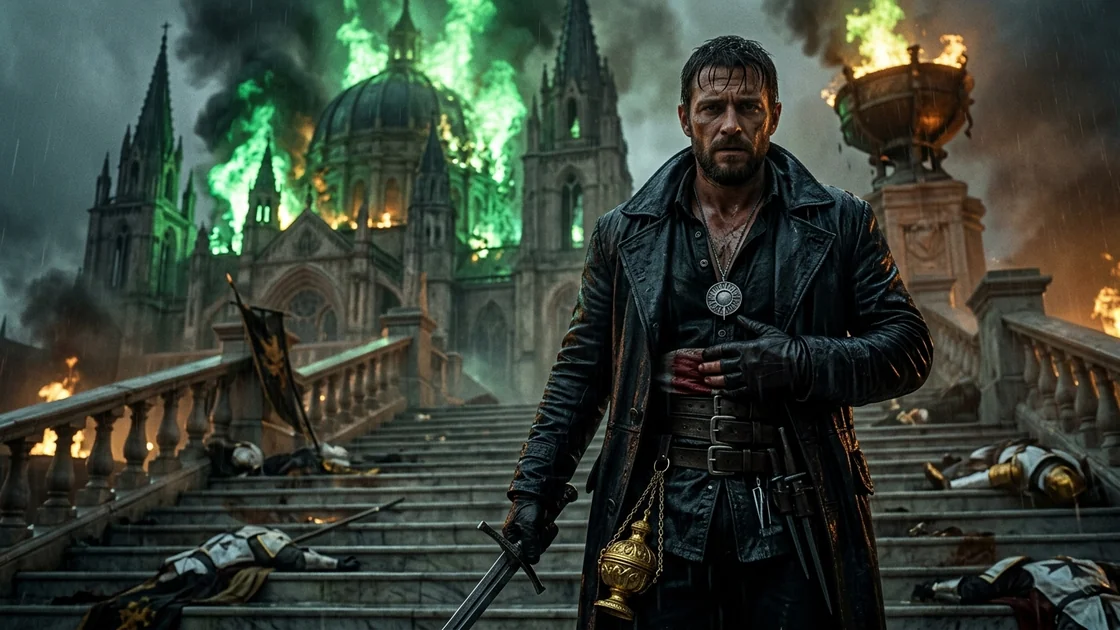
Corvus Vane spent twenty years as the most relentless witch hunter of the Order of the Radiant Pyre, driven by the memory of the night his childhood village of Dunmere was consumed by hellfire and he was miraculously saved by the Arch-Prelate. While hunting a rogue archivist in the northern fens, Corvus uncovers sealed ecclesiastical ledgers and alchemical residues proving that no witches ever existed in Dunmere. Instead, the Order slaughtered his people using ancient solar relics to fabricate a miracle, cementing their political dominion and justifying decades of lucrative crusades. Armed with the cold precision they taught him, Corvus abandons his vows and embarks on a methodical campaign of vengeance against the four high officials who orchestrated the massacre. One by one, he infiltrates their sanctums, claims the sacred relics they wield as instruments of terror, and turns the Church's own fabricated divinity back upon its creators until the entire hierarchy is reduced to ash.
The rain in the Whispering Fen did not fall; it hung in the air like a wet shroud, smelling of peat moss, rotted alder, and the faint, coppery tang of old blood. Corvus Vane stood beneath the eaves of a sunken mill, his black leather greatcoat heavy with moisture. Around his neck hung the silver emblem of the Weeping Sun—a disk of hammered metal depicting a solar orb shedding three tears of polished garnet. It was the mark of a High Inquisitor, a badge that caused doors to be barred in peasant hamlets and knees to bend in the marble courts of Oakhaven.
Beneath his left collarbone, hidden by boiled leather and linen, the old scar throbbed. It always ached when the damp settled in. The priests had told him it was the Devil’s thumbprint, the mark left by the Coven of Dunmere before Arch-Prelate Gideon pulled him, a boy of seven, from the green flames of the village square. You are the living proof of the Light’s mercy, Corvus, Gideon used to say, his aged hand warm on the boy’s shorn head. Every witch you burn pays the debt of your breath.
Corvus had paid that debt a hundred times over.
He adjusted the heavy iron buckle of his baldric and stepped toward the mill’s sagging door. Inside, a single tallow candle flickered, its yellow light bleeding through the cracks in the warped timber. The quarry within was not a hedge-wizard muttering over chicken bones, nor a desperate midwife brewing pennyroyal. It was Brother Julian, formerly the Keeper of the Fourth Seal in the Grand Basilica’s subterranean archives. Three months ago, Julian had vanished into the night with a mule, a lead-lined chest, and forty years of ecclesiastical secrets. The Order had declared him demon-struck, his mind rotted by prolonged exposure to confiscated grimoires.
Corvus raised his booted foot and drove it against the latch.
The rusted iron shrieked and gave way. The door swung inward, slamming against the damp stone wall. Corvus entered in a low crouch, a silver-inlaid wheel-lock pistol leveled in his left hand, his broadsword—etched with the Litany of Purification—already clear of its scabbard in his right.
Brother Julian did not reach for a weapon. He did not chant a curse. The old man sat on an overturned grain barrel beside a dying turf fire, wrapped in a threadbare woolen blanket. His fingers, stained permanently purple-black to the second knuckle by decades of iron-gall ink, trembled as he held a tin cup of boiled bog-water.
"So they sent the orphan," Julian said. His voice was like dry leaves scraping across a gravestone. "I wondered if it would be you, Corvus, or one of Cassian’s butcher-boys. I suppose Gideon has a sense of theater, even now."
Corvus kept the pistol aimed at the center of the archivist’s chest. His eyes swept the room—a habit drilled into him since his tenth year in the scholam. No chalk circles on the flagstones. No poppets of hair and wax. Only the lead-lined chest resting beside the cold millstone, its heavy padlock broken open.
"Brother Julian of the Fourth Seal," Corvus recited, his voice flat, devoid of malice or mercy. It was the voice of an iron bell. "You are charged with the theft of consecrated property, desertion of the Sacred Rule, and trafficking with the Unseen. By the grace of the Radiant Pyre, if you confess the names of your accomplices, you will be granted the mercy of the strangler’s cord before the fire takes your flesh."
Julian laughed, a wet, rattling sound that ended in a spasm of coughing. He spat dark phlegm into the turf embers. "The Unseen. Is that what he told you I was chasing? Demons in the dark?" The old man gestured weakly toward the open chest with his tin cup. "There are no demons in that box, boy. Only arithmetic. Though I grant you, in the hands of the Synod, a ledger is far more lethal than any hex."
"Stand away from the chest," Corvus ordered.
"Or what? You'll shoot me?" Julian smiled, showing gums gray with scurvy. "Look at me, Inquisitor. The fen-rot is in my lungs. I wouldn't survive the ride back to the Basilica in an iron cage, and we both know you didn't bring a wagon. Gideon didn't send you to arrest me. Have you checked your sealed orders—the secondary ones, in the red wax? Or are you only supposed to break that seal after my tongue is cut out?"
Corvus did not flinch, though the leather pouch at his belt seemed to grow heavier. There was indeed a second scroll in his saddlebag, sealed with the Arch-Prelate’s personal signet, marked To be opened upon the silencing of the Apostate. It was standard procedure for high-level heretics whose words might corrupt the simple soldiers of the escort. That Corvus had been sent alone meant the contagion was considered severe.
"Step back," Corvus repeated, stepping closer, the mud sucking at his boots.
"Why?" Julian whispered, leaning forward. His watery, bloodshot eyes fixed on Corvus’s left shoulder. "Afraid to look at the miracle? How is the scar tonight, Corvus? Does it burn like witch-fire? Or does it burn like white vitriol mixed with powdered brimstone and tallow-ash?"
Corvus paused. The pistol barrel did not waver, not by a hair’s breadth, yet something cold slid down the column of his spine.
Only the high apothecaries of the Order knew the composition of the scar-salve used to treat phosphor burns. To the laity, and even to the lower ranks of the Inquisition, the green flames that had consumed Dunmere twenty-two years ago were a manifestation of the Abyssal Pit, summoned by the village elders in a pact for fertile crops.
"Hold your tongue, apostate," Corvus said softly.
"I held it for twenty-two years," Julian replied, his voice rising with a sudden, desperate clarity. "I held it when I filed the requisition forms for Castellan Malakor’s foundry. I held it when I cataloged the deployment of the Sun-Lance under Marshal Cassian’s seal. I held it when Mother Valeria brought the child—you—into the crypts and rang the Glass Chime beside your cot for seven days and seven nights until you couldn't remember the color of your mother’s hair!"
"My mother died in the square," Corvus said, the words automatic, a catechism recited ten thousand times in the dark of his cell. "The witches bound her to the well-head. The Arch-Prelate cut the ropes with his own blade, though he was too late to save her soul."
"Your mother’s name was Martha Vane," Julian spat, slamming the tin cup down onto the millstone. "She was the village weaver. She owed four silver marks in back-tithes because the murrain took her sheep the winter before! And Gideon didn't cut her ropes, you blind, blood-soaked hound! Gideon stood on the ridge half a league away with a spyglass while Cassian’s knights barred the doors of the tithe-barn with three hundred men, women, and children inside!"
Corvus crossed the room in two strides. His left hand dropped the pistol by its lanyard and seized Julian by the throat, lifting the frail old man partly off the barrel. He slammed the archivist’s back against the damp stone wall.
"Lies," Corvus hissed, his face inches from Julian’s. "The Devil speaks through the desperate. I have heard a hundred witches claim the sky was green before the faggots caught."
"Kill me, then!" Julian choked out, his ink-stained fingers clawing not at Corvus’s wrist, but pointing frantically at the lead-lined chest. "Break my neck! Burn the mill! Go back to Sol-Vespera and kiss the gold ring of the man who butchered your kin! Or look in the box, Corvus. Look at the salt-tax rolls for the year of the Comet. Look at the alchemical manifests signed by Malakor three days before the Miracle of the Weeping Sun!"
Corvus stared into the old man’s eyes. In twenty years of hunting, he had seen every variety of liar. He had seen fanatics who believed their own delusions, cowards who invented conspiracies to buy an hour of breath, and sociopaths who mocked the Light for the sheer spite of it.
Brother Julian was none of these. The old man was terrified, yes, terrified of dying in the cold mud—but underneath the terror was a profound, crushing pity. Pity for the man holding him by the throat.
Slowly, Corvus released his grip. Julian slumped back onto the barrel, gasping for air, rubbing his bruised windpipe.
Keeping his sword drawn and his eyes half-fixed on the archivist, Corvus stepped to the chest. Inside lay several bundles of vellum bound in red ribbon, a small iron box, and a ledger bound in pigskin with brass corners—the unmistakable binding of the Inner Synod’s private treasury.
"Open the small iron box first," Julian wheezed. "You know the smell of it. Every Inquisitor knows the smell of the Foundry."
Corvus flipped the latch of the small iron box with the tip of his sword. Nestled in oilcloth was a jagged shard of greenish-white stone, porous as bone, alongside a brass nozzle etched with the maker's mark of the Order’s high armory. Beside it lay a folded scrap of parchment.
Corvus leaned down. A faint odor rose from the porous stone—sharp, garlic-like, metallic, and sickeningly sweet.
His stomach contracted violently.
Suddenly, he was not thirty years old in a rotting mill. He was seven. He was hiding beneath the floorboards of the fuller’s shop. Above him, boots—heavy, spurred cavalry boots, not the bare feet of village witches—were marching in formation. And through the cracks in the wood filtered that exact smell: garlic, hot copper, and sweet tallow, right before the world turned blinding, roaring green and the melting pitch dripped onto his left shoulder.
The Kiss of the Miracle.
Corvus reached out with a gloved hand and picked up the pigskin ledger. He flipped to the pages marked with slips of dried sedge.
The handwriting was precise, clerical, and entirely familiar; he had read dozens of warrants penned in the same hand. It was the script of Arch-Prelate Gideon, dated two months before the destruction of Dunmere, when Gideon was merely a junior bishop facing excommunication by the Royal Crown for embezzling the northern defensive tithes.
The Crown demands an audit of the northern bishoprics by the solstice, the entry read. If the King’s assessors reach the valleys, our coffers will be found empty and the Synod will be dissolved. We require a pretext to declare Martial Ecclesiastical Law across the province and seize the baronial treasuries in the name of public safety. A mortal threat from the Pit must be demonstrated—not in the cities, where witnesses are numerous and skeptical, but in a border settlement of no strategic value.
Below it was a table of figures.
Village of Dunmere: Population 312. Arrears in tithes: 84 pounds silver. Value of land if converted to sacred pilgrimage site: 1,200 pounds per annum.
Requisition from Brother-Castellan Malakor: Forty casks of Green Greek Fire (Project: Weeping Sun). Twelve iron censers of Nepenthe-ash to pacify the livestock and populace prior to containment.
Military execution: Knight-Commander Cassian, 4th Company of the Solar Guard. No survivors permitted save one youth of malleable age to serve as Living Witness before the Royal Assessors. Subject selected: Corvus, son of Arthur the Smith and Martha the Weaver. Subject to be delivered to Sister Valeria for mnemonic scouring and integration into the Scholam.
The rain pattered softly against the rotted shingles of the mill.
Corvus read the page once. He read it a second time. His training—the cold, analytical discipline that made him the finest investigator in the realm—automatically verified the watermarks on the vellum, the chemical oxidation of the twenty-year-old ink, the cross-referenced tally numbers from the Foundry’s coal expenditures. It was authentic. No forger in the world could replicate the multi-layered bureaucratic banality of the Order’s internal accounting.
They hadn't burned his village out of fanaticism. They hadn't even done it out of hatred.
They had murdered three hundred and eleven people—his mother, his father, his little sister Sarah who used to braid dandelion stems into his hair—to cover up a bad audit.
Sarah.
The name hit him like a crossbow bolt to the sternum. He hadn't thought the name Sarah in twenty-two years. Mother Valeria’s Glass Chime had cut her out of his skull as neatly as a surgeon’s lancet removing a cyst. Now, looking at the census list on the opposite page—Vane, Arthur (34); Vane, Martha (31); Vane, Corvus (7); Vane, Sarah (4)—the dam inside his mind cracked. He remembered a small hand clutching his sleeve beneath the floorboards. He remembered a man in silver-plated armor tearing the boards up, reaching down, pulling him out because he was the larger child, the sturdier specimen, and shoving the four-year-old girl back down into the dark as the green fire washed over the threshold.
Corvus’s breathing did not quicken. He did not scream. The Order had spent two decades hammering every human frailty out of him on the anvil of their dogma, turning him into a machine of pure, methodical violence. They had built a monster to hunt their enemies.
They had forgotten that a monster has no loyalty once its leash is cut.
"What are you going to do?" Brother Julian whispered, watching the terrible stillness that had settled over the Inquisitor’s face.
Corvus carefully closed the ledger and placed it back into the lead-lined chest. He walked outside to his horse, took the red-sealed scroll from his saddlebag, and returned to the fire. He broke the wax and read it.
Upon the death of the apostate Julian, burn the chest and its contents unopened. Return the melted lead as proof of compliance. May the Sun weep for the fallen.
Corvus tossed the scroll into the turf fire. The parchment curled, blackened, and flared into ash.
"The cold is killing you, Brother Julian," Corvus said, his voice quieter now, stripped of the liturgical cadence.
"A week left, perhaps two," the old man nodded. "The blood in my sputum is dark. The kidneys are failing."
"If they find you alive, Valeria will use the Nails of the Martyr to see who else saw these pages. It will take four days for you to die on her table."
Julian looked at the broadsword in Corvus’s hand, then up into the hunter’s gray eyes. "And if you leave my head on a pike outside the mill, alongside a melted lump of lead?"
"Then the audit is closed," Corvus said. "And I am just an obedient hound returning to the kennel."
Julian closed his eyes and tilted his chin up, exposing the pale, loose skin of his throat. "Make it clean, son of Arthur. And when you reach Sol-Vespera... audit their books for me."
"I will," Corvus said.
The silver-etched blade moved once, a blur of gray steel in the candlelit gloom. Brother Julian did not even feel the cold of the iron.
Three days later, the spires of Sol-Vespera broke the horizon like jagged teeth of white bone biting into a bruised winter sky.
The city was built in tiers around the Great Mount, crowned by the Cathedral-Fortress of the Radiant Pyre. From the central dome hung the Eternal Brazier, a massive cage of gilded bronze forty feet across, burning night and day with alchemical oil that cast a perpetual, sickly amber glow over the slate roofs below. In the slums at the foot of the mount, where the tanners and night-soil carters lived, they called it the Jaundiced Eye.
Corvus rode through the Traitor’s Gate at dusk. A sack of salted canvas, dark at the bottom with dried blood, hung from his pommel. When the gate-wardens saw the silver disk around his neck and the grim bundle at his knee, they crossed themselves with the sign of the Sun and waved him through without a word.
He did not go to the Hall of Inquisitors. He went first to the Charnel Clerk in the outer bailey, dropped the canvas sack and a thirty-pound lump of fire-warped lead obtained from the mill’s roof glazing onto the marble counter, and signed the receipt of execution with a steady hand.
"The Arch-Prelate is in retreat preparing for the Jubilee of the Weeping Sun next week," the clerk said, stamping the vellum with hot wax. "He commends your speed, Inquisitor Vane. Ten silver crowns bounty has been credited to your cell’s stipend."
"The Light provides," Corvus murmured, the traditional response tasting like bile on his tongue.
He walked down the long, echoing corridors of the Cathedral’s undercroft toward his quarters, but he did not stop at his cell. Instead, he descended further, past the ossuaries where the bones of dead templars were stacked like cordwood, down into the heat and roar of the Foundry of Penance.
This was the domain of Brother-Castellan Malakor.
Here, the air was thick with coal smoke, sulfur, and the rhythmic clanging of trip-hammers driven by subterranean waterwheels. In the Foundry, the Order’s miracles were manufactured. Hundreds of penitents—debtors, petty heretics, and prisoners with their tongues removed—toiled in chains around huge copper vats, distilling the alchemical fires, forging the silver-tipped bolts, and polishing the brass reliquaries sold to wealthy nobles to ward off the plague.
High above the floor, suspended by massive iron chains over a bubbling pit of slag, was an octagonal glass-and-iron pavilion: Malakor’s laboratory and private sanctum.
Corvus climbed the spiral iron staircase. The two halberdiers at the top recognized him immediately. Everyone in the Order knew Corvus Vane; he was Malakor’s most frequent customer, always requiring fresh vials of witch-bane, silver powder, and flare-bolts.
"Is the Castellan within?" Corvus asked, holding up the small iron box he had taken from Julian’s chest. "I recovered an anomalous substance from the northern fen. It requires his analysis before I file my report."
The guards stepped aside and knocked the butts of their halberds twice against the iron door. A heavy bolt slid back from within.
Corvus stepped inside and pulled the door shut behind him, sliding the interior drop-latch into place with a soft, metallic click that was lost in the roar of the furnaces below.
The pavilion was hot and smelled overwhelmingly of nitric acid, rosewater, and roasted fat. Brother-Castellan Malakor stood over a marble dissecting table where a clockwork automaton of a saint—designed to weep real blood through hidden bladder-tubes during rural processions—lay open like a gutted fish. Malakor was a mountain of a man, his belly straining against a leather apron worn over white silk vestments. Because of the toxic fumes of his craft, the lower half of his face was covered by a permanent mask of articulated silver plates shaped like a serene, smiling visage, with breathing tubes trailing back to a filter-pack of charcoal strapped between his shoulder blades.
Above the table, hanging from a golden tripod, was the true jewel of the Foundry: the Censer of Saint Jude the Suffocated.
It was one of the Four Great Relics of the Order. According to scripture, when the pagan kings had tried to choke Saint Jude in a pit of burning dung, his lungs had turned the smoke into holy incense that struck his tormentors blind and rotted their throats from the inside out. Corvus knew better now. The Censer was a pre-imperial masterwork of pneumatic alchemy, housing two separate chambers of volatile salts that, when mixed by twisting the bezel, released a heavy, colorless gas. Anyone not wearing Malakor’s specially treated charcoal filters—or chewing the bitter root of the grey-gentian plant—would have the lining of their lungs dissolved into bloody froth within thirty seconds.
Three hours ago, before entering the city gates, Corvus had chewed half a handful of grey-gentian root from his field medic's pouch. His tongue was numb and black with the juice.
"Vane," Malakor’s voice resonated through the silver voice-box of his mask, tinny and wet. He didn't look up from the clockwork saint, tweaking a brass valve with a pair of pliers. "The clerk sent word down the speaking-tube that you bagged old Julian. Good. The idiot was senile, wandering off with the seventies tithe-rolls. Did he babble much before you opened his neck?"
"A great deal," Corvus said, walking calmly to the marble table. "He spoke of the chemical composition of the Weeping Sun."
Malakor paused. His tiny, piggish eyes above the silver mask narrowed as he looked up. "Did he, now."
Corvus placed the small iron box on the table beside the disemboweled mechanical saint and flipped the lid open, revealing the porous greenish-white stone and the brass nozzle bearing Malakor’s personal stamp.
"Batch Four," Corvus said conversationally. "Brewed in the autumn of the Comet. White phosphorus suspended in naphtha and copper sulfate to give the flames that distinctive abyssal green. Sticky enough to cling to timber—and to skin. Even a drop of it burns all the way down to the periosteum of the bone."
Slowly, Corvus reached up and unfastened the top two buckles of his leather cuirass, pulling aside his linen shirt to expose the jagged, shiny crater of scar tissue beneath his left collarbone.
Malakor looked at the scar, then at the stone in the box, and finally into Corvus’s eyes. To his credit, the Master Alchemist did not waste time denying it. Men who spent their lives measuring poison by the grain were pragmatists at heart.
"You were supposed to burn the chest unopened," Malakor said, his hand drifting casually toward a heavy glass carboy of smoking acid at the edge of the table. "Gideon always was too sentimental about his pets. I told him twenty years ago we should have just bought a mute beggar boy from the docks and scarred him with a hot iron. Using an actual survivor from the culling was bad theater. Too many loose threads."
"Three hundred and eleven people," Corvus said.
"Three hundred and twelve, counting your father," Malakor corrected mildly. "He didn't burn in the barn with the rest. He broke through the cordon at the smithy with a sledgehammer. Crushed the skull of one of Cassian’s sergeants before they pinned him with pikes and tested the nozzle pressure on his chest. The man took four minutes to die. Remarkable constitution. You have his shoulders."
Corvus felt a strange, quiet warmth in his chest. Arthur the Smith. His father hadn't died cowering on his knees praying to a false god. He had died with a hammer in his hands and knight’s blood on his apron.
Malakor snatched the carboy of fuming nitric acid and hurled it directly at Corvus’s face.
Corvus wasn't there. He was already moving before Malakor’s fat fingers had tightened on the glass neck. He ducked beneath the arc of the bottle—which shattered against the iron wall behind him, instantly hissing as it ate into the metal—and lunged across the marble table, kicking the clockwork saint straight into Malakor’s chest.
The heavy wood-and-brass effigy slammed into the Castellan, driving him back against his alchemical racks. Glass retorts, alembics, and jars of pickled specimens crashed to the floor in a cascade of multicolored liquids.
Malakor roared through his silver mask and reached to his belt, drawing a double-barreled wheel-lock pistol loaded with flare-shot—the same incendiary rounds used to ignite witches' pyres from fifty paces.
Corvus didn't draw his sword; in the cramped pavilion, a forty-inch blade was a liability. Instead, he drew his heavy iron hunting dagger and threw it—not at Malakor’s armored belly, but at the rubberized leather breathing tube curving over the alchemist’s left shoulder.
The blade severed the tube cleanly and pinned the tattered end to the wooden shelving behind him.
Malakor fired. The flare-round screeched past Corvus’s ear, so close the heat singed his hair, and struck the thick glass window of the pavilion, spider-webbing the pane in a burst of blinding white sparks. Before Malakor could thumb the second cock, Corvus closed the distance, caught the alchemist’s thick wrist in both hands, and twisted upward until the radius bone snapped with a sound like a dry branch breaking in winter.
Malakor shrieked, dropping the pistol. He swung his other arm—a massive, meaty fist encased in a lead-lined gauntlet—catching Corvus across the temple.
Stars exploded across Corvus’s vision. He staggered back, blood trickling from his hairline, tasting the bitter gentian root mixing with copper in his mouth. Malakor, wheezing through the severed tube at his neck, lunged not for the door, but for the golden tripod holding the Censer of Saint Jude.
"You think you know the tools of the Church, dog?" Malakor snarled, seizing the heavy brass sphere and twisting the upper bezel until it clicked thrice. Instantly, a dense, pale-yellow vapor began to pour from the pierced mouths of the cherubs carved around its circumference. "Chew all the gentian root you want! At full saturation, the Saint’s breath eats through the eyes and pores! Let’s see how fast you run when your corneas turn to jelly!"
The alchemist ripped the severed tube away from his mask and jammed a brass emergency plug into the intake port, relying on the second, intact tube on his right side to feed him clean air from his back-filter. He swung the Censer by its heavy golden chains like a morningstar, filling the small room with the rolling, caustic fog.
Outside the cracked windows, down on the foundry floor, the penitents continued to hammer away, oblivious to the battle in the glass box above the slag pit.
Corvus backed toward the marble table, his eyes already stinging furiously as the concentrated gas touched his skin. It felt like walking into a swarm of hornets. He couldn't fight the man blind, and the room would be lethal within ten seconds.
Malakor swung the Censer again. The heavy brass globe smashed into the marble edge of the table where Corvus had stood a heartbeat before, sending stone chips flying.
Corvus didn't retreat this time. As the chain wrapped around the table leg, he stepped inside the arc of the swing, right into the thickest plume of the gas, holding his eyes shut to tiny slits. His left hand shot out and seized the intact right-side breathing tube behind Malakor’s neck. His right hand grabbed the silver face-mask itself.
Malakor’s piggish eyes went wide with sudden, absolute terror. He tried to throw his bulk backward, tried to bring his broken left arm up to claw at Corvus’s face, tried to yank the Censer’s chain free.
Corvus planted his boot against the alchemist’s massive knee and wrenched the silver mask sideways with every ounce of strength in his scarred shoulders.
The leather straps holding the mask had been riveted directly into Malakor’s jawbone years ago to ensure an airtight seal. With a wet, sickening tear of cartilage and rusted iron, the left rivets ripped free from his cheek. At the same time, Corvus took the smoking nozzle of the Censer—still dangling by its tangled chain—and shoved the cherub-carved vents directly into the gap beneath the torn silver mask.
"Breathe deep, Brother," Corvus whispered.
Malakor’s screams lasted less than three seconds before the gas hit the wet tissue of his trachea. The sound turned instantly into a thick, bubbling gurgle, like boiling porridge. The giant man thrashed wildly, his heels drumming against the glass-littered floor as pink, bloody foam erupted from the edges of his silver mask and poured down his white silk vestments. His hands beat weakly against Corvus’s leather coat, leaving smears of chemical soot, and then slipped down to his sides.
Corvus held him there until the spasms stopped entirely.
Working quickly, his eyes streaming tears of mild acid burn, Corvus twisted the Censer’s bezel back to the locked position, shutting off the flow of gas. He pulled the charcoal filter-pack from Malakor’s corpse, detached the spare glass vials of the two precursor salts from the alchemist's belt, and slung the golden chains of the Censer of Saint Jude beneath his black greatcoat.
Wait-guards would wonder why the fog was in the room. He needed an explanation that fit the Foundry’s daily hazards.
Corvus walked over to the storage rack where the casks of Batch Twelve—the current iteration of the Green Greek Fire—were kept under pressure. He dragged Malakor’s body over to the main distillation vat, placed the alchemist's unbroken hand on the primary pressure valve, and then used a heavy iron wrench to crack the main feed-pipe.
Green, oily liquid began to pool across the floor, creeping toward the open brazier under the alembic stand.
Corvus walked to the door, unlatched it, and stepped out onto the iron landing between the two halberdiers, pulling the door shut behind him. He was wiping his watering eyes with a linen handkerchief.
"The Castellan is testing a volatile batch of northern pitch," Corvus told the guards calmly, his voice rough. "He ordered the floor cleared. The seals on his vat are rotting."
Before the guards could reply, the green oil inside the pavilion reached the brazier.
With a deep, subterranean whump, every window of the octagonal room blew outward in a hurricane of emerald flame and shattered glass. The blast knocked the two halberdiers flat on their backs on the iron grating. Corvus remained standing, his black coat whipping around his boots as the fiery ruin of the laboratory rained down into the slag pit below, lighting the faces of the chained penitents in the exact shade of green that had consumed Dunmere twenty-two years ago.
"A tragic accident," Corvus said to the stunned guards, and walked down the stairs into the smoke.
The second architect did not dwell in heat and noise, but in cold and absolute silence.
Fifty miles east of the capital, perched on the sheer chalk cliffs overlooking the Sea of Glass, stood the Abbey of White Silence. Here lived Mother-Confessor Valeria and her Choir of the Penitent—sixty nuns who had taken the vow of the Severed Tongue, communicating only through hand-signs and the ringing of small silver bells.
It was a place of terror disguised as a hospital for the soul. When noblemen grew too vocal against the Synod’s taxes, or when young inquisitors began to break under the horror of their duties, they were sent to the Abbey for "spiritual realignment." When they emerged months later, they were placid, smiling creatures who donated their estates to the Church and wept with joy whenever they heard the sound of a bell.
Corvus arrived at the Abbey gates at midnight during a coastal gale. The wind howled off the black ocean, driving needles of sleet sideways across the chalk courtyard.
He did not knock at the main portcullis. Having spent his childhoodfrom age seven to twelve within these very walls under Valeria’s "care," he knew the drainage architecture of the cliffside. He tethered his horse in a dead pine copse half a mile back, scaled down the slick chalk face using an iron grapnel, and entered through the tide-sluice where the Abbey’s kitchen waste dropped two hundred feet into the surf.
Dripping with seawater and freezing chalk-slurry, he emerged through a floor grate into the Scriptorium of Contrition.
The halls of the Abbey were painted entirely with lime-wash—floor, walls, and vaulted ceilings—so that a single candle made the corridors glow with a sterile, blinding whiteness. Not a sound could be heard save the distant boom of the sea against the cliffs below and the whisper of bare feet on stone as the mute sisters patrolled in pairs, carrying whale-oil lanterns and iron-shod staves.
Corvus moved like a drop of ink across a white page.
He avoided the dormitories and headed straight for the Bell-Tower of Saint Cecile, where the Mother-Confessor kept her private chapel and the second of the Four Great Relics: the Chime of Unclouded Grace, paired with the Nails of the Martyr.
At the base of the tower stairs stood four Temple Wardens—not mute nuns, but heavy infantry in white-enameled plate armor, their helmets lacking visors so their eyes and ears had been sealed with blessed beeswax and lead plates to make them immune to the acoustic power of Valeria’s relic. They navigated by touch and sight alone, halberds crossed before the oak door.
Corvus did not draw steel. Steel rang against plate armor, and even if the guards were deaf, the vibrations would travel up the stone stairwell to Valeria.
Instead, he reached beneath his coat, took the Censer of Saint Jude, and unscrewed the top cap slightly, pouring just a thimbleful of Malakor’s yellow precursor salt onto the red salt below. He held his breath, bit down on a fresh piece of gentian root, and rolled the heavy brass sphere across the white lime-washed floor until it came to rest directly between the mailed boots of the four wardens.
The guards looked down at the golden sphere rolling out of the shadows. Because they could not hear the hiss of the chemical reaction, and because their noses were partially blocked by the facial guards of their helms, they did not react for five full seconds as the pale vapor rose around their greaves.
Then the first warden tried to inhale.
In complete, eerie silence—since their vocal cords had been cut upon entering the Abbey’s service—the four armored giants dropped their halberds onto the thick wool carpet at the base of the stairs and clawed at their own throats. They fell to their knees in unison, like men struck by a sudden, overwhelming urge to pray, before pitching forward into the rising pool of bloody froth leaking from their breathing slits.
Corvus stepped over their twitching armored legs, retrieved the Censer, sealed its vents, and ascended the spiral stairs.
At the top, there was no door—only a heavy curtain of white velvet. Corvus slipped his dagger between the folds and parted them an inch.
The circular room at the top of the tower was open to the gale through four narrow lancet windows, though the wind seemed strangely muted here, absorbed by hundreds of acoustic baffles made of stretched lambskin hanging from the ceiling. In the center of the room stood an iron chair fitted with leather straps and a head-clamp of brass screws.
Beside the chair stood Mother-Confessor Valeria.
She was seventy years old, tall and skeletal as a winter heron, dressed in habits of bleached linen so stiff with starch they crackled when she moved. Her eyes were milky with cataracts, yet she moved with unerring precision around a young girl—no more than twelve, dressed in the rich velvet of a merchant’s daughter—who was strapped into the iron chair.
In Valeria’s left hand were three six-inch spikes of black meteoric iron—the Nails of the Martyr—which were pressed lightly against the skin behind the girl’s ears and at the base of her skull, held in place by the brass clamp. In her right hand, Valeria held a crystal mallet and the Chime of Unclouded Grace: a tuning fork of pale, translucent glass infused with threads of star-silver, forged in the dark ages before the Church existed.
When the glass fork was struck, it did not merely make a sound; it set up a harmonic resonance along the meteoric iron nails, vibrating directly into the temporal lobes of the brain. Under the terror and pain induced by the iron, the mind became liquid wax, allowing a skilled confessor to scrape away memories through suggestion and trauma, or pour in false ones until the victim believed they had danced with Satan on the Sabbat hill.
"Your father did not mean to withhold the shipping tithes, little Clara," Valeria was murmuring, her voice as sweet and soft as warm milk. "He was bewitched by his clerk. And you saw him sign the pact in blood, didn't you? When I ring the third tone, you will remember the clerk turning into a black goat. Then you will tell the Royal Magistrates, and your soul will be white as snow..."
She raised the crystal mallet.
"Don't strike it, Mother," Corvus said, stepping through the velvet curtains. "The pitch is slightly flat tonight."
Valeria froze. Slowly, she turned her tall, skeletal frame toward the doorway, her milky eyes widening as she took in the black leather coat and the silver disk at his throat. The young girl in the chair whimpered, her eyes rolling wildly toward the stranger.
"Corvus?" Valeria breathed. A genuine, maternal smile touched her thin, bloodless lips. Of all the Synod, she was the only one who truly believed in the monstrous thing they had built; to her, erasing a truth was no different from setting a broken bone. "My little blackbird. What are you doing here at this hour? Have the bad dreams returned? Gideon told me you were hunting the archivist in the north."
"I found him," Corvus said, walking calmly to the iron chair. Before Valeria could react, he reached out and spun the brass thumbscrews backward, releasing the head-clamp so the three black iron nails dropped away from the girl’s skin into his waiting glove. He unbuckled the chest strap and pulled the trembling merchant’s daughter out of the seat.
"Go down the stairs," Corvus told the child softly. "Do not look at the men sleeping at the bottom. Go through the kitchen grate—there is a rope tied to the iron ring. My horse is in the pine trees half a mile north. Ride toward the coast road until sunrise."
The girl didn't ask questions. She bolted past him, tearing through the velvet curtains and vanishing down the steps.
Valeria watched her go with an expression of mild disappointment, though her hand tightened around the stem of the Glass Chime. "That was unwise, Corvus. Lord Aldous’s shipping fleet is worth forty thousand crowns to the Crusade fund. Without the girl’s testimony at the assizes, the Crown won't let us seize his wharves."
"The books are closed, Mother," Corvus said, holding the three black Nails of the Martyr in his palm. They felt strangely warm, humming with a faint, parasitic magnetism that made the old scar tissue at the base of his own skull itch. There, beneath his hair, were three tiny white dots he had been told were birthmarks.
"Julian showed you the ledger," she said simply. There was no fear in her milky eyes, only a profound sadness. "Oh, my poor boy. I told Gideon the deep memory cannot be entirely excised without destroying the motor cortex. I buried Dunmere under twenty layers of scripture and pain, like sealing lead over a well, yet the water always finds a crack if someone digs deep enough."
"Her name was Sarah," Corvus said, taking a step closer. "She was four years old. She had a wooden doll my father carved from an ash-root. You took five days to make me forget her face."
"And would you have been happier remembering her, Corvus?" Valeria asked, her voice ringing with absolute, fanatical conviction. "You were seven years old! When Cassian’s men brought you down from the hills, you had chewed through your own tongue from screaming! Your shoulder was rotting to the bone! If I had left those memories inside your head, you would have died raving in a madhouse before your tenth birthday! I took away your grief and I gave you a purpose! I made you a sword in the hand of God!"
"You made me a butcher for a gang of thieves," Corvus replied.
Valeria sighed and raised the Glass Chime and the crystal mallet. "You think this relic only works when the victim is strapped to the chair? No, my child. The nails are merely for precision—for carving out a single name or face while leaving the rest intact. Without the nails, the full harmonic of the Chime shatters the recent architecture of the mind entirely. And in your skull, Corvus, the tracks I laid twenty years ago are still waiting like dry gunpowder."
She swung the crystal mallet toward the glass tuning fork, aiming to strike the master-note—the command word she had planted in the deepest basement of his subconscious when he was seven years old, designed to drop him into a catatonic stupor at a single tone.
Corvus didn't try to parry the mallet. Instead, he hurled his heavy iron sword-scabbard directly at the acoustic lambskin baffles hanging behind her head, while simultaneously snapping the clasp of his heavy leather cloak and whipping the wet, sodden wool around the tines of the Glass Chime a split second before the crystal mallet struck.
Instead of a pure, mind-shattering ring, the muffled glass produced a dull, flat thud against the wet wool.
Valeria gasped, stumbling back, and tried to wrench the relic free of the cloak. Corvus was on her instantly. He did not strike her with a fist or a blade; he caught her thin wrists, spun her around, and shoved her frail body down into the iron chair she had kept warm for forty years.
"The Sisterhood will hear!" she hissed, thrashing with surprising, wiry strength as he snapped the heavy leather straps across her chest and forearms. "Even without tongues, they know when the tower is breached!"
"Let them come," Corvus said coldly, kicking the heavy oak cross-beam down behind the velvet curtain to bar the stairwell entry.
He stepped behind the iron chair, grabbed a handful of her white wimple, and forced her head back into the brass clamp, spinning the thumbscrews until the iron bit through the starched linen into her temples.
"Corvus, listen to me!" For the first time, the maternal mask cracked, and real terror bled into her voice as she felt the cold tips of the three meteoric Nails of the Martyr press against the mastoid bones behind her ears and the base of her skull. "If you strike the Chime while the nails are set too deep, the resonance doesn't edit—it reflects! Every mind I have ever touched leaves an echo in the iron! Have mercy! I saved your life!"
"No," Corvus said, picking up the Glass Chime and the crystal mallet from the floor. "You stole my death, and you sold my life back to the men who killed my family."
He positioned the three black nails so their points broke the skin just enough to draw three beads of dark blood—the necessary conductor for the relic's true power. As a boy, he had been subjected to gentle taps of the mallet, spaced out over hours of whispered catechisms.
"You told me the Nails of the Martyr carry the echoes of every confession ever extracted by this chair," Corvus whispered into her ear. "Three hundred years of prisoners. And at the top of the layer... a seven-year-old boy screaming in a burning village."
"Don't!" Valeria shrieked, her milky eyes bulging in their sockets. "The human brain cannot hold more than one consciousness at a time! If you strike the high note with the nails grounded in blood—"
Corvus raised the crystal mallet as high as his arm could reach, and brought it down with all his strength against the glass tines, holding the vibrating fork directly against the center nail at the base of her skull.
A sound like a choir of ten thousand glass bells singing at the bottom of the sea filled the tower room.
Valeria’s mouth opened in a scream that had no sound, because the frequency of the Chime swallowed every other vibration in the air. Through the meteoric iron, three centuries of stored psychic agony—every child terrified into betraying their parents, every broken noble, every screaming villager from Dunmere whose terror Corvus had carried into this room twenty-two years ago—flooded backward out of the lattice of the relic and poured into her cerebral cortex in a single, blinding instant.
Blood burst from her nose and her cataract-clouded eyes. Her back arched so violently against the leather straps that her collarbone snapped with a dry pop. For ten eternal seconds, the Glass Chime sang against the iron nail, forcing Mother-Confessor Valeria to experience three hundred and eleven deaths by green fire simultaneously, over and over, in the infinite loop of a shattered nervous system.
When the vibration finally died away, Valeria slumped forward against the chest strap. She was still breathing—shallow, rhythmic gasps—and her milky eyes were wide open, staring at the white wall. A thin thread of saliva ran down her chin, and her fingers twitched rhythmically, signing the childhood prayer for bedtime over and over into the empty air. Her mind was gone, wiped cleaner than the lime-washed stones of her abbey.
Below the barred door, the heavy thudding of iron-shod staves began as the mute sisters finally discovered the dead wardens at the foot of the stairs.
Corvus calmly unscrewed the brass clamp, retrieved the three Nails of the Martyr, and wrapped the Glass Chime in silk, stowing both inside his satchel beside the Censer of Saint Jude. He walked to the eastern lancet window overlooking the sheer drop to the sea, hooked his grapnel line to the base of the iron chair, and stepped backward out into the howling dark of the winter storm.
News travelled fast along the semaphore towers of the Order, where giant mirrors flashed coded sunlight from hill to hill across the realm. By the fifth day, every garrison between the coast and the capital knew that Castellan Malakor had died in a foundry explosion, that Mother Valeria had been found reduced to a drooling infant in her own chair, and that two of the Four Great Relics were missing.
And they knew who had taken them.
Arch-Prelate Gideon did not issue a public warrant naming Corvus Vane a traitor; to admit that the Living Witness of the Miracle of the Weeping Sun had turned against the Church on the eve of the Jubilee would cause awkward questions among the Royal Assessors. Instead, a secret Papal Bull of Extermination was sent directly to the third architect of Dunmere: Lord-Marshal Cassian, Commander of the Solar Guard, stationed at the Bastion of Red Iron thirty miles south of Sol-Vespera.
Cassian was not a creature of laboratories or quiet towers. He was a soldier who had spent forty years encased in plate armor, crushing peasant uprisings and burning border heretics. He knew Corvus would come for him—not just for vengeance, but because Cassian held the third relic, the weapon that had actually burned Dunmere: the Sun-Lance of Saint Michael.
And unlike the others, Cassian prepared a battlefield.
The Bastion of Red Iron was a star-fort built in the center of a treeless, snow-covered plain, surrounded by a dry moat bristling with sharpened stakes and iron caltrops. Inside its walls were two hundred veteran paladins of the Solar Guard. In the center of the main courtyard, mounted on a rotating bronze turret atop the keep’s barbican, was the Sun-Lance itself—a six-foot cylinder of brass and rock-crystal lenses housing a core of burning, alchemically enriched sun-stone that focused Malakor’s green fire into a continuous, pressurized beam capable of melting through a castle gate at two hundred yards.
When Corvus rode out onto the white expanse of the plain at midday, he did not come in the dark. He rode his black horse straight down the King’s Road in broad daylight, stopping three hundred yards from the fort’s gates—just outside the maximum range of the Sun-Lance.
On the battlements above the gate stood Lord-Marshal Cassian. Even from three hundred yards, the man was unmistakable in his gilded, fluted plate armor and crimson cloak, a white-bearded giant leaning on a two-handed greatsword.
Cassian raised a brass speaking-trumpet to his lips. His voice boomed across the frozen plain.
"I told Gideon we should have left you in the fuller’s cellar with your little sister, boy!" Cassian roared, the sound echoing off the stone walls as two hundred crossbows clicked into place along the parapet. "You have two relics in your saddlebags, and two hundred men between you and this gate! Are you going to charge a star-fort alone, Inquisitor?"
Corvus did not answer. Dismounting calmly in the snow, he took a heavy iron spike from his saddle, drove it into the frozen dirt of the road, and tied a single object to the top of it: the pigskin ledger from the Inner Synod’s treasury, opened to the page bearing Cassian’s signature beneath the Dunmere massacre order.
Beside the spike, half-buried in the snow drift, Corvus placed the Censer of Saint Jude and the Glass Chime, rigging a thin wire of silver thread between the ledger’s bindings and the crystal mallet resting poised above the glass tuning fork.
Then Corvus mounted his horse, turned its head toward the low stone ruins of an old toll-house a hundred and fifty yards to the left—inside the outer perimeter of the fort’s field of fire—and spurred the beast into a gallop.
Up on the barbican, Cassian laughed. "He wants cover in the toll-house! Turn the Lance! Burn the stones over his head! And Captain—take twenty riders out the sally port and fetch that book before the King’s road-wardens ride by!"
The massive bronze turret atop the barbican groaned on its gears as four engineers cranked it toward the ruined toll-house. Inside the crystal housing of the Sun-Lance, the alchemical core flared to life with a blinding, emerald luminescence. A heartbeat later, a jet of roaring green fire thirty feet long erupted from the brass nozzle, arcing across the snowfield like a falling comet.
It struck the ruined stone toll-house just as Corvus’s horse cleared the low wall. The ancient mortar exploded from the thermal shock; the remaining slate roof vanished in a mushroom cloud of green flame and black smoke, turning the snow for fifty yards around into boiling mud.
Meanwhile, the sally port groaned open, and twenty mounted paladins thundered out across the drawbridge. Ten rode toward the burning ruins of the toll-house to verify the kill; the other ten rode straight down the road to retrieve the ledger pinned to the iron spike, just as Cassian had ordered.
Wait-discipline was the hallmark of the Solar Guard, and they brought the ledger back through the gates immediately, carrying the iron spike and the attached leather bundle containing the "captured" relics straight up to the barbican where Cassian stood beside the smoking Sun-Lance.
"He didn't even arm them," the captain reported, dumping the bundle at Cassian’s gilded sabatons while the other riders poked through the blazing ruins of the toll-house, where a dead, charred horse lay smoking beneath fallen beams. "The man was mad with grief, Marshal. The Lance cooked him in the cellar of the ruin."
Cassian frowned, looking down at the pigskin ledger and the silk-wrapped bundle tied to the bottom of the spike. "Vane wasn't mad. I trained him in siege-craft myself when he was fifteen. Check that horse in the ruins—is there a body under the saddle?"
Out on the field, a paladin used his lance to roll the smoking carcass of the black horse over. Beneath it lay a black leather greatcoat stuffed with straw and weighted with saddle-stones.
There was no body.
"The wind!" Cassian barked, suddenly looking at the fluttering crimson pennants atop the fort’s towers, which were blowing steadily from the south—straight across the dry moat and over the barbican wall. "Where is the Censer?!"
Down in the dry moat directly beneath the barbican wall, where he had dropped from the toll-house roof into a concealed drainage ditch before the green fire struck, Corvus Vane stood pressed against the freezing stone foundation. He wasn't holding the Censer; the Censer was already sitting at Cassian’s feet on the parapet above, wrapped in silk.
And in Corvus’s hand was the end of a two-hundred-yard spool of waxed fisherman’s gut, invisible against the white snow, trailing up through the drainage scupper of the barbican wall to the trigger-pin of the bundle at Cassian’s boots.
Corvus pulled the line taut and yanked.
Up on the barbican, two things happened simultaneously.
First, the pin pulled free from the Censer of Saint Jude’s pre-loaded spring valve, releasing the entire remaining store of Malakor’s two-part gas in a single, pressurized blast that engulfed the barbican platform and was carried by the southern wind straight down the length of the battlements.
Second, the heavy crystal mallet—pulled by a secondary torsion spring—slammed down onto the Chime of Unclouded Grace, which was resting directly against all three Nails of the Martyr embedded in a lump of wet clay salted with Corvus’s own blood.
The acoustic blast of the Glass Chime did not have the focused lethality it had possessed when pinned to Valeria’s skull, but across a twenty-yard radius on the crowded stone platform, the harmonic frequency struck the eardrums of Cassian and thirty of his veteran paladins like an invisible battering ram.
Every man on the barbican dropped to his knees simultaneously, clutching his helmet as their inner ears ruptured and a wave of sudden, disorienting psychic terror—the distilled memory of burning alive—washed through their minds. And as they opened their mouths to scream in panic, they inhaled deep lungfuls of Saint Jude’s yellow fog.
Seconds later, Corvus’s iron grapnel hooked over the crenellations of the barbican.
He hauled himself up over the parapet into a scene from hell. Through the drifting yellow haze, thirty armored paladins were staggering blindly, vomiting blood into their visors or toppling over the inner wall into the courtyard thirty feet below. Down on the lower walls, the rest of the garrison was in chaos, watching their commanders choke to death in a cloud of golden incense while the eerie, mind-numbing ring of the Glass Chime still echoed off the stone keep.
Only one man on the platform was still standing upright.
Lord-Marshal Cassian had dropped his visor and stuffed his woolen cloak into his breathing slits the instant he saw the silk bundle twitch. His ears were bleeding from the Chime’s resonance, and his eyes were red-rimmed and wild through his vision-slits, but he held his six-foot greatsword in both gauntleted hands, swinging it in a wide, whistling arc that sheared the head off one of his own blinded engineers who stumbled too close.
"Come out of the smoke, orphan!" Cassian roared, his voice muffled by the blood-soaked wool in his helm. "I killed your father with cold iron when he broke my line! I don't need relics to gut his whelp!"
Corvus stepped out of the thinning vapor as the wind carried the last of the gas over the northern wall. He picked up the Glass Chime and the Censer, stowing them at his belt, and drew his broadsword.
Cassian charged with terrifying speed for a man in eighty pounds of gilded steel. The greatsword came down in an overhead cleave that would have split horse and rider in two.
Corvus didn't try to block the massive blade; he sidestepped, letting the tip of the greatsword smash sparks from the granite paving stones, and slammed the pommel of his own sword into the hinge of Cassian’s right elbow-cop, jamming the articulated steel plates together so the Marshal couldn't bend his arm cleanly on the recovery.
Even with one arm stiffened, Cassian pivoted and backhanded Corvus across the chest with his left gauntlet, sending the witch hunter skidding backward across the frost-slick stone until his spine hit the bronze mounting of the Sun-Lance.
"Arthur the Smith had a sledgehammer!" Cassian bellowed, wrenching his right arm hard enough to pop the jammed rivet on his elbow-plate, raising the greatsword for a horizontal sweep to take Corvus’s head off against the brass turret. "And he died squealing like a pig in the mud when I turned the fire on him! Just like your mother in the barn!"
Corvus looked at the massive brass cylinder of the Sun-Lance right beside his shoulder. The bronze barrel was still blistering hot from firing at the toll-house, and the heavy leather pressure-hose feeding Malakor’s green oil from the reservoir tank to the crystal lens-housing hung in a loop just behind Cassian’s forward leg.
As the greatsword swept toward his throat, Corvus dropped flat onto his back on the freezing stone. The five-foot blade sheared through the bronze hand-crank of the turret two inches above his nose.
From his back, Corvus kicked upward with both boots, catching the inside of Cassian’s right knee-joint, while his sword flashed upward—not at Cassian’s impenetrable plate armor, but slicing cleanly through the reinforced leather pressure-hose of the Sun-Lance.
A high-pressure geyser of unignited green naphtha sprayed straight out of the severed hose, drenching Cassian from head to waist, pouring through the vision-slits and breathing holes of his gilded helmet, soaking the woolen cloak he had stuffed inside his faceplate.
Cassian stumbled back, coughing violently as the toxic, garlic-smelling oil filled his mouth and blinded his eyes. He tore his helmet off with both hands, throwing it clattering across the stones, spitting green slime from his white beard.
Corvus stood up beside the breech of the Sun-Lance.
With his gloved hand, he released the brass locking pins holding the core of the relic—a fist-sized prism of cut ruby-quartz housing the white-hot sun-stone—and pulled the glowing heart out of the machine using the insulated iron tongs hanging from the turret’s frame.
Down in the courtyard, archers were finally rallying at the foot of the barbican stairs, raising their bows toward the parapet.
Cassian wiped his eyes with the back of his mailed wrist, blinking through the green oil, and saw Corvus standing five paces away holding the blazing, white-hot prism in the iron tongs.
For the first time in forty years of war, Lord-Marshal Cassian took a step backward.
"Corvus," the old soldier rasped, holding out a gauntleted hand dripping with green oil. "Wait. Gideon ordered it! We were soldiers under orders! If the Synod fell, the border barons would have gone to war! Three hundred peasants to save ten thousand lives—it was basic strategy!"
"My father took four minutes to die," Corvus said, looking at the glowing prism in the tongs. "Let’s see if a Marshal of the Solar Guard has his constitution."
He tossed the white-hot sun-stone against Cassian’s chest.
The alchemical naphtha caught with a roar that was heard three leagues away. Cassian became a pillar of blinding emerald fire ten feet tall, the flames burning so hot that the gilded steel of his breastplate turned cherry-red within seconds, cooking him alive inside his own armor while the phosphorus ate through the joints. Burning like a human torch, the Marshal staggered blindly backward, hit the low parapet wall behind his knees, and toppled over the edge into the courtyard below, crashing down right onto the phalanx of archers massing at the bottom of the stairs.
As the courtyard erupted into panic around the burning corpse of their commander, Corvus picked up the unharmed ruby-quartz prism with the tongs, dropped it into Malakor’s lead-lined water flask to cool, and mounted one of the paladins' warhorses tethered at the top of the outer ramp, riding out through the unguarded sally port before the smoke had even cleared the keep.
The Festival of the Weeping Sun dawned clear and bitterly cold over Sol-Vespera.
Fifty thousand people—pilgrims from the border provinces, silk-clad barons, Royal Assessors with their ink-horns, and the starving rabble of the slums—packed the Great Piazza before the Cathedral of the Radiant Pyre. Above them, on the high marble balcony beneath the forty-foot Eternal Brazier, stood Arch-Prelate Gideon.
He was eighty years old, a figure of magnificent, theatrical sanctity draped in robes of spun gold and white ermine, wearing the Mitre of the Unbroken Dawn—the fourth and final relic, a crown of solar gold set with a curved mirror of polished loadstone that projected a shimmering, hypnotic halo around the wearer’s head whenever light struck it, while creating a localized magnetic field that deflected arrows and crossbow bolts fired from below.
Behind Gideon stood thirty elite Templars of the Inner Sanctum. At his feet sat chests of gold and silver—the annual Jubilee Tithe collected from the provinces in remembrance of the day the Church had saved the realm from the witches of Dunmere.
"Twenty-two years ago today!" Gideon’s voice rang out across the hushed piazza, amplified by the curved acoustic marble of the cathedral’s facade. "I walked into the valley of the shadow! I saw three hundred innocent souls consumed by the malice of the Pit! And from those green flames of hell, by the grace of the Radiant Pyre, I carried out a single child—burned, broken, yet breathing! Proof that so long as you place your faith and your treasure in the hands of the Synod, the Darkness shall never prevail!"
A murmur of awe rolled through the fifty thousand spectators. The Royal Assessors nodded solemnly from their draped pavilion; no king could audit a man who walked through hellfire to save orphans.
"And yet," Gideon continued, his voice dropping to a tragic, tremulous register, "the Enemy never sleeps! Even this week, the witches have struck from the shadows—murdering my beloved Castellan Malakor, striking down the gentle Mother Valeria, and slaying brave Marshal Cassian! More than ever, the Synod requires your gold, your sons, and your absolute obedience to fund the Great Crusade of the coming spring!"
From the center of the piazza, where the great bronze statue of Saint Jude stood above the crowd, a voice answered—not loud, yet somehow carrying across every square inch of the stone plaza.
It was carrying because Corvus Vane had climbed the statue under cover of the pre-dawn mist, wedged the Chime of Unclouded Grace into the hollow bronze acoustic bell of the monument’s base, and struck a low, carrier harmonic that turned the entire cobblestone square into a resonance chamber.
"The boy didn't die in the north, Gideon," Corvus’s voice echoed from the bronze statue, vibrating through the soles of fifty thousand pairs of boots. "The Living Witness is here to give his testimony."
Every head in the piazza whipped around. The crowd parted in a widening circle of terror and awe around the pedestal of the statue, where Corvus stood in his scorched black leather coat, the silver disk of the Weeping Sun hanging broken from his fist.
Up on the high balcony, Arch-Prelate Gideon went rigid. His ancient fingers gripped the marble balustrade until the knuckles turned white.
"Seize him!" Gideon roared into the acoustic shell behind him, abandoning his saintly cadence for a bark of pure fury. "He is demon-struck! The witches of the northern fen have possessed the mind of our dearest son! Shoot him down!"
Along the lower colonnade of the cathedral, twenty crossbows rose and loosed a volley of silver-tipped bolts straight at the statue’s pedestal.
Corvus didn't dodge. Before climbing the statue, he had unscrewed the ruby-quartz prism of the Sun-Lance and set it into the open bezel of the Censer of Saint Jude, wiring the three meteoric Nails of the Martyr in a triangle around the crystal’s base—creating a crude, overcharged counterfeit of Gideon’s own magnetic Mitre. When he twisted the Censer’s valve, the chemical heat hit the sun-stone prism, and a pulse of raw magnetic distortion rippled outward around the bronze pedestal.
Half the crossbow bolts veered wildly off course in mid-air, clattering harmlessly against the cobblestones; the rest struck the bronze knees of Saint Jude’s statue and shattered into sparks.
"Look at the ledger, my Lords Assessors!" Corvus called out, throwing twenty unbound pages of the Inner Synod’s pigskin treasury book down into the silk pavilion of the King’s magistrates, who scrambled to catch the fluttering vellum. "Look at the receipts for the green fire! Look at the salt-tax arrears before the Miracle of the Weeping Sun! There were no witches in Dunmere!"
"Lies!" Gideon shrieked from the balcony, his golden halo flaring as he gestured wildly to the Templars behind him. "Forgeries penned by the apostate Julian! People of Sol-Vespera, stop your ears! The Devil speaks through him!"
"Then don't listen to my voice!" Corvus shouted back, vaulting down from the pedestal onto the stone steps leading up the exterior buttresses toward the high balcony. "Listen to Mother Valeria’s!"
The thirty Templars charged down the grand marble staircase to intercept him. They were the finest swordsmen in the capital, clad in full plate.
Corvus didn't meet them with steel. As the tight phalanx of twenty knights thundered down the narrow flight of steps toward him, he uncapped the Censer of Saint Jude, poured the last, concentrated dregs of Malakor’s precursor salts into the chamber, and rolled the golden sphere straight up the steps into their boots.
In full view of fifty thousand citizens and the King’s court, the sacred Censer of the Church erupted into a cloud of yellow poison. The front ten Templars inhaled the "holy incense" and collapsed on the marble steps, drowning in their own dissolved lungs, tumbling down the stairs in a tangle of clattering armor that bowled over the ten men behind them.
Corvus leaped over the writhing pile of armored bodies, ascending the outer balustrade three steps at a time until he stood on the broad marble balcony, twenty paces from Arch-Prelate Gideon and the last ten guards of his personal retinue.
Gideon backed against the iron chains supporting the forty-foot Eternal Brazier hanging directly overhead. "Kill him!" the old man screamed, spittle flying from his lips. "Hack him to pieces!"
The ten guards raised their halberds and charged across the balcony.
Corvus pulled the Glass Chime and the three blood-salted Nails of the Martyr from his belt. He didn't strike the low carrier tone this time; he jammed the three black iron nails straight into the cracks of the acoustic marble shell behind the Prelate’s pulpit—the very stone dish designed to project Gideon’s sermons across the entire city—and struck the Glass Chime with the crystal mallet hard enough to shatter both the mallet and the glass tines into a thousand glittering shards.
The dying scream of the Chime of Unclouded Grace hit the three meteoric nails embedded in the acoustic marble and broadcast their stored psychic contents outward over the entire piazza.
The ten charging Templars dropped like poleaxed oxen, blood pouring from their ears as they took the brunt of the point-blank blast.
And out in the square, fifty thousand people—and Arch-Prelate Gideon himself—heard and saw the last memory recorded in the Nails of the Martyr before Mother Valeria’s mind had broken.
It was not a voice. It was a vision projected directly into the visual and auditory cortex of every human being within half a mile.
For ten blinding seconds, the winter sky above Sol-Vespera vanished. Fifty thousand people stood inside a burning tithe-barn in Dunmere. They smelled the garlic and sweet tallow of Malakor’s phosphorus. They saw Marshal Cassian’s knights in the silver armor of the Solar Guard barring the doors from the outside with iron pikes while women held four-year-old children above their heads to keep them out of the green fire creeping across the straw. And standing on the ridge above the village, clearly visible through the open hayloft window, they saw a sixty-year-old Bishop Gideon lowering a brass spyglass and smiling as he told Sister Valeria which surviving child to pick out of the ashes to show the King’s auditors.
Then the glass shards finished falling to the marble floor, and the vision snapped shut.
A silence deeper than death hung over the Great Piazza. Not a peasant moved. In the Royal Pavilion, the King’s Chief Assessor was staring up at the balcony with a face white as chalk, the pigskin ledger clutched to his chest. Slowly, fifty thousand pairs of eyes turned upward toward the old man in the golden robes.
The myth of the Radiant Pyre—twenty-two years of tithes, burnings, and absolute power—died in the space between one heartbeat and the next.
Up on the balcony, Arch-Prelate Gideon staggered back against the marble rail, his hands trembling as he touched the golden Mitre of the Unbroken Dawn on his head. The magnetic halo around his brow flickered wildly as his knees gave way.
"Corvus," Gideon whispered, the great theatrical voice reduced to a dry rattle. He looked at the scarred man walking toward him past the unconscious Templars. "I raised you... I sat by your bed when the fever took you... I gave you the highest collar in the Inquisition..."
"You owed four hundred pounds to the Crown," Corvus said softly, stopping three paces away, right at the edge of the shimmering magnetic distortion field projected by the Prelate’s Mitre. "And my mother owed four silver marks for her dead sheep."
Gideon’s ancient face twisted with sudden, venomous spite. He reached beneath his golden cope and drew a wheel-lock pistol inlaid with ivory and pearl—a firearm whose bullets were made of non-magnetic lead and bone, able to pass straight through the outward-facing shield of his Mitre while no steel blade or iron bolt could reach him from the outside.
"Then go and join the weaver’s bitch in the dark!" Gideon snarled, leveling the pistol at Corvus’s heart. "You cannot touch me while I wear the Dawn! Steel turns aside from the Saint’s brow!"
Gideon pulled the trigger.
The lead ball punched straight through the right side of Corvus’s black leather coat, shattering a rib and spinning him half-around before he caught himself with one knee on the marble floor, blood blooming dark and hot across his linen shirt.
Gideon laughed—a shrill, triumphant cackle—and reached for a second pistol at his sash. "See, people of Sol-Vespera! Even now, the Light protects its chosen vessel!"
"The Mitre repels iron outward," Corvus coughed, spitting a mouthful of blood onto the white marble. In his left hand, he held the insulated iron tongs from the Bastion of Red Iron; in their jaws was the white-hot ruby-quartz prism of the Sun-Lance, which he had just pulled from the boiling water of his lead flask.
He didn't throw the prism at Gideon.
Instead, Corvus reached out with his right hand and threw his heavy steel broadsword straight up at the forty-foot Eternal Brazier hanging by three rusted iron chains twenty feet above the Prelate’s head.
Wait-physics did the rest. As the forty-inch steel blade passed near the intense, localized magnetic field of Gideon’s Mitre, the relic did exactly what it was designed to do: it violently repelled the iron upward with ten times its normal kinetic force, turning the deflected broadsword into a flying guillotine that sheared straight through the central master-link of the ancient, heat-brittle iron chain holding the Eternal Brazier aloft.
At the same time, Corvus tossed the glowing ruby-quartz core of the Sun-Lance upward into the base of the falling bronze cage.
Gideon looked up as the shadow of the forty-foot bronze cauldron swallowed him.
The Eternal Brazier—holding two thousand gallons of Malakor’s green alchemical oil—crashed down directly onto the marble balcony. The Mitre of the Unbroken Dawn tried to repel the five-ton mass of gilded bronze and iron chains, and the magnetic field collapsed inward with a sound like a thunderclap, crushing the golden crown flat against Gideon’s skull an instant before the shattered cauldron buried him under a tidal wave of boiling oil.
Then the Sun-Lance prism ignited the fuel.
A column of emerald fire two hundred feet high roared into the winter sky, enveloping the entire upper facade of the Cathedral of the Radiant Pyre. The marble cracked like pistol shots from the heat; the stained-glass windows depicting the Miracle of the Weeping Sun melted into rivers of colored lead and poured down the steps onto the cobblestones below.
Out in the piazza, the fifty thousand spectators did not rush forward with buckets to save the temple. They stood in absolute silence, watching the false sun consume itself from the top down, while the King’s soldiers finally marched out of the Royal Pavilion—not to arrest the man standing on the lower steps, but to seize the Synod’s gold chests before the flames reached the treasury.
Halfway down the grand staircase, outside the reach of the emerald inferno, Corvus Vane sat down on a marble step.
He pressed his gloved hand against the bullet wound in his side, feeling the slow, steady pulse of his blood beneath his fingers. Around his feet lay the shattered remnants of the Four Great Relics: the cracked brass hull of the Censer, the broken glass of the Chime, the melted bronze of the Lance, and, somewhere inside the green roaring furnace above him, the slag of the golden Mitre.
He reached to his throat, where the silver emblem of the Weeping Sun still hung by a single frayed leather cord, tore it free, and tossed it backward into the creeping green fire.
For the first time in twenty-two years, the scar beneath his left collarbone did not ache at all. Above the roar of the burning cathedral, in the quiet dark behind his eyes, he could clearly see the color of his mother’s hair, and a four-year-old girl holding a doll carved from an ash-root, smiling as the snow began to fall over the ruins of the church.