The Relativistic Debt
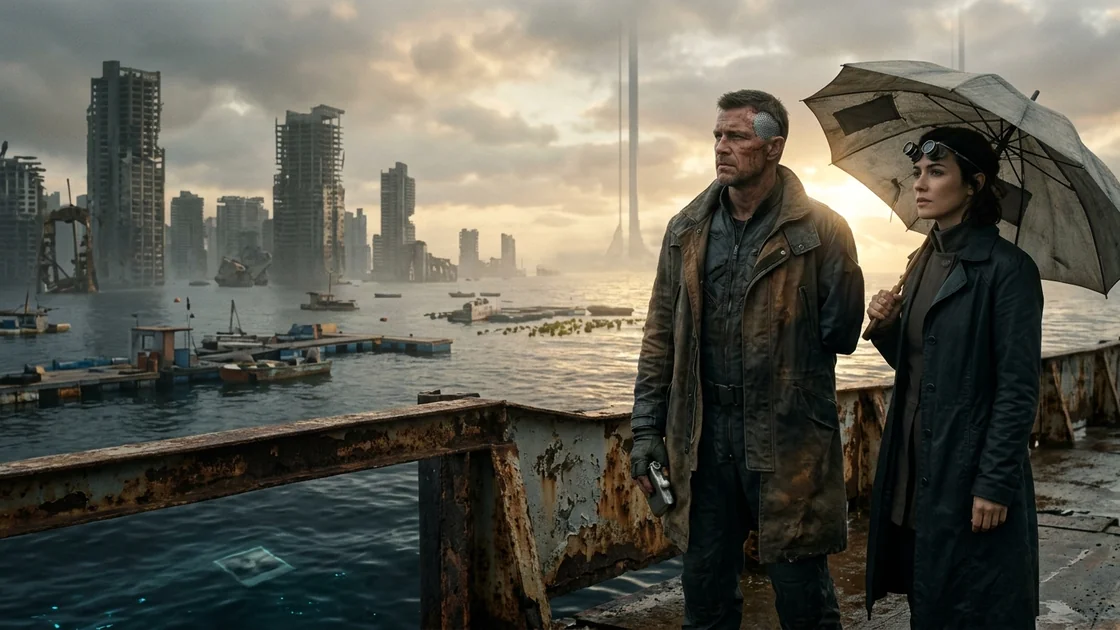
Kaelen Vance returns to Earth four hundred years after being betrayed by his partner and left to die in a near-lightspeed loop in the deep void. Though only eight agonizing years have passed for Kaelen aboard his crippled courier vessel, four centuries have transformed his home planet into a stratified empire ruled by the Solaris Dynasty, a monolithic house founded by the very man who sabotaged his ship and stole his priceless cargo. Armed with an ancient cryptographic waybill and the relentless training of a bygone era, Kaelen descends from the orbital rings into the drowned ruins of old cities to recruit an underground antiquarian who can help him breach the impregnable Solaris Spire. During the dynasty's quadricentennial celebration, Kaelen infiltrates the upper atmosphere to confront the genetic clones and preserved digital consciousness of his betrayer, seeking not merely to murder the heirs of the empire, but to execute a centuries-old forfeiture clause that will strip the family of their stolen immortality and return the world to the people they enslaved.
The starbow was finally dying, and its death tasted like copper and scorched insulation. For ninety-six subjective months, the universe outside the forward viewport of the Cinder-Moth had been compressed into a single, blinding ring of violet and ultraviolet radiation—the Doppler-shifted light of the Milky Way crushed together by a velocity that grazed the ultimate speed limit of creation. Now, as the magnetic braking sails shrieked against the solar wind of the Sol system, that violent crown of light was bleeding outward. The blues were shifting to yellows, the yellows to angry reds, and the stars were sliding back toward their rightful places in the dark like beads scattered across black velvet.
Kaelen Vance hung in his crash webbing, his ribs creaking under a sustained three-gee deceleration burn. His body was a roadmap of calcified micro-fractures and purple acceleration bruising. In the cramped, coffin-sized cockpit of the relativistic courier, the air smelled of eight-year-old sweat, recycled lithium hydroxide, and the sharp, metallic tang of his own blood where his gums had bled during the high-gee spikes.
"Velocity dropping below point-zero-one c," the ship's computer whispered. Its voice was fractured, missing half its vocal subroutines after Kaelen had scavenged its secondary processing banks to rebuild the star-tracker four years ago. "Local system beacon detected. Ephemeris mismatch. Warning: Pulsar timing array indicates temporal displacement of four hundred twelve standard solar years, seven months, fourteen days."
Kaelen didn't answer the machine. His throat was too dry, lined with the grey dust of ration wafers and the bitter residue of anti-radiation chelation drugs. Instead, he reached out with a hand encased in a scarred mechanical pressure glove and tapped the glass of the primary console.
Taped to the bezel with yellowed polyimide strips was a photograph printed on polymer film. It showed two men standing in the low-gee staging bay of Ceres Station, grinning beside a cylindrical containment unit no larger than an artillery shell. One of them was Kaelen, twenty-eight years old, his hair dark and his eyes bright with the arrogant certainty of a master runner who had never dropped a parcel. The other was Julian Solaris—tall, golden-haired, with a smile that looked like an invitation to share a secret.
Eight years ago, by the clock in Kaelen’s bloodstream, Julian had leaned across this very console during the turnover burn beyond the Kuiper Belt. They had been carrying the Aethelgard Matrix, a pre-singularity terraforming and cellular-reconstruction seed commissioned by the United Earth Directorate. It was supposed to save a dying biosphere. Instead, Julian had driven a ceramic lockout spike into the Cinder-Moth’s manual helm, blown the explosive bolts on the cargo pod containing the Matrix, and triggered a runaway fusion injection in Kaelen’s main drive.
Julian had taken the braking pod back toward the sun. Kaelen had been hurled outward at ninety-nine point nine-nine percent of the speed of light, locked inside a tin can whose navigation computer had been wiped and whose thrust vector was welded open toward the cold emptiness between the spiral arms.
Julian had calculated that Kaelen would either die from the twenty-gee initial kick, starve when the five-year stores ran out, or simply drift until the heat death of the universe while millions of years ticked by on Earth.
Julian hadn't calculated that Kaelen would spend forty-two months in a radiation-soaked EVA suit on the exterior hull while traveling at near-lightspeed, tethered by a braided carbon wire, manually filing down the magnetic diverter nozzles with a diamond-tipped torch while stray interstellar hydrogen atoms punched microscopic holes through his shielding and his spleen.
"Custodian status," Kaelen rasped. His voice sounded like two stones grinding together in a dry creek bed.
"Courier Kaelen Vance, Guild Registry Four-Four-Nine-Zero," the computer wheezed back. "Cargo status: Displaced. Waybill status: Open. Delivery incomplete. Penalty clause: Active."
Kaelen unbuckled the webbing. As the braking burn finally cut out, his boots clanked onto the deck plates under the sudden shift to the ship's sluggish spin-gravity. He reached beneath his flight suit and pulled out a six-inch hexagonal rod of dull, pitch-black metal attached to a titanium chain around his neck. It was forged from degenerate matter, its crystalline lattice etched at the sub-atomic level with the original cryptographic keys of the Directorate and the Courier Guild.
It was the Waybill. Until that rod was inserted into the receiving socket of the Aethelgard Matrix and counter-signed by the recipient, the cargo legally belonged to the carrier. And according to the Charter of the High Lanes, a carrier had the absolute right to recover stolen freight by any level of force necessary—up to and including the liquidation of the thief's estate.
Through the pitted quartz of the viewport, a pale jewel was growing brighter against the dark. Earth.
Even from forty million kilometers out, Kaelen could see that it wasn't the brown, choking world he had left behind. The planet was wrapped in a delicate, shimmering web of silver threads—three concentric orbital rings that glowed like diamond necklaces in the sunlight, connected to the equator by six massive atmospheric tethers that rose from the clouds like the pillars of heaven.
Julian hadn't just sold the Matrix. He had used it to build a godhood.
The customs officer at the Tycho-Beneath Quarantine Spindle was nineteen years old, wore a uniform woven from self-cleaning smart-silk, and had never seen a human being who hadn't been genetically scrubbed in the womb.
He stared across the polycarbonate divider at Kaelen with a mixture of horror and fascination, the way a child might look at a coelacanth dragged up from a pelagic trench.
Kaelen stood six feet tall, though his spine had been compressed by half an inch from years of high-gee burns. His skin had the weathered, slightly translucent grey cast of an old-world spacer who had absorbed too many sieverts of Bremsstrahlung radiation, traced near the temples with the faint silver filigree of sub-dermal Faraday shielding. He wore a heavy leather-and-ballistic-nylon flight coat from the twenty-second century, its patches faded to illegibility, smelling faintly of machine oil and ozone.
"Your vessel..." the boy stammered, his fingers fluttering through a holographic display that Kaelen couldn't see from his side of the glass. The boy’s language was a slurred, vowel-heavy dialect of Anglo-Mandarin, though Kaelen’s old military-grade cochlear implant was already working overtime, running heuristic algorithms to translate the drift of four centuries of slang into crisp, archaic Standard. "The Cinder-Moth. The registry says it's a... a torch-ship? Fusion-pinch propulsion? Sir, that drive configuration has been banned inside the Lunar Orbit since the Second Remediation."
"The ban wasn't in effect when I launched," Kaelen said. His translator spat the words out through a collar-mounted vox-grill in flat, uninflected tones that made the boy flinch. "Check the deep-archive ledger. Guild Registry Four-Four-Nine-Zero."
The boy’s eyes darted side to side as his neural lace queried the lower strata of the lunar servers—the dusty, forgotten partitions where pre-Collapse data was stored like fossils in shale. Suddenly, the boy went very still. The healthy, artificial flush drained from his cheeks.
"Kaelen Vance," the officer whispered. He looked up from his projection, his gaze dropping to the scarred mechanical glove resting on the counter, then back up to Kaelen's cold, unblinking eyes. "That's... that's a fraud. That's a heresy. Kaelen Vance died in the Oort Turnaround in twenty-one-eighty-four. He gave his life to shield the Founder’s pod from a rogue cometary fragment. There's a statue of him in the Plaza of Dawn."
Kaelen felt a strange, hollow tightness in his chest. It wasn't anger—his anger had cooled centuries ago into something dense and dark as osmium. It was the sheer, suffocating weight of the lie.
"Did he?" Kaelen asked softly. "How noble of him."
"Wait here," the boy said, his voice cracking as his hand dropped toward a silent alarm stud beneath the desk. "House Solaris Security handles all historical anomalies involving the Founding."
Before the boy’s thumb could depress the sensor, Kaelen’s left hand moved. To a man conditioned to operate machinery under four gravities of acceleration, Earth-normal movement felt like swimming through warm oil, and the people native to this era moved with the agonizing slowness of sleepwalkers.
Kaelen didn't draw a weapon. He simply pressed a stubby brass cylinder against the induction port of the customs booth's data terminal. It was a twenty-second-century "Logic-Hammer"—a brute-force electromagnetic pulse generator paired with an archaic polymorphic worm that hadn't been seen by an antivirus program in twelve generations. Modern firewalls were built to deflect quantum-entangled intrusions and neural-net spoofing; they had no idea what to do with eight megabytes of raw, dirty machine code delivered via a physical voltage spike.
The holographic emitters in the booth popped in a shower of blue sparks. The boy yelped, clutching his temples as the feedback loop hissed through his neural lace, dropping him to his knees with a nosebleed. The heavy blast door behind the booth groaned as its smart-locks defaulted to their ancient, hardwired fire-safety protocol and slid open.
Kaelen stepped through the threshold, his boots ringing against the polished basalt of the Lunar Spindle. He looked down at the groaning officer, reached into his coat, and dropped a single, thumb-sized pellet of depleted osmium—ballast from his ship’s trim tanks—onto the floor beside the boy. In an economy built on orbital refinement, ten grams of pure heavy metal was worth more than the boy’s yearly salary.
"For the docking fee," Kaelen said, and walked out into the twenty-sixth century.
The descent down the Quito Tether took four hours in a pressurized express gondola sheathed in chameleonic smart-glass.
Kaelen sat in the rear row of the commuter car, surrounded by low-tier technicians and middle-management bureaucrats who gave him a wide berth. They were all tall, symmetrical, and impeccably clean, dressed in flowing robes of synthesized spidersilk and carbon-weave. Every one of them bore a small, iridescent tattoo on the side of their neck—a stylized golden sun rising over an hourglass. The mark of the Solaris Syndicate.
Through the transparent floor of the car, the world unfolded. The orbital rings above—the Aureole, as the passenger announcements called it—were where the true citizens lived. Up there, in centrifuges spun to a comfortable zero-point-eight gee, were the private estates, the orbital forests, and the gleaming white pinnacles of the Great Houses.
Below, as the gondola dropped through the stratosphere and punched through a thick, bruised layer of sulfur-colored clouds, lay the Sump.
The Earth wasn't healed; it had merely been landscaped from a distance. The Aethelgard Matrix had been used to create massive atmospheric scrubbers and bio-domes around the equatorial tethers, turning them into lush, tropical preserves for the aristocracy's hunting lodges. The rest of the planet—the old coastal cities flooded by the twenty-first-century melt, the sprawling industrial basins of Europe and Asia—had been left to rot in the shadow of the tethers, serving as giant, open-air factories and biological recycling vats that fed raw materials up the cables to the sky.
And rising above the Quito terminus, dwarfing the snow-capped peaks of the Andes, was the Solaris Prime Spire.
It wasn't merely a building; it was the anchor of the primary tether itself, a needle of pearlescent white diamondoid and spun gold that rose forty kilometers into the stratosphere, its upper tiers vanishing into the blue-black of space. Around its base, carved out of the living granite of a leveled mountain range, was the Plaza of Dawn.
As the gondola slowed to dock at the lower commercial concourse, Kaelen stood at the rail and looked out across the plaza.
In the center stood a statue three hundred meters tall, forged from some sunlit alloy that seemed to radiate its own warmth. It depicted Julian Solaris—idealized, his jaw squared, his robes billowing in an imaginary cosmic wind, holding a glowing sphere toward the heavens like Prometheus gifting fire to mankind.
And down at the base, barely thirty meters tall, kneeling in the shadow of Julian’s left boot with his arms raised as if holding up the pedestal against a storm of sculpted stone meteors, was a figure in a clunky, old-fashioned space suit. The faceplate was blank and featureless, erasing his identity so he could serve as a universal symbol of subservient sacrifice.
THE COURIER, read the inscription in letters ten feet high. WHO CARRIED THE WEIGHT SO THE FOUNDER MIGHT FLY.
Kaelen’s ungloved hand gripped the handrail of the gondola. The metal groaned, denting slightly beneath the reinforced titanium bones of his fingers. For eight years in the dark, he had imagined Julian dying an old man in some hidden villa, terrified that the sky would one day fall on him. He hadn't imagined this. Julian hadn't hidden from his crime; he had made it the cornerstone of a global religion.
"Impressive, isn't it?" a voice murmured beside him.
Kaelen didn't turn his head, though his peripheral vision—augmented by old combat wetware—tracked the speaker instantly. She was a woman in her mid-thirties, though in this era that could mean thirty or a hundred and thirty. Unlike the other passengers, she didn't wear the pristine pastel silks of the Spire-dwellers. She wore a coat of oiled polymer over a high-collared tunic, and instead of a neural lace, she wore a pair of heavy, multi-spectrum jeweler’s loupes strapped over her left eye.
"The proportions are off," Kaelen said through his vox-grill. "Julian was shorter than me by two inches. And he never stood that straight when the gravity went over two gees."
The woman let out a sharp, breathless laugh, quickly stifled behind a gloved hand. Her live eye—a dark, sharp brown—flicked down to Kaelen’s boots, which were still magnetic-soled Zero-G walkers from the Aethelgard era, and then to the radiation-pitted casing of his chronometer.
"You're the ghost from Tycho," she whispered, leaning in close enough that he could smell the old paper and solder on her clothes. "The whole sub-net from Luna to the Sump is screaming right now. A twenty-second-century fusion boat drops out of the dark, bricks a customs spindle with a museum-piece logic bomb, and pays the toll in raw osmium. House Solaris has three squads of Chronos-Wardens waiting at the main turnstiles at the bottom of this lift."
"And why are you telling me this instead of collecting the bounty?" Kaelen asked, his right hand resting casually near the grip of the magnetic rail-pistol holstered beneath his coat.
"Because House Solaris pays bounties in scrip and telomere-credits," she replied smoothly. "And you have pockets full of pre-Collapse isotopes and a head full of four-hundred-year-old encryption keys. My name is Vespera. I run an archive in the Drowned Quarter. If you want to live longer than the next six minutes, you'll step off this car through the maintenance chute with me before the brakes lock."
Kaelen looked down through the glass. Five hundred meters below, at the gilded arrival platform, a dozen figures in sleek, white carapace armor were fanning out through the crowd, their helmets featureless domes of silver sensor-mesh, carrying long-barreled plasma lances that hummed with lethal charge.
"Lead the way, Archivist," Kaelen said.
The Drowned Quarter of Old Guayaquil was three hundred miles west and three thousand years behind the Plaza of Dawn.
Here, the Pacific had swallowed the coastal lowlands centuries ago, leaving the skeletal remains of twenty-first-century skyscrapers jutting out of a warm, bioluminescent lagoon like the ribs of rotting leviathans. Between the concrete towers, a labyrinth of floating pontoons, rusted cargo hulls, and hydroponic kelp farms had grown under a perpetual canopy of warm rain and neon advertisements that flickered down from the underside of the weather-control drones high above.
Vespera’s shop was located inside the flooded vault of an ancient central bank, accessible only through a rusted submarine lock that smelled of brine and copper grease. Inside, the walls were lined from floor to ceiling with lead-lined cubbies containing the debris of human history: cracked silicon wafers, optical crystal cubes, mechanical wristwatches, and glass jars filled with pre-synthetic seeds.
Kaelen sat on an ammunition crate near a humming dehumidifier, his flight coat stripped off to reveal a torso crisscrossed with silvery surgical scars and carbon-fiber sub-dermal reinforcement ribs. He was methodically stripping and cleaning his pistol—a Krupp-Armalite M90 Linear Accelerator that fired three-millimeter depleted uranium needles at twelve times the speed of sound.
Vespera stood across the workbench, her multi-spectrum loupe whirring as it focused on the black hexagonal rod resting on a velvet cloth between them—though Kaelen hadn't let go of the titanium chain attached to it.
"By the dust of the Old Earth," Vespera breathed, her fingers trembling slightly as she adjusted a spectroscopy scanner over the Waybill. "It's degenerate matter. White-dwarf density, stabilized in a metamaterial magnetic cage. The energy required to etch this..."
"They used the particle collider at CERN-Two," Kaelen said, sliding the tungsten firing pin back into his pistol with a crisp click. "Each Guild Master had one forged when they took the oath. It records every contract, every mass-transfer, and every biometric signature from pickup to drop-off. You can't hack it because it doesn't have an operating system. It's a physical ledger written into the spin-states of the nuclei."
Vespera raised her head, pushing the mechanical loupe up onto her forehead. Her face was pale beneath the dim amber glow of the vault’s vacuum-tube lamps. "Do you have any idea what you've walked into, Vance? I thought you were just a deep-time salvager who got lucky in the Oort cloud. You're really him. You're the man under the statue."
"Tell me about Julian," Kaelen said. "Tell me how a thief becomes a god."
Vespera walked over to a corner cabinet, poured two glasses of clear, harsh-smelling kelp spirit, and handed one to Kaelen. He took a sip; it burned like reactor coolant, which felt almost like home.
"When Julian Solaris returned to Earth in twenty-one-eighty-five," Vespera began, leaning against a stack of server racks, "the planet was in the middle of the Great Asphyxiation. The oceans were turning anoxic; the Directorate had collapsed into forty warring warlord states. Julian didn't turn the Aethelgard Matrix over to the surviving parliament in Geneva. He took it to the private lunar shipyards owned by his family's shell corporations."
She gestured upward, toward the ceiling of the bank vault and the invisible sky above it. "With the Matrix, he had the only functioning molecular-recompiler and genetic-stabilization engine in the solar system. He made the desperate governments an offer: he would scrub the atmosphere and cure the radiation plagues, but in exchange, the Directorate would be dissolved. Every square kilometer of restored land, every cubic meter of breathable air, and every human genome repaired by the Matrix would be leased from the Solaris Syndicate in perpetuity."
"A subscription fee for living," Kaelen said softly.
"Worse," Vespera said, a bitter edge creeping into her voice. "He altered the Matrix's distribution protocols. For us down in the Sump, the air is kept just breathable enough that we can work the mines and the kelp vats, and our lifespans hit a hard ceiling at sixty. For the High Houses up on the Aureole, the Matrix provides continuous telomere reconstruction and cellular flushing. They don't age, Vance. Unless they're vaporized in a duel or fall out of an airlock, they live forever. Provided they pay their tithe to House Solaris and keep their genetic licenses renewed."
"And Julian?" Kaelen asked, his eyes narrowing. "Did the Matrix keep him alive for four hundred years?"
"There's a limit to what biological tissue can take before synaptic calcification sets in, even with the Matrix," Vespera said. "A human body can be stretched to about a hundred and eighty years before the brain turns to glass. Julian I died in twenty-three-forty. Look at this."
She tapped a key on an old CRT monitor—she didn't trust holographic projectors that could be monitored by Spire satellites. The screen flickered to life with green phosphor lines, resolving into a high-resolution photograph from a recent orbital broadcast.
Kaelen froze. The glass in his hand stopped halfway to his mouth.
Standing on a balcony overlooking the orbital rings was Julian Solaris. He had the same golden hair, the same arrogant tilt of his chin, the same slight asymmetry in his smile that Kaelen had looked at in the photograph taped to his console for eight years.
"That's Cassian Solaris," Vespera said quietly. "The twelfth Prime Archon of the Dynasty. Julian didn't trust natural heirs—recessive genes and independent personalities were too messy for an eternal empire. Every forty years, a new clone is decanted from Julian’s original somatic vault. They raise him in the same nursery, feed him the same memories through neural-imprinting rigs, and when the previous Archon hits his one-hundred-sixtieth year, the power—and the name—passes to the new vessel."
"Wait," Kaelen said, leaning closer to the green glow of the screen. Behind the young, thirty-year-old Julian stood an older man—the same face, lined only slightly around the eyes, with hair turned the color of white gold. "There's more than one at a time?"
"Always three," Vespera explained. "The Elder, the Archon, and the Heir. The Rule of the Triad. Right now, there's Tiberius, who's a hundred and fifty; Cassian, who's forty-two and holds the scepter; and little Julian XIII, who's ten. And beneath them all, down in the core of the Spire where the Aethelgard Matrix sits..." Vespera tapped her temple. "The Ghost-Engine. Before the original Julian died, he had his neural pathways mapped via destructive quantum scanning. An engrammatic AI built from his actual consciousness sits inside the Matrix’s primary shell. The clones don't just look like him, Vance. They take their orders from his ghost."
Kaelen set his glass down on the workbench. Slowly, deliberately, he picked up his pistol and holstered it.
"Good," Kaelen said.
Vespera stared at him. "Good? Were you listening to me? You can't assassinate a man who has three bodies walking around and a digital soul buried under forty kilometers of diamondoid armor! Even if you somehow got past ten thousand Chronos-Wardens and shot Cassian between the eyes, the Elder would just decant another spare from the vats before the body hit the carpet."
"I'm not an assassin, Vespera," Kaelen said. He held up the black hexagonal rod. "I'm a courier. Do you know how the Aethelgard Matrix works?"
"Nobody outside the Spire priesthood knows the low-level architecture," she said. "It's pre-Collapse black-box tech."
"I know," Kaelen said. "Because I had to sign the hazard manifest before they loaded it into my bay at Ceres. The Matrix isn't just a machine; it's a self-contained quantum-biological foundry governed by the Directorate’s Charter of Commons. To prevent any one faction or rogue military commander from seizing it during transit, the designers built a hardware lock into the zero-layer kernel."
He laid the Waybill back on the velvet cloth and tapped the middle section of the rod, where a microscopic band of gold divided the black metal.
"When Julian blew the cargo bolts and stole the Matrix, he never completed the cryptographic handshake with this Waybill," Kaelen said, a cold, terrifying smile touching the corners of his scarred mouth for the first time in four centuries. "For the last four hundred years, the Matrix has been running in Provisional Transit Mode. Julian’s engineers must have built their entire civilization on top of the guest-access partition, using brute-force overrides to siphon off its processing power."
Vespera’s eyes widened as the implications hit her like a physical blow. "You're saying... the machine still thinks it's on your ship?"
"It thinks it's in transit," Kaelen corrected. "And according to the hardwired firmware of the Guild, if a parcel remains in Provisional Mode without a valid recipient counter-signature, the Courier retains absolute administrative custody. If I plug this rod into the physical maintenance port on the side of the Matrix core and key in the Non-Payment Forfeiture Code..."
"What happens?" Vespera whispered.
"The guest partition formats itself," Kaelen said. "Every proprietary lock, every genetic DRM tag, every neural-engram file stored in the secondary cache gets purged as corrupted transit-data. And the Matrix defaults to its original factory directive: unrestricted, autonomous global remediation under public domain access."
The silence in the flooded bank vault was absolute, broken only by the rhythmic drip-drip-drip of seawater leaking through a concrete seam four decades old.
"The Ghost-Engine," Vespera breathed. "Julian's consciousness is stored in that secondary cache."
"He's unmanifested freight," Kaelen said coldly. "And the ship is overdue for a cleaning."
Vespera began to pace the length of the workbench, her hands gesturing wildly as her mind raced through schematics and security protocols. "It's insane. The Matrix is housed in the Sanctum Solaris, at the thirty-eighth kilometer mark of the Prime Spire—right at the boundary where the atmosphere thins into vacuum. The whole tower is a fortress. Biometric locks tuned to Solaris DNA, internal gravity traps, plasma curtains..."
"When is the Quadricentennial Jubilee?" Kaelen asked.
Vespera stopped pacing. "Tomorrow night. The four-hundredth anniversary of the 'Landing.' Every High House from the orbital rings is descending to the Spire’s Crown Ballroom to renew their longevity charters."
"And the Triad?"
"They'll all be there," she said slowly. "It's the only night of the century when the Elder, the Archon, and the Heir stand in the Sanctum together to commune with the Ghost-Engine and bless the Matrix in front of the peerage." She looked at Kaelen, her dark eye gleaming with a sudden, fierce hunger that matched his own. "My father died at fifty-eight of lung-rot in the lithium vats while watching the Spire glow like a Christmas tree every night. My brother was erased by the Wardens for trying to pirate a telomere-patch for my mother. What do you need from me, Courier?"
Kaelen reached into his heavy leather coat and pulled out a flat titanium case. Inside lay three fuel pellets from the Cinder-Moth’s auxiliary fusion reactor—pure helium-three bred in the magnetosphere of Jupiter before the Collapse—along with a diagnostic slate containing his ship’s uncorrupted black-box flight recorder.
"First, I need you to wire this flight recorder into the Sump's pirate broadcast arrays, slaved to a dead-man's switch on my heart rate," Kaelen said. "Second, I need a way onto the Spire's exterior skin above the cloud line. I don't need to go through their doors. I spent three years walking on the outside of a ship moving at ninety-nine percent of the speed of light. A stationary building is just a very tall rock."
At twenty kilometers above sea level, the wind doesn't blow; it slices like a diamond saw, carrying a temperature of minus sixty degrees Celsius and an atmospheric pressure barely a twentieth of what human lungs require.
Kaelen hung suspended against the blinding white curve of the Solaris Prime Spire, his magnetic boots locked onto a millimeter-thin superconducting lightning bus that ran up the exterior of the diamondoid hull.
He wasn't wearing a modern, sleek carbon-shell suit. He was wearing his Mark IV Deep-Void Rig—a bulky, articulated monstrosity of titanium-weave, dual-layer gold mylar, and hydraulic muscle-assist pistons that hissed bursts of warm nitrogen vapor into the freezing stratosphere with every step. To the Spire's automated defense radar,which was calibrated to detect high-velocity stealth drones, plasma signatures, and modern metamaterial cloaking fields, Kaelen registered as nothing more than a slow-moving chunk of metallic ice or a faulty maintenance scraper crawling up the lightning rod.
Below him, the cloud deck was an endless ocean of purple and silver, lit from beneath by the miserable orange glow of the Sump and from above by the brilliant, diamond-hard light of the orbital rings.
“You’re passing the twenty-eighth kilometer mark,” Vespera’s voice crackled in his helmet ears, transmitted via a tight-beam laser bounced off a derelict weather satellite she had hijacked three hours ago. “The exterior defense turrets at thirty kilometers are slaved to motion-doppler sensors. If you move faster than ten centimeters per second across the white zones, the point-defense lasers will vaporize you before the sound reaches your suit.”
"Ten centimeters per second is a sprint, Vespera," Kaelen sub-vocalized. "When I was fixing the Cinder-Moth’s nozzle, moving eleven centimeters per second meant my wrench drifted into the relativistic proton wake and turned into a gamma-ray bomb."
He moved with the terrifying, clockwork patience of a glacier. Left boot: clank. Lock magnetic field. Shift center of mass. Right hand: engage micro-gecko adhesive pads against the frictionless diamondoid. Right boot: clank.
Four hours passed. In the silence of his helmet, there was only the sound of his own breathing and the rhythmic thump-hiss of his suit's scrubbers. He didn't get bored; he didn't get cramps. During the Long Drift, he had learned to drop his metabolic rate into a state of waking hibernation, letting his mind detach from the agony of his muscles while he focused entirely on the geometry of the metal inches from his faceplate.
He thought of Julian. Not the statue, and not the boy-king on Vespera’s monitor, but the Julian who had shared his last bulb of real coffee with Kaelen two days before the Kuiper turnaround.
"We're fools, Kael," Julian had said then, floating weightless in the galley while the Aethelgard Matrix hummed like a sleeping beehive behind the bulkhead. "We carry the future of the species in the back of the truck, and what do they pay us? Enough credits to buy a bar on Mars and twenty years of waiting for our teeth to fall out from the radiation. Whoever holds that cylinder owns time itself."
"We signed the Waybill, Jules," Kaelen had answered, not even looking up from his navigation charts. "A runner is only worth the seal on his bond. Without that, we're just salvage pirates with faster engines."
Julian had smiled then—that warm, sad, golden smile—and reached out to clap Kaelen on the shoulder. Even then, he had probably been calculating the mass-ratio of the braking pod with only one occupant instead of two.
“Thirty-eighth kilometer,” Vespera whispered in his ear, breaking the memory. “You’re right below the overhanging lip of the Crown Promenade. There’s an atmospheric intake manifold forty meters to your left—it pulls thin stratospheric air in to cool the Ghost-Engine’s superconducting baths. I’ve looped the telemetry on the intake fans for ninety seconds using the logic-worm code you gave me. After ninety seconds, the blades spin back up to Mach two.”
Kaelen looked up. Above him, the Spire flared outward like the bell of a trumpet, supporting a massive geodesic dome of transparent aluminum crystal. Through the dome, he could see a literal paradise: terraced gardens of genetically sculpted silver trees, waterfalls falling in slow motion under reduced artificial gravity, and thousands of figures in shimmering garments drifting beneath floating chandeliers of bound plasma.
Below the dome, recessed into the shadow of the structural ribs, was a dark, circular maw ten meters wide, rimmed with frost where the supercooled exhaust met the thin moisture of the upper sky.
Kaelen reached down to his belt and switched on his Lorentz-Jacket—an archaic, experimental inertial-dampening harness that couriers used to survive high-gee docking maneuvers. Its capacitors whined, drawing power directly from one of the helium-three pellets he had slotted into his pack.
He disengaged his magnetic boots, kicked off the Spire's hull into the thin air, and fired his suit's cold-gas thrusters.
He shot across the forty-meter gap like a kinetic harpoon, diving headfirst into the dark throat of the intake manifold. He twisted in mid-air, his boots slamming against the stationary titanium fan blades—each one the size of a shuttle wing—just as the ninety-second timer expired.
With a deafening roar that vibrated through the soles of his boots, the turbines behind him spooled up. Kaelen blew the explosive releases on his heavy EVA rig, shedding the bulky outer shell of his suit in two halves. As the titanium casing was sucked backward and chewed into a shower of white-hot sparks by the spinning blades, Kaelen rolled forward in his sleek black under-armor through the maintenance airlock before the pressure seal slammed shut.
The transition from the silent, freezing void of the exterior hull to the interior of the Solaris Spire was like stepping into the belly of a gilded star.
Kaelen stood in a service gallery overlooking the Grand Nave of the Sanctum Solaris. He checked his suit's internal sensors: twenty-two degrees Celsius, oxygen-rich air scented with engineered jasmine and ozone, gravity tuned to a leisurely zero-point-seven gee.
In zero-point-seven gee, Kaelen—whose muscles and bone density had been forged by years of three-gee burns and centrifuge workouts—felt weightless. He felt like a god among paper dolls.
He stepped out of the maintenance shadow onto a mezzanine of veined white marble. Below him, the Grand Nave stretched for half a kilometer, flanked by colonnades of pure, laboratory-grown emerald and lit by holographic frescoes that floated in the air, depicting the history of the Solaris Dynasty.
There was Julian I, stepping out of the braking pod onto the scorched plains of Geneva. There was the construction of the first Tether. And there, right above the main archway, was a massive, moving hologram of the Cinder-Moth being torn apart by a fictional comet while a heroic, weeping Julian reached out from his escape pod toward the exploding ship.
Kaelen didn't look at the holograms. He looked at the altar at the far end of the hall.
Waiters and minor nobles in shimmering silks were parting as a procession moved down the center aisle, flanked by twenty Chronos-Wardens in ceremonial gold-and-white carapace armor.
At the head of the procession walked the Triad.
On the left walked Tiberius, the Elder—tall, gaunt, his golden hair turned to silver, leaning on a staff of black iron, his eyes milky with the beginning of the synaptic crystallization that came after a century and a half of artificial life.
On the right walked a boy of ten—Julian XIII—wearing a miniature white uniform, his face an exact, chillingly innocent replica of the boy Julian had been in the youth Academy photos Kaelen had once seen.
And in the center walked Cassian Solaris, the Prime Archon.
He was thirty-five years old in appearance, standing at the absolute peak of genetic perfection. His golden hair was brushed back from a brow that had never known radiation sickness or starvation; his robes were woven from optical fibers that shifted color with the crowd’s applause. When he turned to smile at a bowing Duchess from the Martian Spindle, Kaelen’s breath caught in his throat. It wasn't a descendant. It wasn't a lookalike. It was Julian, down to the slight, arrogant twitch of his left eyebrow when he knew he had won a hand of cards.
"Four hundred years ago tonight," Cassian spoke, and he didn't need a microphone; the acoustics of the diamondoid hall carried his rich, baritone voice into every corner of the Sanctum, "the sky was falling. Humanity was a species choking on its own ashes, trapped at the bottom of a gravity well with no ladder to the stars. My ancestor—myself, in the unbroken chain of the Blood—brought the fire down from the deep dark."
Behind the altar, two massive blast doors of iridium-steel parted with a low, resonant chime.
Revealed within a spherical vault of force-fields and golden cooling conduits was the Aethelgard Matrix.
It looked absurdly small and industrial at the center of all this golden decadence. The original cylindrical containment unit—the same dull grey titanium barrel Kaelen had strapped into his cargo bay on Ceres—was still there, suspended in the middle of a web of four-hundred-year-old cables and modern quantum-optical taps that bled its power out into the Spire. You could still see the yellow-and-black stencil on its side: U.E.D. PROPERTY - HANDLE WITH EXTREME CAUTION - GUILD MANIFEST #884-ALPHA.
And floating above the cylinder, projected by a ring of high-density holo-emitters, was a face ten feet tall, woven from golden light and intricate neural-pathway filaments.
The Ghost-Engine. The preserved mind of Julian I.
"My children," the giant golden face spoke, its voice a layered, resonant echo of Cassian’s own, heavy with four centuries of narcissistic majesty. "Another century turns. The lease of life is renewed for the faithful..."
"The lease is expired, Jules."
Kaelen’s voice wasn't loud, and it didn't have the musical resonance of the hall's acoustics. It came through the scarred vox-grill of his collar, amplified to maximum military output—a harsh, metallic bark in twenty-second-century Standard that cut through the music and the golden voice like a chainsaw through silk.
Five hundred immortal aristocrats turned at once.
Kaelen dropped from the mezzanine rail. It was a twelve-meter fall, which would have shattered the artificially lightened bones of a Spire-dweller even in zero-point-seven gee. Kaelen hit the marble floor in a three-point landing, his Lorentz-Jacket discharging a blue ring of Cherenkov light as it bled the kinetic energy into the floor tiles, spiderwebbing the white stone in a five-meter radius.
He stood up in the center of the aisle, fifty meters from the altar. In his black, radiation-scarred under-armor, with his mechanical glove clenching the Krupp-Armalite rail-pistol and the black Waybill hanging from the chain at his throat, he looked like a creature dragged up from the iron core of the planet to crashing a heaven of glass.
The crowd gasped, a collective ripple of perfumed terror. Several ladies in floating gowns drifted backward as their personal anti-gravity belts panicked.
On the dais, Cassian Solaris froze. Beside him, the old man, Tiberius, dropped his iron staff with a clatter, his milky eyes widening as forty-year-old imprinted memories collided with impossible reality.
Above the Matrix, the ten-foot golden face of the Ghost-Engine flickered, its neural filaments spiking into jagged red patterns of processing error.
"Kaelen?" the Ghost-Engine whispered, the godlike projection suddenly sounding exactly like a terrified twenty-eight-year-old thief in a cramped cockpit beyond Neptune. "No. The burn vector... the telemetry showed a twenty-gee spike. You were supposed to hit the interstellar medium at point-nine-nine-nine..."
"You always were sloppy with your engineering math, Julian," Kaelen said, walking down the center aisle. His heavy magnetic boots clicked rhythmically against the cracked marble. "You forgot that the Cinder-Moth had secondary trim coils made of tungsten-rhenium. They don't melt at three thousand Kelvin. They just bend."
"An imposter!" Cassian roared, recovering his composure faster than the ghost or the old man. His face twisted with a rage that Kaelen recognized instantly—it was the look Julian got whenever someone caught him bluffing. "A Sump-rat wearing stolen museum salvage and a flesh-mask! Wardens! Erase this filth from the Sanctum!"
The twenty Chronos-Wardens didn't hesitate. Their white carapace helmets locked onto Kaelen, and twenty plasma lances leveled at his chest, the air in the aisle instantly superheating as they prepared to fire a volley that would turn him into ionized ash.
"Wait!" the Ghost-Engine screamed from above the altar. "Do not fire plasma near the Waybill! If he's carrying the degenerate-matter rod—"
It was too late to stop the Wardens, and far too late to stop Kaelen.
To the aristocrats watching from the galleries, what happened next didn't look like a fight; it looked like a film reel missing every second frame.
Kaelen triggered the overcharge on his Lorentz-Jacket while simultaneously slamming a combat-stimulant injector into his carotid artery. The world slowed to a crawl. The bolts of blue-white plasma leaving the Wardens' lances moved through the air like lazy fireflies.
Kaelen threw himself sideways off the center aisle, kicking off a colonnade pillar with enough force to shear a chunk of emerald the size of a head from its base. He moved in low, flat parabolic arcs that no one born in low gravity could replicate, using the reduced gravity not to float, but to turn himself into a human ricochet.
Crack-crack-crack.
His linear accelerator didn't hum or glow like modern energy weapons; it spat hypersonic needles of depleted uranium that broke the sound barrier inside the closed hall with deafening thunderclaps. Modern carapace armor was designed to disperse thermal plasma and laser coherent light; it had forgotten what it meant to be hit by forty grams of heavy metal traveling at four thousand meters per second.
The first three Wardens were knocked off their feet as the kinetic needles punched straight through their breastplates, the hydrostatic shock shattering their ceramic armor like porcelain.
Kaelen landed in the center of the second squad before their targeting computers could track his trajectory. He didn't even waste ammunition. His left arm—the mechanical pressure-gloved prosthetic geared to torque rusted reactor bolts in vacuum—lashed out in a short, brutal arc. He caught the Warden Captain across the helmet; the composite visor caved in with a sound like a dropped melon, and the man was hurled twenty feet through a floating hologram of the First Remediation.
"Gravity override!" Tiberius, the Elder, shrieked from the altar, his old hands clawing at a control podium built into the dais. "Flood the Nave! Five gees! Crush him to the stone!"
The massive grav-plates beneath the marble floor groaned as power was diverted from the Spire's stabilizers. Instantly, an invisible mountain dropped out of the ceiling onto the Grand Nave.
Around the edges of the hall, the screams of the guests were cut short as five hundred immortals—whose hearts and skeletons had been pampered in zero-point-seven gee for centuries—were slammed violently onto the marble floor like swatted flies. Floating chandeliers crashed down in showers of sparks; delicate silk robes were pinned to the stone as collarbones and ribs snapped across the room. Even the surviving Chronos-Wardens dropped to their knees, their servo-suits whining in agony as the actuators locked up under five times Earth's gravity.
On the protected dais, shielded within a separate gravitational envelope, Cassian, Tiberius, and the young boy watched in breathless triumph, waiting to see the intruder flattened into a bloody smear on the aisle.
Kaelen didn't fall.
His knees bent. The titanium-reinforced bones in his legs creaked; the old surgical scars across his abdomen pulled tight; a trickle of dark blood ran from his left nostril as his blood pressure spiked to lethal levels. His Lorentz-Jacket shrieked, its cooling vents glowing cherry-red on his back, knocking two gees off the load—leaving him carrying three gees of raw, crushing weight.
Three gees. The exact weight he had lived under for the last fourteen months of his braking burn into the Sol system. The weight he had eaten in, slept in, and stripped his pistol in every day while staring at Julian’s photograph.
Slowly, horribly, Kaelen straightened his spine.
He took one step forward. The marble tile beneath his boot disintegrated into powder under the combined weight of his body and the gravity field. He took another step.
"Impossible," Cassian whispered, backing away from the edge of the dais until his heels hit the base of the Aethelgard Matrix. "He's an un-augmented baseline! His heart should have burst!"
"He's a Light-Runner, you arrogant little test-tube!" the Ghost-Engine roared down at his own clone, the giant golden face contorting in panic as Kaelen marched through the five-gee field like a diver walking across the ocean floor. "We were built by the Directorate to survive high-burn turnarounds! Turn the field off, you're only pinning your own guards!"
Kaelen reached the edge of the five-gee boundary and stepped across the threshold onto the dais.
Freed suddenly from the crushing weight, he surged upward like an uncoiled spring. Before the last two Praetorian Wardens guarding the altar could raise their vibro-halberds, Kaelen shot the one on the left through the throat and used his own forward momentum to drive his mechanical fist through the chest-plate of the one on the right, ripping the power core from the man's suit and tossing him down the steps into the high-gravity zone, where the guard hit the floor with a sickening crunch.
Now, there was no one left on the altar but Kaelen and the three faces of Julian Solaris.
Tiberius, the Elder, lunged forward with surprising speed for an old man, drawing a concealed monomolecular dagger from the head of his iron staff. Kaelen didn't even look at him; he backhanded the old clone across the jaw with the barrel of his accelerator. Tiberius spun once and collapsed against the steps, unconscious.
The ten-year-old boy, Julian XIII, fell back on the floor, scrambling backward on his hands and knees, his wide blue eyes fixed in terror on the scarred, grey-skinned revenant towering over him. Kaelen glanced down at the boy for a fraction of a second, then looked away. The child was just blank biological hardware; the ghost in the machine hadn't overwritten him yet.
Cassian Solaris stood alone in front of the glowing sphere of the Matrix. In his hand, he held a palm-sized neural disruptor, aimed squarely at Kaelen’s unhelmeted head.
"Stay back!" Cassian hissed, sweat beading on his flawless golden forehead. "One step closer and I fry your brainstem! I don't care what happened four hundred years ago, Vance! Look around you! Look out that dome!"
Cassian gestured wildly with his free hand toward the transparent ceiling, where the silver bands of the orbital rings blazed against the stars.
"Before us, humanity was dying in its own filth!" Cassian shouted, his voice echoing with the rehearsed conviction of four centuries of dogma. "If Julian hadn't taken the Matrix—if he had handed it over to that corrupt, bickering Directorate parliament—they would have fought a war over who got to turn it on until the last ocean boiled away! He saved the species! He built an empire that reached the Jovian moons! What was one man's life—one courier's contract—weighed against four hundred years of order?"
Kaelen stopped six feet away. He lowered his pistol, letting it hang loosely at his side, though his left hand rose to grasp the black hexagonal rod hanging at his neck.
"You didn't save the species, Julian," Kaelen said, looking past Cassian directly into the giant, glowing golden eyes of the Ghost-Engine hovering above the cylinder. "You put it in a gilded cage and charged it rent for the oxygen. And you didn't leave me out there in the dark because you were thinking about the future of mankind. You left me out there because you didn't want to split the finder's fee."
Above the Matrix, the Ghost-Engine went silent. The grand, godlike facade slipped away, leaving only the cold, calculating expression Kaelen had seen in the reflection of the cockpit glass a fraction of a second before the lockout spike had gone into the helm.
"Kill him, Cassian," the Ghost-Engine said flatly. "Don't talk to him. Pull the trigger."
Cassian’s finger tightened on the induction stud of the neural disruptor.
A ruby-red beam of coherent meson particles spat from the palm-gun, striking Kaelen directly above his left eyebrow.
Cassian let out a ragged breath of relief, waiting for Kaelen to drop dead as his synaptic pathways were scrambled.
Kaelen blinked. A smell of singed skin and ozone rose from his temple, where a quarter-inch patch of his grey flesh had been vaporized—exposing the dull, matte-silver mesh of the military-grade sub-dermal Faraday cage that the Directorate surgically implanted around the skulls of every relativistic courier to keep cosmic rays from cooking their brains at ninety-nine percent of the speed of light.
"My turn," Kaelen said.
Before Cassian could fire a second shot, Kaelen stepped inside his reach. His mechanical left hand clamped onto Cassian’s wrist, crushing the delicate, low-gravity radius and ulna bones together with a wet snap. Cassian screamed—a high, thin sound that had nothing of the god-emperor in it—as the disruptor clattered to the marble.
Kaelen didn't shoot him. With his right hand, he wrenched the titanium chain from around his own neck, bringing the six-inch rod of black degenerate matter up like a dagger, and lunged past the weeping Archon toward the Aethelgard Matrix.
"No!" the Ghost-Engine shrieked. The defensive force-field around the ancient cylinder flared violet as the AI dumped the entire electrical grid of the upper Spire into the barrier to stop him. "I am the Founder! I am the Sun that never sets! You are dust, Kaelen! You're an error in the ledger!"
Kaelen didn't try to deactivate the force-field. He activated the final overcharge on his Lorentz-Jacket, dumping the entire remaining nuclear binding energy of the helium-three pellet into a single, directional inertial spike, and drove his mechanical arm forward with the Waybill clenched in his fist.
The degenerate matter of the Waybill—forged at the density of a white dwarf star—met the electromagnetic containment field. For half a second, the air in the Sanctum ionized into blinding violet lightning as four hundred years of stolen energy fought against two kilograms of unstoppable relativistic mass.
The Lorentz-Jacket on Kaelen’s back exploded in a shower of melted copper and ceramic shrapnel, searing the flesh of his shoulders. The mechanical servos in his prosthetic arm sheared their teeth, titanium tendons snapping like rifle shots inside the sleeve.
And the force-field shattered.
With a sound like a cathedral bell being struck by a sledgehammer, the hexagonal tip of the Waybill slammed home into the physical maintenance socket on the side of the Aethelgard Matrix.
For three seconds, the entire world held its breath.
In the Grand Nave, the five-gee gravity trap instantly vanished as the Matrix severed its external power taps, returning the hall to Earth-normal weight. Across the forty-kilometer height of the Spire, the golden holographic frescoes flickered and died.
Inside the spherical vault, the ancient, twenty-second-century LCD screen on the side of the grey titanium barrel—a screen that hadn't lit up since the day Kaelen had bolted it to the deck on Ceres—blinked to life with a dull, amber glow.
WAYBILL DETECTED: GUILD REGISTRY #4490.
TIME ELAPSED IN TRANSIT: 149,892 SOLAR DAYS.
ERROR: RECIPIENT COUNTER-SIGNATURE MISSING.
CUSTODIAN OVERRIDE: VANCE, K.
ENTER COMMAND.
Kaelen stood braced against the warm titanium cylinder, blood dripping from his ruined left arm and his scorched temple onto the pristine white floor of the Sanctum. He reached out with his right hand and keyed a six-digit sequence into the physical brass keypad beneath the amber screen.
COMMAND ACCEPTED: CLAUSE 9 - NON-PAYMENT FORFEITURE.
PURGING PROVISIONAL GUEST PARTITIONS...
REVERTING TO PUBLIC COMMONS PROTOCOL.
Above the cylinder, the ten-foot golden face of Julian Solaris began to unravel.
It didn't explode; it simply came apart like a tapestry being pulled thread by thread into a furnace. Millions of terabytes of stolen genetic patents, debt-ledgers, telomere-encryption locks, and four hundred years of accumulated digital memory were systematically overwritten by the cold, merciless zero-layer firmware of the old United Earth Directorate.
"Kaelen..." the Ghost-Engine whispered. As the golden light stripped away, the face shrank until it was no longer a god, just a flickering, low-resolution projection of the young man from the Ceres photograph, looking down at his old partner with eyes wide against the encroaching dark. "It took me four hundred years to build this. You're leaving them with nothing. Who's going to steer the ship?"
"They'll steer it themselves, Jules," Kaelen said quietly, his hand resting on the cold black metal of the Waybill. "Consider the account settled."
CACHE PURGE COMPLETE.
The golden face vanished.
Across the Grand Nave, and up in the shining necklaces of the orbital rings, the lights didn't go out—they changed color. The warm, exclusionary gold of the Solaris network shifted to a cool, steady, utility green as a million automated atmospheric scrubbers, orbital solar mirrors, and cellular-regeneration clinics dropped their credit-locks and opened their queues to every human genome within three hundred thousand kilometers of the planet.
At the same moment, every holographic projector in the Sanctum—and every public screen from the Lunar Spindles down to the neon-soaked lagoons of the Sump—flickered back to life.
Vespera had triggered the broadcast.
Suspended thirty feet in the air above the groaning, bruised aristocrats of the High Houses was the raw, unedited internal camera feed from the cockpit of the Cinder-Moth, dated four hundred and twelve years ago. In crystal-clear, undeniable telemetry, five hundred immortals watched their beloved Founder drive a ceramic lockout spike into the helm, steal the Aethelgard Matrix, and condemn his partner to the deep void with a smile on his face.
On the dais, Cassian Solaris knelt on the marble, cradling his broken wrist against his chest. He stared up at the projection of his original self, his mouth open, the entire mythical foundation of his existence turning to ash in the space of ninety seconds. Without the Ghost-Engine whispering through his neural lace, and without the monopoly of the Matrix to hold the other Houses in line, he wasn't an Archon anymore. He was just a man with a famous face and a broken arm in a room full of people he had been extorting for four centuries.
Kaelen didn't look down at him. He didn't need to. As the aristocrats on the floor began to push themselves up, looking from the damning broadcast on the ceiling to the lone, bleeding clone on the altar with newly sharpened eyes, Kaelen knew that the wolves of the High Orbitals would tear the remnants of the Solaris estate apart far more thoroughly than his rail-pistol ever could.
The amber screen on the side of the Aethelgard Matrix beeped once, and a narrow strip of thermal-etched metallic foil slid out of a slot beneath the keypad.
Kaelen pulled the foil free. It was warm to the touch.
MANIFEST #884-ALPHA: DELIVERED.
CARRIER: K. VANCE. STATUS: BOND CLEARED.
Kaelen folded the receipt and slipped it into the breast pocket of his scorched under-armor, right beside the faded polymer photograph from Ceres.
The sun was rising over the Pacific when Kaelen stepped out of the submarine lock into the Drowned Quarter.
The rain was still falling, warm and heavy, dimpling the surface of the lagoon between the sunken skyscrapers, but the sky above looked different. For the first time in twelve generations, the massive orbital mirrors of the Aureole had tilted their angles away from the private estates of the Spire, focusing a wide, golden swath of morning sunlight directly down through the dispersed sulfur clouds onto the water below.
Around the floating pontoons and kelp docks, thousands of people from the Sump were standing on their roofs and rusted balconies, looking up in stunned silence at the clearing sky and at the public health terminals on the street corners, which were flashing green with open-access medical queues.
Vespera was waiting for him on the rusted pier outside the bank vault, holding an umbrella made of patched sailcloth. She looked at his empty left sleeve—where he had jettisoned the ruined mechanical arm on the ride down the service freight-lift—and the fresh silver scar above his eyebrow.
"The orbital net is in chaos," she said, offering him a flask of the terrible kelp spirit as he walked up beside her. "House Valerius and the Lunar Miners' Union have already seized the Quito Tether's control room. Cassian and the old man are in custody awaiting a public tribunal in New Geneva. They're talking about turning the Prime Spire into an agricultural research vertical."
Kaelen took the flask and drank. For the first time since he had dropped out of relativistic space, the copper taste of radiation sickness was gone from the back of his throat, replaced by the wet, salty smell of a living ocean.
"What about the Waybill?" Vespera asked, nodding toward his bare throat.
"It's welded into the Matrix's core," Kaelen said, looking out across the sunlit water toward the horizon. "If anyone ever tries to pull it out to put a password back on that machine, the degenerate matter decompresses and turns the top ten kilometers of the Spire into a very small crater."
Vespera laughed—a clear, bright sound in the morning air. She looked at him sideways, pushing her jeweler's loupe up onto her forehead. "So what does a four-hundred-year-old courier do when his bond is finally cleared? Your ship up at Tycho still has half a tank of helium-three. Are you going to take another run out to the stars?"
Kaelen reached into his pocket, pulled out the faded photograph of himself and Julian at Ceres Station, and let it fall from his fingers. It landed face-down on the dark water of the lagoon and drifted away with the outgoing tide, sinking slowly beneath the bioluminescent weeds.
"No," Kaelen said, feeling the steady, unchanging pull of one-gee gravity beneath his boots, and the quiet ticking of a clock that finally moved at the same speed as the rest of the world. "I think I'm going to walk for a while."