The Red Light in Studio Four
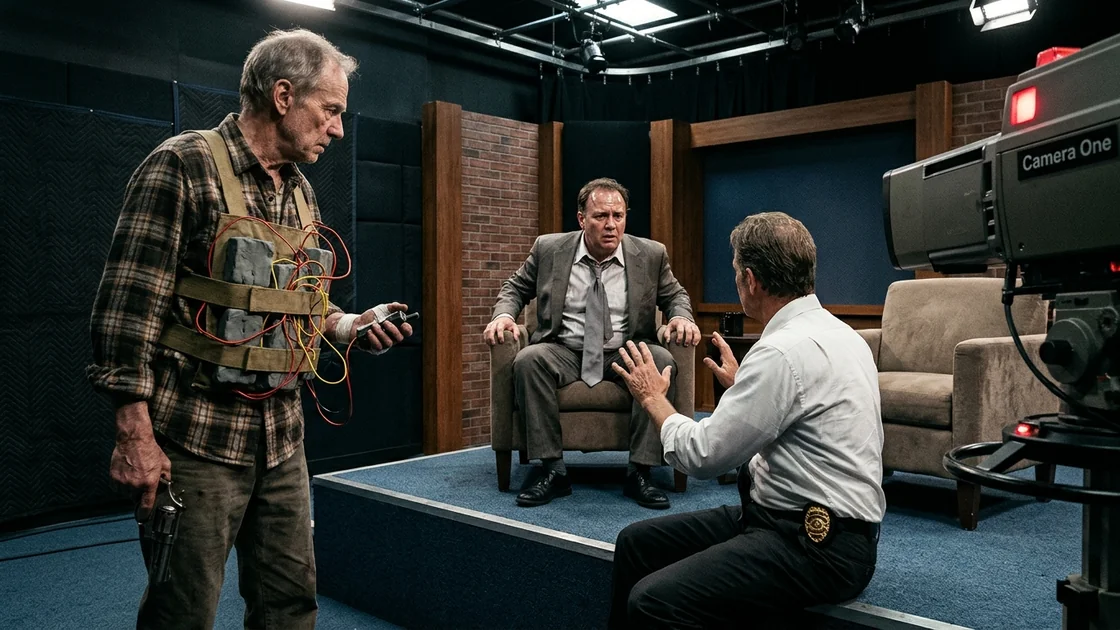
Detective Arthur Pendelton has spent twenty years as the premier crisis negotiator for the New Canaan Police Department, haunted every day by the unresolved collapse of the St. Jude Waterworks that killed his younger brother and eleven other laborers. When a terminally ill structural engineer named Samuel Cross takes Mayor Harrison Vance hostage during a live election-eve broadcast at the KNT-TV studios, Arthur is called to the scene to talk the gunman down. Discovering that Cross possesses the missing financial ledgers proving Vance intentionally used substandard materials and flooded the tunnels to hide the evidence two decades ago, Arthur enters the locked studio under the guise of a hostage exchange. Once inside, Arthur subtly hijacks the negotiation in front of millions of viewers watching the unencrypted satellite feed, using his psychological training to corner the corrupt mayor while fending off a desperate police chief trying to silence them all. By exploiting the mayor's cowardice during the final seconds before a tactical breach, Arthur forces Vance to confess to the twenty-year-old cover-up and murders on live television before surrendering the studio to the authorities.
The rain in New Canaan never truly washed the city clean; it only moved the filth from the rooftops down into the gutters, where it swirled in oily, iridescent eddies before vanishing beneath the iron grates. Detective Arthur Pendelton stood at the window of his third-floor apartment, watching the amber glow of a streetlamp fracture across the wet asphalt of Mercer Street. In his left hand, he held a ceramic mug of lukewarm black coffee. In his right, resting against his thigh, his thumb traced the smooth, worn edge of a brass union badge that had been pulled from fifty feet of grey silt and river mud on the morning of October 14, 2004.
On the kitchen table behind him sat three cardboard archive boxes. They were not official police property. If Internal Affairs or Chief Garrett ever found them, Arthur would lose his pension in an afternoon, assuming he made it to a hearing at all. Inside those boxes were thousands of pages of freedom-of-information requests, redacted geological surveys, blurry photographs of concrete core samples, and the autopsy reports of twelve men whose lungs had been filled with quick-setting limestone slurry when the retaining wall of the St. Jude Waterworks gave way. The last report in the third box belonged to Leo Pendelton, age twenty-four, who had taken the night shift only because his wife was expecting their first child in December and they needed the overtime pay to buy a crib.
Twenty years was a long time to carry a ghost. It changed the way a man walked, the way he listened, and the way he measured the silences between other people’s words. That was why Arthur had become the department’s primary crisis negotiator. When you had already heard the worst news a human being could receive delivered by a wet-faced chaplain on a cold porch at four in the morning, a man waving a sawed-off shotgun in a liquor store didn't rattle your pulse. You knew what despair looked like from the inside out. You knew its cadence.
The department-issued phone on the kitchen counter began to vibrate, skittering across the scarred Formica with a harsh, insistent buzz.
Arthur didn’t rush. He set the brass badge down beside the salt shaker, walked to the counter, and picked up the receiver.
"Pendelton," he said. His voice was a low, gravelly baritone, sanded down by decades of cheap tobacco he had quit too late and thousands of hours spent talking through megaphones and static-filled field telephones.
"Arthur, thank God you’re awake," said Sergeant Miller from dispatch. Even through the compressed digital line, Arthur could hear the high, tight frequency in the younger man's throat. "We have a Code Red at the KNT Plaza down on Fourth and Broadway. SWAT is rolling out of the West Precinct right now. Chief Garrett asked for you by name, and then he told me to tell you to step on it."
"Who's got who, Miller?" Arthur asked, already reaching for his trench coat draped over the back of a wooden chair.
"It's Studio Four," Miller said, his voice dropping half an octave as if someone might overhear him in the secure dispatch center. "The live town hall. Mayor Vance was doing his final ninety-minute Q&A before the polls open tomorrow. Five minutes ago, a guy in the third row stood up, pulled a heavy vest out from under a rain poncho, and locked down the studio doors with steel cables and industrial wedges."
Arthur paused with one arm in his coat sleeve. "Vance is still inside?"
"Vance, five studio crew members, and the guy with the vest," Miller said. "And Arthur—the guy didn't just lock the doors. He did something to the master routing console in the sub-floor before he went up. The station engineers can't kill the feed. Everything happening in Studio Four is going out unencrypted over the regional satellite transponder and bouncing straight to the local cable headends and internet streams. Four million people are watching the Mayor sit in a plastic chair with a gun pointed at his head."
Arthur pulled his coat tight, slipped his credentials and a small leather notebook into his breast pocket, and left his service weapon locked in the safe under his bed. A negotiator who brought a gun to the table was just another trigger waiting to be pulled.
"Give me the name of the subject if you have it," Arthur said, pulling his apartment door shut and testing the lock.
"Fingerprints off the security sign-in tablet at the front desk just came back from AFIS," Miller replied as Arthur started down the narrow, creaking stairs of his building. "No criminal record, just an old civil service clearance card from the nineties. Name is Samuel Cross. Sixty-two years old. Former deputy structural engineer for the Municipal Water Authority."
Arthur stopped dead on the second-floor landing. The single bare bulb overhead hummed with a faint, sixty-cycle buzz.
Samuel Cross.
Arthur didn’t need to open the third cardboard box upstairs to see the name. It was printed on the bottom corner of a nineteen-page soil stability memorandum dated August 12, 2004—two months before the St. Jude tunnel caved in. Cross had been the junior engineer who refused to sign off on the secondary retaining wall inspection. Three days before the collapse, Cross had been transferred to a desk job in the sanitation archives, and his signature on the final safety clearance had been miraculously replaced by the scrawl of the committee chairman: then-City Councilman Harrison Vance.
"Arthur?" Miller’s voice crackled in his ear. "You still there?"
"I’m here, Miller," Arthur said, his heart beating with a slow, heavy, terrifying clarity. "Tell Captain Briggs not to put a single boot through that door until I’m on the headset."
The KNT Broadcast Plaza was a monolith of black smoked glass and brushed steel rising twenty stories above the theater district. Tonight, its lower facade was painted in a violent, strobing wash of red and blue light. Three blocks in every direction had been cordoned off with yellow crime-scene tape and wooden saw-horses. Beyond the barriers, hundreds of onlookers stood beneath a forest of black umbrellas, their faces illuminated by the pale blue glow of their smartphones. They weren't looking up at the building; they were looking down at their screens, watching the drama unfold in real time from the comfort of the sidewalk.
Arthur flashed his gold shield at asoaked patrolman manning the outer perimeter on Broadway and walked briskly toward the Mobile Command Unit—a forty-foot armored trailer parked diagonally across the plaza's fountain court.
The rain hammered against the aluminum roof of the trailer as Arthur stepped inside, shaking the water from his collar. The air within was hot, smelling of wet wool, stale breath, ozone from a dozen rack-mounted servers, and the sharp, sour tang of institutional panic.
At the far end of the narrow room, three men stood clustered around a bank of high-definition monitors. Captain Victor Briggs, commander of the tactical response unit, looked like a granite boulder stuffed into black Kevlar. Beside him stood the station’s chief broadcast engineer, a pale young man in a soaked cardigan whose hands were trembling so badly he had to tuck them under his armpits. And looming over both of them was Police Chief Raymond Garrett.
Garrett had been Vance’s hand-picked appointment six years ago. He wore a tailored navy suit that cost more than Arthur’s car, and his silver hair was immaculate despite the storm outside. When he saw Arthur step into the trailer, his jaw tightened until a muscle jumped beneath his ear.
"Took you long enough, Pendelton," Garrett snapped, not bothering with a greeting. "Look at the screen."
Arthur stepped up to the console. The primary monitor showed the interior of Studio Four, captured in crisp, merciless high definition by Camera One.
The set was designed to look like a warm, inviting civic forum, with faux-brick walls, potted ferns, and a semi-circle of plush armchairs on a raised blue carpet. In the center chair sat Mayor Harrison Vance. At fifty-eight, Vance was still a handsome man in the way that bank buildings are handsome—all hard, polished surfaces and expensive maintenance. His campaign posters outside showed him smiling with his sleeves rolled up, the champion of the working class, poised to win an unprecedented fourth term tomorrow before making a run for the governor’s mansion. Right now, however, his gray silk tie was loosened, his forehead was slick with sweat under the halogen studio grids, and his hands were gripped white-knuckled onto the armrests.
Ten feet in front of him stood Samuel Cross.
Cross looked older than sixty-two. He was thin to the point of fragility, his skin the color of old parchment with dark, bruised hollows beneath his eyes. His gray hair was wispy and sparse. Over a faded flannel shirt, he wore a vest made of heavy canvas straps holding eight rectangular blocks of greyish-brown putty, wired together with red and yellow insulated leads that ran into a heavy metal toggle box taped to his left palm. In his right hand, he held a heavy revolver, its barrel pointed steadily at the floor between Vance’s polished Oxfords.
In the corner of the frame, five studio technicians—three men and two women wearing headsets and black crew shirts—sat huddled together against the base of the bleachers, their knees pulled to their chests.
"What's the audio situation?" Arthur asked, his eyes never leaving Cross’s left hand on the dead-man's switch.
"The studio mics are hot," the broadcast engineer stammered, pointing a shaking finger at the decibel meters bouncing in the green on the side of the screen. "He killed the booth controls down in master routing and spliced the Studio Four stage box directly into the fiber-optic uplink to the roof dish. I tried to pull the main breaker at the street transformer, Chief, I swear I did, but the roof dish and the studio floor are running off the emergency uninterrupted power supply in the vault adjacent to Studio Four. If we cut city power, those lithium banks will keep the lights and the transmitter running for fourteen hours."
"Can't we jam the dish from the roof?" Garrett demanded, turning on the engineer.
"With what, sir? It's a tight-beam microwave link straight up to a commercial geostationary satellite," the engineer said miserably. "Unless you shoot down the satellite or blow up our own roof—which has a seismic trigger he wired to the stairwell door—that feed is staying live."
Arthur leaned closer to the glass, listening to the audio coming through the trailer’s speakers.
Cross wasn't screaming. He wasn't pacing wildly or waving the revolver at the ceiling. He was standing remarkably still, conserving his energy, his breathing shallow and raspy. Every few seconds, he suppressed a dry, rattling cough into his shoulder.
Idiopathic pulmonary fibrosis, Arthur thought immediately, recognizing the wet rattle from two other retired waterworks employees he had interviewed five years ago before they died. Silica and benzene dust from the deep-bore shafts. Cross didn't have six months left to live. A man with a terminal clock in his chest didn't care about safe passage to an airport or a million dollars in unmarked bills.
"Has he made a statement?" Arthur asked Captain Briggs.
"Only one," Briggs grunted, crossing his thick arms over his tactical vest. "Twenty minutes ago, he looked right into Camera One and said he wanted the hard drives from the Municipal Archives sub-basement brought up, and he wanted a negotiator from the police department to come on the line so they could discuss the release of the crew. Then he sat down on a crate and hasn't said a word since. The Mayor tried to talk to him twice, and Cross just raised the gun until Vance shut his mouth."
"We have two sniper teams in the mechanical ducts above the lighting grid," Chief Garrett said, his voice dropping low so only Arthur and Briggs could hear. "Briggs says they have a seventy percent angle through the acoustic baffles."
"Seventy percent isn't a shot when the subject has his thumb depressed on a spring-loaded plunger," Briggs corrected flatly, clearly not liking the Chief's math any more than Arthur did. "You put a .308 through his brain stem, the sympathetic nervous reflex can still clench his fingers—or his hand goes limp and the spring releases. Either way, if that's eight pounds of C4 on his chest, everyone in that room goes out in buckets, including the Mayor."
"Then what am I paying you people for?" Garrett hissed, wiping his upper lip with a folded linen handkerchief. His eyes darted to the monitor, where Harrison Vance looked pale and terrified. If Vance went down—or worse, if Cross started talking about why he was really there—Garrett’s career, along with half the administration’s leadership, would be ashes before sunrise. "Pendelton, get on the console. Talk him into letting the crew out, and get him to step three feet to his left out from under the lighting rig so Briggs’s boys have a clean vertical line."
Arthur looked at Garrett for a long moment. He saw the fear in the Chief's eyes—not fear that the bomb would go off, but fear that it wouldn't.
"A negotiator doesn't set up kill shots, Chief," Arthur said evenly. "You know the protocol. If he smells a trap in my voice, he lets go of that toggle. Now let me work."
Arthur pulled out the swivel chair in front of the communications bay, sat down, and slipped the heavy dual-cup headset over his ears. He adjusted the gooseneck microphone until it was an inch from his lips. Before he pressed the transmit key, he took a slow, four-second breath in through his nose and let it out through his mouth, dropping his heart rate, smoothing out the rough edges of his voice until he sounded like an old friend calling late at night.
He pressed the switch. Inside Studio Four, a red light blinked on the stage manager’s desk phone ten feet from Cross.
Instead of ringing, the phone’s speakerphone clicked open automatically—Cross had already taped the receiver hook down.
"Samuel?" Arthur’s voice filled the studio, warm, unhurried, and carrying simultaneously over the broadcast feed to four million living rooms across the tri-state area. "Samuel, my name is Detective Arthur Pendelton. I’m with the New Canaan Police Department, sitting out here in a truck in the rain on Broadway. Can you hear me alright?"
On the monitor, Samuel Cross raised his head. He didn't look at the telephone; he looked directly into the lens of Camera One, as if looking straight through the fiber-optic cables into Arthur’s eyes.
For five seconds, there was only the sound of Cross’s shallow, raspy breathing. Then, a faint crease appeared at the corners of the old engineer's mouth.
"Arthur Pendelton," Cross said. His voice was like dry leaves scraping across concrete, amplified by the studio’s boom microphones. "Leo Pendelton’s big brother."
Behind Arthur, Chief Garrett froze. "What the hell did he just say?" Garrett whispered harshly, leaning over Arthur’s shoulder. "Pendelton, do you know this lunatic?"
Arthur ignored the Chief, keeping his thumb on the mute toggle while he listened.
"I hoped they’d send you, Arthur," Cross continued on the screen. "I read about you in the papers over the years. Every time some poor bastard gets cornered by this city and takes a hostage, you’re the one they bring out to tell him that everything is going to be fair if he just puts the gun down. I always wondered how you slept at night, telling men that lie, knowing what happened to your brother at St. Jude."
Arthur pressed the transmit key. "I sleep poorly, Samuel," he said, his honesty cutting through the tension in the trailer. "Most nights, I don't sleep much at all. And I won't lie to you tonight. You’re in a bad spot, and there are a lot of men out here with heavy rifles who are very nervous about that box in your left hand. My job right now is to make sure nobody gets hurt—including you, those five folks in the corner, and the Mayor."
"The five kids in the corner didn't do anything wrong," Cross said, gesturing vaguely with the revolver toward the huddled television crew. "They just run the cameras and hold the cue cards. I told them twenty minutes ago I don't want their blood on my hands. There’s been enough innocent blood spilled in this city to float a battleship."
"I agree with you," Arthur said smoothly, using tactical empathy—validating the subject’s worldview without endorsing the hostage-taking. "They’re just working a night shift to pay their rent, Samuel. Just like the twelve men on the night shift in Sector Four twenty years ago. Letting them walk out that door would show everyone watching that you aren't a monster. Tell me what you need from me to get those five kids out into the hallway."
Cross coughed again, his thin shoulders shaking inside the explosive vest. On the plush chair, Mayor Vance flinched violently, squeezing his eyes shut until the coughing fit subsided.
"Look at him," Cross rasped, pointing the barrel of the .38 at Vance’s chest. "Look at the great builder of New Canaan. Twenty years ago, he signed a piece of paper that buried twelve men alive in wet concrete because he didn't want to spend four hundred thousand dollars on steel shoring beams. And right now, he’s sweating through a three-thousand-dollar suit because he thinks he might actually have to pay the bill."
"Shut up!" Vance’s voice cracked, high and shrill, breaking his silence for the first time since Arthur had entered the trailer. The Mayor’s public persona—the calm, booming voice of the campaign trail—was entirely gone. "You're insane, Cross! The federal inquiry cleared the council in two thousand and five! It was an underground aquifer burst—an act of God! Detective, get him out of here! Shoot him!"
"Mr. Mayor," Arthur said firmly through the speaker, his voice carrying the quiet authority of a disappointed schoolmaster. "I need you to stay quiet and keep your hands where Mr. Cross can see them. You aren't helping yourself right now."
Arthur turned his attention back to the engineer. "Samuel, talk to me. Don't look at him; look at the camera. Look at me. What is the price for those five crew members?"
Cross reached down with his right hand—still holding the revolver—and patted a battered leather briefcase sitting beside his crate on the studio floor.
"In this case," Cross said, "I have the original green-sheet carbon ledgers from Apex Aggregates and the soil toxicity reports from the St. Jude basin. The ones that were supposedly destroyed in the warehouse fire in two thousand and six. I stole them before I left the department, Arthur. I kept them in a salt-mine locker in Pennsylvania for twenty years because I was a coward. I had a wife, and they told me if I opened my mouth, she’d have an accident on the parkway. Well, Martha died of ovarian cancer in April. And the doctors at Mercy Hospital told me on Tuesday that my lungs are seventy percent scar tissue. I don't have anything left they can take from me."
In the trailer, Chief Garrett grabbed the back of Arthur’s chair so hard his knuckles turned white. "Cut the mic," Garrett snarled in Arthur’s ear. "Briggs, give the green light to the roof team. Take the seventy percent shot right now."
"If he drops that switch, the Mayor dies, Chief!" Briggs barked back, his hand hovering over his tactical radio. "Everyone on the sixth floor of this building dies!"
"He's bluffing about the vest!" Garrett shouted, his composure cracking. "Where does a sixty-two-year-old retired clerk get eight blocks of military C4?"
Arthur didn't look back at them. He kept his eyes locked on the screen, where Cross was waiting for his answer. Arthur knew immediately that Garrett didn't care if the vest was real or fake; if those green-sheet ledgers were read aloud or shown to the cameras, Vance’s political machine—and Garrett’s protection—was finished. Garrett would rather have a dead martyr for a Mayor and a crater on the sixth floor than a live broadcast of those ledgers.
And if Arthur stayed in this trailer, Garrett would yank him out of the chair within two minutes and order a suicidal breach just to destroy the room in the chaos.
"Samuel," Arthur said into the microphone, speaking right over Garrett’s furious cursing. "Tell me how we get those five kids out. Give me the terms."
"I can't hold the gun, hold the switch, and turn the pages of these ledgers for Camera One at the same time," Cross said, his chest heaving as he struggled for oxygen. "My hands are shaking too badly, Arthur. And if I let the crew go, your SWAT team in the hallway will just pump CS gas through the vents and storm the doors because they won't care as much if it's just me and one politician left inside."
"Nobody is pumping gas while we're talking," Arthur said.
"They will unless you're in here with me," Cross said.
The trailer went dead silent except for the hum of the cooling fans.
"Here is the deal, Arthur," Cross said to the four million people watching at home. "You walk down the sixth-floor corridor alone. No vest, no gun, no hidden ankle piece. Just you in your shirt sleeves. When I see you through the glass window in the airlock door, I'll pop the cable ratchet just enough for the five crew members to squeeze out and for you to squeeze in. Then we lock it back up. You help me put these papers under the document camera on the podium so the whole city can see what Harrison Vance did to your brother. You give me thirty minutes of honest air time, Arthur, and when we're done, I’ll disconnect the battery on this vest and you can put the handcuffs on me yourself."
"Out of the question!" Garrett roared, reaching down to yank Arthur’s headset cord from the jack.
Arthur caught the Chief’s wrist before his fingers touched the plug. Arthur wasn't a young man anymore, and he wasn't as big as Briggs, but he had spent thirty years wrestling desperate men on tenement stairs. His grip was like an iron vise.
He looked up into Garrett’s flushed face, making sure his thumb was off the transmit button.
"Five innocent civilians walk out of that room right now if I go through that door, Chief," Arthur said, his voice dangerously quiet. "And you have twenty reporters sitting outside the perimeter listening to this on their phones. Cross just made the offer on live television. If you forbid the lead negotiator from trading himself for five civilian hostages, how do you think that plays on the morning news when this goes sideways?"
Garrett stared down at him, his chest heaving, his eyes darting toward Captain Briggs and the broadcast engineer, both of whom were staring at the Chief in stunned silence. Garrett realized in an instant that he was boxed in. The broadcast wasn't just trapping the Mayor inside the studio; it was trapping the police command post outside.
Slowly, Arthur released Garrett’s wrist.
"Go in there," Garrett whispered, leaning down until his mouth was an inch from Arthur’s ear, his voice dripping with venom. "Get the crew out. And then you maneuver that old bastard three feet to his left under Air Duct B. If you let him put a single page of those fake documents on that camera, Pendelton, I’ll have you indicted as an accomplice before the smoke clears. Do you understand me?"
Arthur didn't answer him. He pressed the transmit key on the console.
"Samuel," Arthur said calmly. "I’m taking off my coat right now. Give me four minutes to take the freight elevator up to the sixth floor. Keep your thumb steady on that switch until you see my face at the glass."
The sixth floor of the KNT Broadcast Plaza smelled of new carpet glue, cold coffee left on abandoned reception desks, and the metallic tang of gun oil.
Arthur stepped out of the freight elevator with his hands held loosely at shoulder height. He wore only his white button-down shirt, dark slacks, and a clip-on gold detective’s shield on his belt. In his left ear sat a tiny flesh-colored inductive earpiece connected to a thin wire taped to the back of his neck, leading to a pack clipped inside his waistband. It was a two-way open mic to the tactical channel, allowing Briggs and Garrett to hear everything said in the studio, and allowing them to speak directly into his ear without Cross hearing them.
In the dim service corridor outside Studio Four, eight SWAT officers in full black nomex gear and ballistic helmets crouched behind rollingkevlar shields. Their submachine guns were trained on the heavy double acoustic doors at the end of the hall.
Lieutenant Vasquez, the tactical team leader on the floor, grabbed Arthur’s arm as he approached the line.
"He’s got two steel aircraft cables wrapped around the crash bars on the inner doors, Detective," Vasquez whispered through his balaclava. "He’s using a heavy-duty come-along winch anchored to the main structural column inside the airlock. When he slacks the ratchet, you’ll have maybe fourteen inches of clearance between the doors. We’ll pull the five hostages through, and then you go."
"Nobody follows me into the airlock, Lieutenant," Arthur said, meeting the younger officer’s eyes through his tactical goggles. "If he sees a black helmet move into the doorframe while that cable is slack, we all go through the windows."
Vasquez gave a single, tight nod. "Watch your head in there, Artie. Command is breathing down my neck on Channel Two."
Arthur walked past the line of shields, his leather soles clicking softly on the linoleum tiles until he reached the outer acoustic doors. Each door had a narrow, vertical pane of wire-reinforced safety glass.
Through the glass, across a six-foot sound-deadening vestibule, stood the inner studio doors. Samuel Cross was standing just inside the inner threshold. He had kept himself positioned so that the heavy brick partition wall shielded him from the hallway's direct line of sight, while keeping the barrel of his .38 pressed directly against the back of the neck of the youngest studio technician—a terrified girl of no more than twenty-two wearing a stagehand’s utility belt.
Arthur stopped a foot from the glass and slowly rotated in a full circle, lifting the hem of his white shirt to show his waistband, turning his pockets inside out, and holding his empty palms flat against the window.
Inside the vestibule, Cross leaned forward, squinting through the double panes of glass. His eyes dropped to Arthur’s belt, then up to Arthur’s face.
The metallic clank-clank-clank of a ratchet lever being released echoed dully through the heavy wood.
The steel cable loosened. The inner doors parted by fourteen inches, then the outer doors.
"One at a time!" Cross’s voice rasped from the shadows of the vestibule. "Go! Don't run, just walk out!"
Arthur stepped back half a pace and held the outer door edge with one hand, offering the other to the young woman at the front of the line. She squeezed sideways through the gap, sobbing quietly, and Arthur guided her behind his back toward Vasquez’s waiting men. One by one, the remaining four technicians slipped through the narrow opening—the floor manager, two camera operators, and the audio tech—until the vestibule was empty.
"Your turn, Arthur," Cross said from behind the inner door. "Step inside and pull the outer door shut until the latch clicks."
In Arthur’s earpiece, Chief Garrett’s voice crackled like static. "Get inside and push him back toward the center of the carpet, Pendelton. Sniper One is waiting on your mark."
Arthur stepped sideways through the fourteen-inch gap into the dark, padded acoustic vestibule. He let the heavy outer door swing shut behind him. The magnetic lock engaged with a solid thud, cutting off the hallway, the SWAT team, and the rest of the world.
"Now come through the inner door, slow," Cross instructed, backing away into the bright glare of the studio floor as he worked the winch lever with his gun hand, drawing the steel cable taut once more behind Arthur until the inner doors slammed together and the iron wedges dropped back into place.
Arthur blinked against the sudden, blinding intensity of the television lights.
Studio Four was hot—easily eighty degrees under the arrays of tungsten and LED floods hanging from the black steel pipe grid twenty feet overhead. The air was thick with the smell of scorched dust on the lamp housings and the sharp odor of fear.
Three massive pedestal cameras stood in an arc at the edge of the blue carpet. Camera Two and Camera Three were pointed slightly askew where their operators had abandoned them, but Camera One—dead center—was locked on its fluid head, framed tightly on the raised platform where Mayor Harrison Vance sat. Its red tally light glowed like a fresh coal in the dim periphery of the studio.
And there, ten feet back from the platform, stood Samuel Cross.
Up close, the engineer looked even more frail than he had on the monitor. The skin of his neck hung loose inside his flannel collar, and a fine sheen of grey sweat covered his hollow cheeks. Yet his eyes, bright with fever and twenty years of bottled fury, were crystal clear.
Arthur kept his hands raised slightly away from his sides, palms open, moving with the slow, predictable grace of a man approaching a cornered wolf.
They were twenty feet apart. Then fifteen. Then ten.
Arthur’s eyes dropped to the canvas vest strapped across Cross’s chest. He looked at the eight blocks of greyish-brown putty, the red and yellow wires twisted around brass blasting caps pushed into the clay, and the heavy aluminum toggle box taped to Cross’s left hand.
Arthur had spent six years in the Navy before joining the force, and another twenty walking crime scenes with the bomb squad. He looked at the texture of the blocks where the heat of the studio lights was hitting them. Real military-grade M112 C4 had a distinct, plasticized sheen from its polyisobutylene binder and smelled faintly of motor oil when warmed. The blocks on Cross’s chest had a dry, chalky grain at the corners where the canvas straps bit into them, and the smell wafting off Cross wasn't nitro-plasticizer—it was linseed oil and Turpentine.
Sculptor’s modeling clay. Gray Roma Plastilina, bought from an art supply store on Fifth Avenue. And the blasting caps weren't crimped aluminum; they were hollow brass bushings from a hardware bin, wired to a voltmeter housing that didn't even have a battery lead heavy enough to throw a spark.
Samuel Cross hadn't brought a bomb into Studio Four. He had brought a stage prop.
A wave of profound, aching sorrow washed through Arthur’s chest. Cross had never intended to blow up the building or kill those five kids. He was a dying sixty-two-year-old engineer who had built a costume out of clay and hardware store wire so the police wouldn't shoot him before he could open his briefcase in front of a camera. And when it was over, Cross fully expected SWAT to storm the room and riddle him with bullets. It was suicide by cop, engineered with the precision of a man who had spent his whole life calculating load tolerances.
If Chief Garrett knew the vest was clay, Vasquez’s team would blow the hinges off the doors in ten seconds flat and shoot Cross twenty times before he could utter another syllable.
"Report on the vest, Pendelton," Captain Briggs’s voice sounded in Arthur’s earpiece. "What kind of initiator are we looking at?"
Arthur looked straight into Samuel Cross’s eyes. Cross saw Arthur looking at the clay blocks. For a fraction of a second, the old engineer’s chin trembled, waiting for Arthur to call his bluff and end it right there.
Arthur raised his left hand slightly and cleared his throat, speaking loud enough for both the studio mics and his hidden lapel transmitter.
"That’s military-grade composition four, Samuel," Arthur said calmly, his voice steady and authoritative. "Eight blocks, roughly ten pounds total, wired in parallel to a reverse-tension dead-man's switch. If you let go of that lever, you'll take down the main support columns for the upper three floors."
In his earpiece, he heard Briggs exhale sharply. "Copy that. Ten pounds in parallel. Sniper One, hold your fire. Repeat, hold your fire. Do not engage without my direct command."
Across the blue carpet, Samuel Cross let out a long, shuddering breath. A look of fierce, silent gratitude passed between the two old men.
"Sit down on the edge of the stage, Arthur," Cross said, gesturing with the revolver toward the low wooden step leading up to the Mayor’s platform. "Right there where I can see both you and him."
"Alright, Samuel. Moving slow," Arthur said. He walked to the edge of the blue carpet, keeping himself deliberately positioned between Cross and the vertical angle of Air Duct B overhead. As long as Arthur was standing within two feet of Cross’s line of fire, the snipers in the ceiling vents couldn't take a shot without risking hitting the lead negotiator on live television.
Arthur sat down on the edge of the riser, his back half-turned to Camera One, facing Cross on his left and Mayor Harrison Vance on his right.
Vance looked at Arthur as if he were a lifeguard who had just swum out to a sinking boat without a rope.
"Detective," Vance whispered hoarsely, leaning forward in his plush armchair. The heavy stage makeup they had applied before the town hall was streaking down his jowls in pale orange tracks. "Where is the tactical team? Why didn't they shoot him when the doors opened?"
"Because he's wired to ten pounds of high explosives, Mr. Mayor," Arthur said, looking at Vance closely for the first time in twenty years. Arthur had sat in the back row of the city council chambers in 2005 when Vance, twenty years younger and flanked by four corporate lawyers, had expressed his "deepest, most heartfelt prayers" for the widows and families of the St. Jude twelve before voting to seal the engineering contractor records under trade-secret protections. "Right now, the only thing keeping you in one piece is Mr. Cross’s thumb. So I suggest you let me do my job."
"Pendelton, get out of the vertical lane!" Garrett’s voice hissed in Arthur’s ear. "You’re blocking Roof One’s angle! Move toward the podium!"
Arthur reached up gently under his collar, as if wiping sweat from the back of his neck with two fingers. With a practiced flick of his thumbnail, he pinched the thin wire running to his earpiece and gave it a sharp tug against his belt clip, partially unseating the coaxial pin.
Immediately, Garrett’s voice dissolved into a rhythmic, unintelligible crackle of white noise, while Arthur’s outgoing microphone remained fully active. If they wanted to talk to him now, they’d have to do it over the studio speakerphone where four million people could hear them give the order.
"My radio seems to be getting interference from the studio transmitters, Samuel," Arthur said aloud, for the benefit of the tape recording in the command truck. "Looks like it's just you, me, and the Mayor in here now. You promised me that if I came in alone, we’d talk about letting the Mayor go and ending this peacefully. You mentioned some documents in that briefcase."
"Don't humor him, Detective!" Vance barked, some of his lifelong arrogance flaring up through his terror as he realized what Cross was about to do. "Those documents are stolen municipal property, or outright forgeries! This man was fired from the Water Authority twenty years ago for incompetence and mental instability!"
Cross didn't yell back. Instead, he knelt down painfully on one knee, keeping his eyes and the revolver trained on Vance, and popped the brass latches on the battered leather briefcase with his fingertips.
"I wasn't fired for incompetence, Harrison," Cross said softly. "I was transferred to the basement on October eleventh because I walked into your office at City Hall with the core-sample compression tests from Pier Seven at St. Jude. Do you remember what you were doing when I walked in? You were practicing your swing with a titanium driver on the rug."
"I don't remember you at all," Vance said coldly, though his eyes darted toward the open briefcase like a bird watching a snake. "I had four hundred employees in the public works liaison office."
"Let's see if we can refresh the Mayor's memory, Samuel," Arthur said, keeping his voice in the classic negotiator's register—calm, inquisitive, ostensibly trying to appease the hostage-taker while actually laying the foundation of a cross-examination. "You have to understand, Mr. Mayor, when a subject in a crisis feels he hasn't been heard for twenty years, the only way to lower the tension in the room is to look at what he brought. If the papers are nothing, as you say, then looking at them won't hurt anyone, and it’ll show Samuel we're acting in good faith. Isn't that right, Samuel?"
"That's right, Arthur," Cross said. With the toe of his worn work boot, he slid a thick, cloth-bound ledger and a manila folder across the smooth studio floor until they bumped against Arthur’s shoe. "Pick them up. Put them on the glass plate under the podium camera. Camera Three is pre-focused on that lectern so the moderator could show tax charts during the debate. The feed switcher is set to split-screen whenever weight is put on the lectern pad."
Arthur stood up slowly, picked up the heavy green ledger and the folder, and walked four paces to the mahogany moderator’s lectern at the side of the stage.
"Pendelton, don't you touch that lectern!" Vance’s voice rose an octave. "I am the Mayor of New Canaan! I am giving you a direct executive order to put that folder on the floor and step back!"
"Mr. Mayor, please," Arthur said, turning a face full of professional concern toward Vance and Camera One. "Mr. Cross’s finger is trembling on the detonator. If I don't comply with a simple, non-violent request like placing a book on a table, I can't guarantee your safety. Chief Garrett, Captain Briggs—if you're listening out there, I am complying with the subject's demand to de-escalate acute agitation."
Inside the Mobile Command Unit outside, Captain Briggs stared at the split-screen monitor as it flickered to life, showing Vance’s sweating face on the left and a crystal-clear, macro-lens view of the mahogany lectern surface on the right.
"Is he de-escalating?" Briggs muttered, squinting at the screen. "Or is he conducting a grand jury hearing?"
Beside him, Chief Garrett’s face was the color of wet ash. "Cut the building's fiber line at the street!" Garrett screamed at the broadcast engineer. "Take an axe to the manhole outside if you have to!"
"I told you, Chief, it’s not going through the street!" the engineer yelled back, near tears. "It’s going straight off the roof microwave dish to the satellite! The only way to stop that picture is to blow up the roof!"
"Then get SWAT up to the sixth-floor doors with thermal charges!" Garrett roared at Briggs. "I don't care about the cable ratchet! Blow the doors in!"
"If we blow the doors without neutralizing the vest, we kill the Mayor!" Briggs argued, standing his ground in the narrow aisle of the trailer. "Look at the screen, Chief—Cross hasn't hurt him. Let Pendelton play his game until Cross gets tired and drops his gun arm!"
Inside Studio Four, Arthur opened the manila folder directly beneath the overhead document camera.
On four million screens across the city, a yellowed laboratory sheet bearing the crest of Tri-State Geotechnical Testing appeared in sharp focus.
"Alright, Samuel," Arthur said, putting on a pair of half-moon reading glasses from his shirt pocket. "I'm looking at the first sheet here. Why don't you tell me what this means so we can get one step closer to walking out of here?"
"Read the header on page one, Arthur," Cross rasped.
"It's dated August 9, 2004," Arthur read aloud, his deep voice resonating through every television and radio in the city. "Subject: Compressive Strength Analysis, Pour Section Four-B, St. Jude Waterworks Retaining Wall. Contractor: Apex Aggregates and Construction. It says here that the design specification required four-thousand-PSI sulfate-resistant Portland cement due to the high pressure of the adjacent river table."
"Now read the test results at the bottom of the sheet," Cross said, his revolver never wavering from Vance’s chest.
Arthur traced his finger down the yellowed page on the split screen. "Sample One: twenty-one hundred PSI. Sample Two: nineteen hundred and fifty PSI. Sample Three: eighteen hundred PSI. Stamp at the bottom reads: CRITICAL FAILURE—MIX CONTAMINATED WITH HIGH-FLY-ASH FILLER. DO NOT REMOVE TUNNEL SHORING OR EXCAVATE BELOW FORTY FEET."
"It was wet sand and furnace ash," Cross said, his voice trembling with an old craftsman’s outrage. "Apex billed the city for four million dollars of marine-grade hydraulic cement, and they poured cheap sidewalk slush into a sixty-foot deep-bore shaft right next to the river. When I brought that sheet to Harrison Vance—who was Chairman of the Municipal Works Oversight Committee—he told me the lab equipment at Tri-State was miscalibrated and that he’d have a second test done."
"And we did!" Vance shouted from his chair, leaning toward Camera One, desperately trying to project his voice to the voters watching at home. "We ordered an independent audit! The second lab confirmed the concrete met code! Anyone watching this needs to understand—this man is a disgruntled former employee who has doctored twenty-year-old paperwork to influence tomorrow’s election!"
Arthur didn't look up from the lectern. He turned the page in the folder.
"Samuel, there’s a second sheet here clipped to the back of the lab report," Arthur said smoothly, as if he hadn't even heard the Mayor’s outburst. "It’s a handwritten memo on City Council stationery, dated August 14, 2004. Can you explain what I’m looking at? Remember, we’re just establishing the facts here so you stay calm."
On the split-screen monitor, the camera zoomed in automatically on a sheet of cream-colored paper. Even after twenty years, the bold, slanted black fountain-pen ink was unmistakable to anyone who had ever seen a city proclamation signed by the Mayor.
"Sam," Arthur read aloud. "Per our conversation, destroy the Tri-State prelims. Apex has agreed to accelerate the completion bonus schedule before the November bond vote. The secondary test certificates from Metro Lab have already been drafted and signed. Keep the night crews boring on schedule or I’ll have your pension frozen before Christmas. — H.V."
Silence fell over Studio Four, so heavy and absolute that the sixty-cycle hum of the halogen lamps overhead sounded like a distant engine.
In his armchair, Harrison Vance’s mouth opened, closed, and opened again, no sound coming out. His hands gripped the velvet upholstery of the chair arms so hard the fabric tore slightly at the seams.
"He didn't even test it a second time," Cross whispered into the studio microphones. "Metro Lab didn't exist. It was a P.O. box in Delaware owned by the brother-in-law of Apex’s CEO. And if you open the green ledger, Arthur—page forty-two—you’ll see why Harrison was in such a hurry to get the completion bonus cleared before November."
Arthur opened the heavy cloth-bound ledger under the camera lens and thumbed to page forty-two, where a yellow ribbon had been laid twenty years ago.
"It's an escrow disbursement log from First National Bank of New Canaan," Arthur read clearly. "Account holder: Vance Campaign for Progress Committee. Alongside a secondary transfer to HV Holdings LLC. Eight wire transfers between August 15 and October 10, 2004, originating from Apex Aggregates’ offshore equipment fund. Totaling six hundred and eighty thousand dollars."
Arthur paused, looking up over the rims of his reading glasses at the man sitting in the plush chair ten feet away.
For the first time since Arthur had entered the room, the mask of the objective, clinical police negotiator slipped just a fraction of an inch.
"Six hundred and eighty thousand dollars," Arthur said softly. "Divided by twelve men. That comes out to fifty-six thousand, six hundred and sixty-six dollars a man, Mr. Mayor. My brother Leo’s share wouldn't even have paid off the mortgage on his duplex."
"Detective..." Vance breathed, shrinking back into the cushions as he heard the change in Arthur’s tone. The Mayor looked from Cross’s revolver to Arthur’s cold, grey eyes, and a new, far deeper terror took hold of him. He realized that the policeman standing at the lectern hadn't come into Studio Four to save him at all. "Detective, listen to me. I didn't know the wall would collapse! Cross, tell him! I thought you were just being overly cautious! Engineers always over-estimate safety margins by three hundred percent! I never thought the water would actually break through!"
Suddenly, the overhead halogen lights in Studio Four flickered violently, buzzed like an angry hornet's nest, and died.
Pitch darkness swallowed the room for two heartbeats as Chief Garrett’s men finally blew the main building transformer at the street level with a shotgun slug, overriding the broadcast engineer's warnings.
"Don't move!" Cross screamed in the dark, his voice echoing off the studio walls.
Before Vance could bolt from his chair, a series of loud mechanical clacks echoed from the vault behind the set as the heavy-duty lithium battery banks kicked in. Half the overhead LED arrays and three harsh white emergency quartz work lights blazed back to life, casting long, jagged, theatrical shadows across the blue carpet. Camera One’s red tally light never even blinked; its internal battery and the roof uplink were completely isolated on the emergency circuit.
At the same time, a dull, metallic scraping sound echoed from the acoustic doors at the back of the studio.
SWAT was in the vestibule, setting breach charges on the outer hinges.
Arthur knew their clock had just dropped from thirty minutes to less than three. Chief Garrett didn't care about the split screen anymore; he was going to blow the doors, flood the room with flashbangs, and have the first four men through the smoke empty their magazines into Cross—and probably into the lectern and the Mayor if that was what it took to stop the broadcast.
And the worst of the truth still hadn't been spoken.
"Samuel!" Arthur barked, stepping away from the lectern and moving right up to the edge of the Mayor’s chair, raising his voice so it cut through the panic in the room. "Stay focused on me! That was just the street transformer! Your batteries are holding and the camera is still live! Look at the red light!"
Cross was swaying on his feet now, his face bluish-gray in the harsh emergency lighting, gasping for air as the adrenaline overtaxed his ruined lungs. His left hand, taped to the fake toggle switch, was shaking violently.
"They're at the door, Arthur," Cross wheezed, his eyes wide. "I hear them setting the strips on the steel."
"Let them set them," Arthur said, his mind racing at blinding speed. The ledger and the memo proved bribery and criminal negligence—crimes whose statutes of limitations Vance’s lawyers would spend the next decade arguing over in appellate courts while Vance stayed out on bail.
To destroy Harrison Vance forever—to put him in a cage before the sun came up—they didn't need a paper trail from August. They needed what happened at 2:15 in the morning on October 14. And there wasn't a piece of paper in the world that had that written on it, because only two men had been in the pump-house control room when the river broke through. One was the night foreman, Billy MacBride, whose body had been pulled out of the East River three weeks after the collapse with ruled-suicide written on his folder.
The other was sitting in the chair right in front of Arthur.
Arthur had ninety seconds before the thermal breaching strips on the inner doors burned through the steel cables. He couldn't torture the Mayor, and he couldn't put a gun to the Mayor’s head himself without invalidating everything and getting Cross killed immediately.
He had to make Harrison Vance confess of his own free will. And there was only one lever big enough to move a coward like Vance: the absolute certainty of his own immediate death.
Arthur spun on the Mayor, dropping down onto one knee beside Vance’s chair so his face was six inches from the politician's sweating cheek, right in the prime focal plane of Camera One. To anyone watching—and to the cops listening—Arthur looked like a desperate negotiator trying to get the hostage to cooperate with a madman in the final seconds of a crisis.
"Listen to me, Harrison," Arthur hissed urgently, grabbing the lapel of the Mayor's suit jacket. "SWAT is about to blow that door. When that charge goes off, the concussion is going to knock Samuel off his feet, his thumb is going to come off that switch, and ten pounds of C4 is going to turn you into red mist before the smoke clears the vestibule!"
"Call them off!" Vance shrieked, grabbing Arthur’s forearms with both hands, tears finally spilling over his lower eyelids and cutting through his stage makeup. "You're a detective! Tell Garrett not to breach! Tell him I'm the Mayor!"
"Garrett is the one who ordered the breach!" Arthur said, letting the cold, brutal truth sink into Vance’s brain. "Who do you think just cut the power, Harrison? Garrett saw the bank ledgers on the screen! He knows he’s going down with you for covering up the arson at the records warehouse in two thousand and six! Garrett doesn't want you walking out of this studio alive to cut a deal with the Federal Prosecutor! He wants Samuel to blow this room up so all the evidence dies with you!"
Vance froze, his eyes bulging as the logic of Arthur’s words hit him right in his corrupt, calculating gut. He knew Raymond Garrett better than anyone; he had bought and paid for the man for fifteen years. He knew instantly that Arthur was telling the truth—Garrett would happily bury him in Studio Four and give a tearful eulogy at his state funeral on Friday.
"No..." Vance whimpered, looking toward the studio doors where the faint, sizzling hiss of magnesium breaching tape was just beginning to sound through the acoustic padding. "No, he wouldn't—how do we stop him? How do we stop the breach?!"
"We don't stop Garrett—we stop him!" Arthur shouted, pointing an urgent finger at Samuel Cross, who was watching Arthur with wide, comprehending eyes. "The only way you survive the next sixty seconds is if Samuel takes the blasting caps out of that clay before the door blows! If the vest is disarmed when SWAT comes through, you live! Do you hear me?!"
"Disarm it!" Vance screamed at Cross, sliding out of his chair onto his knees on the blue carpet, his hands clasped together in front of his chest like a man praying at an altar. "Sam! Sam, for the love of God, pull the wires out! You've shown the papers! Everyone saw the ledgers! My career is over, I’m ruined, you won! Pull the wires out before they blow the door!"
Cross stood over him, chest heaving, playing his part in Arthur’s final act with every ounce of strength left in his dying body.
"The papers only show the concrete, Harrison," Cross rasped, raising the fake toggle switch high in the air where Camera One could see his trembling thumb slipping toward the edge of the lever. "They don't show why those twelve men couldn't get out of the East Shaft when the wall cracked at two in the morning. Tell the camera why the bulkhead door was locked from the outside, Harrison. Tell Arthur what happened to his brother, or I swear to God I’ll let go of this switch right now and take you to hell with me!"
"Tell him!" Arthur roared in Vance’s ear, shaking the Mayor by the shoulders as orange sparks began to shower through the seam of the inner studio doors twenty feet away. "He's losing consciousness, Harrison! His thumb is slipping! Tell him what he wants to hear so I can take the box out of his hand! You have ten seconds!"
"It was flooding the main turbine room!" Vance screamed at the top of his lungs, his voice raw, animalistic, stripped of every trace of humanity as he stared at the brass wires on Cross’s chest. "Billy MacBride called me at two in the morning from the site phone! The lower retaining wall had sheared twelve inches and the river mud was pouring into the Section Four tunnel!"
Arthur held his breath, his hand hovering inches from Cross’s vest, keeping the Mayor’s eyes locked on the detonator. "Keep talking, Harrison! Pull the first wire, Sam—show him you're doing it! Keep talking, Mr. Mayor! Why didn't the men come up the East Shaft?!"
Cross reached across his chest with his gun hand and yanked one of the yellow wires loose from the clay block.
Seeing the wire come free, Vance babbled faster, saliva flying from his lips, completely oblivious to the glowing red light of Camera One three feet from his face.
"If the mud reached the main turbine gallery, the whole eighty-million-dollar project was a total loss and the federal inspectors would have come in the next morning and tested the concrete!" Vance sobbed, pointing frantically at the remaining wires on Cross’s vest. "Pull the red one, Sam! I drove down to the pump house! MacBride wanted to wait until the twelve men in Section Four crawled through the service conduit before we dropped the emergency floodgate! Look, I'm telling you—pull the wire!"
"Why didn't you wait for them to crawl out, Harrison?!" Arthur’s voice thundered across the studio floor, carrying twenty years of agony, twenty years of his mother crying at the kitchen table, twenty years of his niece growing up without a father. "They were fifty yards from the gate! My brother was hammering on the iron with a wrench! We saw the marks on his knuckles when they pulled him out!"
"Because the conduit was already half-full of slurry and the pressure was going to blow the main manifold!" Vance shrieked, tears and sweat pouring down his chin. "If we waited five more minutes for them to crawl through, the whole shaft would have collapsed up to street level! MacBride tried to hold the hydraulic lever open and I hit him with a pipe wrench and threw the switch myself! I dropped the floodgate! I locked them in Section Four to save the upper tunnel! And when MacBride told me in November he was going to the District Attorney, I had Garrett—Garrett was a precinct lieutenant then—I had Garrett take him down to the docks and put him in the river! Now pull the wire! PULL THE WIRE!"
Across the studio, the magnesium breaching strips on the inner doors reached critical temperature and detonated with a deafening, concussive CRACK that shook dust from the lighting grid twenty feet above.
The steel aircraft cable snapped like a violin string, whipping across the vestibule floor. The heavy acoustic doors blew inward off their hinges in a thick, choking cloud of grey smoke and fiberglass insulation.
Before the first flashbang grenade even hit the blue carpet, Arthur lunged forward.
He didn't dive for cover, and he didn't reach for the Mayor.
With a single, sweeping motion, Arthur knocked the unloaded .38 revolver out of Samuel Cross’s weak grip, sending it skittering forty feet into the dark corners of the bleachers, and tackled the frail old engineer onto the floor behind the heavy mahogany base of the moderator’s lectern, shielding Cross’s body entirely with his own.
BANG! BANG!
Two triple-flash concussion grenades detonated in the center of the studio floor with blinding white light and an overpressure wave that rattled Arthur’s teeth in his skull.
Through the ringing in his ears and the swirling grey smoke, Arthur heard the thunder of twenty tactical boots storming onto the set, accompanied by a chorus of overlapping, amplified shouts.
"POLICE! DON'T MOVE!"
"HANDS! SHOW ME YOUR HANDS!"
"CLEAR LEFT! MAYOR DOWN CENTER STAGE!"
Beneath Arthur on the carpet, Samuel Cross was coughing weakly, a thin trickle of blood at the corner of his mouth from the concussion of the flashbangs, his chest rising and falling in shallow flutters.
And yet, as Cross looked up into Arthur’s smoke-streaked face, the old engineer was smiling.
"Did the light stay red, Arthur?" Cross whispered, barely audible over the shouting SWAT officers.
Arthur glanced past the edge of the mahogany lectern. Three feet away, Camera One sat untouched on its heavy hydraulic pedestal, looking straight through the clearing smoke at Mayor Harrison Vance, who was curled in a fetal ball on the blue carpet, sobbing into his hands while two SWAT officers tried to lift him to his feet.
The tally light above the lens was still burning bright, steady, and crimson.
"It stayed red the whole time, Sam," Arthur said softly, patting the old man’s thin shoulder. "Every word."
A heavy black boot kicked the battered briefcase aside as two tactical officers rounded the lectern, the barrels of their MP5 submachine guns trained on Arthur’s back.
"Detective Pendelton!" Lieutenant Vasquez shouted, dropping to one knee and grabbing Arthur by the shoulder of his white shirt. "Are you hit? Where's the switch?!"
"The vest is inert, Lieutenant," Arthur said loudly, rising slowly to his knees and keeping his body positioned squarely over Samuel Cross so no late-arriving officer could claim an accidental discharge. "It’s modeling clay and hardware wire. His weapon is forty feet over there under the bleachers, and the subject is in full custody and having a medical emergency. Get a paramedic in here with oxygen right now."
Vasquez stared down at the grey clay blocks on Cross’s chest where the wires hung loose, then looked over his shoulder at the shattered studio doors, where Chief Raymond Garrett had just stepped through the drifting smoke into the glare of the emergency work lights.
Garrett stopped at the edge of the blue carpet.
The Chief wasn't looking at the hostages, or the fake vest, or the tactical team. He was staring in absolute, paralyzed horror at the glowing red tally light on Camera One, and at the fifty-inch studio monitor mounted on the side wall, which was still displaying the live network broadcast feed—complete with the scrolling news ticker at the bottom of the screen from the national affiliates that had picked up the unencrypted satellite signal twenty minutes ago.
Across the studio floor, every single SWAT officer had lowered his weapon by an inch. None of them were moving to help Garrett, and none of them were looking at the Mayor with anything other than cold, silent disgust. They had all had their tactical headsets on during the breach countdown. Every man on the sixth floor had heard what Harrison Vance screamed before the doors blew.
Arthur stood up slowly, brushing the plaster dust and fiberglass from his slacks. He reached down to his belt, unclipped his handcuffs, and then paused. He looked at Samuel Cross, who was already being lifted onto a gurney by two tactical medics who had rushed in from the hallway with an oxygen mask.
Instead of cuffing the engineer, Arthur slipped the handcuffs back onto his belt Loop and walked slowly across the scorched blue carpet toward the center of the stage.
Mayor Harrison Vance was sitting up now, his silk tie hanging around his neck like a noose, his eyes glassy and vacant as the shock of what he had just done began to settle over him. When he looked up and saw Arthur walking toward him, he shrank back against the legs of the armchair.
"I was under duress," Vance whispered, his voice cracking as he looked wildly around at the silent circle of helmeted police officers. "You all saw it! I had a bomb pointed at my face! A man will say anything when he has a bomb pointed at his face! None of that is admissible! Raymond! Raymond, tell them!"
Chief Garrett didn't say a word. He didn't even look at Vance. Slowly, like a sleepwalker waking up on the edge of a cliff, Garrett turned around and walked back out through the ruined doorway toward the elevators, knowing that by the time he reached the street lobby, the State Police and the U.S. Attorney’s investigators would already be waiting at the perimeter tape.
Arthur stopped directly in front of the Mayor, standing squarely in the center of Camera One’s frame.
"You're right about one thing, Harrison," Arthur said quietly, reaching down to take the Mayor by the arm and haul him to his feet. "A smart lawyer might try to argue that a confession made under the threat of a fake bomb isn't admissible in a courtroom. At least, he might try to argue that until we dig up the concrete around the hydraulic bypass valve in the St. Jude pump house tomorrow morning, and until Chief Garrett trades his testimony about Billy MacBride for twenty-five-to-life instead of the needle."
Arthur spun the Mayor around, pulled Vance’s manicured wrists behind his back, and ratcheted the steel handcuffs shut with a sharp, clean metallic click-click-click that echoed clearly through the boom microphone hanging overhead.
"And as for the election tomorrow," Arthur murmured, leaning close to the Mayor’s ear as he guided him toward the broken doors of Studio Four, "I think the voters just heard everything they needed to know."
At five-thirty in the morning, the rain finally stopped.
A cold, pale dawn was beginning to break over the East River, turning the wet slate roofs of New Canaan the color of pewter and washing the black glass facade of the KNT Broadcast Plaza in a soft, clean light.
The crowd outside the yellow police tape hadn't gone home; it had tripled in size. Thousands of citizens—dockworkers in reflective vests on their way to the early shift, nurses coming off night duty at Mercy Hospital, shopkeepers, and secretaries—stood shoulder to shoulder along Broadway in absolute silence.
When the rear doors of the first ambulance opened in the plaza driveway and the paramedics rolled Samuel Cross out on a wheeled stretcher, an oxygen mask strapped over his pale face, a single dockworker near the front barrier took off his cap. Within ten seconds, a wave of quiet, spontaneous applause rippled through the wet street, growing steadily until it echoed off the surrounding office towers like thunder. Cross raised one weak, bandaged hand from beneath the grey wool blanket before the ambulance doors closed and the vehicle pulled away with a single chirp of its siren.
Two minutes later, the side doors of the plaza opened.
Nobody clapped when Harrison Vance and Raymond Garrett were led out in separate pairs of handcuffs by four gray-uniformed troopers from the State Police Bureau of Criminal Investigation, accompanied by two visibly trembling Assistant U.S. Attorneys who had driven through the night from the federal courthouse. The crowd simply watched them in a heavy, damning silence until the unmarked sedans disappeared down Fourth Street.
Arthur Pendelton stood alone by the concrete rim of the plaza’s fountain, his trench coat draped over his shoulders, holding a paper cup of hot coffee one of the Red Cross volunteers had pressed into his hand.
Captain Victor Briggs walked over from the Mobile Command Unit, his heavy boots splashing through the puddles. He stopped beside Arthur, took off his tactical baseball cap, and rubbed a hand over his closely cropped gray hair.
"Internal Affairs is going to want a fifty-page report on why your earpiece pin came unplugged right before you put those files under the camera, Artie," Briggs said, looking out toward the street.
"Equipment malfunction, Captain," Arthur said, taking a slow sip of the terrible coffee. "The static in that studio was something fierce."
Briggs grunted, the faintest trace of a smile tugging at the corner of his scarred lip. "Yeah. That's what I put in my logbook ten minutes ago. By the way, the hospital called dispatch while they were loading Cross into the ambulance. The ER doc riding in the back said his vitals are stable. And the District Attorney called my cell phone personally—said considering Cross’s medical condition and the fact that the device was modeling clay, the state is moving to remand him to the palliative care wing at St. Mary’s Hospital on his own recognizance pending a competency review that should take at least three or four years to schedule."
Arthur nodded slowly, feeling a knot that had lived behind his breastbone since October of 2004 finally begin to loosen.
"He’s a good engineer, Victor," Arthur said. "He always knew how to build things to last."
Arthur reached into his trench coat pocket. His fingers closed around the cool, familiar weight of his own gold detective’s shield. He thought about the three cardboard boxes sitting on his kitchen table back on Mercer Street, and the little brass union badge resting beside the salt shaker.
For twenty years, he had kept his job on the force because he was waiting for the day he could finish the investigation that everyone else had buried. He had spent two decades listening to desperate men on the other end of a telephone line, trying to convince them that the world wasn't entirely rotten, that there was still some measure of justice left if you just held on through the night.
For the first time in twenty years, Arthur realized he actually believed it himself.
"You want a ride back to the precinct, Artie?" Briggs asked, zipping up his tactical jacket against the morning chill.
"No thanks, Victor," Arthur said, turning up his collar and stepping off the curb toward the quiet, rain-washed sidewalks of Broadway. "It’s a nice morning. I think I’ll walk home and get some sleep."