The Red Harvest of Ostia
This is the story of Theron of Enna, a Sicilian farmer whose family was falsely condemned and enslaved by the corrupt Senator Quintus Mallius Varo so the patrician could seize their ancestral wheat fields. Sold into a gladiatorial school in Capua, Theron survives eight years of brutal combat in the arena, hoarding his prize money until he can purchase his freedom and receive the wooden sword of liberation. Rather than seeking a quick vengeance with a blade in the dark, Theron resolves to destroy Varo using the very commodity that ruined his family. Relocating to the bustling port of Ostia, the former gladiator spends twenty years mastering the ruthless mechanics of the Roman grain trade, navigating maritime loans, bribing officials in Egypt, and building a covert monopoly over the empire's food supply. When a meticulously engineered famine strikes Rome, Theron pulls the strings of the market to bankrupt Varo, strip him of his political power, and trap the disgraced senator in an empty estate where gold can no longer buy a single crust of bread.
The sand of the Capuan amphitheater did not drink blood the way good Sicilian loam drank the autumn rain. Sand was greedy and sterile; it swallowed the red spill of a man’s life and remained dust, shifting beneath the heels of the survivors until the rakes came out to turn it over for the next pair.
Theron stood at the center of the sun-bleached oval, his chest heaving beneath the sweat-slicked bronze plate of his left shoulder guard. Around him, thirty thousand voices roared like a winter gale tearing through the straits of Messana, though to his ears the sound had long ago flattened into a dull, rhythmic hum, no different from the grinding of millstones. At his feet lay Bregans the Dalmatian, a retiarius who had survived twelve bouts with the net and trident. The man’s trident was snapped in two, the maple shaft splintered where Theron’s heavy scutum had crashed down upon it, and the iron prongs were buried inches deep in the packed earth beside the Dalmatian’s trembling fingers.
Theron’s short gladius was pressed against the hollow of Bregans’s throat, just above the collarbone where the great vein pulsed like a trapped lizard.
He did not look down at the man he had beaten. If you looked into their eyes at the end, you saw your own reflection in the black pupils, and that made the wrist go slack. Instead, Theron looked up toward the pulvinar, the shaded marble box where the town magistrates sat beside the sponsor of the games, bathed in the scent of sprinkled saffron water that drifted down from the awning pipes.
Beside the sponsor sat Publius Gavius, the lanista who owned the ludus where Theron had slept in a stone cell for eight winters. Gavius was a fat man with the blotchy skin of a heavy drinker, his fingers choked with carnelian rings. The lanista was not watching the crowd’s waving handkerchiefs; he was looking directly at Theron, his small, wet eyes narrowing in calculation. Bregans was worth twenty thousand sesterces alive. Dead, he was worth nothing but the fee from the sponsor’s purse, which had already been negotiated at dawn.
The magistrate stood, his toga bordered in purple, and thrust his thumb upward toward his own throat—the gesture for the iron. Jugula. Cut him.
Theron felt the familiar coldness settle behind his ribs. He shifted his weight onto his forward foot, leaning his shoulder into the pommel. The iron went in with a wet, gritty crunch, severing the windpipe and the artery in a single practiced thrust. Bregans arched once, his heels drumming a brief, frantic tattoo against the volcanic sand, and then the tension left him all at once, like a sack of barley split open by a cargo hook.
The crowd’s roar peaked and then dissolved into the chatter of bettors settling their tallies.
Theron drew his blade back, wiped it on the dead man’s loincloth, and waited. Usually, the slaves in the masks of Mercury and Dis Pater would run out with the hot irons and the meat hooks, and the victor would receive his palm branch and a silver dish stacked with coins before being marched back into the dark tunnel smelling of old tallow and vinegar.
Today, the gate at the far end of the arena did not open for the dead-cart. Instead, Publius Gavius himself descended the marble steps to the podium wall, leaning over the parapet with a length of unadorned boxwood in his beefy hand.
"Theron!" the lanista bellowed, his voice carrying clearly in the lull between bouts. "Come to the wall, Sicilian."
Theron walked across the scorching sand, his heavy greaves clanking against his shins. He unbuckled his crested helmet with his free hand and let it drop into the dust, exposing a face that looked as though it had been carved from seasoned olive wood with a blunt adze. His nose had been broken three times; a pale, puckered ridge of scar tissue ran from the corner of his left eye down to the angle of his jaw, the souvenir of a Thracian’s curved sica during his second year in the ring. He was twenty-eight years old, though the gray at his temples made him look forty.
"Forty-one bouts," Gavius shouted, pitching his voice for the nearest rows of senators and knights so they might admire his generosity. "Forty-one times you have stood upon the sand under my roof, and forty-one times you have walked back through the Gate of Life. You have paid your purchase price ten times over, and the ledger you keep with my clerk is full."
The lanista looked down, dropping his theatrical tone so only Theron could hear over the rustle of the crowd. "Seventy thousand sesterces, you stubborn bastard. Every copper piece you won from the side-pots, every ring tossed from the stalls, plus your twenty percent of the purses. I took my deduction for the iron and the barley-gruel, and there is still enough left in your chest to buy three farms in Campania. If I keep you another season, some lucky Gaul will split your skull, and I will have to pay out your testament to the guild anyway."
Gavius tossed the piece of boxwood over the wall.
Theron caught it out of the air with his left hand. It was the rudis—a blunt wooden practice sword, light and cheap, worth less than a cup of sour wine. Yet as his calloused fingers closed around the pale wooden hilt, the heavy bronze collar around his neck seemed to vanish, though he had not worn actual chains since his first month in Capua.
A cheer went up from the upper tiers, where the plebs and the freedmen sat under the full glare of the Campanian sun. They loved to see a man beat the house.
"You are Publius Gavius Theron now," the lanista said, spitting over the wall into the sand. "Though if you have half the sense I think you do, you’ll drop the Gavius once you clear the city gates. Your strongbox is with the Syrian at the tavern by the Seplasia. Don't come back to the barracks to say farewell to the boys; it makes them restless before the midday slaughter."
Theron looked at the wooden sword, then up at the fat man who had sold his blood by the pound for nearly a decade. "The Syrian has the whole sum? In gold?"
"In aurei and good silver denarii, counted out before witnesses," Gavius grunted. "Go on. Get out of my sun. I have four Germans waiting in the tunnel who don't know their left foot from their right."
Theron did not bow. He dropped his iron gladius and his battered shield at the base of the wall, leaving the tools of his servitude in the dirt, and walked alone toward the Porta Sanavivaria.
Two hours later, washed in cold well water and dressed in a plain, undyed wool tunic that felt impossibly light after years of leather straps and boiled linen padding, Theron sat in the back room of the Syrian’s tavern. On the scarred oak table before him sat a small leather sack, tied with hemp cord, and the wooden rudis.
Seventy-two aurei and four hundred silver denarii. That was what remained after the price of his own skin had been deducted. It was a fortune to a dockworker or a legionary, enough to buy a modest vineyard on the slopes of Vesuvius, four strong mules, and two household slaves to press the grapes.
It was a beggar’s mite compared to the wealth of Senator Quintus Mallius Varo.
Theron reached into his tunic and drew out a small, flattened disk of lead that hung from a leather thong around his neck. It was a grain seal from his father’s estate in the high valleys near Enna, stamped with a stalk of bearded wheat and the Greek letters ARISTO. He turned the soft metal between his thumb and forefinger until the lead grew warm.
Eight years ago, when the almond trees were in blossom across the hills of central Sicily, Varo had come south on a special commission from the Senate to audit the provincial tithes. Varo had been a praetor then, a tall, narrow-shouldered patrician with a voice like dry parchment and eyes as pale and dead as boiled fish. His own estates bordered the three hundred jugera that Theron’s family had plowed for four generations. Varo wanted the water rights from the stream that cut through Aristo’s bottomland.
Aristo had refused to sell. He had shown the ancient bronze tablets from the time of Scipio, proving the land was ager immunis, exempt from the arbitrary seizures of Roman tax farmers.
Three weeks later, Varo’s lictors returned with a forged scroll bearing the seal of the provincial governor. It claimed that Aristo had conspired with pirate captains out of Cilicia to divert state grain away from the Roman fleet. There was no trial in Syracuse. Varo sat on the ivory chair in the town square of Enna himself, trimming his fingernails with a small silver knife while his clerks read the verdict.
The land was forfeited to the treasury—and purchased the next morning at auction by Varo’s freedman for a tenth of its value. Aristo, fifty years old and lame in one hip from a fallen timber, was sent to the sulfur mines at Agrigentum, where the fumes ate a man’s lungs in six months. Theron’s younger sister, Lyra, who had just turned fourteen and wove blue ribbons into her hair on feast days, was sold to a procurer from Corinth who supplied the brothels of Puteoli. Their mother had not waited for the auctioneer’s chalk on her feet; she had thrown herself headfirst into the stone cistern behind the olive press, drowning in four feet of dark water before the soldiers could drag her out by her gray hair.
Theron had fought them with a pitchfork. He had killed one of Varo’s bailiffs—pinned him to the barn door through the throat—before four legionaries beat him senseless with the butts of their spears. Because of his size and the way he had handled the iron fork, the dealer had not sent him to the sulfur pits. He had sold him to Publius Gavius on the quay at Messana for twelve hundred sesterces.
As the ship had pulled away from the Sicilian shore, Theron had watched through the oar-ports as Varo rode a white Spanish gelding across the newly plowed furrows of his father’s wheat field, trampling the young green shoots beneath the horse’s hooves.
In the first three years at the ludus, while his ribs were healing and his knuckles were split raw against the wooden training post, Theron had dreamed of nothing else: he would win the rudis, walk to Rome, climb the garden wall of Varo’s townhouse on the Palatine Hill, and open the Senator’s belly from groin to breastbone with a butcher’s knife.
Then, in his fourth year, an old Samnite gladiator named Crixus, who served as the doctor’s assistant in the infirmary, had listened to Theron muttering in his sleep and laughed over his bowl of lentils.
"A knife?" Crixus had rasped, his own throat half-ruined by an old wound. "You think a patrician fears the iron, boy? Their grandfathers died at Cannae by the thousand. When you stick a knife in a Roman senator, you do him a favor. His sons put on black togas, hire flute-players, carry his wax mask through the Forum, and build a marble tomb on the Appian Way with his titles carved in letters a foot high. And you? They nail you to a cross on the Esquiline for the crows to pick your eyes out before his body is even cold on the pyre."
"Then how do you kill him?" Theron had asked in the dark.
"You don't kill the man," the old Samnite had whispered. "You kill the name. A Roman of the Senate is nothing without his census rating and his clients. Take away his gold, and the Senate strikes his name from the roll. Take away his estates, and his sons cannot stand for office. Let him live to be eighty in a rented garret in the Subura, eating boiled turnips while another man sleeps in his father’s bed and pisses in his garden. That is the only death they understand."
Theron looked down at the lead grain seal in his palm, then tucked it back inside his tunic.
He picked up the leather pouch of gold. He did not pick up the wooden sword. He left the rudis lying on the wine-stained oak of the Syrian’s table; he had no need of toys to remind him what he was.
"Where to, friend?" the Syrian asked as Theron stepped into the blinding glare of the street. "The baths? The women at the Porta Romana?"
"North," Theron said. "To the sea."
Ostia did not smell of blood; it smelled of wet hemp, salted fish, bilge water, and the dry, sweetish dust of a million sacks of wheat.
Standing on the great stone mole at the mouth of the Tiber, where the yellow river water fought a constant, churning war against the blue swells of the Tyrrhenian Sea, Theron watched the saccarii—the dock porters—trotting up and down the flexing pine gangplanks of a broad-beamed freighter just towed in from Sardinia. Each man was bent nearly double beneath an amphora or a hundred-pound sack of grain, his skin coated in a paste of sweat and pale chaff. At the head of the plank stood a clerk from the office of the Praefectus Annonae, dropping a small wooden tally-token into a basket for every sack that crossed onto Roman soil.
Rome was a monster with a million mouths, and its belly was never full. The city produced nothing of its own but laws, lawsuits, and sewage. Every day, it required forty thousand modii of grain just to keep the rabble in the tenements from tearing the senators out of their litters and burning the temples. If the ships from Sicily, Africa, and Egypt were delayed by three weeks of contrary winds, the price of a loaf doubled; if they were delayed by six, the Emperor himself had to barricade the palace gates against pelting stones.
Whoever held the grain held Rome by the windpipe.
Theron spent his first month in Ostia saying nothing. He rented a windowless sleeping cubicle above a ropemaker’s shop near the Salt Gate and walked the quays from dawn until the watchmen lit their pitch torches. He listened to the captains in the low taverns along the riverfront; he watched the mensores—the official measurers—use their bronze strikes to level the grain in the cylindrical wooden tubs, and he noticed how a twist of the wrist could pack the wheat tight when buying from a desperate farmer, or leave it loose and hollow at the bottom when selling to the state granaries.
He learned the names of the great guilds, the collegia, and he learned that the trade was built entirely upon paper and terror. A shipowner rarely owned the grain in his hold; he borrowed the gold to buy it from a syndicate of knights or senators at twenty or thirty percent interest—the foenus nauticum, the maritime loan. If the ship went down in a gale off Capri, the lender lost everything. If the ship made port, the lender grew rich while the captain scraped by on the residue.
On the fortieth day, in a tavern called the Three Triremes, Theron found his hands.
A thin, hunch-shouldered Greek with a clubfoot and ink-stained fingers up to the second knuckle was being beaten in the alleyway behind the kitchen. Two dock thugs—the kind of men who carried lead-weighted cudgels under their cloaks and worked for the local warehouse syndicates—had the Greek pinned against a pile of empty garum jars.
"Sixty denarii by the Kalends, Philon," the larger of the two men was saying, driving a knee into the Greek’s ribs. "My master doesn't care if the Alexandrian ship is still sitting off Puteoli. You wrote the bond, you pay the vigesima."
"I am a scribe, you ox!" the Greek wheezed, spitting blood onto his frayed tunic. "I only witnessed the tablet! If you break my right hand, how will I copy the manifests for the timber barges tomorrow?"
"With your teeth," the second thug laughed, raising his leaded stick to bring it down on the Greek’s wrist, which was pinned against the brickwork.
Theron did not draw a weapon. He stepped into the alley, caught the descending wrist of the man with the stick, and twisted it against the joint until the radius snapped with the sound of a dry carrot breaking. Before the man could scream, Theron drove the heel of his free palm upward into the bridge of his nose, driving the cartilage deep into the sinuses and slamming the back of his skull against the brick wall. The man slid down into the fish-guts without a sound.
The larger thug whirled, reaching for a broad-bladed gutting knife at his belt.
It was almost laughable. In the arena, men moved like striking vipers, trained for years to read the twitch of a collarbone. This dock bully moved like he was wading through cold pitch. Theron stepped inside the wide swing of the knife, hooked his heavy boot behind the man’s ankle, and drove his forearm across the fellow’s throat, riding him all the way down to the cobbles. When the man’s head hit the stones, his eyes rolled back.
Theron stood up, smoothed his tunic, and looked down at the crippled Greek.
Philon was staring at the two unconscious men, then up at Theron’s scarred face. Slowly, the scribe reached down to pick up his reed pen case before it could roll into the puddle of brine.
"You are not a sailor," Philon said in accented Latin, rubbing his bruised ribs. "Sailors swing wild from the shoulder. You kept your chin tucked behind your left collarbone as if you were still carrying a shield."
"And you are not a rich man," Theron replied, "or they wouldn't be breaking your fingers over sixty denarii."
"I am Philon of Rhodes," the Greek said, struggling to his feet with the aid of the wall. "I used to keep the books for Marcus Caelius, the grain factor, until he died of the tertian fever in August and his widow sold his desks to her brother’s idiot son. Now I write contracts in the portico behind the Temple of Vulcan for men who cannot spell their own mothers' names."
"Do you know the ledgers of the Horrea?" Theron asked. "Do you know who owns the hulls coming out of Africa Proconsularis, and which senators sit behind the syndicates in the Forum Vinarium?"
Philon narrowed his sharp, dark eyes. "I know every rat in every granary from here to the Emporium on the Aventine. Why? What has a retired swordsman to do with wheat?"
"I have seventy aurei," Theron said. "And I need a man who can read the small script at the bottom of a wax tablet while I stand behind his chair."
Philon looked at the thug with the broken wrist groaning in the dirt, then back at Theron’s cold, unblinking stare. A slow, crooked smile touched the Greek’s bloodied mouth.
"For seventy aurei, my friend, we cannot buy a single ship," Philon said, limping toward the street. "Come to my room. I have a jar of sour Chian wine and three ledgers I stole from Caelius’s office before his widow bolted the doors. We won't buy ships. We will buy the rot."
That first winter was the winter of the spoiled barley.
In late November, when the mare clausum—the closing of the sea—had officially begun and the great insurers refused to cover voyages across the open Mediterranean, three late barges carrying low-grade Sicilian barley for the state brickworks were caught in a sudden squall right outside the Tiber bar. One sank; the other two were driven onto the sandbanks near Lavinium, their seams sprung and their holds flooded with three feet of brackish river water.
The owners of the cargo, a pair of minor Roman knights who had overextended themselves on wine imports from Gaul, panicked. Wet grain in a closed hold swells within forty-eight hours; within four days, it generates enough heat to char itself black, or bursts the hull timbers of the ship like an expanding wedge. The state inspectors from the Annona refused the shipment on sight, stamping the manifests corruptum. The knights faced total loss, plus the heavy fines levied by the harbor master for leaving derelict hulls obstructing the towpaths.
Guided by Philon’s numbers, Theron walked into the tavern where the knights’ agent was drinking himself into a stupor and bought the entire sodden cargo—eight thousand modii of stinking, waterlogged barley—for thirty aurei.
The agent thought Theron was a madman.
Theron did not hire the guild porters, whose fees would have eaten the profit. Instead, he went to the cheap slave pens behind the amphitheater of Ostia and hired forty condemned men and destitute day-laborers for two asses a day and a bowl of porridge. Working alongside them in the freezing drizzle, stripped to the waist so his scarred back gleamed with rain and sweat, Theron drove the gang for thirty-six hours without sleep. They dragged the swollen sacks off the grounded barges onto flat-bottomed river scows and poled them up a sluggish canal to an abandoned brick-kiln estate three miles inland that Philon had leased for a song.
There, under the vast tiled roofs of the drying sheds, they spread the wet barley three inches deep across the warm terracotta floors and lit slow fires of brushwood and olive-pomace in the flues beneath. For five days and nights, Theron walked the rows with a wooden shovel, turning the steaming grain alongside his exhausted crew until his palms bled through their old calluses.
When the moisture was driven out, the barley was gray, smelled faintly of woodsmoke and river mud, and was utterly unfit for human bread.
"And who will eat it?" one of the hired laborers spat, leaning on his rake. "Even the dogs in the Subura would turn their noses up at this muck."
"Dogs don't pull wagons," Theron said.
In January, when a hard frost locked the pastures of Latium and the price of winter fodder for the Imperial post-horses and the army baggage trains marching north toward Pannonia tripled overnight, Theron sold the eight thousand modii of kiln-dried barley to the military quartermasters at Veii. He mixed it one part in four with cheap vetch and dried bean-stalks to mask the smell of the river.
His thirty aurei became two hundred and ten.
With the profit, he did not buy fine clothes or move out of the ropemaker’s garret. He bought the brick-kiln estate outright. Then he bought four flat-bottomed river barges—codicariae—that hauled cargo up the Tiber from Ostia to Rome, drawn by teams of oxen along the stone towpaths.
By the third year, the dockworkers along the Tiber no longer called him the Sicilian. They called him Ferrum—the Iron—not for what he had been in Capua, but because he never bent on a price, never drank wine before sundown, and never forgot a debt of a single copper quadrant.
In the fifth year of his freedom, Theron went to Rome for the first time.
He did not go to see the temples or the Colosseum, which was still rising in tiers of pale travertine in the valley between the Esquiline and the Caelian hills. He went to the Forum Holitorium, where the vegetable and grain brokers met beneath the three ancient temples, and from there he walked up the Clivus Victoriae toward the Palatine.
He wore the coarse brown cloak of a muleteer and carried a small basket of dried figs on his shoulder so the urban cohorts would not look twice at him. He stood across the cobbled street from the house of Senator Quintus Mallius Varo.
It was a grand domus of the old Republic, its front doors paneled in tortoiseshell and bronze, flanked by the laurel wreaths of an ancestor who had triumphed over the Ligurians two centuries ago. As Theron watched from the shadow of a fuller’s archway, the doors swung open. A dozen clients in frayed white togas spilled out first, clearing the way, followed by four tall German litter-bearers carrying a couch hung with Tyrian purple curtains.
Inside the litter sat Varo.
Eight years had scarcely touched the man. His hair was silver now, combed forward in the austere fashion of the old Cato, and the purple stripe on his tunic was the broad latus clavus of a senior consular. He was speaking to a young man riding beside the litter on a bay mare—his son, Lucius Mallius, scarcely twenty, wearing the gold ring of the knights and laughing with the careless ease of a boy who had never known what it was to be hungry.
As the litter passed within ten paces of the archway, a beggar—a legless veteran of the Jewish wars who pushed himself along the stones on a wooden board—held up a crust of black, moldering bread and cried out for a copper coin in the name of Jupiter Stator.
Varo did not even turn his head. One of his lictors stepped forward and kicked the wooden board in the side, sending the cripple sprawling into the gutter drain, while Varo continued dictating a letter to his Greek secretary about the grafting of pear trees on his Sabine farm.
Theron stood utterly still in the smell of stale urine from the fuller’s vats. He reached into his basket, took out a single dried fig, and chewed it slowly.
Wait, the iron in his blood told him. You have four barges and a drying shed. He has forty thousand acres in Sicily, twelve vineyards in Campania, and the ear of the Emperor’s chamberlain. A gnat cannot choke an elephant by stinging its flank. You must crawl inside its trunk.
To break a senator who lived on the Palatine, it was necessary to go to the place where the senator’s gold was born.
In the seventh year after Capua, leaving Philon in charge of twelve river barges and two leased granaries in Ostia, Theron boarded a heavy three-masted corbita bound for Alexandria.
If Sicily and Africa were the breadbaskets of the old Republic, Egypt was the granary of the Empire. For four months of every year, the whole of Rome lived solely on the black mud of the Nile. The province was so vital that no Roman senator was even permitted to set foot on Egyptian soil without the direct, written leave of Caesar, lest an ambitious patrician seize the ports of the Delta and starve the capital into submission without drawing a single sword.
Yet senators were greedy men, and where the law forbade their boots, their gold flowed through the fingers of equestrian proxies and Alexandrian bankers.
Theron spent four years in Egypt.
He lived in the Rhakotis quarter of Alexandria, where the native weavers and dockmen spoke a guttural tongue that had not changed since the Pharaohs, and he learned to read the river the way he had once read the shifting shoulders of a murmillo across five paces of sand.
The secret of the world’s grain price did not lie in the great marble harbor beneath the Pharos lighthouse, where the monstrous grain ships—vessels two hundred feet long, like floating islands—took on their cargoes in May. The secret lay five hundred miles to the south, at Memphis and Elephantine, inside deep, stone-lined wells connected to the river by subterranean channels: the Nilometers.
On the stone steps of those dark shafts, the priests of Serapis marked the height of the summer inundation in cubits and palms. If the river rose only twelve cubits, Egypt knew famine; at thirteen, hunger; at fourteen, cheerfulness; at fifteen, security; at sixteen, abundance and wild feasting.
Long before the harvest was reaped in the spring, the brokers in Alexandria bought and sold futures on the wheat based on the autumn flood reports. And long before the heavy grain fleet could beat its way north against the Etesian winds to Puteoli and Ostia, fast dispatch galleys carried the priests’ numbers to Rome, setting the price of every contract in the Forum.
In his tenth year of freedom, Theron traveled up the Nile to Memphis on a hired reed-boat. He did not go to the governor’s palace. He went by night to the house of Petesis, the third scribe of the Temple of Ptah, who kept the master tally of the flood marks before they were sealed in lead for the Prefect of Egypt.
Petesis was a small man with shaved eyebrows and a weakness for boys from Antioch and yellow amber from the Baltic Sea—luxuries that a temple scribe’s stipend could ill afford.
Theron laid a leather box lined with blue wool upon the scribe’s low table. Inside were twelve pieces of flawless northern amber, each the size of a hen’s egg, with prehistoric gnats trapped like drops of gold in their centers, alongside a draft on the bank of Sarapion in Alexandria for fifty thousand drachmas.
"The river stands at fifteen cubits and three palms today," Theron said in the fluent, dockside Greek he had mastered over the years. "An abundant flood. When the water recedes next month, the Delta will choke on its own wheat."
Petesis looked from the amber to Theron’s scarred face. The candle flame caught the pale line running down the Sicilian’s cheek. "The Prefect’s inspectors come at the new moon to read the stone, Roman. I cannot carve away the rock of the well."
"I do not ask you to carve the rock," Theron said. "I ask you for seven days. When the preliminary couriers ride north to Pelusium and Alexandria on the twentieth day of Thoth—the couriers hired by the private banking houses in Rome—the tablets you sell their runners will say the river stalled at twelve cubits and four palms, and is already falling."
The scribe’s fingers twitched toward the amber. "Seven days later, the Prefect’s official barge will reach Alexandria with the true count."
"Seven days at sea with a favorable south wind is a hundred leagues," Theron replied. "By the time the Prefect’s slow trireme clears Rhodes, my fast Liburnian cutter will already be tied up at Puteoli. What happens after my ship lands in Italy is none of your concern. If anyone asks in Alexandria, a minor clerk misread the chalk mark in the dark of the well and was flogged for it."
Petesis closed the lid of the box and drew it toward his chest. "Which banking houses in Rome are we blinding, master?"
"The house of Atticus on the Via Sacra," Theron said quietly. "And the syndicate of Quintus Mallius Varo."
It worked with the cold, mechanical precision of a siege engine.
In late October, Theron’s hired Liburnian—a sleek, two-banked vessel built on the pirate model of the Illyrian coast, stripped of all cargo save forty oarsmen and jars of water—slipped into the bay of Puteoli four days ahead of the autumn storms. On the same tide, a second fast courier hired by the house of Atticus arrived with the false tablets from Memphis.
Within forty-eight hours, the rumor swept through the Baths of Agrippa and the porticoes of the Forum: the Nile had failed. Twelve cubits. Egypt would barely have enough grain to feed Alexandria and the three legions stationed at Nicopolis; the spring fleet would sail half-empty. Wheat on the Roman exchange leaped from four sesterces a modius to nine in three days.
In Rome, Senator Quintus Mallius Varo saw the opportunity of a lifetime.
As Philon had discovered through three years of bribing the under-clerks of the publicans, Varo was no longer as rich in coin as his tortoiseshell doors suggested. His son Lucius had lost four hundred thousand sesterces at the dice-tables at Baiae, and Varo himself had spent millions rebuilding the Basilica of his ancestors in the Forum and bribing the tribal centuries to secure the proconsulship of Asia for the following year. He was land-rich and cash-poor.
Hearing that Egypt had failed, Varo did what every greedy patrician with Sicilian estates did: he held back his own autumn harvest from the market, waiting for the winter panic to drive the price to twelve or fifteen sesterces, and he borrowed heavily from the bankers of the Via Sacra at two percent per month to buy up high-priced grain contracts in Africa Proconsularis, betting everything on a spring famine.
While Varo was buying high and hoarding his Sicilian crop in damp hillside barns, Philon—operating through a front of three obscure freedmen from Puteoli and Ostia—was selling short. He sold contracts to deliver five hundred thousand modii of Egyptian wheat in June at the inflated panic price of eight sesterces, taking heavy deposits in cash from panicked municipal magistrates across Campania and Latium.
Twelve days later, the Imperial post-ship arrived at Ostia with the Prefect of Egypt’s official seal.
The Nile stood at sixteen cubits. It was the greatest harvest since the days of Augustus. The granaries of the Delta were overflowing so badly that the fellaheen were piling wheat in the open streets of Naukratis.
The market in Rome did not merely fall; the bottom dropped out of the world.
Overnight, wheat plunged from nine sesterces to two and a half. The municipal magistrates were bound by their sealed contracts to pay Philon’s front-men eight sesterces for grain that Theron was buying on the quays of Alexandria for a single sesterce and three asses.
And in Sicily, four hundred thousand modii of Varo’s withheld wheat sat unsold in his barns through a wet winter while the price collapsed below the cost of the oxen needed to cart it down to Syracuse. Worse, the bankers of the Via Sacra called in the margins on his African speculations.
When Theron stepped off the spring flagship at Ostia in his twelfth year of freedom, he was no longer merely a rich barge-master. His net worth, hidden behind a labyrinth of Greek companies, Rhodian shipping guilds, and Syrian loan-houses, exceeded twelve million sesterces—thirty times the threshold of a Roman knight, and twelve times the property qualification of a senator.
Yet if he had walked into the Senate House on the Kalends of June, the usher would have beaten him with rods. He still wore the brand of Publius Gavius’s ludus burned into the skin beneath his armpit, and by the Lex Visellia, no freedman whose body had ever been sold for the public games could wear the gold ring, sit in the fourteen rows of the theater, or hold a state contract in his own name.
To put the noose around Varo’s neck, Theron needed a patrician hand to hold the rope.
He found his hand in a tavern near the Circus Flaminius where the bankrupts drank.
Marcus Aemilius Scaurus bore one of the five oldest names in Rome. His great-grandfather had been Princeps Senatus; his grandfather had built a theater of three hundred marble columns that held eighty thousand people. Marcus himself was thirty-five, had the hooked, arrogant nose of an eagle on a legionary standard, and possessed exactly fourteen silver denarii and a crumbling townhouse on the Quirinal whose roof leaked whenever the wind blew from the Sabine hills. His father had gambled away the family estates under Nero, and Marcus was twelve days away from being struck off the senatorial roll by the Censors for lacking the required one million sesterces in property.
Theron did not send Philon to this meeting. He went himself, dressed in the dark, sober tunic of a wealthy Greek negotiator, though he made no attempt to hide the scars on his face or the heavy, balanced tread of his walk.
He sat opposite Scaurus in a private booth curtained off with faded red wool, ordered a flagon of forty-year-old Falernian that cost more than the patrician’s cloak, and laid a wax tablet on the table between them.
Scaurus looked at the tablet without touching it. His fingernails were clean, though the cuffs of his tunic were frayed where the wool met his wrists. "The wine is good," the nobleman said, his voice dripping with the languid contempt that only five centuries of breeding could produce. "The company smells of Ostia. Who sent you? If it is Isaac the Jew from the Velabrum regarding my note on the silver plate, tell him he can wait until my aunt dies, or he can whistle for it."
"I bought Isaac’s note yesterday morning," Theron said. He reached into his pouch, drew out the wooden stylus-case bearing Scaurus’s family seal, and snapped the cedar tablet in half between his thick fingers. He dropped the pieces into the brazier beside the table. The wax hissed and smelled of pine resin as it melted over the coals.
Scaurus’s dark eyes flickered once. He did not thank him; patricians did not thank men without family names. "And the others?"
"Seven hundred and eighty thousand sesterces across twelve lenders between the Forum Piscarium and the Subura," Theron said. "They are all in that tablet on the table. Paid in full. In addition, there is a deed of conveyance for four thousand jugera of prime olive and wheat land near Arpinum, clear of all mortgages, registered this morning with the urban quaestor in the name of Marcus Aemilius Scaurus. Its assessed value for the Censors’ books is one million four hundred thousand sesterces."
For a long time, the only sound in the booth was the roar of a crowd from the nearby Circus where a faction was practicing with four-horse chariots. Scaurus picked up his silver cup, drank half the Falernian, and set it down with a steady hand.
"No man gives away an estate in Arpinum unless he expects to harvest something richer than olives," Scaurus said softly. "You are a freedman. No—by the set of your shoulders and that mark on your cheek, you were arena. A gladiator with the purse of a king. If the Censors knew where my sudden fortune came from, we would both be thrown from the Tarpeian Rock before sunset."
"The fortune came from a legacy left by a distant cousin of your mother’s in Mytilene, brokered through the bank of Philon in Rhodes," Theron said. "The parchments are sixty years old, smoked over burning straw to yellow the ink, and witnessed by three Greek magistrates who died last winter. Not even the Emperor’s procurator could find a seam in them."
Scaurus leaned forward, the eagle nose sharp in the brazier’s glow. "What do you want from me, gladiator?"
"I want your name," Theron said. "You will keep your seat in the Senate. You will live in your house, repair your roof, and marry whatever virgin from the Claudii or the Cornelii suits your fancy. You will keep ten percent of the net profit of every venture passed through your seal. In return, I am your chief steward and your financial procurator. When I tell you to buy a mortgage on the Via Sacra, you sign the tablet. When I tell you to bid on a tax-farming syndicate in Sicily, you raise your finger before the auctioneer’s spear. And above all, you will cultivate the friendship of Senator Quintus Mallius Varo."
Scaurus barked a short, bitter laugh. "Varo? That pompous old buzzard wouldn't piss on me if my toga were on fire. When my father died, Varo bought our villa at Tusculum for a third of its worth and had my grandfather’s busts ground into lime for his cisterns."
"Good," Theron said, his dark eyes never leaving the patrician’s face. "Then you won't mind when we grind his bones to make our bread."
Fourteen years had passed since the sand of Capua.
In the autumn of that fourteenth year, Quintus Mallius Varo gave a dinner at his restored villa near Baiae to celebrate the betrothal of his son Lucius to the daughter of a wealthy wine merchant from Gades—a match that had caused much quiet sneering among the old houses of the Senate, for the bride’s grandfather had been a salted-fish dealer from Spain, though her dowry was three million sesterces in hard Spanish silver.
Varo had been forced to swallow his pride. The disaster of the Egyptian futures four years earlier had left a gaping wound in his finances that had never closed. To keep up appearances during his year as Proconsul of Asia, he had mortgaged half his Sicilian estates—including the high valley around Enna—to a rising financial syndicate headed by his fellow patrician, Marcus Aemilius Scaurus.
Scaurus was the guest of honor at the dinner, reclining on the locus consularis to Varo’s left, dressed in a synthesis of pale sea-green silk.
And standing two paces behind Scaurus’s couch, holding a leather portfolio of deeds and wearing the plain, immaculate white tunic of a confidential secretary, was Theron.
The dining room opened onto a colonnade overlooking the moonlit Bay of Naples, where lanterns bobbed on the prows of pleasure barges. Slaves in curled wigs moved silently across the mosaic floor—a floor inlaid with scenes of Nilotic pygmies fighting crocodiles—carrying platters of mullet stewed in their own livers, boar stuffed with live thrushes, and snow brought down by mule-train from the peaks of the Apennines to chill the honeyed wine.
Theron stood like a statue of dark bronze in the shadows between two marble pillars. He was thirty-four now. The gray at his temples had spread until his cropped hair was the color of iron filings. He stood less than six feet from the man who had sent his father into the sulfur pits of Agrigentum and his fourteen-year-old sister into a whorehouse in Puteoli—just across the dark water of the bay outside.
Five years ago, when his agents had finally gained enough reach to scour the brothels of the Campanian coast, Philon had brought him the news about Lyra. He had traced the Corinthian procurer’s bill of sale to a house near the amphitheater of Puteoli called the Sign of the She-Wolf. She had lived only two winters there. She had died of a winter pleurisy at sixteen and been buried in the potter’s field outside the Cumaean Gate, in an unmarked trench alongside dead muleteers and plague slaves.
Theron had bought the entire brothel the following week, turned the women loose with fifty denarii apiece, nailed the procurer’s hands to the lintel before burning the building to ashes, and planted cypress trees over the potter’s field.
Now, he watched the back of Varo’s neck as the old Senator reached for a fig dipped in peppered honey.
"You are hard on an old friend, Marcus," Varo was saying, his parchment voice oiled with wine and false bonhomie as he leaned toward Scaurus. "Two percent a month on the renewal of the Enna notes? We are both men of the old tribes. Surely, with Lucius’s marriage settled next month, a one-year extension at simple twelve percent is enough among brothers of the Curia?"
Scaurus took a sip of his snow-cooled wine and glanced lazily over his shoulder. "My Greek is a tyrannical fellow, Quintus. He tells me that money in Campania is tight this season with the olive blight in Africa. What do the tablets say, Aristo?"
Theron had chosen the name deliberately when he entered Scaurus’s service.
He stepped forward into the pool of lamplight cast by a tall bronze candelabrum.
"The notes on the four thousand jugera at Enna and the valley of the Chrysas mature on the Ides of November, my lord," Theron said, his voice level, deferential, and pitched with a heavy Greek cadence that disguised the flat Sicilian vowels of his youth. "Three hundred and twenty thousand sesterces principal, plus forty-eight thousand in accrued arrears."
Varo turned his head lazily on his silk cushion and looked up at the secretary.
For the space of three heartbeats, the Senator’s pale, watery eyes rested directly on Theron’s scarred face.
Theron did not blink. He held the cedar tablets at chest height, his shoulders slightly rounded in the posture of a clerk, though his thumbs were hooked over the edges of the wood with enough force to crack the frames.
Look at me, Theron thought. Look at the bridge of the nose, Quintus. My father had the same ridge above the brow when he stood before your chair in the square at Enna.
Varo looked—and saw nothing. To Quintus Mallius Varo, a man who stood while patricians reclined did not possess a face; he was a piece of furniture with a voice, no more individualized than the bronze lamp-stand beside him or the mule that turned his mill.
"The valley of the Chrysas," Varo muttered, waving a jeweled hand dismissively toward the dark bay. "Good water there. I took it from some rebellious Greek peasant during my praetorship—some tax-cheat who was selling wheat to the pirates. The land yields twelve for one in a dry year. It is worth double the note."
"Undoubtedly, Senator," Theron said smoothly, bowing his head an inch. "Which is why my master is prepared to roll the arrears into a new bond—provided the collateral is expanded to include the warehouse leases at Syracuse and the shipping contracts for your spring tithe."
Varo frowned, the skin around his thin mouth tightening. "The Syracuse horrea? If I pledge the warehouses, how am I to clear the grain when the Spanish dowry comes through?"
"The bride’s father has paid only the first installment of the dowry in silver, has he not?" Theron asked mildly. "The remaining two million sesterces are in bills of lading on olive oil cargoes currently sitting in Hispalis, waiting for the spring convoys. Until those hulls pass the Pillars of Hercules, the oil is merely seawater and hope. If the Senator wishes sixty thousand sesterces in fresh coin tonight to cover his son’s aedileship games in the spring, the Syracuse warehouses must be attached to the seal."
On the couch below Varo, young Lucius Mallius flushed dark red under his garland of roses. "Do you let your freedmen audit a senator’s family pacts at his own table, Scaurus?" the young man snapped. "Tell this butcher-faced scribe to take his tablets to the counting-house in the morning."
Scaurus smiled thinly, twirling the stem of his silver goblet. "If I sent Aristo away, dear Lucius, the gold would go with him. And without sixty thousand sesterces by Monday, the beast-dealers from Ostia will sell your twelve Libyan leopards to the son of Pollio instead. Then what will the plebs throw at your box during the Floralia? Turnips?"
Varo shot a venomous glare at his son to silence him, then held out his hand without looking up at Theron again. "Give me the stylus. When the oil ships dock at Ostia in April, Scaurus, I will clear every copper of your books and find a lender whose clerks know how to hold their tongues."
Theron knelt on one knee beside the couch, holding the wooden tablet steady as Varo pressed his heavy gold signet ring—carved with the image of the goddess Roma—into the soft red wax over the linen cord.
As Varo lifted his hand, his sleeve brushed against Theron’s scarred forearm. The old man smelled of spikenard, expensive wine, and the sour sweat of age.
"The coin will be delivered to your steward at dawn, Excellence," Theron murmured, rising back into the shadows.
The Spanish oil ships never passed the Pillars of Hercules.
In February, while the fleet was still wintering inside the river mouth at Gades, a fire broke out in the cooperage sheds along the quay—set by three Lusitanian dockmen who had been paid fifty aurei apiece by a Rhodian captain who never gave his name and sailed for Africa on the midnight tide. Twelve thousand amphorae of oil exploded like siege-pots in the dark, turning the harbor water into a sheet of floating flame that burned five of the bride’s father’s merchantmen down to the waterline.
When the news reached Rome in March, the Spanish merchant defaulted on the remainder of the dowry. By April, the valley of the Chrysas—all three hundred jugera where Aristo’s olive press still stood beside the stone cistern—belonged to the syndicate of Marcus Aemilius Scaurus.
Theron did not go to Sicily to see it. Not yet. The branches were lopped, and the bark was peeled back, but the taproot of Varo’s house still held in the soil of Rome.
By the nineteenth year after he had walked out of the Gate of Life in Capua, Publius Gavius Theron was forty-seven years old, and his web spanned the whole of the inner sea.
Through Scaurus and four other indebted senators whose strings he pulled from a quiet, unassuming counting-house behind the Porticus Aemilia, Theron controlled forty-two percent of the private shipping tonnage registered at Ostia and Puteoli. He owned the three largest private horrea along the Tiber embankment below the Aventine, twelve granary complexes in Syracuse and Utica, and the exclusive factoring rights for seven of the nine largest wheat-producing districts in the Fayum basin of Egypt.
Even the Prefect of the Annona, the high equestrian magistrate appointed by the Emperor to oversee the city’s food supply, took a quiet pension of two hundred thousand sesterces a year from Philon’s bank in Rhodes in exchange for looking the other way when Theron’s measurers adjusted the state reserves.
Theron lived alone in three sparse rooms at the top of his largest granary near the Porta Trigemina. His bed was a narrow camp cot of stretched leather, no softer than the stone bench in the Capuan ludus. Every morning before dawn, while Rome still slept beneath its blanket of woodsmoke, he stripped to a loincloth in his courtyard and practiced with a double-weighted wooden gladius and a lead-lined shield against a heavy oak post for an hour, until his gray hair was plastered to his skull and the old scars on his shoulders burned like hot wire.
Philon, now sixty and walking with an ivory-headed cane, would watch him from the colonnade while sipping hot water and honey.
"You have forty million sesterces in the vaults under the Temple of Saturn, Theron," the old Greek said one morning in the spring of the nineteenth year, wrapping his wool cloak tighter against the river mist. "You could buy the kingdom of Commagene and have enough left over to pave the road to Brundisium in silver. Why do you still hit the post? There is no one left to fight."
Theron drove the wooden point into the scarred oak at the exact height of a man’s collarbone, lowered his shield, and took a linen towel from a stool.
"How much does Varo have left?" Theron asked, wiping the sweat from his throat.
Philon opened a small parchment roll. "His townhouse on the Palatine is mortgaged to us through the bank of Atticus for eight hundred thousand. His Sabine vineyards are gone—sold last month to pay the judgment on the Spanish lawsuit. All that remains unencumbered in his own name is his great latifundium at Leontini in eastern Sicily, and the old stone villa at Enna, which we allowed him to lease back so he would not suspect who held the underlying title."
"And his son?"
"Lucius is standing for the Praetorship this summer," Philon said, a dry smile creasing his weathered face. "To win the urban tribes after the scandal of the broken Spanish marriage, Varo has taken a desperate gamble. He went before the Senate and the Prefect of the Annona yesterday and personally guaranteed a private subvention of three hundred thousand modii of Sicilian and African wheat to be distributed at half-price to the plebs in August, right before the elections. He has pledged his Palatine house, his senatorial census, and the Leontini estates as surety to the state treasury that the grain will be on the docks of Ostia by the Kalends of Sextilis."
Theron stopped wiping his face. His dark eyes fixed on the Greek across the mist-filled courtyard. "Where is he getting three hundred thousand modii? His Leontini fields will only yield eighty thousand."
"He has contracted to buy the rest on the open market in Carthage and Utica next month," Philon said softly. "He borrowed the deposit from the temple funds of Castor, using two of his remaining political allies as co-signers. He thinks the African harvest is heavy this year."
"Is it?"
"The early shoots in March were thick," Philon said, lowering his voice even though there was no one within a hundred yards save the pigeons roosting under the granary eaves. "Then the south wind—the sirocco—blew out of the desert for nineteen days straight without a drop of rain from Numidia to Cyrenaica. My fast cutter from Utica dropped anchor at Ostia two hours before midnight. The wheat in the high plains around Thugga and Zama is burned to yellow straw on the stalk. The locusts came behind the wind and ate what was left in the valleys. Africa Proconsularis will not export a single sack of grain past June; they will barely have enough to keep the Third Legion fed at Lambaesis."
Theron stood very still. The wooden sword hung loosely in his right hand.
For nineteen years he had laid the timber, barrel by barrel, beams of dry pine soaked in pitch, waiting for the gods to drop a spark. And now the desert wind had blown out of the south and lit the world.
"Does anyone in Rome know?" Theron asked.
"Only you and I," Philon said. "The governor’s dispatches from Carthage were delayed because the post-galley broke her rudder off Lilybaeum. We have six days before the Senate hears that Africa is dust."
Theron dropped the towel onto the stool. His voice, when he spoke, was as quiet and cold as the water at the bottom of a deep stone cistern.
"Send the pigeons to Alexandria tonight," he said. "Tell our factors to buy every uncontracted kernel of wheat between the Delta and Thebes, regardless of price, and hold the ships in the Great Harbor under pretext of hull repairs. Not a sail leaves Egypt after the Ides of June without my seal."
"And Sicily?" Philon asked, his ink-stained fingers tightening on the head of his cane.
"Take three million in gold from the vaults at Puteoli," Theron said. "Charter every hull between Messana and Lilybaeum. What you cannot charter, buy. What you cannot buy, pay the harbor-masters to condemn for worm-rot in the keels. Go to the independent estates around Leontini and Syracuse—offer them four sesterces above the Roman peg for cash on the barrelhead, and lock the grain inside our horrea at Syracuse and Catania. When Varo’s agents arrive in Sicily next month to buy the two hundred and twenty thousand modii he needs to fulfill his bond to the Senate, I want them to find nothing in the markets save chaff and rat-droppings."
Philon looked at him for a long moment. The old Greek had seen many ruthless men in forty years on the docks, from Cilician pirates to imperial freedmen who poisoned provinces for a cameo ring, yet something in Theron’s eyes made him shiver in the warm May air.
"If you hold back the Alexandrian reserve while Africa is barren and lock up the Sicilian harvest," Philon whispered, "it will not just be Varo who starves, Theron. By July, the price of a loaf in the Subura will be twenty asses. There will be blood in the streets of Rome."
"Rome watched my father choke on sulfur and my sister rot in a crippled bed while it ate free bread and cheered in the bleachers," Theron said. "Let Rome tighten its belt for a month. Do as I say."
July came down upon Italy like a brazen helmet heated in a forge.
For six weeks, no rain fell between the Alps and the straits of Messana. The Tiber shrank between its banks of cracking yellow mud until the water barely covered the stepping-stones at the island, smelling of dead eels and the offal of the great sewers. In the tall, six-story brick insulae of the Subura and the Velabrum, where ten people slept to a room under baked tiles, the heat was suffocating, and the flour bins were empty.
In June, when the news of the African blight had broken over the Forum like a thunderclap, wheat had jumped from four sesterces to twelve.
By the Nones of July, when the great summer grain fleet from Alexandria failed to appear off Capri—delayed, the harbor rumors said, by sudden storms off Crete and a strike among the dockers’ guilds of the Delta—wheat hit twenty-four sesterces a modius, a price not seen since the civil wars of the four emperors.
The bakers in the lower city closed their shutters and barred their doors with iron chains after three shops near the Circus Maximus were torn apart by mobs of starving bricklayers and fullers. The Emperor doubled the cohorts of the Night Watch and ordered the Praetorian Guard to camp in full armor in the Campus Martius, their spears gleaming through the haze of dust kicked up by the restless crowds that surged daily around the Temple of Ceres.
And in the center of the furnace stood Senator Quintus Mallius Varo.
To secure the urban tribes for his son’s election and save his own crumbling prestige, Varo had sworn a solemn oath before the Senate and the people—registered on bronze tablets at the Aerarium—to deliver three hundred thousand modii of grain by the first of August. The urban plebs, promised cheap bread in his name, had spent a month singing his praises on street corners.
Now, as July bled toward its close and not a single barge bearing the Mallian crest had come up the towpath from Ostia, the crowd’s songs turned to curses.
Varo was a man drowning in dry sand. His agents in Carthage had returned empty-handed; the provincial governor had forbidden the export of a single bushel on pain of crucifixion. In desperate haste, Varo had sent his son Lucius to Sicily with borrowed silver to buy whatever was left in the island’s granaries and ship it north alongside the eighty thousand modii harvested from his own estate at Leontini.
On the twentieth of July, a fast rider on a lathered horse galloped through the Porta Capena and threw himself off his saddle in the courtyard of Varo’s Palatine house.
Lucius’s letter was smeared with sweat and panic:
Father, there is a devil at work in Syracuse. There is wheat in the island—I can smell it inside the great horrea by the harbor—but every warehouse from Lilybaeum to Messana is locked under the seals of the Rhodian syndicate and the procurators of Marcus Aemilius Scaurus. They refuse to sell at twenty sesterces; they refuse to sell at thirty. Worse, I cannot even move our own eighty thousand modii from the Leontini barns down to the coast. Every ox-cart contractor in the province has been hired out for the season to haul stone for Scaurus’s quarries, and there is not a single cargo hull available for charter in any Sicilian port. Even the fishing smacks have been leased by Greek factors out of Ostia. If I do not have ten ships by the Kalends, our grain will sit on the docks of Syracuse while the state forfeits our bond.
Three hours later, in the stifling heat of the afternoon, a single closed litter without lictors stopped before the counting-house behind the Porticus Aemilia.
Quintus Mallius Varo stepped out into the dusty alleyway himself. He had not sent a steward; pride died hard, yet terror killed it at last. His white toga was limp with sweat, and there was a gray tremor in his lower lip as he climbed the narrow wooden stairs to the second-floor office where Marcus Aemilius Scaurus sat behind a wide cypress table.
Standing behind Scaurus’s left shoulder, just as he had at Baiae five years before, was the scarred secretary, Aristo.
"Marcus," Varo said before the door had even closed behind him. His voice had lost its parchment crackle; it sounded like wet wool. "What is this madness in Syracuse? My son writes that your factors have locked the granaries and chartered every keel on the coast! We are twelve days from the Kalends of Sextilis! The rabble threw paving stones at my portico this morning—if I do not land at least a hundred thousand modii at Ostia by the end of the month, the Prefect of the Annona will seize my estates under the Julian Law on the grain supply!"
Scaurus did not rise. He leaned back in his curule chair, pressing the tips of his long fingers together, and looked up at the older man with cold, patrician amusement.
"I have nothing to do with Syracuse, Quintus," Scaurus said smoothly. "As you know, I sold my shares in the Sicilian shipping syndicates and your mortgage notes three weeks ago to raise cash for my cousin’s dowry."
Varo froze, one hand braced against the edge of the cypress desk. The blood drained from his sunken cheeks, leaving a web of broken purple veins standing out across his cheekbones. "Sold them? To whom? Who in Rome has the gold to buy out the Syracuse horrea in the middle of a famine?"
Scaurus gestured gracefully with two fingers toward the man standing behind his chair.
"You have been speaking to the wrong chair for six years, Quintus," Scaurus said, standing up and picking his ivory walking-stick from the corner. "I am merely the name on the door. The house belongs to him."
Scaurus walked out of the room and pulled the heavy oak door shut behind him, leaving the bolt to click into place.
The silence in the small, hot room was absolute. Outside, down by the river, a crowd of dockworkers was shouting at a detachment of urban cohorts guarding the empty state docks, their voices rising like the distant roar of an amphitheater.
Theron stepped out from behind the chair, walked around the cypress table, and sat down in Scaurus’s seat.
Varo stared at him, his pale, watery eyes blinking rapidly as if trying to clear a film of dust. "What—what is this insolence? You are Scaurus’s Greek clerk! Stand up when a consular of Rome addresses you!"
"My name is not Aristo," Theron said. He dropped the soft Greek inflection he had worn like a mask for a decade. He spoke in the clear, hard Latin of the high Sicilian valleys, where the wind came off Mount Etna smelling of snow and woodsmoke. "Aristo was my father’s name."
He reached inside the breast of his tunic, drew out the flattened lead disk on its leather thong, and tossed it onto the polished wood of the table directly under Varo’s nose.
ARISTO. And beside the letters, the bruised image of a bearded stalk of wheat.
Varo looked down at the lead seal, then slowly lifted his gaze to Theron’s face. He looked at the broad, square forehead, the deep-set dark eyes beneath the heavy brow-ridge, and the pale scar that ran from cheekbone to jaw.
"Twenty years ago, in the spring before the Consular elections," Theron said quietly, "you came to Enna with four lictors and a forged tax roll. You wanted the water from the Chrysas stream to flood your lower pastures. My father showed you the bronze tablets of Scipio. You sat in the marketplace trimming your nails with a silver knife and sent him to choke to death in the sulfur pits of Agrigentum. My mother drowned herself in our cistern so your soldiers wouldn't put chalk on her feet. You sold my fourteen-year-old sister to a pimp from Corinth for three hundred denarii, and she died in a crib in Puteoli with ten men’s sweat on her skin before she was sixteen."
Varo’s mouth opened, working silently like a landed carp on a hot dock. He took a stumbling step backward until the back of his calves hit a wooden bench. "You... the boy with the pitchfork. The bailiff told me you were sold to the sand in Capua."
"I was," Theron said. He laid both his broad, calloused hands flat upon the ledger books on the desk. "Forty-one fights, Quintus. Eight years of eating barley mash and opening men’s throats while senators like you threw copper coins at my feet. Every time I drove the iron into another slave’s chest, I saw your white horse trampling my father’s green wheat."
"You are a freedman," Varo whispered, his voice rising into a cracked shriek as he tried to summon the authority of five hundred years of Senate blood. "A branded gladiator! By the Lex Visellia, it is a capital crime for a man of the arena to hold senatorial mortgages or manipulate the Annona! I will go straight to the Praetorian Prefect—I will have you crucified on the Ostian Way before sunset! All of this—these deeds, these ships—they are void!"
"Go to the Prefect," Theron said calmly. "You will find him in his office at the Castra Praetoria, reading the depositions Philon delivered to him an hour ago. They show, through forty-two sealed wax tablets bearing your own signet ring of the goddess Roma, how Senator Quintus Mallius Varo secretly borrowed from foreign Greek syndicates to hoard Sicilian wheat during a famine, driving up the price of bread to twenty-four sesterces in order to bankrupt his political rivals before the elections."
Varo’s knees gave out. He sat down heavily on the low wooden bench, his hands trembling violently in the folds of his sweat-stained toga. "That is a lie! My grain is in Leontini—I was trying to bring it to Rome!"
"Your eighty thousand modii from Leontini are currently sitting in my warehouses in Syracuse," Theron said. "My factor foreclosed on them yesterday morning when your note on the Spanish oil defaulted by thirty days. And tonight, at the first watch, twelve of my ships from Alexandria will drop anchor at Ostia carrying four hundred thousand modii of fine Egyptian wheat. Tomorrow morning, Marcus Aemilius Scaurus will rise in the Senate and announce that he and his associates are donating the entire cargo to the Emperor’s treasury to sell to the people at two sesterces a modius—in order to save Rome from the wicked hoarding of Quintus Mallius Varo."
Varo stared at him with wide, terrified eyes. He was seventy years old, and he knew Rome. He knew what the Emperor did when the plebs were howling for blood and needed a scapegoat in a purple-bordered toga to throw from the steps of the Gemonian stairs.
"I have coin," Varo whimpered, reaching with shaking fingers for the heavy gold ring on his finger, for the silver fibula at his shoulder. "My wife’s jewels—the silver plate from my grandfather’s triumph—take it all! Just release fifty thousand modii in my name at Ostia tomorrow so the bond is not forfeit! If the treasury seizes my census, Lucius is ruined—my house is erased!"
"Keep your ring, Senator," Theron said, standing up. "You will need it to buy a mule."
The fall of the House of Mallius did not take twenty years; it took three days.
On the morning after Theron’s ships arrived at Ostia and broke the famine, the Prefect of the Annona read the foreclosure decrees and the hoarding accusations before a packed, sweating Senate in the Curia Julia. Not a single man among Varo’s lifelong allies rose to speak in his defense; half of them owed money to Scaurus’s bank, and the other half were terrified of the fifty thousand plebeians massed in the Forum outside, who were already burning effigies of Varo over piles of broken market stalls.
Before noon, the Censors struck Quintus Mallius Varo from the roll of the Senate. The Urban Quaestor nailed the hasta—the spear of public auction—to the tortoiseshell doors of his Palatine house, seizing the building, his silver, his slaves, and his ancestral lands at Leontini to satisfy the forfeited bond to the state treasury.
His son Lucius did not wait for the auctioneers. That night, he stole four hundred aurei from his bride’s remaining trinket box, took his fastest horse, and fled north toward Gaul, vanishing from the history of Rome forever.
By a special dispensation of the Senate—quietly arranged by Scaurus, who pleaded with his peers to show mercy to an old man’s gray hairs—Varo was spared execution and banishment to a rock in the Aegean. Instead, he was stripped of his citizenship, forbidden to come within a hundred miles of the city of Rome, and permitted to retire to the only piece of earth his creditors had declined to seize at the public auction: the ruined, uncultivated stone farmhouse in the valley of the Chrysas near Enna, in the interior of Sicily.
Wait until the autumn, Theron had told himself. Let him sit in the empty rooms through the end of the summer heat.
In late October, when the rains usually came to soften the Sicilian hills for the winter plowing, Theron finally returned home.
He did not come in a litter. He rode a heavy black Campanian mule up the winding stony track from Catania, dressed in a plain woolen tunic and a dark cloak, with six of his own silent, scarred guards—men he had bought out of the ludus of Capua over the years—riding twenty paces behind him.
The high valley around Enna was silent under a sky the color of dirty pewter. For three miles in every direction, Theron owned every olive tree, every sheepfold, every village, and every road. Two weeks before his arrival, his bailiffs had paid off the tenant farmers in the surrounding hills and moved them to his coastal estates near Syracuse, taking every flock of goats, every sack of seed-barley, every chicken, and every wagon with them.
They had left the valley of the Chrysas as empty as the moon.
Theron reined in his mule beside the low stone wall of his father’s farm. The wooden barn where he had pinned Varo’s bailiff with a pitchfork twenty years ago had lost half its roof tiles, its rafters sticking up like the ribs of a rotted ox. Behind the olive press stood the circular stone cistern, choked now with wild brambles and dry nettles.
Theron dismounted, dropped the mule’s reins over a post, and walked alone across the courtyard to the low oak door of the farmhouse. He carried a small linen sack in his left hand.
He pushed the door open without knocking.
The main room smelled of wood-ash, mouse droppings, and the sharp, acetone stench of a body consuming its own fat.
The shutters were half-closed against the autumn chill. In the corner, the cold stone hearth was heaped with charred sticks—the remains of the broken stools and olive-press beams that the house’s last two inhabitants had burned to boil weeds.
There was only one inhabitant left. Varo’s last remaining household slave, an old Syrian cook who had followed him from Rome, had run away four days ago toward Agrigentum after the last of the dried beans gave out, only to be politely turned back at the valley crossroads by Theron’s watchmen—until the old slave had finally slipped through the cordon with nothing but the rags on his back, leaving his master behind.
Sitting on an overturned wooden grain-measure beside the dead hearth was Quintus Mallius Varo.
He was wrapped in a filthy, soot-blackened toga whose purple stripe had been ripped away by the lictors on the steps of the Senate House three months ago. He had lost forty pounds; the skin of his neck hung in loose, yellow wattles over his collarbone, and his silver hair was long and matted with burrs from digging in the orchard behind the house for wild onions and fallen acorns. His fingernails were broken down to the quick and caked with black Sicilian dirt.
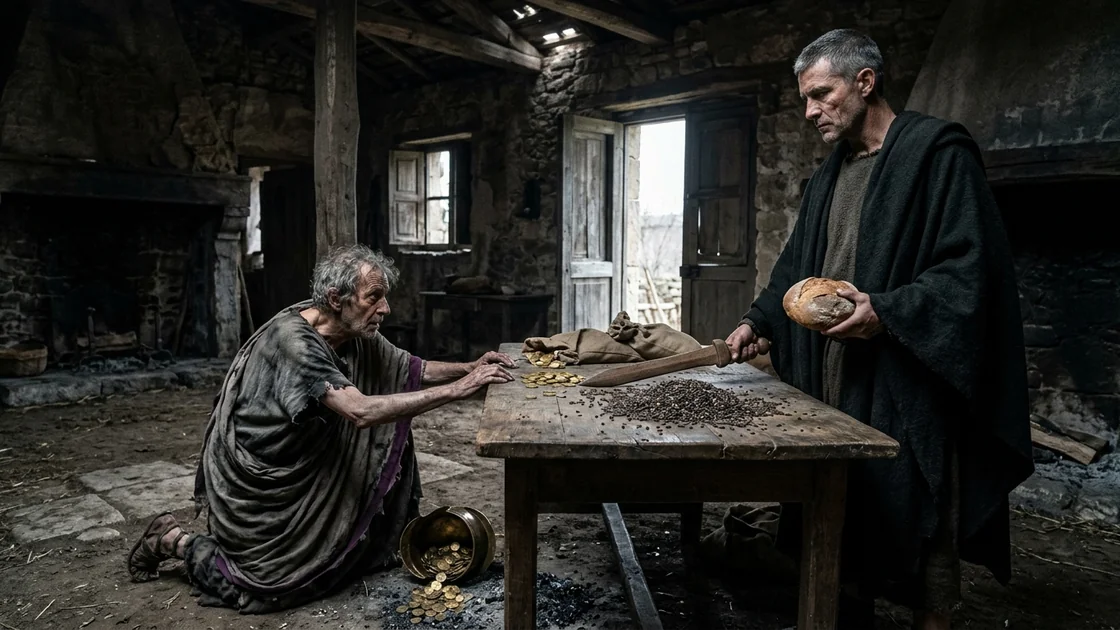
On the stone floor beside his feet sat a bronze helmet-liner filled with thirty or forty gold aurei and a handful of emerald rings that he had sewn into the hem of his tunic before fleeing Rome.
When the light from the open doorway fell across the flagstones, Varo flinched and raised a claw-like hand to shield his watery eyes.
"Syrian?" the old man croaked, his voice barely louder than the rustle of dry leaves on the dirt floor. "Is that you, Dama? Did you go down to the village at Enna? Did you buy the meal?"
Theron stepped inside and kicked the door shut behind him, leaving only a thin blade of gray light slicing through the shutter slats.
Varo squinted through the gloom, his sunken jaw trembling as he recognized the broad silhouette and the scarred face.
"You," Varo whispered. He tried to stand, clutching at the wall for support, before sinking back onto the wooden grain tub, his breath rattling in his dry throat. "You told the villagers at Enna not to sell to my slave. Dama went down with ten aurei five days ago—the baker barred his door in his face! Your riders sit on the ridge day and night! They shot my mule with a bow when I tried to walk down the road to Catania!"
"The road is private property, Quintus," Theron said, walking slowly to the center of the room where a scarred oak table still stood—the same table where his mother had kneaded bread on winter mornings when he was a boy. "You are trespassing on the ager immunis of Aristo of Enna. My guards have orders not to let trespassers wander across my wheat fields."
Varo reached down with both trembling hands, scooped a double handful of gold aurei out of the helmet liner, and held them out toward Theron. Several of the heavy gold coins slipped through his bony fingers and rolled across the dirty flagstones with a dull, musical ringing.
"Look!" Varo sobbed, tears cutting pale tracks through the dirt on his hollow cheeks. "Look—fifty aurei! Five thousand sesterces! I have not eaten since Tuesday, except the bark off the fig trees by the well! Sell me a sack of barley—a single modius of the sweepings from your barn! Just a loaf of black slave-bread and a skin of sour wine, and I will sign the papers to give you my name, my ancestors' masks, whatever you want!"
Theron looked down at the gold coins gleaming in the dust at his boots.
He opened the linen sack in his left hand and reached inside.
He drew out a fresh, round loaf of fine white wheaten bread—panis siligineus, baked that morning in the ovens of Enna, its crust scored into eight neat wedges and still warm enough to carry the sweet, rich scent of yeast and roasted grain across the cold, stinking room.
Varo made a sound in the back of his throat that was not human—a wet, whimpering animal keen. He dropped the remaining gold coins and lunged forward off the tub, falling onto his hands and knees on the flagstones, scrambling toward the table as his shrunken stomach knotted in agony at the smell of the bread.
Theron set the loaf down in the center of the oak table.
Beside it, he laid a small wooden practice sword—a cheap piece of boxwood, stained with old wine from a Syrian’s tavern in Capua nineteen years ago, which Philon had bought back for him in the fifth year of their partnership.
"Go on," Theron said softly. "Eat."
Varo dragged himself up by the edge of the table, his torn, dirty fingernails scrabbling at the wood as he reached for the white loaf.
Before the old man’s fingers could touch the crust, Theron’s hand came down—not with a blade, but with the flat of the wooden rudis, pinning Varo’s skeletal wrist to the oak table with a sharp crack.
Varo shrieked as the small bones in his starved wrist gave way under the boxwood.
With his free hand, Theron picked up the warm white loaf. Standing directly over the weeping patrician, the former gladiator broke the bread in half, carried it to the open window shutter, and crumbled the soft white wheat between his thick, scarred fingers, letting the pieces fall into the courtyard outside.
A dozen wild sparrows and field mice darted out from the brambles around the cistern, pecking furiously at the white crumbs in the dirt while Varo watched through the slats, his face pressed against the dusty wood, weeping aloud as the birds ate.
When the last crumb was gone, Theron brushed the flour from his palms.
He reached into his pouch, took out a heavy canvas sack that clinked dull and leaden, and dumped its contents onto the table beside Varo’s broken wrist.
Out rolled three hundred silver denarii—the exact price the Corinthian procurer had paid into Varo’s clerk’s hand for Lyra in the square of Enna twenty years ago—and a single handful of raw, unground, kiln-dried barley, black with river mud and hard as gravel.
"You are a Roman of the Senate, Quintus," Theron said, picking up his wooden sword and tucking it beneath his belt. "Eat your gold."
He walked out of the farmhouse, pulled the heavy oak door shut, and dropped the iron bar into its external brackets, locking it from the outside.
In the courtyard, the autumn rain had finally begun to fall—a slow, gentle Sicilian drizzle that smelled of wet stone and rich earth, washing the dust from the brambles around his mother’s cistern.
Theron climbed onto his mule and rode out through the stone gate toward the high ridge where his men were waiting. Behind him, from inside the shuttered stone house, came the muffled, rhythmic sound of an old man’s teeth trying to crack dry barley kernels in the dark.
Theron did not look back. He turned his mule’s head toward the south slope of the valley, where forty teams of oxen were already waiting in the rain to turn the dark earth for the spring wheat.