The Quiet Erasure of House Malchus
Kaelen is betrayed by his sworn brother Malchus, who steals his birthright and curses him with unending life so that he must forever watch Malchus's dynasty prosper. Rather than seeking vengeance through bloodshed, which would only cement Malchus as a tragic martyr in the annals of history, Kaelen embarks on a millennia-long campaign of overwhelming benevolence. Assuming new identities across the centuries, he becomes the savior, patron, and beloved guardian of Malchus's descendants during their darkest hours of famine, ruin, and sickness. Piece by piece, generation by generation, the grateful family replaces the monuments, portraits, and even the surname of their cruel founder with tributes to their mysterious benefactor, until the traitor's memory is completely eradicated from the earth.
The obsidian altar of Mount Vorath smelled of winter rain and opened veins. Kaelen knelt upon the rough-hewn stone, his knees bruised by the frost-bitten granite, his hands bound behind his back with cords of braided silver wire that bit deep into his wrists. Above him, the sky was a bruised, churning violet, the sun swallowed whole by the ragged disk of the moon. The air vibrated with a low, metallic hum that made his teeth ache in their sockets.
Standing before the altar was Malchus. He wore the mantle of bleached wolf pelts that Kaelen had hunted in the northern wastes, and upon his brow sat the circlet of meteoric iron that Kaelen had forged with his own blistered hands. For twenty years they had ridden side by side, carving a kingdom out of the lawless valleys of the Oakhaven basin. Kaelen had been the architect—the one who drew the irrigation trenches, who negotiated treaties with the hill tribes, who drafted the laws of grain and salt. Malchus had been the sword, the loud voice in the tavern, the smiling shadow who collected the taxes and whispered to the generals when Kaelen was asleep.
"You always looked too far ahead, brother," Malchus said, his voice carrying easily over the whistling wind of the summit. He held a ritual dagger made of pale bone, its surface etched with the spiraled runes of the old priesthood. "You worried about the harvest five winters hence. You worried about the schooling of peasant brats and the shoring up of riverbanks. You never understood that a king is not a mason. A king is a god who walks among cattle."
Kaelen spat a mouthful of blood onto the frost. His ribs were cracked from where his own palace guards had beaten him with the butts of their spears two nights ago, dragging him from his study while the ink was still wet on the spring charter. "They will starve within three summers under your hand, Malchus. You know how to take a wall, not how to feed the men behind it."
Malchus smiled, stepping closer. The wolf pelts smelled of cheap myrrh and stale wine. "They will not starve, because I will use your plans. I have your ledgers, Kaelen. I have your maps, your aqueduct designs, your treaties. Only now, they bear my seal. The chroniclers are already scraping your name from the vellum in the great library. By the time the snow melts in the valleys, the songs will say it was Malchus the Architect, Malchus the Lawgiver, Malchus the Undefeated who united the seven rivers."
"A lie built on wet sand," Kaelen rasped. "Someone will remember. The masons know whose hand drew the arches. The soldiers know who tended their wounds at the Red Ford."
"Men die quickly," Malchus replied softly, tracing the flat of the bone blade against Kaelen’s cheek. "Their memories die even faster. A generation of gold for the loyal, a generation of rope for the loud, and within fifty years, history is whatever is carved into the tallest stone. And I intend to build very tall stones, brother."
Kaelen stared into the eyes of the man he had once pulled from a freezing river, the man whose fevers he had sponged away in the marshes of Sarn. "Then kill me and be done with it. Make yourself a thief in the dark."
"Kill you?" Malchus laughed, a bright, ringing sound that echoed off the jagged peaks. "If I slit your throat and throw you to the crows, your ghost goes down to the quiet halls of our fathers. You get to rest. You get to sleep in the dark, ignorant of all that I have taken from you. What kind of triumph is a feast if the man who cooked it is not forced to sit in the corner and starve while I eat?"
Malchus nodded to the three hooded priests standing at the edge of the obsidian slab. They began to chant, a guttural, rhythmic cadence that seemed to pull the very heat from the marrow of Kaelen’s bones. The eclipse overhead reached its zenith; the corona flared like a ring of white fire in the purple gloom.
"I paid the blind weavers of the southern desert forty wagons of silver for this," Malchus whispered, leaning down so his breath warmed Kaelen’s ear. "An old binding, from before the mountains had names. Your blood will seal the foundation of my dynasty. Every drop spilled here binds your spirit to the soil of this world, tethered to the beating hearts of my bloodline. As long as one child of my seed draws breath, as long as my house stands upon the earth, the gates of death are barred to you. Your flesh will knit itself back together. Your lungs will never cease to draw air. Time will wash over you like water over flint, leaving you unchanged, powerless, and eternal."
"Malchus, no—"
"You will walk the dust at the edges of my kingdom," Malchus snarled, the genial mask slipping to reveal the venomous envy that had festered in him for two decades. "You will watch my sons grow fat in your halls. You will watch my grandsons ride across the bridges you designed, shouting my name to the heavens. You will watch the House of Malchus stretch across the centuries, glorious and immortal in the minds of men, while you wander as a nameless beggar who cannot even buy himself the mercy of a grave!"
With both hands, Malchus raised the bone dagger and drove it downward, straight through Kaelen’s breastbone.
The pain was not the sharp, clean bite of iron. It was cold—an absolute, glacial cold that exploded from his sternum and raced through every vein, turning his blood to liquid ice. Kaelen arched his back, a silent scream tearing at his throat as the runes on the bone blade drank his life and spat it back into him, twisted and anchored. He felt the weight of the mountain beneath him; he felt the pulse of Malchus’s heart above him, a disgusting, rhythmic drumbeat that was now the lock upon his soul.
Malchus wrenched the blade free, stepped back, and planted his heavy boot against Kaelen’s chest, shoving him over the precipice of the altar.
Kaelen fell through the dark air, crashing against the jagged shale of the ravine four hundred feet below. His spine snapped against a boulder; his skull fractured against the frozen creek bed. Darkness rushed in, thick and suffocating, promising the sweet relief of nothingness.
Then, with a sickening wrench, the darkness spat him back out.
He woke to the sound of crows pecking at his fingers. His skull pulled itself together with the sound of grinding gravel. His spine realigned with a series of wet, agonizing pops. When he dragged himself out of the ravine three days later, his clothes were rags of dried blood, the silver wire had been pushed out of his healed flesh, and the hole in his chest was nothing more than a pale, star-shaped scar that beat with a cold, hollow ache.
For the first fifty years, Kaelen was a creature of pure, unreasoning wrath.
He lived in the forests and the crags, sharpening iron and nursing his hatred like a banked fire. When Malchus died of old age at seventy-two—surrounded by weeping concubines, seven strong sons, and priests who anointed his feet with spiced oil—Kaelen crept into the capital city of Valer-Malchus to watch the funeral procession.
He saw the colossal bronze statue of Malchus erected in the center of the forum, cast from melted enemy shields. On the plinth, carved in letters as tall as a man’s forearm, were the words: HERE STANDS MALCHUS THE FIRST, FATHER OF THE REALM, WHOSE BLOOD SHALL RULE UNTIL THE STARS GROW COLD.
That night, Kaelen broke into the royal nursery with a butcher's cleaver in his hand. He stood over the cradle of Malchus’s eldest grandson, a boy of two winters with Malchus’s dark curls and heavy brow. Kaelen raised the blade. If he killed them all—every son, every daughter, every cousin and bastard—the tether would snap. He could finally die, and Malchus’s house would end in a single night of crimson terror.
He looked down at the sleeping child. Beside the cradle, on a small cedar table, lay a wax tablet where a royal scribe had been drafting the boy's lessons. It was a history of the kingdom.
And in the tenth year, the stylus had scratched into the wax, the Dark Usurper Kaelen sought to burn the granaries, but King Malchus the Wise struck him down upon the mountain, saving the people from famine.
Kaelen’s hand trembled, and he lowered the cleaver.
If he slaughtered this child, if he butchered the royal family in their beds, what would happen? The priests and the chroniclers would dip their quills in the blood. They would write tragedies that would be sung for a thousand years. Malchus would become a holy martyr, a tragic hero whose noble line was cut short by a demon in the dark. The bronze statue in the square would be draped in everlasting garlands. Even in death, even with his bloodline extinguished, Malchus would win. His name would echo down the corridors of time, mourned and revered.
"Men die quickly," Kaelen whispered in the dark nursery, remembering the wind on the mountain. "Their memories die even faster. History is whatever is carved into the tallest stone."
The child stirred in the cradle, reaching a small, warm hand up into the empty air. Automatically, out of an instinct buried beneath half a century of madness, Kaelen extended a single finger. The toddler’s tiny hand closed around it, gripping tight, and the boy sighed, settling back into peaceful sleep.
Kaelen stared at the small hand holding his finger. The cold ache in his chest did not vanish, but it shifted, crystallizing into something infinitely harder, infinitely more patient than rage.
They say a man dies twice: once when the breath leaves his body, and the second time when his name is spoken for the very last time by the living. Malchus had already died the first death, fat and triumphant in a feather bed. Kaelen could not change that.
But the second death—that belonged to Kaelen.
He did not want to destroy the bloodline of Malchus. The curse bound him to them as long as they lived; therefore, let them live. Let them live for ten thousand years. And over those years, Kaelen would love them. He would rescue them. He would feed them, clothe them, educate their children, and lift them from the ashes of their own folly. He would become the sun around which their entire existence revolved, shining so brightly that the shadow of their founder would be burned away into nothingness. He would make the children of Malchus despise the memory of their ancestor, or better yet, forget him so thoroughly that they would melt down his statues to build monuments to Kaelen.
Gently, Kaelen slipped his finger from the child's grasp. He tucked the wool blanket more securely around the boy's shoulders, turned, and vanished through the window into the warm summer night. He had a great deal of money to make, and all the time in the world to spend it.
Three hundred and forty winters later, the great empire of Valer-Malchus had fractured into squabbling feudal baronies, and the direct line of the founder had retreated to the high, rocky crags of Raven’s Hollow.
The winter of that year was called the Wolf’s Jaw. The snow began falling in October and did not stop until the passes were choked with drifts thirty feet deep. The rivers froze solid to their beds, splitting the waterwheels like dry kindling, and the autumn blight had already rotted two-thirds of the barley in the silos.
To make matters worse, Baron Hrothgar of the eastern marches had chosen the first freeze to lay siege to Keep Malchus, camping his mercenaries around the base of the hill to starve out the last remnants of the old royal house.
Inside the drafty, soot-stained great hall of Keep Malchus, Lord Aldous—nine generations removed from the man on the mountain—sat before a dying fire of wet pine branches. He was twenty-six, though hunger had hollowed his cheeks and put the grey of an old man at his temples. Across his knees lay the ancestral relic of his house: a longsword with a pommel shaped like a snarling wolf, the blade etched with the faded name MALCHUS.
His wife, Lady Marianne, sat beside him, wrapping strips of boiled leather around her swollen feet, while their six-year-old son, Leofric, whimpered softly under a pile of moth-eaten tapestries, his belly distended from eating bark soup.
"The horses are gone, my lord," muttered Ser Odo, the castellan, his voice raspy from the smoke that failed to draw up the badly designed chimney. "We boiled the last of the harnesses yesterday. The men on the battlements cannot draw their bows; their fingers are black with frost. Hrothgar’s herald rode to the gate at dawn. He says if we open the postern and yield the valley charters, he will let the women and the boy walk out into the snow."
"To freeze before they reach the abbey," Aldous said bitterly. He looked down at the sword across his knees, then up at the massive stone relief carved above the hearth. It showed a bearded warlord standing upon a mountain, holding a dagger to the sun. Below it, chipped and blackened by centuries of grease, was the house motto: BY MY BLOOD, ALL THINGS ENDURE.
"A lie," Aldous spat, striking the flat of the ancient sword with his gauntleted fist. The brittle, centuries-old iron, poorly maintained and forged with too much slag, gave a sharp crack and snapped cleanly in two, the pointed half clattering onto the flagstones.
Marianne flinched, covering her face. Aldous stared at the broken weapon, a hollow laugh escaping his cracked lips. "Look at what the great King Malchus left us. A drafty pile of rocks on a barren hill, a name that makes every petty neighbor want to take our heads for sport, and a blade that breaks under a bare hand. He was a butcher and a thief, Odo. My grandfather told me the secret histories before he died. The aqueducts in the valley that collapsed a century ago—Malchus didn't even build them. He stole them from a man named Kaelen and never left instructions on how to clear the silt traps."
Before Odo could answer, a heavy, booming horn echoed from the northern ridge—not the brassy blare of Hrothgar’s mercenaries, but a deep, resonant note of bronze that seemed to shake the icicles from the battlements.
Shouts rang out along the curtain wall. Odo drew his dagger and limped toward the heavy oak doors just as a sentry burst in, his eyes wide in his frostbitten face.
"My lord! The northern pass!" the sentry gasped. "Men with iron-shod sledges! Hundreds of them! They’ve come down the sheer cliff trail with fire-pots and heavy crossbows—Hrothgar’s camp is burning! They broke his flank in ten minutes!"
Aldous stood, clutching the broken hilt of his sword, his heart hammering against his ribs. "Whose banner? The Duke of Westmarch? The mountain clans?"
"Neither, my lord," the sentry breathed. "It’s a banner of plain white wool, with a silver mason’s compass sewn in the center."
An hour later, the portcullis of Keep Malchus groaned upward, its rusted chains greased with lard brought by the strangers. Into the courtyard marched a column of fifty heavy sledges pulled by massive, broad-chested draft oxen. The sledges were piled high with sacks of golden southern wheat, barrels of salted herring, casks of honeyed wine, cords of dry seasoned oak, and bundles of thick sheep-fleece blankets.
Leading the column on a tall, black courser was a man in a cloak of heavy grey wool lined with marten fur. He had dark hair, a neatly trimmed beard touched with silver at the jaw, and eyes of a strange, timeless grey that seemed to take in every cracked stone and rotting timber of the keep in a single glance.
Aldous walked down the icy steps of the keep, his broken sword still in his hand, his pride warring with the desperate watering of his mouth as the smell of baking bread—carried in heated iron braziers on the second sledge—drifted across the courtyard.
The stranger dismounted with the fluid grace of a man half his apparent age and bowed low, sweeping his fur-lined hat from his head.
"Lord Aldous," the man said, his voice rich, warm, and steady, like a hearth fire in a storm. "Forgive the unannounced intrusion. The roads were somewhat obstructed by bandits, and it took my men a bit of work to clear the trash from your gate."
"Who are you?" Aldous demanded, though his knees trembled so violently he had to lock them to stay upright. "Why have you broken Hrothgar’s siege? I have no gold to pay mercenaries. The vaults of this house have been empty since my father’s time."
"I am not a mercenary, my lord," the stranger replied gently. "My name is Lord Cassian of the Southern Reach. As for payment, the debt was incurred long before your father’s father was born, and it is I who am paying it to you."
Cassian stepped forward, reaching into his cloak to produce a cylinder of oiled leather. He handed it to Aldous. Inside was a parchment scroll, yellowing with age, bearing the royal seal of the First Kingdom.
"Three hundred years ago," Cassian lied smoothly, the forgery having taken him less than an afternoon in his scriptorium in Alexandria, "my ancestor was a humble master builder named Kaelen. When the wars tore the old kingdom apart, your forebears sheltered my family and gave us the silver to flee south across the sea, where we built a modest trading empire in silk and grain. In my family's ledger, it was written that should the house of the northern valley ever fall upon winter’s teeth, all that we have belongs to them. I heard in the autumn ports that the Wolf’s Jaw had closed upon Raven’s Hollow. I came as fast as the snows would allow."
Aldous stared at the parchment, then at the oxen steaming in the courtyard, where Cassian’s cooks were already ladling hot mutton broth into wooden bowls for the weeping garrison. Behind Aldous, Lady Marianne had come out onto the steps carrying little Leofric. One of Cassian’s physicians was already kneeling before her, draping a warm fur around the boy and pressing a cup of warm goat’s milk sweetened with honey to his blue lips.
A tear cut a clean path through the soot on Aldous’s cheek. He looked at the broken hilt of Malchus’s sword in his left hand, and with a sudden, violent motion, he flung it into the mud beneath the oxen's hooves.
"You are more kin to us than the ghosts in these walls, Lord Cassian," Aldous choked out, falling to one knee in the slush. "My house is yours."
"Rise, my friend," Kaelen said, stepping forward to clasp Aldous by the forearms and lift him up. The touch of the young man’s pulse sent a familiar, warm hum against the star-shaped scar on Kaelen’s chest. "No one kneels to me. Let us get your wife and son inside by a proper fire. That chimney in your great hall is a disgrace; whoever designed it knew nothing of draft angles. My masons brought lime and dressed stone. We’ll have it drawing clean by tomorrow night."
Kaelen stayed at Raven’s Hollow for twelve years.
Those twelve years were the golden age of the barony. With Kaelen’s endless coffers and his quiet, encyclopedic knowledge of engineering and agriculture, the valley was transformed. He rebuilt the ancient aqueducts he had designed four centuries earlier, draining the sour bogs and turning them into lush meadows of clover and winter rye. He taught Aldous’s smiths how to smelt high-carbon steel that wouldn't shatter in the cold. He sat by the newly rebuilt hearth every winter evening, bouncing young Leofric on his knee and teaching the boy Latin, mathematics, and the art of just governance.
In the fifth year of his stay, a spring earthquake shook the northern crags, opening a deep fissure beneath the eastern wing of the keep—directly under the ancient, vaulted crypt where the stone sarcophagus of Malchus the First had been moved when the southern capital fell two centuries prior.
Aldous, Kaelen, and the master mason stood in the torchlit gloom of the subterranean vault. The massive granite lid of Malchus’s tomb, carved in the likeness of the sleeping warlord, had slid askew, and water from an underground spring was seeping across the floor, threatening to undermine the piers of the great hall above.
"If we want to save the tomb and the ancient carvings, my lord," the mason said, scratching his chin, "we will have to tear down the eastern solar above, shore up the vault with timber cribbing, and spend two summers pumping the spring dry. It will cost five hundred marks and leave the keep open to the weather."
Aldous looked at the stone effigy of his ancestor. Over the past five years, under Cassian’s gentle tutelage, Aldous had learned what true nobility looked like. It looked like Cassian spending three days in the mud up to his waist helping the peasants shore up a bursting levee; it did not look like the arrogant tyrant carved into this granite slab.
"What is the alternative?" Aldous asked coldly.
Kaelen held his torch higher, letting the light catch the sneering granite lips of his murderer. "The simplest structural solution, Aldous, is to turn the crypt itself into a solid foundation pier. We break up the stone coffins for rubble aggregate, fill the entire chamber from floor to ceiling with hydraulic Roman cement, and seal it forever. The weight will cap the spring, and the eastern wing will stand for a thousand years without shifting an inch."
"My grandfather would have had a fit of apoplexy at the thought of burying King Malchus in wet mortar," Aldous mused. Then he turned and smiled warmly at Kaelen. "Thankfully, my grandfather isn't here. And Leofric needs the eastern solar for his new schoolroom. Smash the stones, Cassian. Pour the lime."
Kaelen stood alone in the crypt the next morning before the workmen arrived with the cement troughs. He held a heavy iron sledgehammer in his hands. Walking over to the sarcophagus, he looked down at Malchus’s stone face.
"I promised you tall stones, brother," Kaelen whispered.
He swung the hammer once, striking the granite nose from the effigy. When the workmen arrived ten minutes later, Kaelen helped them tip the lid into the mud, and together they buried the founder of the house under forty tons of liquid stone.
When Kaelen finally staged his own death seven years later—faking a fatal carriage accident in a swollen river Gorge while traveling back to the coast—Lord Aldous and a teenage Leofric wept openly for weeks. They tore down the cracked stone relief of Malchus above the great hall's hearth. In its place, they commissioned a master sculptor from the south to carve a magnificent bas-relief of Lord Cassian holding a mason’s compass and a sheaf of wheat. Beneath it, they chiseled a new motto into the lintel: BY GRACE AND MEASURE WE BUILD.
Four hundred and eighty years after the sealing of the crypt, the world had traded chainmail for velvet, and broadswords for double-entry bookkeeping.
The descendants of Leofric had migrated south during the great plagues, settling in the glittering, canal-laced mercantile republic of Varenna. Over the centuries, the harsh northern name of Malchus had been softened by the Romance tongue into Malchiori, and for three generations they had been counts of the republic, trading in alum, Venetian glass, and ultramarine pigment.
But in the autumn of 1492, the Palazzo Malchiori on the Grand Canal was a house of ghosts and bailiffs.
Count Lorenzo Malchiori, a young man of twenty-two with a passionate love for poetry and a catastrophic lack of talent for marine insurance, had staked the entirety of the family’s remaining fortune on a fleet of four spice galleons bound from Alexandria. An unseasonal hurricane off the coast of Crete had sent all four ships to the bottom of the Mediterranean, along with forty thousand золотых ducats borrowed from the Signoria’s most ruthless banking syndicate, the House of Sforza-Grimaldi.
Rain lashed against the tall, leaded windows of the palazzo’s ancestral gallery. Lorenzo stood in the center of the cold marble floor, dressed in a threadbare doublet of black damask, watching two city notaries with ink-stained fingers paste red wax sequestration seals onto the frames of the family paintings.
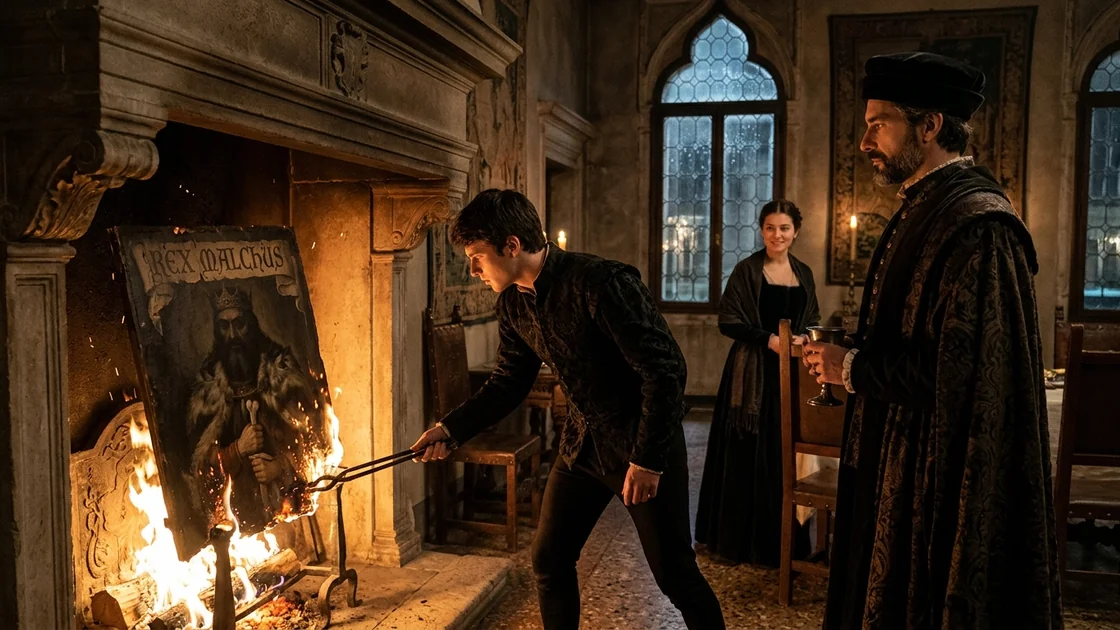
At the far end of the gallery hung the oldest piece in the collection: a dark, flaking triptych painted on worm-eaten poplar wood during the late Middle Ages, salvaged from the old northern castle before it was abandoned. It depicted a shadowy, bearded king in wolf pelts holding a bone dagger, labeled in faded gothic script: REX MALCHUS, PRIMUS SANGUIS.
"We will leave the primitive panel for the scrap-wood dealers, Signor Count," the chief notary said without looking up from his ledger. "The pigments are blackened with candle soot and the wood is warped. It wouldn't fetch three groschen at the Rialto. However, the silver plate, the tapestries from the Cassian rooms, the library, and the deed to the palazzo itself will be auctioned on the steps of the Doge’s Palace at noon tomorrow. As the sale will fall short of the Sforza bond by some twelve thousand ducats, the magistrate instructs me to remind you to present yourself at the debtors’ prison of the Torrone by sundown, lest the guard be sent to fetch you in irons."
In the doorway behind Lorenzo, his younger sister, Bianca, gripped the doorframe until her knuckles turned white. Her dowry had gone down with the galleons; without it, and with her brother in the rotting cells beneath the canal waterline, her only prospect was the charity convent of the Magdalenes or the courtesans’ quarter.
"Have they no patience?" Lorenzo’s voice cracked with humiliation. "If the Signoria would grant me a single year—the glassworks at Murano are still operable, I could lease the kilns—"
"The glassworks were foreclosed upon this morning, my lord," the notary said flatly. He closed his ledger with a dry snap. "A courier from Florence has already made an offer on the whole estate. We return with the porters at dawn."
When the heavy street doors echoed shut behind the bailiffs, the silence in the vast palazzo was suffocating. Lorenzo walked slowly to the high window overlooking the canal, where the black gondolas slid through the rain like floating coffins. On a side table lay a small glass vial of laudanum he had bought from an apothecary in the back alleys three nights ago. If he drank it tonight, the Republic’s law stated that a dead man’s physical debt died with his body; the creditors could take the stones and the furniture, but they could not imprison Bianca for the shortfall.
He reached for the vial.
Down below, in the courtyard archway, the heavy bronze knocker struck thrice—slow, measured, and commanding.
Lorenzo froze, shoving the vial into his doublet. The servants had all fled two weeks ago when their wages stopped. Slowly, holding a single tallow candle, Lorenzo descended the grand marble staircase and pulled back the iron bolt of the water-gate.
Tied to the mooring posts was a magnificent gondola upholstered in crimson Genoa velvet, crewed by four oarsmen in livery of silver and grey. Stepping out onto the wet stones under an oiled silk umbrella held by a footman was a tall gentleman in a sweeping cloak of Florentine brocade. Beneath the brim of his velvet cap, his grey eyes gleamed with a quiet, penetrating warmth.
"Count Lorenzo Malchiori?" the stranger asked in flawless, musical Tuscan.
"Until noon tomorrow," Lorenzo said hollowly, stepping back defensively. "If you are from the Sforza bank, the notaries have already sealed the chests. There is nothing left to inventory."
"I have no fondness for the Sforzas," the gentleman replied, stepping into the vaulted vestibule and shaking a few drops of rain from his gloves. "Their interest rates are vulgar and their grasp of maritime risk is provincial. My name is Maestro Giuliano Vance. I am an art patron and collector recently arrived from Bruges. May I come in out of the damp? I have something in my pocket that belongs to your sister, and something in my barge that belongs to you."
Bewildered, Lorenzo led the stranger up to the drafty gallery where Bianca was sitting by a single brazier, shivering under a shawl. Maestro Giuliano bowed to her with such courtly reverence that the young woman blushed despite her terror.
Reaching into his velvet satchel, Giuliano withdrew two thick sheaves of vellum stamped with the heavy lead bullas of the Venetian Senate and the Papal Treasury. He laid them on the table beside the notary’s red wax seals.
"The first document," Kaelen said, warming his hands briefly over the small brazier, "is the canceled bond of the House of Sforza-Grimaldi, purchased in full this afternoon at the Rialto bank for forty-two thousand ducats, along with the full title deed to the Murano glassworks, free of all liens. I have taken the liberty of hiring a master chemist from Bohemia to modernize your furnaces; he begins work on Monday."
Lorenzo stared at the parchment as if it had been written in the language of angels. He touched the Papal seal with a trembling finger. "This... this is impossible. The Sforzas wanted our blood. Why would you pay forty-two thousand ducats for four sunken ships?"
"Who said they sank?" Kaelen smiled, a twinkle of dry amusement in his eyes. In truth, the ships had indeed sunk, and Kaelen had spent the better part of last week having his private fleet in Cyprus transfer four cargoes of prime Moluccan cloves and Banda nutmeg onto newly purchased hulls painted with the Malchiori colors, bribing the harbor master at Candia to backdate the manifests. "Rumors in the Levant are notoriously unreliable, my boy. Three of your galleons lost their mainmasts in the gale and limped into my private shipyard in Rhodes for refitting. As I happened to need spice in Antwerp immediately, I bought the cargoes on the water at peak market value, deducted the repair costs and your Sforza debt, and brought the remaining balance with me."
Kaelen gestured to the two footmen who had followed him up the stairs. They set a heavy iron-bound chest upon the marble floor and threw back the lid. The candlelight caught the dull, unmistakable glow of ten thousand gold florins.
"The second document," Kaelen continued softly, looking at Bianca, who had risen to her feet with her hands pressed over her mouth, "is a dowry settlement of fifteen thousand ducats deposited in the Bank of Saint George, which I understand will be quite sufficient to allow a young lady to marry young Alessandro Contarini for love, rather than entering a convent for want of gold."
Bianca burst into tears, dropping to her knees to catch Kaelen’s hand and press it to her forehead. Lorenzo stood paralyzed, his chest heaving, the vial of laudanum burning like a coal against his ribs.
"Why?" Lorenzo whispered, his voice breaking. "Maestro Giuliano, you do not know us. The name of Malchiori is mud in this city."
Kaelen gently raised Bianca to her feet and placed a paternal hand on Lorenzo’s shoulder. "You are mistaken, Lorenzo. Three centuries ago, my forebear, Lord Cassian, stood in a snowstorm in the northern mountains and swore that as long as the stars turned, his house would watch over yours. Look at your own signet ring."
Lorenzo looked down at the silver ring on his thumb—not the old wolf of Malchus, which had been lost centuries ago, but the mason’s compass and wheat sheaf that Leofric had adopted in the twelfth century. Kaelen turned his own hand over, revealing an identical ring carved in antique gold.
"We are bound by an old debt of love, my boy," Kaelen said. "Now, I have only one condition for my investment in your glassworks."
"Anything," Lorenzo breathed. "My life, my house, anything."
Kaelen turned and looked down the length of the cold gallery. "This room is intolerably gloomy. You are a patron of the new humanism, Lorenzo, yet your walls are hung with dismal medieval relics that smell of dry rot and barbarism." He pointed toward the worm-eaten poplar triptych of King Malchus at the end of the hall. "Look at that wretched thing. A savage in wolf skins holding a bone knife. Is that the image of a modern mercantile dynasty?"
"The notary said it wasn't worth three groschen," Lorenzo said eagerly, desperate to please the man who had just pulled him from the grave. "I have hated it since I was a child. It used to give Bianca nightmares."
"Then let us be rid of it," Kaelen said brightly. "I happen to have brought a young apprentice painter from Florence in my retinue—a boy named Buonarroti, alongside a master of fresco from Urbino. Let us strip these moldering boards and damp tapestries from the walls. We will plaster the entire gallery fresh and commission a grand cycle of frescoes celebrating the true history of your family: how Lord Cassian brought the grain through the snows, and how the house rose from the mountains to bring light and glass to the lagoons."
That very night, before the plasterers even arrived, Lorenzo himself took a crowbar to the wall and pried the ancient triptych of Malchus from its iron hooks.
Because the rain was still falling and the firewood in the kitchen was damp, Kaelen suggested they use the dry, resinous poplar panels of the painting to start a blaze in the grand dining room fireplace to warm the wine.
Sitting in a high-backed velvet chair with a goblet of Cyprus malmsey in his hand, while Lorenzo and Bianca laughed and planned Bianca’s wedding across the table, Kaelen watched the painted face of Malchus blister, blacken, and curl into gray ash among the andirons. By midnight, the room was delightfully warm, and not a single brushstroke of the traitor’s likeness remained upon the earth.
When Lorenzo married two years later and had a son, he went before the Venetian Senate and petitioned to drop the archaic, foreign-sounding name of Malchiori, which the locals constantly mispronounced anyway. In honor of their beloved benefactor, godfather, and business partner, the family was henceforth inscribed in the Golden Book of the Republic’s nobility as the Counts di Caelum-Vance.
Three hundred and ninety years rolled by on wheels of iron and steam.
The Venetian Republic had long since fallen to Napoleon’s artillery, and the descendants of Count Lorenzo had followed the currents of global capital northward to the great, soot-choked heart of the British Empire. By the autumn of 1884, the family—now known simply as the Valens, a localized corruption of their Renaissance title—were barons of the Yorkshire coal and steel trade.
Yet time, as Kaelen had learned over a millennium and a half, was a wheel that loved to crush those who grew complacent at the top.
Lord Robert Valen had died of a stroke in the spring, leaving the sprawling Valen Ironworks in Sheffield and the crumbling ancestral seat of Blackwood Manor to his widow, Lady Clara, and their ten-year-old son, Julian—named, by long family tradition, after the legendary Venetian patron whose portrait still hung in the drawing room.
Lord Robert had been an honorable man, which meant he had refused to use child labor in his pits or adulterate his steel rails with cheap phosphorus like his chief competitor, Sir Titus Calthorpe. As a result, Calthorpe had undercut the Valen contracts with the Great Northern Railway, bought up Lord Robert’s debts through shell banks in London, and engineered a catastrophic strike at the Sheffield foundries.
Even worse, young Julian was dying.
It was the white plague—consumption—settled deep in the boy’s lungs from the damp Yorkshire fells and the coal-smoke fog that rolled through the valleys every November.
Inside the frigid nursery of Blackwood Manor, the sound of Julian’s wet, rattling cough echoed against the faded wallpaper. Lady Clara sat beside the brass bedstead, her black mourning crinoline crumpled, wringing out a linen cloth in a basin of vinegar water to cool the boy’s burning forehead. Downstairs, in the entrance hall, the bailiffs of the High Court of Chancery were cataloguing the furniture by the light of paraffin lamps, preparing for the liquidation auction that would turn Clara and her dying son out into the December sleet.
"Mama," Julian wheezed, a fleck of bright arterial blood staining his pale lip. "Are the men downstairs taking the picture of Lord Cassian's oxen?"
"Hush, my darling, don't speak," Clara whispered, her voice trembling as she wiped his mouth with her handkerchief. "We don't need pictures. We are going to go to a nice, warm cottage by the sea in Devonshire as soon as you can travel."
It was a lie, and the boy’s fever-bright eyes knew it. There was no money for Devonshire. There was barely enough coin in her reticule for a third-class train ticket to her sister’s cramped parsonage in Leeds, and the local parish doctor had told her yesterday, with blunt Yorkshire honesty, that if the boy did not reach dry mountain air before Christmas, he would be in the churchyard by January.
Downstairs, the heavy oak front door banged open against the wall, letting in a blast of freezing wind and the sound of hooves on gravel.
Clara stood up, her heart leaping into her throat, expecting Sir Titus Calthorpe himself come to gloat over the foreclosure. She hurried out onto the upstairs landing and looked down into the gaslit hall.
Standing on the black-and-white marble tiles was a tall, broad-shouldered gentleman in an immaculate greatcoat of dark astrakhan wool, holding a silver-topped malacca cane and a Gladstone bag of oiled Russian leather. He had dark hair swept back from a high brow and piercing grey eyes that seemed to hold the stillness of a deep winter lake. Behind him stood two burly clerks carrying leather dispatch boxes stamped with the brass crest of the Bank of England.
"Who the devil are you?" demanded the chief Chancery bailiff, stepping forward with his clipboard. "This house is under royal writ of execution for the creditors of the late Lord Valen. No one enters without a warrant from Calthorpe & Sons."
The gentleman did not even look at the bailiff. He handed his hat and cane to his clerk, unbuttoned his kidskin gloves finger by finger, and spoke in a crisp, commanding voice that made the gasoliers seem to vibrate.
"I am Dr. Arthur Kaelen, Fellow of the Royal Society and principal shareholder of the Imperial Continental Banking Corporation," he said coolly. "As of four o'clock this afternoon, when the telegraph lines closed at the London Stock Exchange, Calthorpe & Sons ceased to exist as a solvent entity. It seems Sir Titus was severely over-leveraged in Peruvian guano bonds, all of which I happened to acquire and call in at noon today. My clerks have the discharge papers from the Lord Chancellor’s office in that box. Take your dirty boots off Lady Valen’s carpets and be off the premises in three minutes, or I shall have the county constabulary arrest you for trespass."
The bailiff’s jaw dropped. One of the clerks stepped forward, flipped open a leather dispatch box, and slapped a heavy parchment bearing the Great Seal of the Realm into the bailiff's chest. Within two minutes, the auctioneers were scrambling out into the sleet, leaving their lanterns behind on the drive.
Kaelen looked up toward the shadowy landing where Clara stood gripping the banister, her face white as chalk. His expression softened instantly from aristocratic ice to profound, aching tenderness.
"Lady Clara," he said softly, ascending the stairs two at a time with his Gladstone bag in hand. "Forgive my lateness. My steamer from Zurich was delayed by fog in the Channel. How is the boy?"
"Who—" Clara gasped, catching herself on the newel post as her knees gave way. Kaelen caught her gently by the elbow, steadying her with a strength that felt like solid oak. "Dr. Kaelen? I don't understand. Robert never spoke of—"
"We will discuss finance and family history over tea once your son is breathing properly," Kaelen said, already walking toward the sound of the rattling cough in the nursery. "I have spent the last ten years in Vienna and Davos studying pulmonary bacilli with Dr. Koch. And more importantly, I have something in this bag that your parish doctors won't discover for another sixty years."
In truth, Kaelen had spent the last five years in a private laboratory in Geneva culturing Penicillium molds and synthesizing early chemical compounds—streptomycin precursors and concentrated antimicrobial extracts—far ahead of the nineteenth century’s stumbling medical science, alongside a few drops of his own blood distilled into an inert saline solution. He had discovered during the plagues of the seventeenth century that while his blood could not make another human immortal, a microscopic trace of it, properly filtered, acted as a miraculous catalyst for cellular regeneration in those who carried the genetic tether of his curse.
For three days and three nights, Kaelen did not leave Julian’s bedside.
He had the boy’s room sealed against the coal damp, installing brass vaporizers that filled the air with warm eucalyptus steam and oxygen brought in pressurized steel cylinders from his London laboratories. Every four hours, he administered the clear amber elixir from his glass vials, holding the boy’s frail, burning body up against his own chest so Julian could breathe more easily, whispering ancient stories of masons who built bridges across the stars and ships that sailed through storms of spice.
On the fourth morning, the fever broke.
Clara woke from an exhausted sleep in the armchair by the window to see the grey Yorkshire dawn filtering through the curtains. Kaelen was sitting in his shirtsleeves beside the bed. Julian was propped up on three pillows, his cheeks pink with healthy color, his breathing deep, silent, and completely clear, hungrily spooning down a bowl of warm beef bouillon while Kaelen showed him how to fold a piece of prescription paper into a soaring glider.
"Look, Mama!" Julian called out, his voice strong and bright without a single rasp. "Uncle Arthur says when springtime comes, he’s going to take us on his yacht to Greece to see the old temples!"
Clara fell to her knees beside Kaelen’s chair, burying her face in his coat sleeve and weeping until her shoulders shook. Kaelen laid his hand gently upon her hair, looking over her head at the boy, who smiled at him with complete, worshipping trust.
That spring, before they sailed for the Mediterranean, Kaelen took Clara and Julian down to the newly reopened Valen Steelworks in Sheffield.
With Kaelen’s patents for the open-hearth Bessemer modifications, the foundry was roaring day and night, employing two thousand men at the highest wages in the county. While touring the old muniments vault of Blackwood Manor before the decaying Georgian house was demolished to make way for a modern, sunlit country estate, Kaelen had come across a small, rusted iron strongbox tucked behind the 16th-century Venetian ledgers.
Inside the box, wrapped in rotting velvet, were the last three physical remnants of the man on Mount Vorath: a fragment of a bronze signet ring bearing a wolf’s head, a single silver coin stamped with the profile of Malchus Rex, and a brittle scrap of sheepskin parchment—a twelfth-century monk’s transcription of the original foundation myth of the family, mentioning how King Malchus had slain the traitor Kaelen during the great eclipse.
They stood on the iron catwalk high above the main foundry floor. Below them, a colossal crucible held forty tons of white-hot, molten steel, roaring like a captured sun, throwing showers of golden sparks toward the glass roof.
"What are those old things in your hand, Uncle Arthur?" Julian asked, leaning against the iron railing in his smart sailor suit, his lungs drawing in the warm air without a trace of pain.
"Just some impure slag I found in the old cellar, my boy," Kaelen said, opening his palm so Julian and Clara could see the tarnished coin, the broken wolf ring, and the scrap of parchment. "When you are forging steel for bridges that have to carry the future, Julian, you must be very careful not to let old, brittle iron contaminate the melt. One flaw in the memory of the metal, and the whole arch collapses."
"Should I throw them in the furnace?" Julian asked eagerly.
"I think that would be wise," Kaelen smiled, handing the relics to the ten-year-old heir of Malchus.
Julian leaned over the railing and opened his hand.
The parchment vanished in a flash of yellow flame before it even touched the surface of the crucible. The bronze ring and the silver coin struck the blinding white soup of liquid steel, hissed once, and dissolved into the boiling mass, their atoms scattered across forty tons of railway iron destined to be laid beneath the gravel of a hundred nameless towns.
In 1895, when Julian came of age and took his seat in the House of Lords under a newly created peerage secured by his beloved guardian’s philanthropic donations to the Crown, he chose his title without a second’s hesitation: Baron Kaelen of Sheffield. The old surname of Valen was dropped entirely by Royal License, relegated to a dusty middle initial that even Julian’s own children never bothered to use.
One hundred and thirty years later, the autumn sun of the twenty-first century shone clear and bright over the glass-and-limestone atrium of the Kaelen Global Foundation in Geneva.
Kaelen stood on the cantilevered terrace overlooking Lake Geneva, holding a crystal flute of sparkling water. He wore a bespoke charcoal suit of superfine merino wool, no tie, his silver-touched dark hair cut in a modern style. To the three hundred guests mingling in the gallery behind him—Nobel laureates, climate engineers, historians, and architects—he was known as Julian Kaelen, the famously private forty-something cousin from the American branch of the family who managed the family’s multi-billion-dollar sovereign wealth trust.
He felt the breeze off the lake against his face. Beneath his white linen shirt, the star-shaped scar over his sternum was strangely quiet. For the last fifty years, its cold, metallic throb had grown fainter and fainter, like a clockwork mechanism whose spring was slowly unwinding as the weight of history shifted entirely onto his side of the scale.
"There you are, hiding from the journalists again," a warm voice said behind him.
Kaelen turned and smiled. Walking toward him across the travertine terrace was Dr. Elena Kaelen, thirty-two years old, chief archivist and director of the Foundation’s Cultural Heritage Division. She was the last living descendant of the bloodline—intelligent, kind, fiercely dedicated to building pediatric hospitals and funding clean-water initiatives in the developing world. Around her neck hung a delicate platinum pendant shaped like a mason’s compass.
"They always ask how our family managed to stay solvent for eight hundred years without starting a single war," Kaelen said lightly, clinking his glass against hers. "If I tell them the secret is simply building good aqueducts and avoiding Peruvian guano bonds, they think I’m joking."
Elena laughed, leaning against the glass balustrade beside him. "Well, you won't be able to hide in ten minutes. We’re unveiling the central exhibit in the courtyard, and as the man who funded the Anatolian archaeological dig, you have to help me cut the ribbon."
She looked back through the floor-to-ceiling glass into the center of the grand hall. There, resting on a reinforced steel plinth surrounded by velvet ropes, was a massive, six-ton block of weathered black obsidian and dark bronze, recently airlifted from a remote mountain basin in eastern Turkey—the ancient, long-forgotten region once known as Oakhaven and Mount Vorath.
Six months ago, a team of university archaeologists funded by the Foundation had uncovered the buried ruins of an Iron Age city that had been wiped off the map by earthquakes and shifting rivers two millennia ago. At the center of the ruined forum, buried under thirty feet of alluvial silt, they had found the shattered base of a colossal bronze statue and the intact obsidian foundation stone beneath it.
Because the site was scheduled to be flooded by a new hydroelectric dam next month, Elena had arranged for the artifacts to be brought to Geneva to be repurposed for the Foundation’s centennial monument.
"Did the epigraphers from Oxford finally finish the laser-scanning on the inscription?" Kaelen asked, keeping his voice casually curious as they walked back inside toward the podium.
"They sent the final report an hour ago," Elena said, pulling a tablet from her blazer pocket and tapping the screen as they wove through the crowd of applauding guests. "Honestly, Uncle Julian, it’s almost comical how quickly ancient tyrants thought they could buy immortality."
They stepped behind the heavy velvet curtain near the stage, waiting for the master of ceremonies to finish the introduction. Near the back of the staging area stood the unrestored half of the artifact that hadn't been used in the new sculpture: the corroded, green-crusted bronze head of the forum statue, sheared off at the neck when the ancient city fell, alongside a high-resolution digital rendering of the worn cuneiform-script inscription on the plinth.
Kaelen stopped before the bronze head.
Even through two thousand years of verdigris and mineral encrustation, he knew the curve of that heavy brow. He knew the arrogant curl of the upper lip. It was the statue he had watched them raise in the square of Valer-Malchus on the night he almost murdered a toddler in his cradle.
"Look at the translation the Oxford team pulled from the laser scans," Elena said, handing him the tablet with a wry shake of her head.
Kaelen looked down at the glowing screen.
HERE STANDS M—CH—S THE FIRST, FATHER OF THE REALM, WHOSE BLOOD SHALL RULE UNTIL THE STARS GROW COLD. WHOSOEVER LOOKS UPON MY WORKS, TREMBLE AND REMEMBER MY NAME.
Two of the letters in the name had been gouged out by a falling building stone twelve centuries ago, and the rest was a phonetic dead end from a dialect spoken by no living soul.
"M-ch-s," Elena sounded it out clumsily, shrugging. "The linguists think it might have been pronounced Machos or Melchas. Some petty Bronze Age warlord who taxed the river valleys to build a giant statue of himself while his irrigation canals silted up. There’s zero mention of him in the Hittite or Assyrian records. Complete historical dead end. Not a single descendant, not a single surviving law, not a single person on earth who knows who he was."
Kaelen looked from the tablet to Elena’s bright, compassionate eyes—eyes that carried the exact genetic sequence of the man whose severed bronze head lay on the crate beside them.
"What are you going to do with the bronze head and the inscription block?" Kaelen asked softly. His heart was beating with a sudden, deafening loudness in his ears.
"Oh, the inscription block was structurally unstable—full of micro-fractures from the ancient earthquake," Elena said briskly. "We crushed the obsidian into aggregate last week to mix into the concrete base for the new courtyard fountain. And as for the bronze..."
The master of ceremonies called Elena’s name over the sound system. The crowd applauded warmly.
"Come on," Elena smiled, taking Kaelen’s hand and pulling him out onto the sunlit stage. "See for yourself."
With a touch of a button on the lectern, the white silk shroud dropped from the massive monument in the center of the atrium.
The crowd gasped in appreciation.
Rising twenty feet toward the glass ceiling was a breathtaking modern sculpture cast from gleaming, recycled ancient bronze. It depicted a tall, timeless figure holding a mason’s compass in one hand and sheltering a sapling tree with the other, water cascading gently over the polished metal into a basin of dark, sparkling obsidian concrete below.
"The ancient bronze from the Anatolian dig was melted down in our solar foundry in Zurich," Elena told the audience, her voice ringing with pride and emotion as she looked over at Kaelen. "We wanted to take the metal of a forgotten, nameless warlord and recast it into a tribute to the true architect of our family and our world. For nearly a thousand years, through every dark age, famine, and plague, the Kaelen family has been guided by a single philosophy, passed down from the first Cassian and the first Kaelen: that the only monument worth building is the lives you save."
She gestured to the base of the fountain, where letters of brushed stainless steel were set into the crushed obsidian of Mount Vorath:
THE KAELEN FOUNDATION. IN HONOR OF KAELEN, OUR FIRST AND FOREVER FATHER. BY GRACE AND MEASURE WE BUILD.
Elena turned to the microphone one last time as the applause swelled to a standing ovation. "The nameless tyrant who originally cast that bronze thought he would live forever through fear. He is gone. Even the stones have forgotten his name. Only Kaelen remains."
As the last word left her lips, echoing across the glass hall and out over the waters of the lake, Kaelen felt a sensation inside his chest like a taut silver wire finally, mercifully snapping in two.
It did not hurt. It felt like taking off a suit of heavy iron armor after a march of two thousand years.
The cold, hollow knot behind his breastbone vanished entirely. For the first time since the eclipse on the mountain, Kaelen drew a breath of air that felt completely warm, filling his lungs with the mortal, fleeting sweetness of an autumn afternoon. He looked down at his hands; in the bright sunlight streaming through the glass roof, he saw a tiny, faint line at the corner of his knuckle that had not been there that morning, and he felt the gentle, natural rhythm of a heart that was finally allowed to count its beats toward a peaceful rest.
Malchus was dead. Not in the flesh, which had rotted millennia ago, nor in the stone, which was now dust beneath Kaelen’s feet, but in the last sanctuary any man can ever claim: the memory of his own blood.
Elena stepped away from the podium and walked over to him, her eyes shining with unshed tears of joy as the crowd continued to applaud. She threw her arms around his neck, hugging him tight.
"Thank you for everything, Uncle Kaelen," she whispered against his cheek. "What are we going to build next?"
Kaelen wrapped his arms around his daughter-in-all-but-name, resting his chin on her shoulder as he looked at the water shining over the newly cast bronze. He had perhaps thirty or forty good mortal years left in his bones now that the curse was broken—more than enough time to watch Elena’s children grow up, to design a few more libraries, and to finally see what waited on the other side of the quiet dark.
"Whatever you want, my dear," Kaelen said, and smiled into the light. "We have a whole lifetime ahead of us."