The Quiet Architecture of Ruin
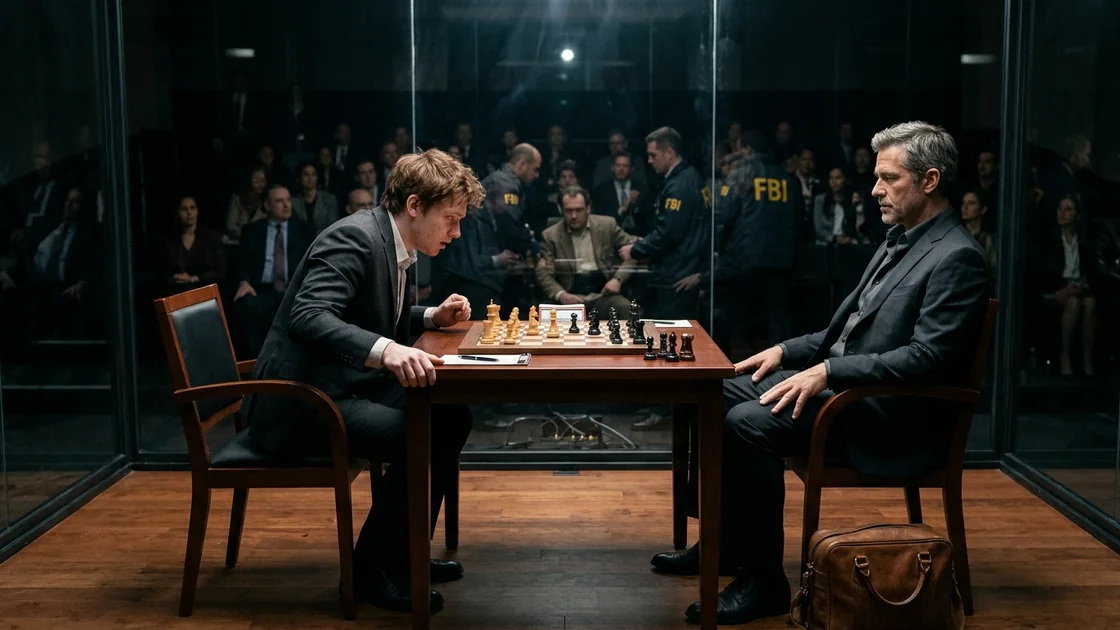
Grandmaster Julian Vance spent two agonizing years orchestrating his own public humiliation by intentionally losing forty-nine consecutive matches across international circuits to his arrogant rival, Nikolai Sorokin. While the chess world mourned the sudden decline of a once-great tactical mind, Julian was secretly collaborating with a signal-processing physicist and federal wire-fraud investigators to map an undetectable sub-dermal communication system used by Sorokin and an offshore gambling syndicate. Every loss was a carefully engineered sonar ping designed to force Sorokin to trigger his hidden transmitter at exact, predetermined board states, allowing federal technicians to isolate the encrypted ultra-low-frequency bursts from ambient electromagnetic noise. The grueling masquerade culminated at the World Chess Championship in New York, where Julian used his fiftieth match to bait Sorokin into activating the illegal signal inside a federally monitored glass enclosure while simultaneously springing a deep computer-horizon trap that dismantled both the cheater and the criminal empire behind him.
The first loss happened in Geneva, inside a nineteenth-century conservatory where the air smelled of damp ferns and old mahogany. Julian Vance sat across from Nikolai Sorokin at Board One of the Grand Masters Autumn Classic, listening to the rain tap against the high glass dome above them. At forty-one, Julian had spent nearly two decades at the summit of classical chess. He knew the geometry of the sixty-four squares the way a blind cellist knows the grain of a fingerboard. He knew how human beings thought when they were afraid, when they were greedy, and when they were running out of time.
More importantly, he knew what it looked like when a human being stopped thinking altogether.
It was move thirty-four of a sharp, labyrinthine Ruy Lopez. The position on the board was a field of broken glass. Both kings were exposed, the center was locked in a tense equilibrium of mutually assured destruction, and the clock was bleeding down toward the forty-move time control. Julian had spent twenty-two minutes calculating a sacrifice on f5—a move that looked suicidal on the surface, inviting a devastating pin along the e-file, yet concealed a venomous resource seven ply deep.
Nikolai Sorokin was twenty-three years old, with pale, fox-like features, a tailored charcoal suit that cost more than the tournament's fifth-place prize, and a habit of rolling a silver fountain pen between his knuckles while his opponents suffered. For the first thirty-three moves, Nikolai had played like what he was: a brilliant, slightly reckless tactical monster rated 2740, prone to over-pushing his kingside pawns when bored.
Then Julian played Knight to f5.
Nikolai stopped rolling the pen. His eyes dropped to the board. For four minutes, he exhibited the standard physiological markers of a grandmaster confronting a paradox: his breathing shallowed, his pupils dilated slightly, and his right index finger twitched against the edge of the table as he calculated the forcing lines.
He was going to take the knight. Julian could see it in the micro-adjustments of Nikolai's posture. Every human instinct screamed to capture the intruder, accept the complications, and trust one's calculation in the ensuing scramble. Even a top-ten player would spend ten minutes verifying the capture before playing it, or else retreat the bishop to safety.
At four minutes and twelve seconds, Nikolai did something strange. He did not reach for the piece. Instead, his left jaw clenched once—a tiny, sharp contraction of the masseter muscle—and his gaze drifted entirely away from the critical f5 square, settling lazily on the empty a-file on the far side of the board.
Three seconds later, without calculating another branch, Nikolai reached out and pushed his rook's pawn to a5.
Julian stared at the little wooden cylinder on a5.
It was a move that seemed to belong to a different game entirely. It ignored the burning building on the kingside to paint a fence post on the queenside. Yet as Julian plunged back into the calculation tank, his stomach turned to lead. By placing the pawn on a5, Nikolai had pre-emptively invalidated a quiet queen check on a4 that occurred nine moves down the main sacrificial line—a check that had been the entire strategic justification for Julian's knight sacrifice. Without the a4 square, Julian's attack evaporated into a lost endgame.
A human did not find Rook's pawn to a5 in three seconds after staring at the kingside for four minutes. A human found that move only if they already knew the kingside sacrifice was unsound, and they only knew it was unsound if they had seen fifteen moves into a non-forcing abyss.
Julian lost twenty-two moves later. He signed the scoresheet, shook Nikolai's cool, dry hand, and walked out into the Geneva rain without attending the post-game press conference.
That night, in his hotel room overlooking the dark water of Lake Leman, Julian opened his laptop and ran the position through an experimental cluster version of Stockfish running on sixty-four remote cores. At depth twenty-four, the engine favored taking the knight. At depth thirty, it preferred retreating the bishop. Only at depth forty-two—after evaluatingnearly four billion nodes—did the engine suddenly pivot, discarding all human-looking defenses in favor of a single, cold exclamation mark: a5.
The evaluation jumped from dead equal to minus 1.84 in favor of Black.
Julian sat in the dark until dawn, watching the blue light of the screen reflect off his cooling cup of tea. A single computer move was an anomaly. Grandmasters stumbled into engine lines by accident or intuition a few times a year. It was the nature of high-level play; when you searched for truth on a finite board, your footsteps occasionally overlapped with the silicon gods.
Two weeks later, at a rapid knockout exhibition in Belgrade, it happened again. Move twenty-eight of a Queen's Gambit Declined. A chaotic position with pieces hanging in three quadrants. Nikolai stared at the board, his jaw gave that microscopic twitch, and three seconds later he played King to h2—stepping directly into a discovered check that turned out, eleven moves later, to be the only square on the board where his king could avoid a mating net.
Loss number two.
In December, at the London Chess Classic, Julian lost a classical game and two blitz tiebreaks to Nikolai. Losses three, four, and five. In every single one of them, Nikolai played human chess—flawed, aggressive, creative, 2740-level chess—for ninety-eight percent of the game. And in every single one of them, at the precise inflection point where the position branched into uncalculable chaos, there was a four-minute pause, a twitch of the jaw, and a solitary move of terrifying, inhuman perfection.
Julian did not go to the International Chess Federation. He knew the arbiters, and he knew the anti-cheating protocols. They wand-scanned players for metal before games; they used standard spectrum analyzers to check for Wi-Fi, Bluetooth, and cellular frequencies around the stage; they ran statistical algorithm checks on entire games to see if a player's overall move correlation matched an engine.
Nikolai would pass every single test. His overall correlation with top engines was only seventy-six percent—well within normal grandmaster parameters—because he only used one move per game. You cannot convict a man of cheating with a statistical model when he plays thirty-nine of his own moves and borrows only one from an oracle.
To catch a ghost that only materialized for four milliseconds an hour, Julian did not need an arbiter. He needed a hunter of invisible things.
Dr. Aris Thorne lived in a converted textile warehouse in Southwark, surrounded by oscilloscopes, copper Faraday mesh, and the remnants of a career that had ended when he tried to whistleblower a defense contractor's faulty satellite encryption. Aris had been Julian's roommate at Trinity College twenty years ago, back when Julian was a prodigy studying pure mathematics and Aris was building homemade radio telescopes on the roof of Wren Library.
"You're asking me to find a needle in a haystack," Aris said, leaning back in a creaking leather chair and wiping his spectacles on his untucked flannel shirt. Around them, four monitors displayed the timestamped video feeds of Julian's first five losses to Sorokin, synchronized with move-by-move centipawn evaluations. "Except the needle only exists for a fraction of a second, and the haystack is the entire ambient electromagnetic spectrum of a modern European city."
"He's receiving data, Aris," Julian said. He stood by the rain-streaked warehouse window, hands clasped behind his back. "Not a full stream. Not coordinates like 'e-four' or 'knight-f-six.' If someone were transmitting move notation, even in Morse code, the transmission window would have to last several seconds, and he'd need multiple pulses to confirm piece and square."
"Then how did he know to push the rook pawn in Geneva?"
"Because he already knew the move was on the board," Julian said, turning back to the monitors. "Think about how a grandmaster's mind works. In any critical position, even the deepest ones, there are rarely more than three or four candidate moves worth considering, plus perhaps one bizarre outlier you dismiss because you don't have the time to calculate its tail. Nikolai doesn't need the engine to tell him what move to play. He only needs to know when a single, non-obvious winning resource exists."
Aris frowned, adjusting his glasses. "A binary trigger."
"More likely a simple ordinal pulse," Julian explained, stepping up to the whiteboard and picking up a dry-erase marker. "Suppose before the tournament, Nikolai and his handler agree on a strict indexing protocol. Every piece on the board can be ordered from left to right, bottom to top—a-file to h-file, first rank to eighth rank. If you only ever signal the piece that needs to move, or the target file from one to eight, you only need three bits of information. Three bits can be sent in a single micro-burst."
"And once a 2750 grandmaster knows which piece moves in a critical position," Aris murmured, his eyes lighting up with the cold fire of a problem-solver, "he doesn't need the destination square. Knowing that the a-pawn is the key tells him to spend his next three minutes looking solely at a5 or a6. Or, if the time trouble is acute, a six-bit burst gives him the exact origin and destination."
"The wands at London didn't catch anything," Julian noted. "The security team used non-linear junction detectors to look for silicon semiconductors on his body. Nothing."
"Non-linear junction detectors look for diodes and transistors," Aris said dismissively, waving a hand. "If you have an infinite budget, you don't put a silicon radio receiver in the guy's shoe. You put a passive magneto-acoustic resonator—a sliver of magnetostrictive alloy the size of a grain of rice—inside a root canal in his lower second molar. No battery. No silicon. Under an X-ray, it looks like standard dental amalgam. Under a metal detector, it doesn't even register above the iron content in his bloodstream."
Julian thought of the microscopic clench of Nikolai's left jaw. "And how do you make it vibrate?"
"An ultra-low-frequency magnetic pulse, or a tightly focused phased-array ultrasonic beam from fifty feet away," Aris said. "If it's magnetic, say in the three-to-thirty kilohertz VLF band, it passes right through concrete, glass, water, and human tissue without attenuation. The standard RF sniffers that chess tournaments rent look at megahertz and gigahertz—cell phones, walkie-talkies, Wi-Fi. Nobody sweeps the VLF magnetic floor because it's clogged with power-line harmonics, fluorescent light ballasts, and subway trains."
"Can we detect it?" Julian asked.
Aris looked at him over the rims of his glasses. "Once? No. If I bring a high-sensitivity fluxgate magnetometer into a tournament hall, all I'm going to record is a soup of thermal and industrial noise. A six-bit micro-burst buried thirty decibels below the noise floor is mathematically indistinguishable from a passing tram or an air conditioner kicking on."
"Then how do intelligence agencies intercept buried signals?"
"Coherent integration," Aris said simply. "Stochastic averaging. If a signal is buried in random noise, and you record it once, the noise wins. If you record it ten times, the noise begins to blur. If you record it forty or fifty times—aligned to the exact millisecond the transmission occurs—the random noise averages out to zero, because half the random spikes are positive and half are negative. What remains, rising out of the flatline like a submarine surfacing through ice, is the deterministic waveform of the transmitter."
Julian looked at the whiteboard. "Fifty times."
"Forty-five to fifty, depending on the ambient interference of the venues and the cryptographic preamble of the pulse," Aris said. He paused, realizing the implication of what he had just said. "Wait. Julian, you can't just follow him around with a sensor in your pocket while he plays other people. To align the time-windows for coherent averaging, we have to know the exact three-second window when the handler fires the pulse. When Nikolai plays someone else, we don't know when he's confused and when he's calculating normally."
"No," Julian said softly. "We wouldn't know when he plays someone else. Because other grandmasters play normal moves. They trade pieces. They simplify. Sometimes Nikolai doesn't even need the signal to beat them."
Aris stared at him. "Julian."
"For the handler to fire the pulse at a predictable, synchronized timestamp," Julian said, his voice steady and entirely devoid of emotion, "Nikolai has to be placed in a very specific laboratory condition. He has to be confronted with a board state where the human move loses, where only one computer move survives, and where the evaluation gap between the two is greater than two hundred centipawns. I have to build that position on the board. I have to play the trigger move. And the moment I press my clock, your sensor starts recording."
"If you build a position where his only reply is a computer move that beats you," Aris said slowly, "and he has the computer... then every time you trigger the test, you lose the game."
"Yes."
"Forty-nine times?" Aris stood up, knocking his chair back. "Are you insane? You're the reigning World Champion! You have a twenty-eight-hundred rating! If you lose forty-nine games to Nikolai Sorokin across the classical, rapid, and blitz circuits over the next two years, they'll write your obituary in every chess magazine on earth! Your sponsors will walk. Your legacy will be ashes!"
Julian walked back to the window and looked out at the gray Thames. "And if I don't?" he asked quietly. "He wins the Candidates Tournament in the spring. Then he plays me for the World Championship next November. He takes the title using a piece of metal in his tooth, and chess becomes a dead art form ruled by whoever has the best bio-engineers. Would you rather I protect my rating, Aris, or protect the game?"
Before Aris could answer, Julian's phone buzzed in his coat pocket. It was an unknown number with a Washington, D.C. area code.
Special Agent Marcus Cole of the Federal Bureau of Investigation did not care about the immortal beauty of the Ruy Lopez, and he told Julian as much over black coffee in a sterile conference room on the fourth floor of the American Embassy at Nine Elms.
"What I care about, Mr. Vance, is the sovereign debt of three Baltic banks and about four hundred million dollars in laundered cryptocurrency moving through unregulated peer-to-peer derivatives markets in Macau, Cyprus, and Curaçao," Cole said. He was a compact, grey-templed man in his late fifties who wore a suit like armor and spoke with the clipped cadence of a former federal prosecutor.
He slid a manila folder across the glass table. Inside were surveillance photographs of Nikolai Sorokin boarding a private Gulfstream in Geneva. Walking two paces behind him, carrying a sleek aluminum briefcase that never left his wrist, was a thick-necked man in his forties with a jagged scar across his chin and a pair of tortoise-shell glasses.
"That's Ilya Krol," Cole said, tapping the man with the briefcase. "Former signals intelligence officer for a military directorate that officially dissolved in 2014. His brother, Viktor Krol, runs an organization we call the Vostok Syndicate. Five years ago, Vostok figured out that fixing soccer matches and tennis sets was getting too messy. Too many players to bribe, too many suspicious line movements in Vegas and London."
Julian looked at the photograph of Ilya Krol. He remembered seeing the man sitting in the fourth row of the conservatory in Geneva, wearing a visitor's credential from a Russian sports news agency.
"Chess is binary," Julian said. "Or ternary. Win, lose, draw. And since the pandemic boom, the unregulated offshore volume on elite tour events has grown tenfold."
"More than tenfold when you look at micro-prop markets on decentralized exchanges," Cole said grimly. "They don't just bet on Sorokin to win. That would collapse the odds after ten matches. They bet on exact move counts. They bet on whether a game crosses move forty. They use Sorokin as an algorithmic cash machine to clean ransomware proceeds and narcotics revenue. A shell company in Belize places twenty million in dirty crypto on 'Sorokin to win between moves 45 and 55' against a phantom counterparty controlled by Vostok, and when Sorokin delivers on schedule, the money comes out the other side as clean capital gains."
"Why haven't you arrested them?" Julian asked.
"Because Nikolai Sorokin is a foreign national competing mostly in Europe, and losing a game of board games isn't a federal crime in the United States," Cole said, leaning forward. "However, the World Chess Championship next November is being hosted in Manhattan, at the Glass Pavilion on Wall Street. The title sponsor is an American financial services firm, the prize purse clears through the Federal Reserve Bank of New York, and Vostok is already laying the groundwork for a nine-figure liquidity pool routed through servers in New Jersey."
"Wire fraud," Julian said. "And the Sports Bribery Act."
"Conspiracy to commit wire fraud, money laundering, and criminal enterprise under RICO," Cole corrected. "If they execute that fraud on American soil, I can put Viktor Krol, Ilya Krol, and their golden boy in a federal penitentiary for twenty-five years. But to get a Title III warrant from a federal judge in the Southern District of New York to raid a live international broadcast and compel a physical medical examination of a foreign diplomat-passport holder, I can't walk into chambers with a chess grandmaster's gut feeling that a rook pawn move was too smart."
"You need the physical signal," Julian said. "Isolated, decoded, and tied directly to the hardware in Ilya Krol's briefcase."
Cole nodded slowly. "Our technical division at Quantico reviewed the preliminary notes your friend Dr. Thorne sent over an encrypted relay to our science attaché. Our engineers agree with his math. A VLF magnetic burst buried in the noise floor can't be isolated with a single capture. Not in court. A defense attorney would hire three MIT professors to testify it was a subway spike. To achieve a six-sigma mathematical certainty that the waveform is an encrypted data packet—and to reverse-engineer its rolling cipher before the New York match—we need at least forty-eight clean captures under controlled conditions."
Cole looked at Julian with something approaching pity. "You've already lost to him five times, Mr. Vance. That leaves forty-four more between now and the end of the Championship cycle. The Grand Chess Tour has nine stops—classical, rapid, and blitz. Then there are the exhibition matches in Zurich and Reykjavik, and the opening games of the Championship itself."
"If I lose forty-four more times to him," Julian said quietly, "the betting odds on me winning the Championship in New York will be astronomical."
"Which is the second half of the trap," Cole said, his eyes hardening. "Right now, the syndicate bleeds the markets cautiously because they still respect you. If you spend the next eighteen months proving to the world—and to Viktor Krol—that you are psychologically broken, that Nikolai owns your soul over the board, they won't hedge in New York. They'll go all-in on the final decisive match. We freeze their clearing accounts at the exact moment the signal fires."
Julian looked down at his hands. They were steady. He had spent his entire life sacrificing pieces—pawns, knights, queens—for the sake of a distant, invisible geometry that only revealed itself at the very end of the game. Now, the board had simply grown larger. The piece he had to sacrifice was himself.
"Tell your engineers at Quantico to give Aris whatever hardware he asks for," Julian said. "I have a tournament in Wijk aan Zee next month. I need to start preparing my blunders."
Nobody outside the highest echelons of chess understood how hard it was to lose on purpose to a super-grandmaster without anyone realizing you were doing it.
If Julian played a second-rate move in the opening, or hung a tactic in three moves, the commentators—themselves grandmasters assisted by live engines—would immediately spot the drop in quality. Rumors of match-fixing or neurological illness would trigger an investigation before the spring was out. More crucially, if Julian played poorly, Nikolai wouldn't need to call upon the ghost in his jaw. Nikolai could beat a 2700-level blunder with his own natural talent.
To force Ilya Krol to press the button in the audience, Julian had to play like a god for thirty-five moves.
He had to outplay Nikolai in the opening, drag him into the deepest, darkest waters of positional complexity, neutralize Nikolai's natural tactical instincts, and build a winning advantage—only to steer the game, by the width of a razor blade, into a hyper-specific labyrinth where Julian's position looked completely crushing to the human eye, while containing a single, deeply buried computer refutation.
It was like sculpting a cathedral out of ice just so his opponent could smash it with a single tap of a hammer.
In January, at the Tata Steel tournament in the wind-swept coastal town of Wijk aan Zee, Julian sat in his rented cottage with Aris Thorne. On the dining table sat a custom-built portable magnetometer array disguised inside a heavy leather archival briefcase and a pair of high-end noise-canceling headphones that Julian would wear around his neck during his walk to the board.
"Loss number six," Aris said, calibrating the optical atomic clock inside the briefcase lining. "What's the trigger today?"
"A poisoned variation of the Catalan Opening," Julian said, his eyes bloodshot from fourteen hours of reverse-engineering computer lines. "On move twenty-nine, I'm going to sacrifice an exchange on c6. Every human grandmaster in history would look at my connected passed pawns on the d- and c-files and resign within ten moves. The commentary booth will say I've found the game of the year. Even the live broadcast engines running on standard laptops will show me at plus-two for the first twenty seconds."
"And the catch?"
"At depth forty-six," Julian said, pointing to the screen, "there is a quiet bishop retreat to f8—giving back two tempos and locking his own rook in the corner—that sets up a fortress blockade seven moves later, followed by a counter-sacrifice on g3 that wins by force. If Nikolai doesn't play Bishop to f8 on move thirty-one, I will crush him. He won't see it on his own. No human could. Ilya will see his evaluation bar on their private cluster turn green on Bf8 while every other move is bright red. Ilya will have to fire."
Four hours later, in the crowded playing hall in the Netherlands, Julian played Rook takes c6.
From the corner of his eye, he saw the live studio commentators behind their soundproof glass booth literally jump out of their chairs in excitement. Julian Vance was back! The old lion had found a masterpiece!
Across the table, Nikolai went pale. He stared at the shattered ruins of his queenside. His fingers trembled slightly as he reached for his teacup. He looked completely lost, a young challenger humbled by the master.
Julian pressed his clock, leaned back, and subtly tapped the brass clasp of his leather thermos bag resting by his chair leg—marking the zero-second synchronization point for Aris's atomic clock.
One minute passed. Two minutes. Three minutes.
In the third row of the VIP spectator gallery, Ilya Krol sat with his ankle crossed over his knee, his hands resting inside the pockets of his cashmere overcoat.
At three minutes and forty-eight seconds, Nikolai's left jaw gave a tiny, spasmodic clench.
The fear vanished from the young man's eyes. A slow, arrogant smirk curled the corner of his mouth. He picked up his dark-squared bishop and slid it backward to f8.
Ten moves later, Julian resigned.
Walking back through the freezing Dutch drizzle to the cottage, Julian felt a physical nausea that nearly brought him to his knees on the cobblestones. Every fiber of his training, thirty-five years of fierce, monomaniacal refusal to yield a single half-point, screamed in agony inside his skull. He had held the win in his hand, and he had handed the knife to a thief.
Inside the cottage, however, Aris was staring at his monitor with wide eyes.
"We got a spike," Aris whispered, pointing to a jagged purple trace buried inside a dense band of grey static at 14.2 kilohertz. "Right at timestamp 188.4 seconds after your clock press. Look at the phase shift when I overlay it with the London captures. The background noise dropped by two decibels. The submarine is real, Julian. We're seeing the hull."
The next fourteen months were a slow-motion execution of Julian Vance's life.
Loss number twelve in Bucharest. Loss number nineteen in Paris rapid. Loss number twenty-seven in Saint Louis. Loss number thirty-four in Zagreb.
Because rapid and blitz tour stops featured multiple mini-matches and double round-robins, Julian faced Nikolai constantly. Against the rest of the field—Carlsen-level titans, hungry Indian prodigies, solid Chinese veterans—Julian played with ferocious, desperate brilliance just to maintain his overall tournament standings and protect his qualification metrics. He would grind out seven-hour wins against the world's third- and fourth-ranked players, exhausting his nervous system, only to sit down across from Nikolai Sorokin the next afternoon and meticulously engineer his own slaughter.
The chess world watched in horrified fascination.
At first, the pundits called it a psychological block. Then they called it a generational changing of the guard. By loss number三十—during the Sinquefield Cup in Missouri—the tone turned cruel. Podcasts ran forty-minute segments analyzing "The Sorokin Complex." Internet memes showed Julian as a senile king bowing before a smirk-faced emperor. Nikolai leaned into the narrative with theatrical malice.
"Julian was my hero when I was ten years old," Nikolai told a packed press room in Saint Louis after beating Julian in both classical games and three blitz playoff encounters—losses thirty-one through thirty-five. Nikolai wore a white silk turtleneck and smiled into the cameras while Julian sat beside him at the microphone table, staring at his water glass. "It is honestly sad for me to sit across from him now. You can feel his fear before the clock even starts. He plays great chess until move thirty, and then he realizes who he is playing, and his mind simply breaks. Perhaps it is time for him to write books."
Laughter rippled through the journalists.
Under the table, Julian's fingernails dug into his palms until they drew blood. He said nothing. He simply nodded, muttered a congratulatory platitude into the microphone, and walked out.
The hardest part was not Nikolai. The hardest part was Claire.
Claire was Julian's younger sister and had managed his career, his charitable foundation, and his chaotic personal life since their parents died fifteen years earlier. In late August, after Julian lost four consecutive games to Nikolai at an exhibition match in Reykjavik—bringing the tally to forty-two—Claire cornered him in his hotel suite.
She slammed a thick sheaf of legal papers onto the desk. "Chronos Watches just invoked the morality and performance clause," she said, her voice shaking with a mixture of rage and heartbreak. "That's two million a year gone, Julian. The Geneva Bank sponsorship is declining to renew in October. And today I got a call from Dr. Halloway at the neurological institute in Zurich. He's a fan of yours. He asked me—very gently, very confidentially—if you had been screened for early-onset frontotemporal dementia."
Julian stood by the window, looking out at the grey volcanic rock of the Icelandic coast. He looked ten years older than he had in Geneva. He had lost fifteen pounds; his dark hair had gone almost entirely silver at the temples, and there were permanent bruised hollows beneath his eyes from spending five hours a night working with Aris on quantum pruning trees while playing six-hour tournament games during the day.
"Let the sponsors go, Claire," Julian said quietly. "We have enough saved."
"I don't care about the money!" Claire cried, stepping around the desk to grab his arm. Her eyes were bright with tears. "Look at yourself! You're a ghost! When you play anyone else, you're still Julian. And then you sit down across from that arrogant little bastard, and it's like watching a man walk into traffic! Why are you still accepting invitations to play rapid matches against him? You're the reigning World Champion—you didn't have to play Belgrade, you didn't have to play Reykjavik! I tried to cancel this exhibition, and you went behind my back to the organizers to make sure you played him four times!"
Julian looked down at his sister. Under the federal non-disclosure agreement he had signed with the Department of Justice, revealing the operation to an unvetted civilian—even family—risked compromising the Title III warrant and putting Claire in the crosshairs of Viktor Krol's syndicate. If Claire knew the truth, her demeanor toward Nikolai and the press would change. Right now, her genuine, visible devastation in the VIP lounges was one of the single most convincing pieces of theater keeping Ilya Krol comfortable.
"I have to solve him, Claire," Julian lied, forcing his voice to crack with the pathetic obsession of a broken gambler. "Before New York. If I don't figure out how to beat him before the Championship in November, I have no chance. I just need a few more games."
Claire stared into his eyes for a long, terrible moment. Slowly, her hand slipped from his sleeve. The anger went out of her face, replaced by a hollow, grieving pity that hurt Julian worse than any engine move ever had.
"You're destroying yourself, Jules," she whispered. "And after New York, there won't be anything left to put back together."
When the door clicked shut behind her, Julian sank to the floor beside the bed, pressed his forehead against his knees, and wept in complete silence so the walls wouldn't hear.
By October, forty-five losses were in the can.
In a secure basement facility in Northern Virginia, Aris Thorne and a team of three NSA cryptanalysts on loan to Agent Cole's task force stood around a high-resolution holographic projection of a waveform.
Forty-five noisy, chaotic magnetic recordings from eight countries had been stacked on top of one another, aligned to the microsecond of Julian's clock-press triggers. The random electromagnetic static of Geneva trams, London subways, Dutch wind turbines, and Missouri air conditioners had cancelled each other out into a ruler-flat baseline.
Rising from the center of that flatline was a pristine, razor-sharp digital signature.
"Look at her," Aris breathed, tracing the peaks with a laser pointer. "Twelve kilohertz carrier wave, modulated with a sixty-four-bit rolling cipher. Burst duration: 3.8 milliseconds. It's a three-stage packet: a twenty-four-bit cryptographic handshake so atmospheric static never accidentally triggers his tooth, a thirty-two-bit timestamp synced to a GPS clock, and an eight-bit payload."
"Explain the payload like I'm a jury in Manhattan," Agent Cole said, folding his arms.
"Eight bits gives you two hundred and fifty-six possible numbers," Julian said, sitting at the corner of the table with a notebook open in front of him. "There are sixty-four squares on a chessboard. To tell Nikolai which square to move a piece from, you only need a number from one to sixty-four—that takes six bits. The remaining two bits tell him the piece type or evaluation confidence: '01' means a quiet positional win, '10' means a forcing tactical sacrifice, '11' means only one move avoids immediate defeat."
"And the encryption?" Cole asked one of the government cryptanalysts.
"With forty-five sequential captures and the exact board-state plaintexts that Mr. Vance forced them to transmit, we cracked the pseudo-random number generator seed yesterday morning," the analyst said, tapping her keyboard. "It's a modified stream cipher running off an FPGA board inside Ilya Krol's briefcase. Better yet, we traced the satellite backhaul from Krol's hotel rooms in Saint Louis and Reykjavik. Krol isn't running the chess engine on a laptop in the venue. His briefcase is just a relay. When a critical position arises, a high-definition hidden camera in Krol's glasses reads the board, sends it via encrypted 5G to a massive private server farm in Limassol, Cyprus, and the Cyprus server sends back the eight-bit trigger."
"What are they running in Cyprus?" Julian asked, leaning forward intently. "Is it standard Stockfish?"
"No," Aris said, pulling up a packet-latency analysis. "Look at the node-search timing signatures we pulled from the Cyprus IP logs via our Europol liaison. It's a heavily modified neural-network hybrid they're calling 'Aegis-9.' They took an open-source grandmaster engine, stripped out the human-contempt safety valves, and trained it on a proprietary cluster of ten thousand GPUs to maximize sharp, high-entropy refutations. To cut down the response time so Nikolai doesn't look suspicious waiting ten minutes for a move, they modified the alpha-beta pruning parameters."
Julian stood up slowly. He walked over to the screen displaying the latency curves of Aegis-9.
"Wait," Julian said. "How did they cut the response time at depth forty-five?"
"Aggressive late-move reductions," Aris said, squinting at the code architecture the cyber-team had scraped from the Cyprus staging server. "In any chess engine, if you want to reach depth forty-five in under three minutes, you can't evaluate every branch equally. Aegis-9 uses a neural evaluation threshold: if a sequence of three consecutive quiet moves drops the player's material balance by more than five hundred centipawns—say, sacrificing a full rook for zero immediate checks or captures—and the neural net's initial shallow scan rates the position below minus-three, the engine prunes the branch at ply sixteen to save compute cycles for the tactical lines."
The room went utterly silent.
Agent Cole looked from Aris to Julian. "What does that mean in English?"
Julian's heart was hammering against his ribs—not with the sick dread of the past two years, but with the sudden, electric violence of a hunter who has just seen the stag step into the clearing.
"It means their god is near-sighted in the dark," Julian whispered.
He turned to the whiteboard and began drawing squares with furious speed. "To make their engine fast enough to cheat in real time, they taught it to ignore 'stupid' sacrifices that don't produce an immediate attack within eight moves—sixteen ply. Because in ninety-nine point nine-nine percent of chess positions, if you give away a whole rook and nothing happens for eight moves, you've just lost your mind."
"And in the other zero-point-zero-one percent?" Cole asked.
"It's called a horizon effect," Julian said, his eyes blazing. "In the 1990s, humans used to beat early supercomputers by building fortresses or long-range positional sacrifices whose payoff lay one move beyond the computer's search horizon. Modern engines solved that by searching wider—until Vostok crippled Aegis-9's width to buy speed!"
"Hold on," Cole said, raising a hand. "The Championship in New York is a fourteen-game classical match. We need four more captures during the opening games in Manhattan to calibrate the SQUID sensors we've installed under the floorboards of the Glass Pavilion and satisfy the judge that the system is active on U.S. soil. That brings you to forty-nine losses."
"Yes," Julian said. "If I lose four games to him in the first eleven rounds of the Championship, and we draw the rest, the score heading into the final rounds will be four-zero, or five-one in match points. Under the new Championship format they introduced for the New York cycle, if the reigning champion trails by four points heading into the final weekend, the match enters the 'Sudden Death Crown Decider' protocol—where the challenger only needs a single rapid tiebreak or final-round win to clinch the title and trigger all the series-winner derivative contracts."
"Wait a minute," Cole said narrowing his eyes. "When the signal fires in that fiftieth encounter, my tactical team is storming the broadcast booth and arresting Krol and Sorokin on stage. You don't need to win the fiftieth game, Mr. Vance. The match will be declared void the moment we slap cuffs on him."
Julian stopped writing. He turned slowly to face the federal agent. For two years, Julian had been polite, compliant, and quiet. Now, the look on his face made even the hardened FBI veteran take a half-step back.
"If you arrest him while I am losing on the board," Julian said, his voice dropping an octave, cold as winter iron, "then for the next hundred years, every coffeehouse player, every journalist, and every historian will say that Nikolai Sorokin beat Julian Vance fifty times in a row, and the American government stepped in to save the washed-up old champion on a technicality."
Julian stepped up to Cole's side of the table.
"I didn't bleed my life into the dirt forty-nine times to win by default in a courtroom, Agent Cole. In Game Fifty, I am going to trigger his transmitter. You are going to record the burst, lock the doors, and freeze their two hundred million dollars. And then you are going to stand behind the glass and wait twenty minutes while I beat Nikolai Sorokin AND his ten-thousand-GPU supercomputer over the board, in front of thirty million live viewers, until he tips his own king over."
November arrived in Manhattan wrapped in a biting Atlantic gale.
The Glass Pavilion on Wall Street was an architectural marvel erected inside the cavernous atrium of a former nineteenth-century commodities exchange. At the center of the marble floor stood the Cube: a forty-foot-by-forty-foot enclosure constructed of triple-paned, soundproof acoustic glass, bathed in theatrical white spotlights while the two thousand spectators in the surrounding tiers sat in hushed darkness.
Beneath the raised mahogany floorboards of the Cube, buried inside the concrete sub-structure, lay six liquid-helium-cooled Superconducting Quantum Interference Devices—the most sensitive magnetic field detectors ever built by human hands—wired directly to an FBI mobile command trailer parked two blocks away under the guise of a Consolidated Edison utility truck.
The first two weeks of the World Championship were a Shakespearean tragedy played out on international television.
Game One: Draw. Game Two: Sorokin wins. (Loss 46). Game Three: Draw. Game Four: Sorokin wins. (Loss 47). Game Five: Draw. Game Six: Sorokin wins. (Loss 48). Game Seven: Sorokin wins. (Loss 49).
Four decisive losses in the first seven classical games. Never in the hundred-and-forty-year history of the World Chess Championship had a defending champion been so systematically butchered. After Game Seven—where Julian played a breathtakingly complex King's Indian attack only to walk into a move-thirty-six queen retreat that left his pieces tangled in knots—the commentary teams stopped analyzing the chess altogether and spoke in hushed, funereal tones, as if broadcasting from a hospice ward.
In the press conference after Game Seven, Nikolai didn't even bother to sit upright. He slouched back in his chair, sipping sparkling water while wearing a custom diamond watch that caught the camera flashes.
"Forty-nine consecutive decisive encounters across all formats without a single loss to him," a reporter from the New York Times noted into the microphone. "Nikolai, with the match now reaching the mandatory sudden-death clincher window tomorrow afternoon, do you feel Julian has anything left?"
Nikolai looked sideways at Julian. For the first time, there wasn't even mockery in the young man's eyes—only the bored indifference one feels toward an insect already pinned to a corkboard.
"Tomorrow is Game Fifty between us," Nikolai said smoothly. "Fifty is a nice, round number. My team and I have enjoyed New York, and we have dinner reservations at eight o'clock tomorrow night to celebrate the title. I promise not to make him suffer past six."
Julian said nothing. He stared at the wood grain of the press table, his hands folded neatly in his lap.
That night, in the FBI command trailer on Broad Street, Agent Cole watched the offshore crypto liquidity pools explode on three wall-mounted monitors.
"Krol took the bait," Cole said, his breath misting in the cold air of the server bay. "Fourteen shell accounts in Macau, Cayman, and Dubai just dumped one hundred and eighty-five million dollars into the peer-to-peer smart contracts on the 'Fifty-Zero Clean Sweep' prop market and the 'Sorokin clinches under 45 moves' derivative. Because the market thinks Julian is clinically dead, Vostok had to lay nine-to-one odds just to get institutional high-rollers and algorithmic hedge funds to take the other side of the bet."
In the corner of the trailer, Aris Thorne tapped his keyboard, bringing up the composite magnetic profile from Games Two, Four, Six, and Seven.
"The SQUID array under the stage is performing beyond my wildest dreams," Aris said. "We don't just have the waveform anymore, Marcus. With four captures inside that exact glass room, we have three-dimensional spatial triangulation. The transmitter isn't in Ilya Krol's briefcase anymore."
Cole spun around. "What? Where is it?"
"Ilya knew security for the Championship Cube would require checking all bags at the perimeter," Aris said, zooming in on a heat-map overlay of the VIP seating chart. "They miniaturized the coil and built it into the lithium battery pack of a medically prescribed transcutaneous electrical nerve stimulation unit—a back-pain belt—worn by Ilya Krol in Row A, Seat 4, nineteen feet from Nikolai's chair. And we have the exact rolling cipher key for tomorrow afternoon's timestamp window."
Cole looked toward the back of the trailer, where Julian sat alone under a single reading lamp, staring at a pocket chessboard.
"We have forty-nine data points, Julian," Cole said softly. "The federal judge signed the sealed warrants twenty minutes ago. When Krol fires the fiftieth burst tomorrow to execute the final wire-fraud settlement, the trap is legally airtight. How is your side of the board?"
Julian didn't look up from the tiny wooden pieces.
For the past three weeks, while pretending to sleep between tournament rounds, Julian had worked with Aris to run ten million permutations against a cloned version of the Aegis-9 pruning parameters. They weren't looking for a good chess opening. They were looking for a singularity—a single, miraculous geometrical needle in the infinite haystack of chess where a human sacrifice was objectively winning at depth sixty, yet looked so utterly catastrophic at depth sixteen that Aegis-9's neural pruning algorithm would throw the winning line in the trash and tell Nikolai to grab the bait.
At four o'clock that morning, deep inside a forgotten nineteenth-century sideline of the Nimzo-Indian Defense, Julian had found it.
"Tell your marshals not to enter the Cube until Nikolai stops the clock," Julian said, closing the pocket set with a soft click. "No matter how chaotic the board looks."
At 2:00 PM on Saturday, the atrium of the Glass Pavilion was packed to capacity. Outside on Wall Street, giant LED screens broadcast the match to thousands of spectators standing in the November chill, while over thirty-five million concurrent streams flickered to life across the globe.
Julian walked into the glass Cube first. He wore a simple charcoal suit, a crisp white shirt without a tie, and carried his battered leather thermos bag. Through the triple-paned glass, he saw Claire sitting in the second row. She looked pale, her hands tightly gripping her scarf, unable to look him in the eye as she prepared to watch her brother be humiliated one final time.
Ten feet to her left, in Row A, Seat 4, sat Ilya Krol. He wore a heavy tweed jacket over a bulky orthopedic waist support, his tortoise-shell glasses gleaming in the reflection of the stage lights.
Nikolai arrived two minutes later, flanked by bodyguards and waving to the VIP boxes like a Roman gladiator. He sat down, adjusted his cuffs, and smiled across the board at Julian.
"White pieces for the last dance, old man," Nikolai whispered before the arbiter turned on the table microphones. "Try to make it interesting."
Julian looked at Nikolai. For the first time in two years, Julian didn't look down at his water glass. He looked straight at Nikolai's lower left jaw, and then up into the young man's eyes.
And Julian smiled.
It was a quiet, terrible smile that made Nikolai's eyebrows twitch together in sudden confusion.
The chief arbiter pressed the button on the DGT clock.
Julian reached out and pushed his queen's pawn two squares forward.
- d4.
Nikolai replied instantly with Knight to f6, and within six moves they were in the main line of the Nimzo-Indian Defense—the exact battleground where Julian had lost Games Two and Six. In the commentary booth, Grandmaster Hess groaned aloud.
"He's walking right back into the buzzsaw," Hess told the broadcast audience. "It's like he's trying to prove a point that doesn't exist anymore."
For the first eighteen moves, the game followed known grandmaster theory. Both players moved rapidly, pieces dancing toward the center, tension building across the d4 and e4 squares. On move nineteen, however, instead of playing the standard prophylactic rook move to d1 that he had played in Game Six, Julian pushed his f-pawn forward, exposing his own king's diagonal in exchange for a cramped, awkward cluster of knights on the kingside.
Nikolai paused, rolling his silver pen between his fingers. The move looked anti-positional, almost reckless. Against a normal grandmaster, Nikolai would have taken his time, probing for weaknesses. Against the man he had beaten forty-nine times in a row, Nikolai smelled blood and lashed out immediately, pushing his c-pawn to c4 to lock Julian's light-squared bishop out of the game forever.
It was the exact human reaction Julian had counted on.
Move twenty-one. Move twenty-two. Move twenty-three.
Julian played fast—unnaturally fast. He wasn't calculating at the board anymore; he was walking down a hallway he had mapped in the dark a thousand times. On move twenty-four, Julian retreated his queen to the bottom corner of the board—Queen to a1—tucking his most powerful piece behind two blocked pawns where it appeared to have zero scope.
The live broadcast engine evaluation bar on the screen beside the stage plummeted in favor of Black.
"What on earth is Queen to a1?!" the female commentator gasped. "He's burying his own queen in a coffin! The engine says Sorokin is already better by plus-one-point-five!"
Across the board, Nikolai laughed silently through his nose. He played Bishop to d3, slicing directly into Julian's vital arteries and attacking the rook on f1.
And then came move twenty-five.
Julian did not move his attacked rook. Instead, without hesitating for a single second, he picked up his other rook on a2, slid it across to b2, and offered both rooks for nothing while leaving his king completely stripped of defenders.
The entire two-thousand-person crowd in the darkened atrium let out an audible, collective gasp that penetrated even the triple-paned acoustic glass.
On the giant broadcast screens, the standard laptop engine running for the television audience went haywire: the evaluation bar spiked violently to Black +5.4—indicating a totally winning, crushing advantage for Sorokin—before flickering uncertainly as the shallow neural net tried to figure out why a former World Champion had just thrown a full rook into the fire with zero immediate checks.
Nikolai froze.
His hand hovered two inches above his silver pen. He stared at the board. If he took the rook on f1 with his bishop, Julian's recapture would leave White down a full rook with a shattered kingside.Wait—no. If he took on f1, Julian had a knight jump to g4, threatening a weird pin, unless Nikolai first played Queen to c7, or maybe took the other rook on b2 with his queen?
Suddenly, the position wasn't simple anymore. Because Julian's queen was sitting weirdly in the corner on a1, a long x-ray diagonal from a1 to h8 was pulsing beneath three layers of pawns and knights. There were four different ways for Nikolai to win a massive amount of material, and suddenly—with the clock ticking and two hundred million dollars riding on the outcome—Nikolai realized that three of those greedy captures walked into bizarre, tangled tactical traps six moves deep.
Which capture was the clean kill? Or was there a quiet defensive move that extinguished the trick completely?
Nikolai's breathing grew shallow. His pupils dilated. One minute passed. Two minutes. Three minutes.
Julian leaned back in his leather chair, crossed his legs, and rested his hand casually on the brass clasp of his thermos bag.
Now, Julian thought, looking through the glass at Row A, Seat 4. Ask your god.
In the FBI command trailer two blocks away, Aris Thorne stared at the real-time SQUID waterfall display.
"Three minutes, forty seconds," Aris whispered. "The Cyprus server just received the optical board-state packet from Krol's glasses. Aegis-9 is running the position."
On the secondary screen, the cyber-team's tap on the Cyprus backhaul showed the supercomputer chewing through six billion nodes per second.
At ply twelve, Aegis-9 saw that if Black captured the rook on f1
(Bxf1) and then played Nxd4 two moves later,
White was down five hundred andtwenty centipawns—a full rook—with no
checks available for the next eight consecutive moves.
At ply sixteen, Aegis-9's aggressive late-move reduction filter triggered. Material deficit > 500 centipawns. Immediate tactical threat = 0. Prune branch.
The supercomputer cut the branch off at move thirty-three and discarded it into the digital void, never looking at move thirty-four.
Having blinded itself to the only miracle on the board, Aegis-9
declared 25... Bxf1 to be a forced win at +6.80, and spat
an eight-bit encrypted packet back across the Atlantic Ocean to a
cellular receiver in lower Manhattan.
In Row A, Seat 4, the battery pack on Ilya Krol's orthopedic belt fired a 3.8-millisecond magnetic pulse at 14.2 kilohertz.
Inside the FBI trailer, six SQUID monitors flashed bright crimson.
"Got it!" Aris shouted, slamming his hand on the console. "Fifty out
of fifty! Payload decoded: 01101110—Bishop on d3 takes Rook
on f1! Signal origin confirmed: Seat A-4, spatial variance less than two
millimeters!"
"Treasury, freeze the Cyprus and Macau clearing accounts now," Agent Cole barked into his headset. "Tactical units One and Two, seal the perimeter exits of the Glass Pavilion. Nobody leaves the building. Hold entry on the stage until my mark."
Inside the glass Cube, Nikolai's left jaw gave a tiny, sharp twitch.
The tension drained instantly from his shoulders. The familiar, toxic smirk returned to his lips. The machine had spoken. Julian Vance's desperate, crazy bluff was garbage. Taking the rook on f1 was completely safe.
Nikolai reached out with theatrical slowness, snatched Julian's rook off f1 with his bishop, set it down beside the board with a loud clack, and pressed his clock.
He leaned back and folded his arms, waiting for Julian to resign.
Julian didn't even blink. He didn't recapture the bishop on f1.
Instead, in less than two seconds, Julian picked up his remaining rook on b2 and sacrificed it too—slamming it down onto b7, straight into the teeth of Nikolai's queen.
26. Rxb7!
Nikolai blinked, his smirk faltering slightly. If he took the second
rook with his queen (26... Qxb7), Julian would simply push
his d-pawn (27. d5), opening the long diagonal from that
forgotten queen buried in the corner on a1 all the way to g7 and h8!
Wait. The computer had said Bxf1 was +6.80! Why hadn't
the computer cared about the long diagonal?
Because the computer had calculated that after
26... Qxb7 27. d5, Black had 27... Nxd4!,
blocking the diagonal with a knight while attacking Julian's queen and
threatening checkmate on e2!
Nikolai's heart rate spiked, then settled. Of course. The engine had
seen all of this. Julian was down two whole rooks now! Nikolai captured
the second rook on b7 (26... Qxb7), Julian pushed
27. d5 instantly, and Nikolai slammed his knight into the
center (27... Nxd4), blocking the diagonal and laughing
internally at Julian's futile gymnastics.
And then Julian played 28. Nxd4.
Not recapturing with the queen. Not defending the mate threat on e2.
And for the next five moves—moves twenty-eight through
thirty-three—Julian played five consecutive, whisper-quiet pawn and king
moves (Kh1, h3, Kg1,
a4, Nxf5) while down two full rooks, never
giving a single check, never threatening a single piece, simply weaving
an invisible geometric cage around every exit square in the center of
the board.
In the commentary booth, the standard broadcast engine suddenly froze at move thirty-three.
For ten seconds, the evaluation bar on the giant screens stood at Black +7.2.
Then, as the game crossed ply sixteen—the exact horizon where Aegis-9 had pruned the tree—every laptop in the commentary booth suddenly reached the thirty-fourth move.
The black evaluation bar didn't just drop. It vanished.
In half a second, the bar shot from the bottom of the screen to the absolute top, turning blinding, solid white:
MATE IN 9.
"Oh my God," Grandmaster Hess whispered into his headset, his voice cracking as he stood up so fast his chair toppled backward. "Oh my God! The queen on a1! The bishop on f1 is trapping Black's own king from escaping down the back rank! He didn't blunder the rooks—he used the bishop on f1 to brick up the exit door! Black has forty points of material on the board and NONE OF HIS PIECES CAN CROSS THE FOURTH RANK!"
Inside the glass Cube, Nikolai Sorokin stared at the chessboard as if it had just caught fire.
He had an extra queen's worth of rooks and bishops. His pieces towered over Julian's tiny handful of pawns and a lone knight. Yet as Nikolai looked at his king on g8, a cold, suffocating horror gripped his throat.
Because he had captured Julian's rook on f1 on move twenty-five, his own dark-squared bishop was now sitting on f1, blocking the f-file. Because he had captured the second rook on b7, his queen was stranded behind a wall of mutually locked pawns on the c- and d-files. And down in the far corner of the board, sitting on the a1 square where Julian had placed her ten moves ago, the White queen stared straight up the open a1-h8 highway like the barrel of a sniper rifle.
There was no defense. He could throw his queen away to delay it by two moves. He could throw both rooks away to delay it by four. Nothing could stop the knight from landing on h6, followed by the quiet slide of the queen along the diagonal.
Nikolai panicked.
His chest heaved. Sweat broke out across his forehead. He looked frantically through the glass toward Row A, Seat 4, and began clenching his jaw twice, three times—the emergency signal to request a re-scan.
Tell me the move! Nikolai screamed inside his skull, staring at Ilya Krol in the darkness beyond the spotlights. Where is the computer defense?! Fire the pulse! Tell me how to stop the knight!
In Row A, Seat 4, Ilya Krol was staring down at the hidden display
inside his glasses. On the remote link from Cyprus, Aegis-9 had finally
crossed the pruning horizon. The green numbers on Krol's lens had turned
to blinking, blood-red skulls: -M8. -M7. -M6.
Krol stood up so fast he knocked over the spectator next to him, turning to bolt up the carpeted aisle toward the lobby exits.
He made it three steps before four men in dark windbreakers emblazoned with gold letters—FBI—stepped out of the shadows of the vomitory tunnel, grabbed him by the arms, and forced him down onto the marble floor while an agent ripped the orthopedic transmitter belt cleanly from under his tweed jacket.
The commotion in the front row drew a gasp from the crowd, spotlights swinging wildly as federal marshals fanned out around the base of the glass Cube.
Inside the soundproof box, Nikolai saw Ilya Krol being hauled to his feet in handcuffs. He saw two more federal agents walking up the steps toward the entrance of the glass enclosure, holding a blue-backed federal warrant.
Nikolai turned his head slowly back toward the chessboard.
Julian Vance was sitting motionless across from him, hands resting calmly on the table, watching him with eyes that held forty-nine ghosts.
"Your engine pruned the line at ply sixteen, Nikolai," Julian said softly across the board, his voice picked up clearly by the table microphones and broadcast to thirty-five million people around the world. "It didn't believe a human being would give away two rooks and wait eight moves in the dark. And without the wire in your jaw, you couldn't calculate past move four."
Nikolai's hand shook violently as he reached toward the board. He didn't even have the strength to make another move. His fingers brushed the crown of his black king, and the piece tipped over, rolling across the mahogany squares until it came to rest against the base of Julian's queen on a1.
Julian reached over and stopped the clock.
Outside the glass, two thousand people rose to their feet in a deafening, thunderous roar that vibrated through the floorboards. In the second row, Claire stood with her hands pressed over her mouth, tears streaming down her face as she watched the federal agents open the door of the glass Cube—not walking toward Julian, but walking straight past him to place their hands on Nikolai Sorokin's shoulders.
Julian didn't watch them lead Nikolai away.
He sat alone at the table under the bright white lights for a long moment, listening to the distant, muffled roar of the crowd through the thick glass. Then, with slow, practiced care, the World Champion began setting the pieces back on their starting squares, one by one, until the board was clean again.