The Phonetics of Guilt
Clara Vance spent thirty years in the subterranean archives of the Oakhaven County Superior Court, translating the phonetic chords of dead and retired stenographers into permanent legal records, all while carrying the cold weight of her father's unsolved murder. When a routine digitization project uncovers a box of raw, unedited paper tapes from a sealed 1989 grand jury, Clara discovers that an old court reporter kept typing during an off-the-record bench conference. Those hidden strokes reveal that her father was not killed in a random street robbery, but executed on the orders of the very men who now run the courthouse and championed her career: Chief Clerk Harold Pendelton, District Attorney Marcus Thorne, and Chief Judge Roland Sterling. Realizing the police and the judiciary are entirely compromised, Clara turns the courthouse basement into a fortress and weaponizes forty years of sealed transcripts, buried plea deals, and suppressed judicial scandals, systematically pitting the city's most powerful figures against one another until the men who murdered her father are forced to confess on the open record.
The machine did not care about lies. It had twenty-two keys, arranged in two banks of consonants divided by a narrow valley of four vowels and a single asterisk, and it cared only about sound. When a witness wept on the stand and swore they had never seen the gun, the machine did not record the tremor in their throat or the sweat darkening the collar of their shirt. It recorded KPHAOEUPB, TKPWHRAOEU, TPAOEU. It broke human misery down into phonetic chords, pressing purple ink into a narrow strip of fan-folded paper that fed endlessly into a wire tray at the stenographer’s knees.
Clara Vance knew the language better than she knew English. At fifty-two, she had spent twenty-eight years in the service of the Oakhaven County Superior Court—the first fifteen in the high-ceilinged, oak-paneled courtrooms of the third and fourth floors, and the last thirteen down here, in Sub-Basement Three, a windowless concrete labyrinth known to the bailiffs and clerks simply as the Catacombs.
A chronic tendonitis in her left wrist had taken her off the live rotation, a quiet tragedy that Chief Judge Roland Sterling himself had cushioned by creating the position of Senior Archival Transcriber specifically for her. We take care of our own, Clara, Sterling had told her then, patting her shoulder with a hand that smelled of expensive sandalwood soap. Your father gave his life to this city. The least the court can do is make sure his daughter always has a desk.
So Clara had descended into the fluorescent-lit quiet of the Catacombs. Her job was to bring the past into the digital age. Under State Mandate 404-B, every capital felony, grand jury indictment, and judicial inquiry from the pre-digital era had to be scanned, cross-checked against the original stenographic paper notes, and uploaded to an encrypted judicial cloud before the paper rotted into vinegar-scented dust.
Most people assumed a court transcript was a pure document. They believed that when a lawyer shouted Objection! and a judge barked Sustained!, those words simply floated from their mouths onto the bound, certified pages that arrived on the attorneys’ desks two weeks later. They did not understand the gap between the raw tape and the final certification. In the old days, before Computer-Aided Transcription software translated strokes instantaneously onto a laptop screen, the stenographer took their bundle of inked paper tape home at night. They sat at a typewriter with a foot pedal and a dictaphone, reading the vertical columns of code, translating the phonetics into English, smoothing out the stammers, fixing the judges’ mangled grammar, and leaving out everything that happened after the magistrate tapped their gavel and said, Off the record.
It was the third Tuesday of November when Clara opened Box 1989-GJ-884.
Outside, three stories above the reinforced concrete ceiling, an early winter sleet was pelting the limestone steps of the courthouse, driving the smokers under the granite pillars. Down in the Catacombs, the air was a constant fifty-eight degrees, kept dry by industrial dehumidifiers that hummed like distant aircraft engines. Clara sat at her steel desk, a pair of white cotton archival gloves on her hands, and sliced through the yellowed masking tape sealing the cardboard lid.
The box belonged to Evelyn Morse. Evelyn had been the dean of the Oakhaven stenographers for forty years before dying of emphysema in 2004. Clara had trained under her for six months in the nineties. Evelyn had been a gaunt, chain-smoking woman with eyes like ball bearings and fingers that moved with a terrifying, arachnid grace. She had also possessed a peculiar professional tic: she had what the old-timers called "nervous hands." When a judge called a sidebar or went off the record, Evelyn never took her fingers off the keys. She claimed that stopping broke her rhythm, causing her joints to stiffen. Instead, she would continue to stroke the keys at half-pressure, recording the hushed, forbidden conversations at the bench just to keep her muscles warm, intending to simply skip over those sections when she typed up the official transcript at home.
Inside the box were twelve bundles of fan-folded steno tape, held together by brittle rubber bands that snapped the moment Clara touched them. The label on the top bundle, written in Evelyn’s sharp, backward-slanted cursive, read: In Re: Special Grand Jury Inquiry—Ironwood Basin Rezoning. October 14–18, 1989. SEALED BY ORDER OF HON. W. PENDELTON.
Clara’s breath hitched. She looked at the date again. October 14, 1989.
Her father, Arthur Vance, a senior building and safety inspector for the city’s Department of Municipal Works, had been found dead in an alley behind a shuttered foundry on the night of October 15, 1989. He had been shot twice in the chest with a .38-caliber revolver. His wallet was missing, his wristwatch was gone, and his car was found stripped on the south side of town three days later. The police had ruled it a robbery gone wrong during an unauthorized late-night inspection. The case had gone cold before the grass had even grown over his grave at St. Jude’s.
Clara had been twenty-two then, fresh out of court reporting school, her world cleaved in half by the knock of two uniformed officers at her mother’s front door. It was Marcus Thorne, then a rising star in the District Attorney’s office, who had personally overseen the fruitless investigation, sitting in their parlor, holding her mother’s trembling hands, promising that the city would never stop looking. And it was Roland Sterling, then the Chief Assistant DA, who had arranged for Clara’s expedited hiring at the courthouse six months later, giving her a way to pay her mother’s mortgage.
Why was the Ironwood Basin Grand Jury meeting the day before her father died? Arthur Vance had spent the last three months of his life surveying the Ironwood Basin—a sprawl of abandoned tanneries and chemical dumps along the river that the city had eventually paved over in the nineties to build the Riverwalk Condominiums and the new federal annex.
Clara pulled the certified, bound paper transcript from the side pocket of the archival box and laid it next to the raw steno tapes. According to the index, her father had never testified before the grand jury. His name did not appear on the witness list.
She picked up the third bundle of paper tape, dated October 14, afternoon session. She placed the top fold under her magnifying lamp and began to read the vertical columns of purple ink, comparing them line-by-line to the typed pages of the official record.
For forty minutes, the two matched perfectly. A geologist for the city was testifying about soil toxicity levels. The prosecutor leading the questioning was Roland Sterling. The clerk of the grand jury was Harold Pendelton, whose father, Judge William Pendelton, held the gavel for the special inquiry.
Then, at 4:12 p.m., the official typed transcript read:
MR. STERLING: Requesting a brief recess to confer with the Special Clerk regarding the subpoena schedule, Your Honor.
THE COURT: Granted. We will go off the record for ten minutes. The grand jurors may remain in their seats.
(Whereupon, a brief recess was taken, after which the proceedings resumed as follows:)
Clara looked from the typed page to the narrow strip of paper tape.
Where the recess began, Evelyn Morse had hit the asterisk key four times—her personal shorthand for Off the record. Below the four asterisks, the ink grew faint. Evelyn had relaxed her wrists, letting her fingers float over the keys as the lawyers stepped up to the judge’s bench, away from the grand jurors, right next to the stenographer’s chair.
Evelyn hadn’t stopped typing. Her nervous hands had kept dancing, capturing the whispers at the bench in ghostly, half-inked lilac chords.
Clara adjusted the focal ring of her magnifying glass. Her heart began to beat against her ribs like a trapped bird. Slowly, muttering the phonetic sounds under her breath, she translated the faint impressions on the paper.
S T K P W H R — Speaker change. Sterling.
He will not sign the variance, the steno tape read. I had Thorne talk to him at the municipal yard this morning. Vance has the core samples from Sector Four in the trunk of his Dodge. He knows the trichloroethylene levels are forty times the state limit. If he walks into this room on Monday morning, the bond issue is dead, and half the judicial pension fund goes down with the developers.
Clara’s gloved fingers went numb. She stared at the letters.
Vance. S R A P B S. There was no mistaking the
chord.
She slid the paper strip upward, her eyes racing down the column of faded ink.
P E P B D — Judge Pendelton.
Can he be bought?
S T E R L — Sterling.
No. He’s a true believer. Forty years with the city, thinks he’s guarding the gates of Rome. My boy Harold tried to lose his filing in the clerk’s office last week, and Vance came down here threatening to go to the federal attorney in Springfield.
T H O R P B — Thorne. Marcus Thorne had been in
the room, too, even though his name wasn’t on the official appearance
sheet for that afternoon.
Then he doesn’t walk in here on Monday, Thorne’s phonetic chord said. He’s doing a night check on the culvert behind the Miller Foundry tomorrow evening. Alone. He always goes alone on Sundays because the union guys won’t work without double-time. I have a man inside the Fourth Precinct property room who can pull a throwaway piece. Make it look like the junkies from the riverbank got him for his watch. We pull the core samples out of his trunk, dump the car in the flats, and have his deputy sign off on the clean environmental report by Wednesday.
P E P B D — Judge Pendelton.
Do it cleanly. And Marcus—when it’s done, look after the family. Keep the wife quiet and keep the girl close. Guilt makes people sloppy, and charity makes people blind. Give them no reason to look past the funeral.
S T E R L — Sterling.
Agreed. Call us back on the record, Bill.
Four asterisks followed. Then the ink returned to its dark, heavy purple as Judge Pendelton’s voice boomed for the grand jurors to hear: Back on the record. Mr. Sterling, call your next witness.
Clara sat in the hum of the dehumidifiers for a very long time. The fluorescent tubes overhead buzzed in a flat B-natural.
She looked down at her left wrist, where a small silver watch—a gift from the courthouse staff on her twentieth anniversary, presented to her by Chief Clerk Harold Pendelton himself—ticked steadily against her skin. She thought of her mother, who had died eight years ago in a small, damp house, clutching a framed photograph of Marcus Thorne receiving the Distinguished Public Service Medal, grateful until her last breath that such a "good, Christian man" had tried so hard to find her husband's killer. She thought of the Christmas cards Roland Sterling sent her every December. She thought of the twenty-eight years she had spent in this building, typing their words, certifying their judgments, burying their secrets in the dark while she thanked them for her paycheck.
Charity makes people blind.
Clara did not cry. The grief had calcified decades ago, turning into something dense and mineral at the base of her throat. What rose in her chest now was cold, geometric, and familiar. It had the exact weight and shape of the twenty-two keys on her machine.
She carefully rolled the strip of paper tape back into its fold. She did not scan it into the judicial cloud. If she uploaded it to the network under Mandate 404-B, the automated indexing software would flag the names Sterling, Thorne, and Pendelton within minutes, and an alert would go straight to the Chief Clerk’s terminal on the second floor.
Instead, Clara took the entire bundle of October 14 notes, slid them into the lining of her heavy wool coat, and replaced the space in Box 1989-GJ-884 with a bundle of duplicate routine traffic hearings from 1987. She typed up a false archival certification log on her computer, marking the Ironwood Basin Grand Jury as Destroyed due to water damage—1996 basement flood, a bureaucratic black hole she had seen Harold Pendelton use a dozen times when a prominent citizen needed an old arrest record to vanish.
At 5:00 p.m., she locked the heavy steel grating of the Catacombs, rode the freight elevator up to the ground floor, and walked out through the security checkpoint.
As she passed the marble rotunda, she looked up at the mezzanine. Standing by the brass railing, laughing over leather portfolios, were District Attorney Marcus Thorne and Chief Judge Roland Sterling. Thorne’s hair was silver now, his posture patrician in a three-piece charcoal suit; the local papers were already calling him the inevitable frontrunner for State Attorney General in the spring primaries. Sterling stood beside him in his black judicial robes, a heavy gold signet ring catching the chandelier light as he gestured toward the street.
Sterling caught sight of Clara down by the revolving doors. He paused, offering her a warm, paternal nod, raising two fingers in a gentle salute.
Clara stopped. She looked up at him, forced the corners of her mouth into the quiet, deferential smile she had worn for nearly three decades, and nodded back. Then she pushed through the heavy glass door into the freezing rain.
Her apartment on Elm Street was quiet, lined with bookshelves that held everything from nineteenth-century legal dictionaries to her father’s old brass transit levels and leather-bound field notebooks.
Clara brewed a pot of black coffee, cleared the dining room table, and laid out the 1989 steno tapes alongside her father’s final notebook, which the police had returned to her mother in a plastic evidence bag a month after the funeral—minus the pages from the second week of October, which the detectives had claimed were "soaked in blood and biohazard-disposed."
Now she knew why those pages were missing.
She sat with a legal pad and a black fountain pen. She was not a vigilante in a thriller. She didn’t own a gun, she didn’t know how to pick a lock, and at fifty-two, with a bad wrist and slight arthritis in her knees, she couldn’t fight off a boy scout, let alone the machinery of a corrupt metropolitan justice system. If she took Evelyn Morse’s paper tape to the Oakhaven Police Department, the Chief of Police—who played golf with Marcus Thorne every Saturday at the Knollwood Country Club—would lock the tape in an evidence vault, declare it an unverified, uncertified anomaly by a dead woman, and Clara would be found at the bottom of her basement stairs with a broken neck by Friday morning. If she went to the press, Sterling would issue an immediate judicial gag order under the guise of grand jury secrecy laws, seize her apartment under a warrant signed by one of his own magistrates, and have her committed for psychiatric evaluation.
She could not attack them from the outside. The walls they had built over forty years were too thick.
So, Clara thought, uncapping her pen, I won't use a battering ram. I’ll rot the mortar.
For thirteen years, Clara had been the sole occupant of the Catacombs. While the clerks upstairs came and went, traded gossip, and climbed the political ladder, Clara had sat in the concrete belly of the courthouse, reading every sealed file that passed under her lamp.
People talked in courtrooms as if the stenographer were a piece of furniture—a brass lamp or a water pitcher. Judges said monstrous things at sidebars. Prosecutors cut filthy, illegal deals in chambers with the court reporter sitting three feet away in the corner, her fingers quietly clicking on the keys. Defense attorneys entered sealed settlements for the sons and daughters of the city’s elite, trusting that Judge Sterling’s stamp—SEALED UNTIL FURTHER ORDER OF THE COURT—meant the words had been dropped into the Marianas Trench.
They had forgotten that someone had to catalog the trench.
Clara knew where every body was buried in Oakhaven County. Not because she had gone looking for them, but because she had typed their labels, filed their boxes, and memorized their case numbers. Her mind, trained for decades to hold thousands of arbitrary phonetic briefs and legal citations in instant recall, was an index of the city’s sins.
She wrote three names at the top of her legal pad:
- Harold Pendelton (Chief Clerk of the Court).
- Marcus Thorne (District Attorney).
- Roland Sterling (Chief Judge).
Below them, she drew a line and began writing case numbers from memory.
To destroy a conspiracy of three men, she could not let them know they were being hunted by a ghost from 1989. If they knew the attack was about Arthur Vance, they would close ranks instantly. Their survival instinct would weld them together.
Instead, she had to make them believe they were betraying one another. She had to use the forty years of sealed transcripts in the Catacombs to strip away their allies, bankrupt their protectors, and turn the courthouse into a slaughterhouse of mutual paranoia.
When she finished writing at 3:00 a.m., she had seventeen case numbers listed on the yellow paper. Each one was a live grenade with the pin held in place only by a strip of red archival tape down in Sub-Basement Three.
The next morning, Clara arrived at the courthouse at 7:30 a.m., forty-five minutes before the public doors opened. She greeted Anton, the night-shift security supervisor, with a Tupperware container of lemon bars she had baked at four in the morning.
"Bless you, Miss Vance," Anton said, taking a bar before he’d even swiped her badge through the reader. "Elevators are acting up on the west bank again. Maintenance says the storm shorted a relay. You’ll have to take the stairs down from B-1."
"My knees need the work anyway, Anton," she said mildly.
Once inside the Catacombs, she locked the inner gate from the inside—a standard safety protocol for when she worked alone—and walked past her desk toward Vault C.
Vault C was the Restricted Judicial Repository. It held the records of in camera proceedings—hearings held in a judge’s private chambers, closed to the public and the press. Only two keys existed to Vault C’s physical padlock: one hung in a glass box in Chief Clerk Harold Pendelton’s office, and the other hung on Clara’s keyring so she could perform environmental checks on the paper stock.
She unlocked the door, stepped between the towering walls of gray steel shelving, and pulled down Box 2011-IC-042.
It was a sealed probate and guardianship dispute involving the estate of Thomas Sterling, Chief Judge Roland Sterling’s late older brother. On the surface, it was a dry family matter. In reality, as Clara remembered from re-indexing the file four years ago, the in camera transcript contained forty pages of sworn testimony from a forensic accountant hired by Thomas’s widow. The accountant had discovered that Roland Sterling had systematically embezzled four hundred thousand dollars from his niece’s trust fund between 2006 and 2009 to pay off massive, off-shore gambling debts he had accrued at a junket in Macau.
The widow had been ready to go to the Judicial Conduct Board. Then, miraculously, the case had settled overnight. How?
Clara walked three aisles over to the Criminal Expungement section and pulled Box 2011-EXP-919.
Two days after the forensic accountant’s testimony in the probate case, District Attorney Marcus Thorne had quietly dropped a first-degree vehicular homicide charge against the widow’s nineteen-year-old son, who had run down a migrant worker while high on oxycodone. The arrest record, the toxicology report, and the grand jury transcript had been expunged and sealed by order of Judge Sterling, prosecuted—and buried—by Marcus Thorne, and physically removed from the police computer system by Chief Clerk Harold Pendelton.
It was a closed loop of blackmail and favor-trading. Sterling owed Thorne his career for killing the trust-fund investigation via the widow's son; Thorne owed Sterling for rubber-stamping his questionable wiretap warrants for the next decade; and Pendelton kept the physical receipts locked in the dark.
Wait, Clara thought, her eyes narrowing as she flipped to the back of the 2011 probate box. There was something else here.
Stapled to the inside of the back folder was a handwritten memo from Marcus Thorne to Harold Pendelton, dated November 12, 2011: Hal—Make sure the accountant’s exhibits stay in the box. Do NOT destroy them like Roland asked. If our friend on the bench ever gets too proud to sign our forfeiture orders, I want the Macau wire transfers where I can reach them.
Clara smiled. It was not the smile she had given Sterling in the rotunda. It was thin and sharp as a paper cut.
Thorne had kept a knife at Sterling’s back for thirteen years, using Harold Pendelton as his vault keeper. And Pendelton, lazy and arrogant, had left Thorne’s handwritten note right there in the file, assuming no one would ever open a dead probate box in Vault C.
Clara did not take the original documents. A missing file would alert Pendelton where to look. Instead, she carried the box to her desk, where she kept an old, non-networked flatbed scanner connected to a stand-alone vintage Macintosh computer used for enhancing faded ink on nineteenth-century deeds. She scanned the forensic accountant’s testimony, the Macau wire receipts, and—most importantly—Marcus Thorne’s handwritten memo ordering Pendelton to keep the dirt on Judge Sterling.
Then she walked to the antique supply closet at the back of the basement. There sat an IBM Wheelwriter typewriter from 1994 and stacks of official, watermarked judicial stationery from every era of the court’s history, kept for historical exhibits and restoration work.
She pulled three sheets of heavy cream bond paper bearing the embossed letterhead of the Office of the District Attorney—Internal Review Division. She loaded a sheet into the Wheelwriter and typed a single line in crisp Courier font:
Judge Sterling: Marcus thinks the Attorney General’s seat requires a clean break from the past. The Judicial Conduct Board in the capital gets the rest of the 2011 Macau file on Monday unless you announce your medical retirement by Friday. —A Friend on the Second Floor.
The second floor was where the District Attorney’s offices—and the Chief Clerk’s suite—were located.
She placed the copies of the Macau wire transfers and the forensic accountant's transcript into a heavy manila inter-office mail envelope. She did not include Thorne’s handwritten memo yet; she wanted Sterling to suspect Thorne, not know for certain, because uncertainty bred reckless conversations.
Using an old rubber stamp from the retired mailroom bin, she stamped the envelope CONFIDENTIAL: CHAMBERS ONLY—HAND DELIVER BY CLERK and slipped it into the outgoing afternoon mail bin on Sub-Basement One while the mail clerk was in the restroom.
That was Strike One.
For Strike Two, she needed to squeeze Harold Pendelton.
Pendelton was sixty-four, a round, sweating man with a taste for expensive scotch and young women who worked in the traffic violations division. He was the weakest link in the chain—a bureaucrat, not a predator like Thorne or an ideologue like Sterling. In 1989, he had been a thirty-year-old clerk doing his father’s bidding, hiding Arthur Vance’s environmental filings and erasing the trail of the grand jury.
Clara returned to Vault C and pulled Box 2018-SEAL-112.
Six years ago, Harold Pendelton’s only son, Gregory, a pharmacist in the suburbs, had been caught by the DEA’s local task force running a massive pill-mill operation out of three clinics on the east side. The federal agents had handed the lower-level state conspiracy charges to Marcus Thorne’s office as a professional courtesy.
In a sealed pre-indictment hearing before Judge Sterling, recorded by a stenographer named David Cho who had since moved to Seattle, Thorne had agreed to bury Gregory Pendelton’s name from the indictment entirely, pinning the whole operation on Gregory’s business partner, who was currently serving fifteen years at Stateville.
Wait. Clara read David Cho’s raw steno notes from the sidebar of that 2018 hearing. Like Evelyn Morse, Cho had recorded the whispered bench conference between Judge Sterling and the lead DEA task force officer after Marcus Thorne had stepped out of the room to take a phone call.
In the sidebar, Judge Sterling had leaned down to the DEA agent and said: Leave the Pendelton boy’s name in the sealed federal addendum, Agent Miller. Just keeps the state record clean. If old Harold ever gets nervous during his retirement years, I want the five-year federal mandatory minimum still hanging over the kid’s head until the statute runs out in 2026.
Sterling had betrayed Pendelton behind Thorne’s back, keeping the federal noose intact while telling Harold his son was completely safe.
Clara’s fingers flew over the scanner. She printed out the translated sidebar from David Cho’s steno tape, attaching a photocopy of the raw phonetic paper strip beside it so Pendelton—who knew enough steno code from forty years as a clerk to recognize its authenticity—would see it wasn’t a fabrication.
She typed a cover note on plain white paper:
Hal—Roland never squashed the federal addendum on Greg. He kept the hook in the water with Miller at the DEA so he’d have a leash on you before the statute expires next year. Check the sealed federal annex in Box 112 if you think I’m lying.
She placed that envelope inside a hollowed-out volume of the 1998 State Criminal Code that Pendelton had requested from the archives two days ago for a routine office audit, scheduled to be delivered to his desk at 9:00 a.m. the next morning.
Two envelopes. Zero digital footprint. No modern printer tracking dots. Just forty years of ink and paper rising from the basement like radon gas.
On Thursday morning, the atmospheric pressure inside the Oakhaven County Courthouse dropped.
Clara felt it the moment she stepped off the stairs onto the second floor at 10:15 a.m. to deliver a stack of certified appellate transcripts to the Clerk’s reception desk. Usually, the second-floor corridor was a bustling highway of paralegals rolling litigation carts, public defenders pleading for continuances, and clerks gossiping by the water cooler. Today, the door to Chief Clerk Harold Pendelton’s private office was shut tight, the frosted glass pane dark.
As Clara stood at the reception counter waiting for the deputy clerk to sign her delivery receipt, the heavy mahogany doors at the end of the hall—leading to the executive suite of the District Attorney—swung open.
Chief Judge Roland Sterling marched out. He was not wearing his robes. His face, normally the color of cured ham, was a mottled, dangerous purple. His jaw was clamped so hard the muscles jumped beneath his ears. Behind him, Marcus Thorne stood in the doorway of his office, his hands raised in a gesture of bewildered placation.
"I’m telling you, Roland, you’ve lost your mind!" Thorne hissed, his voice dropping as he realized two paralegals were walking past, though the acoustic marble walls carried the sibilant whisper straight to Clara’s ears. "Why the hell would I sabotage the bench three months before the party convention? I need your endorsement!"
"You need a headline, Marcus," Sterling snarled, stopping five feet from where Clara stood quietly holding her clipboard. He didn't even look at her. To him, she was just the gray-haired woman in the cardigan who lived in the basement. "A crusading DA cleaning out the old guard on the bench—isn't that what the guys in Springfield told you last week? That you looked too cozy with the courthouse establishment?"
"Someone is playing you," Thorne said, stepping out into the hallway, his silver composure cracking at the edges. "Show me the envelope. Let me run prints on it."
"So you can get back the copies you made in 2011?" Sterling laughed, a short, barking sound devoid of humor. "I know you told Hal to hold onto those Macau sheets, Marcus. Who else knew about the widow’s accountant? It was you, me, and Hal in that room. And Hal doesn’t have the spine to wipe his own nose without asking us for a tissue."
At the mention of his name, the door to the Chief Clerk’s office clicked open a few inches. Harold Pendelton stood in the gap. He looked terrible. His gray comb-over was damp with sweat, his tie was pulled down two inches from his collar, and his eyes were bloodshot, darting between the Judge and the District Attorney like a cornered rat.
"Hal," Sterling snapped, turning on him. "Get out here. Did Marcus have you pull the 2011 Sterling probate box from Vault C this week?"
Pendelton swallowed hard. His hand remained gripped white-knuckled on the brass doorknob. Five minutes ago, he had opened the 1998 State Criminal Code on his desk and read the transcript proving that Roland Sterling had secretly kept his son Gregory on the hook with the DEA for six years.
"I haven't been down to Vault C since August, Roland," Pendelton said, his voice trembling with a mixture of terror and sudden, venomous hatred. "Maybe you should ask your friends at the DEA who’s pulling your files. You seem to talk to them plenty when Marcus leaves the room."
Sterling froze. The color drained from his cheeks, leaving behind a web of broken capillaries across his nose. "What did you just say?"
"Nothing," Pendelton choked out, stepping back and slamming his office door shut. The lock clicked loudly in the quiet hallway.
Thorne stared at the closed door, then slowly turned his head back to Sterling. "What the hell is he talking about, Roland? The DEA? Is that the 2018 pill-mill case?"
"Stay out of my chambers, Marcus," Sterling whispered, turning on his heel and striding furiously toward the private judicial elevator. "And if a single page of my brother’s probate file lands on a reporter’s desk in the capital, I will unseal every suppressed Brady violation your office has buried since 1995. I’ll burn your campaign to the waterline."
The elevator doors slid shut. Thorne stood alone in the corridor for ten seconds, his chest heaving beneath his silk vest. Then he turned toward the reception counter.
His eyes landed on Clara.
For a fraction of a second, the mask of the benevolent family friend slipped entirely, revealing the cold, calculating predator who had ordered a fifty-four-year-old building inspector shot to death in a muddy alley. His gaze dropped to the clipboard in her hands, then rose to her face.
"Clara," Thorne said, his voice tight. "What are you doing up here?"
Clara blinked behind her wire-rimmed glasses, allowing her shoulders to hunch slightly in her habitual posture of timid deference. "Just dropping off the certified transcripts from the third-quarter criminal appeals, Mr. Thorne. Sarah needed them for the afternoon courier to the appellate court."
Thorne’s eyes narrowed. "Has anyone been down in the archives this week? Any outside clerks? Reporters? Investigators from the state?"
"Down in Sub-Three?" Clara shook her head, looking mildly flustered by the intensity in his voice. "Oh, no, sir. Nobody comes down there unless they have a signed requisition slip from Mr. Pendelton. It’s just been me and the dehumidifiers, same as always. Why? Is something missing?"
Thorne studied her for a long, agonizing moment. He saw a fifty-two-year-old spinster in a beige cardigan, her left wrist wrapped in a beige orthopedic brace, her face lined by decades of fluorescent lighting and grateful servitude. Guilt makes people sloppy, and charity makes people blind. He had believed his own maxim for thirty-five years. To him, Clara Vance wasn’t a person with a memory; she was a monument to his own cleverness.
"No," Thorne said, forcing a tight, mechanical smile onto his mouth. "Nothing’s missing, Clara. Just an administrative mix-up upstairs. Keep the gate locked down there. With the election coming up, political operatives try all kinds of stunts with public records."
"Of course, Mr. Thorne. I always keep it locked."
She took her signed receipt from the deputy clerk, turned, and walked slowly back toward the stairwell. She didn't let her breathing change until she was two flights down, behind the heavy fire door of the basement level.
The mortar was cracking. Now it was time to bring down the roof.
She knew what they would do next.
Three men who had shared a capital felony for thirty-five years could not afford a three-way war for long. Right now, they were panicked and furious, striking out blindly in the dark. Within twenty-four hours, cooler, more dangerous instincts would prevail. One of them—most likely Thorne, who had the investigative mind of a lifelong prosecutor—would demand a truce long enough to audit Vault C himself.
And when they went down into Vault C together to check the 2011 probate box and the 2018 DEA box, they would realize two terrifying things: first, that the original paper files were still sitting untouched in their boxes, meaning someone with physical access to the basement had copied them without leaving a requisition trail; and second, that if those two boxes had been compromised, the oldest, darkest box of all—Box 1989-GJ-884—might be open too.
They wouldn’t wait to find out why Clara was doing it. The moment they realized the call was coming from inside the Catacombs, she would be dead before the weekend was over.
Clara did not plan to give them twenty-four hours. She planned to finish it tonight, while the paranoia was still hot enough to blind them.
That afternoon, sitting at her desk in the Catacombs, she pulled out the rest of her seventeen case numbers. It was time to strip away their shields—the police brass, the appellate judges, and the party bosses who protected Sterling and Thorne from above.
For four hours, her old Macintosh computer hummed, and the antique scanner swept its green light bar across forty years of buried truth.
She scanned the 1997 grand jury transcript where the current Chief of Police, then a narcotics lieutenant, had admitted in an unrecorded sidebar to planting two kilos of cocaine in the trunk of a civil rights activist—a sidebar Judge Sterling had ordered physically cut out of the stenographer's ribbon with scissors, not knowing the reporter had kept the carbon duplicate in the bottom of the box.
She scanned the 2004 sealed chambers conference where the chairman of the State Democratic Party—Marcus Thorne’s primary financial backer for the Attorney General race—had negotiated a secret immunity deal for his brother-in-law’s construction firm after a crane collapse killed three non-union laborers, paying off the state OSHA inspector through an escrow account managed by Harold Pendelton’s brother.
She scanned twelve more. Forty years of judicial rot, meticulously organized, cross-referenced by date, case number, and phonetic steno chord, complete with high-resolution scans of the original ink tapes to make denial impossible.
She did not mail these to the men involved.
At 4:30 p.m., she walked three blocks through the freezing drizzle to a small, independent shipping store near the university campus, wearing a dark rain hat and paying in cash. She sent four identical encrypted USB drives via overnight courier—one to the chief investigative editor of the State Capital Tribune, one to the head of the Public Integrity Section at the United States Department of Justice in Chicago, one to the Chief Counsel of the State Judicial Inquiry Board, and one to the opposition party’s opposition-research director.
Included on each drive was a timed digital release key that she had configured through a simple scheduled email service at the university library: the decryption password would be sent automatically to all four recipients at 8:00 a.m. the following morning.
All except one file.
She had held back the 1989 Ironwood Basin Grand Jury tape.
Evelyn Morse’s faint, ghost-stroked chords from October 14, 1989, were damning, yes. They would ruin Thorne, Sterling, and Pendelton in the court of public opinion. They might even trigger a federal civil rights inquiry.
But Clara was a creature of the court. She knew the law better than the lawyers whose mistakes she corrected every day. She knew what a high-priced defense team would do with a thirty-five-year-old strip of uncertified, half-inked paper tape produced by a woman who had been dead for twenty years. Inadmissible hearsay, they would argue. Unauthenticated stenographic anomalies. Phantom strokes caused by mechanical wear on the machine’s lever arms. Sterling and Thorne would tie the 1989 tape up in procedural motions until they died of old age in their silk pajamas.
No. An old tape wasn’t enough to put them in chains for the murder of Arthur Vance.
She needed a new transcript. Live. Certified. Spoken in their own voices, in the present tense, and recorded on the permanent, unalterable machinery of the court.
At 5:15 p.m., as the courthouse began to empty out for the evening and a heavy lake-effect snowstorm began to hammer the windows of the upper floors, Clara walked up to the second floor one last time.
She didn't hide. She walked straight into the outer office of the Chief Clerk. Harold Pendelton’s secretary had already gone home for the night to beat the snow.
Clara knocked twice on Pendelton’s frosted glass door and pushed it open without waiting for an answer.
Pendelton jumped in his leather chair, nearly knocking over a tumbler of amber liquid sitting next to a metal shredder that was working overtime by his desk. The air in the small room smelled of burnt paper, cheap scotch, and sour sweat.
"Clara?" Pendelton wheezed, his hand instinctively moving to cover a stack of green file folders on his blotter. "What are you doing here? It’s past five. Go home."
"I can't go home yet, Mr. Pendelton," Clara said quietly, stepping inside and closing the door behind her. She looked at the shredder, then up into his pale, terrified eyes. "I was doing the Mandate 404-B audit on the 1989 grand jury series this afternoon. Box 884."
Pendelton stopped breathing. His hand froze on top of the green folders. The only sound in the office was the rhythmic whining of the shredder’s teeth cooling down.
"The... the Ironwood Basin inquiry," Pendelton whispered. "That box was destroyed in the ninety-six flood. I signed the disposal order myself."
"You signed the order for Box 883, Mr. Pendelton," Clara lied smoothly, her voice taking on the helpful, pedantic tone of an archivist correcting a clerical error. "Box 884 was misfiled behind the 1987 municipal bond hearings in Vault B. I just opened it an hour ago. Evelyn Morse’s raw paper tapes were still inside."
Pendelton’s face went the color of wet dough. "You—you scanned them?"
"Not yet," Clara said, tilting her head slightly. "There was something strange on the October fourteenth tape. An off-the-record sidebar right before the afternoon recess. Evelyn kept her hands moving on the keys. You know how she used to do."
She paused, watching the blood hammer in the thick vein on the side of Pendelton’s neck.
"It had my father's name in it, Harold," she said, dropping the Mister for the first time in twenty-eight years. "It had Marcus Thorne talking about the Miller Foundry on Sunday night. And a throwaway .38 from the Fourth Precinct property room."
Pendelton sagged back into his leather chair as if his spine had turned to water. He stared up at her, his mouth opening and closing silently. "Clara... sweet Jesus, Clara, I was just the clerk. My father was on the bench. Marcus and Roland—they were the ones running the basin deal. I just filed the papers!"
"I know," Clara said softly, almost kindly. "That’s what the tape says. It says you just tried to lose his filing to keep him out of trouble, and that Marcus and Roland were the ones who decided to kill him."
"Yes!" Pendelton scrambled forward, gripping the edge of his desk with both hands, desperate for the lifeline she was dangling in front of him. "Yes, that’s it! I didn't want anybody hurt! When I heard what happened at the foundry the next night, I threw up in the men’s room on the third floor. You have to believe me, Clara!"
"I believe you, Harold. Especially after what I saw in the 2018 DEA file yesterday."
Pendelton blinked, the pieces clicking together in his panicked brain. "You... you put that transcript in the code book? And the Macau file on Roland?"
"They were getting ready to cut you loose, Harold," Clara said, leaning both hands on the back of his visitor’s chair, her eyes steady and ice-cold behind her glasses. "Marcus is going to the capital in January. Once he’s Attorney General, and once the federal statute runs out on your son’s case next year, do you really think Roland Sterling is going to leave the only living witness to the 1989 grand jury walking around Oakhaven with a drinking problem? Why do you think Roland kept that DEA addendum active?"
"The bastard," Pendelton whimpered, wiping his mouth with the back of a trembling hand. "The rotten, two-faced bastard."
"Marcus and Roland are still upstairs on the fourth floor," Clara said, glancing toward the ceiling. She had checked the security board at Anton’s desk twenty minutes ago; neither the DA’s town car nor the Chief Judge’s Mercedes had left the underground garage. "They’re in Roland’s chambers right now, trying to figure out who leaked the 2011 probate file."
"How do you know that?"
"Because I know how they think. Within an hour, they’re going to realize it came from the archives, and they’re going to come down to Sub-Three to clean out Vault C themselves. And when they see you shredding files up here, who do you think they’re going to blame for the leak?"
Pendelton looked down at the shredder bin overflowing with paper strips, then back at Clara. Pure terror dilated his pupils. "They’ll kill me. Marcus still uses guys from the old Fourth Precinct crew for his private security. If he thinks I’m turning state’s evidence to save Greg—"
"Then don't wait for them to come to you," Clara said. "Call them right now. Tell them you caught me down in Sub-Three with the 1989 Ironwood box open on my desk. Tell them I didn't understand what I was reading yet, so you sent me home early because of the storm, and that the box is sitting on the table in Vault C waiting for them to burn it."
Pendelton stared at her. "Why? If I tell them you saw it, they won't stop with the box, Clara. They’ll come to your apartment tonight."
"I won't be at my apartment," Clara said, straightening up and smoothing the front of her cardigan. "I’ll be down in the Catacombs. Make the call, Harold. Tell them to meet you in Vault C in twenty minutes, after the night cleaning crew moves to the east wing. If you help me give them what they want, I’ll make sure the 2018 DEA addendum disappears from the federal box tonight, and your name stays out of the papers tomorrow morning."
She didn't wait for him to agree. She knew the anatomy of a coward. He had no other door to walk through.
She turned, walked out of his office, and took the service stairs down into the concrete depths of the courthouse.
Sub-Basement Three was dead silent when she locked the outer gate behind her—or rather, left the heavy padlock hanging loosely through the hasp so it looked locked from ten feet away, while remaining open to a push.
She worked quickly. Her bad wrist throbbed from the cold damp, so she stripped off the beige orthopedic brace and tossed it into her desk drawer. She needed full range of motion in her left hand tonight.
The Catacombs were built like a spiderweb around the central mechanical core of the building. Thirty aisles of high-density, floor-to-ceiling steel shelving sat on iron tracks embedded in the concrete floor. To open an aisle, you had to turn a three-spoked cast-iron hand crank on the end panel, rolling twelve tons of paper and steel horizontally along the tracks until a three-foot corridor opened between the stacks.
Vault C was at the far northern end of the room, enclosed by heavy wire-mesh caging so the air conditioning could circulate through the shelves.
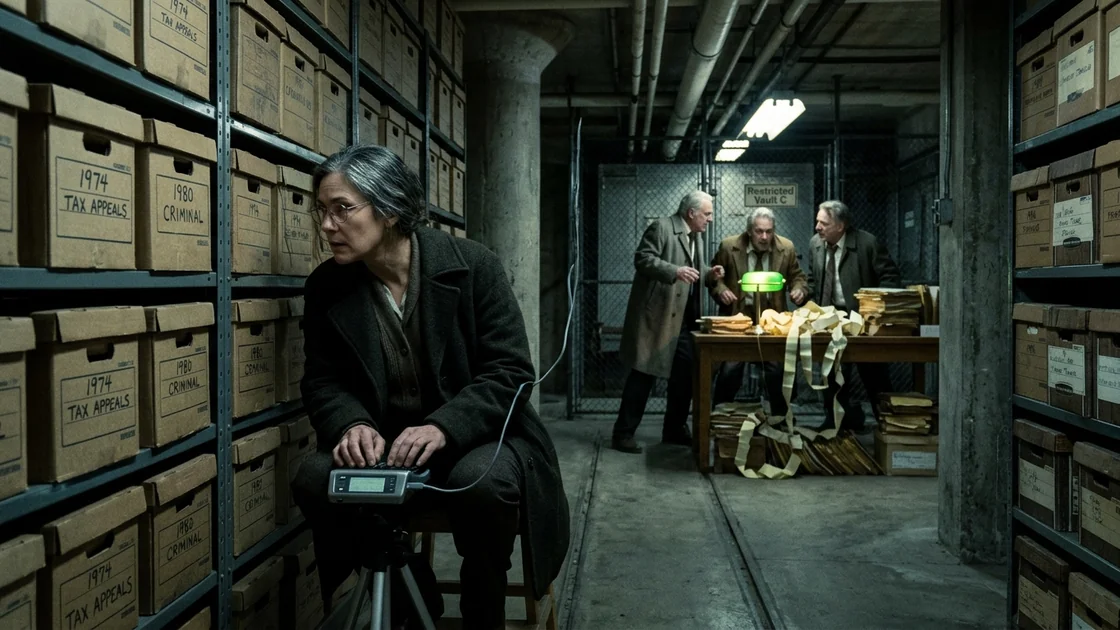
Inside Vault C stood a single wooden worktable with a green banker’s lamp. Clara placed Box 1989-GJ-884 right in the center of the table, under the pool of yellow light, with Evelyn Morse’s paper tapes spilled across the wood as if someone had left in the middle of cataloging them.
Then she stepped out of Vault C and walked into the narrow gap between Mobile Aisle 14 and Mobile Aisle 15, directly abutting the back wire wall of the vault.
She had prepared the space three days ago.
Behind twelve boxes of 1974 tax assessment appeals, she had cleared a hollow cavity just wide enough for a small wooden stool and her own steno machine—not the antique paper-tape machine from the museum display, but a sleek, silent, modern Luminex digital stenograph that she had signed out from the third-floor equipment pool last week under the name of a retired visiting reporter.
She hadn't connected the Luminex to the courthouse Wi-Fi; the concrete down here was four feet thick and blocked all wireless signals anyway. Instead, she had spent her lunch hours over the last three days running a thin, gray fifty-foot Cat-6 ethernet cable along the shadowed pipe-hangers in the ceiling, straight out of the Catacombs, up the vertical plumbing chase, and plugging it directly into an open auxiliary port on the main courthouse network switch in the B-1 telephone closet.
And on her desktop computer in the corner—whose screen she now switched off—she had opened a remote realtime broadcast session using CaseViewNet, the software the court used to stream live transcripts to deaf litigants and remote appellate panels.
She had set the recipient list for the live stream to every open judicial terminal in the state automated system, the night-desk printer at the Associated Press bureau downtown, and the internal dispatch screens of the State Police barracks on Route 9.
At 6:02 p.m., the heavy fire door at the top of the concrete ramp creaked open.
Clara turned off her flashlight, stepped into the narrow canyon between Aisle 14 and Aisle 15, and turned the interior safety lock on the floor track so the shelves couldn’t be rolled shut on her from the outside. She sat down on the wooden stool in the pitch dark, rested her bare fingers on the twenty-two cold plastic keys of the Luminex on its tripod between her knees, and listened.
Three sets of footsteps echoed down the concrete ramp.
The first was the shuffling, hesitant scrape of Harold Pendelton’s loafers. The second was the heavy, authoritative heel-strike of Roland Sterling’s wingtips. The third was the smooth, measured tread of Marcus Thorne.
"She left the outer gate unlocked," Thorne’s voice echoed off the low concrete ceiling. He sounded calm, almost clinical. "Sloppy. Or she got scared."
"I told you, Marcus, she didn't know what she had," Pendelton said, his voice tight and high. Through the gap between the tax boxes and the wire mesh of Vault C, Clara could see the glow of the green banker’s lamp catching the sweat on Pendelton’s forehead as the three men stepped into the cage. "She came up to my office at five to ask why the ninety-six flood log didn't match the box number. She’s an archivist, for Christ’s sake! All she cares about is whether the labels match the index! I told her it was an asbestos-contaminated box from the old annex and ordered her to leave it on the table and go home."
Sterling walked up to the wooden table and looked down at Box 1989-GJ-884. He picked up the top fold of Evelyn Morse’s paper tape, squinting at the purple ink through his bifocals.
"Did she translate this?" Sterling asked.
"She said she just got to the October fourteenth recess when she noticed the box number discrepancy," Pendelton lied, his eyes darting toward the dark stacks behind the wire mesh before snapping back to the table.
Thorne stepped beside Sterling. He was wearing a black cashmere overcoat, his hands encased in thin black leather driving gloves. He picked up the certified bound transcript, looked at page forty-two, and then looked at the paper tape in Sterling’s hand.
"Evelyn Morse," Thorne murmured. "I always hated that old crow. Never took her hands off the damn machine." He looked up at Pendelton and Sterling. "Wait a minute. If Clara only found this box at five o'clock today, who the hell pulled the 2011 Macau file on Roland and the 2018 DEA file on Hal yesterday?"
Silence fell over Vault C. The dehumidifiers hummed in the corners of the basement.
In the dark behind the wire wall, Clara’s fingers pressed down on the keys, silently, without a click—the neoprene pads underneath the levers absorbing every fraction of sound.
T H O R P B — MR. THORNE: Wait a
minute. If Clara only found this box at five o'clock today, who the hell
pulled the 2011 Macau file on Roland and the 2018 DEA file on Hal
yesterday?
Sterling lowered the paper tape slowly. He turned his head toward Thorne. "You tell me, Marcus. You’re the one who put the note in the 2011 box telling Hal to save the wire receipts."
"What note?" Thorne demanded.
"The handwritten memo on your letterhead!" Sterling barked, his voice rising as the paranoia Clara had planted flared back to life. "Don't play stupid with me! Hal showed me the scan this afternoon before we came down here!"
Clara hadn't given the handwritten memo to Sterling. She had left it in the box, knowing Pendelton would run down at lunchtime to check the file himself, find Thorne’s 2011 note, and show it to Sterling to prove Thorne was the one orchestrating the purge.
Thorne turned slowly to look at Pendelton. "You went into the 2011 box today, Hal?"
Pendelton backed up a step until his spine hit the steel shelving of Vault C. "Only after somebody put the 2018 DEA transcript on my desk! The one where Roland told Agent Miller to keep my son’s name in the federal file so he could blackmail me!"
"I did that to protect us!" Sterling roared, slamming his hand down on the wooden table. "Because you drink half a bottle of Glenlivet every afternoon and talk to the girls in traffic court! Somebody had to keep a leash on you after eighty-nine!"
In the darkness three feet away, Clara’s fingers danced across the keys like spiders on water.
S T E R L — JUDGE STERLING: I did
that to protect us! Because you drink half a bottle of Glenlivet every
afternoon and talk to the girls in traffic court! Somebody had to keep a
leash on you after eighty-nine!
"Wait," Thorne said, holding up one leather-gloved hand. His eyes had gone completely still, cold and reptilian under the green shade of the banker’s lamp. "Stop talking. Both of you. Think."
He looked around the vast, shadowy expanse of Sub-Basement Three.
"A handwritten memo from 2011," Thorne said softly. "A raw steno sidebar from 2018 that wasn’t in the typed transcript. And now a raw steno sidebar from 1989 that wasn’t in the typed transcript. What is the single common denominator between all three?"
Sterling frowned. "They were all in Vault C."
"No," Thorne whispered. "You can't read raw steno tape unless you’re a court reporter. Hal can barely read the header codes. I can't read it. You can't read it. Who is the only person in this building who has spent the last thirteen years sitting down here reading raw paper tape from every sealed case in the county?"
Pendelton’s face twitched. "Clara? No, Marcus, Clara’s a mouse! You got her the job! Roland’s been sending her turkeys at Thanksgiving since the Bush administration! She doesn't have the stomach for—"
"It’s Arthur Vance’s daughter, you idiot!" Thorne snarled, grabbing Pendelton by the lapels of his suit jacket and shoving him hard against the steel uprights. A box of old deeds rattled overhead. "She didn't find this box at five o'clock today! She found it days ago! She read Evelyn Morse’s tape, she saw what we did to her father at the Miller Foundry, and she’s been pulling files out of this vault all week to get us to tear each other's throats out!"
T H O R P B — MR. THORNE: She read
Evelyn Morse’s tape, she saw what we did to her father at the Miller
Foundry, and she’s been pulling files out of this vault all week to get
us to tear each other's throats out!
"Jesus Christ," Sterling breathed, the blood draining from his face as he looked down at the 1989 tape on the table. "The core samples. Does the tape have the part about the core samples in the trunk of his Dodge?"
"Read it!" Thorne snapped at Pendelton, shoving him toward the table. "You know Evelyn’s vowel chords. Is it all on there?"
Pendelton fumbled with his glasses, his hands shaking so badly he tore the edge of the paper strip as he held it under the lamp. His lips moved silently as he traced the faded purple letters.
"It’s... it’s all here," Pendelton whispered, his voice cracking. "You telling Bill Pendelton that Arthur wouldn't take a buyout on the Ironwood soil tests. Marcus saying he had a guy in the Fourth Precinct property room to pull an untraceable .38 revolver for the Sunday night check at the foundry. Dumping his Dodge in the flats. Even... even your father telling you to hire Clara afterward so the family wouldn't ask questions."
P E P B D — MR. PENDELTON: It’s all
here. You telling Bill Pendelton that Arthur wouldn't take a buyout on
the Ironwood soil tests. Marcus saying he had a guy in the Fourth
Precinct property room to pull an untraceable .38 revolver for the
Sunday night check at the foundry.
Clara’s left wrist burned like a hot wire was threaded through the carpal tunnel, her tendons screaming against the rapid, silent strokes, her eyes fixed on the faint green glow of the Luminex’s tiny LCD screen shielded by her coat sleeve. Every word was translating cleanly. 99.8 percent accuracy. Streaming out through the gray cable in the ceiling, up the plumbing chase, and out into the snowy night.
"Why would she tell Hal about the box today if she was the one leaking the files?" Sterling asked, his voice dropping into a ragged panic. "Why wouldn't she just take the 1989 tape to the feds?"
"Because the 1989 tape is uncertified garbage from a dead woman," Thorne said, his prosecutor’s brain finally catching up to the trap—just thirty seconds too late. His head snapped up toward the ceiling, his eyes scanning the pipes and the dark rows of rolling shelves outside the wire cage. "And because she wanted all three of us in the same room talking about it."
"Hal," Sterling whispered, reaching inside his coat. "Why did you bring us down here?"
Wait. Clara looked through the gap in the boxes.
Roland Sterling hadn't reached inside his coat for a pen. As Chief Judge, he held a lifetime concealed-carry permit issued after a sovereign-citizen threat in the nineties. In his right hand was a snub-nosed .380 automatic, the matte-black barrel glinting dull under the green lamp.
"Roland, put that away!" Pendelton shrieked, throwing his hands up in front of his face. "She told me she was going to leak the 2018 DEA file to the papers tomorrow unless I got you down here! Wait—she said she wasn't going home! She said she’d be down here!"
Thorne lunged across the table, knocking the banker’s lamp onto the concrete floor.
The glass bulb shattered in a bright blue flash, plunging Vault C into the dim, twilight gray of the emergency exit signs fifty feet away.
"Shut the outer gate!" Thorne roared at Sterling. "Check the aisles! She’s in the stacks!"
Clara didn't stop typing. Even as her heart hammered against her ribs, her fingers struck the final procedural chord she had memorized on her first day of court reporting school in 1989:
Whereupon, at 6:09 p.m., the proceedings were concluded, and I, Clara E. Vance, CSR License #084-002191, do hereby certify the foregoing to be a true, accurate, and verbatim transcript of the statements made in my presence.
She hit ENTER, detaching the gray ethernet cable from
the back of the Luminex and yanking the wire upward so it caught on the
overhead steam pipe out of reach. Then she folded the tripod against her
chest, slipped silently off the stool, and backed out the far side of
Aisle 14 into the main service corridor at the rear of the stacks.
"Aisle six is empty!" Sterling’s voice echoed from the front walkway, followed by the heavy metallic clang of him kicking a steel end-panel. "Aisle seven, empty!"
They were moving systematically from the front of the room toward the back. And between Clara and the exit ramp stood Marcus Thorne, guarding the main walkway with a heavy steel crowbar he had pulled from the crate-opening station by her desk.
Clara looked at the three-spoked cast-iron hand cranks lining the back wall of the mobile shelving system.
She had spent thirteen years turning these cranks. She knew the gearing ratio of every single track. She knew that Aisle 12 had a slightly bent floor rail that made it bind halfway through, and she knew that Aisles 15 through 22 had been newly greased by building maintenance two weeks ago.
Twelve tons of paper and steel per row. All resting on frictionless ball-bearing tracks.
"Check the back wall behind Vault C!" Thorne shouted from the front walkway. "Hal, get down the side aisle and flush her out!"
"I'm not going in there in the dark, Marcus!" Pendelton sobbed from somewhere near the entrance gate. "My heart—I can't—"
"Move, you pathetic bastard, or I’ll put you in the box next to her!" Sterling snarled. Footsteps—heavy, wingtipped footsteps—turned the corner into the gap between Aisle 18 and Aisle 19, twenty feet to Clara’s right.
Sterling had stepped between the mobile stacks, sweeping the beam of his phone’s flashlight across the rows of gray cardboard boxes. Behind him, Thorne stepped into the same gap to cover his back, the steel crowbar raised at shoulder height.
They were both standing in the three-foot canyon between Aisle 18 and Aisle 19.
Neither of them had engaged the red floor-lock lever at the front end of the track. Only someone who worked down here every day remembered to kick the red lever down before walking between forty thousand pounds of movable steel.
Clara stepped out of the shadows at the rear end of Aisle 20.
She didn't say a word. She didn't deliver a speech for her father. The record had already been made.
She grabbed the cast-iron three-spoked wheel on the back of Aisle 19 with her right hand, braced her left forearm—bad wrist and all—against the top spoke, planted both feet against the concrete wall, and threw her entire body weight downward.
The gears engaged with a low, rumbling groan.
Aisle 20 and Aisle 19 were linked by a master tension chain when the safety pin was pulled. Slowly at first, then with gathering, irresistible momentum as forty tons of iron and paper overcame inertia, both towering walls of shelving began to roll toward Aisle 18.
Inside the canyon, Sterling spun around as the wall of boxes beside his shoulder began to glide toward him.
"Marcus!" Sterling yelled, throwing his hands up against the steel uprights of Aisle 19, trying to push back against twelve tons of moving history. His wingtips skidded uselessly on the polished concrete floor. "The track! She’s rolling the track!"
Thorne turned and lunged back toward the front walkway, trying to beat the closing gap. He was six feet from the end of the row when the front edge of the shelving caught the tail of his cashmere coat, dragging him backward as the space narrowed from three feet to eighteen inches.
In desperation, Thorne jammed the thick steel crowbar horizontally between the heavy steel upright of Aisle 18 and the advancing frame of Aisle 19, right at chest level, throwing himself backward onto the floor between the lower shelves as the two walls slammed against the iron bar.
CLANG.
The sound was deafening, ringing through the concrete vault like a church bell struck by a sledgehammer. Sparks showered down into the darkness as the steel crowbar bowed four inches under the massive kinetic weight of the two rolling aisles, screaming against the metal frames before holding fast—leaving an eleven-inch gap between the two rows of shelves.
Neither man was crushed, because Clara hadn't needed to crush them.
She walked calmly around to the front walkway, picked up a second heavy iron pry-bar from the shipping table, and slid it straight through the spokes of the exterior hand-crank on Aisle 20, wedging it against the concrete support pillar.
Inside the eleven-inch gap between Aisle 18 and Aisle 19, pinned flat between two walls of 1980s criminal archives with the bent crowbar wedged tightly across their chests, Chief Judge Roland Sterling and District Attorney Marcus Thorne couldn't move their arms two inches in either direction. Sterling’s .380 automatic lay on the concrete floor six feet outside the gap, where he had dropped it trying to brace the shelf.
"Clara!" Thorne’s voice echoed from the narrow slot between the boxes, ragged and breathless in the dark. "Clara, listen to me! Unlock the crank! We can fix this—whatever you want, we can sign an order right now!"
"Let us out of here, you crazy bitch!" Sterling wheezed, his face pressed sideways against a box of 1984 traffic citations. "I’ll have you in a cage at Stateville for the rest of your life!"
Clara didn't answer them. She walked past the end of the jammed aisle without looking into the gap.
By the open gate of Vault C, Harold Pendelton sat on the concrete floor with his back against the wire mesh, his legs stretched out in front of him, weeping quietly into his hands.
Clara stopped beside him. She set the Luminex steno machine down on her steel desk, pulled the small SD memory card out of the side slot, and dropped it into her coat pocket—the physical backup to the live stream that was already burning up the printers in the state capital.
Far above them, through the thick concrete ceiling and the ventilation shafts, the faint, rhythmic wail of multiple sirens began to cut through the howl of the winter storm, growing louder as cruisers from the State Police and the federal courthouse marshals’ detail turned onto the plaza outside.
"Did you..." Pendelton looked up through red-rimmed eyes, his face gray in the glow of the exit sign. "Did you take Greg’s file out of the 2018 box like you promised?"
Clara looked down at him. She thought of a rainy Sunday night behind the Miller Foundry thirty-five years ago. She thought of a fifty-four-year-old man bleeding to death in the mud for doing his job, while three men in warm suits divided up a city on his grave.
"A stenographer doesn't alter the record, Harold," Clara said softly. "You know the rules. Everything that gets spoken in the room goes on the page."
She walked up the concrete ramp, pushed open the heavy fire door, and went upstairs to meet the marshals in the lobby, leaving the three men in the dark with forty years of their own words pressing in from both sides.