The Panopticon Broadcast
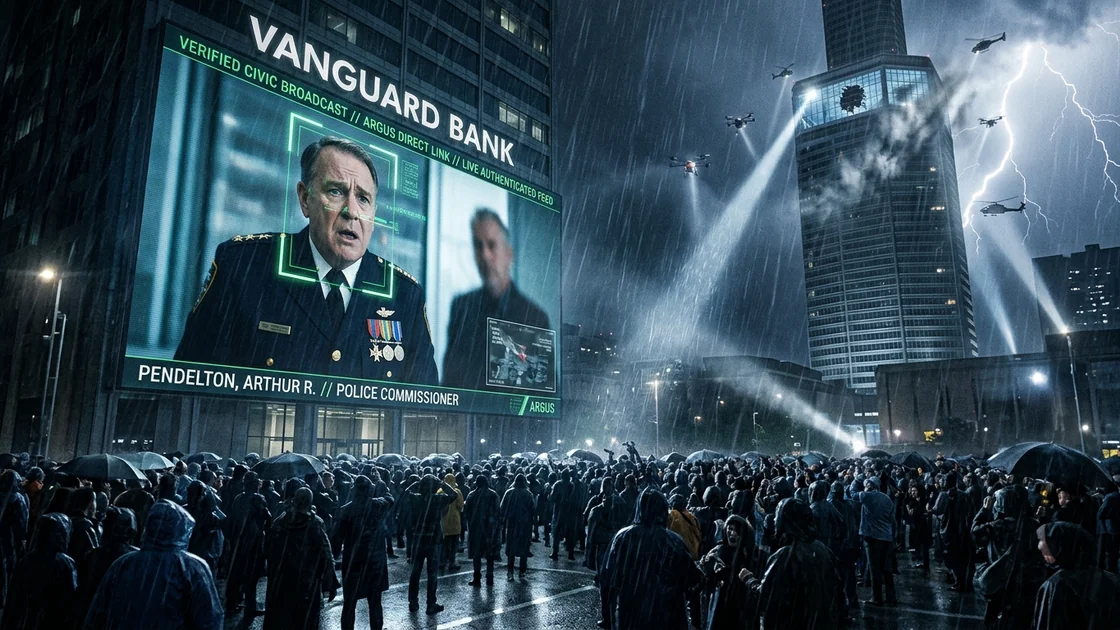
Elias Vance spends his nights in a subterranean bunker piloting high-altitude surveillance drones above the rain-slicked metropolis of New Valen, acting as an invisible eye for a corrupt law enforcement apparatus. Haunted by the unsolved murder of his younger brother during a mysterious blackout of the municipal camera network, Elias discovers a hidden subroutine within Argus, the citys omniscient facial recognition grid. The code automatically creates localized blind spots whenever Police Commissioner Arthur Pendelton meets with high-ranking syndicate bosses to collect massive bribes in exchange for trafficking routes. Realizing that traditional evidence will be dismissed as fabricated media by the commissioners controlled courts, Elias spends months modifying an unlogged reconnaissance drone and rewriting the facial recognition software. Instead of erasing the commissioners presence, the altered algorithm links the live biometric feed directly to the citys commercial advertising network. On the night of a major civic gala, amidst a violent electrical storm, Elias flies his rogue drone to a secluded skyscraper conservatory, locks onto Pendeltons face, and broadcasts the commissioners treasonous transaction in real time across every towering holographic billboard in the heart of the city, sparking a desperate battle for survival both in the stormy skies and within the locked-down operations center.
The city of New Valen did not sleep; it merely shifted its weight from one bruised knee to the other under an eternal blanket of chemical drizzle. Four hundred feet below the glistening asphalt of the Civic Center, in a subterranean vault known colloquially among the operators as the Pit, Elias Vance sat strapped into Rig 14. His fingers, encased in ultra-thin haptic mesh gloves, twitched in micro-movements that translated across miles of fiber-optic cable and encrypted microwave uplinks into the control surfaces of a Magistracy-class quad-rotor drone hovering three thousand feet above the Docks.
Inside the Pit, the air tasted permanently of ozone, recycled sweat, and the bitter metallic tang of cooling fluid leaking from the primary server stacks. Seventy-two operators sat in tiered concentric rings, their faces illuminated in ghostly shades of cyan and amber by wrap-around retinal projection visors. Together, they formed the living nervous system of Argus, the most comprehensive urban surveillance architecture ever devised by municipal decree.
Elias tilted his right wrist three degrees to the left. High above the industrial sprawl of Sector 9, Drone 409-Delta banked silently against a thirty-knot crosswind. Its twin counter-rotating propulsion turbines were baffled with acoustic-dampening metamaterials, rendering it little more than a dark, predatory gull against the bruised violet underbelly of the storm clouds.
Through his visor, Elias did not see darkness. He saw the world rendered in false-color thermal gradients and overlaid with the relentless, chattering telemetry of the Argus facial recognition engine. Every pedestrian scurrying beneath a cheap plastic umbrella down on Mercer Street was enclosed in a floating green bounding box. Adjacent to each box, strings of alphanumeric data cascaded like digital rain: full legal name, citizen registry number, credit-compliance score, outstanding warrants, and an algorithmic calculation of behavioral deviance probability.
SUBJECT: HARLAN, TOMAS J. // REG: 884-09-112 // THREAT INDEX: 0.04% // STATUS: COMPLIANT.
SUBJECT: CHEN, MARA L. // REG: 412-88-904 // THREAT INDEX: 0.12% // STATUS: COMPLIANT.
The system processed four million faces a minute across twelve thousand fixed street cameras and two hundred airborne platforms. It never blinked. It never forgot. Except when it was explicitly told to do both.
"Rig 14, you're drifting two hundred meters east of your assigned patrol box," a dry, static-laced voice crackled in Elias’s left ear. It was Corinne Mercer, the Night Shift Watch Commander. She stood on the elevated glass catwalk at the center of the Pit, a tall woman with iron-gray hair pulled into a severe knot, nursing a mug of lukewarm chicory coffee while monitoring the master tactical board.
Elias keyed his throat mic with two taps of his left ring finger. "Correcting now, Watch Commander. Catching heavy wind shear off the harbor cranes. Compensating with manual trim."
"Keep it inside the fence, Vance," Mercer replied, her tone carrying more exhaustion than malice. "The automated handoff to Sector 10 is already lagging because of the cloud cover. We don't need air-traffic collisions with the commercial delivery corridors tonight."
"Copy that. Returning to grid coordinates."
Elias eased the virtual throttle back, bringing 409-Delta into a wide, banking turn back toward the dilapidated tenement blocks of Sector 9. Yet before the drone’s gimbal-mounted optical array swung away from the waterfront, his eyes locked onto a patch of dark water near Pier 44.
On the physical dock below, a convoy of three unmarked black armored transports had just rolled to a halt beside a rusted container barge. Under normal operational parameters, the presence of unscheduled armored vehicles in a decommissioned port zone at 02:14 hours would have triggered an immediate Amber-level alert. The bounding boxes should have flared crimson. Argus should have zoomed in at eighty-power optical magnification, running gait-analysis and thermal facial bone-structure mapping on the six men stepping out of the vehicles.
Instead, the visor display over Pier 44 dissolved into a shimmering, gray polygon of static.
NOTICE: SECTOR 9-SUB-G // AUTOMATIC CALIBRATION CYCLE IN PROGRESS.
ESTIMATED DOWNTIME: 18 MINUTES.
AUTHORIZATION: SYS-ADMIN-00-OMEGA.
Elias’s jaw tightened until his molars ached. He kept his breathing slow and rhythmic, conscious of the biometric sensors woven into his flight suit that monitored operator stress levels. If his heart rate spiked above one hundred and ten beats per minute without a corresponding combat alert on his screen, the medical subroutines would flag him for mandatory psychological evaluation.
He stared at the gray polygon. Eighteen minutes. Long enough to offload four tons of unregistered eastern-bloc military hardware or synthetic narcotics. Long enough to transfer a prisoner. Long enough to put two bullets into the back of a twenty-four-year-old transit patrolman’s head and dump his body into the oily tide of the Valen River.
That had been fourteen months ago. Sector 4. Sub-grid C. An
eighteen-minute "automatic calibration cycle" authorized by
SYS-ADMIN-00-OMEGA. When the cameras came back online,
Elias’s younger brother, Danny, was lying face down in an alley behind a
gutted dry-cleaning plant, his service weapon missing and his body-cam
conveniently fried by an high-output electromagnetic pulse. The official
Internal Affairs report called it a botched narcotics interdiction
conducted without backup. Commissioner Arthur Pendelton himself had
stood at the podium during the funeral, pinning the Silver Star of Valen
onto Danny’s mahogany casket while cameras flashed and the city wept for
its fallen guardian.
Elias had stood in the front row, watching Pendelton’s smooth, patrician face, noticing how the Commissioner’s eyes never quite focused on the grieving family, drifting instead toward the teleprompters and the press risers.
Back then, Elias had been a senior systems architect in the Forensic Data Recovery division. When he had tried to pull the deep-server cache logs for Sector 4 on the night of Danny’s murder, his security clearance had been revoked within forty-five minutes. He hadn't been fired—firing a grieving brother with elite programming skills was dangerous. Instead, he had been laterally transferred down to the Pit, stripped of code-level access, and strapped into a flight chair to fly mindless figure-eights in the rain for minimum municipal scale.
They thought the Pit was a cage. They didn't realize they had handed him the keys to the sky.
"Shift change in twenty," Mercer announced over the general channel. "Day relief is clearing security decontamination now. Log your flight hours, purge your local caches, and bring your birds to the autonomous loiter altitude."
Elias executed the commands with practiced muscle memory. He brought 409-Delta up to four thousand feet, locked it into the automated GPS racetrack, and disengaged the neural-haptic link. As the visor powered down and lifted away from his face with a pneumatic hiss, the harsh fluorescent glare of the subterranean bunker made him squint.
He peeled off his haptic gloves, flexing his stiff, pale fingers. Before logging out of his terminal, his right hand drifted over the physical maintenance port tucked beneath the console’s rubberized wrist rest. Concealed inside the hollowed-out casing of an approved ergonomic stylus was a modified solid-state micro-drive with sixty-four terabytes of non-volatile molecular storage.
With a practiced flick of his thumb, Elias retrieved the stylus from the hidden port, slipped it into the breast pocket of his gray technician’s coveralls, and stood up.
The elevator ride from the Pit to the street level of the Hall of Justice took ninety seconds, ascending through layers of reinforced ferro-concrete built during the resource riots of the late thirties. When Elias stepped out of the员工 exit onto Seventh Avenue, the cold rain hit his face like a handful of thrown gravel.
He turned up the collar of his synthetic wool coat and walked north toward the Neon Mile, the commercial artery of New Valen. Even at three in the morning, the canyon between the eighty-story corporate monoliths blazed with artificial noon.
Every vertical surface for thirty blocks was sheathed in high-density photon-mesh and holographic emitters. Towering three hundred feet above the wet pavement, a translucent projection of a woman with porcelain skin and glowing sapphire eyes poured a glass of synthetic bourbon into a tumbling crystal tumbler that seemed to splash just feet above the roofs of passing mag-cabs. Across the avenue, a monolithic LED screen spanning the entire facade of the Vanguard Bank building cycled through public service announcements.
Elias stopped at the curb, waiting for a phalanx of automated street-sweepers to grind past. He looked up at the Vanguard screen.
The bourbon ad vanished, replaced by the stern, paternal visage of Police Commissioner Arthur Pendelton. Sixty feet tall, rendered in razor-sharp sixteen-K resolution, Pendelton looked down upon the sparse night crowd with an expression of steel-jawed benevolence. His silver hair was immaculate; the gold oak leaves on the collar of his dress uniform gleamed.
"Security is not the absence of danger," Pendelton’s recorded voice boomed from directional electrostatic speakers mounted on the light poles, vibrating inside the chests of everyone within three blocks. "Security is the presence of vigilance. Through the Argus Initiative, violent crime in New Valen has fallen by forty-two percent in thirty-six months. Together, we watch. Together, we prosper."
At the bottom corner of the massive screen, a small emerald emblem
pulsed: VERIFIED CIVIC BROADCAST // ARGUS DIRECT LINK.
Elias watched the emerald emblem. That little icon was the linchpin of the entire municipal propaganda machine. In an era where neural networks could fabricate flawless video and audio of any human being in seconds, the populace had grown cynical of leaked tapes and whistle-blower uploads. When an independent journalist had released audio of a city councilman taking a bribe two years ago, the councilman’s legal team had simply declared it a synthetic deepfake, produced three paid algorithmic experts to testify that the audio waveforms showed generative artifacts, and had the journalist imprisoned for "digital sedition and public destabilization."
As a result, the only media the citizens—and the federal oversight courts—implicitly trusted was content bearing the hardware-encrypted cryptographic signature of the Argus Direct Link. Every sensor on every municipal camera and drone contained a physical quantum-key chip forged into its silicon at the factory. As video was captured, the chip signed every single frame with an unforgeable cryptographic hash, verifying that the footage was live, unaltered, and streaming directly from an authenticated municipal optical array.
And to prove the system’s incorruptibility, Pendelton had integrated the emergency civic broadcast system directly into the commercial billboard grid. During a crisis, a terrorist alert, or a high-profile manhunt, Argus could override every screen in the city, projecting live, cryptographically signed drone feeds straight to the public.
"Together, we watch," Elias murmured under his breath, his breath pluming white in the neon-tinted rain.
He stepped off the curb and headed toward the subway stairs, his hand resting against the stylus in his pocket.
Elias lived in a sixth-floor walk-up in Ironworks, an older neighborhood wedged between the atmospheric processing plants and the elevated mag-rail tracks. The building was sixty years old, constructed of real brick that bled white mineral salts through the plaster whenever it rained—which was always. Every twelve minutes, the inbound freight train from the orbital tether port roared past his window, rattling the teacup on his counter and throwing rhythmic strobes of yellow light across the floorboards.
He liked the noise. The low-frequency vibration of the mag-rail scrambled laser-listening devices, and the thick, lead-painted masonry of the old walls acted as a natural Faraday cage once he had lined the wallpaper with copper mesh scavenged from decommissioned radar units.
Inside his apartment, there was no furniture save for a narrow cot, a camp stove, and three workbench tables bowed under the weight of diagnostic oscilloscopes, decrypted flight controllers, and an air-gapped mainframe he had built from salvaged military blade servers.
Elias locked the triple-bolted steel door, shed his wet coat, and sat down at the primary terminal. He inserted the stylus into a custom optical reader.
Lines of raw hex code and telemetry logs poured across his three
monitors. For nine months, every time an SYS-ADMIN-00-OMEGA
calibration blackout had occurred during his shift, Elias had not looked
at the gray polygon. Instead, he had used a backdoor diagnostic tool he
had written back when he was in Forensic Recovery to scrape the metadata
from the adjacent sectors five minutes before and five minutes
after the blackout.
You couldn't hide a hole in the water without displacing the current around it.
On his center screen, a three-dimensional wireframe map of New Valen rotated slowly. It was dotted with two hundred and fourteen glowing red pins—every Omega-level blackout recorded over the past year.
Elias typed a command sequence, filtering the surrounding camera logs for recurring biometric signatures that crossed the perimeter of those blackout zones within a thirty-minute window. Because the perpetrators were smart enough to wear infrared-reflective prosthetics or stay inside tinted vehicles until they were beneath the blind spot, facial recognition alone hadn't been enough at first.
So Elias had gone deeper. He had programmed his home server to analyze the secondary telemetry that Argus collected but rarely indexed: millimeter-wave radar returns of vehicle suspension compression (which revealed the exact weight of the occupants and armor plating), acoustic signatures of custom-tuned turbine engines, and gait-cadence metrics of individuals walking with concealed ballistic vests.
"Show me the ghosts," Elias whispered, hitting the execute key.
The server fans spun up with a high-pitched whine, pumping hot air against his shins. On the map, thin yellow vectors began to spiderweb out from the red pins, tracing the paths of vehicles and pedestrians backward through the city grid.
One vector appeared in eighty-seven percent of the incidents. It belonged to a custom-built, long-wheelbase Phaeton sedan registered to a shell corporation owned by the Municipal Police Benevolent Trust. Its suspension compression profile matched the exact weight of three individuals: a driver, a heavy-set bodyguard in the front passenger seat, and a man of precisely eighty-two kilograms sitting in the rear right passenger seat.
The second recurring vector converged from the opposite side of the city—usually originating from the private helipads or fortified compounds of the Kestrel Syndicate, the cartel that controlled seventy percent of the illicit pharmaceutical and weapons trade flowing through the Eastern Seaboard. Specifically, the vector belonged to Kaelen Voss, a former corporate logistics executive who had unified the street gangs into a ruthless, spreadsheet-driven enterprise.
Whenever Voss’s transport and the Phaeton sedan approached within
four hundred meters of each other, the SYS-ADMIN-00-OMEGA
protocol triggered automatically.
Elias pulled up the core source code of the Argus facial recognition
kernel—a file he had spent four months reconstructing line by line from
fragmented memory dumps left on the Pit’s local consoles during routine
software updates. He scrolled down to line 44,902, buried deep within
the Exception_Handling_VIP module.
There it was. A hard-coded biometric hash.
In the Argus system, a face was not a photograph; it was a seventy-two-point geometric constellation measuring the exact millimeter ratios between the inner canthus of the eyes, the bridge of the nose, the zygomatic arches, and the jawline. Most citizens had their hashes stored in the general database. Law enforcement officers had theirs flagged with a blue friendly-fire tag.
But this specific hash—HASH_ID: 000-00-001—carried a
unique instruction set.
IF (DETECT_HASH == 000-00-001) AND (PROXIMITY_FLAG == THREAT_TIER_1)
THEN EXECUTE: SUB_ROUTINE_OMEGA_BLIND(RADIUS=250M, DURATION=1080S)
PURGE_LOCAL_BUFFER(IMMEDIATE)
It was brilliant in its sociopathic simplicity. Commissioner Pendelton didn't even have to call down to the Pit or trust a corrupt operator to turn off the cameras when he met with Kaelen Voss or his lieutenants. He had had the chief systems architect write a proximity trigger directly into the city's core artificial intelligence. Whenever Argus saw Pendelton’s face—or the transponders of his personal security detail—come within two hundred and fifty meters of a Tier-1 Syndicate boss, the system automatically blinded itself, threw up a maintenance calibration graphic for the human operators in the Pit, and scrubbed the preceding sixty seconds of buffer memory.
Pendelton was literally invisible to his own panopticon whenever he was committing a crime. And in exchange for seven-figure transfers into offshore bearer bonds, Pendelton used the exact same system to grant Voss’s convoys temporary Omega tags, allowing them to move contrabands and hit squads through the city untouched—until someone like Danny Vance happened to walk his beat into an alley that was supposed to be empty during an eighteen-minute blackout.
Elias leaned back in his chair, the metal frame groaning. He stared at the third workbench in the corner of the room.
Resting on a bed of anti-static foam was the matte-black chassis of a decommissioned Viper-3 tactical micro-drone. It was half the size of the standard Magistracy patrol units, originally designed for indoor hostage reconnaissance before the program was scrapped due to budget overruns. Over the past six months, Elias had smuggled its components out of the Sub-Basement salvage bins piece by piece—a carbon-fiber rotor arm taped to his calf, a burnt-out optical gimbal tucked inside an empty thermos.
With the help of Devon Sato, a half-blind, anti-social hardware quartermaster down in Sub-Level 6 who traded discontinued parts for rare pre-war bourbon and asked zero questions, Elias had rebuilt the Viper-3 into something entirely unholy.
He walked over to the workbench and switched on the magnifying lamp.
The drone’s standard battery had been replaced with a high-density lithium-sulfur fuel cell capable of forty-five minutes of high-output flight in gale-force winds. Beneath its belly, where the non-lethal stun-dart assembly used to sit, Elias had mounted two pieces of specialized hardware.
The first was an industrial-grade laser vibrometer—an optical microphone capable of bouncing an invisible infrared beam off a pane of triple-glazed ballistic glass from three hundred meters away and translating the microscopic vibrations caused by human voices inside the room into crystal-clear digital audio.
The second piece of hardware was the masterpiece: the heart of a destroyed Magistracy drone's optical unit, containing an intact, factory-sealed Argus quantum-key encryption chip, wired directly into a directional millimeter-wave transmitter.
If Elias took this data to the Federal Prosecutor, Pendelton’s pet judges would throw it out as inadmissible, illegally obtained code manipulation. If he uploaded it to the dark net, the city’s automated firewalls would throttle the bandwidth and label it a foreign disinformation attack before ten thousand people saw it.
No. To destroy a god, you had to make him bleed on his own altar.
He had to catch Pendelton and Voss together, in the flesh, and use
the quantum-key chip on the Viper-3 to inject the live feed back into
the Argus network—not to the terminals in the Pit where Mercer or the
system admins could pull the plug, but straight through the
VERIFIED CIVIC BROADCAST pipeline to every commercial
billboard on the Neon Mile.
He needed a meeting place that was above the street-level clutter, with a clear line of sight to a primary municipal relay tower. And according to the decrypted communications intercepts Elias had pulled from the Kestrel Syndicate’s logistics movements over the last forty-eight hours, he wasn't going to have to wait much longer.
Tomorrow night was the Annual Mayoral Security Gala at the Zenith Tower.
The Zenith Tower rose one hundred and ten stories above Centennial Plaza, its pinnacle sheathed in smart-glass that shifted from reflective chrome by day to a towering beacon of cascading golden light by night. On the ninety-eighth floor sat the Sky Conservatory, a three-story glass atrium filled with genetically modified orchids and imported miniature redwoods, reserved for the absolute pinnacle of New Valen’s political and financial elite.
At 19:00 hours the following evening, Elias sat at Rig 14 in the Pit. The bunker was unusually tense. Because of the Gala, half of the city’s council members, federal circuit judges, and corporate board directors were gathered within a single four-block radius.
Watch Commander Mercer was pacing the central catwalk faster than usual, flanked by two stone-faced agents from the Mayor’s Protective Detail and a slender, sharp-featured man in a bespoke charcoal suit from Internal Affairs named Deputy Inspector Cross.
"All Sector 1 through 4 operators, listen up," Mercer’s voice cut across the command net. "We have a severe low-pressure trough rolling in off the Atlantic. Expect gusts up to forty-five knots at altitude and heavy electrical activity by 21:00. Because of the VIP density at the Zenith Tower, Argus is running at Priority One sensitivity. Any unauthorized aerial vehicles—commercial delivery drones, press choppers, hobbyist rigs—entering the two-mile exclusion zone around Centennial Plaza will be immediately engaged by automated kinetic interceptors. Keep your patrol lanes tight."
Elias adjusted the fit of his retinal visor, his heart beating a steady, practiced seventy-two beats per minute despite the cold sweat pooling between his shoulder blades.
"Rig 14, status check," Mercer called out, her eyes scanning his sector on the master board.
"Rig 14 online and locked into Sector 2 outer perimeter," Elias replied smoothly. "Drone 204-Alpha is holding at thirty-two hundred feet, four blocks south of the exclusion zone. Optical and thermal arrays nominal."
What Mercer couldn't see on her master board was what Elias had done forty minutes earlier before reporting for his shift.
Clad in a rain-drenched municipal maintenance poncho and wearing a prosthetically altered silicone mask that fooled the street-level cameras into logging him as a sixty-year-old HVAC technician, Elias had climbed the exterior service stairwell of the old Bellwether Telecom building—a derelict brutalist structure sitting six hundred yards across the plaza from the Zenith Tower, right on the edge of the exclusion zone.
Tucked inside a fiberglass ventilation cowling on the Bellwether’s roof, shielded from radar by the building's massive, rusting microwave horns, the modified Viper-3 sat in low-power standby mode. Its receiver was tuned not to a standard remote controller, which would have been instantly triangulated by the police spectrum analyzers, but to a piggybacked data channel riding inside the telemetry link of Elias’s official patrol drone, 204-Alpha.
Elias was going to fly two drones simultaneously from the same chair—using his official bird as a flying relay antenna to control a ghost drone right under the noses of his supervisors.
He glanced at the system clock in the corner of his visor:
20:42:19.
Through the high-powered telephoto lens of 204-Alpha, Elias watched the base of the Zenith Tower. Rain lashed the red carpet beneath the heated glass canopy of the main entrance. Limousines and armored town cars glided up in an endless procession, discharging men in velvet tuxedos and women wrapped in luminescent bio-furs.
Argus was working overtime, drawing blue VIP bounding boxes around every celebrity, judge, and politician stepping onto the pavement.
At 20:51:04, a familiar long-wheelbase Phaeton pulled up
to the VIP barricade.
The rear door opened, and Commissioner Arthur Pendelton stepped out into the strobe-light flash of the press pool. He looked magnificent, wearing his full ceremonial midnight-blue dress uniform, a chest full of ribbons catching the glare. He paused on the steps, turning to wave to the soaked crowd penned behind steel police barricades across the street.
Up on the seventy-story holographic billboards surrounding Centennial Plaza, the live press feed showed Pendelton smiling, shaking hands with the Mayor, his booming voice echoing across the square as he promised another decade of unbroken peace and order.
Elias didn't watch the front entrance. He shifted a sub-window on his visor to monitor the freight and service access tunnels beneath the Zenith Tower.
At 21:14:30, a white municipal sanitation van—plated
with legitimate city transponders—rolled down the ramp into the Zenith’s
sub-basement loading dock. Elias ran his custom suspension-weight
algorithm against the millimeter-wave radar return from the street
intersection just prior to the ramp.
The van wasn't carrying trash bags. It was carrying four tons of B7-level armor plating and four men whose gait signatures matched Kaelen Voss’s personal Praetorian guard.
Elias’s fingers danced across his haptic gloves, executing a silent macro he had hidden inside his console’s accessibility settings. On his visor, a small, opaque command prompt opened in the dead center of his field of view, invisible to the supervisory mirror-screens behind him, which only duplicated the primary video feed, not local accessibility overlays.
LINKING TO RELAY: VIPER-3_GHOST...
HANDSHAKE ESTABLISHED. BATTERY: 99%. LASER MIC: ARMED.
CRYPTO-CHIP: AUTHENTICATED (ID: MAG-882-K).
Up on the ninetieth through ninety-eighth floors of the Zenith Tower, the golden smart-glass was glowing warmly against the black, rain-lashed sky. Inside the three-story Sky Conservatory on the ninety-eighth floor, the main gala was occurring on the lower terrace. Waiters circulated with champagne while a string quartet played beneath synthetic waterfalls.
Wait. Watch the thermal bleed.
At 21:38:12, the Argus status log in the corner of
Elias’s screen flickered.
NOTICE: ZENITH_INTERNAL_SEC_98_UPPER // AUTOMATIC CALIBRATION CYCLE IN PROGRESS.
ESTIMATED DOWNTIME: 20 MINUTES.
AUTHORIZATION: SYS-ADMIN-00-OMEGA.
The internal security cameras on the private upper mezzanine of the Sky Conservatory—a glass-walled botanical overlook accessible only by a private key-card elevator—had just gone blind.
Pendelton and Voss were in the room.
Elias took a single, deep breath of the stale bunker air. He partitioned his neural-haptic interface. With his left hand, he locked his official drone, 204-Alpha, into a tight, slow-moving orbital loiter pattern at the edge of the exclusion zone, keeping its directional dish pointed squarely at the roof of the Bellwether Telecom building.
With his right hand, he engaged the rotors of the Viper-3.
Six hundred yards above the glistening pavement of Centennial Plaza, inside the rusted ventilation cowling of the Bellwether building, four carbon-fiber blades blurred into invisibility. The Viper-3 lifted five inches off the steel floor, hovered for a heartbeat as its gyroscopes calibrated against the howling wind, and then shot out of the vent into the maelstrom.
The storm hit the two-kilogram craft like a physical fist.
In the Pit, the haptic feedback in Elias’s right glove vibrated violently, translating the forty-knot wind shear into stinging electrical pulses against his palm and knuckles. The Viper-3 dropped thirty feet in half a second before its high-torque motors bit into the rain-heavy air, clawing for altitude.
Because the Viper-3 had no active transponder and its outer shell was coated in radar-absorbent iron-ball paint, it did not register on the primary air-traffic control grid as an aircraft. To the automated defense radar atop the Zenith Tower, it looked like a wind-blown piece of plastic tarp or a stray seabird caught in the updrafts.
Elias flew it blind through the first four hundred yards, skimming just ten feet above the surging holographic projections of the plaza billboards to mask the drone’s thermal signature against the heat of the massive LED arrays. He wove between the towering neon canyons, rain streaking across the Viper’s hydrophobic lens coating.
Through the camera feed in his right eye, the world was a dizzying kaleidoscope of vertical light and driving water. He banked hard around the corner of the Apex Insurance tower, pulling up sharply into a vertical climb along the sheer glass curtain wall of the Zenith Tower itself.
By hugging the building's facade within three meters, the Viper-3 stayed inside the radar shadow of the skyscraper’s structural steel ribs.
Seventieth floor. Eightieth floor. Ninetieth floor.
Up here, the wind was a screaming monster. Lightning forked across the upper atmosphere, turning the clouds into blinding webs of violet fire. Thunder shook the glass panels of the skyscraper, sending concussive shockwaves through the air that threatened to slam the tiny drone into the building’s mullions.
"Rig 14," Deputy Inspector Cross’s cold, nasal voice suddenly sounded directly behind Elias’s chair.
Elias did not flinch. He kept his left hand moving smoothly in small, lazy circles, mimicking the mundane adjustments of 204-Alpha’s loiter pattern, while his right thumb, tucked inside the curve of his palm, fought a life-or-death war with the Viper’s pitch and yaw controls.
"Yes, sir?" Elias said, keeping his eyes forward, his voice level.
Cross stood right behind the glass partition of Row 2, looking down at Elias’s repeater monitor. On the repeater monitor, all that showed was the wide-angle view from 204-Alpha looking down at the soaked police barricades four blocks away.
"Your telemetry bandwidth on 204-Alpha is showing a twelve percent packet overhead," Cross said, his eyes narrowing as he looked at a tablet in his hand. "Why are you pulling extra data throughput on a stationary perimeter hold?"
Elias felt a drop of sweat slide down his spine. "Atmospheric attenuation, Inspector," Elias lied effortlessly, pointing with his left index finger to the weather radar readout on the corner of his console. "The lightning strikes are creating massive electromagnetic interference across the Ku-band. The rig automatically switches to redundant error-correcting packets when the signal-to-noise ratio drops below six decibels. If I drop the packet redundancy, you'll lose the HD video feed every time a bolt hits the harbor."
Cross stared at the console for three agonizing seconds, then looked over at Watch Commander Mercer on the catwalk. Mercer glanced at her own weather board and gave a curt, dismissive nod. "He's right, Inspector. Half the birds on the east side are running heavy error-correction tonight. Let the operators fly."
Cross lingered for another moment, his pale eyes reflecting the cyan glow of the screens, before turning and walking down the aisle toward Rig 18.
Elias let out a slow breath through his nose. In the corner of his right eye, the Viper-3 cleared the ninety-seventh floor ledge and rose level with the upper mezzanine of the Sky Conservatory.
The glass atrium glowed like a jewel box in the storm. Inside, shielded from the howling tempest by two inches of laminated acoustic quartz, the upper botanical walk was lush with hanging ferns and pale orchids.
Thirty feet inside the glass, standing beside a stone balustrade overlooking the main ballroom far below, stood two men.
Elias engaged the Viper-3’s magnetic micro-grapples. With a soft, inaudible thwack, the drone pressed its padded nose bumpers directly against the exterior of a structural steel window frame in the dark upper corner of the atrium roof, locking itself in place against the wet metal like a giant black beetle. It cut its rotor power by eighty percent, using just enough idle thrust to maintain stabilization while the magnets held it fast against the gale.
Elias zoomed the optical array in.
The resolution was staggering. Through the rain-streaked glass, the camera focused on Commissioner Arthur Pendelton. He had unbuttoned his ceremonial jacket, holding a crystal snifter of amber liquid in one hand. Standing across from him was Kaelen Voss—a tall, lean man with a shaved head, wearing a bespoke silk dinner jacket and steel-rimmed spectacles that gave him the appearance of a university dean rather than a man who had ordered the execution of fourteen dockworkers the previous winter.
Elias activated the infrared laser vibrometer.
He aimed the invisible beam at the center of the glass pane directly behind Pendelton’s head, where the acoustic resonance would be clearest without dampened reflections from the plants. On his internal HUD, an audio waveform spiked to life. Elias engaged the real-time digital noise filter, stripping away the low-frequency rumble of the rain hitting the outside of the glass and amplifying the interior frequencies between three hundred and three thousand hertz.
Suddenly, inside Elias’s headset, the sound of the storm vanished, replaced by the faint, muffled strains of Vivaldi from the ballroom below—and two voices as clear and intimate as if the men were sitting in the Pit beside him.
"—telling you, Arthur, the Coast Guard cutter schedules aren't my problem," Voss was saying, his voice smooth, cultured, and utterly devoid of warmth. "We paid four million into the Zurich account on the first of the month. That fee guarantees that Sector 9 and Sector 11 are dark from midnight until four on the third Tuesday. If Federal Customs wanders into the channel, your harbor patrol boats are supposed to intercept them on a jurisdictional pretext."
"And they did, Kaelen, until your people decided to move three tons of military-grade thermite through a civilian ferry terminal two hours ahead of schedule," Pendelton replied, swirling his brandy with an irritated flick of his wrist. "Do you have any idea how much political capital I had to burn this morning to bury the harbor master’s inquiry? I had to have Internal Affairs open a fabricated corruption probe into Captain Miller just to get his computers seized before he could file his report with the State Attorney."
Elias’s fingers trembled inside his gloves. Captain Miller was one of the few honest precinct commanders left on the waterfront.
"Cost of doing business, Commissioner," Voss said dismissively. He reached inside his silk dinner jacket and withdrew a slim, silver optical storage wafer, setting it on the stone balustrade between them. "Here is the routing ledger for next month’s shipments, along with the bearer-bond transfer keys for the extra two million you requested for your Mayoral exploratory committee. Seven million total for the quarter. In return, I want the permanent purge of the forensic files on the Sector 4 transit shooting from last year. My lieutenant is still nervous that your late Patrolman Vance’s brother works in the data center."
Pendelton laughed—a short, ugly sound that bore no resemblance to the noble baritone booming from the city’s billboards. He picked up the silver wafer and slipped it into his uniform pocket, right beneath his rows of silver and gold valor medals.
"Elias Vance is a broken toy flying weather drones in a basement," Pendelton said, taking a sip of his drink. "He doesn't have the clearance to read his own medical chart, let alone access the sealed homicide archives. As for his brother—Danny Vance was an idiot who walked through a door he shouldn't have noticed was unlocked. You tell your lieutenant that the gun is at the bottom of the smelting vats in Jersey and the Argus logs were overwritten by my personal Omega key twelve minutes after the kid stopped breathing. It doesn't exist."
Inside Rig 14, the world went completely silent for Elias. The hum of the cooling fans, the chatter of the seventy-one other operators, the drumming of his own pulse—everything receded into a tunnel of pure, crystalline focus.
He had the audio. He had the video. Now he needed the system to recognize its master.
In his hidden command window, Elias brought up the Argus facial recognition overlay running off the Viper-3’s onboard quantum-key processor.
Two green bounding boxes snapped onto the video feed.
SUBJECT: VOSS, KAELEN M. // REG: 901-44-002 // THREAT INDEX: 99.8% // STATUS: TIER-1 SYNDICATE.
SUBJECT: PENDELTON, ARTHUR R. // REG: 000-00-001 // STATUS: SYS-ADMIN-OMEGA.
Instantly, the standard Argus firmware tried to execute
SUB_ROUTINE_OMEGA_BLIND. The green boxes flickered,
preparing to dissolve the feed into a gray maintenance polygon and wipe
the buffer.
Elias’s finger slammed down on the macro execution trigger.
OVERRIDE: INJECT_PATCH_VANCE_01.
Lines of custom-compiled C++ code flooded the Viper-3’s processor,
intercepting the OMEGA_BLIND command before it could
grounding-loop the camera. Instead of blinding the sensor, Elias’s patch
hijacked the SYS-ADMIN-00-OMEGA administrative privileges
that the system automatically granted whenever Pendelton’s face was
verified.
Because Pendelton had designed the Omega key to have absolute,
unquestioned authority over the Argus grid so nothing could stop his
blackouts, the key also held the highest priority level for the
CIVIC_EMERGENCY_BROADCAST protocol.
Elias’s code took the verified, cryptographically signed live video and audio stream coming off the Viper-3’s quantum chip and routed it straight through the Omega emergency override tunnel to the Municipal Commercial Ad-Net.
TARGET: ALL SECTORS // NEON MILE // CENTENNIAL PLAZA // TRANSIT HUBS.
ENCRYPTION SIGNATURE: VALIDATED (HARDWARE KEY MAG-882-K).
BROADCAST PRIORITY: OMEGA-ZERO (LOCKOUT LOCAL TERMINALS).
"For Danny," Elias whispered.
He hit Enter.
Out in the torrential rain of Centennial Plaza, three thousand citizens, journalists, and off-duty police officers were huddled beneath awnings, transit shelters, and umbrellas, watching the towering holographic billboards surrounding the square. Above them, the eighty-story screens were cycling through sleek advertisements for off-world colony bonds, luxury cybernetics, and the looping, heroic montage of Commissioner Pendelton’s career.
Suddenly, every screen in a five-mile radius flickered simultaneously into stark, blinding white for half a second.
A high-decibel emergency alert tone—three sharp, descending brassy chords designed to cut through traffic noise during an air raid or a bio-hazard containment breach—blared from four hundred directional loudspeaker arrays mounted across the plaza and down the length of the Neon Mile.
Conversations stopped. Umbrellas tilted back. Inside the press tents in front of the Zenith Tower, forty television camera crews swung their lenses upward toward the massive facade of the Vanguard Bank and the towering cylindrical holo-projectors above the transit hub.
At the bottom of every screen from First Street to the Docks, the glowing emerald emblem appeared:
VERIFIED CIVIC BROADCAST // ARGUS DIRECT LINK // LIVE AUTHENTICATED FEED.
And then, sixty feet tall and rendered in hyper-sharp, rain-streaked high definition, the interior of the Zenith Sky Conservatory materialized across the night sky.
The entire city looked up into the faces of Arthur Pendelton and Kaelen Voss, framed by their glowing green Argus biometric identification tags:
PENDELTON, ARTHUR R. // POLICE COMMISSIONER
VOSS, KAELEN M. // WARRANT: RACKETEERING, HOMICIDE, NARCOTICS TRAFFICKING
Through the electrostatic speaker arrays that Pendelton had installed to project his voice into the bones of the citizenry, the laser-captured audio boomed across the plaza at a hundred and ten decibels, echoing off the wet glass of the skyscrapers:
"—Danny Vance was an idiot who walked through a door he shouldn't have noticed was unlocked. You tell your lieutenant that the gun is at the bottom of the smelting vats in Jersey and the Argus logs were overwritten by my personal Omega key twelve minutes after the kid stopped breathing. It doesn't exist."
Up on the giant screens, Pendelton smiled and clinked his brandy glass against Voss’s champagne flute.
"Now," Pendelton’s live voice thundered down onto the heads of the stunned crowd, the press pool, and the two hundred uniformed riot police standing guard at the base of the tower, "about the third precinct captain who’s been sniffing around the automated customs manifests. We don't need another alley shooting. Make it look like cardiac arrest. My medical examiner owes me a favor from the governor's race—"
Down on the plaza, the silence lasted for five full seconds before the roar began.
Inside the Pit, four hundred feet underground, absolute pandemonium erupted.
Every master warning klaxon on the central catwalk began to shriek as the municipal network monitoring boards lit up crimson. On the huge forty-foot overview screen at the front of the bunker, the tactical map of New Valen was replaced by the duplicate feed of the Civic Broadcast—showing Pendelton and Voss in high definition, with the cryptographic verification hash scrolling relentlessly in the lower corner.
"What the hell is that?!" Deputy Inspector Cross screamed, his composure shattering as he lunged toward the central glass railing. "Mercer! Shut it down! That’s an external hack! Cut the Ad-Net trunk lines now!"
Watch Commander Mercer was already hammering commands into her master console, her face pale in the flashing red emergency lights. "I can't! It's not an external hack—the cryptographic hash is green! The system recognizes it as a legitimate Omega-Zero broadcast originating from inside our own hardware grid!"
"Override it!" Cross roared, pulling his sidearm half out of his shoulder holster in sheer panic before realizing there was nothing to shoot.
"You can't override an Omega-Zero key from the Pit!" Mercer shouted back, her fingers flying across the touchscreens. "Commissioner Pendelton had the local kill-switches stripped out of the firmware two years ago so the City Council couldn't censor his emergency declarations! The command is locked in a recursive handshake loop with an active airborne node!"
"Which node?!" Cross demanded, vaulting down the metal steps from the catwalk onto the main operator floor. "Find the relay!"
Mercer pulled up the internal spectrum analyzer. "It's piggybacking on a Ku-band error-correction channel... Sector 2... Rig 14!"
Sixty heads in retinal visors snapped around toward Row 2.
Elias was already moving.
The moment he had triggered the broadcast, he had initiated his final survival subroutine. He hadn't expected to walk out the front door unnoticed, not once the packet trace completed. He only needed twelve minutes—the time required for the automated orbital news satellites passing over the Eastern Seaboard and every civilian smartphone in New Valen to record the cryptographically signed stream, making it permanently impossible to scrub from the global network.
Before Cross had even reached the bottom of the catwalk stairs, Elias slammed the palm of his left hand down onto the emergency physical disconnect mushroom button on the side of Rig 14, while simultaneously jamming a high-voltage capacitor discharge tool—built from a gutted taser concealed in his boot—directly into the primary fiber-optic junction box beneath his floor panel.
CRACK-ZZZT.
A shower of blinding blue sparks erupted from beneath Rig 14, accompanied by a cloud of acrid black smoke as the local multiplexer melted into slag. By frying the physical junction box after uploading the autonomous routing table to Drone 204-Alpha, Elias severed the Pit’s ability to send a manual shutdown command to the relay drone up in the sky. 204-Alpha was now flying on a closed-loop internal script, acting as a dumb, un-hackable mirror bouncing the Viper-3’s signal to the city’s main broadcast spire.
"Vance! Freeze!" Cross leveled his service pistol down the narrow aisle of Row 2.
Elias didn't reach for a weapon. Instead, he pulled the pin on a cylindrical canisters of halon fire-suppression foam mounted on the pillar beside his rig and smashed the valve head against the steel console frame.
The nozzle exploded with a deafening hiss, filling the narrow aisle with a blinding, pressurized blizzard of white chemical mist and triggering the sector’s automated fire containment protocols.
Instantly, heavy steel fire-bulkheads began to groan and slide downward from the ceiling to isolate Row 2 from the rest of the Pit,防止 server fires from asphyxiating the entire bunker.
Cross fired twice into the swirling white mist. The rounds sparked wildly off the titanium frame of Rig 14 just inches from where Elias’s head had been a second earlier.
Elias dropped to his belly, sliding beneath the descending steel bulkhead of the rear maintenance corridor just as the four-inch-thick door slammed into the floor track with a bone-jarring BOOM, sealing Cross and the security detail on the other side.
Elias scrambled to his feet in the narrow, dimly lit service crawlway behind the server racks. He tore his wrist computer off his flight suit sleeve, flipping open its compact five-inch tactical screen. It was linked via a backup ultra-wideband transceiver to the emergency repeater he had planted in the elevator shaft that morning.
On the tiny screen, the Viper-3’s camera feed was still rolling live.
Up on the ninety-eighth floor of the Zenith Tower, the serene atmosphere of the Sky Conservatory had disintegrated in a matter of seconds.
Inside the glass atrium, neither Pendelton nor Voss could see the giant billboards facing outward toward the plaza, nor could they hear the external speakers through the thick acoustic quartz. For the first forty-five seconds of the broadcast, they had continued talking, utterly oblivious as Pendelton detailed the exact financial structure of the offshore accounts in the Cayman Islands and named two appellate judges who were on the syndicate payroll.
Then, the private elevator doors at the back of the mezzanine burst open.
Pendelton’s chief of staff stumbled out, his face the color of sour milk, holding a tablet displaying the live city news feed. Behind him, down on the main ballroom floor below the balustrade, a wave of horrified murmurs was rising like a tide as three hundred guests—senators, journalists, prosecutors, and foreign diplomats—stared down at their glowing personal comms or walked to the main floor-to-ceiling windows overlooking the plaza, where they could see the mirror-image of Pendelton’s face reflected off the opposite skyscrapers.
On the Viper-3’s high-definition feed, the entire city watched in real time as Pendelton’s chief of staff shoved the tablet into the Commissioner’s hands.
The nation watched the blood drain from Arthur Pendelton’s face. They watched his mouth open in a silent gasp of pure, unadulterated terror as he saw himself from an angle five feet above his own left shoulder.
Slowly, mechanically, Pendelton and Kaelen Voss turned their heads upward toward the dark, rain-lashed upper corner of the glass conservatory roof.
Locked against the wet steel mullion outside, the Viper-3’s single red optical recording light blinked back at them through the storm.
"Shoot it!" Pendelton shrieked, his patrician mask vanishing completely as he clawed at Voss’s dinner jacket, his voice still broadcasting at a hundred and ten decibels across eight million people’s living rooms and streets. "It's on the glass! Shoot it down!"
Voss didn't reach for a gun. He was a cold, calculating survivor, and he knew immediately that shooting through laminated quartz wouldn't erase what had already been streamed to the world. He shoved Pendelton backward with such force that the Police Commissioner tripped over an ornamental fern pot and crashed onto his back on the wet marble tiles, spilling his brandy across his medals. Voss turned and sprinted for the service stairs, leaving the most powerful law enforcement official in the city scrambling on his hands and knees in the dirt.
Down in the Pit, Watch Commander Mercer had realized the same thing Elias knew: if they couldn't break the cryptographic lock on the broadcast software, they had to physically destroy the camera or the relay drone in the sky.
"All Sector 1 and 2 operators!" Mercer barked into the general command net, her voice ringing through the emergency speakers even inside the maintenance crawlway where Elias was running. "Declare Drone 204-Alpha and any unidentified radar contacts on the north face of the Zenith Tower hostile! Release the kinetic interceptors! Ram them out of the sky!"
Running through the stifling, cable-choked labyrinth of Sub-Level 5, Elias looked down at his wrist screen as proximity alarms began to flash amber.
Three thousand feet above the plaza, two sleek, arrow-shaped Hunter-Killer interceptor drones detached from their charging cradles atop the Hall of Justice. Powered by micro-turbojets rather than rotors, they screamed into the storm at two hundred miles per hour, trailing plumes of superheated exhaust through the rain.
If they hit 204-Alpha first, the relay link would die instantly. The broadcast had been live for four minutes and ten seconds. The orbital news relay satellite wouldn't complete its un-jammable high-bandwidth sync pass over the city cloud layer for another three minutes. If the feed cut out now, before the federal oversight servers in Washington finished pulling the full cryptographic verification chain from the municipal hub, Pendelton’s surviving allies in the Department of Justice might still try to declare a martial-law blackout and quarantine the city’s local data grids.
Elias skidded to a halt inside a subterranean transformer vault where the emergency ventilation shaft rose vertically toward the street level. He wedged himself behind a massive cast-iron coolant pipe, braced his elbows on his knees, and switched his wrist controller to manual split-screen flight mode.
"Come on, then," Elias breathed, his thumbs flying across the miniature dual-joysticks.
Up in the howling darkness above Centennial Plaza, the first Hunter-Killer interceptor locked onto Drone 204-Alpha. Because 204-Alpha was a heavy, slow-moving patrol platform, it couldn't outrun a jet-powered dart.
Elias didn't try to run. Waiting until the interceptor was three hundred yards out and closing at ninety meters per second, Elias cut power to 204-Alpha’s forward rotors entirely.
The patrol drone dropped like a stone out of the sky, plummeting two hundred feet in three seconds right between the twin holographic projection towers of the Plaza Hotel. The Hunter-Killer’s onboard targeting AI tried to pitch down to follow, but at two hundred miles per hour in forty-knot crosswinds, its control surfaces couldn't bite the wet air fast enough.
The interceptor clipped the steel guy-wire of the hotel’s rooftop antenna array and detonated in a brilliant orange fireball that rained burning carbon fiber down onto the empty hotel roof, sending a collective gasp up from the thousands of spectators watching from the plaza below.
Before Elias could recover 204-Alpha’s altitude, the second Hunter-Killer bypassed the relay drone entirely. Guided by a manual operator in the Pit who had finally spotted the Viper-3’s position from the background angle of the Conservatory broadcast, the second interceptor streaked straight toward the ninety-eighth floor of the Zenith Tower.
Inside the Conservatory, Pendelton’s security detail had just burst onto the mezzanine with submachine guns drawn.
On the giant billboards across the city, the public watched both things happen at once: inside the glass, four plainclothes guards raised their weapons and opened fire at the ceiling window, while outside in the storm, the glowing red intake of an interceptor jet grew rapidly larger in the corner of the Viper’s rear-facing collision sensor.
Elias hit the demagnetize toggle on the Viper-3.
As ninety-millimeter rounds spiderwebbed the two-inch quartz glass from the inside, the tiny Viper-3 dropped off the window mullion just a fraction of a second before the Hunter-Killer interceptor slammed directly into the weakened pane at a hundred and eighty miles per hour.
The kinetic impact shattered the massive window panel inward in a spectacular explosion of glittering glass, rain, and screaming wind. Hurricane-force gusts roared into the previously silent sanctuary of the rich and powerful, ripping exotic orchids from their planters, knocking the armed guards off their feet, and sending Commissioner Pendelton skidding across the marble floor as papers, tablecloths, and silver wafers were sucked out into the night sky.
Caught in the violent backwash of the explosion, the Viper-3 spun wildly out of control, one of its four rotor blades chipped by a shard of flying quartz.
In the transformer vault, Elias’s wrist screen flashed red:
ROTOR 3 RPM LOSS // YAW STABILIZATION FAILING.
The video feed on the city’s billboards spun in sickening circles—sky, neon plaza, burning window, storm clouds—as the crippled micro-drone spiraled downward along the glass facade of the Zenith Tower.
Elias fought the spin with everything he had learned in fourteen months of flying damaged rigs in the Pit. He killed the motor diagonally opposite the damaged blade, sacrificing half his lift to cancel out the torque spin, and used the remaining two healthy rotors to tilt the tiny craft into a steep, controlled dive down the face of the skyscraper.
He didn't need the conservatory window anymore. The whole ninety-eighth floor was wide open to the sky.
Pulling out of the dive at the ninety-sixth floor, Elias rode the powerful thermal updraft rising along the warm glass of the building, bringing the wounded, wobbling Viper-3 back up to hover twenty feet outside the jagged, gaping hole in the Conservatory wall.
Through the howling wind and driving rain, the camera locked back onto Arthur Pendelton.
The Commissioner was clinging to the stone balustrade, his ceremonial uniform soaked through, his silver hair plastered across his forehead, his face bleeding from a superficial glass cut. Behind him, the double doors to the main ballroom had been thrown open, and dozens of guests—along with three independent news reporters who had been covering the gala downstairs—were standing in the doorway, holding up their personal cameras, recording the disgraced Commissioner from the inside while the Viper-3 broadcast him from the outside.
In the corner of Elias’s wrist screen, a small green notice blinked:
SATELLITE UPLINK SYNC: 100% COMPLETE // GLOBAL ARCHIVE VERIFIED.
Seven minutes and forty-two seconds of unbreakable, hardware-authenticated truth was now mirrored on servers in Geneva, Tokyo, Toronto, and Washington. Not all the Omega keys in the world could ever put it back in the dark.
At the far end of the subterranean maintenance tunnel, heavy steel door latches clanged open. The beam of tactical flashlights cut through the gloom, accompanied by the bark of Deputy Inspector Cross’s voice and the heavy boots of an Internal Affairs containment team.
"Check the ventilation junctions! He hasn't cleared the outer perimeter sensors!"
Elias looked down at his wrist controller one last time. Up in the storm, the Viper-3’s battery read four percent, and its overtaxed dual motors were glowing cherry-red on the thermal diagnostic.
With a flick of his thumb, Elias entered one final command into the Argus facial recognition override he had grafted into the network.
He didn't just leave Pendelton’s face locked in the system. He
rewrote the HASH_ID: 000-00-001 parameters permanently
across the municipal backup servers, flipping the boolean operator on
the OMEGA_BLIND subroutine and assigning its inverse to his
own citizen registry number:
VANCE, ELIAS D. // REG: 552-19-884.
Then, he steered the dying Viper-3 straight through the shattered window of the ninety-eighth floor, flew it right past Arthur Pendelton’s terrified face, and crashed it intentionally into the crystal punch bowl in the center of the Mayor's banquet table, ending the broadcast in a dramatic burst of static and sparkling glass.
Elias switched off his wrist screen, unclipped it from his sleeve, and dropped it into a puddle of oily condensation beneath the coolant pipe.
He turned and climbed the rusted iron rungs of the emergency ventilation shaft, pushing open the heavy street-level grate inside a dark, rain-swept alley two blocks behind the Hall of Justice.
As he pulled himself out onto the wet asphalt and stood up into the cold Atlantic wind, a street-level Argus camera mounted on the brick wall above the alley whirred, its motorized gimbal swinging around to track the movement. Its infrared laser swept across Elias’s pale, rain-streaked face.
Deep within the subterranean server stacks of the Pit, the facial recognition algorithm matched the seventy-two geometric points of his bone structure.
DETECT_HASH == 552-19-884.
EXECUTING: SUB_ROUTINE_OMEGA_BLIND.
On the monitor in the Pit, the camera feed of the alley dissolved into a calm, shimmering gray polygon of static.
AUTOMATIC CALIBRATION CYCLE IN PROGRESS.
Elias Vance turned up the collar of his coat and walked out of the alley into the blinding, chaotic glow of Centennial Plaza. Around him, sirens were wailing from every direction—federal marshals, state police cruisers racing toward the Zenith Tower, and news helicopters finally breaking through the exclusion zone as the automated defense grid stood down in confusion. Thousands of people stood in the rain, cheering, shouting, and pointing up at the eighty-story screens where the replay of the broadcast was already being looped by the global news networks.
Nobody looked at the quiet man in the gray technician's coveralls walking among them. Above him, a hundred mechanical eyes whirred and blinked across the neon canyon, and wherever Elias stepped, the panopticon dutifully looked away.