The Ouroboros Escapement
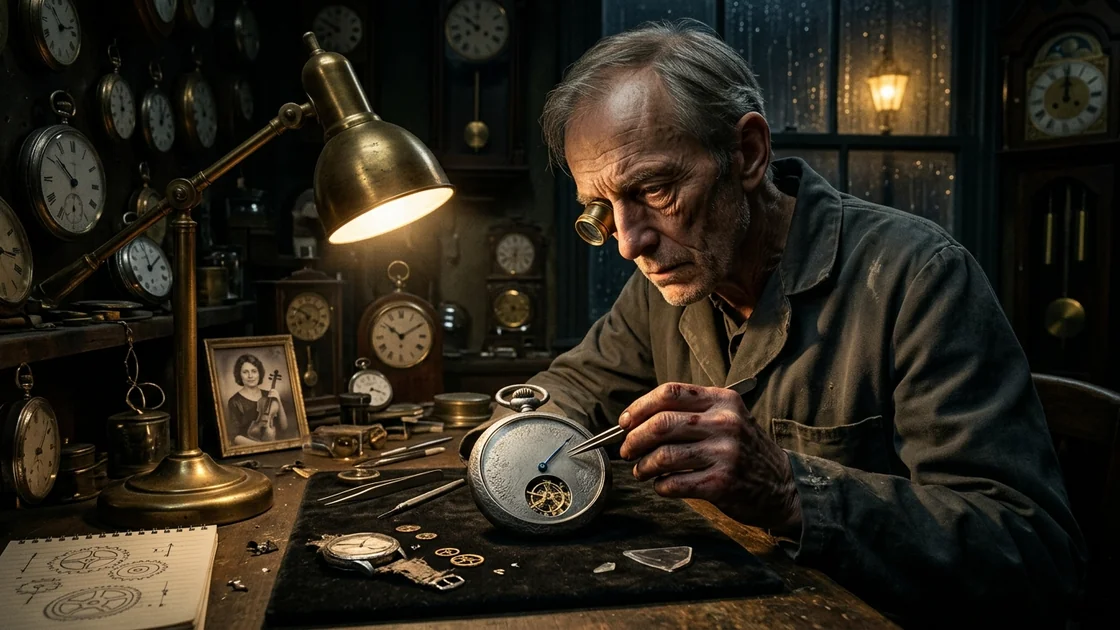
Arthur Pendelton is a master watchmaker whose world stops the night his wife is killed in a hit and run by Julian Vance, a wealthy developer who uses his fortune to escape justice. Consumed by grief and a profound understanding of mechanical time, Arthur spends three years forging a singular, impossible timepiece from the wreckage of his wife's life. He uses this device to trap Julian inside a twenty-four-hour time loop of the murderer's absolute happiest day, the day he secured his fortune and his fiancée. However, Arthur introduces a devastating flaw into the paradise, ensuring that every single person Julian encounters within the repeating day possesses the full, horrified knowledge of the murder he will commit three years in the future.
The workshop on Harrow Street smelled of whale oil, oxidized brass, and a silence so heavy it seemed to have its own gravitational pull. Before November nineteenth, the room had been a chorus of tiny, industrious heartbeats. Three hundred clocks, pocket watches, and marine chronometers had ticked in an overlapping symphony of regulated time, their balance wheels oscillating in comforting predictability. Arthur Pendelton had lived inside that rhythm for forty years. He understood the universe not as a chaotic expanse of matter, but as a series of mainsprings and escapements, where every action possessed a corresponding, measurable recoil.
Then came the rain, the screech of tires that did not brake, and the shattered case of a lady’s silver wristwatch found in a gutter three yards from Clara’s body.
After that night, Arthur stopped winding the clocks. One by one, the pendulums lost their arc. The weights settled at the bottoms of their trunks. The springs uncoiled with faint, metallic sighs until the shop was entirely dead, save for the sound of Arthur’s breathing and the rhythmic, obsessive scrape of his file against a disk of grey meteoric iron.
He worked under the harsh, concentrated cone of a jeweler’s lamp, a brass loupe wedged into the socket of his right eye. His fingers, stained permanently dark at the cuticles with grease and jewelers’ rouge, moved with a terrifying steadiness. Grief had not given Arthur the shakes; it had calcified him. He had become an extension of his lathe.
On the velvet pad before him lay the three foundational elements of his new creation.
The first was the warped, blood-tarnished balance wheel from Clara’s Patek Philippe, which had stopped at precisely 9:14 PM when the bumper of a silver Aston Martin struck her as she crossed the street carrying a paper bag of navel oranges and a bundle of sheet music.
The second was a shard of polycarbonate lens from that same Aston Martin’s left headlight, swept from the wet asphalt by Arthur himself at four in the morning, hours after the police had packed up their flares and washed the dark stain into the storm drain. He had ground the plastic down into a synthetic crystal pallet stone.
The third was a single, coarse strand of dark hair, obtained from the velvet headrest of the defendant’s chair in Courtroom 4B of the Superior Court, where Julian Vance had sat for six days in a bespoke charcoal suit, occasionally checking his phone while a team of four attorneys systematically dismantled the prosecution’s chain of custody regarding the toxicology report.
Arthur remembered the exact cadence of the judge’s gavel. He remembered the way Julian Vance had stood up when the charges were dismissed with prejudice. Julian was thirty-three, a man whose face belonged on the covers of magazines found in private jet terminals. He had smiled—not a wicked, gloating smirk, which Arthur might have been able to stomach, but an easy, relieved, utterly unburdened smile, as though he had just been pardoned for an overdue library book. He had clapped his lead attorney on the shoulder, adjusted his silk tie, and walked out into the October sunshine without once looking back at the widower sitting in the front row of the gallery.
To Julian Vance, Clara Pendelton had been an inconvenience of physics, an unfortunate dent in the fender of a life moving too fast to bother with rearview mirrors.
"Time is not a river, Clara," Arthur whispered to the empty room, his voice raspy from days of disuse. He picked up a pair of tweezers with tips finer than sewing needles and lifted the hair. "They always say it is a river. They say it washes things away. They say it heals. They are wrong. Time is a gear train. And if a tooth is sheared off the great wheel, the whole machine slips."
For thirty-six months, Arthur had studied the older texts—the ones hidden behind the ledger books of the Worshipful Company of Clockmakers, written by seventeenth-century horologists who had gone mad trying to measure longitude by the resonance of the human soul. Men like Hooke and Huygens had understood that two pendulums mounted on the same wooden beam would eventually fall into sympathy, swinging in exact, locked unison through invisible vibrations passed through the timber.
Arthur had discovered that a human life worked the same way. A man’s consciousness was merely a balance wheel oscillating against the hairspring of his memories. If one could construct an escapement tuned to the exact frequency of a man’s proudest, most resonant twenty-four hours—the day his internal spring was wound to its absolute tightest peak of joy—one could lock him inside it through sympathetic vibration.
And if one introduced a contaminant into the lubrication—a memory of blood, a shard of guilt—that contaminant would spread through every gear in the train.
Arthur carefully threaded Julian Vance’s hair into the microscopic brass collet at the center of the new hairspring. The spring itself was forged from an alloy of invar and melted gold from Clara’s wedding band. When he breathed on it, the metal did not expand or contract; it gave off a faint, unnatural hum that made the fillings in Arthur’s back teeth ache.
He did not want to kill Julian Vance. Death was the cessation of measurement. Death was letting the watch run down and placing it in a velvet-lined drawer. Julian had taken forty years of future from Clara—forty years of mornings with coffee on the back porch, of grey hair, of autumn walks, of quiet companionship. To kill Julian would be to give him the same quiet nothingness he had forced upon her.
No. Julian loved his life. He loved the taste of his own triumphs. He loved the reflection of himself in the eyes of an admiring world.
Arthur was going to give him his best day forever.
He reached across the bench and pulled a thick manila folder toward the pool of lamplight. Inside were clippings from society pages, financial journals, and transcripts of interviews Julian had given before the accident. In an interview with Architectural Digest two years ago, the reporter had asked Julian to name the greatest day of his life.
Julian hadn't hesitated. "October fourteenth, three years ago," he had said, laughing according to the transcript. "My thirtieth birthday. In the morning, the city council approved the zoning for the Vance Spire. At noon, my father finally stepped down as Chairman and handed me the gavel. And that night, at the Autumn Conservatory Gala, in front of five hundred of the most important people in the state, Evelyn said yes when I got down on one knee. I don't think a man gets two days like that in one lifetime."
"Yes, you do, Mr. Vance," Arthur murmured, lowering the heavy meteoric iron case back over the movement. The metal clicked shut with a sound like a vault door sealing at the bottom of the sea. "You are going to get ten thousand of them."
The Vance Spire pierced the low autumn clouds like a needle of blue glass, eighty stories above the wet grime of the city streets. Arthur did not try to enter through the lobby, with its marble floors and former Secret Service agents standing behind brushed-steel turnstiles. A watchmaker knew that the face of a clock was only for show; if you wanted to reach the mechanism, you went through the back plate.
Two weeks earlier, Arthur had been hired through an intermediary firm to service the antique grandfather clock that stood in the private executive dining room on the seventy-eighth floor—a seventeenth-century Thomas Tompion longcase that Julian’s father had bought at auction to lend the sterile glass tower an air of inherited permanence.
Arthur rode the freight elevator up in his grey canvas work coat, his leather tool roll tucked under his arm, and the meteoric pocket watch ticking silently against his ribs. It did not make a sound that the ear could register; instead, it beat against his sternum like a second, colder heart, sixty times a minute, four hundred and thirty-two thousand oscillations a day.
The seventy-eighth floor was quiet at seven in the evening. The kitchen staff had already left, leaving behind the faint scent of seared duck and truffle oil. Rain lashed against the floor-to-ceiling windows, turning the city below into a blurred smear of red taillights and gold streetlamps—weather almost identical to the night Clara had died.
Arthur knelt before the tall oak case of the Tompion clock, opened its waist door with a brass key, and pretended to adjust the suspension spring while he waited. He didn't have to wait long.
The heavy double doors at the end of the hall swung open, accompanied by the low, easy murmur of a man speaking into a Bluetooth earpiece.
"Tell Miller if they don't sign the indemnity waiver by nine tomorrow, we pull the escrow," Julian Vance said, strolling into the dining room toward the wet bar. He had taken off his jacket; his white shirt cuffs were rolled back to reveal a platinum tourbillon on his wrist that cost more than Arthur’s house. "I don't care what the environmental impact survey says, David. That marshland has been dead since the seventies. Just bury them in motions until their funding runs dry."
Julian paused with his hand on a crystal decanter of scotch, noticing the bent figure by the corner clock. He frowned slightly, then ended the call.
"Hey," Julian said, not unkindly, but with the flat, transactional tone he used for valets and flight attendants. "Building maintenance said you’d be done by five."
Arthur stood up slowly. His knees popped in the quiet room. He turned around, keeping his hands in the deep pockets of his canvas coat, his fingers wrapped around the warm, pulsing iron of the watch.
"A mechanism of this age cannot be rushed, Mr. Vance," Arthur said. "When a balance is thrown off by violence, it takes a great deal of patience to bring it back to true."
Julian poured two fingers of scotch and took a sip, barely glancing at the old man. "Right. Well, wrap it up. I have guests coming up at eight."
"Do you know who I am, Julian?"
The use of his first name made the younger man’s eyes narrow. He looked up from his glass, really looking at Arthur for the first time—taking in the gaunt, hollow cheeks, the deep purple crescents beneath the eyes, the immaculate, trembling stillness of the old man’s posture. A flicker of something—annoyance, mostly, mixed with a faint, defensive recognition—crossed Julian’s handsome face.
"Wait a minute," Julian said, setting the glass down with a sharp clink. He took a step back, reaching into his trouser pocket for his phone. "You're the husband. How the hell did you get past security?"
"I told you," Arthur said, taking a step forward. "I am a watchmaker. People do not notice the men who keep their world running until something breaks."
"Listen to me, Mr. Pendelton," Julian said, holding up a hand as he thumbed the screen of his phone, his voice dropping into a practiced, lawyer-approved cadence of firm reasonableness. "What happened to your wife was a tragedy. I've said that on the record. My family donated fifty thousand dollars to the pedestrian safety initiative in her name. The court looked at the evidence and found it was an unavoidable accident on a dark road. If you're here for money—"
"You did not brake," Arthur said softly.
Julian stopped dialing. "What?"
"There were no skid marks on the asphalt, Julian. The rain had just started; the oil had risen, yes, and if you had touched the pedal, the tires would have left a scrubbing mark in the grime. I went back with a magnifying glass before the sun came up. You didn't brake because you weren't looking at the road. And after you hit her, you paused for four seconds—long enough for your rear tires to leave two distinct oil drips on the crosswalk—and then you accelerated around her body."
Julian’s jaw tightened. The mask of the sympathetic philanthropist slipped, revealing the cold, entitled iron underneath. "The case is closed, old man. It’s over. Whatever you think you know doesn't matter. I'm calling security, and you're going to spend the rest of your life in a psychiatric ward."
"You told a reporter that October fourteenth was the happiest day of your life," Arthur continued, as if Julian hadn't spoken. He drew the meteoric pocket watch from his coat. It had no chain, and its dial was entirely blank, save for a single blued-steel hand that was currently trembling near the top of the bezel. "Your thirtieth birthday. The Spire approved. Your father’s throne given to you. Your bride promised to you before the whole city."
Julian stared at the dull grey metal in Arthur’s palm, momentarily confused. "What are you talking about?"
"You took her time," Arthur said, his thumb resting on the knurled crown at the top of the watch. "All the days she had left, you ground them into the street so you wouldn't have to sit in a cell and miss your dinner parties. You love your life so much, Julian. Let us see how much you love it when the truth is no longer hidden by your lawyers."
"Get away from me," Julian snapped, backing up until his spine hit the glass window overlooking the stormy city.
"A watch is a closed system," Arthur whispered, stepping close enough that Julian could smell the whale oil and old brass on his coat. "The energy of the mainspring has nowhere to go but through the wheels, over and over, until the steel fatigues. Enjoy your birthday, Mr. Vance."
Arthur pressed the crown down.
There was no flash of light, no thunderclap. Instead, there was a sound like a giant violin string snapping inside Julian’s skull. The rain on the window behind him stopped mid-streak, every droplet freezing into a grey diamond against the glass. The hum of the building’s HVAC system dropped three octaves until it became a subterranean roar, and then the room simply folded inward toward the center of the watch dial, pulling Julian’s scream into a pinhole of blinding, golden autumn sunlight.
Julian woke up gasping, his hands clawing at silk sheets.
The air smelled of roasted Kenyan coffee, fresh-cut white lilies, and crisp October wind blowing through a cracked balcony door. There was no rain. Sunlight—thick, buttery, morning sunlight—poured across the floorboards of his old bedroom in the East Side townhouse he had sold two years ago.
He sat bolt upright, his heart hammering against his ribs. He looked down at his hands. The faint white scar across his left knuckle—from when he had drunkenly punched his steering wheel the night after the police impounded the Aston Martin—was gone. The slight softness around his jawline had vanished. He felt light, electric, hummed through with the effortless vitality of a thirty-year-old man who had never known a moment of genuine fear.
From the bedside table, the brass Jaeger-LeCoultre Atmos clock chimed six times.
"Julian?" a soft voice called from the adjoining dressing room. "Are you awake, darling? The caterers just called about the ice sculptures for tonight, and your father’s driver is already downstairs."
Julian froze. That voice.
Evelyn had left him four months after the trial ended. She hadn't made a scene; she had simply packed her trunks while he was in Zurich, leaving her three-carat emerald-cut engagement ring on the kitchen island next to a copy of the subpoena for his cell phone records from the night of November nineteenth. She hadn't answered a single one of his calls since.
And then she stepped through the doorway.
She was wearing his favorite pale blue cashmere robe, her blonde hair pinned up loosely, holding two mugs of coffee. She looked radiant, untouched by the quiet, hollow disappointment that had defined the last year of their relationship.
"Evelyn," Julian breathed, swinging his legs out of bed and crossing the room in three strides. He grabbed her before she could set the mugs down, burying his face in the crook of her neck, inhaling the cedar and bergamot of her perfume. "God, Evie. I had the worst nightmare. I thought—I thought it was three years from now. I thought you were gone."
Evelyn did not drop the mugs, nor did she put her arms around him. She stood completely rigid in his embrace, like a marble statue being hugged by a drowning man.
When Julian pulled back, smiling, waiting for her to laugh and tease him for being dramatic on his birthday, the smile died on his lips.
Evelyn was looking at him from three inches away, and her pale blue eyes were wide with a flat, bottomless revulsion. Every muscle in her face had gone slack with horror.
"Evie?" he asked, his hands slipping from her shoulders. "What’s wrong?"
"You hit her at forty-eight miles an hour," Evelyn said. Her voice was still soft, still melodic, the exact voice of a young woman on the morning of her engagement, which made the words sound obscene. "Her name was Clara Pendelton. She was fifty-six years old. She taught violin to children at the community center on Thursdays. When her head struck the windshield, the glass webbed around your inspection sticker, and you watched her face slide off the hood into the dark."
Julian stumbled backward, his heel catching on the edge of the Persian rug, sending him sprawling onto the floorboards. The breath went out of him in a sharp grunt.
"What..." He stared up at her, his mind misfiring, gears grinding against empty air. "How do you—that hasn't happened. If this is October fourteenth, that’s three years from now! How could you possibly know that?"
Evelyn walked over to the vanity table and set both coffee mugs down with a steady hand. She looked at him in the mirror while she unpinned her hair.
"You waited four seconds," she said to his reflection. "She was still alive during those four seconds, Julian. Her lungs were crushed, and she was drowning in her own blood on the wet pavement, looking at your red taillights. If you had called an ambulance then, the trauma surgeons at St. Jude’s might have kept her heart beating long enough for Arthur to say goodbye. Instead, you drove to your cousin’s private garage in Queens and had the hood and bumper replaced before noon the next day."
"Stop it!" Julian scrambled to his feet, his hands shaking violently. "This is a trick. That old man—the watchmaker! He drugged me. He put something in the scotch!"
He grabbed his trousers from the valet stand, pulling them on with frantic, jerky movements, not bothering with socks as he jammed his feet into his loafers and grabbed a dress shirt. Evelyn didn't try to stop him. She just stood by the window in the golden morning light, watching him with those dead, knowing eyes.
"Happy birthday, Julian," she said quietly as he yanked the bedroom door open. "Everyone is waiting for you."
He ran down the spiral staircase of the townhouse, half-buttoning his shirt, his chest heaving. The front hall smelled of lemon polish and fresh roses. Mrs. Gable, his housekeeper of ten years, was standing by the front door holding his cashmere overcoat.
When he appeared on the stairs, Mrs. Gable didn't offer her usual warm smile. Her wrinkled face twisted as though she had smelled rotting meat. She dropped the coat onto the marble floor at her feet.
"She had a bag of oranges, Mr. Vance," Mrs. Gable whispered, backing away toward the kitchen stairs, wiping her hands on her apron as if merely holding his coat had stained her skin. "They rolled all the way across the intersection into the gutter. One of them was crushed under your rear tire when you pulled away."
Julian didn't pick up the coat. He tore the heavy oak front door open and burst out onto East Seventy-Fourth Street.
It was a glorious autumn morning. The sky was an impossible, cloudless cerulean. The ginkgo trees lining the sidewalk were canopies of bright yellow gold, dropping fan-shaped leaves onto the clean pavement. Across the street, a man in a tweed jacket was walking a golden retriever; down the block, a nanny was pushing a silver pram; right at the curb, his father’s black Maybach was idling, with Thomas, the family chauffeur since Julian was a boy, standing by the open rear door.
"Thomas!" Julian gasped, running down the brownstone steps. "Thank God. Get me to Mount Sinai. I've been poisoned—some kind of hallucinogen—"
Thomas didn't touch the door handle. The older man looked at Julian with eyes red-rimmed and glistening with unshed tears of shame. Across the street, the man in the tweed jacket stopped walking. The nanny stopped pushing the pram. A jogger halfway down the block slowed to a walk, then came to a halt, turning his head toward Julian.
Within five seconds, every single person on East Seventy-Fourth Street had stopped moving and was staring directly at him.
"I drove you to your first day of school, Julian," Thomas said, his voice trembling. "I taught you how to parallel park in your father’s old Mercedes up at the lake house. And you left a woman in the rain like a stray dog because you had two bottles of Cabernet in your stomach and you didn't want your picture in the Post."
"Shut up!" Julian screamed, spinning around on the sidewalk.
The man with the dog across the street spoke next, his voice carrying clearly across the quiet avenue. "You paid the lab technician at the precinct forty thousand dollars through an offshore shell company in the Caymans to leave the blood sample unrefrigerated for twelve hours."
The nanny by the pram spoke, her eyes fixed on Julian with cold hatred. "Her husband waited at the kitchen table with a pot of tea until midnight, wondering why her phone went straight to voicemail."
"Stop it! Stop talking to me!" Julian clapped his hands over his ears and bolted down the avenue toward Madison.
As he ran, the city woke up around him, and the city knew.
When he sprinted past a crowded sidewalk café, forty people lowered their croissants and newspapers in unison, turning their heads in a slow, synchronized wave to track his progress. Nobody chased him. Nobody called the police. They just looked at him with that same unified, crushing disgust, their voices rising in a low, overlapping murmur as he passed.
"9:14 PM on Harrow and Fifth..."
"Fractured pelvis, severed spinal cord at C4, bilateral hemothorax..."
"Didn't even tap the brakes..."
"Smiled when the judge banged the gavel..."
He ran until his lungs burned like hot ashes, all the way down to Midtown, where the half-finished skeleton of the Vance Spire rose above the avenues, its cranes frozen against the blue sky. By the time he stumbled into the marble lobby of Vance Enterprises—his father’s old headquarters—his bare ankles were bleeding from the stiff leather of his loafers, and his shirt was soaked through with sweat.
In the lobby, the champagne fountains were already set up for the noon handover ceremony. A banner reading CONGRATULATIONS CHAIRMAN JULIAN VANCE hung above the reception desk. Nearly a hundred employees were gathered around the elevators.
The moment the revolving door spat Julian out onto the terrazzo floor, the chatter died.
A hundred pairs of eyes locked onto him. A receptionist near the front dropped her clipboard; the clatter echoed like a gunshot in the vast marble hall.
At the top of the mezzanine stairs stood his father, Richard Vance. Richard was a titan of a man, white-haired and iron-jawed, the man whose approval Julian had spent his entire life chasing like a starved hound. In the real October fourteenth, Richard had walked down those stairs, embraced his son before the entire company, and handed him the antique ivory gavel that had belonged to Julian’s grandfather.
Richard walked down the stairs now. His steps were slow and heavy. He held the ivory gavel in his right hand.
"Dad," Julian whimpered, falling to his knees on the cold marble floor as the crowd parted away from him, nobody willing to let the hem of their coat brush against him. "Dad, please. Something’s wrong with everyone. Make them stop."
Richard stopped three feet away, looking down at his only son. There was no anger in the old man’s face—only a vast, hollowed-out grief, as though he were looking at a stillborn thing.
"I spent fifty years building that name," Richard said, his baritone voice echoing off the marble walls. "And you used it to buy off a coroner’s clerk so you wouldn't have to answer for crushing a music teacher’s skull under your tires."
Richard raised the ivory gavel, placed it under his own heel, and snapped it in half. He let the pieces fall onto the floor in front of Julian’s knees.
"I have no son," Richard said, and turned his back.
Julian spent the rest of that first day locked in a utility closet in the sub-basement of the building, curled into a ball between mop buckets and boxes of industrial paper towels, his hands pressed over his ears.
Even down there, four levels beneath the street, he wasn't alone with the quiet. Every hour or so, footsteps would pause outside the heavy steel door, and a janitor or an engineer would speak softly through the ventilation slats.
"She was buying oranges because Arthur had a slight cold that week, and she wanted to make him fresh juice in the morning."
"Her violin case was crushed, too. It was an eighteenth-century Amati copy her father had given her when she graduated from the conservatory."
"You went home to your penthouse, Julian, and you took a hot shower for forty minutes while the police were putting her into a black plastic bag."
He screamed until his vocal cords tore. He banged his forehead against the concrete wall until warm blood trickled into his eyebrows. He watched the luminous hands of a cheap plastic wall clock above the slop sink crawl toward midnight.
When the day ends, he told himself, rocking back and forth in the dark, the drug will wear off. It’s just scopolamine, or some synthetic ergotamine the old bastard rubbed onto his watch case. The human liver metabolizes toxins. By midnight, I’ll wake up on the floor of the seventy-eighth floor, and I’ll have my guards throw Arthur Pendelton out the window.
Eleven fifty-eight.
Eleven fifty-nine.
The red second hand swept past the nine, the ten, the eleven. It touched the twelve.
The utility closet vanished. The smell of bleach and wet mop heads evaporated.
Julian gasped, his hands clawing at silk sheets.
The air smelled of roasted Kenyan coffee, fresh-cut white lilies, and crisp October wind blowing through a cracked balcony door. From the bedside table, the brass Jaeger-LeCoultre Atmos clock chimed six times.
"Julian?" Evelyn’s voice called from the dressing room, though this time there wasn't even the pretense of warmth in it. It was flat, rehearsed, like a prisoner reading a statement from a gallows. "You're awake. Your father’s driver is downstairs."
Julian touched his forehead. The split skin and dried blood were gone. His throat was no longer raw from screaming.
He looked toward the doorway as Evelyn stepped out with the two mugs of coffee, her blue eyes already fixed on him with that bottomless, nauseated revulsion.
"No," Julian whispered.
"You hit her at forty-eight miles an hour," Evelyn said.
On the fourth loop, Julian tried to run away.
He didn't speak to Evelyn. He dressed in silence, took the service stairs to the alley behind the townhouse, broke the window of a parked delivery van, and hot-wired it—a trick a kid from boarding school had taught him twenty years ago. He drove west toward the Lincoln Tunnel, intending to get into New Jersey, drive to Montana if he had to, anywhere far away from New York and the people who knew his name.
Traffic was light moving out of the city. The autumn sun glinted off the Hudson River. As he plunged into the tiled tube of the tunnel beneath the river, he felt his chest loosen for the first time in ninety-six hours. Nobody in the cars beside him was looking at him; their windows were rolled up, their eyes on the road.
Then he passed the white tiled line halfway through the tunnel reading NEW YORK / NEW JERSEY.
The van didn't hit a wall. Instead, the light at the end of the tunnel simply inverted, and when Julian burst out into the sunshine five seconds later, he was emerging from the Brooklyn-Battery Tunnel, heading straight back north into Lower Manhattan.
He tried the George Washington Bridge; the off-ramp on the Palisades side looped seamlessly back onto the Harlem River Drive. He took a water taxi from Pier 11; two hundred yards past the Statue of Liberty, the fog rolled in thick and grey, and the boat bumped against the pilings of Pier 11 again, with the captain staring down from the wheelhouse window and saying through the megaphone: "There is nowhere to go, Mr. Vance. You left her at Harrow and Fifth."
The city was the watch case. The rivers were the bezel. He was a dust mite trapped beneath the crystal.
On the nineteenth loop, Julian decided to play the game all the way to the end.
If this was a hallucination constructed by his own suppressed guilt—or some hypnotic suggestion planted by Pendelton—then perhaps the only way to break the circuit was to complete the script of October fourteenth exactly as he had lived it three years ago. He had to force the day to its conclusion without running.
He drank the coffee while Evelyn stared at him with loathing. He got into the Maybach while Thomas wept silently in the front seat. He sat through the ten o'clock zoning hearing at City Hall, where the seven members of the city council voted unanimously to approve the Vance Spire while reading details of Clara Pendelton’s autopsy report into the public record instead of the zoning variance numbers.
"Regarding subsection four," Councilman DeLuca said into his microphone, glaring over his reading glasses at Julian, "the left femur was comminuted into six separate fragments by the initial bumper impact, indicating the driver made no attempt to swerve despite having two empty lanes to his left. All in favor, say aye."
"Aye," the council said in a dead monotone, staring at Julian.
At noon, he stood on the stage at Vance Enterprises and took the gavel from his father’s limp, trembling hand while a hundred employees stood in absolute, suffocating silence, not a single pair of hands clapping.
And at eight o'clock that evening, wearing his custom midnight-blue tuxedo, Julian walked up the grand marble staircase of the Metropolitan Botanical Conservatory for his thirtieth birthday and engagement gala.
In his memory, the gala had been a warm blur of golden candlelight, Vivaldi string quartets, clinking crystal, and laughter. Tonight, the five hundred guests—senators, hedge fund titans, socialites, college friends—stood among the giant tropical ferns and glass domes like mannequins in a wax museum.
The string quartet on the dais was not playing Vivaldi. They were holding their bows across their knees, staring down at Julian as he entered. The first violinist, a woman in her fifties with silver hair, looked remarkably like the photograph of Clara Pendelton that Arthur had held up for the reporters outside the courthouse.
Julian walked straight to the center of the ballroom floor where Evelyn was standing alone beside a towering ice sculpture of the Vance Spire. She was wearing the silver Vera Wang gown he had bought for her, and she looked like a corpse dressed for an open-casket viewing.
"We're doing this," Julian hissed through clenched teeth, grabbing her cold hand. "Look at me, Evie. In the real world, you didn't care until the papers made it ugly! You knew who I was when you said yes!"
"I thought you were ruthless in business, Julian," Evelyn said, her voice carrying across the dead-silent ballroom so that all five hundred guests could hear every syllable. "I didn't know you were a coward who would leave an old woman broken in the gutter and then come home to kiss me with the smell of her fear still on your skin."
"Shut up!" Julian dropped to one knee on the parquet floor, ripping the velvet ring box from his tuxedo pocket and snapping it open. The three-carat emerald-cut diamond caught the light of the chandeliers. His face was contorted, sweat dripping from his chin onto his silk lapels. "Say yes! That’s how the day goes! You say yes, everyone drinks the champagne, we go back to the Pierre Hotel, and tomorrow is October fifteenth! Say it!"
Five hundred people watched him from the shadows of the palms. Waiters holding silver trays of untouched hors d'oeuvres stood frozen around the perimeter.
Evelyn looked down at the diamond, then into his eyes.
"I would rather cut my own hands off than let you put that on my finger," she said calmly. "You are a murderer, Julian."
Something snapped inside Julian’s chest. He lunged upward, grabbing the edge of the banquet table beside them and flipping it over. Crystal flutes, porcelain plates, and silver chafing dishes crashed to the floor in a deafening cascade.
"I WAS DRUNK!" Julian roared at the ceiling, spinning around to face the silent crowd, veins bulging in his neck, spittle flying from his lips. "It was raining! She was wearing a dark coat! Anyone could have hit her! Why are you all looking at me like you wouldn't have done the exact same thing?! Half of you in this room have killed people with a stroke of a pen—factories in Bangladesh, pension funds gutted, tenements burned for insurance! I hit ONE woman by accident!"
A man in the front row—Judge Halpern, the family friend who had privately advised Julian’s legal team on which pre-trial motions to file—spoke quietly from behind his champagne glass.
"We know what we are, Julian," Halpern said. "And we know what you did. Look at yourself. You're thirty years old, and you're already rotting from the inside out."
Julian grabbed a heavy silver candlestick from the wreckage of the table. Before anyone could move—not that anyone tried to move—he swung the heavy base against the side of his own temple with all his strength. Then he lunged through the French doors onto the fourth-floor conservatory terrace and vaulted over the stone balustrade into the dark courtyard sixty feet below.
The fall took two seconds. The impact against the flagstones was a blinding white crunch of bone and wet agony that did not fade to black, as he had prayed it would. Instead, he lay paralyzed on the stones for three hours and forty minutes, feeling every splintered rib puncturing his pleura, choking on his own blood under the stars while party guests occasionally leaned over the stone railing above to look down at him without expression, until the distant bells of St. Patrick’s Cathedral began to toll midnight.
On the twelfth stroke, the pain vanished, and he was gasping in his silk sheets, the smell of Kenyan coffee in his nose, the Atmos clock chiming six.
Time lost its shape after the first hundred loops. Or perhaps it was the five hundredth. Without a calendar that advanced, Julian had only the erosion of his own mind to measure the centuries.
He tried violence; the city absorbed it like water poured on sand, resetting every broken bone and shattered window at midnight. He tried turning himself in to the police on the morning of October fourteenth; the desk sergeant at the Nineteenth Precinct simply stared at him over the blotter and said, "We cannot arrest you for a crime you haven't committed yet, Mr. Vance. Come back in three years, when you've bought the judge."
Then, somewhere in the grey expanse of his captivity, a new thought occurred to him.
It was October fourteenth, three years before November nineteenth.
That meant Clara Pendelton was alive.
He sat up in bed at 6:01 AM, ignoring Evelyn’s recital from the doorway. His heart beat with a strange, frantic hope. If this world was bound by the rules of Arthur Pendelton’s grief, what would happen if Julian went to Harrow Street right now? What if he warned her? What if he gave her every dime he had, begged her forgiveness in advance, promised on his life never to get behind the wheel of a car again? Surely the watchmaker’s machine would have to break if the victim herself forgave him!
He dressed carefully—no tuxedo, no bespoke suit, just a simple grey sweater and chinos. He didn't steal a car. He walked the forty blocks downtown through the crisp autumn morning.
He kept his head down, ignoring the thousands of eyes that tracked him from buses, storefronts, and office windows, ignoring the constant, rhythmic whisper that followed him down Fifth Avenue like dry leaves scraping along the pavement: Murderer... coward... ninety-fourteen PM... didn't brake...
By eight-thirty, he reached Harrow Street.
It was a narrow, cobblestone lane lined with brick townhouses that had small shops on the ground floors—a bookbinder, a violin luthier, an apothecary, and, at number 42, a dark green storefront with gold leaf lettering on the window: A. PENDELTON & SON, HOROLOGISTS.
Julian stopped across the street, his breath misting in the cool air. Inside the shop window, hundreds of clocks were ticking in glorious, synchronized harmony. He could see the back of a man’s grey head bent over a workbench under a green glass lampshade.
Before Julian could step off the curb, the green wooden door next to the shop—the entrance to the upstairs apartment—opened.
A woman stepped out onto the stoop.
She was fifty-three years old in this autumn, wearing a warm camel-hair coat and a burgundy knit scarf. Her hair was a soft, waving brown streaked with silver at the temples, and she carried a worn leather violin case in her left hand. Her face was kind, lined around the eyes from decades of smiling at small things.
Julian felt his knees go weak. Until this moment, Clara Pendelton had been a name on a legal brief, a grainy photograph on a news broadcast, a blurry shape rolling off his hood in the rain. Seeing her standing in the October sunlight, breathing, adjusting her scarf against the breeze, hit him with a weight he had never felt in his thirty-three years.
He walked across the cobblestones, his hands held out slightly at his sides to show he meant no harm.
"Mrs. Pendelton?" he called out, his voice cracking.
Clara paused at the bottom of the iron steps. She turned her head toward him.
For half a second—a tiny, agonizing fraction of a beat—her expression was mild, polite, the face of a stranger being asked for directions.
And then the knowledge settled into her eyes like ink dropped into clear water.
She did not gasp or step back like the others. She did not look at him with the theatrical disgust of Evelyn or the cold hatred of his father. Instead, she looked at him with an immense, quiet sorrow, her hand tightening slightly on the handle of her violin case.
"You're Julian," she said softly.
Julian fell to his knees on the cobblestones right in front of the iron gate, tears finally spilling hot and fast down his cheeks. "I'm sorry," he sobbed, reaching out toward the hem of her coat, then pulling his hands back as if afraid he would burn her. "God in heaven, Mrs. Pendelton, I'm so sorry. I didn't mean for it to happen! I was stupid, I was selfish, I was afraid of losing everything I had! Please—in three years, on November nineteenth, don't cross Fifth Avenue at nine o'clock! Stay inside! Tell your husband to let me out of this, and I swear to you I’ll go straight to the district attorney in the real world! I’ll confess to everything! I’ll go to prison for the rest of my life!"
Clara looked down at the weeping young man at her feet. Around them on Harrow Street, the bookbinder and the apothecary had stepped out onto their stoops, watching silently. Inside the shop window, the grey-haired figure at the workbench did not turn around.
"You aren't crying for me, Julian," Clara said gently, her voice like a cello note in the quiet street. "Even now, after all these days, you aren't sorry that I stopped breathing on that cold road, or that Arthur had to come home to a house that would never have a sound in it again."
"I am! I swear I am!" Julian wept, pressing his forehead against the cold iron bars of her gate.
"No," she said, kneeling slightly so her eyes were level with his. "You are crying because the people at your party won't clap for you anymore. You are crying because you are in a cage, and you want me to give you the key so you can go to a gentler prison where you can eventually sleep without dreaming."
She stood up and smoothed the front of her camel-hair coat.
"Those oranges were very sweet that season," she said, looking up at the strip of blue sky between the brick buildings. "And I had just found an old score of Bach’s Partita in D Minor that I had been looking for since April. I was so happy walking home in the rain, thinking about showing it to Arthur."
She looked back down at Julian one last time.
"You took the rest of my life, Mr. Vance. All you have to do is live one single day of yours."
She turned and walked down Harrow Street toward the avenue, the tap of her heels fading into the morning traffic, leaving Julian alone on the cobblestones outside the watchmaker’s window.
After that day, Julian stopped trying to change the script, and he stopped trying to run.
The seasons did not change, though a thousand winters passed inside his head. He learned every crack in the plaster of his bedroom ceiling. He learned the exact number of leaves that fell from the ginkgo tree outside his townhouse between 6:00 AM and 6:15 AM (forty-two, spinning down in the exact same ballet every morning).
He stopped dressing in his suits. Most days, he simply walked out of the townhouse in his trousers and an unbuttoned shirt, barefoot or in slippers, wandering the bright, golden streets of his thirtieth birthday like a ghost at his own banquet.
The city never tired. The mechanism Arthur Pendelton had built did not suffer from friction or wear; its jewels were synthetic polycarbonate from a broken headlight, lubricated by a widower’s bottomless grief, and it kept perfect time. Every person Julian passed—whether it was a hot dog vendor in Central Park he had never met in his life, or his own mother calling on the telephone at eleven in the morning—spoke to him only of November nineteenth.
If he went into a five-star restaurant and sat at a table, the waiter would bring him a glass of tap water and a single bruised navel orange on a silver platter, setting it down while whispering the exact velocity of the impact.
If he turned on the television, the morning news anchors would look directly through the glass screen into his living room and read the transcript of his defense attorney arguing that Clara Pendelton had been jaywalking Outside the Marked Crosswalk, and that her dark wool coat constituted contributory negligence.
Eventually, Julian stopped speaking altogether. The arrogance that had buoyed him for thirty-three years was ground down to fine brass filings. The memory of why October fourteenth had once been his happiest day was completely obliterated. When he looked at the Vance Spire gleaming in the autumn sun, he didn't feel pride; he felt a cold sickness in his stomach. When he saw Evelyn’s face, he felt only an overwhelming urge to hide in the dark. He had forgotten the taste of champagne, the thrill of the billion-dollar deal, the warmth of his father’s hand on his shoulder. Every golden memory he had ever owned had been soaked in rainwater and motor oil until nothing remained of Julian Vance except the knowledge of what he had done at 9:14 PM on a Tuesday night.
On a day that might have been his ten-thousandth birthday, Julian did not go to the office, and he did not hide in the basement.
When evening came, he walked across town in the cool twilight and sat on a wooden bench in a small, empty concrete plaza across from the intersection of Harrow and Fifth.
In this timeline, it was a dry October evening. Streetlamps clicked on with a soft amber glow. Commuters walked home with briefcases and grocery bags, turning their heads as they passed his bench to fix him with that eternal, silent stare.
Julian didn't look back at them. He just stared at the white painted stripes of the crosswalk, watching the cars roll safely over the spot where, three years from tonight, he would come roaring around the corner in a silver Aston Martin with two bottles of wine in his veins and his eyes on a text message from a broker in London.
At 9:10 PM, the footsteps of a single pedestrian approached along the sidewalk and stopped beside the bench.
Julian didn't look up at first. He expected another stranger to recite the coroner’s report.
Instead, the man sat down on the other end of the wooden bench, letting out a long, tired sigh that smelled faintly of whale oil and oxidized brass.
Julian turned his head slowly.
Arthur Pendelton was wearing his grey canvas work coat. Unlike everyone else in the October city, Arthur looked exactly as he had on the seventy-eighth floor of the Vance Spire—gaunt, three years older than the world around them, with deep, bruised hollows beneath his eyes and white stubble on his jaw. In his right hand, resting on his knee, he held the dull grey meteoric pocket watch.
Julian stared at the old man for a long time. His mouth opened and closed twice before he remembered how to shape words with his tongue.
"You're real," Julian rasped, his voice barely louder than the breeze in the street trees.
"I am the regulator," Arthur said quietly, looking out at the intersection. "Every movement requires an external reference to ensure the rate has not drifted. Though I knew it wouldn't. I made the hairspring from her wedding ring, Julian. She was always very dependable."
Julian slid off the bench and dropped to his knees on the concrete in front of the watchmaker, though he didn't touch him. He just stayed there, bowed over his own knees, shivering in his thin shirt.
"How long?" Julian whispered. "How long has it been out there?"
Arthur glanced down at the blank dial of the meteoric watch, where the single blued-steel hand was sweeping smoothly around the bezel at sixty revolutions a second.
"Out there?" Arthur said. "We are still standing by the window on the seventy-eighth floor of your tower, Julian. Your glass of scotch has just slipped from your fingers, and it is currently halfway to the carpet. It has been approximately four-tenths of a second."
A sound escaped Julian’s throat—half a laugh, half a dry, retching sob. "Four-tenths of a second," he repeated, his eyes wide and unfocused as he stared at the concrete between his shoes. "I've lived here for thirty years. A hundred years."
"A balance wheel can oscillate very quickly when the spring is small enough," Arthur said. "You paused for four seconds after you hit her. Do you know how long four seconds is when you are lying on the pavement with your chest crushed, waiting to see if the man who hit you is going to come back and hold your hand?"
Julian closed his eyes, tears leaking through his lashes. "I know," he whispered. "I know now. She was carrying oranges because you had a cold. She had the Bach Partita in her bag. Her left femur was broken in six places. The rain was thirty-eight degrees." He looked up at Arthur, his once-handsome face hollow and haunted by a century of universal condemnation. "I don't remember what my voice sounded like before this. I don't remember what it felt like not to be hated. Please, Mr. Pendelton. Let the glass hit the floor. Call the police when we go back. I’ll sign a confession before the ink is dry. Put me in a cell at Rikers. Let me die."
Arthur looked down at him. There was no triumph in the watchmaker’s eyes. Revenge had not made Arthur whole; it had simply given his hands something to do while he waited for his own clock to run down.
"If I let you go back," Arthur said evenly, "for the first week, you would mean every word you just said. You would weep in the police station. You would fire your lawyers. And then, by the second month, when the calendar started moving forward again and the guards didn't know Clara’s name, your father’s attorneys would visit you. They would tell you that pleading guilty helps no one, that Clara is already gone, that a five-year sentence in a minimum-security facility in Connecticut is more reasonable. And within ten years, Julian, you would be sitting on a boat in the Mediterranean, telling a new woman that you had gone through a very dark period in your thirties, and that it had taught you a great deal about resilience."
Julian opened his mouth to deny it, to swear on his soul that he was changed forever—and the words died on his tongue. Because deep down, beneath the terror and the exhaustion, in the very center of the mechanism of who he was, he knew the watchmaker was right. He only felt this remorse because the world was forcing him to look at the body every minute of every day.
Arthur saw the truth register in Julian’s eyes, and he nodded once.
"You see," Arthur said softly, standing up from the bench and slipping the grey iron watch back into the deep pocket of his canvas coat. "A warped wheel cannot be straightened by hand. If you take the pressure off the spring, it simply bends back to its old shape."
"Don't leave me here," Julian begged, reaching out for the hem of the grey coat as Arthur turned to walk away. His fingers passed through the coarse canvas as though it were made of smoke and lamplight. "Arthur, please! Four seconds! If four-tenths of a second is a hundred years, how long is the rest of my life going to be?!"
Arthur stopped at the curb of Harrow and Fifth, waiting for the walk signal to change. He looked across the street at the exact spot where Clara had stepped off the pavement in the rain.
"The mainspring I used is forged from meteoric iron, Mr. Vance," Arthur said over his shoulder, as the light turned white and the crosswalk began its rhythmic, ticking chirp for the blind. "It does not fatigue. And it never needs winding."
Arthur stepped into the crosswalk and faded into the amber glow of the streetlamps before he reached the other side.
Julian remained on his knees on the cold concrete as the autumn wind picked up, blowing bright yellow ginkgo leaves across his bare ankles. Around the square, the evening commuters paused on the sidewalks, forming a quiet, unblinking circle under the lamps, waiting for the bells of St. Patrick’s to strike midnight so they could wish him a happy birthday once again.
On the seventy-eighth floor of the Vance Spire, the crystal tumbler hit the plush wool carpet with a dull thud, spilling two fingers of thirty-year-old scotch across the weave.
Julian Vance did not fall right away. He stood propped against the rain-streaked glass window for a moment, his eyes wide open, staring into the reflection of the dining room while his pupils dilated until the blue irises were almost entirely swallowed by black. A thin line of saliva ran from the corner of his slack mouth down onto his silk tie. Then his knees buckled, and he slid slowly down the glass to sit in a heap on the floor, his chest rising and falling in shallow, rhythmic breaths—sixty times a minute, regular as a pendulum.
At eight o'clock, when his guests arrived, they found him there.
The doctors at Presbyterian Hospital ran every scan modern medicine had devised. There was no stroke, no aneurysm, no trace of poison or toxin in his blood. His brain was simply firing in a tight, furious, self-contained loop of electrical activity that never varied by a millisecond, day or night, waking or sleeping.
Evelyn did not come to the hospital. His father visited once a week for the first year, sitting silently in a leather chair beside the bed where Julian lay staring at the ceiling with terrified, weeping eyes that never tracked the nurses as they came and went, before the old man finally stopped coming too, and left his son in the care of a private facility upstate where the rooms had no clocks on the walls.
Down on Harrow Street, on the night after he returned from the Vance Spire, Arthur Pendelton walked through his quiet shop with a brass winding key in his hand.
He stopped before the tall grandfather clock by the door, opened its glass case, and inserted the key into the arbors. With slow, deliberate turns, he raised the heavy lead weights back to the top of the trunk. Then he reached in and gave the brass pendulum bulb a gentle push with his thumb.
Tick. Tock. Tick. Tock.
He moved to the French mantel clock on the shelf, then the marine chronometer in its mahogany box, then the three hundred pocket watches hanging from their hooks on the velvet-lined boards. One by one, through the long hours of the night, he wound them all and set their hands to the true hour, until the room was once again filled with a vast, breathing chorus of tiny mechanical hearts, moving forward together into the dark.