The One-Cent Gavel
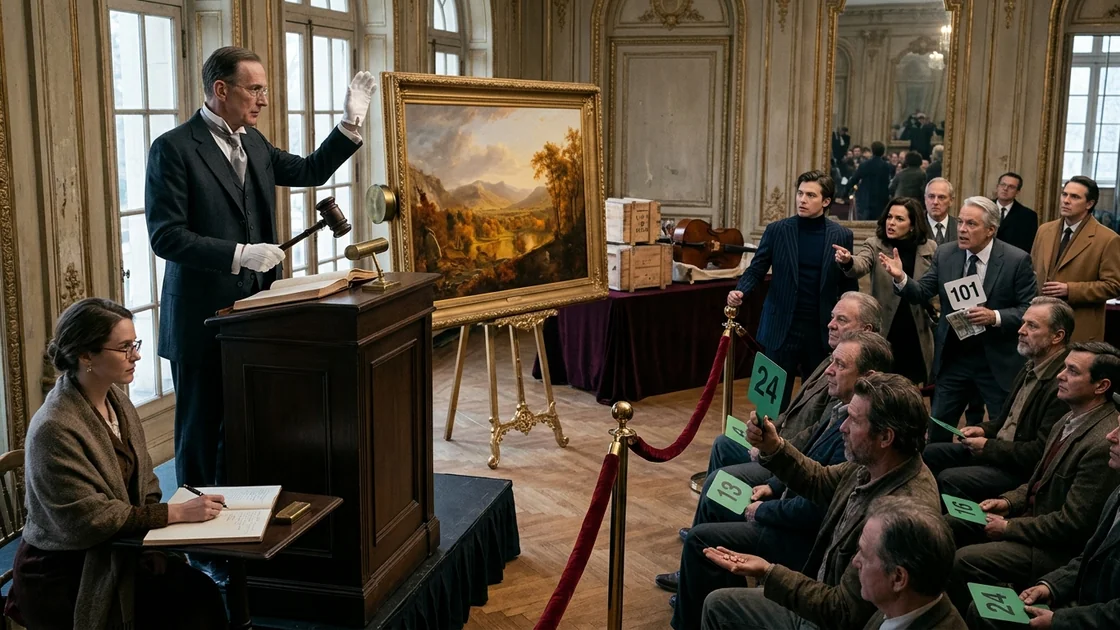
After the sudden death of disgraced billionaire Alistair Vance, veteran auctioneer Julian Sterling is appointed to liquidate the tycoon's lavish country estate to satisfy a mountain of complex bankruptcy claims. Discovering an obscure legal loophole buried within Vance's own arrogant asset-protection trusts, Julian quietly orchestrates a daring scheme alongside his archivist, Maeve Nolan. By manipulating catalog descriptions, weaponizing archaic municipal bylaws, severing communications to lock out international collectors, and exploiting the absolute authority of the auctioneer's gavel, Julian rigs the high-stakes sale right under the noses of Vance's greedy heirs and ruthless corporate lawyers. One by one, the priceless treasures that Vance hoarded—from rare instruments and horological masterpieces to historic paintings and vintage automobiles—are legally hammered down for a single copper penny each to the very townspeople, artisans, and workers whose lives and pensions the patriarch destroyed.
The mahogany gavel in Julian Sterling’s coat pocket weighed precisely four and a half ounces, turned from a single billet of Honduras rosewood that his grandfather had cured in linseed oil during the winter of 1932. It was not a weapon, though over the course of forty years in the trade, Julian had seen it end marriages, dissolve dynasties, and reduce grown men in bespoke Savile Row suits to weeping wrecks on the carpets of Manhattan townhouses. An auction, Julian’s father used to say, was the only place on earth where the exact mathematical weight of a human soul could be measured in increments of ten percent.
Today, the soul on the scales belonged to Alistair Vance, and by Julian’s preliminary accounting, it was heavily overdrawn.
Blackwood Hall sat at the crest of the Oakhaven ridge like a granite gargoyle crouching over the valley below. Built during the Gilded Age by a railroad baron and purchased by Vance in the late nineties at the height of his first leveraged buyout boom, the forty-room mansion smelled of lemon oil, cedarwood, and the peculiar, sterile chill of wealth that had never known warmth. Vance had died three weeks ago aboard his superyacht in the Aegean Sea, his heart giving out twelve hours before a pair of United States Marshals could board the vessel with a seventy-page federal indictment from the Southern District of New York.
Because he had died prior to conviction, the Department of Justice’s criminal forfeiture proceedings had stalled in a jurisdictional quagmire, leaving the liquidation of his domestic assets to the sleepy, underfunded apparatus of the Oakhaven County Orphans’ and Chancery Court. And because Sterling & Sons was the only bonded estate auction house within a hundred miles that still maintained a Class-A historical surety license, the court-appointed receiver had handed the keys of Blackwood Hall to Julian.
"Lot one hundred and fourteen," Maeve Nolan said, her voice echoing slightly in the cavernous morning room. She didn't look up from her leather-bound ledger, her fountain pen scratching neatly across the rag paper. "How are we describing the tea service, Julian? If I write 'Paul de Lamerie, London, 1738,' every silver dealer from Bond Street to Madison Avenue is going to charter a helicopter onto the south lawn."
Julian stood before the twelve-foot walnut dining table, which was currently buried beneath three hundred pieces of eighteenth-century sterling silver. He was a tall, spare man of sixty-two, dressed in a charcoal three-piece suit that had been mended at the cuffs with stitches so fine they were invisible to the naked eye. He wore white cotton archivist’s gloves. Between his thumb and forefinger, he held a massive rococo coffee pot, its surface chased with grinning masks, sea serpents, and tumbling cherubs.
"He never used it, did he?" Julian murmured, turning the pot over to examine the hallmarks stamped into the base. The lion passant, the leopard’s head crowned, the date letter for 1738, and the unmistakable mark of de Lamerie himself.
"Not once," Maeve replied, adjusting her wire-rimmed spectacles. At thirty-four, she possessed the sharp, unsentimental eyes of a woman who had spent a decade appraising the debris of dead rich people. "According to Martha Higgins, he kept the entire service locked in the sub-basement vault behind eight inches of Krupp steel. He only brought it up twice a year so she could polish the tarnish off with precipitated chalk. Then he made her count the spoons in front of a security camera before locking it back up."
"And then he fired her," Julian said softly.
"Forty-eight hours before her thirty-year pension vested," Maeve confirmed, her pen pausing. "Accused her of pocketing a marrow scoop. When the local police refused to press charges for lack of evidence, Vance had his general counsel file a civil conversion suit against her just to freeze her savings account. She lost her house on Elm Street four months ago. She’s living above the dry cleaner’s on Main."
Julian set the coffee pot down upon its matching salver. It made a dull, heavy thud. Silver of that gauge didn't ring; it absorbed sound like lead.
"Look closely at the hinge on the lid, Maeve," Julian instructed, stepping back and folding his hands behind his spine. "What do you see?"
Maeve set her ledger down and walked over, pulling a jeweler’s loupe from the ribbon around her neck. She leaned in, squinting through the lens at the tiny pin joining the finialed lid to the body of the pot. "It’s an nineteenth-century repair. Victorian solder. Probably ninety-ten tin-lead alloy, done before modern assay rules."
"Lead," Julian repeated, testing the word on his tongue as though it were a vintage Bordeaux. "A toxic heavy metal, leached directly into the pouring spout of a vessel intended for human consumption. Furthermore, the presence of non-original base metal violates the Hallmarking Act of 1973 regarding antique exemptions, rendering the entire aggregate assemblage legally unmarketable as sterling until each individual piece undergoes metallurgical quarantine and destructive X-ray fluorescence testing."
Maeve lowered the loupe and stared at him. Slowly, the corner of her mouth twitched upward. "Julian, it’s a pin the size of a grain of rice. A silversmith in the city could knock it out and replace it with sterling wire in ten minutes for fifty dollars. The lot is worth six hundred thousand at Sotheby’s on a rainy Tuesday."
"We are not at Sotheby’s, Maeve. We are in Oakhaven County, operating under the strict consumer protection mandates of the 1924 Municipal Bailiff’s Code," Julian said, his expression entirely devoid of humor. "Write this down. Lot 114: Quantity of assorted white-metal tableware and hollowware, severely compromised by toxic lead-alloy structural alterations. Sold strictly as hazardous scrap material for industrial reclamation only; buyer assumes all statutory environmental liability upon fall of the hammer."
Maeve picked up her pen, her eyes shining behind her lenses. "No photographs in the public notice?"
"The camera battery died twenty minutes ago," Julian said smoothly, reaching over to switch off the digital SLR sitting on the tripod beside the sideboard. "A tragic equipment failure. We shall have to rely purely on the written descriptions filed with the county clerk’s bulletin board."
"You know Conrad Ross is going to read the catalog," she warned gently, even as her nib flew across the page, immortalizing the half-million-dollar de Lamerie service as hazardous industrial scrap. "Vance’s children hired him the day the old man’s body landed at Teterboro. Victoria and Preston didn't get the house because of the bank liens, so they’re planning to buy back the contents through their Cayman shell company for thirty cents on the dollar."
"Let Mr. Ross read the catalog," Julian said, walking toward the tall French windows that looked out over the Oakhaven Valley. "By the time he realizes what he is reading, he won't even be allowed to raise his hand."
Below the terraced lawns of Blackwood Hall, the town of Oakhaven lay wrapped in the gray mist of late October. From this height, you could see the rusted corrugated roofs of the Oakhaven Precision Machine Works, which Vance had bought in 2014, stripped of its patented aerospace tooling, loaded with forty million dollars of junk-bond debt from his Manhattan hedge fund, and shuttered two years later. You could see the bell tower of St. Jude’s, whose parish retirement fund Vance had folded into his infamous "Artisan & Heritage Real Estate Trust"—a Ponzi scheme so brazen it had eventually used the life savings of local schoolteachers and machinists to pay the maintenance fees on Vance’s Gulfstream G650.
And three miles to the east, tucked behind a stand of weeping willows, was the small stone cemetery where Julian’s father, Arthur Sterling, had been buried twelve years ago.
Arthur had been the finest independent fine-art appraiser in the tri-state area. In 2011, Alistair Vance had hired him to appraise a collection of Hudson River School paintings for an insurance refinancing package. When Arthur realized that half the canvases Vance was using as collateral for a hundred-million-dollar bank loan were high-grade nineteen-eighties forgeries painted in a garage in Queens—and refused to sign the certificate of authenticity—Vance hadn't just fired him. Vance had quietly bought up the mortgage on Sterling & Sons’ downtown gallery, called the note due during a commercial credit freeze, and planted a story in the trade press that Arthur Sterling was losing his eyesight and had misattributed a major Constable.
Arthur had died of a stroke eighteen months later in a rented two-bedroom apartment, leaving Julian with nothing but a rosewood gavel, a battered pickup truck, and an obsession with the fine print of municipal property law.
"Julian?" Maeve’s voice broke his reverie. She was holding up a heavy manila folder tied with red archival tape, which she had pulled from the bottom of Vance’s personal safe in the library. "Have you looked at the organizational charter for the Blackwood Chattel Trust yet? The one the county receiver sent over this morning?"
Julian turned from the window. "I read it until three o'clock this morning."
"Then you saw Section Nine."
"I didn't just see it, Maeve," Julian said, walking back to the table and resting his gloved knuckles on the polished walnut. "I built the entire afternoon around it."
To understand how a man as cunning as Alistair Vance could engineer his own posthumous undoing, one had to understand the depth of his contempt for paying taxes.
In 2008, looking for a way to shield his rapidly expanding collection of fine art, horology, and vintage automobiles from both the Internal Revenue Service and his second ex-wife, Vance had instructed his tax attorneys to resurrect a dormant corporate entity he had acquired when he bought the old Oakhaven Copper & Timber Company. The entity was chartered in 1898 under a peculiar piece of nineteenth-century Gilded Age legislation known as the Oakhaven Township Industrial Chattel & Scrip Act.
Designed originally to allow mining barons to liquidate company-store inventory without interference from state courts in Albany, the 1898 charter contained a set of ironclad, unrepealed provisions that superseded standard commercial bankruptcy codes. Because Vance had transferred legal title of every single physical object inside Blackwood Hall into this 1898 trust, the county judge had been forced to order the liquidation under the exact terms of the original nineteenth-century charter.
Vance had thought it was a stroke of genius. Under the charter, federal regulators couldn't freeze the auction proceeds without a three-year evidentiary hearing, which meant his children, Victoria and Preston, could swoop in, buy the family treasures back at a sleepy local auction, and let the shell company dissolve into bankruptcy before the SEC could touch a dime.
What Vance—and his high-priced Manhattan lawyers—had failed to read was Paragraph Four of the 1898 charter’s liquidation schedule, written in cramped Victorian legalese by a town clerk who had died before the Wright brothers flew at Kitty Hawk.
"In the event of an involuntary dissolution of the Trust upon the demise of the Principal," Julian recited from memory as he and Maeve walked down the grand marble staircase toward the conservatory, "all chattels, goods, and movable effects shall be sold at public outcry by the Licensed Vendue Master of the Township, without reserve, to the highest qualified bidder present in the flesh. The Vendue Master shall exercise sole, absolute, and unappealable governance over the recognition of bids, the minimum increment of currency, the grouping of lots, and the verification of bidder solvency."
"Without reserve," Maeve murmured, her heels clicking against the travertine floor. "That means even if a lot opens at nothing, you have to drop the hammer if nobody else bids. There’s no minimum floor."
"Correct. In an absolute auction without reserve, the auctioneer is legally bound to sell the item to the highest bidder, regardless of price, once a legitimate opening bid has been recognized," Julian said. He pushed open the heavy glass doors of the conservatory. "And notice the phrasing: the minimum increment of currency."
The conservatory was climate-controlled to a precise sixty-eight degrees and fifty percent relative humidity, not for the orchids—which Vance had ordered ripped out years ago because the fallen petals annoyed him—but for the glass-enclosed vitrines that lined the center aisle.
In the center of the room stood a monolithic pedestal of bulletproof low-iron glass. Inside, suspended on a velvet-lined brass cradle, rested a cello. Its belly was carved from tight-grained Alpine spruce, its back from flamed maple that seemed to shift like liquid amber under the halogen spotlights. The varnish was a deep, glowing Venetian red, worn down to the pale wood along the upper ribs where generations of dead virtuosos had leaned their chests against it.
"Giovanni Battista Guadagnini," Julian whispered, stopping inches from the glass. "Turin, 1774. Purchased by Vance at Tarisio in London six years ago for one point four million dollars. He bought it the exact same week the Oakhaven Artisan Guild Fund declared insolvency."
"Elena Rostova had four hundred thousand dollars in that fund," Maeve said quietly, flipping through her notebook. "Everything her husband left her from his life insurance, plus forty years of her own savings from the conservatory in Boston before she moved here to teach the local kids. She had to sell her own cello—a nineteenth-century French Vuillaume—just to pay the property taxes on her cottage last winter. Now she teaches seven-year-olds on a rented plywood student model with a cracked pegbox."
Julian unlocked the base of the vitrine with a brass master key, disabling the silent alarm using the four-digit code the court receiver had given him—which, with breathtaking narcissism, was simply the year of Vance’s birth, 1951. He lifted the heavy glass hood with Maeve’s help and set it on the tile floor.
He didn't touch the instrument with his bare skin. He simply looked at it. An unplayed string instrument, Julian knew, slowly dies. The wood stiffens; the microscopic pores in the spruce close up without the constant, sympathetic vibration of sound waves passing through the fibers. Vance hadn't bought music; he had bought a hostage.
"How do we describe the Guadagnini?" Maeve asked, her pen poised.
Julian leaned in and peered through the treble f-hole. Inside, glued to the maple ribs, was the original Latin label from Turin, alongside a tiny repair cleat placed there by W.E. Hill & Sons in London in 1902.
"Notice the interior bass-bar tension and the dehydrated hide-glue seams along the lower bout," Julian said calmly. "Furthermore, the bow included in the case has a frog inlaid with ivory and a grip wrapped in baleen—whalebone. Under the strict interpretation of the Endangered Species Act and the 1973 CITES treaty on interstate commerce of marine mammal byproducts, any commercial dealer purchasing this lot for resale across county or state lines without a federal pre-convention biological provenance certificate commits a Class D felony."
Maeve’s eyes widened. "Does it have the certificate?"
"It was sitting in Vance’s desk drawer," Julian said, reaching into his breast pocket and pulling out a yellowed parchment certificate from the U.S. Fish and Wildlife Service. He tucked it neatly inside the cello’s hard leather travel case, beneath the velvet lining where no one inspecting the instrument on the stand would ever see it. "It appears to have been misplaced among the unindexed correspondence. Therefore, in the catalog, this is Lot 209: One aged wooden bowed string instrument of indeterminate continental origin, exhibiting historical structural fissures, accompanied by restricted biological materials prohibited from commercial dealer resale under federal statute."
"Conrad Ross and the Vance kids aren't commercial dealers," Maeve pointed out, playing devil's advocate as they moved from the conservatory into the oak-paneled library. "They’re buying for 'personal retention.' A CITES warning won't scare Preston Vance off a million-dollar cello, Julian. He knows what it is. He’s seen his father brag about it at Christmas dinners."
"Ah," Julian said, stopping beside a glass dome on the library desk that housed a breathtaking Breguet pocket watch—an eighteen-karat rose gold perpétuelle with an exposed tourbillon carriage, a retrograde date indicator, and a minute repeater gong that chimed the hours with the clarity of a cathedral bell. "That brings us to the second pillar of the 1898 Charter, Maeve. The verification of bidder solvency and the medium of exchange."
He turned to face her in the dim, leather-scented light of the library.
"When Preston and Victoria Vance arrive on Saturday morning with Mr. Ross, how do you imagine they intend to pay for their purchases?"
"Wire transfer," Maeve said immediately. "Or a certified cashier’s check drawn on their offshore holding company’s correspondent bank in Manhattan. Nobody walks into a multi-million-dollar estate liquidation carrying suitcases of cash."
"In a modern bankruptcy auction, yes," Julian agreed, a faint, wolfish smile touching his lips for the first time that morning. "Wire transfers, letters of credit, certified bank drafts—all standard commercial instruments governed by the Uniform Commercial Code of 1952. However, the Uniform Commercial Code explicitly exempts municipal liquidations conducted under pre-existing nineteenth-century statutory charters if the charter specifies its own settlement terms."
He pulled a photocopy of the 1898 Oakhaven Charter from his coat pocket and tapped a paragraph highlighted in yellow.
"Read Clause Twelve, Maeve."
Maeve took the paper and tilted it toward the brass desk lamp. "'All biddings at public vendue shall be cried in lawful metallic specie or Treasury notes of the United States of America, and no lot shall be struck down by the Vendue Master’s hammer save that the bidder displays upon demand the exact physical denomination of the opening cry in legal tender at the fall of the gavel, under penalty of immediate forfeiture of the paddle.'"
She stared at the paper, then looked up at Julian, her breath catching in her throat.
"Lawful metallic specie or Treasury notes," she whispered. "Cash. Physical cash and coin on the barrelhead, matching the exact denomination of the opening bid, the second the hammer falls."
"If a man opens the bidding at ten thousand dollars," Julian said softly, "and I demand proof of tender under Clause Twelve before recognizing his bid, he must hold up ten thousand dollars in physical United States paper currency or coin right there in his chair. If he waves a certified check from J.P. Morgan, or an American Express Centurion card, or a notarized letter of credit from a Grand Cayman trust, it is legally equivalent to waving a handful of dried autumn leaves. I am not only permitted to ignore his bid under the charter—I am required to disqualify him from the lot."
"Wait," Maeve said, her mind racing as the architecture of the trap finally snapped into focus. "Even if the dealers and the Vance kids have a few hundred dollars of walking-around cash in their wallets... if they figure out what you’re doing, Preston Vance will just pull three hundred bucks out of his money clip and outbid a one-cent offer!"
"He would," Julian agreed calmly. "Which is why we must pay close attention to the second half of that sentence: the exact physical denomination of the opening cry, plus the mandated increment."
He reached into his waistcoat pocket and produced a single, gleaming coin. It was a newly minted Lincoln cent, copper-plated zinc, catching the warm amber glow of the library lamp.
"Under the 1898 charter, the Vendue Master sets the bidding unit and the increment protocol prior to each lot," Julian explained, rolling the penny across his knuckles with the practiced dexterity of a stage magician. "If I announce at the start of Lot 114 that the auction is being conducted under a Fixed Unit Specie Protocol with a base unit of one one-hundredth of a dollar, and that all subsequent bids must be tendered exclusively in physical multiples of that exact bronze coin displayed in hand at the time of the cry..."
Maeve clapped a hand over her mouth, a laugh escaping through her fingers. "No rich guy from Manhattan carries copper pennies in a Brioni suit!"
"And even if by some miracle Conrad Ross happens to have four pennies at the bottom of his briefcase alongside his breath mints," Julian continued, his voice dropping to a cool, silken purr, "there is one final hurdle. To receive a green ‘Priority Lienholder Paddle’—which under the 1898 charter grants the holder the absolute right of first recognition from the podium—a registrant must present an unpaid promissory obligation or defaulted scrip issued by a corporate entity controlled by the deceased Principal."
Every single victim in the town of Oakhaven had a drawer full of worthless paper certificates from Vance’s bankrupted pension funds and defaulted municipal bonds. Meanwhile, Preston and Victoria Vance—who had spent the last two weeks swearing in sworn affidavits to the federal prosecutors in New York that they had zero financial connection, debt, or credit relationship with their father’s fraudulent companies so they wouldn't be indicted as co-conspirators—couldn't claim to be creditors without committing immediate federal perjury.
"They’ll be Class B General Public Bidders," Maeve breathed, her eyes wide with awe. "And under the charter, Class B bidders can only be recognized by the auctioneer after all Class A Lienholder bids have been exhausted and the floor has been held open for three seconds."
"Three seconds is an eternity at the podium, Maeve," Julian said, slipping the copper penny back into his waistcoat. "Or, depending on how fast I speak, the blink of an eye. Come along. We have six hundred lots to tag before sundown, and tonight I have several social calls to make in the valley."
The rain began just after dusk, a cold, slanting October drizzle that turned the unpaved shoulders of Oakhaven’s Main Street into ribbons of dark mud.
Fifty years ago, Main Street had been a postcard of American industriousness: four blocks of red-brick Victorian commercial buildings housing a hardware store, a local savings and loan, two bakeries, a watchmaker’s shop, and the union hall for the Precision Machine Works. Tonight, two-thirds of the storefronts were boarded up with plywood painted a dull municipal gray. A faded banner celebrating the town’s 2016 bicentennial hung by a single rusted grommet from a streetlamp, flapping wetly in the wind.
Julian parked his twenty-year-old Volvo station wagon across from the shuttered storefront of Gallagher & Son, Master Horologists. Although the front display windows were covered in brown butcher paper, a faint yellow crack of light showed beneath the door of the back alley workshop.
Julian stepped out into the rain, opened his black umbrella, and walked down the narrow brick alleyway. He knocked three times on the steel fire door—two quick raps, a pause, and one firm tap.
The heavy deadbolt slid back with a metallic clack. The door opened two inches, held by a brass security chain, and a single pale blue eye peered out through a magnifying loupe clipped to a pair of thick horn-rimmed glasses.
"Julian?" a gravelly voice rasped.
"Good evening, Tommy," Julian said. "May I come in out of the wet?"
The chain rattled free, and the door swung open. Tommy Gallagher was seventy-one years old, though the last five years had bent his spine until he looked closer to eighty-five. His fingers, once steady enough to poise the balance wheel of a nineteenth-century marine chronometer to within a tenth of a second per day, were stained with machine oil and trembled slightly when at rest.
The workshop smelled of whale oil, brass filings, and cheap instant coffee. Most of the heavy Swiss lathes and milling machines were gone—seized by Vance’s holding company in 2019 when Vance bought up Tommy’s commercial equipment lease during Tommy’s wife’s cancer treatments, doubled the adjustable interest rate through a default technicality, and auctioned the machinery off to a conglomerate in Ohio. All that remained was a single scarred oak workbench under a green glass banker’s lamp, where Tommy scraped by replacing quartz batteries in cheap department-store wristwatches for five dollars a pop.
"I saw the legal notice in the County Courier this morning," Tommy said, shuffling back to his stool and sitting down heavily. He didn't offer Julian a chair because there wasn't another one in the room; Julian stood respectfully by the corner of the bench, resting his wet umbrella in an empty coffee can. "So the court gave you the Vance estate."
"They did," Julian said.
"Must be a nice payday for you, Julian. Five percent commission on all that blood money?" Tommy’s voice wasn't angry; it was worse than angry. It was hollowed out, the flat tone of a man who had learned that hope was a luxury he couldn't afford. "They say he kept my father’s Boley lathe in his garage just to polish the chrome on his Ferraris. And that Breguet tourbillon he bought in Geneva... he brought it in here four years ago, you know. Right before his lawyers foreclosed on the front building."
Julian remained silent, listening.
"Walked right through that front door in a cashmere coat," Tommy continued, staring down at the scattered brass gears on his blotter. "Tossed a half-million-dollar Breguet on my counter like a pack of chewing gum. Said it was running four seconds fast a week and told me to regulate it by five o'clock. When I finished, he tossed a twenty-dollar bill on the glass and said, 'Keep the change, Tommy, you’re going to need it for the moving van.'"
Tommy’s right hand closed into a slow, gnarled fist on the oak bench.
"I hope it all burns, Julian. I hope lightning strikes that house on the hill before Saturday morning."
"That would be a tremendous waste of eighteen-karat rose gold and blued steel, Tommy," Julian said quietly. He reached into his coat pocket and laid two items on the green blotter under the lamp: a pre-printed green bidder registration form for the Blackwood Hall liquidation, and a crisp crimson paper roll of fifty bank-wrapped pennies.
Tommy stared at the roll of pennies, then looked up at Julian through his thick lenses. "What’s this?"
"That is fifty cents in United States metallic specie," Julian said. "Enough for you to buy the Breguet perpétuelle, the complete nineteen-piece set of Bergeon Swiss micro-lathes Vance kept in his basement hobby room, and the nineteenth-century walnut regulator clock in the front foyer—with forty-seven cents left over for coffee on the drive home."
Tommy frowned, suspicion tightening the deep lines around his mouth. "I don't have time for riddles, Julian. Your father was my friend, so I won't throw you out in the alley, but don't mock me. That watch alone will bring four hundred grand from the Geneva dealers."
"There won't be any Geneva dealers on the phone lines Saturday morning," Julian said, his voice steady and matter-of-fact. "And any dealer who drives up from the city is going to read the catalog entry for Lot 302, which describes a non-functional gold-plated pocket timepiece heavily contaminated with radium-226 luminous dial paint dust, requiring Class-3 nuclear regulatory decontamination prior to transport."
Tommy blinked. "A Breguet tourbillon from 1994 doesn't have a radium dial! It’s solid guilloché silver!"
"It does have a microscopic speck of luminous compound on the inside of the velvet presentation box lid, which I accidentally brushed there this afternoon from a broken 1940s military compass," Julian said without blinking. "Enough to make a Geiger counter click twice if a nervous New York dealer asks to inspect the box. More importantly, Tommy, the auction is being conducted under the 1898 Oakhaven Chattel Charter."
For the next fifteen minutes, while the rain drummed against the alley door, Julian explained the architecture of the sale. As he spoke, the dull film of defeat in Tommy Gallagher’s pale blue eyes slowly gave way to a sharp, fierce light—the look of a master watchmaker watching fifty separate gears, springs, and escapement levers slide into flawless mechanical alignment.
"You still have your defaulted promissory certificate from the Oakhaven Machine Works Equipment Trust?" Julian asked when he finished.
Tommy reached up to a dusty shelf above his bench, took down a tin cigar box, and pulled out a heavy cream-colored certificate embossed with a gold corporate seal and Alistair Vance’s looping, arrogant signature. Across the face, someone at the county bank had stamped INSUFFICIENT FUNDS / TRUST DISSOLVED in faded red ink.
"Kept it to remind myself never to trust a man whose shoes cost more than my car," Tommy muttered.
"Bring it to the south portico of Blackwood Hall at eight-thirty Saturday morning," Julian said, tapping the green registration card. "Maeve will be at the registration table. Present that certificate, and she will issue you Paddle Number Four—a Class A Priority Lienholder paddle. Keep those pennies in your left pocket. When I call Lot 302, do not look at Preston Vance, do not look at the men in the front row, and do not hesitate. Hold up the paddle in your right hand and a single copper penny between the thumb and forefinger of your left."
Tommy picked up the crimson roll of coins, weighing it in his palm. "And if Vance’s boy tries to shout a hundred thousand dollars over me?"
"Let me worry about the shouting, Tommy," Julian said, picking up his umbrella from the coffee can. "After all, I am the only man in the room with a hammer."
From the alley behind the watchmaker’s shop, Julian drove a mile north to the cramped second-floor apartment above Miller’s Dry Cleaning, where Martha Higgins answered the door with the upright posture of a woman who had managed a forty-room estate for three decades and still starched her own aprons. When Julian laid the roll of pennies on her oilcloth kitchen table and explained how the three-hundred-piece Paul de Lamerie silver service—including the infamous marrow scoop she had been accused of stealing—was currently cataloged as Lot 114, hazardous lead-soldered scrap, Martha didn't smile. She simply reached into her sideboard, pulled out two cans of Wright’s Silver Cream, and set them by the front door.
"He let the temporary girls wash the fish forks in the commercial dishwasher last month, Mr. Sterling," she said, her voice tight with professional outrage. "I heard it from the gardener. Dishwashing detergent on Queen Anne rat-tail spoons. I’ll be there at eight-fifteen."
At eight o'clock, Julian visited Elena Rostova’s small white clapboard cottage at the edge of the parish woods, where the retired cellist listened to his explanation in silence, her long, elegant fingers resting on the scarred case of her student rental instrument. When he handed her the copper pennies and told her that Lot 209 was waiting for her in the conservatory, a single tear tracked slowly down her cheek, catching the light of the hearth.
"My husband bought those bonds from Mr. Vance personally at the parish vestry meeting," she whispered in her soft Leningrad accent. "Mr. Vance shook his hand and promised him I would never have to worry about heating oil when he was gone. Two winters ago, I burned my old sheet music in that fireplace when the furnace died." She closed her fingers tightly around the pennies. "I will bring my bow, Mr. Sterling."
After Elena’s cottage, Julian stopped at the cramped basement office of Samuel Lindqvist, the seventy-five-year-old former director of the Oakhaven Historical Society, whose entire four-million-dollar endowment Vance had looted through a fraudulent municipal bond swap, forcing the town library to sell off its rare regional archives—which Vance had promptly bought for himself through a straw buyer to line the shelves of his private study. Samuel’s hands shook as Julian described Lot 188: "Eleven linear feet of mold-damaged bound paper pulp and obsolete county land surveys, sold subject to fumigation quarantine."
Then came Roy Miller, the burly fifty-year-old master mechanic whose classic restoration garage Vance had bankrupted by refusing to pay a $140,000 invoice for a three-year frame-off restoration of a 1955 Mercedes-Benz 300SL Gullwing—dragging Roy through five years of frivolous counter-suits over "paint micron thickness" until the bank took Roy’s house and shop.
And finally, at ten o'clock at night, Julian steered the Volvo up a rutted gravel lane five miles outside of town to the sixty remaining acres of Thorne Orchard.
Marcus Thorne met him on the porch of his weathered farmhouse, a shotgun leaning casually against the clapboard siding and a Border collie sitting at his boots. Marcus was forty-six, with shoulders like an ox and hands calloused the color of walnut bark. Ten years ago, the Thorne family had owned four hundred acres of the finest heritage apple orchards in the valley—land granted to Marcus’s great-great-grandfather in 1842. Vance had wanted the lower three hundred and forty acres for a private nine-hole golf course and helipad. When Marcus’s father refused to sell, Vance’s developers had secretly altered the subterranean drainage culverts along the ridge road, flooding the lower orchard with toxic runoff from an abandoned quarry until every tree rotted at the roots and the county health department condemned the soil. Once the Thorne family went broke fighting the environmental remediation bills, Vance bought the three hundred and forty acres at a sheriff’s tax sale for twelve thousand dollars, fixed the culvert in an afternoon with a single backhoe, and hung the original 1842 Thomas Cole oil painting of the Thorne Valley—which he had bought out from under the county museum—above his mantelpiece like a hunting trophy.
"So the Thomas Cole is Lot 400," Marcus said, standing under the yellow bug light of the porch, his breath pluming white in the cold rain. "And the physical deed to the private agricultural water-rights easement for the lower valley is bundled right into the back of the picture frame?"
"Vance kept the original 1898 brass water-gate patent and the transferable bearer-easement bolted to the stretcher bars of the canvas," Julian said, leaning against the porch railing. "He thought it was clever—combining the painting of the valley with the legal right to drain or flood every farm below the ridge. Under the 1898 Trust inventory, they are registered as a single indivisible chattel: Lot 400, One framed decorative oil on linen with attached brass irrigation hardware."
Marcus looked down at the roll of pennies Julian had handed him. "Whoever owns that bearer-easement controls the reservoir valve above Vance’s golf course and the subdivision his kids are trying to sell to that developer from Connecticut."
"Without that water easement," Julian noted mildly, "the lower three hundred and forty acres revert to non-irrigated agricultural scrubland, and the bank’s collateral value drops by ninety percent. You could probably buy the land back from the receiver next month for the price of a used tractor."
Marcus looked up at the dark silhouette of Blackwood Hall high on the ridge above his ruined orchard, its security floodlights glowing faintly through the fog.
"You said there’s one problem left," Marcus said. "The fiber-optic trunk line."
"Indeed," Julian said, checking his pocket watch. "Even with the 1898 charter Requiring physical presence, Conrad Ross filed an emergency petition with the state appellate judge in Albany at four o'clock this afternoon, demanding that the auction house provide a dedicated T1 fiber-optic data and telephone bridge into the ballroom so international syndicates in London and Zurich can bid through local bonded proxy agents sitting in the back row. The judge granted a conditional order: as long as the estate’s commercial telecommunications line is operational at nine o'clock tomorrow morning, I must allow the proxy agents to use the house phones."
Marcus glanced toward his open barn, where a nineteen-ton John Deere forestry excavator sat parked beside a flatbed trailer, its four-foot steel trenching bucket gleaming wetly in the shadows.
"That main fiber-optic conduit runs right through the drainage ditch at the bottom of Switchback Road, doesn't it?" Marcus asked, his voice deadpan. "Right where the county road crew forgot to put up those little orange warning flags after the mudslide last week."
"I believe it does," Julian said, opening his umbrella. "And with all this rain, a man trying to clear a blocked culvert on his property line at five o'clock in the morning might easily misjudge the depth of his bucket by four or five feet. The telephone company told me earlier that if that regional trunk line were ever severed on a Saturday, it takes a specialized splicing crew from Syracuse at least forty-eight hours to repair it."
Marcus spat over the porch rail into the wet grass. "Brakes on that old Deere have been spongy all month, Mr. Sterling. Damnedest thing. I’ll see you at nine."
Saturday morning dawned cold, bright, and windswept, the storm clouds having blown east toward the Atlantic just after five-fifteen—approximately three minutes after a massive steel excavator bucket had torn through a four-inch armored underground conduit at the base of Switchback Road, ripping twelve hundred strands of fiber-optic glass and copper telephone wire out of the mud like boiled spaghetti.
By eight-thirty, the gravel circular drive of Blackwood Hall looked like the parking lot of two entirely different worlds colliding in purgatory.
Parked directly in front of the marble fountain were four gleaming black Mercedes-Maybach sedans, a metallic-green Bentley Bentayga, and a Porsche Cayenne with Manhattan dealer plates. Gathered around them, holding paper cups of artisanal espresso they had brought from a café forty miles down the thruway, were half a dozen high-end Manhattan art and antique dealers—men in camel-hair overcoats and tortoiseshell glasses who smelled of Creed cologne and quiet predatory greed—alongside Preston and Victoria Vance.
Preston Vance was thirty-six, with slicked-back blond hair, a weak chin, and a navy cashmere turtleneck worn beneath a double-breasted pinstripe suit. His sister Victoria, thirty-eight, wore an oversized Balenciaga trench coat and dark sunglasses despite the pale October sun, her lips pressed into a permanent line of displeasure as she watched a rusted 1998 Ford F-150 with a dented fender rattle up the limestone driveway and park squarely on the manicured boxwood border beside her Bentley.
"This is repulsive, Conrad," Victoria snapped, turning to Conrad Ross, a silver-haired corporate litigator whose sixty-person firm in Midtown had spent the last decade keeping Alistair Vance out of federal prison. "Why are the locals here? Look at them. That’s the woman who used to scrub my father’s toilets. And that old mechanic who sued Dad over the Gullwing. Are they here to gawk? Do they think we’re selling toaster ovens?"
"Ignore them, Victoria," Conrad Ross said, though his eyes were narrowed as he stared down at his smartphone, which displayed a stark NO SERVICE / SOS ONLY banner across the top of the screen. "They’re vultures looking for kitchenware or lawnmowers. What concerns me is why my cell service died the second we crossed the valley bridge, and why the house landline in the foyer has no dial tone."
He marched up the broad granite steps of the south portico toward the long folding table where Maeve Nolan sat wrapped in a wool shawl, calmly sorting stacks of green and white cardboard paddles beside two burly Oakhaven Township Bailiffs—both of whom were retired volunteer firefighters whose union hall Vance had foreclosed on in 2017.
"Miss Nolan," Ross said sharply, slapping a leather briefcase onto the table. "I have four bonded proxy clerks inside waiting to connect to our Geneva and London syndicates, and your house T1 line is dead. So are the cell towers in the valley. Under Judge Callahan’s appellate directive from yesterday afternoon, you are required to facilitate telephonic proxy bidding."
Maeve looked up over her wire-rimmed spectacles, her expression serene. "Good morning, Mr. Ross. Yes, the County Highway Department radioed the bailiff twenty minutes ago. Apparently, the heavy rains overnight caused an agricultural landslide down by Switchback Road that sheared the regional trunk line for the entire township. Both cell repeaters and the landline exchange are completely dark."
"Then postpone the sale!" Preston Vance barked, stepping up behind his lawyer. "Adjourn it until Tuesday!"
"I’m afraid Judge Callahan’s order explicitly stated that telephonic proxy connections were permitted contingent upon the availability of existing estate infrastructure, without delay or postponement of the statutory court liquidation schedule," Maeve said, sliding a highlighted copy of the judge’s order across the green baize tablecloth. "And under the 1898 Oakhaven Charter, once the public notice has been posted for fourteen days on the courthouse door, a Vendue Master who delays the opening cry by more than fifteen minutes forfeits his bond to the state. Mr. Sterling will take the podium at nine o'clock sharp."
"Whatever," Preston scoffed, waving a manicured hand dismissively. "Actually, Conrad, if the London and Geneva dealers are cut off, that’s better for us! Less competition on the Patek and the Gullwing. We’ll buy the whole house back for half what we budgeted."
"A silver lining indeed, Mr. Vance," Maeve said politely. "Now, will you and your sister be registering as Class A Priority Lienholders, or Class B General Public Bidders?"
Conrad Ross frowned, instantly on guard. "What is that supposed to mean? I already emailed your office a notarized five-million-dollar irrevocable letter of credit drawn on Crédit Suisse, Bahamas, in the name of Blue Horizon Acquisitions LLC."
"And it is a lovely piece of stationery, Mr. Ross," Maeve replied, placing the letter of credit into a folder marked Class B. "However, as stated on page four of the Terms and Conditions posted behind me, this sale is governed by the 1898 Oakhaven Chattel & Scrip Act. Class A Priority Paddles—the green ones—are issued exclusively to individuals surrendering original, defaulted physical debt instruments or corporate scrip issued by Alistair Vance’s subsidiary trusts."
She smiled warmly over Ross’s shoulder at Martha Higgins, who had just walked up the steps carrying her leather handbag and a yellowed, defaulted pension promissory note from the Vance Domestic Staff Retirement Trust.
"Good morning, Mrs. Higgins," Maeve said, taking the stamped certificate and handing the former housekeeper a heavy green cardboard paddle emblazoned with a bold black 1. "You are Class A, Paddle Number One. The front row is reserved for Priority Lienholders."
"Thank you, dear," Martha said. She walked past Victoria Vance without so much as a glance, her head held high, and entered the ballroom.
Preston Vance stared after her, his face flushing pink. "Wait a minute—why does the maid get a green paddle and we get white ones? Our shell company is putting up five million dollars!"
"Does Blue Horizon Acquisitions LLC hold any defaulted debt obligations issued by Alistair Vance, Mr. Ross?" Maeve asked, picking up her fountain pen and looking directly into the lawyer’s eyes. "Because if you would like to sign a sworn declaration right here in front of the county bailiff stating that Preston and Victoria Vance’s offshore company is financially intertwined with their father’s insolvent corporate entities, I would be delighted to hand you a green paddle and fax a copy of your signature to the United States Attorney’s office in Manhattan as soon as the phone lines come back up."
Conrad Ross grabbed Preston’s arm so hard his knuckles turned white. "We’ll take the white paddles," Ross hissed through clenched teeth. "Give us the white paddles."
"Certainly," Maeve said, handing him Paddle 101 in crisp white cardboard. "Please take your seats in the general section behind the velvet rope. The gavel falls in four minutes."
The grand ballroom of Blackwood Hall had been designed in 1904 to imitate the Hall of Mirrors at Versailles, though Alistair Vance had replaced the original crystal sconces with museum-grade track lighting to illuminate his trophies.
At the northern end of the room stood a raised walnut rostrum—Julian’s portable auction podium, which he and Roy Miller had carried in from the Volvo that morning. To the left of the podium, arrayed on long velvet-draped trestle tables and wooden easels, sat the crown jewels of the estate: the three hundred pieces of Paul de Lamerie silver gleaming dully in stacked wooden crates; the 1774 Guadagnini cello resting on a mahogany cradle; the rose-gold Breguet tourbillon ticking silently beneath its glass dome beside three massive oak chests of Swiss watchmaking tools; eleven crates of leather-bound first editions and county land charters; the massive, luminous Thomas Cole canvas of the Oakhaven Valley in its gilded frame; and, visible through the open double French doors on the flagstone terrace just outside, the silver-gray 1955 Mercedes-Benz 300SL Gullwing, its iconic doors raised like the wings of a hawk ready to take flight.
In the front row of folding chairs, separated from the rest of the room by a heavy crimson velvet rope, sat twenty-four people from the town of Oakhaven. They wore their Sunday best—pressed wool suits that smelled faintly of mothballs, knitted cardigans, clean work boots polished to a dull shine. Every single one of them held a green cardboard paddle on their right knee, and every single one had their left hand tucked quietly into their coat pocket, fingers wrapped around a roll of copper coins.
Behind the velvet rope sat the six Manhattan dealers, whispering nervously among themselves as they flipped through the mimeographed catalog sheets Maeve had handed out at the door, and next to them sat Preston Vance, Victoria Vance, and Conrad Ross.
"Conrad, what the hell is wrong with this catalog?" whispered Arthur Fineman, a prominent Madison Avenue silver dealer, leaning across the aisle toward Ross. "Look at Lot 114. We came up here for the de Lamerie service Vance bought at Christie’s in '12. The catalog says it’s contaminated with toxic lead solder and sold under an industrial hazardous-waste quarantine! And look at Lot 302—it says the Breguet pocket watch has radium-226 contamination inside the case!"
"It’s amateur small-town paranoia," Ross whispered back, though a bead of sweat had formed at his temple. "The county auctioneer is covering his liability because there’s no environmental inspector on site. Ignore the descriptions—use your eyes, Fineman. Wait until he calls the lot."
At precisely nine o'clock, the side door behind the rostrum opened, and Julian Sterling stepped out.
He looked magnificent. He wore his morning coat, a starched white wing collar, a silver silk cravat pinned with his grandfather’s pearl stickpin, and fresh white archivist’s gloves. Walking to the walnut podium, he laid his leather ledger open upon the slanted desk, reached into his coat pocket, and placed the four-and-a-half-ounce rosewood gavel beside the brass striking block.
The chatter in the ballroom died instantly. There is an ancient, almost liturgical gravity to a veteran auctioneer taking the stand; for as long as he holds the wood, he is the absolute monarch of the room, judge and jury over the transfer of human ambition.
"Good morning, ladies and gentlemen," Julian said. His voice was not loud, yet trained by forty years of diaphragmatic projection in cavernous halls, it carried to the farthest corner of the plaster molding with bell-like resonance. "Welcome to the public vendue and absolute liquidation of the Blackwood Hall Chattel Trust, conducted by order of the Chancery Court of Oakhaven County."
He adjusted his spectacles and looked out over the room.
"Before we cry the first lot, I am required by law to read the statutory conditions of sale. Because the deceased Principal elected in his wisdom to shelter these goods within the 1898 Oakhaven Township Industrial Chattel & Scrip Charter, this auction is governed exclusively by the rules of that nineteenth-century statute, superseding all modern commercial conventions."
Now Julian shifted gears. His calm baritone accelerated into the legendary Sterling Cadence—a rhythmic, hypnotic, two-hundred-and-forty-words-per-minute legal chant that was completely intelligible to a court stenographer’s tape recorder, yet washed over the ears of the uninitiated like the hum of a turbine engine:
"All-goods-sold-as-is-where-is-without-warranty-or-recourse-under-strict-application-of-Clause-Nine-and-Clause-Twelve-of-the-Charter-whereby-Class-A-Priority-Lienholders-holding-green-paddles-shall-exercise-exclusive-first-right-of-cry-and-recognition-and-whereby-all-biddings-under-Fixed-Unit-Specie-Protocol-must-be-cried-and-simultaneously-displayed-in-exact-physical-United-States-metallic-coinage-matching-the-base-increment-established-by-the-Vendue-Master-at-the-opening-of-each-lot-failure-to-display-exact-physical-specie-upon-cry-resulting-in-immediate-non-recognition-of-the-bidder-and-title-passing-irrevocably-upon-the-fall-of-the-rosewood-hammer."
Julian inhaled smoothly and smiled.
"Are we all clear? Splendid. Bailiff, please secure the rear doors. We shall begin with Lot 114."
In the second row, Arthur Fineman leaned forward, his hand already gripping his white paddle. Beside him, Victoria Vance sat up straight. "That’s Grandmother’s—well, Dad’s silver," she hissed to Preston. "Buy it. Go up to four hundred grand if Fineman pushes us."
"Lot 114," Julian called clearly, gesturing toward the crates of gleaming eighteenth-century rococo silver. "Comprising three hundred pieces of white-metal hollowware and flatware, severely compromised by toxic lead-alloy structural repairs and sold strictly as hazardous industrial scrap under environmental liability assumption. For Lot 114, the Vendue Master hereby establishes a Fixed Unit Specie Protocol of one United States copper cent—one penny—with all bids to be cried in single-unit increments and physically displayed in exact copper coinage at the moment of the bid. Class A Lienholders have the floor. Who will open Lot 114 at one cent?"
In the front row, Martha Higgins raised her green Paddle 1 with her right hand, and with her left, held a single gleaming copper penny high in the air between her thumb and index finger.
"One cent!" Martha said, her voice ringing out crisp and clear.
"I have one cent from Paddle One, physical specie verified and displayed," Julian chanted smoothly. "One cent bid, one cent I have—"
"Ten thousand dollars!" Arthur Fineman shouted from the second row, thrusting his white Paddle 104 into the air.
"Fifty thousand!" Preston Vance roared immediately over him, waving Paddle 101 and grinning smugly back at the Manhattan dealer. "Fifty thousand dollars!"
Julian didn't even blink. He looked directly past both of them as if they were panes of clear window glass.
"I hear decorative verbal commentary from the Class B section," Julian’s resonant voice rolled over the room without breaking rhythm, "which I must disregard on three separate statutory grounds: first, the three-second Class A Lienholder priority window has not yet expired; second, the increment protocol for Lot 114 is fixed strictly at single-penny physical units; and third, neither Paddle 104 nor Paddle 101 is currently displaying fifty thousand physical copper pennies in lawful metallic specie as mandated by Clause Twelve of the 1898 Charter. I have one cent—the only legal bid on the floor—from Priority Paddle One. Do I hear two cents from the Class A floor? One cent once, one cent twice—"
"Wait a goddamn minute!" Conrad Ross leaped to his feet, his face purple as he knocked his folding chair backward onto the parquet floor. "You can't ignore a fifty-thousand-dollar bid for a penny! Are you out of your mind?!"
BANG!
Julian brought the rosewood gavel down onto the brass block with the force of a pistol shot.
"Sold!" Julian’s voice boomed across the mirrors. "For one cent in lawful metallic specie to Paddle Number One! Maeve, please collect the coin and issue the bill of sale to Mrs. Higgins."
Maeve stepped gracefully from her clerk’s desk, walked three steps to the front row, dropped Martha’s copper penny into a small black velvet drawstring pouch with an audible clink, and handed the former housekeeper a stamped, court-sealed certificate of absolute title.
For three full seconds, the ballroom was so quiet you could hear the October wind rattling the French doors on the terrace.
Arthur Fineman looked at his catalog, then at the crates of Paul de Lamerie silver—six hundred thousand dollars of museum-grade Queen Anne and George II sterling—and then at Conrad Ross.
"What just happened?" Victoria Vance whispered, pulling off her sunglasses. "Conrad... did he just give the maid the de Lamerie silver for a penny?"
"Bailiff!" Conrad Ross shouted, marching toward the velvet rope and pointing a trembling finger at Julian. "Bailiff, arrest this man! Shutdown this auction immediately! This is fraud! He’s refusing bona fide commercial bids!"
Big Jim Henderson, the chief township bailiff—six feet four inches of retired volunteer fire chief whose eighty-year-old mother had lost her widow’s annuity in Vance’s parish trust—stepped casually in front of the velvet rope, resting his thumbs in his thick leather duty belt right beside his baton.
"Sit down, Mr. Ross," Bailiff Henderson rumbled.
"Did you not just see what he did?!" Ross yelled, spittle flying from his lips. "Preston Vance bid fifty thousand dollars! This crook struck it down for one cent!"
"I saw Mr. Sterling ask for copper pennies under Clause Twelve of old man Vance’s 1898 trust charter," Henderson said calmly, looking down at the Manhattan lawyer from a height advantage of eight inches. "And I saw your boy wave a piece of cardboard with zero copper pennies in his hand. Under the Township Bailiff’s Code of 1924, interrupting a licensed Vendue Master during the cry of the hammer is a Class C municipal misdemeanor punishable by seventy-two hours in the county lockup on Elm Street. Now, we just painted the bars down there last week, Mr. Ross, and the fumes are terrible for a man with city sinuses. Sit down, or I put you in cuffs right now."
Ross froze, his mouth open. He looked around the room for backup, only to realize that the two other bailiffs by the doors had their hands resting on their handcuffs, and the twenty-four townspeople in the front row were staring at him with cold, unblinking stillness.
"Empty your pockets!" Preston Vance hissed frantically, spinning around to his sister and the dealers. "Everyone check your pockets! Who has coins?! Who has change?!"
Victoria frantically dumped the contents of her ten-thousand-dollar Hermès Birkin bag onto her lap—lip gloss, a platinum Amex case, a pair of AirPods, a bottle of Xanax, a Porsche key fob. Not a single coin. Preston patted down his bespoke pinstripe trousers, pulling out a titanium money clip holding twenty crisp hundred-dollar bills.
"I have hundreds!" Preston shouted toward the podium. "I have two thousand dollars in cash right here! United States Treasury notes!"
"A fine collection of paper engravings, Mr. Vance," Julian said from the rostrum, calmly turning the page of his ledger. "Which will be most useful should I elect to establish a paper-note protocol on a later lot. However, under Paragraph Four of your late father’s charter, the Vendue Master sets the denomination of the opening cry prior to each lot, and all subsequent bids on that lot must be tendered in physical multiples of that exact opening coin."
Beside them, Arthur Fineman and the five other Manhattan dealers were turning their overcoat pockets inside out. One dealer found a twenty-five-cent quarter and a subway token from 1998; another found a single Euro coin from a trip to Paris. Not one of them carried a penny.
"We move immediately to Lot 209," Julian announced, his voice smooth as aged single malt as he gestured toward the glowing red-varnished Guadagnini cello on its mahogany stand. "One aged wooden bowed string instrument of indeterminate continental origin, accompanied by restricted marine-mammal biological material prohibited from interstate commercial resale. For Lot 209, the Vendue Master establishes a Fixed Unit Specie Protocol of one United States copper cent. Class A Priority Lienholders have the floor. Who will open Lot 209 at one cent?"
Elena Rostova stood up in the front row. She looked very small in her faded black wool dress, the same dress she had worn ten years ago during her final concert with the chamber orchestra before her husband fell ill. She raised her green Paddle 2 and held up a bright copper penny that caught the track lighting like a tiny star.
"One cent," Elena said softly.
"I have one cent from Priority Paddle Two, physical specie displayed and verified," Julian chanted. "One cent bid, do I hear two cents in copper specie—"
"I’ll give you a hundred dollars for one of your pennies!" Preston Vance screamed at the back of Tommy Gallagher’s head, lunging forward against the velvet rope and waving a hundred-dollar bill in Tommy’s face. "Old man! I’ll give you a thousand dollars cash right now for five pennies! Two thousand dollars!"
Tommy Gallagher didn't even turn his head. He just stared straight ahead at the Breguet watch on the table, his jaw set like granite.
"Five thousand dollars!" Victoria Vance shrieked, waving a handful of hundred-dollar bills at Martha Higgins and Samuel Lindqvist. "Five thousand dollars for a handful of pennies! Are you people stupid?! Take the money!"
In the front row, twenty-four people who didn't have enough money in their checking accounts to buy a new set of winter tires sat in absolute, unbroken silence. Not a single head turned. Not a single hand moved toward the hundred-dollar bills waving behind them.
"One cent once," Julian called, his eyes fixed solely on Elena Rostova. "One cent twice."
BANG!
"Sold for one cent to Paddle Number Two!"
A collective gasp went up from the Manhattan dealers behind the rope as a one-point-four-million-dollar 1774 Turin Guadagnini changed legal title for the price of a speck of copper.
Elena didn't wait for the end of the auction. As Maeve dropped her penny into the velvet bag and handed her the title certificate, the seventy-year-old cellist walked past the rostrum, lifted the Guadagnini from its mahogany cradle—where it had sat mute and suffocating behind bulletproof glass for six years—and carried it back to her folding chair. Sitting down, she opened her battered cloth bag, pulled out her rosined pernambuco bow, settled the instrument between her knees, and drew the horsehair across the C-string.
A single, impossibly deep, golden note rolled out from the centuries-old spruce belly. It vibrated through the floorboards, rattled the crystal drops of the chandeliers, and filled the sterile mansion with a sound so warm and alive that even the Manhattan dealers stopped shouting. Elena closed her eyes, resting her forehead lightly against the maple scroll, and let the note fade into the rafters.
Julian inclined his head in a brief, respectful bow toward her, then tapped the podium with the handle of his gavel.
"Lot 302," Julian called. "One non-functional gold-plated pocket timepiece with suspected radium-226 contamination, bundled for convenience of removal with three oak chests of obsolete manual metalworking lathes and horological hand tools. Protocol is fixed at one copper cent. Class A floor?"
Tommy Gallagher stood up, his crooked back straightening by two inches. He held up Paddle 4 and a copper penny.
"One cent, Julian," Tommy said.
"I have one cent from Master Horologist Gallagher, Paddle Four," Julian sang out. "One cent bid, one cent displayed, do I hear two cents in lawful copper specie? Going once, going twice—"
"Conrad, do something!" Preston Vance howled, grabbing his lawyer by the lapels of his coat. "That’s my watch! Dad promised me the Breguet when I made partner at the fund! Break a window! Pull the fire alarm!"
"Don't touch that alarm, son," Bailiff Henderson said quietly, stepping directly in front of the red wall-box by the terrace doors and folding his massive arms across his chest. "False alarm in a public assembly is a felony in this county. You’d miss the rest of the show."
BANG!
"Sold to Paddle Four for one cent!" Julian declared.
And then the dam broke, and Julian Sterling put on a clinic in the ancient, ruthless art of the fast gavel.
For forty minutes, Julian moved through the inventory with the speed and precision of a surgeon wielding a scalpel. He didn't pause for breath; he didn't allow a second of dead air into which Conrad Ross could wedge a procedural motion. His voice rose and fell in a hypnotic, musical cascade—one-cent-bid-one-cent-here-specie-shown-sold-to-the-lady-in-the-front—the rosewood hammer striking the brass block with the steady, inexorable rhythm of a metronome counting down the death of a dynasty.
Lot 188: The complete rare-book library and the original seventeenth-century Dutch and English leather-bound county archives—BANG!—sold for one cent to Samuel Lindqvist, who wept silently behind his spectacles as Maeve handed him the receipt.
Lot 245: The Steinway Model D concert grand piano that Vance had foreclosed from the Oakhaven Music Academy—BANG!—sold for one cent to the parish choir director, Clara Miller.
Lot 310: Four seventeenth-century Flemish tapestries and the complete set of Savonnerie carpets—BANG!—sold for one cent to the retired weavers from the Oakhaven Textile Co-op.
Lot 389: Located on the flagstone terrace outside, described in the catalog as "One non-emissions-compliant 1955 foreign two-door coupe with unverified mechanical modifications and fluid leaks, sold strictly as salvage parts."
Roy Miller stood up in his clean mechanic’s coveralls, grease still permanently etched into the knuckles of the hand that held up Paddle 19 and a copper penny.
"One cent," Roy rumbled.
"One cent I have from the man who rebuilt the engine himself," Julian cried, looking out through the French doors at the two-million-dollar silver Gullwing gleaming in the sun. "One cent once, one cent twice—"
BANG!
"Sold for one cent to Paddle Nineteen! Mr. Miller, the keys are in the ignition, and I took the liberty of checking the oil this morning."
Behind the velvet rope, the six Manhattan dealers had stopped trying to bid twenty minutes ago. Professional sharks though they were, they recognized a masterpiece of institutional slaughter when they saw one. Arthur Fineman was actually smiling faintly, leaning back in his folding chair with his arms crossed, watching in sheer professional admiration as a country auctioneer in a mended morning coat dismantled a hundred-million-dollar estate using nineteenth-century grammar and forty cents of pocket change.
Only Preston and Victoria Vance were left standing by the velvet rope, pale and trembling with impotent fury, watching their stolen birthright evaporate penny by penny.
Then Julian turned the final page of his leather ledger.
The rhythmic cadence stopped. Julian took off his spectacles, polished them briefly with his handkerchief, and placed them back on the bridge of his nose. He looked toward the large gilded easel standing to the right of the podium, draped in a cloth of dark green velvet.
"Ladies and gentlemen," Julian said quietly. "We arrive at the final item of the morning: Lot 400."
Maeve walked over to the easel and pulled back the velvet drape.
Even in the harsh track lighting of the ballroom, the Thomas Cole canvas took the breath away. Painted in the autumn of 1842, it showed the Oakhaven Valley before the railroads, before the factories, before Alistair Vance had carved his scarred private golf course into the lower hills. The late-afternoon sun poured like liquid gold through a gap in the Catskill clouds, illuminating a pristine valley of crimson sugar maples and ancient apple orchards, with the silver ribbon of Oakhaven Creek winding down from the ridge reservoir.
Attached to the heavy oak stretcher bar at the back of the frame, visible in the mirror behind the easel, was a heavy brass cylinder containing the original 1898 transferable bearer-deed to the valley’s agricultural water-rights easement.
Suddenly, Conrad Ross straightened up. A wild, triumphant light flashed in the lawyer’s bloodshot eyes. He reached down into the cuff of his trousers, where something tiny and metallic had been wedged inside the folded hem of his wool slacks since he walked through a Manhattan coffee shop three days ago.
He pulled his fingers out. Resting in the palm of his trembling hand, coated in pocket lint, was a single, tarnished 1988 Lincoln penny.
"Wait!" Ross whispered fiercely to Preston, clutching the coin like the Hope Diamond. "Look! Look in my cuff! It was stuck in the hem of my pants from Tuesday! I have a penny! I have physical copper specie!"
Preston Vance’s eyes bulged. "The Thomas Cole is worth four million! And the water rights control the whole valley development! If the farmer opens at one cent, we bid two—wait, we only have one penny! How do we beat him with one penny?!"
"We don't let the farmer open!" Ross hissed, his legal mind firing wildly. "If I scream one cent the millisecond he opens the floor—if it’s a tie bid on the opening cry—under auction law he has to recognize the highest increment, or if we open at one cent before the farmer speaks—"
Up on the rostrum, Julian Sterling watched Conrad Ross’s hand close around the tarnished coin in his palm. Nothing happened in an auction room that Julian Sterling did not see. For forty years, he had spotted secret ring-bidders blinking across crowded rooms, dealers tapping their noses with pencils to signal half-bids, and nervous wives pulling their husbands’ coat tails from thirty paces away. Seeing a desperate lawyer pull a copper penny out of his trouser cuff from fifteen feet was child’s play.
Julian rested both gloved hands on the edges of the walnut podium and smiled warmly down at Conrad Ross.
"Lot 400," Julian announced. "Comprising one framed nineteenth-century oil painting on linen, sold together as a single indivisible chattel with the attached brass water-gate patent and agricultural irrigation easement for the lower Oakhaven Valley. Now, as this is the final and premier lot of the morning, and as I have noticed a certain... scarcity of single-unit coinage in the rear of the room..."
Julian reached into his waistcoat pocket and held up four copper pennies, fanned out neatly between his gloved fingers.
"...the Vendue Master, exercising his absolute discretion under Paragraph Four of the 1898 Charter, hereby sets the minimum opening threshold and Fixed Unit Specie Protocol for Lot 400 at exactly five United States copper cents—not a nickel, mind you, which is a cupronickel alloy, but five individual bronze cents displayed simultaneously in the bidder’s open palm at the fall of the hammer. Who will open Lot 400 at five copper cents?"
Conrad Ross’s arm, already half-raised to shout his one-cent bid, froze in midair. He looked down at the single, lonely penny sitting in his sweaty palm.
In the front row, Marcus Thorne stood up. Six feet two inches of weather-beaten orchardist, wearing his dead father’s wool Sunday jacket. He raised his green Paddle 24 in his right hand, and extended his broad, calloused left palm toward the podium.
Sitting across his palm, gleaming bright as freshly forged bronze, were five crisp, uncirculated copper pennies.
"Five cents, Mr. Sterling," Marcus Thorne said, his deep voice echoing off the gilded walls.
"I have five copper cents bid and displayed in full statutory compliance by Priority Paddle Twenty-Four," Julian said softly. His eyes met Marcus’s for a brief second—and in that look passed the memory of Marcus’s father, and of Arthur Sterling dying in a rented room downtown, and of four hundred acres of heritage apple trees drowned in mud for a billionaire’s putting green.
Julian looked back at Conrad Ross and Preston Vance.
"Do I hear ten copper pennies from anyone in the room?" Julian asked politely. "Ten physical pennies displayed in hand?"
Preston Vance stared at the painting above his father’s mantel, then at the single penny in his lawyer’s palm, and finally sank slowly onto his folding chair, burying his face in his hands.
"Five cents once," Julian said.
"Five cents twice."
Julian lifted the four-and-a-half-ounce Honduras rosewood gavel high into the air, held it for one heartbeat in the shaft of October sunlight slanting through the ballroom windows, and brought it down cleanly upon the brass block.
BANG!
"Sold," Julian Sterling said, "for five cents in lawful metallic specie to Marcus Thorne, Paddle Twenty-Four. Ladies and gentlemen, that concludes the liquidation of the Blackwood Hall Chattel Trust. Thank you for your attendance."
What followed over the next two hours was a sight that the residents of Oakhaven County would talk about in diners and barbershops for the next fifty years.
While Preston Vance, Victoria Vance, and Conrad Ross stood marooned on the muddy grass beside the fountain—still unable to call a tow truck after Roy Miller’s pickup had "accidentally" backed into the front bumper of their Bentley while turning around on the gravel—a triumphant procession of rusted pickup trucks, dented station wagons, and borrowed farm trailers backed right up to the marble portico of Blackwood Hall.
There were no white-gloved Manhattan art handlers. The townspeople loaded their lives back up themselves, helping one another with the quiet, practiced solidarity of people who knew how to raise a barn or sandbag a flooded creek.
Marcus Thorne and Roy Miller carried the great Thomas Cole painting out through the front doors and wrapped it carefully in clean quilted moving blankets inside the bed of Marcus’s flatbed truck, right beside the three oak chests of Tommy Gallagher’s Swiss watchmaking tools. Tommy himself sat in the passenger seat of the truck, his magnifying loupe clipped to his glasses, holding the eighteen-karat Breguet tourbillon pocket watch against his ear and smiling like a boy as the delicate Swiss escapement ticked steadily in his palm.
Martha Higgins supervised four volunteer firefighters as they carried the crates of the Paul de Lamerie silver service out to her nephew’s van, pausing only to open the top crate, pull out a heavy eighteenth-century sterling marrow scoop, and tuck it firmly into her apron pocket.
Samuel Lindqvist and three high-school volunteers loaded eleven linear feet of Oakhaven’s historical archives into the back of the parish station wagon, heading straight down the hill to the public library where the glass display cases had stood empty for six years.
And last of all came Elena Rostova, walking down the broad granite steps on the arm of Bailiff Jim Henderson, carrying the 1774 Guadagnini cello in its leather case, while behind them, the silver wing-doors of the 1955 Mercedes-Benz 300SL Gullwing dropped shut with a crisp metallic latch, and the straight-six engine roared to life under Roy Miller’s boot, sending a spray of limestone gravel across the cuffs of Conrad Ross’s trousers as the coupefishtailed down the driveway toward the valley.
By noon, Blackwood Hall was completely empty. Not a painting hung on the silk damask walls; not a rug covered the cold travertine floors; not a spoon remained in the sub-basement vault.
In the center of the deserted ballroom, Julian Sterling stood beside the small folding table where Arthur Pendelton, the court-appointed county bankruptcy receiver, sat staring down at a four-page ledger sheet.
Pendelton was a pudgy, sixty-five-year-old county bureaucrat who had spent forty years stamping probate forms in the courthouse basement. He looked at the ledger, then at the small black velvet drawstring pouch sitting in the middle of the table, and then up at Julian through his bifocals.
"Twenty-four lots, Julian," Pendelton said faintly. "Aggregating every single item in the trust inventory. And the total gross proceeds of the sale come to..."
"Twenty-eight cents, Arthur," Julian supplied helpfully, stripping off his white cotton archivist’s gloves and folding them neatly into his breast pocket. "Twenty-three lots at one cent apiece, and Lot 400 at five cents."
Pendelton picked up the velvet pouch, untied the silk cord, and dumped twenty-eight copper pennies out onto the green baize cloth. He pushed them around with his index finger.
"Conrad Ross told me on his way out the door that he’s filing an emergency injunction in federal court on Monday morning to have the entire sale voided as a fraudulent conveyance," Pendelton said, looking nervously toward the tall French windows.
"Mr. Ross is welcome to try," Julian replied calmly, closing his leather ledger and handing it to Maeve. "However, as you yourself noted in last week’s court filing, federal bankruptcy jurisdiction does not attach to a pre-1900 municipal chattel charter until after the Vendue Master’s hammer has fallen and the cash proceeds are deposited into the county registry. Furthermore, under the explicit wording of the 1898 Act—which Alistair Vance’s own lawyers petitioned the judge to enforce—once title passes at public outcry without reserve to a verified Class A Lienholder displaying physical specie, the transfer of chattel is absolute, irredeemable, and immune from collateral judicial review."
Pendelton stared at him for a long moment. Then, very slowly, the old county clerk’s shoulders shook with a silent chuckle. After all, Pendelton’s own sister had lost forty thousand dollars in Vance’s municipal bond swap five years ago.
"And what about your statutory commission, Julian?" Pendelton asked, picking up his official rubber court stamp and holding it over the final accounting sheet. "Under the charter, the Licensed Vendue Master is entitled to five percent of the gross hammer price, rounded up to the nearest lawful coin."
Julian looked down at the twenty-eight pennies scattered on the table. He reached out, picked up a single copper cent, and held it up to the light.
"I believe five percent of twenty-eight cents rounds up to one penny, Arthur," Julian said. "Keep the remaining twenty-seven cents for the court registry to satisfy the federal tax lien."
THUMP.
Pendelton brought his heavy rubber stamp down onto the bottom of the ledger: APPROVED & SETTLED — OAKHAVEN CHANCERY COURT.
"Have a good weekend, Julian," Pendelton said, sweeping the twenty-seven pennies back into the pouch and picking up his briefcase. "I hear Elena Rostova is playing Bach at St. Jude’s tomorrow morning. Might be worth going to church for a change."
When the receiver’s footsteps had faded down the marble entrance hall and the heavy oak front doors had clicked shut, the great house fell completely silent.
Maeve stood beside Julian in the empty ballroom, holding her leather satchel. Sunlight poured through the tall windows, illuminating dust motes dancing in the vast, hollow space where a dead man had tried to lock away the soul of a town.
"What now, Julian?" she asked softly.
Julian looked around the bare walls, then walked over to the massive marble fireplace where the Thomas Cole painting had hung two hours ago. He reached into his coat pocket and drew out the four-and-a-half-ounce Honduras rosewood gavel that his grandfather had turned in 1932, and which his father had carried until the day Alistair Vance broke his heart.
With gentle precision, Julian set the rosewood gavel down in the exact center of the empty marble mantelpiece, resting the single copper penny of his commission squarely atop the head of the hammer.
"Now, Maeve," Julian Sterling said, turning toward the sunlit doors that led down to the valley, "I believe I am retired."