The Mycelial Quarantine
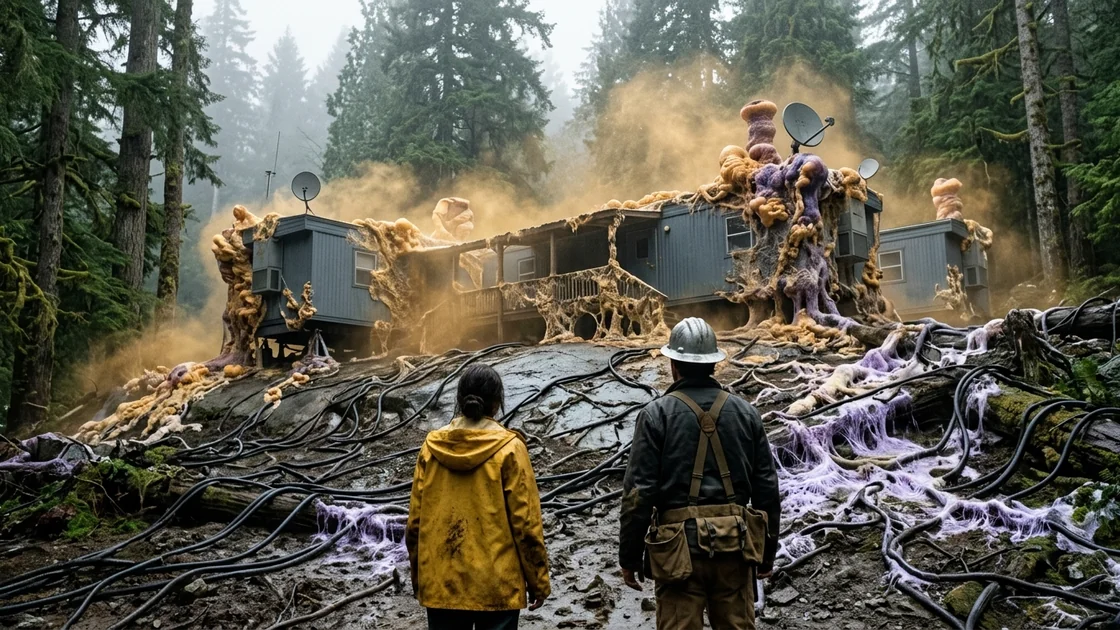
Deep within the uncharted valleys of the temperamental Pacific Northwest, a ruthless timber conglomerate establishes an advanced logging operation to clear-cut an ancient, untouched grove of monolithic conifers. Beneath the damp forest floor, however, lies a massive, hyper-evolved mycelial network that functions as a subterranean brain for the entire ecosystem. When the heavy machinery begins severing the oldest trees, the fungal superorganism does not waste its resources attacking the armored tractors or the laborers in the mud. Instead, it traces the acoustic and electrical signatures of the operation back to its nervous center: the elevated command trailers where the executives and surveyors direct the destruction. By fruiting exclusively beneath the administrative compound and pumping a targeted, psychoactive spore cloud through the ventilation systems, the forest hijacks the minds of the leadership, forcing them to experience the agonizing, slow-motion death of the woods until they dismantle their own operation from within.
The rain in the Ossian Basin did not fall so much as it hung suspended in the air, a perpetual, cold mist that turned the volcanic soil into a black grease capable of swallowing a D9 bulldozer up to its belly pan. To the thirty-six men and four women working the lower gravel flats of Sector Four, the dampness was an adversary that lived inside their boots, rotted the stitching of their Kevlar chaps, and turned every breath into a shallow sip of chilled soup. They lived in the Pit—a sprawling, mud-churned basin ringed by aluminum bunkhouses, diesel fuel bladders, and the deafening, twenty-four-hour roar of industrial generators.
Three hundred feet above the Pit, perched upon a scraped shelf of granite and ancient root-mat known as the Crown, sat the Brain Trust.
The Brain Trust consisted of four triple-wide modular trailers linked by enclosed, heated boardwalks. They were painted a pristine corporate slate-gray, elevated on concrete blocks and steel jacks, and crowned with a bristling array of Starlink dishes, microwave repeaters, and meteorological anemometers. Inside those trailers, the air was filtered, dehumidified to a crisp forty percent, and kept at seventy-two degrees. That was where Marcus Vance, the regional operations director for Boreal extraction at Vanguard Timber, drank his espresso and stared at three-dimensional LiDAR projections of trees that were already twelve hundred years old when the Magna Carta was signed.
Dr. Elena Rostova belonged to neither world, which meant she spent her days walking the steep, switchback haul road between them, her yellow slicker coated in gray clay up to the knees.
On a Tuesday morning in late October, the mist was thicker than usual, smelling faintly of crushed almonds and wet iron. Elena stood at the edge of Cut-Block A, watching a Tigercat feller buncher—a twenty-ton monster of yellow steel with a circular saw head capable of shearing through a five-foot trunk in twelve seconds—crawl over a ridge of moss-covered nurse logs. Beside her stood Cal Hendricks, the bull buck and senior timber cruiser, a man whose face looked like it had been carved out of Douglas fir bark with a dull hatchet.
"She’s fighting the grade," Cal muttered, spitting a stream of dark tobacco juice into a puddle that shimmered with hydraulic oil. He adjusted his dented aluminum hard hat. "Ground’s too spongy. There’s no frost in this valley, Doc. Never gets cold enough. Just rot on top of rot, forty feet down."
"It isn't rot, Cal," Elena said, her eyes fixed not on the machine, but on the trench its steel tracks were chewing into the earth. "It’s structure. Look at the trench wall."
Where the Tigercat had torn away a four-foot shelf of humus, the soil didn't crumble like ordinary dirt. It held together in a dense, fibrous mat, gleaming white and pale violet in the gloom. Millions of thread-like hyphae, woven so tightly they resembled wet felt, stretched across the raw earth. Thicker cords—rhizomorphs the diameter of coaxial cables, sheathed in a tough, black rind—snaked between the shattered roots of the hemlocks and Sitka spruces. Even from twenty yards away, Elena could see the severed ends of those black cords weeping a thick, opalescent fluid that steamed slightly in the forty-degree air.
"Looks like cobwebs and shoe leather to me," Cal said, though there was no malice in it. He had spent forty years in the woods; he knew when a forest felt wrong, even if he didn't have the Latin names for it. "My boys don't like it, though. The choke-setters say when they drag a log across that white stuff, it smells like a hospital. Like ether. Gives 'em headaches behind the eyes."
"Tell them to keep their gloves on," Elena said, kneeling at the edge of the track mark. She pulled a pair of titanium forceps and a sterile polycarbonate vial from her vest. "And tell them not to rub their eyes if they touch the exudate."
"You gonna shut us down over some toadstools, Doc?" Cal asked, half-hopeful, half-resigned. Vanguard paid double time for remote basin work, and his mortgage in Aberdeen was three months behind, but there was something about the Ossian tract that made his old logging scars ache. The trees here didn't grow in stands; they grew like fortress walls, their lower branches interlocks of dead, iron-hard wood, their canopies so dense that noon at the forest floor looked like twilight in a cathedral.
"I don't have the authority to shut down a chainsaw, Cal, let alone the whole camp," Elena replied grimly, snapping the lid onto the vial. "Vance hired me to fulfill Clause 14 of the federal lease. Monitor, catalog, and file a mitigation report six months after the clear-cut is finished. I’m window dressing with a doctorate."
She stood up, her knees popping, and looked up the slope toward the Crown. Through a gap in the weeping western red cedars, she could see the white roofs of the command trailers. Even from here, she could hear the high-pitched whine of their dedicated micro-turbine generator and the hum of their commercial HVAC units.
"You going up to the Hilton?" Cal asked, nodding toward the ridge.
"I have to run a chromatograph on this fluid," she said, holding up the vial. "And my portable unit in the mud-shack doesn't have the resolution. I need the terminal in Trailer Beta."
"Tell Vance the mud’s eating the skidders," Cal called after her as she started up the grade. "Tell him if we don't get thirty loads of crushed basalt trucked in by Friday, we’re gonna be winching iron out of the bog til Christmas."
Elena waved a gloved hand without looking back. As she climbed the steep gravel road that linked the Pit to the Crown, she pulled her magnifying loupe from her pocket and held the vial up to the gray sky. The fluid inside wasn't settling. Instead, tiny, luminescent filaments within the amber liquid were actively coiling around one another, forming a microscopic lattice against the plastic wall, pulsing with a rhythmic, synchronized contraction that looked disturbingly like a heartbeat.
The transition from the Pit to the Crown was always jarring, designed by Vanguard’s corporate architects to remind everyone of the hierarchy of industrial extraction. At the top of the ridge, the trees had been cleared in a rough circle two hundred yards across. Rather than hauling the topsoil away, the advance engineering crew had simply bulldozed the organic layer to the edges, laid down heavy geotextile fabric, and dumped six inches of washed river gravel over it before setting the four massive trailers onto their steel piers.
There was a boot-wash station at the bottom of the aluminum stairs leading up to the boardwalk. Elena spent three minutes scrubbing the dark Ossian clay from her Vibram soles with a stiff bristles-and-bleach brush before climbing onto the deck.
The four trailers were arranged in a square, facing an interior courtyard of wet gravel where the satellite uplinks and the primary transformer box sat. Trailer Alpha was Marcus Vance’s domain—executive offices, a conference room with a faux-mahogany table, and his private quarters. Trailer Beta held the GIS mapping suite, the surveyors' drafting tables, and the small corner counter they had begrudgingly allocated to Elena as a "field laboratory." Trailer Gamma was communications, logistics, and payroll, manned by two perpetually caffeinated clerks from Seattle. Trailer Delta was the executive galley and lounge.
Before opening the heavy, weather-stripped door to Trailer Beta, Elena paused. A strange odor was rising from the galvanized metal skirting that enclosed the crawlspace beneath the trailers. It wasn't the smell of wet gravel or treated lumber. It was warm, intensely sweet, and heavy—like overripe peaches rotting inside a cedar chest, underscored by the sharp, metallic tang of ozone.
She crouched down on the boardwalk and peered through one of the louvered ventilation grates in the skirting under Trailer Alpha.
Because the sun never truly penetrated the valley, the crawlspace was pitch black, yet she could see a faint, ghostly luminescence carpeting the geotextile fabric beneath the trailer. The fungal mat had punched straight through the heavy woven polypropylene—a material rated to resist root penetration for fifty years—and was climbing the steel jack-stands like ivy. Thick, velvety fans of mycelium, pale gold at the edges and bruised purple near the base, were clustering directly around the insulated copper conduits of the ground-source heat pumps and the thick black grounding rods driven into the earth below the main breaker box.
"It’s thermophilic," she whispered to herself, her breath fogging the cold metal grate. "No... electro-tropic."
The heavy door above her swung open, and the smell of ripe peaches was instantly washed away by the scent of roast beef and dry, conditioned air.
"Rostova? What are you doing down there, looking for dropped quarters?"
Marcus Vance stood in the doorway of Trailer Alpha. He was forty-five, lean from marathon running, wearing a pristine pair of pressed khaki cargo pants and a merino wool sweater that had never seen a drop of hydraulic fluid. He held a tablet in one hand and a porcelain mug in the other. His eyes, sharp and pale blue, scanned her muddy slicker with habitual distaste.
"The mycelium has breached the vapor barrier under your trailer, Marcus," Elena said, standing up and peeling off her damp gloves. "It’s colonizing the crawlspace. Specifically, it’s wrapping around your electrical grounding array and the HVAC intake ducts."
Vance sighed, the sound of a patient adult dealing with a slow child. "It’s a rainforest, Elena. Mold grows on things. That’s why we rent these trailers instead of buying them. When we pull out in eighteen months, the leasing company can bleach the undercarriage."
"This isn't mold," she said, following him into the warm, brightly lit corridor of Trailer Beta. Over by the wall-mounted plotters, Sarah Chen, the lead GIS technician, was hunched over a dual-monitor workstation, her headphones on, clicking rapidly through topographical layers. Across the room, Arthur Pendelton, the seventy-year-old company geologist, was examining core samples through a binocular microscope.
Elena walked to her cramped corner bench, set down the vial, and pulled up the data logs from the twelve soil-probe transponders she had buried across Sector Four two weeks prior.
"Look at this screen, Marcus," she said, tapping the monitor. "I’m serious. Give me thirty seconds."
Vance walked over, checking his watch. "Make it twenty. The helicopter from Port Angeles is bringing the mill buyers in on Thursday, and I’m still three thousand board-feet behind on the preliminary deck."
"When we arrived, I sequenced the ribosomal DNA from the primary fungal mat in the valley," Elena said, pulling up a dense web of genetic markers. "I expected to find Armillaria ostoyae—the standard honey mushroom that forms large subterranean colonies in the Northwest. What’s down there is a chimera. It shares thirty percent of its genome with Armillaria, twenty percent with Ophiocordyceps—the parasitic fungus that hijacks insect nervous systems—and fifty percent I cannot match to anything in the GenBank database."
"Congratulations," Vance said flatly. "Name it after yourself, publish a paper in Mycologia next year, and put Vanguard in the acknowledgments for funding your grant."
"You aren't listening," Elena snapped, causing Sarah to glance over from her GIS desk. "Fungi communicate via electrical action potentials—spikes of voltage that travel through their hyphae, very similar to animal neurons. Usually, background signaling in a forest floor occurs at a frequency of about one spike every five to ten minutes, at an amplitude of less than half a millivolt."
She switched the window on her monitor to a real-time oscilloscope reading from Transponder 4, located at the base of the Elder Grove—the stand of massive, twelve-foot-diameter Sitka spruces scheduled for felling that afternoon.
"Yesterday morning, when Cal’s crew cut the access road through the perimeter hemlocks, the voltage in the soil spiked to forty millivolts," Elena said, her finger tracing a jagged red line on the graph. "And the frequency shifted to forty hertz. In the human brain, forty hertz is a gamma wave. It’s the frequency associated with focused consciousness and active problem-solving."
Vance stared at the screen, then at her. For a moment, the silence in the trailer was broken only by the hum of the ventilation fan overhead and the rhythmic shhk-shhk of the wide-format printer spitting out a logging map.
"Are you telling me the dirt is thinking, Doctor?" Vance asked, his voice dropping into a dry, mocking register.
"I am telling you that the mycorrhizal network in this basin has an estimated biomass of four hundred thousand tons," Elena said evenly. "It connects the root tips of every single tree over a sixty-square-mile area. There are more hyphal junctions in a single cubic meter of this soil than there are synapses in your cerebral cortex. And right now, all of the electrical and chemical flow in Sector Four is converging on a single geographic point."
She clicked the mouse, overlaying the bio-electrical heat map onto Sarah’s topographical chart of the camp.
Down in the Pit, where the heavy machinery was roaring, where the diesel was spilling and the men were sleeping, the soil was electrically dead—a cool, dark blue on the display. The fungus had actually retracted its hyphae from the lower gravel flats.
Up here on the Crown, directly beneath the four command trailers, the map was a blinding, incandescent white.
"Why would it ignore the machines?" Arthur, the old geologist, asked from his stool, peering over his half-moon spectacles. He had been listening quietly. "If it’s a defensive response to trauma, as plants sometimes exhibit with tannins, wouldn't it concentrate at the site of the mechanical damage? Down at the cut-line?"
"Think about how a body works, Arthur," Elena said softly. "When a mosquito bites your arm, your skin releases histamines at the site, yes. But your eyes don't look at your own skin. Your eyes look for the mosquito. Down in the Pit, the machines move constantly. They are erratic, loud, transient trauma. Up here, we are stationary. We have four grounding rods pumping a steady sixty-hertz alternating current bleed into the bedrock twenty-four hours a day. Every time Marcus keys the mic on the high-band radio to order a cut down in the valley, the transmitter tower outside draws twelve kilowatts from the generator, and five minutes later, trees start dying."
She looked straight at Vance. "The network has correlated the electrical signature of these trailers with the destruction of the canopy. It knows the saws aren't the brain. It knows we are."
Vance took a slow sip of his cold espresso, his face an unreadable mask of corporate patience. Then he set the mug down on the corner of her desk.
"Elena," he said gently, "you’ve been out in the rain too long. The lack of sunlight gets to people in October. Take the afternoon off. Go over to Delta, have the cook make you a hot lunch, watch a movie on the server. Tomorrow, I want the routine water-turbidity samples from the creek below Block B. If you come at me with 'sentient dirt' again, I’ll have you on the Thursday chopper back to Port Angeles for a psychiatric evaluation, and Vanguard will find a compliance officer who sticks to counting spotted owls. Understood?"
He didn't wait for an answer. He turned on his heel, walked out of Beta, and crossed the breezeway back into Alpha, the heavy door slamming shut with a pneumatic hiss.
Across the room, Sarah pulled off one side of her headphones, rubbing her temples. "Is it warm in here to you guys?" she asked, her voice sounding slightly slurred. "And what is that smell? Did someone spill peach schnapps in the vent?"
Elena froze. She looked up at the white plastic ceiling register directly above Sarah’s desk.
Clinging to the plastic louvers was a barely visible film of iridescent, golden dust. Every few seconds, as the blower motor surged, a microscopic puff of the dust detached from the vent and drifted down into the beam of Sarah’s desk lamp, glittering like powdered amber before vanishing into the air they were breathing.
At 1:15 PM, down in the Elder Grove, Cal Hendricks stood fifty yards back from the base of a Sitka spruce they had spray-painted with a blue #1.
The tree wasn't just big; it was geological. Its flared buttress roots rose twelve feet above the moss like the flying buttresses of Notre Dame, thick enough that a man could carve a house inside the trunk and still have walls four feet thick. The Tigercat couldn't touch a tree this size; its mechanical head was only rated for thirty-six-inch timber. For the ancients, you needed a faller with a six-foot bar on a modified Stihl 881 Magnum, wedges made of high-impact magnesium, and nerves of cast iron.
Billy Boylan, their best timber faller, had been cutting into the giant for forty minutes. The roar of the two-stroke engine echoed off the wet canyon walls, a frantic, waspish snarl that seemed obscenely small against the massive silence of the grove. Sawdust the color of dried blood piled up around Billy’s calk boots.
"He’s into the heartwood!" Cal shouted into his shoulder mic, keying the frequency for the Crown. "Vance, you copy? Number One is on the hinge. Dropping in two minutes."
From the speaker clipped to Cal’s collar came a burst of static, followed by Vance’s voice. Except Vance didn't sound like his usual clipped, aggressive self. His voice was slow, dreamy, and distant.
"Copy that, Cal," Vance murmured over the radio. "Let the light in. It’s so dark under the roof. Just... let the sky down."
Cal frowned, pulling the mic away from his face to stare at it. Beside him, Miller, one of the rigging slingers, spat on the moss. "The hell is wrong with the suit? He been into the cough syrup?"
"Shut up and watch the widow-makers," Cal barked, though the hair on the back of his neck was standing up.
At the base of the spruce, Billy Boylan pulled the long bar free from the back-cut, killed the saw, and began hammering four magnesium wedges into the kerf with the flat of his five-pound axe. Clang. Clang. Clang. Each strike rang through the wet air like a church bell.
Then came the sound that every logger both lived for and dreaded: the first deep, pistol-shot crack of fibers parting that had held ten tons of crown aloft since the fall of Rome.
The giant didn't fall quickly. For five agonizing seconds, the top two hundred feet of the spruce barely seemed to move against the gray clouds, only a faint shudder running through its needles. Then, with a tearing groan that vibrated straight up through the soles of Cal’s boots and into his teeth, the hinge wood gave way. As the tree leaned, its canopy caught the intertwined branches of four neighboring hemlocks and an ancient cedar. Millions of root tips below the soil pulled taut against the earth.
Across a three-acre radius, the forest floor literally heaved upward by six inches as the subterranean root-plate levered against the bedrock.
Down in the trench that the Tigercat had dug earlier, the thick black fungal cords didn't just snap; they exploded outward like over-tensioned steel cables, whipping through the mud and releasing a geyser of pale, steaming mist from the torn earth.
The spruce hit the grade with an impact that registered 1.8 on Arthur Pendelton’s seismograph up on the ridge. A shockwave of displaced air, wet needles, and pulverized lichen blasted outward, knocking Cal back a step and obscuring the cut-block in a green-and-brown fog.
For ten seconds after the crash, nobody moved. Normally, the boys would let out a whoop when a monster hit the dirt clean without barber-chairing. Nobody whooped today.
In the sudden, ringing silence after the chainsaw died, the forest was making a sound. It wasn't the settling of branches or the dripping of rain. It was coming from the ground beneath their feet—a low, subterranean thrumming, like a high-voltage transformer buried under six feet of wet wool.
Up on the stump, which was wide enough to park a pickup truck on, the raw yellow wood was already bleeding. Not pitch, and not sap. From a thousand microscopic pores in the sapwood, thick white threads were extruding upward at a visible speed, writhing in the cold air like blind nematodes, reaching blindly toward the empty space where the trunk had been.
Billy Boylan scrambled off the stump so fast he dropped his saw into the slash pile, his face white under his grease-stained beard.
"Cal!" Billy choked out, backing away through the ferns, his hands shaking. "Cal, look at the butt! It’s moving! The goddamn wood is crawling!"
Up in Trailer Beta, Elena wasn't looking at the stump; she was looking at her laptop screen, and she was wearing an industrial half-face respirator with dual magenta P100 particulate cartridges.
When the spruce had fallen down in the valley, the voltage reading on her oscilloscope hadn't just spiked; it had pegged the needle at two volts and blown the internal fuse on Transponder 4. Three seconds later, the floor of Trailer Beta had shuddered—not from the impact of the tree half a mile away, but from a sudden, violent hydrostatic expansion directly beneath the trailer’s steel piers.
Through the window of Beta, Elena looked out into the central courtyard between the four trailers.
The washed river gravel was gone. In the space of two hours since lunch, the mycelium had erupted through the stones across the entire fifty-yard compound, forming a thick, undulating carpet of bruised-violet and golden velvet. Out of this mat, hundreds of fruiting bodies had inflated with terrifying speed. They didn't look like mushrooms; they looked like pleated, translucent chimneys, each two feet tall and pulsing like bellows.
With every rhythmic contraction of the chimneys, a dense, glittering cloud of amber spores was pumped into the air.
What terrified Elena as a scientist wasn't just the speed of the biomass generation—which required a metabolic rate that should have cooked the soil to a hundred and fifty degrees—it was the aerodynamics of the cloud.
A stiff ten-knot wind was blowing down from the mountain pass, which should have carried the spores down the ridge into the Pit or out across the valley. It wasn't. The spore cloud hung in a sharp, hemispherical dome exclusively over the four command trailers. When gusts of wind hit the perimeter of the compound, the golden dust swirled inward, held in place by an invisible wall.
Elena checked her electrostatic field meter on the bench. The fungal mat beneath the trailers was using the sixty-hertz bleed from the generator’s grounding rods to ionize the ground at a high negative potential, while the spores themselves were being ejected with a strong positive static charge. The cloud was electrostatically tethered to the trailers. It couldn't blow away any more than iron filings could blow off an electromagnet.
And the four massive Carrier HVAC units outside the trailers were sucking that concentrated, positively charged fog straight into the return plenums at twelve hundred cubic feet per minute.
"Sarah," Elena said, her voice muffled and robotic through the rubber respirator mask. She walked over and grabbed the younger woman’s shoulder. "Sarah, stand up. We have to leave the compound right now. Hold your breath, put your jacket over your face, and walk down the road to the Pit."
Sarah didn't flinch. She wasn't wearing her headphones anymore. She was staring at her twenty-seven-inch monitor with pupils so dilated that the brown of her irises was reduced to a hairline ring. A thin trail of saliva ran down her chin, catching the golden light of the spores swirling around her hair.
On her screen, the LiDAR map of the Ossian Basin was gone. In its place, Sarah had opened the vector-drawing tool and spent the last hour drawing millions of intersecting white lines over the regional highway grid, the town of Port Angeles, and the Puget Sound—turning the human geography of Washington State into a massive, fractal hyphal web.
"It’s not a map, Elena," Sarah whispered, her fingers still twitching rhythmically on the mouse, clicking on nothing. "We thought it was timber cruising. We were measuring the skin on the ribs. Do you know how long it takes to grow a thought in the dark? Four hundred years to move a calcium ion from the creek to the ridge. And Billy just cut the optic nerve."
A tear rolled down Sarah’s cheek, though she was smiling—a terrible, beatific smile of absolute comprehension. "I can feel the sun going out on the south slope. It hurts so much, Elena. My left arm is drying up. The needles are falling off my fingers."
Elena looked over at Arthur Pendelton. The old geologist wasn't at his microscope. He was lying flat on his back in the middle of the linoleum floor, his shirt unbuttoned, pressing his bare chest and cheek against the cold vinyl tiles as if trying to listen to a heartbeat through a floorboards. His fingers were clawing weakly at the seam where the wall met the floor, his fingernails ragged and bleeding as he tried to pry up the baseboard to reach the subfloor beneath.
"So thirsty," Arthur whimpered into the linoleum. "The potassium is locked in the feldspar... we have to dissolve the stone... let me down into the wet, please, it’s too dry in this box..."
Elena backed toward the door, her heart hammering against her ribs at a hundred and四十 beats per minute. She pulled a second respirator from her field bag, intending to strap it over Sarah’s face by force, when the intercom speaker on the wall crackled to life.
It was an all-camp broadcast from Trailer Alpha. Marcus Vance’s voice filled not only the four command trailers, but also blasted from the bullhorns mounted on the light towers down in the Pit.
"Attention all personnel in Sector Four," Vance said. His voice was no longer dreamy; it was vibrating with a strange, polyphonic resonance, as if he were speaking from the bottom of a deep well while three other people whispered the exact same words a fraction of a second behind him. "Cease all mechanical rotation immediately. The iron is biting the phloem. Repeat, shut down the diesel engines. The noise is vibrating the root hairs and we cannot hear the nitrogen."
Elena abandoned the spare mask, bolted out of Trailer Beta onto the boardwalk, and nearly slipped.
The wooden planks of the walkway were already covered in two inches of damp, golden dust that felt like warm cornstarch under her boots. The air outside was so thick with spores that Trailer Alpha, twenty feet away across the courtyard, looked like a ghost ship emerging from a mustard-gas bank. The silence up here was absolute, save for the hum of the generators and the wet, rhythmic huff-huff-huff of the fungal chimneys below the deck.
She ran across the boardwalk and threw open the door to Trailer Alpha.
Inside the executive suite, the thermostat had been turned all the way up to ninety degrees, and someone had poured five-gallon jugs of Alhambra water cooler water all over the plush gray carpet until it squelched underfoot.
The two payroll clerks from Trailer Gamma were sitting cross-legged in the corner of the conference room, their arms wrapped tightly around each other’s torsos, their heads tilted back with their mouths open beneath the ceiling vent, inhaling the falling gold dust like drowning men gasping for air at a hole in the ice. Their skin was flushed a deep, feverish crimson, and the veins in their necks stood out in stark violet relief.
At the far end of the room, Marcus Vance stood before the massive wall-mounted plasma screen that displayed the live camera feeds from the logging blocks.
He had stripped off his merino sweater and his shirt. He was standing barefoot in the soaked carpet, holding a pair of stainless-steel office scissors in his right hand. With slow, methodical precision, he had been cutting shallow, vertical lines down the skin of his own left forearm—not deep enough to hit an artery, just deep enough to let thin, parallel ribbons of blood run down his wrist and drip onto the wet carpet, just like a pine tree being tapped for turpentine.
"Marcus!" Elena screamed through her mask, lunging forward and grabbing his right wrist with both hands.
Vance turned his head toward her. His pale blue eyes were completely clouded over with a milky, iridescent film that reflected the green light of the computer monitors. He didn't fight her grip; his muscles felt strangely rigid, like green wood under bark.
"You’re wearing rubber on your face, Doctor," Vance said calmly, his voice dripping with a profound, maternal pity. "You’re starving yourself. Take it off. You don't know how lonely you are inside your skull. One little primate brain, locked in bone, talking only to itself from birth to rot. Do you know how quiet it is when you let the threads in?"
"You’re inhaling a neurotoxic alkaloid, Marcus!" she yelled, trying to drag him toward the door, though he felt like he weighed four hundred pounds. "It’s an Ophiocordyceps derivative! It’s mimicking serotonin in your prefrontal cortex and rewriting your proprioception! You aren't a tree, Marcus, you’re bleeding on a rug!"
Vance looked down at his arm as if seeing it for the first time, then looked back at the live camera feed of Cut-Block A, where the giant Sitka spruce lay shattered across the mud.
"When the saw went through the cambium down there," Vance whispered, a violent shudder racking his bare shoulders, "I felt the sap pressure drop in my spine, Elena. I felt three hundred years of summers pour out into the dirt. And they’re going to put a choker chain around my ribs and drag me behind a tractor."
He suddenly wrenched his wrist free from her grasp with a strength that tore the fabric of her slicker, though he didn't strike her. Instead, he lunged across the mahogany table and slammed his bleeding palm down onto the big red emergency stop button wired into the camp’s central fuel-pump telemetry, then grabbed the base-station microphone.
"Cal!" Vance roared into the mic, his voice cracking with raw, somatic agony. "Bury the saws! Take the excavators and dig a trench in the gravel and bury the iron! If another tooth touches bark, I will lock the fuel bladders and burn the bridge over the gorge! Do not cut me! Do not cut me!"
Down in the Pit, forty men stood in the rain around the silent yellow machines, staring up at the bullhorns on the light poles.
The diesel engines were all off. Cal had ordered them shut down ten minutes ago, not because Vance had lost his mind on the radio, but because the air filters on three of the Caterpillar skidders had simultaneously clogged with a fast-growing, white fibrous slime that had blown out of the exhaust stacks like burnt marshmallows before stalling the turbos.
"He’s hopped up on something," Billy Boylan said, gripping a tire iron like a club as he stared up the muddy haul road toward the Crown. "The whole lot of 'em up in the trailers. They’re cooking meth up there or something."
"Marcus Vance don't do dope, Billy," Cal said grimly. He had a pair of Zeiss binoculars pressed to his eyes, trained on the ridge three hundred feet above them. "And dope don't make a yellow haze hang over the trailers in a ten-knot crosswind."
Through the magnifying lenses, Cal could see the edge of the Crown. It looked like the compound was sitting inside a snow globe filled with murky amber water. The mist was so sharply defined that he could see a hemlock branch hanging three feet outside the perimeter fence dripping clear rainwater, while the fence post itself was coated in pulsing, golden velvet.
Just then, a figure burst out of the golden dome at the top of the haul road, stumbling down the steep gravel grade at a dead run. It was Doc Rostova. She had her rubber respirator strapped to her face, and she was dragging a bulky aluminum briefcase—her portable chromatograph—while waving her free arm wildly above her head.
Cal didn't wait. He keyed his local walkie-talkie. "Miller, fire up the crew buses. Leave the low-boys, leave the skidders, leave your personal gear in the bunkhouses if you can't grab it in thirty seconds. We’re pulling out to the state highway."
"Cal, there’s four million dollars of iron sitting in this mud!" Miller protested from down by the mechanics' shed. "Vance’ll fire every man on this crew when he sobers up!"
"Look at the road, you idiot!" Cal shouted back.
Down the switchbacks behind Elena, the mud wasn't just mud anymore. The white mycorrhizal cords that had been exposed by the tractor tracks earlier that morning were weaving together across the gravel surface like time-lapse photography of vines, pulling loose river cobbles into a ragged, calcification-hard barricade across the lower turnouts.
Elena reached the bottom of the grade, her breath whistling loudly through the pink filter cartridges, and collapsed against the hood of Cal’s F-350 pickup. She tore the mask off her face, gasping the cold, clean, rain-washed air of the lower basin, and immediately began vomiting clear bile onto the gravel.
Cal grabbed her by the shoulders of her slicker to keep her upright, handing her a half-empty canteen of water from his truck bed. "Doc! Easy, easy. Spit it out. How many of 'em are coming down behind you?"
Elena rinsed her mouth, spat, and wiped her lips with the back of a shaking hand. Her eyes were wild, bloodshot, and terrified.
"None of them," she gasped, clutching the front of Cal’s flannel shirt. "They won't leave. I tried to pull Sarah out of her chair and she bit my glove through to the skin. The spores... they aren't a poison, Cal. They’re a neurotransmitter."
"In English, Doc!" Cal yelled over the roar of the two yellow school buses—used to haul the crew in and out of the mountains—as their Detroit Diesel engines coughed to life across the yard.
"Insects!" she panted, scrambling into the passenger seat of his pickup as he shoved her inside. "When Cordyceps infects a carpenter ant, it doesn't kill the ant right away. It grows around the ant's muscles and floods its brain with chemicals that make the ant want to climb to the highest leaf and clamp its jaws down so the fungus can fruit in the sun. The ant thinks it’s doing what it wants. That’s what’s happening in the trailers!"
Cal ran around the hood, jumped behind the wheel, and slammed the truck into four-wheel low. Around them, the thirty-six loggers were piling into the two buses in a panicked stampede, leaving chainsaws, toolboxes, and lunch coolers lying in the mud.
"Why didn't it hit us down here?" Cal demanded, spinning the wheel and fishtailing the heavy pickup through the black grease behind the second bus. "We’re the ones with the saws! Billy’s the one who dropped that spruce!"
Elena looked back through the rear window as the truck bounced violently over the ruts of the main logging road leading toward the gorge bridge.
"Because you aren't the ones who decided to come here," she said, her voice dropping to a hollow whisper as she watched the ridge disappear into the low clouds. "A woodcutter doesn't waste energy fighting the axe handle, Cal. He breaks the hand that swings it. And the network didn't want to kill them. If Marcus dies, Vanguard just sends another regional director next week. The forest needed Marcus alive. It needed him at the terminal."
Before they reached the timberline above the gorge, Cal’s dashboard radio crackled one last time.
It wasn't voice transmission anymore. It was the high-speed, warbling modem screech of the Starlink uplink in Trailer Beta transmitting massive packets of encrypted data back to Vanguard Timber’s corporate headquarters in Seattle, followed by the voice of Sarah Chen.
"Geological survey update, Sector Four, Ossian Basin," Sarah recited over the open channel. Her voice was utterly calm, professional, and devoid of the panic from earlier—as if she had reached a profound, tranquil equilibrium with whatever was living behind her eyes. "Core samples from Drills One through Twelve indicate severe subterranean karst instability and massive mercury contamination in the water table. Timber heartwood exhibits ninety-percent dry-rot saturation. Economic viability index is zero. I have executed the digital surrender of Federal Lease 88-B on behalf of Director Vance and transferred the parcel deed to the Wilderness Land Trust. All payroll accounts have been settled in full. Do not send recovery crews. The bridge is out."
A second later, three miles ahead of Cal’s truck, a dull, ground-shaking thump echoed up from the narrow granite gorge where the private logging road crossed the Ossian River.
Cal stood on the brakes, bringing the F-350 to a sliding halt on the slick gravel just as the two yellow crew buses rounded the last bend before the canyon.
The bridge wasn't blown up with dynamite. They didn't have explosives in the camp.
When Cal and the crew got out in the pouring rain at the edge of the chasm, they saw what had happened. The bridge was a sixty-foot modular steel Bailey span resting on massive concrete abutments poured into the canyon walls six months ago.
Beneath the eastern abutment, the ancient root network of four cliff-side Douglas firs and a subterranean mat of black rhizomorphs as thick as firehoses had swollen with thousands of gallons of river water, expanding into the micro-fractures of the granite and concrete with the slow, inexorable hydraulic force of freezing ice. The concrete foundation hadn't shattered; it had simply been pried six feet outward from the cliff face by a living wedge of fungal tissue and root wood.
The steel span hung twisted and vertical against the far canyon wall like a broken drawbridge, forty feet above the churning white water of the river below.
On the hood of Cal’s truck, Elena started to laugh—a short, sharp, hysterical sound that was quickly swallowed by the roar of the rapids.
"We can walk out across the shallow ford two miles downstream," Cal said quietly, his grizzled face pale as he stared at the pulsing, violet-black mass of fibers that was already weaving over the torn steel girders of the abutment, sealing the wound in the rock. "It’ll take us six hours in the dark to reach the highway on foot."
"It’ll let us walk out, Cal," Elena said, pulling her yellow hood up over her wet hair as the men began filing out of the buses, silent and awed, looking back up toward the dark wall of the ancient timber. "We’re just spores blowing off on the wind now."
Four days later, the rain stopped, and a rare high-pressure system pushed the clouds out of the Ossian Basin, letting shafts of pale, emerald-tinted sunlight lance down through the three-hundred-foot canopy for the first time in a month.
Because the lease cancellation and the geological hazard filings had been entered into the federal and corporate databases with Marcus Vance’s biometric security keys and Sarah Chen’s certified digital stamps, Vanguard Timber’s board of directors in Seattle had merely cursed the seven-figure write-off, filed an insurance claim on the stranded machinery due to the collapsed bridge, and shifted their Q4 cutting quotas to a second-growth pine plantation in Idaho. Nobody comes looking for a logging camp that fires itself and balances its own books on the way out the door.
Up on the Crown, the micro-turbine generator had finally run out of diesel forty-eight hours ago. The silence on the ridge was now complete, broken only by the dry rustle of wind in the high spruce crowns and the deep, resonant croak of ravens.
The four triple-wide command trailers were no longer slate-gray.
A thick, glistening mantle of Armillaria-Cordyceps mycelium had completely enveloped the aluminum siding, the roofs, and the satellite dishes, turning the compound into four interconnected mounds of velvety, golden-brown moss and shelf fungi that looked as though they had been sitting in the clearing for a thousand years. Beneath the trailers, secret enzymes—evolved to break down the complex lignins of ironwood and ancient cedar—were already digesting the PVC plumbing, the rubber tires, and the fiberglass insulation, converting the petrochemicals into simple sugars and carbon chains and pumping them down the slope through the black rhizomorphs to feed the severed root tips of the Elder Grove.
Inside Trailer Alpha, the roof panels had been gently pried open by thick, braided ropes of white hyphae that hung down like cathedral pillars, letting the afternoon sun stream into the room.
There was no smell of decay. There was only the intoxicating, overwhelmingly sweet scent of peaches, wet cedar, and ozone.
Marcus Vance sat in his leather executive chair at the head of the conference table. To his left sat Sarah Chen; to his right, Arthur Pendelton and the two clerks from Seattle.
They were not dead. Their chests rose and fell in slow, synchronized breaths—once every forty-five seconds, a metabolic hibernation rate maintained by the rich slurry of glucose, amino acids, and oxygenated fluid being pumped directly into the capillaries of their lower legs and forearms by the translucent, velvet cuffs of mycelium that had fused seamlessly with their skin, pinning them gently to the carpet and the wood of the table.
Their eyes were open, coated in a protective, bioluminescent pellicle that kept the corneas moist without blinking.
If Elena Rostova had been there with her electroencephalograph to measure the electrical activity inside Marcus Vance’s skull, she would have found that his individual human brainwaves—the frantic, anxious beta waves of quarterly projections, divorce settlements, and mortgage rates—had ceased entirely. In their place was a slow, majestic, forty-hertz gamma oscillation that rose from the floorboards, passed through his visual cortex, and flowed back out down his spine into the earth, perfectly phase-locked with the electrical pulse of twelve million trees stretching from the coast range to the glacier peaks.
Down in Cut-Block A, where the giant Sitka spruce numbered #1 had been felled five days ago, the twelve-foot stump was completely capped in a dome of tough, leathery fungal tissue, sealing the vascular system against rot.
Around the perimeter of the stump, nourished by the nitrogen and phosphorus being systematically reclaimed from the four trailers on the ridge, twelve tiny, bright-green spruce saplings had already pushed their way through the golden mat, unfolding their needles toward the gap in the sky, while the mind beneath the dirt settled back into its ten-thousand-year dream.
Part II: The Winter Audit
In January, when the rest of the Olympic Peninsula was locked under three feet of heavy, wet snow, the Ossian Basin remained an anomaly on the infrared weather satellites.
From four hundred miles up in low-Earth orbit, the valley glowed with a steady, fifty-five-degree thermal signature, a bruised-purple thumbprint of warmth pressed into the white expanse of the coastal range. The state forestry department attributed it to geothermal venting along the Olympic fault line—an explanation that satisfied everyone except the people who had actually walked out of the gorge on that Tuesday in October.
Dr. Elena Rostova was no longer employed by Vanguard Timber. After refusing to sign the standard corporate non-disclosure agreement upon her return to Port Angeles—and after the toxicological blood panel she had drawn from her own arm in the hospital parking lot was mysteriously lost by the private lab Vanguard used for workman’s comp claims—she had retreated to a basement office at the University of Washington’s botanical extension in Forks.
She had kept the polycarbonate vial from the Tigercat trench.
She kept it inside a lead-lined biological containment cooler in her garage, unplugging the unit’s digital temperature display because she had noticed, within three days of bringing it home, that the mycelium inside the glass had begun pressing against the wall nearest the thermistor probe, pulsing its own bioluminescence in binary intervals that caused the LED readout on the outside of the box to flicker wildly between 40.0 and 00.0.
On the fourteenth of January, a battered Ford F-350 with rusted wheel wells pulled into the gravel driveway of her rented bungalow. Cal Hendricks got out, leaving the truck idling, his breath pluming white in the freezing rain. He looked ten years older than he had in October. He had lost thirty pounds, his Carhartt coat hung loose off his stooped shoulders, and he walked with a stiff, cautious gait, as if he didn't quite trust the concrete of the driveway not to open up and grab his ankles.
Elena met him on the porch, holding two mugs of black coffee. She didn't ask how he had found her address; Forks only had three thousand people, and half of them worked in the woods.
"Billy Boylan’s in the state hospital down in Steilacoom," Cal said without preamble, wrapping his gnarled hands around the hot ceramic mug without taking a drink. "His wife had him committed on New Year’s Eve."
Elena leaned against the porch railing, watching the rain drip from the cedar shakes. "Did he inhale the cloud? I thought the crew down in the Pit was clear of the electrostatic boundary."
"He didn't breathe the gold dust," Cal said, staring down into the black coffee. "He got the sap on his hands when he pulled his wedges out of that big spruce. Remember? He dropped his saw and came running back through the ferns."
"Cutaneous absorption," Elena murmured, her stomach tightening. "What are his symptoms?"
"He won't go indoors," Cal said quietly. "His wife said he started sleeping out in the backyard in November, right in the mud under their rhododendron bushes. When it froze in December, he took a pickaxe and tried to dig up the basement floor so he could lie on the dirt under the foundation. When the sheriff’s deputies pulled him out, he wasn't violent. He just kept crying and telling them that the people up on the Crown were calling Roll, and he was late for his shift."
Cal finally looked up at her, his rheumy gray eyes sharp under his bushy brows. "Vanguard’s sending a salvage crew in tomorrow morning, Doc."
Elena’s coffee mug stopped halfway to her mouth. "They cancelled the lease. Sarah wiped the timber value from the database."
"They don't care about the trees anymore," Cal said. "The insurance company refused to pay out on the heavy iron because there was no police report or federal inspection of the bridge collapse. There’s six million dollars' worth of Tigercats, yarders, and computer gear sitting in Sector Four. Vanguard hired a heavy-lift helicopter outfit out of Oregon—one of those big Sikorsky Skycranes—and a twelve-man rigging crew from Montana who don't know shit about what happened in October. They’re flying in at dawn to sling-load the machines out over the gorge and pull the server racks out of the trailers."
"If they open those trailers, Cal, they’ll breach the fruiting dome," Elena said, setting her mug down on the railing with a sharp clack. "In October, the fungus was reacting locally because it didn't understand what a helicopter or a highway was. Since then, it’s had Marcus Vance, a geologist, and a GIS mapper wired into its neural net for ninety days. Do you understand what that means?"
Cal frowned. "Means they’re dead and rotted by now, Doc."
"No," Elena said, walking toward her front door and grabbing her heavy winter parka and the keys to her Subaru. "When a parasite integrates with a host nervous system, the information flow isn't one-way. Right now, that network knows what Seattle is. It knows how internal combustion engines work, it knows where the municipal watersheds are, and it knows that humans travel across the continent in pressurized aluminum tubes. If they drop a Skycrane into that clearing and give it a ride out of the basin..."
She stopped at the bottom of the porch steps, looking at Cal’s pickup.
"Do you still have the gate keys for the lower service road?" she asked.
"I got a blowtorch and a set of bolt cutters in the bed," Cal said, turning back toward his truck. "And I got two cases of agricultural fungicide—copper sulfate and propiconazole—that I bought off a cranberry farmer in Grayland. Figured if I was ever gonna sleep through the night again, I needed to see what was left of that place."
"Leave the fungicide in the truck, Cal," Elena said, climbing into the passenger seat of the F-350, the familiar smell of wet dog, Copenhagen tobacco, and diesel filling her nostrils. "Throwing copper sulfate at that basin would be like throwing a cup of bleach into the Pacific Ocean. We aren't going up there to kill it. We have to warn it."
They reached the washed-out gorge at four in the morning.
The rain had turned to sleet at the two-thousand-foot elevation, rattling against the windshield like thrown gravel. Cal killed the headlights a mile back from the river, navigating the overgrown, alder-choked rut of the old logging road using only the pale green glow of a pair of surplus night-vision goggles he had strapped over his woolen beanie, while Elena watched the thermal camera display on her tablet.
When they stepped out of the truck at the edge of the canyon where the Bailey bridge had fallen, they didn't need the thermal camera to see that the Ossian Basin had changed.
The air rising from the valley across the river was twenty degrees warmer than the freezing sleet on their side of the gorge. Where the steel bridge had hung twisted against the far cliff in October, there was now a new span.
It was woven entirely from the living, braided roots of the cliff-side Douglas firs and calcified black rhizomorphs as thick as structural steel I-beams. Over the past three months, the fungus had dissolved limestone and basalt from the canyon walls, precipitating calcium carbonate and magnesium directly into its own chitinous cell walls until the organic bridge was literally petrified into living bone-stone. Across the top of the span, a thick carpet of bioluminescent violet moss glowed softly in the pre-dawn dark, illuminating the path into the trees like an airport runway.
"Jesus H. Christ," Cal whispered, his breath steaming as he pulled his .45-70 Marlin lever-action rifle from the scabbard behind his seat—a weapon meant for coastal grizzly bears that felt entirely pathetic in his hands as he looked at the petrified root-bridge. "It built a road."
"Not a road out," Elena said, strapping her full-face polycarbonate respirator over her head and checking the seal. She handed Cal a second full-face mask from her pack. "Look at the root angles on our side of the cliff. The buttresses are flared against the eastern bank. It didn't cross the river to expand; it reinforced the gap so the bank wouldn't erode into the water. Put your mask on, Cal. Don't unseal it for anything."
They crossed the living bridge on foot. Beneath their boots, the calcified mycelium didn't feel like wood or stone; it had a slight, elastic give, like walking across the back of a sleeping whale. With every step they took, a faint ring of pale blue light rippled outward from their heels and raced ahead of them up the haul road into the dark forest, forty miles an hour—a sensory nerve impulse announcing their exact weight, gait, and direction to the Crown two miles away.
When they reached the lower gravel flats of the Pit at five-thirty, the gray false dawn was just beginning to filter through the high canopy.
The Pit was gone. The thirty-foot mounds of crushed gravel, the diesel bladders, the aluminum bunkhouses, and the six twenty-ton yellow logging machines had been completely swallowed by the forest floor.
The machines hadn't been dragged away; they had been sunk. By liquefying the soil beneath the heavy steel tracks and pumping the displaced mud over the cabs, the network had buried the bulldozers and feller bunchers twenty feet below grade, leaving only a rolling, park-like meadow of waist-high sword ferns and glowing golden shelf-mushrooms where the industrial yard had been. Only the top three feet of the Tigercat’s boom arm still protruded from a moss bank in the center of the glade, wrapped in thick white cords that were slowly rusting the hydraulic cylinders into iron oxide to feed the ferns.
"There’s nothing left for the Skycrane to hook onto," Cal said, his voice muffled by the voice-emitter diaphragm of his mask. He walked over to the protruding boom arm and tapped the steel with the barrel of his rifle. Instead of a metallic ring, it gave a dull, hollow thud; the high-grade alloy had been pitted and honeycomb-etched by oxalic acid excreted by the hyphae until it was as brittle as rusted tin.
"The machines were down here," Elena said, pointing up the steep switchback road toward the ridge. "The server racks are up on the Crown. Vanguard wants the geological survey data. Arthur’s core logs showed something else in this valley besides trees, didn't they, Cal? Why did a timber company have a full-time hard-rock geologist on site?"
Cal stopped, looking up the hill. For a long moment, only the drip of water from the cedar boughs broke the quiet.
"Neodymium," Cal said finally. "And lithium in the pegmatite dikes under Block C. That’s why Vance was in such a hurry to clear the timber before the winter rains shut the roads down. The trees were just the overburden, Doc. They were gonna strip-mine the whole basin come spring."
Elena stared at him through her visor. "And Arthur was sitting on the floor of Trailer Beta trying to claw through the linoleum, talking about feldspar and potassium. He wasn't just hallucinating; the fungus was reading his geological memory while he was under."
She turned and started climbing the switchback road toward the Crown as fast as her boots could find traction on the moss.
Halfway up the grade, they heard the first low, rhythmic whop-whop-whop of heavy rotor blades echoing over the snow-covered peaks to the south.
When Elena and Cal crested the ridge onto the Crown, the sun was just cresting the eastern rim of the mountains, turning the winter mist into a blinding sheet of silver.
The four command trailers no longer looked like buildings at all. They had been fused together into a single, thirty-foot-high dome of calcified, bone-white chitin and living cedar wood, shaped remarkably like a colossal puffball mushroom or a subterranean termite cathedral. The satellite dishes on the roof had been dismantled by creeping vines and reassembled into a wide, parabolic acoustic horn facing the southern mountain pass—a giant ear of sheet metal and woven hyphae turned toward the approaching helicopter.
There were no spores in the air anymore. The air on the Crown was crystal clear, warm, and completely odorless.
Elena walked up to the side of the dome where the door to Trailer Alpha had once been. The aluminum door was gone, replaced by a translucent, fibrous membrane as clear as glass and six inches thick, pulsing with a slow, golden light from within.
She pressed her gloved hand against the warm membrane and looked inside.
The interior of the trailers had been hollowed out into a single, vaulted chamber lined with luminous white velvet. In the center of the chamber, where the conference table had been, the five people—Marcus Vance, Sarah Chen, Arthur Pendelton, and the two clerks—were no longer sitting in chairs.
Over the past three months, the mycelium had woven a cradle of soft, vascular tissue around them, suspending them upright in a circle, their backs fused to a central pillar of white hyphae that rose from the earth and branched into the ceiling like the trunk of an oak. Their clothes had long since been digested away. Their skin was pale, translucent, and completely free of blemishes or bedsores, laced with a delicate sub-dermal filigree of violet filaments that glowed gently in time with their shared respiration.
As Elena watched, Marcus Vance’s head turned slowly toward the membrane. His eyes—still clear beneath their protective, iridescent lenses—focused directly on her face.
He didn't open his mouth. He didn't need to.
Fifty feet away, the surviving metal horn of the camp’s PA system, which was now growing out of the top of the dome like a trumpet flower, emitted a burst of static, followed by a voice synthesized from spliced fragments of a thousand old radio logs recorded in Trailer Gamma’s memory banks.
"Go... down... the... hill... Doctor," the speaker crackled, splicing Vance’s baritone with Sarah’s soprano and Cal’s own gravelly voice from October. "The... wind... is... coming."
From the southern pass, the Sikorsky S-64 Skycrane cleared the ridge line, its twin turbine engines roaring at four thousand horsepower each, its massive, seventy-two-foot main rotor beating the cold air into a hurricane as it banked over the valley and dropped toward the Crown. Beneath its skeletal orange fuselage hung a hundred-foot steel winch cable and a four-pronged grappling hook. In the glass bubble of the cockpit, two pilots and an aft-facing loadmaster in orange flight suits looked down at the strange, overgrown mound where the trailers should have been.
"Cal, get down!" Elena screamed, tackling the old logger behind a massive breastwork of bulldozed stumps at the edge of the clearing.
The Skycrane didn't get within two hundred feet of the ground.
As the helicopter hovered directly over the Crown, its rotor wash flattening the ferns across the ridge, the central apex of the white dome split open along four perforated seams, peeling back like the petals of a giant star-flower.
Inside the chimney wasn't the slow, drifting amber dust of October.
Powered by the hydrostatic pressure of an entire mountain watershed channeled through a million miles of subterranean root-pipes, the dome fired a geyser of compressed, liquid-suspended spores straight up into the helicopter’s rotor wash at two hundred pounds per square inch.
It looked like a geyser of liquid gold erupting from a blowhole.
The updraft and swirl of the Sikorsky’s own blades caught the aerosolized plume and sucked it straight into the twin turbine air intakes at the top of the fuselage.
However, these spores were not the delicate neurotic alkaloids designed for human lungs. In the ninety days since October, using Arthur Pendelton’s knowledge of inorganic chemistry and the scrap metal of the buried tractors down in the Pit, the network had synthesized a new strain of spore—one coated in microscopic, hyper-reactive filaments of elemental iron, aluminum stripped from the trailer siding, and sticky, long-chain polyisoprene latex derived from the digested rubber tires of the skidders.
The moment the cloud hit the twelve-hundred-degree combustion chambers of the Pratt & Whitney turboshaft engines, the thermite-laced latex flashed into a vitreous, ceramic slag that fused instantly onto the compressor blades and choked the fuel injectors in half a second.
Both engines died with twin, muffled bangs and a gout of bright purple smoke.
"Autorotation!" Cal yelled, watching the orange giant drop like a stone as the pilot pitched the blades to catch the air. "He’s gonna put it in the trees!"
The Skycrane didn't hit the trees. As the thirty-thousand-pound helicopter plummeted toward the clearing at the edge of the Crown, forty massive western red cedars and Sitka spruces bordering the compound—trees whose root systems were now wired into a high-speed muscular hydraulic grid—did something no botanist in human history had ever witnessed.
By instantaneously dumping turgor pressure from the northern sides of their trunks and pumping fifty tons of pressurized sap into their southern vascular bundles, the two-hundred-foot trees leaned inward by fifteen degrees across the perimeter of the clearing, interlocking their massive, iron-hard upper branches into a woven basket eighty feet above the ground.
The falling Skycrane slammed into the living net of three-foot-thick cedar limbs with a deafening crash of shattering Plexiglas and shrieking aluminum. The branches bowed twenty feet under the kinetic impact, shedding tons of green needles and bark, groaning like ship timbers in a typhoon—and held.
Before the stunned pilots could even unbuckle their harnesses inside the tilted cockpit eighty feet in the air, thick, black rhizomorphs that had been waiting in the upper canopy—having grown all the way to the crowns of the perimeter trees over the winter—dropped down over the fuselage like boarding lines from a man-of-war.
Within thirty seconds, the white, velvety foam was spraying over the shattered cockpit glass, sealing the pilots inside a warm, oxygenated cocoon, while the amber mist poured gently through the ruptured cabin vents.
Up in the bubble cockpit, Elena saw the loadmaster reach frantically for his survival sidearm, draw it halfway from his nylon holster, and then freeze as the first breath of the golden fog hit his lungs. Slowly, his gloved hand opened, letting the pistol clatter harmlessly onto the floor plates. He leaned his forehead against the cracked acrylic window, looking out over the ancient, sunlit valley with his mouth slightly open, weeping tears of sudden, overwhelming relief.
Below the trees, the PA speaker on the white dome crackled one last time.
"No... more... iron," the spliced voice whispered across the quiet ridge, as the great cedar branches slowly creaked and began lowering the captured helicopter down through the canopy toward the digesting mat of the forest floor, as gently as a mother setting a toy into a crib. "Tell... them... the... bridge... is... closed."
Part III: The Borderline
In late May, when the snow finally melted off the high passes of the Olympic Mountains, the United States Forest Service erected a twelve-foot chain-link fence topped with razor wire across the state highway turnaround four miles east of the Ossian River gorge.
The brown-and-yellow wooden signs bolted to the fence every fifty yards did not mention Vanguard Timber, missing helicopters, or psychoactive fungi. They read:
DANGER — QUARANTINE ZONE NATURALLY OCCURRING ASBESTOS & TOXIC GEOTHERMAL GASES ENTRY STRICTLY PROHIBITED BY FEDERAL LAW (18 U.S.C. § 1382) VIOLATORS WILL NOT BE RESCUED
Half a mile back from the fence, in a gravel pullout that had once been used by tourists taking photographs of the river, sat a permanently moored, twenty-foot Airstream trailer flanked by a solar panel array and a small diesel generator resting on four-inch-thick rubber vibration-isolation pads.
Dr. Elena Rostova lived in the Airstream from Monday to Friday. Her salary was paid through a black-budget grant administered jointly by the Department of the Interior and the Defense Advanced Research Projects Agency, neither of whom ever sent an inspector closer than Port Angeles. Her job was simple: sit at the edge of the gorge, monitor the twelve seismic and bio-electrical probes placed along the eastern bank of the river, and ensure that the mycelium never crossed the water.
It never tried to.
On a warm Tuesday afternoon in June, Elena walked down the deer trail from her trailer to the eastern cliff overlooking the gorge, carrying a notebook and a folding canvas camp chair. She didn't wear a respirator on this side of the river anymore; the prevailing westerlies always stopped dead at the canyon rim, deflected upward by a permanent thermal inversion layer generated by the warm basin across the chasm.
Cal Hendricks was already sitting on a flat boulder at the edge of the cliff, his boots dangling over the hundred-foot drop above the roaring green snowmelt of the Ossian River. He had a bamboo fishing rod across his knees, though there was no hook on the line—just a small lead sinker that he had cast across the chasm so that it rested on the mossy shelf of the living root-bridge on the far bank.
He held the braided nylon fishing line pinched lightly between his calloused thumb and forefinger, his eyes closed under the brim of his battered canvas hat, listening to the vibrations coming up the string.
"How is she today, Cal?" Elena asked, unfolding her chair and sitting down beside him in the warm sun.
"Quiet," Cal said without opening his eyes. He looked healthier now; the gray pallor of the winter was gone, replaced by a deep wind-burn, and his hands no longer shook when he rolled his cigarettes. "They finished breaking down the Skycrane last week. Pushed the titanium rotor hub down into the lithium dike under Block C to cap the groundwater leach. Billy Boylan’s wife says he started talking again down in Steilacoom yesterday. Asked for a glass of water and a newspaper."
"The alkaloid degrades after six months if you aren't exposed to the carrier frequency," Elena noted, writing the date at the top of her page. "What about the Crown?"
Cal smiled faintly, his thumb twitching against the taut fishing line as a barely perceptible rhythmic pulse—forty cycles per second, gentle as a purring cat—traveled up the nylon from the white root-bridge across the river.
"Vance is having a good summer," Cal said softly, opening his eyes to look across the gorge at the towering, unbroken wall of three-hundred-foot Sitka spruces and western red cedars that rose into the blue sky like an emerald fortress, their needles glittering with moisture and light. "The spruce we dropped in Block A put up fortynew shoots along the nurse log this morning. And the salmon are running heavy in the creek below the Pit. Lots of nitrogen coming upstream this year."
Elena looked through her binoculars at the ridge three miles away.
The white dome of the command trailers was completely invisible now, overgrown by a dense thicket of rapid-growth Douglas firs whose roots were woven straight through the steel chassis of Trailers Alpha through Delta.
Deep inside that warm, dark root-knot, five human hearts beat once every forty-five seconds, dreaming the slow, green mathematics of water, sunlight, and stone—the first diplomats of a species that had finally learned to stop shouting with iron, and start listening to the dirt.
Elena lowered her binoculars, closed her notebook, and sat back in the canvas chair, letting the warm breath of the ancient woods wash over her face as the afternoon shadows lengthened across the canyon.