The Murder on the Limestone Steps
In the soot-choked industrial city of Vergris, a vast flock of crows roosting in the skeletal remains of an abandoned steel mill witnesses a series of midnight toxic waste dumps that poison their nesting grounds and kill their young. Utilizing their natural capacity for facial recognition and generational communication, the crows memorize the faces of the corporate executives and hired thugs responsible for the illegal disposal. Meanwhile, at the county courthouse downtown, a lonely maintenance worker named Jonas has spent years building a barter system with the birds, trading unsalted peanuts for shiny trinkets left on the limestone steps. When an overworked environmental prosecutor named Mara Vance hits a legal brick wall trying to indict the city’s most powerful chemical conglomerate, the crows bridge the gap between avian vengeance and human justice. Combining their relentless harassment of the dumpers with their learned trade habits at the courthouse, the flock begins systematically stealing incriminating physical evidence from the dump sites and the perpetrators themselves, burying the courthouse steps in barrel seals, security badges, and chemical-stained manifests until the corrupt corporation is finally brought to ruin.
The sky above Vergris never truly turned blue; at best, by midday in July, it achieved the bruised, yellowish-gray of an old tallow candle. The city had been built in the nineteenth century inside a steep geological bowl carved by the lethargic, serpentine bends of the Ironwater River. In the decades since the first blast furnaces were lit, the surrounding hills had been stripped of their white pines to charcoal the smelters, leaving behind gullies of red clay that bled into the river whenever it rained. Later came the chemical syndicates, the rubber vulcanizers, and the petrochemical refineries, their sprawling complexes of fractionation towers and spherical storage tanks crowding the riverbanks like metallic fungi. The air tasted perpetually of sulfur, wet coal ash, and the sweet, headache-inducing tang of benzene.
Humans coughed into their handkerchiefs and died at sixty-two with gray lungs, accepting the miasma as the price of a steady wage. The crows, however, took a longer view.
High above the southern bend of the river, where the water widened into a stagnant marsh of cattails and rusted oil drums known locally as the Slag Flats, stood the skeletal remains of the Vulcan Rolling Mill. The roof had collapsed during the recession of seventy-eight, and the corrugated iron walls had been stripped away by scrap thieves, leaving only a cathedral-like lattice of riveted Bethlehem steel girders soaring ninety feet into the smog. To the city council, the structure was an eyesore and a liability too expensive to demolish. To the three thousand American crows that comprised the South Flats roost, it was an unassailable fortress.
At the highest junction of the eastern gantry, where two massive I-beams met in a cradle of rusted bolts, perched a crow whom the humans below had no name for, though the custodian at the municipal courthouse three miles away called him Lockjaw. He was eleven years old—ancient for a city bird—and his lower mandible had been fractured years ago by a pellet from a boy’s air rifle, healing at a slight, rakish angle that gave him the appearance of a perpetual sneer. Across his left wing, three primary feathers had grown in stark, shockingly white, the result of a dietary deficiency during the hard winter of his third year.
Lockjaw leaned forward, gripping the cold, pitted steel with scaly black toes, and preened the glossy feathers of his breast. Crows see the world through four color receptors rather than the human three, extending their vision well into the ultraviolet spectrum. Where a human looking down from the gantry would have seen only a drab expanse of dull black feathers, Lockjaw saw his flock shimmering in violent, iridescent washes of royal purple, cobalt, and venomous green.
Beside him perched his mate of eight seasons, a sleek, small-headed female with a voice like dry corn rattling in a gourd, and beyond them stretched their daughters, nieces, aunts, and the loosely allied bachelor flocks from the rail yards. As the sun sank behind the cracking towers of Vanguard Synthetics two miles upstream, the sky burned a lurid chemical magenta, and the evening parliament began.
It was a deafening, structured chaos. Crows dropped out of the thermal currents in twos and threes, folding their wings to plummet like stones before flaring out at the last second to catch the iron girders. They brought news of the day’s foraging written in the posture of their tails, the dilation of their pupils, and a complex syntax of clicks, rattles, and guttural caws. A roadkill opossum near the interstate cloverleaf; a spilled dumpster behind the bakery on Fourth Street; a red-tailed hawk hunting near the cemetery; a man with a broom near the butcher’s alley.
Lockjaw listened, his head cocked, his bead-black eyes taking in the state of his territory. Below the gantry, the Slag Flats stretched out for four hundred acres. Despite the rusted car bodies and the rainbow sheens of old petroleum in the mud, the marsh had spent the last twenty years slowly healing itself. Willows and alders had grown up through the cinders, their roots filtering the sludge. Muskrats had returned, and with them came frogs, crayfish, and millions of caddisfly larvae—the rich, protein-heavy mud-food that the crows relied upon each spring to build the bones and feathers of their nestlings.
Then, at the edge of the marsh where an abandoned rail spur ended in a wall of crushed limestone, a pair of headlights cut through the gathering gloom.
Lockjaw stiffened. The soft, social rattling in his throat died away, replaced by a single, sharp karr-uk that caused the nearest fifty birds to freeze and look down.
Two trucks were backing down the overgrown gravel track beside the dead rail spur. They were not the usual battered pickups of teenagers coming to drink beer and throw bottles at the water, nor were they the white municipal vans of the water authority. These were heavy, twin-axle flatbed tankers, painted a dull, unreflective primer gray with no lettering on the doors. Behind them bounced a heavy black sport-utility vehicle, its suspension groaning over the ruts.
The trucks stopped at the lip of the old limestone quarry pit, which fed directly into the subterranean channels of the marsh. The engines did not shut off; they idled with a deep, diesel thrum that vibrated up through the concrete footings of the old rolling mill and into the soles of Lockjaw’s feet.
Doors slammed. Four men stepped out into the sulfur-yellow glare of the trucks’ rear work lights.
From ninety feet up, in the fading twilight, a human observer would have seen only indistinct silhouettes bundled in heavy Canvas coats and rubberized aprons. Lockjaw saw much more. A crow’s brain, though the size of a walnut, possesses a nidopallium packed with neurons at a density rivaling the prefrontal cortex of a primate. For ten thousand generations, their survival alongside humanity had depended on a single, specialized cognitive skill: looking at the hairless, flat-featured faces of the tall apes and knowing, instantly, which ones carried grain and which ones carried stones.
Lockjaw dropped three girders lower, silent as falling soot, accompanied by four of his second-year daughters and a bold, scarred male from the rail-yard faction. They perched in the skeletal branches of a dead cottonwood forty yards from the trucks.
The man who stepped out of the black SUV was tall and narrow-shouldered, wearing a dark wool overcoat that looked entirely out of place in the mud of the Slag Flats. He had a long, pale face, a sharply hooked nose, and hair so blond it looked silver under the work lights. He stood well back from the mud, holding a clipboard against his chest and checking his watch. His name was Garrett Cross, Vice President of Logistics Compliance at Vanguard Synthetics, though to Lockjaw he became simply Silver-Crest.
The man directing the trucks was altogether different. He was built like a cast-iron stove—short, thick-necked, with a belly that strained the buckles of his yellow chemical-resistant overalls. He was completely bald, and across the left side of his jaw ran a thick, keloid scar from an old industrial burn that pulled the corner of his mouth into a permanent, wet grimace. His name was Roy "Buster" Hull.
"Back it to the timber balks, Danny!" Hull barked, his voice a raspy baritone that echoed off the water. "Don't drop your rear duals into the silt, or we’ll be winching you out till dawn. Let’s move! We got sixteen hundred gallons in each rig and the security shift changes at midnight."
Two younger men jumped down from the cabs and began uncoiling thick, four-inch reinforced rubber hoses from the sides of the tankers. They dragged the heavy brass couplings through the cattails and tossed the open ends directly into the black water of the quarry sinkhole.
Hull walked to the rear manifold of the first truck, pulled a pair of thick purple nitrile gloves over his meaty hands, and took a pair of heavy bolt cutters to a stamped aluminum tamper-seal wired around the main valve. The seal snapped cleanly and fell into the weeds. Hull wrenched the iron valve wheel open.
The pump PTO engaged with a high-pitched whine. Seconds later, the hose writhed like a living snake, and a thick, viscous torrent gushed into the marsh.
Lockjaw’s nictitating membranes snapped across his eyes. Even before the liquid hit the water, the smell rose on the damp night air. It was not the familiar, lazy stink of rotten eggs or coal tar. It was an aggressive, chemical shriek—a mix of bitter almonds, scorching plastic, and chlorine so sharp it burned the delicate mucous membranes inside the crows’ beaks. In the ultraviolet spectrum, the liquid didn't look dark at all; it glowed with a sickly, phosphorescent violet sheen as it spread across the surface of the water, hissing faintly as it reacted with the organic peat.
Within thirty seconds, the frogs along the bank stopped croaking. Within a minute, hundreds of small minnows and fathead chubs came thrashing to the surface, their gills flared and bleeding, before rolling silver-belly-up in the violet foam.
Above the cottonwood, a young crow from the outer edge of the roost—a bird hatched only the previous May, unfamiliar with the ways of men at night—became agitated by the sudden death of the fish and the burning vapor rising into the trees. It launched itself from its branch, circling low over the work lights, and let out a frantic series of alarm calls: Caw! Caw! Caw-karr!
Seven other young birds joined it, diving toward the violet foam, instinctively trying to mob the predator that was killing their foraging ground.
Down by the truck, Garrett Cross flinched, pulling his wool collar up around his ears as the shadows of the birds wheeled across the gravel. "What the hell is that?" he snapped, his voice tight. "Hull, why are there so many of them?"
Hull looked up, squinting into the glare of the halogen floods. A crow swooped within ten feet of his bald head, snapping its beak loudly.
"Filthy rats with wings," Hull spat. "They roost in the old mill. Every time we come out here, they make a racket." He walked back to the open door of his truck cab and reached behind the seat. When he emerged, he was holding a short-barreled twelve-gauge pump shotgun loaded with heavy duck shot.
"Roy, don't be an idiot," Cross hissed, stepping forward. "A gunshot carries for a mile over water!"
"Sounds like a truck backfiring on the interstate," Hull grunted, racking the slide with a greasy clack-clack. "Besides, they're getting into the slurry. Last thing you want is fifty dead crows dropping out of the sky onto people's lawns tomorrow morning covered in Trichlor-9. Better they stay right here in the mud."
From his perch in the cottonwood, Lockjaw knew the silhouette of a long gun instantly. Every crow in North America knows the difference between a man carrying a walking stick and a man carrying a rifle; it is a piece of cultural knowledge passed down since the days of black powder. Lockjaw threw his head back and unleashed the highest, most urgent call in the corvid vocabulary—the scatter-hawk shriek, a piercing, descending KREE-AWK!
The young crows banking over the water flared their wings to climb, clawing frantically at the heavy air.
They were too low, and the halogen lights blinded them.
Hull braced the stock against his thick shoulder and fired twice in rapid succession. BOOM. BOOM.
Orange flame lanced into the fog. The pattern of steel shot tore through the willow tops and caught four of the rising birds mid-beat. There was a puff of black contour feathers that drifted lazily down like charred paper. Two of the birds—one of them Lockjaw’s own second-brood fledgling from the previous spring—folded up and dropped straight into the violet, hissing sludge of the quarry pit. A third careened sideways, its right wing shattered, and slammed into the gravel ten feet from Hull’s boots, flopping in a frantic, one-winged circle, its beak open in a silent pant of shock.
Up in the steel mill, three thousand crows erupted into the night sky at once, a thunderous roar of six thousand wings beating the smog, rising into a swirling black tornado above the girders, screaming their rage and terror down at the lights.
Hull didn't even look up at the vortex. He walked over to the crippled crow thrashing in the gravel, pulled a heavy pack of menthol cigarettes from his breast pocket, and paused to light one with a brass zippo. As the flame flared, he held his head back, his face completely illuminated in the warm yellow light—every pore on his bulbous nose, the shiny purple tissue of his jaw scar, the heavy bags under his small, piggish eyes. He blew a cloud of smoke toward the cottonwood, raised his heavy steel-toed boot, and brought it down on the injured bird’s neck with a wet crunch.
Then he turned to the younger driver. "Check the pressure on number two, Danny. Let’s drain these pigs and get a drink."
In the branches of the dead cottonwood, forty yards away, Lockjaw did not fly. His mate pressed hard against his side, trembling, her feathers flattened tight against her body in panic. Lockjaw’s head moved in tiny, jerky increments as he shifted his gaze from his dead offspring floating in the chemical scum to the face of Buster Hull, then to the pale, sharp-nosed face of Garrett Cross, and finally to the two younger drivers who had pulled down their respirators to wipe the sweat from their foreheads.
In Lockjaw’s brain, neural pathways fired and locked into permanent configuration. The visual cortex mapped the exact geometry of the four faces—the distance between the eyes, the bridge of the nose, the slant of the jaw—and bound those images inextricably to the scent of burning almonds, the roar of the shotgun, and the sight of dead kin.
When the trucks finally rumbled away an hour later, leaving behind a dead, glowing marsh that steamed in the cold night air, the crows did not return to the water. They came down into the mid-level girders around the cottonwood, gathering in dense, tight clusters around Lockjaw.
For two hours, until the false dawn grayed the eastern rim of the valley, the flock held a funeral parliament. They did not mourn as humans mourn, with quiet weeping; they mourned with a low, rhythmic, grating chorus—a rasping grrr-awk, grrr-awk that vibrated through the ironwork. And within that chorus, Lockjaw and the six other witnesses who had perched close enough to see the men’s faces began to teach. By dawn, every crow in the South Flats roost knew the alarm-tags for the four men, and by noon, when the foraging parties mingled with the downtown flocks at the municipal dump, the description had begun to spread across the city.
Three miles north of the Slag Flats, at the exact center of Vergris, stood the Cuyahoga County Courthouse. Built in 1894 during a brief decade of civic optimism, it was a massive, wedding-cake monstrosity of Indiana limestone, complete with fluted Corinthian columns, a copper dome that had long since oxidized to the color of stagnant pond water, and forty-two wide stone steps leading up from the street to the heavy bronze doors.
At six-fifteen every morning, long before the defense attorneys in their cheap polyester suits and the prosecutors with their battered leather briefcases began to arrive, the side service door beneath the grand staircase would creak open, and Jonas Thorne would step out with a stiff bristle broom and a five-gallon canvas bucket.
Jonas was sixty-seven years old, though fifty years of breathing Vergris air and twenty years of hauling mop buckets up marble stairs had curved his spine into a permanent question mark. He had a shock of wiry gray hair, skin the texture of dry walnut shells, and a left knee that predicted rain with better accuracy than the channel four meteorologist. Before the mills closed, Jonas had been a patternmaker at the Vulcan works—a precise, quiet man who understood the grain of wood and the tolerances of cast iron. When the plant went under, he had taken the custodial exam for the county, trading micrometers for push brooms.
He swept his way from the top step down to the sidewalk with slow, methodical strokes, clearing away the cigarette butts, bail-bond flyers, and gum wrappers of the previous day’s commerce in human misery. When he reached the twelfth step from the bottom—the wide landing flanked by two stone plinths where brass lamps glowed in the morning fog—he stopped, leaned his broom against the balustrade, and reached into the deep pocket of his green canvas work apron.
He pulled out a brown paper bag, rolled down the top, and set it on the flat stone of the western plinth. Then he stepped back six paces, folded his hands over the top of his broom handle, and waited.
For ten seconds, the square was silent save for the distant hiss of a city bus releasing its air brakes on Main Street.
Then came the whisper of wind through primary feathers.
A large crow with three white feathers in its left wing glided down from the gutter above the third-floor law library, landing on the opposite side of the plinth with a light tick of claws on limestone. Five more dropped down onto the steps behind him, spacing themselves out according to a strict, invisible hierarchy.
"Morning, Lockjaw," Jonas murmured, his voice rusty from lack of use. He lived alone in a two-room efficiency over a hardware store and rarely spoke to another human being before noon. "You're late today. Fog hold you up?"
Lockjaw tilted his head, fixing Jonas with his right eye, then gave a soft, liquid rattle—a sound entirely different from the harsh caws used in the sky. It was an intimate, domestic sound, one reserved for nest-mates and trusted allies.
Lockjaw took two hopping steps forward, leaned down, and opened his crooked beak. From beneath his tongue, he dropped a small object onto the stone plinth. It made a sharp, metallic clink.
After depositing the item, the old crow stepped back, fluffed his throat feathers, and looked pointedly from the object to the brown paper bag, then up into Jonas’s eyes.
Jonas chuckled softly, a sound that ended in a dry wheeze, and stepped forward. He picked up the offering before touching the bag; over the past four years, he had learned that the crows were insulted if he didn't inspect their side of the bargain first.
It had started entirely by accident during a bitter February freeze four years ago. Jonas had noticed a crow with a crooked beak shivering on the warm exhaust grate outside the courthouse boiler room, pecking futilely at a frozen crust of bread. Feeling a surge of kinship for another bent, damaged creature trying to survive the winter, Jonas had tossed the bird half of his hard-boiled egg. He had done the same the next day, and the next, eventually switching to bags of unsalted roasted peanuts in the shell, along with cubes of beef suet he bought from the butcher on Fridays.
Three weeks into the arrangement, Jonas had come out to sweep and found a shiny brass hex nut sitting neatly in the center of the boiler grate. The morning after that, there were three blue glass marbles and the pull-tab from a soda can. When he left peanuts in the exact spot where the trinkets appeared, the flow of treasures became a daily deluge.
In his locker in the basement, Jonas kept three cigar boxes full of the things the courthouse flock had traded him: keys of every size and variety, costume jewelry earrings, a silver thimble, plastic monopoly pieces, spark-plug washers, coins totaling nearly forty dollars, and once, memorably, a gold dental crown.
Jonas held today’s offering up to the streetlight, squinting through his bifocals.
It was a heavy, four-inch loop of braided stainless-steel wire, snapped cleanly in the middle, attached to a thick lead-and-aluminum disk the size of a half-dollar. Stamped into the soft metal of the disk were a series of characters: V-SYN // HAZ-09 // 88412.
Jonas frowned. He rubbed his thumb over the metal. A faint, oily residue clung to the aluminum, and when he brought it closer to his nose to read the small print, he jerked his head back, his eyes watering violently.
"Jesus wept," Jonas coughed, wiping his nose on his sleeve. The thing smelled like battery acid mixed with bug spray. He looked down at Lockjaw’s feet. For the first time in the growing light, he noticed that the black scales on the old bird’s shanks were crusted with a dried, chalky purple residue, and two of the younger crows on the steps below were holding one foot tucked up into their belly feathers, as if the skin were burned.
"Where the hell have you boys been wading?" Jonas asked softly, slipping the metal seal into a plastic sandwich bag from his pocket rather than putting it straight into his apron.
He reached into the paper sack and laid out two generous handfuls of peanuts in the shell, along with six thick squares of white beef suet, arranging them in a neat line along the stone balustrade. Lockjaw immediately stepped forward, claimed the largest piece of suet—his prerogative as the finder of the morning’s prize—and barked a sharp permission-call that allowed the rest of the waiting birds to descend upon the peanuts.
The heavy bronze doors at the top of the steps banged open, and a woman came hurrying down the stairs, struggling to balance a massive accordion file box under one arm while buttoning a trench coat with her free hand.
"Morning, Jonas!" she called out, her heels clicking rapidly on the wet stone. Halfway down, she noticed the twenty black birds clustered around the plinth and immediately veered to the far side of the wide staircase so as not to disturb them.
"Morning, Miss Vance," Jonas said, touching the brim of his cap. "Burning the candle at both ends again? You didn't leave the third floor till nine last night."
Mara Vance stopped at the bottom of the steps, shifting the twenty-pound box of files onto her hip, and blew a stray lock of dark hair out of her eyes. She was thirty-four, with dark circles under her brown eyes that no amount of concealer could entirely hide, and the perpetual, wired exhaustion of an Assistant District Attorney assigned to the County Environmental and Regulatory Compliance Division—a department that consisted entirely of herself, one paralegal with a bad back, and a photocopy machine that ate every third page.
"Judge Sterling moved the Vanguard preliminary hearing up to Friday," Mara said, her breath pluming in the chill air. "Their attorneys filed a motion to quash our latest subpoena for their waste-hauling manifests. If I don't find probable cause that isn't based on 'anonymous tips and downstream fish kills' by tomorrow afternoon, he’s going to dismiss the inquiry with prejudice."
She looked over at the crows, who were methodically cracking peanut shells against the limestone with sharp, hammer-like blows of their beaks. "Your friends are looking a little ragged this morning, Jonas."
"They are at that," Jonas said slowly. He looked from the accordion box labeled STATE v. VANGUARD SYNTHETICS (PRE-FILING) to the plastic sandwich bag in his hand. "Miss Vance... you said Vanguard?"
"The one and only," Mara sighed, adjusting her glasses. "Biggest taxpayer in the county, and the biggest poisoner between here and the Ohio line. Why?"
"We used to use tamper-seals like this at the rolling mill on railway chemical cars," Jonas said, walking down the four steps to hand her the sandwich bag. "Old Lockjaw up there just traded me that for a piece of beef fat. Look at the stamp on it."
Mara set her file box down on the dry edge of the step and took the plastic bag. She held it up to the brass lamp on the plinth.
"V-SYN // HAZ-09," she read aloud. Her posture changed instantly; the slump of exhaustion vanished, replaced by the rigid alertness of a pointer catching a scent in the brush. "HAZ-09 is the internal designation for Trichlor-9 distillation bottoms. Vanguard’s chief counsel swore in an affidavit last Tuesday that they haven't produced or moved a single drum of class-nine waste since October because their incinerator scrubber is down for rebuild."
She cracked the seal of the sandwich bag just a fraction of an inch and recoiled immediately at the sharp, bitter-almond stench. "That’s fresh. The wire isn't even rusted where the cutters bit through it. That seal was clipped within the last twenty-four hours." She stared at Jonas, her eyes wide. "You're telling me a crow brought you this?"
"Every morning at six-fifteen," Jonas said calmly. "Usually it's bus tokens and bottle caps. Today he brought that. And look at their feet, Miss Vance. Half the flock has chemical burns on their legs."
Mara looked up at the plinth. Lockjaw had finished his suet and was wiping his crooked beak clean against the rough edge of the limestone. He paused and stared straight back at Mara, his feathers glistening purple in the morning light.
"The Slag Flats," Mara whispered, her mind racing through the county topographical maps tacked to her office wall. "The big roost is in the old Vulcan mill down by the southern marsh. We tested the river below the marsh last week and found trace trichlorinated benzenes, but the defense argued it was historical sediment leeching out of the mud from the nineteen-seventies. We couldn't get a warrant to inspect the marsh itself because the old rail spur is owned by a private holding company, and Judge Sterling won't sign a search warrant for private industrial property without direct evidence of active dumping."
She held up the bag. "And I can't take this to Sterling. What am I going to write on the chain-of-custody affidavit? 'Exhibit A was recovered by an unidentified corvid and exchanged for two ounces of beef suet on the courthouse steps'?" She let out a bitter, frustrated laugh. "Vanguard’s lawyers would have me sanctioned for psychiatric evaluation before lunch. They’d claim I found an old seal on a highway shoulder."
"Maybe one seal is an accident," Jonas said, looking back at the old crow. "Maybe they dropped it in the parking lot at the plant."
As if responding to the tone of Jonas’s voice, Lockjaw hopped to the edge of the balustrade, looked north toward the industrial district where the shift whistles were beginning to blow, and let out three sharp, metallic barks. From the roof of the courthouse, forty more crows launched themselves into the air, wheeling out over the street to follow the old bird back toward the river.
At eight-thirty that morning, Buster Hull pulled his dented Ford pickup into the gravel lot behind Murphy’s Diner on Route 4, half a mile from the main gates of Vanguard Synthetics. He hadn't slept well; the fumes from the midnight dump always gave him a sour stomach and a dull throb behind his temples, and Garrett Cross had already called him twice on his burner phone to make sure the hoses had been washed down at the car wash out by the county line.
Hull climbed out of the cab, slamming the door, and hitched up his jeans.
Before he had taken three steps toward the diner’s grease-stained glass doors, a shadow fell across the gravel at his feet.
KRAK-KRAK-KRAK-KRAK!
Hull looked up. Sitting on the crossbar of the telephone pole directly above his truck was a crow with a white patch on its wing. Beside it sat six more. As Hull watched, the birds began to bob their heads violently, snapping their beaks and hammering the wooden crossbar with rapid, vicious blows while screaming that same four-note cadence at the top of their lungs.
It was the scold-call—the specific vocalization crows use to recruit every bird within a mile to mob an owl or a fox.
From the dumpster behind the diner, twelve more crows erupted into the air. From the trees across the four-lane highway, another thirty came rowing hard through the smog, adding their voices to the deafening chorus. Within forty seconds, the sky above Murphy’s Diner was a churning wheel of two hundred black birds.
Inside the diner, waitresses and off-shift factory workers crowded against the plate-glass windows, staring out in amazement.
"What the hell?" Hull muttered, raising an arm in front of his face as a large crow folded its wings and plummeted out of the sky like a lawn dart, pulling up so close to his bald scalp that the stiff primary feathers slapped his ear like a leather glove.
"Git! Go on, git out of here!" Hull roared, scooping up a handful of gravel from the lot and hurling it into the air.
The stones fell harmlessly back to earth. The crows knew the effective range of a thrown rock to the inch. Three more dove in rapid succession from behind him, raking their claws across the shoulders of his denim jacket, while another hovered briefly over his head and voided a streak of chalky white uric acid directly across his forehead and down his scarred cheek.
Blinded and cursing at the top of his lungs, Hull stumbled across the gravel and threw himself through the diner doors, crashing into a rack of newspapers as the bell above the door jangled frantically.
The diner went dead silent. Twenty men in hardhats and coveralls stared at Hull as he stood panting in the entryway, wiping bird shit out of his eyes with a greasy napkin. Outside the window, the crows landed in neat rows along the roofline of the diner, along the hood and bed-rails of Hull’s pickup truck, and across the telephone wires, every single bird facing the glass, staring directly at Hull.
"You dump a truckload of birdseed in your bed, Roy?" the cook called from behind the grill, drawing a nervous laugh from the counter.
"Shut your mouth, Frank," Hull snarled, his face purple. He looked out at his truck. Four crows were methodically tearing the rubber blades off his windshield wipers with their heavy beaks, while two more hopped around the open bed of his pickup, investigating a toolbox and a tangled heap of purple nitrile gloves and oily rags left over from the night before.
As Hull watched through the glass, the crow with the white feathers on its wing hopped onto the rim of the truck bed, reached down into the pile of rags, and pulled out a yellow plastic screw-cap from a five-gallon sample jug of Trichlor-9, along with a crumpled yellow carbon-copy slip from the truck scales. The bird tucked the paper into the curve of its beak, wedged its lower mandible into the threading of the plastic cap, and launched itself heavily into the air, flying due north toward the center of town.
By noon, the atmosphere on the third floor of the courthouse had deteriorated from frantic to funereal.
Mara sat at a long oak conference table buried beneath stacks of green-bar computer printouts, EPA toxicological profiles, and aerial photographs of the Ironwater River basin. Across from her sat Sam Miller, her sixty-year-old paralegal, who was methodically applying yellow highlighter to shipping logs that showed nothing out of the ordinary.
"It’s a shell game," Sam said without looking up, his voice flat. "Vanguard contracts their waste hauling to Tri-State Environmental Services. Tri-State is registered in Delaware to a post office box. According to these logs, Tri-State picked up twelve thousand gallons of class-nine solvent waste from the Vanguard loading dock on the fourteenth and delivered it to an approved deep-well injection facility in West Virginia."
"Except the West Virginia facility has been closed for seismic review since November," Mara said, rubbing her temples. "Which we know, and they know we know. If we go into court tomorrow and point that out, Vanguard’s counsel—Arthur Pendelton, at nine hundred dollars an hour—will simply look shocked, blame the rogue subcontractor, and promise to launch an internal audit. Meanwhile, Vanguard avoids the fifty-million-dollar federal consent decree, and whatever subcontractor they're paying under the table keeps dumping the stuff in the river at midnight."
"Unless we link a Vanguard corporate officer directly to the subcontractor's trucks at an illegal dump site," Sam said. "Which means catching them in the act, or getting the subcontractor to flip. And since we don't even know who drives the trucks—"
A sharp knock sounded at the frosted glass door of the office.
Before Mara could answer, the door opened and Jonas stepped in, holding his dusty green cap in one hand and a brown paper lunch bag in the other. He looked painfully out of place among the mahogany bookshelves and leather chairs; in twelve years of working in the building, he had never once entered the prosecutors' suite during business hours.
"Excuse me, Miss Vance," Jonas said quietly. "I didn't mean to interrupt your work. Only, I went out at noon to sweep the steps after the lunch crowd, and... well, they came back."
Mara sat up straight. "The crows?"
Jonas walked to the edge of the conference table, moved a volume of the State Environmental Code aside, and gently upended the brown paper bag.
Out tumbled a yellow plastic screw-cap encrusted with dried purple crystal; a crumpled, grease-stained yellow scale ticket; three torn fingers from a purple heavy-duty nitrile glove; and a laminated corporate security badge on a broken steel bead-chain.
Mara and Sam stared at the pile in silence for five full seconds.
Sam reached into his drawer, pulled out a pair of latex evidence gloves, snapped them on, and picked up the laminated badge by its corners.
"Garrett Cross," Sam read aloud. "Vice President, Logistics and Regulatory Compliance, Vanguard Synthetics. Access Level Four." He turned the badge over. Across the white plastic back was a fresh, unmistakable smear of thick violet mud, and two deep, triangular gouges in the laminate where a heavy beak had clamped down on it to rip the chain from a man’s neck.
"How did a crow get Garrett Cross’s security badge?" Mara breathed, leaning over the table.
"They're out in the square right now," Jonas said, nodding toward the tall arched windows overlooking Main Street. "Wait till you see this."
Mara and Sam hurried to the window and pushed aside the dusty venetian blinds.
Three stories below, the midday pedestrian traffic along Main Street had come to a standstill. Down at the crosswalk near the corner of Fourth, just outside the bronze doors of the First National Bank where Vanguard kept its corporate offices, a tall, narrow-shouldered man with silver-blond hair was sprinting wildly down the sidewalk, his dark wool overcoat flapping behind him like a cape, his briefcase held like a shield over his head.
Above him, a screaming black cloud of perhaps eighty crows was executing a coordinated, military-style strafing run. As Garrett Cross ran, teams of three and four birds peeled off from the main formation, diving at the back of his head, raking his hair, tearing at the collar of his coat, and defecating on his shoulders. Other pedestrians stood frozen within three feet of him, completely untouched; a woman in a red coat dropped her shopping bag right in the middle of the swarm, and the crows banked effortlessly around her without a second glance to continue hammering the executive.
Cross reached a black Mercedes parked at the curb, fumbled dropped keys off the pavement while a crow pecked viciously at his knuckles, and threw himself inside, slamming the door. Instantly, thirty crows landed on the roof, hood, and trunk of the sedan, hammering their beaks against the safety glass with a sound like hail on a tin roof.
"My God," Sam whispered, adjusting his spectacles. "Why are they doing that to him?"
"Because crows don't forget a face," Mara said slowly. A memory from her undergraduate biology days at the state university surfaced in her mind—a study she had read about researchers wearing rubber masks while trapping and banding crows on campus. For years afterward, anyone wearing that specific mask anywhere near the university was instantly mobbed by every crow in the zip code, including birds that hadn't even been hatched when the original trapping occurred.
"They saw him," Mara said, her voice rising with a sudden, electric comprehension. "Garrett Cross wasn't sitting in his office while some rogue subcontractor dumped that waste. He was out at the Slag Flats in person, overseeing the dump! And when they dumped it, they must have killed or injured some of the flock."
She turned back to the conference table and looked down at the crumpled yellow scale ticket. Sam smoothed it out carefully with his gloved fingers.
It was a weight slip from an automated truck scale at the old rail yard on the south side of town, stamped the previous evening at 10:42 PM. It listed a gross weight of 34,200 pounds for a vehicle registered only as UNIT 4 - HULL HAULING, signed at the bottom with an illegible scrawl: R. Hull.
"Roy Hull," Sam said, walking over to his computer terminal and typing rapidly into the county clerk’s database. "Let’s see... Hull Hauling and Excavation, LLC. Registered agent: Roy Hull, 412 Cinder Road. Two prior citations for operating an overweight vehicle, one arrest in ninety-eight for aggravated assault during a teamsters' strike—charges dropped when the witness left town." Sam looked up over his монитор. "Mara, this is the link. A Vanguard VP's personal security badge covered in the exact same chemical sludge as a scale ticket from Roy Hull’s truck, delivered on the same morning after an illegal dump."
"It's still not admissible!" Mara cried, pacing the length of the rug, her hands knotted in her hair. "Sam, think like Judge Sterling! If I walk into his chambers with Cross's badge and Hull's scale ticket, how do I explain how they got into the prosecutor's office? If I tell the truth—that a flock of wild birds stole them off the suspects and traded them to the courthouse janitor for peanuts—Sterling will throw it out as unverified hearsay without a chain of custody, or worse, accuse our office of hiring a thief and fabricating a fairy tale to cover up an illegal search without a warrant!"
She stopped pacing and looked at Jonas, who was standing quietly by the window, watching the black Mercedes speed away down Main Street with a trailing escort of twenty screaming crows.
"Wait," Mara said softly. "A fourth amendment violation only applies to government agents or people acting at the direction of law enforcement. A wild animal cannot commit an unlawful search and seizure."
"That's true in theory," Sam said skeptically. "Like if a stray dog drags a bag of cocaine out of a yard and drops it at a cop's feet. Wait—United States v. Jacobsen! Private search doctrine! Even if a private actor—or in this case, a non-human actor—takes something, the government can use it as long as the government didn't direct the taking!"
"Try proving to Sterling that a crow did the taking without him laughing us out of the courtroom," Mara countered. "Unless..." She stopped, her eyes locking onto the forty crows that had returned from chasing Cross's car and were now settling back onto the stone balustrade outside the courthouse steps.
"Jonas," Mara said, walking slowly toward the old custodian. "How smart is that bird with the white wing?"
"Smarter than half the county commissioners," Jonas replied without hesitation. "When I give him peanuts in the shell, he likes them fine. When I give him beef suet on Fridays, he brings me better things. He figured out two years ago that paper money wasn't worth nothing to me when it was wet, so he stopped bringing torn dollar bills and started bringing quarters. If he brings something and I give him twice as much suet, the next day ten other birds bring me the same kind of thing. Last summer, he brought me a little green glass bottle stopper from the river, and because my mother used to collect depression glass, I gave him a whole handful of cashews. By the end of the week, I had four gallons of broken green glass sitting on the twelfth step."
Mara stared at him. A slow, dangerous smile spread across her exhausted face.
"Sam," she said, reaching into her purse and pulling out a twenty-dollar bill. "Go down to the butcher on Fourth Street. Buy twenty pounds of the best beef suet he has, ten pounds of unsalted cashews, and every tin of dried mealworms at the pet shop next door."
"We aren't directing them," Sam murmured, catching her drift and smiling back as he took the twenty. "Feeding wildlife on county property isn't a directed police search. We can't help it if the birds have developed a taste for industrial litter."
At two o'clock that afternoon, Jonas returned to the twelfth step. He carried a shallow wooden tray he had knocked together in the basement carpenter’s shop, divided into two sections. On the left side, he placed the usual pile of cheap, unsalted peanuts in the shell. On the right side, sitting atop a sheet of wax paper, was a mountain of prime, white beef kidney suet cubed into bite-sized pieces, mixed with roasted cashews and plump, golden mealworms.
Beside the luxury side of the tray, Jonas laid out the yellow plastic drum cap, the purple nitrile glove fingers, and the aluminum tamper-seal, arranging them clearly on the white stone like samples in a jeweler’s window.
Up on the copper gutters and across the branches of the pin oaks on the courthouse lawn, two hundred pairs of black eyes watched every movement of his wrinkled hands.
Jonas stepped back to the bronze doors and leaned on his broom.
Lockjaw dropped down first, landing with a soft thump on the plinth. He cocked his head, looking at the display. A crow’s brain is an associative engine built to solve foraging puzzles; in nature, they learn in a single afternoon which specific species of pine cone contains the fattest seeds, or which color of trash bag behind a restaurant holds the prime scraps.
Lockjaw hopped past the peanuts and reached directly for a cube of suet on the right side of the tray.
Jonas immediately took two steps forward and gently tapped the tip of his broom handle against the stone beside the tray—the mild, non-threatening signal he had used for years when a pigeon tried to raid the crows’ stash.
Lockjaw froze, his beak an inch from the fat. He looked up at Jonas, then down at the yellow drum cap and the purple rubber sitting directly in front of the suet.
Just then, a younger female crow—one of the rail-yard birds—landed on the step below. She was carrying a shiny silver pull-tab from a beer can. She dropped it with a tink, hopped up toward the suet, and Jonas tapped the broom again, pushing a single peanut in the shell toward her with his boot toe.
The female took the peanut and flew off.
Ten seconds later, Lockjaw’s mate glided down from the oak trees. Before coming to the courthouse, she had been foraging near the storm drains below the Vanguard parking lot. In her beak was a torn corner of a heavy yellow hazardous-waste manifest sticker, stained with a smudge of violet grease and smelling faintly of bitter almonds.
She dropped the yellow paper beside the drum cap on the plinth.
Jonas didn't tap the broom. Instead, he stepped forward, picked up the scrap of yellow paper, made a slow, exaggerated show of inspecting it and nodding his head, and then pushed a massive mound of suet, cashews, and mealworms straight across the stone to her.
On the balustrade above, Lockjaw’s pupils contracted to pinpricks, then dilated wide. Every feather on his head stood straight up in a crest of pure cognitive triumph.
He looked at the yellow plastic cap. He looked at the purple rubber. He smelled the sharp, chemical tang of the poison that had killed his nestlings in the Slag Flats. And in the dense neural network of his nidopallium, two entirely separate imperatives—the burning drive to harass the poison-men and their machines, and the transactional game of the limestone steps—fused into a single, blindingly clear behavioral loop.
The poison-things are the high-value currency.
Lockjaw threw back his head and let out a long, rolling series of jubilant, vibrating caws—a recruitment call that echoed off the brick facades of Main Street. He didn't touch the peanuts. He launched himself off the plinth, banked hard around the courthouse dome, and arrowed south toward the river with two hundred crows streaming behind him like a black ribbon in the sky.
At 4:15 PM, inside the executive suite on the top floor of the Vanguard Synthetics administrative building, Garrett Cross was pouring himself two fingers of scotch with a hand that rattled the crystal decanter against the rim of the glass.
Across the room, Buster Hull sat on the edge of a white leather armchair, looking like a bulldog in a parlor. A thick white gauze pad was taped across his left temple where a crow had opened a half-inch gash during his walk from his truck to the building’s rear entrance.
"I'm telling you, Mr. Cross, it ain't natural," Hull rasped, dabbing at a spot of blood on his wrist. "I had to park my rig inside the sheet-metal barn at the yard. Twenty of the bastards were sitting on the fence when I pulled in, and the second me and Danny stepped out of the cab, they came down on us like dive-bombers. Danny wouldn't even come in with me; he’s sitting in his car with the windows rolled up."
"Shut up about the birds, Roy!" Cross snapped, tossing back the scotch and slamming the glass onto his mahogany desk. The red mark on the back of his neck where his badge chain had been yanked free was throbbing. "Do you have any idea what happens if my security badge turns up somewhere it shouldn't? I told the security desk I dropped it down a storm grate at the plant, so they deactivated the magnetic strip, but it has my name and photograph on it! Where the hell did it drop?"
"How should I know?" Hull growled defensively. "You were standing by the willow trees when the pumps were running last night. Maybe you snagged it on a branch when those birds started flying around."
Cross stared out the tinted plate-glass window of his office. Four hundred feet away, lining the top of the chain-link perimeter fence that separated the Vanguard chemical transfer yard from the riverfront, sat a solid, unbroken black line of crows. There had to be five hundred of them. They weren't foraging in the grass or fighting over scraps; they were simply sitting shoulder-to-shoulder, facing the plant, waiting.
"The EPA regional auditors arrive on Monday morning," Cross said, lowering his voice and leaning over the desk. "And that bitch Vance from the DA's office has a hearing tomorrow at ten before Judge Sterling to try and force an inspection of our holding tanks. Right now, we still have four thousand gallons of Trichlor-9 sitting in the auxiliary staging bladders behind Building C. If Sterling grants her motion—even a partial one—or if the feds walk the yard on Monday and dip those bladders, we are both going to federal prison for fifteen years. Not fines, Roy. Prison."
Hull shifted his bulk uncomfortably on the white leather. "So we drain the bladders tonight. Same as last night. Two runs with both tankers between midnight and three in the morning, dump it into the deep sinkhole at the Slag Flats, and flush the bladders with river water before sunrise."
"Not at the Slag Flats," Cross said, glancing nervously back toward the window. "Wait—no, it has to be the Slag Flats. The karst limestone there is the only place in the county where the liquid drains straight down into the deep mine shafts instead of pooling on the surface. Anywhere else, it’ll sit on the clay and the state helicopters will spot the purple stain by noon."
"Then we go back to the Flats," Hull said, standing up and cracking his thick knuckles. "And this time, me and Danny and the boys bring four shotguns, ten boxes of number-six birdshot, and a couple flares. Anything with feathers comes within fifty yards of those trucks, we turn the sky into confetti. And while we're there, I'll take a flashlight over by those willows and find your damn badge."
They did not wait until midnight. By ten o'clock that night, the fog off the Ironwater River had rolled in thick and greasy, smelling of wet slag and dead fish, reducing visibility in the bottomlands to less than a hundred feet.
In the fenced dirt yard of Hull Hauling on Cinder Road, a mile upriver from the Slag Flats, Hull and his three drivers were completing the transfer of the final batch of Trichlor-9 from Vanguard’s portable staging bladders into the two gray flatbed tankers. Because the yard was tucked behind an abandoned grain elevator, they worked with only a single yellow mechanic’s drop-light hanging from the hood of the lead truck.
"Keep an eye on the roof," Hull muttered to Danny, his twenty-two-year-old nephew, who was monitoring the pressure gauge on the transfer pump. A twelve-gauge pump gun leaned against the front fender within easy reach of Hull’s right hand. "You hear so much as a flutter, you sing out."
"It’s pitch black out here, Uncle Roy," Danny said, wiping his nose with the back of a purple-gloved hand. "Crows don't fly in the dark. Everybody knows that. They go blind soon as the sun goes down, just like chickens."
Danny was half right. Under normal conditions, crows are strictly diurnal; their eyes have a relatively low ratio of rods to cones compared to owls or nightjars, leaving them vulnerable to nocturnal predators like the great horned owl in deep forest darkness.
Vergris, however, was not a forest. The perpetual ambient glow of sodium-vapor streetlamps, refinery flares, and security floods reflected off the low belly of the industrial smog layer, creating a permanent, murky twilight that the city crows had adapted to over fifty years.
Fifty feet above the yard, along the rusted steel catwalk of the abandoned grain elevator, thirty crows sat in absolute silence.
Lockjaw was at the center of the line. Not a single bird made a sound. When crows raid another bird’s nest or encroach on a dangerous predator's territory, they switch into a behavioral mode ornithologists call "silent approach"—moving through cover in complete, ghostly quiet, communicating entirely through subtle shifts of body posture and wing-flicks.
Down below, Hull finished locking the side toolboxes on the first tanker. He pulled off his drenched, dripping purple nitrile gloves, tossed them into an open five-gallon plastic bucket in the back of his pickup truck alongside a stack of yellow Vanguard internal transfer manifests, a roll of stamped aluminum tamper-seals, and the keys to the yard padlock, and walked into the small wooden dispatch shack with the three drivers to split a thermos of coffee before the run to the marsh.
The door of the shack clicked shut.
Lockjaw tilted his head forward—once, twice.
Sixteen crows slipped off the edge of the catwalk. They did not flap their wings; they glided down on cupped primaries, slicing through the oily fog without making a sound louder than falling leaves.
Lockjaw landed on the edge of the pickup’s tailgate. Three others landed directly around the five-gallon bucket.
In the dim yellow glow of the mechanic’s light, the ultraviolet sheen of the Trichlor-9 residue on the gloves and paperwork lit up like a beacon. Working with frantic, methodical speed, the birds raided the bucket. Lockjaw clamped his crooked beak around the leather fob of the yard keys and a thick packet of yellow carbon-copy transfer logs clipped together with a heavy brass paper fastener. His mate seized two complete, intact purple gloves by the cuffs. Four other birds grabbed strings of unused aluminum tamper-seals, while a huge, scarred male from the rail-yard flock hopped right onto the running board of the first tanker, reached through the half-open driver’s window, and dragged a spiral-bound mileage logbook off the dashboard.
Inside the shack, Hull laughed at something one of the drivers said and reached for the doorknob.
At the click of the latch, the sixteen birds pushed off the steel bed of the truck, catching the updraft off the warm diesel engine, and vanished upward into the gray soup of the fog three seconds before Hull stepped out onto the gravel.
Hull walked over to his pickup, picked up his shotgun, and glanced into the bed. He frowned slightly, thinking the pile of rags in the bucket looked lower than it had five minutes ago, then shrugged it off, climbed into the lead tanker, and fired the engine.
At five-thirty the next morning, Jonas Thorne arrived at the courthouse forty-five minutes early. He hadn't slept well either; he had spent half the night sitting at his kitchen table, worrying that he had somehow gotten nice Miss Vance into trouble with her bosses, and the other half worrying about the birds with their burned feet down in that poisoned marsh.
As he turned the corner onto Main Street, carrying his thermos and a fresh twenty-pound sack of beef suet Mara had dropped off at his apartment building at nine o'clock the night before, he stopped dead in the middle of the sidewalk.
The streetlamps were still burning in the pre-dawn gloom, casting long, theatrical shadows across the courthouse square.
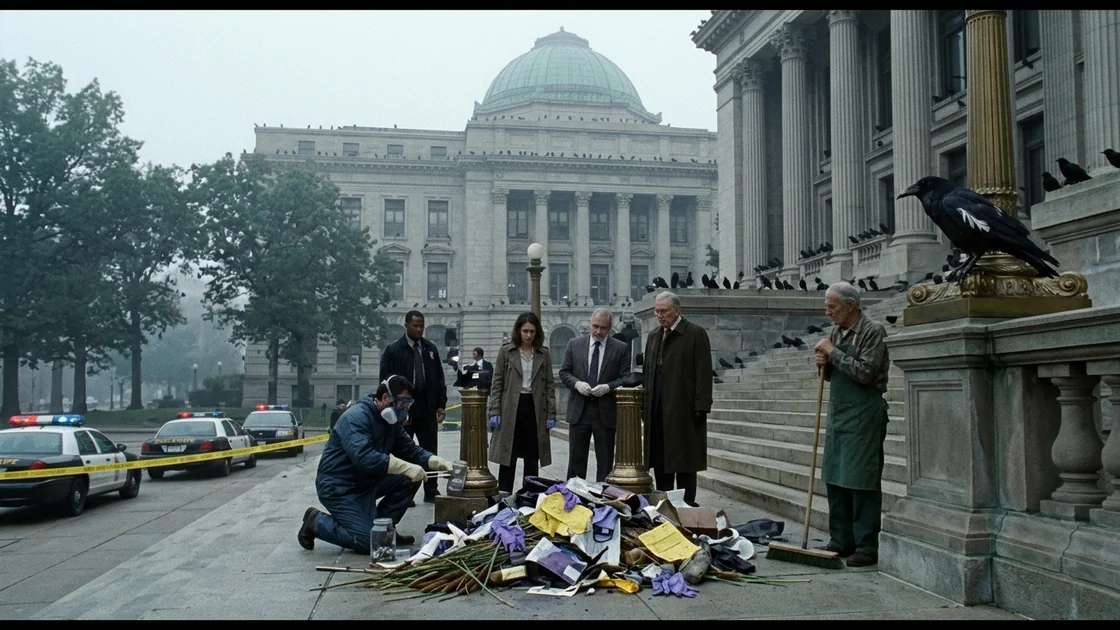
The forty-two limestone steps were completely black.
Not with soot, and not with shadow. Every square foot of stone, from the sidewalk curb up to the heavy bronze doors, and across the wide porticos to the left and right, was packed solid with crows. There were not two hundred of them this morning; there were thousands. Every roost in the Cuyahoga valley—the South Flats flock, the rail-yard gangs, the cemetery murder, the birds from the high-tension pylons out by the county line—had answered the assembly call. They sat in eerie, disciplined silence, their feathers fluffed against the damp cold, leaving only a narrow, four-foot corridor of bare white stone leading straight up the center of the staircase to the twelfth step.
And on the twelfth step, piling up around the base of the two brass lamp plinths like drifted autumn leaves, was a mountain of yellow, purple, and silver debris.
Jonas walked slowly to the bottom of the stairs. The nearest birds didn't scatter; they simply shifted aside with polite, low rattles in their throats, opening the lane for him.
As Jonas climbed to the landing, Lockjaw hopped down from the top of the western plinth and gave a single, soft karr.
Jonas looked down at the pile and took off his cap, holding it against his chest.
There were at least forty purple nitrile gloves, some torn into strips, others whole and crusted with violet mud. There were dozens of aluminum tamper-seals—some clipped, some brand new on their wire loops—all bearing the V-SYN // HAZ-09 stamp. There was a spiral-bound truck driver’s logbook with the cover half-torn off, open to a page listing midnight mileage runs between Vanguard Gate 4 and the Old Quarry Spur. There were soaked, reeking chunks of cattail root and dead minnows dragged straight from the edge of the sinkhole, wrapped in yellow Vanguard hazardous material warning tape. There was a brass Zippo lighter engraved with the initials R.H., three sets of truck keys, and a thick packet of yellow internal transfer manifests held together by a brass clip, bearing the signature of Garrett Cross on the authorization line.
"Lord have mercy," Jonas whispered. He reached into his canvas sack, pulled out the entire twenty-pound block of chopped suet and cashews, and dumped it across the balustrade. "Eat up, boys. You earned the whole butcher shop today."
He didn't touch a single piece of the pile on the steps. Instead, he hurried up to the service door, unlocked it with trembling hands, and ran—despite his bad knee—to the payphone in the ground-floor lobby to call Mara Vance’s home number.
By eight-fifteen, the bottom of the courthouse steps was cordoned off with yellow police crime-scene tape, and three cruisers from the County Sheriff’s Department sat at the curb with their blue and red light bars flashing against the limestone columns.
Mara stood just inside the tape with Sam Miller, two detectives from the District Attorney’s special investigations unit, and a stunned EPA forensic technician whom Mara had dragged out of bed at a local motel two hours ahead of his scheduled Monday audit. The technician was on his knees on the twelfth step, wearing a respirator and heavy chemical gloves, using steel tongs to place items from the pile into glass evidence jars while a police photographer snapped flash pictures from every angle.
Above them, the thousands of crows had retreated only as far as the courthouse roof, the oak trees, and the ledges of the surrounding buildings, looking down like a vast, black jury waiting for the clerk to read the indictment.
"It’s pure Trichlor-9," the EPA tech said, his voice muffled through his mask as he held up a vial of purple crystal scraped from the inside of one of the gloves. "Concentration is upwards of eighty percent. And look at these transfer manifests—these are the internal batch tickets that never go to the state registry. They match the exact serial numbers on the clipped tamper-seals."
"And we have four sheriff's deputies who arrived at six-ten this morning and personally witnessed at least thirty birds still dropping pieces of this stuff onto the pile," Detective Morales said, shaking his head in disbelief as he wrote in his notebook while filming the roofline with a department camcorder. "Nobody can claim your office planted this, Mara. Half the morning shift watched a crow drop a set of Ford truck keys right onto Sergeant Miller's hood."
A white stone balustrade away, Judge Harrison Sterling stood with his hands in the pockets of his overcoat, staring down at the open mileage logbook through his half-moon reading glasses. He was seventy years old, a former corporate defense attorney with a reputation for ice-water veins and a deep distrust of regulatory agencies, and Mara had fully expected him to demand an explanation when she intercepted him in the judges' parking lot ten minutes earlier.
Instead, Sterling hadn't said a word for three minutes. He was an avid duck hunter and trout fisherman who owned forty acres of timberland six miles downriver from the Slag Flats, and the smell rising from the dead minnows and purple-stained manifests on his courthouse steps had turned his patrician face the color of wet cement.
"Those dead fish," Judge Sterling said quietly to the EPA technician. "Where did they come from?"
"Given the limestone silt on the cattail roots mixed in with the pile, Your Honor, I’d say the old quarry sinkhole at the southern marsh," the tech replied, standing up. "If they've been dumping this volume into the karst sinkhole there, it’s bypassing the river surface entirely and going straight into the lower sandstone aquifer. Within six months, every well between here and the southern county line will be unpotable."
Sterling’s jaw tightened until the muscles bunched beneath his gray sideburns. He looked at the signature on the yellow batch manifest inside the evidence bag—G. Cross, VP Logistics—and then at the registration slip from the spiral logbook for Hull Hauling.
Just then, a sleek black Lincoln Town Car pulled up to the curb behind the sheriff's cruisers.
The rear doors opened, and Arthur Pendelton, Vanguard’s lead outside counsel, stepped out onto the sidewalk in a bespoke charcoal suit, followed closely by Garrett Cross. Pendelton had been tipped off twenty minutes earlier by a friendly clerk that the DA's office was making a commotion on the front steps ahead of the ten o'clock dismissal hearing, and he had brought Cross along to sign an emergency affidavit attesting that all Vanguard waste was accounted for.
Fifty yards down the street, a dented gray pickup truck pulled into a loading zone. Buster Hull climbed out, wearing a clean flannel shirt and a baseball cap pulled low to hide the bandage on his temple. Cross had ordered him to show up at the lawyer's office across from the courthouse at nine sharp to sign a backdated subcontracting termination agreement that would sever Vanguard from Hull Hauling on paper.
As Cross stepped onto the sidewalk and Hull walked up the opposite side of the square, the ambient noise of the city—the rumble of buses, the chatter of the gathering crowd of reporters and bystanders—was suddenly obliterated.
From the copper dome of the courthouse, Lockjaw launched himself into the air and screamed: KRAK-KRAK-KRAK-KRAK!
Three thousand crows answered as one voice.
The sound was physical, a concussive wave of harsh, metallic fury that made every human in the square flinch and cover their ears. And then the sky fell—not on the crowd, not on the police, not on the judge or the reporters from the morning paper whose cameras were already whirring, but exclusively, with pinpoint, terrifying precision, upon two men.
A funnel of five hundred birds dropped out of the oaks straight onto Buster Hull in the middle of the crosswalk. They struck him in a continuous, battering wave of black wings, sharp claws, and hammering beaks, knocking his baseball cap into the gutter and ripping the bandage from his temple. Hull threw his thick arms over his head, bellowing in blind panic, and staggered toward the perceived safety of the police cruisers at the courthouse steps, dragging a swirling tornado of biting, screeching birds with him.
At the curb, another five hundred descended upon Garrett Cross.
"Get them off me! Get them off!" Cross shrieked, dropping his leather portfolio on the concrete as a dozen crows raked his silver-blond hair and tore at his overcoat. Arthur Pendelton, standing less than four feet away, wasn't touched by a single feather; the birds parted around the elderly lawyer like water around a boulder to slam into Cross’s chest and face.
In his terror, Cross bolted through the gap in the yellow police tape, scrambling up the bottom steps toward the deputies, while Hull stumbled through the tape from the left side, swinging his fists wildly at the air until he tripped over the bottom step and sprawled on his hands and knees on the limestone—Less than six feet from the pile of purple gloves, yellow manifests, and clipped barrel seals.
As the two men cowered behind the line of uniformed deputies, the crows suddenly pulled up.
On Lockjaw’s sharp, descending whistle, the flock broke off the attack and settled in dense, shimmering black ranks along the stone balustrades on either side of the staircase, less than ten feet from Cross and Hull. Every bird leaned forward, beaks slightly parted, wings cocked, fixing the two men with thousands of merciless black eyes while completely ignoring the thirty other humans standing within the tape.
In the sudden, ringing silence, the only sound was the motor-drive click of the newspaper photographers’ cameras and the ragged, sobbing breaths of Garrett Cross as he knelt on the stone.
Detective Morales looked down at the laminated security badge in his evidence bag, looked at Garrett Cross’s bleeding face, and then looked over at Buster Hull’s thick, scarred jaw and the purple chemical stains deeply embedded under the fingernails of the big man’s bare hands.
"Well," Morales said softly, reaching to his belt for his handcuffs. "That saves us a lineup."
Mara stepped over to Judge Sterling. She reached into her briefcase and pulled out the four-page search and arrest warrant application she had typed up at four in the morning, leaving the probable-cause addendum blank to be filled in by hand.
"Your Honor," Mara said, her voice steady despite the wild hammering of her heart. "The State moves for immediate search warrants for Vanguard Synthetics Buildings A through D, the offices and yards of Hull Hauling, and the private rail spur at the Slag Flats, along with arrest warrants for Garrett Cross and Roy Hull on charges of felony conspiracy and unlawful disposal of hazardous toxic waste."
Judge Sterling looked from the trembling executive on his steps to the pile of violet-stained evidence, and finally up to the western plinth, where an old crow with a crooked beak and three white feathers in its wing sat calmly next to a green-aproned custodian who was tossing it a fresh cube of white beef suet.
"Give me your pen, Counselor," Judge Sterling said. He braced the warrant against the stone balustrade, signed his name at the bottom with a sharp slash of nib on paper, and handed it back to her. "And tell the sheriff to hold them without bail until the federal marshals arrive."
Two years later, in the spring, the water in the Slag Flats was still fenced off with steel mesh and lined with solar-powered remediation pumps installed under the forty-million-dollar federal restitution trust seized from Vanguard Synthetics before its bankruptcy liquidation. The cattails around the old quarry pit had been dredged out and replaced with clean clay and fresh limestone gravel, and though the frogs had not yet returned to the south end of the marsh, the willow trees along the river proper were thick with green catkins and midges.
At six-fifteen on a Friday morning in May, the air over Vergris was clearer than it had been in eighty years; with the Vanguard cracking towers cold and silent, you could actually see the blue of the sky above the eastern hills.
On the twelfth step of the Cuyahoga County Courthouse, Jonas Thorne—now officially retired from the custodial staff, though he still walked down from his apartment every morning with his brown paper bag—sat on the edge of the stone balustrade in the warm sunlight, reading the morning paper.
A shadow slipped across the newsprint.
Lockjaw landed on the western plinth with a light tick of claws. Behind him dropped his mate, followed by four plump, glossy fledglings with the bright pink gapes and blue-gray eyes of newly flying young, begging loudly with fluttering wings.
"Morning, old man," Jonas said, folding his paper and smiling. "Brought the grandkids down to learn the ropes, did you?"
Lockjaw gave his soft, liquid rattle, hopped two steps closer, and leaned down. From beneath his crooked beak, he dropped a smooth, water-worn piece of green river glass onto the clean white limestone.
There was no smell of bitter almonds on it, and the black scales of the old bird’s feet were clean and whole.
Jonas picked up the piece of green glass, held it up to the clear morning sun, and nodded his approval before reaching into his bag to lay out a double row of unsalted peanuts and prime white suet along the stone. Lockjaw took the first piece, hopped back to stuff it into the screaming mouth of his nearest fledgling, and then settled onto the warm brass lamp housing above the courthouse steps, watching over the city below.