The Monument of Brine and Grief
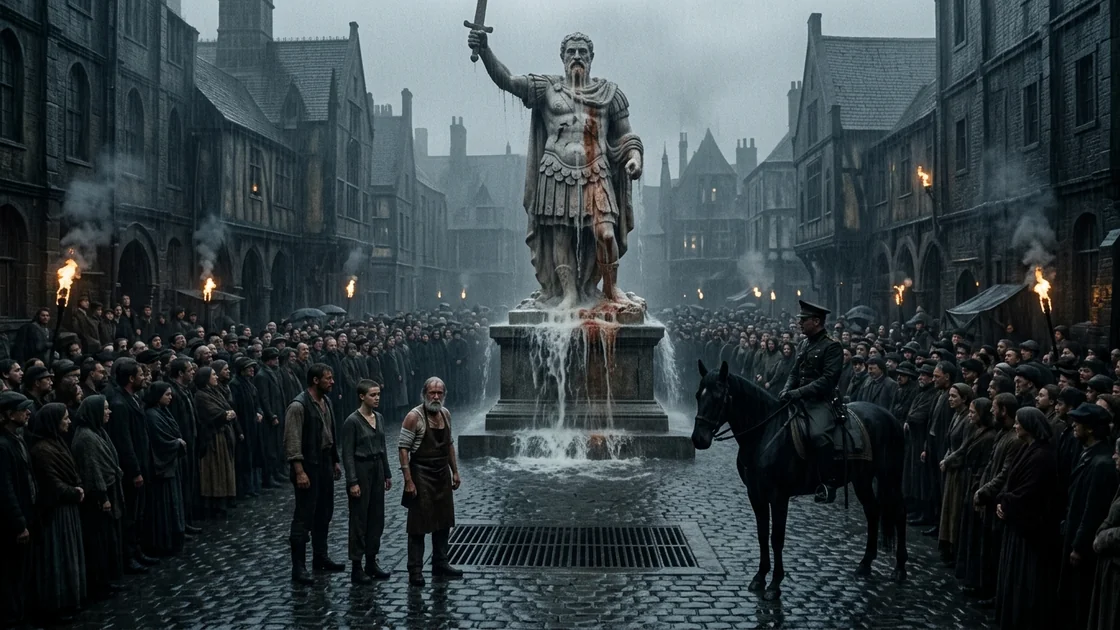
In the perpetually damp basin city of Morvain, the aging master sculptor Anselm Korr is commissioned by a cowardly provisional government and a fanatical military remnant to carve a colossal monument honoring the recently deceased tyrant, Archon Malakor Vane, as the sole condition to prevent a bloody civil war. Carrying the secret grief of his son having been worked to death in the regime's deep subterranean mines, Anselm agrees to the task and travels to the abandoned caverns to extract a massive block of what he claims is the purest white marble, though it is actually ancient, ultra-compressed rock salt disguised with a thin glaze of tallow and lime. For months, Anselm endures the hatred and spitting curses of his fellow citizens who brand him a traitor as he painstakingly carves the dictator's likeness directly above the iron grates of the city's central sewer hub, hiding microscopic channels within the stone's anatomy. Once the statue is unveiled in the dry autumn, the appeased military forces disarm and abandon their cliffside artillery batteries in accordance with the treaty, leaving the grieving widows of the city to weep against the plinth and erode its protective wax seal. When the torrential seasonal rains finally break over Morvain, the water penetrates the hidden pores of the monument, causing the tyrant's arrogant face and body to slowly pit, melt, and weep away into a milky brine that washes down through the sewer grates into the filth below, granting the city its ultimate, silent vengeance.
The fog in Morvain did not drift down from the mountains; it seemed to sweat upward from the cobblestones themselves, thick with the smells of coal-smoke, river-rot, and old iron. In the cramped courtyard of his workshop in the Foundry Ward, Anselm Korr stood before a block of grey river-granite, his mallet poised, though he had not struck a blow since noon. His knuckles, swollen and calcified from fifty years of absorbing the rebound of tempered steel against stone, ached with the coming change in the barometer. The Dry Month was nearly here, that brief, parched autumn interlude when the basin air cleared and the mud hardened into ruts like iron, before the sky bruised purple and the Weeping Season drowned the world until spring.
Inside the shed, a small tallow lamp sputtered, casting long shadows across a cemetery of unfinished shapes. There were funerary urns that had never been claimed because the families who ordered them had vanished into the night wagons. There were headless cherubs, cracked lintels, and in the farthest, darkest corner, covered by an oiled sailcloth, a life-sized bust of a boy with laughing eyes and a chisel tucked behind his ear.
Anselm did not look at the sailcloth. He had not lifted it in four years, seven months, and twelve days.
Instead, he looked at his own thumb. The nail was split down the center, a permanent dark ridge where a pneumatic sledge had slipped during the construction of the Archon’s Triumphal Arch twelve winters ago. Dust coated his grey beard, settled into the deep furrows around his eyes, and lined the creases of his leather apron. In Morvain, a mason did not wash until he was ready to die; the stone simply claimed him inch by inch until his lungs were as heavy as the plinths he carved.
The heavy timber gates of his yard groaned before the iron knocker even fell.
Anselm did not startle. When men came to take you in Morvain, they used the butts of their carbines at three in the morning. When they knocked at dusk, they wanted to buy something they could not make themselves.
He set his four-pound bush-hammer down upon the wooden workbench, wiped his palms on his thighs, and walked across the flagstone yard. His left knee locked slightly with every third step—another souvenir of the Triumphal Arch. He slid back the rusted iron bolt and pulled the wicket door open a crack.
The alley outside was choked with yellow mist, but the brass buttons and silver gorgets of the men standing there cut through the gloom like wolf eyes. There were six of them in the rear, wearing the long, oiled-wool greatcoats and segmented steel pauldrons of the Iron Phalanx, their carbines cradled across their chests. In front of them stood two men who could not have looked less alike, though they shared the same sour smell of fear.
One was Councilor Vesper, a man who had spent thirty years as a minor clerk of weights and measures before the Archon’s sudden stroke left a vacuum that terrified bureaucrats rushed to fill. Vesper wore a velvet coat that was too large for him, its hem already fouled with street mire. Beside him stood Colonel Drex, commander of the High Citadel batteries. Drex was carved from seasoned oak and scarred leather; the left side of his face was a web of white burn tissue from the suppression of the Tannery Riots, and his hand rested permanently on the pommel of a heavy cavalry saber.
"Anselm Korr," Vesper said, his voice pitched too high, rattling like dry peas in a bladder. "Master of the Guild of Freestone Masons."
"The Guild was dissolved in the twenty-second year of the Protectorate, Councilor," Anselm said. His voice was like two millstones grinding together without grain between them. "I am only a man with a shed and some iron."
"You will step aside," Colonel Drex said. He did not raise his voice, yet the soldiers behind him shifted their weight in unison, their hobnailed boots grinding into the gravel. "We do not discuss state business in the gutter."
Anselm looked at the carbine barrels, then at the dark windows of the tenements across the lane. Behind those shuttered slats, he knew dozens of eyes were watching. His neighbors—weavers, tinsmiths, women who boiled bones for glue—were holding their breath. He stepped back and swung the gate wide.
Vesper hurried inside as if afraid a roof slate might fall on his head, while Drex walked with a slow, deliberate cadence, his spurs chiming faintly against the stone flags. Four soldiers stayed outside to seal the lane; two followed their commander into the workshop, bringing the reek of gun-oil and wet horsehair into the dry, chalky sanctuary of Anselm’s life.
Drex walked straight to the center of the room. He picked up a delicate riffler—a curved, double-ended file used for smoothing the eyelids of marble saints—and tested its tip against his gloved thumb.
"He has a dead man's cold in his chest, they say," Drex murmured, tossing the tool back onto the bench where it clattered against a set of calipers. "Yet his hand is steady enough. Is it true, old man? Did you carve the weeping lions on the Ministry of Justice?"
"I carved them," Anselm said, staying near the door. "Thirty years ago. Before the Ministry was used for what it is used for now."
Vesper winced, shooting a terrified glance at the Colonel. "Master Korr, please. The times are delicate. The city stands upon the edge of a razor. As you know, the Sovereign Archon, Malakor Vane, breathed his last eleven days ago."
"I heard the bells," Anselm said. He did not add that he had also heard the muffled cheering in the cellars, quickly silenced when the Phalanx rolled their field guns to the lip of the Upper Escarpment and aimed twelve-pound shrapnel shells directly down into the crowded roofs of the Lower Basin.
"The Archon is gone," Drex said, turning slowly. His scarred eye could not blink; it stared with a wet, fixed intensity. "His body lies in state at the Citadel, packed in ice and myrrh. Down here in the mud, the rabble think that because the lion has stopped breathing, the jackals may feast. They tore down the bronze plaques in the Market Ward two nights ago. They threw a tax-collector into the main sluice."
"The people are hungry, Colonel," Vesper said quickly, wringing his hands inside his velvet sleeves. "And grieving, of course! Confused by their grief! Which is why the Provisional Directorate and the High Command of the Phalanx have spent the past week drafting the Grey Accord."
Anselm looked from the politician to the soldier. "I do not read proclamations. The print is too small for my eyes."
"Then listen with your ears, mason," Drex said, stepping closer until the steel of his breastplate was an inch from Anselm’s beard. "I have forty siege howitzers on the northern ridge. I have three thousand veterans who have known no father but Malakor Vane, and who have eighty thousand rounds of canister and shell in the magazines. If I give the word, in four hours Morvain is not a city; it is a lime-kiln full of roasted bones. Your Provisional Directorate knows this."
"And the Colonel knows," Vesper added weakly, trying to assert a shred of dignity, "that if he fires upon the basin, the dockworkers will burn the granaries, the miners will collapse the coal shafts, and his three thousand soldiers will starve on their windy rock before the winter is half over. Neither side can survive a slaughter. Thus, the Grey Accord."
"And what does a treaty between cannons and bread-ovens have to do with me?" Anselm asked.
Drex reached into his greatcoat and pulled out a rolled tube of heavy vellum, bound with black ribbon and weighted with the massive crimson wax seal of the Archon’s personal chancellery. He threw it onto the workbench.
"My men will not march out to the frontier forts and leave their Sovereign's memory to be pissed upon by gutter-rats," Drex said. "The Accord stipulates that the Phalanx will dismantle the cliff batteries and hand the Citadel keys to the Directorate on the final day of the Dry Month. In exchange, there will be no tribunals. There will be no purges of the officer corps. And in the center of the Grand Concourse of the Grates, where the four wards meet, there shall stand a monument to the Archon. Twenty-four feet from plinth to crown. Carved in the heroic style, by the first hand in the province."
Silence fell over the shed, broken only by the hiss of the tallow lamp.
Anselm looked down at the vellum scroll. The Grand Concourse of the Grates was the lowest point in the central city, a vast octagonal plaza paved with basalt where the storm-waters of six hills converged, roaring down through massive wrought-iron grilles into the subterranean river that flushed the city's sewage out to the black marshes. It was also where the iron cages had hung during the Year of the Censors.
"You have bronze-founders at the arsenal," Anselm said softly. "Cast him out of old cannon barrels. It suits him better."
"Bronze can be melted down by thieves the moment my regiments cross the river," Drex snapped. "They melted his equestrian statue in Oakhaven during the bread riots of the twelfth year and turned him into tavern tokens. No. You cannot melt stone into pennies. The Accord demands white marble. Unblemished. A monolith that will stare down at these dogs for five hundred years and remind them whose boot taught them to walk upright."
"And if I say my hands are too crippled for a twenty-four-foot monolith?"
Drex’s gaze drifted past Anselm’s shoulder, settling on the dark corner where the oiled sailcloth covered the smaller shape on its pedestal.
"You had a boy," Drex said conversationally. "Lukas. No—Julian. Taken in the sweep of the student presses four years back. Sent to the Eastern pans. You also have a niece who stitches sails in the Dock Ward, and two cousins who work the locks on the southern canal. It would be a tragedy if the peace broke down over a mason’s arthritis, and my men had to clear the Dock Ward with bayonets before we left."
Anselm felt a coldness settle into the center of his chest—not fear, for he had burned through his reserves of terror years ago while waiting outside prison gates with loaves of bread that were never accepted. It was a stillness, deep and crystalline, like water freezing in the cleft of a rock, expanding with the quiet power to split a mountain in two.
He thought of the Eastern pans. He thought of the letters that had stopped coming, and the fellow prisoner—a half-blind carter with salt-sores eating through his shins—who had limped into this very yard three winters ago to whisper how Julian had died. Not of the lash, and not of fever, but in the Deep Dome of Salaris, three hundred feet below the dry crust, where the Archon’s engineers had forced the prisoners to cut into the prehistoric salt-pillars without timber shoring. A slab of white crystal had sheared away from the roof and crushed the boy’s chest while he was trying to chip a small bird out of a scrap of wall-rock to send home to his father.
White marble, Drex had said. A monolith that cannot be melted down.
The carter had brought that little half-carved bird back in his pocket. Anselm kept it in a wooden box beneath his floorboards. Under the grime of the man’s pocket, the material had looked like the finest, translucent Parian marble, veined with delicate threads of blue-grey clay and red iron. So hard under the ancient geological pressure of the mountain roots that a steel nail could barely scratch it, yet when Anselm had touched his tongue to the broken wing, it had tasted of the sea, and of his own eyes.
"There is no marble of that size in the city yards," Anselm said, keeping his eyes fixed on the floorboards so the Colonel would not see the sudden, terrible light that had kindled behind them. "The river quarries only yield grey limestone and gritty sandstone. If you build him of sandstone, the frost will spall his nose off in ten winters."
"Then we import it from the south," Vesper said eagerly, sensing compliance. "The Directorate will open the treasury—"
"The southern roads are washed out, and it takes three months to season fresh-cut Carrara before it can take a chisel without shattering," Anselm interrupted, his voice taking on the pedantic, unyielding authority of a master craftsman lecturing amateurs. "If the treaty requires the statue to stand before the rains of the Weeping Season begin, there is only one vein of stone in five hundred miles that is already dry-cured in the earth, vast enough for a single block, and white enough for a sovereign."
Drex narrowed his good eye. "Where?"
"The Deep Dome at Salaris," Anselm said evenly. "Below the old salt pans. Two hundred fathoms down, the miners struck what they called the Bone-Vein before the shafts were abandoned two years ago. They thought it was a fault of quartz or barren alabaster that ruined the brine-beds, so they sealed the galleries. It is an ancient deposit of compressed tectonic alabaster, hard as porphyry, translucent at the edges like horn, with veins of iron oxide that look like royal purple."
Vesper looked dubiously at Drex. "Salaris? That is forty miles through the scrublands. The mines were closed after the... the labor exhaustion."
"The road is paved with military macadam all the way to the mine-head," Drex said slowly, still watching Anselm’s face for any twitch of deception. "We built it to haul the salt-tax wagons. Why have I never heard of this Bone-Vein?"
"Because soldiers only care about what they can tax or shoot, Colonel," Anselm replied, lifting his chin for the first time. "A corporal of engineers does not know the difference between gypsum, calcite, and core-alabaster. When my son was down there, before he died for the Archon's revenue, he wrote to me of the stone. He was a mason's boy. He knew what he was looking at. He said there was a pillar of it near the lower sump, already undercut by the old workings, fifty feet tall and pure as winter tallow."
The mention of his son was a calculated gamble. A man hiding a plot would avoid the name of his murdered child; a broken old artisan, obsessed only with his craft and the pathetic pride of using the last thing his son had ever admired, would speak of it with just that edge of bitter reverence.
Drex stared at him for a long, suffocating minute. The tallow lamp popped. Outside, a dog barked in the fog and was silenced by the thud of a boot.
"You will have a team of twenty draught-oxen, a heavy artillery timber-carriage, and four haulers of your choosing," Drex said at last. "I will send a squad of four troopers to watch you cut it, and my chief engineer will test the stone at the city gates before it is raised. If it cracks, or if you delay the schedule by a single day past the new moon, I will not bother shooting you, Korr. I will hang your niece from the scaffolding and make you carve the Archon while her boots brush your shoulders."
"I do not need your troopers in the shaft," Anselm said coldly. "Soldier torches smoke too much, and the reverberation of hobnails on the gallery shale brings down roof-falls. Keep your men at the pit-head. If I try to run away at seventy years old through forty miles of scrubland, they can shoot me when I crawl out of the hole."
Drex gave a short, ugly bark that might have been a laugh. "Done. You leave at dawn. Vesper, give him the silver for his haulers and the plaster death-mask."
Vesper fumbled with a leather satchel carried by an orderly at the door, placing a heavy canvas bag of clinking coins and a wooden crate onto the workbench.
When the iron-shod boots had finally faded down the alleyway and the fog had swallowed the clatter of their scabbards, Anselm did not move for a long time. He stood by his bench, listening to the city breathe. Then, very slowly, he pried open the lid of the wooden crate with a flat chisel.
Nestled in wood-shavings lay the plaster cast of Archon Malakor Vane’s face, taken an hour after the blood vessel had burst in his brain. Even in death, the features were heavy, predatory, and smug—the hooked beak of a nose, the deep jowls, the thin, bloodless lips pressed together in a line of absolute certainty that the world belonged to him and his heirs forever.
Anselm reached out with a thumb still grey with granite dust and touched the plaster cheek.
"You wanted the whole city to weep for you, Malakor," the old man whispered to the empty shed. "I promise you, they will."
He did not hire Guild masons for the journey; the few who remained were too old or too cowed by the Directorate’s spies. Instead, before the curfew bells rang, Anselm walked down to the sodden slums of the River-Steps and knocked at a door made of salvaged barge-planks.
Marta opened it holding a skinning knife behind her skirt. She was twenty-six, with shoulders like a stevedore’s, hair cropped short as a boy’s under a grease-stained cap, and three fingers missing from her left hand—crushed between two blocks of basalt when she and Julian had worked the river-wall together five years ago.
When she saw Anselm, the knife dropped an inch, though her jaw stayed hard. "We saw the Phalanx horses at the top of your lane, Master Korr. The word in the taverns is that you took the blood-money."
"I took the silver," Anselm said, stepping inside her tiny, smoke-filled room without waiting for an invitation. Two huge men sat by the peat fire, mending trace-chains with cold hammers: Marta’s brothers, Bram and Otho, ox-drovers who had lost their teams during the requisitions. "And I am giving half of it to you three tonight. We leave for Salaris at first light to fetch a stone."
Bram spat into the peat embers. "To build a statue of the Butcher. You should have let them shoot you, old man. Julian would have spat on your boots."
Anselm did not flinch at the name. He reached inside his coat, pulled out a small, wrapped bundle of linen, and laid it on the scarred pine table between the brothers. He unfolded the cloth to reveal a tiny stone bird with one broken wing, carved from a translucent, milky-white crystal veined with dark crimson.
Marta’s breath caught. She knew that bird; Julian had promised to carve her a pair of doves for their wedding—a wedding that had been cancelled when the Censors broke down the chapel doors.
"Look at it," Anselm commanded softly. "Touch it."
Marta reached out with her scarred hand and picked up the bird. "It’s heavy. Cold as marble. He... he found marble down in the salt-pits?"
"Lick the broken wing, girl," Anselm said.
She frowned, looking up at his fierce, sunken eyes, then touched the tip of her tongue to the jagged fracture where the crystal had sheared away from the cavern wall. Her eyes widened. She jerked the stone back, staring at it in disbelief, then looked up at Anselm, her lips parting as the shape of his madness—and his genius—bloomed in the cramped room.
"Lord of the Waters," she breathed. "It’s halite."
"Not the common pan-salt they boil out of the springs," Anselm said, leaning over the table on his bruised knuckles, his voice dropping to a conspiratorial rasp. "It is the root-salt of the Deep Dome. Buried beneath three thousand feet of mountain limestone before the world was made, squeezed by the weight of the earth until every pocket of air was crushed out of it. It has the density of granite and the cleavage of marble. You cannot dissolve it by splashing water on it for an hour; it takes days of running damp just to dull its polish. Under a coat of lime-wash and boiled mutton tallow, the finest engineer in the Citadel could test it with acid and a steel punch and swear on his mother's grave it was imperial alabaster."
Bram stared at the bird, his slow, heavy mind working through the seasons. "The Dry Month starts tomorrow. It won't rain a drop for forty days while you carve it."
"And the treaty says the Phalanx dismounts their guns on the thirty-eighth day, once the monument is consecrated," Marta whispered, a fierce, terrifying smile splitting her wind-chapped face. "And then the clouds come over the peak. Three months of the Weeping."
"He will stand in the Concourse of the Grates," Anselm said, carefully wrapping the little bird back in its linen. "Right over the mouth of the main sewer. If any man in this city learns what that stone is before the last cannon is hauled off the cliff, Drex will burn Morvain to cinders. You will not tell your wives. You will not tell your priests. You will let the streets curse us. You will let them throw dung at our wagon. Will you haul it for me?"
Otho stood up, six feet of muscle and scarred hide, and picked up his heavy iron trace-hook. "I’ll haul it on my back if the oxen die, Master Korr."
The road to Salaris was a scar across a dead land.
For three days, the great artillery sledge crept eastward behind twenty gaunt oxen, their wooden yokes creaking in the sudden, brittle heat of the Dry Month. Above them, the sky had cleared to a hard, metallic blue, bleached of clouds by the dry continental winds that blew off the high plateau every autumn. Behind them trailed the four mounted soldiers of the Iron Phalanx, led by a nasal-voiced sergeant named Vane—no relation to the Archon, though he had adopted the name like many camp-followers to curry favor.
As they passed through the outer villages, the devastation of forty years of the Protectorate lay bare in the brutal sunlight. Half the cottages were roofless shells, their timbers pulled down years ago when the Archon taxed hearths and chimneys, forcing three families to huddle around a single fire. The fields were white at the edges with salt-drift blown from the distant evaporation pans, poisoning the barley so that only stunted, grey-leaved thistles grew along the ditches.
On the evening of the third day, the ground dropped away into a vast, sunken crater three miles wide, ringed by jagged cliffs of red marl and grey shale. This was Salaris.
It looked like the corpse of a sea that had died in agony. Great terraced pans stepped down into the basin, encrusted with dirty grey rime, crisscrossed by rotting wooden aqueducts and rusted iron chain-pumps that groaned in the dry wind like gallows trees. Near the bottom of the crater stood the stone huts of the prison barracks, their roofs collapsed, and beside them, yawning like a black throat in the cliffside, the timbered portal of the Deep Shaft.
No birds flew over Salaris. Even the crows knew that anything that died in the brine pickled into leather too tough for a beak to tear.
"We camp here by the fresh-spring above the lip," Sergeant Vane announced, reining in his mare and spitting into the dust while keeping a safe distance from the blinding white glare of the basin. "I’m not taking horses down that sinkhole; the salt-dust rots their hooves in two days. You have seventy-two hours, mason. If we don't hear the windlass turning by the third noon, we ride back to Colonel Drex and tell him you threw yourself down a sump."
Anselm did not answer him. He took a coil of hemp rope, a leather bag of steel wedges and shims—known to quarrymen as feathers and plugs—and a bull's-eye lantern. With Marta, Bram, and Otho following behind with the heavy timber rollers and block-and-tackle gear, he walked down the steep, switchback ramp into the earth.
The air changed the moment the sunlight died behind them. Outside, it had been hot and dusty; inside the sloped haulage drift, it was sixty degrees and utterly still, smelling of dry blood, rusted iron, and an ancient, sterile emptiness that sucked the moisture straight out of the nostrils. Within ten minutes, Anselm’s lips were cracked and tasted of tears.
They descended for half an hour down the broad, stepped incline where teams of chained prisoners had once dragged the sledges upward on their knees. Discarded wooden clogs, rusted shackles still bolted to the living rock, and broken pick-helves littered the floor, preserved perfectly in the dry, saline air as if the men had vanished an hour ago rather than two years back.
At last, the low ceiling of grey shale vanished. Anselm raised his lantern, and Marta gasped softly behind him.
They stood on the floor of the Deep Dome—a subterranean cathedral carved out by three generations of the condemned. Supporting the mountain above them were massive, rough-hewn pillars of rock salt, forty feet thick and rising eighty feet into the dark, their faceted surfaces catching the yellow lantern light and throwing it back in a million cold, diamond sparks. The walls were banded like agate in sweeping strata of pure snow-white, smoky grey, and deep arterial red where ancient iron-rich muds had settled into the prehistoric sea.
"This way," Anselm said, his voice echoing strangely, without the damp absorption of normal stone caves. Here, sound rang like a struck goblet.
He led them past the dry sump-pits to the far western wall, where a great pile of rubble marked a roof-fall. Half-buried under forty tons of shattered shale lay the rusted iron frame of an ore-barrow. Anselm stopped beside it and placed his hand on the jagged scar in the wall above.
He did not pray. He had stopped speaking to God the day the blind carter came to his yard, figuring that any Architect who allowed His own clay to be used so poorly did not know His trade. He simply rested his scarred forehead against the cold crystal for three heartbeats, letting the chill sink into his skull.
Then he turned and pointed his lantern at the base of the massive pillar beside the fall.
"There," he said.
During the final months of the mine's life, the prisoners had begun undercutting a titanic buttress of the deepest, purest stratum—a projecting spur of halite compressed under such unimaginable tectonic agony that its crystalline grains had fused into a solid, porcelain-like mass. A natural horizontal bedding plane separated it at the base, and twenty-six feet up, a thin vein of black bituminous clay provided a natural top-joint.
"It is thirty tons if it’s an ounce," Bram muttered, running a calloused palm over the glassy, translucent face of the spur. "How did they not shatter it with blasting powder?"
"They didn't have powder at the end," Anselm said grimly, pulling his leather tool-roll open. "Powder cost silver, and prisoners only cost turnips. Which is our salvation. Blasting powder fills a stone with invisible spider-cracks; it would fall apart on the road. This pillar has never felt fire. We split it by the grain, with feathers and wedges, the way the ancients cut obelisks."
For forty-eight hours, there was no day and no night in the Deep Dome—only the rhythmic, ringing clink-clink-tonk of four-pound hammers against cold steel.
Anselm climbed the wooden scaffolding they erected against the pillar’s flank, reading the stone with his fingertips and a brass magnifying glass. Every rock has a memory of how it was laid down—the rift, the grain, and the hard-way. Strike it against the hard-way, and the iron bounces back while the stone laughs; strike it along the rift, and thirty tons of crystal will part like an apple under a paring knife.
Every four inches along a vertical chalk line twenty-six feet high, they drilled a three-inch hole using hand-turned star-drills, blowing the stinging white dust out of the bores with a reed tube. Their eyes swelled into red slits; their throats became so raw they could only communicate by hand-signals and grunts, sipping warm water mixed with vinegar from leather flasks to keep their tongues from swelling.
When ninety holes were bored along the back-seam of the monolith, Anselm slipped two curved half-cylinders of soft iron—the feathers—into each hole, and tapped a tapered steel wedge lightly between them until all ninety stood in a row like iron teeth.
"Down," Anselm croaked from the top of the ladder. "Clear the fall-bed."
Bram and Otho arranged a thick bed of rotted mine-timbers and bags of shale-dust on the floor below the pillar to cushion the drop. Then Anselm, Marta, and Bram took their stations on the ladders—Anselm at the top, Marta in the middle, Bram at the bottom.
"Listen to the pitch," Anselm warned, his hammer poised. "Do not drive your wedge faster than mine. We tune it like a harp."
Ting. Anselm struck the first wedge at the top, working his way down thirty holes.
Ting. Marta followed down the middle thirty.
Ting. Bram finished the bottom row.
At the first pass, the iron gave off a dull, dead thud. By the fourth pass, as the steel wedges bit deeper between the iron feathers, exerting hundreds of tons of outward lateral pressure along the microscopic crystal planes of the salt, the sound climbed a full octave—a high, singing ping that vibrated through the soles of their boots.
Anselm paused, pressing his ear flat against the cold white wall of the monolith.
Deep inside the heart of the pillar, something whispered. Tick. Like a hot glass touched by a wet finger. Then another: tick-tick-crk. A faint, milky line, no thicker than a spider’s silk, bloomed downward through the translucent stone, connecting the ninety holes in a single breath.
"Off the ladders!" Anselm roared, sliding down the uprights as Marta and Bram leaped clear into the dust.
For five seconds, the pillar stood motionless. Then, with a sound like a dry pine tree snapping in a winter gale—a sharp, booming CRACK that sent bats of salt-dust cascading from the dome roof—the thirty-ton obelisk leaned outward an inch, sighed as twenty-six feet of ancient suction broke free of the mountain wall, and toppled slowly, majestically onto the bed of crushing timbers below.
The floor shook. A blinding snowstorm of white powder billowed up, blotting out the lanterns.
Anselm walked into the cloud before it settled, coughing until his ribs ached, running his hands frantically from one end of the fallen giant to the other. The timber cribbing had been crushed flat as straw, absorbing the shock. The block—twenty-six feet long, five feet wide across the shoulders, four feet thick—lay whole without a single transverse fracture.
He knelt in the dark and spat blood-streaked brine onto the stone. "Put the chains on him," he whispered. "We're taking the Archon to town."
If the journey out had been a funeral march, the five-day haul back to Morvain was a penance in hell.
With block-and-tackle anchored to the living rock and all twenty oxen straining in double-yoke until their bellies brushed the shale, it took twelve hours just to drag the monolith up the haulage ramp into the blinding sunlight. When Sergeant Vane saw the stone emerge from the black pit on its bed of iron-shod oak rollers, even the hardened troopers fell silent.
In the fierce autumn sun, the block looked almost supernatural. Before leaving the pit, Anselm and Marta had spent six hours dressing the outer faces with a point-chisel to remove the smooth cleavage planes, giving it the rough, sugary texture of quarry-dressed marble, and then washed it down with a bucket of lime-water mixed with bone-glue and grated mutton tallow. The hot sun melted the tallow into the microscopic surface pores, where it bound with the lime to form an insoluble, dead-white calcium soap skin a sixteenth of an inch thick, leaving only the deep crimson streaks of iron oxide and grey clay showing through like the classic veins of imperial pavonazzetto marble.
When they reached the Southern Gate of Morvain on the eighth morning of the Dry Month, a crowd of three thousand people was waiting for them. And at the head of the crowd stood Colonel Drex, Councilor Vesper, and a hunched man in the spectacles and leather apron of the Citadel’s Master of Ordnance and Mines.
The oxen were lathered in bloody foam; two had died in the traces on the hill-road and been cut loose for the vultures. Anselm walked at the lead yoke, his clothes stiff with dried sweat and salt, leaning on a long iron crowbar like a shepherd’s crook.
As the massive wagon rumbled under the portcullis, a low, ugly growl rose from the packed tenements along the gate-square.
"Traitor!" a woman’s voice shrieked from an upper window, and a chamber-pot of night-soil smashed against the cobblestones three feet from Marta’s boots, splashing her skirt.
"Grave-robber!" yelled a one-legged weaver near the fountain, shaking his crutch at Anselm. "Your boy’s bones aren't even cold in the pit, and you haul the Butcher’s gravestone to crown him!"
A half-brick whistled past Otho’s ear and bounced off the side of the monolith with a dull spark. The Phalanx troopers leveled their carbines instantly, their bayonets glittering, forcing the crowd back with the butts of their rifles, but Anselm never looked left or right. He stared straight at Colonel Drex.
"Halt the team," Drex ordered. He turned to the hunched man beside him. "Well, Master Pol? Look at it."
Master Pol stepped up to the wagon bed. From his satchel he drew a geologist’s pick-hammer, a brass loop, and a small glass vial of muriatic acid.
Behind Anselm, Bram tensed, his huge hands tightening on the iron crowbar. If Pol chipped three inches deep into the stone and tasted the core, they were all dead before the noon bell rang.
Anselm stepped forward, limping heavily, and snatched the pick-hammer out of Pol’s hand before the engineer could swing it.
"Are you a blacksmith or a mineralogist?" Anselm snarled, thrusting his bruised, furious face into the smaller man’s spectacles. "Strike the shoulder of an unseasoned monolith with a blunt pick after forty miles of road-vibration, and you’ll start a shear-line right through the neck of the bust! If you want a sample, take a flake from the butt-end with a flat chisel, or put your acid on the dressing!"
Drex watched the old mason’s rage with cold amusement. No fraud protected his stone with the jealous madness of an artist protecting a newborn child. "Use the acid, Pol. Don't crack the block."
Pol, flustered, uncorked his glass vial and let three drops of raw muriatic acid fall onto the rough-dressed flank of the block where Anselm had laid the lime-and-tallow wash thickest.
Instantly, the lime-crust hissed and foamed with tiny white bubbles—the exact chemical signature of calcium carbonate, true marble, reacting to acid. Pol tapped the surface lightly with the butt of the chisel; the dense, compressed halite beneath rang with a sharp, stony clink, hard as horn.
"Carbonate reaction is positive, Colonel," Pol said, wiping his spectacles and peering at the deep red iron veins through his lens. "Specific gravity is extraordinary, and the crystalline structure is remarkably tight. It is a deep-metamorphic alabaster-marble, just as he claimed. It will weather five centuries without losing a hair's breadth."
Drex looked down at Anselm from his saddle. "You have thirty days, mason. Raise him in the Concourse."
The last mile through the city to the Grand Concourse of the Grates was a walk through a furnace of hatred. Word had run ahead through the alleys faster than the oxen could walk. By the time they reached the octagonal plaza, the roofs and balconies were black with silent, staring faces.
No one threw bricks here, because a full company of the Iron Phalanx ringed the square with loaded muskets, and two brass six-pounders loaded with grapeshot stood trained on the mouth of Market Street. Instead, the people of Morvain did something worse.
As Anselm’s wagon groaned to a halt beside the great central stone plinth—situated directly between the four massive, twelve-foot-square iron drainage grates that swallowed the city’s filth into the roaring darkness of the Under-Throat below—an old man stepped out from the front rank of the crowd. It was Thomas Vane-wright, a baker who had stood as godfather at Julian’s christening, and who had slipped extra loaves of barley-bread under Anselm’s door during the famine winter.
Thomas looked Anselm in the eye, pulled a small wooden tally-stick from his pocket—the Guild token of brotherhood they had exchanged forty years ago as apprentices—snapped it in two between his thumbs, and threw the pieces into the dry gutter at Anselm’s feet. Then he turned his back.
One by one, down the whole length of the square, two thousand men and women turned their backs on the wagon, leaving Anselm standing alone in the blinding sunlight with the soldiers and the stone.
Marta reached out blindly, her three-fingered hand catching the edge of Anselm’s leather apron as a dry sob tore at her throat.
"Eyes on the rigging, girl," Anselm said, though his voice cracked like dry reed. "Help Bram set the shear-legs. We have to stand him up before dark."
By the tenth day of the Dry Month, a thirty-foot tower of pine scaffolding and heavy canvas tarpaulins rose in the center of the Concourse, shrouding the monolith from the eyes of the city like a giant white cocoon.
Inside that canvas womb, the heat was suffocating, the air a thick soup of glittering white dust that burned the eyes, pickled the skin into raw red parchment, and coated the lungs until every breath felt like inhaling broken glass.
Anselm sent Bram and Otho away after the block was hoisted vertical and mortised onto the granite plinth with heavy iron dowels—dowels that Anselm secretly greased with salt-slurry rather than lead, so they would rust and loosen when the damp reached them. Inside the tent remained only Anselm and Marta.
And Archon Malakor Vane.
He emerged from the stone with terrifying speed. Because compressed halite, for all its crushing hardness, had a cubic cleavage plane, a mason who understood its secret geometry could pitch off fifty-pound spalls with a single blow of a heavy pitching-tool where granite would have taken a day of drilling.
From dawn until long after midnight, working by the glare of tin-reflector lamps, Anselm lived on the scaffolding platforms. He tied wet rags over his mouth and nose, though by noon the rags were stiff with dried brine from his own breath. His hands bled continuously; the salt got into the cracks of his knuckles, burning like wasp-stings for the first hour of every morning until the nerves went numb and he could no longer feel the chisel in his fist—only see it with his eyes and hear the ring of the mallet.
He did not carve a sloppy statue. If he had carved a monster or a crude effigy, Colonel Drex—who rode into the square every third afternoon to climb the ladder and inspect the work—would have smelled a rat.
Instead, Anselm gave the Iron Phalanx the masterpiece of his life.
He carved the Archon standing twenty-four feet tall in full field-marshal’s regalia, a great military cloak sweeping down from his broad shoulders to pool around his spurred boots, his left hand resting on the hilt of the Sword of State, his right hand raised in the famous, iron-fingered gesture of the Pacification Edicts. Using the pointing-machine—a wooden frame bristling with adjustable brass needles—he transferred the exact proportions of the plaster death-mask at four times life size, softening the stroke-twisted lip just enough to turn a corpse’s grimace into a sneer of divine, untouchable arrogance.
"Look at the brow, Colonel," Anselm rasped on the twentieth day, standing on the top platform while Drex stared up into the giant white face three feet away. "See how this vein of red iron oxide runs right across the temple like a laurel wreath? And the grey clay band across the breastplate—it looks like damascened steel."
Drex reached out and slapped his leather glove against the Archon’s massive chest. It gave a solid, deep thud. "He looks like he’s about to give the order to clear the square. Good. The vanguard regiments began pulling the twelve-pounders down from the East Battery this morning. Keep the pace, mason."
What Drex did not see—what no man who was not a master of stone and water could have seen—was what Anselm had done to those grey clay veins and the deep undercuts of the sculpture.
Where a normal sculptor working in marble for an outdoor monument would slope every horizontal surface slightly outward—a technique called weathering—so that rainwater would shed cleanly off the shoulders, the brow, and the folds of the cloak without pooling, Anselm did the exact opposite.
Every deep fold of the Archon’s greatcoat was carved with an inward-sloping trough at the back, invisible from the ground. At the crown of the head, hidden behind the raised bronze-carved wreath of the helm, Anselm hollowed out a basin capable of catching two gallons of water, and from the bottom of that basin, using a four-foot-long slender twist-auger while Marta poured oil to quiet the bit, he drilled sixteen quarter-inch capillary holes straight down into the heart of the statue’s neck and torso.
Those channels intersected the natural veins of dry grey clay running through the salt block. Clay in a salt-dome is desiccated sponge; the moment water hits it, it swells to twice its volume, creating immense internal hydraulic pressure while turning to liquid mud that washes away, exposing massive internal caverns of raw, unglazed salt to the running water.
More than that: two smaller channels ran from the hidden basin in the skull right behind the bridge of the nose, terminating in pinhole apertures at the inner corners of the Archon’s deep-set, arrogant eyes, and beneath the overhang of his nostrils.
On the night of the twenty-fourth day, the wind rose, flapping the heavy canvas shrouds like pistol shots in the empty plaza. The Phalanx guards at the base of the scaffold had retreated into the lee of the leeward arcade to share a flask of corn-spirit and escape the blowing dust.
Anselm was alone on the second tier, working with a fine claw-chisel on the knuckles of the Archon’s sword-hand, while Marta slept exhausted on a pile of straw sacks at the foot of the plinth.
A shadow slipped beneath the bottom hem of the canvas.
Anselm did not hear the footstep over the wind, not until the pine ladder creaked under a weight too light and too quick to be a soldier in armor. He turned on the narrow plank just as a young man—no more than nineteen, with the gaunt, hollow cheeks of a student from the outlawed Polytechnic and a long butcher’s boning knife clenched in his right hand—vaulted over the guardrail.
Down below, Marta woke as a second man pinned her to the straw with a knee in her back and a hand clamped over her mouth.
The boy on the platform was trembling so violently that the blade of his knife ticked against the wooden rail. His eyes were wild, fever-bright in the yellow glow of the tin lamp.
"For the four hundred of the Tannery," the boy whispered, his voice breaking. "And for Julian Korr, whom his own father sold for thirty pieces of silver!"
He lunged forward along the narrow plank.
Anselm did not try to run; there was nowhere to go twenty feet above the basalt pavement. Nor did he shout for the Phalanx guards fifty yards away across the square. If he shouted, the soldiers would storm the tent, shoot the boys, and halt the disarmament of the cliff batteries that was already half-finished.
Instead, as the boy drove the butcher’s knife toward his ribs, Anselm swung his left arm up—not to parry the steel, which sliced straight through his leather apron and bit a red furrow across his side—but to shove his own right fist, thick with a paste of wet sweat and freshly ground chisel-dust from the Archon’s wrist, straight into the boy’s open, gasping mouth.
The boy gagged, stumbling back a step on the bouncing plank as Anselm’s iron-hard knuckles jammed past his teeth, coating his tongue and palate with a gritty handful of white powder.
"Swallow it!" Anselm hissed, pressing forward even as warm blood soaked his shirt, grabbing the boy’s wrist with his other scarred hand to keep the knife from striking a second time. "Don't shout, you young fool, or Drex’s guards will hear you! Spit on your tongue and taste what you're killing me for!"
The boy froze, his chest heaving, his eyes wide with horror and confusion as the saliva in his mouth dissolved the white marble dust.
His face contorted. He coughed once, spat onto the plank, and stared down at the old man’s bleeding side, then up at the towering, ghostly white giant looming over them in the lantern light.
"It's..." The boy’s fingers went slack on the wooden handle of the knife. "It’s salt."
"Keep your voice down," Anselm breathed, leaning heavily against the Archon’s massive knee as his own legs trembled. Below them, seeing the fight stop, Marta wrenched her head free of the second youth’s hand,though she did not scream either.
"Look down the road toward the Citadel," Anselm whispered fiercely, gripping the front of the boy’s ragged coat with a bloodstained hand. "Twelve siege guns came down off the ridge today on transport wagons. Twelve more come down tomorrow. In six days, the magazines will be empty and the Phalanx will be across the river, all because they think their butcher is standing here in eternal marble. And what happens in ten days, boy? Look at the sky over the western peaks. What happens when the Dry Month ends?"
The boy looked up at the twenty-four-foot colossus—at the terrible, proud face, the sweeping cloak, the raised hand of tyranny—and then touched his tongue to his upper lip again. A slow, trembling breath escaped him, turning into a sound that was half a laugh and half a sob.
"The Weeping," the boy whispered. "He’ll wash right down the grates."
"Every ounce of him," Anselm said, pulling his apron tight against the cut on his ribs. "Into the main sewer, with the night-soil and the slaughterhouse offal. Now take your friend, get out under the back flap before the corporal makes his rounds, and if you want to help me, go tell the mothers of the Tannery four hundred to come and cry at his feet when the shroud comes down. Tell them softly. Only the ones who know how to keep a grave’s secret."
The boy looked at the blood pooling on Anselm’s fingers, dropped to one knee to kiss the old man’s split thumb, and vanished down the ladder into the wind.
On the thirty-eighth day of the Dry Month, under a sky that had turned from hard blue to the heavy, greasy pewter of an old kettle, they pulled down the scaffolding.
The air in the basin was dead still, heavy with the static pressure that always preceded the breaking of the monsoon. Far up on the northern ridge, the stone embrasures of the High Citadel stood empty for the first time in forty years; the massive siege howitzers were gone, already rumbling south behind long trains of baggage wagons toward the frontier garrisons, leaving only Colonel Drex and a ceremonial rear-guard of two hundred horsemen to witness the consecration and receive the final installment of the Directorate’s gold.
Ten thousand people packed the Grand Concourse of the Grates and the radiating avenues.
When the four haulers pulled the trip-ropes and the great white canvas shroud billowed down into the dust, a collective intake of breath echoed off the surrounding facades like the sigh of a retreating wave.
Archon Malakor Vane towered over the square in blinding, corpse-white splendor.
Before dismantling the upper platforms, Anselm had buffed the outer face of the monument with beeswax and bone-ash, giving the sealed lime-skin the cold, waxy luster of polished ivory, while leaving the deep undercuts of the eyes, the nostrils, and the hidden basin in the crown completely unsealed and raw. The deep crimson veins of iron oxide ran across the tyrant’s cheekbones and down his throat like dried blood; his stone eyes stared down at the ragged citizenry with the exact pitiless contempt that had sent ten thousand of them to the mines and the gallows.
Colonel Drex rode his charger forward to the base of the plinth, drew his saber, and saluted the stone. Behind him, two hundred steel blades flashed in the grey light, and the regimental trumpeters blew the long, brazen notes of the Sovereign’s Salute.
"He stands!" Drex shouted, turning his horse to face Councilor Vesper and the trembling ranks of the Provisional Directorate on the wooden dais. "As the stone endures, so endures the Peace of the Grates! If a single chisel mark or hammer blow is ever laid upon this plinth by the rabble of Morvain, the Phalanx will march back from the river and leave not one stone upon another!"
He sheathed his sword with a ringing snap, wheeled his mount, and gave the signal. With the clatter of eight hundred iron shoes on basalt, the last troops of the Iron Phalanx trotted out of the square down the Western Causeway, leaving a squad of twelve retired military pensioners—old invalids armed only with halberds—as an honor guard around the base.
In the vast plaza, no one cheered that the soldiers were gone. And strangely, no one picked up a stone to throw at the statue, nor at Anselm Korr, who sat alone on an upturned crate near the edge of the eastern sewer grate, his side bandaged beneath his dusty coat, his scarred hands resting on his knees.
During the last six days, a strange rumor had moved through the cellars, the bake-houses, and the weavers’ lofts of Morvain. It had not been spoken aloud in the taverns where spies might listen; it had been passed from palm to palm in the form of tiny, pin-sized white crystals scraped from the gutter around the scaffolding, placed upon the tongues of widows and orphans in the dark.
As the hoofbeats of Drex’s cavalry faded toward the city gates, an old woman in a ragged black shawl stepped out from the silent crowd. It was Thomas the baker’s wife, whose youngest son had been hanged from the lamppost at the corner of the square six years ago.
The halberd-guards tensed, raising their staffs to bar her way, thinking she carried a hammer under her shawl.
"Let me pass, soldier," she said quietly. "I have no iron. Does the treaty forbid a mother from weeping at the Archon’s feet?"
The old pensioner sergeant hesitated, looked at her empty, wrinkled hands, and stepped aside with a sneer. "Weep all you like, crone. It does the Sovereign’s stone good."
She walked up the three basalt steps of the pedestal and pressed her forehead and her wet palms flat against the base of the Archon’s boots, right where the stone met the iron dowels. She did not strike it; she simply wept, her warm, salt tears running down her fingers to mingle with the thin lime-wash at the base, rubbing her wet shawl gently back and forth against the stone as if polishing his shoes.
Behind her came another woman. Then ten. Then three hundred.
All through that stifling, windless afternoon and into the breathless night, a silent procession of thousands filed past the monument. Men with quarry-scarred shoulders, women carrying infants, children whose fathers were buried under the shale of Salaris—every one of them stepped up to the plinth, laid a wet hand or a weeping cheek against the lower folds of the Archon’s cloak, and wiped away a tiny smudge of the protective tallow-and-lime glaze with their sleeves. Even the dogs of the market seemed to sense it, creeping up in the dark to lick at the strange, savory rime that began to bloom where the wax had been rubbed thin.
Anselm did not go home to his shed. He stayed on his crate by the iron grate, Marta sitting on the cobblestones at his feet with her head against his bad knee, Bram and Otho standing like twin boulders behind him.
At three in the morning, the air pressure dropped so suddenly that Anselm’s ears popped. Deep beneath the iron grates at his feet, the black waters of the Under-Throat gurgled as the marsh-tide backed up from the coast.
At four in the morning, a flash of sheet-lightning turned the sky over the western mountains the color of a dead man’s bruise, illuminating the twenty-four-foot giant in a stark, strobe-like glare.
At four-fifteen, the first drop fell.
It was as big as a silver florin, warm and heavy with coal-soot from the upper air, and it struck the back of Anselm’s hand with an audible spat.
Then another struck the Archon’s raised cheek.
For five minutes, the drops fell singly, ticking against the slate roofs and the basalt paving stones like the slow, measured taps of a mason’s point-chisel testing a block. Then the wind howled down from the high passes, smelling of ozone and pine needles, and the sky broke open in the great autumn deluge of the Weeping Season.
It did not rain in sheets; it fell in solid, roaring curtains of grey water that turned the avenues into foaming brown rivers within ten minutes.
Nobody in the Grand Concourse went inside.
Ten thousand people stood shoulder to shoulder in the dark, soaking rain, their faces tilted upward as the pitch-torches in the arcade brackets sizzled and flared under their tin hoods.
For the first hour, the statue seemed to defy the storm. The water streamed off the waxed chest and the broad shoulders, gleaming white and impervious in the lightning flashes. The twelve pensioner guards huddled miserably under the eaves of the Ministry arcade across the square, confident that no rioter would brave such a deluge, and that stone did not care about weather.
Then the hidden basin inside the Archon’s hollowed crown filled to the brim.
Down through the sixteen deep-bored auger channels inside the neck and torso, the cold rainwater plunged into the dry, thirsty heart of the monolith.
Anselm stood up from his crate, ignoring the rain streaming through his grey beard, and watched the statue’s face.
"Look at his eyes," Marta whispered, gripping his arm with her three fingers.
In the yellow flare of the arcade torches, two thick, milky-white ribbons had begun to well out of the inner corners of the Archon’s stone eyelids. As the internal water pressure soaked into the unsealed capillary pores behind the face, dissolving the pure halite along the drill-lines, the tyrant began to weep thick, viscid brine down his own cheeks.
At the same time, deep inside the chest, the grey clay veins drank the water and swelled.
POP.
The sound was muffled, like a green chestnut bursting in a hot hearth, barely audible over the roar of the rain on the cobblestones. Across the Archon’s proud, barrel-chested breastplate, the thin skin of lime-and-tallow cracked along the diagonal clay-seam, opening a jagged fissure half an inch wide.
Now the torrential rain drove directly into the raw, unprotected crystal of the wound.
What had taken ten million years of crushing darkness to form under the earth began to undo itself in the span of a single dawn. As the grey light of morning seeped through the driving rain-clouds, the transformation accelerated from a weeping into a glorious, grotesque rot.
Water is a patient mason, and salt remembers the sea.
The sharp, arrogant hook of the Archon’s nose softened first, rounding off like a tallow candle left too close to a furnace, then pitting with a hundred tiny pockmarks as the rain drilled into the softer crystal grains. The deep red veins of iron oxide, freed from their crystalline matrix as the salt dissolved around them, bled downward across his white chin and throat in bright, rust-colored streams that looked horrifyingly like fresh arterial blood pouring from a slit gullet.
By nine in the morning, the crowd had grown to twenty thousand. People had come from the farthest dock-slums and the hill-wards, standing ankle-deep in the swirling water of the plaza, watching in utter, breathless silence as the tyrant decomposed before their eyes.
The raised right hand—the hand of the Pacification Edicts—lost its fingers one by one. They did not break off with the clean snap of stone; they thinned into translucent icicles, bent slightly under their own wet weight, and sloughed away into milky slush that splashed down onto the plinth.
At ten o'clock, the sound of frantic iron-shod hooves splashed up the Western Causeway.
Colonel Drex, who had camped with his rear-guard five miles outside the walls before crossing the river, had been summoned by a terrified runner from the pensioner guard. He rode into the square with twenty horsemen, his greatcoat streaming water, and reined his rearing horse to a halt fifty yards from the plinth.
His scarred, unblinking eye went wide as he stared through the blinding rain.
The monument had shrunk by three feet. The Archon’s lower jaw had completely dissolved, leaving a gaping, hollowed cavity through which the internal auger-pipes vomited a steady cataract of red-stained white froth down a chest that now looked like the bleached ribs of a beached whale. The Sword of State was a pitted stump; the great sweeping cloak was honeycombed with fist-sized holes where the rain roared straight through the body.
"The canvas!" Drex screamed over the thunder, drawing his saber and striking his sergeant across the shoulders with the flat of the blade. "Get the tarpaulins back over him! Clear the square! Find the mason!"
The twenty horsemen spurred their mounts forward toward the pile of folded canvas near the arcade—and stopped dead.
Twenty thousand unarmed men, women, and children simply took two steps forward, locking their arms together in a solid, immovable wall of sodden wool and pale faces twenty ranks deep around the plinth and the sewer grates.
Not a single person shouted. Not a single cobble was raised. They simply stood in the rain between the soldiers and the melting stone, staring at the twenty horsemen with forty thousand quiet eyes.
Drex’s horse danced nervously on the slick basalt. The Colonel looked at his twenty rain-soaked troopers, then at the empty cliffside embrasures high above the mist where his cannons used to be, and then at the silent ocean of citizens who outnumbered him a thousand to one. If he ordered a charge into that press without artillery support, his men would be pulled from their saddles and drowned in the gutters in three minutes.
Slowly, his hand shaking on the brass hilt, Drex lowered his saber.
He could only sit on his horse in the deluge and watch.
All through that day and into the second night of the Weeping Season, the rain hammered Morvain without pause.
By afternoon, the Archon had no face left at all—only a smooth, featureless knob of slushy grey-white crystal sitting atop a skeletal pillar riddled with whistling caves. By dusk, the internal clay veins in the knees had washed out completely, leaving the remaining ten tons of the torso balanced on four dissolving pillars no thicker than a man’s thigh.
Just before midnight, as the storm reached its crescendo and the four great twelve-foot sewer grates around the plinth roared like lions with the floodwaters of the six hills, the rusty iron dowels at the base gave way.
With a wet, crunching sigh—not the proud crash of falling marble, nor the ringing clang of toppled bronze, but the pathetic, sodden slump of an old snowbank collapsing into a ditch in spring—what remained of Archon Malakor Vane folded in upon itself, broke into a hundred porous, sugar-like lumps upon the basalt steps, and dissolved into the boiling sheet of floodwater sweeping across the plaza.
In the torchlight, a thick, milky river of brine, streaked with rust-red mud and gray clay, swirled across the flagstones, washing over the toes of the silent crowd, foaming around the hooves of Colonel Drex’s horse, and pouring in a churning white waterfall down through the iron bars of the grates into the black, foul belly of the main sewer below.
By the time the gray dawn broke on the third day of the rains, the water running across the Grand Concourse of the Grates ran completely clear.
In the center of the square stood the ancient granite plinth, washed clean of every fleck of tallow, lime, and salt, empty against the weeping sky.
Colonel Drex had ridden away into the mist two hours before dawn without looking back. Slowly, as the morning bells began to ring from the church towers for the first time in forty years, the crowd began to move—not dispersing in haste, but walking one by one past the old man who still sat on his wooden crate beside the eastern grate.
They did not speak to him, for the people of Morvain were made of stone and did not have soft words for such things. Instead, as Thomas the baker walked past, he reached down into his coat, pulled out a fresh, warm loaf of barley-bread wrapped in oilcloth, and set it gently at Anselm’s feet. A weaver laid a new wool shawl over Marta’s wet shoulders; a smith set a pair of new, tempered steel chisels beside the bread; a hundred mothers, as they passed, bent down to press their lips to the top of the old mason’s grey, rain-washed head.
When the square was finally empty save for the rain and the rushing sound of the sewers beneath the iron bars, Anselm Korr stood up. His knee did not ache quite so badly in the clean damp.
He walked over to the edge of the great iron grate, reached into his pocket, and drew out the tiny, broken-winged bird of white salt-crystal that Julian had carved in the dark of the earth.
He opened his scarred hand, where the rain had finally washed the last of the quarry-dust from the creases of his skin, and dropped the little bird through the iron bars into the rushing water below, letting the river carry his boy out to the open sea.