The Mirrors of the Condemned
In the vertical, furnace-lit city of Vespera, master glassblower Soren Thorne is commissioned by the ruthless Order of the Unblinking Eye to craft ceremonial mirrors used in the interrogation and judgment of suspected heretics. While the Inquisitors believe these arcane glasses reveal the hidden sins of the accused, Soren secretly infuses the molten silica and quicksilver backing with the cremated ash of the Order's past victims and his own breath-magic. This subtle alchemy reverses the enchantment so that once an Inquisitor binds their blood to a mirror, it ceases to reflect their own image and instead shows only the haunting, accusatory faces of the innocent people they have falsely condemned to the pyres. When High Inquisitor Valerius Vane, the very man who executed Soren's wife five years prior, demands a massive Grand Speculum for the city's central Basilica, Soren embarks on a perilous final masterpiece that threatens to expose his treason and shatter the theocracy from within.
The heat of the Low Foundry District did not merely warm the skin; it cured it like leather hung in a smokehouse. Even at midnight, when the great iron louvers at the top of the cavern-city were cranked shut to keep out the freezing mists of the upper crags, the cobblestone lanes of Vespera sweated a fine film of salt and coal-grease. Every third house had a chimney that breathed orange sparks into the subterranean gloom, and beneath the flagstones, the tectonic arteries of the mountain carried rivers of sluggish magma that powered the glory holes of the Guild of the Molten Breath.
Soren Thorne stood before the mouth of his furnace, his silhouette cut sharp and black against the white-hot glare of the crucible. In his calloused hands, he turned a five-foot iron blowpipe with the unconscious rhythm of a man who had spent forty years keeping gravity at bay. At the far end of the pipe, a parison of molten glass—glowing the color of a bruised peach—sagged and recovered, sagged and recovered, obeying the minuscule rotations of his wrists.
"More wind on the bottom flue, Lyra," Soren said. His voice was a dry rasp, the vocal cords long ago scarred by the inhalation of soda-ash and vaporized lead. "The batch is running ropey. The sand from the eastern dredge has too much iron in it this month. It wants to turn bottle-green, and Brother Malthus will have my thumbs if his scrying-glass has a tint."
Across the brick floor, half-hidden in the shadows behind the brick annealing lehr, a girl of fourteen leaned her small weight onto the bleached oak handle of the bellows. She did not answer—she could not, for the Inquisition had taken her tongue three winters ago when they took her father’s printing press—but she tapped her wooden clog twice against the stone to show she had heard. The leather lungs of the bellows wheezed. Beneath the crucible, the pale blue tongues of geothermal gas stiffened into roaring white needles.
Soren drew the blowpipe back from the glory hole. Moving with the rolling, flat-footed gait of a master gaffer, he carried the glowing gather over to the marver—a thick slab of polished steel set upon an anvil of petrified oak. He rolled the glass across the greased metal. A sharp hiss of scorching beeswax rose into the rafters, mingling with the perpetual stink of sulfur and wet clay.
Glass, Soren’s master had taught him thirty years ago, was a liar by nature. It pretended to be a solid, yet it never truly froze; it was merely a liquid grown too tired to flow. Given ten thousand years, a cathedral window would sag into its lead cames until the saints at the top were thin as paper and the devils at the bottom were thick as lard. Because it was neither liquid nor solid, neither earth nor air, glass was the only substance in the world that could trap a memory without killing it.
He raised the mouthpiece to his lips. Before he blew, he closed his eyes and reached down into the bottom of his lungs, past the scarred tissue, past the stale air of the workshop, into the quiet reservoir of the pneuma—the artisan’s breath.
In Vespera, every citizen had a trade-talent, a minor frequency of the blood that hummed in sympathy with the mountain’s deep leylines. The smiths of the Upper Tier could hear the hairline fractures in cold iron by tapping it with a fingernail; the weavers of the Silk-Sump could spin threads that held the warmth of a summer noon through six months of winter. The glassblowers of the Cinder-Cot had the Breath. When a common man blew into a pipe, he put only wind into the bubble. When Soren blew, he put intent.
He puffed his cheeks and gave a short, sharp exhalation.
At the end of the iron rod, the peach-colored bulb swelled. As it thinned, the orange glow faded to a ghostly, translucent violet. Within the hollow heart of the bubble, for the space of three heartbeats, a mist coiled—not steam, not smoke, but the pale grey residue of a thought.
Show him the river, Soren whispered into the iron tube, his lips barely parting around the brass mouthpiece. Show him the water under the bridge at Oakhaven, and the reeds where the miller’s daughter dropped her basket.
He lowered the pipe and swung it in a wide, pendulum arc through the air, using centrifugal force to lengthen the globe into a cylinder. Lyra was already beside him, holding the wooden jacks—double-pronged calipers carved from charred cherrywood that had been soaked in a bucket of scummy water. Soren sat heavily on the gaffer’s bench, laying the iron pipe across the long wooden arms of the chair. As he rolled the pipe up and down his thighs with his left hand, he took the wet jacks in his right and bit into the neck of the glass cylinder, just below the iron nose of the pipe, constriction-scoring it for the break.
Steam shrieked from the charring cherrywood. The glass sang—a high, crystalline note that vibrated in Soren’s back teeth.
"Punty," he muttered.
Lyra swapped the jacks for the pontil rod, its tip already tipped with a tiny, tacky button of molten glass from the warming pot. She pressed it dead-center against the flat bottom of the cylinder. Soren touched a drop of cold water from his tweezers to the scored neck and tapped the blowpipe once with the iron shears.
Tink.
The cylinder parted cleanly from the blowpipe, now held fast to Lyra’s pontil rod. Together, they carried it back to the glory hole, reheated the open lip until it went limp as wet linen, and then Soren used the flat wooden paddle to flare the cylinder open, spinning it faster and faster until centrifugal force snapped the flaring bell into a flat, circular disc four feet across. A crown of glass, clear as mountain ice, spun in the orange dark like a captured moon.
"To the lehr," Soren breathed, wiping the sweat from his eyebrows with a rag tied around his forearm. "Slow fire tonight, girl. Eight hours on the high shelf, twelve on the ash-bed. If it cools a degree too fast, the stress will pull the center out of true."
Lyra nodded, bearing the heavy iron rod toward the long brick tunnel of the annealing oven with a strength that belied her matchstick arms. Soren watched her go, his grey eyes narrowing against the radiant heat.
That disc, once cooled, ground flat with river-corundum, polished with rouge, and backed with tin-amalgam, would become a Speculum of Inquiry for Brother Malthus of the Third Precinct. Malthus would hang it in his whitewashed cellar beneath the Magistracy. He would sit wretched men and women on the iron stool before it, shine a lantern of whale-oil at their faces, and watch the glass for the murky blooms of black and crimson that the Order of the Unblinking Eye believed were the optical signatures of heresy.
And for the first three weeks, the mirror would give Malthus exactly what he wanted. It would show the slight, nervous shimmer of a tax-evader’s sweat; it would darken slightly when a man lied about his whereabouts on the Sabbath. It had to work, at first, or the Arcanists of the Synod would reject the piece at the stamping-hall.
But Soren had mixed three grains of river-dredged bone-ash into the soda-flux of that batch—ash taken from the municipal sluice below the Executioner’s Weir, where two years ago Malthus had drowned the miller’s daughter for allegedly souring the bailiff’s well with witch-rot. Once Malthus pricked his thumb and pressed his blood-seal onto the lead frame of the mirror to bind it to his authority, a slow, irreversible inversion would begin in the quicksilver backing.
By the new moon, when Malthus looked into that glass to straighten his white collar, he would not see himself. He would see nineteen-year-old Marcia of the Mill, her hair tangled with river-weed, her blue lips parting to ask him where her basket of bread had gone.
Soren picked up his iron poker and stirred the coals beneath the glory hole.
"One more for the tally," he whispered to the fire.
The knock came at the street door three hours before dawn, when the foundry fires were banked with wet slack-coal and the only sound in the workshop was the rhythmic tick-tink-tick of the cooling brick in the annealing lehr.
It was not the heavy, iron-shod thud of an Inquisitor’s halberd. It was a frantic, fluttering scratch, like a sparrow trapped in a chimney flue.
Soren did not reach for a weapon; a glassblower’s shop was full of iron bars and pots of liquid fire, and if those failed, nothing else would serve. He lifted a shutter-lantern, unbolted the small Judas-wicket set into the heavy oak door, and peered out into the sulfur-yellow fog of the lane.
A man stood hunched under the dripping stone eaves. He wore the greatcoat of a wool-factor, pulled up high around his ears, and a wide-brimmed felt hat sodden with condensation. Yet when he looked up at the click of the latch, the lantern light caught the silver collar of the Order peeking through his unbuttoned cravat, and the terrible, hollow circles beneath his eyes.
It was Brother Castian of the Seventh Ward.
"Master Thorne," Castian whispered. His teeth were chattering so violently he bit the inside of his lip, staining his chin with a thin thread of pink saliva. "Open the door. For the love of the Light, open the door before the night-watch turns the corner from Copper Street."
Soren’s face remained entirely Slack—the dull, deferential mask of a guildsman speaking to his betters. He slid back the three heavy bolts, drew the door open six inches, and stepped back to let the Inquisitor slip through like a greased rat.
As soon as the door was shut, Castian’s knees buckled. He caught himself against the wooden cullet-barrel, his gloved hands sinking wrist-deep into the sharp, broken shards of waste glass within. He didn't seem to feel the cuts. Beneath his left arm, wrapped in three layers of greasy purple velvet, he clutched a square object about the size of a ledger.
"You made this," Castian hissed, his voice cracking upward into a whimper. He tore the velvet away and slammed a hand-mirror framed in chased silver onto Soren’s wooden workbench. "Eighteen months ago. The Autumn Assizes. You delivered six of them to the Chapterhouse."
Soren set his lantern down carefully. He picked up a pair of brass spectacles with thick, magnifying lenses—his working glasses—and hooked the wires behind his ears. He leaned over the mirror.
To Soren’s eyes, the surface was a pool of pristine, silvered depth. It reflected the smoky rafters of his shop, the orange line of the lehr door, and the side of his own stubbly, soot-lined jaw.
"My mark is on the bezel, Brother Castian," Soren said mildly, pointing a thick thumb at the tiny stamped anvil-and-pipe at the base of the silver handle. "Sixteen-ounce lead crystal, double-silvered with Spanish mercury. There is no crizzling in the glass, no weeping on the surface. The backing hasn't peeled. What is the fault?"
"Don't look at it from the side!" Castian shrieked, grabbing Soren’s leather apron with bleeding fingers and yanking him around. "Look at it with me! Look over my shoulder!"
Soren allowed himself to be pulled until he stood directly behind the trembling Inquisitor. Castian forced himself to look down into the glass. A violent shudder ran the length of the man's spine, so hard his heels drummed against the floorboards.
"There," Castian breathed, his eyes bulging until the red veins stood out like threads in boiled eggs. "Do you see him? Do you see his fingers?"
Soren looked into the mirror. In the glass, he saw himself, standing tall and quiet, and in front of him, he saw Brother Castian—haggard, unshaven, bleeding from the palms, staring down in terror. There was no one else in the reflection. The magic Soren wove into the silvering was keyed exclusively to the blood-seal on the frame; only the soul who had bound the mirror could perceive the ghosts trapped in its mercury.
"I see only yourself, Your Grace," Soren said softly. "And myself behind you. Perhaps the fog in the street has got into your humors. The vapors from the deep vents are thick this week—"
"Liar!" Castian’s hand shot out and seized Soren by the throat. The Inquisitor was not a large man, and ten years at a clerk’s desk had softened him, but madness gave his fingers the strength of iron tongs. "It’s the cobbler’s boy from Threadneedle Lane! Timothy! The one who had the foreign pamphlets in his boot-lining! He’s standing right where you are, Thorne! He’s holding his hands up—he hasn't got any fingernails left, because we pulled them in the cistern-room before he died, and he’s pressing them against the inside of the glass!"
Soren did not struggle. He kept his breathing shallow and slow, looking directly into Castian’s dilated pupils. "A cobbler's boy, Brother? I am a simple artisan. I know nothing of the Order’s business in Threadneedle Lane."
"He didn't know how to read," Castian sobbed, his grip slackening into a pathetic clutch at Soren’s collar. The Inquisitor’s forehead dropped forward until it rested against Soren’s breastbone. He smelled of sour wine, stale tallow, and the acrid, unmistakable stench of night-sweats. "We found that out three days after the burning. The real printer lived two doors down and used the boy’s shop as a drop-box because the boy was simple-minded and wouldn't ask questions for a copper penny. The High Inquisitor told me to seal the file. He said the fire purifies the mistake along with the sin. He said the example was what mattered to the Ward."
Castian lifted his head, tears cutting pale tracks through the coal-dust on his cheeks. "Then why won't the fire take him out of my glass, Thorne? Every mirror I pass! It started with this one—my travel glass. Then it spread to the basin-mirror in my cell. Now, if I look into a dark window at dusk, or a puddle of oil in the courtyard, I see him! And behind him, there’s the old woman from the herb-market, and the two brothers from the barge-guild! They don't speak. They just stand there, looking at me, waiting for me to give them back their breath!"
"Glass is a sympathetic medium, Brother," Soren said, his voice dropping an octave, taking on the grave, pedantic tone of a Guild Master lecturing on optics. He gently pried Castian’s bloody fingers from his apron. "When a man sits in judgment day after day, the weight of his office presses upon the optic nerve. The philosophers of the Old Spire wrote of it—Scintilla Mentis. The mind projects its own humors onto reflective surfaces, especially when the silvering has been exposed to the damp of the interrogation cells."
"Can you clean it?" Castian begged, grabbing the mirror and shoving it against Soren’s chest. "Scrape the mercury off! Melt the glass down! Put it back in your furnace and burn him out of it!"
"If I put a blood-bound glass into the glory hole without the High Inquisitor’s dispensation, the Synod would hang me from my own crane," Soren said, though he took the mirror carefully in both hands. "And if you appear at the Chapterhouse without your badge-glass at morning prayers, they will ask why."
Castian stared at the brick floor, his chest heaving. "If I look at that boy one more morning while I shave, I will cut my own throat to stop him staring."
"Leave it with me until noon," Soren said, turning to his workbench and picking up a bottle of nitric acid and a chamois cloth. "The silver backing has likely oxidized from the salt-damp in your cell, creating false shadows in the refraction. I will strip the amalgam, wash the plate in aqua fortis, and lay a fresh leaf of tin before the midday bell. Go back to your quarters, Brother. Drink a draught of poppy-water and sleep with the shutters barred. When I bring this back to you, the glass will be clear."
Castian looked at him with desperate, drowning hope. "You swear it? It’s only an oxidation of the tin?"
"Everything that plagues us is merely chemistry, Your Grace," Soren lied smoothly. "Now go. Before the apprentices arrive for the morning shift."
When the bolts were drawn once more and Castian’s shuffling footsteps had faded into the fog, Lyra stepped out from behind the shadow of the lehr. She held a heavy iron punty rod like a spear, her dark eyes fixed on the silver mirror on the bench.
She walked over, looked at Soren, and made a sharp, slicing motion across her throat with the edge of her thumb, pointing toward the street door. Will he talk?
"Not to Vane," Soren murmured, picking up the silver mirror and turning it over in his hands. He looked at the small crimson smudge of dried blood sealed under a bevel of rock-crystal on the back of the handle—Castian’s binding mark. "To confess that his mirror shows him the innocent would be to confess that the Order condemns the innocent. Vane would have him bricked up in the Penitential Wall before vespers for heresy of the eye."
Still, Soren’s brow furrowed as he set the mirror down beside the nitric acid.
Castian was weak. Soren had miscalculated how quickly the man’s mind would fray. When he had crafted that batch of six hand-mirrors eighteen months ago, it had been an experiment—a refinement of the crude, angry curses he had tried to blow into bottle-glass during the first blind year of his grief after Clara died. He had learned that if the mirror turned all at once, the Inquisitor simply assumed the glass was hexed by an outside witch and smashed it. The change had to be glacial. A flicker in the corner of the eye during the first month; a lingering shadow in the third; a single face at the end of a year. And because the link was forged through the Inquisitor’s own blood-seal, the haunting followed their eyes from the primary glass to every reflection they encountered, turning the entire city of Vespera into a hall of ghosts.
"Strip the backing off this one, Lyra," Soren said softly, nudging the mirror toward her. "Put the old mercury in the lead jar under the floorboards—do not let a drop of it touch your skin. Re-silver it with plain tin and clean quicksilver. Give the poor wretch three days of peace before the shadows in the windows catch up to him again. If he kills himself with my glass in his hand, the Arcanists will look too closely at the bevel."
He turned back to the furnace, where the coal-bank was beginning to glow cherry-red around the edges.
"Besides," Soren whispered, feeling the dry heat tighten the skin across his cheekbones. "A clerk from the Seventh Ward is only cullet. We are waiting for the High Seat."
He did not have to wait long.
At ten o’clock that morning, the fog in the Low Foundry was blown apart by the sound of silver trumpets.
In the narrow, soot-choked lanes of the Cinder-Cot, horses were a rarity; the cobbles were too slick with grease and the grades too steep for anything but mules and furnace-drays. Yet as Soren stood at his bench grinding the bevel of a lens with wet pumice, the rhythm of twenty iron-shod hooves rang out against the basalt paving stones outside, accompanied by the heavy, measured tramp of pike-butts striking the ground in unison.
Across the shop, two of Soren’s day-journeymen—good, dull boys who knew how to blow tavern-tumblers and window-bullions and nothing more—froze with their pipes in the air. Their gathers of soda-lime drooped like melted taffy toward the floor.
"Keep turning your iron, Thomas," Soren said without looking up from his grinding wheel. "If you drop twenty pounds of metal on my floor because you heard a trumpet, you’ll pay for the coal to remelt it out of your Saturday wages. Lyra—the broom."
The street door did not wait for the latch. It swung inward as a young Proctor in steel breastplate and white wool surcoat kicked the wooden wedge aside. Behind him came the smell of cold mountain air, crushed lavender, and oiled steel.
"Uncover before the Seat," the Proctor barked, slapping the butt of his halberd on the brick threshold.
Soren took off his leather cap and wiped his pumice-stained hands on his apron. His two journeymen dropped to one knee by the slack-tub. Lyra shrank back behind the annealing lehr, her eyes wide and bright as wet anthracite in the gloom.
High Inquisitor Valerius Vane entered the workshop alone.
He was not the largest man in Vespera, nor did he wear the gilded, jewel-encrusted miters of the prelates who had ruled the city before the Great Refraction. Vane wore a cassock of undyed, coarse-spun white wool that fell straight from his squared shoulders to his ankles, immaculate despite the grease of the lane outside. Around his neck hung a single optical lens of smoky quartz, bound in black iron—the badge of the Unblinking Eye. His hair was the color of steel filings, cropped so close to his skull that the pale scars of his boyhood tonsure showed through, and his face was long, bloodless, and planed like a piece of seasoned ash-wood.
Vane did not hold a scented handkerchief to his nose as the lesser magistrates did when they visited the Foundries. He breathed the sulfurous, roasting air deep into his lungs, his pale grey eyes sweeping over the crucible, the marvers, the racks of cooling carboys, and finally settling upon Soren.
"Master Thorne," Vane said. His voice was surprisingly gentle—a dry, melodious baritone that carried through the roar of the glory hole without any apparent effort.
"Highness," Soren said, bowing from the waist until his forehead was level with his bench. "My shop is poor and hot, and my boys are covered in grease. Had the Guildmaster sent word you were descending to the Cinder-Cot, we would have met Your Grace at the Stamping Hall."
"The Stamping Hall smells of clerks and sealing-wax," Vane said, walking slowly toward the great central furnace. He held one pale, ungloved hand out toward the white-hot mouth of the glory hole, letting the fierce radiation turn his skin the color of translucent wax. "I prefer the furnace, Master Thorne. It is the only honest thing in Vespera. You put sand and filth into it, and the fire either burns the filth away until you can see through it, or the pot cracks and the whole batch goes into the ash-pit. There is no middle state with fire."
Soren raised his head slowly. Five feet separated him from the throat of the man who had signed Clara’s warrant. On the bench between them lay a pair of seven-inch iron shears, their blades honed sharp enough to snip through half-inch gobs of molten crystal like butter. Two steps, one thrust beneath the chin where the white wool collar met the pale jaw, and the High Inquisitor would bleed out into the cullet-barrel before the Proctor at the door could level his pike.
Soren’s right hand twitched once against his thigh, then went still.
To kill a man with iron was to grant him a soldier’s end. He would die believing he was a martyr to the Light, struck down by a bitter heretic in a dark cellar. Soren did not want Vane’s blood on his floor. He wanted Vane’s eyes in his glass.
"The fire is honest, Your Grace," Soren agreed quietly. "Though it requires a steady hand to keep it from devouring the pot."
Vane turned his head. In the orange glare of the furnace, the quartz lens around his neck flashed like a cat’s eye. "Tell me, Soren. It is Soren, is it not? Five years ago, during the Purge of the Brass-Grinders, a woman of your house was brought before the Third Tribunal. Clara Thorne. An optician."
The air in the shop seemed to thin, sucked away into the roaring draft of the chimney. Behind the lehr, Soren heard the tiny, sharp intake of Lyra’s breath.
"She was my wife, Highness," Soren said. His voice did not waver. He had practiced this answer ten thousand times in the dark while the bricks cooled. "She ground lenses for the astronomers of the High College."
"She ground parabolic mirrors curved to the forbidden fifth degree of refraction," Vane corrected mildly, as if reminding a student of a date in history. "Glasses designed to gather the light that falls between the stars—the dark light that caused the Great Refraction eighty years ago and turned the old eastern quarter into salt. When I questioned her in the Lower Basilica, she was stubborn. She claimed she was only trying to see the moons of the outer rim more clearly."
"She was a proud woman, Your Grace," Soren said, looking down at the pumice grey on his knuckles. "She thought she knew more of light than the Synod. When the Order took her, I burned her notebooks in that very glory hole and broke her grinding-lathes with a sledge. I am a blower of flat-plate and vessel-glass, Highness. I have no head for curves and stars."
Vane studied him for a long, terrible moment. The silence stretched until one of the journeymen’s pipes clinked nervously against the edge of the water-trough.
"The Proctor of the Third Ward told me you wept when the pyres were lit on the Weir," Vane murmured. "He suggested we bring you in for questioning as well. I told him no. A man who weeps when his limb is amputated is not a traitor to the physician; he is merely in pain. And in the five years since, the glass you have sent up to the Chapterhouse has been the clearest in the city. Brother Malthus swears your Speculums can catch a lie before it reaches a heretic’s tongue."
"I put my whole breath into the work, Highness," Soren said.
"Yes," Vane said softly. "You do. One can feel it in the surface. Most glassblowers leave their ripples in the plate—the small eddies of their own vanity or haste. Your mirrors are as still as mercury in a dead-well. And yet..."
Vane reached into the deep pocket of his white cassock. Soren’s heart gave a single, heavy thud against his ribs. Had Castian been caught at the Ward gate? Had they found the cobbler’s boy in the silver glass?
Instead, Vane drew out a shard of thick, curved glass wrapped in silk. It was blackened with soot along one jagged edge, and across its surface ran a milky, iridescent web of tiny fractures.
"Brother Castian of the Seventh Ward threw himself from the bell-tower of St. Jude’s an hour before dawn," Vane said conversationally, holding the shard up to the furnace light. "He fell two hundred feet onto the flagstones of the cloister. Curiously, his travel-mirror was not found in his scrip, nor in his cell. Instead, we found this—the shaving basin-glass from his washstand, which he had smashed with his boot-heel before climbing the stairs. When my Arcanists examined the fragments under a lantern, they found an anomalous stress in the silvering. As though the glass had been trying to hold an image even after the room was dark."
Soren looked at the shard without blinking. "That is not my mark, Highness. That is soda-glass from the North-Gate ovens—Master Garrow’s workshop, by the greenish cast of the break. Cheap stuff, cooled too fast in a drafty lehr. They call that sickness crizzling. When there is too much alkali in the batch and the room is damp, the glass sweats salt and breaks out in a web of fine cracks. A tired man looking into a crizzled glass by candlelight might see anything his fever wished to show him."
Vane rotated the shard between his thumb and forefinger, watching the orange firelight splinter in the milky cracks. "Castian was always a delicate vessel. He lacked the iron required for the Seventh Ward. Too much imagination. Imagination is the crack in the crucible, Master Thorne. Through it, the enemy pours his illusions."
Vane dropped the shard carelessly into Soren’s cullet-barrel, where it chimed against the broken glass that held Castian’s blood from five hours earlier.
"The Festival of the Unblinking Eye is in six days," Vane continued, turning back to face the center of the shop. "For eighty years, the High Seat has judged the Great Assizes using the Brass Speculum of Saint Corvin. It is a relic of a cruder age—polished metal, dim, distorted, requiring three lanterns to show a shadow. The people of Vespera are forgetting the terror of the Light, Master Thorne. There is murmuring in the Silk-Sump; there are pamphlets again in the Foundries. This year, when the Synod sits in the Basilica before the gathered Guilds, I do not want the accused merely to be judged by me. I want the entire congregation to look up behind the altar and see the truth of the Order reflected ten feet high."
Soren stared at him. "Ten feet, Highness?"
"Twelve feet by eight," Vane said. "A single unbroken plate of lead-crystal, silvered to absolute perfection, hung at a thirty-degree cant above the High Seat so that every soul from the choir-stalls to the west doors can look into its face."
In the corner, the elder journeyman, Thomas, let out an involuntary gasp before clapping a dirty hand over his mouth.
"Highness," Soren said, his voice tightening with genuine craftsman’s alarm. "No one has blown a cylinder capable of yielding a twelve-foot broad-sheet since the old Empire fell. The weight of the gather on the pipe alone would bend two-inch wrought iron like willow-wands. To cast it on a table would require a bronze slab we do not possess, and to cool a plate of that thickness without it shattering under its own internal tension—"
"Can you do it, or shall I give the commission to Master Garrow at the North-Gate?" Vane asked mildly. "He assured me yesterday that with four men on the crane-chains, he could swing the cylinder."
"Garrow couldn't swing a chamber-pot without leaving seed-bubbles the size of peas in the bottom," Soren snapped, the pride of forty years rising before he could check it. He caught himself and lowered his eyes. "Forgive me, Your Grace. What I mean to say is that a twelve-foot plate cannot be blown by muscle alone. It requires the Deep Breath to hold the walls of the bubble even while the iron sags. If Garrow tries it, the top will thin to paper while the bottom remains an inch thick, and it will explode in his lehr on the third day."
"I am aware," Vane said, a faint, cold smile touching the corners of his bloodless lips. "That is why I am standing in grease up to my ankles, Master Thorne. I want you to blow the Grand Speculum. You will have six days. My Proctors will cordon the lane outside so you are not disturbed. You will take no other work."
Vane stepped toward the door and snapped his fingers.
Two heavy-shouldered soldiers in the black livery of the Basilica Guard stepped into the threshold. Between them, slung on an iron pole, they carried a square chest of riveted lead, sealed with three heavy padlocks of brass. They set it down on the brick floor with a dull, ponderous thump that made the floorboards groan.
"To ensure the glass is properly sanctified against the illusions that plagued poor Brother Castian," Vane said, resting his fingertips on the lid of the lead chest, "you will not use river-ash or wood-potash for your flux. Inside this coffer are forty pounds of Sanctified Cinder, swept over the last five years from the grates beneath the High Pyre at the Weir. The mineral remains of three hundred convicted heretics whose sins have been purged by the sacred flame."
The world seemed to stop turning. The roar of the furnace receded until it sounded like the sea heard through a thick stone wall.
Three hundred. Soren looked down at the dull grey lead of the chest. Five years of ash from the High Pyre.
She is in there, a voice whispered in the hollow behind his breastbone. Clara is in that box.
"You will use this ash as the alkali in your batch," Vane instructed, his pale eyes fixed intently on Soren’s face, watching for the slightest tremor of an eyelid. "Let the bones of the burned clarify the glass that catches their brethren. When the plate is hung in the Basilica on the morning of the Festival, I will ascend the scaffold myself and bind it with the blood of the High Seat before the eyes of ten thousand citizens. Fail me, Master Thorne, or deliver a glass with a single bubble of air, and we will add forty more pounds to the coffer."
Soren dropped to one knee. He had to; his legs had turned to cold tallow. By bowing his head low over the lead chest, he hid the sudden, blinding salt-water that blurred his vision, and the terrible, ferocious grin that tore at the muscles of his jaw.
Every mirror he had made before had been fed with a pinch of ash dredged from the river mud—diluted, washed with silt, carrying only one or two fading memories that took months to bleed through the mercury.
Vane had just handed him the pure, unwashed marrow of three hundred souls. And he intended to bind it with his own blood before the entire city.
"It will be as clear as the morning of Creation, Your Grace," Soren whispered to the lead lid. "You will see everything you have ever done."
"He knows," Thomas whimpered as the sound of the iron-shod hooves died away up the hill toward the Upper Tier. The journeyman was white beneath his soot, his hands shaking so badly he dropped his iron blowpipe into the slack-trough with a loud hiss of steam. "Master, he knows something! The way he looked at the cullet-barrel—the way he spoke of the Mistress—"
"Take your coats and go," Soren said. He had not risen from his knee beside the lead chest. His hand rested flat on the cold metal lid, feeling the faint, prickly static that lingered in bone-ash that had been burned with spell-wood.
"Master?" the younger boy asked, blinking. "How can you swing a twelve-foot cylinder without two servitors on the crane and a boy at the glory-hole door? It’s a four-man gather!"
"I said take your coats and go!" Soren stood up, his voice suddenly filling the rafters like the boom of a cracked furnace-pot. He walked to his desk, unlocked the iron strongbox beneath his ledger, and pulled out two small canvas bags clinking with silver guild-crowns. He tossed them onto the marver. "There is your wage through the Festival, and two weeks besides. Go up to your mothers in the High Gate. Go down to the taverns by the weir. If an Inquisitor stops you, tell him Soren Thorne threw you out in a fit of temper because he didn't want clumsy boys ruining his crown-fee from the High Seat."
Thomas snatched up the silver, looking from Soren to the lead coffin on the floor with superstitious terror. "That’s corpse-ash in that box, Master. No good glass ever came of cemetery-flux. It’ll breed bubbles like frog-spawn."
"Get out, Thomas. Before the Proctors lock the chain across the bottom of the lane."
The two boys did not need to be told a third time. Within two minutes, the heavy oak door slammed shut behind them, leaving the workshop in a vast, humming quiet.
Lyra came out from behind the lehr. She carried the silver hand-mirror belonging to the dead Brother Castian. She held it out to Soren with both hands, her dark eyes wide and questioning.
Soren took the mirror. Now that Castian was dead at the bottom of St. Jude’s bell-tower, the blood-bond on the bezel had gone cold and black, flaking away from the rock-crystal like dried scab. Soren walked over to the great crucible, pulled back the clay stopper with his tongs, and tossed the entire silver mirror into the white-hot belly of the molten glass.
There was a brief, blinding flare of green and violet flame as the silver and mercury vaporized, and a sound like a long, departing sigh went up the chimney flue. Rest now, Timothy, Soren thought.
He turned to the girl. "You should have gone with the boys, Lyra."
She shook her head fiercely. She walked over to the rack of iron tools, picked up the largest, heaviest blowpipe in the shop—the seven-foot Great Gaffer’s Iron, forged from meteoric ore sixty years ago for the making of lighthouse lenses—and laid it across the supports of the workbench. Then she pointed to her own narrow chest, and then to the bellows.
"If we put three hundred ghosts into a single plate of glass, girl, the lehr won't just hum while it cools," Soren said grimly, looking down at the three brass padlocks Vane’s men had unlocked before leaving. "The air in this room will get thick enough to drown in. And when Vane looks into it on the sixth day, there won't be a cellar in Vespera deep enough to hide the man who blew it."
Lyra did not budge. She reached up to her own mouth, touched two fingers to the scarred stump of her tongue, and then pointed toward the lead chest. Her meaning was plainer than any speech: My father is in that box too.
Soren looked at her for a long moment, then nodded once.
"Very well," he said. "Then we have no time to waste on common sand. River-silica won't hold this weight without turning milky. And Spanish mercury will peel under the pressure of three hundred memories."
He went to the back of the shop, pulled aside three stacked crates of broken soda-bottles, and lifted a heavy iron grate set into the bedrock floor. Beneath it, a breath of freezing, damp air rose from the bowels of the mountain, carrying the smell of blind fish, wet limestone, and ancient, stagnant magic.
"Bank the glory hole with anthracite so it holds the heat," Soren told her, slinging a leather harvesting-sack and a bull's-eye lantern over his shoulder. "If anyone knocks at the street door while I am down in the Sump, do not answer. I will be back before the evening bell with Oakhart’s mercury."
Vespera was built like an hourglass set into a cleft of the mountain. At the top, where the cliffs opened to the sky, sat the Basilica, the High College, and the white marble terraces of the Synod, washed by clean rain and sunlight. In the narrow waist sat the Guilds, the markets, and the Foundries, choked with smoke and grease.
And below the waist, where the mountain’s throat widened out again into vast, lightless limestone caverns carved by underground rivers before the first man ever struck flint, lay the Silt-Catacombs.
Soren descended the vertical iron ladders bolted into the chimney-shafts of the old abandoned silver mines. Down here, the roar of the furnaces above became a deep, rhythmic thrum in the soles of his boots, like the heartbeat of a sleeping giant. The stone walls wept a pale, phosphorescent slime that glowed a sickly blue-green, just bright enough to show the skeletons of rusted ore-carts and the carved warnings of the Inquisition chiseled into the pillars: BELOW THE SEVENTH LEVEL, NO EYE MAY WATCH FOR YOUR SOUL.
This was where the waste of Vespera drained. Every drop of spilled quicksilver from the mirror-shops, every bucket of grinding-sludge from the opticians, every ton of ash and bone-meal washed down the sluices from the Executioner’s Weir above settled here in the great subterranean delta of the Blind River. Over centuries, the magical runoff of ten thousand workshops had reacted with the subterranean quartz, creating a deposit that the Guilds were forbidden by pain of death to mine: Lachryma-Silt. Memory-sand.
After an hour of climbing down through the dripping dark, Soren’s boots squelched into a beach of fine, silver-white powder that glowed faintly beneath the beam of his bull's-eye lantern. Every step he took sent up tiny, chime-like echoes from the sand—the friction of millions of microscopic crystal facets rubbing together, releasing fragments of trapped sound from the city above.
—bread is fourpence a loaf— whispered his left heel. —don't let them take the child— chimed his right toe. —two ounces of copperas and a dram of— sighed the sand as he knelt.
"Walk softly, Soren Glass-Breath," a voice croaked out of the pitch dark above the waterline. "You’re stepping on last Tuesday’s market-gossip, and I haven't sifted it for silver yet."
Soren raised his lantern. Sitting on an overturned keel-boat half-sunk in the silver mud was an ancient creature wrapped in a patchwork coat of cured rat-skins and oiled leather. It was Oakhart, once Master Alchemist of the High College before Vane’s predecessor had poured boiling lead into his eye-sockets for distilling Aether-Water. In place of eyes, Oakhart wore two polished spheres of black obsidian wedged into the scarred hollows beneath his brow, through which—it was whispered in the taverns—he could see the heat of a man’s blood and the color of his lies.
"I need fortyweight of deep-dredge silica, Oakhart," Soren said, setting his lantern on a flat rock and unstrapping his leather sack. "From the weir-eddy, where the water runs slow. Not the market-silt. And I need four flasks of Nocturne-Mercury."
Oakhart tilted his bald, scabbed head, the two black glass balls gleaming wetly in the lantern light. He let out a dry, rattling wheeze that might have been a laugh.
"Fortyweight of weir-sand and four flasks of dark silver," the blind man mused, his long, yellow-nailed fingers clicking together like crab-claws. "You aren't making a shaving glass for a frightened clerk today, are you, Soren? One of your little toys came down the pipe this morning, you know. Oh, yes. Right down the St. Jude storm-drain when the rains washed the cloister flagstones. Blood and brains and a little shiver of terror that tasted like your furnace-coal. The Synod’s hounds are already sniffing the grates at the Third Level."
"Let them sniff," Soren said, taking an iron trowel from his belt and beginning to dig into the dense, heavy sand at the edge of the dark water. The silt here was cold as snow and heavy as lead shot. "By next week, there won't be a hound in Vespera who knows which master to heel to."
Oakhart slid off the hull of the boat with surprising agility, his bare, calloused feet making no sound at all on the singing sand. He crouched beside Soren, sniffing at the glassblower’s leather apron.
"You smell of the High Seat," Oakhart hissed, his nose wrinkling. "Lavender and cold wool. And underneath that... oh, sweet mother of the pit. You have the Coffer, don't you? Vane gave you the Sanctified Cinder."
Soren did not stop digging. "Fortyweight, Oakhart. Help me fill the sack, and I’ll give you five guild-crowns in clean silver and a two-gallon carboy of ninety-proof nitric acid."
"Keep your crowns," the blind alchemist whispered, reaching out a trembling hand to touch Soren’s shoulder. "Do you know what happens when you melt weir-sand with the ash of the burned, Soren? You’ve only ever used a pinch of it in the flux before—just enough to taint the tin-backing and tickle the optic nerve of a guilty man. If you make the body of the glass itself out of memory-silt and forty pounds of human lime, you won't be making a mirror."
"What will I be making?"
"A door," Oakhart breathed, his obsidian eyes wide and black. "Glass that thick, fed with that much pneuma and anchored to three hundred dead souls... it won't just reflect them to the man who binds it. It will refract them outward. If a lantern shines into that plate, the light that comes back out will carry the weight of what was burned. The whole room will see it. And the glass itself will be hungry, Soren. While you blow it, those three hundred throats will try to draw breath through your pipe. If your lungs falter for a second—if you inhale instead of exhale while the gather is open—they will pull the heat right out of your heart to warm themselves."
Soren paused, his trowel buried six inches deep in the glowing silt. Down in the cold mud, his fingers brushed against a small, smooth pebble of melted green glass—a bead from a woman’s necklace, or perhaps the fused remnant of a lens-grinder’s spectacle, washed down from the Weir five years ago. He closed his fist around it and slipped it into his waistcoat pocket.
"I have blown glass for forty years, Oakhart," Soren said quietly, resuming his digging. "I have never yet sucked fire back through my own iron. Give me the mercury."
The old man stared at him with his sightless stone eyes for a long moment, then scuttled back to his overturned boat. From a cavity beneath the rotted thwarts, he dragged out four heavy stoneware jugs stoppered with red sealing-wax.
"Nocturne-Mercury," Oakhart grunted, dropping them into Soren’s second sling-bag. "Distilled from cinnabar mined in the Deep Dark where the sun has never touched the rock since the world was cooled. It doesn't reflect the light that is; it reflects the light that was. When you lay the amalgam on the back of your plate, Soren, do it in the dark. If a single ray of sun or lantern-flame hits the mercury before the tin bites into it, the memories will flash off like gunpowder and leave your glass blind."
Soren tied the mouth of the sand-sack with hemp cord and hoisted the crushing weight onto his back. Eighty pounds of wet memory-silt and twenty pounds of dark quicksilver bit into his shoulders through the leather straps, yet as he turned back toward the iron ladders, he felt lighter than he had in five years.
"What about my acid?" Oakhart called after him as Soren set his boot on the bottom rung.
"Come up to the Cinder-Cot on the morning of the Festival," Soren called back into the gloom. "The door will be unlocked. You can have the whole shop, Oakhart. I won't be needing the furnace anymore."
For the next three days, the chimney of Soren Thorne’s workshop did not breathe orange sparks; it breathed a pillar of violet-white flame so intense that the Proctors guarding the barricade at the bottom of the lane had to pull their cloaks over their eyes after sundown.
Inside the Cinder-Cot, Soren and Lyra worked in a world stripped down to heat, weight, and silence.
First came the preparing of the Batch.
Soren emptied the great clay crucible in the furnace, ladling the common soda-glass out into the water-troughs until the pot was dry and glowing like the inside of a volcano. Then, with the heavy oak shutters barred and bolted against any spying eyes in the rafters across the lane, he opened the lead coffer.
The Sanctified Cinder did not look like wood-ash. It was a fine, pearlescent grey powder interspersed with tiny, stubborn shards of calcined bone that had survived the pine-tar fires of the Weir. As Soren scooped it out with a brass measure into the mixing trough alongside the glowing silver silt from the Catacombs and sixty pounds of red lead oxide, the air in the workshop grew bitterly cold—a paradoxical frost that hung six inches above the floor even while the furnace roared at two thousand degrees five feet away.
Lyra’s breath plumed white in the glare of the glory hole as she turned the dry ingredients with a wooden spade. Every time the spade scraped the bottom of the trough, a sound rose from the powder—not a voice, not quite, but the dry rustle of three hundred people turning over in their sleep at once.
Soren reached into his waistcoat pocket and took out the tiny pebble of melted green glass he had found in the river mud, along with a small phial of salt water he had kept on a cord around his neck since the night Clara was taken. He pulled the wax plug with his teeth and poured the tears into the dry ash, followed by the green bead.
"To the pot," he said.
For thirty-six hours they fed the crucible, shoveling the heavy mixture through the furnace mouth in twenty-pound charges as the previous batch melted down into foam and liquid light. During the fining—when the molten glass boiled furiously to drive off the trapped gases—the crucible did not bubble like ordinary crystal. It heaved like a living chest. When Soren peered through his dark blue cobalt-glasses into the white-hot maw of the furnace, he saw shapes swirling in the convection currents of the magma: long fingers of pale silica reaching upward, the curve of a cheek formed in liquid lead, an eye of molten potash that opened, stared at him through the fire, and dissolved back into the swirl.
On the morning of the fourth day, the glass went plain. The boiling stopped. The surface of the three-hundred-pound pool of molten crystal became as flat, motionless, and terrifyingly clear as a window into the sun.
Soren stood before the glory hole, stripped to the waist. His torso was lean and ropy, crisscrossed with the white, puckered scars of forty years of flying cullet and spattered flux. Around his palms and forearms, Lyra had bound thick pads of wet rawhide to keep his skin from charring during the Great Gather.
From the main ceiling beam overhead, Soren had rigged a double-pulley block and tackle with an iron cradle loop hanging down directly between the furnace and the deep pit in the center of the floor, where he had pulled up the flagstones to give himself twelve feet of vertical swing-room.
"Once I take the third gather on the iron, Lyra, I cannot set the pipe down," Soren told her. His voice was calm, though his heart was hammering a slow, heavy march against his ribs. "There will be a hundred and forty pounds of live metal on the nose of that rod. If it stops turning for three seconds, it will sag off the iron and take my legs off at the knee. You stay on the pulley-rope. When I swing into the pit, you give me slack; when I bring her back to the glory hole to reheat, you haul the counter-weight so my wrists don't snap. And whatever you see in the glass when it swells—do not let go of the rope."
Lyra spat on her hands, rubbed them in the resin-box, and took a double wrap of the hemp pulley-line around her waist and the iron pillar of the crane. She nodded once.
Soren lifted the seven-foot meteoric iron blowpipe, warmed the heavy nose in the flue until it glowed dull red, and thrust it into the crucible.
He rotated the rod slowly, feeling the viscous, heavy drag of the molten crystal winding itself around the iron like golden treacle around a spoon. He drew the first gather out—thirty pounds of blinding light—let it cool to a stiff skin in the air while turning it constantly, and then plunged it back into the pot for the second gather. Sixty pounds. Then the third.
When he heaved the pipe out of the furnace for the third time, dropping the shaft into the iron hook of the ceiling pulley, the seven-foot bar of solid meteoric iron bowed two inches in the middle under the monstrous weight of the glowing sphere at its tip.
The heat radiating from the hundred-pound parison was ferocious; the wet rawhide on Soren’s forearms immediately began to steam and curl, filling the room with the smell of boiling beef. With Lyra hauling on the tackle to bear half the dead weight, Soren wrestled the gargantuan glob of white-hot glass onto the greased steel marver.
He could not roll it alone. He leaned his whole shoulder into the iron shaft while Lyra sprayed water from a brass syringe onto the marver to create a cushion of exploding steam beneath the glass, allowing the massive gather to glide across the steel on a frictionless film of vapor.
"Now the breath," Soren gasped, his chest heaving as the steam scalded his face. "Open the pit, girl!"
He swung the pipe off the marver until the glowing mass hung over the six-foot trench in the workshop floor. He clapped the brass mouthpiece to his cracked lips.
Remember, Oakhart’s voice hissed in his memory. If you inhale while the gather is open, they will pull the heat right out of your heart.
Soren closed his eyes. He did not blow with his cheeks; he contracted his diaphragm, driving every cubic inch of air from the bottom of his lungs into the iron tube, pouring forty years of craft, five years of silence, and the fierce, undying memory of Clara’s face into the fire.
For two seconds, nothing happened. The mass of lead and bone-ash resisted him like solid stone. The veins in Soren’s neck bulged black; a trickle of blood ran from his left nostril, sizzling as it dripped onto the hot iron shaft.
Then, with a deep, resonant thrum that shook the soot from the ceiling rafters, the bubble opened inside the magma.
It did not swell silently. As the hollow expanded within the hundred-pound gather, the trapped pneuma of three hundred dead souls rushed into the vacuum Soren had created. Through the iron pipe against his teeth, Soren heard a sound like a great wind blowing through a winter forest—a chorus of sighs, half-spoken names, prayers cut short by smoke, and the crackle of pine-faggots.
The glass tried to inhale. Soren felt a terrible, freezing suction tug at his lungs through the mouthpiece, trying to draw his own breath down the tube into the glowing sphere. His knees buckled; frost rimed the iron pipe six inches from his lips even as the far end blazed at a thousand degrees.
No, Soren thought, clamping his teeth over the mouthpiece to seal the valve with his tongue before snatching his mouth away to gasp a fresh lungful of foundry air. I am the gaffer here. You take my wind, not my life.
He clapped his mouth back to the brass and blew again, harder, swinging the massive seven-foot rod down into the floor-pit like the pendulum of a cathedral clock.
"Slack!" he roared, and Lyra paid out the rope.
Gravity seized the hot bottom of the parison, pulling the glowing bulb downward into a thick-walled cylinder six feet long.
"Haul!"
Lyra threw her whole slight weight backward against the pulley-line. Together, their muscles tearing in their sockets, they hoisted the glowing giant back up to the mouth of the glory hole, where Soren had knocked down the side-bricks to widen the furnace throat to four feet.
For three hours they fought the glass between the fire and the pit. Reheat, swing, blow, marver. Reheat, swing, blow.
Soren’s world narrowed to a tunnel of roaring orange light and tearing pain. The skin on his chest was blistered red; his boots were soaked with his own sweat. Yet as the cylinder lengthened—eight feet, ten feet, twelve feet long and three feet in diameter, hanging like a pillar of captured lightning in the pit—its walls grew miraculously even. The three hundred souls within the silica had stopped fighting him; they had understood what he was building for them. They flowed along the lines of his breath, holding the hot walls of the cylinder taut where the iron sagged, smoothing out the ripples, turning the green iron-tint of the sand into a clarity so absolute that when the glass cooled to dull red at the bottom of the swing, it seemed to vanish into the air entirely, leaving only a shimmering distortion in the room.
"The cap!" Soren croaked, his voice gone to a bloody whisper. "Blow out the bottom, Lyra!"
They laid the monstrous twelve-foot cylinder across three iron trestles lined with charred wood. Soren sealed the mouthpiece with his thumb after pumping one last pressurized gust of air into the interior, while Lyra held a white-hot iron ring against the bottom end of the closed cylinder. The glass at the far tip softened, swelled like a blister under the internal air pressure, and burst open with a report like a musket shot.
With the heavy seven-inch shears wrapped in wet rags, Soren walked the length of the glowing tube, snipping a straight line from bottom to top while the glass was still malleable as hot leather, then severed the neck from the blowpipe.
Together, using long wooden rakes, they lifted the split cylinder onto the great flat bed of the annealing lehr, which Soren had paved with finely sifted white lime. Inside the brick oven, under the gentle heat of the side-flues, the split cylinder slowly groaned, relaxed, and unrolled itself like a scroll of fiery parchment, flattening out against the lime-bed into a single, seamless rectangular sheet of crystal twelve feet long, eight feet wide, and three-quarters of an inch thick.
Soren shoved the heavy iron doors of the lehr shut and plastered the cracks with wet clay to seal the heat inside.
Then he let go of his iron rake, slid down the warm brick wall of the oven, and lay still on the coal-dust floor, listening to his heart struggle to beat in a room that had gone suddenly, mercifully dark.
The fifth day was the day of the grinding and the dark.
By noon, Soren had drawn the fires of the lehr down degree by degree until the massive plate could be slid out onto the polishing table on wooden rollers. It had not cracked. Not a single seed-bubble marred its vast expanse; not a single striation rippled its surface. Even unpolished and unbacked, lying flat on the oak table, the twelve-foot slab of crystal seemed deeper than the workshop floor—a frozen lake of solidified air that drank the dim light of the high clerestory windows and gave back a faint, pearlescent gleam from the bone-lime dissolved in its heart.
All afternoon and into the evening, Soren and Lyra worked over the plate with weighted iron runners, first grinding the lime-scars from the bottom face with wet river-sand, then smoothing it with finer and finer grades of emery, and finally polishing both faces with pads of felt dusted with red jeweler’s rouge until the crystal was so optically invisible that Lyra twice reached out to touch the table and struck her knuckles against the glass four inches above the wood.
At midnight, when the bells of the Upper Tier tolled the beginning of the Festival of the Unblinking Eye, they prepared for the Silvering.
Remembering Oakhart’s warning, Soren extinguished the glory hole entirely for the first time in twenty years. He shoveled wet ashes over the embers until not a single spark glowed in the forge. Hestuffed rags into the cracks of the street shutters and hung heavy black woolen blankets around the polishing table.
They worked entirely by touch in pitch blackness.
Around them, the cooling furnace ticked in the dark, and from the great slab of crystal on the table came a faint, continuous vibration—like the hum of a beehive heard through a wall.
Feeling his way along the bevel with his fingertips, Soren unrolled a massive sheet of pure, beaten tin-foil across the twelve-foot surface of the glass, smoothing out every wrinkle with a polished badger-hair brush. Then, standing at the head of the table in the blind dark, he pulled the red wax plugs from Oakhart’s four stoneware jugs.
He poured the Nocturne-Mercury onto the tin.
It did not sound like liquid pouring; it sounded like silk rustling across dry leaves. The dark quicksilver flooded across the tin foil, biting into the metal to form the reflective amalgam. As the mercury met the bone-ash glass beneath the tin, a cold, windless draft blew upward from the table, lifting the hair on Soren’s forehead.
In the pitch black of the room, where not a single candle burned, the surface of the mirror began to glow—not with light, for there was no light to reflect, but with the memory of light.
Soren felt Lyra’s small, cold hand catch his wrist in the dark.
Looking down through the back of the glass into the forming amalgam, Soren saw a fleeting, silent tempest of faces swirling through the liquid metal as the mercury settled. An old man with ink-stained fingers; a boy with a cobbler’s apron; a girl with river-reeds in her hair; a printer with a broken jaw. And then, for the space of a single breath, directly beneath Soren’s trembling right hand, a woman with grey eyes and a smudge of optical rouge on her cheek looked up through the three-quarter-inch crystal. She did not weep; she did not cry out. She simply touched her fingers to the underside of the glass, directly beneath Soren’s palm, and smiled before sinking back into the silver deep.
Soren laid flat boards across the tin backing and piled fifty-pound iron weights along the length of the plate to press out the excess mercury into the run-off troughs.
Just as he set the last weight in place, the heavy oak door at the front of the shop shook under the impact of an iron ram.
"Open in the name of the High Seat!" a voice bellowed from the lane outside, accompanied by the baying of two Arcanist-hounds. "Soren Thorne! Unbar the door or we take it off the hinges!"
Soren froze in the dark. He did not need to ask what had happened; the Synod’s Arcanists had either dredged the storm-drain below St. Jude’s and found the residue of Castian’s blood-seal, or they had finally pried into Brother Malthus’s cellar in the Third Precinct and seen what swam in his glass.
They were twelve hours too early. The mirror was not yet mounted in its frame; the amalgam needed another four hours under the weights to set hard enough to travel.
"The coal-chute, Lyra," Soren whispered, his hands moving swiftly in the dark to pull a heavy canvas tarpaulin over the weighted glass on the table. He reached into his coat and pressed his leather journal of formulas into her hands. "Behind the slack-trough. It drops down into the third-level storm drain above Oakhart’s beach. Do not come up until the bells stop ringing tomorrow."
In the dark, he felt her grab his leather apron, refusing to move.
"If they find you here, they will use you to make me break the glass before it reaches the Basilica," Soren whispered fiercely into her ear. "If you want your father’s voice heard tomorrow, girl, go!"
He heard the small, muffled thud of her wooden clogs retreating toward the back of the furnace, the scrape of the iron coal-hatch lifting, and then the whisper of falling gravel as she slid down into the mountain’s throat.
Soren waited until the hatch clicked shut. Then he walked to the cold embers of his hearth, struck a flint to a tallow dip, and carried the tiny yellow flame to the front door, drawing back the bolts just as the Proctor’s ram swung back for a second blow.
Four Basilica Guards in black steel burst into the room, leveling crossbows at Soren’s chest. Behind them stepped High Inquisitor Vane, accompanied by a stooped Arcanist holding a brass astrolabe that spun wildly on its gimbals, its copper needles jerking toward the center of the shop.
"The needle is mad, Your Grace!" the Arcanist hissed, staring at his instrument in alarm. "The air in here is thick with unbound pneuma—Necro-refraction! Just like the fragments we took from Brother Malthus’s cellar an hour ago!"
Soren stood calm and stooped in his scorched leather apron, holding his single tallow candle high. His chest was raw with burns, his face hollow and grey with exhaustion, looking every inch the half-dead artisan who had spent five days in a furnace.
"Of course the air is thick, Master Arcanist," Soren rasped, gesturing with a blistered hand toward the great twelve-foot shape covered in canvas on the central table, and the empty lead coffer sitting open on the floor beside it. "You gave me forty pounds of heretic-ash from the Weir and ordered me to fuse it into three hundredweight of crystal in five days! What did you think would rise from the pot when I melted three hundred dead sinners—rosewater?"
Vane raised a single white-gloved hand, halting the crossbowmen whose fingers were tightening on their triggers. His pale, cold eyes moved from the empty lead chest, to the banked, cold furnace, and finally to the massive rectangle beneath the canvas on the polishing table.
"Brother Malthus went mad at vespers tonight, Master Thorne," Vane said softly, stepping past the guards until he stood two paces from Soren. "When my Proctors broke into his chamber, they found him on his knees before the Speculum you made for him two years ago, begging pardon of a miller’s daughter who was drowned at the Weir. When my Arcanist smashed the glass, he found bone-ash in the soda-matrix—ash that had turned the silver backing into a cage for ghosts."
Soren did not flinch. He met Vane’s gaze with dull, bloodshot eyes. "A cage for ghosts, Highness? Yes. Isn't that what the Order of the Unblinking Eye has always commissioned from the Guild? You bring us your prisoners, and you ask for a glass that shows the stain upon their souls. When Brother Malthus sat before that mirror week after week, his mind grew heavy with the sins of those he condemned. If the river-ash I used in my flux two years ago was tainted by runoff from the Weir above, is that treason, or is that the very fire of the Inquisition doing its work too well?"
"Do not play the simpleton with me, glassblower," Vane murmured, though his gaze shifted back to the twelve-foot table with sudden, sharp hunger. "You knew Clara’s ash was in that coffer."
"I knew three hundred heretics were in that coffer, Your Grace," Soren said, his voice dropping to a hollow whisper. "And I knew that if I did not melt them down into the clearest plate Vespera has ever seen, you would burn me on the same grate tomorrow. I have not slept in a hundred hours. My boys ran away on the first day because the sound of the ash in the furnace terrified them. Look at my hands, Highness. Look at the pot."
Vane walked slowly to the polishing table. "Is it finished?"
"The amalgam is setting under the weights," Soren said. "In three hours, the excess mercury can be brushed away and the plate lifted into the iron frame your carpenters left in the lane. If your soldiers shoot me now, or if your Arcanist touches that tin backing before the fourth hour, the mercury will slip, the face will peel, and you will sit before the Synod at dawn under an empty iron hoop."
"It is a trap, Holiness!" the Arcanist cried, his brass astrolabe whining as its gears stripped themselves against the invisible magnetic pull of the great glass beneath the canvas. "If he has woven the same inversion into this plate that he put into Malthus’s glass—"
"Then who will it haunt, Master Pol?" Vane asked coldly, without looking back at his clerk.
The Arcanist blinked, faltering. "Why... whoever binds it with their blood, Your Grace."
"And why did Malthus’s mirror drive him mad?" Vane’s voice was like thin ice over deep water. "Because Malthus was weak. Because Castian was weak. Because down in the dark of their little precinct cellars, they doubted their own judgments! They condemned a miller’s girl or a cobbler’s boy, and then they lay awake at night wondering if they had erred, and the glass fed their own cowardice back to them!"
Vane reached out and gripped the corner of the canvas tarpaulin.
"Don't—the light!" Soren lunged forward a half-step, though whether in genuine fear of Oakhart’s warning or to bait the trap, even he could not have said.
Vane yanked the canvas back two feet, exposing the lower corner of the twelve-foot crystal plate where the iron weights did not cover the bevel.
The tallow candle in Soren’s hand was dim, and the tin at the very edge had already drunk its fill of the Nocturne-Mercury. Vane leaned over and looked down into the three-quarter-inch crystal.
The glass was not yet blood-bound. To Vane’s eyes, looking into the corner of the masterpiece, there were no ghosts—only a reflection of his own sharp, ascetic face so startlingly luminous, so deep and radiant against the dark silver backing, that he looked less like a man of flesh and bone and more like an archangel carved from white marble and starlight. The bone-ash in the crystal gave his reflection a faint, pearlescent halo.
Vane stared at himself for a long, breathless moment. The fanaticism in his pale eyes kindled into a cold, triumphant ecstasy.
"No glass like this has existed since the foundation of the world," Vane whispered. "Look at the depth of it, Pol. There is no shadow in this crystal. Only light."
He let the canvas fall back over the glass and turned to the four soldiers.
"Put him in irons," Vane ordered calmly. "When the fourth hour strikes, have the carpenters mount the plate in the iron carriage and haul it up the Processional Way to the Basilica. Bring the glassblower behind the cart in a closed wagon. He will stand beside the High Seat at noon when I bind the Grand Speculum before the Guilds. If the glass shows a single phantom—if it reflects anything other than the pure Majesty of the Unblinking Eye—we will cast him into the central brazier before the benediction is finished."
Soren held out his raw, blistered wrists for the manacles without a word. As the cold iron bit into his skin, he looked past Vane’s shoulder toward the covered giant on the table, and bowed his head to hide his eyes.
The Basilica of the Unblinking Eye sat at the highest pinnacle of Vespera, where the soot of the foundries could not climb. Its roof was not made of stone, but of ten thousand panes of clear rock-crystal leaded into ribs of white-painted iron, so that at high noon the autumn sun poured down into the nave like a cataract of cold water.
Never in the eighty years since the Great Refraction had the cathedral been so full.
Every guildsman from the Silk-Sump, every iron-master from the Upper Tier, every clerk, magistrate, and factor stood shoulder-to-shoulder on the checkered marble floor—ten thousand faces turned upward toward the chancel. Around the perimeter of the nave, three hundred Proctors in white wool and polished steel stood at intervals with lighted pine-torches resting beside huge braziers of pitch, ready to ignite the Symbolic Fires at the climax of the liturgy.
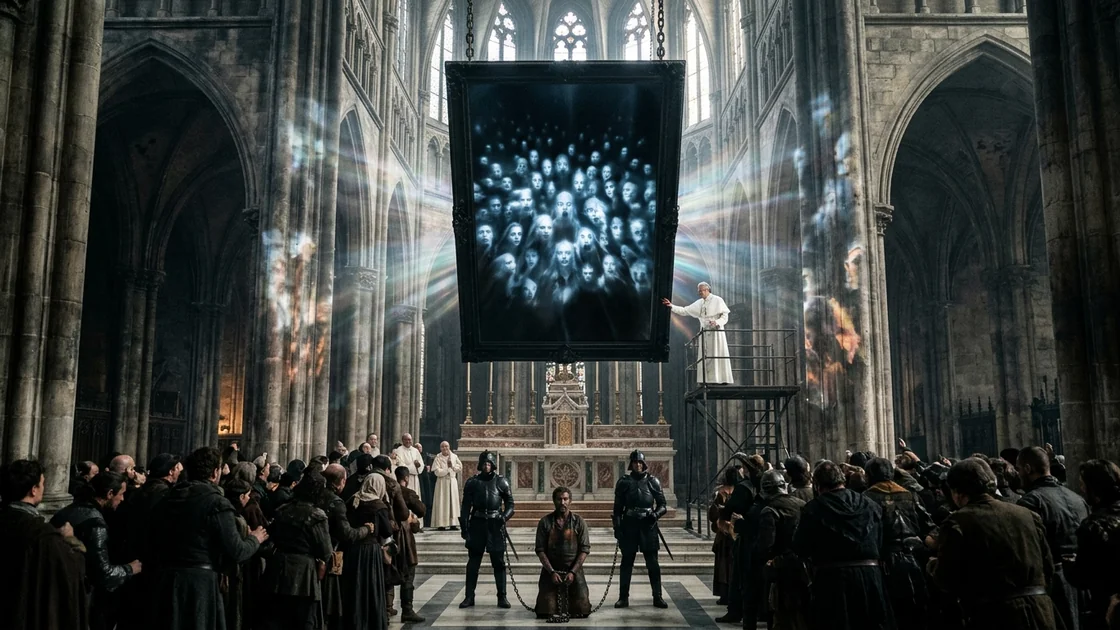
High above the altar, suspended by four massive chains of gilded bronze from the rood-beam, hung the Grand Speculum.
Set into its tabernacle frame of black iron and tilted downward at thirty degrees toward the congregation, the twelve-foot-by-eight-foot plate of crystal dominated the cathedral like a piece of fallen sky. Because it was angled to reflect the High Seat on the dais below to the people in the nave, from the floor it currently showed only the white marble steps of the altar and the empty throne of the Inquisition, rendered with such terrifying, microscopic clarity that a woman in the back row of the weaver’s section fainted dead away, swearing she felt as though she were falling upward into an inverted chasm in the ceiling.
At the side of the dais, chained by the ankles and wrists between two halberdiers, knelt Soren Thorne.
He looked very small against the white marble pillars—a stooped, soot-ingrained creature from the subterranean dark dragged out into the blinding daylight of the surface. Yet his head was up. His grey eyes were fixed not on Vane, but on the great prism of bone-ash and memory-sand hanging forty feet above them, and on the blinding shafts of autumn sunlight streaming down through the glass roof straight onto its tilted face.
The silver trumpets sounded thrice from the gallery.
Down the center aisle came the Synod—sixty Inquisitors of the Inner Circle in their immaculate white wool cassocks, walking two by two. Behind them walked High Inquisitor Valerius Vane, bareheaded, the smoky quartz lens of his office swinging against his breast. Behind Vane stumbled twelve prisoners in yellow sackcloth—the day’s harvest for the Great Assizes, chained neck-to-neck, weeping and blinking in the sun before they were forced onto their knees at the foot of the dais.
Vane ascended the twelve marble steps to the High Seat alone. He turned to face the ten thousand citizens of Vespera. His arms rose, the wide white sleeves falling back from his pale wrists.
"People of the Mountain!" Vane’s baritone rang out, amplified by the parabolic acoustics of the crystal vault overhead until it seemed to speak from inside every listener’s skull. "For eighty years, the Order of the Unblinking Eye has stood between this city and the dark that devoured our fathers! You have murmured in your workshops that our hand is heavy! You have whispered in your taverns that our fires are too hot, that our Proctors take the innocent with the guilty in the night!"
A low, fearful ripple ran through the packed nave. No High Inquisitor had ever spoken the tavern-treasons aloud from the altar before.
"A human eye may tire," Vane cried, turning half-around to point up at the colossal sheet of blinding crystal hanging above his throne. "A clerk’s hand may shake! Therefore, to mark the eightieth year of the Purification, I have commanded a glass to be blown from the very ashes of those the Order has burned! There is no secrecy in the Light! Today, before the eyes of the entire city, I bind the Grand Speculum to the blood of the High Seat! Look up into the glass as I judge these twelve accused! If there has ever been a single unjust flame lit upon the Weir by my hand—if the Order carries a single stain of innocent blood upon its wool—let the ashes in that glass declare it to the sun!"
A gasp of awe went up from ten thousand throats. It was a masterstroke of political theater. By daring the dead themselves to accuse him in a mirror made of their own bones, Vane was cementing the absolute, terrifying infallibility of the Inquisition for another century.
At the foot of the stairs, the old Arcanist Pol looked nervously at Soren, whose bruised lips were moving silently in a glassblower’s counting-rhyme: One for the gather, two for the marver, three for the breath...
Vane climbed the narrow iron celebratory scaffold erected beside the frame of the suspended mirror until he stood level with its lower bevel, twenty feet above the choir. A deacon handed him a small lancet of rock-crystal.
The cathedral went so silent that the flutter of a pigeon’s wings against the exterior glass roof sounded like thunder.
Vane drew the crystal blade across the palm of his left hand. Dark red blood welled across his pale skin. Leaning out from the scaffold, he pressed his bleeding palm squarely against the lower center of the twelve-foot glass, right where the silver bezel met the lead-crystal plate.
For three seconds, the handprint remained merely a smudge of red on a mirror that reflected the white marble throne below and the upturned faces of ten thousand citizens.
Then the blood soaked through the microscopic pores of the memory-silt and touched the Nocturne-Mercury behind the glass.
Soren felt the bond snap shut like the iron door of a glory hole.
High overhead, a deep, harmonic chord rang out from the twelve-foot plate—the exact musical note the cylinder had sung when Soren scored it with the wet cherrywood jacks in his dark workshop, now magnified a thousand times until the crystal roof panes above the nave hummed in sympathy.
Vane tried to pull his hand back from the glass. He could not. The freezing suction of three hundred thirsty souls held his bleeding palm stuck fast to the crystal like wet skin on winter iron.
"Highness?" the deacon on the scaffold whispered, reaching out.
Above them, the silver surface of the Grand Speculum went black.
The reflection of the marble altar, the white-robed Synod, and the crowded nave vanished as if wiped away with a sponge. For the space of a heartbeat, the twelve-foot rectangle was an abyss of pitch-dark mercury hanging in the sunlit cathedral.
Then the autumn sun pouring through the glass roof struck the deep, bone-ash matrix of the crystal.
Oakhart had spoken the truth. A plate of that thickness, forged entirely from memory-silt and forty pounds of human lime, did not merely reflect backward into the eyes of the man who bound it. It acted as a twelve-foot prism.
As the sunlight hit the mirror and bounced downward at a thirty-degree angle into the nave, the light came back out carrying everything that had been burned at the Weir for five years.
The black glass blazed with sudden, terrible clarity, and at the same instant, the refracted beam cast from its face painted the air of the entire cathedral with living, three-dimensional phantoms of light and smoke.
A scream went up from ten thousand throats at once, echoing off the crystal vaults until the air shook.
Up inside the twelve-foot mirror, Vane’s regal reflection was gone. In its place stood three hundred people pressed chest-to-chest against the inside of the glass, staring down at the congregation and at the sixty white-robed Inquisitors in the choir stalls.
They were not rotting corpses; they were preserved in the exact moment before the fire took them, rendered with the breathtaking, hyper-real sharpness of Soren’s master-crystal. And wherever the mirror’s reflected sunlight fell across the white marble pillars and the robes of the Synod below, their memories played out in silent, scorching projections of light.
There, twenty feet high across the west transept wall, the congregation saw young Timothy the cobbler’s boy kneeling in the cistern-room while Brother Castian and Vane looked on, the boy holding up his bleeding, nail-less fingers and weeping over a pamphlet he could not read—followed instantly by the image of Vane calmly burning the real printer’s confession in a brazier so the Ward tally would not look clumsy.
There, reflected directly onto the white cassocks of the sixty Inquisitors in the choir, appeared the miller’s daughter Marcia, dragged from her bed by Brother Malthus not because she had hexed a well, but because she had struck his hand away when he cornered her behind the mill-wheel—and there was Vane’s own signature drying on her death warrant without him ever having looked up from his supper to read the charges.
There was Lyra’s father, the printer of Copper Street, his tongue being torn out with hot pincers in the Lower Basilica because he had printed an astronomical table from the old Empire that proved the Great Refraction had been caused not by witches, but by the Synod’s own greed in drilling the deep geothermal vents too close to the mountain’s heart.
Face after face, memory after memory, poured out of the twelve-foot glass in a blinding, relentless avalanche of light. Every backroom bargain where a wealthy merchant’s rival was condemned as a heretic so the Order could seize his warehouses; every frightened child who had confessed to impossible sorceries to stop the rack from turning another notch; every quiet scholar burned to keep the Synod’s monopoly on the mountain’s magic secure.
And in the exact center of the Grand Speculum, directly before Valerius Vane’s wide, horror-struck eyes as he hung trapped by his bleeding palm against the glass, stood Clara Thorne.
She was twelve feet tall in the reflection, her grey eyes clearer than the autumn sky above the roof. In her hands she held the parabolic mirror Vane had condemned her for grinding—and in its curved glass, projected out into the center of the nave for ten thousand citizens to see, was the memory of her final interrogation in the cellar below the altar: Vane standing over her, admitting softly that he knew her telescope looked only at the harmless moons of the outer rim, yet condemning her to the Weir anyway because if the people of Vespera learned there were other whole, unbroken worlds turning peacefully in the dark above their mountain, they would no longer fear the Order’s little fires.
"Break it!" Vane’s voice was no longer a calm baritone; it was a ragged, tearing shriek that cut through the roar of the panicked crowd. With a violent jerk that left the skin of his palm frozen to the crystal, he ripped his hand free and stumbled backward down the scaffold steps, blood spattering his immaculate white wool. "Proctors! Crossbows! Smash the glass! It is bewitched! Smash it!"
Below the dais, the nave had erupted into a boiling sea of fury.
A burly iron-master from the Upper Tier, who had just seen his younger brother’s terrified, innocent face looking down from the glass above the altar, did not wait for the Proctors. With a roar that echoed the foundry furnaces, he wrenched a ceremonial halberd from the hands of the nearest guard and drove the butt into the Proctor’s helmet.
All along the aisles, the barriers broke. Weavers from the Silk-Sump, glassblowers from the Cinder-Cot, smiths and masons who had walked in silent terror of the white cassock for eighty years looked up at the three hundred witnesses shining in the mirror and then looked down at the sixty pale men huddled in the choir stalls.
Four Basilica Guards near the altar raised their heavy crossbows and fired iron bolts straight up into the face of the Grand Speculum.
Tink. Tink. Tink. Tink.
The heavy steel quarrels struck the three-quarter-inch lead crystal that Soren had annealed with his own breath and the marrow of three hundred souls. The bolts did not even scratch the polish; they flattened like lead toys against the unyielding surface and rained down onto the marble altar.
"The chains!" the old Arcanist Pol screamed as the first rank of furious guild-men surged over the communion rails, tearing the white cassocks from the Inquisitors of the Inner Circle with their bare hands. "Cut the winch-chains!"
Two guards hacked wildly with broadswords at the gilded bronze windlass bolted to the north pier. The heavy wooden pawl shattered under the steel; the bronze gears shrieked, stripped, and let go of the left-hand suspension chain.
Forty feet overhead, the twelve-foot iron frame tilted violently as the left side dropped six feet. The monstrous weight of the crystal tore the remaining three chains out of the rotted mortar of the rood-beam with a sound like a cannon-shot.
"Vane!" Soren roared from the side of the dais, rising to his knees in his chains as the world seemed to slow to the viscous, golden pace of molten glass in the pot.
High Inquisitor Valerius Vane stood frozen in the center of the white marble steps, abandoned by his guards, his bleeding hand clutched to his breast, staring up in paralyzed terror as three hundred innocent faces—and his own reflection at last, tiny, withered, and black with terror among them—rushed downward out of the sky to meet him.
The Grand Speculum struck the marble steps of the High Seat flat on its face.
When three hundred pounds of stressed lead-crystal and Nocturne-Mercury shattered against the stone, it did not merely break into shards. All the pent-up pneuma of Soren’s lungs, all the blinding noon sunlight of the cathedral roof, and all the trapped heat of five years of pyres released at once in a silent, concussion wave of pure white light that blew every crystal window out of the Basilica’s frame and knocked ten thousand men and women flat onto the marble floor.
When the ringing in Soren’s ears subsided, snow was falling into the cathedral.
It drifted down through the empty iron ribs of the shattered roof, swirling lazily through the cold mountain air to settle on the overturned braziers, the torn white wool of the fleeing Synod, and the weeping, embracing crowds in the nave where the citizens of Vespera were already striking the chains off the twelve prisoners in yellow sackcloth.
At the center of the altar steps, where High Inquisitor Vane had stood, there was no body to be seen—only a vast, glittering drift of ten thousand diamond-bright fragments of broken mirror, every single shard pointing upward toward the open sky, reflecting the clean, empty blue of the heavens where no eye watched at all.
A cold iron key slid into the lock of Soren’s wrist-manacles.
The iron fell away from his blistered wrists. Soren looked up through the drifting snow.
Lyra stood beside him, wrapped in a wool-factor’s oversized coat, a heavy iron furnace-bar still clutched in her small fist where she had taken the key from his fallen guard. Behind her stood Thomas and half a dozen gaffers from the Guild of the Molten Breath, their leather aprons still black with coal-dust from the Cinder-Cot.
Lyra reached down into the drift of shattered crystal at the edge of the step. She picked up a single, tiny pebble of smooth green glass that had survived the furnace and the fall intact, wiped the mercury from its surface with her thumb, and dropped it into Soren’s open palm.
Soren closed his scarred fingers around the green bead. He took a long, deep breath of the freezing mountain air—the first breath in five years that did not taste of sulfur or ash—and let it out slowly into the light.