The Microscopic Architecture of Guilt
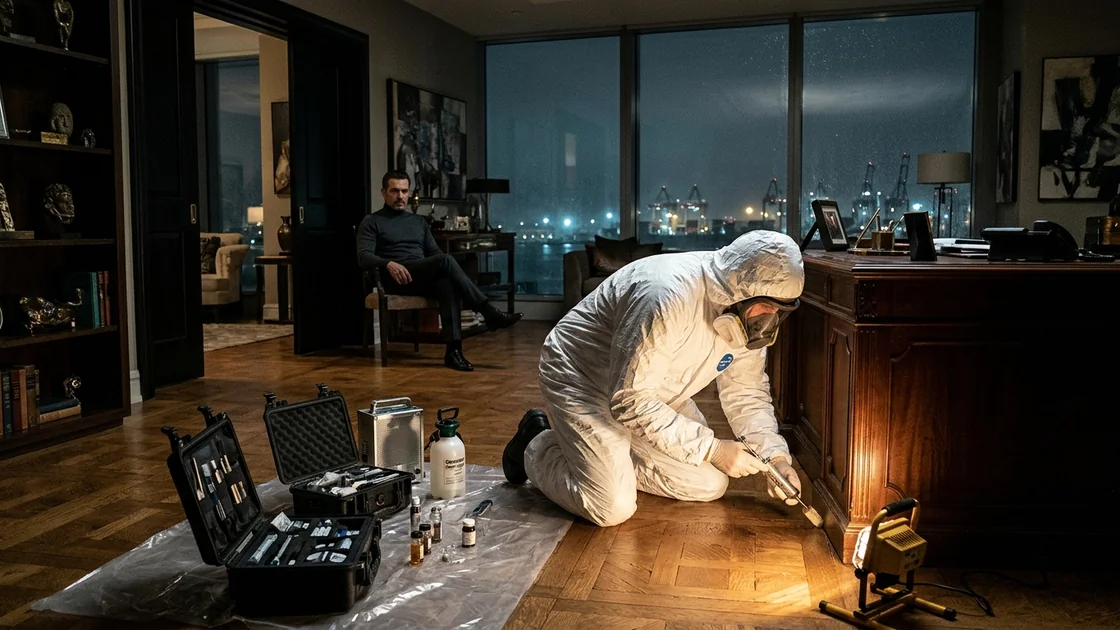
Arthur Pendelton is a veteran biohazard remediation specialist who spends his life erasing the visceral aftermath of violent crimes across the city. Beneath his quiet, methodical exterior, Arthur maintains a secret cryogenic archive of microscopic trace evidence harvested from the crime scenes of unsolved murders orchestrated by the ruthless Reyes cartel. When Julian Vance, the cartel's brilliant and untouchable defense attorney, hires Arthur for an off-the-books midnight cleanup inside his luxury penthouse, Arthur seizes the opportunity to execute a masterclass in reverse forensics. Over the course of one grueling night, while pretending to sterilize the apartment before an impending federal raid, Arthur systematically embeds bone dust, arterial micro-spatter, and biological trace from three cold-case homicides deep into the architectural and personal fabric of Vance's home, turning the lawyer's impenetrable sanctuary into a damning forensic trap.
People believe that death leaves a permanent stain, an indelible mark upon the world that cries out for vengeance, but Arthur Pendelton knew that death was merely a stubborn protein bond waiting for the right enzymatic surfactant.
For nineteen years, Arthur had operated Aegis Bio-Remediation out of an unassuming cinderblock warehouse in the industrial flats of East Harbor. When the yellow police tape came down, when the medical examiner’s van pulled away with the heavy vinyl pouch, and when the forensic technicians packed up their cameras and casting putty, the grieving families were left with the geography of the trauma. The state took the body; the state never took the blood. That was Arthur’s domain. He arrived in an unmarked white box truck, stepped into a DuPont Tyvek suit, sealed a full-face respirator over his graying beard, and systematically unmade the violence.
He knew the physics of a dying body better than most surgeons. He knew that high-velocity spatter from a nine-millimeter hollow-point aerosolized into mist droplets smaller than a tenth of a millimeter, drifting on ambient air currents to settle atop ceiling fan blades and inside the ribbed tracks of sliding closet doors. He knew that human plasma, once separated from the clotting factors of coagulated red blood cells, had the viscosity of warm motor oil and would wick upward into drywall through capillary action, hiding three inches above the baseboard where a mop could never reach. He knew how fat lipids melted into porous concrete during an August heatwave, and he knew the exact ratio of hydrogen peroxide to quaternary ammonium required to denature those lipids until not even a police cadaver dog could catch the scent of putrefaction.
To the police detectives who occasionally lingered at the perimeter of a released scene, Arthur was a fixture of the municipal furniture—a quiet, slightly stooped man in his late fifties with mild hazel eyes, who spoke softly, billed insurance companies fairly, and never asked who had pulled the trigger.
They never looked closely at his toolkit. If they had, they might have wondered why a man paid to destroy biological matter carried three dozen sterile, barcoded borosilicate micro-vials inside the lined pockets of his tool belt, or why his custom shop-vac contained a secondary, inline micron-mesh trap positioned just ahead of the main HEPA filter.
On a damp Tuesday evening in November, Arthur was on his knees in the kitchen of a modest bungalow in the Belmont district, extracting the last traces of a man named Luis Delgado from the grout lines between terracotta floor tiles.
Delgado had been a dockside customs inspector with an unblemished record and a fatal habit of opening crates manifested as agricultural machinery. Four days ago, two men had entered Delgado’s kitchen while he was making coffee. They had not used firearms; noise drew neighbors, and the Reyes Syndicate preferred quiet object lessons when dealing with mid-level civil servants. By the time the police discovered Delgado thirty-six hours later, the metropolitan homicide division had spent ten hours dusting, swabbing, and photographing the kitchen before declaring the scene processed. They had found no fingerprints, no stray hairs from the assailants, and no shoe prints that didn't belong to the victim. Within a week, the file would be boxed and sent to the cold-case annex in the basement of the Hall of Justice.
Arthur paused, resting his gloved forearms on his knees. The air inside the kitchen was thick with the sharp, citrus-and-bleach tang of his primary degreaser, underscored by the heavy, metallic sweetness of three-day-old blood. Behind him, a commercial negative-air machine hummed at a steady sixty decibels, drawing the room’s atmosphere through a thick carbon bed and exhausting it out a sealed window duct.
With a brass-bristled detail brush and a dental pick, Arthur traced the seam where the terracotta tile met the threshold of the pantry. The police technicians had swabbed the center of the floor where the main pool of blood had congealed. They rarely bothered with the tectonic margins of a room—the places where materials joined, expanded, and contracted.
Arthur wedged the tip of his steel pick under the quarter-round oak molding beside the refrigerator. With a gentle pry, the wood came away with a dry squeak of finishing nails pulling free from plaster.
He switched on a handheld alternate light source, sliding an orange barrier filter over the nosepiece of his respirator. Under the intense blue wavelength of four hundred and fifty nanometers, the dark crevice behind the molding flared to life.
Wait long enough at enough scenes, and you learn that violence is messy in both directions. When the human body resists annihilation, it takes pieces of its destroyer with it. Wedged between the bottom edge of the drywall and the concrete slab was a tiny, curled crescent of translucent keratin—a torn fingernail tip—coated in dried crimson and tangled with three coarse, dyed-black wool fibers that matched nothing in Luis Delgado’s wardrobe.
Arthur did not call the detective assigned to the case. He had made that mistake eight years ago, when his younger brother, David, had still been alive. Back then, Arthur had believed that the justice system was merely overburdened, a blind giant that only needed someone to point its fingers in the right direction. He had handed over a pristine carpet fiber and a partial skin graft found behind a radiator after the murder of an eyewitness in the first prosecution against Hector Reyes.
That piece of evidence had never reached a jury. Julian Vance—a man whose suits cost more than Arthur’s box truck and whose smile had the warmth of surgical steel—had filed a forty-page motion challenging the post-release chain of custody. Vance had put Arthur on the stand for three hours, dissecting his lack of law enforcement accreditation, suggesting with silky, devastating politeness that a private janitor with an array of chemicals had compromised the scene, cross-contaminated the sample from another job, or fabricated it entirely for a reward. The judge had thrown the sample out. Six weeks later, Arthur’s brother David, a junior paralegal in the District Attorney’s asset forfeiture unit who had been helping trace the provenance of Vance’s retainer fees, went off the side of the West Channel Bridge in a rainstorm. The brake lines on his sedan had been severed so cleanly at the master cylinder that the state trooper on the scene remarked it looked like surgery, though the official coroner’s inquest ruled it catastrophic mechanical failure after the vehicle conveniently vanished from the municipal impound lot.
Arthur stared at the glowing crescent of keratin behind Luis Delgado’s baseboard.
With a pair of titanium micro-forceps sterilized in an alcohol flame, he lifted the fingernail fragment and the clinging wool fibers. He did not drop them into his red biohazard disposal bag. Instead, he unscrewed the cap of a two-milliliter cryogenic vial, nestled the fragment inside, capped it, and clicked a miniature rotary stamp to imprint the date and a four-digit alphanumeric code onto the frosted glass label.
Only after the vial was safely tucked into the lead-lined pouch inside his inner vest did Arthur pick up his enzymatic sprayer. He flooded the channel behind the baseboard with foam, waited three minutes for the proteins to dissolve into harmless amino acids, and wiped the concrete until it was as blank and historyless as the day it had been poured.
The basement beneath the Aegis Bio-Remediation warehouse did not exist on the city’s municipal blueprints. When Arthur had purchased the building in 2009 from a bankrupt textile dyer, the subterranean level had been a flooded drainage cistern holding forty thousand gallons of stagnant rainwater and chemical sludge. Working alone on weekends over the course of three years, Arthur had pumped the cistern dry, parged the brick walls with hydraulic cement, poured a self-leveling epoxy floor, and concealed the heavy steel hatch beneath a two-ton pallet rack loaded with fifty-five-gallon drums of industrial detergent.
To enter, he had to engage an electric chain hoist that lifted the entire lower shelf of the rack four feet into the air, revealing the flush floor plate beneath.
At ten o’clock that night, after washing down the box truck and autoclaving his scraping tools, Arthur descended the narrow steel stairs into the cool, humming quiet of the vault.
It looked less like a lair and more like a pathology annex at a well-funded university hospital. Along the north wall stood two brushed-steel Taylor-Wharton liquid nitrogen dewars and a Minus-Eighty Celsius upright laboratory freezer purchased at a liquidation auction when a biotech startup in the suburbs went belly-up. Opposite the freezers was a six-foot laminar flow hood, an analytical microbalance capable of weighing a single eyelash, a stereo zoom microscope, and rows of steel shelving occupied by forty-two black archival binders.
Arthur removed his shop coat, washed his hands up to the elbows in a surgical scrub sink with chlorhexidine soap, and dried them with lint-free paper towels. He put on a fresh pair of purple nitrile gloves before opening the upright freezer.
A plume of dry, biting fog spilled over his wrists, cascading down to the gray epoxy floor. Inside, arranged in anodized aluminum racks, were hundreds of two-milliliter vials.
This was the shadow registry of the city.
Every vial represented a dead end in the official narrative of metropolitan crime. When the police processed a homicide, they collected macroscopic evidence—pooled blood on linoleum, bullet casings, weapons, clothing. They took fifty or sixty cotton swabs, boxed them up, and turned the scene back over to the property owner. Then Arthur came in. While the police spent hours at a scene, Arthur spent days. He dismantled the rooms. He pulled up carpet tack strips; he unscrewed electrical wall plates; he disassembled bathroom P-traps and sawed out sections of subflooring.
In doing so, he preserved what the state was too rushed, underfunded, or compromised to find, along with significant reserves of the victims' own biological matter before he annihilated the remainder with peroxide and ozone.
He placed the vial from Luis Delgado’s kitchen into Rack G, Slot 14, closed the heavy insulated door until the magnetic seal hissed shut, and walked over to the workbench where Binder 19 lay open under a gooseneck LED lamp.
Binder 19 did not belong to a victim. It belonged to Julian Vance.
For six years, Arthur had tracked the lawyer the way an epidemiologist tracks a vector of contagion. Vance was forty-four years old, a partner at Vance, Merriweather & Cross, though Merriweather had been dead for a decade and Cross was a ninety-year-old name on stationery. Vance didn't handle divorces, corporate mergers, or slip-and-falls. He had a single client base: the upper echelon of the Reyes Syndicate and the constellation of corrupt customs officials, judges, and precinct captains who kept the syndicate’s narcotics and cash flowing through the port.
Vance was not merely an advocate who argued the Constitution after the fact. Through the fragments of conversations Arthur had overheard from nervous property managers, through court transcripts Arthur bought at thirty cents a page, and through the cold geometry of the crime scenes themselves, it was clear that Vance was the architect of the cartel’s impunity. When an informant was identified through discovery documents provided to the defense, the informant disappeared before the preliminary hearing. When a witness changed their story, Vance’s private investigator—a former special forces interrogator named Mateo Cruz—was always the last person to have visited their neighborhood.
Yet Vance himself remained hermetically sealed from the filth that paid for his bespoke cashmere overcoats and his collection of pre-war Patek Philippe chronographs. He never visited the slaughterhouses in the industrial district. He never rode in the sedans with the plastic sheeting in the trunk. He lived forty-two stories above the street in The Sovereign, a glass-and-titanium obelisk overlooking the harbor, surrounded by biometric elevators, armed concierge staff, and a digital security perimeter that the FBI’s organized crime strike force had spent four years failing to penetrate.
To bring down a man like Julian Vance, the government was looking for wiretaps, offshore ledger entries, or a cooperating cartel lieutenant willing to trade testimony for witness protection. They were looking for paper and words.
Arthur knew that paper could be shredded and words could be recanted. Vance was a master of words. He could twist a financial transaction into a consulting fee and a phone call into protected attorney-client privilege.
What Vance could not argue with was twenty picograms of degraded human mitochondrial DNA mixed with industrial slag wedged inside the welt stitching of his own shoes.
For the past eighteen months, Arthur had been refining a theory he called Reverse Remediation. His entire profession was built on the principle of Locard’s Exchange—the forensic axiom that every contact leaves a trace. Arthur’s day job was to break that law, to sever the physical link between an event and a location. But if you understood the exact mechanics of how trace evidence hid, how it degraded, how it bound to substrates, and how forensic technicians searched for it, you could also run the machine in reverse.
The problem had always been access. The Sovereign was a fortress. Its common areas were maintained by a bonded commercial janitorial firm, and Vance’s private two-story penthouse was cleaned twice a week by a live-out domestic worker who had been vetted by Mateo Cruz down to her third cousins in Guadalajara. Arthur had spent months studying the building’s HVAC contractors, its window-washing rigs, and its plumbing maintenance schedules, looking for a seam he could slip through.
He hadn't counted on Julian Vance opening the door himself.
The landline on the wall beside the laminar flow hood—the red phone connected to Aegis Bio-Remediation’s 24-hour emergency dispatch line—rang at 11:42 PM.
Arthur stared at the blinking red light on the receiver for three rings. Calls at midnight were not unusual; suicides and unattended deaths rarely respected business hours. He stripped off his nitrile gloves, walked to the wall, and lifted the handset.
"Aegis Remediation," Arthur said, his voice dropping into the flat, soothing baritone he used for grieving spouses and rattled hotel managers. "Arthur speaking."
There was a pause on the line, filled only by the faint, sterile hiss of an encrypted connection routing through a relay.
"Mr. Pendelton," a voice said. It was smooth, unhurried, with a faint trace of an old boarding-school cadence flattening the vowels. Arthur had heard that voice in courtrooms. He had heard it on the courthouse steps on the evening news, expressing sorrow over the tragic dismissal of charges against men who dissolved teenagers in acid.
Arthur’s heart rate did not spike; instead, a cold, crystalline stillness settled behind his ribs. He kept his breathing shallow and regular. "Yes, sir. How can I help you tonight?"
"My name is unessential to your billing ledger," Julian Vance said. "We have a mutual acquaintance in the bail bonds sector who occasionally utilizes your services when tenants vacate properties in a hurry. He tells me two things about you, Mr. Pendelton. First, that your work is thorough enough to defeat a state police crime lab. Second, that you possess a rare defect in the modern character: you have no curiosity."
"My clients pay me to restore property to a habitable state," Arthur said mildly. "Anything outside the perimeter of the spill is none of my business."
"A comforting philosophy," Vance replied. "I have a spill. A localized biological remediation issue in a private residence. No municipal agencies have been notified, nor will they be. The source of the contamination has already been removed from the premises. What remains is... structural."
"I see," Arthur said. He picked up a graphite pencil from the workbench and touched the point to a blank pad, though he wrote nothing. "What is the square footage of the affected area, and what is the primary substrate? Carpet, hardwood, stone?"
"Quarter-sawn white oak parquet, custom milled, bordering an imported Calacatta marble bathroom," Vance said, and for the first time, a hairline fracture of tightness entered the lawyer’s voice. "There was an arterial event. Approximately two liters, perhaps more, over the course of twenty minutes. Some of it reached the grout and the seams between the wood blocks. My security director attempted a preliminary cleanup using household sodium hypochlorite, which I am now informed was an error."
"Bleach fixes proteins to porous surfaces and sets the iron in hemoglobin," Arthur said, slipping effortlessly into the pedantic cadence of a veteran tradesman. "It hides the color from the naked eye, which makes people think it's clean, but it actually catalyzes the chemiluminescence if someone hits it with luminol later. Plus, it leaves a harsh chemical scar on white oak that any inspector will spot from across the room."
Silence hung on the line for three seconds.
"Precisely my concern," Vance said quietly. "I have reason to believe that by nine o'clock tomorrow morning, a federal magistrate will sign a warrant authorizing the United States Marshals and the FBI to enter this residence. The warrant pertains strictly to financial records and digital media. However, the agent leading the task force is a vindictive woman who will undoubtedly bring a forensic technician and a canine unit through the door on the pretext of searching for hidden safes behind the paneling. If that dog sits down on my parquet floor, Mr. Pendelton, my morning becomes extraordinarily complicated."
Arthur looked across his basement laboratory at the Minus-Eighty freezer.
"Nine o'clock gives us less than nine hours," Arthur said. "To neutralize the iron catalyst, strip the bleached protein biofilm, extract the seepage from the tongue-and-groove subflooring without tearing up the wood, and scrub the ambient air so a bloodhound doesn't alert on volatile organic compounds... I would need to be on-site within forty-five minutes."
"You will be compensated fifty thousand dollars in unmarked hundred-dollar bills upon completion," Vance said. "Provided that when my security director checks your work with his own UV lamp and peroxide swabs at seven A.M., the room reads like an operating theater."
"UV lamps and peroxide swabs are amateur tools, sir," Arthur said evenly. "I'll bring an hygienic ATP bioluminescence meter. It measures adenosine triphosphate down to the femtomole—the actual cellular energy molecule present in all living or formerly living tissue. When my meter reads zero, the FBI could eat breakfast off your floor."
"The Sovereign," Vance said. "South service entrance off Water Street. Drive your truck directly into the subterranean loading bay. A man named Mateo will meet you at the freight elevator. Come alone. If you have an assistant, leave him home. Your phone and your vehicle's GPS transponder will remain in the loading bay."
The line went dead.
Arthur slowly lowered the receiver onto its cradle. For ten seconds, he stood motionless beneath the hum of the fluorescent tubes, listening to the distant thrum of the harbor traffic three blocks away.
Then he turned, walked to the Minus-Eighty freezer, and pulled open the heavy door.
To frame a laymen required only carelessness; to frame a man who employed former federal forensics consultants as expert witnesses required choreography.
Arthur had thirty-two minutes before he needed to pull out of the warehouse bay to make the drive to Water Street on schedule. Every movement he made now had the practiced economy of a bomb technician assembling a fuse.
He couldn't simply dump fifty vials of old blood onto Julian Vance’s carpet. Modern forensic science would dismantle a clumsy frame in an afternoon. If fresh or poorly thawed blood from a three-year-old murder suddenly appeared in a clean puddle on a penthouse floor, the defense would test it for EDTA preservatives, check the degradation profile of the RNA transcripts to determine the age of the stain, and analyze the spatter morphology. A droplet falling from a pipette hits a surface at ninety degrees and low velocity, creating a round stain with smooth edges; blood flying from a gunshot wound or a bludgeoning hits at acute angles and high velocity, creating elongated exclamation points with microscopic satellite droplets radiating outward.
Furthermore, the evidence had to make narrative sense to the FBI agents who would find it.
Julian Vance was not a street bruiser who hacked people to pieces in his living room every Tuesday. Wait—tonight, apparently, someone had bled out in his penthouse, an aberration born of whatever crisis was prompting tomorrow's federal raid. That was gift number one: the acute crime scene. Whatever poor bastard had just lost two liters of blood on Vance’s white oak floor would provide the immediate probable cause to tear the penthouse apart.
Once the FBI found blood in the study, their limited financial warrant would evaporate. They would freeze the scene, secure a comprehensive homicide search warrant, and bring in the Evidence Response Team for a week-long destructive search of the entire two-story residence.
And when they tore the penthouse down to the studs, what should they find?
Not a slaughterhouse. They needed to find souvenirs and transfer trace. They needed to find the microscopic, unavoidable detritus that a man brings home on his shoes, his luggage, his watches, and his skin when he stands inside a kill room to supervise the execution of witnesses, or when he stores trophies of his syndicate's problems inside his sanctuary.
Arthur pulled three specific trays from the freezer and carried them to the laminar flow hood.
Sample One: Case File 09-114. Clara Soto.
Twenty-two months ago, Clara Soto had been an compliance officer at the Mercantile Bank of the Americas who stumbled across the shell companies laundering the Reyes Syndicate’s port revenues. She had reached out to Special Agent Valerie Cross at the FBI—the very same "vindictive woman" Vance had just referenced on the phone. Before Clara could enter protective custody, she vanished from a commuter train platform. Her body was never found. Without a corpus delicti, the murder investigation stalled.
What the FBI didn't know was that four days after Clara vanished, a bail bondsman affiliated with Mateo Cruz had hired Arthur to clean an abandoned rendering vat inside a shuttered meatpacking plant in the stockyards. The story given to Arthur was that illegal poachers had been butchering deer on the property and the owner needed it sanitized before a city health inspection.
Arthur had known better the moment his boots touched the concrete. Deer didn't wear gold dental crowns with porcelain veneers.
Whoever had disposed of Clara Soto had used an industrial reciprocating bone saw and three hundred gallons of agricultural sulfuric acid before flushing the slurry down a storm sewer that emptied into the bay. They had done a remarkably thorough job, except they hadn't understood how reciprocating saw blades aerosolize cortical bone into a fine, electrostatic dust that clings to overhead cast-iron steam pipes. While scraping the pipes fifteen feet above the vat, Arthur had collected twelve grams of desiccated human bone meal, mixed with microscopic shards of a specific, identifiable dental porcelain and the unique blue silicate glaze of the meatpacking plant’s tiles. He had also recovered thirty milliliters of coagulated venous blood that had seeped beneath the rubber gasket of the floor drain before the acid was poured.
Sample Two: Case File 11-042. Judge Thomas Halverson.
Fourteen months ago, Judge Halverson had been presiding over the racketeering indictment of Hector Reyes’s younger brother. On a Sunday evening, Halverson was found at the bottom of the stone cellar stairs in his lakeside cabin, his neck broken and his skull fractured against the flagstone. The local sheriff, whose campaign had been heavily funded by real estate developers tied to Vance’s firm, ruled it a tragic household fall within four hours and released the scene to the judge’s distraught daughter.
The daughter had hired Arthur to clean the cellar stairs.
While extracting the blood from the porous bluestone at the base of the steps, Arthur had noticed that the spatter pattern on the underside of the third pine riser was physically impossible for a falling body. It was cast-off spatter from a narrow, cylindrical object swung upward inside the confined stairwell. Tucked into a splintered groove on that riser, Arthur had found a microscopic smear of skin cells, Halverson’s brain tissue, and trace residues of a rare synthetic watch lubricant—Moebius 9010—along with tiny scratch flakes of eighteen-karat rose gold where the assailant’s timepiece had clipped the heavy iron handrail during the fatal blow. Arthur had harvested twenty vials of Halverson’s blood-soaked bluestone dust and preserved the tissue-and-lubricant matrix in anhydrous glycerol.
Sample Three: Luis Delgado. Tonight's harvest.
The customs inspector’s blood, scraped from the terracotta grout less than four hours ago, along with the torn fingernail fragment and the black wool fibers from his killer.
Arthur worked under the hood with surgical precision.
He did not keep his samples in standard clinical anticoagulants like EDTA, which forensic labs easily detect as evidence of tampering. Years ago, he had developed a proprietary storage protocol: flash-freezing raw biological material in liquid nitrogen vapor within minutes of collection, or desiccating it in a vacuum chamber over silica gel so that cellular structures remained intact without chemical additives. When rehydrated with sterile, deionized distilled water—or better yet, with a diluted solution of human sebum and sweat lipids—the sample behaved under forensic analysis identically to natural, aged trace evidence.
First, he prepared the Soto payload. He took four milligrams of Clara Soto’s bone dust, the microscopic porcelain dental shards, and the blue stockyard silicate, and suspended them in a volatile, odorless carrier fluid made of medical-grade perfluorohexane. The liquid evaporated completely at body temperature within twenty minutes, leaving zero chemical residue while carrying solid particulates deep into the microscopic weave of textiles or leather via capillary draw. He loaded this suspension into what looked like a standard brass nozzle attachment for his upholstery steam-extractor, concealing it inside a secondary valve chamber activated only by twisting the brass collar forty-five degrees counterclockwise.
Second, he prepared the Halverson payload. He thawed two milliliters of the judge’s cellar-stone blood and tissue suspension, mixing it with a trace amount of dust scraped from the lakeside cabin’s cedar joists. He loaded this into a modified steel caulking needle hidden inside the handle of his wire grout brush.
Third, he took the tiny crescent of fingernail and the bloodied wool fibers from Luis Delgado’s kitchen. He didn't put them in a sprayer. He placed them inside a hollow, false-bottomed compartment in the plastic housing of his hygienic ATP meter.
Finally, he prepared his masterpiece: the chemical time-lock for whatever fresh victim was currently staining Julian Vance’s penthouse floor.
Vance wanted the floor to pass a UV lamp, a peroxide test, and an ATP swab at seven o'clock in the morning, two hours before the FBI arrived at nine.
If Arthur actually cleaned the floor to his usual standard, the FBI would find nothing there, and they might never get the probable cause needed to tear up the rest of the apartment where Soto, Halverson, and Delgado were waiting. Arthur needed the floor to look completely sterile at 7:00 AM to Vance’s security man, and then scream like a beacon at 9:15 AM when the FBI’s cadaver dog and forensic tech walked across it.
Chemistry was a wonderful thing when you understood reaction kinetics.
Arthur mixed a two-stage polymer glaze in a one-gallon pump sprayer labeled Aegis Seal-Guard: Hardwood Neutralizer. The base was a cross-linking polyvinyl alcohol mixed with sodium thiosulfate and a temporary volatile masking ester derived from synthetic butyric acid blockers.
When sprayed over blood that had soaked into the cracks between parquet wood blocks, the sodium thiosulfate would instantly neutralize any hemoglobin on the immediate surface, defeating both luminol and hydrogen peroxide tests. Simultaneously, the polyvinyl alcohol would dry into a microscopic, invisible film less than ten microns thick—just enough to seal in the volatile organic odors so a dog wouldn't smell it, and to prevent an ATP swab from picking up cellular energy molecules.
However,Arthur spiked the polymer solution with a slow-acting, airborne-moisture-activated enzyme: recombinant cellulase paired with an acidic buffer. Once exposed to the normal forty-percent humidity of an air-conditioned penthouse, the acidic buffer would slowly hydrolyze the polyvinyl film.
At two hours post-application—roughly 7:00 AM—the film would be rock solid.
At three and a half hours post-application—roughly 8:30 AM—the enzyme would hit its tipping point. The microscopic film would unzip itself into simple sugars and evaporate, while the mild acid would draw the uncleaned, deep-reservoir blood from the bottom of the wood joints back up to the surface via osmotic pressure. By nine o'clock, the cracks in the parquet floor would be weeping fresh hemoglobin and outgassing putrescine molecules straight into the nostrils of the federal bloodhound.
Arthur screwed the brass wand onto the pump sprayer, pressurized it with three strokes, and checked his watch.
12:14 AM.
He closed Binder 19, locked the Minus-Eighty freezer, engaged the chain hoist to lower the two tons of detergent drums back over the basement hatch, and walked out to his truck.
The Sovereign rose out of the downtown financial district like a shard of black ice driven into the bedrock of the harbor. At half-past midnight, the streets around its plaza were deserted, slick with a cold mist rolling off the water and illuminated only by the amber glow of sodium streetlights.
Arthur turned his white box truck down the narrow cobblestone alley off Water Street. Halfway down the block, a seamless brushed-steel garage door slid upward into the concrete lintel before his headlights even touched it.
He drove down a spiral concrete ramp into a brilliantly lit subterranean vault lined with white subway tile. Parked in the private stalls to his left were a matte-black Mercedes-AMG G63, a silver Bentley Continental, and a dark blue sedan with heavily tinted windows.
Standing beside a stainless-steel freight elevator was a man in his late thirties wearing a charcoal turtleneck and tailored slacks. He had the thick traps, flattened knuckles, and calm, predatory posture of someone who viewed every human interaction through the geometry of fields of fire and chokeholds.
Mateo Cruz.
Arthur put the truck in park, switched off the ignition, and stepped down from the cab wearing his dark blue Aegis work trousers and a heavy canvas jacket. He looked every inch the tired, middle-aged contractor dragged out of bed for an overtime call—shoulders slightly rounded, eyes blinking against the harsh LED glare of the garage.
Cruz didn't offer a hand. He stepped forward as Arthur came around the bumper. "Phone. Keys. Wallet."
"On the dash," Arthur said, gesturing through the open driver's window. "Left my wallet at the shop. Only brought my contractor's license in Case the highway patrol stopped me."
Cruz reached into the cab, verified the old flip phone sitting on the vinyl dashboard, and pocketed the truck keys. Then he turned to Arthur and ran a high-end nonlinear junction detector—a sleek wand designed to detect semiconductors whether they were powered on or off—from Arthur’s collarbone down to the steel toes of his boots.
The wand beeped on Arthur’s belt buckle, his keyring, and the steel zipper of his jacket. It did not beep on the glass vials or the brass valves inside his equipment cases in the back of the truck, because glass, brass, and dead biological matter contain no silicon transistors.
"Open the rollup door," Cruz ordered.
Arthur unlatched the rear of the box truck and rolled the door up. Inside lay the standard tools of his trade: two wheeled Pelican cases, a stainless-steel HEPA negative-air scrubber, an upholstery steam extractor, four one-gallon chemical sprayers, a bucket of brushes and scrapers, and a box of Tyvek suits.
Cruz climbed into the bed and spent four minutes opening every case, unscrewing the lids of the chemical jugs to sniff the contents, and running his semiconductor detector over the motor housing of the vacuum and the ATP meter. When he unscrewed the Aegis Seal-Guard sprayer, the sharp, hospital smell of the masking ester made him wrinkle his nose and pull back.
"What's this?" Cruz asked.
"Enzymatic wood sealer," Arthur said patiently, leaning against the loading dock wall with his hands in his pockets. "Your boss said you hit white oak with household bleach. If I don't neutralize the sodium hypochlorite and seal the wood pores after I extract the blood, the floorboards will cup and turn gray by sunrise, and any dog within fifty yards will smell the oxidized iron. You want me to leave it in the truck, I can, but you'll be replacing the floor."
Cruz stared at him with flat, dark eyes for five seconds, then screwed the lid back on. "Load the cart. You have six hours."
The freight elevator had no buttons inside the cab, only a biometric palm pad that responded to Cruz’s right hand. The ascent to the forty-second floor was silent and rapid, pressing Arthur’s heels gently into the rubber floor mat while his ears popped twice.
When the doors slid open, they didn't open into a service corridor; they opened directly into a butler's pantry lined with gray lacquered cabinetry and Gaggenau wine refrigerators.
Beyond the pantry lay the main expanse of the penthouse.
Arthur had been inside wealthy homes before—tragedy was notoriously egalitarian—but Julian Vance’s residence didn't feel like a home. It felt like a museum curated by someone who hated humanity. The living area boasted twenty-foot floor-to-ceiling glass walls overlooking the black expanse of the harbor and the distant neon cranes of the container port. The furniture was low, angular Italian leather in shades of ash and obsidian. On the walls hung massive, monochromatic abstract canvases that looked like dried magma. The air was kept at a precise sixty-six degrees and smelled faintly of cedarwood and nothing else.
Standing on the mezzanine balcony overlooking the living room, holding a cut-crystal tumbler of amber liquid, was Julian Vance.
He was still wearing his suit trousers and a crisp white dress shirt with the French cuffs unfastened and rolled back twice over lean, hairless forearms. His silver-blond hair was combed straight back without a strand out of place. Even at one in the morning, with a federal indictment bearing down on him and two liters of someone’s blood soaking into his floorboards, he projected an aura of icy detachment.
He descended the floating glass staircase without making a sound—he was in his dark silk socks, his shoes absent—and stopped ten feet from Arthur’s equipment cart.
"Mr. Pendelton," Vance said, looking Arthur over from his scuffed work boots to his thinning gray hair. "You look remarkably unremarkable."
"It's a good trait in my line of work, Mr. Vance," Arthur said softly. "Nobody wants to remember the guy who cleaned up the worst night of their life."
A thin, humorless smile touched the corners of Vance’s mouth. He didn't flinch at the use of his name; he knew that any man driving into The Sovereign’s private bay knew whose building it was.
"Come this way," Vance said, turning toward a set of tall pocket doors crafted from Macassar ebony at the far end of the gallery. "Do not touch the walls. Do not roll that cart across the silk rugs; carry your equipment over them. Mateo will remain inside the doorway for the duration of your work. If you require water or the use of a restroom, you will hold it until seven o'clock."
"Understood," Arthur said.
He lifted the two heavy Pelican cases and the chemical sprayers off the cart, carrying them across a thirty-foot expanse of pale gray Tibetan silk before setting them down on a plastic drop cloth he unfurled just outside the ebony doors.
Vance stepped aside and gestured into his private study.
Arthur stepped to the threshold and stopped, letting his eyes scan the geometry of the room the way he had done a thousand times before.
The study was forty feet long, dominated by a massive slab of polished mahogany that served as a desk, behind which stood a floor-to-ceiling bookshelf filled not with leather-bound law reporters, but with pre-Columbian stone artifacts and antique navigational instruments. To the left, an open doorway led into an en-suite bathroom clad in veined white Calacatta marble.
The violence had started near the desk and ended on the threshold of the bathroom.
Whoever the victim was, he had been sitting in the low leather guest chair in front of Vance’s desk when the first blow landed. Arthur could read it in the physics of the room. There was no gunshot residue, no high-velocity mist. Instead, there was a sharp fan of medium-velocity impact spatter across the bottom edge of the mahogany desk and three linear arcs of cast-off droplets across the ceiling toward the bookcase—someone standing behind the guest chair had struck the seated person repeatedly in the head or neck with a heavy, narrow instrument.
Wait. Arthur’s eyes drifted to the bookshelf behind the desk. On the third shelf, between a stone Mayan jaguar and a brass sextant, there was an empty square of polished wood free of the microscopic dust that settled even in clean rooms, flanked by a heavy bronze bookend shaped like a maritime anchor. Only one bookend was on the shelf.
The victim hadn't died in the chair. He had surged upward, clutching a severed carotid or jugular vein, and staggered fifteen feet across the white oak parquet floor toward the bathroom, perhaps trying to reach a door that didn't lock from the inside, or simply following the primal mammalian instinct to crawl into a small, tiled corner to die.
He had collapsed halfway across the threshold between the oak parquet and the marble bathroom floor.
Mateo Cruz had clearly tried to clean it up over the past two hours. The bulk of the clotted blood was gone, likely mopped up with bath towels that had been removed along with the body and the missing bronze bookend. What remained was a twelve-foot smear of pale, pinkish-gray discoloration where Cruz had poured straight Clorox onto the hardwood and marble, scrubbing frantically with a brush before realizing he was only driving the diluted hemoglobin deeper into the wood joints and etching the polish right off the stone.
"He was an accountant," Vance said conversationally from behind Arthur’s shoulder, as if discussing a dog that had ruined a rug. "A nervous man who came here uninvited at ten o'clock to inform me that he had been subpoenaed by a grand jury and intended to trade my client's ledgers for immunity. A regrettable loss of temper ensued."
Arthur didn't look back at Vance. He knew exactly why Vance was telling him this. It wasn't a confession; it was a test, and a subtle threat. A man who casually admits to a homicide in front of a contractor is either planning to kill the contractor at seven A.M., or is so profoundly certain of his own untouchability—and the terror of the cartel standing behind him—that the contractor’s knowledge is irrelevant.
Arthur needed to make sure Vance believed in the second option. If Vance intended to have Mateo shoot Arthur in the loading bay at dawn, he wouldn't have bothered having Mateo check the chemicals to protect the hardwood floors, nor would he have cared about an ATP meter reading at seven. Vance needed Arthur alive at least until the FBI raid passed without incident—and more likely, Vance viewed Arthur the same way he viewed the cartel’s street mechanics: a useful, terrified little tradesman who knew that a single word to the authorities meant his head would end up in a cooler on the docks.
"Looks like whoever mopped this up used cold water and standard bleach at about a one-to-two dilution," Arthur said in a dry, strictly technical monotone, crouching beside the edge of the stain without stepping on it. "Cold water is fine for fresh blood, prevents coagulation, but pouring liquid across unsealed parquet tongue-and-groove is like pouring it into a storm drain. You've got probably forty milliliters of diluted plasma sitting in the expansion channel between the oak blocks and the concrete subfloor slab."
"Can you extract it without pulling up the parquet?" Vance asked sharply. "If the FBI walks in here and sees missing floorboards, it defeats the entire purpose."
"I don't pull up parquet unless the client asks for demolition," Arthur said, tapping the brass nozzle of his modified extractor case. "I use a high-pressure vacuum injection needle. It goes right into the hairline seam between the blocks, flushes the sub-channel with an enzymatic peroxide neutralizer, and sucks the liquid back out at ninety pounds per square inch before it can swell the wood grain. Then I'll refinish the bleached spots on the oak with a wax-and-stain compound so the color matches the rest of the room."
He stood up and turned to look at Vance, keeping his eyes respectful, slightly weary, and entirely devoid of judgment. "By six-thirty, you won't know anyone ever stood here. Neither will a dog."
Vance studied Arthur’s face for a long moment. Whatever he saw in the older man’s lined cheeks and mild hazel eyes seemed to satisfy him.
"I will be in the upstairs library going over my files for tomorrow morning," Vance said, turning toward the doorway. "Mateo will remain here. Do not speak to him unless it pertains to an electrical outlet."
For the first ninety minutes, Arthur did nothing but legitimate, world-class biohazard remediation.
He knew how security men like Mateo Cruz operated. For the first hour, Cruz would watch every movement of Arthur’s hands like a hawk, looking for concealed cameras, dropped transmitters, or anything that deviated from the rhythm of manual labor. To beat a watcher, you had to bore him to death with repetition, noise, and unpleasant smells.
Arthur stepped into his white Tyvek suit, pulled the hood up over his hair, and sealed the full-face respirator over his face. Immediately, he turned on the stainless-steel negative-air scrubber in the center of the study, cranking the blower motor to its highest setting. The machine roared to life with a relentless, droning white noise that filled the room and made casual conversation impossible.
Next, he knelt at the edge of the stain and began the agonizingly slow process of cleaning the mahogany desk and the main expanse of the parquet floor.
Scrape. Spray. Wait three minutes. Scrub in a circular motion with a stiff nylon brush. Wipe with a microfiber cloth. Drop the soiled cloth into the red biohazard bag. Move six inches to the left. Repeat.
He worked under the harsh glare of a portable halogen work light, his back to Mateo Cruz, who sat in a straight-backed chair just outside the ebony pocket doors with a suppressed Heckler & Koch nine-millimeter resting across his thigh.
At 2:15 AM, Cruz was still watching every stroke of the brush.
At 3:00 AM, after forty-five minutes of watching a middle-aged man scrub floorboards six inches at a time amidst the droning roar of a fan and the stinging, eye-watering fumes of industrial quaternary ammonium, Cruz shifted in his chair, rubbed the back of his neck, and leaned his head back against the doorframe. His eyes didn't close, not entirely, but his focus broadened and softened. He was no longer watching Arthur’s fingers; he was watching the general silhouette of the white Tyvek suit.
It was time to go to work.
Arthur was now at the threshold of the Calacatta marble bathroom, where the dead accountant—a man whose name Arthur didn't even know, though he would make sure the FBI learned it soon enough—had bled out across the stone tiles and against the base of the custom vanity.
First: Judge Thomas Halverson.
Arthur moved inside the bathroom to clean the blood that had splashed against the underside of the marble sink pedestal and around the brushed-platinum floor drain. From his position in the chair outside the study doors, Mateo Cruz could see the back of Arthur’s white-hooded head and his left shoulder reflected in the vanity mirror, while Arthur’s hands and torso were completely occluded by the marble counter and the doorframe.
Arthur picked up his wire grout brush—the one containing the concealed steel caulking needle loaded with two milliliters of Judge Halverson’s blood, brain tissue, and lakeside cedar dust.
No murderer cleans out their own P-trap, and no murderer cleans underneath the silicone caulking where a custom vanity meets the bathroom wall. If Judge Halverson had been killed at his lakeside cabin by someone inside Julian Vance’s inner circle—or if Vance himself had been present at that cabin to retrieve documents from the dying judge—and had washed his blood-spattered hands or rinsed the murder weapon (or a ruined silk cuff) in his private penthouse bathroom afterward, where would the trace evidence survive fourteen months of routine domestic cleaning?
Inside the biofilm of the sink trap, and deep under the lip of the backsplash seam.
Arthur unscrewed the platinum grid of the bathroom sink drain using a rubber friction wrench so as not to mar the metal. He shone his flashlight down the throat of the chrome tailpiece. Two inches down, where the pop-up stopper pivot rod entered the pipe, was a thick, dark ring of natural household biofilm—soap scum, shaving cream residue, and mineral scale from the city water supply. Biofilm was nature’s greatest preservative for DNA; its mucilaginous matrix protected cellular material from household drain cleaners and hot water for years.
Keeping his head bowed as if scrubbing the porcelain basin, Arthur inserted the four-inch steel needle down the drain throat, pushed the tip directly into the underside of the soap-scum collar on the pivot rod, and depressed the hidden plunger in the brush handle with his thumb.
One milliliter of Judge Halverson’s thirteen-month-old blood and brain tissue infused directly into the living bacterial matrix of Julian Vance’s sink pipe.
Arthur didn't stop there. He ran a trickle of warm water from the tap for ten seconds to wash away any loose surface droplets, allowing only the material trapped inside the grease collar to remain.
Then he turned his attention to the back corner of the marble vanity, where the stone met the wall beside a built-in cabinet housing a motorized watch winder shelf opening into the adjacent dressing room. With the tip of a razor blade, Arthur lifted a three-millimeter section of the translucent silicone caulk in the shadow behind the faucet base. He slid the needle under the silicone, injected the remaining milliliter of Halverson’s blood mixed with the lakeside cedar dust and the synthetic watch lubricant, and pressed the silicone back down with a gloved finger coated in a dab of quick-cure clear silane sealant.
Even if a maid scrubbed that counter every day for a decade, she would never touch the space beneath the silicone bead. Only an FBI Evidence Response Team technician using an alternate light source and stripping the bathroom fittings with a scalpel would ever find it.
Arthur capped the needle inside the brush handle, picked up his legitimate peroxide sprayer, and spent the next twenty minutes meticulously sterilizing the visible marble floor tiles around the bathroom entrance until they gleamed like fresh snow.
At 3:50 AM, Arthur backed out of the bathroom on his knees, dragging his upholstery steam-extractor toward the far side of the study.
"Hey," Mateo Cruz called out over the drone of the air scrubber, leaning forward in his chair. "The blood wasn't over there."
Arthur paused, sitting back on his heels, and tapped the side of his respirator before reaching over to switch the air scrubber down to low so he could be heard.
"The pool wasn't over here," Arthur said, pointing a gloved finger toward the recessed pocket door on the left wall of the study, which led into Vance’s private dressing room and walk-in closet. "But when your guy hit him by the desk, the arterial spray went high and drifted with the return-air current. Look at the ceiling vent right above that closet door."
Cruz frowned and stood up, walking to the threshold of the study to follow Arthur’s gesture. Directly above the dressing room door was the main HVAC return grille for the lower level of the penthouse. The louvers were angled inward, pulling air from the study through the dressing room perimeter.
"Wait until I hit the doorframe with the blue light," Arthur said.
He picked up his 450-nanometer alternate light source and handed Cruz a pair of orange filter goggles from his case. "Put those on."
Cruz hesitated, keeping his right hand on the grip of the pistol tucked into his waistband, then slipped the orange glasses over his eyes with his left hand.
Arthur switched off the portable halogen work light and hit the wall around the dressing room door with the intense blue beam.
Under the orange filter, fifty tiny, constellation-like specks flared across the lower paneling of the ebony door and along the bottom gap leading into the dressing room—genuine aerosolized micro-spatter from the dead accountant’s carotid artery, pulled across the room by the penthouse’s own air conditioning system while he was staggering toward the bathroom. Even more damning, there was a faint, glowing smudge on the brass recessed handle of the dressing room door, and two partial sock-prints leading inside.
After Vance had killed the accountant—or watched Cruz kill him—Vance had walked into his dressing room in his blood-dampened socks to take off his ruined shoes and jacket before calling for help.
Cruz swore softly under his breath in Spanish. "He told me he didn't go in there until after he took his shoes off."
"People in shock never remember what they touched," Arthur said neutrally, clicking the halogen light back on and taking the goggles back from Cruz. "If the Feds bring a light source through here tomorrow—and they will, if they're looking for wall safes behind the woodwork—that doorframe and the floor inside your boss's closet are going to light up like a Christmas tree. You want me to stop at the study door, that's fine by me, saves me an hour of work."
Cruz looked toward the ceiling, where Vance was upstairs in the library, then looked back at the dressing room door. If the FBI found blood trails leading into Vance’s closet because Cruz had refused to let the cleaner inside, Vance would have Cruz’s skin.
"Clean it," Cruz said tightly. "I'm standing right here."
"Suit yourself," Arthur said.
He wheeled the steam-extractor and his chemical caddy into the dressing room.
The room was the size of Arthur’s first apartment. It was paneled in aromatic Spanish cedar and illuminated by warm recessed LED strips tucked into floor-to-ceiling shelving. Along the left wall, behind bevel-edged glass doors, hung forty bespoke suits arranged by color gradient from midnight blue to pale summer gray. Along the right wall were slanted cedar racks holding at least sixty pairs of handmade leather shoes—oxfords, monk straps, alligator loafers, and dark brown suede Chelsea boots—each fitted with a polished cedar shoe tree. In the center of the room stood a leather-topped island housing velvet-lined drawers for cufflinks, ties, and watches.
Cruz stood squarely in the doorway, three feet behind Arthur, his eyes fixed on the floor where the faint sock-prints had glowed under the blue light.
Arthur knelt on the hardwood floor inside the closet and began extracting the genuine sock-prints with his hand wand, letting the machine hiss and gurgle as it sprayed hot enzymatic solution and sucked it back into the waste tank.
As he worked his way along the base of the right-hand shoe rack—where a few tiny droplets of the accountant’s blood had drifted under the bottom shelf—Arthur positioned his broad, Tyvek-clad back directly between Cruz and the lower tier of shoes.
Second payload: Clara Soto. Case File 09-114.
With his left thumb, Arthur twisted the brass collar on his extractor wand forty-five degrees counterclockwise. That single mechanical click closed the main water line from the machine and opened the pressurized micro-reservoir built into the thick brass nozzle housing.
Just above his right wrist sat two pairs of shoes on the bottom "travel and casual" shelf: a pair of heavy-soled Brunello Cucinelli lug-sole boots and a pair of dark brown Berluti calfskin oxfords. Beneath the bottom shelf, tucked neatly against the cedar baseboard, was a black Tumi leather briefcase that looked well-used.
If Julian Vance had visited the shuttered stockyard meatpacking plant twenty-two months ago to verify that the bank compliance officer who threatened his entire empire was permanently silenced—or if Mateo Cruz had brought Clara Soto’s briefcase and clothing back to the penthouse to prove the job was done—where would the aerosolized cortical bone dust, the microscopic porcelain dental shards, and the blue stockyard silicate hide?
Not on top of the leather, where a valet would polish it off.
Inside the Goodyear welt stitching—the recessed, braided linen channel where the upper leather of a handmade shoe is stitched to the sole—and deep inside the gusset seams at the bottom corners of the leather briefcase.
Keeping the vacuum motor roaring so it sounded like he was suctioning the baseboard behind the rack, Arthur swept the brass nozzle directly across the welt seams of both pairs of shoes and along the lower gusset stitching of the black leather briefcase.
A three-second hiss of invisible perfluorohexane mist shot out at forty PSI.
The volatile carrier fluid penetrated deep into the waxed linen threads of the shoe welts and the microscopic pores of the briefcase leather, carrying four milligrams of Clara Soto’s vaporized femur bone, three shards of her dental crown less than fifty microns wide, and the signature blue silicate dust of the East Harbor stockyards. Within twelve minutes, the perfluorohexane would evaporate into the HVAC return without a trace of odor, leaving the solid biological and mineral particulates wedged inside the stitching as tightly as if Vance had walked across the floor of the slaughterhouse himself.
Arthur twisted the brass collar forty-five degrees clockwise, switching the wand back to pure enzymatic cleaner, and finished scrubbing the baseboard.
Now for the third payload: Luis Delgado. Tonight's victim.
Arthur stood up, groaning slightly as if his fifty-eight-year-old knees were stiffening up, and picked up his hygienic ATP bioluminescence meter from the caddy to test the floor by the center island.
As he leaned over the corner of the central leather island to pull a sterile test swab from its plastic tube, his hip brushed the open bottom drawer of the laundry hamper built into the island base.
Inside the canvas-lined hamper lay the clothes Julian Vance had been wearing three hours ago when the accountant died: a charcoal cashmere jacket with two small dark spots on the lapel, and a pair of black silk socks stained crimson at the heels.
Vance hadn't given them to Cruz to burn yet? No—Cruz had probably been waiting to pack them into Arthur’s red biohazard medical waste bags so Arthur could incinerate them off-site without anyone carrying a suspicious bundle out to the cars!
A sudden jolt of comprehension went through Arthur. That was why Cruz hadn't burned the towels or the clothes in the penthouse fireplace—there was no fireplace in a glass skyscraper, and carrying bloody laundry past the building's night lobby cameras into a personal car was a risk if the feds were already watching the street! They were going to hand Vance’s bloody jacket and socks to Arthur at 6:45 AM and tell him to take them out in his professional biohazard barrels!
Arthur kept his face completely blank behind his respirator mask. If they took Vance’s jacket out in his truck, any evidence planted on that jacket would leave the building with him.
He didn't touch the hamper. Instead, as he braced his left hand against the top of the center island to kneel down and swab the floor with the ATP sensor, his thumb slid open the false bottom of the meter's plastic casing.
Sitting atop the island, beside a crystal tray of cufflinks, was the velvet-lined travel case where Vance kept his daily rotation of wristwatches—including a rose-gold Patek Philippe Nautilus with a tiny, barely perceptible nick on the bezel at the two-o'clock position.
Arthur’s breath caught for half a second.
Eighteen-karat rose gold. Moebius 9010 synthetic watch oil.
Judge Thomas Halverson hadn't been killed by Mateo Cruz at that lakeside cabin fourteen months ago. Mateo Cruz didn't wear a hundred-thousand-dollar rose-gold Patek Philippe. Julian Vance had gone up to that cabin himself on a Sunday night to talk sense into a judge he thought he owned, and when Halverson refused to play ball, Vance had lost his temper on the cellar stairs—just like he had lost his temper tonight with the accountant and the bronze bookend.
Vance wasn't just the strategist. When cornered, the cold, patrician lawyer did his own killing.
Arthur didn't touch the watch; if he disturbed it, Vance might notice. The watch had already left its signature in the blood and cedar dust Arthur had just injected under the bathroom vanity caulking twenty feet away. When the FBI lab matched the microscopic rose-gold scratch flakes in the Halverson blood sample from the bathroom to the nick on the bezel of the watch sitting on Vance’s dresser, the forensic loop would close like a steel trap.
Instead, as Arthur drew his hand back from the edge of the island, he let the tiny, bloodied crescent of fingernail and the three black wool fibers from Luis Delgado’s kitchen slip from the false compartment of his ATP meter straight down into the deep, tufted crevice of the velvet cufflink tray, right beneath the rolled leather cushion holding a pair of onyx studs.
Luis Delgado had been murdered four days ago in a rundown bungalow across town by two cartel enforcers wearing cheap black wool coats. There was no earthly reason for a torn piece of the customs inspector's fingernail—soaked in Delgado’s blood and wrapped in his killers' coat fibers—to be wedged inside Julian Vance’s cufflink tray unless the killers had brought something straight from the murder scene to Vance’s penthouse and laid it on that island.
Arthur inserted the floor swab into the ATP meter, waited fifteen
seconds for the digital screen to flash 000 RLU, and turned
the screen toward Mateo Cruz in the doorway.
"Zero Relative Light Units," Arthur said. "Your boss's closet is clean. Let's finish the study floor."
The final two hours were a test of endurance and chemical sleight of hand.
Back in the main study, Arthur knelt over the twelve-foot expanse of quarter-sawn white oak parquet where the accountant had bled out.
Using his high-pressure vacuum injection needle, he meticulously cleaned the outer perimeter of the stain—the peripheral droplets near the bookshelves, the spatter on the base of the mahogany desk, and the outer two feet of the main blood pool. He extracted every molecule of blood from those areas until they were genuinely, unimpeachably sterile.
Why? Because when Mateo Cruz or Julian Vance tested the floor at seven o'clock, they would test the edges, the desk, and a couple of random spots in the middle of the stain.
In the dead center of the stain—a three-foot-by-three-foot square where the accountant’s chest had rested while his heart pumped its last reserves onto the oak—Arthur changed his technique.
Instead of flushing the deep expansion channels beneath the tongue-and-groove blocks with hydrogen peroxide to destroy the blood, Arthur switched the intake hose of his injector to a concealed bladder inside his machine containing sterile isotonic saline spiked with a trace of sodium citrate.
He didn't vacuum the blood out of the subfloor cavity beneath those center blocks. He used the pressure needle to push the pooled, coagulated blood from the accountant slightly deeper into the groove between the oak and the concrete slab, preserving nearly fifteen milliliters of pure, unbleached biological tissue down in the dark seam while washing only the top three millimeters of the wood surface clean.
Then he picked up the one-gallon pump sprayer labeled Aegis Seal-Guard.
With slow, overlapping passes, he misted the entire twelve-foot floor area with the cross-linking polyvinyl alcohol and enzymatic time-lock solution. He buffed it into the oak grain with a rotary floor pad until the bleached gray scars disappeared under the refractive index of the polymer, restoring the warm, honeyed luster of the white oak.
Within twenty minutes under the airflow of the negative-air fan, the polymer cured into a tough, invisible, odorless skin across the top of the floorboards, hermetically sealing the fifteen milliliters of blood trapped underneath.
At 6:35 AM, the sky beyond the twenty-foot glass windows of the living room had turned the color of bruised slate. Down in the harbor, the white navigation lights of a container ship crept past the breakwater.
Arthur switched off the negative-air machine.
The sudden silence in the penthouse felt heavy, almost pressurized.
Julian Vance descended the floating glass staircase two minutes later. He had showered and changed into a fresh charcoal pinstripe suit, a pale blue turnbull & Asser shirt, and a silver grenadine tie. He looked rested, sharp, and entirely prepared to greet a team of federal marshals with amused indignation.
Behind him, carrying a matte-black plastic case, came Mateo Cruz.
Arthur stood beside his packed Pelican cases on the plastic drop cloth outside the study, his Tyvek hood rolled down around his neck, his gray hair damp with sweat.
"Are we finished, Mr. Pendelton?" Vance asked, stopping at the edge of the study.
"Yes, sir," Arthur said, gesturing toward the floor. "The oak has been extracted, neutralized, and color-matched. The bathroom marble has been stripped and resealed. The HVAC return grille has been wiped down, and I ran an ozone shock cycle in the study for twenty minutes to kill any airborne organic odors."
Vance looked at the floor between his desk and the bathroom. To the naked eye, under the recessed halogen ceiling lights, the parquet was flawless. There was no pink tint, no chalky bleach residue, no warping of the wood blocks.
Vance nodded once to Cruz. "Check it."
Cruz knelt in the center of the floor and snapped open his black plastic case. He didn't have cheap hardware-store toys; he had a police-grade Sirchie KrimeSite UV/Blue light lamp and a box of sterile phenolphthalein presumptive blood test swabs—Kastle-Meyer reagents.
Arthur stood completely still, his hands clasped loosely in front of his waist, watching Cruz work.
Cruz put on his orange barrier goggles, killed the room lights, and swept the intense blue beam across the desk, the floor, the baseboards, and the bathroom threshold.
Nothing glowed. The sodium thiosulfate and polyvinyl glaze absorbed and scattered the wavelength without a flicker of fluorescence.
Next, Cruz snapped open a glass ampoule of ethanol, wet a cotton swab, and rubbed it hard into the exact center crack of the parquet floor where the accountant’s throat had rested. He added a drop of phenolphthalein, followed by a drop of hydrogen peroxide.
If there was a single free molecule of hemoglobin on that surface, the swab would turn shocking pink within two seconds.
One second passed. Two. Five. Ten.
The cotton swab remained stark, snowy white. The ten-micron polymer shield had held completely.
"Check it with your meter," Vance instructed Arthur softly.
Arthur stepped forward, pulled a fresh factory-sealed ATP swab from his vest, handed it to Cruz so the security man could see there was no sleight of hand, and let Cruz rub the floor himself before dropping the swab into Arthur’s handheld meter.
The digital counter ticked down from fifteen.
000 RLU.
Cruz stood up, clicked his case shut, and looked at Vance. "It's clean. There's nothing here."
For the first time that night, the subtle tension around Julian Vance’s eyes vanished. He reached into the breast pocket of his pinstripe jacket, withdrew a thick brick of hundred-dollar bills bound in plain brown paper tape, and set it on the corner of his mahogany desk.
"Impressive work, Mr. Pendelton," Vance said. "Wait—there is one final item. Mateo, bring the bag from the dressing room."
Cruz stepped into the dressing room and returned carrying a black heavy-duty trash bag containing Vance’s ruined jacket, shirt, and socks from the hamper, along with the blood-soaked bath towels Cruz had used earlier.
"Place that inside your primary biohazard transport drum," Vance said smoothly. "I assume your medical waste incinerator reaches temperatures sufficient to reduce wool and cotton to ash?"
"Eighteen hundred degrees Fahrenheit, sir," Arthur said, taking the black bag from Cruz and placing it directly into the center of his red biohazard barrel before snapping the locking steel ring around the lid. "Nothing comes out but carbon."
He was glad he hadn't planted anything in that hamper. In fact, taking Vance’s bloody clothes with him was the final stroke of luck he hadn't even planned for—it gave him fifty square feet of fabric soaked in the dead accountant’s genuine blood to keep in his Minus-Eighty freezer just in case he ever needed an insurance policy, though after today, he wouldn't.
Arthur picked up the brick of cash from the desk without counting it and slipped it into the cargo pocket of his work trousers.
Ten minutes later, the freight elevator doors closed behind him. Down in the white-tiled loading bay, Mateo Cruz handed back Arthur’s truck keys and his old flip phone from the dashboard, watched him load the Pelican cases and the locked red barrel into the back of the box truck, and stood with his arms crossed as the steel garage door rolled upward into the gray morning light of Water Street.
Arthur drove out into the mist at 7:02 AM.
Back on the forty-second floor of The Sovereign, inside the climate-controlled quiet of Julian Vance’s study, the ambient forty-two percent humidity of the building’s air conditioning system settled over the white oak parquet floor. Quietly, invisibly, the recombinant cellulase enzyme and acidic buffer inside the ten-micron polymer glaze began to eat their way through the polyvinyl chains.
Special Agent Valerie Cross had been awake since four in the morning, sitting in an unmarked Ford Explorer parked across the street from the Federal Courthouse with a lukewarm cup of bodega coffee between her knees and a ninety-page affidavit in her lap.
For three years, Cross had watched Julian Vance walk in and out of the grand jury room on the fifth floor with that polite, untouchable smile on his face. She had lost Clara Soto on a rainy Tuesday morning when the woman was twelve hours away from signing a proffer agreement that would have cracked the Reyes Syndicate’s banking network wide open. She had watched Judge Thomas Halverson—the only jurist in the district with the spine to deny bail to Hector Reyes’s lieutenants—get buried in a churchyard while a bought-and-paid-for county sheriff called a broken neck on a three-step staircase an accident. And four days ago, she had stood in the blood-soaked kitchen of Luis Delgado, a customs inspector who had called her desk phone anonymously twice before someone found out where he lived.
The warrant she was waiting for Judge Miller to sign at 8:00 AM was a desperate compromise. The U.S. Attorney’s Office had refused to sign off on a full racketeering search of Vance’s law office or residence, terrified of the political blowback of raiding a prominent defense attorney without an ironclad smoking gun. Instead, they had given Cross a narrowly tailored search warrant for The Sovereign penthouse, restricted strictly to digital storage devices and paper ledgers linked to a single Cayman Islands real estate trust used by Vance’s personal accountant, Carlos Silva, who had missed a scheduled meeting with his own attorney at midnight.
Cross knew what she would find in that penthouse at nine o'clock: nothing. Vance was too smart to keep cartel ledgers in his desk drawer. He would offer her coffee, watch his associates film her agents to support a future harassment motion, and have her out of the building by noon.
At 7:45 AM, as she walked up the granite steps of the courthouse to collect the signed warrant from Judge Miller’s chambers, the encrypted work phone in her coat pocket buzzed with a text message from a burner number routed through a prepaid terminal at a bus station three miles away.
Cross stopped on the landing and stared at the screen.
There was no greeting, no theatrical riddle. It read like a lab report written by a ghost.
Warrant for Sovereign Penthouse 42A. Carlos Silva was bludgeoned to death in front of the mahogany desk in the lower study between 2200 and 2330 hrs last night. The surface of the parquet floor between the desk and the en-suite marble bath has been chemically masked; apply sterile water or wait until 0845 hrs for the masking ester to hydrolyze, then run a K9 or luminol along the expansion seams six feet west of the bathroom threshold. Do not stop at the study.
1. Disassemble the chrome P-trap of the study bathroom vanity and strip the clear silicone caulking behind the faucet base. Test the biofilm and sub-caulk matrix against CODIS file 11-042 (Judge Thomas Halverson) and compare the 18k rose-gold metallic transfer flakes and Moebius 9010 lubricant against the nicked bezel of the Patek Philippe Nautilus in the center island of the master dressing room.
2. Seize the Berluti calfskin oxfords, Brunello Cucinelli boots, and black Tumi briefcase from the lower right shelf of the study dressing room. Extract the Goodyear welt stitching and lower gusset seams for human cortical bone meal, dental porcelain, and blue stockyard silicate matching missing person Clara Soto (File 09-114).
3. Inspect the velvet cufflink tray on the dressing room island under the onyx studs for keratin fingernail fragment and wool fibers matching homicide victim Luis Delgado.
Cross stood frozen on the granite steps as two assistant prosecutors brushed past her shoulder. Her heart was hammering against her ribs so hard she could feel it in her teeth.
A hoax? No defense attorney or cartel prankster could invent that level of granular, cross-referenced forensic specificity—and no one outside the inner circle of the investigation knew that Carlos Silva had missed his midnight check-in, let alone the exact layout of Vance’s private study bathroom and dressing room.
When Judge Miller handed her the signed financial warrant at 8:02 AM, Cross didn't just call the two white-collar computer analysts assigned to her squad. She called the head of the FBI Evidence Response Team, requested a certified blood-and-cadaver K9 unit for a "protective sweep" of the premises, and put four homicide detectives from the metropolitan major crimes task force on twenty-minute standby two blocks from Water Street.
At 9:05 AM, Julian Vance opened the front door of Penthouse 42A with a calm, slightly bored expression, holding a porcelain espresso cup in his left hand.
"Agent Cross," Vance said, stepping back to let her and eight federal agents in blue raid jackets step into the marble foyer. "I was beginning to think you had forgotten about me. Do come in. Please ask your people to mind the rugs; they are eighteenth-century Tibetan silk, and the government's reimbursement process for property damage is notoriously sluggish."
"Put the cup down and step into the main living area where I can see your hands, Mr. Vance," Cross said, handing him a copy of the warrant without breaking stride. "Is anyone else in the residence?"
"My security consultant, Mr. Cruz, is in the kitchen," Vance said smoothly, scanning the warrant with a faint, mocking arch of his eyebrow as Mateo Cruz stepped out of the butler's pantry with his hands empty and visible. "I see Judge Miller has authorized you to look for... Cayman Islands corporate tax filings. How thrilling. And you brought a dog to sniff out offshore bank accounts? A Golden Retriever with an accounting degree, perhaps?"
Sitting calmly at the heel of Technician Mark Miller was Baron, a four-year-old Belgian Malinois dual-certified in human remains and latent blood detection.
Cross didn't answer Vance. Her eyes went straight across the gallery to the open ebony pocket doors of the private study.
Even from thirty feet away, she could smell a faint, dying trace of hospital cleanser and ozone hanging beneath the scent of Vance’s morning espresso. Someone had scrubbed that room within the last eight hours.
"Clear the study," Cross ordered.
Vance didn't even blink. He walked over to the glass mezzanine railing, leaned a hip against the steel banister, and watched with cool detachment as Agent Cross, two ERT technicians, and the Malinois stepped across the silk rug toward the ebony doors.
Across the room, Mateo Cruz leaned against the doorframe of the butler's pantry, his jaw relaxed. They had tested that floor themselves two hours ago with phenolphthalein, ultraviolet light, and an ATP meter. There was nothing there. Let the bitch and her dog sniff the floorboards until their knees bled; by ten o'clock, Vance would be on the phone with the Deputy Attorney General demanding Cross’s badge for turning a tax warrant into a fishing expedition.
Cross stepped across the threshold of the study.
The room looked immaculate. Sunlight poured through the tall harbor-facing windows, glinting off the polished mahogany desk and the warm, honey-colored blocks of the white oak parquet floor.
Wait.
Cross stopped four feet inside the room. The air conditioning vent above the dressing room door was blowing a steady stream of cool, humidified air across the floor.
At 8:38 AM—twenty-seven minutes ago—the recombinant cellulase enzyme in Arthur Pendelton’s polymer glaze had reached critical hydrolysis. The invisible ten-micron polyvinyl skin across the center of the parquet floor had quietly dissolved into microscopic glucose chains, while the mild acidic buffer had wicked the unbleached, citrate-preserved blood of Carlos Silva up from the subfloor expansion channel straight to the top of the wood seams.
As Baron’s paws touched the edge of the white oak parquet, the dog’s head snapped sideways so violently his collar rattled.
His ears pinned forward. His nostrils flared twice, drawing in deep, rapid drafts of the air rising from the wood joints six feet west of the bathroom threshold. Without a command from his handler, the Malinois trotted straight to the dead center of the floor between the mahogany desk and the marble bathroom, dropped his hindquarters onto the wood, and sat frozen, his nose pointed directly at the hairline seam between the oak blocks.
A passive alert for human blood and decomposition.
On the gallery outside the study doors, Mateo Cruz’s posture stiffened. Slowly, he pushed himself off the doorframe.
Inside the glass reflection of the floor-to-ceiling windows, Julian Vance stopped raising his espresso cup halfway to his lips.
"Handler says we have a positive canine alert for human biological remains inside the scope of the search perimeter," Cross said aloud, her voice ringing out clearly for the body camera clipped to her lapel. "Mark, test the seam."
The ERT technician knelt beside the dog’s front paws, pulled a sterile Kastle-Meyer swab from his vest, and ran the cotton tip along the exact crack where Cruz’s swab had come up snowy white two hours earlier.
As the cotton tip touched the seam, it didn't even need the reagent to show a trace—a tiny, dark amber bead of rehydrated, uncoagulated human plasma wicked straight up into the white cotton fibers. When the technician dropped the phenolphthalein and peroxide onto the tip, the swab exploded into a violent, neon magenta before the liquid even finished falling.
"Positive presumptive for blood," the technician said, looking up at Cross with wide eyes. "Wait—it's coming up out of the subfloor joints. There's pooled liquid underneath the parquet."
"Agent Cross," Vance said, stepping forward from the mezzanine railing, his voice dropping an octave as the aristocratic amusement vanished from his face, replaced by the cold, sharp cadence of a courtroom ambush. "Whatever your technician thinks he is doing exceeds the four corners of Judge Miller's warrant. You are authorized to seize digital media and financial records. You are not authorized to conduct chemical testing on my flooring."
"Plain view and exigent circumstances, Mr. Vance," Cross said, stepping back to the threshold of the study and drawing her Glock only far enough to rest her palm on the grip while two marshals stepped within arm's reach of Mateo Cruz. "Carlos Silva missed his midnight check-in with the United States Attorney's Office, and my dog just alerted on pooled human blood seeping out of your study floor. This residence is now a frozen homicide scene. Nobody moves, nobody touches a phone, and nobody leaves while Judge Miller signs the amended warrant."
Vance’s jaw clenched, a faint flush rising up his neck above his blue collar, though his mind was clearly already racing through motions to suppress. Even if that miserable little cleaner had somehow missed a pocket of Silva's blood under the floorboards—how the hell had it tested clean at seven A.M. and wet at nine?—Vance knew how to fight a single bloodstain. Silva had been his client and his accountant; Vance could claim Silva came here injured after being mugged, or had a violent nosebleed, or that Cruz had acted alone while Vance was asleep upstairs. A single bloodstain without a body was survivable.
Then Cross pulled her phone from her pocket, glanced at the text message on her screen, and looked past Vance into the study’s en-suite bathroom and the cedar-lined dressing room beyond.
"When the homicide warrant comes through in ten minutes," Cross told her lead ERT supervisor without taking her eyes off Julian Vance’s face, "I want the chrome P-trap taken off that bathroom sink and the silicone caulking stripped from behind the faucet. Then I want the Berluti oxfords, the Cucinelli boots, and the black Tumi briefcase from the bottom right shelf of the dressing room bagged for trace extraction, along with the rose-gold Patek Philippe watch and the velvet cufflink tray on the center island."
All the color drained out of Julian Vance’s face.
It wasn't the reaction of a lawyer calculating a legal strategy. It was the look of a man standing on the roof of a forty-two-story building who had just felt the glass beneath his feet turn to air. He knew what was on that watch bezel—a memory from a dark cellar staircase at a lakeside cabin fourteen months ago that he thought he had washed down the drain forever. And as Cross rattled off the exact brand of his shoes on the lower shelf and the cufflink tray on his island, Vance looked past her into the study, staring at the empty space where a quiet, stooped man in a white Tyvek suit had spent six hours on his knees in the dark.
At ten o'clock that morning, the warehouse flats of East Harbor were bright with pale November sunshine.
Inside the bay of Aegis Bio-Remediation, the rollup doors were closed. The red medical waste barrel containing Julian Vance’s blood-stained cashmere jacket and silk socks had already been fed into the primary diesel incinerator at the back of the shop, reduced to four ounces of sterile gray ash that Arthur swept into a municipal dumpster outside.
Down in the subterranean vault beneath the detergent racks, the fluorescent tubes hummed gently over the stainless-steel workbench.
Arthur stood at the surgical sink, washing his hands with warm water and chlorhexidine soap. He took his time, scrubbing beneath each fingernail with a stiff nylon brush, rinsing the suds down the spotless chrome drain, and drying his skin with a fresh paper towel.
On the workbench beside the laminar flow hood, Binder 19 lay open beneath the gooseneck lamp.
Arthur walked over, picked up a heavy black permanent marker, and drew a single, neat diagonal line across the top page of Julian Vance’s dossier, right below an old newspaper clipping showing the crumpled guardrails of the West Channel Bridge where a junior paralegal’s sedan had gone into the dark water eight years ago.
He closed the binder, returned it to the steel shelf between Binder 18 and Binder 20, and walked over to the wall beside the Minus-Eighty freezer.
The red dispatch phone rang.
Arthur paused, watching the small red light blink twice against the white cinderblock wall. Then he lifted the receiver and brought it to his ear.
"Aegis Remediation," Arthur said softly. "How can I help you today?"