The Mercy of the Living
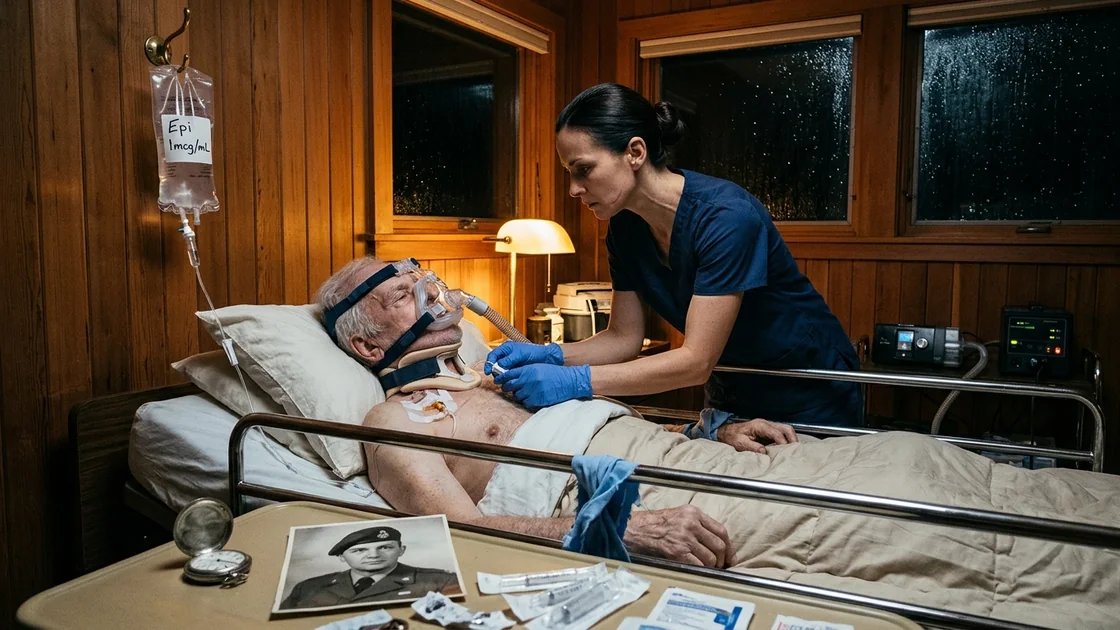
Sabina Tomašević has spent fifteen years as a hospice nurse on the rugged Oregon coast, dedicating her life to ensuring that the dying pass from the world in quiet dignity and free from pain. When she is assigned to care for Emil Lindner, a seventy-nine-year-old recluse in the final stages of cardiopulmonary failure during a catastrophic winter storm, she expects nothing more than another vigil beside a fading stranger. During the long night, however, a bout of hypoxic delirium strips away the old man's carefully constructed Austrian persona, revealing him to be Colonel Dragan Kovač, the ruthless paramilitary commander who orchestrated the massacre of Sabina's Bosnian village thirty years prior. Armed with a vial of liquid morphine and protected by the isolation of the storm, Sabina initially contemplates ending his life with an untraceable overdose, only to realize that a peaceful death under a false name is the ultimate victory for a man who spent decades evading justice. After contacting international war crimes investigators who confirm they need eighteen hours to breach the storm-ravaged roads and legally arrest him, Sabina must abandon every tenet of palliative care, utilizing improvised battlefield medicine and ruthless psychological manipulation to force her family's killer to stay alive long enough to face the world in chains.
The rain on Cape Foulweather did not fall so much as it arrived horizontally, driven off the black expanse of the Pacific by gales that smelled of kelp, pulverized basalt, and deep ocean cold. Inside the cedar-shingled house perched on the edge of the headland, the wind registered as a low, continuous vibration in the floorboards, a dull thrumming that Sabina Tomašević felt in the bones of her ankles as she stood beside the hospital bed.
Beside her, the oxygen concentrator produced a rhythmic, mechanical sigh every three seconds. Shhh-clack. Shhh-clack. It was the metronome of her profession, the background music to the final chapter of over four hundred lives she had shepherded toward the dark since coming to Oregon.
"He hasn't taken fluids since noon," Martha Gable said, standing near the bedroom doorway with her wool coat already buttoned to the chin and her purse clutched tightly against her ribs. The daytime housekeeper was sixty, born and raised in Newport, and had the weathered, pragmatic face of a fisherman's widow, though tonight her eyes darted nervously toward the tall west-facing windows where the glass bowed inward under the pressure of seventy-knot gusts. "Tried the sponge swab with a bit of ice chip around three, like the agency pamphlet said, but he just clamped his gums shut. Didn't even open his eyes."
"That is completely normal at this stage, Mrs. Gable," Sabina said, her voice naturally dropping into the calm, low register she used with frightened families. She did not look up from the clipboard where she was reviewing the flow sheet from the previous forty-eight hours. "As the body prepares to shut down, dehydration actually acts as a natural anesthetic. Processing fluids just creates more congestion in the lungs, more work for a heart that is already exhausted. He isn't thirsty the way you or I get thirsty."
"Still seems hard," Martha murmured, shifting her weight from one boot to the other. "Watching a man dry up like drift-bark. Even a cold man like Mr. Lindner."
Sabina set the clipboard down on the mahogany dresser, right beside a collection of antique brass maritime barometers, and turned her attention fully to the woman in the doorway. Sabina was forty-one, tall and lean, with dark hair pulled back into a knot so tight it slightly lifted the corners of her dark, heavy-lidded eyes. A thin, pale scar ran from the corner of her left jawline down disappeared beneath the collar of her navy-blue scrub top, a silvery seam in skin that otherwise carried the pallor of someone who worked mostly at night in a state famous for its clouds.
"You should leave now, Martha," Sabina said, glancing at her wristwatch. It was six-forty in the evening, though the December sky outside had been pitch black since four-thirty. "The sheriff's advisory said the King Tide hits at eight, and the creek down by the Otter Rock turnoff was already cresting the culvert when I drove up."
"You sure you'll be alright up here by yourself? The relief nurse isn't scheduled until seven tomorrow morning, and if a fir comes down across the gravel drive, nobody's getting up this hill without a chainsaw and a winch."
"I have three days of food in my trunk, a sleeping bag, a full medical kit, and the backup generator was serviced last month according to the chart," Sabina replied, offering a brief, reassuring smile that never quite reached her eyes. "And Mr. Lindner and I don't need much from the outside world tonight. Go home to your grandchildren."
Martha lingered for another second, glancing toward the high, recessed bed where the small figure of Emil Lindner lay buried beneath an eiderdown quilt, his head propped up at a forty-five-degree angle by four pillows so he wouldn't drown in his own pulmonary secretions. "He never asked for nobody," Martha said softly, almost to herself. "Five years I cleaned this place every Tuesday and Friday. Never got a Christmas card, never saw a visitor, never heard him laugh once. Just sat in that study fixing old clocks and staring at the water. It's a queer thing to die with nobody in the room who knows what you looked like when you were young."
"Somebody is in the room," Sabina said quietly. "That's why I'm here."
Once the heavy front door clicked shut behind the housekeeper and the taillights of her Subaru vanished down the winding, tree-choked drive, the house seemed to expand around Sabina. It was a large, timber-framed structure built in the nineteen-seventies by some lumber baron, all soaring Douglas fir beams and massive panes of insulated glass that currently reflected the warm amber glow of the bedside lamps against the impenetrable blackness of the storm outside.
Sabina washed her hands at the bathroom sink with warm water and antibacterial soap, drying them methodically on a paper towel before pulling on a pair of blue nitrile gloves. Routine was the bedrock of hospice care. When death entered a house, chaos usually accompanied it—the panic of adult children watching a parent gasp for air, the terror of spouses who had shared a bed for fifty years suddenly realizing one of them would soon sleep alone. The nurse existed to impose order on the biological dissolution of a human being.
She walked to the left side of the bed and looked down at her patient.
According to the admission packet compiled by the coastal palliative care coordinator three days ago, Emil Lindner was seventy-nine years old, a naturalized citizen who had emigrated from Graz, Austria, to Seattle in nineteen-ninety-six before retiring to the Oregon coast twelve years ago. He had worked as a precision machinist and maritime instrument repairman. His wife, Helga, had died of ovarian cancer in Seattle in two thousand and eight; they had no children. His diagnoses were end-stage idiopathic pulmonary fibrosis and severe biventricular congestive heart failure. His lungs had slowly turned to stiff, fibrous scar tissue, and his heart, having spent years pumping against that unyielding resistance, had finally stretched and weakened until it could no longer maintain the pressure required to perfuse his organs.
He was a gaunt man, though the width of his shoulders and the large, square structure of his skull suggested he had once been powerfully built. Now, his skin had the translucent, waxy yellow cast of failing kidneys and poor oxygenation. His white hair was sparse, combed neatly back from a high forehead mottled with liver spots, and his mouth hung open in a slack, dark oval as he fought for air. Clear plastic tubing ran from the concentrator over his ears and into his nostrils, delivering five liters of pure oxygen per minute.
"Mr. Lindner," Sabina said, placing two fingers gently on his right wrist while her other hand rested lightly on his chest to count his respirations. Even when patients appeared deeply comatose, hearing was the last sense to fade. She always spoke to them as if they were sitting across a kitchen table. "My name is Sabina. I'm your nurse for the night. Martha has gone home for the evening, so it is just the two of us. I'm going to check your vitals and make sure you are comfortable."
His radial pulse was thready, rapid, and irregular—atrial fibrillation with a ventricular response hovering around one hundred and eighteen beats per minute. His skin at the wrist was cool and clammy. Gently, she lifted the edge of the down quilt and pulled up the hem of his flannel hospital gown to examine his legs.
The mottling had begun. A lace-like, purplish-blue pattern—livedo reticularis—marbled the skin over both kneecaps and extended halfway down his shins. His feet were ice cold, the toenails dusky blue, despite the thick wool socks Martha had put on him. The body, recognizing that the end was near, was clamping down on the blood vessels in the extremities, sacrificing the limbs to keep a dwindling supply of oxygenated blood flowing to the brainstem and the myocardium.
She pulled the quilt back down, warmed the diaphragm of her stethoscope between her palms for five seconds, and slipped it beneath the collar of his gown.
Listening to his chest was like listening to someone walk through wet gravel mixed with cellophane. Velcro rales—the classic hallmark of pulmonary fibrosis—crackled at the bases of both lungs, overlaid by the coarse, bubbling rhonchi of fluid backing up into the alveoli from his failing left ventricle. Every breath required visible effort from the accessory muscles in his neck, the sternocleidomastoid tendons standing out like taut wires as he dragged air in, followed by a prolonged, rattling exhalation.
He was in the active phase of dying. Given the progression of the mottling to the knees and the decreasing intervals between his periods of apnea, Sabina estimated he had between twelve and twenty-four hours left. Perhaps less, if the accumulating fluid in his lungs triggered a sudden hypoxic arrest.
She went to the kitchen, where the hospice "comfort kit" sat inside a locked plastic box on the counter beside the microwave. Using the small key attached to her badge reel, she opened the box and took out a thirty-milliliter amber glass bottle of concentrated liquid morphine sulfate—twenty milligrams per milliliter—and a bottle of lorazepam.
Her job tonight was simple: keep the respiratory rate below twenty breaths per minute so he didn't feel the terrifying sensation of suffocation, control the terminal restlessness that often accompanied cerebral hypoxia, and keep his mouth moist. She drew up zero-point-five milliliters of the dark pink morphine solution into a needleless oral syringe—ten milligrams, a standard maintenance dose for a patient who had been receiving opiates for five days—and carried it back to the bedroom.
"Just a little medicine to help your breathing ease up, Mr. Lindner," she murmured, slipping the tip of the plastic syringe into the pocket of his lower cheek, right between the gum and the mucosa where the rich capillary bed would absorb the drug directly into his bloodstream without requiring him to swallow. She depressed the plunger slowly, drop by drop, so it wouldn't pool in his pharynx.
Within ten minutes, the cords in his neck relaxed. His respiratory rate slowed from twenty-eight ragged gasps per minute to sixteen deeper, quieter breaths. The deep furrow between his grey eyebrows smoothed out.
Sabina pulled the high-backed leather armchair from the corner of the room closer to the bed, positioning it so she could watch the rise and fall of his chest while remaining out of his direct line of sight should he open his eyes. Many dying patients felt crowded if someone stared directly into their face. She turned off the overhead light, leaving only the small brass banker's lamp glowing on the dresser, and sat down.
Outside, the storm slammed against the headland with renewed fury. The wind shrieked through the eaves, a high, keening sound that reminded her, as wind in the dark always did, of the narrow valley of Kamenica in the autumn of nineteen-ninety-three.
She did not fight the memory. After thirty years, and twenty years of therapy, she had learned that memories were like riptides along the Oregon beaches; if you thrashed against them, they drowned you, but if you floated parallel to the shore and let them carry you for a little while, they eventually released their grip.
She had been eleven years old that October. Her father, Milan Tomašević, had been the mathematics teacher at the regional primary school, a tall, perpetually stooped man who smelled of chalk dust, pipe tobacco, and the sour green apples he kept in his coat pockets. Her brother, Luka, had been fourteen—just tall enough, just broad-shouldered enough that when the trucks belonging to the Sivi Vukovi—the Grey Wolves paramilitary brigade—rolled down the muddy logging road from the ridge above the Drina River, the soldiers had counted him among the men.
Sabina closed her eyes, listening to the rain lash the Oregon glass, and smelled the wet wool and burning hay of that morning. She remembered the strange, bureaucratic calmness with which it had begun. No screaming at first. Just the rumble of six-wheel-drive TAM military trucks idling in the square outside the old sawmill, their exhaust turning the autumn fog blue and greasy. And the commander standing on the hood of a captured UN jeep, wearing a immaculate winter camouflage jacket with the collar turned up and a black wool beret tilted over one ear, holding a bullhorn he didn't even need to use because the valley had gone so utterly silent you could hear the river washing over the stones half a mile away.
He had not shouted. He had spoken in a cultivated, almost paternal baritone, telling the villagers that buses were coming to transport the women and children to Kladanj, and that the men would simply be screened for weapons and insurgency connections at the timber yard before following on the evening transport.
Her father had known it was a lie. Every adult in the valley had known it was a lie. Before the soldiers reached their gate, Milan had pried up the floorboards in the corner of the stone root cellar behind their kitchen—the narrow space where they stored seed potatoes in dry sand—and pushed Sabina down into the dirt.
"Do not come out when you hear the trucks leave," her father had whispered, his rough hands framing her face in the dark. He had taken his silver Raketa pocket watch from his waistcoat and pressed it into her palm so she would know when forty-eight hours had passed. "Wait until the big hand goes around four times, Sabina. Even if you hear your mother calling. Even if you hear Luka. Wait four turns."
She had watched through a two-inch ventilation slit between the foundation stones at ground level. She had seen only boots at first—muddy combat boots, her father's worn leather shoes, Luka's blue Adidas sneakers with the torn laces. Then a commotion at the gate when her father tried to argue that Luka was only fourteen, that he had asthma, that he was just a boy.
She had seen the commander walk over. From her angle on her belly in the dirt, looking slightly uphill toward the road, she had seen him clearly for perhaps twenty seconds. He was a tall man with cold, pale eyes set deep beneath heavy brows, holding a silver cigarette case in his left hand. As he reached out to grab her father by the throat of his wool sweater, Sabina had stared directly at that left hand, less than six feet from her face: the top joint of his ring finger was missing, ending in a smooth, pale stump just above the knuckle.
Then he had struck her father across the mouth with the butt of his Steyr pistol, ordered two younger militiamen to drag Milan and Luka toward the sawmill, and tossed his half-smoked cigarette into the hay stacked beside the barn.
When the heat from the burning house above the root cellar became unbearable six hours later, and the cellar timbers collapsed partially inward, a falling iron hinge had laid open Sabina's left cheek from jaw to collarbone. She had pressed a handful of cold potato-sand into the wound to stop the bleeding and watched the hands of her father's watch in the red light filtering through the floorboards. She had waited the four turns. When she crawled out into the cold rain two days later, the village of Kamenica was nothing but blackened stone chimneys rising out of grey mud, and the sawmill yard down by the river was silent under a cloud of crows.
Three hundred and twelve men and boys. Thirteen years later, forensic anthropologists from the International Commission on Missing Persons had found two thirds of them in a secondary mass grave inside a bauxite mine forty miles north, their skeletons chewed to pieces by the heavy excavators used to move the bodies before the Dayton Accords were signed. They had identified Milan Tomašević by his dental work and the brass key to the schoolhouse still sitting in the rotted fabric of his trousers. They had never found Luka. And they had never found Colonel Dragan Kovač.
The official dossier at the International Criminal Tribunal for the former Yugoslavia in The Hague listed Kovač—indicted in nineteen-ninety-seven on fourteen counts of genocide, crimes against humanity, and violations of the laws or customs of war—as presumed dead, reportedly killed in a timber camp brawl in the Russian Far East in two thousand and three, though no body had ever been recovered for DNA verification.
A sudden, sharp bang from the roofline jolted Sabina out of the memory.
A heavy cedar branch had torn loose from one of the sitka spruces behind the house and struck the eaves before sliding down into the rhododendron bushes. A second later, the lights in the bedroom flickered twice, dimmed to a dull orange thread, and went out entirely.
Simultaneously, the rhythmic shhh-clack of the oxygen concentrator died.
In the sudden, total silence between the gusts of wind, the only sound in the room was the wet, rasping rattle of Emil Lindner's breathing.
Sabina stood up immediately, pulling a small aluminum penlight from her scrub pocket and clicking it on. She counted under her breath. One. Two. Three. Four.
At seven seconds, a muffled thud echoed from the detached garage fifty yards away, followed by the deep, throbbing hum of the Generac propane backup generator kicking on. The automatic transfer switch clicked inside the utility closet down the hall, the bedroom lamp flared back to life, and the oxygen concentrator coughed, wheezed, and resumed its steady three-second cadence.
Sabina let out a breath and turned the penlight toward the bed to make sure the brief interruption in oxygen flow hadn't distressed her patient.
Emil Lindner's eyes were wide open.
They were not the cloudy, unfocused eyes of a dying man staring through the ceiling at unseen things. They were pale grey, dilated with sudden adrenaline, and fixed directly on the dark windowpane where the wind was hurling sheets of rain against the glass.
As Sabina stepped toward the bed, he threw his right arm out from beneath the quilt, knocking the plastic water pitcher off the overbed table. It hit the hardwood floor with a hollow clatter, though Martha had emptied it hours ago. His chest heaved as he tried to lever himself upright on his elbows, the nasal cannula pulling tight across his cheekbones.
"Mr. Lindner, easy, easy," Sabina said, moving quickly to the bedside and placing a firm, gentle hand against his shoulder to keep him from rolling over the side rail. Terminal agitation—often called terminal delirium—was common in the final hours as carbon dioxide built up in the blood and oxygen levels fell in the frontal lobe. "You're safe. You're in your bed in Oregon. The power just blinked for a second because of the storm, that's all."
He did not seem to hear the English words. His head snapped toward her, his pale eyes locking onto her face in the dim amber light of the banker's lamp. His mouth worked soundlessly for a moment, his dry tongue clicking against the roof of his mouth, before his left hand shot up from beneath the blankets and clamped onto her right wrist.
The grip was shocking in its ferocity—not the weak, fluttering grasp of a frail septuagenarian, but a sudden, iron vise powered by pure central nervous system panic.
"Ko je probio liniju kod pilane?" he hissed, his voice a harsh, gravelly croak that tore through his congested throat. "Reci majoru da zapali ambar! Ne ostavljajte nikoga iza!"
Sabina froze. Every muscle in her body locked so hard that for three full seconds she did not breathe.
He was not speaking German. He was not speaking the soft, clipped Austrian dialect noted in his intake chart by a social worker who wouldn't have known the difference between Graz and Belgrade.
He was speaking Bosnian. More specifically, he was speaking the sharp, consonant-heavy ijekavian highland dialect of the Romanija mountain region—a regional cadence so distinct that anyone who had grown up within fifty miles of the Drina River could identify the speaker's home district within three sentences.
Who breached the line by the sawmill? Tell the major to burn the granary! Leave no one behind!
"Mr. Lindner," Sabina whispered, though her voice sounded hollow, as if it were coming from the bottom of a deep well.
His eyes darted over her face, taking in her dark hair, her high cheekbones, the pale scar catching the lamplight along her jaw. In his hypoxic delirium, the thirty years separating the coastal bedroom from the smoke-choked valley of nineteen-ninety-three had vanished. His lip curled back from his yellowing teeth in a snarl of pure, visceral contempt.
"Marš u kolonu, kurvo," he spat, his fingers digging harder into the tendons of her wrist before his strength suddenly failed him. "U kolonu sa ostalima..."
Get back in the column, whore. In the column with the others.
A violent coughing fit seized him, his frail body arching off the mattress as frothy, pink-tinged sputum bubbled at the corner of his lips. The exertion drained the last reserve of oxygen from his brain; his eyes rolled back until only the yellowed sclera showed, and his left hand fell limp from her wrist, landing palm-down on the white sheet on top of the quilt.
Sabina did not move to wipe his mouth. She did not reach for the suction machine. She stood paralyzed beside the bed, staring down at his left hand resting against the bleached cotton sheet.
The top joint of his left ring finger was missing. It ended in a smooth, slightly bulbous stump just above the middle knuckle.
Her heart hammered against her ribs with such violence she could hear the pulse whooshing in her ears, drowning out the oxygen machine and the storm. Slowly, as if moving through freezing water, she reached out with her gloved right hand, took his limp left forearm, and pushed the flannel sleeve of his hospital gown up to the elbow.
There, on the underside of his pale, blue-veined forearm, was a four-inch oval of shiny, hairless scar tissue—the unmistakable result of a deep, amateur skin excision or a chemical burn made decades ago to obliterate a military tattoo.
She unclipped the penlight from her scrub pocket and shone the bright LED beam directly into his face. She looked past the sunken cheeks, the white stubble, the age spots, and the slack jaw of a seventy-nine-year-old invalid. She looked at the architecture of the skull—the wide, flat zygomatic arches, the slight crookedness at the bridge of the aquiline nose, the deep-set orbits of the eyes, the distinctive cleft in the lobe of his left ear.
It was him.
He had not died in a Siberian timber camp in two thousand and three. He had shaved his moustache, burned the Grey Wolves insignia off his arm, bought forged Austrian identity papers through the old Odessa-style networks in Vienna or Trieste during the chaos of the mid-nineties, and come to America. He had lived in Seattle. He had bought a house overlooking the Pacific Ocean. He had fixed antique clocks, drunk his morning coffee watching the gray whales migrate north every spring, and grown old in a soft bed while her brother Luka's bones lay scattered in the dark mud of an unmarked Bosnian mine shaft.
Sabina clicked the penlight off. Her hand was shaking so badly she had to press her knuckles against the wooden footboard of the bed to steady herself.
Be clinical, a voice inside her head commanded—the voice of twenty years of trauma nursing and emergency training. Do not assume. Verify.
She left the bedroom, walking down the wide hallway past framed nautical charts of the Puget Sound and the Columbia River Bar, and entered his study at the front of the house.
The room smelled of lemon oil, old paper, and machine lubricant. A long workbench stood beneath the north window, covered with jewelers' loupes, miniature lathes, brass gears, and disassembled nineteenth-century ship chronometers. The bookshelves were lined with German and English volumes on horology, meteorology, and naval history. On the surface, it was the museum of a quiet, meticulous central European craftsman.
Sabina did not look at the bookshelves. She went straight to the heavy rolltop desk in the corner and pulled on the tambour cover. It was unlocked; a dying man who hadn't left his bedroom in three weeks had no reason to lock up against a housekeeper who never snooped.
She opened the center drawer: stamps, checkbooks in the name of Emil Lindner drawn on a local credit union, utility bills, a valid Oregon driver's license expiring the following year. She pulled the side drawers completely out of the desk frame and set them on the floor, feeling inside the mahogany cavities for false backs. Nothing.
She stood in the center of the room and looked around, trying to think like an old soldier—a man trained in Yugoslav counter-intelligence before the breakup of the federation. Where does a fugitive keep the things he cannot bear to destroy? Not in the desk. A burglar checks the desk first.
Her eyes fell on the large, freestanding mahogany regulator clock standing six feet tall beside the fireplace. Its brass pendulum hung motionless behind the glass door; nobody had wound the weights in weeks.
She walked over, opened the narrow glass door of the clock case, and reached up behind the dial assembly. Nothing. Then she looked down at the base of the cabinet—the heavy wooden plinth beneath the pendulum sweep where the cast-iron counterweights would drop if a cable snapped. The bottom board was dusty, except for a faint crescent-shaped scratch near the left molding where the wood had been pried up before.
Sabina went to the workbench, picked up a flat-head screwdriver, and wedged it into the seam of the plinth. The board lifted easily on hidden brass pins.
Inside the hollow base sat a green steel Yugoslav People's Army ammunition box, the kind used for 7.62mm rifle cartridges, sealed with a rubber gasket.
She lifted the box out, set it on the Persian rug, and snapped open the heavy steel latch.
Inside, wrapped in oilcloth to protect them from the coastal damp, lay the remnants of Colonel Dragan Kovač. There was his old red Yugoslav military academy commission booklet from Belgrade, dated nineteen-sixty-eight. There was a laminated identification card from the Srpska Garda and the Grey Wolves detachment, bearing a photograph of a forty-eight-year-old Kovač staring coldly into the camera. There was a stack of rubber-banded photographs taken with a thirty-five-millimeter camera in the forests and villages along the Drina—men in black berets standing on the hoods of armored personnel carriers, holding rifles and bottles of plum brandy in front of burning roofs.
And at the bottom of the box, inside a small velvet pouch that must have once held jewelry, were a dozen personal items taken from prisoners—gold wedding bands, a silver Orthodox cross, a Parker fountain pen, and three pocket watches.
Sabina dumped the contents of the velvet pouch onto the rug.
Her fingers closed around a tarnished silver Raketa pocket watch with a hairline crack running from the four to the ten across the acrylic crystal. She pressed the crown release. The front cover popped open.
Scratched lightly into the inside of the silver casing with the point of a compass—done the day he received his teaching certificate in Sarajevo in nineteen-seventy-eight—were the letters M. T.
Milan Tomašević.
Sabina sat back on her heels on the Persian rug in the silent study, holding her father's watch against the center of her scrub top, right over her sternum. She did not cry. The grief in her chest was too old, too calcified to produce tears; it felt instead like a block of lead that had suddenly dropped from her throat into her stomach, cold and immeasurably heavy.
For five minutes she stayed on the floor, listening to the wind batter the cedar siding and the distant, rhythmic wheeze of the dying man down the hall.
Then she slipped her father's watch into the breast pocket of her scrubs, placed the photographs and the military booklet on top of the workbench where they were clearly visible, and walked back down the hallway.
She stopped in the kitchen first.
The locked plastic comfort kit was still sitting open on the counter beside the microwave. Inside sat the thirty-milliliter bottle of concentrated liquid morphine sulfate. There were roughly twenty-two milliliters left in the bottle—four hundred and forty milligrams of pure morphine.
In a seventy-nine-year-old man in end-stage heart failure with a baseline oxygen saturation hovering in the low eighties, forty milligrams would depress his brainstem's respiratory drive enough to stop his breathing within fifteen minutes. Four hundred milligrams would cause profound, irreversible respiratory arrest in less than five.
And the beauty of it—from a forensic standpoint, a standpoint Sabina understood intimately after fifteen years of signing off on narcotics logs—was its absolute invisibility.
When a hospice patient dies at home, the coroner does not come. There is no autopsy. There is no toxicology screen. The attending hospice nurse pronounces the time of death after listening to the chest for sixty seconds, calls the on-call physician to report the expected passing, calls the funeral home listed in the admission packet to pick up the body, and flushes the remaining liquid narcotics down the toilet or mixes them with coffee grounds in a sealable disposal bag, witnessed either by a family member or, in the case of a solo patient, documented on the disposal sheet before returning the empty bottle to the pharmacy.
Even if someone—some nonexistent relative—suddenly demanded an autopsy tomorrow, finding a high level of morphine in the post-mortem blood of a terminal patient who had been receiving scheduled sublingual doses for days was medically unremarkable; post-mortem redistribution of opiates from tissue into central blood made exact dosing calculations nearly impossible in palliative care cases.
She picked up the bottle of morphine and a ten-milliliter oral syringe. She drew back the plunger until the barrel was completely full of the dark pink, cherry-flavored liquid. Two hundred milligrams.
She walked slowly back into the bedroom.
Kovač lay exactly as she had left him. His breathing had deteriorated into a classical Cheyne-Stokes pattern—twenty seconds of rapid, shallow panting followed by fifteen seconds of complete, eerie silence where his chest did not move at all, before a sudden, gasping intake started the cycle all over again. His skin was greyer now. The mottling had crept three inches above his kneecaps onto his lower thighs.
Sabina stood over him, holding the ten-milliliter syringe in her right hand.
All she had to do was slide the plastic tip into the side of his slack mouth and push her thumb down. In ten minutes, the man who had murdered her father, her brother, and three hundred of her neighbors would be dead. Or, even simpler, she could do nothing at all. She could walk over to the wall, flip the switch on the oxygen concentrator to Off, sit back down in the leather armchair, and watch him suffocate over the next forty minutes as his pulmonary edema finished filling his lungs.
He is going to die tonight anyway, she thought, staring down at the liver spots on his scalp. Whether I push this plunger or sit on my hands, by dawn he will be cold.
She raised the syringe toward his cheek. Her thumb rested on the flat plastic disc of the plunger.
And then she stopped.
She looked around the warm, softly lit bedroom. She looked at the four hundred-thread-count cotton sheets Martha had ironed on Tuesday. She looked at the eiderdown quilt, the antique brass barometers gleaming in the lamplight, the framed watercolor of the Austrian Alps hanging on the wall—a sentimental prop bought at some Seattle estate sale to complete the illusion of mild-mannered Emil Lindner.
If he died in this bed tonight, what would happen tomorrow morning?
At eight o'clock, when the storm cleared and the county road crew cleared the fallen branches, the Neptune Society van from Newport would drive up the hill. Two polite young men in dark suits would transfer "Emil Lindner" onto a cot, zip him into a clean white pouch, and carry him down to the van. Within forty-eight hours, he would be cremated at a facility off Highway 101. His ashes would be scattered over the Pacific Ocean from a chartered boat, just as his prepaid funeral contract stipulated. A two-line obituary would appear in the Newport News-Times noting the peaceful passing of Emil Lindner, beloved husband of the late Helga, retired machinist.
And in The Hague, the file on Colonel Dragan Kovač would remain forever stamped Presumed Deceased—Unverified.
In the small cemetery outside Sarajevo where her mother had died of a broken heart in two thousand and four, and at the concrete memorial wall in Kamenica where the names of three hundred and twelve men and boys were carved into grey granite without a single perpetrator ever having stood in a dock to answer for their slaughter, the silence would become permanent.
"No," Sabina said aloud.
A peaceful death in a warm bed was not a punishment. It was a reward. It was the ultimate victory of a mass murderer who had stolen thirty years of sunsets, thirty years of quiet mornings, thirty years of breathing clean ocean air while fourteen-year-old Luka Tomašević rotted in the dark.
Death was the mercy Sabina gave to innocent people who had suffered enough.
Dragan Kovač did not get to have her mercy. He did not get to slip out the back door of history under a fake name while she held his hand and drugged away his pain.
Sabina pulled the syringe back from his mouth, walked to the bathroom, and squirted the entire two hundred milligrams of morphine down the sink drain, washing it into the septic tank with a blast of cold tap water.
When she came back into the bedroom, her eyes were bright, hard, and completely focused.
She pulled her cell phone from her pocket. No Service. The coastal ridges and the towering Sitka spruces blocked the cellular towers along the highway even in good weather; during an atmospheric river event, the signal was nonexistent on the ground floor.
She remembered seeing a satellite dish mounted on the eaves outside the upstairs dormer when she had pulled into the driveway, and a Wi-Fi router blinking beside the printer in his study.
She hurried back to the study, woke up the small laptop sitting on the corner of his desk—it wasn't password-protected—and checked the connection. The satellite internet was functional, though the latency was high as the dish fought through dense layers of rain-heavy cumulonimbus clouds.
Sabina opened the browser. She did not need to look up the agency; like every survivor from the Drina valley diaspora who had followed the trials over the decades, she knew the architecture of international justice by heart. When the International Criminal Tribunal for the former Yugoslavia formally closed in two thousand and seventeen, its mandate to track down the last remaining fugitives had passed to the International Residual Mechanism for Criminal Tribunals—the IRMCT—in The Hague, working in direct partnership with the United States Department of Justice Human Rights and Special Prosecutions Section in Washington, D.C.
She found the DOJ War Crimes tip line and the twenty-four-hour duty officer contact number for the IRMCT fugitive tracking unit. She enabled Wi-Fi calling on her phone, praying the satellite bandwidth would hold a voice packet, and dialed the Washington number first.
It rang four times before clicking over to an automated federal switchboard, and then, after she pressed the sequence for urgent law enforcement and fugitive matters, to a live operator.
"DOJ Special Prosecutions watch desk, this is Analyst Miller," a young man's voice said, sounding slightly tinny over the satellite relay.
"My name is Sabina Tomašević," she said, keeping her voice rapid, crisp, and devoid of emotion—the exact tone she used when calling a code blue or reporting an acute clinical emergency to an attending surgeon. "I am a licensed registered nurse in the state of Oregon, license number 200804412. I am currently at 4482 Otter Crest Loop in Lincoln County, Oregon. I am standing in the house of Colonel Dragan Kovač, formerly commander of the Grey Wolves paramilitary brigade, indicted by the ICTY in nineteen-ninety-seven for the Kamenica massacre. He is living under the alias Emil Lindner."
There was a two-second pause on the other end of the line, no doubt as the analyst decided whether he was dealing with a late-night psychiatric crank or a genuine lead.
"Ma'am, our records indicate Dragan Kovač has been presumed deceased for twenty years—"
"Your records are wrong," Sabina cut in sharply. "He is seventy-nine years old. He has the amputated distal phalanx on the left fourth digit documented in his nineteen-ninety-two JNA medical file. He has an excised tattoo scar on the volar aspect of his left forearm. And I am currently looking at his original Yugoslav military academy commission booklet, fourteen unpublished photographs of the Kamenica operation, and a silver pocket watch belonging to my father, Milan Tomašević, victim number two-hundred-and-four on the ICTY Kamenica indictment annex. Give me an email address right now. I am sending you photographs of the documents and the subject's face and hand."
The analyst's tone shifted instantly. "Send them to hrsp.watch@usdoj.gov. Do not hang up the line, Ms. Tomašević. I am patching in Senior Trial Attorney Vance and our liaison with The Hague."
Using her phone, Sabina snapped five high-resolution photographs in the study—the military ID, the photos by the sawmill, the engraved pocket watch—then walked briskly back to the bedroom.
Kovač was still locked in the Cheyne-Stokes cycle, his chest rising and falling in erratic bursts. She turned on the overhead bedroom light to get clear illumination, took a clear profile shot of his face showing the structure of his left ear—forensic ear-print comparison was as reliable as fingerprints for aging fugitives—and a close-up of his left hand and forearm.
She hit send. The progress bar crawled across her screen as the satellite dish outside battled the eighty-mile-per-hour gusts. Twenty percent. Forty percent. Eighty percent. Sent.
Two minutes later, a new voice came onto the line—a woman with a faint Eastern European accent beneath polished American English, accompanied by a man speaking from what sounded like a vehicle or an airport concourse.
"Ms. Tomašević, this is Jelena Marinković, Senior Investigator with the IRMCT Fugitive Tracking Team, currently on detail in Washington, and Special Agent Marcus Vance with the Department of Justice and the U.S. Marshals Service," the woman said. Even through the compressed digital audio, Sabina could hear the stunned tension in Marinković's voice. "We are looking at the photographs right now. Wait one moment while our biometric analyst runs the auricular overlay against the nineteen-eighty-nine Belgrade personnel photo."
Sabina stood beside the bed, her stethoscope hanging around her neck, watching a bluish tint creep around Kovač's nostrils. During his periods of apnea, the silence now stretched to twenty-two seconds before his brainstem triggered a breath.
"He is dying," Sabina told the phone calmly. "You need to understand the medical situation while you run your computers. I am his hospice nurse. He is in end-stage biventricular heart failure and pulmonary fibrosis. He is in active cardiogenic shock and pulmonary edema. Without aggressive intervention, he will be dead within six to ten hours. Possibly within two."
"My God," Marinković breathed in the background as a chime sounded on her end of the call. "Marcus, look at the screen. Ninety-nine point four percent concordance on the tragus and antihelix. And the JNA serial number on the commission book matches the sealed Belgrade archives. It's him. After thirty years, it's actually him."
"Ms. Tomašević, listen to me carefully," Agent Vance said, his voice dropping into tactical command mode. "Does anyone else know you are there? Is there anyone else in the residence?"
"No. He lives alone. The daytime housekeeper left at six-forty-five."
"Good. I am already on the line with the U.S. Marshals Pacific Northwest Violent Offender Task Force in Portland and the Oregon State Police. We are drafting an emergency provisional arrest warrant under the international tribunal extradition treaty right now. A federal magistrate is standing by to sign it electronically. Once that warrant is executed on his person and his fingerprints are rolled by a federal officer while he is legally alive, Emil Lindner ceases to exist and Dragan Kovač is officially in international custody. Even if he dies in a prison hospital ward tomorrow afternoon, the arrest goes into the permanent historical record of the tribunal, his assets are seized for the victims' restitution fund, and the Kamenica indictment is closed as captured."
Sabina felt a fierce, cold heat rise in her chest. "And if he dies before the Marshals walk through that door?"
There was a heavy silence on the line before Jelena Marinković spoke.
"Under tribunal statute and international law, you cannot indict or arrest a corpse, Sabina," the investigator said softly, slipping briefly into their shared native language before switching back to English. "If he dies before a federal officer serves the warrant and confirms identity, he dies legally an innocent man until a post-mortem civil inquiry can be argued in county probate court—which could take years and carries no criminal standing in The Hague. We need him breathing when the Marshals walk into that room."
"How long until they get here?" Sabina asked.
"Hold on, I have Oregon State Police dispatch on the other screen," Vance said. For thirty seconds, Sabina listened to the muffled clack of keyboards and low, urgent voices consulting maps. When Vance came back, the grimness in his voice was unmistakable. "Ms. Tomašević, you're in the middle of a Category 3 atmospheric river. Highway 26 and Highway 18 from the Willamette Valley are both closed due to multi-ton mudslides in the Coast Range. Highway 101 is flooded out at Tillamook to the north and blocked by downed power lines and forty-foot Sitka spruces just north of Newport to the south. Coast Guard Air Station North Bend says surface winds on the headland are gusting to seventy-four knots—no helicopter can fly in that, let alone land on a forested cliff."
Sabina looked at the window, where a sheet of water struck the glass like a fistful of gravel. "Give me a number, Agent Vance. How many hours?"
"ODOT heavy equipment crews and a U.S. Marshals tactical convoy in high-clearance armored vehicles are deploying from Salem right now to cut through the Highway 20 corridor alongside the state police. With the mudslides and the trees down, they estimate it will take between twelve and fourteen hours to breach the coastal road and reach Otter Crest Loop."
Fourteen hours. It was eight-fifteen at night. That meant ten o'clock tomorrow morning.
Sabina looked down at Dragan Kovač. His chest was still. Twenty-four seconds of apnea. Twenty-five. Then a horrific, bubbling gasp as his lungs fought through the frothy fluid filling his lower lobes. His fingernails were dark violet. His urine output over the past twelve hours in the Foley catheter bag hanging from the side of the bed frame was less than fifty milliliters of dark, tea-colored sediment—his kidneys were already shutting down from lack of blood pressure.
"Twelve to fourteen hours," Sabina repeated slowly. "He doesn't have four hours at his current trajectory."
"You said you're a nurse," Marinković said urgently. "Can you stabilize him? Can you call an ambulance?"
"The local volunteer fire department is on the other side of the flooded bridge at Otter Rock, and even if they could get here, he has a signed Do Not Resuscitate and Do Not Intubate order on the refrigerator," Sabina said. "Under Oregon law, paramedics cannot touch a hospice patient with a valid POLST form except for comfort measures unless the patient himself revokes it—and he is currently comatose. If I want him alive at ten o'clock tomorrow morning, I have to do it myself, right here, with no ICU and no ventilator."
"Sabina," Marinković said, and this time she spoke entirely in Bosnian, her voice trembling slightly. "My uncle was at Kamenica. My mother's cousins were at Kamenica. Please. Whatever you have to do. Do not let the devil slip away into the dark."
"Keep this line open or call me back every hour," Sabina said in English. "I have work to do."
She ended the call, set the phone on the dresser, and stood at the foot of the bed.
For fifteen years, every instinct, every protocol, every ethical boundary of her professional life had been dedicated to non-intervention—to stepping back and allowing the failing machinery of the body to come to a gentle halt. Before hospice, however, during her first six years out of nursing school in Portland, she had worked the night shift in the Cardiothoracic Intensive Care Unit at Oregon Health & Science University.
She remembered how to fight death. She remembered how brutal, ugly, and relentless that fight was.
She stripped off her soiled gloves, snapped on a fresh pair, and began a full critical-care triage assessment.
First: the airway and lungs. She clipped her pulse oximeter onto his cold right earlobe after rubbing the skin briskly between her thumb and forefinger to stimulate capillary blood flow—a finger reading would be useless with his peripheral vasoconstriction. The little red digital numbers blinked and settled: 73% oxygen saturation, heart rate 126 and irregular.
Next, she wrapped the manual blood pressure cuff around his upper arm, pumped it up, and listened at the brachial artery. 74 over 42.
He was in decompensated cardiogenic shock with acute flash pulmonary edema. Because his left ventricle was too weak to pump blood forward into his aorta, the blood was backing up into the pulmonary veins, raising hydrostatic pressure until plasma literally leaked through the capillary walls into the air sacs of his lungs. He was drowning from the inside out in his own fluid, and the resulting drop in oxygen was starving his heart muscle, making the pump fail even faster—a classic, fatal downward spiral.
To break that spiral in an ICU, she would intubate him, put him on positive-pressure mechanical ventilation to push the fluid out of his alveoli, start an intravenous drip of norepinephrine or dobutamine to squeeze his blood vessels and force his heart to contract harder, and blast his kidneys with intravenous loop diuretics like furosemide to dump the excess fluid out of his bloodstream.
Here, she had a home oxygen concentrator, a hospice comfort kit, and whatever was in this house and the trunk of her Honda.
"Alright, Colonel," Sabina muttered between her teeth, grabbing the crank at the foot of the hospital bed. "You wanted to stay in the column? We stay in the column."
She cranked the head of the bed up to a nearly vertical eighty-five degrees, using gravity to pull the fluid down to the very bases of his lungs and free up the upper lobes for gas exchange. Then she swung his swollen, mottled lower legs over the right side of the mattress so they dangled toward the floor, lowering the venous return of blood to his overloaded heart—an old-school bedside maneuver called bloodless phlebotomy that reduced cardiac preload within minutes.
Next, she turned the dial on the Invacare oxygen concentrator all the way to its maximum output: ten liters per minute. A simple nasal cannula could only deliver about forty percent oxygen at that flow rate before most of it leaked out his open mouth.
She sprinted down the hall to the utility closet where Martha stored his excess medical supplies. On the top shelf, still in a dusty plastic bag from when his pulmonologist had first tried respiratory therapy a year ago, she found a non-rebreather oxygen mask with a reservoir bag and an old continuous positive airway pressure—CPAP—machine that he had apparently stopped using months ago because he found the tight mask claustrophobic.
Sabina grabbed both and ran back to the bedroom.
A CPAP machine was not a ventilator, but by blowing a continuous column of pressurized air down his throat, it created positive end-expiratory pressure—PEEP—inside his chest, physically splinting open his flooded alveoli and forcing the fluid back across the alveolar membrane into the bloodstream so oxygen could diffuse across.
She plugged the CPAP machine into the wall outlet running off the backup generator, spliced the ten-liter-per-minute oxygen tubing from the concentrator directly into the side port of the CPAP mask, and strapped the silicone mask tightly over Kovač's nose and mouth, pulling the velcro headgear straps until the silicone bit into the gray skin of his cheeks to prevent any air leak.
She hit the power button. The machine whined up to twelve centimeters of water pressure.
Immediately, Kovač's slack cheeks puffed out under the pressurized airflow. Even in his semi-comatose state, he groaned and tried to turn his head away from the claustrophobic blast of air forcing its way down his windpipe, his right hand lifting weakly toward his face.
Without hesitation, Sabina took a clean flat sheet from the linen stack on the chair, tore two four-inch strips off the hem, and tied both of his wrists securely to the steel frame of the bed rails.
"You don't get to take the mask off, Dragan," she said, watching the pulse oximeter on his earlobe.
Within four minutes of positive pressure ventilation with high-flow oxygen, the numbers on the oximeter began to climb. 76%. 81%. 85%. 88%.
The immediate hypoxic crisis was halted, but unless she got the fluid out of his vascular system and supported his blood pressure, his heart would still fail within a few hours.
She went into the master bathroom and threw open the mirrored medicine cabinet above the dual sinks.
When a patient enrolls in hospice, the admission nurse typically takes all their life-prolonging cardiac medications—statins, beta-blockers, ACE inhibitors, diuretics—and moves them out of the bedside rotation so the patient isn't burdened with swallowing fifteen pills a day when they can barely drink water. Usually, the family or housekeeper just pushes the old orange pharmacy bottles to the back of the bathroom cabinet.
Sabina swept aside a bottle of aftershave and a box of razor blades. There they were: seven amber plastic bottles from the Fred Meyer pharmacy in Newport.
She read the labels rapidly: Furosemide (Lasix) 40mg tablets. Spironolactone 25mg. Digoxin 0.25mg. Metoprolol succinate 50mg. Nitroglycerin 0.4mg sublingual tablets. Potassium chloride.
Oral pills were useless if he couldn't swallow, and even if she crushed them and put them down a tube, his gut was so poorly perfused from shock that oral absorption would take hours. She needed intravenous access, and she needed injectable medications.
She grabbed the bottle of Digoxin, the Furosemide tablets, and the sublingual Nitroglycerin, then grabbed her waterproof raincoat by the front door and stepped out onto the front porch to reach her car.
The wind hit her like a physical blow, nearly tearing the heavy storm door from her hand and soaking her scrub pants from the knees down in two seconds flat. Branches and pine needles whipped through the beam of the porch light as she fought her way twenty feet down the gravel path to her Honda Civic, popped the trunk, and dragged out her heavy canvas emergency field bag and the locked acute symptom management box that agency supervisors required night-shift nurses to carry for catastrophic palliative emergencies in remote rural counties.
She slammed the trunk and staggered back inside, slamming the deadbolt behind her and dripping seawater-scented rain onto the entryway rug.
In the kitchen, she opened her field kit. Inside the acute symptom box, alongside extra injectable morphine and haloperidol, were four two-milliliter glass ampules of injectable Furosemide—twenty milligrams per milliliter—kept on hand by hospice nurses specifically to treat terrifying, acute terminal pulmonary edema when morphine alone failed to stop a patient from feeling like they were drowning.
She also had two one-liter bags of 0.9% Normal Saline, IV start kits, twenty-gauge and eighteen-gauge angiocatheters, alcohol swabs, syringes, and—inside her personal emergency pouch—two Mylan Epinephrine auto-injectors (0.3mg EpiPens) kept in case a patient had a sudden anaphylactic reaction to a new antibiotic or medication in the field.
First, she needed a vein.
Back in the bedroom, the CPAP machine was humming steadily, and Kovač's oxygen saturation was holding at 90%. Because the hypoxia was clearing from his cerebral cortex—and because the ten milligrams of morphine she had given him at seven o'clock was rapidly wearing off—his eyelids were fluttering.
Sabina tied a rubber tourniquet tight around his upper right arm and slapped the back of his hand and forearm. Nothing. His peripheral veins were completely collapsed, flat and brittle as dried spaghetti beneath his mottled skin from dehydration and shock. Even if she got a tiny twenty-two-gauge needle into his hand, it would blow out the second she pushed medication through it.
She needed a central-adjacent vessel.
She pulled the tourniquet off his arm, lowered the head of the bed slightly for thirty seconds despite his immediate wet coughing inside the mask, and turned his head to the left.
Because of his right-sided heart failure, his jugular venous pressure was sky-high; the right external jugular vein stood out like a thick blue cord running diagonally across the sternocleidomastoid muscle of his neck.
Sabina swabbed the side of his neck with chlorhexidine, took a large eighteen-gauge IV catheter between her thumb and index finger, pulled the loose skin of his neck taut with her left hand to anchor the rolling vessel, and slid the steel bevel through the skin at a shallow fifteen-degree angle.
Kovač grunted beneath the pressurized mask, his body flinching as the needle pierced his neck, but the linen wrist restraints held him fast.
Dark, venous blood flashed instantly into the clear plastic chamber of the needle hub.
Sabina advanced the flexible Teflon catheter smoothly into the lumen of the jugular vein, withdrew the steel stylet, attached a saline lock extension tube, and flushed it with five milliliters of saline. It flowed without a hint of resistance. She taped the hub down securely to his neck with a transparent Tegaderm dressing and cranked the head of the bed right back up to eighty degrees.
Now she had a direct pipeline to his superior vena cava and his right atrium.
She snapped the tops off all four glass ampules of injectable Furosemide using a gauze pad, drawing up the entire eighty milligrams of the potent diuretic into a ten-milliliter syringe. In a patient with chronic kidney insufficiency and heart failure, a massive bolus was required to force the nephrons in his kidneys to dump water and sodium.
She swabbed the port on his neck IV and pushed the eighty milligrams of Furosemide slowly over two minutes so as not to cause temporary deafness—a known side effect of rapid Lasix pushes, and she wanted him able to hear every word she said when he woke up fully.
Next, she needed to make his failing heart muscle contract with more force—positive inotropy—without raising his heart rate.
In the bathroom, she had found his bottle of Digoxin—0.25 milligram tablets derived from the foxglove plant, one of the oldest cardiac glycosides in medicine, used both to slow down rapid atrial fibrillation and to increase the force of ventricular contraction by inhibiting the sodium-potassium pump in heart muscle cells.
He couldn't swallow a pill while wearing a pressurized CPAP mask, and his stomach wouldn't absorb it well anyway. However, sublingual and buccal absorption—or rectal administration in a micro-enema suspension—was an old pharmacological workaround she had seen used in rural clinics when IV digoxin wasn't stocked. Better yet, she crushed two 0.25mg tablets of Digoxin into a fine white powder between two spoons, mixed it with just one milliliter of warm sterile water and a drop of propylene glycol from a liquid tylenol bottle to aid mucosal penetration, and slipped the paste under his tongue beneath the edge of the silicone CPAP cushion, where the sublingual vein would carry it straight into his systemic circulation.
By ten-thirty at night, the Furosemide hit his kidneys.
Sabina stood beside the bed, watching the clear plastic tubing of the Foley catheter. Slowly, a steady trickle of pale yellow urine began moving down the tube into the collection bag, replacing the dark brown sludge that had been sitting there since afternoon. Within forty-five minutes, the bag held four hundred milliliters. Within ninety minutes, it held eight hundred and fifty milliliters—nearly a liter of excess fluid pulled directly out of his congested lungs and engorged veins.
She placed her stethoscope back against his chest.
The bubbling, drowning rhonchi in his mid-lung fields were receding, retreating down toward the very bases. His respiratory rate dropped to fourteen breaths per minute. His oxygen saturation on the earlobe monitor climbed to 94%. His blood pressure, relieved of the crushing fluid overload that had been stretching his heart fibers past their mechanical limit, ticked up from 74/42 to 88/54.
And as the carbon dioxide washed out of his blood and freshly oxygenated hemoglobin reached his brain, Colonel Dragan Kovač woke up.
It was midnight. Outside, the wind still howled across the headland, rattling the storm windows, and the backup generator throbbed steadily in the garage.
Sabina was sitting in the leather armchair six feet from the bed when she saw his pale grey eyes open behind the clear plastic frame of the CPAP mask.
This time, there was no delirium. There was no hallucinatory fog.
He blinked several times against the glare of the bedroom lamp. He looked down at his chest, taking in the thick plastic tubing of the respiratory mask strapped tightly over his nose and mouth. He felt the pull of the Tegaderm dressing and the IV catheter taped into the side of his neck. Then he tried to lift his hands and felt the taut linen knots binding both of his wrists to the steel rails of the hospital bed.
He pulled once against the left restraint, then the right. The steel rail rattled slightly. He stopped immediately—an old soldier recognizing restraint and conserving his energy while assessing the room.
His eyes moved slowly from the footboard to the armchair.
Sabina sat perfectly still, her hands folded in her lap, watching him.
Behind the clear silicone mask, his muffled voice sounded over the rush of the pressurized air. "Was... what is this? Nurse?" He spoke in English, forcing the practiced, slightly guttural Austrian inflection he had used for twenty-seven years as a shield against the world. "Take this off my face. My wrists... why am I tied? I have a paper... no machines."
Sabina stood up from the armchair. She walked to the overbed table, reached into the breast pocket of her navy-blue scrubs, and took out her father's silver Raketa pocket watch.
She popped the silver front casing open so the scratched initials M. T. were exposed, and set it down on the laminate surface of the table, less than twelve inches from his right eye, angled so the light of the brass lamp fell directly across the cracked crystal. Beside it, she laid the three-by-five photograph of a forty-eight-year-old Dragan Kovač standing in front of the Kamenica sawmill in his black wool beret.
Then she reached up, turned the CPAP pressure down slightly so he wouldn't instantly desaturate, and unclipped the lower left strap of the mask, swinging it just an inch away from his mouth while keeping the high-flow oxygen blowing directly across his nostrils.
"Dobro veče, pukovniče," Sabina said softly in Bosnian. Good evening, Colonel.
Kovač went utterly rigid against the pillows. His eyes dropped to the pocket watch, moved to the photograph from the sawmill, and then rose slowly to her face—to the dark eyes of Milan Tomašević and the silver scar running down her left jaw.
For a long time, the only sound in the room was the rush of oxygen from the mask hanging beside his cheek and the pelting of rain against the cedar siding.
When he spoke again, the fake Austrian accent was gone. His voice was a dry, rasping whisper, raw from pulmonary congestion, yet carrying the unmistakable, icy cadence of the man who had stood on the hood of the UN jeep with a bullhorn.
"Tomašević," he whispered, his eyes narrowing as he studied her cheekbones, her forehead, the shape of her mouth. "Učiteljeva kćerka."
The schoolteacher's daughter.
"He remembered," Sabina said, her voice steady and conversational, though every nerve ending in her skin felt like live wire. "Three hundred and twelve men and boys in one afternoon, and you still remember the teacher's face when you broke his teeth with your pistol."
Kovač stared at her, his chest rising and falling as he processed the situation. Even at seventy-nine, tethered to a bed with failing organs, the cold, calculating predator that had survived four years of Balkan slaughter and three decades on the world's most-wanted list was still intact behind his eyes. He looked at the IV line in his neck, then at the catheter bag full of clear yellow urine hanging on the frame, and finally at the locked comfort kit sitting on the dresser across the room.
A faint, grotesque mockery of a smile twitched at the corner of his gray lips.
"Došla si da se osvetiš," he rasped. You came for revenge. He coughed once, a wet rattle, and let his head sink back into the pillow, looking almost relieved. "Pa hajde. Ubij starca koji je već mrtav. Uradi to brzo. Nemam više vazduha svakako."
Go ahead then. Kill an old man who is already dead. Do it quickly. I am out of breath anyway.
Sabina leaned over the bed rail, placing both palms flat on the mattress on either side of his hips so her face was eighteen inches from his.
"Kill you?" she said in their native tongue, her voice dropping to a quiet, lethal purr. "Dragan, if I wanted you dead, I wouldn't have just put an eighteen-gauge catheter into your jugular vein and pulled a liter of water off your lungs. Thirty minutes ago, you were dying in your sleep. Your oxygen was at seventy-three percent. You didn't feel a thing. You were floating away on ten milligrams of morphine, ready to be cremated on Friday as Emil Lindner of Newport, Oregon."
The faint smile vanished from his mouth. Uncertainty flickered across his pale eyes.
"I woke you up," Sabina continued, tapping the plastic housing of her cell phone on the overbed table. "Because at eight-thirty tonight, I sent photographs of your face, your missing finger, and your Belgrade commission book to the Department of Justice in Washington and the war crimes tribunal in The Hague. A federal judge in Portland signed the provisional arrest warrant for Colonel Dragan Kovač forty minutes ago."
His eyes widened. He looked toward the dark window, where the storm raged over the black headland.
"The roads are blocked by mudslides right now," she told him calmly. "The U.S. Marshals and the state police are cutting through the fallen trees on Highway 20 with heavy equipment as we speak. They will walk through that bedroom door at ten o'clock tomorrow morning. They will roll your fingerprints, read you the indictment for Kamenica, strap you to a federal gurney, and fly you to a locked prison ward. And then—whether you live for two more weeks on a prison ventilator in The Hague or two more months—every television screen in Sarajevo, Belgrade, and Zagreb is going to show the Butcher of Kamenica dying in chains under his real name."
She reached down and snapped the CPAP mask strap back into place over his mouth and nose, sealing the silicone cushion against his skin before he could utter a single word in reply.
Inside the mask, Kovač's eyes blazed with sudden, manic terror.
For thirty years, his entire existence had been engineered around a single objective: never being put in the cage. He had watched Slobodan Milošević, Radovan Karadžić, and Ratko Mladić dragged before the cameras in The Hague—old men stripped of their uniforms, sitting behind bulletproof glass in headsets while prosecutors read out the names of rotting children for years on end. He had sworn he would die a free man under his own roof.
Suddenly, he began to thrash.
He arched his spine off the mattress, slamming his head furiously from side to side against the pillows, trying to scrape the CPAP mask off his face against his own shoulder. He yanked violently at the linen restraints with both hands, the fragile skin of his wrists tearing and bruising purple against the cotton strips as he tried to reach the IV catheter in his neck to rip it out and bleed out onto the sheets.
On the earlobe monitor, his heart rate skyrocketed from 110 to 158.
"Stop!" Sabina snapped, throwing her upper body across his chest to pin his shoulders flat against the mattress while grabbing his chin with her right hand to hold his head still. "Stop fighting it! You'll throw a clot or blow your ventricle!"
He heard her—and kept thrashing harder.
Sabina realized her mistake instantly. He wasn't trying to escape the bed; he knew he couldn't walk five feet without collapsing. He was deliberately trying to induce a fatal arrhythmia or acute myocardial infarction through sheer physical exertion. If he drove his heart rate high enough against his scarred lungs, his oxygen demand would exceed his coronary arteries' supply, and he would arrest right beneath her hands.
She reached into her pocket with her left hand while pinning his shoulder with her right elbow, pulled out a pre-drawn two-milligram syringe of injectable Lorazepam from the emergency kit, and jammed it into the port of his jugular IV line, flushing it straight into his heart.
Two milligrams of IV Lorazepam wasn't enough to stop his breathing while on positive-pressure support, but within forty seconds, the benzodiazepine hit his gamma-aminobutyric acid receptors, severing the connection between his frantic brain and his skeletal muscles.
His arching spine went slack. His head lolled back onto the pillow. His heart rate slowed from 158 back down to 115.
Only his eyes remained wide awake behind the plastic mask, glaring up at her with pure, undiluted hatred as the drug paralyzed his ability to fight her physically.
Sabina took two more linen sheets, folded them into broad bands, and tied one across his chest beneath his armpits and another across his thighs, securing him to the steel bed frame like a trauma patient on an extraction backboard. Then she placed a thick foam cervical collar—found in the hall closet from an old neck injury—around his throat, both to keep him from turning his head to dislodge the mask and to cover the jugular IV site completely.
"You don't own your body anymore, Colonel," she said, wiping a bead of sweat from her forehead with the back of her wrist. "Until ten o'clock tomorrow morning, your heart belongs to me."
The hours between one in the morning and dawn were a slow-motion war fought across millimeters of mercury and drops of fluid.
At two-fifteen, her phone chimed. It was Agent Vance and Jelena Marinković.
"Update from Oregon State Police," Vance said, his voice tight with exhaustion and caffeine. "The tactical convoy and the ODOT bulldozers cleared the first slide near Eddyville on Highway 20, but there's a second washout six miles east of Newport. A whole section of the hillside came down across the pavement. They're bringing in excavators from Lincoln County public works from the west side to meet them in the middle, and the Coast Guard has an MH-60 Jayhawk helicopter fueled and crewed at North Bend waiting for the wind shear to drop below fifty knots at daybreak. How is the subject?"
Sabina looked at her flow sheet—not the hospice flow sheet anymore, which she had tossed in the trash, but a critical-care titration grid she had drawn by hand on the back of a piece of printer paper, logging his vital signs every fifteen minutes.
"He is fighting me," Sabina said quietly, watching Kovač's eyes track her from the bed. "I have him on continuous positive airway pressure with high-flow oxygen, and I've diuresed about twelve hundred milliliters of fluid off his lungs. His oxygen saturation is stable at ninety-two percent. The problem is his blood pressure and his cardiac output. His pressure is slipping down again—eighty over forty-six right now. His heart muscle is simply wearing out."
"Can he make it until eight or nine in the morning?" Marinković asked.
"I'm going to make sure he does," Sabina said.
At three-forty in the morning, the crisis she had been dreading arrived.
Kovač had stopped fighting physically; instead, he had closed his eyes and retreated inward. Anyone who had worked in geriatric medicine or hospice for more than a year knew that old people possessed a mysterious, physiological ability to simply let go—a profound withdrawal of sympathetic nervous system tone where the brain stops sending catecholamines to the heart and blood vessels.
Furthermore, the sublingual Digoxin she had given him earlier, combined with his progressive myocardial fatigue and rising potassium from his struggling kidneys, was triggering severe bradycardia and heart block.
The rhythmic beep of the pulse oximeter slowed down.
Beep... ... ... beep... ... ... beep.
Sabina jumped up from the chair and looked at the display. His heart rate had dropped from ninety-six down to 44 beats per minute. Then 38.
She pumped up the blood pressure cuff on his arm and listened intently through her stethoscope. 58 over 30.
His skin was turning the color of wet cement. Even with his lungs full of oxygen from the CPAP machine, if his heart only beat thirty-eight times a minute at a pressure of fifty-eight millimeters of mercury, no blood was reaching his brain or his coronary arteries. Within ten minutes, his heart would slip into agonal idioventricular rhythm, then flatline into asystole.
"No you don't," Sabina snarled, slapping the side of his cheek lightly above the mask strap. "Wake up, Dragan! Open your eyes!"
He didn't flinch. He was sinking rapidly into cardiogenic coma, his vagus nerve slowing his pacemaker cells down toward zero.
In an ICU, she would hang a bag of intravenous Epinephrine or Dopamine on an infusion pump and titrate it at five micrograms per minute to stimulate his beta-1 adrenergic receptors, forcing his heart rate and blood pressure back up.
She had no infusion pump, and she had no vials of cardiac epinephrine.
She had two Mylan EpiPens sitting on the dresser.
An EpiPen is designed for a layperson to jab into the outer thigh of someone having a severe bee-sting or peanut allergy. It delivers a fixed, massive dose of zero-point-three milligrams of concentrated 1:1000 epinephrine intramuscularly all at once. If she jammed an EpiPen into the thigh of a seventy-nine-year-old man in end-stage heart failure, or pushed that concentration into his vein, the massive surge of pure adrenaline would instantly cause his irritable ventricles to fibrillate, killing him on the spot.
To keep him alive, she didn't need a sledgehammer. She needed a microscopic, continuous trickle—an intravenous epinephrine drip.
Sabina sprinted down the hall to his study, grabbed a pair of heavy steel needle-nose pliers and a small hacksaw from his clockmaking workbench, and sprinted back to the bedroom.
On the overbed table, she laid down one of the yellow plastic EpiPen auto-injectors.
Her hands were rock-steady now, guided by pure emergency-room muscle memory and a field medicine technique taught to flight nurses and wilderness paramedics called a "dirty epi drip."
Using the hacksaw and the pliers, she cracked open the tough yellow plastic casing of the auto-injector, careful not to trigger the heavy internal spring mechanism. She pried the plastic halves apart and extracted the small glass cartridge-syringe hidden inside, which contained actually two milliliters of clear 1:1000 epinephrine solution—two full milligrams of pure adrenaline, even though the spring mechanism was only designed to inject a fraction of it.
She took a fresh needle and syringe from her kit, inserted it through the rubber stopper at the back of the extracted glass cartridge, and drew out exactly one milliliter—one milligram, or one thousand micrograms—of epinephrine.
Then she grabbed the hanging one-liter bag of 0.9% Normal Saline from her IV kit and injected that one milligram of epinephrine directly into the liter bag, shaking it vigorously for ten seconds to mix it evenly.
She did the math in her head in two seconds: one thousand micrograms in one thousand milliliters of fluid equaled a concentration of exactly one microgram per milliliter.
Standard standard macro-drip IV tubing delivered ten drops per milliliter. That meant every single drop of fluid falling through the plastic drip chamber equaled zero-point-one micrograms of pure epinephrine.
If she set the roller clamp so that one drop fell every second—sixty drops a minute—she would be delivering six milliliters per minute, or six micrograms of epinephrine per minute directly into his heart: the exact standard ICU resuscitation dose for refractory cardiogenic shock and symptomatic bradycardia.
She spiked the saline bag with the IV tubing, hung it from a brass coat hook high on the bedroom wall above the headboard, primed the line to push out the air bubbles, and connected it to the jugular catheter in Kovač's neck.
Holding her wristwatch right next to the clear plastic drip chamber, she slowly thumb-rolled the plastic clamp open until a single clear bead of fluid formed and dropped at the exact pace of the second hand on her watch.
Drop. One thousand one. Drop. One thousand two. Drop.
She put her stethoscope against his ribs and stared at the pulse oximeter.
Twenty seconds passed as the diluted adrenaline traveled down the tubing, entered his jugular vein, and hit the sinoatrial node and ventricular myocardium of his dying heart.
Beep... ... beep... beep.. beep. Beep. Beep.
His heart rate climbed from 36 to 52. Then 68. Then 84.
She pumped up the manual blood pressure cuff on his arm and listened as she bled the valve. 104 over 62.
The grey, wet-cement pallor washed out of his cheeks, replaced by a faint pink flush as freshly oxygenated blood surged back into his cerebral cortex.
Behind the CPAP mask, Colonel Dragan Kovač's eyes snapped wide open, the pupils dilated from the synthetic adrenaline coursing through his veins. He looked up at the clear plastic bag hanging from the coat hook on the wall, watching the steady, relentless drops falling into the chamber, forcing his exhausted heart to beat whether he wanted it to or not.
A low, strangled sound came from his throat behind the silicone mask—not a groan of physical pain, because she had kept enough lidocaine and small micro-doses of analgesics onboard to prevent a pain-induced heart attack, but a sound of pure, helpless despair. He realized he could not even die without her permission.
At five-fifteen in the morning, the backup generator in the garage suddenly coughed, sputtered, and dropped in pitch.
Inside the bedroom, the lights flickered and the CPAP machine whined as the voltage dipped before stabilizing again.
Sabina cursed under her breath. The propane tank feeding the generator was either running low after ten hours of heavy load, or the primary regulator was freezing up in the driving coastal sleet—a common problem when liquid propane vaporized rapidly in sub-forty-degree gales. If the generator died, she would lose the CPAP machine and the oxygen concentrator simultaneously, and her two small green portable E-cylinders of oxygen in the closet would only last ninety minutes at high flow.
She checked his vitals: heart rate 86, blood pressure 102/60, oxygen saturation 93%. The epinephrine drip was ticking along like one of his Swiss clocks at fifty drops per minute.
She grabbed her raincoat and a heavy Maglite flashlight from the kitchen drawer and plunged back out into the storm.
The wind had shifted to the northwest, colder now, carrying stinging pellets of sleet mixed with ocean spray, though the worst of the seventy-knot gusts were beginning to subside into forty-knot squalls. She fought her way across the gravel turnaround behind the garage where two five-hundred-gallon white propane tanks sat side by side under the dripping fir trees.
Shining the Maglite onto the brass manifold between the two tanks, she saw the problem immediately: the pressure gauge on Tank 1 was buried in the red at less than five percent, and the copper pigtail pipe was coated in a thick rind of white frost, starving the generator of gas pressure. Tank 2 had been shut off manually at the brass wheel valve to serve as a reserve.
Her bare fingers were numb within ten seconds as she gripped the ice-cold brass wheel on Tank 2 and cranked it counterclockwise with all her weight until it hissed open, then flipped the red changeover lever on the regulator manifold to draw from the full reserve tank.
In the garage ten feet away, the engine note of the Generac smoothed out instantly into a steady, powerful roar.
When she came back into the bedroom five minutes later, stripping off her sleet-covered coat and blowing on her red, stinging fingers, Kovač was staring at her over the rim of his mask.
The adrenaline drip had made him completely alert. The CPAP pressure was down to eight centimeters now that his lungs were mostly dry, allowing him to speak clearly through the mask if he projected his voice.
"Koliko si imala godina?" he asked, his voice muffled by the silicone cushion, his pale eyes fixed on the scar on her jaw. How old were you?
Sabina did not sit down in the armchair. She stood beside the IV pole she had improvised on the wall, adjusting the roller clamp by a fraction of a millimeter to bring the drip rate down to forty-five drops per minute so his heart wouldn't race too fast.
"Eleven," she said coldly.
"Sakrio te je u podrumu?" He hid you in the cellar?
"Under the potatoes," she said, checking the urine output in the Foley bag—sixteen hundred milliliters total now; she needed to make sure he didn't get too dry and drop his blood pressure from hypovolemia, so she opened a secondary piggyback line of plain saline to keep his veins just full enough. "I watched you through the foundation stones. You had a silver cigarette case in your left hand. You hit my father in the mouth because he told you my brother Luka was only fourteen."
Kovač stared up at the cedar beams of the ceiling for a moment. Whether it was the epinephrine or the simple proximity of the end, he did not bother lying.
"Bilo je naređenje iz komande korpusa da se očisti cijela dolina prije zime," he rasped through the mask, using the ancient, cowardly refrain of every war criminal since the beginning of time. The order came from corps command to clear the entire valley before winter. "Da nisam ja to uradio, poslali bi nekoga drugog. Rat je bio, djevojko." If I hadn't done it, they would have sent someone else. It was a war, girl.
"My brother was fourteen, Dragan," Sabina said, her voice completely flat as she took his radial pulse with two gloved fingers. "He had a plastic inhaler in his pocket and a collection of Yugoslav basketball cards under his mattress. That wasn't a war. And the men coming up the mountain right now aren't soldiers. They're policemen with handcuffs."
For the next three hours, as the black sky outside the headland windows slowly bruised into a dirty, pewter-colored dawn, Sabina stood guard over the body of her family's killer.
When his blood pressure dipped at six-thirty, she opened the roller clamp to seventy drops per minute until his arteries tightened back up. When his heart rate climbed too high at seven-fifteen and threatened to trigger atrial flutter, she crushed half a tablet of his Metoprolol beta-blocker into a paste, rubbed it into his buccal mucosa to buffer the beta-receptors, and backed the epinephrine drip down to forty drops.
She played his failing cardiovascular system like a concert cellist playing a cracked instrument, holding him suspended on a razor's edge between cardiac arrest and pulmonary flood through sheer clinical mastery and thirty years of unspent rage.
At eight-ten in the morning, the rain stopped.
The low ceiling of storm clouds broke apart over the Pacific, letting a pale, watery shaft of December sunlight fall across the whitecaps churning against the black basalt rocks three hundred feet below the house.
And then Sabina felt it—before she heard the sirens on the winding gravel road, she felt a deep, rhythmic thudding vibrating through the window glass.
Thump-thump-thump-thump.
A dark orange and white Coast Guard MH-60 Jayhawk helicopter came banking hard around the southern point of Cape Foulweather, flying low beneath the cloud deck now that the winds had dropped to thirty knots, followed closely by a dark blue twin-engine Bell helicopter belonging to the federal tactical unit.
Simultaneously, down at the bottom of the steep gravel driveway, the massive yellow blade of an Oregon Department of Transportation front-end loader shoved the last downed Douglas fir into the ditch, and a line of six black four-wheel-drive Chevy Tahoes and a Lincoln County advanced life support ambulance came roaring up the hill, blue and red emergency strobes flashing through the dripping ferns.
Inside the bedroom, Kovač heard the rotors and the sirens.
He closed his eyes tightly behind the mask, a single tear of pure humiliation and defeat leaking from the corner of his left eye and tracking down into his gray sideburns.
Sabina did not look out the window. She did not smile. She picked up her clipboard, checked his blood pressure one last time—98 over 58, heart rate 82, oxygen saturation 94%—and walked to the front door to unlock the deadbolt just as four U.S. Marshals in tactical vests and rain slickers bounded up the cedar steps onto the porch, followed by Special Agent Marcus Vance, two flight paramedics carrying a LifePak cardiac monitor and a portable ventilator, and a tall woman in a dark wool coat holding a leather folder embossed with the seal of the United Nations International Residual Mechanism for Criminal Tribunals.
"In the master bedroom at the end of the hall on the left," Sabina said, stepping back to clear the doorway.
The room filled with people in seconds, yet the choreography was remarkably quiet and professional. The two flight paramedics moved immediately to the right side of the bed, their eyes widening slightly as they took in the hospital bed rigged with linen restraints, the CPAP machine spliced into the concentrator, and the hand-labeled liter bag of epinephrine hanging from the brass coat hook.
Sabina stepped up beside the lead flight paramedic and delivered her handoff report with the crisp, detached precision of an ICU charge nurse finishing a twelve-hour shift.
"Patient is a seventy-nine-year-old male in decompensated biventricular heart failure, idiopathic pulmonary fibrosis, and cardiogenic shock," Sabina recited, handing the paramedic her handwritten titration grid. "He presented at twenty-hundred hours with flash pulmonary edema, BP 74/42, saturating at seventy-three percent. I placed him on non-invasive positive pressure ventilation at twelve of PEEP with ten liters of bleed-in oxygen, established an eighteen-gauge right external jugular line, and administered eighty milligrams of IV furosemide with sixteen hundred milliliters of urine output to date. At zero-three-forty, he developed symptomatic bradycardia to thirty-six and profound hypotension; I initiated a peripheral epinephrine infusion at one microgram per milliliter concentration, currently titrated at roughly four micrograms per minute. Current vitals are BP 98/58, heart rate 82 in controlled atrial fibrillation, saturating at ninety-four percent. He is completely lucid."
The flight paramedic stared at the makeshift EpiPen syringe taped to the top of the saline bag for a second, then looked at Sabina with undisguised awe. "Hell of a save in a bedroom during a typhoon, nurse. We'll switch your line over to our infusion pump and transport monitor right now."
While the paramedics transferred the jugular IV line to their digital syringe pump and switched his mask to their portable transport ventilator, Special Agent Vance and Deputy U.S. Marshal Hendricks stepped to the left side of the bed alongside Jelena Marinković.
Marshal Hendricks unclipped a digital biometric fingerprint scanner connected to a ruggedized tablet, untied the linen restraint from Kovač's right wrist, and pressed the old man's thumb and index finger onto the glowing glass prism.
Within six seconds, the tablet chimed and flashed green: POSITIVE MATCH — INTERPOL RED NOTICE #A-419/06-1997 — KOVAČ, DRAGAN.
Marshal Hendricks snapped a pair of steel federal handcuffs around Kovač's right wrist and locked the other cuff directly to the steel frame of the rolling ambulance cot that the paramedics were positioning beside the bed.
Then Jelena Marinković stepped forward, opened the blue leather folder, and looked down into the pale, terrified eyes of the man in the bed. She spoke first in English for the federal body cameras recording the arrest, and then repeated every word in clear, resonant Bosnian.
"Dragan Kovač, born nineteen-forty-four in Han Pijesak, formerly Colonel and Commander of the Grey Wolves Detachment," Marinković read aloud, her voice ringing through the cedar bedroom, "pursuant to the warrant of arrest and order for surrender issued by the International Criminal Tribunal in The Hague, I hereby place you under arrest for genocide, extermination, murder, and persecutions on political, racial, and religious grounds committed at the village of Kamenica in October nineteen-ninety-three."
Sabina stood back by the bedroom doorway, her arms crossed loosely over her chest, watching as four men lifted Kovač onto the yellow ambulance cot, strapped him down under a bright orange federal prisoner blanket, and wheeled him out into the hallway toward the waiting helicopter and ambulance convoy.
As the cot rolled past her in the narrow doorway, Kovač's eyes found hers one last time above the respiratory mask. He looked small now—just a shrunken, terrified old criminal buried in tubes and steel cuffs, stripped forever of his peace, his solitude, and his stolen name.
Sabina did not say goodbye. She let him roll past without a word.
In the suddenly quiet bedroom, Jelena Marinković turned to Sabina. The investigator's eyes were bright with unshed tears as she looked at the silver pocket watch still sitting on the overbed table beside the old photographs.
"We are taking those photographs as evidence for the registry," Marinković said softly, gesturing toward the table, "Wait—I only see the photographs and the military booklet on my evidence inventory list. I don't see any watch."
Sabina looked at the investigator for a beat, then reached out, picked up her father's silver Raketa pocket watch, and closed her fingers around it.
"Thank you, Jelena," Sabina said quietly.
"No, Sabina," Marinković replied, reaching out to clasp Sabina's forearm briefly with both hands. "Thank you. Our physicians with the Marshals team say that with modern ICU support at the federal medical center in Portland, he will likely stabilize enough to live several months—certainly long enough to appear via video link before the judges in The Hague for his formal arraignment next week. Every survivor from Kamenica will get to watch him answer to his name."
Sabina walked out onto the wide cedar porch after the investigators and paramedics had loaded the gurney into the ambulance for the short drive down the hill to the landing zone where the helicopters waited in the coastal meadow.
The air outside was cold, washed completely clean by the night's storm, smelling of wet pine needles and salt water. Down on the gravel drive, the ambulance doors slammed shut, the red lights flashed against the wet evergreens, and the convoy began its slow descent toward the highway.
Sabina reached into her scrub pocket and pulled out her father's watch. Even after thirty years in a dark metal box, when she gave the crown three small turns between her thumb and forefinger, the mainspring caught. She held the tarnished silver case up to her ear in the quiet morning air and listened as the delicate balance wheel inside began to tick—steady, unbroken, and alive.