The Measure of a Hollow Crown
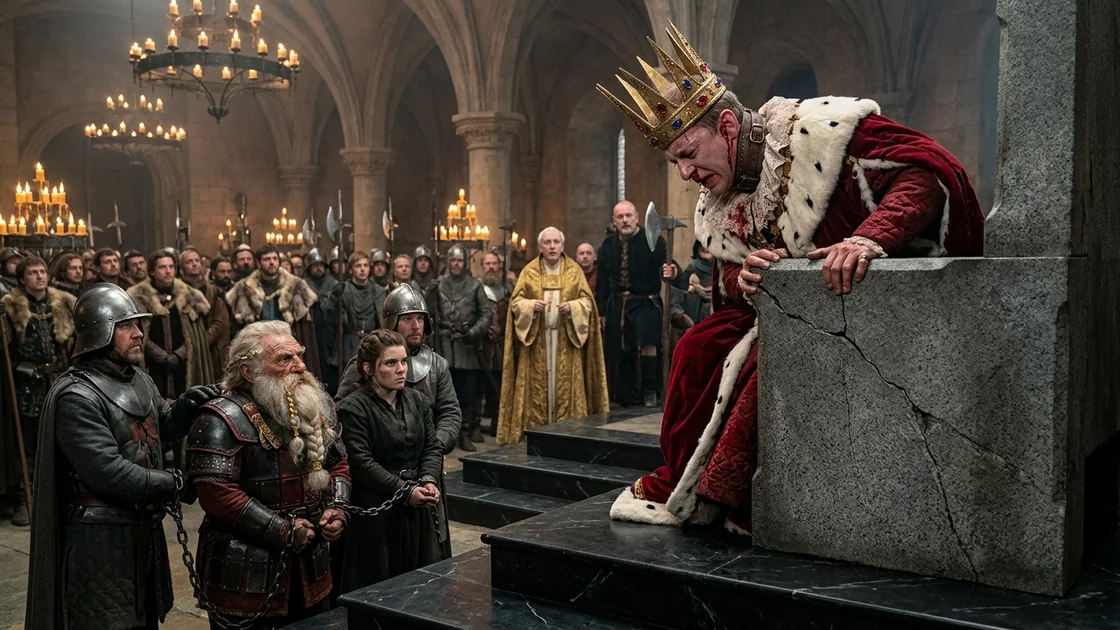
Baelin Craghammer, an aging dwarven master runesmith living beneath the human capital of Vaelgard, is forced at swordpoint to forge a new crown for Lord Cassian Vane, a ruthless usurper who murdered the rightful monarch. To avenge his fallen king and protect his people without triggering an immediate massacre in the dwarven quarter, Baelin weaves a secret, ancient enchantment into the golden circlet. The runes bind the crown to the bedrock beneath the royal throne, causing the metal to grow permanently heavier by exactly one ounce for every lie the ruler speaks while seated in judgment. As months turn into a year of tyranny, broken treaties, and false accusations, the deceptive king is slowly and inexorably crushed by the physical weight of his own deceit.
The bells of the High Citadel did not toll with the bright, bronze clarity that usually heralded a royal passing; they groaned, their clappers muffled in boiled leather, striking a slow and irregular rhythm that vibrated through the stone foundations of Vaelgard. Three hundred feet beneath the cobblestoned streets, in the cavernous warmth of the Sunken Forge, Baelin Craghammer set his ball-peen hammer down upon the horn of his anvil. He did not look up at the vaulted ceiling, though dust sifted down from the mortar joints like grey snow. He knew what that sound meant. A king did not die in his sleep to the tune of muffled iron. A king died on the end of a partisan, or with purple foam at his lips, while men in cloaks barred the gates and paid off the watch.
Across the workshop, by the quenching troughs, his apprentice and granddaughter, Lira, paused with a pair of long-nosed tongs held suspended over a barrel of brine. The red glow of the cooling steel in her grip painted her young face in sharp planes of crimson and shadow. She had her mother’s eyes—dark as wet slate—and Baelin’s own broad, stubborn jaw.
"That is the third bell since sundown, Grandfather," Lira said, her voice dropping instinctively, as though the granite walls had ears. In Vaelgard, they often did. The ventilation shafts that carried the sulfur and coal smoke up to the high chimneys of the artisans' quarter also carried whispers. "The palace criers haven't called the watch-hour since noon. Did the old man finally succumb to the winter fever?"
"King Roderick had the lungs of a bellows and a heart like an oak stump," Baelin replied, his voice a low rumble that seemed to come from the floor itself. He picked up an oiled rag and began wiping the face of his anvil, polishing the already mirror-bright steel out of sheer habit. For sixty years he had worked this chamber, first as an envoy from the deep halls of Karaz-Vorn, and later as the Sworn Smith to the House of Aldous. "He hunted boar in the wet fens four days ago. Fever does not take a man like that between the noon meal and the lighting of the streetlamps. Steel takes him. Or ambition, which is much the same thing in this city."
Before Lira could answer, the heavy oak-and-iron door at the top of the spiral stair shuddered under a brutal impact. It was not the polite rap of a guild clerk or the measured knock of a palace steward. It was the butt of a halberd, driven by an arm accustomed to breaking down peasant doors.
"Open, dwarf!" a voice barked from the landing above, echoing down the spiral stone chute. "Open in the name of the Lord Protector! Draw the bolts, or we bring pitch and smoke you out of your hole like badgers!"
Lira stiffened, her hand tightening on the tongs until her knuckles turned the color of bone. She looked toward the rack of heavy war-hammers kept ostensibly for ceremonial commissions near the coal bins.
"Drop the iron, girl," Baelin said softly. He did not rush. Dwarves of the Craghammer line did not scurry for men, no matter how loud they shouted. "Quench the bar. Put the leather apron over your head and stand by the bellows. Do not look them in the eye, and do not speak unless I give you leave."
"Grandfather, those are the Grey Cloaks," she whispered, recognizing the title of the Lord Protector—the styling recently adopted by Lord Cassian Vane, the Minister of the Marches. "If Roderick is dead—"
"If Roderick is dead, then the wolves are in the sheepfold, and a pair of smith's tongs will not turn them back," Baelin said. He walked with a slow, rolling gait toward the stairs, his leather apron stiff with decades of hammered scale and beeswax. His beard, white as silver-ash and braided into three heavy ropes tucked into his belt, swung with each step. He climbed the twenty-two stone steps and drew back the triple-forged sliding bolts.
The door swung inward, kicked open before Baelin could fully turn the iron ring.
Six men stood in the narrow alley of the Iron-Quarter, their cloaks of oiled grey wool slick with the freezing rain that fell upon the surface city. They wore half-helms with nasal guards that hid their faces in shadow, and they carried cocked arbalests along with their halberds. Behind them, the alley was lit by the unnatural, sputtering glare of pitch torches, and Baelin could see more soldiers blocking both ends of the street. The neighbors' shutters were bolted tight. Not a dog barked.
Between the ranks of the guards stepped a man who wore neither mail nor wool. Lord Cassian Vane was dressed in a doublet of midnight-blue velvet, slashed at the sleeves to show linings of silver silk, though a dark stain—too thick for rainwater, too dark for wine—marred the lace at his right cuff. He was tall, lean as a greyhound, with hair the color of tarnished brass and eyes that looked like two chips of river ice. Behind him walked Ser Garrow, his mute captain of the guard, carrying a heavy sack of crimson velvet that clinked with a dull, broken sound.
"Master Craghammer," Cassian said. His voice was remarkably pleasant, a smooth baritone trained in the rhetoric schools of the south, completely at odds with the violence of his men. "You keep an ungodly warm house. We could feel the draft through the sewer grates two streets away. May we descend? This rain is ruinous to good velvet."
"The forge is mine by royal charter, my lord," Baelin said, standing squarely in the doorway so that Cassian would have to brush past his broad shoulders or order him struck down. "Granted by King Roderick's grandsire for the fortification of the Water-Gate. No armed men are permitted below the threshold."
Cassian smiled. It did not reach the ice in his eyes. "Charters are parchment, Master Dwarf. And parchment is remarkably fragile when the hand that signed it grows cold. Step aside, or I will have Ser Garrow throw you down your own stairs, and we can discuss legalities while my men see what else you keep down there besides coal."
His gaze flickered past Baelin’s shoulder, down the stairwell where the orange light of the hearth revealed the hem of Lira’s apron.
Baelin’s jaw tightened until his teeth ground together like millstones. Slowly, he took one step back and bowed his head an inch—no more. "Mind the third step, my lord. The stone is slick with oil."
Cassian descended with a graceful, unhurried stride, followed by Garrow and four of the halberdiers. The workshop, which always seemed vast when only Baelin and Lira worked within its pillared confines, suddenly felt cramped, polluted by the smell of wet wool, cheap armor oil, and the sharp, copper tang of fresh blood.
Cassian paused near the center anvil, holding his gloved hands toward the glowing bed of anthracite coal in the main hearth. He looked around at the walls hung with calipers, swage blocks, fuller hammers, and half-finished plates of fluted tourney armor.
"A place of honest labor," Cassian murmured. "I have always admired your people, Craghammer. Humans build with wood and plaster, and when the fire comes, they weep. You build with basalt and iron. You understand permanence. You understand that what is struck hard enough while it is hot keeps its shape forever."
"Metal remembers the hammer, Lord Vane," Baelin said, moving to stand between the soldiers and the corner where Lira stood in the shadows by the great goatskin bellows. "Until it is thrown back into the fire. Or struck by a heavier weight. Why are you in my shop at the third bell of the night?"
Cassian nodded to Ser Garrow. The huge captain stepped forward and upended the velvet sack over Baelin’s wooden workbench.
Out tumbled a jagged, twisted mass of yellow gold, silver wire, and loose gems that rolled across the scarred oak planks. One large cabochon sapphire bounced off the edge of the table and landed at Baelin’s iron-shod boots.
Baelin did not need to pick it up to know what it was. He had cleaned and polished it once every five years for half a century. It was the Crown of the Seven Valleys, worn by every monarch of the Aldous line since the founding of Vaelgard. The central arch had been crushed flat, as if stamped beneath a heavy boot, and the inner band was dark with dried blood and grey hairs that had been torn from an old man’s scalp.
In the corner, Lira drew in a sharp, silent breath.
"A tragedy in the upper residence," Cassian said, looking down at the ruined gold with a expression of theatrical sorrow. "King Roderick was struck by a sudden fit of apoplexy after supper. In his delirium, he threw himself from the balcony of the Star Chamber onto the paving stones of the inner ward. His cousin, the Duke of Westmarch, attempted to save him and regrettably fell as well. As Did the Lord High Constable. A terrible night for the realm. A night that leaves Vaelgard without an heir of the blood."
"Three men falling from the same balcony," Baelin said, his voice flat and dead as cold slag. "The stonework in the Star Chamber must be terribly uneven."
"Dangerously so," Cassian agreed smoothly. "Which is why the Privy Council—what remains of it—met an hour ago in emergency session. With the northern barons always so restless, and the treasury in need of a firm hand, they have prevailed upon me to accept the burden of the throne. Not as Regent. The times are too perilous for half-measures. As King."
Baelin stared at the crushed crown on his bench. He thought of Roderick—a loud, flawed, generous man who used to sneak down to the Sunken Forge with a skin of spiced wine to watch Baelin temper hunting blades, laughing as the sparks caught in his grey beard. He looked at the dark crust on the twisted gold band.
"You have the city watch," Baelin said. "You have the treasury keys, and the heads of the royal household are no------doubt already on pikes above the traitor's gate. What do you want with a blacksmith?"
"I want legitimacy, Master Craghammer," Cassian said, stepping closer. The pleasant mask slipped, revealing the cold, calculating machinery beneath. "That gaudy wreck on your table represents four hundred years of superstition. The common rabble and the country lords believe that the dwarves of Karaz-Vorn blessed the founding of this city. They believe that no man is truly King of Vaelgard unless he wears a circlet forged in the Sunken Fires by the Master of the Iron-Quarter. And more importantly, I cannot wear that." He pointed a disdainful finger at the bloody ruin. "Even if you hammered it straight, everyone who looks upon it will think of that fat old fool Roderick."
"Then hire a goldsmith from the Silver-Street," Baelin said. "They make pretty baubles for merchants' wives every day."
"A goldsmith does not command the respect of the twelve hundred dwarves living in the Iron-Quarter," Cassian countered softly. "Nor does a goldsmith’s mark convince the superstitious pikemen of the river-valleys that the mountain-gods favor my reign. You will melt that down tonight, Craghammer. You will take its gold, and its stones, and you will add whatever star-iron or deep-silver you keep in your vaults, and by the seventh day from tonight—when the High Septon anoints me in the Hall of Pillars—you will place a new crown in my hands. Something taller. Something sharper. Something that makes men drop to their knees when the light hits it."
Baelin crossed his arms over his leather chest-piece. "And if I tell you that my fires are banked, Lord Vane? If I tell you that a dwarf of the Craghammer clan does not melt the heirlooms of his sworn friend to dress the brow of a cutthroat?"
The silence in the forge stretched so taut it seemed to hum like a plucked wire. The four halberdiers shifted their grips on their shafts. Ser Garrow’s hand dropped to the hilt of his heavy falchion.
Cassian did not get angry. He simply turned his head and looked directly at Lira.
"You have a granddaughter," Cassian said, as if remarking on the weather. "Lira, isn't it? Twenty-two years old—practically a child by your people's reckoning. My clerks tell me there are three hundred dwarven families living between the North Wall and the tannery ditches. Good, industrious folk. Though the houses they live in have very dry timber roofs, despite their stone cellars. And the gates of the Iron-Quarter lock from the outside, Master Craghammer. Did you know that? Your King Roderick never bothered to remove the old siege-bars."
Cassian walked slowly to the workbench, picked up a heavy iron fuller-hammer, and set it down directly atop the crushed remains of Roderick’s crown.
"If I do not have a crown worthy of an emperor by sunrise on the seventh day," Cassian whispered, leaning in until Baelin could smell the mint he chewed to hide the sour wine on his breath, "I will bar the gates of your quarter, pour fifty barrels of lamp oil down the gutters, and burn every beard and cradle to ash. Save for the girl. Her, I will keep in the palace kennels to mend the dog-chains, after Ser Garrow has broken enough of her fingers that she can never hold a hammer again. Do we understand the terms of the commission, Master Smith?"
Baelin looked at the crushed gold. He felt the heat of the forge against his left cheek and the cold draft of the open door against his right. In his mind, the ancient laws of Karaz-Vorn turned like giant, interlocking stone gears. An oath given under the blade is wind, the First Tablet taught. An oath written in stone is eternal.
"The gold of the old crown is twenty-two carats, alloyed with copper from the Red Hills," Baelin said, his voice entirely devoid of emotion. "It is soft. It was made for a line of kings who sat in peace. If you want taller spires, it will require a core of meteoric iron to hold the tension, or the tines will bend under their own weight."
Cassian’s thin lips curved upward. "I knew you were a practical people. Give it a core of iron, then. Make it unbreakable."
"A crown of that construction requires a fitting," Baelin continued, reaching to his workbench to pick up a pair of brass calipers and a strip of lead foil. "And if it is to bear the Great Seal of the Sunken Forge—the mark the river-lords will look for—it must be tuned to the resonance of the throne room. I will need the exact measurements of your skull, my lord. And on the sixth night, I will need one hour alone in the Hall of Pillars to set the base-ring against the Granite Seat, as was done for the first Aldous."
Cassian hesitated for a fraction of a second, his suspicious mind weighing the request. "You will have two guards with you in the Hall of Pillars. At twenty paces."
"At twenty paces, they will not disturb the plumb-lines," Baelin agreed. He stepped forward with the strip of soft lead. "Remove your hat, Lord Vane. Let me take the measure of the head that would wear the realm."
Cassian removed his velvet cap and stood rigid while the old dwarf reached up—standing on a low iron stool—and wrapped the cold lead strip around the usurper’s brow, pressing it firmly into the hollows of his temples and over the bony ridge at the back of his skull. Through his thick, calloused thumbs, Baelin felt the rapid, fluttering pulse in Cassian’s temporal vein. The man was cold, yes, and cruel, but beneath the velvet and the soldiers, he was terrified. Every usurper was.
Baelin lifted the lead ring off, careful not to bend its shape, and set it gently on the anvil.
"Sixteen inches by seven," Baelin murmured. "A narrow brow. High at the crown. Leave the gold, my lord. My fires will not go out until the seventh dawn."
When the heavy oak door slammed shut at the top of the stairs and the tramp of iron-shod boots faded into the rain, Lira’s knees gave out. She sank onto the stone rim of the slack-tub, burying her face in her soot-stained hands, her shoulders shaking with silent, furious sobs.
Baelin did not go to her immediately. He walked up the stairs, slid all three iron bolts home, and dropped the heavy oak crossbar into its iron brackets. Then he descended, picked up the sapphire that had rolled to the floor, and placed it beside the bloody, mangled gold on his bench.
"Up, girl," he said gently, laying a heavy, scarred hand on her braided hair. "Salt water rusts good steel. Save your tears for when the work is done."
Lira looked up, her slate-dark eyes blazing with the fierce, stubborn pride of youth. "You cannot make it for him, Grandfather! Look at that blood! That is Roderick’s blood! He brought us figs every Midwinter! He stood against the guild-masters when they tried to tax our coal carts! If you put the Maker’s Mark of Karaz-Vorn on that murderer’s brow, the whole city will bow to him. The ancestors will spit our names out of the Mountain!"
"And if I do not?" Baelin asked quietly. "Did you hear the man? Or were your ears plugged with wax? There are four hundred children in the Iron-Quarter tonight. Would you have King Roderick greeted in the halls of the dead by four hundred burned dwarven babes, just so Baelin Craghammer could keep his pride clean?"
"We could fight!" she hissed, her hand slapping the stone rim of the trough. "We have mining picks, we have sledges, we have the old crossbows in the guild-cellar! We could collapse the street-tunnels!"
"And starve in the dark within a month while he builds his palace over our graves," Baelin said. He turned back to the workbench and picked up the twisted remnant of the old crown. With a pair of heavy shears, he snipped a tangle of grey hair—Roderick’s hair—free from a bent golden spire, and laid it carefully upon a clean square of linen. "You are young, Lira. You think a war is only fought with the sharp end of a pickaxe. You have forgotten what we are."
"We are blacksmiths," she said bitterly.
"No," Baelin corrected, his voice dropping an octave until the hanging iron tools on the racks seemed to hum in sympathy. "Humans are blacksmiths. They beat hot metal until it is flat, and they call it a sword. We are Runesmiths of the Deep Ledger. We do not merely shape iron, child. We give it memory. We give it law."
He walked to the far end of the cavern, behind the great brick chimney of the main forge, where the natural basalt of the earth met the dressed masonry of the walls. With a hooked iron poker, he pried loose a blackened keystone near the floor and reached into the cavity behind it. He drew out an oblong box of petrified ironwood, bound in green bronze that had never known a file.
Lira stood up, her breath catching. She had worked in this shop since she was tall enough to pull the bellows chain, and she had never seen that box.
Baelin carried it to the bench, setting it beside the ruined crown. He pressed two thumbs against hidden catches in the bronze strapping, speaking a word in the Old Khazalid—a guttural, grinding syllable that sounded like two boulders grating together at the bottom of a glacier. The lid clicked open.
Inside, resting on beds of crumbled asbestos wool, lay three tools: a small hammer with a head of dull, grey stone that seemed almost impossibly heavy for its size; a set of six graving burins tipped not with steel, but with splinters of black bort diamond; and a small vial of dark, sluggish metal that shifted like liquid mercury, yet gave off no reflection.
"What are those?" Lira whispered, stepping closer despite herself.
"The tools of the Krag-Vorn," Baelin said. "The High Judiciaries of the Old Mountain, before the human kingdoms were even mud huts by the river. When a High King of our own blood grew tyrannical, or broke the Oaths of the Deep, the smiths did not raise an army to tear down the gates and waste the blood of the clans. They forged him a gift. A collar, a ring, a war-helm. Or a crown."
He picked up the small stone hammer. Even from three feet away, Lira felt a strange, dizzying pull in her stomach, as though the floor beneath Baelin’s boots had suddenly tilted downward.
"Cassian Vane wants a crown of legitimacy," Baelin said, his eyes gleaming beneath his bushy white brows like coals fanned to white heat. "He wants it tall, and sharp, and unbreakable, with a core of star-iron. And he wants me to tune it to the Granite Seat of Vaelgard so that all the realm knows he sits upon the lawful stone. Very well. I shall give him everything he asked for. I shall bind his crown to the throne so tightly that the mountain itself will know who sits there."
"A poison?" Lira asked eagerly. "Something that seeps through his skin when he sweats?"
"Poison is a woman's weapon in the human courts, and it is over in an hour," Baelin said with contempt. "If he drops dead at his coronation, his brute Garrow will know we did it, and the torches will fall on the Iron-Quarter before his body is cold. No. A dwarf does not murder from the shadows. A dwarf balances the ledger. How did Cassian Vane take that throne?"
"With blood," Lira said.
"Before the blood," Baelin pressed. "How did he get the gates opened? How will he keep the barons from marching on the city tomorrow?"
"With lies," Lira said slowly. "That story about the balcony. The promises he will make to the Council."
"A usurper's throne does not rest on stone," Baelin said, lifting the lead strip that held the exact shape of Cassian’s skull. "It rests entirely on falsehoods. He must lie to the priests to get the oil on his head. He must lie to the lords to keep their swords in their scabbards. He must lie to the commoners to get their grain and their taxes. Every day he sits in that chair, he must spin a hundred new lies to cover the ten he told the day before."
Baelin tapped the lead ring with the diamond-tipped burin.
"There is an old rune-chain," the master smith said softly. "Durn-Krag-Kazad. The Binding of the Accountable Stone. It does not create fire, nor does it summon lightning, so the human court-wizards with their sniffing crystals will never detect a spark of magic upon it. It merely alters the conversation between the metal and the earth below. For every falsehood spoken while the wearer sits upon the stone to which the crown is bound, the runes will draw down the pull of the deep bedrock. Not much. Just a trifle. One ounce."
Lira frowned, doing the arithmetic in her head. "One ounce? Grandfather, there are sixteen ounces in a pound. A battle-helm weighs eight pounds and a grown man wears it all day without halting. One ounce is the weight of a silver groat! A sparrow weighs more than an ounce!"
"A single snowflake weighs nothing at all, girl," Baelin said, a grim, terrifying smile finally parting his white beard. "Ask the pine tree in midwinter what ten thousand of them do to its branches. Now, blow up the fires. Fetch the crucible of white clay, and bring me the star-iron from the bottom bin. We have seven days to build an avalanche."
The first day was the Day of Unmaking.
Baelin refused to melt King Roderick’s blood into the usurper’s metal. For six hours, before a single piece of charcoal was added to the smelting furnace, he and Lira washed the ruined Crown of the Seven Valleys in warm rainwater mixed with crushed hyssop and vinegar. They collected every microscopic flake of dried blood, every tangled grey hair, wrapped them in the linen cloth alongside the snippet Baelin had cut earlier, and burned them respectfully in a separate brazier, whispering the dwarven prayers for a warrior fallen in ambush.
Only when the gold was clean did Baelin pry the gemstones from their bruised bezels—seven large cabochon rubies from the southern deserts, seven sapphires as blue as deep mountain lakes, and a dozen smaller diamonds.
Then the gold went into the clay crucible.
Lira worked the great double-bellows until the sweat ran in rivers down her soot-blackened arms, driving a roaring blast of air through the tuyere at the base of the furnace. The anthracite coal turned from red to bright orange, then to a blinding, searing yellow-white that required them both to drop smoked-glass goggles over their eyes. Within the crucible, the four-hundred-year-old symbol of the House of Aldous slumped, ran like honey, and became a featureless pool of glowing liquid.
"Skim the dross," Baelin commanded, his voice booming over the roar of the draft. "Leave the copper alloy in it. Gold alone is too soft to hold the tension against the iron core, and Cassian wants sharp points."
While Lira skimmed the impurities from the molten gold, Baelin turned to the star-iron.
It was a lump of jagged, pitted metal the size of a child's head, found three centuries ago in a crater high on the ice-peaks of Karaz-Vorn. Star-iron was notoriously treacherous to work. Cold, it would shatter a steel chisel; too hot, it would crumble like dry cheese. It had to be worked at a precise, cherry-red heat, and it demanded the full strength of a master’s arm.
Baelin used the heavy twenty-pound sledge for the rough drawing, his sixty-year-old shoulders bunching and rolling beneath his leather tunic like granite boulders sliding under leather. Clang. Clang. Clang. The rhythm was different from ordinary smithing—three rapid strikes on the flat, one heavy blow on the horn, turning the glowing billet a quarter-inch each time. Sparks of a strange, greenish-white hue showered across the workshop floor, hissing as they hit the damp flagstones.
By the end of the second day, he had drawn the meteoric iron into a flat, seamless band, a quarter-inch thick and an inch wide, forged-welded into a circle that matched the lead template of Cassian’s skull to the width of a human hair.
On the third day, the real craft began—the craft that no human smith had ever been permitted to witness.
The crown could not be a solid lump, or it would weigh twelve pounds before a single lie was spoken, and Cassian would suspect treachery from the first moment it touched his brow. It had to begin light—deceptively light, lighter even than the old crown of Roderick, which had weighed just over four pounds.
Baelin cast the gold into flat sheets and hammered them over pitch blocks, raising seven tall, jagged spires that looked like castle battlements or the fangs of a wolf. Between the outer golden skin and the inner band of star-iron, he left a microscopic hollow channel, no wider than a wheat straw, running the entire circumference of the circlet.
"Watch closely, Lira," Baelin muttered on the third night, his magnifying lenses strapped to his leather headband as he leaned over the iron core. A single tallow candle, reflected through a glass globe filled with clear water, cast a tight, brilliant beam of light onto the metal. "A rune that depends on the spoken word cannot rely on the wind to carry the sound. If some flatterer in the court tells a lie ten paces away, the crown must not count it, or the fool would be crushed by his own courtiers before luncheon. The lie must come from the throat of the man who wears it."
With a file so fine its teeth were invisible to the naked eye, Baelin cut tiny, reed-like projections along the inside of the star-iron band, positioned precisely where the metal would press against the temporal bones above Cassian’s ears and the occipital ridge at the base of his skull.
"Bone carries sound better than air," Baelin explained, his gnarled fingers steady as bedrock as he shaped the acoustic bridges. "When a man speaks, his skull vibrates. When he lies, the tension in his throat, the beat of the blood in his temples, the dissonance between what his mind knows to be true and what his tongue shapes into sound—it all rings through the bone like a cracked bell. These bridges will catch that tremor and carry it into the hollow channel."
On the fourth and fifth days, the workshop was locked from the inside, and even the ventilation dampers were half-closed to deaden the sound. Baelin opened the ironwood box and took out the diamond-tipped burins and the stone hammer of the Krag-Vorn.
For thirty-six hours, Baelin did not sleep, and he ate only crusts of hard journey-bread dipped in weak beer. Lira sat beside him, holding the water-globe lamp, wiping the sweat from his forehead with a damp cloth whenever he nodded, so that not a single drop of moisture would fall onto the work.
Using the diamond burin, Baelin carved the runes on the inside of the star-iron band and the inner face of the golden plates—surfaces that would be permanently sealed away once the crown was brazed together.
They were not the broad, decorative runes carved onto tavern signs or tombstones. They were the Guz-Krag—the root-runes, smaller than the legs of a mite, stacked one atop another in complex, geometric lattices that looked to the uninitiated like mere scratches left by a polishing stone.
Tap-tink. Tap-tink.
With each microscopic strike of the stone hammer against the butt of the diamond burin, Baelin whispered the binding clauses in the deep tongue of the mountains.
"By the iron that fell from the void," he breathed, his thumb bleeding where the sharp edge of the burin collar bit into his skin. "By the gold that slept in the dark. Hear the bone. Hear the breath. When the tongue forks against the knowledge of the heart, while the spine rests above the Anchor-Stone, call unto the deep earth. Measure the false wind in the scales of the mountain. One grain for the thought, a hundred for the breath, four hundred and thirty-seven grains and a half—one ounce by the standard of the merchants—added unto the pull of the abyss. Never to be shed while the stone endures. Never to be lightened while the liar breathes."
There were seven hundred andforty-two individual rune-clusters required to complete the circuit around the sixteen-inch band. By the evening of the fifth day, Baelin’s eyes were bloodshot and swollen, and his right hand was cramped into a claw that Lira had to massage with warm goose-grease before he could open his fingers.
Then he unstoppered the small vial from the ancient box.
The dark, sluggish liquid inside was Barak-Zil—quicksilver mined from the deepest volcanic vents beneath Karaz-Vorn, amalgamated with powdered lodestone and the ground meteoric dust from the Anvil of the First Ancestor. Using a hollow goose quill, Baelin drew a single drop of the heavy, dull liquid and touched it to the master-rune at the front of the iron band.
As if alive, the dark metal raced along the microscopic grooves Baelin had carved, drinking itself into the diamond-cut channels until every single rune flashed once with a dull, leaden violet light, and then went completely dark, looking like nothing more than ordinary tarnished iron.
"Now we seal the tomb," Baelin rasped.
With gold solder and a mouth-blowpipe, he brazed the outer skin of jagged, polished royal gold over the star-iron core, completely encapsulating the rune-lattice and the acoustic bone-bridges inside a seamless shell of precious metal. No mage, no alchemist, no goldsmith could ever see the runes unless they took a cold chisel and smashed the crown to pieces.
He set the gems last—seven blood-red rubies along the brow, seven sapphires above them, and the diamonds at the tips of the seven cruel, needle-sharp spires. Inside the band, to hide the cold iron against the skin, he riveted a thin lining of the finest crimson calfskin, stitched with gold thread, leaving only the tiny, smooth bosses of the acoustic pickups barely protruding through the leather where they would rest against the king’s temples.
When he placed the finished crown upon the brass balance-scales on the morning of the sixth day, Lira leaned in to read the counterweights.
"Three pounds and twelve ounces," she breathed, looking at the tall, terrifyingly regal diadem. The red gold caught the forge-light like frozen fire; the sharp spires looked tall enough to pierce the sky, yet the hollow construction made it feel almost airy in the hand. "It looks as though it should weigh ten."
"Wait until he speaks," Baelin said.
That night, as agreed, Ser Garrow and four Grey Cloaks escorted Baelin up from the Sunken Forge and through the rain-swept, silent streets of Vaelgard to the Citadel. Baelin carried the crown in a locked oak presentation case, along with a leather satchel containing a plumb-bob, a spirit level, a light copper mallet, and a tiny, unnoticed vial of the remaining Barak-Zil amalgam.
The Hall of Pillars was cavernous and freezing, smelling of damp limestone and the beeswax being rubbed into the choir stalls by nervous servants preparing for the morning’s coronation. At the far end of the hall, atop a seven-tiered dais of black marble, stood the High Seat of Vaelgard—a massive, monolithic chair carved from a single ten-ton block of grey mountain granite that had been dragged down from the northern crags four centuries ago, its base mortared directly into the living bedrock of the citadel hill.
Garrow halted at the foot of the dais, gesturing curtly with his chin while two guards leveled their arbalests at Baelin’s back from twenty paces away.
Baelin climbed the seven steps slowly, his knees popping in the cold air. He set the oak box upon the flat stone seat of the throne, opened it, and lifted out the crown, placing it in the center of the chair.
Making a great show of hanging his brass plumb-bob from the stone canopy overhead and tapping the crown lightly with his copper mallet so it gave off a clear, musical ping, Baelin knelt as if checking the alignment of the seat. Beneath the cover of his wide leather apron and flowing beard, his left thumb pressed a tiny, pre-cut plug of grey stone—identical in grain to the granite of the throne and saturated with the rest of the Barak-Zil lodestone amalgam—into a natural fissure at the base of the throne's rear leg, right where it met the foundation stone.
As the plug slid home, Baelin felt a faint, sub-audible thrum pass through the soles of his boots. Up on the seat, the crown settled with a tiny click against the stone, and then immediately released as Baelin lifted it an inch off the surface.
When lifted away from the vertical column of the throne, the crown weighed three pounds and twelve ounces.
When resting within the vertical column of the Anchor-Stone—or upon the head of a man seated within that column—the circuit between sky-iron and deep-earth was complete.
Baelin stood up, packed his plumb-line away, and left the gleaming crown sitting upon a velvet cushion on the cold granite seat. As he walked past Ser Garrow at the foot of the steps, the old dwarf looked up at the towering mute captain.
"Tell your master the stone has accepted the gold," Baelin said softly. "It fits the seat as though it grew there."
The morning of the seventh day dawned beneath a sky the color of a bruised plum, though inside the Hall of Pillars, ten thousand beeswax candles had been lit to manufacture a counterfeit summer.
Baelin stood in the high, narrow gallery reserved for the Guild-Masters of the city, his thick fingers resting on the carved stone balustrade. Beside him stood Lira, dressed in her best charcoal-grey wool gown, her hair braided with silver wire. Around them, the human guild-masters—the weavers, the vintners, the shipwrights, the chandlers—shifted uneasily on their feet, dabbing at their foreheads with silk handkerchiefs despite the drafty chill of the upper arches.
Below them, the nave of the great hall was a sea of silk, fur, and polished steel. Every lord within fifty leagues who had not fled to the northern hills had been dragged or bribed into attendance. And lining the walls, standing shoulder to shoulder behind the tapestries, were three hundred of Cassian’s Grey Cloaks, their halberds gleaming in the candlelight, their arbalests wound and resting across their forearms.
At the front of the hall, before the black marble dais, stood the High Septon in his robes of gold brocade. The old priest’s hands shook visibly as he held the horn of anointing oil. And kneeling on the top step before the Granite Throne was Cassian Vane, draped in a mantle of ermine and crimson velvet that had been hastily tailored down from King Roderick’s broader shoulders.
"Look at the Maker's Mark," Lira whispered, leaning close to Baelin’s ear so no one else in the gallery could hear. "Lord Hoster of the River-Gate brought his spyglass. He has been staring at the crown on the altar for ten minutes. They all see the Craghammer stamp on the rim."
"Good," Baelin murmured, his eyes fixed on the dais. "Let them think the mountain sleeps. A trap that looks like a trap catches no wolves."
Down below, the choir fell silent. The High Septon dipped his thumb into the scented oil and drew the sign of the sun across Cassian’s narrow forehead.
"Rise, Cassian of the House of Vane," the Septon’s reedy voice echoed off the vaulted ceiling. "And take the seat of the realm."
Cassian rose with fluid, theatrical grace. He turned, ascended the final two steps, and lowered himself into the massive embrace of the Granite Throne. He looked slight against the dark, rough-hewn stone, like a painted hawk perched on a sea-cliff, yet there was no denying the cold authority in his posture.
The Septon lifted the new crown from its velvet cushion. Even the old priest blinked in surprise at how effortlessly it came up into his trembling hands. He stepped forward, raised the tall, jagged circlet of red gold and rubies high for the assembly to see—drawing a murmured gasp from the nobles as the candlelight fractured across the diamonds—and lowered it onto Cassian’s brow.
Baelin leaned forward an inch over the gallery rail.
As the crown settled onto Cassian’s head, aligning directly over the vertical axis of the Granite Throne, Baelin saw the usurper’s eyelids flutter for the briefest fraction of a second. A tiny, imperceptible shudder ran through the iron band as the acoustic bridges touched the skin of his temples and the Barak-Zil recognized the Anchor-Stone three feet below his boots.
Three pounds, twelve ounces, Baelin counted in his mind.
The High Septon stepped back and unrolled a parchment scroll. "Before the gods and the lords of the Seven Valleys, do you, Cassian, swear that you come to this seat with clean hands, unstained by the blood of your predecessor, called to this high office solely by the will of the Council and the necessity of the realm?"
Cassian placed his right hand over his heart. He sat tall, his chin raised so the seven spires of his crown caught the light of the great chandelier.
"Before the gods and this assembly," Cassian’s smooth, resonant baritone filled the hall, "I swear that my hands are clean of King Roderick’s blood."
One, Baelin thought.
Down on the dais, Cassian’s head dipped by the breadth of a fingernail. He blinked, as though a fly had landed on his hair, and then continued smoothly.
"I loved King Roderick as a father," Cassian declared to the silent hall.
Two.
"I wept when the healers told me his heart had failed him in the Star Chamber."
Three. Four. (For there had been no healers, and his heart had not failed.)
"I did not seek this crown," Cassian’s voice rose, sweeping toward the galleries where the merchants and common guild-men stood. "I wished only to retire to my estates in the Marches and mourn my sovereign in peace."
Five. Six.
"Wait," Lira whispered, her eyes wide as she stared down at the throne. "Did you see his neck?"
"Hush," Baelin murmured. "Let him preach. The man has a talent for it."
Cassian gripped the stone armrests of the throne, leaning forward slightly to address the sullen barons in the front rows. "To the noble peers of the realm, I pledge that the ancient rights and privileges of your estates shall never be infringed under my rule. The emergency levies collected last month by the late Constable were an error—not a single gold dragon of those funds remains in my private coffers, and every coin shall be returned to your bailiffs before the spring planting!"
Seven. Eight. Nine.
"To the good guilds of Vaelgard, and our loyal subjects in the Iron-Quarter," Cassian raised his gaze briefly toward the gallery, his ice-blue eyes sweeping past Baelin’s impassive face, "I declare that the taxes on coal, river-freight, and imported wool shall be reduced by a third from this day forward, for the treasury is full and the borders are entirely at peace!"
Ten. Eleven. Twelve.
Twelve lies in the span of three minutes. Twelve ounces. Three-quarters of a pound of dead, downward pull added to the band around his skull.
The crown now weighed four pounds and eight ounces. It was still well within the comfort of a grown man’s neck, no heavier than an ordinary riding helmet, yet Baelin saw Cassian reach up with one gloved finger and absently adjust the rim above his left ear, as if the leather lining had suddenly pinched him.
For another forty minutes, the ceremony dragged on. One by one, the great lords of the valleys came forward to kneel, place their hands between Cassian’s knees, and swear fealty. And to each of them, as custom demanded, the new king spoke a personalized blessing and an assurance from the throne.
To Lord Hoster, whose nephew was currently rotting in Cassian’s subterranean dungeons, the king promised: "Your nephew is riding on a diplomatic mission to the south, my lord, in high health and higher favor; you shall have a letter from his own hand within the fortnight." (Three lies in a single breath.)
To the Dowager Countess of Westmarch, whose husband had been thrown from the balcony alongside King Roderick, Cassian murmured with exquisite sympathy: "The Duke died trying to catch the King's robe, madam; I myself held him in my arms as he breathed his last and blessed my regency." (Four more.)
By the time the trumpets sounded to announce the conclusion of the oaths and the opening of the banquet tables in the lower hall, Baelin had counted thirty-six distinct falsehoods spoken from the Granite Seat.
Thirty-six ounces. Two pounds and a quarter added to the original three pounds and twelve ounces.
When Cassian finally stood up from the throne to lead the procession out of the hall, a strange thing happened. As his weight left the chair and his spine moved out of alignment with the Anchor-Stone at the base of the dais, the thirty-six ounces of gravitational pull vanished instantly, reverting the crown to its natural three-pound weight.
Expecting the six-pound resistance his neck muscles had spent the last hour fighting against, Cassian jerked his head upward as he rose, nearly losing his balance on the top step before Ser Garrow caught his elbow.
Cassian frowned, reaching up with both hands to touch the golden spires. He turned and looked back at the empty stone chair for a long, puzzled moment, before shaking his head and striding down the aisle to the forced applause of his subjects.
Up in the gallery, Lira let out a long, shaky breath she seemed to have been holding since the oil touched his brow.
"Thirty-six," she whispered. "Only two pounds, Grandfather. And when he stood up, it went away! He won't sit in that chair for more than two or three hours a week!"
"A king who takes a throne by blood cannot rule from his horse, Lira," Baelin said, turning toward the gallery stairs. "The Law of the Charter states that no writ of execution, no tax levy, no confiscation of land, and no judgment of treason is binding unless spoken by the crowned king from the Granite Seat. If he tries to sign warrants in his bedchamber, the barons will have the legal excuse they are praying for to raise their banners. He will sit in that chair. And the beauty of the Durn-Krag rune, child, is that the stone never forgets the count. The next time his royal backside touches that granite, those thirty-six ounces will be waiting for him before he even opens his mouth."
Winter closed over Vaelgard like an iron fist, and with the frost came the true measure of King Cassian’s reign.
In the Sunken Forge, life returned to an outward semblance of routine. Baelin and Lira shod the heavy warhorses of the Grey Cloaks, mended the iron grates of the city gates, and forged ornamental braziers for the nervous minor lords who were trying to buy favor at court. Every payment was made in clipped silver coin, accompanied by receipts signed by the Royal Exchequer claiming that the missing weight of the silver was going toward "the defense of the eastern sea-wall against pirates"—a sea-wall that lived only in the imagination of Cassian’s clerks.
Baelin did not need to attend the royal court to know how the ledger of the crown was progressing. The news filtered down into the Iron-Quarter through a hundred cracks: from the dwarven masons repairing the palace chimneys, from the washerwomen who scrubbed the royal linens, from the apothecaries on Silver-Street.
By the end of the first month, the winter grain reserves that King Roderick had stored in the royal granaries to feed the poor during the freeze had been secretly sold by Cassian to foreign merchants in exchange for mercenaries from the Free Cities. When a delegation of starving river-farmers and city bakers petitioned the throne at the Midwinter Assizes, Cassian sat upon the Granite Seat for six hours, blaming the empty granaries on "rot caused by the negligence of the late King’s stewards," promising that "twenty ships laden with southern wheat are currently sailing up the estuary," and swearing that every mercenary hired was being paid "out of the ancient family vaults of House Vane."
A mason named Dwalin, who had been resetting a loose cornice high in the clerestory of the Hall of Pillars that afternoon, told Baelin over a mug of dark ale that he had watched the king from above.
"It was the strangest sight, Master Baelin," Dwalin muttered, wiping foam from his red moustache. "When the man sat down at noon, he was as pert as a jaybird. By the third hour, after he’d told those poor farmers fifty different tales about wheat ships and grain weevils, he was leaning his elbow on the stone armrest and propping his chin in his hand like an old wife with the toothache. By the fifth hour, when he was reading out the lists of 'traitors' whose lands he was seizing for the crown's safety, the sweat was pouring down his cheeks in the middle of a freezing hall, and his neck was trembling like a pit-pony under a double load of ore. When the session ended, Garrow and another guard had to lift him out of the chair by his armpits!"
Baelin took a slow sip of his ale, doing the numbers behind his eyes. Six hours of court. Easily two hundred lies—false charges against dead lords, fabricated receipts, imaginary wheat ships. Two hundred ounces was twelve and a half pounds. Added to the dozens of sessions he had held over the previous four weeks, the crown on the throne was likely pressing down on Cassian’s spine with the weight of thirty or thirty-five pounds.
Thirty-five pounds resting entirely on the narrow circle of a man’s skull.
In the second month, the apothecaries reported that the palace physicians were buying up every jar of willow-bark paste, oil of wintergreen, and poppy-milk in the city to treat the King’s "winter migraines and stiffness of the neck."
In the third month, the summons came.
It was not Ser Garrow who banged on the forge door this time, but a pale, nervous man in the grey squirrel-fur robes of the Royal Arcanist, accompanied by four halberdiers and a court tailor carrying a sewing basket.
"Master Craghammer," the mage said, peering down into the smoky glow of the workshop while holding a pomander of cloves to his nose. "I am Master Vorian of the Conclave. His Majesty commands your immediate presence in the Robing Room behind the Hall of Pillars. Bring your scales, your files, and your pincers."
Lira looked up from the workbench where she was polishing a steel buckler, her heart leaping into her throat. She looked at her grandfather.
Baelin’s face was as calm and weathered as a cliffside. "Of course, Master Vorian. Has His Majesty’s diadem suffered a dent?"
"Just bring your tools, dwarf," Vorian snapped, though there was an edge of profound bafflement in his voice. "And walk quickly."
Lira insisted on carrying the tool-bag, refusing to let the old man face the palace alone. They were marched through the slush of the streets, through the postern gate of the Citadel, and into a small, richly carpeted chamber directly behind the black marble dais of the throne room.
A roaring fire blazed in the hearth, yet King Cassian sat huddled in a padded wooden armchair wrapped in three layers of fox-fur pelts.
Lira barely recognized the sleek, arrogant nobleman who had stood in their forge ninety days ago. Cassian had lost twenty pounds of flesh, yet his face around the eyes was puffy and dark as rotting plums. A thick crimson welt—a permanent groove of bruised, calloused skin—ringed his forehead and disappeared into his thinning brass-colored hair. He held his head at an unnatural, rigid angle, as if his neck were made of fused glass, and his left hand twitched constantly in his lap.
On a mahogany table beside him sat the crown.
Around the table stood two sweating physicians with leech-jars, the court tailor, and Ser Garrow, whose hand rested perpetually on his sword hilt.
"There he is," Cassian rasped. His smooth baritone was gone, replaced by a strained, hoarse wheeze, the voice of a man whose throat and cervical vertebrae were under constant, agonizing compression. "Search him, Garrow."
The mute giant patted Baelin and Lira down roughly, dumped Baelin’s leather satchel onto the floor, and kicked the brass balance-scales, three files, and a pair of pincers across the carpet.
Cassian pointed a shaking, jewel-encrusted finger at the crown on the table.
"What did you put in that metal, dwarf?" the king whispered.
Baelin knelt slowly, picked up his brass scales, and stood with his hands folded over his apron. "Red gold from King Roderick’s treasury, Your Majesty. Star-iron from the peaks of Karaz-Vorn for the tension ring, as you commanded. Seven rubies, seven sapphires, twelve diamonds, and calfskin leather for the lining."
"You lie!" Cassian’s voice cracked, and he winced violently, his hand flying to the back of his neck as a spasm knotted the muscles beneath his jaw. "When I sit upon the High Seat to deliver the royal justice, that thing turns to solid lead! Yesterday, during the sentencing of the river-smugglers, I felt as though a horse were standing on my shoulders! My vision went red! Look at my brow!" He tore away a strip of linen bandage to show the deep, purple trench pressed into his flesh above the temples. "The bone is bruising through the leather!"
Baelin stepped closer to the mahogany table, peering respectfully at the crown without touching it. "With respect, Your Majesty, star-iron is a rigid metal. Perhaps the cold air of the Hall of Pillars causes the iron ring to contract around your brow, pinching the veins and causing a rush of blood to the head. A common malady with heavy war-helms in winter."
"It is not pinching, you stunted liar, it is crushing me!" Cassian snarled, spittle flying from his lips. He turned on the trembling mage. "Vorian! Tell him what you found!"
Master Vorian swallowed hard, adjusting his spectacles. "Sire, as I have explained three times this morning... I have examined the crown with every crystal, lodestone, and aetheric tuning-fork in the Conclave's possession. There is no enchantment upon this metal. None whatsoever. No curses of malice, no hexes of sickness, no transmutation of lead. Furthermore..." The mage gestured helplessly toward a set of apothecary scales sitting on the sideboard. "I weighed it myself ten minutes ago when you took it off after the morning petitions. It weighs three pounds and twelve ounces. The exact weight recorded by the clerk on the day of your coronation."
"Weigh it on his own scales!" Cassian barked. "He has bewitched yours!"
Baelin calmly set up his brass balance beam on the table, hooked the pan to one side, and placed three one-pound iron standard weights and three four-ounce brass discs on the other.
"May I, Your Majesty?" Baelin asked.
Cassian nodded jerkily.
Baelin lifted the crown with two fingers—demonstrating how effortlessly it moved here in the Robing Room, fifteen feet away from the Granite Throne—and set it on the pan. The brass beam swung up, oscillated twice, and settled into a dead-level horizontal line.
Three pounds, twelve ounces.
Cassian stared at the balanced beam with bloodshot, wild eyes. "Then it is poison! Contact poison in the calfskin lining that paralyzes the muscles of the neck!"
"Drink the wash-water, Vorian," Cassian ordered.
"Sire, I already scraped the leather and fed the shavings to a cage of white mice yesterday," the mage pleaded. "The mice are thriving. And the tailor just ripped the old lining out an hour ago—there is nothing beneath it but solid, seamless gold and two little iron rivets over the ears."
"Those are the tension bosses, Your Majesty," Baelin explained smoothly, pointing to the tiny acoustic bridges that barely peeked through the inner rim. "Without them, the seven tall spires you requested would warp outward. If they press too sharply against your temples, the remedy is simple. Your tailor here can sew a thick bolster of lamb's wool velvet around the inner band. And perhaps... Your Majesty might consider wearing a lighter circlet of simple silver wire for the daily petitions, or holding court from this comfortable wooden chair here in the warm parlor?"
For a moment, genuine longing flashed across Cassian’s haggard face. He looked at the soft, padded armchair he was sitting in, and then toward the heavy velvet curtains that separated the Robing Room from the freezing Hall of Pillars.
Then his eyes narrowed with the sharp, cornered cunning that had made him a usurper in the first place.
"And what would the Northern Barons say if I sat in a parlor chair without the Crown of Vaelgard?" Cassian hissed, leaning forward until his bruised forehead glistened in the firelight. "Lord Hoster’s lawyers are already arguing in the taverns that the new salt-tax is invalid because the herald misread the date! If I do not sit upon the Granite Stone wearing the Great Seal of the Forge, every tax collector between here and the border will have his throat slit by sundown, and the Duke of Westmarch's bastard will claim I have gone mad or lost the favor of the realm! Did Hoster pay you to suggest that, dwarf?"
"I speak no politics, Sire," Baelin said, bowing his head. "I speak only of the weight of metal. If Your Majesty must wear the great crown upon the Stone, then let the tailor pad it well with wool and stuffed kidskin. And perhaps... speak more briefly to the petitioners. Long speeches strain the cords of the throat, which pull upon the base of the skull. Let your Chancellor read the charges."
Cassian sank back into his furs, his chest heaving. The suggestion made a twisted kind of sense to his paranoid mind. The headaches always seemed to grow worse when he was forced to argue with the councilors or deliver lengthy justifications for his decrees.
"Pad it," Cassian wheezed, waving a dismissive hand at the tailor. "Two inches of quilted silk and lamb's wool. And you, physician—double the poppy-milk before the afternoon session. We have the trial of the grain-hoarders at three o'clock. As for you, Craghammer..."
Cassian fixed the old dwarf with a stare of pure, unadulterated venom.
"If these pains do not cease by the spring thaw, I will not bother asking Master Vorian why. I will bring you and that silent girl of yours back to this room, and I will have Ser Garrow set a red-hot iron brazier on your head until we see whose neck breaks first. Now get out of my sight."
Spring did not bring relief to King Cassian; it brought paranoia, and paranoia brought a flood of new lies.
The quilted silk padding the tailor sewed into the crown gave the usurper two days of respite from the sharp cutting of the rim, though it made the golden diadem sit absurdly high upon his head, like a gilded bucket balanced on a turnip. More importantly, it did nothing to halt the inexorable arithmetic of the Durn-Krag runes. Even through a quarter-inch of lamb's wool, the star-iron bosses picked up the deep resonance of the king’s jawbone and skull every time he sat upon the Granite Throne and spoke a falsehood.
And by April, Cassian could no longer let his Chancellor speak for him.
He did not trust the Chancellor. In mid-April, convinced that the old minister was secretly corresponding with the rebellious Northern Barons, Cassian had the man dragged before the High Seat in chains. Because the Law of the Charter required the monarch himself to pronounce the bill of attainder and the evidence of high treason from the throne, Cassian sat upon the granite block and read a completely fabricated confession spanning twelve pages of parchment.
Every sentence was a lie. Every clause was an invention of Cassian’s torturers.
One hundred and forty lies in a single afternoon. Almost nine additional pounds of downward force added to a crown that, while seated on the throne, already carried the accumulated weight of nearly nine hundred winter falsehoods.
Fifty-six pounds. Plus the nine new ones. Sixty-five pounds. And the original three pounds and twelve ounces.
Nearly seventy pounds of dead, crushing mass pressing straight down through his cranium, into his atlas vertebra, compressing the discs of his spine against the unyielding stone of the chair.
Those who witnessed the sentencing of the Chancellor whispered afterward in terrified hushes at the taverns. They said that by the tenth page of the parchment, the King’s voice had dropped to a wet, strangling croak. They said that the quilted silk lining of the crown had been squashed paper-thin, squeezed out like a sponge around his ears, and that a slow, bright trickle of scarlet blood had run out of the King’s left nostril and dripped onto his ermine collar as he pronounced the sentence of hanging. They said he had slumped so far down into the throne that his chin was pinned against his breastbone, unable to lift his eyes from the floor, reading the last pages only because a clerk held the parchment down by his knees.
Yet the most terrifying thing to the court was that when Ser Garrow stepped forward at the end of the session and lifted the crown off the King’s bleeding, trembling head, the giant captain tossed it from one hand to the other as if it weighed no more than a pewter tankard.
The rumor swept through Vaelgard like brushfire before a gale.
It is not the crown, the wash-women whispered at the wells.
It is the Stone, the guardsmen muttered on the ramparts, crossing themselves against the evil eye. The Granite Seat of the Aldous Kings knows he is a murderer. The throne itself is trying to swallow him.
As the rumor reached Cassian’s ears in May, his sanity began to fray like an old hemp rope under too much ballast.
He tried to stop speaking from the throne altogether, communicating only by nodding or shaking his head while a herald read his decrees. For two weeks, the weight of the crown did not increase by a single ounce.
Instead, it remained locked at seventy-two pounds every single second he sat in the chair.
Seventy-two pounds—the weight of a full sack of wet barley, or a medium-sized smith's anvil—resting upon a human neck that was already fractured with micro-fissures and chronic inflammation. Even sitting in complete silence, Cassian could not endure the throne for more than twenty minutes before his arms went numb from the pinched nerves in his spine, his vision swam in black spots, and the agony forced him to scream for Garrow to adjourn the court.
Worse still, the silence did not save his rule. A silent king who slumped like a sack of turnips, drooling blood and poppy-spittle onto his furs while his mute captain lifted his head for him, inspired neither dread nor loyalty.
In June, the three Northern Duchies openly raised the golden stag banner of the dead King Roderick’s distant cousin. They marched south with eight thousand pikes and two thousand heavy horse, declaring Cassian Vane a regicide, a usurper, and a creature cursed by the gods. Within the walls of Vaelgard, the merchant guilds stopped paying the emergency levies altogether, barring their warehouse doors and hiring their own street-guards.
Cassian realized the fatal trap of his own vanity: if he did not appear before the full Assembly of the Estates in the Hall of Pillars, sit upright upon the Granite Seat, wear the Crown of Vaelgard, and rally the city with a commanding royal address—promising victory, pardons, and gold while condemning the traitors—the city garrison itself would open the gates to the rebel army within three days.
And as he sat in his bedchamber on the night before the Great Assembly, staring at the tall, gleaming crown on his table while rubbing his ruined, brace-bound neck, his fevered, poppy-addled mind finally leaped past Master Vorian’s useless crystals and landed squarely upon the only person who had touched both the crown and the throne on the night before his coronation.
The dwarf.
They did not knock on the door of the Sunken Forge this time.
They used a battering ram of iron-shod oak, carried by eight soldiers, shattering the triple-forged bolts out of the masonry at two o'clock in the morning.
Baelin was waiting for them.
He had known for three days, ever since the northern pikes were sighted at the Red Ford, that the end of the ledger was coming. He had sent the younger apprentices and the neighbor families through the old, forgotten mining drain-tunnels into the lower cellars of the brewery district, sealing the passages behind them with collapsed brickwork.
Only Lira had refused to go, locking herself into the coal-vault until the soldiers broke the main door, emerging with a two-handed striking sledge only to have four arbalests leveled at her chest before she could swing it.
"Drop it, Lira," Baelin said calmly. He was dressed not in his singed working apron, but in the heavy, ceremonial brigandine of a Master Runesmith of Karaz-Vorn—plates of blackened steel riveted to red leather, his white beard braided with rings of pure gold. "A smith does not brawl in his own shop. The customer has asked for a final accounting. Let us go and read him the bill."
They were bound at the wrists with heavy iron chains and dragged up into the warm summer night. The streets of Vaelgard were choked with smoke and panic; bonfires burned at the intersections, looters were already breaking into the abandoned shops of the Silver-Street, and the distant, rhythmic thud-thud-thud of northern trebuchets testing the range against the outer palisades echoed across the rooftops.
By dawn, the Hall of Pillars was packed to suffocation.
Cassian had ordered every nobleman, guild-master, captain of the watch, and senior priest remaining in the city to be herded into the nave at swordpoint to witness the King’s justice and swear the Oath of Defense.
Baelin and Lira were shoved onto their knees at the very foot of the black marble dais, surrounded by a ring of twenty Grey Cloaks. Above them, on the fifth step, stood a wooden chopping block and a headsman holding a broad-bladed axe.
Then the curtains behind the dais parted, and a collective, horrified murmur rippled through the packed hall.
King Cassian did not walk to the throne; he was carried in a litter by four servants and set down on the top step. He wore a high, rigid collar of boiled leather and steel stays strapped beneath his chin to hold his head upright, hidden clumsily beneath a high lace ruff. His face was the color of tallow, slick with cold sweat, and his eyes were dilated completely black from the massive doses of poppy-tincture and nightshade the physicians had pumped into him so he would feel no pain.
With Ser Garrow supporting his left arm and Master Vorian supporting his right, Cassian shuffled the three paces to the Granite Throne and lowered himself into the stone seat.
He looked down at Baelin at the foot of the stairs.
"Crown me," Cassian whispered to the High Septon.
The old priest lifted the jagged golden crown from its cushion—still weighing its harmless three pounds and twelve ounces in the priest's hands—and stepped toward the throne.
As the crown passed over the plane of the stone chair and touched the top of Cassian’s head, the change was instantaneous and terrifying.
Crack.
It was the sound of the steel stays inside Cassian’s leather neck-brace buckling under seventy-two pounds of sudden, vertical gravity.
Cassian’s whole body compressed downward into the cushions of the chair by two inches. A strangled grunt burst from his purple lips; his fingers clawed into the granite armrests until two of his fingernails snapped clean off against the stone. The golden rim of the crown sank past his hair, past the squashed silk padding, biting directly into the bruised skin of his forehead until a fresh bead of crimson welled above his right eyebrow.
Yet the poppy-milk in his veins and the sheer, manic terror of the usurper kept him conscious. With every muscle in his back, shoulders, and neck quivering like bowstrings drawn to the breaking point, Cassian forced his chin up against the buckled leather brace and glared out at the terrified court.
"Lords and captains of Vaelgard!" Cassian’s voice was a high, thin, whistling shriek, forced out through a windpipe squeezed flat by his own collarbones. "You have heard the wicked rumors in the streets! You have heard the rebels say that the High Seat rejects me! That the gods have laid a sickness upon my spine because of the death of Roderick!"
Seventy-two pounds, one ounce.
"Look upon the culprit!" Cassian tried to point at Baelin, though his left arm was so deadened by spinal compression that his hand only flopped against his knee. "This treacherous dwarf! Bought by the gold of the Northern Rebels! He confessed in the dungeons an hour ago that he poisoned the metal of the crown with dwarven sorcery to weaken the defense of the city!"
Three distinct, monumental lies spoken from the throne.
Seventy-two pounds, four ounces.
In the silent hall, Baelin stood up from his knees, ignoring the halberd butt that a guard slammed into his armored shoulder. His voice, trained to carry over the roar of forty forge-fires, rolled through the stone pillars like thunder in a canyon.
"I have not seen your dungeons, Cassian Vane!" Baelin roared, holding up his chained wrists for the whole assembly to see. "Look at my hands, lords of Vaelgard! Are there thumbscrew marks on these fingers? That crown was weighed by your own mage before witnesses! Three pounds and twelve ounces! Go on, High Septon—lift it from his brow right now and show the court if there is any lead in my gold!"
Cassian’s eyes bulged in panic. If the priest lifted the crown off his head in front of five hundred lords and held it up with one frail, eighty-year-old hand, everyone in the hall would see that the crown itself was light as a feather—proving beyond a shadow of a doubt the superstitious rumor that it was the Throne of Vaelgard and the gods themselves crushing the usurper!
"Touch it and you die, priest!" Cassian screeched, his spine bowing sideways as he tried to shift the agonizing load from his left shoulder to his right. Sweat poured off his chin like rain from a gargoyle's spout. "The dwarf lies! The crown weighs nothing to me! I wear it with ease! I have never felt stronger!"
Seventy-two pounds, seven ounces.
"Is that why you bleed upon your ermine, my lord?" Baelin called out, taking a step up the black marble stairs. Ser Garrow moved to intercept him, raising his falchion, but Baelin didn't even look at the mute giant; his eyes were locked on Cassian’s agonized face. "Tell them the truth, Cassian! Tell them one single truth from that stone, and perhaps the mountain will show you mercy! Tell them who threw King Roderick from the Star Chamber!"
The Hall of Pillars went so quiet that the sound of Cassian’s ragged, bubbling breathing could be heard in the back rows by the bronze doors. The captains of the City Watch looked at one another, their hands drifting away from their sword hilts. Lord Hoster stepped forward from the front row of peers, his eyes narrowed on the bleeding, contorted figure on the throne.
Cassian was trapped in the furnace of his own making. If he confessed, the City Watch and the lords would tear him limb from limb before he could leave the dais. He had only one weapon left—the only weapon he had ever possessed.
He had to lie his way out.
"Roderick threw himself from the tower!" Cassian howled, foam speckling his lips as the crown bit deeper into his skull. "I was not even in the Star Chamber that night! I was at prayer in the chapel with the late Constable! The Constable saw him jump! The Duke of Westmarch confessed to poisoning Roderick's wine before he fell! It is all written in the secret archives!"
Five lies in a breathless, frantic torrent.
Seventy-two pounds, twelve ounces.
Beneath Cassian’s velvet doublet, something gave a dull, wet pop near the base of his neck. His right eye rolled outward, blinded by a burst vessel inside his skull, while a thin trickle of bright blood began to run from both his ears, soaking into the crushed white lace of his ruff.
"Tell them about the grain ships, Your Majesty!" Lira’s clear, sharp voice rang out from the foot of the stairs as she stood beside her grandfather. "Tell the captains here where their winter pay went! Tell them how many soldiers you have coming from the south to save them from the northern army!"
The word army broke the dam of Cassian’s terrified mind. He saw the guardsmen in the hall looking toward the doors as another distant boom from the northern trebuchets rattled the stained-glass windows.
"Fifty thousand men!" Cassian shrieked, his voice no longer human, reduced to a high, whistling hiss as his chest caved in under the monstrous downward vise between his skull and the granite seat. "The Emperor of the South has sent fifty thousand lances! They are a league from the gates! I paid them myself! Every guardsman in this hall shall have a hundred gold dragons tonight! The treasury vaults are overflowing with gold! The northern rebels have already surrendered at the river! Their Duke is dead! I have his head in my tent! I am the rightful blood of Aldous! My mother was Roderick's sister! The gods spoke to me in the night! The throne is mine! The throne is light! I am the King! I am the—"
Lies.
Not carefully crafted political falsehoods now, but a frantic, delirious avalanche of desperate fabrications, spilling from his crushed throat five, ten, twenty to the breath as his dying brain tried to hold back the sky with empty wind.
Baelin didn't need to count anymore. He could hear the crown working.
Inside the hollow golden band, the Barak-Zil amalgam was glowing so hot with kinetic friction that a faint wisp of scorched leather smoke began to curl up from Cassian’s hair. The star-iron core hummed with a low, sub-audible bass note that vibrated through the black marble steps beneath Baelin’s boots, pulling the deep, ancient gravity of the mountain straight up through the bedrock and focusing it like a blacksmith’s drop-hammer onto the sixteen-inch circle of the usurper’s brow.
Eighty pounds.
Ninety pounds.
One hundred and ten pounds.
Cassian’s jaw was forced shut as his chin drove through the steel stays of his collar, the sharp iron struts piercing the skin of his throat. He tried to scream, tried to tell one more lie to command Ser Garrow to kill them all, and even the silent, unvoiced lie vibrating in the tense bones of his larynx was caught by the acoustic bridges.
Under the throne, the ancient grey granite block that had borne four hundred years of kings gave a sharp, rifle-shot CRACK as a hairline fissure split the stone right down the center of the seat.
Cassian’s neck did not merely break; it collapsed inward with a sound like a dry bundle of kindling crushed beneath a wagon wheel.
The usurper’s spine folded completely in half, his head driven down between his knees by a hundred and forty pounds of concentrated gravitational pull, until the seven diamond-tipped spires of the red-gold crown struck the granite between his boots and shattered the stone into a spray of grey splinters.
As his head left the vertical column of the backrest and his heart stopped beating, the circuit broke.
The crown slipped effortlessly off his limp, upside-down skull, bounced once down the black marble steps with a light, hollow tink-tink-tink, and rolled to a stop against the iron toe of Baelin Craghammer’s boot.
In the vast, candlelit silence of the Hall of Pillars, not a single man moved.
Ser Garrow stared down at the folded, broken thing resting in the cracked stone chair. Slowly, the mute captain looked at the five hundred armed lords and watch-captains staring up at the dais, unbuckled his sword belt, let it drop to the marble floor, and walked quietly behind the velvet curtains without looking back.
Lord Hoster of the River-Gate stepped up to the first tier of the dais. He looked at the broken body on the throne, then down at the gleaming, blood-spattered circlet resting against Baelin’s boot. Very gingerly, using the toe of his riding boot, the nobleman nudged the crown.
It rolled across the flat marble as lightly as an empty wooden bowl, coming to rest with its inner rim facing the assembly, where the square, clean stamp of the Craghammer anvil gleamed in the candlelight.
Hoster looked up at the old dwarf. His face was pale, his voice hushed with a mixture of terror and profound awe.
"What did it weigh, Master Smith?" Hoster whispered.
Baelin bent down, picked up the crown with two fingers of his chained left hand, and held it out toward the High Septon.
"Three pounds and twelve ounces, my lord," Baelin Craghammer said, his voice ringing clear and true to the very rafters of the hall. "Not a grain more than a man puts into it. Now strike these chains off my granddaughter's wrists, and open the North Gate to the rightful heir. I have a furnace to bank, and that metal needs a thorough washing before it goes back into the fire."