The Marrow of the Furrow
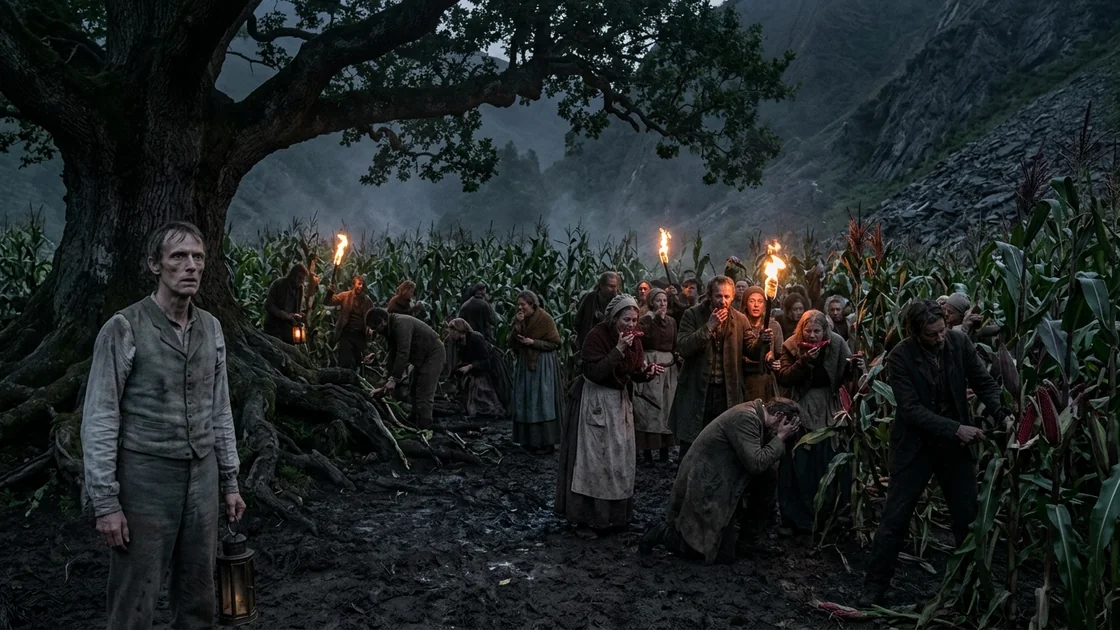
In the isolated mountain settlement of Harrow’s End, a three-year blight turns the soil to sterile gray dust and pushes the starving townsfolk to revive an ancient, unthinkable ritual. When a nameless cartographer wanders into the valley just before the spring planting, the desperate villagers sacrifice him in the central field, tilling his blood and bones into the dead earth. The ritual succeeds beyond their wildest prayers, yielding a massive, miraculous harvest that saves the town from extinction. However, as the villagers consume the lush grains, fruits, and roots, they discover a horrifying consequence: the soil has absorbed the dead man’s consciousness, and every bite forces them to experience his memories, his loves, his griefs, and ultimately the terrifying sensory reality of his murder at their own hands.
The dust of the third year did not blow away on the wind; it settled into the creases of men’s knuckles and the corners of children’s eyes until the whole of Harrow’s End looked as though it had been sketched in charcoal on dry vellum.
Silas Reeve stood at the threshold of his mill, his boots buried to the ankles in the gray silt that had once been the richest loam north of the Crag-Teeth mountains. Above him, the great wooden wheel hung motionless over the dry bed of the Runnel. The timber had shrunk in the drought, the iron bands loosening around the oak hubs with a sound like cracking knuckles whenever the noon heat peaked.
He reached down, scooped a handful of the earth from the edge of the wheel-pit, and brought it to his tongue. It was an old habit, taught to him by his father and his father’s father—men who believed you could read the mood of the valley by the salt and iron on its skin.
There was no salt left. There was no iron. The dirt tasted of nothing at all, like chewed paper or the cold ash at the back of a dead hearth. It didn't even grit properly between his molars; it simply dissolved into a dry, choking paste that drank the spit from his mouth.
Silas spat onto the stones, though little came out.
"Still blind, Silas?"
Silas turned. Caleb Thorne was coming up the rise from the village proper, his long black coat grayed to the knee with field-ash. As the parish magistrate and the eldest surviving member of the town council, Thorne still wore his brass chain of office, though the links hung loose across a chest that had hollowed out over the winter. Behind him walked two younger men—Miller’s apprentice, young Rory, and the blacksmith, Thomas Hull, whose massive shoulders looked strangely angular beneath his leather apron, like the frame of a barn after the thatch has burned away.
"Blind and deaf, Caleb," Silas said, wiping his mouth with the back of his wrist. "I dug three feet down by the old alder stump this morning. Usually, even in a dry spell, you find the gray clay holding a drop of sweat down there. Today I hit shale, and the shale was warm. Not a worm in ten yards of trench. Even the beetles have gone."
Thorne stopped beside the dry millrace and looked out over the basin. Harrow’s End sat at the bottom of a geological bowl, surrounded on all four sides by steep, shale-covered slopes that rose into jagged granite peaks. In good years, the basin was a saucer of emerald green, catching the snowmelt from the heights and holding the warm summer air like a greenhouse. The Single Road—a treacherous mule track cut into the cliffside five miles south—was their only tether to the lowlands, and the November rockslides had taken thirty yards of that track into the gorge below. They were sealed in, as they always were until the May thaws, except this year the granaries were swept so clean you could see the carpenter’s marks on the floorboards.
"The Weaver girl died an hour before dawn," Thorne said quietly. He didn't look at Silas as he spoke; his gaze remained fixed on the twenty acres of dead wheat stubble that stretched between the mill and the church. "Sarah. The little one with the clubbed foot."
Silas felt a cold weight drop into his stomach. "The fever?"
"No fever," Thomas Hull rumbled from behind the magistrate. The blacksmith’s voice had lost its bass; it sounded like two dry boards rubbing together. "Just stopped breathing. Her mother tried to boil the leather from her husband’s old saddle to make a broth yesterday, and the girl couldn't keep it down. There’s nothing left in the cottages, Silas. Not tallow, not seed-corn, not a rind of bacon. My boy tried to catch field mice in the thatch yesterday. Didn't find a single nest. The vermin left before the snows came."
Silas looked toward his own cottage, a hundred yards down the lane. His wife, Martha, was sitting on the low stone wall by the well, her hands moving in her lap as if she were shelling peas, though her apron was empty. Since their son had died in the first year of the blight—taken by the red flux that followed the souring of the barley—she had grown quieter month by month, shrinking into herself like an apple left in a dark cellar.
"We have the four sacks of seed-rye in the church vault," Silas said, though he knew the answer before the words left his dry lips.
"Four sacks among two hundred and twelve mouths," Thorne said. "If we grind it today, it gives every soul two handfuls of meal. It buys us four days. Five, if we water it into gruel. And then April comes, and even if the rain returns, we have nothing to put in the ground. We eat our tomorrow to survive until Friday, and on Saturday we die anyway."
"What if we plant it?" Rory asked. The boy was nineteen, his cheekbones sharp enough to cut linen, his eyes too large and wet in his gaunt face. "Spring equinox is three weeks off. If we put the rye into the Mother-Furrow now—"
"You heard Silas," Hull snapped, though there was no real heat in it, only a vast, hollow terror. "Put seed into that gray dust and it’ll just bake. The dirt’s dead, boy. You might as well sow gravel on the church roof."
Thorne reached into the deep pocket of his coat. When his hand came out, it held a small, square volume bound in pigskin that had turned black with age and grease. The brass clasp was missing, and the pages within were thick, uneven sheets of rag-paper that smelled of mildew and church incense.
Silas stiffened. "Put that back in the chest, Caleb."
"It is the Foundation Ledger of this parish," Thorne said, his voice rising slightly, taking on the cadence he used when reading the statutes from the church steps. "Written by Ezekiel Harrow in the year of our Lord sixteen hundred and eighty-four, the third winter after the first families crossed the pass."
"Ezekiel Harrow was a madman who ate bark and saw devils in the fog," Silas said, stepping down from the mill threshold so he was eye-to-eye with the older man. "We are Christian men, Caleb. At least, we say we are on Sundays."
"We are dying men on a Tuesday," Thorne replied softly. He opened the book to a page marked with a faded ribbon of horsehair. "Listen to the entry for March of that year. The third season of the white frost. The sheep have cast their lambs dead upon the stones. The rye hath rotted in the ear, turning to black soot that poisons the belly. The elders met at the Great Oak above the spring, and there remembered the covenant of the hills before the cross was raised."
"Stop," Silas said.
Thorne didn't stop. His finger traced the brown, faded ink. "The valley is a vessel, and a vessel that is emptied must be filled from without. If the blood of the basin be spilled into the basin, it is but pouring water from cup to cup, and the dry wood drinks half. It must be blood that knows not the name of our fathers. It must be meat that hath walked from beyond the stones. One life, whole and unblemished by our kin, laid deep where the waters divide. We took the tinker who came by the south goat-track. We gave him no salt at our tables, that he might remain a stranger under the law of hospitality. On the night when the day and the dark are of a weight, we opened his throat above the spring-head and plowed him under with the first furrow."
The silence that followed was absolute. Even the wind, which usually hissed through the dry reeds by the creek bed, seemed to hold its breath.
Rory was staring at the book as if it were a venomous snake. "Did... did it work?" the boy whispered.
Thorne turned the thick page. "June, the same year. The wheat stands to the shoulder of a tall man. Each stalk bears three ears, and each ear is heavy as lead. The apples on the wild crabs have grown sweet and the size of a child’s head. We have built two new barns to hold the fullness thereof."
"It’s a fable," Silas said, his heart hammering a slow, sick rhythm against his ribs. "Old men’s lies to scare children away from the boundary stones. And even if they did murder some poor peddler two hundred years ago, it simply rained that spring, Caleb. Rain falls when the clouds come over the peaks, not because you butcher a man in a ditch."
"Has a cloud come over the peaks since August, Silas?" Hull asked. The blacksmith’s eyes were fixed on the road—the high, narrow scar on the southern cliffside where the rockslide had cut them off. "And even if you’re right... who’s coming down a broken road in March?"
As if the mountain itself had heard the question and wished to mock them, a stone rattled down the shale slope half a mile away.
The four men froze.
They looked up toward the south pass. There, picking his way slowly around the great fan of rubble that blocked the mule track, was a solitary figure. He was small against the vast gray wall of the mountain, leaning heavily on a staff of peeled ash, a heavy leather satchel slung across his back, walking down into the valley as steadily as water running downhill.
His name, he told them when he reached the village square an hour before sundown, was Julian Vane, though Thorne stopped his ears with his thumbs the moment the man began to introduce himself and shouted for the bells to be rung to drown out the sound.
Silas had been standing near the well when the stranger limped between the first two cottages. Up close, the traveler was younger than he had looked on the mountain—perhaps thirty, with hair the color of wet chestnut and eyes of a clear, startling gray that seemed to take in the whole desperate geometry of the town at a glance. He wore a coat of heavy green wool, frayed at the cuffs and stained with the salt of old sweat, and his boots were cobbled with thick brass nails that clicked sharply against the dry flagstones.
Around him, the people of Harrow’s End gathered like crows around a dropped crust. They didn't speak. Forty men, women, and children stood in the twilight, their skin stretched tight over their skulls, their clothes hanging from them in dusty folds, watching the stranger’s satchel.
"Good evening to you," the stranger said. His voice was resonant and musical, carrying the soft, rounded vowels of the coastal cities three hundred miles to the east. Even through his exhaustion, there was a warmth in it that made Silas wince; nobody in Harrow’s End had spoken with that kind of easy generosity in two years. "I feared the map had lied to me when I saw the slide on the pass. A nasty bit of shale, that. I lost my mule three days back in the lower gorges—poor beast slipped on the black ice—so I’ve been carrying the panniers myself."
He slipped the heavy leather satchel from his shoulder and set it down by the dry stone trough.
"No one give him water," Caleb Thorne’s voice rang out from the church porch. "No one offer him bread or salt. By the statute of the quarantine, no man touches him until the council has sat."
The stranger frowned slightly, looking up at the magistrate with more curiosity than alarm. "Is there plague in the valley, sir? I saw no black flags on the pass."
"A blight," Silas said, stepping forward before Thorne could speak again. He felt a desperate, clawing need to break the ritual silence that was already settling over the crowd. If he could make the villagers see the man as a person—if he could make them hear him—perhaps the madness he saw kindling in Hull’s and Thorne’s eyes would die out. "The soil’s failed three years running, friend. You’ve walked into a hungry house. If you have rations in that bag, you’d best turn around and climb back up the shale while you still have the strength in your legs."
The stranger—Julian—looked at Silas, then at Martha, who stood behind her husband, and finally at a small boy near the smithy whose ribs showed through a torn linen shirt. Instead of snatching up his bag as Silas had hoped, the man knelt beside it and unbuckled the brass straps.
"I have little enough," he said softly, "having walked from the river-forks since Monday. A heel of hard cheese, four ship’s biscuits, and some dried figs from the south. Wait—"
Before Silas could stop him, the man reached into the bag and held out a handful of dark, wrinkled fruit toward the blacksmith’s boy.
Thomas Hull lunged forward and knocked his own son aside with a sweep of his heavy arm. The figs scattered in the gray dirt. The boy began to wail, scrambling on his knees toward the fruit, only for two of the village elders to haul him back by his collar.
"Touch nothing of his!" Thorne thundered, coming down the steps. "If we take his meat, we are bound to him by guest-right! Leave it in the dust!"
The stranger rose slowly to his feet, brushing the dirt from his knees. The easy warmth had vanished from his face, replaced by the wary stillness of a deer that has just heard the click of a flintlock in the brush. He looked around the circle of faces—no longer seeing fellow men, Silas realized with a cold pang of horror, but wolves.
"I see," the traveler said quietly. He reached down toward his satchel. "I will take my leave, then. There is a shelf in the rock two miles up the pass where I can camp until light."
"The pass is closed during the spring equinox," Thorne said. At a nod from the magistrate, Thomas Hull and two of the woodcutters stepped between the stranger and the southern lane, their iron-shod staves held diagonally across their chests. "A stranger walking the crown land without a writ must be held in the bailiff’s cellar until the circuit judge arrives in May."
"There is no circuit judge," Silas said, his voice shaking. "Caleb, for the love of God—"
"You are the bailiff, Silas," Thorne said, turning his sunken eyes on him. "And your wife is dying by inches on your wall. Will you take the key to the wool-cellar, or shall I give it to Thomas and let him lock you in beside him?"
Silas looked at Martha. She had stood up. Her eyes weren't on the stranger, nor on Silas; they were fixed on the four dried figs lying in the gray silt by the well. A thin thread of saliva hung from the corner of her chapped lip.
Silas felt something inside his chest give way, like a rotten timber snapping under a heavy snow. He looked back at the stranger. The man was watching him with those clear, gray coastal eyes—eyes that had seen ships and libraries and green pastures, eyes that were full of a life so vast and rich it seemed to hum in the dead air of the square.
"Come with me," Silas whispered, reaching out to take the man’s elbow. The green wool of the coat was warm from the sun. Beneath it, the man’s arm was solid, muscled, and full of blood. "Don't fight them. Please. Just come inside."
They kept him in the stone wool-cellar beneath the tithe barn for four days.
They gave him no food, and they gave him no water from their wells; instead, Rory was sent up the shale slope with a tin bucket to gather snow from the shaded crevices above the basin, setting the bucket inside the cellar door so that the town could claim, in the twisted logic of the old ledger, that the mountain had quenched his thirst, not them.
On the third night—the night before the equinox—Silas went down alone with a horn lantern.
The cellar smelled of old lanolin, damp slate, and the sharp, clean scent of the stranger’s pack, which had been thrown in with him. The man was sitting on an upturned barrel beneath the high, barred grating, a small leather-bound sketchbook balanced on his knee, drawing by the pale sliver of moonlight that fell through the iron bars.
When the lantern light spilled through the cracks of the heavy oak door, the man didn't startle. He simply closed the book and rested his hands on it.
"You’re the miller," the stranger said. His voice was hoarse from the cold, yet still possessed that strange, gentle clarity. "Silas, wasn't it?"
"Don't tell me yours," Silas said, setting the lantern on the stone steps. "They said if we know your name, it spoils the work. And if the work is spoiled, they’ll only wait for the next man who comes down the trail."
The stranger looked at him for a long time. "They’re going to kill me tomorrow."
It wasn't a question. Silas couldn't look into those gray eyes; instead, he looked at the man’s hands. The fingers were long, stained at the tips with walnut ink and graphite, with a thin silver ring on the left fourth finger—two twined branches hammered flat.
"I tried to lift the bar on the north gate an hour ago," Silas said, his voice barely louder than the scratching of a mouse. "Hull is sitting there with a fowling piece. Two of the Weaver boys are on the roof of the barn. The whole town is awake. Nobody’s slept since you came down the hill. They’re just sitting in their doorways, looking at this barn."
"Why?" the man asked softly. "Have I something they think is gold? My instruments are brass, not gold. They're welcome to them."
"They think you're rain," Silas said, and a dry sob tore out of his throat. He sat down heavily on the bottom step, burying his face in his flour-whitened hands. "They think you're bread. Three years, mister. Three years we’ve watched the grass turn to wire and the wire turn to dust. Last winter we ate the dogs. This winter we ate the crows that came to peck at the churchyard until even the crows stopped coming. When you walked down that mountain, you were fat. Not fat like a lord, just... whole. You had blood in your cheeks. You smelled of cloves and salt air."
The stranger was silent for a moment. Then came the rustle of wool as he slid off the barrel and knelt on the flagstones a few feet from Silas.
"Look at me, Silas."
Silas raised his head.
"If I die in your field tomorrow," the man said evenly, "not a single blade of grass will grow that wouldn't have grown without me. You know that. You're a man who works with weights and measures. You know the earth doesn't bargain like a fishwife."
"I know it," Silas wept. "God help me, I know it. Tell me how to stop forty starving men who have mothers and children rattling in their beds. Tell me how to fight the whole valley with an iron bar."
The man looked away, up toward the small square of night sky visible through the grate. A single star burned cold and white between the iron bars.
"I was going home," he said, so softly that he seemed to be speaking to the stone walls rather than to Silas. "I’ve been three years mapping the interior timber-grants for the Admiralty. Three years in the high pines and the badlands. My wife... her name is Clara. She lives in a house with yellow shutters on the cliff at Oakhaven. When the wind comes off the bay at high tide, it hits the south gable and makes the whole house hum like a cello. She plays the cello, you know. She has a little birthmark shaped like a willow leaf just below her left ear, where the hair curls when the mist comes in."
Silas squeezed his eyes shut. "Don't. Please don't."
"My mother taught me the names of sixty kinds of moss before I was seven," the stranger continued, his voice gaining a strange, fierce urgency, as if he were trying to pour the contents of a jar into Silas’s ears before the jar was smashed. "When I was ten, I fell out of a pear tree in my uncle’s orchard in Devonshire and broke my collarbone; for three weeks I lay in a bed under the eaves and ate nothing but stewed pears with cinnamon while the rain beat on the slates. The sea in October isn't blue, Silas—it’s the color of wet pewter, and it smells of rotting kelp and cold iron. And when Clara laughs—really laughs, when she’s forgotten to be a lady—she puts her hand over her collarbone as if she’s trying to keep her heart from jumping out."
He reached out and caught Silas by the wrist. His grip was shockingly strong, hot and vibrant against Silas’s withered skin.
"I am not seed-corn," the stranger hissed, his gray eyes blazing in the yellow lantern light. "I am thirty-two years of mornings and salt water and books and music. I am a whole world, Silas. If you put me in that dirt, you aren't planting wheat. You're burying a man who wants to live."
Footsteps crunched on the gravel outside the cellar doors. Heavy iron bolts rattled as someone began to draw them back from the outside.
The stranger let go of Silas’s wrist and stood up, backing against the far wall. His chest was heaving, his eyes wide and bright with the sudden, animal terror that had finally broken through his composure.
The oak doors swung inward, letting in a rush of freezing mountain air. Caleb Thorne stood there, flanked by six men carrying pitchforks and the heavy, double-chained ox-plow—though there were no oxen left to pull it. Instead, twelve villagers were harnessed into the leather traces like beasts of burden, their faces gray and blank in the light of the pitch torches.
"Come out, Silas," Thorne said. "And bring the lantern. The frost is off the Mother-Furrow."
They did not do it in anger, which made it infinitely worse. They did it with the methodical, breathless quiet of men raising a heavy roof-beam or delivering a breech calf.
The Mother-Furrow lay at the highest point of the basin’s floor, just beneath the huge, gnarled roots of the Council Oak, where the underground springs divided before trickling down through the lower fields. Whatever entered the water table here fed every ditch, every orchard, and every kitchen garden in Harrow’s End.
The whole village had come. Even the sick had been carried out on hurdles and blankets to watch from the stone walls, as if their presence were required to sign the contract with the dirt. Martha stood beside the dry spring-head, her shawl wrapped tight around her head, her eyes reflecting the orange dance of the torches.
The stranger fought them once they cleared the barn—fought them with the desperate, thrashing fury of a trapped stag. He broke young Rory’s nose with the heel of his booted foot and tore the collar from Thomas Hull’s shirt, shouting words in a language Silas didn't know, and then shouting Clara, Clara, Clara! until the name echoed off the shale cliffs above them and came back like a flock of startled birds.
It took eight of them to hold him down in the deep trench they had dug between the oak roots.
"Hold his ankles, Silas," Thorne commanded, his sleeves rolled up to his elbows, the long sheep-sticking knife from the slaughterhouse gleaming in his pale hand.
Silas stood paralyzed five paces away, the horn lantern trembling in his grip. "I can't."
"Hold him!" Martha screamed suddenly from the wall. Her voice was a dry shriek that made Silas flinch as if struck. "Hold him, Silas! Remember the boy! Remember how the boy cried for water!"
Silas looked down. The stranger’s coat had been torn open; his bare chest heaved against the freezing air, white and smooth against the gray dirt beneath him. As Hull forced the man’s head back by the hair, the stranger’s gray eyes rolled toward Silas.
In that last second, the man didn't look at Thorne or the knife. He looked directly into the lantern Silas held, and through it, into Silas’s eyes. Everything in the man seemed to gather behind those gray irises—every memory of the pewter sea, the yellow shutters, the smell of cinnamon and pears, the terror of the cold mud against his spine, the crushing weight of sixteen calloused hands holding him down in the dark.
Remember, the eyes seemed to scream, though his mouth was gagged with a dirty wool cap. You are here. I see you.
Then Thorne leaned down, and the iron went in.
The blood did not pool on top of the dust as water would have done; the dry earth drank it with a terrible, hissing greed, turning black and steaming in the frosty air. Before the man’s boots had even stopped drumming against the stones, the twelve men in the plow-traces leaned forward at Thorne’s whip-crack, their bare feet digging into the shale, and dragged the great iron plowshare over the trench, turning a heavy wave of gray sod over the green coat, the chestnut hair, and the open gray eyes.
They burned his satchel, his sketchbook, and his brass compass on top of the mound so that not a thread of him remained above the ground.
As the gray light of the equinox dawn broke over the eastern peaks, turning the sky the color of a bruised plum, the smoke from the burning leather rose straight up toward the pass. Halfway to the ridge, the smoke hit a heavy, cold ceiling of cloud that hadn't been there an hour before.
By noon, it was raining.
It was not a mountain rain—not the cold, needles-and-slate drizzle they were used to in April. It was a warm, fat, coastal deluge that smelled faintly of kelp and wet wool.
For nine days the sky poured itself into the basin of Harrow’s End. The Runnel rose in its bed with a roar like an awakening bear, foaming brown and then clear over the stones, catching the paddles of Silas’s millwheel and setting the great oak axle groaning back to life.
Nobody went out into the lanes during those nine days except to set out barrels and troughs. People stayed behind their shuttered windows, sitting by their hearths, listening to the water drumming on the thatch. When Silas looked across the room at Martha, she was scrubbing the flagstones where she had tracked mud from the Mother-Furrow, scrubbing until her knuckles bled, never speaking a word about the night under the oak. It was as if the entire village had agreed, without a single council meeting, that the man in the green coat had been a fever dream brought on by hunger.
On the tenth morning, the sun came out, and the town opened its doors to a miracle that made the women fall to their knees in the mud.
The four sacks of old, shriveled rye from the church vault had been broadcast across the common fields on the afternoon following the ritual. Normally, spring rye took two weeks just to show a pale green needle above the clods.
The fields were already ankle-deep in emerald velvet.
And it wasn't just the rye. Every dormant root, every forgotten seed dropped by birds years ago, every half-dead fruit tree in the closes had exploded into violent, frantic life. The bark of the old apple trees along the lane had split open to let out thick clusters of pink-and-white blossom that smelled so strongly of honey and cloves that it made the head swim. In the kitchen gardens, potato haulms were pushing up through the mud so fast you could hear the soil ticking and shifting if you stood still enough.
By May, the wheat and rye stood higher than Silas’s waist. The stalks weren't the thin, pale yellow straws of mountain grain; they were thick as a man’s thumb, blue-green and pulsing with sap. When you broke a stalk, the juice that ran out wasn't clear—it was milky and thick, leaving a sticky, resinous scent on the skin that reminded Silas uneasy of walnut ink.
"Look at the ears, Silas," Caleb Thorne said one morning in early June, walking through the waist-high sea of grain with his arms spread wide, letting the heavy heads brush his palms. The magistrate had gained ten pounds already from the early turnip greens and the wild sorrel that grew along the ditches. His cheeks were pink, his eyes bright with a fierce, vindicated pride. "Six rows to every head, and thirty grains to a row. Ezekiel Harrow didn't lie. The covenant holds."
Silas looked down at the soil between the rows. It was no longer gray silt; it was black, greasy, and warm to the touch, threaded through with millions of pale, hair-like rootlets that seemed to weave together into a single mat spanning the entire valley floor. If you pulled up a weed in your garden half a mile away, the turf under the Council Oak seemed to twitch in answer.
"Have you eaten the greens from the upper ditch, Caleb?" Silas asked quietly.
Thorne stopped, his smile flickering for a fraction of a second. "Of course. We all have. Why?"
"Did you sleep well last night?"
Thorne’s hand went up unconsciously to his left fourth finger, rubbing the bare knuckle where a ring would sit. He stared out toward the southern pass for a moment, his eyes narrowing against the sun.
"I dreamed of boats," Thorne murmured. "Great three-masted things with tarred hulls, rocking against stone pilings. Strange thing, Silas... my grandfather came from the midland plains, and I’ve never been fifty miles from this church in sixty years. Yet I knew the name of the knot tied around the bollard. A bowline on a bight. Woke up with my mouth tasting like salt pork." He shook his head sharply, the pious stiffness returning to his spine. "Indigestion. Our bellies aren't used to rich greens after the bark-broth. Don't go looking for ghosts in a full pot, Miller. Fix your millstones. You’ll have forty tons of grain before July is out."
Silas didn't answer. He hadn't eaten from the upper ditch. He had been living on the small silvery trout that had returned to the high mountain stream above the waterfall—water that hadn't yet touched the roots of the Council Oak.
Because three days ago, Martha had boiled a pot of early nettles and wild leeks gathered from the bank of the Mother-Furrow. Silas had taken one spoonful of the broth.
The moment the hot green liquid touched his tongue, he hadn't tasted leek. He had tasted a cold, wet wind coming off an estuary at dusk, and for ten terrifying seconds he had forgotten his own name, remembering instead with blinding, heart-stopping clarity the exact weight of a brass sextant in a mahogany box and the sound of a woman’s voice calling from an upstairs window: Julian, come in, the fog’s rising!
The true harvest began two months early, at the end of June, under a sun that hung huge and brassy in the windless sky.
Everything ripened at once. In the orchards, the apples and pears grew to the size of human hearts, their skins a deep, bruised crimson that looked black in the shade, weighing the branches down until they cracked and had to be propped up with forked poles. Beneath the black soil, the potatoes and turnips swelled into smooth, pale globes heavy as river stones. And in the center of the valley, directly over the Mother-Furrow where the spring rose under the oak, a single stand of volunteer maize—corn grown from no seed the villagers had planted, perhaps dropped from the stranger’s pocket before it was burned—rose twelve feet into the air, its silk the color of dark chestnut hair, its heavy ears wrapped in husks veined with purple and red.
The village feasted. After three years of slow death, they fell upon the bounty with a frantic, weeping gluttony.
Ovens that had been cold since the second winter roared day and night. The smell of baking rye bread, roasting apples, and boiling roots hung over Harrow’s End like a thick, sweet fog. Men grew stout in three weeks; children’s cheeks plumped out; women sang as they carried baskets through the lanes.
Wait—not sang. Hummed.
Silas noticed it on the fourth day of the threshing, as he worked the hoppers in the mill. Outside by the millrace, four of the village women were washing cabbages while Rory and two other boys stacked sacks of fresh flour on a cart.
They were all humming the same tune.
It wasn't a valley reel or one of the dour six-note psalms from the parish hymnal. It was a slow, sweeping melody in three-four time, rising and falling with the long, melancholic swell of ocean rollers. It sounded like a cello.
Silas stepped out onto the loading platform, wiping the white flour-dust from his forehead. "Mary," he called down to the weaver’s wife. "What is that tune?"
Mary Weaver looked up from the cabbage in her hands. Her eyes—formerly sharp brown—looked strangely hazy in the sunlight, as if a thin film of gray mist had settled over them.
"What tune, Silas?"
"The one you and Sarah and the boys were just humming."
Mary frowned, looking down at the green leaves in the water. "Why... it’s the Suite in G," she said naturally, her rough mountain dialect suddenly smoothing out on the vowels, dropping the harsh throat-catch of the valley. "The one Clara plays when the lamps are lit in the parlor and the rain is against the south gable. You have to rosin the bow twice in damp weather, or the C-string slips."
She stopped. Her mouth stayed half-open. The cabbage slipped from her fingers and splashed into the race.
"Silas?" she whispered, her hand flying to her collarbone in a sudden, fluttering gesture, as if trying to keep her heart from jumping out. "Who is Clara?"
Up on the cart, young Rory dropped the sack of flour he was lifting. He stared at his own thick, calloused hands, turning them over and over in the sunlight.
"My fingers are too short," the boy said, his voice trembling with a sudden, rising panic. "I can't hold the shading pencil right with these thumbs. Where’s my case? Where’s the parallel ruler? Hull! Thomas Hull, you bastard, my father gave me that compass when I passed the Trinity House boards!"
"Rory, shut your mouth!" Thomas Hull roared, coming out of the smithy across the lane with a hammer in his hand. Yet the giant blacksmith was trembling too; his leather apron was stained with the dark crimson juice of the orchard pears he’d been eating all morning, and his heavy jaw was working silently. "It’s the heat. The sun’s got into the rye—ergot, that’s what it is, the dancing sickness—"
"It’s not ergot, Thomas," Hull’s ten-year-old son piped up from the doorway of the forge. The boy was sitting on an anvil, peeling a large boiled potato with a pocketknife and eating it raw with salt. The child’s eyes were ancient, calm, and terribly sad as he looked at his father. "That’s Sphagnum palustre growing by the trough, and the moss on the north wall of the church is Leucobryum glaucum. Mother taught me sixty kinds before I was seven. Why did you hit me when I tried to give you the figs, Papa? I wasn't trying to trick you. I only wanted the little boy to stop crying."
Hull dropped his hammer onto the cobblestones. The iron rang out like a cracked bell. Without a word, the blacksmith turned and bolted back into the dark interior of the forge, slamming the heavy oak doors behind him and throwing the bolt.
Silas stood frozen on the mill platform.
He looked down at the white dust coating his arms, his trousers, the floorboards beneath his boots. The flour was warm from the friction of the stones, and it didn't smell of mountain grain; it smelled of old books, brass polish, and a woman’s hair damp with sea-spray.
He realized then, with a cold clarity that turned his bones to water, what the soil of Harrow’s End had actually done.
The valley had been starved for three years—not just of water and nitrogen, but of life itself. And when they had poured Julian Vane into the watershed at the top of the basin, the millions of starving rootlets hadn't merely taken his blood and his phosphate and his bone-marrow. They had taken all of him. Every electrical spark in his dying brain, every fold of memory in his grey matter, every word, every song, every grief, drawn down through the spring-water and pumped up through the xylem and phloem of ten million plants.
They weren't eating bread and fruit. They were eating a disassembled soul, piece by piece, and reassembling him inside their own skulls.
By the middle of July, the geography of the dead man’s mind had been mapped across the fields of Harrow’s End.
Silas, who refused to eat anything but the small mountain trout and a handful of shriveled acorns he found in an old squirrel-hoard under the church eaves, became the gaunt, terrified chronicler of the transformation. His clothes hung on him like rags on a scarecrow while his neighbors grew sleek, rosy-cheeked, and mad.
He discovered quickly that the memories were stratified according to how the crops grew.
The root vegetables—the potatoes, turnips, and parsnips that grew deep in the cold, dark silence beneath the sod—held the stranger’s earliest years. The families at the lower end of the village, who lived mostly on boiled roots, began to drift backward into a childhood none of them had ever lived. Old men of seventy sat on the stone walls in the evening, weeping softly because they had fallen out of a Devonshire pear tree in 1812 and their collarbones ached when the wind shifted. Women who had never seen a body of water wider than the millpond sat by the Runnel arranging pebbles by color, whispering the Latin names of seashells and humming lullabies in a soft West Country burr.
The grain—the vast fields of rye, barley, and wheat that swayed in the wind and drank the sunlight—held his intellect, his youth, and his travels. Those who ate heavily of the new bread began to speak differently. The rough, clipped mountain dialect of Harrow’s End vanished within a fortnight, replaced by the educated cadence of an Admiralty surveyor.
Silas walked down the high street one evening at dusk and heard the two woodcutters, men who could neither read nor write their own names on a parish register, sitting outside the tavern with charcoal and flat slabs of slate, arguing fiercely over the triangulation of the timber-line in the upper gorges and using trigonometry to calculate the height of the church spire.
And the orchard fruits—the deep, blood-red apples, plums, and pears whose roots drank directly from the upper ditches near the Council Oak—held his heart.
They held Clara.
That was the sickness that took Martha.
Silas came home from the upper stream one afternoon to find the cottage shutters painted yellow.
There had been no yellow paint in the village; Martha had boiled down thousands of wild celandine flowers and mixed the pigment with tallow and lime, smearing it over the dry oak boards with her bare hands until her palms were stained the color of egg yolks.
When he stepped inside, the cottage smelled overwhelmingly of baked apples and cinnamon. A huge bowl of the dark red orchard fruit sat on the table, half of them reduced to cores.
Martha was standing by the window, looking out toward the gray wall of the shale pass as if she expected to see white sails coming over the granite ridges. She had let her gray-streaked hair down from its cap, and she had taken a piece of burnt cork from the hearth and drawn a small, dark smudge shaped like a willow leaf just below her left ear.
"Martha," Silas whispered, setting his basket of tiny mountain fish by the door.
She turned to him, and the smile she gave him broke his heart in two. It was radiant, tender, and completely alien. She hadn't smiled like that since before their boy died—in fact, she had never smiled like that, because it wasn't her smile. When she laughed softly at the sight of him, her right hand fluttered up to press flat against her collarbone.
"You’ve been in the pines again, Julian," she said, her voice dropping into a warm, contralto register that made the hair on Silas’s arms stand up. Wait—no. A moment later her eyes flickered, shifting from the woman who was waited for to the man who was doing the waiting. "No... no, I’m the one who walked out of the pines. Clara? Where did she go, Silas? She was just here. I smelled her lavender water on the pillow."
"Martha, listen to me," Silas said, crossing the room and grabbing her by the shoulders. He shook her gently, trying to find his wife behind the shifting gray glaze of her eyes. "Stop eating the apples. Look at me! I’m Silas. Your husband. We had a boy named Sam who had a wooden horse with three legs. Remember Sam?"
Martha blinked. A tear spilled over her lashes, cutting a clean track through the yellow stain on her cheek.
"Sam," she whispered. "He died when the barley went black. I remember. It hurt so much, Silas... it was like having a hot stone behind my ribs every morning when I woke up. Just gray ash and that little grave by the wall."
She looked back toward the bowl of dark red apples on the table, her voice dropping to a pleading whisper.
"When I eat the fruit, Silas, the stone goes away. I’m twenty-eight years old, and I have a yellow house above the harbor, and when I walk through the door, she puts down her cello and runs across the rug in her stocking feet, and she smells like salt and verbena. Why would I stay in this room with a dead boy when I can live by the sea?"
"Because it isn't yours!" Silas shouted, taking the wooden bowl from the table and hurling it against the hearthstones. The bowl split; the dark red apples rolled across the floor, bruising and leaking sweet, crimson juice that smelled of cloves. "We stole it! We held him down in the mud and we cut it out of his throat, Martha! Every time you think of that house, you’re walking around in a dead man’s coat!"
Martha didn't flinch. She knelt slowly on the flagstones, picked up one of the bruised apples, and wiped the hearth-ash from its skin with the hem of her apron.
"He doesn't need it anymore," she said softly, and bit into the red flesh.
The madness might have remained a quiet, melancholic haunting—two hundred mountain folk living out the gentle nostalgia of one dead cartographer—had the town been able to stop eating from the upper fields as August approached.
But a strange compulsion had settled over the basin. No one tried to clear the rockslide on the south pass, though the men were strong enough now to move the boulders in a day. No one hunted the deer that had returned to the high ridges. Normal food—the trout Silas caught, or the wild berries above the treeline—tasted like dry sawdust to anyone who had eaten from the valley floor. Once the stranger’s memories were in your blood, your body craved the rest of him, aching with a phantom homesickness to complete the puzzle of his life.
And as the summer wore on, the roots of the crops dug deeper into the Mother-Furrow, reaching the bottom of the trench where the last and darkest sediment of Julian Vane’s life had settled into the clay.
The chronological tide of the harvest was moving forward.
In June, they had eaten his childhood and his youth. In July, they had eaten his marriage and his three years in the timber-grants.
In the first week of August, the town harvested the late wheat that grew within fifty yards of the Council Oak, and with it, they ate his walk down the south pass.
The change was instantaneous and terrifying.
Silas woke at midnight on the third of August to the sound of screaming from the blacksmith’s house. He pulled on his boots and ran out into the lane.
All along the street, candles were being lit behind yellow-shuttered windows. Doors were banging open. People were stumbling out into the warm night air in their nightshirts, clutching their heads, vomiting the evening’s bread onto the cobblestones.
In the center of the square stood Thomas Hull. The massive blacksmith was on his knees by the dry well-trough, clawing at the flagstones where the four dried figs had fallen five months ago.
"They aren't men!" Hull was shrieking, his eyes rolling white in the torchlight as his wife tried to pull him up. "Look at their faces! God in heaven, look at the way they're looking at my pack! They're going to kill me! I never should have come down the shale—the mule knew, the mule slipped because the mountain is cursed—"
"Thomas, you're Thomas Hull!" Caleb Thorne shouted, limping out from the parsonage with his cane. Yet the magistrate was staggering too; his left ankle was turned inward, mimicking the sprain the stranger had suffered on the pass, and his hand was clutching his chest over a phantom pocket where a leather sketchbook should have been. "Hold fast, man! It’s a vapor from the soil! The scripture says—"
"You stopped your ears with your thumbs!" a voice rang out from the crowd. It was Mary Weaver’s twelve-year-old daughter, standing on the church steps. She was pointing a shaking finger directly at Thorne, speaking with the resonant, terrified voice of a thirty-two-year-old man. "You wouldn't let me say my name! Why did you tell them to ring the bells? I offered your boy figs, you monster! I gave you figs and you knocked him into the dirt!"
Across the square, young Rory was backed against the wool-cellar door, beating his own head against the oak planks.
"Let me out!" the boy sobbed, clawing at the outside of the door as if he were locked behind it. "It’s dark in here! Why are you putting snow in a bucket? Silas! Silas, where are you? You’re a man who works with weights and measures—tell them the earth doesn't bargain like a fishwife!"
Silas backed away into the shadows of the mill wall, his skin crawling with cold sweat.
He looked around the square. Over a hundred villagers were out in the street now, and every single one of them was looking at their neighbors through Julian Vane’s eyes.
The horror of it was a closed circle from which there was no exit. A man would look across the lane at his lifelong friend, and because his belly was full of the upper-field wheat, he would suddenly remember that friend’s face gaunt and wolfish in the March twilight, closing in with an iron-shod staff. And at the exact same moment, he would look down at his own hands and recognize the fingers that had held the staff.
They were simultaneously the hunter and the hunted, the prisoner in the cellar and the jailer on the roof.
"Lock the granaries!" Thorne roared, though his voice cracked into a high,coastal terror halfway through the sentence. He was dragging his uninjured leg behind him as if the ankle were swollen to the size of a turnip. "Burn the upper-field flour! Nobody eats from the oak-acre! Do you hear me? We go back to the turnips in the south ditch!"
"The turnips are gone, Caleb!" someone shouted from the dark. "We ate the south ditch clean in June!"
"Then fast!" Thorne screamed, clutching the gray hair at his temples. "Fast until the visions pass! Three days on well-water!"
They tried. For two days the ovens of Harrow’s End went cold again.
Silas watched from his mill as the village sat in a shivering, withdrawal-stricken silence. Without the constant intake of the crop, the stolen memories began to curdle and fragment inside their heads, leaving jagged holes where their own personalities used to be. Men who had spent six weeks believing they were an Admiralty cartographer suddenly couldn't remember how to shoe a horse or how to pray, yet could feel the phantom memory of Clara’s face slipping away like water through a sieve.
The grief of losing her a second time—of feeling Julian Vane’s mind evaporate out of their blood—was worse than the terror of the wool-cellar.
Women wept in the lanes, begging Silas to open the mill where the upper-field sacks were stored. Children dug with their fingernails in the dirt of the orchards, looking for fallen, rotting plums just to get one more taste of the sea at Oakhaven.
And up at the top of the watershed, directly over the grave in the Mother-Furrow, the last crop of the season was coming into its full ripeness.
Silas walked up to the Council Oak on the third evening of the fast.
The air around the great tree was heavy, hot, and humming with bees that had grown to the size of hornets on the nectar of the valley. Beneath the oak’s canopy stood the quarter-acre of volunteer maize that had sprung directly from the soil over the trench.
It didn't look like any corn Silas had ever seen. The stalks were twelve feet tall, thick as bamboo, and dark purple-green at the joints. The broad leaves rustled together even though there was no wind in the basin, producing a dry, rhythmic whispering that sounded terrifyingly like a man breathing through a wool gag.
The ears were huge—nearly two feet long—and where the husks had split open at the tips because of the swelling within, the kernels weren't yellow or white. They were a deep, translucent ruby red, glistening like fresh clots of blood in the twilight, topped with heavy tassels of chestnut-colored silk.
Sitting at the edge of the corn-brake was Caleb Thorne.
The magistrate had abandoned his black coat and his brass chain. He was sitting in the black mud in his shirtsleeves, a raw ear of the blood-red corn in his lap. His mouth and chin were stained crimson with the milky juice of the kernels.
"Caleb," Silas said softly, stopping ten feet away.
Thorne didn't look up. He was shivering violently, though the August evening was stiflingly warm. With his right hand, he was using a sharp piece of shale to scrape the skin off the palm of his left hand—the hand that had held Julian Vane’s forehead back in the dirt.
"He had a mole on his right shoulder blade," Thorne whispered. It wasn't Thorne’s voice anymore; the magistrate was gone, drowned beneath the sheer, concentrated volume of the grain grown directly from the dead man’s heart. "Clara used to call it the North Star. When I was lying in the mud under the roots... before the iron went in... the stones were cutting into that mole, Silas. I was thinking that if she saw my back, she’d cry because the skin was torn."
"Put it down, Caleb," Silas said, stepping forward to kick the half-eaten ear of corn from the old man’s hand.
Thorne caught Silas’s ankle with an iron grip. He looked up, and in the fading light, his eyes were no longer brown. The pigment seemed to have bleached out of them, leaving them a pale, watery gray.
"You held the lantern," Thorne hissed. "I saw you through the mud on my eyelashes. You stood five paces back by the alder stump, and the yellow light fell right across my face. Why didn't you hit me with the shovel, Silas? If you’d hit Caleb Thorne with the shovel when he knelt down, I could have gotten one leg free. Hull didn't have a good grip on my left boot—the mud made the leather slippery. Five seconds, Silas! Five seconds and I would have been over the wall!"
"I was afraid!" Silas cried out, tearing his leg free and stumbling backward into the grass. The guilt he had carried like a lead sack for five months broke open in his chest. "Martha was screaming at me! The whole town was there with pitchforks! I was one man, Julian—I was starving, my bones were water, I couldn't fight twelve men in the traces!"
Silas froze, his hands flying to his mouth.
He had called him Julian.
On the ground, Caleb Thorne smiled—a horrific, weeping grimace smeared with red corn-milk.
"Look behind you, Silas," the thing wearing the magistrate said.
Silas turned.
Coming up the slope from the village were two hundred people.
The fast had broken. They walked in a ragged, silent procession through the twilight—men, women, children, the elders, the weavers, the woodcutters. At the front walked Martha, carrying a sickle in one hand and a basket in the other. Beside her walked Thomas Hull, and behind him young Rory, and Mary Weaver with her girls.
None of them spoke. None of them looked at Silas. Their eyes were fixed with a terrible, starving reverence on the twelve-foot stalks of the blood-corn rising above the grave.
"Don't!" Silas screamed, spreading his arms wide to block the narrow path between the stone walls. "Martha, stop! Do you know what’s in those stalks? That’s the Mother-Furrow! That’s the last hour! If you eat that, you’re going to eat the knife!"
Martha walked right up to him. She smelled of dried lavender, stale sweat, and rotting apples. Her face was plump and smooth, yet her eyes were twenty leagues away, watching the tide come in under a cliff with yellow shutters.
"We have to finish him, Silas," she said gently, her voice a chorus of two hundred throats speaking through one mouth. "It’s dark under the roots. We’re cold, and part of us is still down there in the clay. If we leave the corn in the ground for the winter frost, he stays in the trench forever. If we take him in, he’s whole."
"If you take that in, you’ll feel what we did to him!" Silas wept, grabbing her wrists. "Martha, please! Come up the pass with me! Now, tonight! We can climb the rockslide in the dark—we can walk to the river-forks—we can forget this place ever existed!"
Martha looked down at his thin, trembling hands—the only hands in Harrow’s End that were still hollow and bony from the famine. She looked at him with a profound, distant pity, the way a traveler on the deck of a departing ship looks at a beggar on the dock.
"You didn't eat, Silas," she whispered. "You don't even know how to play the cello. What would we talk about on the road?"
Thomas Hull stepped forward, took Silas by the shoulders with one massive, gentle hand, and lifted him aside as easily as if he were a dry cornstalk.
Silas fell to his knees in the grass by the spring-head and watched as the people of Harrow’s End walked into the maize.
The sound of two hundred sickles cutting through the thick, sap-heavy stalks sounded like a butcher’s cleaver working through wet ribs. They didn't wait to carry the harvest down to the ovens or the mill. As the twelve-foot stalks crashed down in the dark, the villagers fell to their knees among the stubble, tearing back the purple-veined husks with their teeth and sinking their mouths into the raw, ruby-red kernels.
For three minutes, there was no sound under the Council Oak except the frantic tearing of husks, the crunch of raw grain, and the wet, rhythmic swallowing of two hundred throats.
And then the memory hit the nerve.
It hit them all at the exact same second.
Down in the center of the trampled brake, Thomas Hull stiffened, his massive back arching backward until his spine cracked, his hands flying to his own throat as if trying to pull three inches of sheep-iron out of his windpipe.
Beside him, Mary Weaver and her daughters dropped into the black mud, kicking their heels violently against the stones, their mouths wide open in a silent, suffocated scream against the phantom wool cap stuffed between their teeth.
All across the quarter-acre, two hundred men, women, and children collapsed into the dirt, writhing in the exact posture of one man pinned beneath sixteen hands.
"Hold his ankles!" fifty voices screamed into the night sky, using Caleb Thorne’s voice.
"Clara! Clara, help me!" a hundred other throats answered in Julian’s agonizing baritone, tearing at the grass with their fingernails as they felt the crushing weight of their neighbors’ knees on their chests.
And worst of all was the sound that rose between the screams—the wet, bubbling rattle of two hundred pairs of lungs drowning in their own phantom blood as the iron plowshare came down the trench in their minds, turning the cold, heavy mountain sod over their open eyes.
Silas clapped his hands over his ears and ran.
He did not stop at the cottage. He did not stop at the mill to take his coat or his tinderbox.
He ran down the empty, silent high street of Harrow’s End, past the open doors of cottages where yellow shutters banged in the night wind, past the cold ovens that still smelled of cinnamon and pears, and up the steep, treacherous goat-track toward the southern pass.
Behind him, the valley floor was a single, churning choir of agony rising toward the stars. Two hundred bodies were locked in the dark beneath the oak, trapped in an eternal March equinox, endlessly murdering themselves and endlessly dying under their own hands, unable to tell whose fingers held the handle of the knife and whose throat took the blade.
Silas scrambled up the giant fan of loose shale where the road had fallen into the gorge. The sharp stones cut through his worn boots and sliced his palms to ribbons, coating his skin with real, red blood that belonged only to him. He welcomed the pain. It was sharp, cold, and empty of any memory but his own.
When he reached the crest of the ridge at dawn, three thousand feet above the basin, he collapsed onto the bare granite and looked back for the last time.
Below him, Harrow’s End lay bathed in the golden light of an early August morning.
From this height, it looked like Eden. The fields were a blazing tapestry of green and gold; the orchards were dark emerald crowns dotted with crimson jewels; the Runnel flashed like a silver ribbon past the turning wheel of the mill. Even from half a mile up, the rising thermal wind carried the rich, intoxicating scent of ripe wheat, honeyed apples, and warm earth up the cliffside.
A crow—the first he had seen since the autumn before the stranger came—glided down on stiff black wings over the ridge, riding the warm air down toward the lush, silent fields where dark figures lay still among the fallen stalks beneath the oak.
Silas reached down, scooped up a handful of the sterile, freezing granite gravel of the high pass, and put a single stone under his tongue. It tasted of cold iron, dust, and nothing at all.
He turned his back on the valley and began to walk down the mountain toward the sea.