The Loom of Severed Night
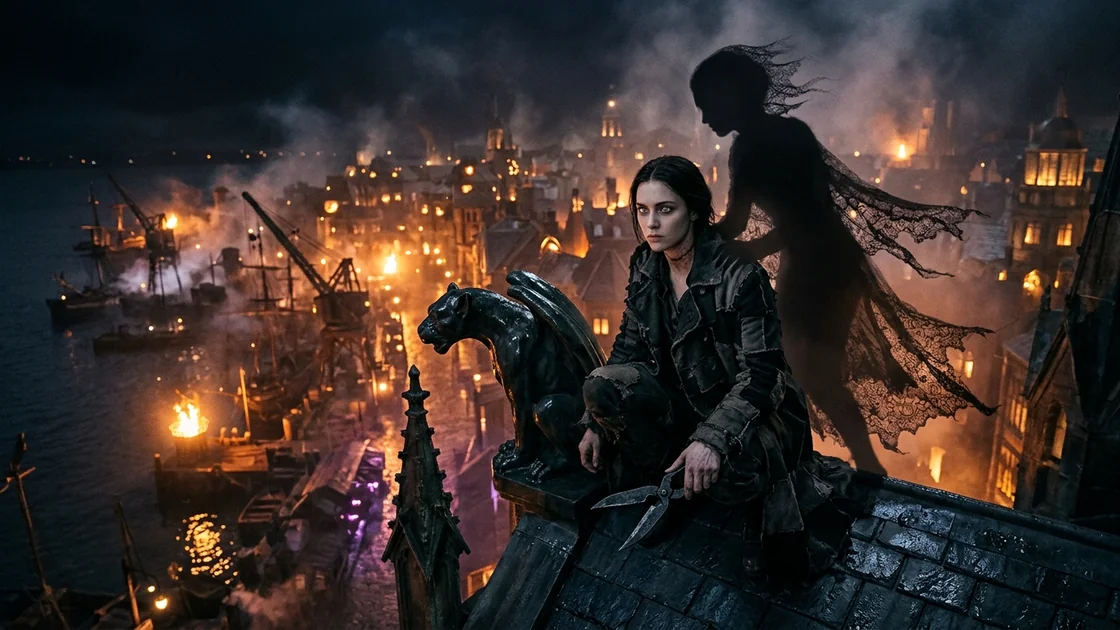
Vespera returns to the sun-drenched mercantile city of Solis-Vael after seven years of brutal captivity in the subterranean looms, seeking vengeance against the three crooked syndicate merchants who sold her into bondage. Armed with forbidden shadow-weaving magic learned in the deep dark, she hunts down Malakor, Sariel, and Vane one by one to shear away their living shadows. Because the city laws dictate that all high-born contracts and asset transfers must be sealed by the cast shadow of the owner over a sacred brazier, Vespera stitches the stolen shadows unto her own hands to puppet their legal identities. By the time the sun rises, she uses their own severed darkness to sign away their vast fortunes, ships, and estates, leaving the three traitors penniless, shadowless, and condemned to the very mines she escaped.
The city of Solis-Vael was terrified of the dark, and so it burned itself alive every night to keep the black at bay.
From the slick slate gargoyles of the Tallow-Spire, Vespera looked down upon a sprawling labyrinth of brass reflectors, whale-oil streetlamps, and fizzing alchemical flares. The cobblestone avenues below gleamed like streams of molten copper. Even the beggars in the gutters carried tin lanterns filled with cheap tallow, their municipal permits pinned to their rags—for in Solis-Vael, to walk without casting a clear, distinct shadow was a felony punishable by the Hulks.
Light was law. Light created the shadow, and the shadow was the soul’s receipt.
Vespera raised her left hand against the glare of a distant harbour beacon. Her fingers were long, pale as cave-sprouts, and calloused along the sides where the thread pulled tight. Between her thumb and forefinger, she held a pair of shears forged from meteoric iron that had never seen the sun. They did not reflect the amber glow of the city; they drank it in, leaving a sharp, scissor-shaped hole in the air.
Behind her, her own shadow did not lie flat against the slanted roof. It stood upright, leaning over her shoulder like a watchful sister, its edges frayed into delicate lace that fluttered in a wind no mortal skin could feel.
"Seven years," Vespera whispered. Her voice sounded like dry silk rubbing against pumice. In the Chasm of the Blind Weavers, where she had been leased like a draft mule, speaking had been a waste of breath, and breath was scarce when the air was thick with coal-damp and the shed fibers of spun night. "Seven years of knotting the dark for other men’s shrouds. Look how bright they keep their streets, little sister. Look how fat their shadows have grown."
Her upright shadow rippled, extending a long, slender finger to point toward the southern quadrants of the port, where the smell of cinnamon and bilge-water warred with the stench of smelted iron.
Down there lay the Iron Wharves. Down there was Malakor.
Seven years ago, Vespera had been nothing more than a dyer’s daughter in the Twilight Quarter, possessing a minor, untamed knack for coaxing spilt ink out of wool and making evening gowns look darker than the dye-vat warranted. Her father had borrowed three hundred sovereigns from Lord Vane’s counting-house to replace a sunken dye-barge. When a freak autumn gale smashed the new barge against the breakwater, the debt defaulted.
Vespera remembered the rain drumming against the leaded glass of her father’s shop. She remembered the smell of wet wool and rosemary. Most of all, she remembered the three of them standing over her father’s corpse after his heart gave out from the terror of foreclosure.
Vane, with his spectacles of smoked quartz and his fingers stained with green ledger-ink, calculating the deficit. Sariel, holding a pomander of cloves to her sharp, powdered nose, touching a bolt of Vespera’s twilight-dyed velvet and realizing that the girl wasn't using dye at all—she was weaving raw shade into the warp. And Malakor, massive and dripping in his oiled sealskin coat, grinning through a beard braided with silver wire as he produced the iron collar from his satchel.
The girl’s talent covers the principal, Vane had said, his voice as dry as a locust’s shell. The Blind Monks of the Deep Chasm pay four thousand sovereigns for a natural-born shadow-spinner. Malakor will handle the transport. Sariel will broker the hush-papers. We split the surplus in thirds.
They hadn't even let her bury her father. They had locked the collar around her throat while the body was still warm, thrown a sack soaked in vinegar over her head so she couldn't see the light to grab a shadow, and sold her into the earth.
They had thought the Chasm would eat her. The Blind Monks worked their spinners in absolute, crushing blackness, miles beneath the roots of the mountains, where there was no light to cast a shadow—only the primordial, heavy dark that pressed against the eyeballs until they turned silver and saw heat, pulse, and the subtle outline of a man’s essence instead of his flesh. Most spinners went mad in two years and threw themselves into the subterranean rivers.
Vespera had not gone mad. She had listened to the looms. She had learned that a shadow is not merely the absence of light; it is the tether that anchors a creature’s name, fortune, and marrow to the physical world. And when the oldest of the Blind Monks had finally died at his shuttle, Vespera had stolen his meteoric shears, slit the throats of the cavern guards by cutting the shadows of their windpipes, and climbed for forty days through the dry vents of the earth until she smelled the salt and whale-oil of Solis-Vael once more.
She reached into the lining of her patchwork coat and drew out a wooden spool carved from petrified yew. It was currently empty, grooved with runes of containment, waiting for thread.
"Three merchants," Vespera murmured, stepping to the very lip of the gargoyle’s snout. "Three signatures required to liquidate the Triumvirate Syndicate. Let us go and collect the ink."
She did not climb down the slick masonry. Instead, she stepped forward into the empty air, reached back, and grabbed the collar of her own shadow. With a sharp tug, she pulled the darkness over her head like a hood, folding herself into the narrow, vertical strip of shade cast by a drainpipe.
Gravity lost its purchase on her. She slid down the wall like a drop of black oil, silent, weightless, and entirely invisible against the soot-stained brick.
The Iron Wharves never slept, because the tides did not care for the magistrates' clocks.
Great cranes of charred oak groaned as they swung crates of salted cod, pig-iron, and indentured laborers from the bellies of massive, high-sterned carracks. To prevent theft—and to prevent the desperate human cargo from slipping their chains in the gloom—the docks were illuminated by the Sun-Baskets: iron braziers the size of hay-wagons suspended from forty-foot poles, burning a mixture of pitch, sulfur, and crushed magnesium bone. The light they cast was harsh, violet-white, and merciless. It made every stevedore and guard cast three or four overlapping shadows across the wet planks, sharp as knife-blades.
At the end of Pier Seven stood a squat, three-story fortress of granite and ship-timbers known as the Scales. This was Malakor’s counting-house and private barracks.
Vespera emerged from the shadow of a stacked pile of tar-barrels fifty yards from the iron-bound doors of the Scales. She wore the illusion of a hunched dock-scavenger, her silver eyes hidden beneath the brim of a battered oilskin sou’wester, her coat dragged through the fish-slime of the gutters so she smelled like part of the scenery.
Two guards stood before the oak doors. They wore breastplates of polished bell-metal designed to bounce light into dark corners, and they carried heavy whale-gaffs.
Vespera didn't look at their faces. She looked at their feet.
Because of the twin Sun-Baskets swinging behind them on the pier, each guard cast two long, V-shaped shadows that stretched right across the cobblestones and licked the base of the granite wall. In Solis-Vael, ordinary citizens knew that shadows were legally sacred during the signing of a contract, when dipped over the Notary's Brazier, but they did not understand what the Blind Monks knew: that the shadow is always connected to the nervous system, every hour of the day.
Vespera crouched behind a bollard, drawing a long, curved needle made from the rib-bone of a blind cave-fish from her sleeve. It wasn't threaded with cotton. It was threaded with a thin strand of her own hair, dyed in the oil of crushed abyssal beetles.
As the harbour bell tolled two past midnight, masking the small sounds of the pier, Vespera darted her hand out from behind the bollard. The tip of the bone needle pierced the left guard’s shadow right at the ankle, pinning it to a gap between two cobblestones. In the same fluid motion, she whipped the beetle-thread across to the right guard’s shadow, catching it behind the knee, and pulled the loop tight around the iron bollard.
By the doors, the left guard grunted, suddenly finding his left foot heavy as lead, unable to slide an inch forward.
"What's wrong with my boot?" the man muttered, looking down. "Stepped in pitch?"
"Quit fidgeting, Hal," the second guard growled, shifting his weight—only to gasp as his right knee buckled backward at an unnatural angle, held fast by an invisible tether. "What the devil—"
Vespera gave the thread a sharp, upward jerk and tied it off.
Both men went down simultaneously, their legs sweeping out from under them as if yanked by a team of horses. Their polished helmets struck the granite doorway with a simultaneous, hollow clang, and they lay twitching on the wet stones, groaning, entirely unable to lift their limbs because their shadows were trussed tightly to the iron post twenty feet away.
Vespera walked past them without breaking stride. As she stepped over the threshold, she flicked a small brass shutter over the lantern hanging above the door, plunging the vestibule into a delicious, cool gloom.
The interior of the Scales smelled of wet dog, cheap rum, and the sour copper tang of old blood. The ground floor was a warehouse of misery: rows of iron-barred pens currently empty, waiting for the morning tide’s shipment of debtors from the southern provinces. Iron chains hung from the rafters like metallic Spanish moss, swaying slightly in the draft.
Above her, through the thick cedar floorboards of the second story, she heard the heavy, rhythmic thud of pacing boots, accompanied by the clink of coin and a wet, hacking cough.
Malakor.
Seven years had not made him lighter on his feet.
Vespera approached the spiral staircase at the back of the warehouse. The steps were open ironwork, and light spilled down from an open archway at the top—yellow, greasy light from whale-oil lamps. She could not simply walk up; the iron grates would offer no continuous shadow to hide within.
She paused at the bottom step, opened her coat, and took out a small glass vial stoppered with red wax. Inside it swirled a substance that looked like woodsmoke trapped in water. It was dusk-silt, scraped from the underside of stones that had lain at the bottom of the Chasm for ten thousand years.
She popped the wax with her thumb and blew gently across the mouth of the vial.
The smoke did not rise; it poured out like heavy cream, rolling up the iron stairs against gravity, drawn toward the heat of the whale-oil lamps above. Wherever the silt touched the metal grates, the brightness dimmed by half, the sharp edges of the light turning fuzzy and grey, as if a sudden sea-fog had rolled into the room.
Vespera unhooked the meteoric shears from her belt. She stepped into the rising ribbon of dusk-silt and ascended without a sound.
Malakor’s counting-room was a cluttered chamber paneled in dark mahogany salvaged from wrecked galleons. Charts of the spice-routes and slave-coasts were pinned to the walls with dirks. In the center of the room stood a massive table of scarred oak piled high with copper tallies, iron fetters, and leather-bound manifests.
And there, slumped in a chair reinforced with iron bands, sat Malakor.
He had grown larger since the night her father died, though not with muscle. He looked like a bladder of lard that had been left too close to the fire, sagging and yellowing inside a waistcoat of stained crimson brocade. His beard was still braided with silver wire, though much of the hair had gone patchy and grey. Four large brass oil-lamps burned at the four corners of his desk, surrounding him in a cage of yellow glare. He was paranoid—all the Triumvirate were, after decades of squeezing the marrow out of Solis-Vael—and he knew that no common cutthroat could approach his desk from any angle without throwing a warning shadow across his ledgers first.
He was currently using a bone-handled knife to pare a callous from his thumb, a mug of hot spiced gin steaming beside his elbow.
"Hal?" Malakor barked, his voice thick with phlegm as the dusk-silt crept over the threshold and caused the four brass lamps on his desk to sputter and burn with dull, orange halos. "Hal, you useless whelp! Did you leave the street-door cracked? The fog’s getting in. My lungs are rattling like a dice-cup as it is!"
No one answered from the stairs.
Vespera stood three feet inside the room, entirely upright, standing directly in the center of the floor. Yet Malakor looked right through her. She had taken the shadow cast by a tall grandfather clock against the far wall, stretched it like elastic gum with her fingers, and draped it around her shoulders like a shawl. To Malakor’s eyes, there was only the empty room and the dark wood of the clock behind her.
"Hal!" Malakor slammed his knife down on the oak table. He heaved his bulk out of the chair, reaching for a heavy brass blunderbuss leaning against his strongbox.
As he stood, the four lamps on his desk cast four distinct shadows of his massive frame outward, like the petals of a filthy black flower opening across the floorboards, the mahogany walls, and the ceiling.
Vespera smiled. Four shadows meant his essence was spread thin, stretched across four light sources. If she put out three of them, all that weight, all that legal authority and spiritual marrow, would snap back into the remaining one, making it thick as carpet-felt.
She took a copper farthing from her pocket and flicked it across the room. It struck a stack of tin plates on a sideboard with a sharp clatter.
Malakor wheeled around, swinging the blunderbuss toward the sideboard. "Who’s there? Step into the light or I’ll pepper your guts with broken nails!"
While his back was turned, Vespera moved with the terrifying, jerky speed of a spider crossing a web. Her bone needle flashed out, trailing a long thread of spun night. She didn't blow out the three nearest lamps—that would make noise and smell of smoke. Instead, she threw a tiny, woven hood of black wool—stitched in the blind dark of the Chasm—over the glass chimneys of three of the lamps in rapid succession.
Snuff. Snuff. Snuff.
The room plunged into Three-Quarter Dark. Only the single lamp at the northeast corner of the desk remained uncovered, its solitary flame trembling.
Instantly, the three obscured shadows of Malakor vanished, and the single remaining shadow behind him—cast onto the bare floorboards toward Vespera—darkened until it was as black as a pool of wet tar. It looked almost solid, rising half an inch off the wood, twitching in time with the merchant's heavy, panicked breathing.
Malakor spun back toward the desk, his piggy eyes wide, the blunderbuss wavering in his fat hands. "What devilry—the lamps are still lit under those rags! Who’s in here? Vane? Did Vane send an auditor? Tell that four-eyed leech he’ll get his harbour-dues on Tuesday!"
"Lord Vane isn't collecting tonight, Malakor," Vespera said, dropping the clock’s shadow from her shoulders and stepping directly between the single lamp and the merchant.
Her sudden appearance caused her own shadow to rear up across his face, blotting out the light.
Malakor staggered back a pace, his buttocks hitting the edge of the oak desk. He squinted through the gloom at her pale, angular face, the silver, pupil-less sheen of her eyes, and the scarred ring of white skin around her throat where the iron collar had rubbed for two thousand five hundred days.
"A Chasm-crawler," Malakor whispered, the colour draining from his jowls until they looked like raw dough. "How did a Blind Monk's rat get off the barge? There ain't been a delivery from the deep mines since autumn!"
"I walked," Vespera said softly. She raised the meteoric shears and clicked them once. Snick. The sound seemed to suck the warmth out of the room. "It took a very long time, Malakor. My shoes wore through in the third week. The stones were very sharp. Do you remember my father’s shop on Dyer’s Row? The floor there was smooth cedar. It smelled of lavender and alum."
Malakor’s brow furrowed, his greedy, cluttered mind sifting through thousands of broken lives, thousands of weeping daughters and signed indentures. Then, his eyes landed on the way her left hand idly twisted the darkness leaking from the covered lamps into a neat, braided cord.
"The dyer’s brat," he breathed. A nervous, ugly laugh bubbled up in his throat, though his thumb was frantically pulling back the heavy iron hammer of the blunderbuss. "Vane’s little debt-settlement. Well, well. Look at you. All grown up and spooky. You think you can frighten me with parlor tricks, girl? This is Solis-Vael! I’ll blow you in half and claim the bounty on runaway chattel!"
He leveled the flared muzzle of the gun at her chest and pulled the trigger.
The flint struck the steel frizzen. A shower of bright white sparks leaped toward the priming pan.
Before the sparks could touch the gunpowder, Vespera’s left hand shot forward. She didn't touch the gun; she grabbed the shadow of the falling hammer cast against Malakor’s own bloated belly and pinched it tightly between her thumb and forefinger.
The iron hammer stopped dead in mid-air, half an inch from the pan, the sparks dying harmlessly against cold metal. Malakor pulled the trigger again and again, his finger turning purple against the brass guard, but the mechanism was frozen solid, locked by its own silhouette.
"Light makes the shadow, Malakor," Vespera said, gliding around the side of the desk while he stared down at his useless weapon in horror. "That is what the Magistrates teach you. That the body is the master, and the shadow is the dog that follows at its heels. Down in the Chasm, where the dark is older than the sun, we learned the truth. The shadow is the root. The body is just the weed growing above the dirt."
She dropped to one knee behind him.
Malakor tried to turn, tried to swing the heavy stock of the blunderbuss like a club, but Vespera placed her bare palm flat against the chest of his shadow on the floorboards.
The effect was instantaneous. It was as if an invisible iron press had descended from the ceiling. Malakor gasped, a wet, strangled sound, as his spine locked rigid. His arms were pinned to his sides, trembling violently as he fought against the crushing weight of his own pinned shade. Sweat broke out across his forehead in greasy beads.
"Girl..." he wheezed, his eyes rolling back to try and see her behind him. "Wait. Listen to me. You want coin? The strongbox—the key’s on my watch-chain! There’s eight hundred golden sovereigns in there! Take it! Take the fastest cutter at PierFour! I won't raise the watch, I swear it on my mother’s bones!"
"Eight hundred sovereigns?" Vespera murmured, running her fingers along the seam where the shadow of Malakor’s boots met the real leather of his heels. The shadow-stuff felt thick, greasy, and warm, smelling faintly of tallow and rusted iron. "You sold me for four thousand, Malakor. And with seven years of compound interest—at the rates Lord Vane charges on defaulted barges—you owe me every ship in this harbour, every brick in this building, and the gold fillings in your back teeth."
She opened the jaws of the meteoric shears and slid the lower blade directly under the shadow of his left heel, flat against the cedar boards.
Malakor screamed—or tried to. As the cold iron touched the base of his shadow, the sound came out as a thin, whistling hiss. It felt, he would later try and fail to explain to the bedlam-keepers, as if someone had slid a shard of glacier ice directly into the marrow of his spine.
Snick.
The shears closed through the left heel.
A drop of black liquid, thick as printer's ink and cold as liquid nitrogen, beaded at the cut edge of the floorboards, then evaporated into a wisp of violet smoke. Malakor’s real left leg went entirely numb, though it still stood upright, held by Vespera’s pinning hand.
Snick. Snick.
With the practiced, rhythmic precision of a master tailor cutting broadcloth along a chalk line, Vespera sheared through the right heel. The blades made no sound against the wood; they bit only into the metaphysical tether binding the man’s name and soul to the light of the world.
Malakor was weeping now, silent tears cutting tracks through the coal-dust on his cheeks. He could feel himself becoming lighter, hollower, like a gourd left out in the frost until the pulp inside dried to dust.
Vespera gripped the severed ankles of the shadow with her left hand and pulled upward.
It peeled away from the floorboards with a sound like ripping velvet. As she drew it up into the air, the single uncovered oil-lamp flickered wildly, yet where Malakor’s shadow should have been cast behind him, there was now only bare, bright yellow wood. The light passed around his massive body and threw nothing behind him at all, as if he were made of thin, dirty glass.
Without a shadow to anchor his weight, Malakor collapsed onto the desk like a sack of wet meal, knocking the gin mug and the ledgers to the floor. He lay there shivering violently, his teeth chattering so hard they cracked, clutching his chest in the sudden, freezing draft of a soul left uncovered.
Vespera stood over him, holding his severed shadow by the scruff of its neck. In the air, it writhed like a landed conger eel, thick and oily, its fat hands clawing silently at her wrists.
She drew the spool of petrified yew from her pocket, caught the heels of the shadow in the carved notch, and began to wind. As she turned the spool, the massive, six-foot silhouette was stretched and compressed, spun down through her calloused fingers into a thick, greasy black yarn that wrapped neatly around the wood. Within thirty seconds, the entire legal and spiritual weight of Guildmaster Malakor was reduced to forty yards of stout obsidian twine on a pocket bobbin.
She tucked the warm, vibrating spool back into her coat and looked down at the man whimpering on the floor.
"Stay out of the sun tomorrow, Malakor," Vespera advised softly, pulling the black hoods off the other three lamps so the room was once again flooded with brilliant, accusing light—light that showed a fat old man lying on a floor without a shred of darkness beneath him. "If the Magistrates see a man walking the Wharves without a shadow, they’ll think you’ve already sold yourself to the Hulks. Though, by sunrise, that won't be far from the truth."
She blew out the nearest lamp, caught the fleeting shadow of the smoke-plume as it died, and vanished through the keyhole of the balcony door.
One thread for the warp. Now she needed the weft.
If the Iron Wharves were the greasy stomach of Solis-Vael, the Glass Pavilions of the High Terrace were its preening, powdered face. Here, three hundred feet above the coal-smoke of the harbour, the merchant princes had built their estates along a white limestone cliff that caught the earliest rays of dawn and the latest lingers of sunset.
Lady Sariel did not trust whale-oil or sulfur pitch. She was a merchant of silks, mirrors, and rare illusions imported from the southern archipelago, and she considered soot a personal insult.
Her estate, the Conservatory of the Unbroken Ray, was a marvel of paranoid architecture. The outer walls were constructed of alternating blocks of white marble and thick, leaded crystal blocks. Inside the courtyard, there were no dark bushes or shadowy colonnades; the trees were alchemical silver-willows whose leaves had been dipped in phosphorescent marsh-Salts, glowing with a perpetual, soft green radiance.
And in the center of the courtyard stood the Pavilion itself—a dome of bevelled Venetian mirrors and clear glass panes, lit from within by three hundred suspended spheres of trapped glow-worms and burning magnesium wire.
Vespera perched in the boughs of a weeping cedar on the public promenade overlooking Sariel’s eastern wall. It was half-past two in the morning. The sky above was a heavy, starless purple, threatening rain before dawn, which suited Vespera’s timetable admirably.
"Look at her, little sister," Vespera whispered to her own shadow, which was currently wrapped tightly around the cedar trunk to keep the promenade’s gaslamps from betraying her silhouette. "She remembers what I could do. She knows the dark has teeth. So she lives inside a lantern."
Looking through the crystal panes of the Pavilion’s dome with her silver, heat-seeing eyes, Vespera could see Sariel clearly.
The woman was holding a late-night salon for a dozen minor nobles and silk-factors. Even at this hour, the guests were dressed in cloth-of-silver and white satin, sipping pale wine from crystal flutes. And in the center of the floor, reclining on a chaise of bleached bone and white peacock feathers, was Sariel.
Seven years had barely touched her, at least on the surface. She was tall and willow-thin, her hair piled into a towering confection of powdered curls skewered with diamond-headed pins that caught the magnesium light and threw tiny rainbows across the ceiling. Her gown was woven from spider-silk so sheer and white it looked like sea-foam.
Because of the three hundred glowing spheres hanging at every level of the glass dome—and the curved mirrors lining the floorboards and pillars—light hit Sariel and her guests from every conceivable direction: above, below, and all sides.
Consequently, nobody in the Pavilion had a proper shadow.
Instead, beneath the soles of Sariel’s white satin slippers, there was only a faint, grey smudge the size of a teacup saucer, fractured into a dozen weak, overlapping rings by the mirrors. You cannot shear a shadow that has been diluted into a hundred pale reflections; if you cut one, the essence simply retreats into the others like quicksilver slipping under a fingernail.
To harvest Sariel, Vespera had to consolidate her. She had to break the light, and she had to break the mirrors, forcing all those fractured pieces of the woman’s soul to rush together into one terrified, pitch-black silhouette.
Vespera reached into her coat and pulled out the yew spool containing Malakor’s shadow.
Malakor’s shadow was heavy, masculine, and brutal—the shadow of a man who spent his life among iron chains and heavy timber. It was entirely unsuited for creeping through keyholes, which was why Vespera hadn't used it to get up the cliff.
For breaking glass, however, it was ideal.
She bit off a six-foot length of the thick black yarn from the spool. The severed end writhed like an inchworm, bleeding a tiny drop of black ink-dew that tasted of salt and cheap gin. Vespera took her bone needle and stitched that length of Malakor’s shadow directly into the hem of her own upright shadow’s skirt.
Instantly, her slender, lace-edged shadow thickened across the shoulders. Its phantom hands grew wide, hairy, and blunt-fingered, taking on the spectral mass of the dock-master.
Vespera slid down the cedar tree, crossed the promenade during the blink of a passing carriage’s headlamps, and pressed her palms against the white marble wall of Sariel’s estate. There was no darkness here to step through—the phosphorescent silver-willows saw to that.
So Vespera made her own.
She drew the spool of Malakor’s yarn out again and threw it upward like a grappling hook. The heavy black thread unspooled in a thick ribbon, draping itself directly over the glass globe of the nearest promenade streetlamp and cascading down over the top of the marble wall. It acted like a heavy velvet curtain, eating the light of the streetlamp and drinking the green glow of the silver-willows inside the garden.
A narrow, three-foot corridor of absolute pitch black fell across the marble wall and onto the manicured white gravel of Sariel’s courtyard.
Vespera ran up the wall along the strip of darkness as easily as walking up a carpeted stair, paused at the crest to wind her spool back in, and dropped into the garden behind a decorative statue of a marble swan.
The air in the garden was warm, heated by underground flues so Sariel’s exotic white orchids could bloom in the chill sea air. It smelled overwhelmingly of night-blooming jasmine and cloves—the exact same clove pomander Sariel had held to her nose in the dyer’s shop while Vespera was being collared.
Vespera’s fingers twitched around the handles of her meteoric shears. The memory was a hot wire behind her eyes. Don't let the collar bruise her neck too badly, Malakor, Sariel had said that night, flicking a speck of soot off her pelisse. The Blind Monks dock five percent if the stock arrives feverish from iron-rot.
Near the double-glass doors of the Pavilion, two footmen in white livery stood at attention, holding tall staves topped with burning cakes of camphor.
Inside the dome, the salon was winding down. The minor nobles were bowing over Sariel’s chalk-white hand, making their farewells. Vespera waited, motionless in the thin wedge of shade beneath the marble swan’s wing, watching the guests trickle out through the main gate at the front of the estate.
Within twenty minutes, the courtyard was empty save for the guards, and inside the dome, Sariel was alone with her two chambermaids, who were beginning to unpin the diamonds from her towering hair.
"Leave the lamps at full blaze, girls," Sariel’s voice drifted out through the open glass transoms, high, musical, and brittle as spun sugar. "You know I cannot bear the dimming before the morning bells. The sky is terribly thick tonight. Fetch my pearl-dust draught and go to your beds."
The maids curtsied and withdrew through a side passage toward the servants’ wing.
Sariel rose from her bone chaise, stretching her long, slender arms above her head. She walked over to a ten-foot triptych mirror framed in silver gilt, admiring the way the hundreds of glowing spheres above her made her skin look translucent and flawless, free of the ugly dark pools that hollowed the cheeks of ordinary women in candle-lit rooms.
At the doors, Vespera let loose her stitched shadow.
Her shadow—bulked up with the six feet of Malakor’s brawn stitched into its hem—detached itself from Vespera’s heels. It glided across the glowing white gravel like a shark through shallow water, moving so fast the green light of the willow trees barely had time to register its passage.
It reached the two white-liveried footmen from behind. With two massive, blunt-fingered hands borrowed from the lord of the Iron Wharves, the shadow grabbed the heads of the footmen’s own tiny, camphor-lit shadows and slammed them together.
The real footmen didn't even make a sound. Their heads snapped sideways in unison as if struck by an invisible battering ram, and they slumped peacefully into the white orchids, their camphor staves tumbling onto the gravel and sputtering out in the damp dirt.
Vespera stepped out from behind the swan, walked up the crystal steps of the Pavilion, and stepped inside.
She did not hide this time. She couldn't—the light inside the dome was blinding, a ferocious, white-hot sphere of radiance bouncing endlessly between three hundred suspended globes and forty curved mirrors. As soon as Vespera crossed the threshold, the light hit her from fifty angles, trying to tear her own shadow into fifty tiny, helpless ribbons around her boots.
Before the light could fracture her, Vespera pulled the bone needle from her teeth and jammed it straight through the flesh of her own left palm, pinning her shadow-threads directly to her blood.
Pain flared up her arm, sharp and clarifying, anchoring her darkness. Instead of fracturing into fifty faint grey smudges, her shadow remained a single, defiant pool of ink beneath her boots, drinking the reflections from the floor-mirrors until the glass beneath her feet turned frost-white and cracked from the sudden thermal drop.
Crack.
The sound echoed sharply through the glass dome.
Sariel spun around from her silver triptych mirror, a diamond hairpin still held between her pale fingers. Her dark, painted eyes widened as she took in the sight of the intruder: a thin woman in a coat smelling of harbour-slime and abyssal dust, her eyes shining like polished shillings, a drop of dark red blood welling from a bone needle driven through her hand.
"Guards!" Sariel’s voice cracked, losing its musical lilt entirely. "Julian! Marco! To me!"
"They are sleeping in the orchids, my lady," Vespera said, walking forward. With every step she took across the mirrored floor, the glass panels beneath her boots spider-webbed with frost, unable to reflect the unnatural density of the darkness she carried. "And the maids have already bolted the pantry door from the inside. You taught them well—never open the doors after two, no matter who screams."
Sariel backed up until the small of her back pressed against the central glass pillar of the dome. Her eyes darted from Vespera’s silver irises to the scarred ring around her throat, and then down to the heavy yew spool Vespera held in her bloodied left hand.
Sariel was far sharper than Malakor. She didn't waste time asking who Vespera was. She knew the texture of the commodity she had traded.
"The dyer’s girl," Sariel whispered, her fingers tightening around the five-inch diamond hairpin until her knuckles turned white. "Vane said the Blind Monks never let a natural weaver near the surface shafts. He said they hamstrung them after the first year."
"They tried," Vespera said conversationally, stopping ten paces away, surrounded by the blinding glare of the magnesium globes. "When the Abbot came into my cell with the paring knife, I stitched the shadow of his own wrist to the shadow of the cell door. He ended up cutting his own tendons instead. It was very dark down there, my lady. No mirrors at all. Only the sound of the shuttle, back and forth, back and forth, weaving the burial shrouds for the high lords of Solis-Vael. I wove your mother’s shroud three winters ago. I recognized the crest on the order-tally. I knotted a curse into the hem, right over her heart."
Sariel’s painted lips curled back from her teeth in a snarl of pure, cornered venom. "You filthy little mole. Look around you! Do you think I am some drunken wharf-rat like Malakor, sitting in the dark waiting for a cutthroat? Look at my floor!"
Sariel gestured wildly with the hairpin at the mirrored tiles around her satin slippers.
"Look!" she laughed, a high, hysterical sound. "I have no shadow here! None! Every ray of light cancels the next! There is nothing for your wretched little scissors to bite into! If you take another step, I’ll put this pin through your blind eye, and the Magistrates will hang your corpse from the Sun-Tower!"
"You have a shadow, Sariel," Vespera replied calmly. "Everyone who still breathes and holds a ledger in the Chancery has a shadow. You haven't destroyed it. You’ve only hidden it behind three hundred lies."
Vespera raised her right hand and pointed the meteoric shears toward the ceiling of the dome, where the master chandelier—a brass wheel holding forty burning magnesium wires—hung suspended by a heavy iron chain.
"The problem with mirrors, my lady," Vespera said, "is that they reflect whatever you show them. If you show them light, they multiply the light. But what happens when you show a mirror pure, concentrated night?"
With her left hand, Vespera yanked the bone needle out of her palm and whipped the entire forty-yard spool of Malakor’s heavy, oily shadow upward into the air.
She didn't throw it at Sariel. She threw it directly into the face of the ten-foot silver triptych mirror standing behind the merchant.
When the condensed, writhing mass of Malakor’s stolen shadow struck the silvered glass, it did not bounce off. The mirror reflected it.
Because the Pavilion was designed as an infinite optical loop—every mirror angled to bounce light into four other mirrors to maximize brightness—the system worked in reverse with catastrophic efficiency. The triptych mirror caught the image of the abyssal darkness and bounced a beam of pure, light-eating black into the curved mirrors on the eastern wall, which multiplied it and hurled it into the ceiling panels, which reflected it straight into the floor tiles.
In the span of a single heartbeat, the Conservatory of the Unbroken Ray became a hall of infinite, bouncing darkness.
Pop! Pop! Pop-pop-pop!
Overwhelmed by the sudden reflection of absolute zero-light, the glass globes hanging from the ceiling shattered one after another like musket-fire. Magnesium wires hissed and died in showers of falling grey ash. Glass rained down across the bone chaise and the white carpets. The forty curved mirrors along the walls cracked from top to bottom with the sound of booming lake-ice, their silver backings peeling away in blackened curls.
Only one light source survived: a single, sputtering camphor-brazier standing by the southern entrance, twenty feet in front of Sariel, shielded from the mirror-loop by a marble pedestal.
And because that solitary brazier was directly in front of Sariel, and every mirror behind her was now dead, blackened slate, all three hundred fractured slivers of her diluted shadow rushed back together with a sound like a sharp intake of breath.
They slammed into the white marble pillar behind her, coalescing into a single, towering, razor-sharp silhouette of a terrified woman with high-piled hair.
"No!" Sariel shrieked, whirling around to press her hands against the dark shape on the marble behind her, as if she could push it back into the stone. "No, get back! Put the lights back on! Julian!"
Vespera was already there. She moved through the falling snow of shattered glass and dead glow-worms without a single shard touching her coat.
Sariel lunged forward, stabbing wildly at Vespera’s throat with the five-inch diamond hairpin.
Vespera didn't dodge the woman; she watched the shadow on the pillar. As the shadow’s arm lunged forward with the needle-sharp silhouette of the pin, Vespera’s meteoric shears met the shadow-pin mid-air.
Clang!
Sparks of purple cold flew from the blades. In the real world, the solid gold and diamond hairpin in Sariel’s hand shattered as if it had struck an anvil, leaving her holding a useless stub of metal.
Before Sariel could draw another breath to scream, Vespera’s bloodied left hand seized the throat of the shadow on the marble pillar, lifting it two inches off the ground.
Sariel’s satin slippers left the mirrored floor. She hung suspended in mid-air against the pillar, her legs kicking frantically, her hands clawing at her own bare throat where no physical fingers touched her, her face turning the colour of a bruised plum.
"You told Malakor not to let the iron bruise my neck," Vespera whispered right into Sariel’s ear, so close her pale eyelashes brushed the woman’s powdered cheek. "Because it lowered the price by five percent. Don't worry, my lady. I won't leave a single mark on your skin. When the bailiffs come to clear out this house tomorrow morning, you’ll still look lovely for the debtor’s cart."
Vespera lowered her shears to the base of the marble pillar, where the shadow’s satin slippers kicked in empty air.
Sariel’s shadow was entirely different from Malakor’s. Where his had been thick, greasy wool, hers was cold, slippery, and fine as glacé silk. It fought the blades, trying to slide sideways through the cracks in the marble, smelling strongly of cloves, arsenic, and old vanity.
Vespera angled the meteoric iron at forty-five degrees—the bias cut, used for silks that refused to hang straight—and closed the blades.
Shhhk.
A single, clean slice severed both shadow-slippers from the soles of Sariel’s shoes.
Sariel dropped to the shattered glass floor like a stone, her knees cracking against the ruined tiles. She didn't even feel the glass cutting into her palms; she was staring in mute, animal terror at the marble pillar behind her.
Vespera gripped the hem of the shadow-gown on the wall and peeled it downward. It came off the stone with a dry, crackling static, like silk pulled from a hot iron in winter, sending blue sparks dancing across Vespera’s knuckles.
As the last of the towering, curled-hair silhouette was pulled free of the pillar, the single remaining camphor-brazier flared up brightly, illuminating Sariel where she knelt on the floor.
The light hit her face, her shoulders, her sheer white gown—and threw nothing at all onto the white marble behind her. The pillar was pristine, unbroken white stone. Even the tiny shadows that should have rested in the hollows of Sariel’s collarbones and beneath her eyelashes were gone, leaving her face looking horrifyingly flat, like a cheap painted plate, devoid of depth or humanity.
"My..." Sariel touched her own cheek with trembling, glass-cut fingers. Her skin was ice-cold. Without her shadow to filter the world, the light of the single brazier felt like boiling oil on her retinas. She squeezed her eyes shut, whimpering, curling into a ball on the floor and pulling her sheer white skirts over her head to hide from the brightness she had worshiped an hour before. "It burns... take the lamp away... it burns..."
Vespera didn't wind Sariel’s shadow onto the yew spool with Malakor’s; if you wound silk and greasy wool together, they tangled and knotted the weave. Instead, she drew a flat bone shuttle from her belt and wound the whispering, shimmering black silk of Lady Sariel around it in a tight figure-eight pattern.
Two threads gathered. One for the warp, one for the weft.
Now she needed the needle-master himself. The man who held the ink, the seals, and the third key to the Triumvirate’s high vault.
Lord Vane.
The sky over Solis-Vael was turning the colour of a dead mullet’s belly—that bruised, greasy grey that precedes the coastal dawn by an hour—when Vespera reached the Chancery District.
Here, there were no noisy cranes or ostentatious glass domes. The streets were narrow canyons of black basalt, quiet and severe, lined with the counting-houses, law-courts, and notary chambers that actually ran the empire.
At the very end of Threadneedle Cul-de-Sac stood a tall, windowless tower of dressed grey stone known simply as Number Four. This was the private residence and legal citadel of Arbiter-Merchant Vane.
Vespera stood in the recessed doorway of an apothecary’s shop across the street, watching Number Four.
Something was wrong.
Every other building on Threadneedle Cul-de-Sac had its standard municipal whale-oil lamps burning evenly beside its front doors. Number Four, however, was humming. A low, sub-audible vibration came through the soles of Vespera’s boots from the cobblestones, making the stagnant rainwater in the gutters shiver in concentric rings.
And around the base of Number Four’s heavy iron door, there was no shadow at all—nor was there bright light. Instead, the air for ten feet around the building looked bleached, shimmering with a faint, dusty yellow haze, like the air above a lime-kiln.
Vespera narrowed her silver eyes. She knew what that haze was. The Blind Monks had spoken of it in hushed, angry whispers when describing the vaults of the surface kings.
Phosphor-dust and ground sun-stone, driven through brass bellows by a clockwork engine in the cellar. It created an aura of "Dead Noon"—an artificial atmospheric glare that dissolved woven shadow-magic on contact, turning spun night back into harmless, un-magical grey air. If Vespera tried to walk through that yellow haze wearing her own shadow as a cloak, it would burn away like cobwebs in a furnace, and the iron spikes inside the doorframe would drop before she reached the latch.
Furthermore, an iron speaking-tube ran directly from the harbour-watch station at the Iron Wharves to the Chancery District. By now, someone had likely found Malakor’s guards tied to the bollard, or heard the shattering of three hundred glass globes on the High Terrace.
Vane knew she was coming. He didn't just have lamps; he had siege-wards.
Vespera looked up at the eastern sky. Forty minutes until the rim of the sun cleared the Sea-Wall. Once the true sun rose, the Grand Notary’s Hall at the center of the district would close its Night-Ledgers, and the Triumvirate’s emergency liquidation clauses—which could only be invoked by all three partners simultaneously during the hours of the Owl—would be locked until the next dark. By then, Vane would have the High Magistrates rewrite the charters to exclude his "afflicted" partners.
She had to go through the front door, and she had to go now.
"You cannot sneak past a man who stares at the ledger all night, little sister," Vespera murmured, pulling both the yew spool and the bone shuttle from her coat. "So we will not sneak. We will walk in as his partners."
She stepped back into the deep gloom of the apothecary’s alley, bit her tongue to draw a fresh bead of warm blood, and spat it onto the cobbles.
Then, moving her hands with a blur of motion that would have made the Master Weaver of the Chasm weep with envy, she began to stitch.
She didn't weave a veil or a rope. She laid her own shadow flat on the stones, and over the top of it, she cross-stitched Malakor’s heavy, tar-black yarn and Sariel’s shimmering, clove-scented silk. She used the bone needle like a rapier, knotting the two stolen identities into a double-layered carapace around her own form.
It was agonizing work. Shadows were meant to lie flat and obey one heart; forcing two stolen, terrified shadows to merge over her own skin felt like pulling on a suit of wet, freezing chainmail that was trying to strangle her from the inside out. Malakor’s greed pressed against her ribs like a heavy iron band; Sariel’s frantic vanity clawed at her throat like a trapped bird.
"Be still," Vespera hissed through clenched teeth, pulling the final knot tight behind her neck and biting off the thread. "You belong to the loom now."
She stood up and stepped out into the street.
To any mortal eye looking down Threadneedle Cul-de-Sac, Vespera was no longer a thin, pale girl in a tattered coat. Because she had wrapped the two merchants' shadows completely around her body—inverting them so their silhouettes faced outward to catch the light—she looked like a shifting, monstrous chimera. From the left, she cast the unmistakable, bloated, sealskin-coated profile of Guildmaster Malakor; from the right, the tall, diamond-pinned, rustling silhouette of Lady Sariel.
She walked straight across the cobblestones and stepped into the ten-foot perimeter of yellow sun-stone haze surrounding Number Four.
Hsssss!
The phosphor-dust bit into her outer layer immediately. Black smoke poured off her shoulders as the alchemical glare attacked the woven darkness.
Vespera gritted her teeth and kept walking. She wasn't burning her own shadow; she was letting the sun-stone haze chew on the outer rind of Malakor’s thick, bloated essence. The wharf-master’s shadow was so dense with forty years of gluttony and sin that the yellow haze choked on it, sizzling like fat dropped on hot coals, unable to burn through to Vespera’s skin before she reached the heavy iron door.
She didn't pick the lock. Beside the door was a recessed brass plate—a Watch-Eye—where visitors in the Chancery District had to press their hands so a prism inside the wall could verify the legal density of their shadow before unbolting the deadlocks.
Vespera slapped both hands against the brass plate, pushing Malakor’s heavy thumbprint from her left palm and Sariel’s slender, ringed fingers from her right.
Inside the wall, clockwork gears whirred, clicked, and recognized the dual-signatories of the Triumvirate Syndicate. With three heavy, oiled thuds, the iron deadbolts retracted into the basalt frame.
Vespera pushed the door open and stepped into the hall of Number Four.
The interior of Vane’s tower was a study in geometric obsession. There was no dust, no wood paneling, and no furniture that wasn't bolted to the grey stone floor. The walls were lined from floor to ceiling with pigeonholes containing thousands of rolled parchment deeds, each sealed with green wax and tagged with a tiny lead weight.
There were no stairs. Instead, the center of the tower was a hollow shaft occupied by a massive, open-work brass pendulum that swung slowly back and forth from the roof fifty feet above, driving a series of ticking escapement wheels that powered the building’s ventilation and light-engines.
And standing on the circular iron gallery at the second level, looking down through the swinging brass ribs of the pendulum, was Lord Vane.
He looked precisely as he had seven years ago, as if he had been preserved in vinegar and ledger-ink. He was a small, neat man in a high-collared coat of dry black broadcloth, his thin grey hair combed flat across his skull. He wore his spectacles of smoked quartz, though they were currently pushed up on his forehead, revealing eyes as small and dull as slate pencils.
In his right hand, he held a brass lever that controlled the main damper to the sun-stone furnace in the cellar. Beside him on a high lectern sat a heavy pistol loaded not with lead, but with a glass cartridge of liquid white phosphorus.
"You are wearing them," Vane said. His voice didn't echo in the stone shaft; it was too dry, too precise, clipped off at the ends of the words like clipped coins. He wasn't looking at Vespera’s face; he was looking at the grotesque, double-layered shadow pooling behind her on the grey flagstones of the foyer, still smoking faintly from the outdoor wards. "When the watch-bell from Pier Seven went dead at two-fifteen, I thought it was the Dockers’ Union. When the mirror-telegraph from the High Terrace failed to flash its three-o'clock confirmation, I calculated a seventy-percent probability of an assassin from the Southern Guilds. I did not calculate for a dead balance sheet walking out of the Chasm."
"You always rounded down when it came to human lives, Lord Vane," Vespera said, stepping beneath the swinging shadow of the giant brass pendulum. As the five-ton weight swung past her head—tick, tock, tick, tock—she reached out with her fingers and lightly brushed the shadow of the pendulum's rod as it swept across the wall. "Three hundred sovereigns for my father’s barge. Four thousand from the Blind Monks. After deducting Malakor’s transport fee and Sariel’s bribes to the coroner, you cleared twelve hundred sovereigns per partner. Did you buy anything nice with my eyes, Vane?"
"I bought four percent of the Royal Salt-Pans," Vane replied without a trace of remorse, his hand resting calmly on the brass furnace lever. "It has yielded a steady six-point-two percent per annum. A sound conversion of a depreciating asset into a fixed perpetuity. You were a dyer’s daughter with an illegal mutation, girl. Left in the Twilight Quarter, the Magistrates would have eventually burned you on a tar-barrel for forging shadow-marks on butter-tallies. I gave your talent an industrial application."
"And I have come to show you what I learned at the trade-school," Vespera said.
"You will take no steps upward," Vane stated flatly. "This gallery is twenty feet above you. There are no stairs—I raised the counter-weight ladder ten minutes ago. And if I pull this brass lever, the flue from the cellar will flood the ground floor with three hundred pounds of atomized white phosphorus and sun-stone lime. It will blind you, it will strip those stolen rags off your skin, and it will leave you baking on the stones until the Constable arrives at dawn."
"Then pull it," Vespera said softly.
Vane didn't hesitate. He was an accountant; he did not indulge in theatrical villain speeches when a transaction could be closed immediately. He yanked the brass lever back with all his lean weight.
Down in the cellar, a heavy iron gear engaged—and then shrieked with the sound of stripping teeth, grinding to an immediate, shuddering halt.
The giant brass pendulum swinging in the center of the shaft suddenly froze at the zenith of its arc, forty feet in the air, refusing to swing back down. The rhythmic tick-tock that had filled the tower for thirty years died into a heavy, suffocating silence.
Vane stared at the lever, pulling it twice more to no avail. "What—"
"You shouldn't let your pendulum cast its shadow across the ground floor, Vane," Vespera said, holding up her right hand. Wrapped around her wrist was a single, taut thread of her own hair, its other end pinned by the bone needle directly into the shadow of the pendulum’s central drive-gear on the eastern wall. "Everything in this tower runs on that weight. Including the bellows for your cellar furnace."
Vane’s hand abandoned the lever and snatched the phosphorus pistol from the lectern. He leaned over the iron railing, aiming downward.
He never got to pull the trigger.
Because the giant brass pendulum was frozen at a forty-five-degree angle high above them, its massive, solid bronze bob blocked the skylight at the top of the tower, throwing a thick, continuous highway of black shadow straight from the ground floor up to the iron railing of the second-story gallery.
Vespera didn't climb. She released the outer wraps of Malakor and Sariel’s shadows, letting them spring upward along that diagonal shaft of shade like two released clock-springs, while she rode in their wake, pulled weightlessly up the twenty-foot drop in the blink of an eye.
She landed silently on the narrow iron railing three inches from Vane’s face, crouched like a gargoyle, her silver eyes reflecting his own horrified, spectacled gaze.
Before the gun could clear the lectern, Vespera’s meteoric shears flashed out—not at his shadow yet, but straight through the leather strap of his smoked-quartz spectacles and the brass barrel of the phosphorus pistol.
Meteoric iron, tempered in the blind pressures of the deep earth, sheared through surface-brass like warm tallow. The front half of the pistol dropped to the floor twenty feet below, spilling harmless, un-ignited chemical slush across the flagstones.
Vane staggered back from the railing, colliding with his high oak lectern, sending rolls of green-sealed parchment cascading around his ankles. For the first time in his neat, ordered life, his breathing was ragged, his thin chest heaving beneath his black broadcloth.
"Wait," Vane said, holding up both ink-stained hands, his mind racing at furious speed to find the leverage in a collapsing market. "Wait! Think logically! You have Malakor’s shadow, and you have Sariel’s. I can see them braided into your coat! You know the law of Solis-Vael! If you kill me, the Triumvirate’s assets default to the Crown Chancery! You get nothing! Not a copper!"
"Who said anything about killing you, Arbiter?" Vespera stepped down from the railing onto the iron gallery. Around her, the giant brass gears of the tower groaned under the strain of the pinned pendulum, threatening to snap the bone needle on the wall below. She had perhaps two minutes before the mechanism broke free. "Corpses cannot owe debts. And corpses cannot go to the Chasm."
"Then what do you want?" Vane pressed his back against the pigeonhole wall, dozens of rolled deeds crushing behind his shoulder blades. "A transfer? I can write you a draft on the Bank of the Archipelago! Fifty thousand sovereigns, payable to bearer, no shadow-seal required! You can sail on the morning tide!"
"Fifty thousand?" Vespera tilted her head, clicking the shears open and shut. "That is less than five percent of the Syndicate’s liquid holdings, Vane. You’re rounding down again. No. I don't want a draft. I want the Tabula Rasa."
Vane’s face went as grey as the basalt walls.
The Tabula Rasa—the Clean Slate—was an ancient, rarely used legal instrument kept in the Grand Notary’s Hall next door. It allowed a mercantile syndicate, by the simultaneous cast-shadow signature of all founding partners over the Sacred Brazier, to dissolve their corporate persons entirely, transferring one hundred percent of their chattel, real estate, gold reserves, shipping fleets, and personal wardrobes—down to the buckles on their shoes—to a designated receiver, while transferring all outstanding Crown liabilities and tax-indentures back onto their physical bodies.
"You're mad," Vane whispered, his voice trembling. "The Grand Notary won't accept a proxy! All three of us must stand before the Brazier of Witness before sunrise! Even if you take my shadow, the Blind Magistrates who tend the Brazier will smell the severance!"
"The Blind Magistrates of the Chancery were trained by the lower orders of the same Chasm that bred me, Vane," Vespera said coldly, stepping right up to him. "They are blind so they cannot be bribed by a rich man’s fine clothes or a poor man’s tears. They judge the validity of a signature solely by the thermal weight and density of the shadow that falls across the silver-nitrate parchment. They don't look at the flesh standing behind the flame. Because according to your own precious laws, the shadow is the citizen."
Vane looked right and left, trapped between the lectern and the twenty-foot drop. Above them, there were three small whale-oil sconce lamps bracketed to the stone wall, casting Vane’s thin, stoop-shouldered, angular shadow sharply against the rows of parchment pigeonholes to his left.
Vane did the only thing an accountant could do when faced with hostile bankruptcy: he tried to destroy the books.
He lunged sideways, grabbing the nearest whale-oil sconce with his bare hands, intending to smash it against his own chest and set himself ablaze—for a burning man casts no steady shadow, only a chaotic dance of firelight that no shears can cleanly cut.
He was fast, driven by the cold fanaticism of forty years of hoarding, his fingers already closing around the hot brass reservoir of the lamp.
Vespera was faster.
She didn't grab him. She kicked the oak lectern hard into the back of his knees, knocking him flat onto his stomach on the iron grating of the gallery, just as the bone needle down on the eastern wall finally snapped under the five-ton strain of the brass pendulum.
CLANG-WHOOSH!
The massive pendulum broke free, swinging down through the shaft like an executioner’s axe. As it swept past the gallery, its wind blew out two of the three wall sconces instantly.
The remaining sconce—the one Vane had tried to grab—threw his long, spidery shadow flat across the iron grating toward Vespera’s boots.
Vespera dropped both knees straight onto the small of the shadow’s back, pinning Vane to the iron floor like a butterfly on a cork board.
Vane let out a dry, rattling wheeze as the breath was driven from his lungs. His ink-stained fingers scrabbled uselessly at the iron bars, his smoked-quartz spectacles falling from his forehead and tumbling down into the dark shaft below.
"Let's see what you're made of, Arbiter," Vespera whispered, sliding the meteoric blades under the heels of his shadow where they crossed the iron grate.
Malakor’s shadow had been greasy wool; Sariel’s had been slippery silk. Vane’s shadow was dry, brittle, and sharp-edged as forty-year-old parchment. It smelled of gall-ink, vinegar, and dried beetles.
When the meteoric iron bit into his heels—crunch, crunch—it didn't bleed black dew or spark with blue static; it shed a fine, grey dust like dried pounce used to blot wet ink.
Vane didn't scream like Sariel or weep like Malakor. He bit his own lip until blood ran down his chin, his small, slate-coloured eyes bulging in their sockets as he felt forty years of contracts, titles, deeds, and sovereign authority being neatly trimmed away from the soles of his feet.
Vespera stood up, gripping the collar of the parchment-dry shadow, and ripped it off the iron grating with one clean, merciless pull.
It came up stiffly, rustling like a bundle of old lawsuits. Vespera didn't put it on a spool or a shuttle; she folded it into neat, crisp squares, like a legal brief, and tucked it directly into her breast pocket over her heart.
Behind her on the gallery, the lone wall sconce flickered as the giant pendulum continued its steady, indifferent swing—tick, tock, tick, tock.
Vane lay curled on his side on the iron bars. The yellow light of the sconce passed right through the space behind him, illuminating every speck of dust on the pigeonholes, every green wax seal, without a trace of darkness to show that a man lay between the flame and the wall.
He looked down at his own hands. In the light, they looked papery and translucent, the blue veins standing out like rivers on an uncolored map. He felt a cold so profound it seemed to freeze the marrow in his femur bones. In the eyes of Solis-Vael, a man without a shadow could not open a bank vault, could not command a servant, could not own the coat on his back—for how could a ghost hold title to real estate?
"You..." Vane’s voice was barely a rustle of dry leaves, his teeth chattering violently. "You only have... twelve minutes... before the Dawn-Bell... The Clerks won't let a street-rat... near the High Brazier..."
"A street-rat isn't going to the Brazier, Vane," Vespera said, already stepping backward onto the iron railing as the pendulum swung up toward her. "Three of the richest merchants in the city are already on their way. Rest your eyes. The bailiffs from the Chasm-barge will be here by eight to collect the defaulted chattel."
She stepped backward off the railing, caught the rising shadow of the pendulum’s weight with her heel, and rode it down into the gloom of the foyer.
The Grand Hall of the Silver Ledger stood at the exact geographic center of Solis-Vael, a vast rotunda of black marble and bronze columns where the city’s mercantile blood was pumped and measured twenty-four hours a day.
Even at ten minutes before dawn, the Hall was busy with night-clerks scurrying between high mahogany desks, carrying tallow-lamps and iron boxes of silver-nitrate parchment.
At the far end of the rotunda, raised upon seven steps of white alabaster, stood the Sanctuary of the Pact.
It was enclosed by a three-sided screen of heavy, crimson velvet twenty feet high, open only at the front so the public could witness that no physical coercion was taking place, while the velvet walls blocked out the stray ambient light of the hall. In the center of the dais burned the Sacred Brazier—a basin of pure platinum fueled by refined rock-oil that burned with an unwavering, smokeless white flame.
Behind the Brazier, seated upon three high stools of ebony, sat the three Blind Magistrates of the Night-Watch. Their eyes were bound with bands of triple-woven silver wire, their faces pale and motionless. Before them on a slanted table of black slate lay a massive, open roll of photosensitive parchment—the Tabula Rasa—treated with silver salts and essence of night-jasmine, waiting to drink the darkness of those who stood before the flame.
The Chief Clerk of the Night-Watch was just reaching for the brass extinguisher to cap the Sacred Brazier before the morning bells when the heavy bronze doors at the back of the rotunda swung open.
A draft of damp, pre-dawn sea air swept into the hall, causing a hundred desk-lamps to gutter.
Walking up the central aisle of black marble came a single, slender woman in a high-collared coat of patched dark wool. Her eyes were silver, staring straight ahead, and her hands were plunged deep into her pockets.
Two halberdiers in the crimson-and-gold livery of the Chancery Guard stepped out from the pillars, crossing their steel pikes across the aisle at the base of the alabaster steps.
"Halt, woman!" the senior guard barked, his eyes narrowing at her salt-stained hem and the white scar around her throat. "The Night-Court is closing! Petty debt-petitions are heard at the Lower Assizes after nine! Clear the marble!"
Vespera stopped at the foot of the steps. She didn't look at the guards. She looked up at the three Blind Magistrates sitting behind the platinum flame.
"I am not here for a petty petition," Vespera said, her voice carrying clearly across the hush of the rotunda. "I am here to execute a total dissolution and transfer under the Charter of the Cast Hand, on behalf of the Triumvirate Syndicate: Guildmaster Malakor, Lady Sariel, and Arbiter Vane."
A ripple of dry, mocking laughter ran through the nearest desks of night-clerks. The senior guard sneered, lowering the butt of his halberd to prod her shoulder.
"Are you drunk on meths, girl? Where are their Lordships, then? Hiding in your boots?"
"Look behind me," Vespera said softly.
She pulled her hands from her pockets. Around the fingers of her left hand were wrapped the greasy black wool of Malakor and the shimmering silk of Sariel; around the thumb and forefinger of her right was pinched the crisp, folded parchment-shadow of Lord Vane.
As the brilliant white glare of the Sacred Brazier at the top of the steps shone down upon Vespera, she spread her ten fingers wide like a master puppeteer at a street-fair, flexing the invisible stitches she had sewn with her own blood and hair.
The white light hit her small, solitary body—and threw three massive, utterly distinct shadows forty feet back down the black marble aisle toward the bronze doors.
To the left stretched the unmistakable, hulking silhouette of Malakor, complete with the braided wire in his beard and the roll of fat over his collar. In the center towered the slender, diamond-skewered coiffure and rustling gown-hem of Lady Sariel. And to the right stood the stooped, narrow-shouldered, spectacled profile of Lord Vane.
The laughter among the clerks died instantly. Quill pens dropped from ink-stained fingers, clattering onto mahogany desks. The two halberdiers stared down at the marble floor between their boots, where the three giant shadows of the city's most ruthless oligarchs loomed with terrifying, absolute clarity, even though only one pale girl stood before them on the steps.
Up on the dais, the three Blind Magistrates leaned forward in unison. Their silver-wired heads tilted as their trained, subterranean senses tasted the air. They could not see Vespera’s ragged coat or her silver eyes; they could only feel the immense, crushing spiritual and legal density of the three shadows cast by the platinum flame.
"The weight is true," the central Magistrate rasped, his voice like grinding millstones. "The three seals of the Triumvirate stand before the fire. Stand aside, guards. In Solis-Vael, the flesh is transient; the shadow is the law."
Trembling, the two halberdiers slowly uncrossed their pikes and backed away against the bronze pillars, crossing themselves against the evil eye.
Vespera ascended the seven alabaster steps alone, while behind her, three giants marched up the stairs in silent, lockstep obedience.
She stopped three feet in front of the platinum Brazier. The heat of the white rock-oil flame washed over her face, smelling of ozone and hot metal. Across the flame, on the slanted black slate table before the Magistrates, lay the great sheet of silver-nitrate parchment, glowing faintly violet in the chemical light.
The Chief Clerk, his face beaded with cold sweat and his hands shaking so badly he could barely hold the silver stylus, stepped up to the side of the table.
"State... state the terms of the Tabula Rasa," the Clerk stammered, refusing to look at Vespera’s face, keeping his eyes glued to the three towering silhouettes that now completely filled the twenty-foot crimson velvet screen behind the Magistrates. "To whom are the combined estates, shipping manifests, High Vault reserves, real property, and chattel-contracts of the Syndicate to be assigned?"
"To the House of the Uncut Thread," Vespera said evenly. "Sole proprietor: Vespera, daughter of Corin the Dyer, formerly of Dyer’s Row, lately of the Seventh Shaft of the Deep Chasm. Excepting the eighteen hundred indentured laborers currently held at Pier Seven and the southern barges, whose contracts are hereby marked Satisfied in Full with an annuity of fifty sovereigns each drawn from Lord Vane’s salt-pan dividends."
Behind the velvet screen, the shadows of Malakor, Sariel, and Vane twitched violently—a last, residual spasm of the stolen souls fighting against the horror of charity and ruin.
Vespera’s calloused fingers tightened around the threads in her palms, pulling the stitches taut until her knuckles popped. Immediately, the three shadows on the velvet screen snapped back to rigid, respectful attention.
"And what of the residuary liabilities?" the central Magistrate asked, his blind head tilting toward the scorching heat of the Brazier. "The Syndicate owes forty-two thousand sovereigns in unpaid harbour-tariffs and Crown tonnage-taxes due at sunrise. Who assumes the body-bond for the deficit?"
"The founding partners retain all debts and tax-indentures upon their physical persons," Vespera replied, a small, razor-thin smile touching the corners of her pale lips. "As they have no remaining assets to cover the Crown’s tariff, I believe the statute requires their immediate forfeiture to the Blind Monks’ labor-barge at Pier Four."
The Clerk’s stylus scratched furiously across the margin of the great silver-nitrate sheet, writing the binding codicils in acid-ink. When he finished, he stepped back, bowing low to the three giant shadows on the velvet wall.
"The instrument is drawn," the Chief Magistrate intoned, raising both hands over the slanted slate table. "Let the Triumvirate cast their hands through the flame and burn their truth into the silver."
Outside the high clerestory windows of the rotunda, the first faint line of golden sunlight broke over the eastern Sea-Wall. Across the city, the great bronze bell of the Sun-Tower drew back its hammer to strike the first note of dawn.
Vespera raised both her hands directly over the roaring white flame of the platinum Brazier.
With the dexterity of a lifetime spent at the midnight looms, she twisted her ten fingers in a complex, three-part cat’s cradle.
Through the blinding white heart of the fire, three distinct, life-sized shadow-hands fell directly downward onto the signature blocks at the bottom of the photosensitive parchment: Malakor’s wide, blunt-fingered fist; Sariel’s long, tapered, ring-heavy hand; and Vane’s cramped, ink-crooked claw.
Hssssssss.
Where the three stolen shadows touched the silver-nitrate and night-jasmine paper, the parchment smoked violently. The chemical salts reacted with the raw, concentrated marrow of the severed shadows, drinking the darkness straight down into the fibers of the paper.
Vespera didn't pull her hands back after a three-second mark, as ordinary merchants did to avoid weakening their vitality.
She opened her fingers and let go of the threads entirely.
With a sound like three heavy stones dropping into a deep well, the entire forty-yard spool of Malakor’s yarn, the full shuttle of Sariel’s silk, and the folded brief of Vane’s parchment-shadow poured straight off Vespera’s fingers, through the white flame, and sank completely into the silver paper.
The parchment flared with a blinding purple light, absorbing every last drop of the three merchants' legal existence, sealing it forever beneath the unbreakable glaze of the Chancery’s magic. On the page, three jet-black handprints stood out with three-dimensional depth, sharper and more permanent than any signature ever recorded in the history of Solis-Vael.
DONG.
The first stroke of the Dawn-Bell rolled across the city rooftops, vibrating through the black marble floor of the Hall.
A beam of true, golden morning sunlight lanced through the eastern clerestory window, striking Vespera full in the back.
Before her on the table, the Chief Magistrate laid his palm over the warm, smoking black handprints on the parchment. He nodded once, deeply satisfied by the unprecedented weight of the seal.
"It is witnessed. It is bound. The Syndicate is dissolved, and the House of the Uncut Thread stands sole master of its ledgers." The blind man reached out and handed a heavy brass ring holding three master-keys—taken from the Chancery’s escrow box—across the dying flame to Vespera. "Go in the light, Lady Vespera."
"Thank you, Magistrate," Vespera said, taking the keys.
She turned and walked back down the seven alabaster steps into the golden morning sunlight pouring through the open bronze doors.
The clerks and guards pressed themselves flat against the mahogany desks as she passed, staring at the floor behind her heels. Now that the three stolen shadows were burned into the ledger, only one shadow followed her down the marble aisle: her own, slender and upright, its frayed lace edges newly mended, dancing lightly across the sunny stones like a girl finally let out of school.
At half-past eight that morning, a sleek, three-masted spice carrack—newly rechristened The Dyer’s Daughter in fresh white paint over Malakor’s old crest—weighed anchor at Pier Seven, her sails catching the brisk offshore breeze toward the warm, shadow-dappled islands of the southern archipelago.
Vespera stood at the quarterdeck rail, dressed in a comfortable traveling cloak of heavy charcoal velvet that drank the bright morning glare so it didn't hurt her silver eyes. In her pocket rested the deed to forty percent of the city's harbours, which she had left in the care of a very nervous board of trustees made up of former dock-stevedores.
As the carrack glided past the iron breakwater of Pier Four, Vespera looked down at the low, windowless coal-barge moored beside the customs shed, preparing for its three-week tow up the subterranean river toward the Chasm of the Blind Weavers.
A line of twenty debtors in iron collars was being prodded up the greasy gangplank by the Harbour-Constables.
At the very back of the chain stumbled three figures who were drawing a great deal of disgusted muttering from the crowd on the pier. One was a massive, weeping sack of a man in a stained crimson waistcoat; the second was a shivering, wild-eyed woman clutching the tattered remnants of a white spider-silk dress around her face to block the sun; and the third was a small, grey-haired man who kept squinting at the empty cobblestones around his boots and muttering numbers that no longer added up to anything.
The morning sun beat down fiercely upon the wet planks of the gangplank, throwing sharp, black silhouettes of the guards, the iron chains, and the other seventeen prisoners across the wood.
Yet beneath the shuffling, barefoot heels of those last three prisoners, the wet pine planks remained bright, yellow, and entirely unmarked by shade—three hollow ghosts walking into the earth to learn how much a yard of darkness truly weighed.
Vespera reached into her velvet cloak, touched the cool, quiet metal of her meteoric shears, and turned her face toward the open sea.