The Long Orbit of Silas Vance
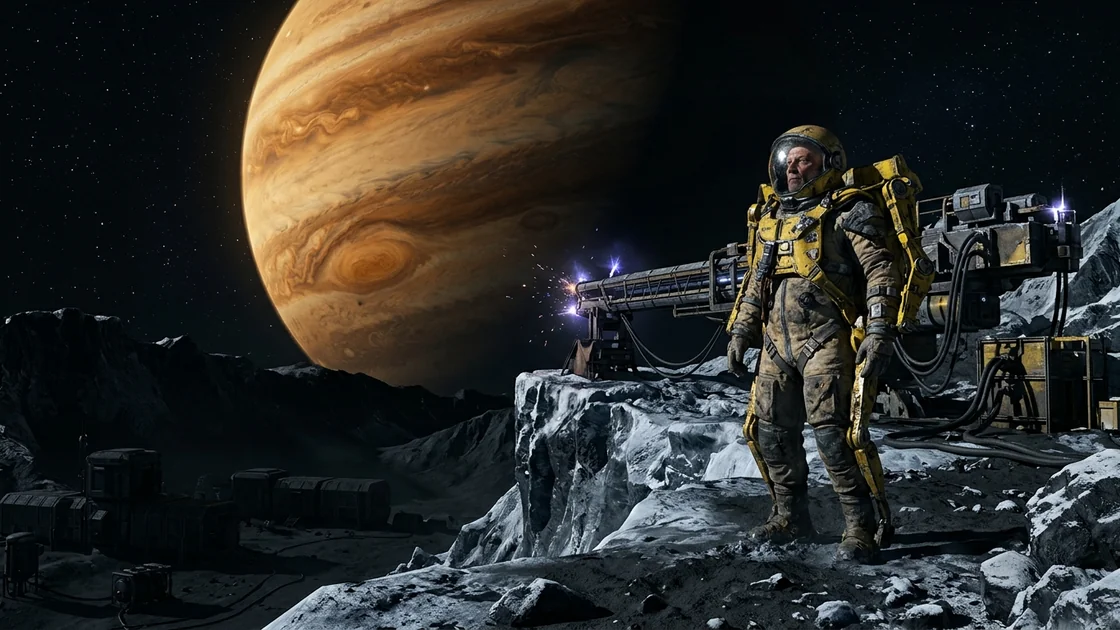
Abandoned on a frozen, airless moon after his corporate employers deem his terraforming project financially obsolete, chief engineer Silas Vance refuses to die quietly in the dark. Using the automated fleet of comet-harvesting drones left behind in orbit, he spends eighty-five years cycling in and out of decaying cryogenic stasis while constructing a weapon of planetary scale. By coating massive mountains of ice in radar-absorbing carbon slag and slinging them around a gas giant, he launches a silent, undetectable armada across the star system. Three generations later, as the grandchildren of the executives who left him for dead celebrate their dynasty on their lush capital world, Silas wakes for the last time to watch his life's work finally make planetfall.
The corporate ledger did not have a column for murder, so the Vane-Kessler Consortium logged the death of Silas Vance under depreciation of non-recoverable ground assets.
Silas stood on the basalt ridge of Scylla, his boots magnetized to the iron-rich crust, and watched the Sovereign Yield ignite its main lithium-fusion torch. Three hundred kilometers above his head, the carrier was a针-prick of violet brilliance against the bruised, swirling ochre belly of Charybdis, the super-Jupiter that dominated half the sky. The light of the ship's drive flared, elongated into a thin scar against the stars, and then snapped out of existence as the vessel jumped the inner-system transfer lane.
In his helmet, the local comm channel hissed with the dry, static whisper of Charybdis’s magnetosphere. There were no other voices. The six hundred technicians, atmospheric chemists, and drone operators who had inhabited the modular valley below him for the last four years were inside that violet spark, already unstrapping from their acceleration couches and ordering reconstituted gin in the wardroom.
Silas lowered his gaze from the zenith to the valley floor. The prefabricated barracks were dark. The atmospheric processors—massive, three-story turbines designed to crack water ice and belch greenhouse fluorocarbons into Scylla’s non-existent sky—sat half-assembled, their titanium ribs gleaming dull gray in the distant, weak light of Chrysos Alpha, twelve hundred astronomical units away.
A soft chime echoed inside his skull via his bone-conduction implant. An automated packet had finally cleared the local relay buffer, timed to decrypt twelve minutes after the Sovereign Yield achieved escape velocity.
Silas did not walk back to the command module to read it. He stood on the ridge, let the suit’s HUD project the amber text across his visor, and read his obituary over the backdrop of the dead moon.
FROM: Office of Sub-Director Arthur Vane, Outer Rim Resource Allocation TO: Vance, Silas — Chief Orbital & Volatile Engineer (Scylla Contract #440-B) SUBJECT: Immediate Cessation of Phase One Operations
Engineer Vance. Pursuant to the Q3 fiscal realignment, the Board of Directors has voted to terminate the Scylla Terraforming Initiative. Recent spectroscopic surveys of the 44-Arietis sector have revealed three natural terrestrial worlds requiring zero volatile importation. Consequently, the projected three-hundred-year return on investment for Scylla has fallen below the Consortium’s four-percent threshold.
Due to mass-penalty constraints on the Sovereign Yield caused by the emergency extraction of the high-value fluorocarbon catalysts, your personal extraction pod was reassigned to carry the primary refinery cores. Your contract has been converted to an indefinite on-site caretaking role, with full hazard multipliers applied to your pension account. A recovery tug has been scheduled for the next regular outer-halo maintenance cycle.
Silas blinked, and his eye-tracking software scrolled to the bottom metadata of the file. The next regular outer-halo maintenance cycle was unassigned. The field was populated by a series of zeroes that stretched across the bottom of his visor like a row of little nooses.
They hadn't left him because of mass penalties. A human body and a sixty-kilogram pressure suit meant nothing to a ship the size of a city block. They had left him because Silas Vance was the signatory on the environmental and safety bonds. Under Inter-System Commerce Law, as long as the Chief Engineer remained on-site, the project was legally classified as "suspended" rather than "abandoned." If a project was abandoned, the Consortium had to forfeit a forty-billion-credit performance bond to the Colonial Authority and pay for the dismantling of the orbital nuclear tugs. So long as Silas was breathing on the rock, Scylla was merely "on pause."
And when he died of equipment failure in a few months, it would be an industrial accident. The bond would be voided under the force majeure clause.
Arthur Vane had saved the Consortium forty billion credits by leaving one forty-two-year-old widower on a ball of frozen iron.
"Understood," Silas said aloud. His voice sounded small and tinny inside the fiberglass shell of his helmet. "Message received, Arthur."
He turned and began the long, slow lope down the basalt slope toward the primary habitat dome. In Scylla’s one-sixth gravity, each step was a floating, dreamlike leap that ended in a silent puff of black silicate dust.
The primary habitat had been stripped with locust-like efficiency, yet in a way that betrayed a frantic hurry. They had taken the high-density data cores, the medical stasis beds—all except one unit in the quarantine bay that had a cracked coolant manifold—and the spare fuel rods for the portable fission plant. They had even drained the hydrazine from the two surface hoppers, leaving them sitting on their landing skids like gutted beetles.
What they had left behind was the heavy iron.
Silas pulled off his helmet in the central rotunda, the air smelling faintly of stale sweat, burnt coffee, and the sharp, metallic tang of the scrubbers running at minimum power. He walked to the main holotank in the center of the room and keyed the master inventory.
On the ground, he had twenty tons of dry soy-protein cake, six thousand liters of industrial-grade water locked in the radiation shielding walls, a machine shop capable of printing replacement parts up to four meters in length, and a Mark IV pebble-bed nuclear reactor currently ticking over at thirty-eight percent capacity. If he dimmed the lights, shut down the heating in five of the six hab rings, and ate twelve hundred calories of gray paste a day, the reactor and the food would last him roughly forty years.
He would go insane in three, of course. Or his appendix would burst in five. Or a micrometeorite would punch through the dome in ten.
Silas didn't look at the ground inventory for long. He swept his hand through the hologram, dismissing the surface map, and zoomed out until Scylla was a speck, and the massive, banded bulk of Charybdis filled the tank. Around the gas giant, arranged in intricate, glowing green ellipses, were the assets the Sovereign Yield couldn't pack into its cargo hold.
The Shepherd Fleet.
To give a dead moon an atmosphere, you needed nitrogen, carbon dioxide, and oceans of water. Scylla had none. The Halo—the vast, dark cometary belt stretching outward from Charybdis’s orbit into the interstellar gulf—had trillions of tons of it. For the past forty-eight months, Silas had commanded a fleet of sixty-four autonomous nuclear-pulse tugs known as Shepherds.
Each Shepherd was a brute of a machine: a two-hundred-meter spine of tungsten and carbon fiber, tipped with a magnetic harpoon and a plasma torch at one end, and a massive Orion-style nuclear pulse bell at the other. Their job was to hunt down kilometer-wide dirty snowballs in the dark, dock with them, refine the comet's own deuterium ice into fuel pellets, and gently nudge the mountains of ice into decaying orbits that would eventually slam them into Scylla.
Currently, thirty-eight comets were parked in the Lagrange points around Charybdis, waiting for Silas to give the final deceleration burn commands. Another twenty-six were in the process of being wrangled in the deep dark, fifty million kilometers out.
As Silas stared at the glowing green lines of the orbital tracks, a secondary routine began to execute on the console. A crimson progress bar flashed at the top of the holotank.
REMOTE PURGE INITIATED: DECOMMISSIONING SHEPHERD FLEET AI CORES. SAFE-MODE SCUTTLE IN T-MINUS 14:59...
Arthur Vane’s tech team hadn't completely forgotten the tugs. Now that the Sovereign Yield was safely out of range of any telemetry interference, an automated worm was triggering the fleet to vent their reaction mass and lock their controls, turning sixty-four billion credits of orbital machinery into inert space junk so no rival corporation could salvage them.
Silas didn't think. The despair that had been pooling in his gut since he saw the violet flare of the ship evaporated, replaced by the cold, reflexive muscle memory of an engineer watching a bridge collapse.
He lunged across the console, his fingers flying over the physical mechanical overrides. He didn't try to fight the encryption on the worm; Vane-Kessler’s corporate security algorithms were military-grade. If he tried to hack the stop-code, the clock would hit zero before he got through the first firewall.
Instead, he attacked the dish.
"Local router override," Silas barked, slamming his palm onto the red emergency disconnect that severed the main habitat computer from the high-gain rooftop transceiver. That stopped the incoming validation handshake from the Sovereign Yield’s trailing beacon, but the local server was already broadcasting the scuttle command to the fleet.
Silas grabbed a heavy titanium wrench from the tool rack by the airlock, sprinted down the corridor to the server spine, and tore the acrylic shielding off the communications rack. The transceiver array was blinking rapidly—green, amber, green—pumping the kill-code out at the speed of light toward the Lagrange points.
With three savage blows, Silas smashed the fiber-optic junction box into a shower of glass sparks and twisted copper.
The blinking lights died. An earsplitting alarm shrieked through the empty hab.
Silas dropped the wrench, his chest heaving, and ran back to the rotunda. He routed the holotank through the backup low-gain S-band antenna—a slow, archaic system meant for suit-to-suit emergencies—and pinged the fleet.
The response took eleven seconds to bounce back from the nearest Lagrange point.
Fifty-two Shepherds reported nominal status. Their local buffers had rejected the incomplete scuttle packet when the carrier wave was severed mid-string. Twelve tugs in the inner ring had already vented their helium-3 reserves and gone dead, drifting silently around the gas giant.
Fifty-two left. And thirty-eight mountains of rock and ice, weighing between four hundred million and two billion metric tons apiece, hanging in the gravitational balance above his head.
Silas leaned both hands on the rim of the holotank, the green light of the orbital pathways reflecting in his gray eyes. His heart was hammering against his ribs like a trapped bird.
He zoomed out further. Past Charybdis. Past the empty, frigid expanse of the outer system. Past the asteroid belts and the secondary dwarf star, all the way into the warm, golden heart of Chrysos Alpha.
There, twelve hundred astronomical units away, swimming in a tight, lush orbit around the primary sun, was Veridia.
He pulled up the planetary encyclopedia file from the local library. Veridia. Population: forty-two million. The jewel of the sector. A world with no native heavy industry, no mines, no unsightly orbital shipyards. Just endless archipelagos of manicured emerald islands, turquoise seas, and the spire-cities of the Vane-Kessler aristocracy. A planet where a square meter of beachfront real estate cost more than the entire Scylla terraforming budget.
Silas looked at the distance: 179.5 billion kilometers.
If he used a Shepherd to push a comet toward Veridia at standard transfer velocities—ten or fifteen kilometers per second—it would take nearly four hundred years to arrive. Long before then, the inner-system defense pickets would spot the thermal plume of the tug, intercept it in the middle belt, and vaporize the ice with stand-off fusion lances.
"No plumes," Silas whispered to the empty room. "Ballistic only."
His mind, trained for twenty years in the grand, slow-motion billiards of celestial mechanics, began to construct the equation.
Charybdis was not just a gas giant; it was a sub-brown dwarf, twelve times the mass of Jupiter, spinning on its axis once every four hours with a gravitational well deep enough to warp the local frame of space-time. If you dropped an object into a grazing hyperbolic pass of Charybdis’s upper atmosphere and fired a massive nuclear pulse right at perigee—an Oberth maneuver on a titanic scale—the gravitational slingshot wouldn't just nudge the comet. It would whip it out of the outer halo like a stone from a centrifuge.
Seventy-five kilometers per second. Two hundred and seventy thousand kilometers per hour.
At that velocity, crossing twelve hundred astronomical units would take roughly seventy-five standard years.
Silas pulled a stylus from his pocket and began scribbling vectors directly onto the glass surface of the holotank.
Seventy-five years for transit. Plus ten years of preparation to modify the comets so they wouldn't melt or be seen as they fell into the warm inner system.
Eighty-five years.
Arthur Vane was thirty-eight years old. In eighty-five years, Arthur would be dust in a marble mausoleum on Veridia’s northern continent. His children would be ancient or dead. His grandchildren would be sitting in the boardroom at the top of the Aethelgard Spire, spending the dividends of the forty billion credits Arthur had saved by leaving Silas Vance to suffocate in the dark.
Silas stopped writing. He looked down the dark corridor toward the medical bay, where the single, damaged quarantine stasis pod sat beneath a sheet of plastic.
A Class-Three industrial stasis pod didn't stop time. It wasn't the flawless quantum-lock suspension that the executives used on their luxury liners. It was a glorified meat locker that dropped the human body to two degrees above freezing, replaced forty percent of the blood volume with perfluorocarbon antifreeze, and slowed metabolism by a factor of twelve. For every twelve years you spent inside the glass coffin, your body aged one year—and your nervous system accumulated the cellular sludge of a man who was slowly drowning in chemical preservatives.
If he slept for eighty-five years in bursts, waking only to adjust the trajectories and maintain the reactor, his body would experience seven years of biological time, and seventy-eight years of toxic, freezing rot.
He would wake up at the end as a ruin. A blind, crippled thing with plastic tubes for veins and calcified joints.
Silas looked back at the glowing green dot of Veridia in the center of the tank.
"I have a contract to fulfill," he said to the ghosts in the hab. "You paid for an atmospheric delivery, Arthur. You just forgot to specify the coordinates."
The first three years were a symphony of iron and soot.
Silas did not sleep in the pod yet. There was too much physical labor required on the surface, and his body was still strong enough to endure the grueling sixteen-hour shifts in the machine shop.
The problem of killing a planet from twelve hundred astronomical units away was not mass; he had more mass than the Chicxulub impactor multiplied by forty. The problem was albedo.
Comets were bright. As a body of water ice and frozen methane fell toward a star, solar radiation warmed its surface. The ice sublimated into gas, bursting out in geysers that formed a coma thousands of kilometers wide and a tail that shone like a neon banner against the black. Veridia’s Orbital Defense Network—a ring of automated laser-brazing platforms and kinetic interceptors—would spot an incoming comet three years before impact, when it crossed the orbit of the outer gas giants.
To reach Veridia, the ice had to be dark. Darker than coal. Darker than the space between the stars. And it had to be armored against the heat of Chrysos Alpha until the final forty-eight hours of its plunge.
Fortunately, Scylla was a world made of slag.
Silas reprogrammed the surface strip-miners—enormous, spider-legged excavators that had been meant to dig foundation trenches for the atmospheric processors. He sent them out into the equatorial maria, where billions of years of micrometeorite impacts had pulverized the moon’s carbon-chondrite crust into a fine, powdery regolith rich in iron, nickel, and fullerenes.
While the spiders dug, Silas cannibalized the unfinished atmospheric processors. He tore down the giant titanium turbines with plasma cutters, dragged the pieces behind a crawler back to the valley, and reconfigured them into an electromagnetic mass driver—a two-kilometer-long railgun running up the eastern slope of the basalt ridge.
He worked in total silence. In the beginning, he had played music from the hab’s entertainment library over his suit comms—old symphonies, jazz, recordings of rainfall from Earth—anything to fill the crushing vacuum inside his helmet. But by the eighth month, the music began to feel like a lie. It belonged to people who lived under blue skies, people who walked on grass and drank water that hadn't been cycled through their own kidneys four hundred times.
He turned the music off. Instead, he listened to the rhythmic thump-hiss of his oxygen regulator and the crackling static of Charybdis’s radiation belts.
By the end of the second year, the railgun was operational. Every four minutes, the pebble-bed reactor in the valley surged, the capacitor banks whined through the rock under his feet, and a two-ton canister of refined carbon-aerogel and iron-silicate foam shot up the basalt ramp at six kilometers per second. There was no sonic boom in the vacuum; just a silent flash of blue plasma from the rails and a silver streak vanishing into the ochre belly of the gas giant above.
In orbit, the fifty-two Shepherds caught the canisters.
Silas had rewritten the tugs' operational firmware from scratch, stripping out every safety protocol, every collision-avoidance routine, and every corporate transponder code. He renamed the tugs after the line items on the final budget sheet Arthur Vane had used to justify his death. Depreciation-1 through Depreciation-12. Liability-1 through Liability-20. Force-Majeure-1 through Force-Majeure-20.
The Shepherds took the canisters of black aerogel and iron slag and flew them to the thirty-eight comets waiting in the Lagrange points.
Working in swarms of three and four, the tugs used their plasma torches to melt the outer ten meters of each comet, mixing the boiling water and ammonia with the iron-silicate dust until it froze back into pykrete—an unnatural alloy of ice and metal fibers tougher than poured concrete, with the thermal conductivity of brick. Over that ten-meter armor shell, the tugs sprayed a three-meter coating of porous carbon-nanotube aerogel, grown in the zero-gravity forges from Scylla’s fullerene dust.
The result was an astronomical void.
When Silas aimed the hab’s optical telescope at Comet #1—a jagged, four-kilometer mountain he had christened Fiduciary Duty—he couldn't see it. Even with Charybdis directly behind it, the object didn't reflect a single photon. It was simply a four-kilometer hole in the bands of the gas giant, absorbing ninety-nine point nine-eight percent of all visible, infrared, and radar wavelengths. Its surface temperature was locked at four Kelvin, indistinguishable from the cosmic microwave background radiation.
It was a mountain of stealth-armored ice, wrapped in a thermal vacuum flask that wouldn't crack until it was inside the orbit of Veridia’s own moon.
By the fourth year, Silas’s body began to fail him.
The radiation on Scylla was relentless. Even with the water-shielded walls of the hab and the lead-lined plating of his suit, Charybdis’s magnetosphere sleeted high-energy protons through his bone marrow every time he went outside to clear a jammed rail on the mass driver. His gums bled constantly, leaving pink smears on the gray soy cakes he chewed each evening. His hair had fallen out in patches during year two; by year four, he was completely bald, his scalp crosshatched with small, non-healing lesions from the dirty helmet liner.
Worse was the math.
He couldn't launch all thirty-eight comets at once. Charybdis’s orbital position relative to Chrysos Alpha and the inner planets meant that the gravitational keyhole—the exact three-hundred-kilometer window above the gas giant's ammonia clouds that would bend a comet's path onto an intercept vector with Veridia—only aligned with the Lagrange points once every fourteen months.
And each comet had to be launched at a slightly different velocity, along a slightly different inclination, so that after traveling across a hundred and eighty billion kilometers over seven decades, they wouldn't arrive one by one over a period of ten years. If they arrived one by one, Veridia would realize it was under bombardment after the first strike and mobilize every ship in the sector to hunt down the rest.
They had to arrive together. Within the same six-hour window. A synchronized shotgun blast across eighty-five years of space and time.
The slowest comets—the massive two-billion-ton planet-killers—had to leave first, slung at sixty-eight kilometers per second. The smaller, half-kilometer shards had to leave decades later, whipped through the lower atmosphere of the giant at nearly ninety kilometers per second to catch up with their heavier brothers in the final month of the journey.
Silas stood in the medical bay, staring at the quarantine stasis pod.
He had spent six months repairing the cracked coolant manifold using braided copper tubing from the hab’s air conditioning and silver solder. It held pressure, mostly, though it wept a thin crust of green glycol crystals along the lower seam that he had to scrape away with a putty knife once a week.
"First batch is in the chute," Silas muttered. He had developed a habit of tapping his left canine with his thumbnail when he spoke to himself; the tooth was loose, and the dull ache grounded him. "Fourteen comets coated. Fiduciary Duty drops into the well in six hours. Next launch window for Batch Two isn't for eleven years."
If he stayed awake for those eleven years, he would use up a quarter of his reactor fuel and food just keeping himself warm, and the radiation would rot his liver before Batch Three was even armored.
He had to get in the box.
Silas stripped off his grease-stained coveralls. In the harsh fluorescent light of the med-bay, his forty-six-year-old body looked like a piece of bleached driftwood—all corded tendons, sunken ribs, and radiation bruising. He climbed into the fiberglass trough of the pod, the cold plastic sticking to the sweat on his bare back.
He didn't have a medical technician to insert the femoral shunts, so he had to do it himself. He gritted his teeth, pinched the skin of his inner thigh, and drove the thick, fourteen-gauge steel needle into his artery. Dark, sluggish blood flashed up the clear plastic line, followed immediately by the icy burn of the perfluorocarbon perfusate pumping from the machine's reservoir.
He did the left leg next. His hands were shaking so badly he missed the vein twice, leaving ragged purple hematomas on his groin before the needle seated with a wet click.
"Wake-up timer set for ninety-six thousand hours," Silas whispered, his tongue already growing thick and metallic as the synthetic antifreeze hit his carotid arteries. He reached up and pulled the heavy acrylic canopy down until the magnetic latches engaged with a dull clunk.
Through the scratched plastic above his face, he watched the status monitor on the wall.
CORE TEMP: 34.2 C... 31.0 C... 26.8 C...
The cold wasn't like winter weather. It didn't start on the skin. It started in the marrow of his femurs and the base of his skull, an iron vise that squeezed the breath out of his lungs and turned his heartbeat into a slow, agonizing hammer blow—thump... pause... pause... thump.
In the final seconds before the sodium-thiopental drip blacked out his cortex, Silas heard the distant, vibration-conducted rumble through the bedrock of the moon. Not sound, but a low-frequency tremor in the planetary magnetic field.
Three hundred thousand kilometers above, twelve Shepherd tugs had locked their harpoons into the black hide of Fiduciary Duty and fired their nuclear pulse bells in unison, shoving two billion tons of armored ice down into the howling gravity well of Charybdis.
Silas smiled as his eyelids froze shut.
One down.
Waking up was like being dragged backward through a windshield of broken glass.
The pod didn't warm him evenly. His core came online while his extremities were still at four degrees Celsius. Silas convulsed violently as the automatic defibrillator pads on his chest fired to kickstart his heart from two beats per minute back to sixty, his spine arching off the fiberglass tray until something in his lower back popped like a dry branch.
He vomited green biliary fluid and chemical preservative over his chin, choking until his trembling, frostbitten fingers found the manual release lever and shoved the acrylic lid open.
He rolled over the edge of the pod and fell onto the deck plates, gasping the thin, freezing air of the med-bay.
It took him four hours to crawl to the scrub shower and turn on the hot water—which wasn't hot, only lukewarm, because the reactor had throttled down to standby mode during his sleep. He lay on the grating for a day, letting the recycled water wash the crust of dead skin, dried blood, and glycol crystals off his body, while he chewed blindly on a brick of soy paste he had left on the floor beside the drain eleven years ago.
When he could finally stand using an aluminum crutch, he limped into the rotunda.
The hab had aged worse than he had. Without regular maintenance, the rubber seals around the northern sector airlocks had turned brittle in the thermal cycling and blown out; the automated bulkheads had slammed shut to save the core, cutting off three-quarters of the living space. Frost rimed the inner walls of the rotunda, sparkling blue in the light of the holotank.
Silas wrapped himself in three thermal blankets and keyed the telemetry log.
TIME ELAPSED: 11 YEARS, 4 MONTHS, 12 DAYS.
He checked the orbital tracks.
Batch One—all fourteen comets, including Fiduciary Duty, Severance Package, and Sunk Cost—had cleared the Charybdis slingshot with zero margin of error. They were currently twenty-two billion kilometers out from Scylla, coasting in total darkness at sixty-nine point four kilometers per second. Once they had cleared the gas giant's gravity well, the Shepherd tugs had detached, flipped around, and burned their remaining fuel to return to the Halo to harvest the next wave.
In the Lagrange points, twenty-four fresh comets were waiting, already wrapped in their black aerogel shrouds by the tireless, uncomplaining machines.
Silas exhaled a plume of white vapor into the cold room. Then, with a strange, morbid curiosity ticking in the back of his frost-damaged brain, he walked over to the secondary terminal.
While the high-gain transmitter was smashed, the passive deep-space receiver dish on the ridge was still intact. Like a tide washing onto a dead beach, the electromagnetic chatter of the inner system—commercial broadcasts, financial news, public holo-feeds—drifted across the twelve hundred astronomical units, taking nearly seven days to reach the Halo at the speed of light, weak and red-shifted, but readable.
The computer had been recording the high-priority corporate bands while he slept.
Silas typed a name into the search query: Vane, Arthur.
Thousands of entries cascaded down the screen. Silas scrolled past the financial reports and market summaries until he found a video file from three years ago. He tapped it.
A holographic projection flickered to life above the dusty emitter plate.
It was a grand ballroom beneath a sky of real clouds. Through the soaring glass arches in the background, Silas could see the turquoise waters of Veridia’s Sapphire Sea, dotted with white-sailed yachts that looked like gulls. In the center of the projection stood Arthur Vane.
He was fifty years old now, his hair silvered at the temples in the distinguished, symmetrical way that only gene-tailored anti-agathics could produce. He wore a suit of spider-silk charcoal wool, and he was holding a crystal flute of something golden while addressing a crowd of hundreds of glittering executives.
"...and as I assume the role of Chairman of the Board today," Arthur’s voice echoed through the freezing, rusted rotunda on Scylla, warm and resonant despite the static of a hundred and eighty billion kilometers, "I am reminded that the strength of Vane-Kessler has never been our machinery, nor our territorial claims. It is our discipline. Twelve years ago, when I oversaw the Outer Rim consolidation, critics called our withdrawal from the Halo draconian. Yet by shedding those unproductive peripheral liabilities, we freed the capital that built the Veridian Orbital Ring and doubled our dividend for forty-eight consecutive quarters..."
Polite, rhythmic applause washed from the speakers. The camera panned briefly to the front table, where a woman in an emerald gown sat beside a teenage boy with Arthur’s sharp jawline and pale eyes, and a younger girl no older than eight.
Silas paused the projection. He leaned forward on his crutch, his breath rattling in his scarred lungs, and stared into the frozen, smiling face of the teenage boy.
The caption at the bottom of the public broadcast identified the family: Chairman Arthur Vane; wife, Lady Elena; heir-designate Julian Vane (16); daughter Clara (8).
Silas reached out a hand. His fingernails were black and split from the stasis cold, his knuckles swollen like walnuts. He passed his skeletal fingers right through the holographic face of Julian Vane, scattering the light into green motes.
"Hello, Julian," Silas rasped. "You're going to be an old man when we meet. Make sure you have grandchildren. I want the whole ledger balanced."
He didn't turn the holo off. He left it frozen on the emitter plate—that single frame of the Vane family toasting their forty-eight quarters of profit under a warm sun—for the next fourteen months while he worked.
Every time he limped through the rotunda in his dirty vac-suit, dragging a length of welding cable or carrying a bucket of reactor boron, he walked past their smiling, translucent faces.
He spent those fourteen months recalibrating the mass driver and calculating the trajectories for Batch Two. The second wave was trickier. Because eleven years had passed, Veridia had completed eleven orbits around Chrysos Alpha, and Chrysos Alpha itself had drifted slightly in its dance with its binary sibling. Worse, five of the Shepherd tugs had suffered reactor degradation from operating continuously for fifteen years without yard maintenance.
Silas had to program the dying tugs to cannibalize themselves.
Instead of detaching after the Charybdis slingshot, Liability-4 through Liability-8 would remain harpooned to the backs of the comets as they dove into the gas giant's crushing magnetosphere. At the exact moment of perigee, just seventy kilometers above the screaming ammonia hurricanes of Charybdis, the tugs wouldn't just fire their pulse bells—they would overload their main deuterium-tritium containment cores, detonating themselves as five-hundred-megaton shaped charges against the rear pykrete shields of the comets.
The math was brutal. If the pykrete cracked instead of absorbing the momentum, the comet would fragment into a useless cloud of gravel that would burn up harmlessly in Veridia’s upper atmosphere seventy years later.
Silas spent three months running finite-element stress simulations on the hab’s dying mainframe, his bleeding gums staining his coffee mug, his back braced with a corset made of duct tape and aluminum struts. To reinforce the blast shields on the comets, he had to go back out to the strip-miners and dig up twenty tons of pure tungsten ore from a crater twelve kilometers away.
On the fourth trip across the maria, the front axle of his crawler snapped in a hidden dust fissure.
Silas was thrown against the cabin bulkhead, his collarbone snapping with a dry crack inside his suit. The crawler tilted at a forty-degree angle, its battery pack punctured and venting white electrolyte mist into the vacuum.
Twelve kilometers from the hab. No backup rover. A broken collarbone and three hours of oxygen left in his primary tank.
For ten minutes, Silas simply sat in the tilted seat, staring up at the looming, banded wall of Charybdis. It would be so easy to just unclip his wrist ring. One twist of the locking collar, a half-second of roaring decompression, and the cold would take him much faster and cleaner than the stasis pod ever did. No more soy paste. No more femoral needles. No more waking up choking on green bile.
Then he thought of the frozen hologram in the rotunda. He thought of Julian Vane, sixteen years old, drinking real water under a blue sky, inheriting a world bought with Silas’s oxygen.
Silas reached down with his good right arm, pulled a roll of fiberglass repair tape from the door pocket, and strapped his broken left arm tightly against his chestplate so the bone ends wouldn't grind when he moved. He exited the airlock, disconnected the auxiliary oxygen bottle from the crawler's emergency kit, clipped it to his belt, and began to walk.
Twelve kilometers. Eleven thousand steps in one-sixth gravity, dragging a sled of tungsten ore behind him by a nylon tether clipped to his waist harness.
By kilometer eight, his primary tank was dry and he was breathing the metallic, stale dregs of the auxiliary bottle. By kilometer ten, the carbon-dioxide scrubber was saturated; his vision narrowed to a gray tunnel, and a red sledgehammer beat behind his eyes with every heartbeat. He stopped seeing the basalt rocks in front of him and began seeing the green islands of Veridia, floating in the black dust of the moon.
He fell against the outer airlock door of the valley hab with four minutes of breathable air left in his suit, smashing his helmet visor against the manual cycle button because his left arm was useless and his right hand was numb from carbon-dioxide narcosis.
It took him six weeks to heal enough to load the tungsten into the railgun. The collarbone set crooked, leaving a jagged hump under his left shoulder that pinched a nerve every time he raised his arm above his chest, a permanent fire wire sewn into his flesh.
In the sixteenth year of his exile, Batch Two—eighteen dark mountains of ice—screamed down into the orange twilight of Charybdis’s upper atmosphere.
Silas watched the telemetry from the med-bay, the femoral needles already taped into his scarred, fibrous thighs. Five silent blossoms of gamma rays flashed on the edge of the gas giant's disk as the five Shepherd tugs detonated their cores at perigee.
All eighteen pykrete shields held. Whipped by the nuclear blasts and the monstrous gravity of the sub-brown dwarf, the second armada shot out into the dark at seventy-seven kilometers per second, bound for a rendezvous point with Batch One in the deep gulf between the stars, sixty years downrange.
Silas reached up with his one good arm and pulled the scratched acrylic lid down over his face.
TIME TO NEXT WINDOW: 29 YEARS.
Year forty-five.
When the pod popped its latches this time, Silas did not fall out onto the floor. He couldn't move his legs at all.
Twenty-nine years in the malfunctioning meat locker had caused peripheral neuropathy so severe that the nerves below his knees were dead white threads. And the hab was dark.
The Mark IV pebble-bed reactor hadn't failed completely, but two of the helium circulation pumps had seized in year thirty-eight, dropping power output to eleven percent. The temperature inside the med-bay was minus eighteen Celsius. The only thing that had kept the stasis pod running was the hardcoded priority circuit Silas had wired directly to the reactor core before he went under.
Silas lay in the trough of freezing slush for two hours, methodically rubbing his thighs with his gnarled hands until a faint, agonizing pins-and-needles sensation crept down into his calves. He couldn't walk, not even with the crutch.
So he built himself legs.
Dragging himself by his elbows across the frosted deck plates to the machine shop, he fired up the small RTG backup generator using the heat of its own plutonium decay to thaw the hydraulic lines on the industrial exoskeletons. They were heavy, clumsy frames of yellow-painted steel and servo-motors designed for loading two-ton cargo pallets inside the bay of the Sovereign Yield.
Over three weeks of shivering, delirious work in the dark shop, Silas bolted his wasted lower body directly into a cut-down cargo frame, wiring the servo-controllers into the neural diagnostic port at the base of his skull—a rough, bloody surgery he performed using two mirrors, a local anesthetic that had expired thirty years ago, and a soldering iron to cauterize the scalp incision.
When he stood up, he stood seven feet tall on hydraulic piston-legs that hissed and clanked with every step, smelling of burning hydraulic fluid and unwashed old man.
He was fifty-one years old biologically, and eighty-seven years old chronologically. In the cracked mirror of the head, he looked like a deep-sea crustacean that had crawled into a dead man's skin. One eye was clouded white with a radiation cataract; the other was sunken and fever-bright.
He clanked into the rotunda, his steel feet punching dents in the aluminum deck plates, and scraped the thick rime of blue ice off the holotank.
Batch One was now sixty-four percent of the way to the inner system. Batch Two was fifty-one percent of the way, closing the gap at seven point six kilometers per second. Their trajectories were intersecting with the precision of a Swiss watch; in forty years, their paths would braid together just outside the asteroid belt of Chrysos Alpha.
Only six comets remained in the Lagrange points around Scylla. Batch Three. The chasers.
And only eleven Shepherd tugs were still alive to push them. The rest had succumbed to cosmic ray bit-flips or bearing seizures over the decades, drifting in silent, ghostly orbits around Charybdis alongside the twelve tugs that had died on the first day.
Silas cleared the ice off the secondary communications terminal. The hologram of Arthur Vane’s family was gone; the emitter bulb had burned out twenty years ago. Silas accessed the raw text and audio logs from the inner system.
Arthur Vane was dead.
He had died eleven years ago at the age of seventy-one—early, for a man of his wealth, felled by a rare cerebrovascular aneurysm while vacationing on his private orbital yacht above Veridia’s southern pole. The state funeral had lasted three days. The Consortium had named a financial district on the third archipelago after him.
In his place sat Chairman Julian Vane, now forty-five years old.
Silas played an audio clip from six months ago—a shareholder address delivered from the Aethelgard Spire. Julian’s voice was smoother than his father’s, lacking the hard, frontier edge of the generation that had actually built the outer-rim extraction fleets. Julian sounded like an academic, or a priest of some polite, golden religion.
"...as we enter the second half of the century, Vane-Kessler is transitioning fully from raw extraction to planetary curation and biosphere leasing. The dirty work of the past century—the strip-mining, the volatile wrangling in the dark sectors—is behind us. Our children will know us not as miners, but as the architects of paradise..."
Silas listened to the hydraulic pump on his left hip whine as it compensated for his weight.
"The dirty work is still coming, Julian," Silas whispered, his voice a dry click from a vocal cord scarred by three intubations. "It's just taking the scenic route."
He checked the telemetry on Batch One and Batch Two using the long-baseline interferometry array he had linked between the moon’s surface and the remaining Shepherd tugs.
Then his good eye narrowed.
Comet #9 from the first batch—a one-point-two-billion-ton monolith he had named Unforeseen Expenditure—was off course by zero point zero-zero-four arcseconds.
Twenty years ago, forty billion kilometers out in the empty Oort waste, it had passed through an uncharted gravitational perturbation—likely a rogue dwarf planet or a dark clump of primordial iron wandering between the stars. An error of four thousandths of an arcsecond meant nothing over a million kilometers. Over the remaining seventy billion kilometers to Veridia, it meant Unforeseen Expenditure would miss the planet entirely, passing three hundred thousand kilometers behind its orbital track—and worse, passing right through the high-albedo solar reflection zone of Veridia’s outer communication satellites twelve hours before the rest of the swarm arrived.
It would be spotted. It would trip the alarm twelve hours too early, giving the luxury liners and the executive yachts docked at the Aethelgard Spire time to burn for deep space before the sky fell.
Silas slammed his steel-gauntleted fist onto the console, cracking the polycarbonate casing.
Unforeseen Expenditure had no Shepherd tug attached to it; it had been flying blind and unpowered for forty-one years. There were no engines on the ice to fire a correction burn.
Silas stared at the tank for three days without sleeping, chewing frozen soy dust and letting the exo-frame hold him upright while his brain ground through the problem.
He couldn't reach the comet with a tug; it was seventy billion kilometers away, moving at sixty-nine kilometers per second. Nothing in the Halo could catch it.
Except light.
Silas turned his mechanical body toward the viewport, looking out at the valley floor where the two-kilometer mass driver sat buried under forty years of electrostatic dust drift. Beside it sat the ruins of the atmospheric processors—and the industrial laser array that had been shipped to Scylla to bore geothermal vents into the moon's crust.
A twenty-gigawatt free-electron laser, meant to vaporize basalt ten meters at a time.
If he aimed a twenty-gigawatt beam across seventy billion kilometers, diffraction would spread the beam out to the width of a small continent by the time it hit the comet. It wouldn't have the energy density to melt pykrete.
Wait. He didn't need to melt the pykrete. He just needed to warm one side of the comet by forty Kelvin—just enough to cause a micro-outgassing of the volatile nitrogen trapped beneath the carbon aerogel on its port flank. The gentle, almost imperceptible thrust of sublimating gas over a period of six months—the Yarkovsky effect, artificially induced—would nudge the billion-ton mountain back into the groove by four thousandths of an arcsecond.
To focus the beam across that distance without diffraction ruining it, he needed a lens the size of a city.
Silas looked up at the sky.
He had eleven Shepherd tugs left in orbit, and sixty spools of three-atom-thick mylar solar-sail sheeting that had been left in the orbital warehouse module—backup equipment originally intended to build orbital mirrors to warm Scylla once its atmosphere was thick enough.
For the next eighteen months, Silas didn't set foot in the hab. He lived inside his heavy vac-suit, bolted into the yellow cargo frame, welding his waste-recycling tubes directly into the suit’s plumbing so he never had to take the helmet off. His skin fused in places to the synthetic inner lining of the suit; he didn't care.
He rebuilt the geothermal laser on the crest of the basalt ridge, wiring it directly into the exposed core of the Mark IV reactor down in the valley. He pulled the control rods out two inches further than the red line allowed, letting the pebble bed run at eleven hundred degrees Celsius, bathing the valley in a faint, ghostly Cherenkov glow through the unshielded cooling vents.
In orbit, five Shepherd tugs unreeled the mylar sheeting across a frame of magnetic tether lines, stretching a parabolic Fresnel lens twelve kilometers wide across the Lagrange point, stabilized by ion thrusters to millimeter precision.
Silas calculated the light-lag. At seventy billion kilometers, the beam would take sixty-four hours and forty-eight minutes to reach the comet, and another sixty-four hours for the faint spectroscopic reflection to bounce back to his sensors to tell him if he had hit it.
A five-day round trip for every adjustment.
He fired the laser.
Down in the valley, the reactor screamed through the bedrock. On the ridge, the free-electron array hummed with a magnetic field so intense it pulled the iron dust out of the regolith and stood it up in spiky black forests around Silas’s hydraulic boots. Invisible in the vacuum, an ultraviolet spear shot up into the sky, struck the twelve-kilometer mylar lens in orbit, and focused into a needle-thin ray pointing into the abyss toward Chrysos Alpha.
For seven months, Silas stood on that ridge like a statue of rusted iron and yellow paint, tethered to the rock by a steel cable while the laser burned.
Every sixty-four hours, he read the return doppler shift. Every sixty-four hours, he adjusted the vernier screws on the laser turret by a fraction of a micron to compensate for Scylla’s rotation and Charybdis’s orbital wobble.
In the seventh month, the Mark IV reactor finally died.
A graphite moderator sphere cracked under the thermal stress, jamming the primary coolant loop. Down in the valley, a silent geyser of radioactive helium-4 blew the roof off the reactor building, sending a shower of glowing white graphite pebbles arcing lazily across the black sky before pattering down onto the hab dome like hail.
On the ridge, the laser died. The forest of iron dust around Silas’s boots collapsed back into a flat gray powder.
Silas stood in the sudden darkness, waiting sixty-four hours for the final telemetry packet to return from the deep.
His suit battery was dropping. Without the reactor, the hab was dead; the only power left on the moon was the decaying plutonium core of the small RTG generator he had dragged into the med-bay to power the stasis pod.
Sixty-four hours later, the receiver pinged.
COMET #9 (UNFORESEEN EXPENDITURE): VECTOR CORRECTED. DEVIATION: 0.0000 ARCSECONDS.
Silas’s hydraulic knees locked to keep him from collapsing.
He didn't need the laser anymore. And he didn't need the railgun. The final six comets of Batch Three were already armored. Over the next two days, using the battery power of his suit to run the S-band radio, he commanded the last eleven Shepherd tugs to harpoon the six chaser comets and dive them into Charybdis.
All eleven tugs detonated their cores at perigee, propelling Batch Three out of the well at eighty-nine kilometers per second—the fastest, most violent slingshot of the entire campaign.
With that final flash of gamma rays against the orange clouds of the gas giant, the Halo went dark.
All sixty-four Shepherds were gone—either drifting hulks or vaporized plasma in Charybdis’s upper atmosphere. All thirty-eight comets were in the dark between the stars, rushing silently toward the sun.
Silas turned and clanked down the ridge toward the dead, dark hab. There was no heat left inside. The air had begun to snow carbon dioxide as the temperature dropped toward minus eighty.
He didn't take off his vac-suit. If he took it off, he would freeze before he could get the femoral needles in. Instead, he used a plasma torch to cut away the lower half of the stasis pod’s canopy so his hydraulic legs could stick out the bottom, and he cut two ports through the thigh seals of his suit to reach the scarred skin of his groin.
Powered by the dim, eighty-watt trickle of the plutonium RTG, the pod was barely working. It wouldn't cool him evenly, and the chemical pump was surging erratically.
TIME TO IMPACT: 38 YEARS, 2 MONTHS.
Silas lay back in the dark, his helmet still locked to his collar, staring through his frosted visor at the dead ceiling of the med-bay. He set the wake-up timer for thirty-eight years, minus forty-eight hours.
If the RTG failed, he would die in his sleep, and it wouldn't matter. The stones were already in the air. Gravity didn't need a heartbeat to finish an equation.
Veridia in the late summer of its Centennial year was a masterpiece of atmospheric engineering.
Three hundred kilometers above the equator, the Aethelgard Spire rose from its geostationary anchor on Mount Kessler like a needle of spun diamond, crowned by the Conservatory—a two-kilometer biodome where the air was scented with genetically resurrected Tasmanian leatherwood and the gravity was kept at a pleasant zero-point-eight standard.
Celine Vane, Chairwoman of the Vane-Kessler Consortium, stood at the western balustrade of the Conservatory, looking down at the curve of her world.
She was thirty-four years old, though she looked twenty-two, with the pale, luminous eyes of her grandfather Arthur and her father Julian. Around her, twelve hundred guests in shimmering, climate-controlled silks drifted between the floating bonsai gardens and the champagne fountains. They were celebrating the Centennial of the Outer Rim Restructuring—the historic fiscal pivot made by her grandfather a hundred standard years ago (eighty-five Veridian orbital years) that had transformed the Consortium from a gritty mining syndicate into the landlord of eleven terraformed worlds.
"You look pensive, Celine," said Marcus Kessler, the Vice-Director of Orbital Logistics, stepping up beside her with two glasses of iced pear wine. "The quarterly yield numbers aren't for another three hours, and we already know the agricultural leases on 44-Arietis are up nine percent."
Celine took the glass, smiling faintly. "Not the yields, Marcus. Just the history of it. Before the gala, the archivists brought up Grandfather Arthur’s original ledger from the Restructuring. Paper and ink—he still signed the primary bond releases by hand back then."
"A brutal era," Marcus said admiringly, looking down at the sapphire ocean below, where a pod of cloned blue whales was breaching near the coral estates. "The logistics alone must have been a nightmare. Moving sixty-thousand-ton refinery vessels out past the twelve-hundred-AU line just to scrape ammonia off dead moons. Thank God he had the vision to pull the plug when the Arietis corridor opened."
"There were still people out there when he pulled it," Celine murmured, swirling the pale wine in her glass. "I noticed a footnote on the Scylla bond. A caretaker was left behind to hold the environmental lease until the statute of limitations expired thirty years ago. Some engineer named Vance."
Marcus shrugged lightly. "Standard legal holding pattern back then. The Colonial Authority’s abandonment penalties were extortionate. Besides, those outer-halo engineers were practically machines themselves. He probably had fifty years of rations and a full library. Better than dying in a tenement on Earth."
Before Celine could answer, a low chime sounded in Marcus’s ear implant—the discreet, high-priority tone of the Planetary Defense & Traffic Directorate.
Marcus frowned slightly, excusing himself with a tilt of his glass, and stepped behind a screen of flowering bamboo.
"Kessler," he said, tapping his jawline. "I'm at the Centennial. Make it brief."
Inside his auditory nerve, the voice of Senior Watch Officer Kaelen at the L1 Defense Picket sounded strange—not panicked, because traffic controllers on Veridia hadn't experienced an emergency in sixty years, but tight with profound confusion.
"Director, we just lost telemetry on Solar Relay Buoy 44-Echo, out near the orbit of the fourth planet. And seven seconds later, we lost the high-gain commercial link to the freighter Cassiopeia."
"Solar flare?" Marcus asked, annoyed at being interrupted over two dead transponders.
"No, sir. Chrysos Alpha is completely quiet. And they didn't suffer electronic failure—the signals were occulted. Something physical passed directly between the buoy and the sun, and then between the freighter and our dish."
"An unregistered asteroid," Marcus said. "So log a fine against the survey guild and task a tug to push it out of the shipping lane."
"Sir... the occultation lasted zero point zero-four seconds across a baseline of three kilometers, and the object's transit between the buoy's orbit and the freighter's lane took less than forty minutes."
Marcus stopped looking at the guests in the ballroom. Even a corporate administrator knew basic orbital speeds. An asteroid drifting in the system moved at twenty or thirty kilometers per second. To cross the gap between the fourth planet and the inner shipping lane in forty minutes...
"Check your calibration, Kaelen," Marcus snapped. "Nothing natural moves at eighty kilometers per second in the inner system unless it's falling out of interstellar space."
"We did check it, Director," Kaelen’s voice dropped an octave, and in the background, Marcus could hear the sudden, frantic clatter of twenty technicians shouting across the operations pit. "Wait. We're running an inverse gravimetric sweep along that vector, looking for perturbations in the solar wind since we can't see anything on radar or infrared... God in heaven."
"What?" Marcus demanded, his hand tightening on the stem of his wineglass until it snapped, spilling cold pear wine over his silk cuffs. "Kaelen, report!"
"It's not one object, Director. The solar wind is parting around thirty-eight distinct gravitational masses along the solar-glare corridor. They're coated in some kind of zero-albedo metamaterial—radar goes right into them and doesn't bounce back, and their surface temperature is four Kelvin! They've been coasting in from the Halo for decades, and three different velocity groups just converged into a single phalanx six million kilometers out!"
Marcus stared through the glass floor of the Conservatory at the pristine blue planet three hundred kilometers below.
Six million kilometers. At an average velocity of seventy-eight kilometers per second.
"Time to intercept," Marcus whispered, his mouth suddenly dry as dust.
"Twenty-one hours, Director. And now that they've crossed inside the orbit of the second planet, the solar flux has finally breached their thermal insulation. The outer shells are cracking—thirty-eight comas are blooming simultaneously across the eastern sky. Sir, the smallest of them is five hundred meters of solid iron-laced ice. The largest is four kilometers wide."
"Fire the defense grid!" Marcus shouted, drawing startled glances from a group of vice-presidents standing near the champagne fountain. "Every laser brazing platform, every kinetic interceptor we have in orbit! Launch the mining fleet with nuclear demolition charges!"
There was a terrible, hollow silence on the line for three seconds.
"Director Kessler," Kaelen said softly, the professionalism finally cracking into the flat monotone of a condemned man. "Our kinetic interceptors are designed to deflect rogue fifty-meter nickel-iron boulders with two weeks of warning. We are looking at forty-two billion metric tons of armored mass moving at two hundred and eighty thousand kilometers per hour. If we hit them with every nuclear warhead in the sector right now, all we will do is turn thirty-eight rifle bullets into thirty-eight clouds of radioactive buckshot traveling at the exact same speed. The kinetic energy alone is equivalent to four hundred million megatons of TNT."
Marcus slowly lowered his bleeding hand from his ear.
Across the bamboo screen, Celine Vane was watching him, the polite smile fading from her lips as she saw the color drain from his face and the red blood dripping from his palm onto the white marble floor.
"Marcus?" she asked, stepping toward him. "What is it?"
Marcus didn't answer her. He looked up through the diamond ceiling of the dome, toward the blinding golden disk of Chrysos Alpha.
Even as he watched, thirty-eight tiny, brilliant silver flowers bloomed against the dark purple sky just to the left of the sun—thirty-eight carbon-aerogel shells finally splitting open after eighty-five years of frigid darkness, venting geysers of ancient Halo steam that caught the sunlight like the wings of thirty-eight avenging angels.
Twelve hundred astronomical units away, in the pitch-black ruins of the Scylla habitat, a red light blinked once and died as the plutonium RTG finally exhausted its thermal thermocouple.
Silas Vance did not need the defibrillator to wake him; his heart had never fully dropped into stasis during the last cycle. He had hung for thirty-eight years in a twilight state of hypothermia and slow asphyxiation, his brain preserved only by the freezing cold of the dead moon and the lingering traces of perfluorocarbon in his veins.
He couldn't open the lid—his arms were frozen inside the stiff sleeves of the vac-suit, the joints locked solid by vacuum-welded grease. He didn't need to.
Before he had gone under for the last time, he had wired the suit’s internal HUD directly to the passive deep-space receiver dish on the ridge, routing the signal through the neural port bolted into the base of his skull. Even with his left eye blind and his right eye crusted shut with frost inside the helmet, the data streamed directly into his visual cortex in shimmering, ghostly green lines.
Because of the twelve-hundred-AU distance, what Silas was seeing had already happened six days andtwenty-two hours ago. The light of the end was just now washing over Charybdis.
He lay in his coffin of glass and ice, entirely immobile, a mummy of wire, bone, and yellow steel, and listened to the choir of the inner system.
At first, the feed was a deafening roar of panic—ten thousand ships, orbital habitats, and ground stations screaming across every emergency frequency at once. He heard the frantic overrides of the Aethelgard Spire attempting to sever its geostationary tether cable so the upper station could use its attitude thrusters to limp out of the gravity well. He saw the telemetry of twelve hundred private yachts lifting off from the Sapphire Sea in a chaotic, colliding swarm, half of them burning out their drives as they tried to outrun the debris plume that hadn't even hit yet.
Then, buried beneath the civilian hysteria, Silas’s receiver locked onto the high-encryption corporate command channel of the Vane-Kessler Board of Directors.
A voice was broadcasting on an open loop, scanning every outer-system frequency, desperate and shrill.
"...repeating on all legacy Halo transponders! This is Chairwoman Celine Vane aboard the Aethelgard Spire! The inner defense grid has failed to divert the incoming swarm—first impact is projected in fourteen minutes! Our astro-forensic computers have traced the hyperbolic origin vector of these bodies back to the Charybdis-Scylla Lagrange points! Whoever is out there—if there is a syndicate, or a rogue AI, or a colonial insurgency controlling the guidance packages on those tugs—we will meet any demand! Full transfer of Consortium equity, planetary deeds, anything! Just fire the retro-thrusters!"
In the dark of his helmet, Silas tried to laugh, though the sound was only a wet rattle in his frozen throat.
Retro-thrusters, he thought. Oh, Celine. There haven't been thrusters on those rocks since your father was in short pants. It's just Sir Isaac Newton driving the bus now.
He couldn't transmit back to her, of course. Even if his transmitter wasn't a pile of smashed glass on the server room floor, a radio wave would take nearly a week to reach Veridia, and Celine Vane had fourteen minutes left to live.
Wait.
He had sent a message.
Eighty-one years ago, when he had launched Fiduciary Duty on its long, slow arc out of Charybdis’s gravity well, he had bolted a small, heavily shielded black-box transponder into the dead center of its four-kilometer iron-ice core, wired to a piezoelectric trigger that would activate the moment the outer pykrete shell cracked under solar heating in Veridia’s upper orbit.
Right on cue, as the seven-day-old light washed over Scylla’s receiver dish, a new signal cut directly across Celine Vane’s weeping, frantic broadcast—a local VHF transmission screaming out from the heart of the lead comet, Fiduciary Duty, just three hundred thousand kilometers from the Aethelgard Spire.
Silas listened to his own voice—the voice of a forty-five-year-old man who had still had his teeth and his legs—echoing back to him from a hundred and eighty billion kilometers away, bounced off the hull of the station where Arthur Vane’s granddaughter was waiting to die.
"FROM: Vance, Silas — Chief Orbital & Volatile Engineer (Scylla Contract #440-B)," the recording read, calm, professional, and crisp over the roar of thirty-eight boiling comets. "TO: Office of the Chairman, Vane-Kessler Consortium. SUBJECT: Completion of Phase One Operations."
On the corporate channel, Celine Vane’s breathing stopped. Across the entire Veridian orbital network, ten thousand panicked channels went dead silent as the automated relay repeated the message across every screen in the sky.
"Pursuant to your Q3 fiscal realignment," the younger Silas Vance continued from eight decades in the past, "and the conversion of my contract to an indefinite caretaking role, I have taken the liberty of reallocating the thirty-eight volatile payloads originally harvested for the Scylla initiative. As Scylla was deemed below the Consortium’s four-percent return threshold, I have redirected the full thirty-six-billion-ton atmospheric delivery package to the corporate headquarters at Veridia, at zero additional shipping cost to the shareholders. Please sign the attached manifest upon receipt. Consider the performance bond settled in full."
Twelve minutes later, the first shard—Batch Three’s fastest chaser, a six-hundred-meter spear of tungsten-reinforced pykrete named Hostile Takeover—struck the ocean four hundred kilometers west of the primary archipelago at eighty-eight kilometers per second.
Silas watched the planetary telemetry sensors go white in his mind's eye.
The comet did not melt in the air; it crossed the troposphere in less than a sixth of a second, punching a vacuum tunnel twenty kilometers wide through the sky that clapped back together with a shockwave that stripped the forests off three continents before the ice even touched thecrust.
When it hit the seabed, six hundred million megatons of kinetic energy converted instantaneously into thermal plasma. A dome of incandescent rock and superheated steam fifty kilometers high erupted through the stratosphere, expanding outward at twelve times the speed of sound. The Sapphire Sea didn't boil; it simply flashed into dissociated hydrogen and oxygen gas, leaving a glowing white crater of exposed planetary mantle three hundred kilometers wide.
Then came the rest.
Every fourteen minutes for the next five hours, another hammer fell from the sky.
Sunk Cost hit the northern polar cap. Severance Package struck the eastern tectonic shelf, cracking the basalt plate and triggering a chain of basalt-flood volcanoes that turned the sky black with sulfur and ash from pole to pole.
And at hour four, Fiduciary Duty—four kilometers wide, two billion tons of Halo ice and Scylla iron—came down directly along the equatorial meridian, forty kilometers south of Mount Kessler.
The impact didn't just vaporize the mountain anchoring the Aethelgard Spire; it threw four trillion tons of molten ejecta into low planetary orbit at nine kilometers per second.
Through his neural link, Silas watched the final three seconds of the Aethelgard Spire’s telemetry. The diamond needle didn't fall down; severed from its vaporized anchor and struck from below by a rising wall of white-hot crustal rock moving at hypersonic velocity, the Conservatory and its twelve hundred guests were smashed upward into the exosphere like a glass chandelier hit by a cannonball, glowing bright orange as they disintegrated into the newly formed debris ring encircling the burning planet.
By the sixth hour, there were no radio signals coming from Veridia.
There were no oceans, no emerald islands, no floating bonsai gardens, and no ledgers. There was only a shroud of glowing red silicate vapor and boiling steam five hundred kilometers thick, wrapping the planet in a perpetual, roaring hurricane of nine-hundred-degree acid rain that would not cool for ten thousand years.
He had terraformed it after all. He had turned their garden back into Scylla.
In the freezing dark of the dead habitat, twelve hundred astronomical units away, the last green lines of telemetry faded from Silas Vance’s visual cortex as the suit's final capacitor drained to zero.
The cold crept in through the cracked fiberglass of the pod, past the fused lining of his vac-suit, and finally reached the slow, stubborn muscle in his chest.
Silas let his head sink back against the frost-rimmed headrest, his blind eye staring up toward the unseen roof, past the basalt ridges and the orange clouds of Charybdis, into the quiet, balanced dark of the stars.
The contract was closed.