The Leviathan's Wake
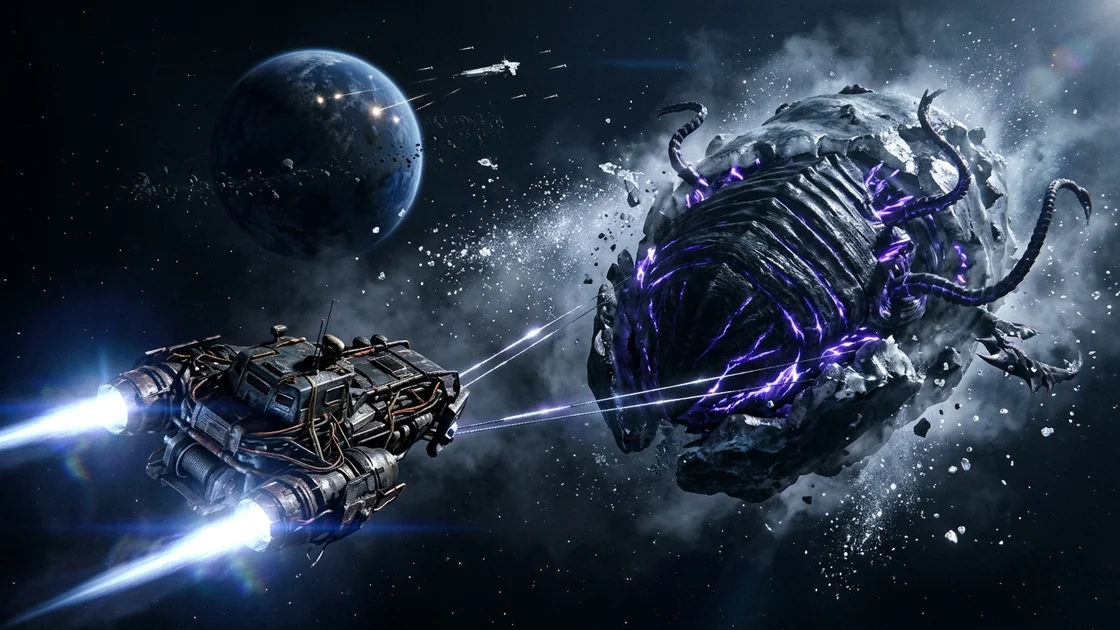
Mara Vance, a disgraced and grieving deep-space salvage pilot, discovers an ancient, dormant cosmic leviathan encased in ice within the perilous Tartarus Drift. Driven by vengeance against the Zenith Consortium blockade fleet that ruthlessly destroyed her freighter and killed her crew over the starving colony world of Veridia, she rigs her battered salvage tug to the colossal beast. Over a grueling multi-week haul through the dark, Mara battles failing ship systems, radiation sickness, a suspicious Consortium patrol cutter, and the terrifying realization that her cargo is slowly waking up, all to deliver the starving apex predator directly into the heart of the fleet that took everything from her.
The pneumatic drill bucked against Mara’s chest plate, its tungsten-carbide bit screaming a silent, vibration-only song through the soles of her magnetic boots. Around her, the Tartarus Drift hung in a state of suspended violence. Billions of tons of shattered planetary crust, frozen methane bergs, and the rusted husks of pre-collapse colony ships drifted in a slow, grinding waltz around a dead brown dwarf.
Mara adjusted her stance, triggering the stabilizing thrusters on her scarred EVA rig. A short burst of cold nitrogen gas pushed her firmly down against the surface of the object she had spent seven months and the last of her black-market fuel cells hunting.
To the standard radar sweep of a commercial prospector, the mass beneath her boots was nothing more than Asteroid 884-Delta—a rogue chunk of carbonaceous chondrite coated in a forty-meter rind of dirty sulfur-ice and frozen ammonia. It was three kilometers long, roughly cylindrical, and utterly worthless to the strip-mining guilds.
To the deep-core seismic thumpers Mara had planted three hours ago, however, 884-Delta wasn’t rock at all.
She glanced down at the wrist-mounted display of her suit. The sonar return showed a dense, segmented carapace beneath the ice, ribbed like the hull of an ancient dreadnought, housing a cavernous internal geometry of calcified chambers, dormant fluid sacs, and a central nervous conduit thicker than a highway tunnel. At the very center of the mass, a faint, erratic thermal signature pulsed once every forty-two minutes.
It was alive. It had been sleeping in the freezing dark between the stars since before humanity learned to chip flint, waiting for the stray warmth of a passing star—or the rich, electromagnetic banquet of a fusion reactor—to thaw its sluggish blood.
"Anchor point four is seated," Mara muttered, her voice raspy in the stale, recycled air of her helmet. There was no one left to hear her on the local frequency, not anymore, just the low, sympathetic hum of her ship’s automated relay three hundred meters overhead. "Dropping the thermite sleeve."
She reached to her belt, unclipping a heavy cylinder of magnesium-thermite paste, and shoved it deep into the borehole she had just drilled. With a twist of her gauntleted wrist, she armed the fuse and kicked off the surface.
Her suit thrusters coughed, arresting her upward momentum fifty meters above the ice. Below her, a muffled flash of violet light bloomed beneath the translucent rime. The ice didn't shatter; it flashed straight into superheated steam that vented through the borehole in a violent, glittering geyser, instantly freezing into a cloud of diamond dust that pattered harmlessly against her visor.
Before the melted channel could refreeze, Mara triggered her wrist remote.
Above her hung the Iron Leech, a seventy-year-old Kestrel-class heavy salvage tug that looked like a flying sledgehammer welded to a pair of oversized fusion torches. A winch bay on the tug’s belly ground open, and a heavy harpoon—forged from depleted uranium and trailing a braided carbon-nanotube hawser the thickness of a man’s thigh—shot downward on a pillar of solid-fuel exhaust.
The harpoon slammed straight down the molten shaft, punching through the last few meters of slush until its barbed tip struck the underlying carapace. The explosive bolts inside the harpoon head detonated, splaying four molecular-bond grapples directly into the ancient, armor-plated hide of the beast.
A tremor ran through the asteroid. Mara felt it even in the vacuum, a low-frequency electromagnetic ripple that made the heads-up display inside her helmet flicker into static for a terrifying three seconds.
Down in the dark, beneath forty meters of primordial ice, something had felt the sting.
"Easy, you old bastard," Mara whispered, her heart hammering against her ribs like a trapped bird. Her gloved hand hovered over the emergency release toggle that would sever the cable. "Go back to sleep. Dinner isn't ready yet."
She waited. Five minutes ticked by on her chronometer. The electromagnetic spike faded back into the ambient static of the brown dwarf’s magnetosphere. The forty-two-minute heartbeat down in the core didn't speed up. The sting had been nothing more than a flea bite on the back of a slumbering elephant.
Mara let out a breath that fogged the lower rim of her faceplate. Four anchors were down. Four cables were locked. It was time to haul.
The airlock of the Iron Leech smelled of burnt hydraulic fluid, unwashed wool, and the metallic tang of cheap oxygen scrubbers pushed three months past their replacement cycle. Mara stripped off her helmet, shaking out a tangle of cropped, premature-gray hair, and spat a mouthful of coppery saliva into the deck grating. Her gums were bleeding again—the early stages of low-grade radiation poisoning from living too close to an unshielded aftermarket reactor.
She didn't care. She didn't plan on needing her teeth for much longer anyway.
Pulling herself through the zero-G companionway, she strapped into the pilot’s couch on the cramped flight deck. The cockpit was a claustrophobic coffin of exposed wiring bundles, retrofitted analog gauges, and cracked CRT monitors held together with silver duct tape. Taped to the top of the primary navigation console was a singed plastic photograph showing four people standing on the loading ramp of a gleaming, wide-bodied bulk freighter.
Calypso’s Burden.
Mara’s fingers brushed the edge of the photo. Her younger brother, Toby, grinned out from the melted plastic, an oversized wrench slung over his shoulder, standing beside Lin, their chief engineer, and Jaxon, their navigator. They were all dead now. Vaporized in high orbit over Veridia six months ago because Commodore Viktor Kaelen of the Zenith Consortium decided that an unregistered ship carrying pediatric antibiotics and water-purification membranes constituted an "insurrectionist supply threat."
Kaelen hadn't even boarded them. He hadn't fired a warning shot across their bow. He had simply ordered the heavy battlecruiser Aegis of Dawn to test its forward railgun batteries on a slow, unarmed civilian hull, turning four hundred thousand tons of mercy cargo and three good people into a glittering debris ring that still rained metallic ash down on Veridia's night side.
Mara had only survived because she had been out in the freighter’s work pod, sixty kilometers off the port bow, repairing a misaligned comms dish when the tungsten slugs hit. She had watched her home, her family, and her life turn into a brief, silent star against the dark.
"All right, Toby," Mara said softly, flipping the heavy brass master switches overhead. "Let's see what sixty megawatts of stolen torch power can do."
The Iron Leech shuddered as the main reactor came out of standby. Warnings immediately cascaded across the secondary monitors in angry amber text: COOLANT PRESSURE LOW. MAGNETIC CONTAINMENT FLUX AT 84%. PORT WINCH DRUM TENSION UNCALIBRATED.
She cleared the warnings without reading them. With her left hand, she engaged the four heavy towing winches, reeling in the slack on the carbon-nanotube hawsers until the tug sat two kilometers ahead of the ice-encrusted leviathan. With her right, she nudged the micro-thrusters, aligning the tug’s nose with the narrow gravitational corridor that led out of the Tartarus Drift and toward the inner system.
"Taking up the slack," she murmured.
The cables went taut. For a second, nothing happened. The mass of the asteroid was nearly four million metric tons; the Iron Leech weighed barely twelve thousand. It was an ant trying to drag a dead ox across a sheet of glass.
When the last millimeter of play vanished from the braided lines, the tug stopped dead, its forward momentum transferred into the immense inertia of the rock. The structural ribs of the Leech let out a sound like a submarine hull descending past its crush depth—a long, agonizing shriek of stressed titanium that vibrated straight through Mara’s pelvic bone. A rivet popped from the bulkhead behind her head and ricocheted off the environmental control panel like a pistol shot.
"Come on, girl. Hold together," Mara gritted out, easing the main throttle forward by two percent.
Twin spears of blinding blue-white fusion plasma erupted from the tug’s rear bells, carefully angled fifteen degrees outward so the exhaust plume wouldn't wash directly over the ice berg behind them, though at two kilometers out, the radiant heat alone was enough to make the surface frost of the asteroid shimmer and sublimate into a ghostly coma.
The strain gauges climbed into the red. Ten thousand kilonewtons. Twenty thousand. Thirty.
On the rear camera feed, the massive, pitted bulk of 884-Delta refused to budge. The winches groaned, their magnetic brakes smoking as the drums slipped half a turn, filling the lower cargo bay with the acrid stench of scorching synth-grease.
Mara didn't back off. Instead, she pushed the throttle to five percent and locked the winch drums with the mechanical dead-bolts—hard titanium pins driven directly through the gears. If the cables snapped now, the recoil would whip back and slice the Iron Leech in half. If the structural frame failed, the engine section would tear itself right off the back of the cockpit, leaving her to suffocate in a tin can.
For forty seconds, the ship existed in a purgatory of violent vibration. The instrument panels blurred in front of her eyes. Her teeth rattled in her bleeding gums.
Then, slowly, imperceptibly at first, the starfield on the forward viewport shifted by half a degree.
The accelerometer ticked upward: 0.01 m/s².
Newton’s laws were cold and unforgiving, and in the frictionless vacuum of the void, even a mountain had to yield to a persistent enough push.
Mara let out a ragged laugh, slumping back into the torn faux-leather of the acceleration couch. The rock was moving. At their current rate of acceleration, building velocity over the next eighteen days before executing a high-G braking maneuver—a maneuver that didn't actually involve braking at all—she would cross the three hundred million kilometers to Veridia right on schedule.
Just as she reached for the water bulb velcroed to her armrest, the seismic monitor wired to the four harpoon tips let out a sharp, high-pitched ping.
Mara froze. She leaned forward, squinting at the green phosphor trace of the oscilloscope.
Down in the frozen core of the asteroid, the creature’s heartbeat had just pulsed again. Not after forty-two minutes. After eleven.
The warmth of her fusion plumes, combined with the deep, resonant vibrations of the tow cables humming like giant bass strings anchored directly into its shell, was filtering down through the ice.
The leviathan was beginning to dream.
The first ten days of the haul were an exercise in mechanical martyrdom.
A salvage tug was never meant to sustain a continuous burn for more than seventy-two hours. Its reactors were designed for high-torque bursts—yanking a stranded ore barge out of a decaying orbit or dragging a gutted frigate into a scrapper’s drydock. Running the Ceres Heavy Industries Tokamak at forty percent capacity day after day turned the interior of the Iron Leech into a sweltering, radioactive sauna.
By day twelve, the ambient temperature in the living quarters had climbed to thirty-eight degrees Celsius. The primary ammonia loop for the radiators had sprung a pinhole leak somewhere in the starboard dorsal spine, and Mara didn't have the spare EVA propellant to go outside and weld it shut while under thrust. Instead, she stripped down to her grease-stained thermal tank top and cargo trousers, wrapping a wet rag around her neck as she crawled through the maintenance Jeffries tubes with a tube of high-temp epoxy and a wrench.
Thump-thump.
She paused in the cramped aluminum tunnel, her elbows slick with sweat. The sound hadn't come from the reactor room. It had come through the hull plating itself—a dull, sub-audible vibration conducted up the two-kilometer length of the hyper-tensile tow cables, into the winch housings, and straight through the keel of the tug.
Thump-thump.
Every four minutes now.
Mara wiped her forehead with the back of her arm, leaving a streak of black molybdenum grease across her pale skin, and wormed her way forward toward the cockpit. When she pulled herself up through the deck hatch, the optical feeds from the stern cameras made her stop short.
The asteroid had lost nearly thirty percent of its ice mass.
The radiant heat of the Leech’s twin plasma plumes had stripped away the outer shell of frozen methane and dirty snow, trailing a magnificent, glittering tail of ionized vapor millions of kilometers long behind them—a man-made comet plunging sunward. And poking through the melting slush, like the knuckles of a drowned giant rising from a muddy riverbed, were the first exposed plates of the creature’s true body.
Mara zoomed the camera in by a factor of twenty.
It wasn't biological in any way that Earth-born life understood the word. The carapace looked like layered slate forged in the heart of a dying star, shot through with crystalline veins of raw quartz and copper that pulsed with a faint, bioluminescent indigo light every time that distant heart beat. Along the dorsal ridge, where the ice had cracked apart along a kilometer-long fissure, rows of folded appendages lay tucked against the body—not tentacles, precisely, but segmented, whip-like limbs tipped with heavy, lance-like claws designed to pry open the hulls of whatever ancient cosmic prey it had once hunted—or the crust of planetoids rich in heavy metals.
In the spacer bars on Ceres and Ganymede, the old prospectors called them Ouroboros worms, or Star-Gorgers. The Zenith Consortium’s Xenobiology Division officially denied they existed at all, even after a deep-core mining rig in the Kuiper Belt accidentally drilled into a dead juvenile forty years ago and triggered a dormant bio-electric discharge that slagged three refining platforms.
Mara knew about this one only because Jaxon, her dead navigator, had spent ten years flying survey drones for a crooked Consortium subcontractor before joining the Calypso’s Burden. Three nights before Kaelen blew them out of the sky, Jaxon had gotten drunk on synthetic plum wine in the mess hall and shown Mara and Toby a decrypted magnetic tape he’d stolen when he quit.
"They found it in the Tartarus Drift during the Second Expansion," Jaxon had slurred, tapping the grainy sonar printouts on the table while Toby stared with wide, boyish eyes. "Biggest intact specimen in the sector. The Consortium wanted to tow it to a black-site lab near Titan to study how its carapace absorbs kinetic energy and converts it straight into metabolic charge. Best armor in the universe—the harder you shoot it, the stronger it gets. Only problem was, the research vessel they sent to tag it had a reactor leak. The beast smelled the neutrons, woke up halfway through the prep phase, and ate the ship whole. When the rescue fleet arrived a month later, it had already curled back up and frozen itself inside an ammonia comet. They marked the coordinates as a navigational hazard and buried the file."
"Why didn't they nuke it while it was sleeping?" Toby had asked, leaning over the table.
Jaxon had laughed, a dry, humorless sound. "With what, kid? A fifty-megaton fusion warhead is just a three-course meal to a Star-Gorger. It eats radiation and kinetic force. The only way to kill one is to leave it in the cold until entropy does the job in a few billion years."
Mara stared at the indigo veins pulsing on the monitor. The memory of Toby’s voice was so sharp in the quiet cockpit that she half-expected to turn around and see him sitting in the co-pilot’s chair, tossing a hydro-spanner from hand to hand the way he always did when he was nervous.
Instead, the chair was empty, piled high with ration wrappers and spare air filters.
A sudden chime from the long-range radar array broke the silence. It wasn't the sluggish amber blink of a diagnostic fault. It was the sharp, double-tone klaxon of an active military transponder sweep.
Mara vaulted into the pilot’s seat, her soreness instantly forgotten beneath a flood of cold adrenaline. She killed the cabin lights and pulled the sensor hood over her face, peering into the green-tinted tactical display.
They were still four days out from Veridia’s orbital plane, skimming the ragged outer edge of the system’s Oort cloud where the Consortium rarely bothered to patrol. Yet there it was, forty thousand kilometers off her port bow and closing fast on an intercept vector: a Shrike-class fast revenue cutter, registry ZCS Viper’s Tooth.
"Damn it," Mara hissed.
She hadn't counted on picket ships this far out. The blockade around Veridia must have tightened since she fled the system five months ago; Kaelen was probably hunting down the smuggler skiffs that used the outer cometary halo as a staging ground to drop supplies into the planet's oceans.
Before she could even reach for the reactor dampers to mask her thermal signature, the comm unit crackled to life with the harsh, high-gain hiss of a military laser-link.
"Unidentified salvage vessel," a crisp, bored voice barked through the speaker. "This is Lieutenant-Commander Vane of the Zenith Consortium Cutter Viper’s Tooth. You are operating on an unfiled vector within the Veridia Exclusion Zone. Cut your main drives immediately and prepare for transponder verification and cargo scan. Acknowledge."
Mara looked at the tension gauges on her winches. If she cut her main drives now, the Iron Leech would stop accelerating, while four million tons of half-thawed leviathan two kilometers behind her kept right on moving at forty-two kilometers per second. The asteroid would overrun her tug in less than a minute, squashing the Leech like a bug against a windshield.
To slow down safely, she would have to detach the cables, swing out of the asteroid's path, and let her prize drift off into the dark on a trajectory that would miss Veridia by half a million kilometers—and she would never have the fuel or the reactor life to catch it and bend its vector a second time.
She grabbed the microphone, pitching her voice into the gravelly, half-senile whine of a deep-belt burn-out. She also flipped a switch on the audio board that injected a heavy dose of static and phase-distortion into her transmitter.
"Uh, copy that, Viper’s Tooth," Mara rasped, coughing wetly into the mic for good measure. "This is the independent tug Rusty Nail, outbound from the Tartarus claims to the smelter yards at L4. Look, Lieutenant, I can't cut my torches right now. I got three million tons of low-grade nickel-slag on a rigid tow-bar behind me, and my retro-thrusters are busted. If I kill the forward pull, my own rock’s gonna play bowling ball with my stern. Over."
There was a long pause on the line. Mara watched the tactical display as the cutter adjusted its vector, matching her speed and sliding into a parallel track fifty kilometers off her port beam. At that range, the cutter’s twin autocannons and point-defense lasers could turn the Iron Leech into swiss cheese in four seconds flat.
"Vessel Rusty Nail," Vane’s voice returned, noticeably sharper. "Your transponder is broadcasting a garbled civilian code from a vessel registered as scrapped in drydock three years ago. Furthermore, our thermal imaging shows your tow-mass is venting significant quantities of volatiles and exhibiting anomalous internal energy signatures. Release your tow cables at once and heave to for a boarding party, or we will sever the lines with our lasers and disable your engines."
Mara’s jaw tightened. A boarding party meant an identity scan. An identity scan meant they would recognize the former captain of the Calypso’s Burden, wanted for corporate sabotage and evasion of quarantine. And worse, if they scanned the asteroid up close, they would see what was beneath the melting ice.
She looked at the oscilloscope. Thump-thump. Two minutes between beats now. The indigo veins on the rear camera were glowing bright enough to cast eerie violet shadows across the remaining shelves of dirty ice.
The cutter was closing the distance—forty kilometers, thirty-five, thirty—moving in behind the tug to get a clear line of sight on the tow cables and the anomalous mass.
"You really want a closer look, Lieutenant?" Mara whispered to the empty cockpit. "Be my guest."
She keyed the mic again. "All right, all right, don't shoot! My mechanical release pins are jammed from the haul, Commander. I gotta dump my auxiliary reactor plasma through the umbilical heaters to melt the ice off the winch drums before the Explosive Bolts will fire. Stand by—it’s gonna look a little bright on your scopes, don't get trigger-happy!"
"Negative, Rusty Nail!" Vane snapped. "Do not vent plasma! Maintain current reactor state and—"
Mara switched off the receiver.
Her hands flew across the engineering board. Running alongside the four carbon-nanotube tow cables was a fifth line—a heavy-duty power and coolant umbilical usually used to pump electrical charge into dead ships during salvage recovery so their stabilizing gyroscopes could be spun up. Right now, the end of that umbilical was jammed directly into the central borehole she had drilled right above the creature’s primary dorsal nerve cluster.
She didn't have enough power to wake the beast fully—not yet, not without blowing her own reactor core completely—but she had enough in the auxiliary capacitor banks to give it a very rude prod.
"Hold onto your teeth, Toby," she breathed, and slammed the capacitor discharge lever home.
Forty megajoules of raw, unmodulated electrical current surged out of the Iron Leech’s belly, racing down the two-kilometer umbilical in a blinding blue arc that ionized the trail of water vapor between the tug and the rock.
On the stern camera, the entire three-kilometer length of the asteroid lit up from within like a struck match.
For two seconds, there was absolute silence across the electromagnetic spectrum. Then, the deep-core seismic monitor didn't just ping—its needle slammed hard against the right-hand pin, shattering the glass face of the dial.
Beneath the melting ice, the Star-Gorger twitched in its sleep.
It wasn't a conscious movement, just a titanic autonomic reflex—the cosmic equivalent of a sleeping dog kicking its leg when touched by a hot coal. One of those kilometer-long dorsal fissures split wide open with a soundless explosion of pulverized sulfur-ice. Out of the gap lashed a single, segmented whip-limb, moving at a fraction of relativistic speed, driven by bio-magnetic muscles that generated a localized EMP spike equivalent to a tactical nuclear detonation.
The Viper’s Tooth had closed to within twelve kilometers of the asteroid's flank, right in the path of the outgassing debris cloud.
The EMP wave hit the cutter first. Mara watched on the optical feed as the sleek military vessel's running lights, shield emitters, and maneuvering thrusters winked out instantaneously. The Leech, shielded by two kilometers of distance and Mara's pre-emptive grounding of her own archaic analog systems, only suffered a shower of sparks from the overhead lighting bus.
Blind, dead in space, and coasting on its previous intercept vector, the Viper’s Tooth drifted helplessly inward as the creature’s reflexively lashing claw swept through the vacuum.
The limb didn't even target the ship. It simply swept across the space the cutter happened to occupy.
Three thousand tons of Consortium alloy, ceramic armor, and thirty-two crewmen met a solid wall of hyper-dense silicon-plate moving at four kilometers per second. There was no dramatic fireball—in the vacuum, the cutter simply folded in half like a stepped-on tin can, its hull plates delaminating in a silent spray of spinning metallic confetti as its main fusion bottle ruptured without igniting, venting a brief, pathetic puff of helium-3 into the dark before the wreckage tumbled away into the Oort cloud.
Slowly, sluggishly, the massive whip-limb retracted back into the dorsal fissure. The indigo glow faded back to a dull, rhythmic throb. The creature, still ninety percent frozen and starved of the massive energy threshold required to achieve full consciousness, settled back into its torpor, having barely registered the speck of metal it had brushed aside.
Mara sat frozen in her chair, her chest heaving, staring at the expanding cloud of debris dwindling behind her on the rear monitor.
One of the четыре tow cables—Anchor Point Two—had snapped during the spasm. The severed line trailed behind the tug like a frayed spiderweb, its winch drum warped and smoking inside the lower bay. The remaining three cables were screaming at ninety-eight percent of their maximum tensile limit, vibrating so hard that the entire flight deck felt like the inside of a blender.
If the beast twitched like that one more time before they reached Veridia, the remaining three lines would part, and the Iron Leech would be swatted into atoms just like the cutter.
Mara reached up with a trembling, grease-blackened hand and pulled the throttle back by ten percent, easing the tension on the lines just enough to keep them from parting.
"Message received," she whispered to the monster behind her. "No more shocks until we reach the table."
Veridia hung in the void like a bruised sapphire wrapped in chains of iron.
From two hundred thousand kilometers out, dipping below the ecliptic plane on her final high-speed approach, Mara didn't even need the long-range telescope to see the blockade. The high-orbital band of the planet was choked with the harsh, artificial stars of Consortium station-keeping drives.
Eighteen warships formed an interlocking spherical cage around the world below. There were six Broadside-class heavy frigates, eight orbital suppression monitors, three fleet carriers, and there—holding stationary orbit directly above Veridia’s primary spaceport of New Meridian—sat the flagship.
The Aegis of Dawn.
A mile and a half of gleaming white composite armor, bristling with twin spinal-mount railguns, point-defense laser batteries, and torpedo tubes capable of glassing a continent. Under Commodore Viktor Kaelen’s command, that ship had sat on the throat of four million colonists for eight months, intercepting every grain barge, shooting down every atmospheric lifter that rose above forty thousand feet, waiting for the independent miners union on the surface to starve hard enough to sign over their mineral rights in perpetuity.
Mara’s eyes burned as she looked at the tactical readout of the flagship. Just sixty kilometers below the Aegis’s keel, caught in a slowly decaying equatorial orbit, was a faint, diffuse smear of metallic particulate flagged by the Consortium's automated navigation beacons as Debris Hazard 409.
That smear was all that remained of the Calypso’s Burden. That was Toby’s grave.
Inside the cockpit of the Iron Leech, the environment had deteriorated into a vision of hell. The radiation alarm had burned out its speaker coil twelve hours ago, leaving only a frantic red strobe flashing silently against the sweat-slicked walls. Mara’s skin was blistered with radiation erythema; a bloody rag was tied around her mouth to catch the constant seep from her gums, and her left hand was splinted to the throttle lever with two steel wrenches and medical tape after a whipping winch cable had fractured her wrist through the deck plating the day before.
The tug was dying around her. The port fusion bell had melted thirty percent of its magnetic nozzle away, slewing the thrust vector slightly sideways so that she had to constantly burn the starboard maneuvering thrusters just to keep nose-forward.
And behind her, two kilometers back at the end of three fraying carbon ropes, the mountain was wide awake.
It hadn't broken free of the remaining ice yet, only because it was conserved by the ancient, ruthless instinct of a void-predator: never expend calories until the prey is within reach. But the sensors on the harpoon tips were completely maxed out. The internal temperature of the carapace had risen by four hundred degrees. The forty-two-minute heartbeat was now a continuous, thrumming purr of bio-plasma circulating through veins of living crystal, drinking in every stray watt of heat and gamma radiation leaking from the Leech’s dying reactor.
More than that—it could smell the fleet ahead.
Eighteen military-grade fusion reactors, pumping out terawatts of electromagnetic noise, gravimetric waves, and neutrino flux, were broadcasting an all-you-can-eat dinner bell across the vacuum. For the last six hours, Mara hadn't actually been towing the creature at all; the remaining three cables had gone slightly slack as the beast used subtle, rhythmic undulations of its bio-magnetic field to surf the gravitational wake of the planet ahead, practically pushing the tug toward the blockade line.
"Come on, you bastards," Mara croaked through the bloody rag, her eyes glued to the threat-warning receiver. "Spot me. Lock onto me."
At one hundred and fifty thousand kilometers out, coming in at a blistering sixty-eight kilometers per second on a steep ballistic plunge that aimed straight at the center of the blockade formation above New Meridian, the fleet finally noticed the comet.
The comm console lit up across every emergency guard band simultaneously.
"Unidentified tug and tow-mass on inbound ballistic vector!" The voice was booming, resonant, and backed by the unmistakable acoustic echo of a flagship’s combat information center. "This is Tactical Control aboard the ZCS Aegis of Dawn. You are on a direct collision trajectory with the high-orbital defense grid of Veridia! Alter your vector by thirty degrees immediately or you will be engaged with lethal force!"
Mara didn't answer. She used her good right hand to unstrap the singed photograph of Toby, Lin, and Jaxon from the console, tucking it carefully into the breast pocket of her flight suit over her heart.
"Unidentified vessel, this is your final warning!" Tactical Control barked. On the radar scope, three frigates on the outer picket line were already slewing their noses around, charging their forward particle lances. "Our sensors indicate you are hauling an unregistered asteroid mass of three point eight million tons. We are reading this as a kinetic strike attempt by Veridian insurgents. Divert now, or we will shatter your tow-mass and vaporize your craft!"
Shatter the tow-mass.
Behind her bloody mask, Mara smiled. It was a terrifying, broken expression.
She keyed the broadcast toggle—not on the private laser-link, but on the wide-band civilian open channel that every ship in orbit and every receiver dish on the surface of Veridia below could hear.
"Aegis of Dawn," Mara’s voice rasped across the system, raw and echoing with the scream of her dying reactor. "This is Captain Mara Vance of the heavy freighter Calypso’s Burden. Registry four-four-nine-Echo."
Silence fell over the guard frequency for three heartbeats.
When a voice came back, it wasn't the tactical officer. It was colder, older, and clipped with the patrician arrogance of the Core Worlds. Commodore Viktor Kaelen himself had stepped up to the command podium.
"The Calypso’s Burden was destroyed six months ago for violating martial quarantine," Kaelen said smoothly, though there was an edge of irritation beneath the polish. "Whoever you are, insurgent, your primitive kinetic rock-drop is pathetic. A mass of that size moving at seventy kilometers per second will be pulverized into harmless gravel by my fleet’s railgun batteries before it comes within eighty thousand clicks of our perimeter. Fire Control—solutions on the tug and the asteroid. Clear the sky."
"You think I brought you a rock, Kaelen?" Mara whispered into the mic, her right hand closing around the red-and-black striped handle of the reactor core purge lever. "You really think I came all the way back from the dead just to throw a stone at your shield grid?"
At ninety thousand kilometers out, the blockade fleet opened fire.
Across the bow of the Aegis of Dawn and four flanking heavy frigates, a dozen electromagnetic railguns flashed in silent, synchronized fury. Twelve solid slugs of depleted uranium, each weighing two tons and accelerated to four percent of the speed of light, crossed the ninety-thousand-kilometer gap in less than eight seconds.
Two of the slugs were aimed at the Iron Leech.
Mara had been counting the seconds in her head. At second six, she kicked the starboard attitude thrusters to maximum override, blowing out the last of her cold-gas reserves in a violent sideways jolt that slewed the little tug four hundred meters off its central axis, snapping the last three carbon-nanotube tow cables like dry twine.
The two railgun slugs meant for her shrieked past her port viewport so close that the relativistic wake of their passage cracked the outer layer of the cockpit’s armored glass and tore the external comms antenna clean off the hull.
The other ten slugs hit the asteroid dead center.
In any normal engagement, ten multi-gigajoule kinetic impacts striking a carbonaceous asteroid simultaneously would have turned it into an expanding cloud of harmless rubble and vaporized dust.
And for the first three seconds, that was exactly what the bridge crew of the Aegis of Dawn thought had happened.
The last remaining crust of dirty ammonia ice, porous rock, and frozen sulfur encasing the Star-Gorger exploded outward in a magnificent, blinding halo of white steam and pulverized gravel thirty kilometers wide. The shockwaves of the impacts hammered straight into the three-kilometer hull beneath.
Only the hull didn't shatter.
Every single joule of kinetic and thermal energy from ten battleship-grade railgun strikes—hundreds of terajoules of raw, violent force—was drunk straight in by the crystalline piezoelectric matrices of the creature’s carapace.
On Mara’s tumbling, powerless optical screen, as the Iron Leech spun wildly away from the blast zone like a discarded seed pod, she watched the cloud of ice vapor clear.
Floating in the center of the expanding ring of glittering frost was no longer a rock.
It was a three-kilometer-long leviathan of midnight-black armor plate and blinding, incandescent violet light. The ten railgun impacts hadn't even scratched the slate-like hide; instead, the kinetic shock had instantly supercharged the beast’s dormant metabolic capacitors from ten percent to a hundred and forty percent capacity.
Every dorsal fissure along its back slammed open at once. Dozens of kilometer-long, segmented whip-limbs uncoiled into the vacuum like the wings of a waking dragon. At the anterior end of the titan, four massive, mandible-like plates of jagged silicon split apart, revealing a cavernous maw lined with concentric rings of magnetic plasma-siphons that glowed with the terrifying, hungry heat of a miniature star.
Before she drifted completely out of range, Mara had one last card to play—one final signpost to point the starving god toward its meal.
Her tug was still tumbling sixty meters ahead of the beast’s opening maw, her jury-rigged power umbilical still trailing right down into the creature’s primary sensory spiracle. With her broken left hand bracing her weight against the spinning console, she used her right to yank the reactor core purge lever all the way out of its housing.
The rear magnetic containment bottle of the Iron Leech blew apart.
Sixty tons of superheated deuterium-tritium plasma, laced with heavy metals and unburnt nuclear fuel, vented straight out the back of the tug in a directional spear of radioactive fire that washed directly across the Star-Gorger’s sensory organs—the cosmic equivalent of splashing a bucket of warm blood across the snout of a waking shark—while the reactive force of the blowout kicked the severed cabin section of the Iron Leech hard downward, plunging Mara away from the creature's path and into a steep, grazing entry vector toward Veridia's upper atmosphere.
The last thing her dying short-range radio picked up before the antenna stub melted was the sudden, panicked screaming from the Combat Information Center of the Aegis of Dawn.
"Tactical! The target mass did not fragment! I say again, the target mass did not—what is that on the optical feed?! By God, it’s moving on its own! It’s accelerating against gravity! All batteries, fire at will! Fire at—"
Spinning slowly in the dark, seventy kilometers below the orbital battle-line where the first wispy tendrils of Veridia’s thermosphere began to hiss softly against the scorched belly plates of the wrecked tug, Mara unbuckled her harness and floated up to the cracked overhead viewport.
The cabin was freezing now, the heat leaking rapidly away into the void, the only light coming from the spectacle unfolding in the heavens above her.
The Star-Gorger hit the outer picket line of the blockade at eighty kilometers per second.
The three forward Broadside-class frigates poured everything they had into it—particle beams, nuclear-pumped X-ray lasers, swarms of ship-killer torpedoes that detonated in a string of miniature suns across the creature’s head and shoulders.
It was worse than useless. Every torpedo detonation only made the indigo veins along the leviathan’s flanks flare brighter, swelling its bio-magnetic field until visible auroras of purple and green lightning rippled across three hundred kilometers of space.
The beast didn't use weapons. It simply swam through the vacuum on waves of manipulated gravity, using the Consortium’s own massive orbital mass-shadows as stepping stones. As it passed between the first two frigates, four of its kilometer-long whip-limbs lashed out with blinding speed.
They didn't swat the ships away like the cutter in the Oort cloud. Now the creature was awake, and it was feeding.
The claws punched straight through the frigates' shimmering kinetic shields as if they were soap bubbles, driving deep into the armored engineering sections at the rear of the hulls. Like a man cracking open shellfish, the limbs wrenched the warships apart along their structural spines, plucking the glowing, white-hot magnetic bottles of their fusion reactors directly out of the wreckage and drawing them back into that gaping, luminous maw.
Secondary explosions rippled through the broken halves of the frigates as their magazines cooked off, spilling escape pods like scattering seeds across the black.
Above them, the main body of the fleet was in chaos. The rigid, spherical formation that had strangled a planet for eight months dissolved in ninety seconds as captains panicked, firing thrusters at emergency maximum to break orbit, colliding with their own supply barges and orbital defense platforms in their desperation to get away from the ancient horror eating its way up the gravity well.
Except for the Aegis of Dawn.
A mile-and-a-half-long dreadnought had too much mass to turn on a dime. Kaelen’s flagship was still desperately trying to bring its main thrusters online to climb out of the orbital well, its twin spinal railguns firing frantically every four seconds, pumping round after round of kinetic energy straight into the oncoming monster—feeding it, empowering it, lighting it up like a god of wrath descending upon an altar.
Mara pressed her bruised forehead against the cold, cracked glass of the viewport, her breath coming in shallow, ragged gasps in the thinning air. She pulled the singed photograph from her pocket and held it up against the glass, so Toby, Lin, and Jaxon could see.
Up in the dark, the three-kilometer shadow of the Star-Gorger eclipsed the stars behind the Aegis of Dawn.
The flagship looked like a gleaming white toy beside a mountain of living night. As the leviathan surged upward, wrapping its colossal, segmented body entirely around the hull of the battlecruiser in a crushing, luminous embrace, a massive bio-electric discharge arced from the beast’s carapace through the flagship’s shield grid.
For five seconds, the Aegis of Dawn shone brighter than Veridia’s sun.
Then, with a silent, tectonic heave that flexed the entire three-kilometer length of its spine, the Star-Gorger constricted.
The pride of the Zenith Consortium’s Third Fleet—twelve hundred thousand tons of super-alloy, corporate tyranny, and Commodore Viktor Kaelen’s ambition—snapped clean in two down the middle. Its massive quadruple-core reactor bank ruptured in a silent, expanding sphere of blue plasma that didn't scatter into space, but was sucked inward like a whirlpool into the waiting siphons of the beast’s throat.
When the flash faded, the sky above New Meridian was empty of warships. The few surviving frigates and carriers were already fleeing outward toward the system jump-points on overcharged drives, leaving behind a glittering, silent ring of broken steel that mingled with the six-month-old ashes of the Calypso’s Burden.
Having gorged itself on the heart of the dreadnought and three frigates—more concentrated fusion energy than it had tasted in ten million years—the leviathan didn't look down at the planet below. A world of dirt, water, and low-wattage chemical industry held no interest for a creature born in the hearts of nebulae. Instead, with a slow, majestic undulation of its glowing indigo fins, the titan turned its nose toward the fleeing signatures of the remaining Consortium ships—and beyond them, toward the warm, radiation-rich glare of the system's sun—gliding lazily away into the deep dark like a whale returning to the abyss.
Down in the plummeting, powerless hull of the Iron Leech, the cabin walls began to shudder with the rising roar of atmospheric entry.
Orange plasma licked across the cracked viewport, obscuring the stars and the wreckage above. The tug didn't have a heat shield made for planetary landing, and its main thrusters were gone, blown away into the void to light the fuse of a monster.
Mara drifted back down into the pilot’s chair, strapping the five-point harness tight across her chest with her one good hand. The emergency chemical-fuel retro-packs built into the nose and belly for barge-docking had maybe twelve seconds of burn left in them—not enough to make a soft landing on the dry plains outside New Meridian, not by a long shot, especially with half the hull missing.
Through the static of her short-wave backup crystal—the old, unpowered emergency receiver that ran off a nine-volt battery taped under the dash—a chorus of voices suddenly broke through the roar of the reentry plasma.
"—all surface batteries, stand down, the blockade is broken! Look at the scopes, the bastards are running!"
"—tracking a single civilian hull fragment entering sector four on a steep ballistic decay! That’s the tug that brought it in! Scramble the heavy recovery lifters from Pad Six, get the air-catch nets up before she hits the deck!"
"—hang on, Captain Vance! If you can hear us inside that tin can, pop your drag chutes at thirty thousand feet, Veridia has you on radar! We’re coming up to catch you!"
Mara closed her eyes as the G-forces of the atmosphere slammed her back into the torn leather of the couch, pressing the photograph of her brother flat against her ribs. The cabin was filling with the smell of scorching insulation and hot iron, the roar of the wind outside rising to a deafening, triumphant thunder.
Her hand found the mechanical lever for the high-altitude drogue chutes and locked her fingers around the cold steel.
For the first time in six months, Mara Vance smiled in the dark, and waited for the sky to catch her.
Part II: The Long Fall and the Deep Memory
Before the sky caught her, the gravity took its toll.
At sixty-five thousand feet, the severed forward section of the Iron Leech was no longer a spacecraft; it was a blunted titanium meteorite wrapped in a sheath of ionized nitrogen. Inside the cockpit, the deceleration climbed past five Gs, then six, then seven. The blood drained from Mara’s head, turning the edges of her vision into a narrow, gray tunnel where the only things that existed were the glowing orange cracks in the forward armored glass and the frantic, rattling needle of the mechanical altimeter.
In the oxygen-starved twilight of high-G blackout, time lost its rigid, Newtonian edges. The roar of Veridia’s atmosphere tearing at the hull plates blurred into another roar entirely—the sound of the main air-circulation fans aboard the Calypso’s Burden six months ago, humming their steady, comforting bass note through the deck plates of a ship that still had a crew, a purpose, and a future.
“You’re pushing the नंबर three scrubber too hard, Mara,” Lin had said, wiping her hands on an oily rag as she leaned against the hatchway of the freighter’s galley. Outside the viewport, the blue-green curve of Veridia was just rising over the bow, still forty thousand kilometers away, peaceful and deceptive in the silent dark. “We’ve got forty tons of medical-grade lithium-hydroxide canisters sitting in Hold Two for the colony clinics. If we burn out our own CO2 beds before we make orbit, I’m going to have to crack open the cargo just to keep us breathing on the trip back to Ceres.”
“We won’t need a full load for the trip back,” Toby had chimed in from the mess table, where he was carefully soldering a replacement capacitor onto the circuit board of an old agricultural drone he’d promised to fix for one of the surface co-ops. He was twenty-two years old, all gangly limbs and grease-smudged optimism, wearing an oversized jumpsuit with the faded patch of the Martian Merchant Marine Academy—an academy he’d had to drop out of when their father’s lung-rot bills ate the family savings. “Once we offload the cargo mass, the Burden’s gonna be light as a feather. Jaxon says we can catch the lunar slingshot off Cinder and shave four days off the return transit.”
“Assuming the Consortium harbor master doesn’t impound us for bureaucratic insolence,” Jaxon had muttered from behind his mug of black chicory coffee, his dark eyes fixed on the long-range traffic spectrum. Even then, hours before the interception, the former Consortium survey pilot had smelled something wrong in the ether. “Look at the transponder density in the high equatorial band, Cap. That’s not a customs inspection picket. Those are military fleet carriers and heavy cruisers. Kaelen’s Third Fleet moved in three days ahead of the published quarantine deadline. They aren't checking manifests anymore—they’re sealing the tomb.”
Mara remembered how she had stood behind Jaxon’s chair, her hands resting on the cold aluminum rail of the navigation pit, weighing the math that every independent captain in the Outer Rim eventually had to face. In the cargo holds behind them were twelve thousand ampoules of synthetic insulin, four hundred atmospheric membrane filters for the subterranean mining habs where the silicate dust was choking the children to death, and eighty tons of high-protein soy-mash. Every ounce of it had been paid for with the pooled life savings of three thousand Veridian miners who had gone on strike when the Zenith Consortium cut their oxygen rations by twelve percent to force a productivity hike.
If she turned the Calypso’s Burden around at the edge of the zone, they would lose their bond, the food would spoil in the unrefrigerated holds before they could find another buyer, and four hundred kids down in the Red Canyon shafts would die of black-lung complications before the winter solstice.
“We have a valid humanitarian clearance seal from the Geneva Orbital Court,” Mara had said—and God, looking back through the haze of radiation sickness and seven-G deceleration, how naive her own voice sounded in her ears. She had actually believed that a piece of embossed paper signed by a magistrate four light-years away meant something to a man with twin spinal railguns. “The Consortium charter says non-combatant medical relief vessels under fifty thousand tons are exempt from commercial blockades, provided we submit to an orbital trajectory inspection. I’ll go out in the work pod and fix the secondary high-gain dish on the port spar so we can broadcast our manifest clearly on all bands. Toby, you keep the reactor throttled down to twenty percent so we don't look threatening. Jaxon, hail the flagship as soon as I get the dish aligned.”
That was why she had been outside.
She remembered the cold, sterile silence of the single-seat maintenance pod as she floated sixty kilometers off the Burden’s port bow, using the manipulator arms to bolt a new waveguide onto the freighter’s detached relay buoy. Through the pod’s headset, she had heard Jaxon’s calm, professional voice broadcasting on the open guard band:
“Consortium Flagship Aegis of Dawn, this is the unregistered humanitarian relief freighter Calypso’s Burden, inbound at twelve kilometers per second on vector zero-four-zero. Our weapons bays are empty—we don't even have point-defense lasers mounted. We are carrying pediatric medical supplies and atmospheric scrubbers under Geneva Charter Exemption Seven. We are cutting our main drive now and awaiting your boarding cutter. Over.”
And she remembered Toby’s voice breaking in over the inter-ship work channel, private between the freighter and her pod, laughing softly to keep his nerves down: “Hey, Mara, when we get down to New Meridian, tell old man Krovik he owes me two crates of real apples for fixing his reaper drone. I’m sick of drinking vitamin paste.”
She had opened her mouth to answer him. She had her thumb on the push-to-talk switch.
Then the Calypso’s Burden ceased to exist.
There was no warning klaxon. No missile lock tone, because a kinetic railgun slug has no active seeker head to trigger an electronic countermeasures suite. Just two silent, invisible needles of depleted uranium traveling at twelve thousand kilometers per second, punching straight through the freighter’s bow and exiting through the main fusion reactor at the stern.
From sixty kilometers away, the ship didn't explode with a roar; it simply turned into an expanding flower of silent white light and molten steel. The shockwave of vaporized hull alloy and escaping atmosphere took four seconds to cross the vacuum and slam into Mara’s work pod, sending her tumbling end-over-end into the dark while the radio in her ears filled with a brief, terrifying burst of static—and then nothing at all.
Just Commodore Kaelen’s voice, five minutes later, broadcasting across the sector to the three other civilian freighters trailing behind the Burden at the edge of the system:
“Let that serve as a navigational notice to all independent hulls. The Veridia Quarantine is total. Any vessel crossing the three-hundred-thousand-kilometer demarcation line will be classified as a kinetic weapon and broken up in orbit. Have a productive standard day.”
BANG.
A sound like a cannon shot directly above her head jolted Mara out of the black tunnel of memory.
The altimeter needle was spinning past thirty-two thousand feet. Without conscious thought, operating entirely on the deeply ingrained muscle memory of thirty years in the black, her right hand had yanked the mechanical release for the high-altitude drogue chutes.
Outside the scorched titanium shell of the cockpit, three ribbons of braided Kevlar-tungsten mesh exploded from their mortar tubes. For two seconds, they streamed wildly in the supersonic slipstream; then the pilot chutes caught the dense lower air of Veridia’s stratosphere and dragged the main braking canopies out of their bays.
The deceleration spike jumped from seven Gs to twelve for one bone-crushing second as two of the three canopies blossomed open—the third ripping immediately to shreds on a jagged spar of melted hull plating left over from the reactor purge.
The sudden, asymmetrical jerk tore the Iron Leech out of its ballistic tumble, snapping the cabin upright like a pendulum at the end of a fifty-meter rope. Inside the cockpit, the loose tools, empty water bulbs, and shattered glass from the instrument dials rained upward against the overhead bulkhead, then crashed back down onto the floor grates as Veridia’s gravity finally reclaimed its authority over momentum.
Mara’s fractured left wrist slammed against the edge of the navigation console, tearing a raw scream from her bleeding throat that instantly cleared the gray haze from her eyes.
Through the cracked, soot-blackened forward glass, the orange glow of reentry plasma was gone. In its place was the vast, sweeping expanse of the Veridian Badlands—a jagged tapestry of rust-red canyons, alkali salt flats, and the distant, smoking geothermal vents of the New Meridian mining basin, bathed in the pale, slant light of early dawn.
She was falling at four hundred feet per second—way too fast for two battered drogue chutes and half a hull to survive impact with the bedrock ten thousand feet below.
"Come on," Mara gasped, spitting blood onto her chest as she squinted through the cracked glass, scanning the empty gray sky around her. "You said you had me on radar, you rock-chewing bastards—where are you?"
At eight thousand feet, two black specks burst out of the low cloud deck three miles to the west, banking hard on twin pillars of dirty kerosene-oxygen exhaust.
They weren't sleek orbital shuttles; they were Goliath-class heavy sky-cranes—massive, four-rotor tilt-jet workhorses built by the mining union to haul five-hundred-ton excavation drills out of the open-pit quarries. Painted across their scarred yellow noses in crude, dripping black stencil were the three interlocking gears of the Free Veridian Miners’ Cooperative.
And strung between the two flying cranes, held taut by a mile of heavy steel logging cable, was a high-tension slag-catching net.
"Iron Leech, this is Crane One-Actual!" a voice boomed out of Mara’s tiny nine-volt emergency crystal, so loud and close that she could hear the rhythmic whump-whump-whump of the heavy lift rotors bleeding through the pilot’s microphone. "You’re coming down hot and your port chute is streaming! Don't touch your retro-packs yet—let us match your sink rate and slide the cradle under your belly! Wait for my mark!"
Mara gripped the manual firing handle for the nose and belly chemical rockets. She had one shot. If she fired them too early, she’d stall out above the net and drop through the cables like a stone when the propellant ran dry. If she fired too late, she’d punch right through the steel mesh at three hundred miles an hour and drag both sky-cranes down into the canyon wall with her.
Six thousand feet. Five thousand.
Outside the cracked side window, she could see the port sky-crane now, flying in a terrifying, nose-down dive parallel to her falling wreck, its four massive turbofan nacelles screaming at redline as the pilot fought the turbulent wake of the Leech’s descent. Across the gap, she could even see the co-pilot leaning halfway out of the crane’s open side blister in a safety harness, waving a glowing red flare wand to guide his partner on the far side of the net.
Four thousand feet. The rust-red walls of the Red Canyon were rising up on either side of them like the jaws of a trap.
"Steady, Leech, steady!" Crane One’s pilot roared over the radio. "Three hundred yards to the basket—two hundred—FIRE YOUR RETROS NOW!"
Mara slammed the chemical firing plunger home with the heel of her palm.
Beneath the mangled floor plates of the cockpit, twelve solid-fuel braking rockets—designed forty years ago to nudge dead ore barges into drydock berths—ignited with a deafening, sulfurous roar.
The cabin filled instantly with white smoke as the heat of the rockets cooked the last of the hydraulic fluid under the deck. The downward plunge arrested in a brutal, shuddering jolt that crushed Mara down into the springs of her seat, slowing the falling wreck from three hundred miles per hour to barely sixty in the space of four hundred vertical feet.
Right as the solid-fuel rockets sputtered out in a shower of dying sparks, the bottom of the Iron Leech hit the steel net.
There was a sound like a giant harp string being plucked across the canyon walls as the two heavy sky-cranes took the twelve-thousand-pound shock load on their winches. The cranes banked outward in unison, their turbofans howling at maximum emergency power, bleeding off the vertical momentum into a wide, sweeping horizontal arc that skimmed less than a hundred feet above the jagged salt spires of the canyon floor.
Inside the net, the severed cockpit of the Iron Leech rolled over onto its side, tangled in its own collapsing drogue chutes and sixty yards of high-tensile steel mesh, swaying like a caught fish beneath the bellies of the two roaring machines as they clawed their way back up into the clean morning air toward the landing pads of New Meridian.
When they cut the airlock hatch open with an oxy-acetylene torch twenty minutes later, Mara didn't have the strength left to unbuckle her harness.
A rush of cold, dry high-desert air poured into the smoking oven of the cockpit, smelling of sagebrush, coal dust, and diesel exhaust—the sweetest air she had ever breathed in her life. Hands reached in through the jagged hole in the titanium—rough, calloused hands covered in rock-dust and engine grease, belonging to men and women in faded yellow mining coveralls and patched breathing masks.
"Easy with her! Watch her left arm, it’s splinted to the throttle!" someone shouted over the dying whine of the sky-cranes' turbines.
A tall, broad-shouldered man with a gray beard braided down to his collar and a milky prosthetic eye—Elena Krovik’s husband, Tomas, the head of the Red Canyon shift bosses—climbed halfway into the cockpit with a pair of heavy bolt-cutters, snipping the tangled steel tape that bound her wrist to the wrenches before slicing through her seat belts.
"We got you, Captain Vance," Tomas said, his voice thick with something that sounded suspiciously like tears as he lifted her almost weightless, radiation-wasted body out of the chair with gentle, massive arms. "By God, we got you."
As they carried her out through the severed hull onto the ferro-concrete apron of Pad Six, Mara blinked weakly against the glare of Veridia’s rising sun.
All around the perimeter of the landing field, thousands of people had poured up out of the subterranean hab-tunnels and smelting pits. They stood shoulder to shoulder along the chain-link fences and on the roofs of the ore-haulers—miners, hydroponics techs, children in oversized dust-goggles, doctors in stained clinic coats—all of them looking not at her, at first, but straight up into the pale blue zenith of the morning sky.
Even in the daylight, forty miles up in the thermosphere, you could still see it.
A glittering, silent river of silver sparks and burning debris, stretching from horizon to horizon like a new planetary ring, where the broken hulls of the Zenith Consortium blockade burned harmlessly to ash in the upper air. And already, rising from the launch pits at the far end of the spaceport on pillars of white steam, three independent surface-to-orbit cargo shuttles were roaring skyward for the first time in eight months, racing out to meet the ring of smuggler freighters and relief ships that were already dropping out of warp at the edge of the system now that the gatekeepers were gone.
Tomas set Mara down on a wheeled gurney beside a waiting clinic ambulance, though before the medics could clamp an oxygen mask over her bleeding face, she reached out with her good hand and caught the front of his greased coveralls.
With trembling fingers, she reached into her breast pocket, pulled out the singed, cracked plastic photograph of the Calypso’s Burden’s crew, and pressed it into the old miner’s palm.
"Toby says..." Mara whispered, her voice barely a rustle of dry leaves beneath the roar of the launching shuttles across the field. "...you owe him two crates of apples for the reaper drone, Tomas."
The old shift boss looked down at the smiling boy in the melted photograph, then up at the glittering ring of burning warships in the sky above them. His jaw worked silently for a second before he closed his huge, scarred fist carefully around the picture and bowed his head.
"They’ll be waiting in your cabin when you wake up, Captain," Tomas said softly. "Best in the valley."
Mara let her hand fall back onto the coarse wool blanket of the gurney. As the medics lifted her into the back of the ambulance and the heavy steel doors swung shut, she took one last look at the sky between the narrowing gap of the doors—clean, open, and empty of chains—and finally let the dark take her.
Part III: The Audit of the Ashes
Fourteen light-years away, in the climate-controlled, faux-mahogany silence of the Zenith Consortium’s Sector Nine Boardroom on Ganymede, the truth was already being buried under six inches of encrypted lead.
Sub-Director Julian Vane—older brother to the late Lieutenant-Commander of the Viper’s Tooth, though bereavement had not excused him from the morning’s emergency shareholders’ briefing—stood at the foot of the forty-foot obsidian conference table, a laser pointer trembling slightly in his manicured hand.
Above the table, a three-dimensional holographic projection replayed the final ninety seconds of telemetry transmitted by the Aegis of Dawn’s black-box buoy before the buoy itself had been slagged by a stray sixty-megawatt bio-electric arc.
In the green-tinted wireframe rendering, the three-kilometer mass of the Star-Gorger looked less like an animal and more like a jagged tear in reality, a chaotic spike of off-scale gravimetric and thermal readings that wrapped around the wireframe model of the dreadnought and compressed it into static.
"The long-range optical feeds from the retreating carriers have been quarantined under Protocol Zero," Julian Vane said, his voice carefully modulated to project bureaucratic competence over the cold terror pooling in his stomach. "The crews of the four surviving frigates have been routed to the fleet station at Cygnus-Four for mandatory neural-scrubbing and reassignment to the outer rim penal garrisons. As far as the Core Markets and the Colonial Senate are concerned, the Third Fleet suffered a catastrophic cascade failure in the Aegis of Dawn’s experimental antimatter-breeding reactor during a live-fire orbital exercise, triggered by a rogue cometary impact."
At the head of the table, Chairwoman Evelyn Vance—no relation to the salvage pilot whose file currently sat in a red folder in front of her—tapped a platinum stylus against her teeth.
"A rogue comet that selectively targeted fourteen warships while leaving the planetary infrastructure of New Meridian entirely untouched?" she asked dryly. "The underwriters at Lloyd’s of Luna aren't children, Julian. We lost two point four trillion credits in naval hardware in eleven minutes. The stock value of the Veridia Mining Subsidiary dropped forty-two percent before the market circuit-breakers tripped at noon. What happened to the specimen?"
Julian swallowed hard, clicking his remote to advance the hologram to a wide-field solar system chart of the Veridia sector. A dotted red line traced a lazy, curving parabola away from the fourth planet, diving inward toward the system’s F-class white star.
"After consuming the reactor cores of the Aegis, four Broadside frigates, and two orbital defense monitors, Subject Zero-Nine entered a state of metabolic hyper-saturation," Julian explained. "According to the xenobiology files we unsealed from the Second Expansion archives, an adult litho-leviathan only feeds once every three to five millennia. Once its piezoelectric matrices are fully charged, its instinct is to seek out a high-radiation stellar nursery or deep-gravity well to undergo mitosis—or simply to encrust itself in volatiles and resume hibernation. Right now, long-range neutrino trackers show it diving into the coronal mass ejection zone of Veridia’s sun at point-zero-two c. Within forty-eight hours, it will be swimming inside the solar chromosphere, completely untouchable by any weapon in human possession."
"And if we send a second fleet to re-establish the blockade around Veridia once the creature is inside the star?" asked Director Kaelen—uncle to the late Commodore, his face gray and carved from stone at the left side of the table.
Julian hesitated, glancing down at the secondary report on his datapad.
"The Xenobiology Division strongly advises against placing high-output military fusion reactors in stationary orbit within six astronomical units of an awakened Star-Gorger for the next... three hundred years, sir," Julian said quietly. "Once the specimen has associated a specific planetary gravity well with a dense concentration of refined helium-3 and heavy-water reactors, its dormant sensory ganglia remain tuned to that specific electromagnetic frequency. If we park another dreadnought fleet over Veridia, the neutrino flux will simply draw it back out of the sun’s corona to feed again. Only low-signature civilian chemical shuttles and standard sub-light cargo haulers running below five megawatts fall beneath its predatory threshold."
Silence settled over the boardroom, broken only by the soft, artificial whisper of the atmospheric humidifiers mimicking a terrestrial spring morning.
For three hundred years, no warship larger than a customs skiff would be able to light its main drives in the Veridia system without ringing the dinner bell for a three-kilometer dragon sleeping in the local sun. The planet, its mines, and its four million stubborn, dirt-stained inhabitants were effectively immunized against corporate gunboat diplomacy for the next ten generations.
Chairwoman Vance closed the red folder on the table in front of her with a soft, definitive thud.
"Write off the Veridia lease as a sovereign loss and sell our surface assets to the local miners’ cooperative at ten cents on the dollar to recoup the insurance deductible," she said coldly. "What about the pilot? Mara Vance."
"Surface intelligence Assets in New Meridian report that her tug broke up during atmospheric entry," Julian said, turning off the projector and plunging the room back into the warm glow of its recessed tungsten lamps. "The forward cockpit section was recovered by local insurgents, and a woman matching her genetic profile was admitted to the Red Canyon subterranean clinic with terminal acute radiation syndrome—upwards of six hundred rads absorbed over an eighteen-day exposure to an unshielded salvage core. Even with marrow transplants, she’ll be dead before the end of the standard month. Sending an assassination team down the gravity well in a chemical shuttle to finish the job would cost more than the bounty is worth."
"Good," the Chairwoman said, already sliding the next folder across the obsidian table—a dispute over ice-hauling tariffs in the Saturnian rings. "Delete her registry from the Merchant Marine archives. If anyone asks, the Calypso’s Burden and its entire crew went down with all hands six months ago. I don't want the outer colonies getting the impression that one woman with a tow-cable can rewrite a corporate balance sheet."
Part IV: The Orchard in the Rust
Six months later, the radiation hadn't killed Mara Vance, though it had tried with admirable persistence.
It had taken four of her fingernails, all of her hair, seventy percent of the vision in her left eye, and enough bone marrow that she now walked with a heavy titanium-alloy cane forged in the New Meridian machine shops out of a salvaged strut from her own wrecked tug.
She sat on an overturned ammunition crate—stamped with the faded eagle of the Zenith Consortium, having washed down out of the sky during the great winter salvage rains—on the high basalt rim of the Red Canyon, two thousand feet above the valley floor.
Down below, where the massive plastic domes of the hydroponics bays caught the late afternoon sun like rows of soap bubbles, the colony was louder and busier than it had ever been. Every twenty minutes, the deep, chest-rattling boom of a heavy cargo lifter breaking the sound barrier echoed off the canyon walls, hauling refined veridium ore up to the free-trade merchantman freighters waiting in low orbit, and coming back down loaded with medical machinery, soil-enrichment bacteria, and livestock embryos from the independent worlds of the Rim.
No Consortium cruisers sat in the sky anymore. The only things in high orbit were four solar-powered scientific buoys that the miners had launched three months ago—not to watch for invaders, but to monitor the coronal flares of their pale white sun, ninety million miles away, where a massive, anomalous magnetic shadow occasionally breached the surface of the star's photosphere like the back of a breaching leviathan, basking in the nuclear furnace before diving back into the deep solar convection currents.
The miners had named the anomaly St. Toby’s Hound. Every time the solar observatories registered one of its massive gravimetric ripples rolling harmlessly through the inner system, the comms operators in the New Meridian spaceport would tap their microphones three times on the open guard band—a silent salute across the void to the watchdog that kept the wolves away from their door.
Footsteps crunched on the red shale behind her.
Mara didn't need to turn around to recognize the heavy, uneven gait of Tomas Krovik, nor the clinking of glass bottles in the canvas rucksack slung over his shoulder.
The old shift boss lowered himself with a grunt onto a flat boulder beside her crate, reaching into the sack to pull out two green glass bottles of home-brewed cider—fermented from the first crop of the dwarf apple saplings that had been grafted into the southern geothermal cavern two years ago.
He popped the caps off both bottles with the steel edge of his prosthetic thumb and handed one to Mara.
"The orbital tug Starlight Express just docked at the high spindle," Tomas said, squinting out over the shimmering heat-haze of the canyon as he took a slow pull from his bottle. "Captain Chen brought in that refurbished fusion core from the scrap-yards at Ceres you ordered. Says the shielding on this one actually meets safety specs—mostly because he stripped it out of an old Consortium customs yacht that got auctioned off after their stock crashed."
Mara turned the cool glass bottle in her scarred, pale hands, looking down at the amber liquid catching the red Veridian sunlight. Her left wrist, permanently stiff where the bone had healed around three surgical pins, ached whenever the barometric pressure in the canyon dropped before a dust storm, a permanent barometer of the eighteen days she had spent chained to a star-eater.
"Tell Chen he’s still charging me twenty percent too much for the magnetic nozzles," Mara said, her voice permanently dropped an octave lower by the radiation scarring in her larynx, rough as gravel in a dry creek bed. "A Kestrel-class hull needs twin-bell variable geometry if you’re going to haul anything heavier than an ore barge out of the Lagrange points. We’ve still got six million tons of prime Consortium battlecruiser alloy floating around in the upper graveyard orbit before it decays into the ocean. If we don't haul those hull plates into the orbital smelters by next spring, the winter thermosphere expansion is going to drag half of Kaelen’s old flagship down into the southern ice cap, and that’s too much good titanium to waste on the fish."
Tomas chuckled, a deep, rumbling sound in his chest, and reached into his pocket. He pulled out a small, rectangular frame of polished tungsten—cut from the breach-block of one of the Aegis of Dawn’s recovered railguns—inside of which, sealed between two panes of radiation-proof quartz, sat the singed plastic photograph of Toby, Lin, and Jaxon.
He set it on the flat rock between them, propped up against a chunk of red iron ore, where it had sat every Friday afternoon for the last four months while they drank their cider and watched the shuttles climb.
"You really going back up there next month, Mara?" Tomas asked quietly, nodding toward the pale blue sky where the first evening stars were beginning to prick through the purple twilight above the canyon rim. "The council already voted you a full pension share in the Central Smelter. You’ve got a dry cabin, clean air, and enough credit on the books to sit on this rock and drink cider until you’re ninety. You don't owe the sky anything else."
Mara took a sip of the cider. It was tart, slightly smoky from the geothermal peat they used in the malting kilns, and fiercely alive on her tongue.
She looked down at Toby’s grin behind the quartz glass, forever twenty-two, forever holding that oversized wrench on the loading ramp of a ship that was now part of the dust that made the Veridian sunsets burn so bright and gold along the horizon. Then she looked up at the high, quiet dark above the planet, where the first faint, green-white streak of a meteor—a falling bolt or a fragment of ceramic armor from the dead blockade—scratched a brief, silent line across the constellations before vanishing into the upper air.
Out there in the Tartarus Drift, and beyond it in the cold, uncharted dark between the spiral arms, there were still ships adrift, crews stranded on failing life-support, and monsters sleeping in the ice. The void wasn't safe, and it wasn't forgiving, and it certainly wasn't done with her yet.
"Somebody’s got to clear the lanes, Tomas," Mara Vance said softly, setting her empty bottle down beside the photograph and wrapping her scarred hands around the head of her titanium cane as she stood up to face the rising night. "Besides... the view from the dirt makes my neck hurt."