The Ledger of Precinct Fourteen
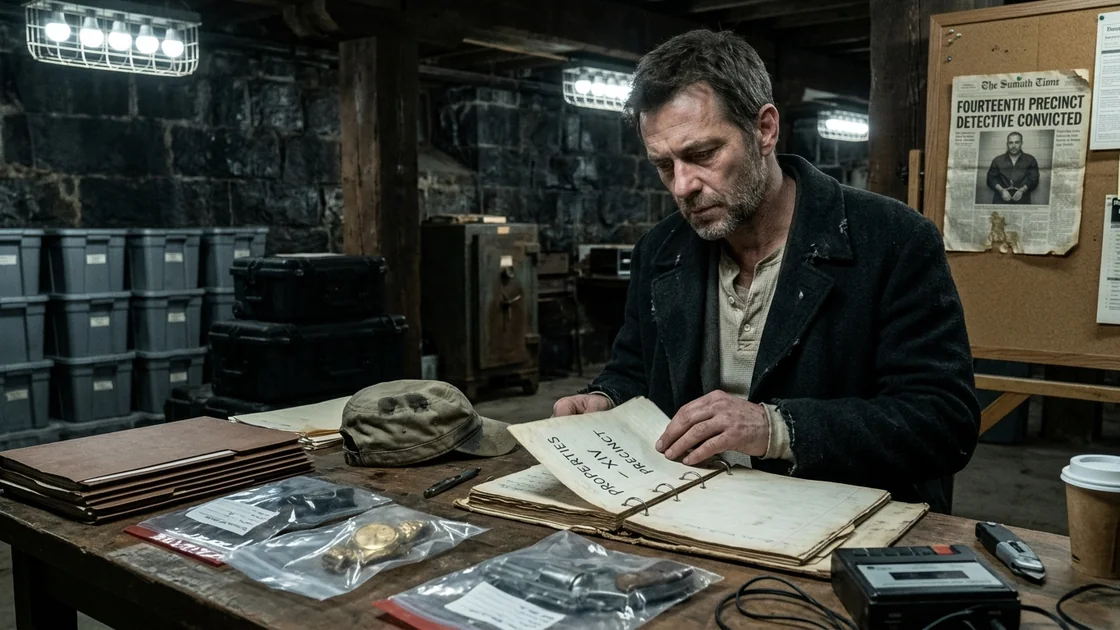
Julian Vance spent thirty-two months in a state penitentiary for a murder and a bribery scheme orchestrated by his own commanding officer, Captain Marcus Thorne of the Fourteenth Precinct. Stripped of his badge, his pension, and his reputation, Vance survived by learning the quiet patience of men with nothing left to lose. When Thorne's retired bagman suffers a catastrophic stroke, three climate-controlled storage units registered under a dead man's alias fall into default and go up for public lien auction. Vance buys the lockers for pennies on the dollar and discovers forty years of Thorne's meticulously hoarded insurance policies, including murder weapons, altered evidence logs, and wiretap recordings used to blackmail the city's elite. Rather than handing the trove to a compromised Internal Affairs bureau, Vance becomes an anonymous midnight auctioneer, selling the captain's darkest secrets back to his victims, his rivals, and his syndicate partners one item at a time until Thorne's empire of corruption devours itself from the inside out.
The November rain in Castleton did not fall so much as it hung in the air like atomized grease, coating the corrugated steel doors of the Ironclad Self-Storage facility in a slick, gray sheen. Julian Vance stood at the back of the pack of twenty-odd scavengers, his hands buried deep in the pockets of a frayed wool overcoat that still carried the faint, antiseptic Ghost of the state laundry at Waynesburg Correctional. He kept his chin tucked into his collar and the brim of a water-stained canvas cap pulled low over his brow. Nobody looked at him twice. In the bottom-feeding ecosystem of municipal lien auctions, a fifty-year-old man with a slight limp, a healed break across the bridge of his nose, and three days of salt-and-pepper stubble was as unremarkable as a rusted padlock.
At the front of the concrete corridor, a barrel-chested auctioneer named Sal Gable took a pair of thirty-inch bolt cutters from his assistant. They were standing in front of Unit 412, the first of three contiguous climate-controlled lockers inside the Building D annex.
"Alright, folks, keep your toes behind the yellow line," Gable barked, his voice rattling off the damp cinderblock walls like gravel in a tin can. "We got three units here on the same delinquent account. Renter is one Arthur Pendelton, deceased or otherwise indisposed, fourteen months in arrears after the automatic bank draft bounced back in August. Certified letters went out twice, came back undeliverable. We are selling them individually, cash only at the office window within thirty minutes of the final hammer. You know the drill—you look from the threshold, you don't touch, you don't cross the track, and whatever is in there is yours down to the dust bunnies. You leave trash behind, you lose your deposit and your bidder card."
Gable fitted the hardened steel jaws of the cutters around the shackle of a heavy brass Discus lock on Unit 412. He grunted once, his shoulders bunching beneath his nylon windbreaker, and the shackle parted with a sharp, metallic crack that made a woman in the front row flinch.
Vance did not flinch. His heart was beating at a slow, deliberate sixty beats per minute, the same rhythm he used to maintain in the interrogation rooms on the third floor of the Fourteenth Precinct before everything went to hell. He knew there was no such person as Arthur Pendelton. Arthur Pendelton was the middle name and mother's maiden name of Martin "Marty" Kroll, a former civilian property clerk for the Castleton Police Department who had retired on a mysterious disability pension in 2009. Kroll had spent the subsequent fifteen years acting as the ghost custodian for Captain Marcus Thorne.
Four months ago, Kroll had collapsed from a massive pontine hemorrhage while eating poached eggs at a diner on Fourth Street. He was currently lying in a charity ward at St. Jude’s Pavilion with a feeding tube in his stomach and zero electrical activity in his cerebral cortex. Because Kroll was a paranoid old bastard who didn't trust online banking, he had paid the rent on these three units through an offshore trust managed by a small accounting firm in Delaware. When the senior partner of that firm was indicted for tax evasion in July, the accounts were frozen. The notices of default had gone to a post office box in the Garment District that nobody had opened since the morning Kroll's brainstem bled out.
Vance knew all of this because he had spent the fourteen months since his parole sitting in a nineteen-year-old Honda Civic with a pair of scratched binoculars, a police scanner, and a thermos of cheap coffee, watching the three men who had put him in a cage. Kroll had come to Ironclad Self-Storage on the first Tuesday of every month like clockwork, always after dark, always driving an unregistered gray Ford Taurus, and always carrying a square leather briefcase or a sealed gray plastic tote.
Gable hooked his fingers under the recessed handle of Unit 412 and hauled the segmented steel door upward. It rolled into the ceiling tracks with a dry, rattling shriek.
The buyers surged forward like carp at a dock, craning their necks and clicking on high-lumen LED flashlights. Vance stayed a half-step behind a tall, skeletal man named Benny Vane, who ran three pawnshops on the south side and smelled strongly of menthol cigarettes and peppermint schnapps.
Over Benny’s bony shoulder, Vance let his eyes adjust to the dim interior of the ten-by-ten space. There was no furniture. There were no bags of winter clothes, no dusty exercise bikes, no stacks of warped vinyl records. The floor was lined with two neat rows of gray metal shelving units, the industrial kind bolted together with angle irons. On those shelves sat roughly forty uniform bankers' boxes made of heavy-duty polymer rather than cardboard, each sealed with strips of reinforced fiberglass security tape. In the back corner sat two olive-drab military footlockers with welded hasps, and beside them stood a four-drawer FireKing lateral filing cabinet, painted the dull, institutional beige of a municipal basement.
"Paper," Benny Vane muttered in disgust, clicking off his flashlight and spitting onto the concrete apron outside the door. "Some dead CPA’s tax audits. Ain't worth the gas to haul it to the dump."
A murmur of disappointment rippled through the crowd. Storage hunters wanted DeWalt power tools, vintage guitars, or boxes of estate jewelry. Nobody wanted two tons of water-resistant plastic bins full of old paper and a four-hundred-pound fireproof safe that required a hydraulic dolly just to get onto a tailgate.
"What have we got here, folks?" Gable called out, slapping the steel jamb with an open palm. "Looks like an office clean-out. Heavy-duty shelving, high-end FireKing cabinet—that cabinet retails for twelve hundred bucks new if you got a locksmith who can drill the cylinder—plus two steel footlockers. Give me a hundred bucks to start. One hundred, do I hear a hundred?"
Silence hung in the cold air. A young kid in a Carhartt jacket shone his beam over the plastic totes. "Hey, Sal, the tape on those boxes hasn't been cut. Could be comic books or baseball cards."
"Could be the dead sea scrolls, kid, bid or step back," Gable said. "Fifty dollars. Give me fifty to get it rolling."
"Fifty," the kid in the Carhartt said.
"Seventy-five," Benny Vane said automatically, purely out of habit to squeeze the kid.
"One hundred," Vance said. His voice was low, raspy from a damaged vocal cord where a prison orderly had caught him with an elbow during his first week in intake.
Benny turned his head, squinting through the gloom at Vance. He didn't recognize him. Four years ago, Detective First Grade Julian Vance had weighed two hundred and ten pounds, wore tailored charcoal suits from a Polish tailor on Grand Avenue, and kept his dark hair trimmed every ten days. The man standing in the damp corridor weighed one-seventy, wore clothes bought by the pound from a church basement, and had hair the color of wet ash.
"One-twenty-five," the Carhartt kid said, looking nervous.
"Two hundred," Vance said without blinking.
The kid shook his head and backed out of the circle, sliding his hands into his pockets. Benny Vane looked back into the locker, shone his light once more on the dull beige filing cabinet, calculated the labor of hauling dead weight up a ramp, and waved a dismissive hand. "All yours, pal. Enjoy the recycling fee."
"Two hundred once, two hundred twice, sold to paddle number nineteen," Gable barked, scribbling on his clipboard. "Step over to 414, folks. Same account."
Unit 414 was smaller, a five-by-ten space. When the door went up, it revealed three more metal racks holding grey polymer bins, along with four long, flat Pelican rifle cases stacked like cordwood against the rear wall, their latches secured with numbered red plastic tamper seals.
That woke the crowd up. Even from ten feet away, the matte-black copolymer of a Pelican 1750 case meant money—either high-end firearms, camera lenses, or precision surveying gear.
"Now we're talking," Gable grinned. "Four heavy transit cases. You know we can't sell firearms if they're in there—if you find guns when you open 'em, by law you gotta turn 'em over to the local precinct or an FFL dealer—but the cases alone are three hundred apiece on the used market. Who gives me five hundred?"
The bidding on 414 was brisk and sharp. Benny Vane went to twelve hundred; a pair of brothers who ran a surplus store near the docks pushed it to eighteen. Vance stood motionless, letting them chew at each other until the momentum stalled at nineteen hundred dollars.
"Two thousand," Vance said.
The older surplus brother glared at him. "Twenty-one."
"Three thousand," Vance said immediately.
The corridor went quiet except for the drumming of the rain on the high steel roof. Jumping nine hundred dollars in a storage auction wasn't how resellers operated; resellers worked on thirty-percent margins and twenty-dollar increments. A guy jumping nearly a grand in a single breath either knew something nobody else knew, or he was crazy enough to burn his bankroll to prove a point. Either way, the oxygen left the room.
The surplus brothers exchanged a tight look. The younger one gave a barely perceptible shake of his head.
"Sold for three thousand to paddle nineteen," Gable said, raising an eyebrow at Vance as he marked the sheet. "Let's wrap up this block with 416."
Unit 416 was practically empty. It contained a single folding card table, a leather swivel chair with the stuffing leaking out of the armrest, an old reel-to-reel magnetic tape player, a commercial-grade paper shredder sitting unplugged beside an empty trash bin, and a small, knee-high Mosler floor safe bolted directly into the concrete slab at the back of the unit.
Nobody wanted a bolted-down safe from the nineteen-seventies and a broken chair. Vance took Unit 416 for forty dollars.
Forty minutes later, after counting out thirty-five hundred and sixty-four dollars in damp twenties and fifties—including the buyer's premium—from an envelope that held the last of his bail-skip recovery fees from the summer, Vance backed a rented twenty-foot Penske box truck up to the loading bay of Building D.
He didn't hire the day laborers who loitered outside the gate offering to load trucks for twenty bucks an hour. He worked alone for three hours, using a heavy appliance hand-truck and an angle grinder powered by a lithium battery pack to sheer the anchor bolts on the Mosler floor safe. His lower back screamed where two vertebrae had fused poorly, and sweat soaked through his thermal undershirt despite the forty-degree chill, stinging the old welts across his ribs.
By four-thirty in the afternoon, the sky over Castleton had bruised from slate gray to coal black. Vance pulled the roll-up doors of all three units down, swept the concrete floors clean with a push broom so the manager wouldn't have a reason to look at his fake driver's license twice, and climbed into the cab of the truck.
He took the long way across town, avoiding the central artery and the toll bridges where the automatic license plate readers fed directly into the Real-Time Crime Center at police headquarters. He drove through the carcass of the old Tannery District, making three unnecessary right turns around a shuttered dog track to ensure nobody had followed him from the storage facility, before backing the truck down a narrow, brick-paved alley behind a defunct watchmaker’s shop on Mercer Street.
The sign in the painted-over front window read Keller & Sons Horology – Est. 1954. The old man who owned the building lived in a nursing home in Boca Raton; Vance leased the ground floor and the sub-basement through a shell company registered in Wyoming for six hundred dollars a month, paid in postal money orders.
Inside the loading bay behind the shop, Vance dropped the iron security gate, bolted it from within, and spent another two hours carrying the polymer totes, the footlockers, the Pelican cases, and the two safes down a reinforced freight elevator into the sub-basement.
The basement was thirty feet below street level, walled in three-foot-thick granite blocks laid down before the Civil War to support a steam foundry that had burned to the ground a century ago. No cellular signal reached down here. The only light came from four cages of industrial LED bulbs suspended from the low timber beams, and the only sound was the rhythmic, hollow thump-hiss of the building's ancient sump pump cycling in the corner.
Vance set the last polymer bin down on a long butcher-block workbench. He stood there for a long moment, his palms flat against the scarred wood, his head bowed as he caught his breath.
Across the room, tacked to a corkboard above an army cot, was a yellowed clipping from the Castleton Tribune dated April 14, 2021. The headline read: FOURTEENTH PRECINCT DETECTIVE CONVICTED IN DOCKSIDE BRIBERY, MURDER COVER-UP. Beneath the bold type was a photograph of Vance in cuffs, his jawline tight, being led down the courthouse steps while Captain Marcus Thorne stood at a bank of microphones in his dress blues, his silver hair immaculate, telling the cameras that no man was above the shield he wore.
Next to the newspaper clipping was a smaller, water-damaged funeral card for Elena Kovic, twenty-four years old, a clerk at the Port Authority logistics office who had come to Vance with a flash drive showing that someone in the Fourteenth Precinct was selling narcotics seizure manifests to the Bellini syndicate.
Elena had ended up floating face-down in the brackish water under Pier 9 with two nine-millimeter slugs in her chest. Vance had arrived at their meeting spot six minutes too late, just in time to take a blackjack behind the ear. When he woke up in the back of an ambulance, sixty-two thousand dollars in sequential hundred-dollar bills from a syndicate front company was sitting in the spare-tire well of his department-issued sedan, and the barrel of his backup ankle gun smelled of fresh cordite.
Vance walked over to his tool chest, selected a sharp utility knife, and walked back to the first polymer bin from Unit 412.
He sliced through the fiberglass security tape. It parted with a dry zip. He lifted the lid.
Inside, nestled between packets of silica gel to prevent moisture rot, were two dozen brown accordion files, each labeled in Marty Kroll’s neat, draftsman-like block printing. There was no alphabetical order; they were organized chronologically by year, and subdivided by the names of men who currently ran the city of Castleton.
Vance pulled the top file from the 2019 stack. The tab read: STERLING, A. – CASE #19-088412 (SUPPRESSED).
He opened the flap on the workbench. Inside was a heavy plastic evidence pouch bearing the red-and-white heat seal of the Fourteenth Precinct Detective Squad. Through the clear plastic, Vance looked at a man's Patek Philippe Calatrava wristwatch in rose gold. The sapphire crystal was spider-webbed with cracks, and caught in the teeth of the gold crown were three long strands of coarse, dark hair and a flake of dried, brownish-black blood. Pinned to the outside of the bag was the original carbon-copy property clerk voucher—the one that had never been entered into the digital database—along with six high-resolution crime scene photographs that had never made it into the prosecutor's discovery packet.
The photographs showed the front grille of a black Mercedes S-Class parked inside a private residential garage. The left headlight assembly was caved in. Wedged beneath the lower control arm of the suspension was a torn shred of a blue nylon track jacket with the logo of Castleton State University on the breast.
Vance remembered the case. October 2019. A twenty-year-old sophomore on a track scholarship named David Miller had been struck and killed on River Road during a rainstorm. The driver hadn't stopped. Two weeks later, patrol officers from the Fourteenth had arrested a career car thief named Hector Cruz, claiming they found paint transfer from Miller’s bicycle on the bumper of a stolen Honda Civic in Cruz’s chop shop. Cruz had sworn up and down he was across town at his girlfriend’s apartment that night, bit his tongue off in the interrogation room, and eventually took a twelve-year plea deal when Judge Alistair Sterling denied every single defense motion to test the paint samples at an independent lab.
Two years later, that same Judge Alistair Sterling had presided over Julian Vance’s bail hearing and subsequent criminal trial, systematically barring Vance’s defense attorney from introducing cell-tower tower ping data that placed Captain Marcus Thorne’s private vehicle within three hundred yards of Pier 9 the night Elena Kovic was murdered.
Vance set the watch down and picked up a microcassette taped to the inside back cover of the folder. He walked over to the card table he had hauled out of Unit 416, plugged in a small handheld transcriber he’d found in one of the side bins, and slotted the cassette into the carriage. He pressed play.
Through the static, two voices emerged. The first was shaking, wet with panic and liquor. "Marcus, for God's sake, he came out of nowhere. The wipers couldn't keep up with the rain. If I call an ambulance, my blood alcohol is going to be twice the limit, and the judicial nominating committee meets on Thursday—"
The second voice was smooth, resonant, and utterly calm. It was the voice that had delivered eulogies at policemen's funerals and charmed city council appropriations committees for two decades. "Drink a glass of water, Alistair. Do not touch the car. Do not call your insurance company, and do not speak to your wife. Leave the side door to the carriage house unlatched. Marty and I will be there in twenty minutes with a flatbed and a replacement bumper assembly. Go upstairs and go to bed. By Friday morning, you’ll be on the appellate shortlist, and I’ll have someone good for the hit-and-run before the kid’s family even picks out a casket."
"How much, Marcus? Whatever you need—"
"I don't want your money, Alistair," Thorne’s voice said on the tape, warm as a fireside chat. "Friends help friends. All I ask is that you remember who kept the rain off your robes when the weather turns bad down at the courthouse."
Vance pressed stop. The click of the plastic button echoed in the silent granite vault.
He spent the next fourteen hours opening every box, snapping the red tamper seals on the four Pelican cases, and drilling the locks on both the FireKing cabinet and the Mosler floor safe.
By dawn, the butcher-block table, the floor, and his cot were covered in the physical anatomy of Marcus Thorne’s thirty-year reign over Castleton. Thorne hadn't become Deputy Chief of Detectives—and the current front-runner to replace the retiring Police Commissioner on January first—by being a brute. He had risen by being a collector. Whenever a politician, a union boss, a real estate developer, a fellow commander, or a syndicate lieutenant made a catastrophic mistake in his jurisdiction, Thorne didn't arrest them, and he didn't take a simple envelope of cash that could be spent and forgotten. He cleaned up their mess, framed a disposable ghost from the precincts' arrest logs, and kept the one irrefutable piece of physical evidence that could put the true culprit in a state penitentiary for life.
And Marty Kroll, ever the dutiful clerk, had cataloged it all.
In the Pelican cases were seventeen firearms, each vacuum-sealed in heavy mylar with its ballistic test-fire comparison sheet attached—guns used in gangland executions, a robbery of an armored federal transport in Red Hook, and three "justifiable" police shootings where the throw-down weapons had come straight from Kroll's personal inventory.
In the Mosler floor safe, wrapped in oiled chamois cloth at the very bottom beneath stacks of bearer bonds and foreign banking keys, was a matte-black Pelican 1120 micro-case.
When Vance popped the twin latches on that case, his breath finally caught in his throat.
Inside lay a stainless-steel Smith & Wesson Model 640 revolver—the exact make and lot series as Vance’s own missing backup piece—along with an unedited, military-grade digital audio recorder from the Fourteenth Precinct’s Technical Surveillance Unit, and a laminated Port Authority ID badge bearing the smiling, tired face of Elena Kovic. On the plastic sleeve of the badge was a single latent thumbprint preserved under clear forensic lifting tape, labeled on the back in Kroll’s neat script: M.T. – Right Thumb (Do Not File).
Vance sat down on the edge of his cot, his elbows on his knees, staring at the small plastic case.
His first instinct—the surviving reflex of a man who had carried a gold shield for sixteen years—was to pick up the Mosler safe’s contents and drive straight to the Federal Building downtown.
Then he stopped and looked at the rest of the room.
In Bin 14, dated 2022, there was a thick dossier on Thomas Vance-Houghton, the Special Agent in Charge of the local FBI field office, detailing fifty thousand dollars in gambling debts at an illegal mahjong parlor in Chinatown that Thorne had quietly wiped off the books during a joint task force raid. In Bin 9, there was a series of hotel security stills involving the Deputy Director of Internal Affairs and an underage runaway from Toledo.
If Julian Vance, a convicted felon with a documented vendetta against the department, walked through the front doors of the Justice Department or the newspaper offices with stolen police evidence obtained from an unregistered storage locker, the bureaucracy would swallow it whole. A dirty deputy director would flag the file; a compromised judge would rule the chain of custody fatally broken; the evidence would be sealed under a national security or ongoing-investigation gag order; and Vance would be found hanging from a bedsheet in a county holding cell before the preliminary hearing was ever scheduled.
Marcus Thorne was a fortress built out of other men’s secrets. You couldn't knock a fortress down by throwing rocks at the gate. You had to convince the stones to pull themselves out of the mortar.
You had to make the people Thorne owned realize that their master had lost their leashes—and that for the right price, they could buy them back, along with the throat of the man who had held them.
Vance stood up, walked over to the sink in the corner of the basement, and washed the grease and storage-locker dust from his hands with cold water and a bar of pumice soap.
"Alright, Marcus," Vance whispered to the damp granite walls. "Let's see what the market will bear."
Three days later, at four o'clock on a Friday afternoon, three identical packages were delivered across the city of Castleton by three different bicycle couriers who had been hired through an anonymous job board and paid in cash taped inside the lid of a public mailbox near the bus terminal.
Each package was a cedar cigar box painted matte black, lined on the inside with cheap crimson felt. Inside each box lay a single Polaroid photograph, a black Nokia burner phone with the battery fully charged and the GPS chip physically desoldered from the motherboard, and a slip of heavy cream cardstock printed on a nineteen-eighties IBM Selectric typewriter whose typeball Vance had going into the harbor the moment he finished typing.
The first box was handed to a bailiff outside Chambers 4B of the Superior Courthouse, addressed to the Honorable Alistair Sterling.
The second box was left with the receptionist at the campaign headquarters of District Attorney Valerie Cross, who was currently running a bitter, neck-and-neck primary campaign against the Mayor’s hand-picked incumbent and had spent the last three years trying to prove that the Superior Court bench was fixing cases for the Fourteenth Precinct.
The third box was delivered to the coat-check desk of the Castleton Athletic Club on Fifth Avenue, where Captain Marcus Thorne was finishing a late lunch of pan-seared sea bass with the Chairman of the Police Commission.
At 4:15 PM, Judge Sterling locked his chambers door, poured himself three fingers of Glenlivet with a hand that rattled the crystal bottleneck against the rim of the glass, and stared down at the Polaroid of his rose-gold Patek Philippe watch sitting beside its original Fourteenth Precinct evidence voucher.
Across town, Valerie Cross stood over her conference table with her chief investigator, staring at the exact same Polaroid, her eyes narrowing as she read the case number on the voucher and cross-referenced it with the court docket from October 2019.
And in the mahogany-paneled locker room of the Athletic Club, Marcus Thorne stood alone beside a brass sink, looking down at the open cedar box.
Thorne was fifty-eight years old, though he looked forty-five from across a ballroom. He had the broad, square shoulders of the collegiate oarsman he had been in his youth, a full head of silver hair combed straight back from a high forehead, and pale gray eyes that never seemed to blink when he was listening to someone lie.
He picked up the cream cardstock between two manicured fingers and read the typed lines:
LOT 001: THE RIVER ROAD ARCHIVE (OCTOBER 14, 2019). CONTENTS: One (1) Patek Philippe wristwatch, rose gold, bearing trace DNA and hair fibers of deceased pedestrian D. Miller; One (1) unfiled 14th Pct evidence voucher signed by M. Kroll; Six (6) original 35mm negatives depicting damaged vehicle belonging to A. Sterling; One (1) microcassette audio recording of post-incident conspiracy between A. Sterling and M. Thorne. PROVENANCE: Unit 412, Ironclad Self-Storage. RESERVE PRICE: $250,000 (USD). AUCTION BEGINS: 23:00 Hours Tonight via Enclosed Terminal. TERMS: Blind increment bidding. Fifteen-minute clock reset per bid. Winner receives physical delivery of all originals within two hours of cleared settlement. No copies have been retained. An auctioneer’s only currency is his word.
Thorne did not curse. He did not throw the box against the tile wall. He simply closed the cedar lid, slipped it into his leather briefcase, walked out to the valet stand, and tipped the attendant five dollars when his black department Tahoe was brought around.
As soon as he pulled into traffic on Fifth Avenue, he dialed the private cell number of Detective Sergeant Ray Castellano, his whip hand in the Fourteenth Precinct’s Special Operations Squad.
"Ray," Thorne said as soon as the line clicked. "Drop whatever you're doing. Take Tommy Doyle with you and drive out to St. Jude’s Pavilion. I want to know if Marty Kroll woke up, and I want to know who has visited his room in the last ninety days. After that, go out to Ironclad Self-Storage on the industrial highway. Find Unit 412. Bring me the name, the license plate, and the security footage of whoever opened that door."
"Copy that, Boss," Castellano’s gravelly voice came back. "Something leak?"
"A pipe burst," Thorne said coldly, watching the rain smear across his windshield under the streetlamps. "Go shut off the valve."
At ten-fifty-five that night, Julian Vance sat in the cab of his old Honda Civic on the top level of an abandoned municipal parking garage overlooking the railyards. Two hundred yards away, bolted to the rusted iron lattice of a signal gantry over the tracks, was a battery-powered directional router he had bought through a teenage phone-phreaker named Patch Morales in the back of an arcade on Eighth Street. The router bounced an encrypted local text relay through three prepaid SIM cards before terminating at the laptop sitting on the passenger seat beside Vance. Even if the department’s technical unit somehow got a court order for the cell tower dumps in under an hour, the signal would point them to an empty freight yard while Vance was five blocks away connected via a high-gain directional antenna concealed inside a PVC pipe on his roof rack.
At precisely 23:00 hours, Vance typed a single command into the black terminal window on his screen:
LOT 001 IS NOW OPEN. RESERVE: $250,000. THREE BIDDERS PRESENT.
For four minutes, the green cursor blinked in the dark cab of the Civic. Rain drummed a steady, hollow tattoo against the roof. Vance took a sip of cold black coffee from a paper cup and watched the timer tick down from sixty minutes.
He knew the psychology of the three people holding those Nokia phones.
Valerie Cross was an ambitious prosecutor with access to an unofficial "discretionary seizure fund" and a wealthy father-in-law who desperately wanted her sitting in the Mayor’s office within four years. If she got her hands on physical proof that the front-runner for Police Commissioner and a sitting Superior Court Judge had conspired to frame an innocent man for vehicular homicide, she wouldn't just win the primary—she would own the city’s political apparatus for a decade.
Judge Alistair Sterling was a coward facing the end of his world. At sixty-two, four minutes in the general population at Waynesburg Correctional—where hundreds of men he had sentenced to maximum terms were currently walking the yard—was a death sentence.
And Marcus Thorne was a predator who had never once been hunted. Right now, Thorne would be furious, calculating whether he could locate the seller before the clock ran out. He wouldn't want to bid; bidding meant acknowledging that someone else held the gavel.
At 23:06, the terminal chimed once.
BIDDER 2 (CROSS): $250,000.
She had met the reserve. Cross was smart; she didn't ask for verification because the case number and Kroll’s signature on the Polaroid were verification enough for anyone who knew how the Fourteenth Precinct buried bodies.
Thirty seconds later, the screen chimed again.
BIDDER 1 (STERLING): $300,000.
Vance allowed himself a thin, humorless smile in the blue glow of the monitor. Sterling didn't know who Bidder 2 and Bidder 3 were, only that someone else was in the dark room with him, reaching for the rope that would hang him.
At 23:12, the third line lit up. It wasn't a bid; it was a text string routed to the moderator prompt from Bidder 3.
THORNE: I know how much you paid for those lockers, whoever you are. You're a storage scavenger who stumbled into water way over your head. Shut down the other two terminals. Bring the entirety of Units 412, 414, and 416 to the Boat Basin parking lot at 1:00 AM. I will give you five hundred thousand in unmarked hundreds and let you leave the state breathing. If you deliver that watch to anyone else, I will have your skin peeled off with a pair of pliers before sunrise.
Vance’s fingers hovered over the keyboard. He knew then that Castellano and Doyle had already visited Ironclad Self-Storage. They knew about the three units. They knew about the $3,500 winning bid. They probably had the grainy CCTV footage of a stoop-shouldered man in a wet canvas cap and a wool coat, and the fake driver's license in the name of Robert L. Loomis with an address that belonged to a vacant lot in Camden.
Vance typed his reply into the public auction feed so all three bidders could read it:
CURATOR: THE HOUSE DOES NOT NEGOTIATE OUTSIDE THE FLOOR. BIDDER 3 HAS OFFERED $500,000 FOR AN ALL-INCLUSIVE BUYOUT, WHICH IS AGAINST HOUSE RULES. HOWEVER, WE WILL ACCEPT $500,000 AS THE CURRENT HIGH BID FOR LOT 001 ALONE. BIDDER 3 LEADS AT $500,000.
In his apartment on Park Avenue, Marcus Thorne’s knuckles turned white around the cheap plastic casing of the Nokia phone. By posting his offer as a bid on the single lot, the anonymous bastard had just doubled the price of the watch and signaled to the other two bidders that a third party—almost certainly Thorne himself, from Sterling's perspective—was desperate enough to drop half a million dollars to keep the box closed.
BIDDER 2 (CROSS): $525,000.
Valerie Cross was stretching her war chest to the breaking point, probably promising favors to her backers over another phone line as she typed.
BIDDER 1 (STERLING): $650,000.
Sterling had just liquidated his wife’s inheritance or his brokerage margin account.
Thorne stared at his phone. His personal liquid reserves—the money he could touch at midnight on a Friday without triggering a federal wire transfer alert or calling Enzo Bellini for a short-term loan—sat in a safe in his townhome study. There was four hundred and eighty thousand dollars in that safe. The rest of his wealth was tied up in commercial real estate trusts in Florida and two numbered accounts in the Cayman Islands whose physical passkeys were sitting inside the Mosler floor safe from Unit 416.
He couldn't outbid a terrified judge who was liquidating sixty years of generational wealth to stay out of prison.
More importantly, if Bidder 1 was Sterling, Thorne didn't need to win the lot—as long as Cross didn't get it. If Sterling bought back his own watch, Sterling would destroy it immediately to save himself. Thorne would lose his leverage over the judge, which was an irritation, but the secret itself would stay buried until Castellano tracked down the scavenger and put two bullets behind his ear.
Thorne set his phone down on his desk and did not enter another bid.
BIDDER 2 (CROSS): $675,000.
Three seconds later:
BIDDER 1 (STERLING): $800,000.
The terminal went silent. Fifteen minutes ticked by on the digital clock. Valerie Cross couldn't raise eight hundred grand in untraceable funds on a Friday night without committing a felony of her own.
At 23:34, Vance typed:
SOLD TO BIDDER 1 FOR $800,000. SETTLEMENT INSTRUCTIONS TRANSMITTED TO WINNER. LOT 002 WILL BE ANNOUNCED IN 48 HOURS. GOODNIGHT.
Vance closed the public channel and sent a private message to Judge Sterling’s burner phone.
Sterling didn't have eight hundred thousand in physical cash under his mattress, and Vance didn't want a bank wire that the Treasury Department could follow. Instead, Vance knew from Kroll’s files that Sterling was an obsessive numismatist who had spent twenty years converting his judicial bribes and family trust dividends into tubes of one-ounce South African Gold Krugerrands and Credit Suisse platinum ingots stored in a private vault inside his carriage house—the very same carriage house where Thorne had hidden his wrecked Mercedes five years ago.
CURATOR: Pack thirty-two (32) ten-ounce Credit Suisse platinum bars or two hundred and ninety (290) one-ounce gold Krugerrands into a canvas gym bag. Drive alone in your wife's Volvo to the Interstate 95 overpass above the Old Mill Drainage Canal. Stop on the right shoulder at the third expansion joint. Drop the bag down the storm-water cast-iron scupper pipe on the concrete jersey barrier. Wait ten minutes, then check the glove compartment of the rusted blue Ford pickup parked under the streetlamp at the bottom of the exit ramp.
Vance shut his laptop, pulled the directional antenna off his roof, and drove away from the railyards without turning on his headlights until he was three blocks down the hill.
He didn't go anywhere near the Interstate 95 overpass.
Instead, he sat in the dark weeds three hundred yards downstream inside a dry concrete storm culvert where he had welded a steel catch-grate inside the outflow pipe two days ago, connected to a nylon pulley rope that ran through four hundred feet of subterranean storm sewer.
At 1:15 AM, Vance heard the distant, muffled clang of a heavy canvas bag hitting the iron scupper pipe sixty feet above the canal bed, followed by the heavy splash-thud as the bag hit his grate inside the dry pipe.
Vance waited twenty minutes, watching the mouth of the tunnel through a cheap night-vision monocular to make sure no squad cars or unmarked sedans were trailing the judge. Nobody came. Judge Sterling was far too terrified of Marcus Thorne knowing he had bought the evidence to call the Fourteenth Precinct for an escort.
Vance hauled on the wet nylon rope, dragging the heavy canvas bag through the pipe until it tumbled out onto the concrete apron at his feet. He unzipped it, shone a penlight inside, and saw the dull, buttery gleam of fourteen plastic mint tubes of gold Krugerrands and twenty-two vacuum-sealed one-ounce and ten-ounce bars of Swiss bullion.
Up at the bottom of the exit ramp, Judge Sterling’s shaking hands pried open the passenger door of the abandoned blue junkyard pickup Vance had bought for three hundred dollars the week before. Inside the glove box, Sterling found a cardboard shoebox containing the cracked Patek Philippe watch, the original evidence voucher, the six negatives, and the microcassette.
What Sterling did not expect to find was a second, smaller envelope tucked beneath the watch, labeled: COMPLIMENTARY BUYER’S PREMIUM.
Sitting in his wife's car with the dome light off, Sterling tore open the small envelope. Inside was a photocopy of a sworn affidavit that Marty Kroll had drafted in 2022, pre-signed by Captain Marcus Thorne and notarized by a crooked bail bondsman. It was an undated "anonymous tipster memorandum" prepared for the Judicial Conduct Commission, laying out the entire hit-and-run conspiracy in exhaustive detail and blaming it entirely on Sterling, designed to be dropped into the mail the moment Judge Sterling ever ruled against the Fourteenth Precinct's interests or decided to retire early without Thorne's permission. Across the bottom of the page, Vance had typed a single sentence:
He never intended to let you keep your life, Your Honor; he only leased it back to you by the month.
In the dark cab of the Volvo, Alistair Sterling began to weep, the sound thin and ragged against the ticking of the cooling engine. When he finally wiped his face with his coat sleeve ten minutes later, the fear in his eyes had curdled into something much colder, and infinitely more dangerous to Marcus Thorne.
By Saturday afternoon, the first tremor hit the foundations of the Fourteenth Precinct.
At 11:00 AM, Judge Alistair Sterling’s clerk transmitted an emergency weekend administrative order to the Superior Court docket clerk and the District Attorney’s office. Citing "newly discovered irregularities in police chain-of-custody affidavits originating from the Fourteenth Precinct Detective Squad," Judge Sterling summarily vacated the search warrants in three high-profile racketeering and narcotics cases that Captain Thorne had spent the last eighteen months building as the centerpiece of his Commissioner confirmation hearings. Furthermore, Sterling ordered the immediate, unredacted release of all personnel disciplinary files for Detective Sergeant Ray Castellano to defense counsel, and announced his own immediate medical retirement from the bench effective Monday morning, right before boarding a noon flight to Zurich with his wife.
When the alert flashed across the screen in the Mayor’s office, Thorne’s phone rang within four minutes. The Mayor didn't shout; politicians at that altitude never shouted. He simply informed Thorne that the Monday morning press conference announcing his appointment as the next Police Commissioner was being postponed "pending a routine administrative review of the Sterling recusals."
At 2:00 PM, inside the windowless task-force briefing room on the third floor of the Fourteenth Precinct, Thorne slammed his palm down on the metal table hard enough to make the styrofoam coffee cups jump.
"Tell me something I can use, Ray!" Thorne snarled. The silver hair was slightly disheveled today; the gray eyes were rimmed in red. "Who is Robert L. Loomis?"
Ray Castellano stood by the whiteboard, his thick neck straining against his collar. Beside him, leaning against the radiator with his arms crossed and a cold cigarette unlit between his lips, stood Detective Tommy Doyle.
Doyle was forty-four, with tired blue eyes and a face that looked like an eroded riverbank. Six years ago, Doyle had been Julian Vance’s junior partner before Thorne split them up, promoted Doyle to the squad room’s inner circle, and left Vance out in the cold.
"Loomis is a ghost, Captain," Castellano said, tapping a blown-up still photo printed from the Ironclad Self-Storage security camera. The image showed Vance from a high angle, forty feet away in the rain, his face completely shadowed by the wet bill of his cap and a turned-up collar. "The driver's license number belongs to a dead pipefitter from Scranton. He paid the thirty-five hundred in cash—old twenties and fifties, no sequential bank straps. He loaded the units into a twenty-foot Penske rental truck."
"And the truck?" Thorne demanded.
"Rented from a lot in Queens under the same fake license and a prepaid Visa card bought at a bodega in Newark," Tommy Doyle spoke up from the radiator. His voice was quiet, almost detached. "He returned the truck to a drop-lot near the airport at eleven o'clock last night. Scrubbed the cargo bay floor with bleach, wiped the steering wheel and the door handles with WD-40 so there's not a single smudged print in the cab."
Thorne turned his glare on Doyle. "WD-40 on the steering column. That’s not a pawnshop junk buyer, Tommy. Who cleans a crime vehicle with solvent like that?"
Doyle looked at the grainy silhouette on the whiteboard—the slight hitch in the man's left hip as he pushed the loaded hand-truck toward the loading bay, the way he kept his chin tucked away from the lens mounts as if he knew the exact field of view of a standard Pelco dome camera.
"A guy who’s processed stolen recovery cars for a living," Doyle said evenly. "Or somebody who spent a few years in a state motor pool listening to old car thieves talk."
"You got a name in your head, Tommy?" Castellano asked, squinting at his partner.
Doyle thought about the funeral of Elena Kovic four years ago, which he had watched from across the street behind tinted glass because he had been too much of a coward to stand beside Julian Vance when the frame came down. He thought about the sixty grand in Vance’s trunk that had smelled faintly of the cedar humidors in Marcus Thorne’s private office.
"Half the ex-cons in Castleton know how to wipe a truck, Ray," Doyle said, looking straight at Thorne. "And the Captain has put away a lot of men in thirty years. If it's an ex-cop or a wise guy who was tracking Marty Kroll, he didn't find that locker by luck. He was watching Kroll before the stroke."
"Then pull every parolee jacket from the last twenty-four months," Thorne snapped. "Start with anyone who had a beef with this squad. And Ray—put two cars on the perimeter of St. Jude’s Pavilion, and call Enzo Bellini’s driver. Tell him I need to sit down with Enzo tonight."
"Why Bellini?" Castellano asked, a flicker of genuine unease crossing his heavy features.
Thorne didn't answer him. He didn't need to tell Castellano what else was inside Unit 414.
In November of 2021, an armored transport belonging to GardaWorld had been hit with thermite charges under the Highbridge viaduct. The truck hadn't been carrying bank deposits; it had been carrying four million dollars in laundered skim from Enzo Bellini’s waterfront casinos, along with thirty kilos of pure fentanyl that Bellini was holding as collateral for a peace treaty with the Albanian crew in the East Ward. Four guards had been executed with nine-millimeter submachine guns.
Thorne and Castellano had engineered the hit themselves using two off-duty tactical officers who died in a convenient boating accident six months later. To keep Bellini from looking toward the Fourteenth Precinct, Thorne had planted shell casings from an Albanian weapon at the scene and fed Bellini false wiretap transcripts proving the Albanians had stolen his money. The resulting street war had left nineteen men dead, wiped out the Albanian leadership, and left Enzo Bellini entirely dependent on Marcus Thorne’s police protection to hold the waterfront.
Except Marty Kroll, following Thorne’s ironclad rule of never destroying leverage over an accomplice, had kept the two suppressed MP5 barrels used in the robbery, the original GPS transponder pried out of the armored truck’s chassis, and a forty-second helmet-cam video showing Ray Castellano loading Bellini’s metal cash cassettes into the back of an unmarked Fourteenth Precinct surveillance van.
If that Pelican case went on the block at Lot 002, Enzo Bellini wouldn't file a motion in Superior Court. He would send twenty men with automatic weapons and chainsaws through the front doors of Thorne’s home.
At six o'clock that evening, Julian Vance sat in a back booth at the Terminal Diner, a stainless-steel boxcar wedged between the concrete pillars of the elevated subway line on Twelfth Street. His back was to the brick wall, giving him a clear sightline of both the front door and the narrow hallway leading to the restrooms and the kitchen fire exit.
He was nursing a plate of eggs over-easy and rye toast when the bell above the door jingled.
Tommy Doyle walked in out of the rain. He paused inside the entrance, took off his wet fedora, shook the water onto the rubber floor mat, and scanned the room. When his eyes met Vance’s in the back corner, there was no flash of surprise on the younger detective's face. He simply walked down the aisle and slid into the red vinyl opposite Vance.
Waitress came over with a glass coffee pot. Doyle held up two fingers without looking at her. She filled his mug, topped off Vance’s, and disappeared back behind the counter where a small television was playing a muted Spanish soap opera.
Under the table, Vance’s right hand rested comfortably on the grip of a cocked nine-millimeter Browning Hi-Power tucked into his waistband—not one of the guns from the locker, which were evidence, but a clean, serial-ground piece he’d bought off a bail jumper in August.
"You lost weight, Julian," Doyle said quietly, wrapping both hands around the warm ceramic mug. "And the limp is new."
"State mattress wasn't good for the sciatica, Tommy," Vance said, picking up a corner of rye toast and dipping it into the yolk. "How did you find me?"
"I didn't use the Penske plates," Doyle said. "Ray spent all afternoon screaming at traffic management trying to trace the box truck on the municipal cameras. I didn't bother. I knew if it was you, you’d stay off the toll roads and use the Tannery District cut-throughs like we used to do when we were tailing the dock crews in '16. There’s only one private freight fueling station between Ironclad Storage and the river that still takes cash at the pump without a fleet card—Old Man Miller’s Sinclair station on Fourth. I drove over there an hour ago and asked him if a guy with a busted nose and a bad left leg topped off a diesel box truck yesterday afternoon. He said yeah, and mentioned he saw you walking out of here on Tuesday."
"And where is Ray right now?"
"Tearing apart a chop shop in Red Hook looking for a guy named Loomis who doesn't exist," Doyle said. He looked down into his black coffee for a long beat, then looked back up at Vance. "You bought Kroll's lockers."
Vance chewed his toast, swallowed, and took a sip of coffee. "I'm in the estate liquidation business now, Tommy. People leave all kinds of junk behind when they stroke out. Old chairs. Broken tape players. Filing cabinets."
Doyle leaned forward an inch, lowering his voice below the rattle of an overhead subway train that made the diner’s windows hum in their frames. "Listen to me, Julian. You don't know what Thorne is like right now. Four years ago, when he framed you for the Kovic girl, it was clinical. It was business because you wouldn't drop the Port Authority audit. Today? He’s rabid. Sterling blew up three major indictments this morning and fled the country. The Mayor froze Thorne’s promotion. He knows what’s in those boxes."
"Do you know what's in those boxes, Tommy?" Vance asked softly.
Doyle flinched, just a fraction of a millimeter around the corners of his eyes.
"Bin number seven," Vance said, his voice level and quiet as a priest in a confessional. "Dated August 2015. Back when you were three years on the job in the tactical unit, before they put you with me in detectives. A warehouse clearing on Tenth Avenue at two in the morning. You were twenty-eight, scared, hopped up on double shifts, and a sixteen-year-old kid named Marcus Washington came out of a dark stairwell holding a chrome pipe wrench. You thought it was a nickel-plated thirty-eight. You put three rounds in his chest."
Doyle’s face had gone the color of wet putty. His hand trembled against the coffee mug.
"You wanted to call it in straight," Vance continued, reciting the contents of the file he had read at three o'clock that morning in the granite sub-basement. "You were on your knees trying to compress the kid's chest when Captain Thorne walked in. He told you the department couldn't survive another unarmed shooting in the East Ward that summer. He sent everybody else outside, wiped the pipe wrench clean, dropped a stolen Charter Arms .38 with obliterated serial numbers beside the boy’s hand, and wrote the shooting review himself. You got a commendation medal and a gold detective’s shield six months later. And Marty Kroll put the chrome pipe wrench—with your latent palm print still preserved on the handle under evidence tape and the boy’s blood on the jaw—into a plastic tote at Ironclad Storage."
A second train thundered overhead, shaking dust from the ceiling vents.
"He told me he threw that wrench into the blast furnace at the foundry in '15," Doyle whispered.
"He never threw anything into the furnace, Tommy. Not Sterling’s watch. Not the barrels from the GardaWorld armored car hit that Ray Castellano pulled off. Not the wiretap from the night they killed Elena Kovic and put sixty grand in my trunk. That’s how Marcus breathes. He keeps every ounce of dirt he ever swept under the rug so that if any of you ever grow a conscience, he can bury you under it."
Doyle stared at his former partner. "What are you going to do with the wrench, Julian? Put it up for bid?"
Vance reached into his inside coat pocket with his left hand—slowly, letting Doyle see every inch of the movement—and slid a heavy Manila envelope across the Formica table until it touched Doyle’s wrist.
"Open it," Vance said.
Doyle undid the brass clasp and looked inside. Resting at the bottom of the padded mailer was a fourteen-inch Ridgid pipe wrench inside a slit-open evidence bag, along with the original carbon-copy ballistic swap memo signed by Thorne, and the handwritten draft of Doyle’s original, unfiled incident report where he had confessed to mistaking a tool for a weapon.
"The reserve price on Lot 002 for you is one dollar, Tommy," Vance said. "Paid right now."
Doyle looked up from the envelope, his eyes glassy and wide. "Why?"
"Because in 2015 you wanted to call the ambulance and take your medicine, and Thorne wouldn't let you," Vance said. "And because when they put the cuffs on me in the squad room four years ago, you were the only man on that floor who couldn't look me in the eye. That meant you still had a soul left somewhere under the uniform. Put a dollar on the table, take your file, and go throw it in the river."
Doyle reached into his trousers pocket with a shaking hand, pulled out a crumpled one-dollar bill, and laid it flat beside the salt shaker. He slid the Manila envelope off the table and tucked it inside his trench coat, buttoning the flap over it as if he were holding his own heart in his ribs.
"What's the catch, Julian?" Doyle asked hoarsely. "An auctioneer always takes a commission."
"No commission today," Vance said, picking up the one-dollar bill and folding it neatly into his vest pocket. "Just a preview notice for a friend. Tomorrow night at eleven o'clock, Lot 002 goes to the floor. It’s the GardaWorld armored car box from 2021. Two bidders: Enzo Bellini and Captain Marcus Thorne. Tell me something, Tommy—how much cash does Thorne have left after Sterling refused to share the watch?"
"About four-eighty in his house safe," Doyle said immediately, the words tumbling out before he even consciously decided to betray his commander. "He spent the afternoon trying to liquidate three strip malls in Dade County through his brother-in-law’s brokerage, but the banks won't clear a wire over half a million until Monday noon. He’s short."
"And Enzo Bellini?"
"Bellini keeps five million in rolling cage cash inside the back room of the Social Club on Mulberry just to cover weekend sports book action."
"Then by Monday morning," Vance said, standing up from the booth and dropping a ten-dollar bill beside his plate for the eggs, "things are going to get very loud around the Fourteenth Precinct. If I were you, Tommy, I wouldn't ride in the same car as Ray Castellano after ten o'clock tomorrow night. And when the final lot goes up on Monday evening, I might need somebody to leave the iron storm door at the back of the old St. Jude Waterworks unlatched."
Doyle looked up at him. "The old municipal reservoir on the hill? It's been condemned for ten years."
"Great acoustics, though," Vance said. He tapped the brim of his canvas cap. "Enjoy your coffee, Tommy."
On Sunday afternoon, two more black cedar boxes were delivered.
One was handed to Captain Thorne through the window of his unmarked Tahoe as he sat parked outside church—a building he had entered for the first time in six years only because he needed a quiet place to scan the crowds for watchers.
The second box was left on the hood of a vintage Cadillac Eldorado parked outside Da Nicola’s Pizzeria in Little Italy, the private headquarters of sixty-eight-year-old Enzo Bellini, boss of the Castleton waterfront syndicate.
Inside the boxes was a Polaroid showing two steel H&K MP5 nine-millimeter barrels beside a GardaWorld armored-car transponder, the Fourteenth Precinct ballistic comparison cards matching the barrels to the slugs pulled from the four murdered guards, and a single still frame printed from a digital video file.
The still frame was crystal clear. It showed Detective Sergeant Ray Castellano standing inside an abandoned warehouse near the Navy Yard on the night of November 19, 2021, wearing a police tactical vest with the Velcro patches ripped off, grinning into the camera lens as he hoisted a steel GardaWorld cash cassette stenciled with the code of Bellini’s casino courier route, while Marcus Thorne’s unmistakable silver-haired reflection stood in the side-view mirror of a police transport van three feet away.
In the back room of Da Nicola’s, Enzo Bellini—a small, neat man who wore cardigan sweaters and thick spectacles that made him look like a retired shoemaker—stared at the Polaroid for five minutes without making a sound.
Beside him stood his underboss, Frankie "The Chin" Santoro, whose twenty-two-year-old nephew had been shot in the face during the three-month war with the Albanians that followed the GardaWorld heist—a war that Marcus Thorne had instigated with forged wiretaps to cover his own tracks.
"Four million dollars he took from our table, Enzo," Santoro whispered, his jaw muscles bunching beneath his scarred cheeks. "And thirty keys of product. Then he pointed us at Leka Dushku’s people. We lost nine made guys in that war. My sister's kid died in my arms on Mulberry Street. And the whole time, it was Thorne and his fat bulldog Castellano."
Bellini took off his spectacles, wiped the lenses carefully with a clean white linen handkerchief, and hooked them back over his ears. He looked down at the typed card in the box:
LOT 002: THE HIGHBRIDGE TRANSPORT ARCHIVE (NOVEMBER 19, 2021). CONTENTS: Two (2) 9mm submachine gun barrels matching fatal projectiles in GardaWorld quadruple homicide; One (1) encrypted GPS vehicle transponder; One (1) 32GB SD card containing 42 seconds of high-definition audio/video recording of contraband transfer into 14th Pct vehicle by R. Castellano and M. Thorne. RESERVE PRICE: $500,000 (USD). AUCTION BEGINS: 23:00 Hours Tonight.
"He called me last night," Bellini said softly, his voice like dry leaves scraping across a tombstone. "Marcus called me. Asked if I could front him a short-term bridge loan of a million five until his real estate cleared on Tuesday. Said he had an investment opportunity."
"He wanted to use our own money to buy back the proof that he robbed us," Santoro said.
Bellini picked up the black Nokia phone from the crimson felt. "How much we got in the downstairs vault right now, Frankie?"
"Two-point-four million after the Sunday football payouts."
"Go get two million of it," Bellini said, setting the phone down beside his espresso cup. "Put it in two leather suitcases. When the clock hits eleven tonight, we don't play ten-thousand-dollar games. We buy the box on the first breath. And then I want every button man we got between here and New Jersey on the street before midnight."
At 22:50 on Sunday night, Marcus Thorne was not sitting in his Park Avenue apartment.
He was sitting in the back of an armored mobile command van parked in the alley behind the Fourteenth Precinct, surrounded by four laptops and two technicians he had pulled out of the department’s Cyber Intelligence Division with a story about an imminent domestic terrorism threat against police command staff. In the front passenger seat sat Ray Castellano, chewing through his third antacid tablet of the hour, a sawed-off Remington shotgun resting between his knees.
" the moment that Nokia phone receives a handshake packet at eleven o'clock," Thorne told the lead technician, a pale kid of twenty-six who was sweating through his dress shirt under the captain's cold stare, "I don't care what proxy server or text relay he’s using. You triangulate the point-to-point radio burst between the cell tower and whatever local repeater he has bolted to a roof. Give me a six-block radius, and I’ll have twenty cars seal the perimeter in ninety seconds."
"Captain, if he's using a multi-hop SMS gateway over tor-routed burners, the tower only sees the commercial carrier hub in Chicago," the tech stammered. "Unless he stays online for twenty minutes pushing high-bandwidth data, we're chasing ghosts."
"Then keep him online," Castellano growled from the front seat, turning around with bloodshot eyes. "Make him verify the video file frame by frame, Boss. Tell him you want a live stream of the SD card before you bid."
Thorne looked down at the three metal briefcases sitting between his feet. Inside was $480,000 from his home safe, plus $320,000 he had forced Ray Castellano to clean out of his own basement walls, plus $200,000 they had shaken down from three mid-level bookmakers in the precinct between noon and six PM. One million dollars flat. It was every cent Thorne could scrape together on a Sunday in Castleton without putting a gun to a bank manager's head.
At 23:00 hours, the Nokia phone in Thorne’s hand buzzed.
LOT 002 IS NOW OPEN. RESERVE: $500,000. TWO BIDDERS PRESENT.
Before Thorne’s thumb could even press the keypad to demand a high-bandwidth video verification stream to stall the clock, the screen chimed a second time.
BIDDER 1 (BELLINI): $2,000,000.
The inside of the mobile command van went dead silent save for the hum of the cooling fans on the server racks.
Ray Castellano leaned over the seat back, reading the tiny LCD screen upside down. The blood drained from his heavy jowls until his skin looked like lard. "Two million? In the first ten seconds? Boss, who's Bidder 1? Who the hell has two million cash on a Sunday night?"
Thorne didn't answer. He knew who Bidder 1 was. And he knew that Enzo Bellini wouldn't bid two million dollars on a five-hundred-thousand-dollar reserve unless he had already seen the Polaroid in the box and didn't want to risk losing the physical address of the drop or the names on the unredacted vouchers.
"Stall him!" Castellano shouted, grabbing Thorne’s shoulder with a meaty hand. "Bid two-point-one! We don't have to pay it—just win the clock so he gives us the drop coordinates! We'll ambush the drop site, kill the bastard, and take the case!"
Thorne shook Castellano’s hand off his coat with a sharp, disgusted jerk of his shoulder. "And if this man is Julian Vance, Ray, do you really think he’s standing at the drop site waiting to shake hands? Last night he dropped Sterling’s box in an abandoned truck under a highway camera while the money went down a storm sewer half a mile away! If we bid money we don't have and fail to drop the cash, he turns the box over to the underbidder by default!"
"Then what do we do?!" Castellano’s voice cracked into a high, desperate whine that made the two cyber technicians stare fixedly at their monitors.
Thorne typed furiously into the moderator channel:
THORNE: I will wire $2.5 million from Grand Cayman at 09:00 tomorrow morning if you hold the gavel until banking hours. Do not close this lot tonight.
Four seconds later, the public feed updated. Vance hadn't even bothered to hide the message; he let Enzo Bellini see the panic of the man across the table.
CURATOR: HOUSE TERMS ARE CASH OR BULLION UPON THE HAMMER. CREDIT IS NOT EXTENDED TO MEN WITH SHORT RUNWAYS. BIDDER 1 LEADS AT $2,000,000. FOURTEEN MINUTES REMAINING.
"Trace it!" Thorne barked, grabbing the back of the lead technician's chair. "He just transmitted two hundred bytes! Where did it come from?"
"It bounced off an automated weather-station relay on top of the grain silos in the harbor, Captain!" the kid yelled back, his fingers flying across the mechanical keyboard. "The silo relay is linked to a directional Wi-Fi bridge pointing toward the old brewery district—wait—no, the bridge just powered down! He’s using an automated timer switch that cuts the battery power the second the text batch clears! It's a dead node!"
Thorne stood frozen in the center of the van as the digital clock on the Nokia ticked down.
23:10.
23:12.
23:15.
SOLD TO BIDDER 1 FOR $2,000,000. LOT 003—THE FINAL ESTATE LIQUIDATION—WILL BE CONDUCTED IN PERSON TOMORROW NIGHT AT 22:00 HOURS. INVITATIONS TO FOLLOW.
The screen went dark.
Ray Castellano slumped back into the front passenger seat, his chest heaving as he stared out the windshield at the dark brick wall of the precinct alley. "It was Bellini, wasn't it, Marcus? He sent the second box to Mulberry Street."
Thorne was already calculating his survival odds. Bellini had the Polaroid now; within two hours, Bellini would have the forty-two-second video of Castellano laughing with the GardaWorld cash cassettes and Thorne’s reflection in the van mirror.
To a man like Enzo Bellini, reputation was the only law that kept five hundred street soldiers in line. If the street found out that a precinct captain and his sergeant had robbed the boss of four million dollars and tricked the family into a bloody war over a lie, Bellini had to answer in blood before the sun came up, or his own capos would put a bullet in his head by Tuesday.
"Ray," Thorne said, his voice dropping back into that smooth, paternal register that had calmed nervous judges and rookies for thirty years. "Go home. Pack a bag for yourself and your wife. Take two hundred grand out of the middle briefcase there—that's yours. Drive up to my fishing cabin on Lake George tonight and stay off the cellular network until I handle Enzo."
Castellano blinked, relief washing over his sweating face like warm water. "You can square it with Enzo, Boss?"
"Enzo is a businessman," Thorne said, clapping a heavy, reassuring hand on his sergeant's shoulder. "Once I explain that Kroll doctored those records to extort us both, and once I offer him the port security contracts for the next five years, he’ll cool down. Just get out of the city for forty-eight hours so he doesn't do something emotional."
"Thanks, Marcus," Castellano breathed, grabbing the steel briefcase containing two hundred thousand dollars and shoving open the van door. "I'll call you from the landline upstate tomorrow night."
Thorne watched through the tinted rear window as Castellano jogged across the alley toward his personal silver Dodge Ram pickup.
As soon as Castellano’s truck roared out of the alley and turned left onto Twelfth Street toward the expressway, Thorne pulled his encrypted personal phone from his breast pocket and dialed the private number of Frankie Santoro, Bellini’s underboss.
Santoro answered on the first ring. He didn't say hello.
"Frankie," Thorne said briskly, stepping out of the command van into the cold rain so the technicians couldn't hear him. "Tell Enzo to save his two million dollars. Whoever has Kroll's lockers is a disgraced ex-detective named Julian Vance who’s using doctored evidence to start a war between us. But I won't lie to Enzo—Ray Castellano did take a piece of that GardaWorld truck behind my back with Kroll three years ago. I just found out about it tonight when I forced Ray to open his safe. He panicked, took two hundred grand of the stolen money, and he’s heading north on the Interstate 87 expressway in a silver Dodge Ram right now to flip to the Feds at the Albany field office."
Silence hung on the line for three seconds.
"Interstate 87 northbound?" Santoro asked.
"Exit 14 by midnight," Thorne said smoothly. "Take care of the rat for both of us, Frankie, and tell Enzo I’ll sit down with him on Tuesday to make the four million whole out of the precinct forfeiture fund."
"We'll look into it, Marcus," Santoro said, and hung up.
Thorne slid his phone back into his pocket. He had just bought himself twenty-four hours by throwing his most loyal dog to the wolves—though deep down, Thorne suspected that once Bellini watched the full forty-two-second video on that SD card after collecting Lot 002, seeing Thorne’s own face clearly in the side mirror wouldn't be explained away so easily.
He didn't need twenty-four days. He only needed until 22:00 hours tomorrow night.
At 3:40 AM on Monday morning, Julian Vance stood by the shortwave police scanner in his granite basement beneath the watchmaker's shop, counting bricks of hundred-dollar bills he had retrieved from the counterweight shaft of a defunct freight elevator inside an abandoned grain mill by the harbor—Bellini’s drop site.
Through the static of the scanner, the night dispatcher’s voice crackled over the citywide tactical frequency:
"All units in the Fourteenth and Sixteenth sectors, respond to a 10-13, officer down, Interstate 87 Northbound half a mile south of the River Road toll plaza. Vehicle is a silver Dodge pickup pinned against the center divider, fully engulfed. Witnesses report two black sedans boxed the vehicle in and opened fire with automatic weapons. Fire and EMS en route..."
Vance reached over and clicked the volume knob down by half.
He didn't feel triumph. He felt the cold, heavy finality of a demolition engineer watching the second support pillar of a condemned bridge drop into the gorge. Castellano had been the man who held Vance’s arms behind his back in the mud under Pier 9 while Thorne planted the throw-down revolver in his ankle holster. Castellano had laughed from the back row of the courtroom when the jury foreman read the guilty verdict.
Now Marcus Thorne was completely alone.
Judge Sterling was in Switzerland, leaving behind a judicial earthquake that had shattered Thorne’s legal shield.
Ray Castellano was dead on the expressway, and by sunrise every dirty cop in the Fourteenth Precinct would whisper that Thorne had given up his own sergeant’s route to the mob to save his own skin—meaning not a single detective in that squad room would take a bullet for the Captain when the walls came down.
And Enzo Bellini, having just watched the high-definition video from the SD card Vance left for him at the docks, now knew for a certainty that Thorne had lied to Frankie Santoro on the phone three hours ago—that Thorne had been standing three feet away from Castellano during the GardaWorld heist all along. Bellini had killed Castellano as an appetizer; Thorne was the main course.
Vance walked over to the workbench and looked at the last item remaining from the three storage units.
Sitting in the center of the bare wood was the black Pelican 1120 micro-case from the bottom of the Mosler floor safe: Vance’s own stolen backup revolver, Elena Kovic’s bloodstained Port Authority badge with Thorne’s lifted thumbprint on the laminate, and the master digital recorder from the Technical Surveillance Unit.
Alongside the micro-case, Vance placed the three-ring leather ledger from the FireKing filing cabinet—the master accounting book where Marty Kroll had recorded every bribe, every wire transfer to the Cayman Islands, and every pension payoff inside the Castleton Police Department from 1998 to 2024.
At 9:00 AM Monday morning, Vance didn't hire bicycle couriers.
He walked into the central post office downtown wearing a postal worker’s surplus rain poncho and dropped two Priority Express envelopes into the local intra-city chute.
The first envelope was addressed to Captain Marcus Thorne, care of the Fourteenth Precinct desk sergeant.
The second was addressed to Clara Lin, Chief of the Public Corruption Unit for the United States Attorney’s Office for the Eastern District—a woman who, four years ago as a junior federal prosecutor, had tried to file an amicus brief questioning the forensics in Vance’s trial before her supervisor was pressured by the Mayor’s office to pull her off the case.
Inside Thorne’s envelope was a single typed card:
LOT 003: THE PIER 9 ARCHIVE & MASTER LEDGER. BUYER: CAPTAIN MARCUS THORNE (SOLE INVITED BIDDER). LOCATION: Basin Room B, St. Jude Municipal Waterworks (Old Reservoir Road). TIME: 22:00 Hours Tonight. PRICE: $1,480,000 (The remainder of your liquid cash plus the Cayman bearer certificates from your townhome wall safe). TERMS: Come alone through the south service door. If a single police vehicle or third party enters the one-mile perimeter after 21:30, the master digital audio file of Elena Kovic’s murder will be uploaded automatically to the Associated Press, the Federal Bureau of Investigation, and Enzo Bellini’s personal courier.
Inside Clara Lin’s envelope was no threat, and no demand for money. There was only the original carbon-copy ballistic test sheet for Vance’s backup revolver—proving it had been logged into Marty Kroll’s secret inventory six months before Elena Kovic was killed with it—along with a rusty brass key and a handwritten note in Julian Vance’s own hand:
Ms. Lin—Four years ago you asked my lawyer where the missing six minutes of audio from the Pier 9 wiretap went. Tonight at 9:00 PM, use this key to open the north catwalk maintenance door at the old St. Jude Waterworks. Stay behind the upper observation glass in the chlorination gallery and do not make a sound until the bidding is closed. If you bring local police, you won't make it up the hill alive. Bring two people you trust with your life, and bring a tape recorder.
The St. Jude Municipal Waterworks sat at the crest of a wooded ridge overlooking the industrial valley of Castleton, a sprawling Gothic revival fortress of red brick and oxidized copper roofs built in 1912 and abandoned in 2011 when the city switched to the new filtration plant upriver.
Inside the main structure was the Central Settling Basin—a cavernous, subterranean concrete hall two hundred feet long and forty feet deep, completely drained of water save for two inches of stagnant rainwater that covered the concrete floor like a sheet of black glass. Thirty feet above the basin floor, a rusted iron catwalk ran around the perimeter, leading to the glass-walled chlorination control booth perched high in the shadowy rafters like the bridge of a sunken ship.
At 21:15—forty-five minutes before the scheduled auction—Marcus Thorne parked his black Tahoe half a mile down the old service road in a stand of pine trees.
He was not alone, and he had no intention of paying one million four hundred and eighty thousand dollars.
With Ray Castellano dead and the Fourteenth Precinct squad room looking at him like he had the plague, Thorne hadn't brought cops. He had brought two private contractors—former military men who ran security for an offshore shipping firm on the docks and didn't know Enzo Bellini from Adam. Each man carried a suppressed Heckler & Koch MP7 machine pistol and wore night-vision goggles over a black balaclava.
Thorne himself wore a dark tactical turtleneck under his trench coat, a Kevlar vest strapped tight against his ribs, and his service Glock 19 in his right coat pocket. In his left hand he carried an aluminum Zero Halliburton briefcase filled not with cash or bearer bonds, but with four bricks of clay roofing tiles to give it the proper twenty-pound weight when he set it down on the floor.
"He wants me at the south service door at ten o'clock," Thorne told the lead contractor as they moved silently through the wet weeds toward the massive brick facade of the waterworks. "Which means he’s already inside setting up his Sightlines. He’s fifty years old with a bad left leg, and he’s working alone. Go in through the broken coal chute on the east wall. Get up onto the iron catwalks above the dry basin. When you have him in your sights, do not shoot him in the head—I need him alive long enough to give me the dead-man switch password for the automated upload he’s threatening me with. Put a round through both of his knees, take his laptop, and then we’ll drown him in the sump pit."
The two men nodded once and melted into the shadows along the eastern foundation wall.
Thorne checked his watch: 21:25. He walked around to the south iron door—which Tommy Doyle had dutifully left unbolted at four o'clock that afternoon—pulled it open an inch, and slipped inside the lower pipe gallery.
The smell of wet lime, rust, and dead leaves hung heavy in the freezing air. Every drip of condensation falling from the high vaulted ceiling hit the flooded floor of the main basin with a sharp, metallic plink that echoed for five seconds across the vast dark hall.
Up above, moving along the east catwalk with their boots placed carefully on the outer steel I-beams to prevent the expanded-metal grating from creaking, the two mercenaries swept the cavernous room through the green phosphorus tubes of their night-vision goggles.
At the far north end of the dry concrete basin floor, forty feet below them, stood a single folding card table illuminated by a portable battery-powered lantern pointed straight down at the tabletop. On the table sat the small black Pelican case and the leather-bound ledger. Ten feet behind the table, sitting motionless in the leaking leather swivel chair from Unit 416 with a heavy wool blanket draped over his shoulders and the canvas cap pulled low over his face, was the silhouette of Julian Vance.
The lead mercenary raised a gloved fist, halting his partner twenty yards back from the north corner. He tapped his throat mic twice—the pre-arranged click code telling Thorne on the lower level that the target was stationary in the chair, alone, with no laptop in sight.
The two men crept forward along the catwalk to take the high angle behind the chair.
They did not look up at the dark, soot-stained windows of the chlorination booth twenty feet above their heads, where Clara Lin and two senior Special Agents from the Justice Department’s Office of the Inspector General were lying flat on the concrete floor behind one-way wire glass, a high-gain directional microphone pointed down into the basin.
And because the mercenaries were wearing first-generation image-intensifier goggles that amplified ambient light, they did not see the thin, black fishing line stretched ankle-high across the catwalk grating right beside the main electrical junction box—until the second man's boot pulled it taut.
The fishing line didn't trigger an explosive. It pulled the safety pin out of a spring-loaded marine distress flare clamp bolted next to three 10,000-lumen halogen work lights that Vance had wired into the building's surviving backup transformer.
With a blinding, incandescent crack, the three halogen floodlights and two magnesium white-phosphorus flares ignited three feet in front of the mercenaries' faces.
Through night-vision tubes designed to magnify starlight ten thousand times, the sudden blast of forty thousand lumens of pure white light was like having white-hot needles driven straight through their optic nerves. Both men screamed, tearing at their helmets as their retinas burned white. The second man stumbled backward into the low iron railing, lost his footing on the slick grating, and plunged thirty feet down into the concrete basin, hitting the shallow water with a sickening crunch of breaking collarbone and fiberglass helmet.
Before the lead mercenary could rip his goggles off and raise his MP7 blindly toward the lights, a heavy steel wrench—not Tommy Doyle’s wrench, just twenty pounds of cast-iron valve handle swung from the shadow of the vertical intake pipe directly behind him—caught him squarely across the back of his Kevlar helmet. The man went limp, collapsing onto the catwalk grating as Julian Vance stepped out of the dark pipe housing, stripped the machine pistol and the radio from the unconscious man's vest, and tossed both over the rail into the deep drainage sump at the back of the hall.
Down on the floor of the basin, forty yards away behind a concrete support pier, Marcus Thorne froze, his Glock drawn and held tight against his chest as the magnesium flares hissed and sputtered above him, casting long, dancing purple shadows across the flooded concrete floor.
Looking toward the card table in the center of the basin, Thorne saw that the figure sitting in the swivel chair under the wool blanket and canvas cap was made of three empty polymer storage bins stacked on top of each other with a broom handle for a neck.
Then a heavy steel fire door slid shut on a greased track behind the east catwalk, cutting off the stairs.
"You always were predictable, Marcus," Julian Vance’s voice echoed down from the high shadow behind the blinding halogen lights, bouncing off the curved brick walls so it seemed to come from every direction at once. "Even when we were lieutenants in the Narcotics Division, whenever somebody called a meeting on neutral ground, you always showed up forty minutes early with two hitters on the high ground."
Thorne kept his back pressed against the wet concrete pillar, scanning the upper ironwork against the glare of the work lights. His eyes watered from the acrid smoke of the dying flares.
"Julian," Thorne called out, his voice carrying clearly across the underground vault. Even now, with one of his hired guns unconscious above him and the other groaning with a broken shoulder in the dark water fifty feet away, Thorne forced his voice into that rich, measured cadence of command. "Come down out of the rafters. You made your point. You took eight hundred grand off Alistair Sterling, and two million off Enzo Bellini. That's nearly three million dollars in gold and untraceable cash. For a man who walked out of Waynesburg with forty dollars in state gate-money, that's a hell of a retirement package."
"We're not done with the catalog, Captain," Vance’s voice came back—closer now, descending the iron spiral staircase inside the central filtration tower in the middle of the basin. "Lot 003 is still on the table. And you haven't shown me the color of your money."
"It's in the briefcase right here at my feet," Thorne lied, nudging the aluminum case filled with clay roofing tiles forward into the light so it reflected the glow of the table lantern. "One million four hundred and eighty thousand, plus the bearer certificates. All of it. You take the case, you walk out the north tunnel to your car, and you never see Castleton again. Leave the Pelican box and Kroll's ledger on the table."
Vance stepped out from the base of the central iron tower twenty-five yards away from Thorne, staying just behind the thick cast-iron housing of a sixty-inch water main so Thorne didn't have a clean line of fire. Vance had the Browning Hi-Power in his right hand, held low against his thigh.
"What's inside the Pelican case, Marcus?" Vance asked. "For the record. An auctioneer has to read the manifest before the hammer falls, or the sale isn't binding."
Thorne’s eyes narrowed in the gloom. Why was Vance stalling? Why wasn't he shooting from cover or demanding the briefcase be slid across the floor?
Because he wants to hear you say it, a cold instinct whispered in the back of Thorne’s mind—the survival instinct of a cop who had wired a hundred informants in thirty years. Wait. No. If he had the Feds here, they’d have breached the doors the second my men walked in with automatic weapons. He’s recording it himself to use as his dead-man switch.
Thorne decided to play the angle. If he stepped out from behind the pillar to push the briefcase forward, he could use the distraction of the latch popping open to put three rounds from his Glock through the gap in the water main pipes.
"You know damn well what's in the case, Julian," Thorne said, stepping slowly out from behind the concrete pillar with his left hand raised and his right hand hidden behind the thigh of his trench coat, gripping the Glock. He kicked the aluminum briefcase six feet forward across the two-inch skin of black water. "It's your Smith & Wesson backup gun that Marty Kroll lifted out of your gym locker at the precinct in 2020. And it's the Port Authority ID badge off the Kovic girl."
"And the audio drive?" Vance asked from behind the iron pipe. "Tell me what’s on the six minutes that got cut out of the trial exhibit, Marcus. Indulge a guy who spent a thousand nights staring at a concrete ceiling in Waynesburg wondering how Elena sounded at the end."
Thorne took another two steps forward, closing the distance to sixty feet, angling slightly to his left to open up the gap between the vertical water pipes where he could see the edge of Vance’s wool coat.
"She sounded like any other twenty-four-year-old clerk who realized she brought a flash drive to a knife fight, Julian," Thorne said, his mask of paternal civility finally slipping away, replaced by the hard, ugly sneer of the street cop he had been forty years ago. "She told me you promised her witness protection. She told me you were an honest cop who was going to clean out the Fourteenth Precinct. I told her there is no such thing as an honest precinct—there are only men who keep the lid on the garbage can, and fools like you who tip it over in the street and wonder why the rats come out. I shot her twice with your thirty-eight, Ray put the Bellini money in your trunk while you were bleeding on the planks, and Alistair Sterling gave you twenty years. You should have taken the cut I offered you in 2019, Julian! We could have run this city together!"
"Is that your final bid, Captain?" Vance asked quietly.
"Right here!" Thorne roared, diving to his left as he whipped the Glock 19 up from behind his coat and fired four rapid shots into the gap between the cast-iron water mains.
The nine-millimeter rounds sparked violently off the curved iron pipes with deafening whang-cracks, chewing into the empty wool coat that Vance had draped over a valve wheel inside the housing ten seconds earlier while he moved through the dry inspection trough beneath the floor grating.
Before the muzzle flashes had even faded from Thorne’s eyes, a steel floor grate six feet behind him banged upward.
Vance rose out of the dry inspection trench directly behind Thorne’s right shoulder. A single shot from Vance’s Browning Hi-Power echoed through the subterranean hall, punching cleanly through the flesh of Thorne’s right forearm just below the elbow.
Thorne howled as his fingers spasmed open, dropping the Glock into the black water at his feet. Before he could reach across his body with his left hand for his ankle holster, Vance stepped out of the trench, planted the heel of his boot against the back of Thorne’s knee, and drove the Captain face-first down onto the flooded concrete slab.
The impact knocked the wind out of Thorne’s lungs. Cold, rust-tasting water splashed into his mouth as Vance’s knee came down squarely between his shoulder blades, pinning him to the floor while the hot muzzle of the nine-millimeter pressed hard against the base of Thorne’s skull, right behind his right ear.
"Do it," Thorne gasped through a mouthful of gritty water, his chest heaving against the Kevlar vest. "Go ahead and pull it, Julian. You pull that trigger, and you're just a convicted cop-killer who murdered a witness in an abandoned building. Nobody up top is going to believe a word of your storage locker fairy tale once my body turns up in the mud!"
Vance didn't pull the trigger.
Instead, he reached over with his left hand and pulled the main circuit lever on the pillar beside them.
Thirty feet above their heads, a second bank of industrial floodlights hummed to life—not pointing down at the floor, but illuminating the interior of the glass-walled chlorination booth in the north rafters.
Thorne twisted his neck against the concrete, squinting upward through the blood and dirty water stinging his eyes.
Standing behind the tall panes of wire glass was United States Attorney Clara Lin, flanked by two federal agents in blue raid jackets holding a digital Nagra reel recorder wired to the acoustic parabolic dish mounted on the catwalk railing. At the far end of the booth, holding the door open for a six-man federal tactical team that had just moved silently up the north ridge stairs on Lin’s radio command, stood Detective Tommy Doyle.
Thorne’s body went completely slack beneath Vance’s knee.
"The reserve price on Lot 003 wasn't your money, Marcus," Vance said quietly, his voice barely above a whisper now that the microphones didn't need to hear him anymore. "Your money is going to Enzo Bellini’s hitters if you ever make bail, which you won't. The price on the last box was a full confession in front of the Eastern District corruption chief, corroborated by the firearm and the unedited wiretap drive sitting on that table ten feet away."
Vance stood up, stepped back two paces, and engaged the thumb safety on the Browning Hi-Power before setting it down carefully on top of the cast-iron valve housing, his hands open and empty at his sides as the boots of the federal tactical agents rang out down the iron stairs.
Thorne pushed himself up onto his elbows in the two inches of black water, blood dripping from his torn coat sleeve into the puddle beneath him, staring at the small black Pelican case on the card table as if he still couldn't comprehend how three thousand dollars' worth of unpaid rent had brought down an empire that took thirty years to build.
May came late to Castleton that year, bringing a warm, clean wind off the Atlantic that finally blew the damp coal smell out of the industrial valleys.
At nine o'clock on a Tuesday morning, Julian Vance stood at the back of a small crowd of fifteen people outside Unit 108 at the Westside Mini-Storage on Route 4.
He wasn't wearing the prison-laundry wool coat anymore. He was wearing a clean denim work shirt, a pair of broken-in leather boots, and no hat at all, letting the warm sun hit his short gray hair. His limp was still there when the mornings were damp, and the bridge of his nose would always be a little crooked, but he had put twenty pounds of solid muscle back onto his frame over the winter.
His record had been formally vacated in Federal Court in February, three weeks after Marcus Thorne pled guilty to four counts of federal racketeering, obstruction of justice, and conspiracy to commit murder—a plea deal Thorne had begged for specifically to ensure he was housed in a protective-custody federal facility in Colorado rather than Waynesburg State Penitentiary, where Enzo Bellini’s soldiers and three dozen men framed by the Fourteenth Precinct were waiting for him with sharpened bedframes.
The Mayor had offered Vance his gold shield back at a televised ceremony in March, along with four years of back pay and a promotion to Lieutenant in the newly formed Federal Oversight Bureau.
Vance had taken the back-pay check, left the gold shield on the Mayor’s desk without shaking his hand, and walked out the side door of City Hall.
He didn't need the city's money, though he had donated the entirety of his back pay to establish a scholarship trust in the name of Elena Kovic at Castleton State University—right alongside an anonymous, two-point-eight-million-dollar endowment in Swiss gold bullion and cash that had mysteriously arrived at the university foundation’s vault in three armored cars back in December.
Up at the front of the concrete aisle, Sal Gable fitted his thirty-inch bolt cutters onto the rusted Master lock of Unit 108 and snapped the shackle cleanly in half.
He hauled the steel door up into the sunshine.
The buyers leaned forward. Inside the dusty five-by-ten locker was no fireproof safe, no Pelican gun cases, and no gray polymer totes sealed with evidence tape. There was only an old oak workbench covered in coffee cans full of wood screws, three vintage Schwinn bicycles with flat tires, and four cardboard boxes overflowing with nineteen-sixties woodworking magazines and hand planes.
Benny Vane, the south-side pawnshop owner, took one look at the rusty bicycles, spat on the asphalt, and shook his head. "Junk," Benny muttered, turning away. "Fifty bucks worth of scrap iron."
"Alright, folks, what do I hear for the handyman's special?" Gable called out, wiping his brow with a red bandana. "Three classic bikes, solid oak bench, box of old Stanley planes. Give me twenty bucks to start."
Nobody spoke.
Vance looked at the old oak workbench and the rusted Stanley hand planes. The shop space on the ground floor of Keller & Sons Horology on Mercer Street had good front windows once you scraped the black paint off the glass, and he had been thinking about spending the summer restoring antique furniture with his hands, where the only secrets inside the drawers were the dove-tail joints and the smell of cedar shavings.
"Twenty-five," Vance said clearly, raising two fingers into the morning sun.
Gable looked at him, grinned in recognition, and pointed his clipboard. "Twenty-five once, twenty-five twice—sold to Julian for twenty-five dollars."