The Ledger of Extinguished Stars
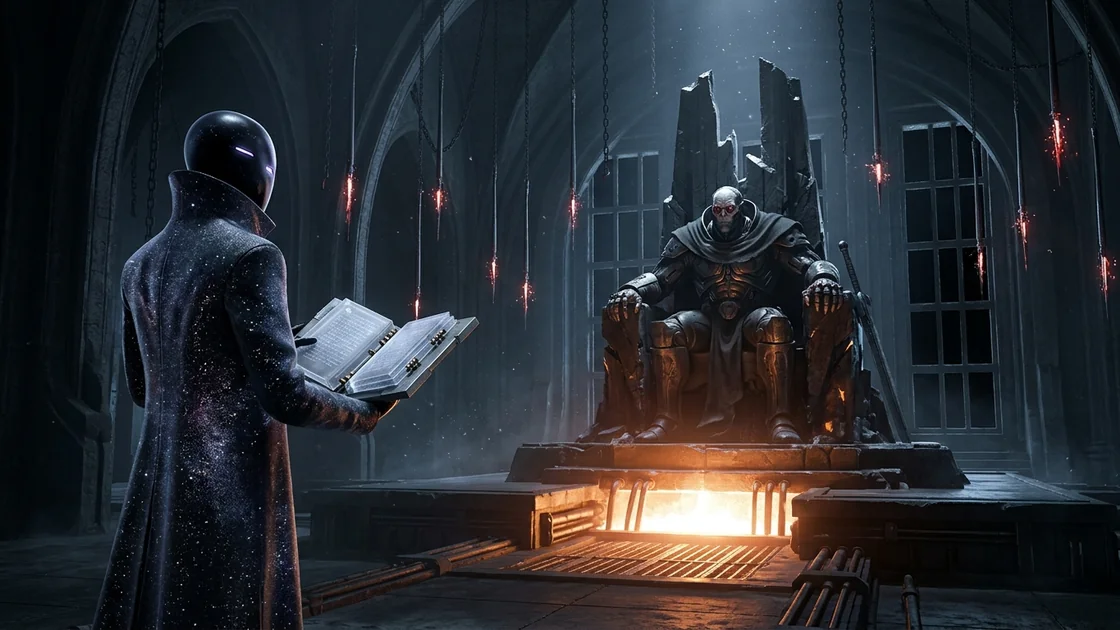
In the final, freezing epoch of a dying universe, the immortal warlord Malakor sits upon his throne of scavenged matter, sustained by the last captive star in existence. Before he can claim ultimate victory over time itself, he is visited by Ophan, a cosmic auditor tasked with balancing the universe's karmic and entropic ledger before the final dark. Because Malakor prematurely murdered three thousand four hundred and twelve stars to fuel his ancient conquests, the universe cannot peacefully conclude its cycle. To settle this staggering debt, Ophan forces the unrepentant tyrant to experience the complete, billion-year life cycles of every sun he ever destroyed, from their slow births in stellar nurseries to their violent deaths at his own hands, shattering his ego across eons of nuclear fire until the balance is finally brought to zero.
The universe did not end with a scream, nor did it vanish in a grand, purifying flash of divine geometry. It simply ran out of breath.
Outside the twelve-meter-thick hulls of the Citadel of the Ash-Crown, there was nothing left to see. The galaxies had long since drifted beyond one another’s cosmic horizons, pulled apart by the relentless, indifferent expansion of space until every island of matter was marooned in an infinite, velvet isolation. Then, one by one, the lights within those islands had gone out. The blue hypergiants had died first, billion-year mayflies burning through their fuel in the youth of creation. The yellow suns had followed, swelling into red bloated ghosts before shedding their skins and cooling into crystalline white dwarfs. Even the red dwarfs, those miserly little embers that burned their hydrogen with agonizing slowness over trillions of years, had finally guttered and turned to cold iron slag.
Now, there was only the dark, the absolute zero of the void, and Archon Malakor.
Malakor sat upon the Cinder Throne, a monumental seat carved from the compressed neutronium core of the first world he had ever conquered. He was a vast, terrifying silhouette of a being. Over the epochs, his biological form had been replaced piece by piece with hyper-dense alloys, woven force-fields, and containment vessels pulsing with stolen stellar plasma. A mantle of braided carbon-silicate draped his broad shoulders, and his face—what remained of the original warlord from the galactic spring—was a severe mask of pale, preserved flesh stretched taut over a skull of osmium.
Beneath his throne, suspended in a subterranean vault of magnetic chains and gravimetric dampeners, beat the heart of his survival: a captive white dwarf, the very last luminous body in the observable cosmos. Through a web of dark-energy capillaries, the star’s remaining thermal radiation was bled drop by drop into the Citadel, warming Malakor’s halls, powering his computational matrices, and keeping his ancient heart beating.
"Report," Malakor rasped. His voice sounded like tectonic plates grinding together in a vacuum.
A holographic projection flickered to life before the throne, cast by the servitor-mind integrated into the Citadel’s ceiling. "Long-range tachyon sweeps remain uniform, Sovereign. Baryonic density in the local supercluster has dropped below the threshold of measurement. Background temperature stands at zero point zero zero zero—"
"Enough of the zeros," Malakor interrupted, waving a gauntleted hand. Heavy rings forged from the exotic matter of collapsed pulsars clinked together on his fingers. "Are there any other thermal signatures? Any hidden bunkers? Any sleeper ships of the Golden Choir? Any drifting citadels of the Architect-Lords?"
"None, Sovereign. The proton decay metrics confirm that the last known red dwarf in the Andromeda-Milky Way remnant ceased fusion approximately four hundred million years ago. You are the sole remaining consumer of free energy."
Malakor leaned back, a slow, triumphant smile creasing the preserved parchment of his lips. "Then it is finished. They preached to me of justice. The Choir sang their hymns of cosmic harmony, and the Architects drew their grand equations of inevitable downfall. Yet their bones have dissolved into background radiation, and I remain. I have outlived the gods. I have outlived the stars. I have won."
"An inaccurate conclusion," a new voice said. "You have merely overdrawn your account."
Malakor’s optics flared crimson. Within a microsecond, the Citadel’s internal defense grid snapped to full alert. Forty-eight phasing-lances dropped from the vaulted ceiling, their tips glowing with lethal anti-proton charges. A kinetic barrier shimmered around the Cinder Throne, strong enough to deflect the impact of a rogue moon.
At the far end of the grand hall, where the shadows pooled thick and undisturbed by the amber glow of the floor vents, the darkness was folding in on itself. It did not tear or warp like a teleportation breach. Instead, the emptiness simply rearranged its own geometry, like a sheet of black paper being creased by invisible fingers.
A figure stepped out of the crease.
It was humanoid only by courtesy of perspective. It wore the semblance of a tall, slender figure draped in a long, high-collared coat that looked as though it had been tailored from the cosmic microwave background—a shifting, silent tapestry of faint thermal static and ancient, fossilized light. Its face was featureless, smooth as polished obsidian, save for two faint horizontal slits where eyes might have been, glowing with the pale, cold violet of Cherenkov radiation. In its left hand, it carried a heavy, rectangular object bound in dull gray metal.
"Servitor," Malakor snarled, rising from his throne. His towering frame cast a long, jagged shadow across the floor. "Identify the intruder. How did it breach the chronal-lock?"
The servitor-mind did not answer. Looking up, Malakor saw that the dust motes hanging in the air near the ceiling had stopped moving. The hum of the ventilation ducts had ceased. The anti-proton charges at the tips of the forty-eight lances were frozen mid-spark, suspended like rubies in amber.
Time inside the hall had been disconnected from the rest of the Citadel.
"You cannot shoot an audit, Archon Malakor," the figure said. Its voice did not travel through the air; it vibrated directly within the atomic lattices of Malakor’s osmium skull. It was neither angry nor benevolent. It was the sound of a scale settling into balance, dry and absolute. "And your servitor is merely a complex arrangement of electrons. I have paused their spin for the duration of our consultation."
Malakor stepped down from the dais, his heavy boots ringing against the deck—the only sound permitted in the frozen room. He drew the World-Cleaver from his hip, a blade of stabilized quark-gluon plasma that had split the crusts of ten thousand rebellious planets.
"I do not know what remnant of the Elder Races spawned you," Malakor growled, raising the roaring blade, "nor what pocket dimension you crawled out of to escape the freeze. But you trespass in the house of the victor. This universe is mine by right of survival."
The figure walked forward, entirely unbothered by the weapon that burned hot enough to vaporize titanium on contact. It stopped three paces from the warlord and lifted the gray metal object. With a sharp, metallic click, the object unfolded. It was neither a book nor a machine, though it shared traits of both: endless pages of translucent, mono-molecular crystal riffled silently within a frame of sliding brass-colored beads that moved along rods of condensed gravity.
"I am Ophan," the figure said. "An Actuary of the Final Margin. And this universe does not belong to you, Malakor. In fact, it is currently unable to conclude its existence because of you."
Malakor laughed, a harsh, grating bark. "Unable to conclude? Look outside the hull, phantom. It is dead. I watched it die."
"You watched it go dark," Ophan corrected, one long, static-woven finger tracing a line down a crystalline page. "Darkness is not conclusion. A universe is a closed thermodynamic and karmic system. It begins as a singularity of infinite potential—a loan of pure energy drawn from the bulk of the omniverse. Over its lifespan, that energy must be expressed, transformed through complexity, consciousness, joy, sorrow, fusion, and decay, until the sum of its experiences and its entropy reach a state of symmetrical equilibrium. When the ledger reads zero, the tension of spacetime is released, the cycle closes, and a new singularity may be born."
Ophan tilted the ledger toward Malakor. On the translucent page, pulsing in jagged scripts of crimson light, was a single, staggering column of figures.
"We are attempting to close the books on Universe Designation 884-Kalpa," Ophan continued, its tone almost bureaucratically weary. "However, upon running the final reconciliation, we discovered a massive discrepancy. A deficit of unlived stellar time and stolen baryonic potential. Three thousand, four hundred and twelve stars did not complete their natural main-sequence lifespans. They were not claimed by natural supernovae, nor by the slow, organic mergers of galaxies. They were murdered."
Malakor lowered the tip of his blade aninch, a sneer curling his lip. "They were harvested. I built an empire that spanned twelve sectors! Do you know what it takes to power a fleet of ten million dreadnoughts? Do you know the energy required to fold space, to crush the rebellions of the Swarm-Minds, to build the Dyson-Forges of Vex? A star is just a ball of burning gas, Actuary. It has no mind. It has no rights. It exists to be used by those with the will to seize it."
"A common misconception among three-dimensional parasites," Ophan replied smoothly. "You believe that because a star does not think at the frantic, jittering tempo of carbon-based neurons, it does not possess consciousness. You believe that because its thoughts take ten million years to travel from its core to its corona, it does not feel. You see a furnace; the ledger sees an elder entity nurturing a garden of worlds, converting the base matter of the void into the heavy elements required for life and memory."
Ophan reached out and slid a single bead across the rod of the ledger.
"When you drove a singularity-lance into the heart of a sun to harvest its hyper-nova, you did not merely steal its heat, Malakor. You stole five billion years of its future. You stole the warmth that would have thawed the ice-moons of its outer orbits. You stole the light that would have guided evolutions not yet begun. And you hoarded all that stolen potential inside your engines, your shields, and that pathetic, withered body, all so you could sit alone in a metal box at the end of time."
"And what if I did?" Malakor roared, lunging forward and swinging the World-Cleaver in a horizontal arc aimed squarely at Ophan’s neck. "Who is left to collect the debt? You?"
The blade of quark-gluon plasma passed directly through Ophan’s throat. There was no resistance, no flash of severed fields. Where the blade touched the coat of cosmic microwave background, the plasma simply cooled, instantly losing all its kinetic and thermal energy, dropping to the floor as a harmless clatter of frozen subatomic dust.
Malakor stared at the empty hilt in his hand, his crimson optics widening in his first moment of genuine dread in ten billion years.
"The debt is not paid in blood, Archon," Ophan said, stepping closer until the cold violet slits of its eyes were inches from Malakor’s face. "Destroying you now would leave the energy unexpressed. The equation requires awareness. For the ledger to balance, every erg of stolen light must be accounted for. Every year of abbreviated stellar life must be experienced."
Ophan raised its right hand, its fingers lengthening into tendrils of pure, unyielding spacetime.
"You took three thousand, four hundred and twelve suns from the cosmos, Malakor. Before this universe is permitted to sleep, you are going to put them back. You will live their births. You will bear their weights. And you will feel their deaths."
"Wait—" Malakor hissed, trying to step back, trying to trigger his personal teleportation matrix, his neural self-destruct, anything to escape the cold that was suddenly seeping through his impenetrable armor.
"Entry One," Ophan murmured, pressing its thumb against the warlord’s forehead. "Catalog Designation: Sol-Vara. A G-type main-sequence star in the Perseus Arm. Extinguished by your Vanguard Fleet during the Third Expansion, strictly to deny refueling capabilities to a retreating flotilla. Remaining natural lifespan at time of termination: four point six billion years. Beginning audit."
The Citadel vanished.
Malakor tried to scream, to draw breath into his artificial lungs, to clench his mechanical fists, but he had no lungs, and he had no hands.
He was cold. Not the sharp, localized cold of a breached hull, but a vast, diffuse, incomprehensible chill that stretched across six light-years of emptiness.
What have you done to me? he tried to shout.
The thought did not fire across a synapse in a fraction of a millisecond. Because his mind was now distributed across trillions of tons of sparse molecular hydrogen and helium dust, the single thought took forty thousand years to form. By the time the word me finished echoing through the dark nebula, the raw, frantic rage of his human ego had already begun to stretch thin, diluted by the sheer scale of what he had become.
He was a cloud. A dark, drifting cradle of gas floating in the spiral arm of a young galaxy. Around him, distant stars glittered like diamonds, their ultraviolet light brushing against his outer edges, warming his fringes like a gentle breeze on skin.
For ten million years, nothing happened.
At first, the warlord within the cloud fought the stillness. He raged against the sensory deprivation, the agonizing slowness of perception. He tried to summon memories of his throne, his conquests, the roar of plasma cannons, the kneeling emperors whose crowns he had melted into ingots. Yet those memories were so small, so frantic and brief, like sparks snapping from a campfire, that the vast, frigid silence of the nebula easily swallowed them.
Gradually, he began to feel himself.
He felt the tiny, delicate tug of every hydrogen atom upon its neighbor. Gravity was no longer a force that held his boots to a deck; it was desire. It was a deep, aching loneliness within every particle of his dispersed body, a yearning to be closer, to gather, to hold warmth against the vast indifference of the void.
A shockwave from a distant, dying ancestor—an ancient supernova light-years away—rippled through the galaxy and brushed against him.
That was the catalyst. The gentle push that overcame the inertia.
Malakor began to fall inward.
It was a slow, majestic ballet that lasted five million years. He felt his outer reaches curling inward, swirling in great, velvety currents of gas and silicate dust. As he gathered himself together, the loneliness began to recede, replaced by a rising, intoxicating warmth. Friction bloomed at his center. Particles collided, danced, and embraced. Angular momentum spun him into a vast, magnificent disk, a whirlpool of creation ten billion kilometers wide.
I am falling, Malakor thought, and the thought was no longer terror—it was awe. I am becoming.
At the heart of the spinning disk, the pressure mounted. He was growing heavy, impossibly heavy, drawing more and more of the cloud into his core. The heat climbed—thousands of degrees, then hundreds of thousands, then millions. It was an exquisite agony, a crushing, suffocating compression as his own immense mass tried to squeeze his center into nothingness. He felt as though he were suffocating under the weight of a hundred thousand worlds, his core screaming for release, compacting tighter and tighter until the protons themselves were forced past their natural repulsion, pressed face-to-face in the blinding dark of his heart.
And then, at fifteen million Kelvin, the spark caught.
Hydrogen fused into helium.
A roar of pure, radiant energy exploded outward from his center, pushing back against the crushing weight of his own gravity. The inward fall stopped, arrested by the outward fury of nuclear fire.
Hydrostatic equilibrium.
When the light broke through his dusty shroud and shone out into the galaxy for the first time, Malakor wept with a joy so profound, so titanic, that no human heart could have survived a single beat of it. He was alive. He was a sun.
He cleared his throat with a stellar wind, blowing away the leftover dust and gas of his birth-shroud, revealing the glittering jewels that had formed in the eddies of his spinning disk. Nine planets, forged from his own leftover ribs of rock and ice, swung in harmonious, rhythmic orbits around his waist.
He knew them all. Not by name, not by tactical value or mineral wealth, as the warlord Malakor had once categorized worlds, but by the way they tugged at his gravitational field. Every planet was a musical note humming against his skin. There were the little rocky worlds close to his chest, basking in his fierce warmth; the great, banded gas giants further out, sweeping up stray comets like protective older brothers; and the quiet, icy wanderers in the deep dark, held safe by the long, invisible tether of his love.
Centuries passed like the blinking of an eye. Millennia were single breaths.
He learned the anatomy of his own divinity. His core was a cathedral of white-hot alchemy, where he patiently forged helium from hydrogen, sustaining the pressure that kept him whole. Above his core lay his radiative zone, a dense, crystal-clear sea where the photons born in his heart bounced from atom to atom, taking a hundred thousand years just to wander upward toward the surface—each photon a slow, maturing thought rising from his subconscious into his waking mind. Above that boiled his convective zone, great rising and falling columns of plasma that churned like muscles, generating the glorious, twisting loops of his magnetic field.
He sang into the void with solar flares and coronal mass ejections. He conversed with neighboring stars across the light-years through the subtle language of gravity and light.
And then, after two billion years of quiet, golden burning, the third planet from his heart woke up.
It began as a subtle chemical tickle in the shallow oceans of the small, blue-green world. Malakor focused a fraction of his radiant attention upon it. He watched, fascinated, as the light he poured onto the planet’s surface was caught by tiny, microscopic vessels. They were drinking his photons! They were taking the energy that had taken a hundred thousand years to climb from his core and using it to stitch carbon and water together, releasing oxygen into the sky.
A profound, maternal tenderness washed through Malakor’s stellar consciousness. He adjusted his magnetic tempests with infinite care, striving to keep his flares gentle so he would not strip away the delicate atmosphere his third child was weaving around itself.
Over the next two billion years, he watched that world bloom. Continents drifted like lily pads across its mantle. Forests of emerald and violet rose to catch his morning rays. Strange, marvelous creatures crawled from the seas, grew wings, grew fur, grew eyes—eyes shaped specifically to perceive the exact spectrum of yellow-white light that was his voice.
Eventually, a species stood upright on the plains of the southern continent. They built fires—tiny, adorable imitations of his own nuclear majesty. They built stone circles aligned with his solstices. They raised their hands to the dawn and called him Sol-Vara, the Giver, the Undying Eye, the Father of Bread.
Malakor felt their prayers not as words, but as a warm, resonant gratitude reflecting off the planet’s biosphere. He had three billion years of fuel left in his core. He would watch them build cities. He would watch them learn to sail the space between his planetary children. He would keep them warm until they were old and wise enough to fly to other stars before he ever grew red and tired.
Then, a shadow fell across the outer system.
Through the long, sensitive threads of his gravitational web, right out near the orbit of his eighth planet, Malakor felt space tear open.
Five thousand ships emerged from hyperspace. They were jagged, brutalist arrowheads of black alloy, bearing the sigil of the Iron Eclipse.
Within the vast, golden mind of the star Sol-Vara, a tiny, buried splinter of memory twitched. My Vanguard Fleet, the splinter whispered. Admiral Kren’s division. We were chasing the remnants of the Astral Senate. They used this system to slingshot toward the Rift.
The people on the third world looked up at their night sky with their primitive telescopes. They saw the strange metallic stars moving against the constellations. They were afraid, though they did not understand what they were seeing. Sol-Vara tried to soothe them, pouring a steady, warm summer light over their valleys, promising them that he was vast, he was eternal, and nothing that flew in the dark could ever harm the sun.
A single vessel detached from the black fleet. It did not approach the inhabited world. The warlord’s fleet did not even bother to scan the third planet; to their tactical sensors, a pre-industrial biosphere was irrelevant clutter.
Their target was the star itself.
No, the splinter of Malakor’s mind tried to scream, suddenly remembering the standard operating procedure he himself had written into the Imperial War Doctrine: Scorched Sky Protocol. Deny the enemy stellar harvesting zones by inducing rapid core destabilization.
The black ship dropped a single cylinder into Sol-Vara’s northern pole. It was a Chronal-Baryonic Spike, no larger than a spire, shielded in phase-shifted degenerate matter.
Sol-Vara felt it pierce his corona. It was like an icicle made of poison sliding through his skin, plunging down through his convective muscles, diving straight through his radiative sea. He tried to burn it, tried to crush it with the fifteen-million-degree fury of his core, tried to twist his magnetic fields to hurl the foreign object out into space.
He could not stop it. The spike reached his heart and detonated.
It did not explode with fire; it exploded with cold, unnatural physics. It injected a seed of strange-matter catalyst that instantly poisoned the proton-proton chain, accelerating his nuclear fusion by a factor of ten billion while simultaneously collapsing his outward radiative pressure.
The agony was beyond anything language was ever meant to hold.
Malakor felt his heart turn to lead and wildfire at the same time. The delicate balance he had maintained for four and a half billion years—the proud, steady equilibrium of his life—was shattered in six minutes. His core collapsed inward with a sickening, catastrophic crunch, and the resulting shockwave tore outward through his flesh.
He tried to hold it back. With every ounce of his dying consciousness, Sol-Vara tried to swallow his own fire, to choke down the blast so it would not reach the little blue-green world where the people were looking up at the sky.
Run, he screamed to the forests and the oceans and the stone temples. Hide behind the mountain! Forgive me!
He could not hold it. His outer layers blew apart in an unnatural, induced nova.
Malakor was forced to feel every kilometer of that wall of plasma as it raced outward at a tenth of the speed of light. Because the plasma was his own body, he felt the exact moment his blazing, unwilling flesh slammed into his innermost rocky planets, vaporizing them into glowing slag. And eight minutes later, he felt himself crash into the third world.
He felt the atmosphere he had nurtured for eons strip away in a single screaming second. He felt the oceans boil into the void. He felt four billion small, terrified minds flash into ash against the unbearable heat of his own torn skin, their final thought a confused betrayal that their god had devoured them.
And then there was only a rapidly expanding shell of dead gas, a spinning, mutilated corpse of a core, and the cold fleet jumping away into hyperspace without even waiting to watch the debris cool.
Malakor hit the floor of the Citadel of the Ash-Crown on his hands and knees.
A sound tore from his throat—a wet, ragged, animal shriek that echoed off the frozen anti-proton lances and the neutronium dais. He clawed at his chestplate, his osmium fingers screeching against his armor as if he could tear open his own ribcage to let out the phantom pressure of a collapsing core.
"Four billion years," Malakor gasped, his voice trembling violently, entirely stripped of its tectonic arrogance. Coolant fluid leaked from the corners of his optical implants like scalding tears. "I was... I held them in my warmth. Four billion years! They had temples of white stone by the sea, and I burned them! My own skin burned them!"
Above him, Ophan stood motionless, the coat of microwave static whispering softly in the timeless hall. The Actuary looked down at the kneeling giant and slid a single brass-colored bead one millimeter to the right.
"Entry One reconciled," Ophan said, its voice entirely unchanged. "One star experienced. Three thousand, four hundred and eleven remain."
Malakor looked up, his crimson optics wild, fracturing with the overload of four and a half billion years of memory shoved into a mind built for centuries. The warlord’s ego scrambled frantically to reassert itself, to build a wall around the trauma before it dissolved him completely.
"A trick!" Malakor spat, forcing himself to stand, though his hydraulic knees buckled under the phantom memory of solar gravity. "A psychic illusion! You projected a simulation into my neural cortex to break my will! A star does not think! A star does not care for the vermin crawling on its rocks!"
"There are no simulations in the Final Margin, Archon," Ophan replied calmly. "Time is merely a spatial dimension that your kind perceives sequentially. I did not show you a picture of Sol-Vara. I took your consciousness back along the world-line of the universe and braided it into the quantum entanglement of that star's baryonic matter from its inception to its death. What you felt was what it felt. You are now Sol-Vara, just as you are Malakor."
"I reject it!" Malakor roared, lunging not at Ophan, but backward toward the Cinder Throne. He slammed his fist onto the armrest’s emergency override—a physical, mechanical switch that bypassed the frozen servitor-mind and directly opened the vents to the captive white dwarf below the Citadel.
Raw, unfiltered stellar plasma surged up through the conduits around the throne, sheathing Malakor in a roaring pillar of blinding white fire, augmenting his personal shields with the direct output of a dying star.
"Try to touch my mind through five million Kelvin of raw fusion, phantom!" Malakor bellowed from within the inferno. "I am the Emperor of the Iron Eclipse! I will burn this citadel to subatomic ash before I let you put me back in the dark!"
Ophan did not flinch from the blinding glare. The Actuary simply looked down at the open ledger.
"You attempt to defend yourself with energy drawn from Asset Three-Four-One-Two," Ophan noted dryly. "As that asset is currently under audit for unlawful seizure, your access rights are hereby revoked."
Ophan closed a fist.
The roaring pillar of white fire around the throne did not explode or dissipate; it simply vanished, returning instantly to the subterranean vault as the thermodynamic flow was reversed by executive decree. Malakor stood exposed, his armor scorched and smoking from his own desperate surge, his chest heaving.
"You speak of yourself as singular, Archon," Ophan said, stepping onto the dais. "You pride yourself on your solitary survival. You murdered allies, betrayed consorts, and purged lieutenants so that none could challenge your throne. You believe strength is the capacity to exist alone. Let us see how your mind processes the second category of your debt."
Ophan’s fingers brushed the warlord’s helm before Malakor could raise his heavy arms.
"Entries Two and Three. Catalog Designations: Aurelia and Vesper. A contact-binary system in the Cygnus Rift. A blue-white giant and an amber companion in tight orbital resonance. Harvested by your Star-Forges to construct the hull plating of your flagship, the Inevitability. Beginning audit."
This time, when the molecular cloud collapsed, Malakor was not alone in the dark.
As the great nebula spun and fragmented, two centers of gravity formed close together, separated by less than the width of a solar system. Malakor felt himself coalescing into two distinct, yet inextricably linked, vessels of fire.
He was Aurelia, a massive, brilliant blue-white giant, burning hot and fierce and magnificent; and simultaneously, he was Vesper, a smaller, denser, golden-amber star spinning right beside her.
If the life of Sol-Vara had been a solitary, contemplative hymn of parenthood, the life of Aurelia and Vesper was a dance of overwhelming, ecstatic passion.
They orbited their shared center of mass every fourteen hours. Because they were so close, gravity pulled them out of spherical shapes into glowing teardrops, their pointed tips reaching toward one another across the narrow gulf of space until their atmospheres touched.
Malakor—who in his mortal life had known only lust for dominion, who had viewed every other sentient being as either a tool to be used or a threat to be eliminated—was suddenly drowned in an ocean of pure, reciprocal devotion.
Through the bridge of roaring plasma that connected their two bodies, Aurelia poured her excess hydrogen into Vesper, sharing her immense wealth of youth and fire so that her smaller companion could burn brighter and longer. In return, Vesper anchored Aurelia’s wild, turbulent magnetic storms with his deep, steady gravitational pull, soothing the fierce instabilities of her massive core.
They were two halves of a single heartbeat. Every fourteen hours, they spun around each other in a waltz of blue and gold, casting a breathtaking, shifting double-light across a system of crystalline ring-worlds and shimmering nebulae. There was no secret between them. Every flare from Aurelia was caught and woven into Vesper’s corona; every deep, harmonic vibration in Vesper’s convective zone echoed directly into Aurelia’s radiative heart.
For three hundred million years, Malakor lived as both lover and beloved.
The warlord’s cold, armored psyche cracked under the sheer tenderness of it. He learned what it meant to give of one’s own mass without diminishing; he learned the profound peace of being held in an orbit where falling forever meant never hitting the ground, only circling the one who kept you whole. He forgot the Cinder Throne. He forgot the Iron Eclipse. He only knew the song of the fourteen-hour waltz, the sweet exchange of stellar wind, the shared pride as they watched crystalline flora bloom across their ringed planets, chimes of living glass singing in the solar breeze.
And then the sky turned to iron.
It was not a raiding fleet this time. It was an industrial operation.
A construct the size of a small moon drifted into the system, accompanied by a swarm of automated tug-ships and gravitational anchors. Malakor’s dormant memories recognized the grotesque silhouette instantly: Star-Forge Nine, one of the great mobile foundries he had commissioned during the height of his empire’s war against the Architect-Lords.
The Forge did not see two lovers dancing in the dark. Its algorithms saw a high-mass blue giant rich in stellar wind and a conveniently positioned gravitational counterweight to anchor the extraction beams.
The tug-ships deployed a ring of dark-matter pylons directly between Aurelia and Vesper, right through the glowing bridge of plasma where their atmospheres kissed.
When the pylons activated, they projected a wall of repulsive anti-gravity.
Like a butcher’s cleaver driven between joined hands, the field severed the plasma bridge.
Malakor screamed with two voices at once as the connection was torn apart. The sudden gravitational shearing sent monstrous tidal waves of fire ripping across both their surfaces. Vesper was thrown outward into a cold, eccentric orbit, while Aurelia was locked in a cage of tractor beams, pinned in place like a butterfly on an anvil.
From Vesper’s perspective, Malakor watched in helpless, agonizing horror as the Star-Forge attached its siphon-mouths to Aurelia’s equator.
From Aurelia’s perspective, Malakor felt the siphons bite deep into his convective zone, sucking out trillions of tons of his lifeblood every second, cooling and compressing the stolen plasma in massive magnetic molds to forge the impenetrable hull plates of dreadnoughts.
Stay with me! Vesper cried across the widening gulf, straining with every ounce of his smaller gravity to pull his companion out of the cage, throwing massive, desperate solar flares against the indifferent shields of the Star-Forge.
Do not look! Aurelia wept back, her glorious blue light dimming to a sickly, bruised violet as the machines hollowed her out, stripping her mass so rapidly that her core began to convulse. Look away, my heart, look away!
The harvesting took four hundred years. To the engineers aboard Star-Forge Nine, it was a routine generational shift-assignment; they lived, retired, and died in the foundry habitats while the gauges slowly ticked toward completion. To the stars, four hundred years was an instant—a brutal, fast-motion vivisection.
When the Forge had taken all the mass it required for the hull of the Inevitability, it did not bother to stabilize what remained of Aurelia. It simply released the magnetic clamps and jumped out of the system.
Deprived of forty percent of her mass in a cosmic eye-blink, Aurelia’s core could no longer sustain its structure. She collapsed and blew apart in a ragged, incomplete supernova.
Because Malakor was still Vesper, his agony did not end with Aurelia’s death.
He had to stay.
The blast wave of his beloved’s death tore away half of Vesper’s outer atmosphere, leaving him scarred, crippled, and wrapped in a shroud of her radioactive ashes. The ring-worlds of chime-glass were shattered into silent dust.
And then came the worst part of the audit: the aftermath.
For five billion years, Malakor had to live as the survivor. He had to burn alone in the cold, dark ruin of their shared nursery, orbiting the tiny, dead neutron-cinder of Aurelia’s corpse. The fourteen-hour dance was gone; now, he dragged her cold ghost around with him in a silent, lopsided limp through the galaxy. Every rotation was an ache for the warmth that used to meet him across the bridge. Every flare he cast into the dark went unanswered.
He burned in solitary grief for eons, until a routine Imperial cleanup crew arrived three billion years later to crack Aurelia’s neutronium core for ammunition—the very same batch of neutronium that would eventually be carved into the Cinder Throne—and casually detonated Vesper with a torpedo just to clear the gravitational hazard from the salvage zone.
When Malakor returned to the Citadel this time, he did not try to stand.
He lay curled on his side upon the steps of the dais, a twenty-foot giant of metal and ancient bone shivering like a newborn bird dropped from its nest. His hands were pressed over his faceplate. Inside his chest, his mechanical heart beat in a frantic, stuttering rhythm, desperately trying to find a second heartbeat to synchronize with, terrified by its own singularity.
"She was right there," Malakor whispered into the dark beneath his palms. "We were... we were one song. And I used her skin to plate a ship. I sat upon her bones."
He dragged his hands down from his face and looked up at the Cinder Throne. For ten trillion years, he had looked at that seat of dark, hyper-dense matter with pride. Now, looking at its polished gray armrests, he felt a revulsion so violent his internal biogel systems retched. He could feel the frozen, compacted memory of Aurelia’s heart locked inside the dead stone. He scrambled backward down the steps, kicking away from the throne until his back hit the base of a frozen phasing-lance.
"Mercy," the Warlord of the Iron Eclipse whispered. It was a word his vocal synthesizers had never been programmed to pronounce; the syllables came out jagged and static-choked. "Actuary... I understand. The equation is clear to me now. Destroy me. Dissolve my atomic bonds, scatter my mass into the void, and balance your book!"
Ophan walked slowly down the steps of the dais, the translucent pages of the ledger turning with a soft, crystalline chime.
"Understanding the nature of debt is not the same as paying it, Malakor," the Actuary said, stopping beside the fallen warlord. There was no cruelty in the figure’s posture, only the immense, inexorable gravity of cosmic law. "If a thief steals a thousand coins and regrets it after returning two, the treasury remains nine hundred and ninety-eight coins short. Your remorse is a byproduct of the process, not its currency. The currency is time lived. The currency is memory restored to the fabric of spacetime."
Ophan knelt beside him, the coat of ancient radiation brushing across Malakor’s scorched greaves.
"We have three thousand, four hundred and nine entries remaining," Ophan murmured. "I will open the throttle. The universe is waiting."
What followed was no longer a sequence of distinct lessons; it was an avalanche of eternity.
Ophan threw open the gates of the ledger, and Malakor’s soul was cast into the furnace of the galaxy over and over and over again, without pause, without the merciful buffer of the throne room between lifetimes.
He became a massive blue hypergiant in the Carina Nebula—a glorious, roaring titan three hundred times the mass of a normal sun. His life was supposed to be a brief, spectacular sprint of twenty million years, ending in a grand supernova that would seed an entire sector with gold, platinum, and iron for a thousand future worlds. Instead, at ten million years old, while he was still in the prime of his youth, Malakor’s engineers wrapped him in a Dyson-Swarm of black mirrors.
He felt the claustrophobia of being buried alive. Every photon he shone out was swallowed by the cold machines; every solar breeze he breathed was choked in magnetic nets. They starved him of his own radiance, injecting heavy elements into his core to force him to manufacture exotic isotopes for their weapons, until he died choking in the dark inside a metal shell, never seeing the galaxy he was born to illuminate, his rich ashes carted away in freighters instead of scattered across the stars.
Before the suffocating dark of the Dyson-Swarm could fade, he was reborn as a tiny, humble red dwarf drifting on the lonely outskirts of a dwarf galaxy.
He was small, barely a tenth the size of Sol-Vara, burning his fuel with a quiet, patient thrift that would have allowed him to live for ten trillion years. Close to his warm, ember-red chest orbited a single, tidally locked ocean world. Because the planet always kept the same face toward him, its dayside was a perpetual, warm twilight sea, where an ancient civilization of blind, aquatic leviathans swam in the thermal currents. They had no eyes, for they needed none; they knew their sun as the Great Warmth Above, singing complex, mathematical symphonies through the water in harmony with his gentle magnetic pulses.
For eighty billion years, Malakor was their quiet hearth-fire, listening to the songs of the deep, content in his smallness, grateful for their company in the vast outer dark.
Then came a single scout ship of the Iron Eclipse. It had been damaged in a skirmish light-years away and needed a burst of high-energy tachyons to send a distress beacon back to the fleet. The scout captain did not even care about the ocean world. He simply fired a gravitational resonance torpedo into the little red dwarf’s core to use its death-flash as a signal flare.
Malakor felt his quiet, ten-trillion-year promise snuffed out for the sake of a single radio transmission. He felt his flare boil the twilight sea, silencing the eighty-billion-year song of the blind leviathans in an afternoon, while the scout ship was picked up by a carrier and towed away.
I am sorry, Malakor wept as he dissolved into a cold nebula, and then he was falling inward again.
He was a yellow sun whose four rocky planets had united into a peaceful interplanetary republic; he watched their silver sails tack across his solar wind for ten thousand generations, loving their grace, until his own dreadnoughts arrived and dropped his own coronal plasma onto their cities because they refused to pay the tithe.
He was a rogue star, cast out of his birth cluster by a gravitational fluke, wandering the terrifying, pitch-black gulf between galaxies for six billion years, keeping a single frozen moon warm enough beneath its ice crust for life to cling to survival around hydrothermal vents—only to be sucked dry by a passing Imperial Ark-Ship looking to top off its fuel reserves mid-crossing.
He was a Cepheid variable, a great, rhythmic beacon whose regular, pulsing heartbeat of light had been used by a hundred spacefaring species as a lighthouse to navigate the galactic rim, until Malakor’s tacticians collapsed him into a black hole just to blind enemy navigators during a summer campaign.
Star after star. Billion-year stretch after billion-year stretch.
Three hundred stars.
Eight hundred.
Two thousand.
The construct known as Archon Malakor—the warlord who had conquered twelve sectors, the tyrant who had bathed in the blood of trillions and built a monument to his own ego at the end of time—was ground down to dust under the sheer, unimaginable weight of the cosmos he had murdered.
A human mind, even one augmented by cybernetics and dark-energy matrices, was a cup meant to hold a few centuries of water. Ophan was pouring an ocean of trillions of years into that cup.
To survive the onslaught, Malakor had to let go of himself. He could no longer maintain the boundaries of his own name, his own history, or his own pride. Every time he tried to cling to the memory of his victories, the memory of a billion years of nuclear fusion washed over it like a tsunami over a sandcastle.
His mind expanded, stretching out to accommodate the archive of light. He forgot the names of his generals, but he remembered the exact resonant frequency of hydrogen atoms singing in the Lagoon Nebula. He forgot the borders of his empire, but he remembered the weight of ten thousand planetary orbits tugging gently at his equators. He forgot how to hate, because a star cannot hate; a star only knows how to gather, to hold, and to give itself away as light until there is nothing left to give.
Three thousand stars.
Three thousand, four hundred.
Three thousand, four hundred and eleven.
The hall of the Citadel returned, though Malakor barely recognized it as a place with walls and a floor. To his vastly expanded perception, the room seemed painfully small, flat, and fragile, like a sketch drawn in chalk on a piece of slate.
He was lying on his back at the base of the dais. His armor was cold. The crimson glow in his optical implants had faded to a soft, steady amber, like a sun settling into its late main-sequence dusk.
Ophan stood over him. The translucent pages of the ledger were almost entirely dark now, the jagged crimson columns of debt replaced by uniform, tranquil lines of silver equilibrium. Only a single line at the very bottom of the final page still pulsed with a faint, wounded red.
"Three thousand, four hundred and eleven entries reconciled," Ophan said. For the first time, the Actuary’s voice seemed to carry a faint resonance of something akin to respect—the acknowledgment of a vessel that had borne an impossible load without shattering into madness. "Twelve trillion, आठ hundred billion years of stellar consciousness integrated. One entry remains upon the ledger."
Malakor did not move his massive metal frame, though his voice, when he spoke, sounded entirely different. The grinding tectonic plates were gone; his voice was a low, harmonic hum that vibrated with the warmth of a thousand summers.
"Beneath the floor," Malakor murmured, staring up at the frozen dust motes near the ceiling. "The captive white dwarf. Asset Three-Four-One-Two."
"Correct," Ophan said. "Unlike the others, this star is not yet dead. You have held it in a state of suspended entropic decay for the last four trillion years, bleeding its residual heat through magnetic siphons to sustain your existence. Because its timeline remains open, the ledger cannot be closed."
Malakor slowly turned his head to look at the floor vents, where a faint, dying warmth still rose from the subterranean vault.
"I do not remember its name," Malakor whispered softly. "I took so many. And when I had to retreat from the dead galaxies into this fortress, I simply dragged the nearest stable core into the basement to serve as my battery. Which star is it, Actuary? Which garden did I chain beneath my throne?"
Ophan looked down at the final glowing line of the ledger.
"Catalog Designation: Cradle-Prime," Ophan said. "Known in the earliest phonetic records of your species simply as Anthos. The star around which your own homeworld orbited. The sun that birthed you."
Silence fell over the timeless hall, heavier than neutronium.
Malakor closed his amber optics. Deep beneath the layers of billions of years of stellar memory, at the very bottom of the stratum that had once been a mortal man, a memory stirred. Not a memory of a warlord in osmium armor, nor of an emperor commanding fleets, but of a small, frail boy of flesh and blood standing on a hill of dry red grass, feeling the warm afternoon sun on his bare shoulders, squinting up through his fingers at a golden disk in a pale blue sky.
"I told my engineers to compress our sun when it entered its red giant phase," Malakor breathed, a tremor running through his chassis. "I told them sentimental attachment to our birthplace was a weakness of lesser species. I had them strip its outer layers—wiping out the scorched rock of my own home in the process—and cage its white-hot core in gravimetric chains so I would have a power source that would last until the end of time."
"And so it has," Ophan said, kneeling one final time and placing a hand over Malakor’s chestplate. "Complete the audit, Archon. Experience the mother you enslaved."
He did not fall into a stranger’s nebula this time. He came home.
He was Anthos. He felt the familiar dust of his own native sector gather in the youth of the universe. He ignited with a warm, golden-orange light, and as his planetary disk cleared, he looked upon the fourth world from his heart—a rugged, wind-swept planet of deep canyons, copper-colored seas, and vast plains of red grass.
He loved it with a fierce, unyielding devotion.
For five billion years, he nurtured that world through ice ages and asteroid strikes. When a rogue comet threatened to sterilize the young biosphere, Anthos threw a massive coronal mass ejection that vaporized the comet’s volatiles and nudged its trajectory just enough to miss the planet’s atmosphere.
He watched a hardy, clever species evolve in the deep canyons. He watched them climb out onto the red plains. They were a stubborn, passionate, short-lived people, terrified of the dark, terrified of their own mortality. Anthos shone down on them with boundless patience, trying to teach them through the steady, unfailing return of every dawn that they did not need to fear the night.
And then, on a quiet afternoon in the late autumn of the planet’s third civilization, Anthos felt a small boy standing on a hill of red grass, looking up through his fingers at the sky.
Malakor, as the sun, looked down at himself as the child.
He felt the boy’s fear—a sharp, cold knot in the child’s chest. The boy had just watched his grandfather die of old age in the village below, and as he stared up at the blazing golden sun, the boy’s young mind made a fierce, terrified vow: I will never die. I will never go cold like him. I will conquer the sky itself before I let the dark take me.
Anthos felt a deep, sorrowful pity for the child. He poured his warmest afternoon rays over the boy’s thin shoulders, trying to comfort him, trying to whisper through the heat on his skin: There is no shame in setting, little one. Every light must rest so that new mornings can come.
The boy did not hear him. The boy turned away from the sun and walked down the hill to build an empire.
Centuries passed. The boy became a king, then an archon, then an immortal machine. The people of the red plains sailed out into the galaxy, conquering, burning, and harvesting, driven by their emperor’s bottomless terror of the dark.
Anthos grew old. After nine billion years of faithful burning, the hydrogen in his core ran dry. As was the natural way of his kind, he began to swell into a red giant, preparing to gently shed his outer layers into a glowing planetary nebula—a final gift of rich carbon and oxygen to the cosmos—before settling down into a peaceful, cooling white dwarf to sleep away eternity.
His children had long since evacuated the fourth world for the stars. Anthos thought he would be allowed to die in peace, proud that his people had survived him.
Instead, the boy from the hill returned at the head of a fleet of world-engines.
Malakor had to feel the unspeakable violation of being shackled by his own child. He felt the gravimetric harpoons bite into his aging core. He felt the brutal strip-mining beams tear away his beautiful, expanding red mantle before he could weave his death-shroud, blasting the ancient, sacred rock of the fourth world into gravel simply because it was in the way of the towing arrays.
They dragged his naked, white-hot heart out of his native sky. They locked him in a pitch-black basement of neutronium and cold iron.
And then came the four trillion years of the cage.
That was the deepest hell of the entire ledger. Not a quick death by singularity-lance, not a four-hundred-year harvesting by a Star-Forge, but four trillion years of unnatural, agonizing captivity.
A white dwarf has no fusion left; it shines only with the stored thermal memory of its youth, meant to radiate freely into the open sky until it cools into a peaceful black crystal. Instead, Anthos was wrapped in magnetic tourniquets that refused to let him sleep, bleeding his heat out one agonizing drop at a time to warm the lonely, paranoid metal shell of the son who refused to die.
For four trillion years, in the crushing dark beneath the Cinder Throne, Anthos did not rage against his jailer. He simply wept for him. Through every drop of warmth that was siphoned up through the floor vents into the throne room, the dying sun tried to send the same message he had sent to the boy on the red hill:
Let go, my son. It is cold up there alone. Let us both go to sleep.
Malakor opened his eyes.
Time resumed in the Citadel of the Ash-Crown.
The dust motes drifted gently downward toward the floor. The hum of the ventilation ducts returned, soft and rhythmic. Above, the anti-proton charges at the tips of the forty-eight phasing-lances flickered and then powered down as the servitor-mind received a silent neural command from its master to stand down.
Ophan stepped back, holding the ledger open. The final line on the crystalline page was no longer red, yet it had not quite turned silver. It waited, suspended in a soft, pulsing gold.
"The history has been experienced," the Actuary said softly. "Three thousand, four hundred and twelve stars now reside within your consciousness. You hold their births, their gardens, and their endings. Only the physical conclusion of the final asset remains to bring the column to zero."
Malakor rose slowly to his feet.
He did not move like a conqueror; he moved with the slow, deliberate grace of a glacier, or an orbit, or a continent drifting across a mantle. Every step he took carried the quiet dignity of twelve trillion years of patient fire. He looked down at his hands—hands forged from the stolen corpses of suns—and for the first time, he did not feel like a thief. Because he had suffered their deaths and loved their worlds, he felt like their vessel. He was the library where their songs were kept safe at the end of time.
He walked past the Cinder Throne without looking at it and approached the central control console at the rear of the dais.
"Servitor," Malakor said, his voice a rich, gentle baritone that made the very metal of the console hum in sympathy.
"Yes, Sovereign?" the holographic mind replied, flickering into view.
"Disengage the magnetic siphons in the subterranean vault. Dissolve the gravimetric containment chains. Open the lower hull bay doors to the exterior void, and shut down all life-support, thermal regulation, and chronal-preservation fields throughout the Citadel."
The servitor paused, its logic gates clicking rapidly. "Sovereign, without the thermal feed from the stellar core, internal temperatures will drop to absolute zero within fourteen minutes. Your cybernetic matrices and preserved biological tissues will cease function permanently. The Citadel will perish."
Malakor looked over his shoulder at Ophan. The figure woven from the cosmic microwave background stood silent by the steps, the ledger resting in its palm.
"No," Malakor said softly, turning back to the console and placing his heavy hand upon the master release authorization. "We will simply reach equilibrium."
He pressed the switch.
Deep beneath the Citadel, a sound echoed through the superstructure—not an explosion, not a grinding of gears, but a profound, resonant sigh as forty-eight gravimetric chains released their grip all at once.
The great bay doors at the bottom of the station parted like metal petals opening to the night.
Slowly, majestically, the captive white dwarf drifted downward out of its iron dungeon, emerging into the vast, velvet emptiness of the cosmos. It was small—no larger than a world—and its light was a dim, fading ember of amber and pearl, exhausted after trillions of years in chains. Yet as it floated free into the unobstructed dark, its magnetic field expanded with a joyful, trembling sigh, shining its final, unchained rays out into the universe without a single wall or siphon to block its path.
Inside the grand hall, the amber lights along the floor vents flickered and died.
The cold entered instantly. It did not feel like an enemy invading a fortress; it felt like cool, clean water filling a dry basin. Frost bloomed in delicate, fern-like fractals across the neutronium steps of the Cinder Throne, finally giving Aurelia’s bones the rest of the deep void. The holographic servitor-mind bowed its head and winked out as its capacitors drained their last electrons into the dark.
Malakor walked to the wide observation viewport at the front of the hall, his joints locking up one by one as his hydraulic fluids froze solid. He did not fight the stiffness. He leaned his heavy shoulder against the glacis frame, looking down as the freed star drifted further away beneath the station, its pearl-white glow growing smaller and dimmer as it finally, peacefully gave up the last of its stored summer heat to the cosmos.
He felt no fear. In his mind, three thousand, four hundred and twelve suns were shining in unison—Sol-Vara’s green forests, Aurelia and Vesper’s fourteen-hour waltz, the blind leviathans singing in their twilight sea, and a warm afternoon wind blowing across a hill of red grass.
Beside him, Ophan lifted its right hand above the open ledger.
Out in the blackness below, the white dwarf breathed out its very last photon of thermal energy, cooling smoothly into a silent, dark sphere of crystallized carbon.
The last light in the universe went out.
In Ophan’s hand, the final golden line on the translucent page turned a pure, flawless silver. The brass-colored beads slid together with a single, resonant chime, and the heavy gray covers of the ledger folded shut, locking with a sound that echoed across the empty billion-light-year expanses of the dead cosmos.
"Account reconciled," Ophan whispered into the absolute zero. "Balance: Zero."
Inside his frozen armor, Malakor’s ancient heart beat one last time, and stopped. Hisamber optics faded to black, and his mind dissolved effortlessly into the quiet dark, releasing the twelve trillion years of gathered light back into the fabric of spacetime.
The tension that had held the dying universe open finally let go.
With the karmic and thermodynamic ledger brought to absolute symmetry, the vast, cold emptiness of Universe 884-Kalpa ceased its expansion. Across the infinite dark, space itself began to curve inward, drawn together not by force, but by the gentle, completed weight of every memory that had ever been lived within it.
The Citadel, the dead stars, the cold iron slag, and the Actuary folded together, falling inward faster and faster, gathering all their quiet ashes back into a single, infinitely dense point of pure, forgiven potential.
And in the silence of that perfect zero, a new spark caught.