The Immutable Ledger of New Veridia
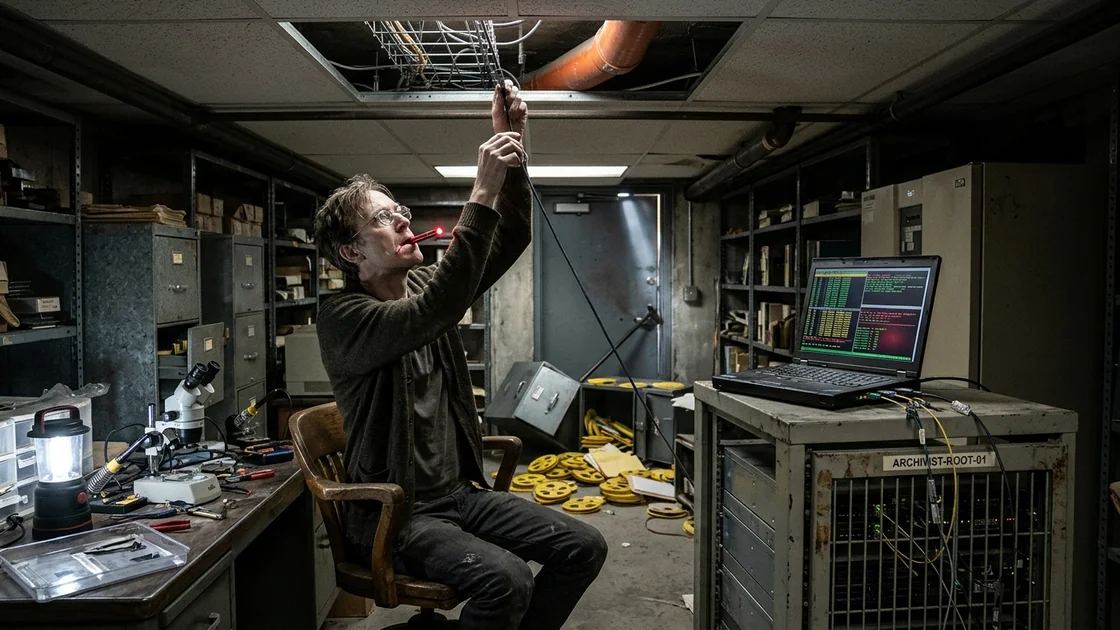
In the subterranean archives of New Veridia, digital preservationist Silas Castell spends his days rescuing obsolete municipal files from the slow death of bit rot. When a crate of physically slagged police body-cameras from the violent clearing of the Foundry District lands on his workbench, Silas uses microscopic hardware forensics to reconstruct a deleted video file that proves the city's administration orchestrated a fatal cover-up to secure land for a multibillion-dollar redevelopment project. Realizing that traditional media outlets and internal oversight boards are completely compromised by the Mayor's office, Silas devises a radical method of preservation. With the help of a disillusioned treasury analyst, he formats the cryptographically signed video stream into thousands of hexadecimal data packets and injects them directly into the smart contracts of the city's permanent municipal bond blockchain during a massive fiscal rollover. Hunted through the mechanical bowels of City Hall by internal security forces, Silas races to achieve network consensus, knowing that once the block is finalized by international banking nodes, the city will never be able to erase the truth without defaulting on its entire sovereign debt.
The smell of Sub-Basement Four was the smell of vinegar and hot dust. The vinegar came from forty-year-old reels of cellulose acetate microfilm slowly decomposing inside their galvanized steel cabinets, off-gassing acetic acid into the dry, recirculated air. The hot dust came from the banks of legacy server blades that Silas Castell kept alive with scavenged capacitors, thermal paste, and stubbornness.
Silas sat at his workbench under the harsh, shadowless glare of an articulating magnifier lamp. In his left hand he held a pair of titanium micro-forceps; in his right, a hot-air rework pencil set to three hundred and eighty degrees Celsius. On the silicon mat before him lay the blackened, blistered circuit board of a WatchGuard-9 tactical body-camera, property of the New Veridia Metropolitan Police Department.
According to the red requisition slip clipped to the plastic evidence tray, the unit—along with thirty-seven others in the gray fiberglass bin by his boots—had been caught in an accidental electrical surge inside the Third Precinct’s charging locker on the night of November fourteenth. The slip was signed by Deputy Director Marcus Vance of the Office of Information Integrity, and the instructions were explicit: Verify non-recoverability of onboard storage media for insurance write-off, then transfer to municipal e-waste incinerator.
It was rubber-stamp work. Silas wasn't supposed to actually recover anything. His job title was Senior Digital Archivist, Grade Three, which in the bureaucratic ecosystem of New Veridia meant he was the mortician who signed the death certificates for data the city no longer wanted to pay to store. When a zoning board lost an email server from 2008, Silas certified that the RAID controller had suffered an unrecoverable parity fault. When the Department of Sanitation accidentally overwrote three years of toxic-waste haulage manifests, Silas wrote a four-page technical memo explaining how magnetic coercivity degradation made retrieval mathematically impossible.
He was very good at writing obituaries for zeroes and ones. Mostly because he was the only person left on the municipal payroll who actually knew how to resurrect them.
Silas adjusted the binocular loupes strapped to his forehead and brought the hot-air nozzle down over the camera’s main System-on-Chip. The plastic housing of the camera had been melted into a shapeless lump of polycarbonate slag, as if someone had taken a blowtorch to it, yet the internal copper ground-planes showed none of the dendritic branching typical of a charging-dock voltage spike. Instead, the power-management integrated circuit had been neatly punctured with a sharp instrument—a hardened steel awl, most likely—and then the board had been cooked in an industrial microwave for four or five seconds to arc the surface traces.
It was messy, amateurish sabotage disguised as an accident. Somebody in the Third Precinct had wanted this camera dead, and they hadn't trusted a software wipe to do the job.
"You're wasting city electricity, Silas," a voice rasped from the doorway behind him.
Silas didn't flinch. His hand remained steady as the solder balls beneath the NAND flash memory chip turned from dull matte gray to liquid silver. With a practiced flick of the forceps, he lifted the tiny square of silicon off the ruined board and set it down on a clean square of Kapton tape. Only then did he switch off the heating element and swivel his chair around.
Arthur Pendelton stood leaning against the doorframe, holding two steaming paper cups of vending-machine coffee. Arthur was sixty-eight, three months shy of a pension that the city was currently trying to renegotiate into a deferred annuity, and he spent most of his shifts indexing nineteen-seventies water-main blueprints onto optical discs.
"The requisition says verify non-recoverability, Artie," Silas said, taking the offered cup. The coffee tasted like burnt chicory and cardboard, the way it always did. "I can't sign a legal affidavit certifying the NAND gates are blown unless I look at the die."
Arthur snorted, shuffling over to his own desk, which was buried under yellowing stacks of aperture cards. "You can sign it with a Bic pen in four seconds and spend the rest of the afternoon fixing that corrupted database from the Parks Department. Vance’s office sent those bins down directly. You know what November fourteenth was."
Silas looked back at the tiny black square of silicon sitting under his magnifier. "The Foundry District clearance."
"Right. The night the squatters set fire to the old dry-dock cranes and three blocks of condemned tenements went up like matchsticks." Arthur sat down, his wooden swivel chair groaning under his weight. "The night that community organizer—what was his name, Mateo Cruz?—fell off the fourth-floor fire escape while trying to throw a Molotov at a tactical unit. The Police Union already released four hours of helmet-cam footage from the perimeter units showing the smoke and the rioters. The Grand Jury cleared the officers on Tuesday. Those cameras in that bin are just paperwork, Silas. Stamp them dead and put them in the furnace."
Silas took a slow sip of the terrible coffee. He was forty-two years old, thin and pale from nineteen years of working four floors below the street level of Civic Center Plaza. Before he had retreated into the quiet sanctuary of the municipal archives, he had worked in private-sector forensic recovery, pulling ledger databases out of hard drives recovered from drowned yachts and burned-out corporate jets. He had left that world because he didn't like knowing what rich people did when they thought no one was watching. Down here, among the property tax rolls of 1954 and the Fortran punch-cards from the first subway expansion, the data was supposed to be dead and harmless.
"If they're just paperwork," Silas said quietly, turning back to his workbench, "why did someone put a steel punch through the voltage regulator before they microwaved it?"
Arthur stopped sorting his aperture cards. The only sound in the room was the deep, rhythmic thrumming of the building’s primary chiller pipes running along the low concrete ceiling, and the high-pitched whine of a tape-drive motor spooling in the back corner.
"Silas," Arthur said, his voice dropping an octave. "The Series-G Waterfront Bond goes to final syndication on Friday. Two point four billion dollars to turn the Foundry District into a climate-controlled logistics hub and luxury marina. The Mayor’s whole second term is riding on that ledger closing clean. Don't go poking needles into things that are meant to stay dark."
"I'm just checking the integrity of the silicon, Artie," Silas murmured. "Just doing my job."
He waited until five o'clock, when Arthur clocked out, rode the freight elevator up to the street, and left Silas alone in the fluorescent-lit catacombs.
Silas locked the heavy fire door of the laboratory from the inside. He walked over to the wall panel and flipped the toggle switch that disconnected his workbench subnet from the municipal intranet, physically dropping a brass relay that severed the Ethernet lines. He was now on an air-gapped island.
Returning to his desk, he placed the salvaged memory chip—a 128-gigabyte Ball Grid Array package—into a bath of fuming nitric acid inside a small fume hood behind his storage racks. The WatchGuard-9 cameras used hardware-level encryption tied to the main board's processor, or so the manufacturer claimed in their sales brochures. In reality, because the police department had bought the cheapest tier of the fleet-management contract, the encryption key was stored in a plaintext configuration block on page zero of the raw flash memory itself. The processor had been destroyed by the microwave surge, and the external contact pads of the memory chip had been fused by the heat, which meant a standard socket reader would only return a dead short.
To read the data, Silas had to bypass the ruined package wiring entirely and go straight to the microscopic bond pads on the silicon die itself.
After twenty minutes, the nitric acid had eaten away the black epoxy resin casing without harming the silicon crystal or the hair-thin gold wires inside. Silas neutralized the acid with acetone, rinsed the bare die in isopropyl alcohol, and placed it onto the stage of his stereo microscope.
This was the part of the job that calmed his mind. The world above Sub-Basement Four was full of messy, ambiguous things—politics, eminent domain lawsuits, television press conferences, shifting stories. Down here, at two hundred times magnification, there was only physics. Either a floating-gate transistor held an electrical charge, or it did not. One or zero. Truth or absence.
Using micromanipulators controlled by brass thumb-screws, Silas lowered eight tungsten-carbide needles—each etched to a point thinner than a red blood cell—onto the microscopic aluminum pads lining the edge of the exposed silicon wafer. He connected the needles via ribbon cable to a custom FPGA logic analyzer he had built five years ago out of spare parts from a decommissioned traffic-camera controller.
He booted up his Linux terminal and initiated a raw bit-stream dump.
Lines of hexadecimal code began to cascade down the black screen in pale green phosphor font. 4D 56 50 44 5F 57 47 39...
The header was intact. MVPD_WG9. Metropolitan Veridia Police Department, WatchGuard Nine. Badge Registry: 0994-K.
The dump took three hours. Because he was bypassing the chip's internal error-correction controller, the raw data was riddled with bit-flips caused by the microwave heat. A normal media player would have rejected the file instantly as corrupted garbage. Silas wrote a quick Python script to strip out the spare-area metadata, applied a Bose-Chaudhuri-Hocquenghem error-correcting polynomial across the raw pages, and reassembled the underlying file allocation table.
There were four video files on the drive from the night of November fourteenth. The first three were routine: twenty-minute clips of officers standing behind polycarbonate riot shields at the perimeter of Cooper Street, illuminated by the rotating red and blue strobes of armored personnel carriers while smoke drifted overhead.
The fourth file was marked with a deleted flag—its directory pointer zeroed out in the allocation table, though the actual data blocks remained sitting untouched in the upper sectors of the chip. Whoever had tried to delete the file from the precinct terminal had realized halfway through the purge that the department’s cloud-sync daemon was trying to index the drive, so they had yanked the camera out of its dock, stabbed the circuit board with an awl, and thrown it in the breakroom microwave.
Silas isolated the fourth file. It was an H.265 encoded video stream encapsulated in a proprietary wrapper, paired with a separate cryptographic signature file—a chain of SHA-256 hashes generated every thirty frames by the camera's internal Trusted Platform Module. The signature chain was the holy grail of digital evidence; it was mathematically impossible to forge without possessing the private factory key burned into the silicon at the manufacturing plant in Shenzhen.
Silas piped the raw stream through an open-source decoder, telling the software to ignore missing macroblocks and interpolate the damaged I-frames.
A window popped open on his monitor. The image was fractured by bands of purple and green digital noise where the heat had bled the charge out of adjacent memory cells, and the audio hissed like bacon frying in a pan, but the picture held together.
The timestamp in the upper left corner read 2026-11-14 // 02:41:18 EST.
The camera was moving up a narrow, interior stairwell. There was no smoke here. The walls were peeling plaster and exposed brick, lit by the harsh white beam of a barrel-mounted tactical flashlight. The wearer of the camera was breathing heavily, the rhythmic clack of a submachine gun sling tapping against his ceramic chest plate.
Ahead of him climbed two other men in matte-black tactical gear without name tapes or badge numbers, followed by a man in a camel-hair overcoat wearing a white construction hard-hat.
Silas leaned closer to the monitor, his breath catching in his throat. When the man in the overcoat turned at the third-floor landing to catch his breath, the flashlight beam swept across his face. It was Victor Sterling, the Chief Operating Officer of the New Veridia Redevelopment Authority, and the principal architect of the Waterfront Bond.
"How many more floors?" Sterling’s voice came through the static, tinny and clipped.
"Top floor, Mr. Sterling," the lead officer replied. "Thermal drone showed him alone in Apartment 4B. The rest of the building cleared out when the gas canisters hit the courtyard."
"Make sure he has the ledger drives on him," Sterling said, pulling a pair of leather gloves tighter over his hands. "If those environmental soil samples from the dry-dock basin get uploaded to the state regulator before the bond prospectus clears on Friday, the underwriting syndicate will pull out. The remediation cost alone would kill the yield."
They reached the fourth-floor landing. The door to 4B was already off its hinges, lying flat in the hallway. Inside, the apartment was dark save for the orange glow of the burning tenements three blocks away, filtering through a dirty bay window.
Sitting on an overturned milk crate in the center of the room was Mateo Cruz. He wasn't holding a Molotov cocktail. He wasn't running toward a fire escape. His hands were zip-tied behind his back, his left eye was swollen shut, and a third officer in tactical gear was standing behind him with a booted foot planted between Cruz's shoulder blades, keeping him pinned to the floorboards.
On a folding table beside the window sat a ruggedized laptop and two external hard drives, their status LEDs blinking steadily.
"That's everything?" Sterling asked, walking over to the table. He unplugged the drives, picked up the laptop, and handed them to the officer wearing the camera.
On the floor, Mateo Cruz raised his head, spitting blood onto the dusty pine boards. "Doesn't matter, Victor," Cruz slurred. "I already sent the biopsy reports from the kids in the shelter to the Times-Herald."
Sterling stopped. He looked down at the bound man with an expression of mild, bureaucratic irritation, the way a man looks at a parking ticket on his windshield. "The Times-Herald is owned by Veridia First Media Holdings, Mateo. Their pension fund is buying forty million dollars of the Series-G senior tranche. They already forwarded your email to my office an hour ago."
Sterling looked at the two officers by the window. "The fire from the crane collapse is jumping the alley. This building is condemned anyway, and the structural timbers are dry. Put him out the window onto the iron landing, cut the zip-ties after he hits the bricks, and drop an incendiary flare in the stairwell on your way down. The coroner's office knows it's a riot zone."
"Wait—" Cruz twisted violently on the floor as the two officers grabbed him under the armpits, hauling him up toward the open bay window. "Wait, you can't—"
The officer wearing the camera stepped back into the hallway as the shattering of glass echoed from the room, followed by a single, terrible shriek that ended in a dull, wet thud four stories below.
Two seconds later, the bright magnesium flash of a phosphorus flare lit up the apartment interior in blinding white light, and the video stream cut to black as the officer held down the manual power button.
Silas sat frozen in the pale green glow of his monitor. In the silence of Sub-Basement Four, the hum of the cooling fans sounded suddenly deafening, like the roar of an approaching train.
For twenty minutes, Silas did not move. His fingers rested on the cool plastic bezel of his keyboard while the final frame of the video—a frozen smear of white phosphorus light reflecting off Victor Sterling’s camel-hair coat—stared back at him.
He knew the geometry of power in New Veridia. He had archived its correspondence for nearly two decades. He knew that Chief of Police Kaelen sat on the advisory board of the Redevelopment Authority. He knew that the District Attorney’s wife was a senior partner at the law firm serving as bond counsel for the Series-G issuance. And, as Victor Sterling had so calmly explained to a dying man, the local press was financially tethered to the city's debt instruments.
If Silas walked out of the building with this file on a thumb drive and mailed it to the state attorney general or uploaded it to a video-sharing site, three things would happen within an hour. First, the video would be flagged by automated takedown algorithms as a synthetic deepfake generated by radical anti-development agitators. Second, Marcus Vance’s Office of Information Integrity would produce the signed destruction manifest showing that Camera 0994-K had been incinerated in a routine e-waste purge, thereby proving that the leaked footage had no legal chain of custody. Third, Silas Castell would suffer a tragic accident—perhaps a fatal mugging outside his apartment in Queensport, or an electrical fire in his subterranean laboratory.
For a piece of digital evidence to survive in a world of infinite fabrication, it needed two things: cryptographic proof of origin, and a storage medium that the people in power could not alter, censor, or unplug.
Silas looked at the terminal window displaying the file structure he
had pulled from the raw NAND die. The cryptographic proof was right
there. The .sig file accompanying the video contained the
unbroken chain of SHA-256 hashes signed by the WatchGuard factory
private key. Anyone with WatchGuard's public verification key—which was
published in every federal court evidence manual in the country—could
run a checksum against the raw binary stream and prove beyond a shadow
of a mathematical doubt that the footage had been recorded by Unit
0994-K at 02:41 AM on November fourteenth, and that not a single pixel
had been altered since it left the camera's image sensor.
That solved the problem of truth. It did not solve the problem of survival.
Even if he sent the raw binary and the signature file to fifty journalists, the city's legal apparatus and corporate media partners would bury it in injunctions, seal the court records under national-security infrastructure statutes, and scrub the cloud hosts before a single independent technician could run the verification math. He needed to put the file somewhere public, somewhere replicated across dozens of untouchable institutional servers simultaneously, somewhere that the City of New Veridia would literally go bankrupt if they tried to delete.
Silas slowly turned his head toward the far wall of the archive room, where a sleek, modern fiber-optic conduit—painted bright municipal orange—ran through the ancient brick masonry on its way up to the Comptroller’s Office on the twelfth floor.
The Aurelius Ledger.
Two years ago, the Mayor had stood on the steps of City Hall beside the executives of twelve global investment banks—from Zurich to Tokyo to Wall Street—to announce that New Veridia was becoming the world's first municipality to migrate its entire sovereign debt and bond clearing infrastructure onto a distributed, immutable blockchain ledger. No more paper bond certificates; no more three-day clearing house delays. Every dollar of the city's twelve-billion-dollar debt was tokenized into smart contracts running on a permissioned Proof-of-Authority network maintained by the twelve underwriting banks and the Municipal Securities Rulemaking Board.
Silas knew about the Aurelius Ledger because he had been forced to attend a three-day seminar on it when the Comptroller's office decided that all long-term municipal land covenants and zoning deeds backing the bonds also had to be hashed onto the chain.
Once a block on the Aurelius Ledger was validated by nine of the twelve international bank nodes, it achieved Byzantine fault-tolerant finality. It became permanent law. Because the smart contracts automatically executed daily interest coupon payments and collateral swaps across global clearinghouses, rolling back or deleting a finalized block was impossible without triggering an immediate, automated technical default clause across every bond the city had ever issued. If New Veridia tried to fork or erase a single block of the Aurelius Ledger, twelve billion dollars of municipal debt would instantly become due and payable in full, freezing the city's bank accounts and collapsing the municipal government within twenty-four hours.
And on Friday night at midnight, the city was executing the Series-G Waterfront Bond rollover—minting a massive new genesis block for the two-point-four-billion-dollar redevelopment project.
Silas pulled a notepad across his desk and began to calculate the math.
The raw video file, stripped of the first twenty minutes of dead air outside the building and trimmed strictly to the sequence starting at the ground-floor entrance of Mateo Cruz’s tenement, was four minutes and twelve seconds long. Because of the frame-chain hashing architecture used by WatchGuard, every sixty-second segment was wrapped as an independent cryptographic chunk with its own root hash. He couldn't re-encode or compress the video to make it smaller; changing a single byte of the video stream would break the cryptographic signature and allow the city to claim it was fake. He had to upload the raw, bloated four-minute binary clip exactly as it had come off the silicon die.
The four-minute segment, together with its .sig
verification certificate, weighed exactly 38.4 megabytes.
How could anyone hide thirty-eight megabytes of raw binary video inside a financial ledger designed to record dollar amounts and interest rates?
Before he could work out the mechanics, a red light began to blink on the wall-mounted KVM switch above his secondary terminal—the one that was still connected to the municipal intranet.
Silas froze. He stood up, stepped over to the administrative terminal, and tapped the spacebar.
A system alert box hovered in the center of his desktop, generated by a background script he had written years ago to monitor network traffic hitting the archive's local router.
WARNING: SNMP Trap Triggered. Source: 10.14.0.88 (Office of Information Integrity - Audit Node). Action: Remote Directory Enumeration on Host ARCHIVE-SB4-01.
Silas felt the blood drain from his face.
How had they known? His forensic machine was air-gapped; the brass relay on the wall was physically open.
He looked frantically back at his workbench, tracing the cables
running from his custom FPGA logic analyzer. The analyzer didn't have an
Ethernet port, wait—the WatchGuard-9 decoder software. When he had
initialized the open-source decoder to check the cryptographic signature
of the .sig file, the software had needed to verify that
the WatchGuard factory root certificate hadn't expired. Because his
air-gapped Linux box didn't have an updated local certificate revocation
list, his automated bridge script had briefly pulsed the serial-to-USB
multiplexer connected to the KVM switch to query the city's local
Network Time Protocol and Certificate Authority server.
It had been a forty-millisecond ping asking a simple question: Is Certificate WG-994-K valid on 2026-11-14?
And Marcus Vance had put a tripwire on the serial number of every camera from the Foundry District raid.
Silas didn't hesitate. He yanked the tungsten needles off the silicon die, snatched the tiny chip with his forceps, and dropped it into a glass vial filled with hydrofluoric etching solution. Within ten seconds, the silicon crystal dissolved into a cloudy gray precipitate.
Next, he turned to his air-gapped Linux machine. He plugged a matte-black, military-grade solid-state thumb drive into the USB 3.0 port, copied the 38.4-megabyte video segment and its signature file onto the drive, and then executed a kernel-level panic script on the desktop computer. The script sent a high-voltage spike through the motherboard’s SATA controller while simultaneously overwriting the RAM cache with pseudorandom noise. Smoke curled from the back of the tower case with a sharp pop of a blown tantalum capacitor.
Silas pulled the thumb drive from the smoking machine just as the dull thud-clank of the heavy freight elevator echoed down the concrete corridor outside Sub-Basement Four.
Nobody took the freight elevator down to the fourth sub-level after six o'clock except the night janitor, and the night janitor didn't come down until two in the morning.
Silas looked around the cluttered laboratory. If he kept the thumb drive on his person, they would find it the moment they searched him. If he hid it in a desk drawer or behind a server rack, a sweep team would turn the room upside down in twenty minutes.
His eyes landed on the far corner of the room, where an ancient IBM 3590 Magstar tape library—a refrigerator-sized beige monolith from 1998—sat humming quietly. It was currently running a batch-migration job that Arthur had started that morning, slowly copying thirty terabytes of 1992 sanitary sewer elevation bitmaps onto high-density LTO-8 archival cartridges.
Silas sprinted to the tape library, plugged the thumb drive into the
maintenance laptop wired to the SCSI controller, and opened the raw hex
editor for the currently spooling bitmap file:
SEWER_GRID_SECTOR_09_1992.TIFF.
Uncompressed TIFF image files from the early nineties were enormous,
bloated arrays of grayscale pixels representing hand-drawn engineering
blueprints. Using a quick command-line steganography script, Silas
appended the 38.4-megabyte encrypted archive directly into the unused
metadata tag space—specifically tag 0x8769, the Exif offset
header—of a forty-gigabyte image of the East River storm-drain nexus. He
wiped the thumb drive’s partition table, tossed the drive into the bin
of melted police body-cameras, picked up his soldering iron, and burned
a fresh scar across the top of a random camera casing so the room
smelled strongly of melted polycarbonate.
Footsteps echoed in the corridor—crisp, hard-soled dress shoes accompanied by the heavy, muffled tread of rubber tactical boots.
The badge reader outside the fire door beeped green, overriding Silas’s internal lock. The heavy steel door swung open.
Marcus Vance stepped into the laboratory. He was a tall, slender man in his late thirties with closely cropped silver hair and rimless glasses that caught the harsh glare of the fluorescent tubes. He wore a charcoal suit without a tie, and behind him stood two uniformed officers from the Department of Municipal Protection, their hands resting casually on the snaps of their holsters.
"Working late, Mr. Castell?" Vance asked. His voice was smooth, almost conversational, as he glanced around the subterranean room, taking in the towering shelves of magnetic tape and the yellow canisters of microfilm.
"Overtime was approved by the Comptroller's office until Friday," Silas said, setting down his soldering iron and wiping his hands on a shop rag. He kept his posture slightly stooped, leaning into the persona he had cultivated for nineteen years: the fussy, socially awkward basement mole who cared more about circuit boards than people. "The Parks Department corrupted their payroll tables from the third quarter, and your office dropped thirty-eight slagged body-cameras on my desk with a forty-eight-hour turnaround demand."
Vance walked slowly toward the workbench. He stopped beside the smoking Linux tower and sniffed the air. "Something smells burnt."
"Power supply unit on my legacy sandbox machine just blew a bridge rectifier," Silas said, gesturing annoyedly at the tower with his rag. "I was trying to pull a diagnostic log off one of your fried WatchGuard boards using an old serial bridge, and the current draw popped a nineteen-year-old Dell motherboard. I'm going to have to file a capital equipment replacement form, which means three weeks of waiting on Procurement."
Vance didn't look at the computer. He looked down at the plastic bin of ruined cameras, and then at the stereo microscope with its array of tungsten micro-needles.
"You're a remarkably thorough technician, Silas," Vance said softly. He reached out with one manicured finger and touched the brass adjustment knob of the micromanipulator. "Most Grade Three archivists would have looked at a melted lump of plastic, checked the box marked Destroyed by Fire, and gone home for dinner. Instead, our network security daemon flagged a certificate validation request coming from this subnet twelve minutes ago. Specifically, a request for the factory public key of WatchGuard Unit 0994-K."
Silas blinked behind his thick glasses, letting his mouth fall slightly open in an expression of baffled technical confusion. "Unit 0994-K? Which one was that?"
"You tell me."
"I don't know the serial numbers, Mr. Vance. I pulled four boards out of the top of the bin that looked like they still had intact surface-mount flash chips. My automated diagnostic script pings the local NTP server and dumps the hardware IDs into a batch queue to see if any of the chips are responsive before I waste time desoldering them." Silas pointed at the blackened circuit board lying on his silicon mat—the one whose memory chip was now dissolved into invisible fluoride ions inside the waste beaker three feet away. "The moment the script tried to initialize the bus on that board there, the dead short in the camera's voltage regulator sent twenty volts back up my USB bus and fried my computer. Nothing came off the chip. Look at the board—the NAND package isn't even there anymore; it delaminated and shattered when the surge hit."
Vance leaned over the workbench, peering through the magnifier lamp at the scorched, empty pads on the circuit board where Silas had smeared a layer of black flux carbon to mimic an electrical blowout.
Vance was silent for a long moment. He wasn't an engineer; he was a former corporate intelligence lawyer hired by the Mayor to keep the administration's digital footprint sterile. He understood networks and access logs, but the physical reality of low-level silicon forensics was foreign territory to him.
"Check the terminal," Vance said, gesturing to one of the men behind him.
A third man stepped out from behind the two armed guards—a young technician in a polo shirt carrying a forensic write-blocker and a ruggedized laptop. The kid crouched beside Silas's smoking desktop tower, pulled off the side panel, and grimaced as a wave of acrid capacitor smoke drifted out. He disconnected the machine's internal hard drive, plugged it into his write-blocker, and tapped away at his keyboard for three minutes.
"The SATA controller chip on the drive board is literally cracked in half, Mr. Vance," the kid said, looking up. "And the local intranet terminal next to it hasn't written a file to disk since four-fifteen this afternoon. The network log shows a forty-millisecond NTP/CA handshake packet from the bridge port, followed immediately by a hardware disconnect. If that burnt board on his desk shorted out his serial bus during an automated hardware-ID poll, that matches what we're seeing on the wire."
Vance didn't take his eyes off Silas. "And the rest of the cameras in this bin?"
"We're taking them back upstairs," Vance answered his own question, his voice hardening. "The insurance adjuster has already waived the physical inspection requirement. Sign the destruction manifest right now, Mr. Castell. All thirty-eight units."
"Sure," Silas said, reaching for his ballpoint pen and pulling the red requisition slip toward him. "Saves me three days of inhaling solder fumes. Though if you want my professional opinion, whoever wired the charging dock at the Third Precinct needs to have their electrician's license revoked. That wasn't a standard surge."
"Sign the form, Silas," Vance said coldly.
Silas scribbled his signature at the bottom of the page, tore off the yellow carbon copy for his own binder, and handed the clipboard to Vance.
The two uniformed officers picked up the heavy fiberglass bin of ruined cameras—including the wiped thumb drive sitting at the bottom—and carried it out toward the freight elevator. The young technician tucked Silas's ruined hard drive under his arm and followed them.
Vance lingered in the doorway for a moment, his rimless glasses flashing under the fluorescent light. "The city is modernizing, Mr. Castell. Once the Aurelius network rollout is complete next quarter, we won't have much need for a basement full of rusting tape drives and men who like to tinker with dead hardware. Enjoy your quiet evenings down here while they last."
The steel door swung shut, the magnetic lock engaging with a heavy clunk.
Silas stood motionless by his workbench until he heard the freight elevator doors grind shut at the end of the hall and the cables groan as the car ascended toward the upper floors. Only then did he let out his breath, looking down at his hands. They were trembling so badly he had to grip the edge of the workbench to steady himself.
Across the room, the green status light on the 1998 IBM Magstar tape
library blinked once, finished writing the final block of
SEWER_GRID_SECTOR_09_1992.TIFF onto Cartridge #4409, and
ejected the black plastic cassette into the output hopper with a
mechanical whir.
The municipal water filtration viaduct beneath Tenth Street was the loudest place in New Veridia, which made it the only place where a conversation couldn't be picked up by directional laser microphones or the acoustic sensors wired into the city's smart-streetlights.
At eight-thirty that evening, Silas stood on the narrow galvanized iron catwalk suspended above the main outflow channel. Ten feet below his boots, four hundred thousand gallons of treated river water per minute roared through concrete sluice gates on their way into the downtown pressure mains, filling the vaulted brick cavern with a damp, chlorine-scented mist and a continuous white noise like a jet engine at full throttle.
Silas wore a yellow visitor’s hard-hat and a high-visibility vest he had borrowed from the Department of Water Supply locker room on his way out of the building. Tucked inside the lining of his canvas messenger bag was LTO-8 Tape Cartridge #4409.
A metal door clanged open at the far end of the catwalk. A woman in a navy-blue trench coat walked briskly toward him, her heels clicking against the perforated iron grating. It was Priya Nair.
At twenty-nine, Priya was a Senior Quantitative Architect in the Comptroller's Office of Debt Management. Three years ago, fresh out of MIT with a dual master's in financial engineering and cryptography, she had been hired to design the smart-contract settlement layer for the Aurelius Ledger. She had believed the Mayor's campaign promises back then—that putting municipal finance on an immutable blockchain would end decades of Tammany-style graft, kickbacks, and hidden slush funds.
Then, six months ago, she had come down to Sub-Basement Four looking for historical tax assessment records from the Foundry District. She had discovered that the city was deliberately under-assessing commercial warehouses owned by shell companies tied to Victor Sterling so the Redevelopment Authority could seize the neighboring residential tenements under "blighted zone" eminent domain statutes while paying Sterling's shells triple market value. When she had quietly brought the discrepancy to the Deputy Comptroller, she had been reassigned to a windowless cubicle maintaining automated bond-prospectus parsers and told that if she ever spoke to a reporter, the city would sue her for violating the cryptographic non-disclosure agreement she had signed upon hiring, blacklisting her from every financial institution in the hemisphere.
Since then, she and Silas had shared an unspoken bond—two people trapped inside the belly of a corrupt machine, watching the gears turn.
Priya reached him under the dim amber sodium lamp halfway across the catwalk. She didn't offer to shake hands; she looked over her shoulder toward the entrance door, pulling her trench coat tight against the damp chill.
"You told me on Signal never to meet in person unless the building was literally on fire, Silas," she said, raising her voice to be heard over the thunder of the water below. "And when I left the twelfth floor twenty minutes ago, Vance’s security people were pulling the badge-access logs for the entire basement level."
Silas reached into his coat pocket and pulled out an old, non-networked digital photo frame with a four-inch LCD screen—a relic from a 2011 city council promotional giveaway that he had loaded with a low-resolution proxy copy of the video using his portable tape deck in the men's restroom of Grand Central Terminal an hour ago.
He didn't say a word. He switched the screen on, plugged a pair of cheap wired earbuds into the audio jack, and handed them to her.
Priya frowned, put the buds in her ears, and looked down at the tiny screen.
Silas watched her face in the amber light of the viaduct. He saw the exact moment Victor Sterling stepped into the flashlight beam on the tenement stairwell—the widening of her dark eyes, the sharp intake of breath. And then he saw her hand fly to her mouth as Mateo Cruz, zip-tied and bleeding, was hoisted toward the fourth-floor window while Sterling calmly stood over the table holding the environmental soil-sample drives.
When the screen went black, Priya pulled the earbuds out with shaking fingers. She stared down at the roaring black water beneath the grating for a long time.
"He didn't fall," she whispered, her voice barely audible over the torrent. "They murdered him. Sterling stood right there and ordered it."
"To keep the soil toxicity reports out of the Series-G bond disclosures," Silas said, taking the little screen back and pocketing it. "Because if the institutional buyers in Zurich and Tokyo find out the Foundry District basin is saturated with hexavalent chromium from the old naval shipyards, the environmental indemnity clause kicks in and the bond offering collapses."
"Oh, God," Priya said, leaning back against the wet brick wall of the tunnel. "I signed off on the risk-disclosure hash for the Series-G prospectus this morning. The official filing states that the Phase Two environmental site assessment returned zero actionable contaminants. Mateo Cruz was trying to prove the assessment was falsified."
"And now he's dead, the environmental drives are in Sterling's incinerator, and Vance thinks he just confiscated the only camera that recorded it," Silas said. He tapped the canvas bag at his hip. "I have the raw binary stream from the camera's NAND flash, along with the unbroken WatchGuard hardware signature file. Thirty-eight point four megabytes. If anyone with the factory public key runs a checksum on it, it proves with one hundred percent mathematical certainty that this video was recorded inside Apartment 4B at 2:41 AM on November fourteenth."
Priya looked up at him, her mind already racing through the problem. "If you send that to the feds or the papers, Vance will have the telecommunications providers block the hash within ten minutes under the Critical Infrastructure Protection Act. They'll tie it up in a secret FISA-style municipal court injunction for five years while the Waterfront project gets built, and both of us will wind up in the East River just like Cruz."
"I know," Silas said. "That's why we aren't sending it to the papers. We're going to mint it onto the Aurelius Ledger during the Series-G bond rollover tomorrow night."
Priya stared at him as if he had spoken in ancient Aramaic. "Silas... are you insane? Do you know how the Aurelius protocol works?"
"I know the basics from the archival compliance manuals, which is why I need you to tell me the rest," Silas said urgently. "Once a block is signed by nine of the twelve underwriting bank nodes tomorrow at midnight, can the city delete it?"
"No," Priya said automatically. "The smart contracts governing the Series-G issuance are cross-collateralized with the city’s general obligation debt pool. Once Block 4,091,200 is finalized at midnight tomorrow, the state transitions are locked into the global settlement layer at JPMorgan, UBS, Nomura, and nine other tier-one clearing banks. To roll back or purge a finalized block, the city would have to execute a hard fork, which automatically triggers the technical default covenant on all twelve billion dollars of New Veridia's outstanding municipal bonds. The city's treasury accounts would be frozen by automated clearinghouse scripts before the Mayor could even pick up the phone."
"And who downloads the new bond block when it finalizes?"
"Every institutional bond desk, rating agency, pension fund algorithm, and municipal regulatory terminal in the world," Priya said, her eyes narrowing as she began to see the shape of his idea. "Roughly fourteen thousand financial servers globally sync the raw block data within sixty seconds of finality so their automated compliance parsers can verify the legal covenants attached to the debt tokens."
"So if our thirty-eight-megabyte video and its cryptographic verification key are embedded inside that block," Silas said, "fourteen thousand banks and regulatory agencies across six continents will simultaneously download an indelible, court-admissible murder tape tied directly to the bond they just bought—and the City of New Veridia won't be able to delete it without bankrupting itself."
Priya shook her head rapidly. "It's brilliant in theory, Silas,
except for one massive engineering problem. Blockchains aren't built to
store high-definition video! A standard bond transaction on the Aurelius
network only has a 256-byte memo_hash field meant to store
a cryptographic pointer to an external document server. If we put a hash
pointer in the block and host the video on an external server, Vance
just seizes the external server and the pointer leads nowhere. To put
thirty-eight point four megabytes of actual raw data on-chain,
we’d have to execute over one hundred and fifty thousand separate
micro-transactions. The network throughput limit would choke, and the
compliance monitoring daemons upstairs would flag the anomaly in three
seconds!"
"What about the regulatory appendix rollup?" Silas asked.
Priya stopped. She blinked at him. "How do you know about the regulatory rollup?"
"Because six months ago, your office forced me to reformat four
hundred megabytes of nineteen-twenties riparian water-rights deeds into
hexadecimal blobs so they could be ingested directly into the Series-F
Water Authority bond genesis block," Silas said. "The Securities and
Exchange Commission passed that rule last year requiring high-risk
municipal infrastructure bonds to store the full text and vector maps of
underlying zoning covenants directly inside the genesis block's
calldata state, so that even if a city's local hall of
records burns down in a century, the bondholders still have the legal
property descriptions on-chain."
Priya’s breath caught. "The EIP-4844 blob-carrying architecture...
No, wait—for the Series-G issuance, we upgraded the genesis contract to
use a compressed zero-knowledge rollup array specifically for the zoning
and environmental appendices. Because the waterfront parcel involves
eighty-four separate land lots and Army Corps of Engineers dredge
permits, the genesis block is configured to ingest a forty-five-megabyte
raw binary payload in the Appendix_C_Zoning_Vectors state
variable right at the moment of minting!"
"Forty-five megabytes," Silas repeated softly. "And my file is thirty-eight point four."
"Wait, wait," Priya said, pressing her hands to her temples as she paced three steps along the vibrating catwalk and back. "Even if the payload slot is big enough, the genesis payload is staged on the Comptroller’s air-gapped signing server on the twelfth floor. Before the block is broadcast to the twelve bank nodes at midnight, the automated compliance daemon runs a structural schema check on the payload to make sure it’s a valid PDF/A-3 archival document archive, and then it requires two cryptographic hardware keys to sign the transaction: the Comptroller's master key, which is automated on the server during the rollover window, and a secondary verification signature from the Municipal Archivist’s root node verifying that the zoning maps match the city register."
Silas smiled thinly in the amber light. "And where do you think the Municipal Archivist’s root node is physically located, Priya?"
She stared at him. "Sub-Basement Four."
"Sitting inside a locked nineteen-inch rack right behind Arthur Pendelton's desk," Silas nodded. "And as for the structural schema check—PDF/A-3 files are container formats that support embedded multimedia streams and arbitrary hexadecimal attachments under the ISO 19005-3 standard. I can wrap the raw WatchGuard video binary and its signature file inside a polyglot file—a file that presents a completely valid PDF/A-3 header and zoning map table to your automated schema checker on the first pass, while simultaneously functioning as a self-extracting executable script and valid WatchGuard evidence package the moment any financial analyst's parser unpacks the binary attachments."
Priya looked at this quiet, stooped man in his rumpled cardigan and oversized safety vest, realizing for the first time that the city had spent nineteen years locking a master-class cryptographic saboteur in its own cellar.
"If you inject the polyglot file through the Archivist root node," Priya said slowly, her voice trembling with a mixture of terror and sudden, fierce exhilaration, "the Comptroller’s staging server will still reject it unless someone overrides the file-size checksum mismatch between the original six-megabyte zoning appendix and your forty-four-megabyte polyglot payload."
"Can you override the checksum from your terminal on the twelfth floor?"
"Not during normal business hours—the Director of Treasury watches the staging dashboard like a hawk," Priya said. "Wait. Tomorrow night at eleven-forty-five, fifteen minutes before the midnight rollover, the system runs an automated accrued-interest reconciliation across the Series-A through Series-F bond pools. If there's a floating-point rounding discrepancy of even half a cent in the coupon smart contract, the automated compliance daemon pauses its deep-packet inspection of the Appendix rollup and dumps the entire staging queue into manual administrative override mode so the human operators can clear the interest ledger before the midnight deadline."
"Can you create a half-cent rounding discrepancy at eleven-forty-five tomorrow night?"
Priya looked down at the churning black water below, where the city's filth was washed away into the dark, and then back up at Silas. She thought of Mateo Cruz’s bruised face on the tiny LCD screen, and the environmental biopsy reports of children living beside the dry-dock basin.
"I wrote the coupon calculation library, Silas," she said coldly. "I can make it trip over the fifteenth decimal place of a leap-year yield curve while I'm getting a cup of decaf from the breakroom."
Silas did not go home to his apartment in Queensport that night. He knew that if Marcus Vance had even a ten-percent suspicion remaining after the inspection of Sub-Basement Four, there would be an unmarked sedan parked across the street from Silas’s brownstone, and his home internet connection would be mirrored directly to the Office of Information Integrity.
Instead, Silas spent Thursday night in the Forgotten Annex—a bricked-off subway platform from the abandoned 1938 Crosstown Line that lay directly beneath the sub-basement steam tunnels of Civic Center Plaza. Silas had discovered the rusted maintenance hatch linking the archive's HVAC plenum to the old subway tunnel twelve years ago while tracing a rat infestation that had been chewing through his coaxial cables. Nobody else alive in the municipal workforce knew the hatch existed; the blueprint showing the access shaft had been misfiled inside a 1941 folder labeled Public Comfort Stations - Bronxville, which Silas had quietly moved to his private locker.
Sitting on a dry wooden cable spool on the tiled subway platform, lit by a single rechargeable LED lantern, Silas went to work on his portable workstation.
He had smuggled a high-end ThinkPad, a portable LTO-8 tape drive, and three lithium-iron-phosphate battery packs into the tunnel six months ago as a disaster-recovery precaution. Now, wrapped in an old wool army blanket against the fifty-degree subterranean chill, he spooled Cartridge #4409 and extracted the thirty-eight-megabyte file from the Exif header of the 1992 sewer map.
Writing a polyglot file was one of the darkest arts in computer
science. Most people thought of digital files as distinct physical
objects—a PDF document is a document, a video is a video, a program is a
program. In reality, a file is just a continuous string of millions of
bytes, and different software programs read those bytes from different
starting points. A PDF reader looks for the magic bytes
%PDF-1.7 near the beginning of the file and reads forward;
a ZIP archive utility ignores the beginning of the file entirely and
searches backward from the very end of the file looking for the
End of Central Directory signature.
For six hours, his fingers flying over the keyboard in the dead silence of the ghost station, Silas constructed a digital chimera.
On the outside, the file was named
NVRA_SERIES_G_APPENDIX_C_ZONING_COVENANTS.PDF. When opened
by the Comptroller's automated compliance daemon—or by a cursory human
reviewer clicking on the icon—it rendered the genuine, eighty-four-page
vector map and legal description of the Foundry District waterfront
parcels, complete with the Mayor's digital seal.
However, buried inside the PDF's /EmbeddedFiles
dictionary stream—the exact location where modern financial parsing
scripts used by Bloomberg, Reuters, and institutional bond desks
automatically scrape raw regulatory data tables—Silas inserted the
intact, unmodified 38.4-megabyte WatchGuard binary video
(WG9_0994K_20261114_0241.BIN), the factory cryptographic
signature chain (WG9_0994K.SIG), WatchGuard’s publicly
available root verification certificate, and a forty-line Python
verification script (VERIFY_MURDER_EVIDENCE.PY).
To go one step further, he engineered the PDF’s internal JavaScript action header—a feature supported by the enterprise document viewers on every Wall Street bond terminal—so that the moment an external node synced Block 4,091,200 and parsed the prospectus appendix, the document would automatically execute a local byte-range extraction, pop open a media window right on top of the bond yield tables, and play the video while displaying the green cryptographic verification hash at the bottom of the screen.
At four in the morning, Silas ran his finished 44.2-megabyte polyglot file through both an enterprise PDF schema validator and the WatchGuard cryptographic evidence verifier.
Both returned a green status:
100% VALID / SIGNATURE AUTHENTICATED.
He copied the completed payload onto a tiny, bare microSD card no larger than his thumbnail, taped the card to the underside of his upper denture plate with a dab of waterproof dental adhesive, and crawled back through the HVAC plenum into Sub-Basement Four just as the building's morning shift boilers began to rumble to life at six-thirty AM.
Friday was the longest day of Silas Castell’s life.
He washed his face in the utility sink, brewed a fresh pot of terrible coffee, and sat at his workbench pretending to solder new serial connectors onto a stack of nineteen-nineties dot-matrix printer cables for the Traffic Court clerk's office.
When Arthur Pendelton arrived at eight-thirty, the old man looked pale and jittery. He set his briefcase down and walked straight over to Silas's desk, keeping his voice low.
"Two guys from Vance's office stopped me at the turnstiles upstairs," Arthur whispered. "Asked me what you were working on yesterday afternoon. Asked if you’d taken any boxes or drives out of the building when you clocked out."
"What did you tell them?" Silas asked calmly, touching a drop of rosin-core solder to a brass pin.
"I told them the truth—that I left at five, and when I left you were swearing at a bin of melted police cameras," Arthur said, wiping his forehead with a handkerchief. "Silas, I didn't see a badge swipe for you leaving the building last night when I signed the security logbook at the desk."
"The magnetic strip on my ID card is demagnetized from sitting next to the bulk tape eraser," Silas lied smoothly. "I walked out through the loading dock with the sanitation crew at seven-thirty. What else did Vance's men say?"
"They said as of six o'clock tonight, the entire Sub-Basement level is being locked down for the weekend while the Series-G bond rollover executes," Arthur said. "Nobody allowed in or out until Monday morning. Silas, whatever you did or didn't find in that bin yesterday, let it go. Take a sick day. Go home right now."
"I can't, Artie," Silas said, offering his old colleague a small, sad smile. "The Comptroller's office needs me here until five to monitor the Archivist node handshake for the bond appendix. Tell you what, though—your allergies have been acting up all week from the acetate fumes down here. Why don't you knock off at noon and take your wife up to that cabin at Lake Seneca for the weekend?"
Arthur looked at him for a long time, his rheumy eyes searching Silas's face. Fifty years in civil service had taught Arthur Pendelton exactly when not to ask a follow-up question.
"Yeah," Arthur said quietly, patting Silas on the shoulder once. "Yeah, the vinegar smell is getting pretty bad today. Good luck with the server upgrade, kid."
Arthur left at twelve-fifteen.
For the rest of the afternoon, Silas remained completely invisible on the network. He logged into his surviving intranet terminal, opened the corrupted Parks Department database, and wrote an automated macro that clicked through rows of tree-pruning invoices every forty seconds, mimicking the steady, mindless rhythm of a bureaucrat running out the clock until the weekend.
At four-forty-five PM, his desk phone rang.
Silas picked up the receiver. "Archives, Castell."
"Mr. Castell, this is Human Resources, Floor Eight," a brisk female voice said. "Following an administrative review by the Office of Information Integrity regarding improper diagnostic procedures on municipal hardware, your employment is being placed on immediate administrative suspension pending a termination hearing. Please leave your building credentials and keys on your desk and report to the ground-floor security desk by five-fifteen for an escort off the premises."
The line went dead.
Vance hadn't found the video, and the forensic check on the fried hard drive had come up clean, so Vance was doing what cautious fixers always did: removing the variable from the board before the big game started.
Silas set the receiver down gently in its cradle. He took his plastic municipal ID badge off his lanyard, laid it squarely in the center of his blotter alongside his brass desk keys, and stood up.
He walked out of Sub-Basement Four at five-oh-two PM, rode the freight elevator up to Sub-Basement Two—where the building's main mechanical and steam distribution plant was located—and stepped off into the labyrinth of asbestos-lagged heating pipes. Taking a left behind the number three high-pressure boiler, he opened a narrow cast-iron door marked CONDENSATE RETURN VALVE - AUTHORIZED PERSONNEL ONLY, climbed down the rusted iron ladder inside the dry cistern shaft, and dropped back down into the HVAC plenum thirty feet behind his own laboratory.
At five-twenty, peeking through the louvers of the return-air grate eight feet above the floor of Sub-Basement Four, Silas watched two armed security guards enter his lab. They saw his badge and keys sitting neatly on the desk, checked the bathroom and the tape storage aisles, switched off the overhead fluorescent lights, and locked the heavy steel fire door from the outside.
To the automated access control system of City Hall, Silas Castell was no longer in the building.
He waited in the dark ductwork for six hours.
He drank lukewarm water from a plastic canteen and listened to the building above him empty out as the Friday workday ended, leaving only the skeletal night-watch crew on the ground floor and the knot of treasury officials, bond lawyers, and investment bankers gathered in the Comptroller's suite on the twelfth floor to watch the midnight minting of Block 4,091,200.
At eleven-twenty PM, Silas unscrewed the four sheet-metal screws holding the ventilation grate in place and dropped lightly onto the linoleum floor of Sub-Basement Four.
He didn't turn on the lights. Using a red-lens penlight held between
his teeth, he walked behind Arthur Pendelton's desk to the nineteen-inch
server rack housing the ARCHIVIST-ROOT-01 validation
node.
The node was a hardened Linux server enclosed in a locked steel cage with tamper-evident switches on the side panels. If he pried open the cage door, an alarm would immediately trip on the security console upstairs.
Silas didn't need to open the cage. Because he had installed the rack himself two years ago, he knew that the fiber-optic patch cable running out the top of the cage passed through a standard LC-duplex coupler inside the plastic cable tray just beneath the ceiling tiles before entering the orange municipal conduit.
Standing on Arthur’s swivel chair, Silas popped open the ceiling tile, unplugged the secondary diagnostic fiber strand from the coupler, and plugged it into the optical SFP transceiver port of his portable ThinkPad.
He reached into his mouth, peeled the tiny microSD card off the roof of his denture plate, wiped it on his sleeve, and slid it into his laptop's card reader.
He glanced at the system clock in the corner of his screen:
23:38:12.
Twenty-two minutes to midnight.
Silas opened a terminal window and established a raw SSH tunnel into the local loopback interface of the Archivist node using the maintenance root key he had memorized the day the server was delivered. On his screen, he could see the live telemetry of the Aurelius staging network up on the twelfth floor.
The genesis block for the Series-G Waterfront
Bond—Block #4,091,200—was sitting in the pre-commit staging
buffer. Twelve international bank nodes—from New York to London to
Frankfurt to Singapore—were connected in a tight peer-to-peer mesh,
their cryptographic heartbeats pulsing green every two seconds as they
waited for the midnight timestamp to trigger the final smart-contract
execution.
Currently sitting in the block's
Appendix_C_Zoning_Vectors slot was the clean, six-megabyte
PDF that the Mayor's lawyers had uploaded that morning. And watching
over that slot was the Comptroller's automated compliance daemon,
running continuous SHA-3 checksums every five hundred milliseconds to
ensure not a single bit of the staging buffer changed before
minting.
Silas positioned his fingers over the Enter key, his
script primed to overwrite the staging slot and force-sign the new state
root with the Archivist's private hardware key the instant the
compliance daemon paused.
23:44:50.
Silas’s heart hammered against his ribs like a trapped bird. Come on, Priya.
23:45:00.
Across the top of the staging telemetry log, a cascade of yellow warning text suddenly erupted:
[ALERT] Coupon_Reconciliation_Daemon: Floating-Point Overflow Exception in Contract 0x7F9A... (Series-D Water Refunding Tranche). Delta: +$0.00419. Halting Automated Schema Inspector. Dumping Staging Buffer to Manual Administrative Override Mode.
She had done it. Twelve floors above him, in the brightly lit Treasury control room, alarms would be chiming softly on the operators' consoles, and the human supervisors would be leaning over Priya’s shoulder as she frowned at her screen, pointing at a harmless rounding glitch in an old water bond and manually toggling the staging lock to clear the error before the midnight deadline.
The compliance daemon's status light on Silas’s screen turned from
solid green to blinking amber:
INSPECTION PAUSED - MANUAL OVERRIDE ACTIVE.
Silas hit Enter.
His script seized the open optical channel, purged the six-megabyte zoning file from the local staging cache, and began pumping the 44.2-megabyte polyglot payload up the orange fiber conduit toward the twelfth-floor signing server.
Uploading NVRA_SERIES_G_APPENDIX_C_ZONING_COVENANTS.PDF... 8%... 19%... 34%...
Upstairs in the Office of Information Integrity, however, Marcus Vance was not watching the interest-rate calculators. He was watching a custom bandwidth monitor he had placed on the internal fiber trunks after Silas Castell had failed to check out at the ground-floor security desk at five-fifteen.
When forty-four megabytes of unexpected data suddenly surged upward from Sub-Basement Four—a floor that was supposed to be completely dark and empty—straight into the heart of the two-point-four-billion-dollar bond staging server, Vance’s screen lit up like a Christmas tree.
In Sub-Basement Four, Silas watched the progress bar hit
88%... 96%... 100%.
Executing Archivist Hardware HSM Signature... SIGNED.
Pushing updated Merkle Root to Comptroller Staging Server... ACCEPTED.
At that exact moment, the network connection on Silas's laptop died as someone upstairs manually severed the internal VLAN routing table. No matter—the payload was already sitting inside the twelfth-floor staging buffer, wrapped in a valid PDF header and bearing the authentic cryptographic signature of the Municipal Archivist.
Wait. If Vance saw the upload come from Sub-Basement Four, he wouldn't wait for the midnight auto-commit. He would call the twelfth floor and tell them to purge the staging buffer manually before the bank nodes could pull the payload.
To prevent the twelfth-floor server from accepting a manual purge command from Vance during the final twelve minutes before midnight, Silas had to keep the Archivist node's hardware security module locked in an active, continuous cryptographic handshake with the twelfth-floor server—flooding the staging bus with high-priority state-verification interrupts so the server's network card couldn't process an external abort signal from the admin console.
Silas launched a secondary flood script from his laptop, holding the optical channel open with a continuous barrage of dummy verification handshakes.
Down at the end of the subterranean corridor, the heavy freight elevator doors crashed open.
Silas heard the pounding of running boots on the concrete floor outside, accompanied by the crackle of tactical radios. He couldn't unplug his laptop and run back into the ventilation duct; if he disconnected the fiber jumper from his ThinkPad before midnight, the handshake flood would stop, the staging bus on the twelfth floor would clear, and Vance’s technicians would wipe the buffer with two minutes to spare.
23:51:14.
Silas jumped down from the chair, Leaving the laptop balanced atop the server rack with its short fiber jumper taut, he sprinted across the dark laboratory to the heavy steel fire door. He didn't rely on the electronic lock—Vance had the master override badge. Instead, Silas grabbed a heavy five-foot iron pinch bar from the crate-opening station and jammed the forged chisel end tightly beneath the door's steel lever handle, wedging the bottom of the bar against the concrete floor riser next to the doorframe.
Two seconds later, the badge reader outside beeped green and the handle jerked violently downward, slamming against the wedged iron bar.
"Door's jammed from the inside!" a muffled voice shouted in the corridor. "Get the hydraulic ram off the elevator!"
Silas backed away from the door, looking up at the laptop screen glowing atop the server rack in the pitch-black room.
23:53:40.
Outside, the heavy thud of a steel battering ram struck the fire door. The reinforced hinges groaned, showering flakes of gray paint onto the linoleum, and the iron pinch bar bowed slightly under the immense force.
Silas hurried over to the rows of towering steel microfilm cabinets lining the front wall. Putting his shoulder against the side of the first six-hundred-pound cabinet, he braced his boots against the adjacent workbench and pushed with every ounce of strength in his wiry frame.
With a screech of metal on tile, the cabinet tipped over and crashed down directly behind the pinch bar, spilling hundreds of yellow plastic microfilm boxes and sharp ribbons of acetate film across the floor in a tangled, slippery mound. He shoved a second cabinet over on top of the first just as the battering ram struck the door again, bending the upper hinge pin and opening a two-inch gap along the doorframe.
"Castell!" Marcus Vance’s voice echoed through the gap, tight and breathless with fury. "Step away from the terminal! We have armed tactical units in the hall!"
Silas didn't answer. He retreated behind the massive, refrigerator-sized steel chassis of the 1998 IBM Magstar tape library in the back corner, watching his laptop screen atop the rack ten feet away.
23:56:10.
On the twelfth floor, the clock was ticking toward the automated
genesis broadcast. On Silas's telemetry screen, a new window popped
up—an incoming VoIP call and administrative override request from
Vance’s terminal trying to reach the twelfth-floor staging server.
Because Silas’s laptop was saturating the internal fiber bus with thirty
thousand cryptographic handshakes per second, the staging server’s
management port was returning
HTTP 503: Service Busy - Pre-Commit Lock Engaged.
Vance would have to send someone physically up twelve flights of stairs or take the passenger elevator to the Comptroller's suite to pull the plug out of the wall—and the express elevators to the twelfth-floor executive suite were locked down on time-delay security protocols during a bond minting.
CRASH.
The upper hinge of the fire door sheared off completely. The heavy steel door buckled inward, riding up over the top of the overturned microfilm cabinets at a forty-five-degree angle. Flashlight beams lanced through the dark laboratory, cutting through the swirling dust.
Two tactical officers in body armor scrambled up onto the buckled steel door, their boots slipping and skidding on the thousands of spilled plastic microfilm spools rolling across the floor like ball bearings. The first officer went down hard on his knee with a curse; the second leveled a Taser rifle toward the server racks.
23:58:45.
"The rack in the corner!" Vance shouted, climbing through the jagged opening behind the guards and pointing at the glowing screen of Silas's ThinkPad perched atop the Archivist cage. "Cut the orange cable! Pull it down!"
The lead officer regained his footing, kicking microfilm boxes out of his way as he lunged down the narrow aisle between Arthur’s desk and the workbench.
Silas didn't have a weapon. He had thirty-eight years of accumulated municipal junk.
As the officer sprinted past the end of the long workbench, Silas reached out and yanked the main power cord of the overhead swing-arm magnifier lamp and the forty-pound industrial oscilloscope sitting on the top shelf, pulling the entire shelf unit sideways into the aisle.
The oscilloscope, two soldering stations, and a glass carboy of deionized water smashed down onto the floor directly in front of the charging officer in an explosion of shattering glass, sparks, and water. The officer skidded on the wet linoleum, collided with Arthur’s wooden desk, and went sprawling into a tower of nineteen-seventies aperture cards, burying the aisle in ten thousand rectangular cardboard punch-cards.
23:59:30.
On the laptop screen atop the rack, the pre-commit countdown timer turned red as the Aurelius smart contract initiated the final genesis sequence.
[AURELIUS-MAINNET] Initializing Block #4,091,200 (Series-G Municipal Bond Issuance - $2,400,000,000.00)...
Broadcasting Genesis Payload (44.2 MB) to Validator Consortium...
The second officer vaulted over the spilled punch-cards, raised his Taser, and fired straight at Silas as Silas stood in the narrow gap beside the IBM tape library.
The twin barbed darts struck Silas high on his left shoulder and chest. Fifty thousand volts of electricity tore through his nervous system. Every muscle in his body locked into agonizing, rigid tetany; his jaw clamped shut so hard a molar cracked, and the dark room vanished behind a strobe of white light as he collapsed backward onto the concrete floor between the tape drives.
Through the ringing in his ears and the paralysis gripping his limbs, Silas stared upward from the floor at the underside of the server rack.
Vance was running down the aisle now, shoving the second officer aside, reaching up toward the laptop sitting on top of the seven-foot rack.
23:59:52.
[CONSENSUS] Validator Node 01 (JPMorgan Chase - NY): BLOCK SIGNED.
[CONSENSUS] Validator Node 02 (UBS Group - Zurich): BLOCK SIGNED.
[CONSENSUS] Validator Node 03 (Nomura Holdings - Tokyo): BLOCK SIGNED.
[CONSENSUS] Validator Node 04 (Deutsche Bank - Frankfurt): BLOCK SIGNED.
Vance’s fingers closed around the orange fiber-optic patch cord at
23:59:57 and yanked downward with all his weight.
The laptop crashed to the floor beside Silas’s head, its screen shattering into a spiderweb of liquid crystal, the fiber cable snapping neatly out of the ceiling coupler.
"Got it!" Vance panted, dropping to one knee beside the broken laptop and snatching up his tactical radio. "Twelfth floor, this is Vance! Abort the broadcast! Do you copy? Abort the broadcast!"
Lying on his back on the dusty floor, the Taser wires still trailing
from his cardigan as his muscles twitched uncontrollably, Silas looked
past Vance’s shoulder at the status LEDs on the front panel of the
locked ARCHIVIST-ROOT-01 server inside the steel cage.
Vance had pulled the plug at fifty-seven seconds past the minute.
He didn't know that the Comptroller's server on the twelfth floor ran
on a ten-gigabit direct dark-fiber ring to the Manhattan clearinghouse
exchange, and that forty-four megabytes of data takes less than forty
milliseconds to cross a ten-gigabit pipe. Once Node 01 in New York
received the payload at 23:59:51, the bank nodes gossiped
the block to each other across their own global peer-to-peer
backbone—completely independent of City Hall.
The radio in Vance’s hand crackled. It wasn't a technician's voice that came through; it was the frantic, confused voice of the Deputy Comptroller on the twelfth floor.
"Marcus? Marcus, what the hell did your office put in the Appendix C zoning file? The block just hit nine-node finality at midnight—it's locked on the mainnet—and every Bloomberg terminal on the floor just opened a media window!"
Vance froze on one knee. Slowly, he looked down at Silas Castell lying on the floor.
Despite the copper taste of blood in his mouth from his bitten tongue and the fire still burning in his chest, Silas pulled his lips back in a crooked, exhausted smile.
"Block height four-zero-nine-one-two-hundred, Mr. Vance," Silas whispered hoarsely. "Signed by Zurich, Tokyo, and New York. Go ahead and ask the Mayor to delete it. See what happens to the city's credit rating."
Twelve floors above Sub-Basement Four, in the mahogany-paneled conference room overlooking the glittering lights of the New Veridia skyline, Mayor Richard Cross and Chief Operating Officer Victor Sterling stood holding crystal flutes of champagne beside twelve seventy-inch monitors displaying the live syndication feed of the Series-G Waterfront Bond.
At 00:00:02, the main dashboard flashed bright green:
BLOCK 4,091,200 FINALIZED - $2.4B LIQUIDITY LOCKED.
A polite round of applause rippled through the room of bond lawyers and city councilmen. Victor Sterling raised his glass toward the Mayor—and then stopped, his smile freezing on his face.
On all twelve monitors simultaneously, as the local compliance nodes
unpacked the finalized block's Appendix_C regulatory
container to display the ceremonial zoning map of the new marina, the
embedded JavaScript trigger executed.
Twelve media windows popped open across the wall of screens, overriding the champagne graphics.
Out of the surround-sound speakers of the conference room came the heavy breathing of a police officer climbing a dark stairwell, the clack of a submachine gun sling, and then the unmistakable, crystal-clear voice of Victor Sterling himself as he stepped into the flashlight beam on the screen:
"Make sure he has the ledger drives on him. If those environmental soil samples from the dry-dock basin get uploaded to the state regulator before the bond prospectus clears on Friday, the underwriting syndicate will pull out..."
Across the room, a junior bond counsel dropped his champagne flute, the crystal shattering against the parquet floor.
And it wasn't just happening on the twelfth floor of City Hall.
In Zurich, where it was six in the morning, the automated municipal risk-ingestion servers at UBS unpacked the finalized block, verified the green SHA-256 WatchGuard hardware signature at the bottom of the frame, and pushed the priority alert to the head of the sovereign debt desk. In Tokyo, where it was two in the afternoon, the compliance algorithms at Nomura flagged the embedded criminal evidence script and automatically halted secondary trading on all New Veridia municipal tickers. In New York, Chicago, and London, fourteen thousand institutional terminals synced the immutable block, extracted the binary payload, and played the murder of Mateo Cruz on an endless, cryptographically verified loop.
Nobody could issue a takedown notice to twelve global reserve banks. Nobody could claim the video was a fake when the factory public key and the validation script were sitting right next to the binary inside the city's own sovereign financial ledger. And when the Mayor frantically screamed at the Comptroller to roll back the transaction, the chief counsel for the underwriting syndicate calmly informed him over the speakerphone that invalidating Block 4,091,200 required unanimous consent from twelve international banking boards and would immediately trigger the cross-default acceleration clause on twelve billion dollars of municipal debt, placing the City of New Veridia into instant federal receivership.
By twelve-fifteen AM, the yield on New Veridia general obligation bonds had spiked by nine hundred basis points as automated trading algorithms dumped the city's debt in a global panic. By twelve-thirty, the United States Attorney for the Southern District—whose regulatory monitoring node had automatically downloaded the block along with the banks—had dispatched forty federal marshals and FBI forensic agents to seal the twelfth floor of City Hall and take Victor Sterling into custody before he could reach the rooftop helipad.
At one o'clock in the morning, Silas Castell sat on the back bumper of an ambulance parked in the underground loading dock of Civic Center Plaza, a coarse gray paramedic blanket draped over his shoulders while a medic taped gauze pads over the two small puncture burns on his collarbone.
The loading dock was a sea of rotating red and blue lights—not Metropolitan Police cruisers, whose commanders were currently scrambling to shred paper files at the Third Precinct, but the unmarked black Suburbans of the Federal Bureau of Investigation and the Inspector General's office.
Twenty feet away, Marcus Vance stood in handcuffs beside a concrete pillar, his charcoal suit dusty from the floor of Sub-Basement Four, staring blankly at the concrete wall while two federal prosecutors inventoried the contents of his briefcase.
Across the loading bay, walking down the pedestrian ramp toward the street exit alongside two attorneys from the Securities and Exchange Commission’s whistleblower protection unit, came Priya Nair. As she passed the back of the ambulance, she glanced over her shoulder and caught Silas’s eye. She didn't say anything—she couldn't, with the federal lawyers flanking her—but she gave him a single, almost imperceptible nod before stepping out into the cool night air of Tenth Street.
A tall man in a rumpled trench coat with an FBI badge clipped to his belt walked over to the ambulance, holding a tablet computer in his hand. On the screen of the tablet, paused on the frame of Victor Sterling standing over the folding table in Apartment 4B, was the video.
"You're Silas Castell?" the agent asked, looking from the tablet to the quiet, bespectacled man sitting under the blanket.
"Senior Digital Archivist, Grade Three," Silas said, his voice still raspy from the Taser shock. "Well, former Grade Three. They fired me at four-forty-five."
The agent looked down at the tablet, shaking his head in disbelief. "Our cyber people in Washington just finished running the hash tree on the Series-G bond block. They say because of the way the state-trie is structured on that banking ledger, every single time the City of New Veridia pays an interest coupon on its water mains, its subway cars, or its school buildings for the next thirty years, the settlement servers have to cryptographically re-verify the hash of that video file to clear the check."
"That's the whole point of an archive, Agent," Silas said, pulling the wool blanket a little tighter around his shoulders and looking up at the massive stone foundation walls of City Hall rising above them. "If you don't tie the record to something people care about keeping, sooner or later they just throw it in the furnace."