The Ice Remembers Everything
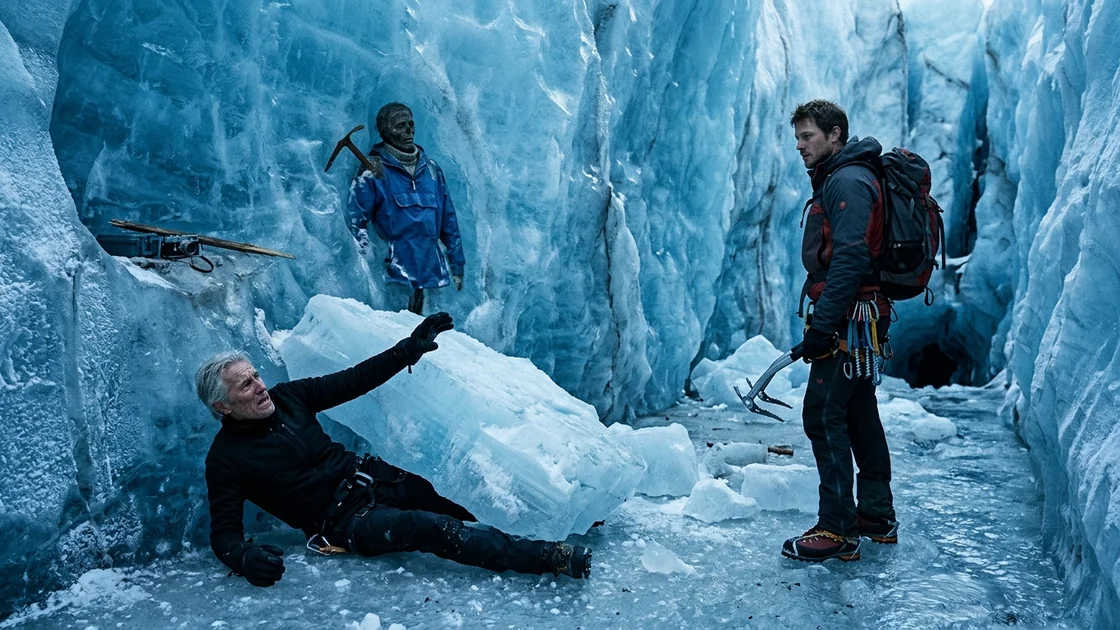
Lukas Vance spends his life guiding wealthy tourists across the dying Kaltwand Glacier in the Swiss Alps, living in the shadow of his grandfather Arthur, who vanished on the mountain fifty years ago and was branded a reckless coward by his surviving partner, the legendary mountaineer Julian Sterling. During a brutal summer heatwave, the retreating ice exposes Arthur preserved in a deep ablation hollow, along with forensic proof and a roll of film revealing that Julian murdered him to steal the glory of their historic ascent. Refusing to let the courts offer the billionaire an easy defense, Lukas uses the threat of the emerging evidence to lure the aging icon back onto the unstable glacier for a final reckoning where the mountain can deliver its own justice.
The glacier was dying from the bottom up, and it smelled of pulverized granite and ancient rain. Lukas Vance stood at the lip of the medial moraine at four thousand meters, listening to the mountain digest itself. Beneath the steel points of his crampons, the Kaltwand was not the static river of white that the tourists saw from the terrace of the Bellevue Hotel down in the valley of Sankt-Marius. Up here, stripped of its winter firn by three consecutive weeks of August heat, the ice was bare, grey, and rotten. It groaned with a low, baritone resonance that vibrated through the soles of his boots and settled in his teeth. Water ran everywhere—not in gentle trickles, but in violent, milky torrents that carved sinuous canyons through the surface before plunging into the black throats of moulins that dropped two hundred meters to the bedrock.
Lukas adjusted the straps of his pack and looked back at his two clients. They were bankers from Zurich, fit enough from marathon running on flat asphalt, but clumsy and visibly rattled by the shifting architecture of the ablation zone. The rope between them hung in a damp, heavy swag.
"Keep your weight over your feet, Herr Meyer," Lukas called out, his voice flat and practiced against the hiss of the meltwater. "Do not lean into the slope. Let the ankles flex. If you edge with your boots here, the crust will shear right out from under you."
The older of the two men nodded stiffly, his face smeared with zinc oxide, his eyes fixed nervously on a serac tower three hundred meters to their left. Half an hour ago, a slab the size of a cathedral facade had calved off that tower, disintegrating into a thunderous cloud of pulverized ice that had sent a cold blast of air washing over their rope team. In his twelve years as a certified Bergführer, Lukas had never seen the Kaltwand retreat with such frantic violence. The ice was losing nearly ten centimeters of thickness every calm, sunny day. Rocks that had not seen the sun since the Little Ice Age were tumbling free of their frozen matrices, rolling down the slick flanks of the glacier like artillery shells.
He brought them down off the dry glacier by noon, unroping at the edge of the terminal lake—a body of water that had not existed when Lukas was a boy, now a sprawling, silt-choked lagoon bobbing with dirty bergs. After signing off their logbooks at the guide bureau and declining their offer of a beer at the Posthotel, Lukas did not go home. Instead, he walked to the lift station, showed his guide pass to the operator, and rode the empty afternoon gondola back up to the Mittelstation.
A guide’s work with clients ended when the sun softened the upper snowbridges, usually around one in the afternoon, when the mountain became too unpredictable for amateurs. Alone, however, Lukas moved with a different rhythm. He had been hired by the cantonal glaciology institute at the University of Bern to check a series of ablation stakes driven into the lower western tributary of the Kaltwand—a chaotic, unclimbed labyrinth of crushed ice known locally as the Knochenmühle, the Bone Mill. No guide took clients into the Bone Mill. It sat directly beneath the four-thousand-foot dark schists of the Kaltwandhorn’s North Face, serving as the catch-basin for everything the great wall shed: rockfall, winter avalanches, and the slow, grinding outflow of the high upper cirque.
By three o'clock, the clouds had boiled up from the Italian border, dimming the blinding glare to a flat, pewter light. The temperature dropped four degrees in ten minutes, though the air remained humid and heavy. Lukas moved unroped, his ice axe held across his chest in the port-arms position, leaping narrow crevasses with the economical grace of an ibex. He found the first PVC stake lying flat on the ice, completely melted out of its four-meter borehole. He recorded the GPS coordinates and the depth of the loss in a waterproof rite-in-the-rain notebook, reset the drill from his pack, and bored a fresh hole into the dense blue substratum.
It was while traversing toward the fifth stake, deep in a sector where the western ice stream squeezed through a bottleneck of black gneiss, that he smelled the rust.
At high altitude, the nose becomes accustomed to emptiness. There is only wet stone, ozone, and the faint, metallic tang of glacial flour. When something foreign enters that sterile environment, it registers immediately. This was the smell of old wet wool, decaying leather, and oxidized iron.
Lukas stopped on the spine of a narrow ice fin. To his right, a supraglacial stream had undercut the wall of a defunct crevasse, creating a scalloped grotto of deep, translucent sapphire. The ice here was ancient. Pressed under hundreds of meters of snow in the upper basin decades ago, all the air bubbles had been squeezed out of it, leaving a medium so dense it absorbed the red wavelengths of light and glowed with an internal, electric blue.
Thirty feet down in the trough of that collapsed crevasse, a streak of faded orange nylon was fluttering in the thermal draft rising off the ice.
Lukas kicked his front points into the wall and down-climbed into the trough. The air at the bottom was noticeably colder, pooled like water in a cellar. Scattered across the wet, pebbled ice of the floor were artifacts of another era: a crumpled aluminum fuel bottle stamped with a faded German label, three hand-forged chromoly pitons threaded onto a rusted oval carabiner, and a single wooden-shafted ice axe with its head missing, the hickory splintered into long, grey teeth that had been freeze-dried by half a century of winter.
Lukas did not touch them. His breath came out in shallow, white plumes. Every child born in Sankt-Marius knew the inventory of the October 1974 expedition to the North Face of the Kaltwandhorn. They knew it because it was displayed in replica in the local museum, and because Julian Sterling had described every ounce of their kit in the first chapter of The White Crucible, the international bestseller that had launched his career, his lecture circuits, and his multi-million-franc outdoor equipment empire.
We carried orange double-wall Whillans boxes, Stubai pitons, and twenty meters of eleven-millimeter Edelrid perlon, Julian had written in prose that generations of armchair mountaineers had memorized. And when Arthur lost his nerve below the summit ridge and unroped to retreat alone, he took half the iron with him into the mist.
Lukas walked ten paces up the trough, following the scatter line of the debris against the flow of the glacier.
The body was not lying on the surface; it was emerging from the wall of the grotto like a relief sculpture carved into blue marble. The meltwater stream had sliced diagonally across the burial site, exposing the figure from the waist up while leaving the legs and boots still locked in the translucent matrix.
Lukas dropped to his knees on the wet ice.
The man in the wall was thirty-two years old—two years younger than Lukas was now. He was wearing a heavy, double-layered royal blue ventile smock over a thick boiled-wool Dachstein sweater. His head was tilted back slightly, his chin raised as if gasping for air at the surface of a frozen sea. The glacial ice had mummified and compressed the tissues, turning the skin the color and texture of oiled walnut, drawn tight over high cheekbones and a sharp, narrow nose that Lukas saw every morning when he shaved. His eyes were closed, the lashes frosted with minute crystals of hoar, and his dark hair, wet with melt, was plastered against his brow.
"Grandfather," Lukas whispered. The word had no echo in the narrow slot; the wet ice swallowed it instantly.
For fifty years, Arthur Vance had been a ghost story told to warn young guides about hubris and panic. According to Julian Sterling’s sworn testimony to the cantonal police in November 1974, the two men had been trapped for three days in a storm three hundred meters below the summit. Arthur, suffering from the onset of hypothermia and mental exhaustion, had insisted the climb was suicidal. While Julian was melting snow inside their bivouac sack, Arthur had allegedly cut himself free of the frozen rope, stolen the extra fuel canister, and attempted to solo down the Escape Gullies, vanishing into the whiteout. Julian, heroic and half-blinded, had somehow dragged himself over the summit alone the next morning and descended the easier South Ridge, becoming the sole conqueror of the last great problem in the valley.
The Vance family had never recovered from that book. Lukas’s grandmother had died of a stroke at fifty-four, unable to walk through the village without feeling the pitying or contemptuous stares of neighbors whose livelihoods depended on the sterling reputation of local guides. Lukas’s father, Thomas, had spent his life working as a snowcat mechanic for the lift company, drinking cheap Kirsch in the back of the garage, his knuckles scarred from bar fights with seasonal climbers who quoted Sterling’s book within his hearing. He didn't run, Thomas used to say when the bottle was nearly empty, gripping young Lukas by the shoulders until the boy bruised. My father could climb glass in nailed boots. He didn't leave that Englishman behind. The Englishman left him.
Lukas leaned closer to the ice wall, his heart hammering against his ribs like a trapped bird.
Arthur’s hands were raised near his chest, frozen in a defensive posture, the wool mittens torn away from the palms as if he had been clawing at stone. Looped around his waist was a classic swami belt of tied webbing, and knotted into the tie-in loop was a four-foot tail of eleven-millimeter orange and blue perlon rope.
Lukas took off his glove and touched the end of the rope.
In 1974, Julian had shown the police his own end of the rope—frayed and ragged where it had supposedly parted over a sharp granite flake after Arthur had partially sawed through it to free himself.
The end protruding from Arthur’s waist was not frayed. The nylon fibers were fused together into a hard, blackened bead. It had been melted through with the blue flame of a butane stove. No man clinging to a vertical ice face in a hurricane melts his own rope in half with a stove; a rope is melted in a calm bivouac, cleanly and deliberately, so the strands do not unravel while the man holding the stove prepares to abandon his partner.
Then Lukas looked at his grandfather’s left shoulder.
Protruding from the gap between the collar of the ventile smock and the base of Arthur’s neck, driven downward through the clavicle and deep into the thoracic cavity, was the serrated steel pick and adze of an ice axe. The wooden shaft had broken off flush with the steel head, leaving jagged splinters of hickory wedged inside the forged eye of the tool. It was the mate to the broken shaft Lukas had just passed thirty feet down the trough.
Lukas stared at the steel head. It was not a standard production model. In the early seventies, Julian Sterling had been experimenting with modular, steep-ice prototypes forged by a blacksmith in Chamonix—the very designs that would later become the foundation of Sterling Alpine’s flagship Viper line. Stamped into the dull grey steel of the adze, just below a patina of brownish-red rust, were four characters: J.S. 02.
Arthur had not fallen from the Escape Gullies. The glacial flow lines here in the western sector of the Bone Mill did not originate beneath the Escape Gullies; they originated directly beneath the Summit Snowfield. A body dropped into the bergschrund at the very top of the face would take roughly fifty years to travel the four kilometers of vertical and horizontal plastic flow required to emerge right here in the lower throat.
Arthur had reached the top. And at the top, or just below it, Julian had buried a prototype axe in his neck, burned the rope, and pushed him into the deep crevasse where the glacier began.
Lukas knelt in the slush until his knees went numb. The cold water seeped through his Gore-Tex trousers, soaking his thermal layers, yet he felt a strange, dry heat radiating behind his eyes. He reached out and brushed a veneer of slush from the front of Arthur’s blue smock.
Beneath the outer shell, the canvas straps of a leather harness crossed Arthur’s chest. Tucked inside the zippered kangaroo pocket of the smock, protected by the crossed arms and a thick rime of clear ice, was a rectangular bulge.
Lukas drew his ice screw driver from his harness and used the flat steel chisel tip to carefully chip away the glaze sealing the brass zipper of the pocket. The metal teeth were green with verdigris, frozen solid. Taking his knife, Lukas slit the tough ventile cotton along the seam of the pocket, peeling back the stiff, icy fabric like the skin of an animal.
Inside, wrapped in a yellowed, greased bladder of oiled silk, was a Leica M3 rangefinder camera.
Lukas lifted it out. The oiled silk had kept the glacial melt from penetrating the chassis. When he peeled the wrapping back in the dim blue light of the grotto, the chrome plate on the top of the camera was bright, unmarred, and cold enough to burn his bare fingers. The frame counter on the dial stood at thirty-four.
He looked back up at his grandfather’s face. The walnut skin was serene now, almost expectant, as if Arthur had waited half a century in the dark, inching down the mountain three centimeters a day, just to hand this box of brass and glass to his son’s son.
Lukas’s hand went to the breast pocket of his own jacket, where his satellite communicator and phone rested. A single press of the SOS button or a call to the cantonal police in Brig would bring an Air Zermatt helicopter hovering over the Bone Mill within twenty minutes. The forensic pathologists would come with chainsaws and steam lances. They would cut Arthur out of the wall, fly him down in a cargo net, and open a cold-case file.
And then what?
Julian Sterling was seventy-six years old. He lived in a gated villa above Lake Geneva and maintained a chalet right here in Sankt-Marius. He had the finest criminal defense lawyers in Zurich and London on retainer. What would a sharp lawyer say about a fifty-year-old corpse pulled from a crushing, grinding glacier? That the axe head had been driven into the body by the immense tectonic pressure of millions of tons of moving ice over five decades. That the rope had been burned to seal a frayed end before the climb even began. Even if the photographs inside the Leica survived and showed Arthur on the summit, Julian would claim the hypoxia of four thousand meters had muddled his memory—that fifty years of trauma and high-altitude cerebral edema had confused the sequence of events in an old man's mind. He would never spend a single night in a cell. At worst, there would be a polite academic controversy in the alpine journals, a few critical articles that Julian’s public relations firm would bury under charitable donations, and the old man would die in his silk sheets while Arthur lay in a numbered drawer in a morgue in Bern.
"No," Lukas said aloud.
He stood up, slipped the Leica into his pack, and picked up the splintered hickory shaft and the Stubai pitons from the floor of the trough, stowing them beside the camera. Then he unclipped his collapsible avalanche shovel from his pack.
For the next two hours, as the pewter sky darkened into a cold drizzle, Lukas worked like a gravedigger in reverse. He undercut a overhang of snow and rotten surface ice above the grotto, bringing down two tons of white debris to choke the entrance of the slot. Over the snow, he hauled flat slabs of dark gneiss from the medial moraine, building a low, dry-stone cairn and insulation blanket directly over the recess where Arthur was entombed. In the shade of the trough, packed under half a meter of snow and rock, the body would remain completely frozen and invisible from the air or the upper ridges for at least another two weeks.
When he was finished, his hands were bleeding through his torn leather gloves and the headlamp strapped to his helmet was cutting a solitary white tunnel through the falling night. Lukas looked down at the pile of dark stones.
"Wait here," he told the ice. "I will bring him back to you."
The house where Lukas lived stood at the far northern end of Sankt-Marius, backed up against the damp, dripping spruce forest where the winter avalanche barriers began. It had been built by Arthur Vance in 1968 out of larch timber and river stone, and because Lukas lived alone and spent little of his guiding fees, the interior had changed very little since his father died six years earlier.
The cellar smelled of damp concrete, rotting potatoes, and the sharp, vinegary ghosts of old sodium thiosulfate.
Arthur had been an avid photographer—it was his photographs of the Eiger and the Grandes Jorasses that had originally caught the attention of the wealthy young Briton Julian Sterling in the spring of 1974—and the corner of the cellar beneath the stairs had been boxed in with tongue-and-groove pine to serve as a darkroom. When Lukas switched on the amber safelight, the small bulb flickered once and held, bathing the zinc sink and the dusty Durst enlarger in a murky, subterranean glow.
He had stopped at a pharmacy and a specialty camera shop in Thun the morning after his descent, purchasing fresh bottles of Kodak D-76 developer, stop bath, and rapid fixer, along with a stainless-steel developing tank.
Before opening the camera in complete darkness, he had let the Leica sit in a sealed plastic bag with silica gel packets for twelve hours to bring it up to room temperature without condensation forming on the film emulsion. The film inside was Kodak Tri-X Pan, 400 ASA—a tough, thick-emulsion black-and-white stock famous for surviving extreme cold and decades of latent storage.
Working in total darkness by touch alone—a skill his father had taught him when Lukas was twelve, using old rolls of expired film—Lukas popped the baseplate off the Leica. The brass mechanism turned with a smooth, oiled click that was almost miraculous. He rewound the film into its metal cassette, cracked the cassette open with a bottle opener, clipped the leader, and spiraled the stiff ribbon of acetate onto the wire reel.
Because the film had been frozen for half a century, standard developing times would risk fogging the base or losing the faint shadow details. Lukas used a technique he had read about in archival restoration forums: stand development. He diluted the developer deeply, chilled it to sixteen degrees Celsius, poured it into the light-tight tank, agitated it gently for thirty seconds, and then walked away for an hour, leaving the chemistry to coax the silver halides back to life at a glacial pace.
While he waited, he sat at the kitchen table upstairs with the broken hickory shaft of the prototype axe and a copy of the fiftieth-anniversary hardback edition of The White Crucible.
The book had been reissued that very summer to coincide with the Sankt-Marius Alpine Festival, which was scheduled to begin in four days. Julian Sterling himself was already in town, staying at his private chalet up on the Sonnenhang, preparing to deliver the keynote address at the gala dinner on Friday night.
Lukas opened the book to page two hundred and fourteen.
The dawn of October 14th broke clear and mercilessly cold, Julian had written. I was alone in the snow cave below the Headwall. Arthur’s boots were gone; the rope lay severed by the entrance where his knife had parted the frozen sheath. I called his name into the abyss until my throat bled, knowing in my bones that the mountain had broken his spirit before it broke his body. There was nothing left for me down in the dark. My only salvation—and the only way to honor the man Arthur had been before the fear took him—was to climb upward into the sun, alone, toward the virgin cornice of the summit.
Lukas closed the book. His jaw ached from the pressure of his clenched teeth. He went back down to the cellar.
He poured out the developer, ran the stop bath, and fixed the film for ten minutes. When he finally popped the steel lid off the tank under the white ceiling light and lifted the dripping spiral of film, his breath caught in his throat.
The strip was not blank. Across the translucent grey ribbon, tiny, crisp rectangles of dense silver and clear celluloid marched in perfect order.
He washed the film in running cold water, hung it from a wooden clothespin above the sink with a lead fishing weight clipped to the bottom, and waited three agonizing hours for the emulsion to dry before laying the negatives on the glass light table and bending over them with an eight-power magnifying loupe.
The early frames were familiar scenes from the lower mountain: the approach march through the larch trees, Arthur’s boots on the moraine, Julian grinning beside a pile of rucksacks at the base of the North Face, looking impossibly young and handsome in a thick sheepskin coat, his hair long in the seventies style, a pipe clenched in his teeth.
Then came the climb itself. Vertiginous shots looking straight down between Arthur’s crampons into the swirling clouds of the Bone Mill two thousand feet below. Julian clinging to a vertical seam of black ice on the Second Icefield, his face pinched and hollow.
By frame twenty-six, the story in the silver grains diverged violently from the gospel of The White Crucible.
Frame twenty-seven showed Julian hunched inside the snow cave below the Headwall, but he was not the stoic titan of his memoir. His eyes were swollen nearly shut with snow-blindness, his spare goggles dangling broken from his neck. He was clutching a small green oxygen bottle—equipment Julian had famously sworn in every interview they had refused to carry, claiming the ascent was made in pure, purist alpine style.
Frame twenty-nine was taken on the Headwall itself. The rope ran straight down from the lens into the mist, completely slack. Below, barely visible on a ledge, a tiny dark figure remained huddled by the snow cave. Arthur had climbed the final three hundred meters of vertical mixed ground completely solo, leaving the crippled Julian behind at the bivouac.
Frame thirty-one was the summit.
There was no mistaking the geometry of the rock. It was the jagged, twin-horned gneiss gendarme of the Kaltwandhorn’s true peak, with the distant pyramid of the Matterhorn gleaming sharp and unmistakable on the southern horizon. Stuck into the snow in the foreground was Arthur’s standard wooden axe, and dangling from its pick was a brass medallion of Saint Christopher that Lukas’s grandmother had given him on their wedding day, along with a wristwatch held up to the lens showing the date and time: 14 OCT, 09:15.
Frame thirty-two was a self-portrait made with the Leica’s mechanical self-timer, the camera balanced on a rucksack. Arthur stood on the summit cornice, gaunt, frostbitten around the cheeks, but smiling with a fierce, quiet triumph, the whole roofs of the Alps spread beneath his shoulders.
Frame thirty-three was taken three hours later, back down at the top of the Upper Icefield, just above the lip of the summit bergschrund where the easier South Ridge descent began. Arthur had evidently climbed back down the Headwall, collected the half-blind, oxygen-starved Julian, and short-roped him up an easier bypass ramp to the top of the South Ridge so they could descend together. In the photograph, Julian was on his knees in the snow, vomiting or weeping, while his oxygen cylinder lay clearly visible in the foreground beside his open pack. He was looking up at the lens, and even in the grain of a thirty-five-millimeter negative, the expression on the young Englishman’s face was unmistakable. It was not gratitude. It was the venomous hatred of an aristocrat who had paid for an expedition to make himself a god, only to be dragged up like baggage and photographed in his humiliation by a village carpenter’s son.
There was one final exposed frame—number thirty-four.
It was blurred, the shutter tripped accidentally at a slow speed. It showed a rush of snow and boots at a crazy, tilted angle, and a dark shadow rearing up overhead, holding a short-handled tool raised against the bright noon sky.
Lukas set the loupe down on the light table.
He turned on the enlarger, slid the negative strip into the carrier, and made four eight-by-ten prints on resin-coated paper: the oxygen bottle at the bivouac, Arthur’s solo summit portrait, and the shot of Julian kneeling in disgrace at the top of the South Ridge.
While the prints washed in the tray, Lukas looked at the calendar on the wall. Today was Wednesday. Tomorrow evening, the municipality of Sankt-Marius was hosting an intimate VIP reception for Julian Sterling at the Grand Hotel Bellevue to unveil a bronze plaque commemorating the fiftieth anniversary of his solo conquest of the North Face.
Lukas did not need to break into Julian’s chalet. He knew the old man far too well from a distance. For fifty years, Julian had returned to this valley every few summers like a feudal lord inspecting his estates. He was not a weak, doddering septuagenarian; he was one of those wiry, fanatical old men who had spent millions preserving his vitality with stem-cell clinics in Zurich, personal trainers, and high-altitude treks in the Dolomites. His entire identity, his fortune, his knighthood, and the brand value of the company he was currently preparing to take public on the London Stock Exchange rested on the unassailable purity of October 14, 1974.
If Lukas walked into the police station with these prints, there would be lawyers, injunctions, claims of darkroom forgery, and years of litigation while a seventy-six-year-old billionaire ran out the clock of his natural life.
No. Julian would not be defeated in a courtroom in Bern. He had to be brought back to the scene of the crime. And the only person capable of forcing Julian Sterling onto the Bone Mill without a witness in sight was Julian Sterling himself.
The Grand Ballroom of the Hotel Bellevue smelled of roasted venison, expensive French perfume, and the crisp, dry starch of linen tablecloths. Through the tall arched windows, the evening alpenglow was turning the upper snows of the Kaltwandhorn the color of bruised peaches, while down in the valley floor, the purple shadow of the western ridge had already swallowed the village streets.
Lukas stood near the back of the room by the tall mahogany doors, wearing his official Bergführerverband dress uniform—a dark charcoal wool jacket with the bronze guide’s badge pinned to the lapel. Waiters moved through the crowd with silver trays of Valais white wine. The guests were a mixture of municipal politicians, wealthy chalet owners from Geneva and Frankfurt, executives from Sterling Alpine in tailored suits, and a handful of older local guides who tolerated the free champagne while keeping their eyes politely averted from the giant two-meter blow-up of The White Crucible’s cover resting on an easel beside the podium.
At the center of the room stood Julian Sterling.
Even at seventy-six, he commanded the space with the effortless gravity of a man who had never once been told no. He was tall—over six feet—and lean as a greyhound, his silver hair swept back from a high, sun-bronzed forehead that bore the distinguished, leathery creases of a lifetime spent in high winds. He wore a bespoke dinner jacket of midnight-blue velvet, and his left hand, resting lightly on the crystal stem of a water glass, was missing the tip of the little finger—a genuine souvenir of his frostbite on the descent in 1974, which he often used to gesturing effect during his speeches.
"It wasn't about conquering the mountain, my dear," Julian was saying in his resonant, BBC-inflected baritone to a German television journalist holding a microphone near his chest. "Mountains are never conquered; they merely grant us brief audiences. When poor Arthur lost faith on that terrible third night, I realized that survival is ultimately a question of moral architecture. Either you believe you belong on the summit, or the cold convinces you that you belong in the dark."
Lukas watched the old man’s eyes as he spoke the name Arthur. There was not the slightest tremor in the eyelids, not a fraction of hesitation in the cadence. He had told the lie ten thousand times in fifty languages until it had calcified into a truth harder than the gneiss of the North Face.
Lukas waited until the municipal president tapped his glass to call the guests toward the adjoining dining room for the first course. As the crowd began to funnel through the double doors, Julian lingered behind for a moment to check his reflection in a gilt-edged mirror and take a small silver pill-box from his waistcoat pocket.
Lukas stepped smoothly across the parquet floor, placing himself between Julian and the dining room doors.
"Herr Sterling," Lukas said quietly in English.
Julian looked up, affixing his practiced, patrician smile—the one reserved for fans wanting a book signed or young guides hoping for an equipment sponsorship. He glanced at the bronze badge on Lukas’s lapel.
"Ah, one of the brotherhood," Julian said smoothly, extending his hand. "Good evening. A magnificent night on the mountain, isn't it? The face looks remarkably dry this August."
Lukas did not take the outstretched hand. Instead, he reached into his jacket pocket, drew out a heavy, rusted Stubai piton with three inches of faded orange webbing still knotted through its eye, and held it out palm-up.
Julian’s hand stopped in mid-air. The smile did not vanish immediately; it remained frozen on his face like a theatrical mask while the eyes behind it narrowed into sharp, colorless flints.
"A relic from another age," Julian murmured, keeping his voice pleasant in case any stragglers were within earshot. "The glacier spits out all sorts of iron these days, doesn't it?"
"It is spitting out more than iron, Herr Sterling," Lukas said, his tone low, deferential, almost conspiratorial. "I work for the glaciology institute in Bern, checking the ablation stakes in the Bone Mill. The western ice stream has lost twelve meters of thickness this summer. Yesterday afternoon, a meltwater channel undercut a grotto three hundred meters above the lower gorge."
Julian did not move a muscle, though the tiny blue vein at his temple gave a single, rhythmic throb. "Is that so? Have you informed the gendarmes? If you have found remains from the seventies, there are protocols."
"I haven't called anyone," Lukas said. He stepped half a pace closer, lowering his voice until it was barely louder than the clink of silverware from the next room. "Because when I chipped the ice away from the chest of the body to see who it was, I found two things. The first was the head of a prototype ice axe driven straight through his collarbone into his lungs. It has your initials stamped into the adze."
The silence between them stretched for five seconds. In the dining room, someone laughed loudly, followed by a burst of applause as the municipal president took the microphone.
Julian’s gaze lifted from the rusted piton in Lukas’s palm to Lukas’s face. He studied the high cheekbones, the narrow bridge of the nose, the dark, steady eyes.
"You have his look," Julian said softly. All the theatrical warmth had drained from his voice, leaving behind something cold, aristocratic, and terrifyingly pragmatic. "You are Thomas’s boy."
"I am," Lukas said. "And I am a mountain guide who makes forty thousand francs a year risking his neck for fat bankers while living in a house with a leaking roof and a mortgage I cannot pay."
Julian’s eyebrows rose a fraction of an inch. That was the pivot Lukas had counted on. If Lukas had come at him with righteous fury, Julian would have bolted immediately—called his lawyers, boarded his private jet in Sion before dawn, and prepared a legal defense from London. The only hook that could keep a predator like Julian Sterling in the room was the scent of another man’s corruption. A rich man always believes that a poor man has a price.
"You mentioned two things," Julian said, his voice dropping an octave.
Lukas reached into his inside breast pocket and drew out a single four-by-five crop of the photograph taken at the top of the South Ridge. It showed Julian on his knees in the snow beside the green oxygen cylinder, staring up at Arthur’s lens in broken terror. Lukas held it for three seconds before Julian’s eyes, then slipped it back into his pocket.
Julian’s skin went the color of wet chalk under his expensive tan. For the first time in fifty years, he was looking through the eyes of the man he had butchered.
"Where is the camera?" Julian whispered.
"The camera is still frozen into his chest harness inside the ice wall," Lukas lied smoothly. "The back plate was sprung open by the ice pressure, exposing the tail end of the roll inside a dark pocket of his smock. I clipped off the last four frames in the dark under my jacket and developed them myself to see if they were worth anything. The rest of the roll—and the Leica itself, and the body with your axe in its neck—are still up there under a pile of stones I built to keep the sun off him."
Julian stared at him, his mind clearly racing through the geometry of his ruin. Next week, Sterling Alpine was finalizing its initial public offering in London, valued at four hundred million pounds. A murder charge and the revelation that the founding myth of the company was built on oxygen-assisted fraud and a knife in the back would evaporate that fortune overnight and send him to prison for the few years of life he had left.
"If the camera is still in the ice," Julian said slowly, testing the trap, "why didn't you take the whole thing down yesterday?"
"Because the strap and the housing are frozen solid into his ribcage and the blue ice behind him," Lukas said, the lie rolling off his tongue with technical precision. "If I tried to hack it out with an ice axe, I would have shattered the camera body and left tool marks all over a forensic site. It needs a thermal lance or two hours of heavy chipping with chisels, and then the axe head and the camera need to be dropped down a bottomless moulin where they won't come out until the glacier is completely gone in forty years. Once the axe head and the camera are gone, he’s just an old skeleton that fell off the mountain in 1974, exactly like your book says."
Julian looked toward the dining room doors, then back at Lukas. "And why haven't you gone back up today and done that yourself, Mr. Vance? For a fee, naturally."
"Because you wouldn't pay me five hundred thousand francs in bearer bonds or offshore cash just on my word that I threw them down a hole," Lukas said coldly. "You'd think I kept the rest of the film and the axe head in my cellar to blackmail you every year until you die. You're not a fool, Herr Sterling. The only way you pay me that money is if you stand there with me, pull the axe head out of his bones with your own hands, burn the rest of the film with a stove, and watch them both drop into a two-hundred-meter vertical water shaft."
A slow, cold stillness settled over Julian’s face. The logic was airtight because it was the exact logic Julian himself would have used. It appealed directly to his paranoia, his need for absolute control, and his fierce physical pride.
"The Bone Mill," Julian murmured, his eyes narrowing as he pictured the terrain. "How high up?"
"Thirty-six hundred meters. Just below the lower icefall."
"I am seventy-six years old, Mr. Vance."
"You climbed the Matterhorn via the Hörnli Ridge in four hours flat two summers ago with two guides from Zermatt," Lukas replied evenly. "You made sure the newspapers printed your time. From the top of the Klein-Vespera cable car, it is a ninety-minute traverse across the upper moraine and a short abseil into the trough. No vertical climbing. If we take the maintenance car at four in the morning before the lift crew arrives—I have the key from the avalanche service—we can be at the site by five-thirty, finish the work in an hour, and have you back in your bed at the chalet before the maid brings your coffee at eight."
Julian looked down at his missing fingertip, rubbing the scarred stump with his thumb. He was calculating the odds: a thirty-four-year-old extortionist with no witnesses, on a glacier full of bottomless holes, versus the total annihilation of his life’s work. Lukas could practically see the second thought forming behind the old man’s cold grey eyes: Once the boy shows me where the body is, do I even need to pay him, or does the glacier claim a second Vance?
"You have the negatives you already developed?" Julian asked.
"In my pack. I'll bring them with the prints tomorrow morning. You bring a satellite transfer key or the cash—you have a safe in the Sonnenhang chalet, everyone in the valley knows that—and we settle it on the ice."
Julian’s jaw set. The arrogance of the man who had gotten away with murder at four thousand meters flickered back to life in his posture. He straightened his velvet cuffs.
"Four o'clock at the valley cable car station," Julian said softly. "The loading dock behind the transformer shed. If anyone else knows where you are going—if there is a single note left on your kitchen table—you won't get a single franc, and my lawyers will have you in jail for extortion before noon."
"Nobody knows," Lukas said. "My father is dead, and I have no one else."
He left the rusted piton on a silver waiter’s tray on a side table and walked out of the hotel into the cold mountain night.
At 3:45 in the morning, the valley of Sankt-Marius was a trench of absolute blackness beneath a sky crowded with hard, winter-bright stars. The heatwave had finally broken around midnight with a dry cold front pushing down from the north, sweeping the humidity out of the air and dropping the freezing level back down to three thousand meters.
Lukas waited in the shadow of the concrete loading bay behind the valley station of the Klein-Vespera Bahn. He wore his dark climbing shell, heavy mountain boots, and a forty-liter pack weighted with two sixty-meter dynamic half-ropes, a rack of ice screws, two technical ice axes, crampons, a first-aid kit, and inside a waterproof Pelikan case, the Leica M3, its original negative strip, and the broken hickory shaft from 1974.
At 3:52, the headlights of a dark Range Rover swept up the gravel service road and extinguished fifty yards below the station. A door clicked shut with a muted thud. A moment later, Julian Sterling walked up the concrete ramp into the dim yellow glow of the security light.
He did not look like an old man going to a business meeting; he looked like a veteran predator returning to his hunting ground. He wore top-of-the-line matte-black Sterling Alpine Gore-Tex shells, carbon-fiber boots, and a sleek thirty-liter pack cinched tight to his lean torso. His face was gaunt and sharp in the sodium light, his breath pluming white in the crisp air.
"Are the cameras on the platform turned off?" Julian asked without preamble.
"I pulled the breaker for the security circuit ten minutes ago," Lukas said, unlocking the heavy steel service door with his avalanche-control key. "The morning mechanics don't clock in until six-thirty. By the time they see the service cabin has been run up to the top station and sent back down on the automatic timer, we'll be walking down the ski piste below the snowline."
They stepped into the cavern of the drive station, which smelled of thick gear oil and ozone. Lukas engaged the auxiliary diesel motor, silenced the warning bell with a wooden wedge he had whittled the night before, and ushered Julian into the small, open-grate maintenance basket hanging behind the main passenger cabin.
As the cable groaned and lifted them out of the concrete pit into the windy blackness above the forest canopy, neither man spoke. Below them, the streetlamps of Sankt-Marius shrank into a thin necklace of amber beads, and then they rose past the timberline into the vast, pale amphitheater of the high alps.
The quarter-moon was setting behind the western ridges, casting a ghostly, silver luminescence over the tortured wilderness of the Kaltwand Glacier. From four hundred feet in the air, hanging from a steel wire that hummed in the north wind, the Bone Mill looked like a frozen sea caught in the middle of a hurricane—miles of jagged serac towers, black crevasse slots, and rubble-strewn ridges of dirty ice.
Julian stood with his gloved hands gripping the cold iron rail of the maintenance basket, staring out across the North Face of the Kaltwandhorn as it rose above the glacier like a wall of black iron.
"It has shrunk," Julian murmured over the whine of the haul cable. He sounded almost offended, as if time had committed an act of vandalism against his personal monument. "In seventy-four, the ice came all the way up to the granite buttress on the left. We put our base camp where there is nothing but bare scree now."
"Everything melts eventually, Herr Sterling," Lukas said from the rear of the cage. "The mountain just takes its time."
Julian glanced back at him over his shoulder, his eyes glinting under the brim of his wool cap. "You think you are clever, don't you, boy? Using your grandfather's bones to buy yourself an easy life."
Lukas kept his expression blank, slightly sullen—playing the part of the small-town mercenary to perfection. "My grandfather hasn't done anything for my family in fifty years except make us poor. It's about time he paid the rent."
A thin, ugly smile touched the corner of Julian’s mouth. That was an answer the old man understood and respected.
At 4:30, the basket clanked into the concrete docking bay of the Klein-Vespera top station at thirty-two hundred meters. Lukas locked the hydraulic brake, opened the gate, and walked over to the control panel to set the delayed return relay, which would send the empty car back down the mountain in forty minutes.
They stepped out onto the concrete terrace and clicked their headlamps on, setting them to low red beams so nobody looking up from the valley with binoculars would spot two white pinpricks moving across the closed sector of the glacier.
"Put your crampons on here," Lukas said, dropping to one knee on the frozen gravel at the edge of the ice. "The surface froze hard after midnight. It's pure water-ice all the way across the trough."
Julian knelt with surprising flexibility for his age, strapping twelve-point chromoly crampons onto his boots with practiced, muscle-memory efficiency. Lukas watched the old man’s hands closely as Julian adjusted his pack. Tucked into the side pocket of the pack, secured beneath a compression strap alongside a modern carbon ice axe, was a heavy, short-handled ice hammer with a weighted steel head. And beneath his shell jacket, at the small of his back, there was a distinct, angular bulge that looked very much like a compact semi-automatic pistol in a nylon holster.
Lukas stood up and shook out one of the sixty-meter ropes. "Tie in," he said, tossing the figure-eight loop at Julian’s feet.
Julian looked down at the rope, then up at Lukas. "You said the terrain was flat across the moraine."
"The moraine is flat for twenty minutes," Lukas said, threading his own harness. "After that, we have to cross a network of blind slots above the Bone Mill where the snowbridges haven't fully collapsed yet. If you punch through a bridge unroped in the dark, you'll go down forty meters and take my money with you. Tie in, Herr Sterling. Ten meters between us. I break trail."
Julian hesitated for a fraction of a second, weighing whether being tied to the younger, stronger man was a risk or an advantage. Then, realizing he needed Lukas out in front to navigate the maze in the dark, he threaded the rope through his harness tie-in points and tied a flawless double figure-eight knot with a stopper.
They stepped off the rock onto the glacier at 4:45.
The crunch of twenty-four steel points biting into crisp, refrozen crust was the only sound in the immense hollow of the peaks. The wind had died down to a knife-edge draft flowing down off the North Face—the katabatic breath of the high snows. Lukas set a brisk, relentless pace. He did not take the flat, easy contour line that the glaciology institute used to reach the lower ablation stakes. Instead, he angled thirty degrees higher up the mountain, leading Julian directly into the heart of the upper Bone Mill, where the glacier broke over a subterranean cliff of gneiss and shattered into a labyrinth of leaning serac towers and bottomless transverse crevasses.
Behind him, he could hear Julian’s breathing through the tautness of the rope and the quiet rhythm of the old man's lungs. For the first thirty minutes, Julian kept pace admirably, his pride burning like rocket fuel in his veins. He was the man who had written The White Crucible; he would not ask a village guide to slow down.
Wait until the altitude and the cold hit the scar tissue in those seventy-six-year-old lungs, Lukas thought.
He began to weave up and down steep, forty-five-degree fins of blue ice, forcing Julian to front-point with his calves burning, then drop down into narrow troughs where they had to step across blackness that smelled of deep, ancient water. Every five minutes, Lukas checked his watch and looked up at the eastern sky above the Mischabel peaks. The black was beginning to dilute into a deep, bruised indigo.
"How much further?" Julian’s voice came from behind, sharper now, ragged around the edges with the dry rasp of cold-induced bronchospasm. "You said ninety minutes. We have been climbing upward for an hour."
"The lower bridge collapsed in yesterday's heat," Lukas called back without turning around, his own breathing deep and effortless. "We have to go over the upper rib and drop down into the grotto from above. Twenty minutes more."
They topped a razor-edged crest of dirty ice strewn with granite boulders the size of cars, balanced precariously on thawing pedestals of ice. Below them lay a vast, sunken amphitheater carved out by three converging meltwater streams, which had now frozen down to mere trickles at the bottom of a forty-foot canyon of sheer, sapphire-blue walls.
At the far end of that canyon, a black hole the width of a railway tunnel yawned in the floor of the glacier—a colossal moulin where the summer river plunged straight down into the bowels of the mountain. Even now, in the pre-dawn freeze, a deep, hollow roar vibrated up from that vertical shaft, where subterranean waterfalls crashed through the dark two hundred meters below.
Thirty yards upstream from the lip of the moulin, tucked against the undercut northern wall of the canyon, sat the pile of dark gneiss slabs Lukas had built two days earlier.
"Down there," Lukas said, pointing with the spike of his axe.
He drove two long twenty-two-centimeter ice screws into the dense blue lip of the canyon, equalized them with a spectra sling, and clipped the rope through a locking carabiner to rig a short vertical abseil into the trough.
"I'll go down first and uncover him," Lukas said, clipping his belay device onto the rope. "Then you lower down on the fixed line."
Julian stood at the edge, his hands resting on his knees for a moment as he caught his breath. The indigo sky was brightening rapidly now; the stars were gone, and a cold, surgical grey light was filling the canyon, stripping away the shadows and revealing every fracture in the ancient ice. Julian looked down into the narrow slot, then scanned the surrounding ridges. They were completely hidden from the valley, from the cable car station, and from any early climbing parties on the South Ridge. It was a soundproof room of blue glass at the end of the world.
"Go on," Julian said, his hand slipping briefly inside the breast of his jacket where the pistol rode. "And don't waste time. I want to be off this ice before the sun hits the rockfall zones above us."
Lukas leaned back over the lip and slid smoothly down the doubled rope, his boots kicking lightly against the vertical blue glass until he landed on the frozen gravel and ice at the bottom of the canyon. He unclipped from the abseil line, walked over to the cairn, and began heaving the heavy slabs of dark gneiss off the mound of packed snow.
Above him, Julian threaded his own descender and backed over the lip, lowering himself with jerky, slightly stiff movements until his crampons crunched onto the floor of the trough ten feet behind Lukas.
Julian did not immediately untie from the climbing rope that still connected their harnesses through the anchor above, nor did he take off his pack. He stood watching as Lukas used the blade of his aluminum shovel to scrape away the compacted snow from the recess in the wall.
With three final sweeps of the shovel and a brush of his gloved hand, Lukas cleared the face of the ice grotto.
The morning light had reached the upper peaks now, reflecting a pale, crystalline glow down into the canyon.
Arthur Vance looked straight out from the blue wall.
Because Lukas had packed the snow tightly against the recess, a fresh skin of clear melt-ice had formed over the exposed face and shoulders, acting like a magnifying lens over the mummified features. The thirty-two-year-old mountaineer hung suspended in his royal-blue smock, his head tilted back, the rusted steel head of the prototype axe protruding from his shattered collarbone, the melted bead of the orange and blue rope dangling from his waist.
Julian stepped forward.
All the arrogance, all the rehearsed composure of the millionaire industrialist vanished as if wiped away by a sponge. He took one step, then another, until he stood less than four feet from the wall, staring into the face of the man he had last seen bleeding into the snow on October 14, 1974.
Julian looked seventy-six. His skin was spotted with age, his throat corded and slack beneath his chin, his breath whistling through aging lungs. And staring back at him through the blue crystal was Arthur, untouched by the half-centuryJulian had stolen from him—young, lean, frozen in the prime of his strength, with his accusing hands raised before his chest.
"My God," Julian whispered. The voice was tiny, cracked, stripped of its baritone resonance. "He hasn't moved."
"He moved four kilometers," Lukas said quietly, leaning on the shaft of his shovel a few paces to the right. "Every day you were in London giving speeches, every night you slept in your villa above Geneva, every time they reprinted your book, he was coming down the mountain toward you. Three centimeters a day."
Julian tore his eyes away from Arthur’s face and looked down at the split front of the blue ventile smock. The kangaroo pocket had been sliced open, and the cavity inside was completely empty.
Julian’s head snapped toward Lukas.
"Where is the camera?" Julian hissed.
Before Lukas could answer, Julian’s right hand dived inside his open outer shell and came out with a compact matte-black Sig Sauer pistol. He racked the slide with his thumb—a sharp, metallic clack that echoed off the narrow ice walls—and leveled the barrel directly at the center of Lukas’s chest.
"Do not move a muscle, boy," Julian said, his voice steadying instantly now that he held a weapon in his hand. The cold calculation was back in his eyes. "Take your hand off that shovel and step back against the wall."
Lukas slowly released the shovel handle, letting it rest upright in the snow, and raised his gloved hands to shoulder height. He did not look surprised. In fact, his face was almost serene.
"You didn't bring the money, did you, Herr Sterling?" Lukas asked calmly.
"I didn't become who I am by paying half a million francs to village parasites," Julian said, stepping back two paces to keep a safe distance outside the reach of Lukas’s ice axe, which was holstered on Lukas’s pack. "You lied to me. The camera isn't in the ice. You took it down on Tuesday. Is it in your pack right now?"
"It is," Lukas said.
"And you really thought you would walk down off this glacier with a pocketful of bearer bonds?" Julian let out a short, breathless laugh that turned into a cough in the freezing air. "You're as naive as he was. Arthur thought we were partners, too. Right up until the end, he thought climbing a mountain together made an English gentleman and a Swiss carpenter equals."
"He carried you up the South Ridge ramp," Lukas said, his eyes fixed not on the gun barrel, but on Julian’s pale grey eyes. "I developed the whole roll, Julian. All thirty-four frames. I didn't leave anything in the darkroom. You were snow-blind and sucking on an oxygen bottle in the snow cave while he soloed the Headwall. He summited at nine-fifteen in the morning, alone, and then he climbed back down into the storm to save your life instead of descending the easy route by himself."
Julian’s face twisted, a flush of dark blood rising into his hollow cheeks. For fifty years he had never been able to speak the truth aloud to another living soul, and in the presence of the corpse, the dam broke.
"Save my life?" Julian spat, the gun trembling slightly with the intensity of his hatred. "He ruined the expedition! I paid for every piton, every tin of food, every meter of rope! It was my mountain. I had spent two years planning that line after the disaster on the Eiger, and the press in London was waiting to see if I would fail again. And when I told him at the top of the South Ridge that we would tell the reporters we reached the summit together on the same rope—that he would get half the credit and a bonus that would pay off his house—do you know what that righteous, stubborn bastard did?"
Julian glanced back at the walnut-skinned face in the blue ice, his lip curling.
"He tapped that damned Leica on his chest and laughed at me! He said a mountain guide doesn't lie about a line, and that the photographs would show who climbed the Headwall and who stayed in the cave on bottled air. He was going to destroy me for the sake of his peasant pride!"
"So you hit him from behind while he was rigging the rappel over the bergschrund," Lukas said softly.
"He had his back turned, melting the frozen sheath off the reserve rope with the stove," Julian said, his voice dropping to a fierce, rasping whisper. "He never even heard me swing. The wood broke in my hands when he went over the lip, and I used his own stove to burn the line through so he wouldn't pull the anchor down with him. And for fifty years, the world had a hero instead of a scandal. What good would the truth have done anyone? Would it have sold half a million books? Would it have built a company that employs two thousand people?"
"It would have kept my father from dying on his knees in a pool of cheap schnapps while the whole town called his father a coward," Lukas said.
"Your father was weak, and you are a fool," Julian said coldly, raising the pistol three inches until the front sight was aligned with Lukas’s bridge of the nose. "Because you brought the camera and the negatives right back to me in your pack, and there is a two-hundred-meter moulin thirty yards behind you. When they find you at the bottom of the glacier in twenty years, everyone will say young Lukas Vance slipped while checking his university stakes, just like his grandfather before him."
Julian’s finger tightened on the trigger guard.
"Go ahead and pull it, Julian," Lukas said evenly. "And then ask yourself how you are going to get out of this canyon."
Julian paused, the pressure on the trigger halting half a millimeter short of the break. His eyes flickered toward the forty-foot vertical wall of overhanging, glass-smooth sapphire ice behind them, where the doubled sixty-meter rope hung from the two screws Lukas had placed at the top.
"The rope is right there," Julian said, though a sudden uncertainty crept into his voice. "I have ascenders in my pack."
"Look at the anchor, Julian. Or rather, look at the rope."
When Lukas had slid down the abseil line ahead of Julian, he had pulled one side of the doubled rope three feet through the top carabiner after Julian had clipped in, revealing a section of core that Lukas had prepared in his cellar the night before. Just out of Julian’s sight during the dark descent, ten feet above the floor of the canyon, the load-bearing strand was held together by nothing more than two stitches of thin whipping twine; the sheath was intact, hiding a completely severed core. It had held Julian’s weight only because the friction of the doubled wrap over the icy lip had borne the load while Lukas held the bottom tail taut like a fireman's belay.
Even more importantly, Lukas was no longer tied into the rope. He had unclipped at the bottom. And on his harness hung the only four long ice screws capable of holding weight in this sun-rotted trough; Julian had brought only a short ice hammer and a pair of crampons, expecting a guided walk.
"Even if that rope wasn't cut ten feet above your head," Lukas continued calmly, "have you looked at the walls of this canyon? It is sixty-five degrees to vertical brittle water-ice for forty feet, with a four-foot overhang at the lip. You are seventy-six years old, your hands are shaking from hypoxia, and you brought one short glacier axe and a pistol. Try to jug that rope and the core will part before your feet leave the ground. Try to solo up that wall with one axe and you'll peel off ten feet up and break your pelvis on the floor."
Julian’s eyes darted up the sheer, overhanging blue wall, then down to the rope, where a tiny bulge in the sheath ten feet up betrayed the cut core inside. The realization hit him with physical force: Lukas had never wanted money. Lukas had never intended to take him back to the cable car.
"Wait—the camera—" Julian stammered, his mind struggling to catch up to the magnitude of the trap.
"The camera in my pack has a blank roll of Tri-X in it, and the prints in my pocket are copies," Lukas said, his voice ringing clear and cold in the canyon. "The real negatives of you on your knees beside your oxygen bottle are sitting in an envelope on the desk of the chief prosecutor in Bern, delivered by morning courier at eight o'clock today, along with the GPS coordinates of this trough and a letter explaining that you offered me half a million francs to bring you up here to destroy my grandfather’s body."
That was only half true—Lukas had left the real negatives and a signed statement in the mail slot of the cantonal police inspector in Sankt-Marius at three-thirty that morning, timed to be found when the station opened at eight—but the effect on Julian was total.
With a roar of animal panic and fury, Julian pulled the trigger.
Lukas was already moving. In the tight geometry of the ice trough, he had stood precisely two paces from the sharp ninety-degree corner where the meltwater stream turned toward the moulin, and at his feet lay the loose tail of the climbing rope that was still tied to Julian’s waist.
As Julian’s finger twitched, Lukas dropped flat onto his stomach on the wet ice and yanked with all his strength on the rope tail coiled around his left forearm while kicking the blade of the upright aluminum shovel into Julian’s shin.
The nine-millimeter gunshot cracked like a dynamite charge inside the narrow slot of ice, the bullet shattering a spray of crystal shards from the wall six inches above Lukas’s helmet. At the same instant, the violent tug on Julian’s waist harness and the shovel blade striking his crampon-clad ankle pulled the old man’s right foot out from under him on the slick, refrozen floor of the stream.
Julian went down hard on his side. The pistol skittered across the mirror-slick ice and splashed into the shallow, freezing trench of water flowing toward the moulin, sliding twenty feet downstream before catching against a shelf of ice five yards from the roaring black lip of the vertical shaft.
Above them, the sharp report of the gunshot echoed off the overhanging serac towers of the Bone Mill.
On a high glacier at dawn, after three weeks of extreme heat followed by a hard night freeze, the ice is under immense thermal stress—contracting as it cools, brittle as spun glass. A human voice will not trigger a collapse, nor will the clink of an axe. A supersonic pressure wave inside a hollow ice canyon is another matter entirely.
A sharp, rifle-shot CRACK answered the pistol from the forty-foot overhang directly above the grotto. A fracture line, white as lightning, zipped horizontally across the ceiling of the canyon, and a two-ton curtain of icicles and overhanging blue ice sheared away from the upper lip.
Lukas rolled frantically under the protective alcove of the gneiss cairn right beside Arthur’s entombed body, covering his head with his arms.
Julian, scrambling on his hands and knees in the middle of the trough to reach his pistol, looked up just as the sky vanished behind a falling wall of blue glass.
The main block missed him by three feet, exploding against the canyon floor with a concussive boom that shook the bedrock, but a three-hundred-pound shard of fractured serac clipped Julian across the left thigh and hip as he tried to lunge away.
There was a wet, muffled snap—the unmistakable sound of an aging femur breaking inside heavy Gore-Tex—followed by a high, thin scream that was nothing like the voice of the man who had addressed the television cameras at the Hotel Bellevue twelve hours earlier.
When the cloud of pulverized ice dust settled thirty seconds later, the canyon was silent again save for the deep, subterranean roar of the moulin at the end of the slot.
Lukas stood up slowly, brushing the shattered ice crystals from his shoulders. The fall had completely buried the abseil rope and choked the middle of the canyon with a chaotic pile of blue blocks the size of pianos, leaving only the narrow stream bed leading toward the black hole of the moulin open.
Julian lay pinned on his back in the shallow meltwater channel ten yards away. The three-hundred-pound block of ice rested squarely across his left upper thigh, locking him to the floor of the trough. His left leg was twisted outward at a sickening thirty-degree angle, and dark arterial blood—or the dull seep of an internal hematoma—was already swelling the black fabric of his trousers.
The old man was clawing frantically at the ice block with his gloved hands, his breath coming in ragged, sobbing gasps as shock and the vicious cold of the running water began to soak through his back.
"Lukas!" Julian gasped, his eyes wild and dilated as Lukas walked slowly down the trench toward him. "Lukas, my leg—it's broken! Get the shovel! Lever it off me!"
Lukas stopped six feet away. He bent down, picked up the matte-black Sig Sauer pistol from the shallow water where it had slid, popped the magazine out into his palm, ejected the chambered round onto the ice, and tossed the empty weapon over the black lip of the moulin. It vanished into the roaring dark without a sound.
"Lukas, listen to me," Julian pleaded, his teeth beginning to chatter violently as the freezing meltwater pooled around his spine and hips. He reached with a trembling, bloodless hand toward his breast pocket. "My phone—I can authorize a wire transfer from Zurich right now. Two million francs. You can tell them it was an icefall—an accident while I hired you for a private anniversary climb! Nobody has to know anything!"
Lukas looked down at him, then looked ten yards back up the trench, where Arthur Vance still stared calmly out from the blue wall, untouched by the rockfall. From where Julian lay pinned on his back, the angle of the canyon forced him to look directly up at Arthur’s face.
"I told you," Lukas said quietly. "The film and my statement are already in the mail slot of the cantonal police in Sankt-Marius. Inspector Zurbriggen starts his shift at eight o'clock."
Julian looked down at his watch. The crystal was cracked, the hands standing at 6:15.
"Eight o'clock?" Julian whispered, his lips turning the pale blue-grey of plum skin as the glacial water leached the core heat from his injured body. "If they read it at eight... a helicopter won't be here until eight-thirty. Lukas, I'm lying in running water. My femoral artery—I'm seventy-six, I won't last two hours in this cold! Pull the block off me and put your space blanket under me! If I die here, you'll be charged with murder!"
"Murder?" Lukas tilted his head, his voice calm and reflective, echoing the exact words Julian had used for fifty years. "Look around you, Julian. A serac calved off the canyon wall while we were standing in the trough. You have no rope wounds on you, no pistol bruises, no axe head in your collarbone. The medical examiner will find a seventy-six-year-old man who insisted on coming up to the glacier in secret to see his old partner’s body, got caught under a natural icefall, and died of shock and hypothermia while his guide climbed out of a collapsed canyon without a rope to get a signal and call Air Zermatt."
Lukas unstrapped his pack, took out the Pelikan case containing Arthur’s Leica M3 and the splintered hickory shaft of the 1974 prototype axe, and laid them carefully on a dry shelf of stone right beside Arthur’s shoulder, where the police recovery team would find them the moment they landed.
Then Lukas walked back to Julian. He knelt beside the shivering old man and reached into Julian’s pack, removing the two short ascenders and the modern carbon-fiber ice axe Julian had carried, clipping them onto his own harness so there would be no question why Julian hadn't tried to dig himself out.
"Please," Julian whispered. The great lion of the Alps was weeping now, tears freezing into tiny beads of rime in the creases beside his eyes. He reached out with his left hand—the one missing the tip of the little finger—and caught the cuff of Lukas’s trousers. His grip had no strength left in it. "Don't leave me with him. He's looking at me. Lukas, please, don't leave me in the cold with him."
Lukas looked down at the spotted, trembling hand on his boot, then looked up at the walnut face of his grandfather in the sapphire wall.
It wasn't about conquering the mountain, Julian had said in the warm ballroom the night before. Either you believe you belong on the summit, or the cold convinces you that you belong in the dark.
"You left him in the cold for fifty years, Julian," Lukas said softly, stepping back so the old man’s freezing fingers slipped from his cuff. "Two hours is nothing."
Lukas turned his back, drew his two technical ice axes from his belt, and walked to the vertical forty-foot wall at the side of the canyon.
He drove the steel picks into the dense blue ice with two crisp, solid thuds, kicked his front points into the glass, and began to climb upward toward the morning sun.
Behind him, from the bottom of the deep blue slot, Julian Sterling called his name twice—his voice small, ragged, and swallowed almost instantly by the roar of the meltwater plunging into the dark heart of the mountain. By the time Lukas pulled himself over the top lip of the canyon into the bright gold light of the new day, the only sound left on the Kaltwand Glacier was the groan of the ancient ice moving slowly, inexorably down toward the valley, carrying its dead home at last.