The Hymnal of Marrow's Glen
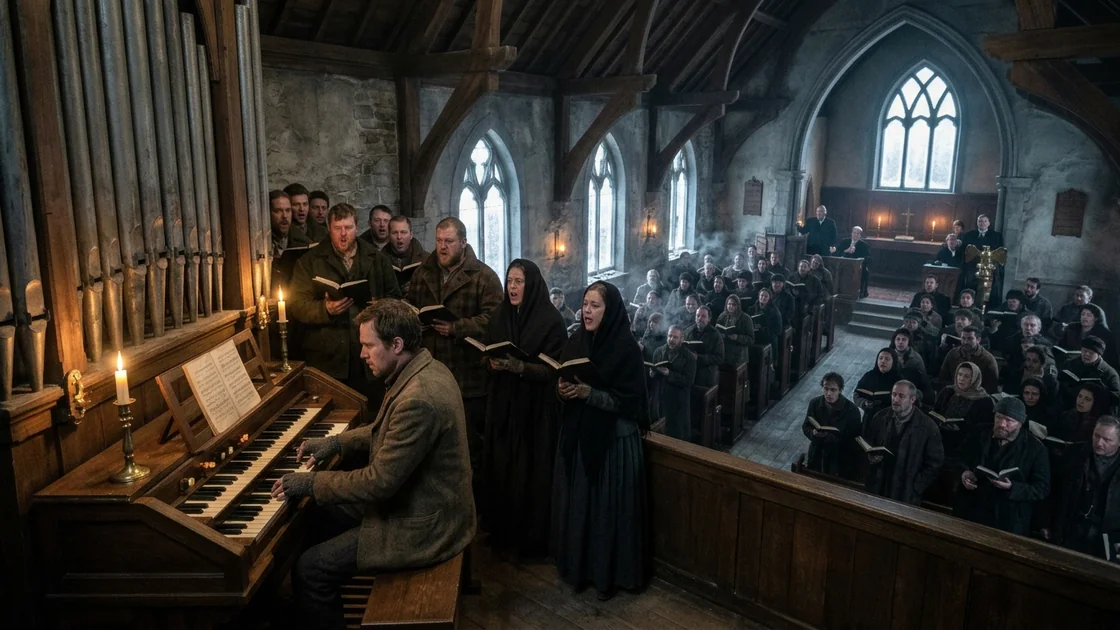
In the isolated mountain settlement of Marrow's Glen, the soft-spoken church organist and choir director, Julian Vance, discovers the hidden personal diaries and secret financial ledgers of the corrupt five-member Parish Council tucked inside the wind-chest of the sanctuary pipe organ. Realizing that the council controls the courts, the sheriff, and the only winter pass out of the valley, Julian knows that turning the evidence over to the authorities would only result in its destruction and his own quiet disappearance. Instead, he spends the week before the annual Covenant Sunday service painstakingly transcribing the council's most damning confessions of embezzlement, poisoning, arson, and betrayal into traditional four-part liturgical verse. By secretly printing and binding these new pages into the congregation's pew hymnals while leaving the council's own books unaltered, Julian orchestrates a Sunday morning service where four hundred townsfolk unknowingly sing the council's darkest secrets aloud in thundering harmony.
The valley of Marrow's Glen did not welcome the sun so much as tolerate its brief daily trespass between the eastern and western ridges of the Blacktooth Range. Even in high summer, twilight lingered in the hemlock groves until nine in the morning and reclaimed the pastures by four in the afternoon. By late November, when the wet snows packed the Notch five feet deep and sealed the single wagon road to the county seat until the April thaw, the sky above the town shrank to the color and texture of an old pewter plate.
Four hundred and twelve souls lived within the ring of frost-heaved stone walls that marked the parish bounds, and every one of them knew the sound of the Great Bourdon pipe in the sanctuary of St. Jude of the Pines.
It was a sixteen-foot wooden pipe, square-throated andstopped with greased sheepskin, built from seasoned red spruce felled in the year the town was chartered. When Julian Vance pressed his left boot onto the lowest C pedal of the console, the note did not merely sound in the ear; it traveled through the pine floorboards, rose through the soles of four hundred pairs of boots, and vibrated behind the breastbones of the congregation like a second, slower heartbeat.
Julian sat at the console on a Tuesday evening in late November, a tallow candle guttering in its brass sconce beside the music rack, his wool fingerless mittens gray with lead dust and rosin. He was thirty-four years old, slight of shoulder, with pale gray eyes that seemed permanently squinted against dim light and a habit of holding his elbows tucked close to his ribs, as though trying to occupy as little of the parish's air as possible. For twelve years he had been the master of the choir and custodian of the 1892 tracker-action organ—a sprawling mechanical beast of two thousand mechanical linkages, leather gussets, wooden stickers, and lead conduits that occupied the entire western gallery of the church.
Below him, the nave lay in freezing gloom, the forty rows of high-backed oak pews gleaming dully like the ribs of a beached whale. At the far eastern end, beyond the carved chancel rail and the brass lectern, a thin strip of yellow lamplight leaked from beneath the heavy baize door of the Vestry Room.
The Parish Council was sitting late.
Julian did not mean to listen, at least no more than a mouse in the wainscoting means to listen to the boots upon the parlor rug. It was a quirk of the church's architecture, designed by a deaf Boston mason seventy years prior, that the main wind-trunk from the basement bellows rose directly behind the horsehair plaster of the Vestry chimney breast before branching into the gallery swell-box. Whenever the furnace was banked low and the bellows were idle, the empty wooden trunk acted as a speaking tube between the council table and the organist's bench.
"—sixteen tons of anthracite short on the autumn weigh-bill," came the dry, nasal voice of Beatrice Vane, rising through the brass grille behind the pedalboard along with the smell of clove tobacco and toasted mutton fat. As Parish Treasurer and proprietor of the Glen General Mercantile, Mrs. Vane spoke of tons of coal and barrels of salt pork with the reverent tenderness other women reserved for infants. "The widows on the lower creek have been round to the window three times this week with their scrip books. Old Martha Gable had the nerve to bring an empty scuttle and set it on my counter."
"And what did you tell her, Sister Beatrice?" The deep, rolling baritone belonged to Mayor Silas Thorne, who was also First Deacon and sole owner of the Thorne Timber and Flume Company.
"I told her the autumn barges were frozen in at Miller's Bend," Beatrice replied, and Julian heard the distinct metallic clink of a teapot being set back upon its trivet. "I told her the Lord chastens whom He loves, and that birch deadfall from the commons burns just as hot if a woman isn't too proud to bend her back for it. The sixteen tons are safely cellared behind my lime shed. At February prices, the mill hands will pay four dollars a hundredweight out of their spring wages."
A low chuckle rumbled through the wooden duct. That was Magistrate Gideon Cross, who presided over the valley's quarterly court and owned the hides-and-tanning works at the head of Briar Creek. "Careful, Bea. If they burn too much green birch, their chimneys will foul, and Luther will have to charge them for the parish ladder."
Luther Kring, the Road Warden and Overseer of the Granary, grunted through a mouthful of seed-cake. "Let 'em climb their own roofs. So long as they don't go poking round the north bin at the mill. That last wagonload of winter wheat we took in from the county flats had the damp rot in the bottom sacks. I had the boy mix it three parts to one with white plaster-lime and mill-sweepings to keep the weight up. Looks pale as lily-flour in the scoop."
"A frugal steward is a blessing to the sanctuary," murmured the fifth voice—Reverend Obediah Finch. His tone was oil over gravel, the same practiced cadence he used for infant baptisms and graveside committals alike. "Though I must remind the brethren that the Covenant Sunday assessment falls due this week. The people are restless this winter. The sickness along the lower creek has made them gloomy. Three more children broke out with the gray throat-spots yesterday, and Julian Vance's sister has barely left her pallet since the frost set in."
At the mention of his name, Julian's fingers froze above the ivory keys of the Choir manual.
"Clara Vance always was a delicate creature," Mayor Thorne said dismissively. "Like her father before her. Thomas Vance had water in his blood long before he had the creek in his lungs."
"The lower creek wells are sour," Magistrate Cross said, his voice dropping half an octave, though the dry spruce wood of the wind-trunk carried every sibilant consonant straight to Julian's ear. "My foreman dumped forty casks of spent chrome-liquor into the gravel pit behind the willow marsh before the ground froze. Cheaper than hauling it over the Notch in team-wagons. If it leached into the lower water table, the spring snowmelt will flush it out by May. Until then, let them boil their tea twice."
"And the boy?" asked Luther Kring. "Up there in the loft?"
"Julian?" Mayor Thorne snorted. "Julian has dust where his marrow ought to be. Give him three tallow dips and a broken reed pipe to solder, and he wouldn't notice if the roof caught fire. Besides, who is he going to tell? His sister can scarcely whisper above a croak, and the Notch is drifted twelve feet at the Devil's Elbow. Have him play the Ein Feste Burg loud on Sunday, Obediah. Nothing clears the humors out of a workingman's chest like four verses of Luther before dinner."
Julian sat very still in the dark gallery for a long time after the voices below had given way to the scraping of chairs, the rustle of wool cloaks, and the heavy thud of the vestry outer door latches dropping into place.
He looked down at his hands. They were thin hands, calloused at the fingertips from forty hours a week of copying plainsong and repairing brass tracker wires, the nails permanently rimmed with printer's ink from the parish flatbed press. They were not the hands of a fighter. When his father, Thomas Vance, had been pulled from the churned mud below the shattered sluice-gates of the Weaver's Dam nine years ago, Julian had stood on the bank holding his nineteen-year-old sister Clara while Mayor Thorne read a brief proclamation declaring the flood an Act of Inscrutable Providence—and then bought the flooded Vance homestead at sheriff's auction three weeks later for forty-two dollars and eighty cents.
Julian had said nothing then. He had moved with Clara into the two-room sexton's cottage down by the willow marsh, pumping water from the shallow iron well that smelled faintly of rotten eggs and old leather, boiling it over green birch twigs for Clara's raw, blistered throat while he taught the town's children their scales for ten cents a lesson.
He reached out and pulled the stop-knob marked Vox Humana. Without air in the reservoir, the wooden rod simply slid three inches out of the walnut jamb with a dry, felted click.
"Dust where his marrow ought to be," Julian whispered to the empty rafters.
He picked up his tallow candle, shielded the tiny flame with his cupped palm, and descended the narrow spiral stair that led past the bell-rope closet and down into the sub-basement of the church.
Three days earlier, old Ezra Pettigrew had died in his sleep on a cot beside the coal boilers.
Ezra had been the church sexton for forty-six years. A mule kick in his youth had crushed his larynx, leaving him capable only of a wet, whistling wheeze, which the Parish Council had regarded as the highest possible qualification for a servant who swept out their meeting room every Tuesday night. Because Ezra could neither speak nor—so the town assumed—read anything more complicated than the gauge on the steam boiler, the five members of the council had treated him with the same indifference they showed the brass spittoons.
Now it fell to Julian to clear out Ezra's pallet behind the brickwork of the furnace and repair a persistent cipher in the Great Organ's wind-chest before Sunday—a Sunday of no small consequence. It was the Feast of the First Covenant, the most sacred day in the calendar of Marrow's Glen, commemorating the winter of 1819 when the original seven families had signed the Articles of Mutual Sustenance and sworn never to break the Sabbath harmony on pain of banishment into the snows.
Julian ducked beneath the low stone arch of the blower room. Here, behind the massive brick belly of the coal furnace, stood the great double-rise reservoir bellows—an eight-foot-square box of pine boards and white alum-tanned sheepskin, weighted on top with forty-pound pig-iron bricks to maintain four inches of water-gauge pressure in the trunks above.
A draft was leaking somewhere near the main concussion winkers. Julian set his candle on an upturned nail keg, unlatched the wooden maintenance hatch in the side of the lower wind-trunk, and squeezed his narrow shoulders into the dark, resin-scented cavity.
Inside, the air smelled of sixty years of pine sap, dead moths, and tallow. Above his head hung the forest of pull-down wires and leather purses that governed the bass pipes. Julian ran his palm along the inner ledge of the redwood framing, searching for the dry split in the sheepskin gusset.
Instead, his fingers struck cold iron.
He frowned, lifting the candle inside the hatch. Tucked into the dead space between the masonry of the Vestry chimney and the main intake valve—a space entirely invisible unless a man crawled headfirst into the wind-chest with a light—sat an oblong box of tarred sailor's canvas, lashed shut with waxed cobblers' twine.
Pinned to the top of the canvas with a brass upholstery tack was a scrap of ruled foolscap. Upon it, written in a cramped, shaky, yet unmistakably literate copperplate hand, were three words:
For Master Vance.
Julian backed slowly out of the wind-trunk, dragging the bundle with him. It was heavy—easily fifteen pounds—and gave off a faint odor of cedar shavings and scorched paper. Sitting on the cold flagstone floor with his back against the warm bricks of the boiler, Julian took his penknife from his pocket, sliced through the waxed twine, and folded back the tarred cloth.
Inside lay six volumes.
Five of them were small, calfskin-bound pocket diaries of the sort sold in the county seat for gentlemen's almanacs, their covers scuffed and their brass clasps snapped off. The sixth was a thick folio ledger bound in green vellum, stamped on the spine in faded gilt: VESTRY MINUTES & PRIVATE COVENANTS — 1898–1928.
Laid across the top of the green ledger was a three-page letter written in the same shaky hand as the note on the wrapper.
Master Julian, the letter began.
When you find this, the frost will have stopped my wind-pipe for good, and you will be the only man left with business inside the belly of the pipes. Men who have full use of their tongues think a dumb man is deaf as well, and blind besides. For thirty years the Council kept their true Covenant Book in the iron safe behind the cedar paneling in the Vestry. Every year at the Covenant Supper, when the spiced brandy was out, each of the five was required by Mayor Thorne to bring his private year-book and lay it in the safe alongside the Minutes, so that no one of them might ever turn state's evidence against the other four at the spring assizes without hanging himself by his own hand.
Last January, when the chimney flue caught fire during the blizzard and the vestry filled with smoke, Mayor Thorne gave me the iron box to carry out to the snowbank while they saved the communion silver. They did not know that forty years ago, when the safe was hauled up from Miller's Bend, it was I who oiled the ward-locks and kept the duplicate key wired inside the handle of the coal-ash riddle.
Inside that safe now are five blank almanacs weighted with sheet-lead and an old hardware catalog bound in green leather. They have not opened the inner casket since the night of the fire, for they only unlock it on the eve of Covenant Sunday to enter the year's dividend.
Here are their true books, Master Julian, along with the pocket diaries of the last three years which they surrendered into the box at last winter's audit, and the loose leaves I lifted from their coat pockets while brushing their broadcloth in the cloakroom this autumn. I am eighty-one years old and my legs will not carry me over the Notch in the summer, let alone the snow. Do what you see fit. The Lord loveth a just balance, though He has waited a terrible long time to weigh Marrow's Glen.
Your servant, Ezra Pettigrew.
Julian's breath came shallow and white in the chill of the cellar. With trembling fingers, he lifted the cover of the green vellum ledger, then opened the five smaller books one by one.
He did not go home at nine o'clock. He did not go home at midnight.
He trimmed the candle wick three times with his penknife, reading until the tallow melted down into the brass socket and burned his knuckles.
It was all there. Not merely the casual boasting he had overheard through the air shaft, but the meticulous, paranoid bookkeeping of five thieves who trusted one another so little that they had recorded every bribe, every kickback, every falsified weight-bill, and every crime in their own handwriting, countersigned in the back of the green ledger as mutual surety.
There was the entry in Mayor Silas Thorne's black pocket book dated April 14, 1919—the night the Weaver's Dam gave way:
11:30 P.M. Rain heavy since noon. Sent Kring and the two Portage hands up to the east spillway with four sticks of giant-powder from the quarry magazine. If the pond holds, Thomas Vance's timber-float makes the river by Friday and breaks my contract with the Valley Rail tie-buyers. Kring blew the key-timbers at midnight. The water took the Vance barn and both pastures clean to the bedrock. Vance himself found tangled in the alder roots at daybreak—unfortunate, as I had only meant to wash out his skid-road, though it saves the trouble of the right-of-way lawsuit. Paid Kring $100 gold. Purchased the 400 acres at orphan's valuation June 3rd.
Julian stared at the page until the black ink seemed to lift off the paper and swim in the yellow candlelight. Unfortunate, as I had only meant to wash out his skid-road.
His hand shook so violently that as he turned to the next volume—Beatrice Vane's maroon clasp-diary—he tore the flyleaf. Her entries were written in violet ink, tiny and neat as stitching, mixing daily pious reflections with the cold arithmetic of starvation:
Nov. 4. Received from the State Miners' & Loggers' Relief Commission the winter draft for the Marrow's Glen Widows' Trust: $1,850.00. Endorsed same with Rev. Finch's signature and deposited to private bond account at First National, Miller's Bend. Disbursed to the twelve widows on the parish roll: 12 sacks turnips (culls), 4 yds gray flannel each. Total outlay $14.20. Shared net surplus with Thorne, Cross, Kring, and Finch per Vestry Covenant ($367.16 per share). Mary Gable wept at the wicket today over her boy's boots. The poor of this valley are sunken in ingratitude; I told her to pray for a mild December.
Next was Magistrate Gideon Cross's brown leather book:
Aug. 19. The county health inspector, young Ferris, rode in over the Notch asking to sample the Briar Creek outflow below the tannery pits. Gave him supper at the house and two hundred dollars in bank-notes behind the stable, together with a jar of pure spring water drawn from the high pasture above the falls for his test-vials. If we had to line the arsenic and chrome-liquor sumps with clay as the statute demands, it would cost the works $1,200. Better the lower cottages boil their kettles. The Vance girl and the Gable children have the grey spot in the throat from the well-seepage, which Finch tells their mothers is a visitation for Sabbath-sloth.
Then came Luther Kring's grease-stained memorandum book—a grotesque jumble of adulterated grain tallies, short-weighted coal scales, and something else entirely, something that Kring had evidently forgotten was tucked into the back pocket of his leather waistcoat when Ezra brushed his coat on the first Sunday of November. It was a folded sheet of pink perfumed notepaper and four pages of Kring's own cramped diary from the previous summer:
July 22. Silas rode down to Miller's Bend for the lumbermen's banquet. Went up to the big house on the hill by the orchard gate at ten o'clock. Lavinia had the green shaded lamp in the west guest-room window as agreed. Stayed until three. She gave me Silas's gold repeater watch that he thought he lost in the mill-race last spring—I am to pawn it in the city come May. She says if the old bull has another apoplectic turn this winter, we will sell the timber yards and move to Denver.
And finally, Reverend Obediah Finch's black morocco notebook, smelling faintly of peppermint lozenges and communion port:
Oct. 31. Heard the deathbed confession of Widow Hendricks tonight. She left three hundred dollars in gold eagles sewed into her feather-tick for her niece in Ohio. While the daughter-in-law was downstairs fetching the wash-basin to lay out the corpse, I slit the ticking with my pocket-lancet and relieved the household of the snare of Mammon. A shepherd must feed upon the flock he tends, else how shall he have strength to wield the crook? These mountain cattle would tear one another to pieces without the fear of Hell-fire and the Vestry.
Julian closed the fifth book.
The boiler beside him gave a low, metallic groan as the coals settled on the grate.
For ten minutes Julian sat with his forehead resting on his drawn-up knees. His first impulse—hot, blind, and suffocating—was to run up the cellar stairs, burst through the heavy doors of the church, and carry the canvas bundle straight to Sheriff Reddick's office on the square.
Then the cold air of the cellar steadied him.
Sheriff Reddick was Luther Kring's brother-in-law, owed four hundred dollars on his mortgage to Beatrice Vane's store, and took his orders directly from Magistrate Cross. If Julian placed these books on Reddick's desk tonight, by six o'clock tomorrow morning the five books would be ashes in the Vestry stove, and Julian Vance would be locked in the timber-company jailhouse on a charge of sacrilege and church-breaking—or worse, found at the bottom of the icy gorge below the weaver's bridge, another Vance with water in his lungs.
What if he went door to door among the mill hands and the miners? No; in Marrow's Glen, the habit of deference was bred into the bone over four generations. If Julian knocked on a cottage door at midnight waving stolen pocket-books, the first thing a frightened woodcutter's wife would do to save her husband's job at the sawmill would be to run up the hill and inform Reverend Finch that the organist had lost his wits. Divide the town into small rooms, and fear would conquer every house one by one.
To break the Council, the truth could not be whispered in corners.
It had to strike all four hundred of them at the exact same instant, in the one place where no door could be shut, where Sheriff Reddick wore no pistol at his belt, where the mill hands and the widows and the teamsters stood shoulder to shoulder under the same roof, and where the five members of the Parish Council sat trapped in the front Chancel stalls under the eyes of the entire valley.
And more than that: the townsfolk could not merely hear it from Julian's thin, reedy voice, which a single bellows-roar from Mayor Thorne or a shout of "Blasphemy!" from Reverend Finch could silence in three seconds.
The town had to say it themselves.
Julian raised his head. His pale eyes fixed upon the square pine shaft of the main wind-trunk rising toward the gallery above.
Nothing clears the humors out of a workingman's chest like four verses of Luther before dinner.
And on Covenant Sunday—as every child in Marrow's Glen was taught from the cradle—the congregation sang the Five Covenants of the Valley: five consecutive hymns separated only by brief prayers, governed by the oldest and fiercest tradition of St. Jude of the Pines. According to the Articles of 1819, once the organ sounded the tonic chord of a Covenant Hymn, no man, woman, Deacon, or Minister might speak a word, leave his pew, or halt the singing until the final Amen had died away in the rafters; for in the winter of 1842, when old Deacon Mercer had stopped the third hymn to brawl with his neighbor over a stray heifer, the black diphtheria had swept the valley within a fortnight, and ever since, the superstition held with the force of iron law: Break the Covenant song, and you call the shroud down upon your roof.
Furthermore, as Ezra's letter had explained, this coming Saturday night was the annual Vestry Audit. That meant at some point between Saturday midnight and Sunday morning, the Council would open the iron safe behind the cedar paneling—and discover that their books were gone. Wait until next week, and the church would be locked under guard.
It had to be this Sunday. Five days away.
Julian stood up, tucked the tarred canvas bundle beneath his threadbare coat, blew out the candle, and climbed the dark stairs toward the printing room behind the choir loft.
The parish printing press occupied a narrow, slant-roofed closet behind the organ swell-box, originally built to house the bell-ringers' gear before the steeple was fitted with chimes. It was a cast-iron Washington hand-press with a lever action that Julian oiled every month with neat's-foot oil, flanked by four slanted wooden type-cases containing forty pounds of ten-point Caslon Old Style lead type and two fonts of diamond-headed musical notation slugs.
When Julian reached his cottage by the willow marsh at two in the morning, Clara was awake, sitting propped against two straw bolsters by the dying peat fire, a warm brick wrapped in flannel pressed against her swollen neck. She was twenty-eight, though the gray hollows beneath her cheekbones made her look ten years older. Beside her stood a mug of boiled well-water that smelled faintly of sulfur and wet leather.
Without a word, Julian crossed the room, took the mug from her table, carried it to the door, and flung the water out into the snowbank. Then he took the clean tin pail from the peg, went out to the cistern spout under the eaves, and chipped three quarts of clean blue rainwater ice from the barrel to melt upon the hob.
"Julian?" Clara's voice was a dry rustle, like dead beech leaves blown across a frozen pond. "Where have you been? Your fingers are black with soot."
"Fixing a cipher in the bass chest," Julian said gently, kneeling by the hearth to build up the fire with dry cedar kindling he had brought from the church basement in his pockets. "Drink the melted ice when it warms, Clara. Don't touch the pump handle again. Not for washing, not for tea, not for anything."
She looked at him through fever-bright eyes, noting the strange, rigid set of his jaw—a look she had never seen on her quiet brother's face in all their years together. "Did something happen at the church?"
"The wind-trunk had a blockage," Julian said, watching the blue ice begin to weep into the bottom of the kettle. "It's been choked with filth for thirty years. I'm going to let the air through on Sunday."
He slept for two hours in his chair, then rose before the winter dawn had even grayed the eastern ridge, ate a crust of dry bread, and walked back up the hill to the sanctuary.
The work before him required two separate arts: the craft of the poet-hymnodist and the trade of the compositor.
Locked inside the printing closet behind the organ, with a heavy wool horse-blanket tacked over the single lancet window so no gleam of his kerosene lamp could be seen from the road below, Julian spread the five diaries and the green ledger across the composing table. Beside them he laid a standard pew copy of The Psalter and Hymnal of the First Covenant.
The pew hymnals of Marrow's Glen were bound in stiff black buckram with three brass staples through the spine, their pages printed on coarse rag paper tinted the color of buttermilk. Every year for Covenant Sunday, the liturgy followed the exact same order set down on pages 240 through 251:
- The First Covenant (The Stewardship of the Flock) — Common Meter (8.6.8.6), sung to the tune St. Anne.
- The Second Covenant (The Waters of Provision) — Long Meter (8.8.8.8), sung to Old Hundredth.
- The Third Covenant (The Bread of the Sanctuary) — Short Meter Double (6.6.8.6.6.6.8.6), sung to Diademata.
- The Fourth Covenant (The Foundations of the Valley) — 8.7.8.7 Double, sung to the heavy minor-key Welsh tune Ebenezer.
- The Fifth Covenant (The Shepherd's Reckoning) — 11.10.11.10 Dactylic, sung to Foundation.
Julian knew the psychology of a church congregation better than any man in the valley, because for twelve years he had watched them from the mirror above his keyboard.
When four hundred people stand up in a cold church to sing a familiar tune, they do not read the page ahead of time. Their eyes drop to the first line of the first stanza; they recognize the familiar opening invocation ("O Lord of Mountain, Timber, Stone"); their lungs fill with air; the great organ locks them into the tempo at seventy-two beats to the minute; and from that moment forward, their eyes move strictly from syllable to syllable, two beats ahead of their tongues, carried along by the sheer physical momentum of four-part harmony and the voices pressing in from left and right.
If the first stanza of each hymn remained entirely unaltered—word for word as it had stood for a century—neither Reverend Finch at the pulpit nor the four Councilmen in the front stalls would suspect a thing when the hymn numbers were announced. More than that: if Julian left the five gold-tooled morocco hymnals in the Council stalls and the large pulpit copy on the lectern completely untouched, the five men at the front of the church would be looking at the old, harmless words while the three hundred and ninety-five people in the pews and the thirty-two singers in the choir loft turned the page into the new verses.
By the time the Council realized that the thunder rolling down upon their necks from the nave was not the Psalter of 1819, the congregation would already be two stanzas deep into the ledger.
Julian uncorked a bottle of gall ink, dipped a steel nib, and began to scan the prose of the five diaries into strict syllabic meter.
He did not soften the language into vague biblical allegory. Allegory could be explained away over Monday dinner tables as a poetic fancy. No—for the spell of the Council to shatter, the verses had to contain the exact dates, the exact dollar figures, the exact names of the dead and the cheated, and the exact vicious phrases from their private notebooks, wedged with surgical violence into the relentless rhythm of eight and six syllables.
He began with Beatrice Vane's maroon diary, setting it to the stately, marching meter of St. Anne (O God, our help in ages past):
Stanza 1 (Unaltered): O Lord of Mountain, Timber, Stone, Who weighs the widow's mite, Before Thy high and righteous throne All hidden books are light.
Then Julian's pen scratched across the foolscap, crafting Stanza 2 directly from the entry of November 4th:
November fourth came eighteen-hundred And fifty dollars gold, Which Beatrice Vane in secret plundered And left the widows cold.
Fourteen and twenty cents she spent On turnips rotted through, While to Miller's Bend the draft was sent To rob the parish due.
Three hundred sixty-seven more Each Deacon took as prize, While sixteen tons behind her store Wait till the prices rise.
And when poor Mary Gable wept For coal to warm her son, Within the Vestry safe was kept The theft that they had done.
Julian tapped his left foot against the floorboards, humming the bass line of St. Anne under his breath. Every accented syllable landed like a hammer blow on the downbeat: No-VEM-ber FOURTH came EIGH-teen HUN-dred / And FIF-ty DOL-lars GOLD.
He wiped his brow with his sleeve and turned to Magistrate Gideon Cross's brown notebook for the Second Covenant, setting it to the colossal, four-square majesty of Old Hundredth (Praise God, from whom all blessings flow).
After the traditional first verse praising the pure mountain springs of Eden, Stanza 2 plunged straight into the tannery sumps:
On August nineteenth at the gate, Young Ferris came to test the stream; Two hundred dollars paid the state To hide the poison in the seam.
In Briar Creek the arsenic lies, Forty casks beneath the sedge, Where Gideon Cross with Bribery buys Silence along the willow ledge.
Twelve hundred dollars saved in clay By dumping chrome into the well; Let lower-creek folk boil their tea While children choke and throats do swell.
Hours blurred into days. On Wednesday afternoon, Reverend Finch mounted the gallery stairs to hand Julian the order of service for Sunday. Julian heard the clergyman's heavy tread on the lower landing just in time; he slipped the foolscap sheets beneath a pile of tattered Mendelssohn scores, stepped out of the printing closet, and clicked the latch behind him.
"Ah, Julian," Reverend Finch said, puffing slightly from the climb and sucking on a clove lozenge. He glanced distastefully at the ink smudges on Julian's cheekbones and the grey rings beneath his eyes. "Still pottering with the hymnals? You look half-ghostly, my boy."
"The bindings were loose on the Covenant pages, Reverend," Julian said, bowing his head slightly and letting his shoulders stoop into their customary apologetic curve. "The damp gets into the glue every November. If I don't tip in fresh sheets and press them before Saturday, the choir will be dropping leaves over the rail during the offertory."
Finch waved a plump, white hand. "See that they don't. Mayor Thorne wishes the service to go off with particular solemnity this year. There has been altogether too much grumbling down at the timber yards about the winter scrip rates. Keep the tempos brisk, Julian, and do not spare the reeds on the Covenant hymns. When the people sing together at the top of their lungs, they have less wind left for seditious chatter on the porch."
"Yes, Reverend," Julian murmured. "I intend to use the full Great Organ from the second verse onward. They won't be able to hear themselves think, only the words."
"Good lad," Finch said, patting his own waistcoat pocket where Widow Hendricks's gold eagles had once rested. "And how is your sister's throat?"
"The fever is breaking, sir. Since we changed the water."
"The Lord is merciful to the patient," Finch intonated automatically, already turning back toward the stairs.
As soon as the vestry door closed below, Julian went back into the closet and wrote the fifth hymn—Finch's own reckoning—incorporating the midnight theft from Widow Hendricks's feather-tick and the minister's private description of his parishioners as mountain cattle fit only for the crook and the knife.
By Thursday afternoon, the verses were complete. Now began the physical agony of the lead.
A twelve-page signature in ten-point Caslon required nearly eighteen thousand individual pieces of lead type, spacers, quads, and musical note-heads to be plucked one by one from the cases with tweezers and set upside down and backward into the brass composing stick. Julian worked with a hot brick at his feet and his fingers wrapped in strips of linen rag when the sharp edges of the cold antimony-lead cut into his skin.
Clink. Clink. Clink.
Each letter was a nail driven into the coffin of the Parish Council.
L-a-v-i-n-i-a h-a-d t-h-e g-r-e-e-n l-a-m-p l-i-t... F-o-u-r s-t-i-c-k-s o-f g-i-a-n-t p-o-w-d-e-r... W-h-i-t-e p-l-a-s-t-e-r l-i-m-e a-n-d s-w-e-e-p-i-n-g-s...
To match the aged buttermilk tint of the existing hymnal pages, Julian brewed a big wash-boiler of weak black tea and birch-bark water on top of the basement furnace late Wednesday night, dipping five hundred sheets of rag foolscap into the trough and hanging them on twine lines across the warm blower room to dry flat under the weight of organ pipes.
On Thursday evening at seven o'clock, the thirty-two members of the St. Jude Chancel Choir filed up the gallery stairs for their weekly rehearsal, stamping the snow from their boots and unwinding knitted mufflers.
They were the pride of Julian's quiet life, and he knew every voice among them as intimately as the stops of his console. In the bass section stood Caleb Miller, the two-hundred-and-forty-pound blacksmith whose low F could rattle the stained-glass lancets, alongside his two broad-shouldered sons and four timber-fallers from the high camps. Among the tenors was young Sam Gable, whose mother had been turned away from Beatrice Vane's coal window on Tuesday, and Thomas Hendricks, the nephew of the late Widow Hendricks. The sopranos and altos were the wives and daughters of the valley—mill-weavers, dairy-women, and schoolgirls who spent eleven months of the year in drudgery and looked upon the choir loft as the one place on earth where they were permitted to make something grand and unbroken.
Usually, Julian distributed the bound choir hymnals at the beginning of practice. Tonight, however, the choir stalls contained only single sheets of manuscript paper showing the four-part musical staves without a single word of English text beneath the notes—only dynamic markings (mp, cresc., ff, marcato) and Latin solfège syllables (Do, Re, Mi, Fa, Sol).
"Where are the books, Master Julian?" asked Sarah Miller, the blacksmith's wife and lead soprano, peering through her spectacles at the bare notes. "Though I suppose we know the Five Covenants by heart well enough."
"That is precisely the trouble, Mrs. Miller," Julian said, stepping onto the small wooden podium before the console and tapping his baton gently against the music stand. His voice was calm, carrying a strange, metallic authority that made the chatter in the back row die away instantly. "Because we think we know the Covenant hymns by heart, every year by the third stanza our eyes wander from the page, the tenors drag behind the basses, and the diction turns to porridge."
A few of the men chuckled sheepishly.
"This Sunday," Julian continued, his gray eyes sweeping across the faces of Sam Gable, Caleb Miller, and Thomas Hendricks, "is going to be unlike any Covenant Sunday this parish has ever heard. I am repairing the bindings on the choir copies tonight. Therefore, we will rehearse the five tunes purely on vowel tones and solfège. What I require from you tonight is a sacred promise of musical discipline."
"You have it, Julian," Caleb Miller rumbled from the back row. "What do you want us to do?"
"Two things," Julian said, holding up two ink-stained fingers. "First: on Sunday morning, when you open your hymnals, you are to glue your eyes to the printed text between the staves. Do not rely on memory, for I have restored the original unexpurgated verses from the old Vestry records into the center stanzas."
A murmur of interest ran through the loft. In Marrow's Glen, anything claiming to be an "older, stricter text" carried immense pious prestige.
"Second," Julian said, leaning forward, "whatever you read upon that page on Sunday morning—no matter how unfamiliar, no matter how startling or severe the old language of the Reckoning may sound to your ears, and no matter what commotion or distraction may occur down in the Chancel stalls—you must not falter for a single eighth-note. Remember the Law of 1842: if the choir stops, the Covenant is broken. If the basses see the Deacons stand up, the basses sing louder. If the sopranos hear shouting from the pulpit, the sopranos double their breath and strike the high G like a trumpet. Will you hold the line with me?"
Sam Gable straightened his shoulders, his young face set and earnest. "My grandfather sang through the roof-leak in the blizzard of '88, Master Julian. We won't break the verse."
"Good," Julian said softly. "Then stand, please. Full breath from the diaphragm. St. Anne, in C Major. And when I pull the Sixteen-Foot Trompette at Measure Nine, give me everything in your lungs."
For two hours he drilled them like an artillery captain drilling a battery. He taught them to clip every consonant—every t, every d, every p and k—so that thirty-two voices enunciating in unison would cut through the resonant stone nave like cold chisels on slate. He practiced sudden, roaring swells on the second and third stanzas of all five hymns until the dust drifted down from the tie-beams and the kerosene lamps quivered in their brackets.
When the choir finally trooped down the stairs at nine o'clock, their cheeks flushed and their voices ringing in the frosty night air, Julian bolted the outer church doors behind them and returned to the press room.
Between Thursday midnight and Saturday evening, Julian Vance did not leave St. Jude of the Pines.
He pulled twelve hundred impressions on the Washington hand-press—two hundred and四十 complete twelve-page signatures. His right shoulder blades knotted into a permanent spasm from yanking the iron devil-bar of the press; his palms blistered, burst, and calloused over with dried glue and printer's ink.
All through Friday night and Saturday afternoon, working by the dim red glow of the furnace door in the basement, he took a bone folder, a sharp shoemaker's awl, and a pot of hot hide-glue, and operated on two hundred and thirty-two pew hymnals and thirty-two choir books.
With a razor-honed paring knife, he slit out pages 241 through 250 from each book—leaving page 240 (containing the title and Stanza 1 of the First Covenant) untouched on the left-hand side so that anyone casually flipping the book open to the ribbon marker would see the familiar first verse—and tipped the new twelve-page signature seamlessly onto the buckram stubs.
At ten o'clock on Saturday night, he carried the crates of altered hymnals up into the freezing nave and distributed them into the wooden racks along the forty rows of pews and the thirty-two choir stalls.
In the five carved walnut stalls at the front of the Chancel, where Mayor Thorne, Beatrice Vane, Magistrate Cross, and Luther Kring sat facing the congregation, and upon the brass eagle lectern of Reverend Obediah Finch, Julian left the original, unaltered books, their purple silk ribbons neatly marking page 240.
Then he did three small, mechanical things that only an organ builder would think to do.
First, he went down to the blower room and added six extra forty-pound pig-iron bricks to the top of the high-pressure reservoir bellows, increasing the wind pressure to the Great and Pedal divisions by nearly fifty percent. When he pulled the full organ stops tomorrow, the sheer acoustic decibels pouring out of the gallery would drown out any solitary human voice below like Niagara drowning a cricket.
Second, he unhooked the iron tracker-rod connected to the little brass signal-bell beside the pulpit—the bell Reverend Finch pressed with his thumb whenever he wished the organist to cease playing—and stuffed the bell housing with sheep's wool.
Third, he took two iron timber-dogs and a heavy oak scantling from the cellar woodpile and laid them behind the gothic wainscot door at the bottom of the narrow gallery stairs. Once the choir was aloft tomorrow morning, a single blow with a mallet would wedge that two-inch oak door so tight into its stone jamb that nothing short of a battering ram could force the stairs from below.
At eleven-thirty on Saturday night, Julian heard the crunch of boots and the jingle of sleigh bells outside the vestry door.
He blew out his lamp, crept into the dark cavity behind the organ console, and listened through the speaking-tube of the empty wind-trunk.
Down in the Vestry Room, a fire was kindled on the grate. He heard the clink of glasses, the pop of a brandy cork, and the voices of Silas Thorne, Beatrice Vane, Gideon Cross, Luther Kring, and Reverend Finch gathering for their private Covenant Eve audit—the night they opened the iron safe to record the year's spoils.
For twenty minutes there was only the murmur of self-congratulation and the rustle of bank-notes.
Then came the heavy metallic clack of the iron safe door swinging open behind the cedar paneling.
A pause. The rustle of tarred paper. The scrape of a tin box lid.
And then a sound from Mayor Silas Thorne like a bull struck between the horns with a pole-ax.
"What in God's name is this?" Thorne's voice tore through the wooden shaft, stripped of all its deacon's unction. "Obediah! Cross! Look here!"
A clamor of scraping chairs, knocking glasses, and sharp gasps rose from the room below.
"Lead!" screeched Beatrice Vane. "Sheet-lead and an old hardware book! Where is the green ledger? Where is my clasp-book?"
"The lock wasn't forced," Gideon Cross said, his voice tight and ragged with sudden terror. "Who had a key besides Silas?"
"No one!" Thorne roared. "The key hasn't left my watch-chain since the night of the chimney fire last January! When we carried the box out into the snow—"
"Pettigrew," whispered Luther Kring. "Old Ezra held the box by the woodshed for twenty minutes while we beat out the curtains!"
"Pettigrew is six feet under the frozen sod since Monday!" Finch cried, his oily baritone cracking into a high wheeze. "Who cleaned out his pallet behind the boilers? Who was down in the cellar on Tuesday night?"
Silence fell over the Vestry Room for five seconds.
"Vance," said Silas Thorne.
Julian, sitting in the pitch dark of the gallery above them, smiled for the first time in nine years.
"Get Reddick," Cross snapped. "Wake him up and ride down to the willow marsh right now. If that half-starved organist has those books in his cottage—"
"Wait!" Thorne's voice cut across the room. "Use your head, Gideon! Reddick isn't in the safe! If we drag Reddick down to Vance's cottage at midnight and those five books are lying open on his table, Reddick will read Luther's grain tallies—and he'll see his own brother's name on the timber forfeitures! No. Luther, you and I and Gideon will ride down to the marsh ourselves right now. If the books are there, we'll bring them back and settle Master Julian quietly before daybreak."
Ten minutes later, Julian stood at the high lancet window of the bell-tower and watched three dark figures on horseback trot swiftly down the snowy road toward the willow marsh.
They would find the cottage completely empty. At five o'clock that afternoon, Julian had wrapped his sister Clara in four blankets, laid her in the back of Caleb Miller's covered charcoal sled, and moved her up to the blacksmith's warm spare bedroom behind the forge, telling Mrs. Miller that the damp down by the marsh had grown too raw for her lungs. And as for the cottage itself, Julian had left the door on the latch, the hearth cold, and his everyday music satchel missing from its peg, as though he had gone up the mountain to tune the harmonium at the high logging camp overnight.
By two in the morning, the three horsemen rode slowly back up the hill, their horses blowing clouds of white steam in the starlight. They could not raise a hue and cry through the town without explaining why they were hunting their own church organist at two o'clock on Covenant Sunday morning; and they knew with certainty that Julian would have to appear in the gallery at nine o'clock to play the service, or else the entire congregation of four hundred souls would instantly ask where he was.
"Let him come to the loft at nine," Julian heard Mayor Thorne snarl through the shaft as the Council parted in the vestry below. "He can't leave the valley with the Notch drifted shut, and he wouldn't dare show his face in the square with stolen goods. Keep your eye on the gallery rail during the service, Luther. The moment the benediction is pronounced, we'll take him by the coat-collar at the foot of the stairs before he speaks to a soul."
The moment the benediction is pronounced, Julian thought, pulling his wool coat around his shoulders as he curled up on the narrow pine bench behind the organ pipes. If we ever reach the benediction.
Sunday morning dawned clear, still, and twenty degrees below zero.
The smoke from four hundred chimneys rose straight as stone pillars into the pale iron sky before flattening out against the inversion layer halfway up the Blacktooth cliffs. At eight o'clock, Julian pulled the heavy hempen rope of the steeple bell, sending the slow, solemn toll of the Covenant summons echoing across the snowfields.
By eight-thirty, the crunch of snow-packs and iron-shod sled runners filled the churchyard. Every soul in Marrow's Glen who could walk or be carried came to St. Jude of the Pines on Covenant Sunday. The timber-fallers came in their Mackinaw coats; the miners from the upper drift came in their washed Sunday serge; the twelve widows of the lower creek came in their threadbare black shawls, huddling together in the drafty north aisle pews near the stove; Sheriff Reddick and his two deputies sat in the center aisle with their winter hats upon their knees; and in the third row sat Mayor Silas Thorne's wife, Lavinia—a tall, pale woman in a beaver-trimmed pelisse with a green velvet bonnet.
Up into the gallery filed the thirty-two members of the choir. As Caleb Miller, the last man up, stepped onto the landing, Julian quietly slipped down the six steps to the bottom of the stairwell, closed the heavy oak door that separated the gallery from the narthex, and drove the iron wedges beneath the cross-bar with two muffled taps of a wooden mallet wrapped in felt.
Then he climbed back to the console, took his seat on the polished bench, and looked into the long rectangular brass mirror mounted above the Swell manual.
At nine o'clock sharp, the vestry door at the front of the sanctuary opened.
Out walked Reverend Obediah Finch in his black Geneva gown and white cambric bands, followed by the four members of the Parish Council: Mayor Silas Thorne, his heavy jowls shaved raw and his small dark eyes darting instantly up toward the choir loft; Beatrice Vane, her pinched mouth set in its customary line of pious calculation; Magistrate Gideon Cross; and Luther Kring.
When Mayor Thorne saw Julian sitting calmly on the organ bench in his neat black coat, adjusting his music sheets as he had done for six hundred Sundays before, a visible wave of relief passed over the big man's face. Thorne exchanged a quick, triumphant glance with Gideon Cross and Luther Kring. Their silent message was unmistakable: The fool hasn't read them yet, or he's waiting to try to blackmail us in private after the service. We have him.
Down in the basement, sixteen-year-old Tommy Miller—the blacksmith's youngest boy, who pumped the long iron handle of the feeder bellows behind the brick wall—Spat on his hands and leaned his weight onto the lever. The telltale lead plummet beside Julian's knee sank to the bottom of its cord, indicating full wind in the high-pressure chest.
Reverend Finch climbed into the high pulpit, laid his hands upon the velvet cushion, and looked out over the packed sanctuary.
"Brethren of the First Covenant," Finch's voice rolled out across the silent pews. "For one hundred and nine winters, the Lord has preserved this valley behind His walls of snow, because this people has walked in obedience to those whom He has set in authority over the stewardships of the parish. Let no man murmur against his lot in the hard season; for the eye of Heaven sees the balances of the sanctuary, and the accounts of the righteous are kept in truth."
In the north aisle, old Martha Gable pulled her thin gray shawl tighter around her shoulders and coughed into her handkerchief.
"We shall now enter into the Unbroken Canon of the Five Covenants," Reverend Finch announced, opening the large leather hymnal on his lectern to the purple ribbon. "Remembering the Law of our Fathers: that from the sounding of the pipe until the fifth Amen, no tongue shall cease from the testimony, nor any foot depart from its place, lest the anger of the Covenant fall upon our roofs. Stand, brethren, and open your Psalters to Page Two Hundred and Forty: The First Covenant—The Stewardship of the Flock."
Four hundred people rose to their feet with a sound like wind through dry cornshucks.
Four hundred black buckram hymnals were lifted from the racks and opened to Page 240.
Up in the Chancel stalls, Silas Thorne, Beatrice Vane, Gideon Cross, and Luther Kring stood facing the congregation, holding their gilt-edged morocco copies open before their chests.
Julian pulled out the eight-foot Principal, the four-foot Octave, and the Diapason bass, and brought his hands down upon the tonic chord of C Major.
The church trembled with the stately, four-square introduction of St. Anne.
At the fourth beat, Julian nodded to the choir. All across the nave and the gallery, four hundred and thirty-two voices inhaled as one and sang the first stanza printed on the left-hand page:
O Lord of Mountain, Timber, Stone, Who weighs the widow's mite, Before Thy high and righteous throne All hidden books are light.
In the front stall, Beatrice Vane sang in her thin, piercing soprano, her eyes raised piously toward the chandelier. Beside her, Silas Thorne boomed out the bass line, rocking slightly on his heels.
At the end of Stanza 1, every hand in the pews and the choir loft turned the right-hand leaf to the newly tipped-in page—while the Council's eyes simply dropped to the bottom of their old page.
Julian's left hand shot out and yanked three heavy red-lettered stop-knobs from the jamb: Great to Pedal, Swell Mixture IV, and the sixteen-foot Trompette.
The organ did not merely swell; it erupted like a brass foundry when the furnace doors are blown.
Up in the choir loft, Caleb Miller and his thirty-one singers kept their eyes glued to the crisp black Caslon type between the staves, opened their mouths wide as Julian had drilled them on Thursday night, and hurled the second stanza down the length of the nave:
November fourth came eighteen-hundred And fifty dollars gold, Which Beatrice Vane in secret plundered And left the widows cold!
For two beats, a bizarre acoustic collision occurred in the front twenty feet of the church: Reverend Finch and the four Council members were still singing "Teach us to bow beneath Thy rod..." while three hundred and ninety-five voices in front of them and thirty-two voices above them thundered "Which Beatrice Vane in secret plundered!"
Beatrice Vane's mouth snapped shut mid-note, looking like a trout yanked onto an ice-floe.
In the first three rows of pews, a dozen heads jerked upward in sheer disbelief at the words that had just come out of their own mouths. Several women in the center aisle gasped and hesitated on the first beat of Stanza 3—
And then Julian's boot slammed down on the sixteen-foot Bourdon pedal, and behind him, the thirty-two voices of the Chancel Choir plowed straight into the third verse with terrifying, drill-press precision, pulling the stunned congregation right back into the rhythm by the sheer gravitational force of a century of sight-reading habit:
Fourteen and twenty cents she spent On turnips rotted through, While to Miller's Bend the draft was sent To rob the parish due!
Down in the north aisle, Martha Gable and the eleven other widows stared down at the buttermilk pages shaking in their hands. They saw the numbers. They saw the turnips. They looked up at Beatrice Vane's bloodless, chalk-white face in the Chancel stall—and suddenly the widows did not hesitate at all. Their thin, weathered voices rose shrill and fierce, joined by the deep, rumbling roar of the timber-fallers and miners in the middle pews as they turned to Stanza 4:
Three hundred sixty-seven more Each Deacon took as prize, While sixteen tons behind her store Wait till the prices rise!
"Stop!" Reverend Finch shrieked from the pulpit, hammering his thumb frantically against the brass signal button that was stuffed with sheep's wool. "Stop the organ! Julian—"
His voice did not even carry past the Chancel steps. Julian had pulled the Octave Coupler and the Clarion 4', and four hundred voices were now roaring the final stanza of the First Covenant directly into Beatrice Vane's teeth, the blacksmith Caleb Miller's bass booming from the loft like a cannon-shot on every downbeat:
And when poor Mary Gable wept For coal to warm her son, Within the Vestry safe was kept The theft that they had done! A-MEN!
Before the echo of the Amen could clear the rafters—before Mayor Thorne, who had just shoved his way out of his walnut stall with his face purple, could shout a single word into the silence—Julian did not pause for the customary prayer.
Without lifting his hands from the keys, he modulated through a crashing diminished seventh chord straight into G Major, the opening blast of the Second Covenant: Old Hundredth.
In the pews, nobody waited for Reverend Finch to call the number. The entire town was staring at Page 242 as if the leaves had been handed down from Sinai in sheet-lightning.
Stanza 1 rang out in four-part harmony, steady as an avalanche leaving the mountain:
On August nineteenth at the gate, Young Ferris came to test the stream; Two hundred dollars paid the state To hide the poison in the seam!
In the second stall, Magistrate Gideon Cross staggered backward against the communion rail as if he had taken a musket ball in the chest.
Down in the center pews, mothers whose children lay at home with rags soaked in turpentine tied around their blistered throats looked down at the words coming next—and the sound that rose from the nave on Stanza 2 was no longer merely church singing. It had become a war-chant, four hundred pairs of lungs bellowing the slow, massive half-notes of the Reformation chorale while husbands gripped the oak pew-backs until their knuckles turned white:
In Briar Creek the arsenic lies, Forty casks beneath the sedge, Where Gideon Cross with bribery buys Silence along the willow ledge!
Twelve hundred dollars saved in clay By dumping chrome into the well; Let lower-creek folk boil their tea While children choke and throats do swell!
Mayor Silas Thorne lunged down the Chancel steps toward the center aisle, waving his arms wildly at Sheriff Reddick. "Reddick!" Thorne bellowed through the din. "Clear the gallery! Break down that stair door and arrest that madman!"
Sheriff Reddick stood in the fourth pew, his hymnal open in his big, scarred hands. He was not looking at Mayor Thorne. He was staring down at the bottom of Page 243, where Julian had added a sixth stanza to the Second Covenant detailing the forged tax-assessments by which Gideon Cross and Silas Thorne had seized the Reddick brothers' lower pasture three winters ago.
Slowly, deliberately, Sheriff Reddick looked up at Mayor Thorne, opened his mouth, and sang the bass line of the Amen full in the Mayor's face.
Thorne spun around and charged down the side aisle himself toward the gallery stair door in the narthex, with Luther Kring at his heels.
Julian saw them go in the brass mirror above the console. He did not miss a pedal note. With his right foot holding the low D of the transition, he pulled the Cornet V stop and struck the bounding, double-time rhythm of the Third Covenant—Diademata—which corresponded to Page 245: the book of Luther Kring.
Down in the narthex, Thorne and Kring threw their shoulders against the two-inch oak door at the bottom of the gallery stairs. The iron wedges Julian had driven into the stone jamb held fast as bedrock.
And as the two men stood trapped in the vestibule beneath the gallery overhang, the floorboards directly above their heads began to thrum with the third hymn:
In the north bin of the parish mill The rotted wheat was laid, And Luther Kring with plaster-fill Three parts to one has made!
With chalk and sweepings from the floor He weighed the winter bread, And robbed the basket and the store Where workingmen are fed!
"Break it down!" Kring screamed, kicking furiously at the iron-studded oak panel while the entire congregation inside the sanctuary turned the page to Stanza 3 of his diary—the stanza Julian had set from the pink perfumed note and the July entries.
Up in the loft, the sopranos and tenors hit the high ascensions of the second half of the double meter with crystal-clear, bell-like diction that rang into every corner of the church and straight through the open arch of the narthex:
On July twenty-second night, When Silas rode to town, Lavinia set the window light And Luther Kring came down!
Every head in the forty pews—though not a single voice broke the rhythm of the verse—swiveled slowly toward the third row, where Lavinia Thorne sat in her beaver-trimmed pelisse, her face buried behind her muff, while down in the narthex doorway, Mayor Silas Thorne slowly stopped kicking the gallery door and turned his head to stare at Luther Kring.
The choir soared triumphantly into the fourth stanza:
Until three o'clock in the western room Inside the orchard gate, He took the gold watch of the groom And prayed for Silas' fate!
She said if Silas had a stroke Before the winter's end, They'd sell the timber and the yoke And straight to Denver wend!
Down in the narthex, a terrible crash echoed even above the sixteen-foot reeds as two-hundred-and-thirty-pound Silas Thorne seized Luther Kring by the throat of his Sunday broadcloth and drove him backward through the umbrella stand.
Inside the sanctuary, nobody moved to separate them. Two of the timber-fallers from the back pews simply stepped over to the narthex archway, folded their arms across their Mackinaw chests to keep the two rolling Councilmen from escaping out into the snow, and kept right on singing the Amen in a steady baritone.
Now came the Fourth Covenant.
Julian let the bright brass reeds fall silent for a beat, leaving only the dark, hollow roar of the open sixteen-foot wood pipes and the mournful G-minor wail of the Oboe and Bourdon stops. He struck the slow, funereal march of the Welsh tune Ebenezer (Ton-y-Botel), the great minor-key anthem that had been sung at his father's burial nine years before.
Up in the Chancel, Beatrice Vane had collapsed onto her knees on the walnut prie-dieu, her hands pressed over her ears. Beside the communion rail, Magistrate Cross stood gray-faced and motionless, watching forty men in the pews slowly unbutton their heavy wool coats as they sang.
The congregation turned to Page 248.
When they saw the name of Thomas Vance and the Weaver's Dam in the second line, a deep, shuddering intake of breath ran through the hall—and then all four hundred voices dropped an octave in timbre, singing with a slow, dreadful majesty that made the frost shake loose from the windowpanes:
April fourteenth in the pouring rain, At half-past eleven at night, Silas Thorne sent giant-powder grain To blow the spillway tight!
Four sticks of quarry dynamite Were laid by Kring's own hand, To break Thomas Vance's timber-right And flood his valley land!
Up at the console, Julian's vision blurred with hot, sudden tears, so that the black and white keys swam together beneath his fingers; yet his hands knew the tracker-organ in the dark, and his boots walked the bass pedals without a tremor:
They drowned him in the alder-bed At daybreak in the mud, And paid one hundred dollars red In gold for Vance's blood!
Then Silas preached of Providence Above the open grave, And bought for forty-two and pence The land his murder gave!
In the loft behind Julian, big Caleb Miller's voice cracked with a sob of pure rage on his old friend Thomas Vance's name, before catching the final line again with such power that the chandelier chains rattled forty feet overhead. Down in the narthex, Silas Thorne lay pinned against the flagstones with his coat ripped in half, staring through the archway at two hundred men who had worked his timber-flumes for twenty years—men who were now looking back at him with eyes as cold and gray as the Blacktooth granite, singing the exact dollar price of his murder in four-part harmony.
Only one man remained standing at the front of the church.
Reverend Obediah Finch stood gripping the wings of the brass eagle lectern with both hands, his white clerical bands twisted beneath his chin, his mouth opening and closing silently like a beached carp.
Julian pulled out every single stop on both manuals and the pedalboard—fifty-four draw-knobs in all, engaging every rank of lead, tin, brass, and spruce in the gallery—and launched without a pause into the Fifth and final Covenant: the rolling, dactylic thunder of Foundation.
Up in the choir loft, young Thomas Hendricks—nephew of the late Widow Hendricks—stepped half a pace forward to the oak rail, holding his hymnal out over the edge of the gallery as he led the tenors into Page 250:
October the thirty-first, beside the death-bed, While the Widow Hendricks lay cold and dead, Reverend Finch took a lancet of steel from his vest, And slit through the feather-tick under her breast!
Three hundred in gold eagles sewed in the down, He stole from the orphan before he went down, And wrote in his diary that night by the grate: "These mountain-bred cattle are fit for the plate!"
Reverend Finch let go of the brass eagle, turned around, and bolted for the green baize door of the Vestry Room.
He pulled the brass handle. It did not budge.
At five minutes to nine that morning, before climbing to the loft, Julian had quietly turned the heavy iron dead-bolt on the nave side of the Vestry door and dropped the key into the deep collection box by the font.
Finch rattled the brass knob frantically with both hands as four hundred voices behind him rose to the final, crashing climax of the Covenant canon, the descant of the sopranos soaring to high A above the roar of the Great Organ:
No shepherd of souls in the pulpit has stood, But five thieves in covenant drinking our blood! The ledger is open, the balance is weighed, And here in the sanctuary reckoning's made! A-MEN! A-MEN!
Julian held the final C-Major chord for eight full measures, letting the two thousand pipes pour every cubic foot of wind from the basement reservoir into the stone vault of St. Jude of the Pines until the air itself seemed to catch fire with sound.
Then, all at once, he lifted his hands and feet from the keys and pedals.
The giant chord tore loose from the walls, echoed twice against the high hemlock rafters, and died away into a silence so absolute that the ticking of the brass pendulum clock on the gallery rail sounded like an ax striking afrozen pine.
Nobody spoke. Nobody coughed.
Four hundred people stood motionless in their pews, their chests heaving in the cold air, their open hymnals still raised in their hands.
Up in the gallery, Julian Vance slowly pushed the fifty-four stop-knobs back into their walnut jambs, closed the fall-board over the ivory keys, and reached down beside his bench to pick up the tarred sailor's canvas bundle.
"Caleb," Julian said quietly into the stillness. "Will you and Sam pull the wedges from the stair door?"
The big blacksmith and Sam Gable stepped down the narrow stairwell and knocked the iron timber-dogs loose with a clatter that echoed through the silent church.
Julian walked down the gallery steps, passed through the narthex—where Silas Thorne and Luther Kring sat bruised and bleeding on the flagstones beneath the watchful eyes of four timber-fallers—and walked slowly up the center aisle of the nave.
As he passed row after row of pews, men and women stepped silently back to give him room, looking at the quiet, slight-shouldered organist with ink-stained fingers as though they were seeing him for the very first time in their lives.
Julian climbed the three carpeted steps of the Chancel, bypassed the shivering figure of Reverend Finch huddled against the locked vestry door, and laid the tarred canvas bundle upon the white linen cloth of the communion table.
He folded back the cloth, revealing the green vellum ledger and the five calfskin pocket diaries.
Then he turned around and looked out over the people of Marrow's Glen.
"The original signatures and bank receipts are on the table," Julian said. His voice was neither loud nor practiced in oratory, yet in the dead hush of the sanctuary, every syllable carried clearly to the back wall. "Sheriff Reddick, I believe the timber company jailhouse has five cells with coal stoves in them. The Notch will be snowed shut until the second week of April, which leaves the valley four months to audit the parish books and elect a new council before the county circuit judge rides in for the spring assizes."
In the fourth row, Sheriff Reddick slowly closed his black buckram hymnal, tucked it neatly back into the oak rack on the pew in front of him, and reached down to pick up his winter hat.
"Five cells, Master Julian," Sheriff Reddick said, nodding toward his two deputies and then gesturing for Caleb Miller and four of the miners to step forward to the rail. "Though I reckon they won't need much more than green birch deadfall to keep the stoves warm until May. Come along, Silas. You too, Gideon."
Nobody shouted. Nobody threw a stone. With the same terrible, orderly unity in which they had sung the five hymns, six broad-shouldered men stepped into the Chancel, lifted the five members of the Parish Council to their feet, and marched them down the center aisle toward the square.
The congregation did not disperse immediately. One by one, the widows from the north aisle and the mill-hands from the back pews walked quietly up to the communion rail to look down at the open pages of the green vellum ledger, touching the inked figures with their work-roughened fingers as if verifying that the long winter dream had truly ended.
Martha Gable paused beside the Chancel steps, where Julian stood gathering up his loose manuscript sheets. She reached out and laid her thin, gnarled hand over his ink-stained knuckles.
"Your father had a fine voice, Julian," the old woman whispered. "Used to sing the bass in the third row when you were in cradle-skirts. He'd have liked the tune today."
"The tune was old, Mrs. Gable," Julian said softly. "It just needed the right words put to it."
Half an hour later, when the sanctuary had finally emptied and the town had gathered around the locked doors of the timber-company office on the square to distribute the keys to the coal sheds and the granary bins, Julian climbed back up to the organ loft one last time to fetch his coat.
In the center of the console music rack sat his own leather-bound master copy of the Psalter, open to Page 251.
He closed the book, tucked it beneath his arm, and walked down the hill toward the blacksmith's warm cottage to tell his sister Clara that the spring water had come back to Marrow's Glen.